The great North America mushroom guide
From the Rockies to the plains - 10 edibles to fill a basket with, 6 to recognise
The great North America mushroom guide

 Cep
Cep
 American matsutake
 Fly agaric
 Death cap
 Cep
CepNorth America runs from Arctic spruce to subtropical oak, and its mushrooms change with every mountain range and prairie. This guide is for the heart of the continent - the Rocky Mountain conifer forests, the aspen groves, the northern woods and the open plains - gathering ten edibles worth filling a basket with and six dangerous species to know by heart. Nothing here is a guarantee. It is an invitation to look closely, dig up the whole base, cook thoroughly, and stay humble.
What matters most
- The safest beginner edibles have no deadly twin: the hedgehog, the giant puffball (when pure white inside) and the cauliflower mushroom are hard to get badly wrong.
- The deadliest trap is a white mushroom with a sac-like volva - the western destroying angel (Amanita ocreata) and the introduced death cap (Amanita phalloides) carry amatoxins that no amount of cooking can destroy.
- The green-spored parasol (Chlorophyllum molybdites) is the single most common cause of mushroom poisoning in North America - always take a spore print before eating any big parasol.
- Spring belongs to the morels, but their dangerous mimic is the false morel (Gyromitra): true morels are hollow and honeycombed, false morels are solid and brain-like.
- DNA has split many familiar names - a North American porcini, chanterelle or matsutake is now several species - but the field marks that keep you safe are unchanged.
- Almost everything must be cooked, and even good edibles upset some people raw - try a small amount of anything new and wait 24 hours.
The great toxin groups
A handful of toxins cause nearly every serious poisoning on the continent. The deadliest share a cruel pattern - you feel fine for hours, even seem to recover, before the real damage begins.
Carried by the destroying angels (Amanita ocreata, A. bisporigera), the introduced death cap (A. phalloides) and the little funeral bell (Galerina marginata). They shut down protein synthesis in the liver. Symptoms are deceptively delayed 6-24 hours: violent vomiting and diarrhoea, a false recovery, then jaundice and acute liver failure. Heat-stable - cooking, drying and freezing do nothing.
The toxin of the false morels (Gyromitra esculenta and kin). In the body it becomes monomethylhydrazine - a rocket-fuel compound. Six to twelve hours after eating come vomiting, headache and weakness, with damage to blood, nerves and liver; the vapour can even poison you while it cooks.
The intoxicants of the fly agaric (Amanita muscaria) and the more dangerous panther cap (A. pantherina). Half an hour to two hours after eating: confusion, drowsiness, agitation and vivid delirium, sometimes alternating with deep sleep. Rarely fatal in healthy adults, but frightening - and dangerous for children and pets.
The broad group behind most ruined evenings. The green-spored parasol (Chlorophyllum molybdites) and the jack-o'-lantern (Omphalotus) bring violent vomiting, diarrhoea and cramps one to three hours after eating. Seldom fatal for healthy adults, but children, elders and pets can dehydrate dangerously.
The edibles
 CepCep
 CepCepCep
King bolete (porcini)
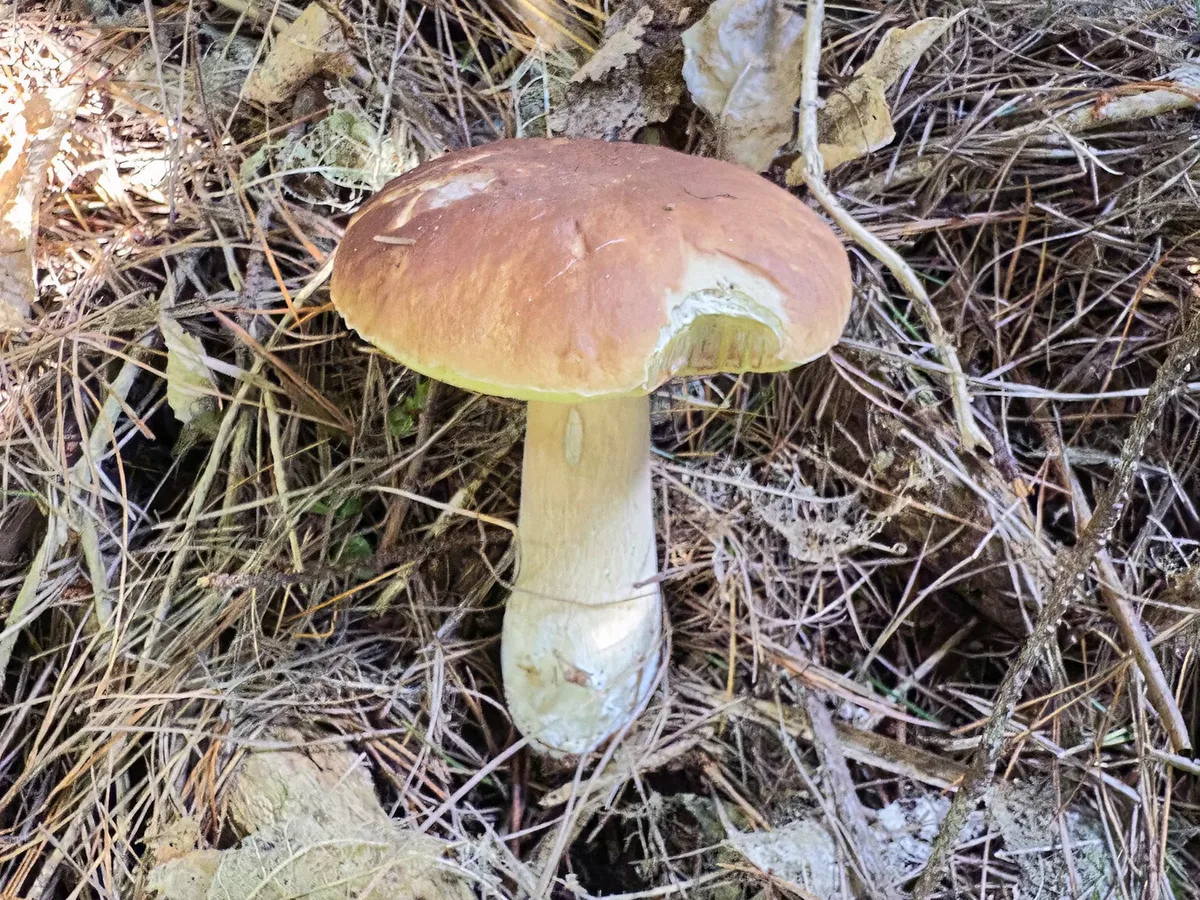
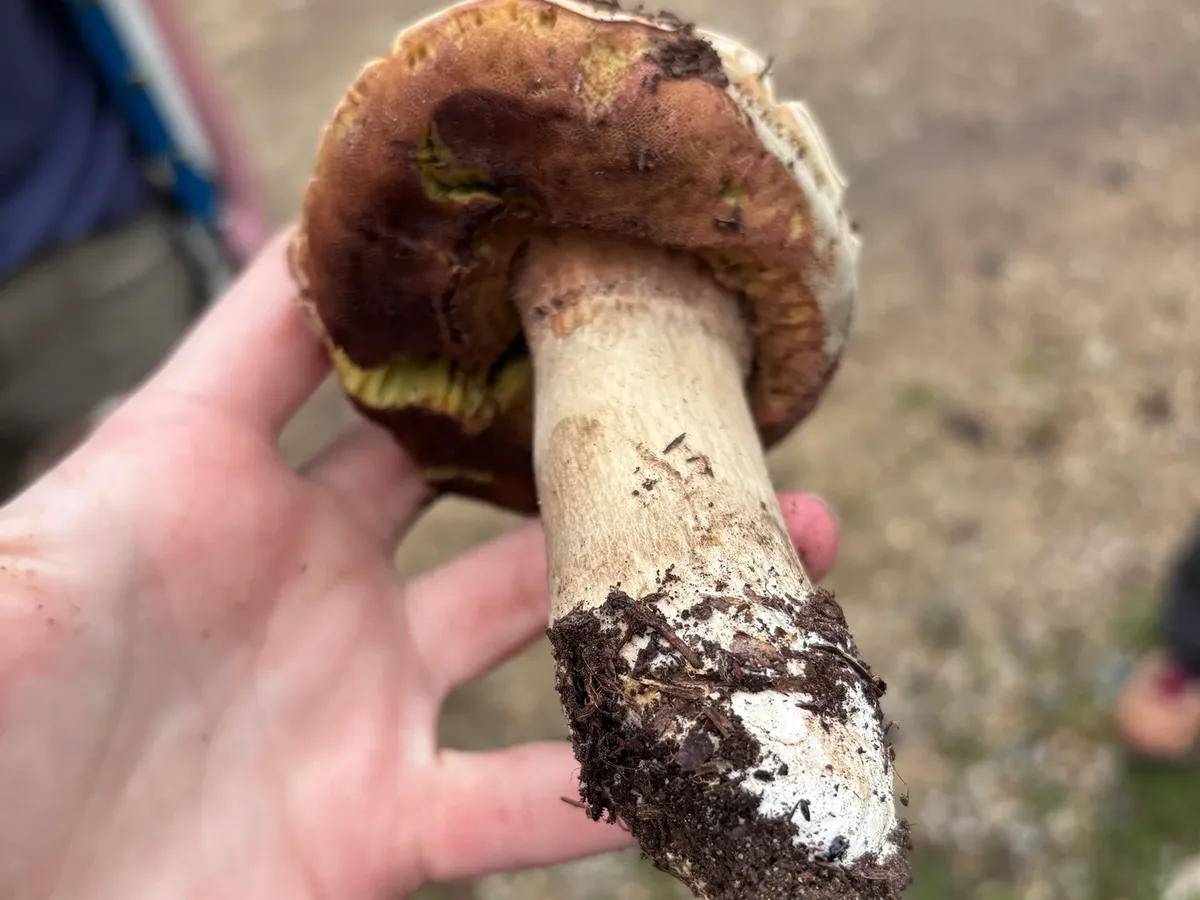
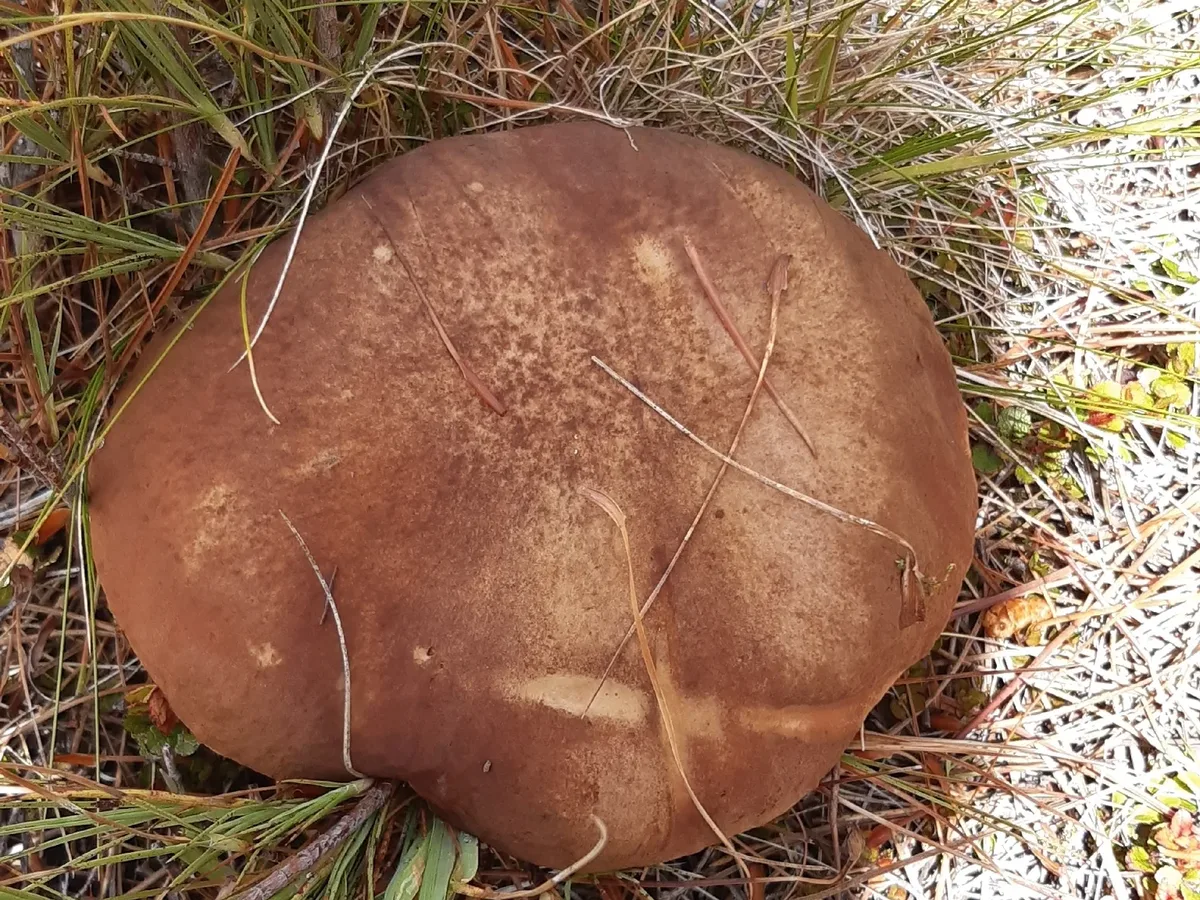
Boletus edulisThe mountain porcini - a fat brown cap over a pale, pored sponge, pushing up under spruce and pine after the first cold rains.
How to recognise it
Cap 7-30 cm, brown (penny-bun coloured), slightly tacky when wet, domed when young and flattening out. Instead of gills there is a tube layer (pores) under the cap: white when young, turning yellow-green with age. Stem stout, white to pale brown, club-shaped or bulbous, with a pale net pattern (reticulation) at the top - a key identifying feature. Flesh white, unchanging when cut, with a mild nutty smell and taste. Spore print olive-brown. B. aereus is darker (almost black-brown cap), firmer, and grows in warmer oak/chestnut woodland.
Where it grows
Mycorrhizal with both broadleaf and conifer trees: oak, beech, chestnut, hazel as well as spruce and pine. Thrives at forest edges and in clearings. B. aereus is bound to oak and chestnut on warm, often lime-rich ground in southern/central Europe.
Cooking
Fried in butter is classic. Excellent dried - the aroma intensifies (dry in the oven at 25-30 C for a few hours, then raise to about 50 C until crisp; store airtight). Dried cep is soaked for 15-20 minutes; save the soaking water for stock/risotto. The basis of cepes a la bordelaise and Steinpilzrisotto.
Look-alikes
Bitter taste; dark net pattern on a pale stem and pink pores (the cep has a pale net on a brownish stem with white/yellow pores). Tasting a small piece reveals its bitterness.
Red pores and red stem, bruises blue; poisonous. General rule: avoid boletes with red pores or that bruise strongly blue.
Blues immediately when cut and has red/orange pores. Porcini flesh stays white and does not change.
The white net pattern (reticulation) on the upper stalk and the non-bluing pores distinguish Boletus edulis.
Much of the commercial Chilean "porcini" export is actually Suillus and native boletes rather than true B. edulis; the trade name is applied broadly.
 American matsutakeAmerican matsutake
 American matsutakeAmerican matsutakeAmerican matsutake
American matsutake (pine mushroom)
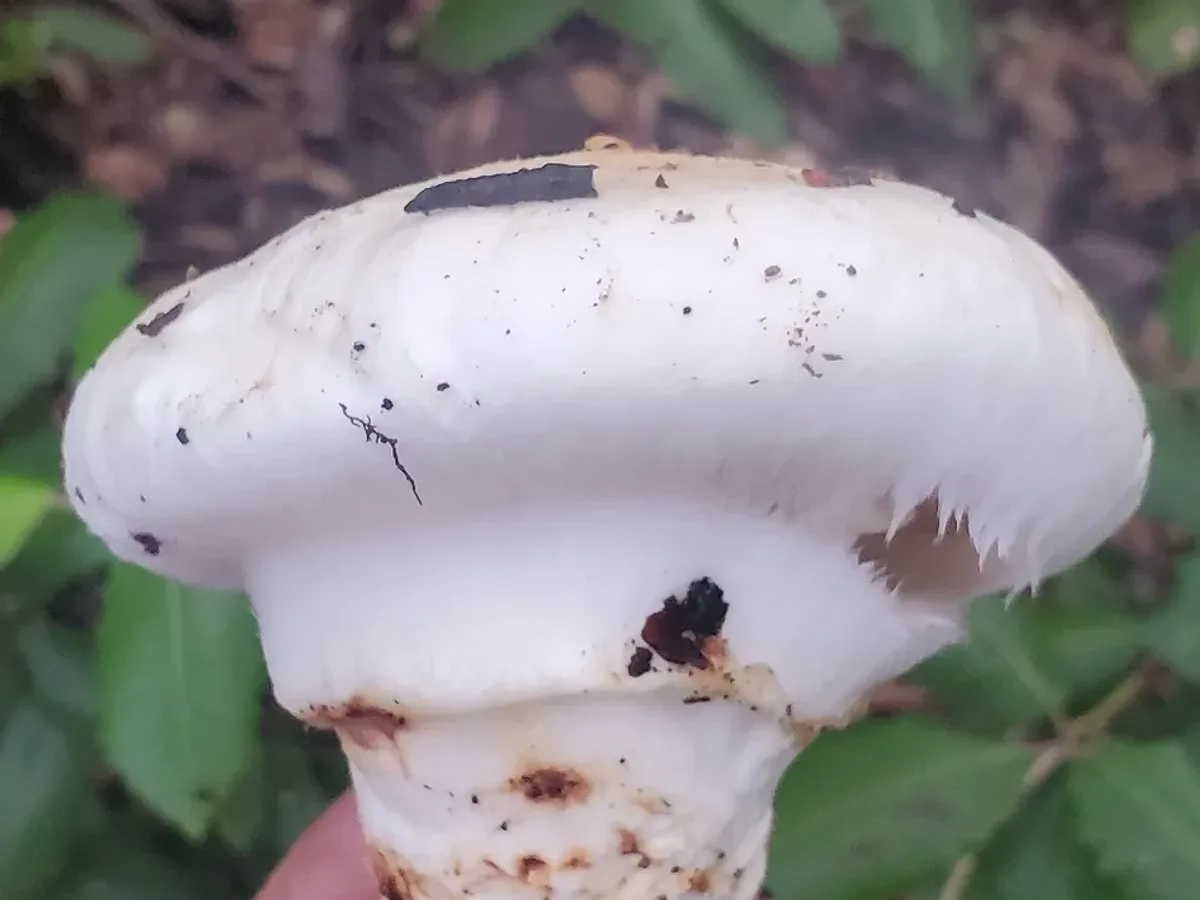
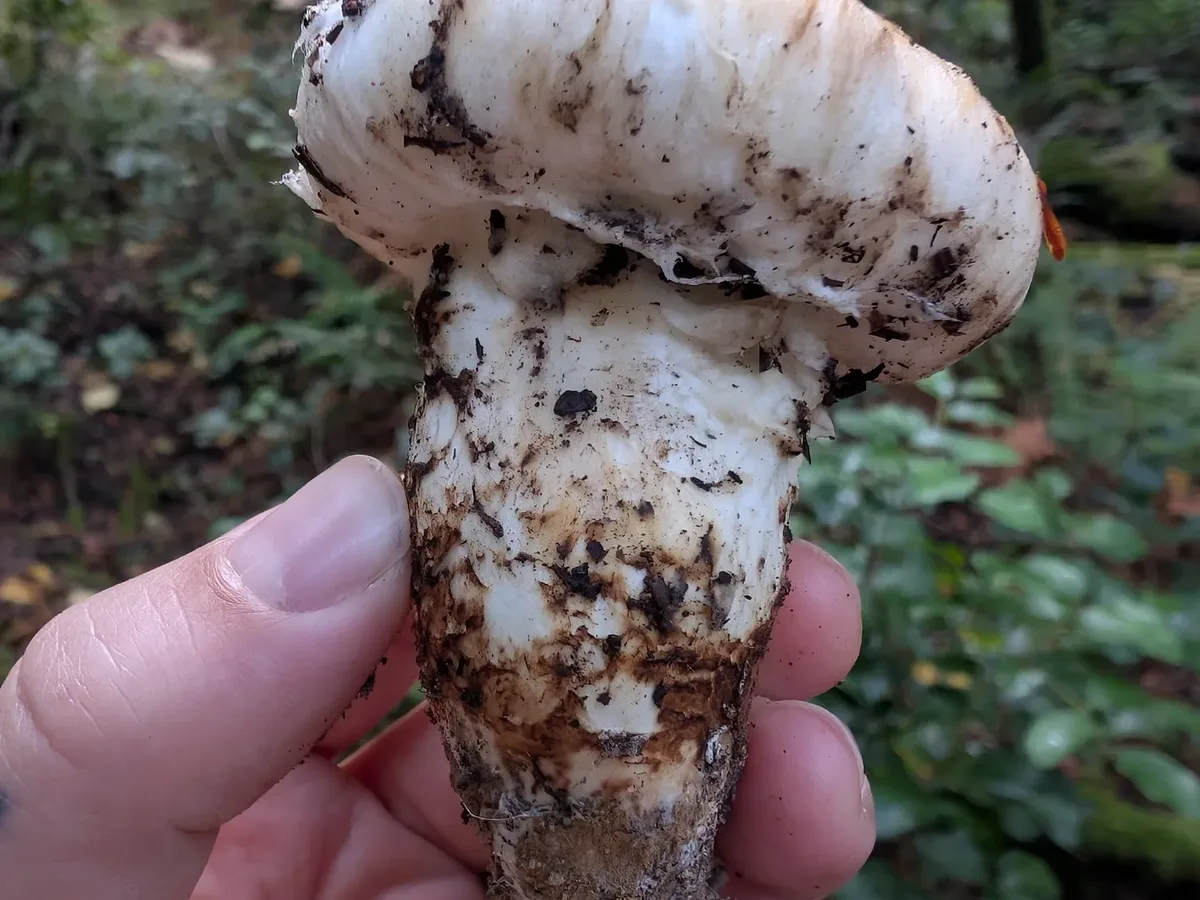
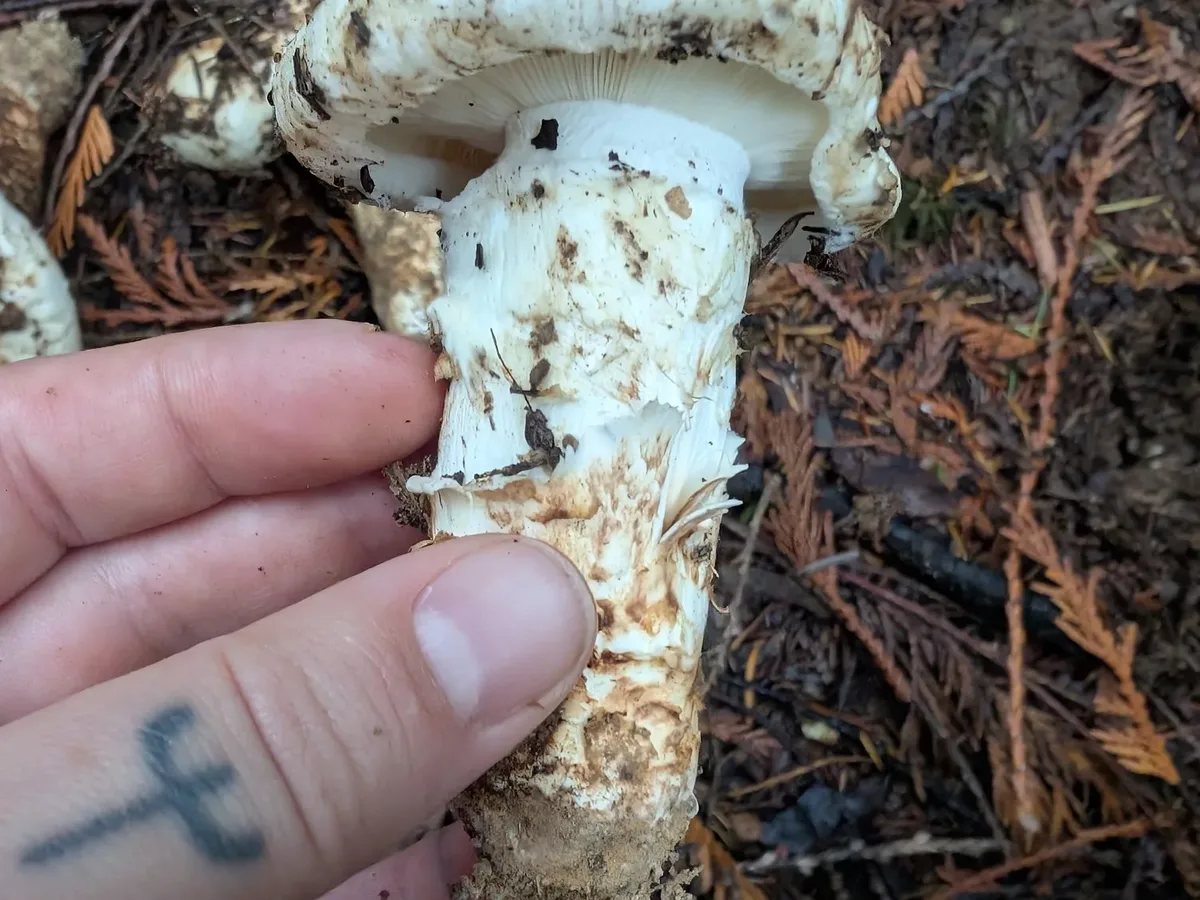
Tricholoma murrillianumA firm white mushroom with a spicy, cinnamon-and-gym-sock scent, prized in the high pine and fir woods of the West.
How to recognise it
A robust, firm mushroom. Cap 5-20 cm, white to cream, with ingrown brownish/rust-coloured fibres and scales that deepen to brown stains with age. Gills are white and dense, also staining brown. The thick white stem tapers downward and is often buried surprisingly deep in the duff. A cottony partial veil wraps the young cap; when it tears it leaves a white ring high on the stem. White spore print. The aroma is the most distinctive feature: a powerful, spicy, cinnamon-like smell famously described as "a provocative compromise between Red Hots candy and dirty socks" - unmistakable once you know it.
Where it grows
Grows mycorrhizally in sandy, nutrient-poor, well-drained soils - exactly the kind of lean ground that most plants avoid. In the Pacific Northwest it partners most often with pine (lodgepole pine/Pinus contorta, ponderosa pine), but also with Douglas fir, hemlock, tanoak, madrone and manzanita. Along the Oregon coast it fruits on stabilised sand dunes with shore pine, Sitka spruce and hemlock. These mycelial partnerships run deep: the underground network, the "shiro", can persist for decades, its outward-growing ring slowly mapping years of hidden life.
Cooking
Never wash - wipe with a damp cloth to preserve the aroma. Japanese methods dominate: matsutake gohan (mushroom rice with dashi, soy, mirin, sake), dobin mushi (clear broth steamed in a clay pot with shrimp, chicken, ginkgo, mitsuba and a splash of sudachi/lime), grilled (yaki-matsutake), in sukiyaki. Thinly sliced to spread the aroma.
Danger
The principal danger is misidentification: Amanita smithiana is white, robust and shares the same habitat, and its ingestion can lead to kidney failure. Distinguish by the matsutake's spicy odour, firm brown-staining flesh, and a stem that tapers to a point with no bulbous base or volva; smithiana lacks the spicy odour, has a deeply rooting base and may bear veil remnants.
Look-alikes
White, robust, grows in the same habitat but causes acute kidney failure. Unlike matsutake it lacks the spicy odour (old specimens smell putrid), has a deeply rooting base and may bear veil remnants; matsutake has the spicy/cinnamon odour, firm brown-staining flesh, and a stem tapering to a point with no bulbous base or volva.
Has a double veil and amyloid spores; only a mediocre edible, not the prized matsutake.
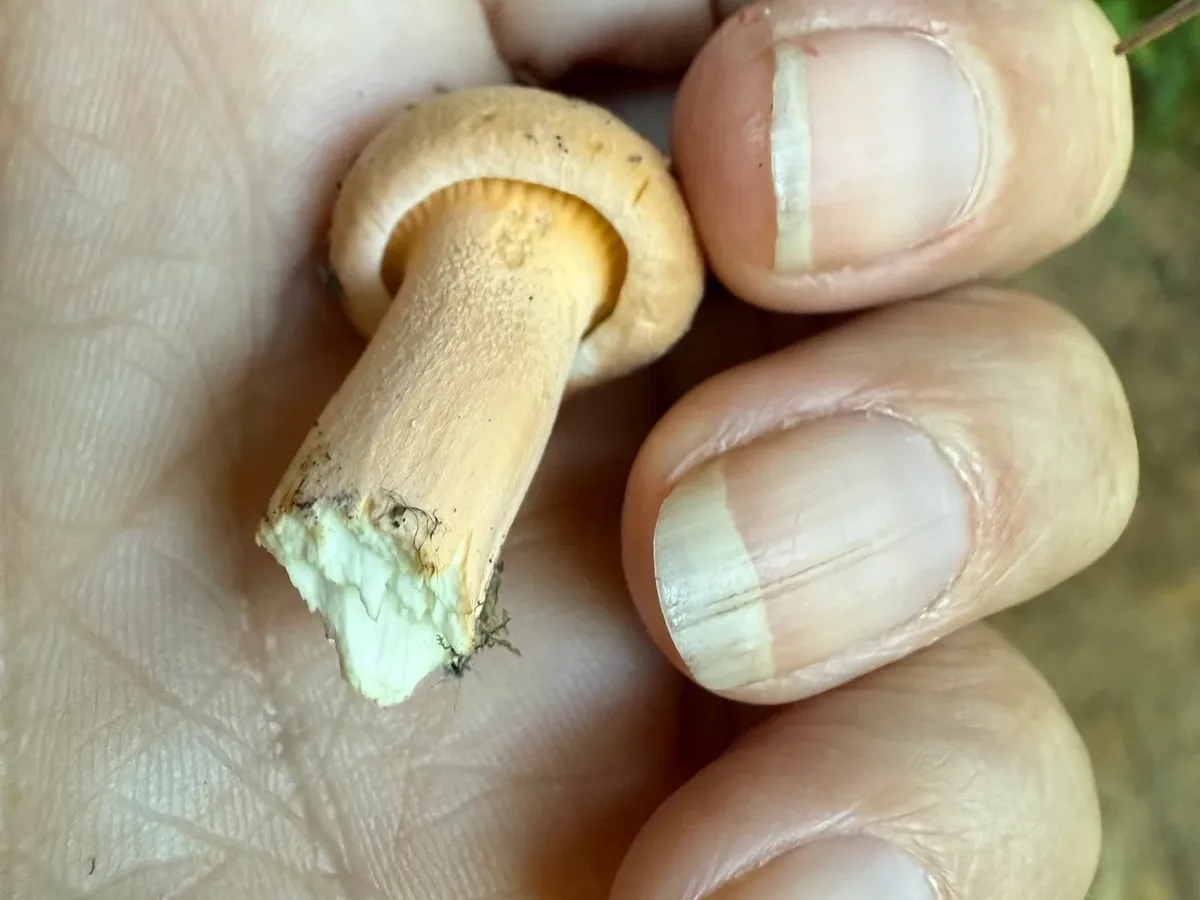 Rainbow chanterelle
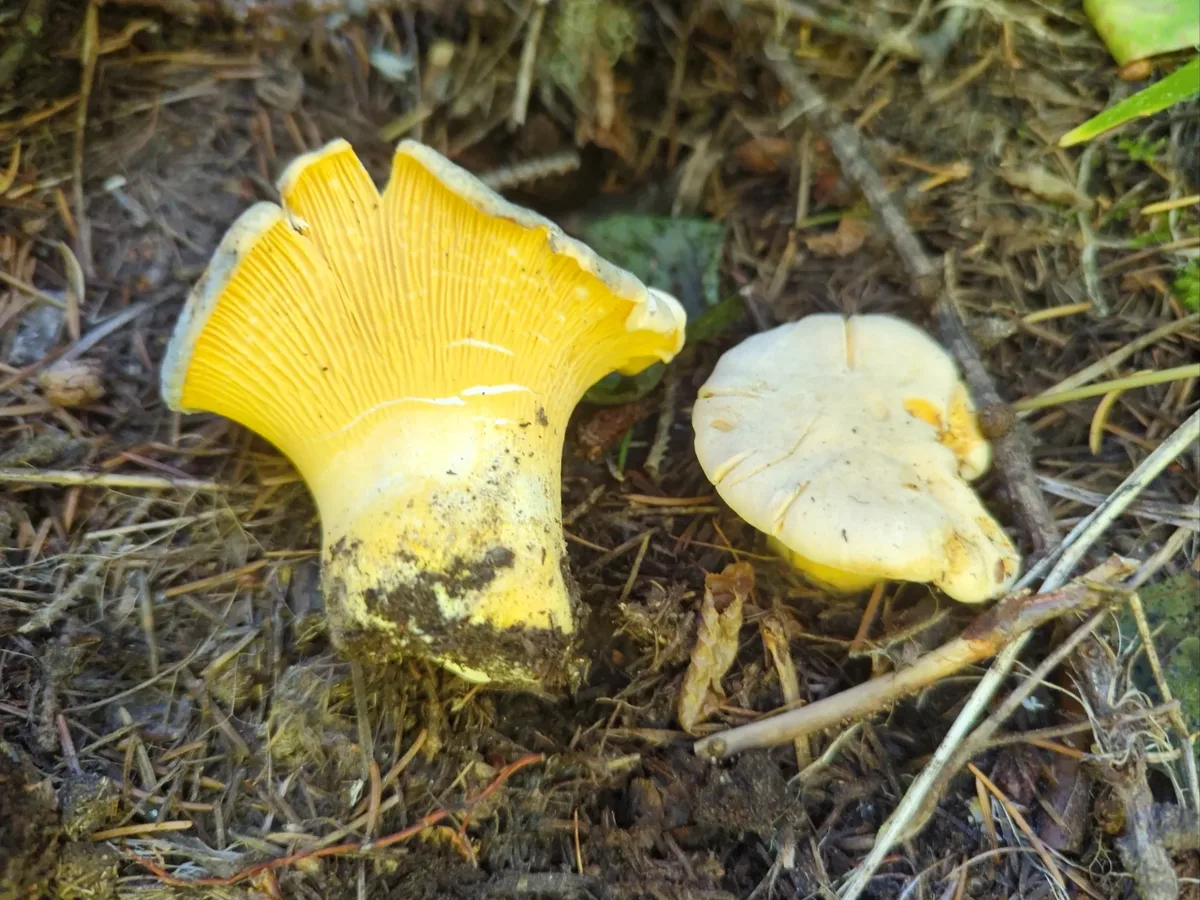 Rainbow chanterelle
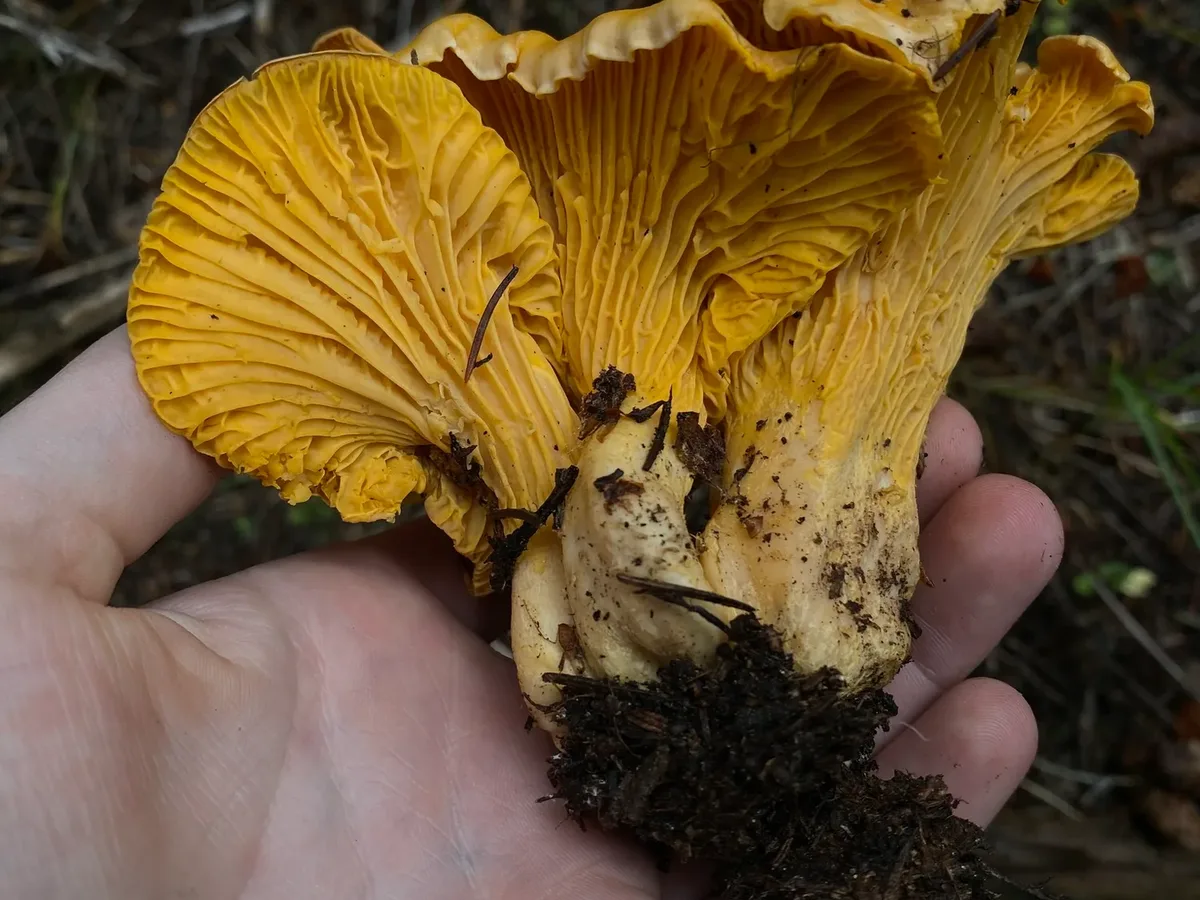 Rainbow chanterelle
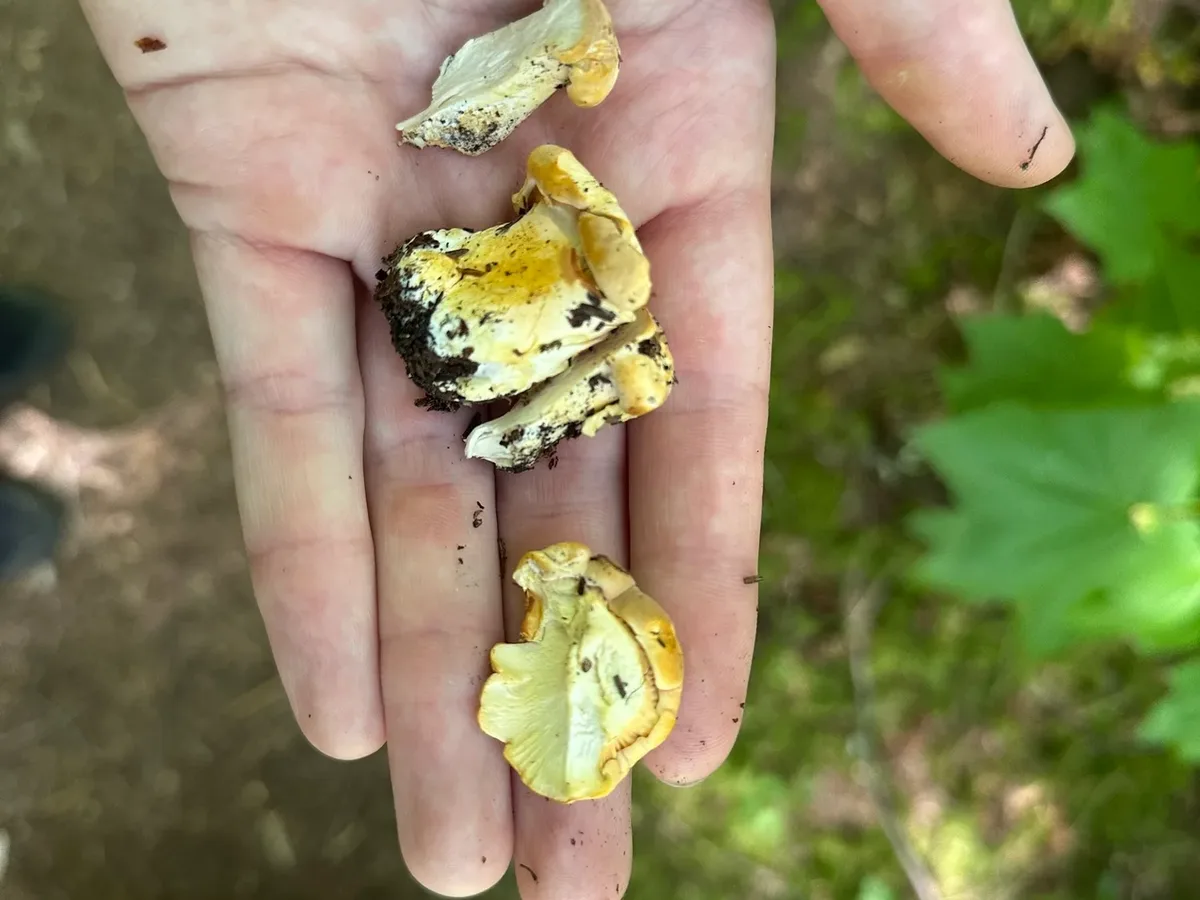 Rainbow chanterelleRainbow chanterelleRainbow chanterelle
Rainbow chanterelle
Cantharellus roseocanusApricot-gold with a faint pink bloom, rising singly from mossy conifer ground on blunt forking ridges - never sharp, crowded gills.
Look-alikes
Grows in tight clusters at or near buried wood or tree bases (not from soil mycorrhizally); has true thin, crowded, knife-blade gills (not blunt forking ridges); orange without pink blush; bioluminescent in darkness; flesh does not smell of apricot. Causes severe gastrointestinal illness.
Has thin, crowded, repeatedly forking true gills (not blunt ridges); cap often more intensely orange to orange-red with a velvety texture and incurved margin even in age; lacks apricot scent; flesh thin and insubstantial; causes mild gastrointestinal upset.
Much smaller; cap brown to grey-brown, not golden-yellow; stem yellow-orange but hollow; ridges grey-lilac; grows in sphagnum or wet moss; easily distinguished by size, colour, and hollow stem.
Very similar chanterelle co-occurring in the Pacific Northwest; typically lacks the rosy-pink to salmon flush on the cap; more closely associated with hemlock and fir rather than Sitka spruce; equally choice edible - confusion is gastronomically harmless.
Deep vase- to funnel-shaped with a scaly or shaggy orange-red cap surface; ridges are white and deeply decurrent; lacks the pinkish-golden smooth cap of C. roseocanus; may cause gastrointestinal upset in some people.
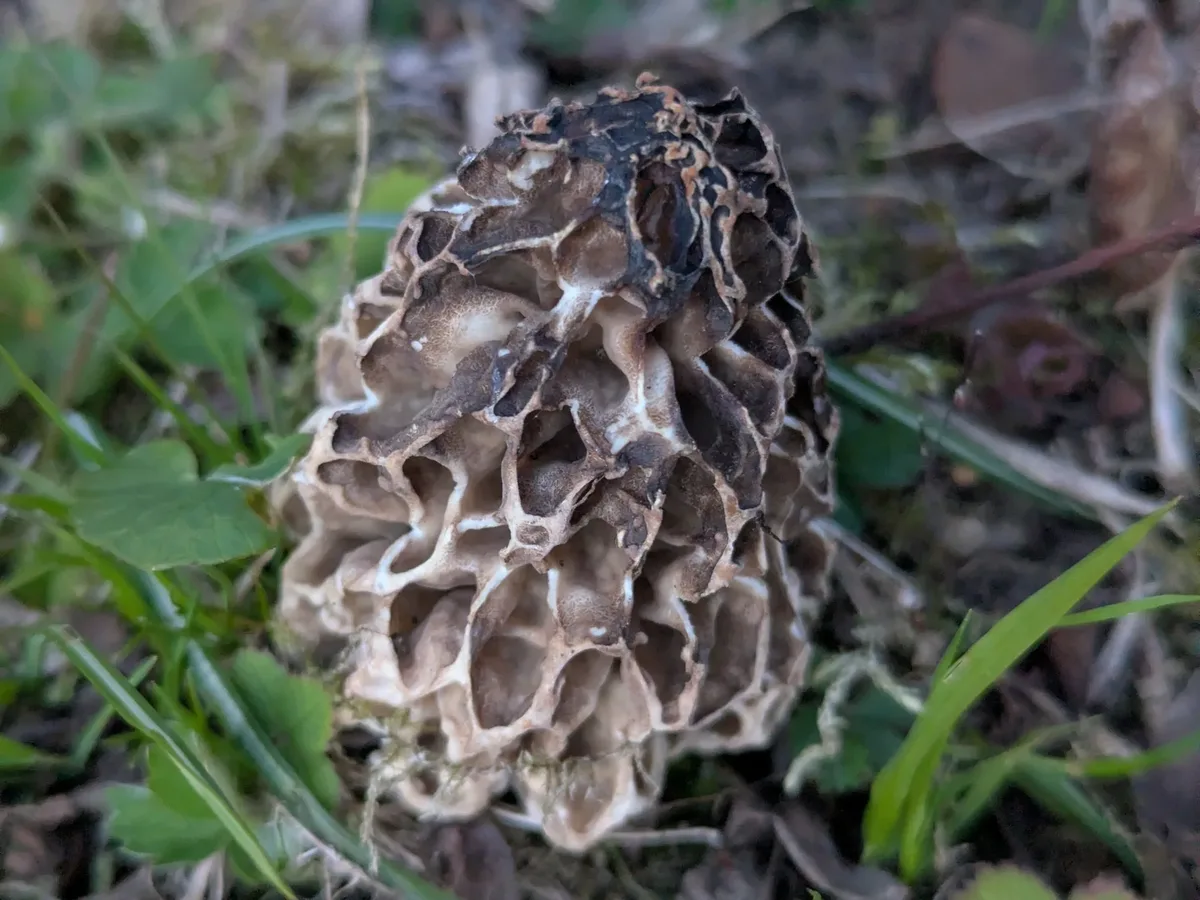 Common morel
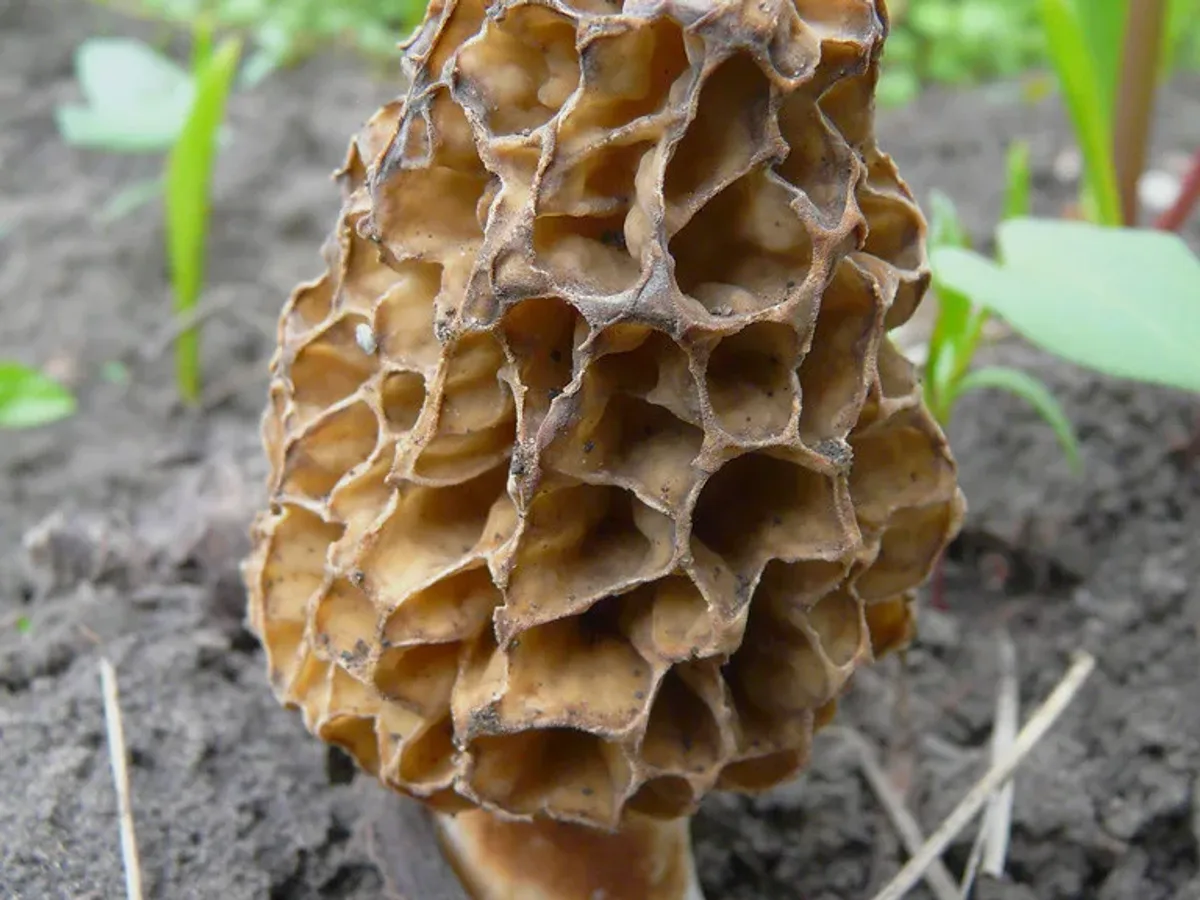 Common morel
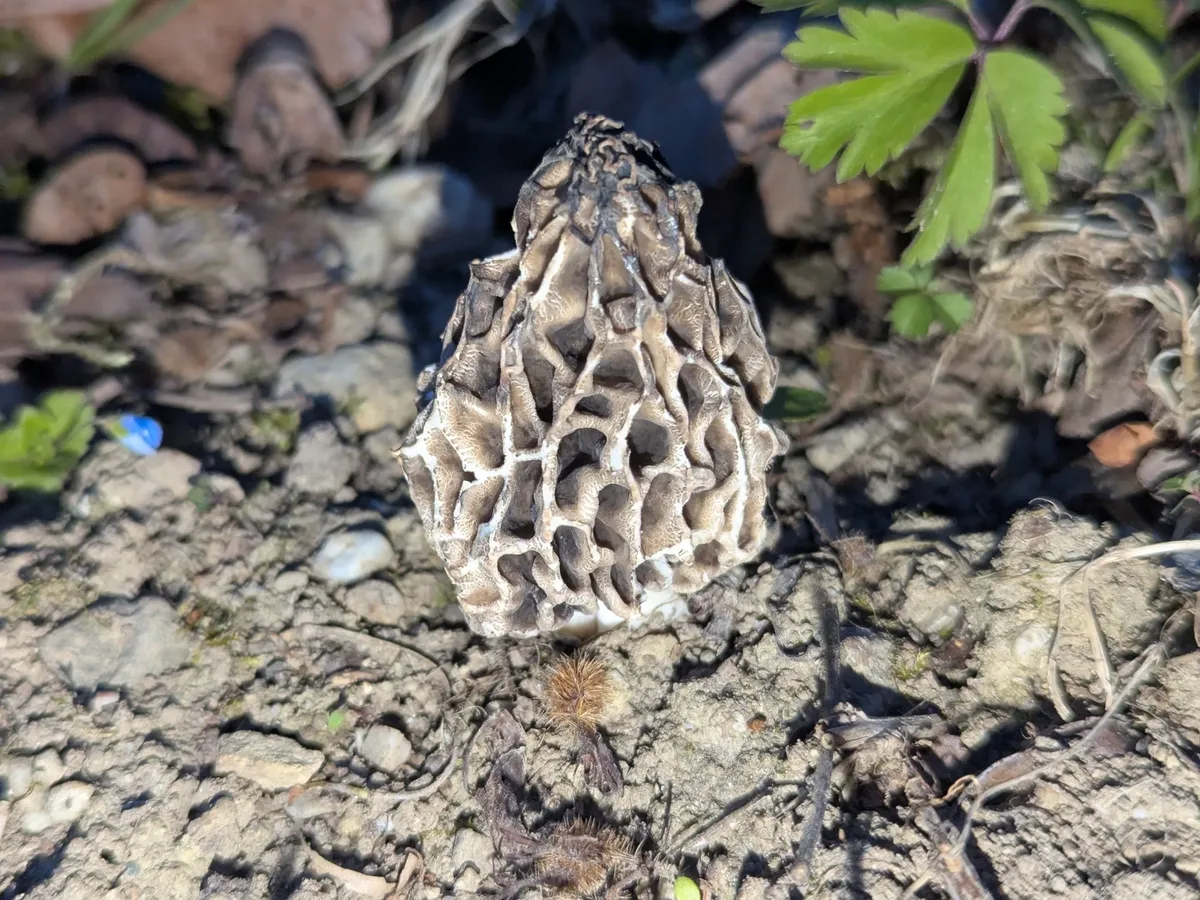 Common morel
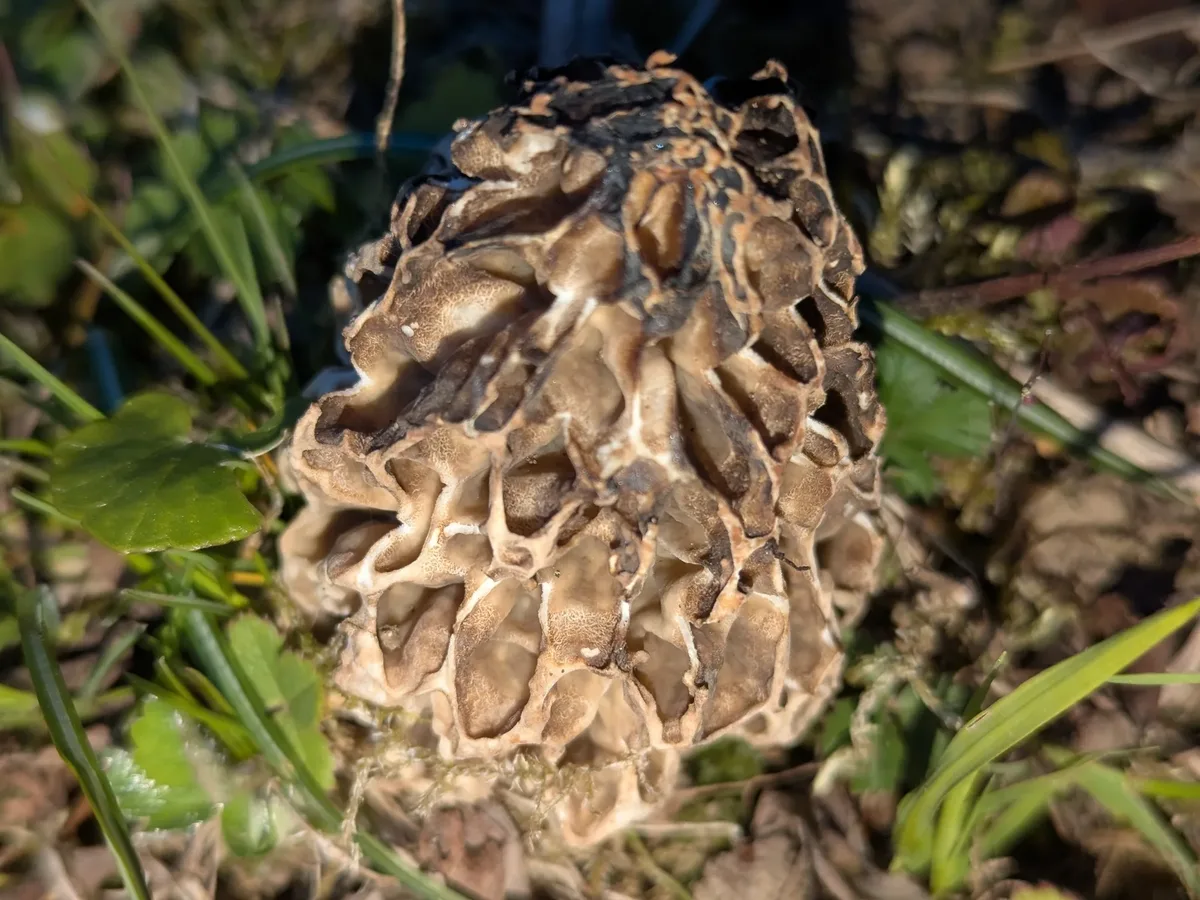 Common morelCommon morelCommon morel
Yellow morel
Morchella esculentaThe honeycombed prize of spring, hollow from tip to base - and toxic until it is thoroughly cooked.
How to recognise it
Cap 2-7 cm wide, 2-10 cm tall, yellow-brown, covered in a honeycomb of irregular pits and ridges - closer to a sponge than anything else in the forest. Cut one open: cap and stem share a single continuous hollow chamber, with no interior divisions. That clean hollow interior is the key check. Stem white to pale yellow, hollow, slightly granular. Mild odour.
Where it grows
Moist, often calcareous ground near elm, ash and apple trees - woodland edges, old orchards, burn sites and recently disturbed earth. Partly saprophytic. The morel has a well-documented fondness for post-fire ground, sometimes erupting in numbers the spring after a forest fire on a site where none grew before.
Cooking
Must be cooked through - see safety notes. Once properly cooked, the morel's earthy, nutty depth makes it one of the most prized culinary fungi: classic in cream sauces (poulet aux morilles, omelette aux morilles), or simply sautéed in butter. Dries exceptionally well - thread onto a string and the flavour concentrates further. Soak dried morels before use.
Danger
Never eat raw or lightly cooked. Cook thoroughly 15-30 minutes, avoid alcohol with the meal, and try only a small amount the first time. The most dangerous confusion is with the seriously poisonous false morel (Gyromitra esculenta), which contains gyromitrin.
Look-alikes
Brain-/walnut-like and irregularly wrinkled rather than a pitted honeycomb; not cleanly hollow but chambered/filled inside. Contains gyromitrin and is seriously poisonous.
The cap hangs free, attached to the stem only at the top. In a true morel the cap is attached to the stem along its lower edge and the whole body is hollow.
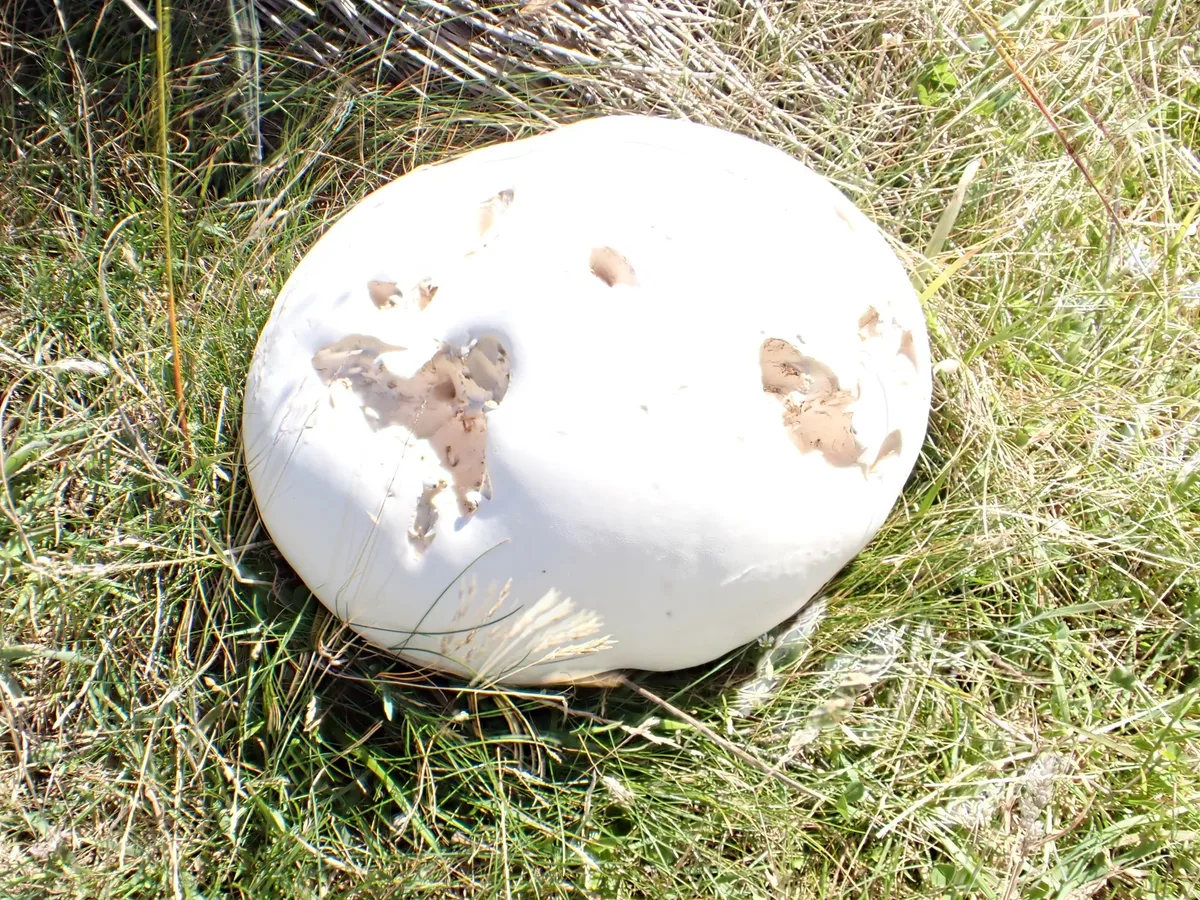 Giant puffball
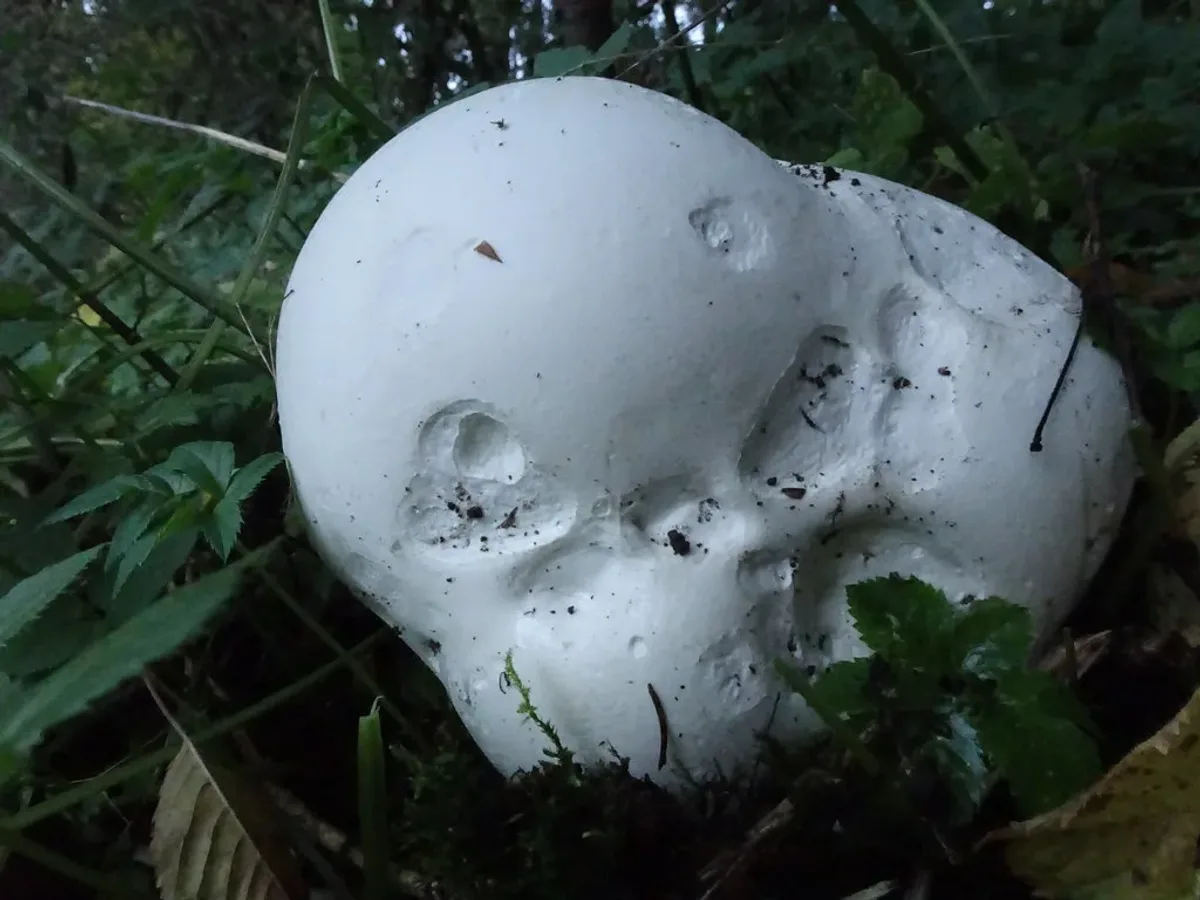 Giant puffball
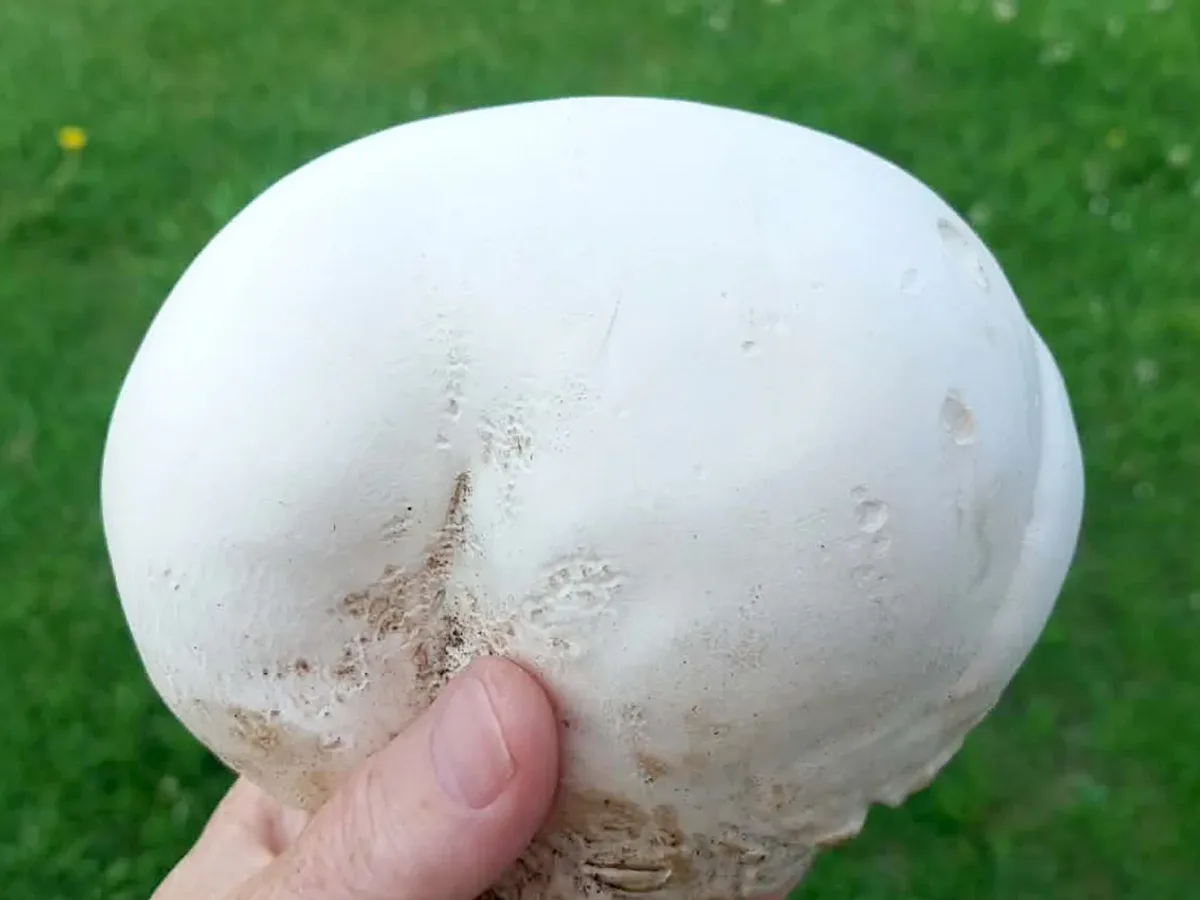 Giant puffball
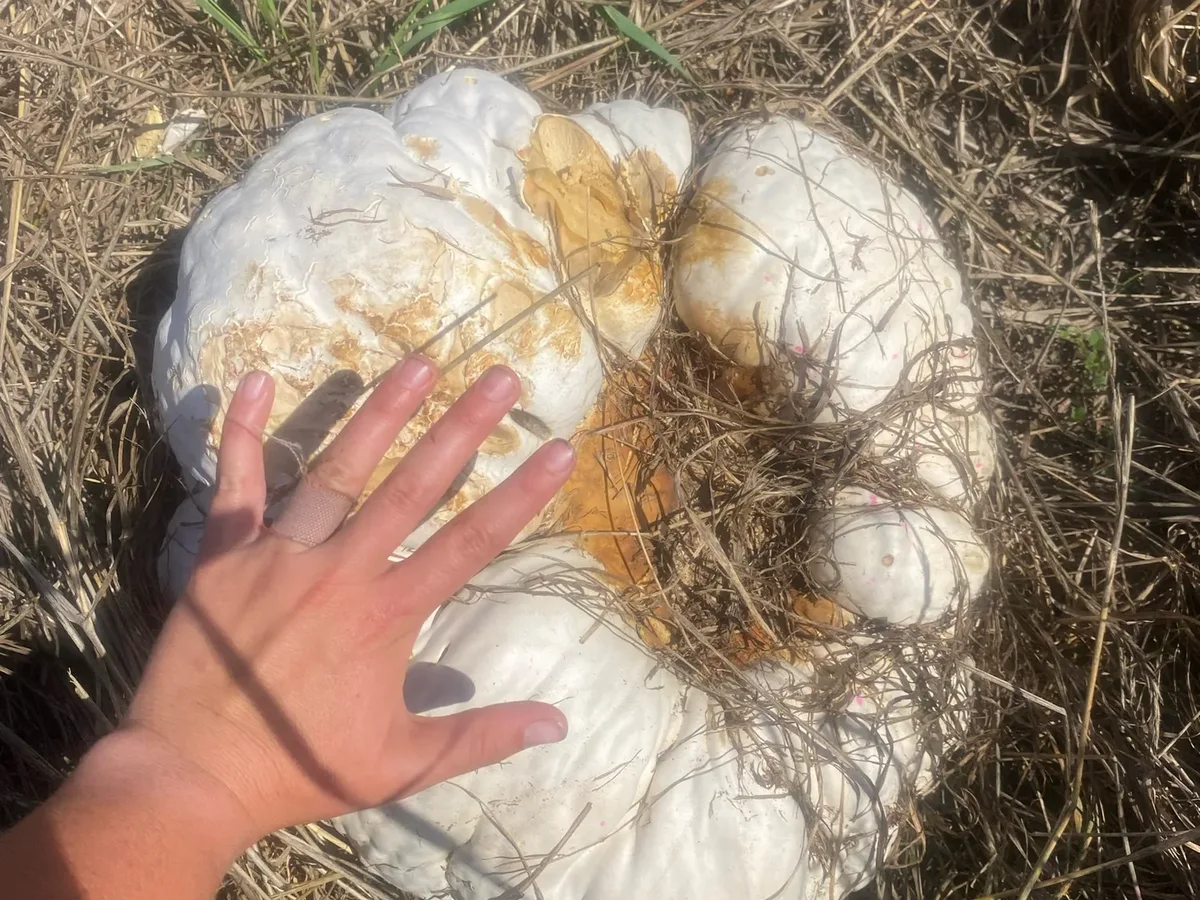 Giant puffballGiant puffballGiant puffball
Giant puffball
Calvatia giganteaA white boulder in the meadow - safe only when pure white and firm all the way through, with no hint of gills inside.
How to recognise it
A large white ball, often the size of a football (can grow to more than 1 m across and weigh several kilograms). When young it has solid white inner flesh. When older it yellows on the outside and the interior becomes brown spore powder.
Where it grows
Disturbed soil, farmland and pasture. Self-introduced in New Zealand. Found February to June throughout New Zealand.
Cooking
Sliced and fried; Maori also boiled or steamed it fresh. Must be eaten immediately as it rots quickly.
Look-alikes
Always cut lengthwise. An Amanita button shows a fully formed mushroom in miniature (gills, stem, volva), whereas a true puffball is homogeneously white with no internal structure. Never cut into a 'puffball' smaller than a ball.
Much firmer than a puffball and has a dark purple-black interior even when young.
If the inner flesh is gelatinous rather than solid white, it may be a stinkhorn.
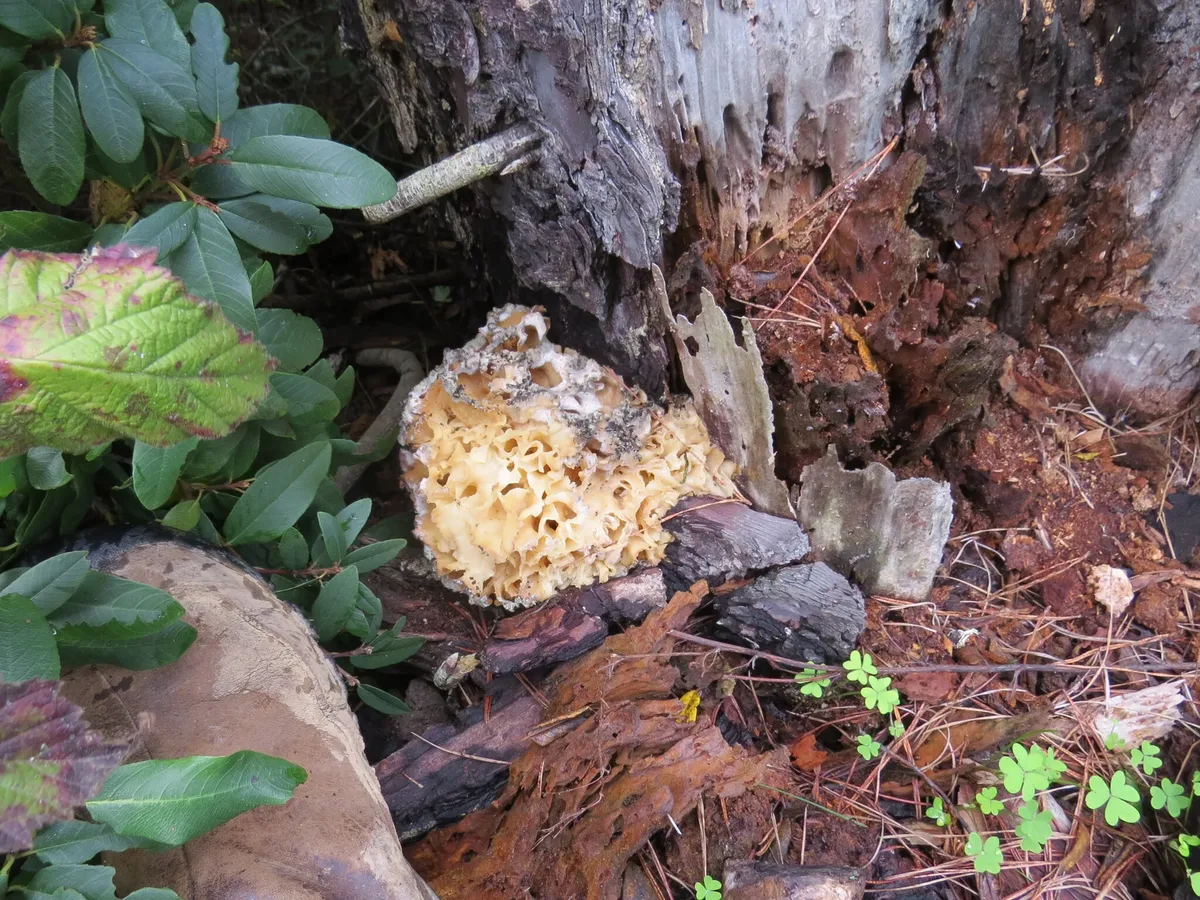 Cauliflower mushroom
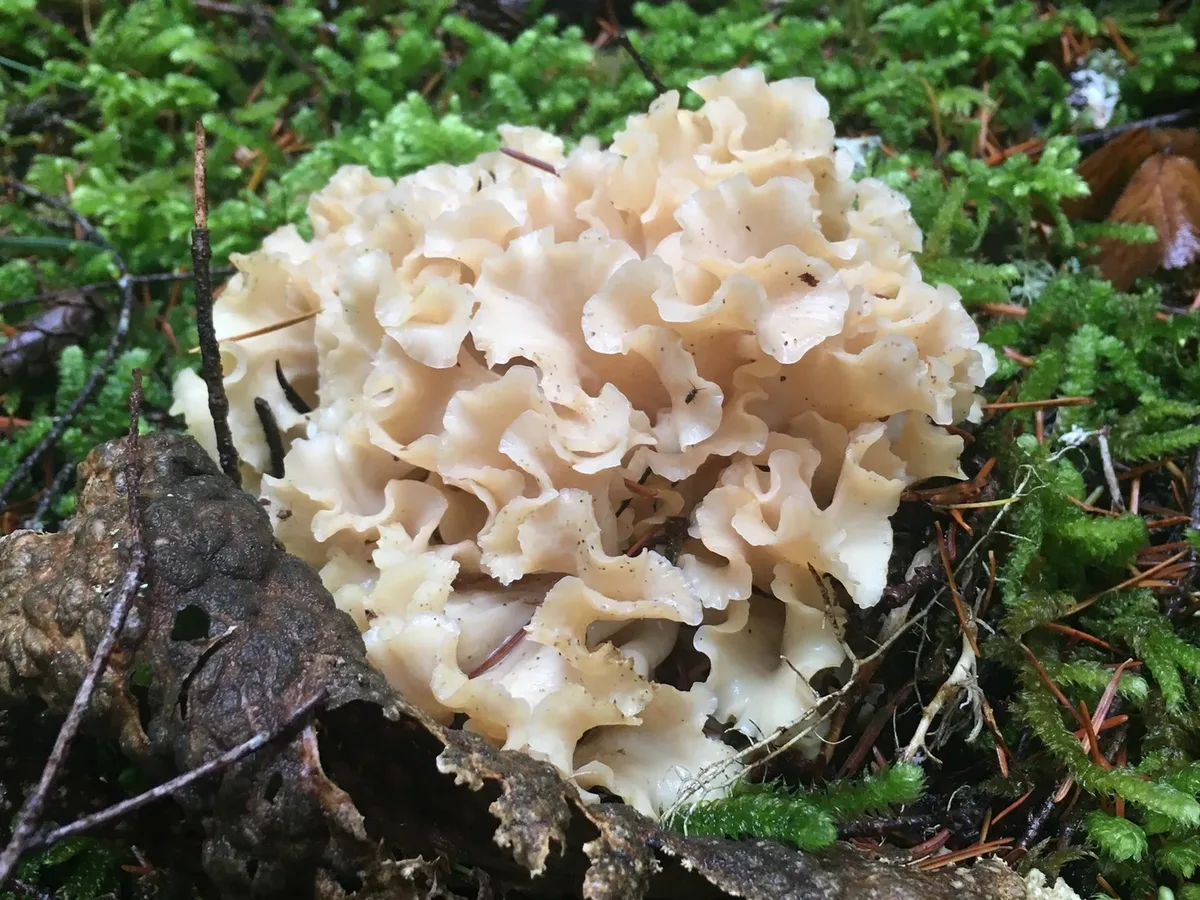 Cauliflower mushroom
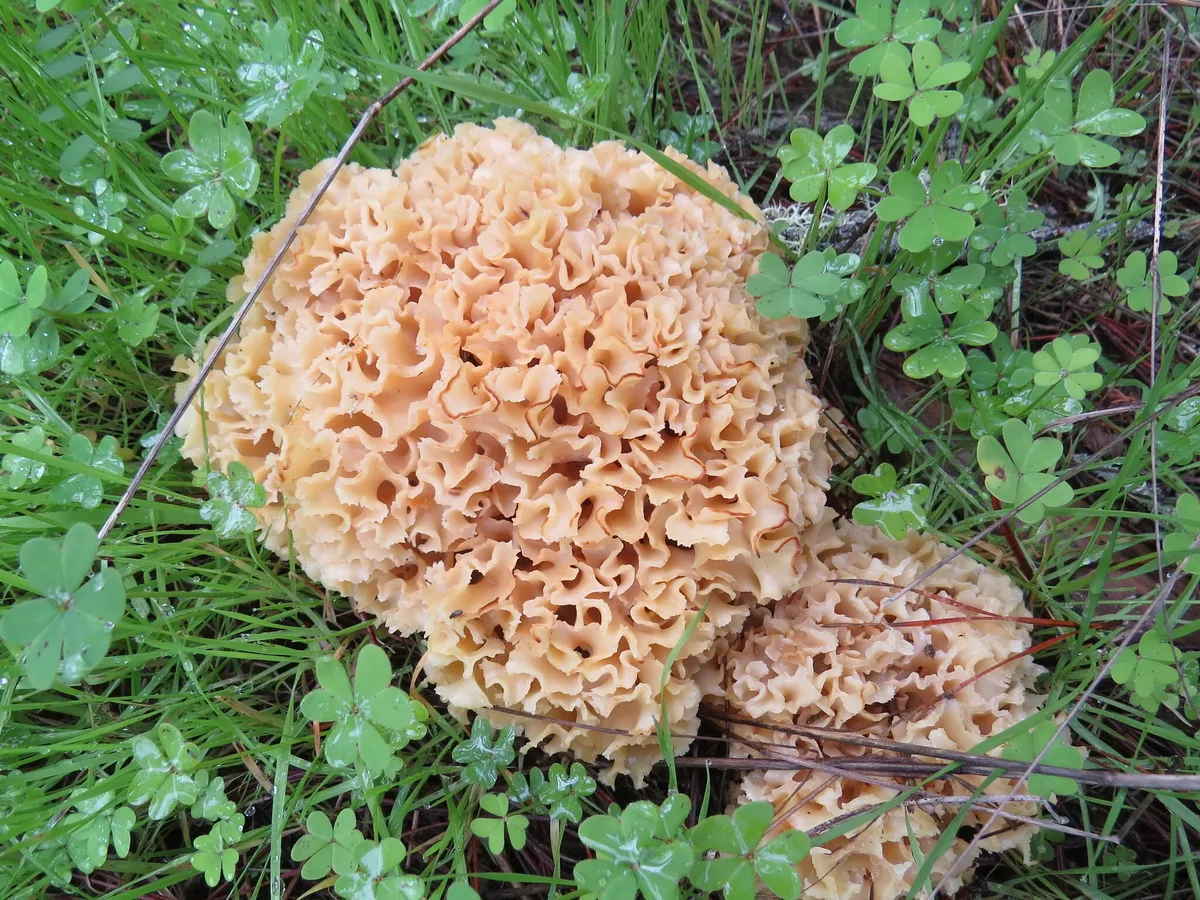 Cauliflower mushroom
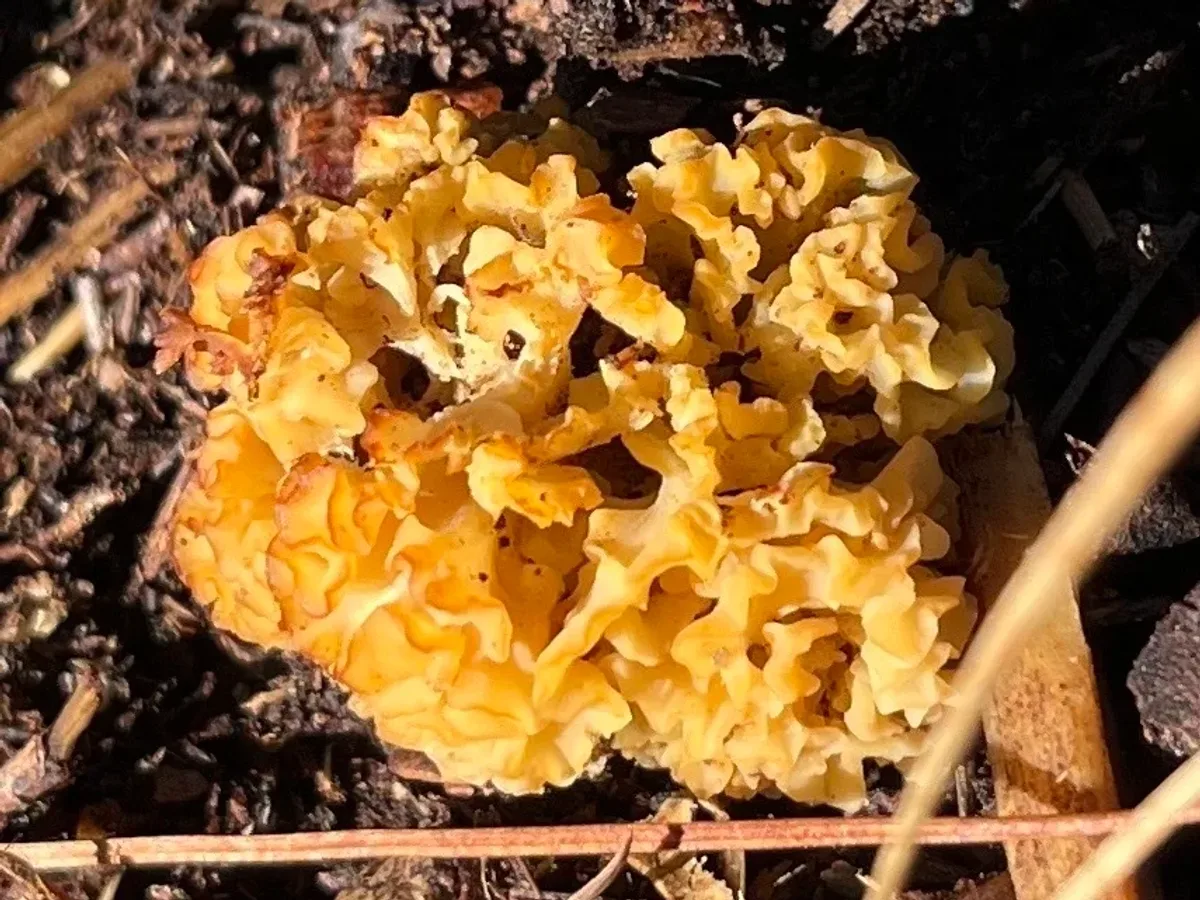 Cauliflower mushroomCauliflower mushroomCauliflower mushroom
Western cauliflower mushroom
Sparassis radicataA great pale rosette like a sea sponge at the foot of conifers - distinctive, and almost impossible to mistake for anything harmful.
How to recognise it
Large cauliflower- or brain-like mass of flat, wavy, ribbon-like lobes. Cream-white to pale yellowish-brown (darkens with age). 10-60 cm wide. Dark "root"/base (2-10 × 10-30 cm) that descends into the host. Spicy/fragrant, non-mushroomy odor. White spore print.
Where it grows
At the base of or on the roots/stumps of Douglas fir (and Sitka spruce); in California near pine. Likely a parasite, can recur for several years in the same place.
Cooking
Retains its texture (slightly crunchy) when cooked. Sauté, soups, quiche; a good meat substitute.
Look-alikes
Ramaria/coral fungi have a different, branched form; the cauliflower mushroom's flat, wavy, ribbon-like lobes are unique.
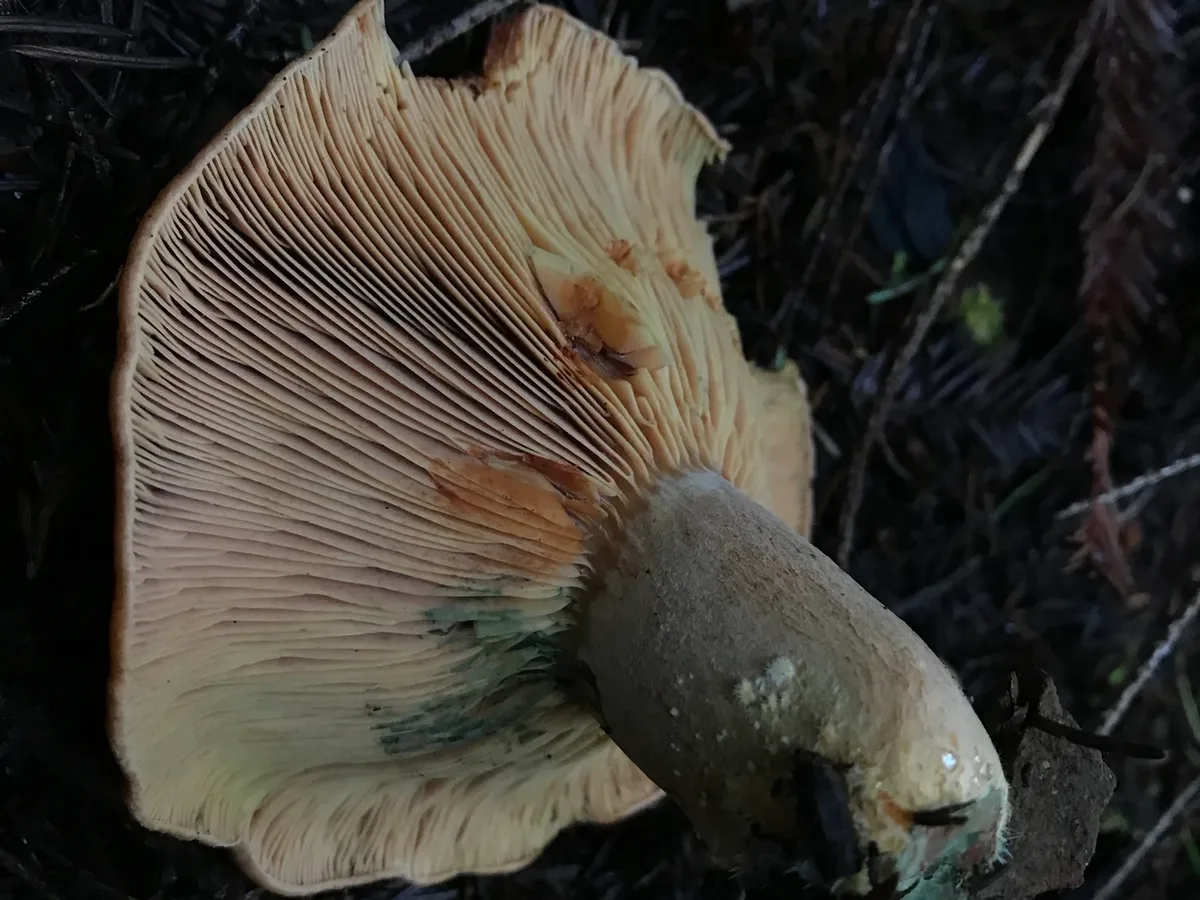 Bleeding milkcap
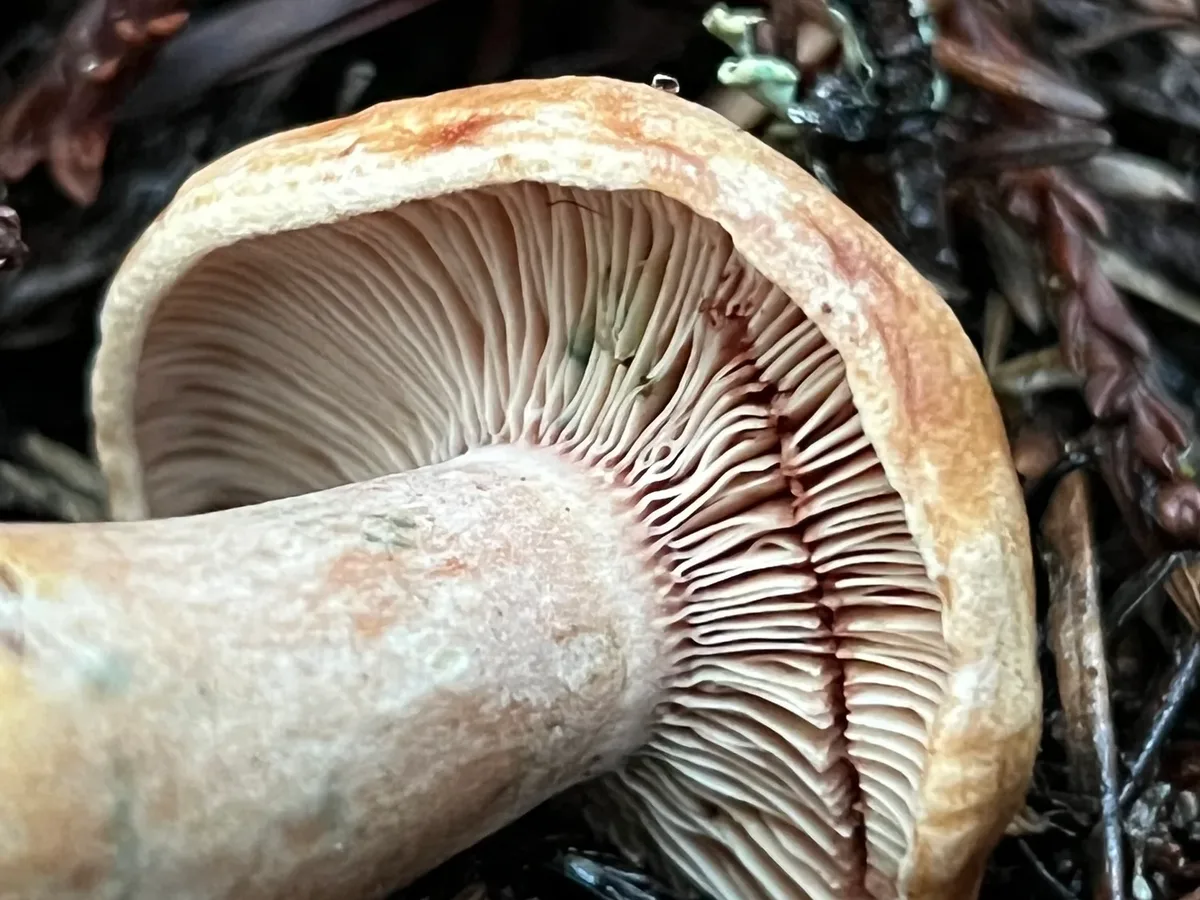 Bleeding milkcap
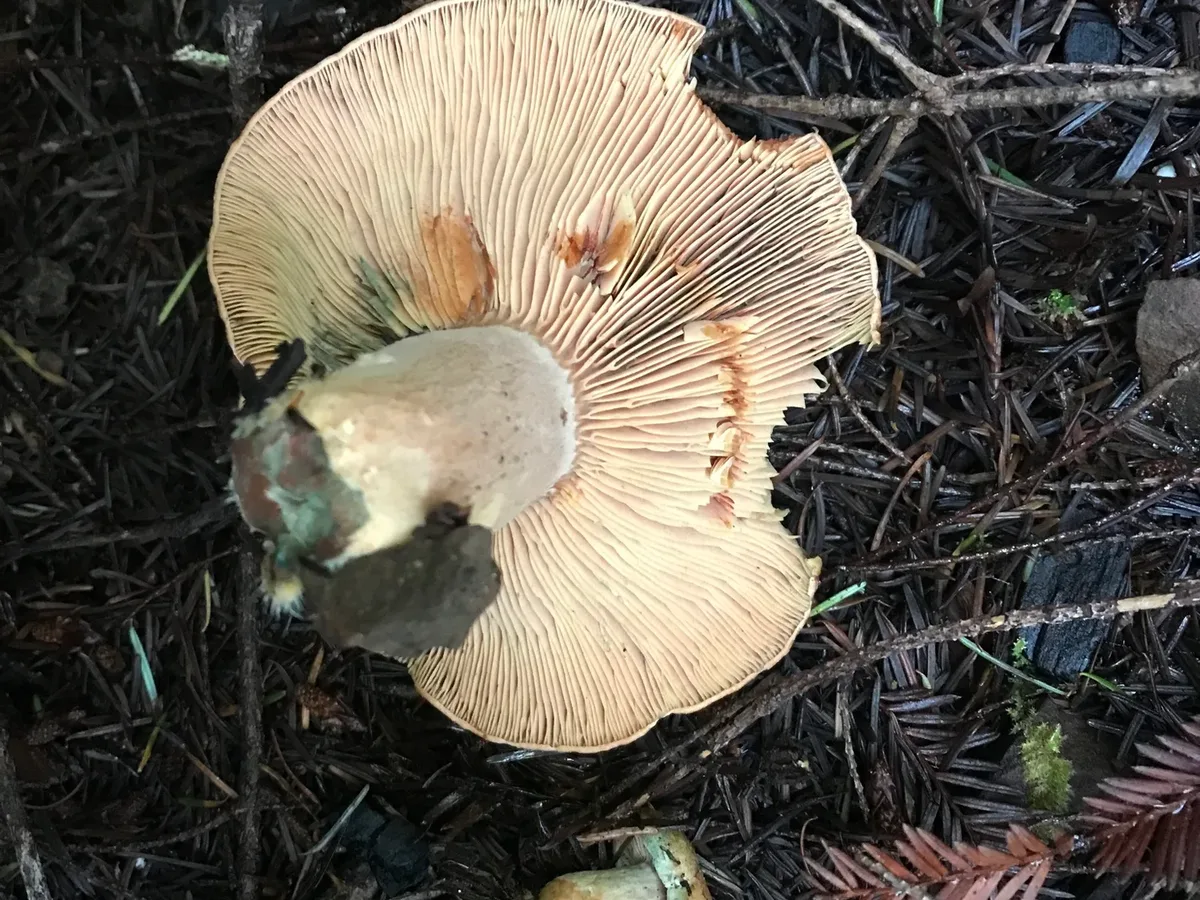 Bleeding milkcap
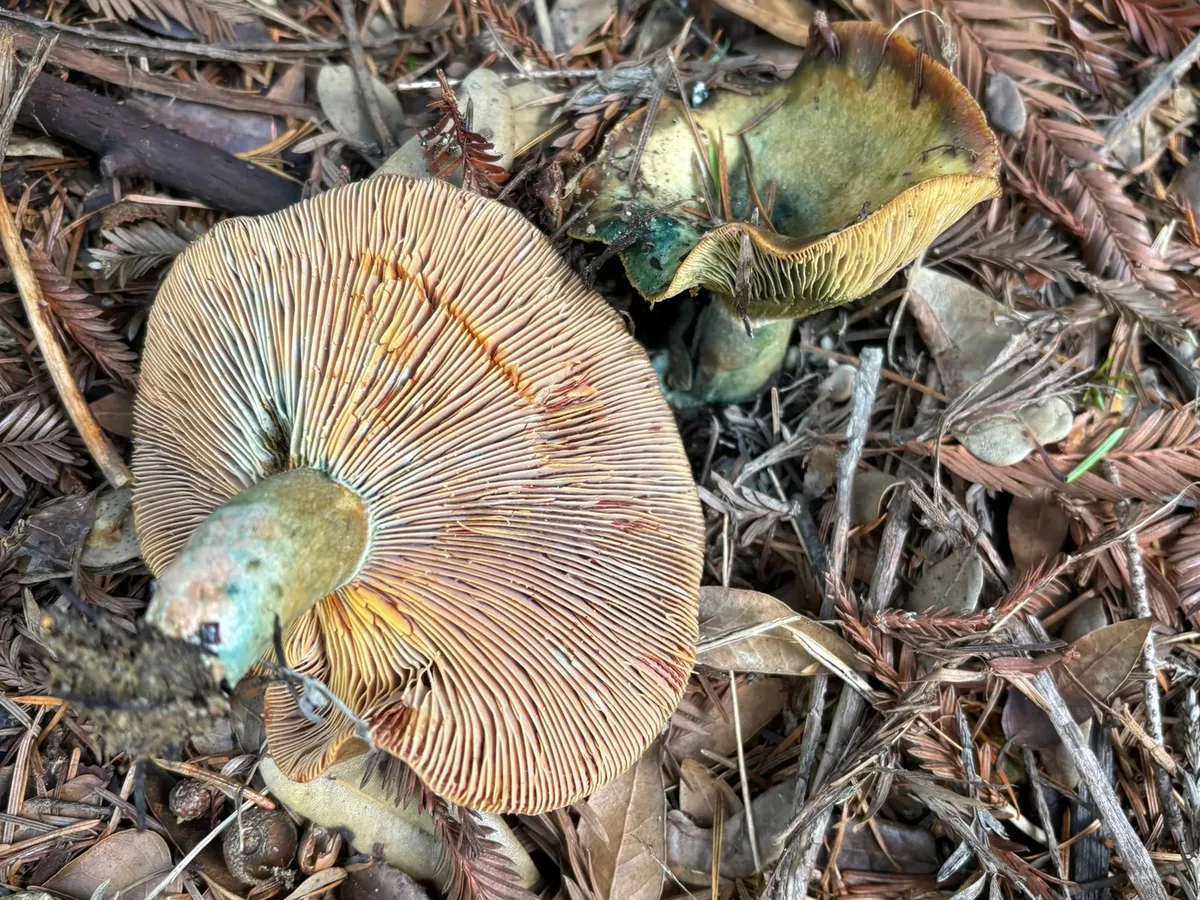 Bleeding milkcapBleeding milkcapBleeding milkcap
Bleeding milkcap
Lactarius rubrilacteusAn orange western milkcap that bleeds dark red and bruises green - the staining rule that marks the safe saffron milkcaps.
Look-alikes
L. deliciosus has bright carrot-orange latex (not dark blood-red) from the first instant of cutting, and develops vivid, rapid green staining on cut surfaces - more intense and faster than in L. rubrilacteus. Cap banding is more vivid orange-carrot. Both are edible; confusion is harmless but worth resolving for accurate ID records.
Very similar latex colour but L. semisanguifluus has latex that begins pale orange and only slowly (5-15 minutes) darkens to wine-red. In L. rubrilacteus the latex is immediately and intensely dark blood-red. L. semisanguifluus is primarily a Mediterranean and European species; range overlap with L. rubrilacteus is limited.
A different Pacific Northwest milkcap, L. rubidus (candy cap) has a much smaller, thin-fleshed pale orange-brown cap and exudes sparse, watery, pale-coloured latex with no blood-red character. Fresh specimens smell faintly sweet; dried specimens develop a powerful maple-syrup aroma - entirely absent in L. rubrilacteus. A very different species in practice.
White cap, white gills, copious white latex that is intensely acrid-peppery. No orange, red, or reddish-brown colouration at all. Shares some conifer and mixed-forest habitat. Separated immediately by colour and burning taste.
Very large, white, velvety-tomentose cap; white acrid latex; no colour resemblance whatsoever. Inedible (acrid, mildly toxic raw). Distinguished instantly by white colour, velvety cap texture, and strongly peppery-bitter taste.
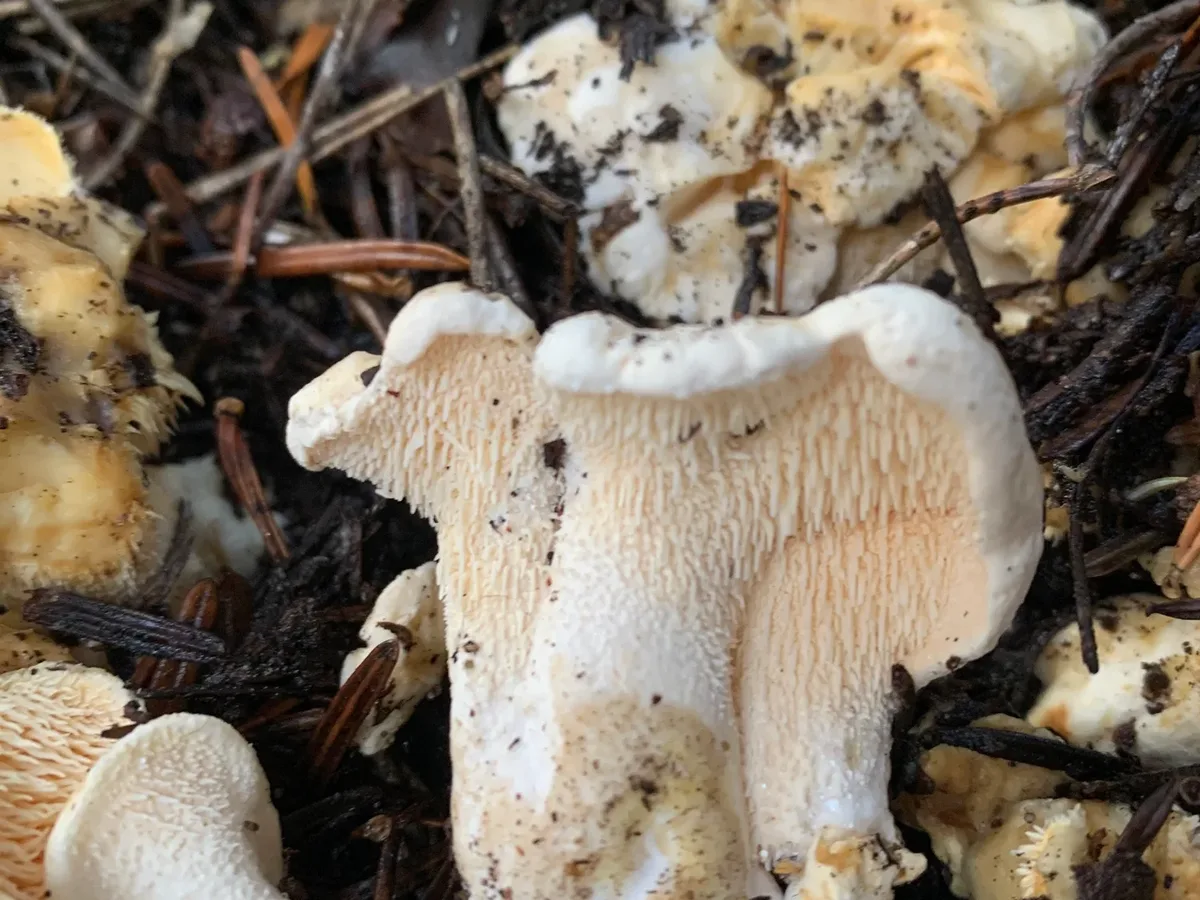 Hedgehog mushroom
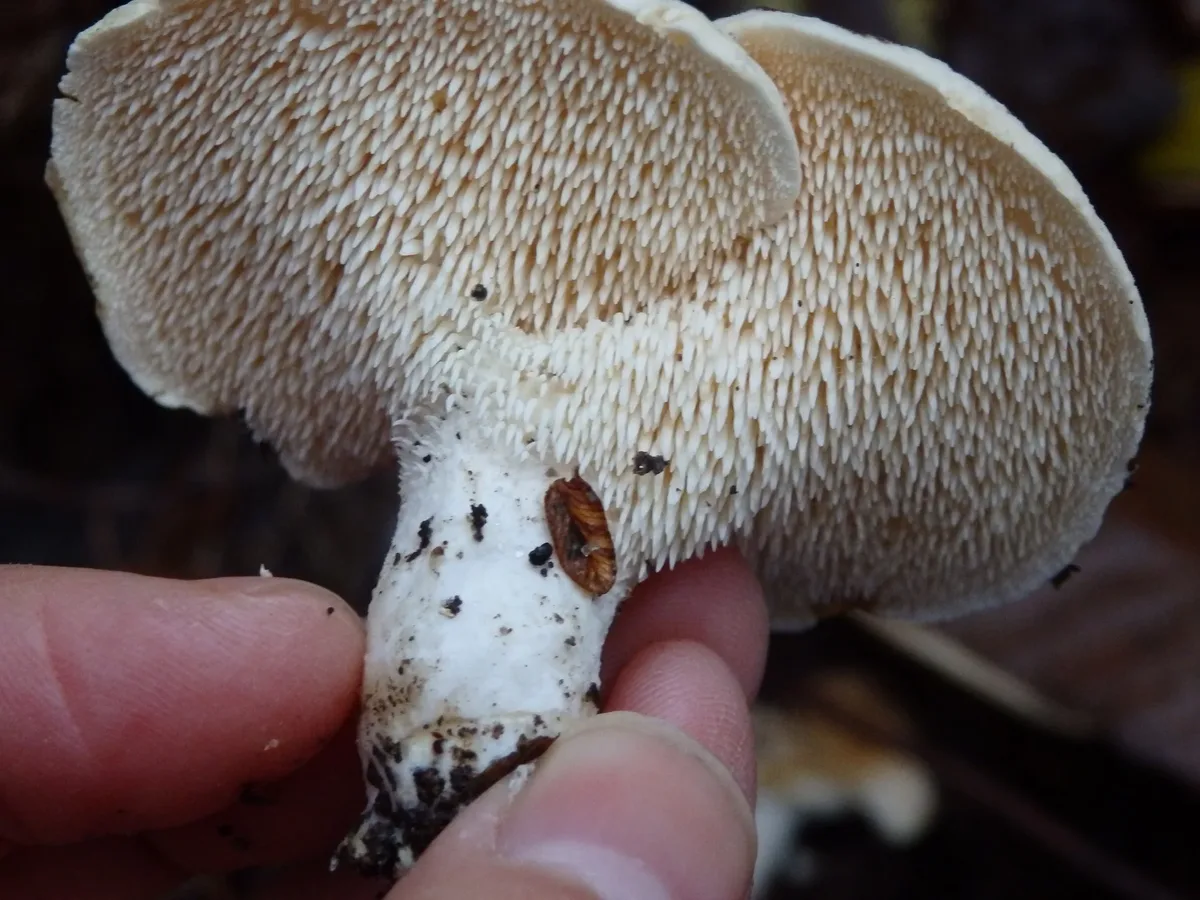 Hedgehog mushroom
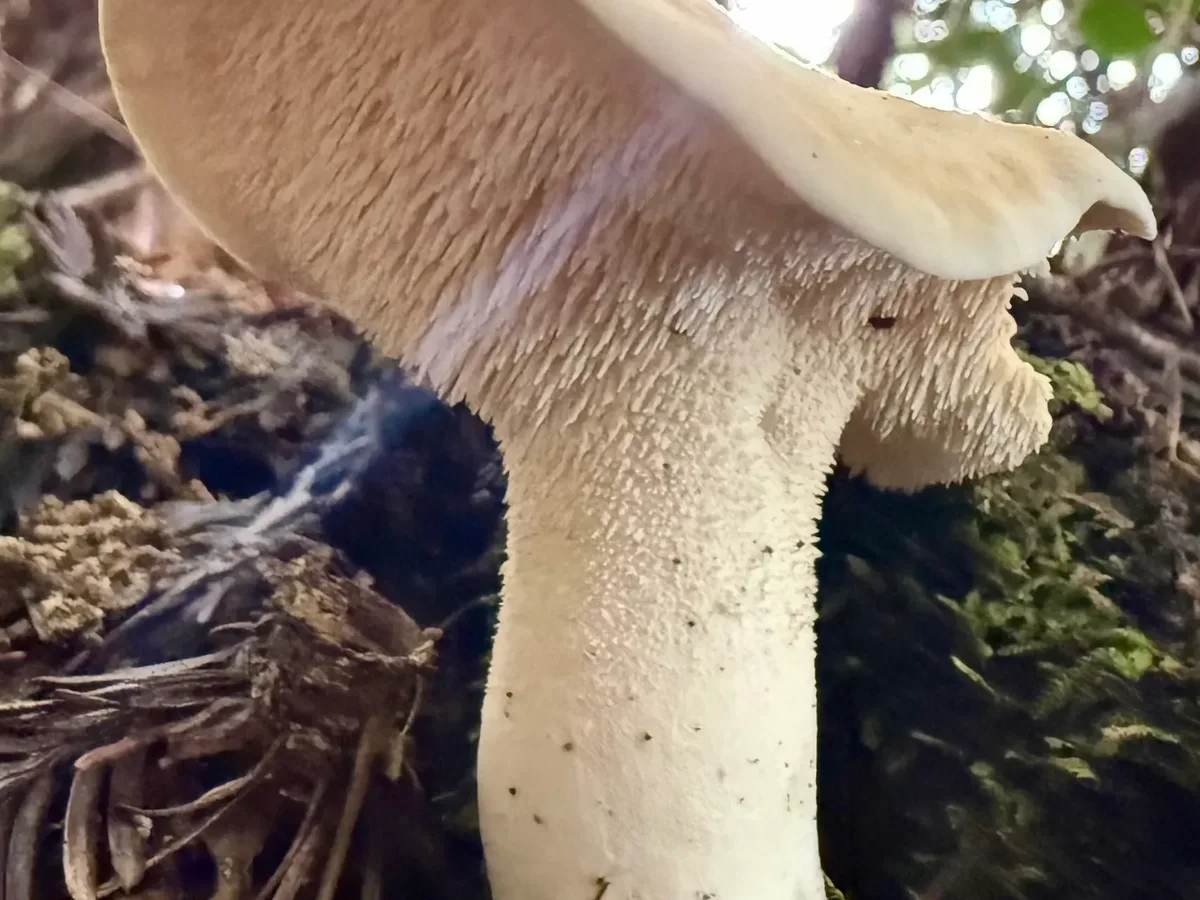 Hedgehog mushroom
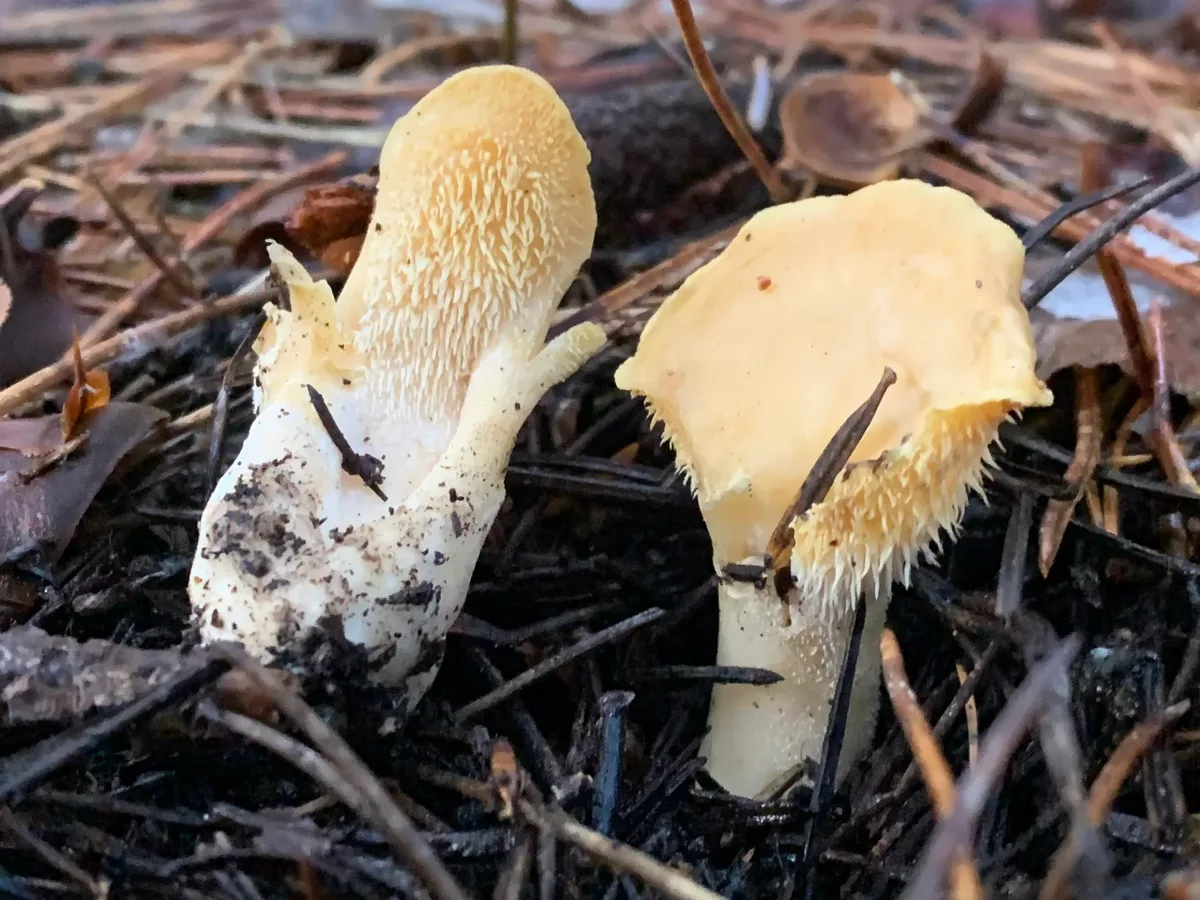 Hedgehog mushroomHedgehog mushroomHedgehog mushroom
Hedgehog (sweet tooth)
Hydnum repandumSoft spines instead of gills underneath make this buff-coloured mushroom one with no dangerous look-alike.
How to recognise it
Cap 4-17 (-25) cm, irregular with a wavy, lobed edge, cream-white to yellow-brown or salmon-pink. The underside carries the hedgehog's calling card: soft, brittle spines or teeth (1-6 mm) that detach at a touch - no other common edible mushroom looks quite like this underneath. Stem short and stout, often off-centre, white. Flesh white and firm, yellowing or browning slightly where bruised. No milk or latex (separates it from the milkcaps). Spore print white.
Where it grows
Mycorrhizal with deciduous and coniferous trees - beech, oak, birch and spruce - in mossy, well-drained woodland. The mycelium lives for years in the soil, quietly maintaining its tree partnerships long before the fruitbodies emerge each autumn.
Cooking
Firm and meaty, it holds its shape beautifully in the pan - less prone to wilting than a chanterelle. Fry in butter, use in soups and risotto, or pair it with chanterelles in the classic French autumn market combination. The mild, nutty flavour deepens with a good sear.
Look-alikes
Smaller and more orange than H. repandum; equally edible.
Can resemble a pale chanterelle from a distance, but the spiny underside of Hydnum (versus chanterelle's blunt ridges/false gills) tells them apart. Both edible.
Resembles the hedgehog from above, but the chanterelle has blunt ridges/false gills rather than the hedgehog's spines.
Gelatinous with rubbery spines.
Scaly, darker in colour, and can be bitter.
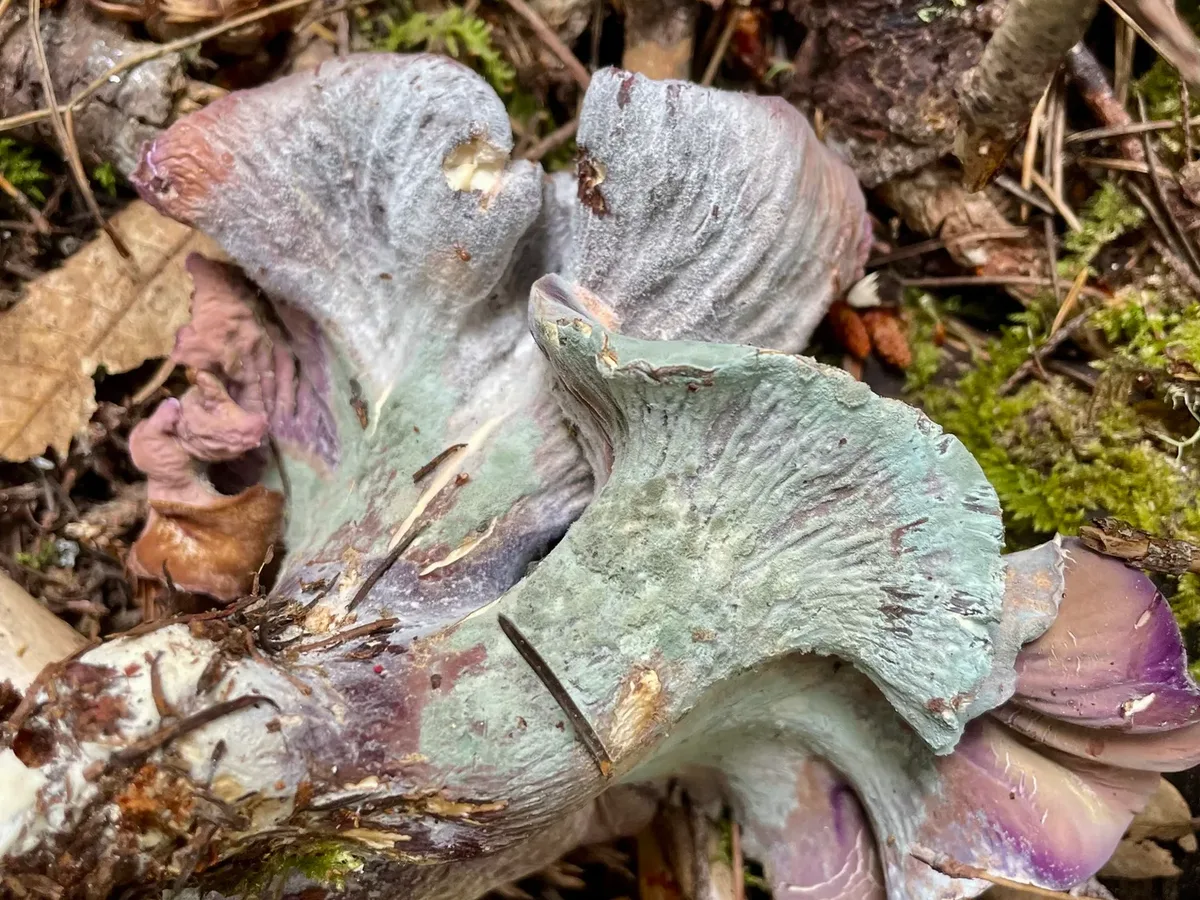 Pig's ears
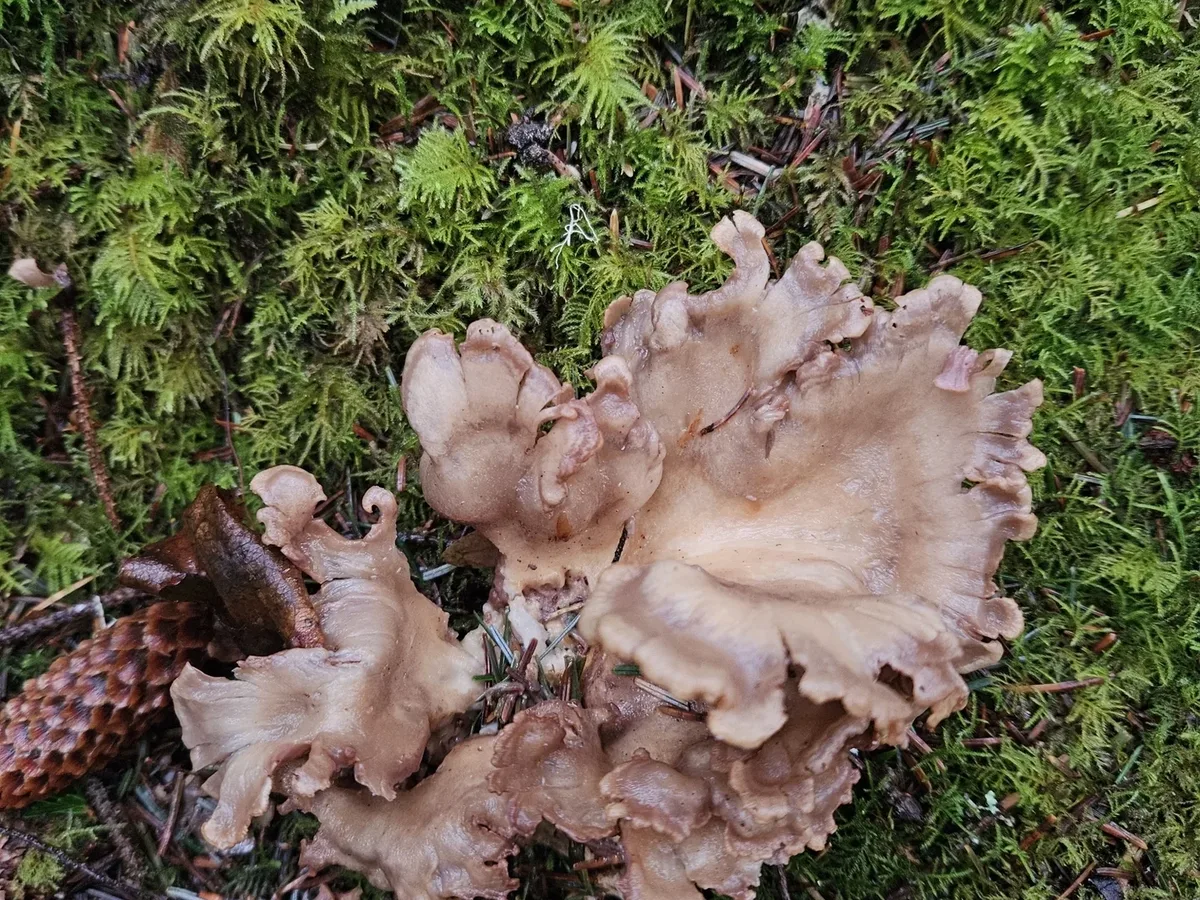 Pig's ears
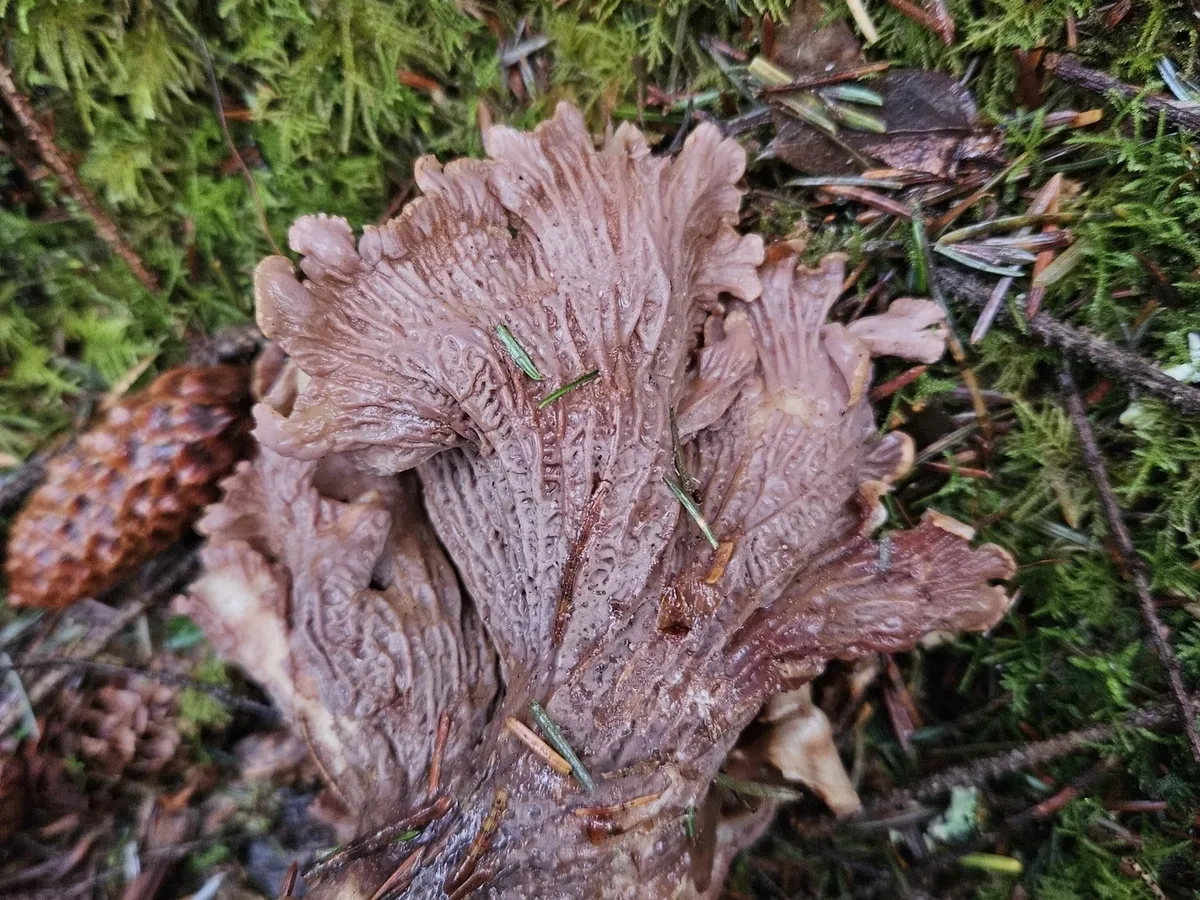 Pig's earsPig's earsPig's ears
Pig's ears
Gomphus clavatusViolet-tinged, wrinkled trumpets clustered in mountain conifer duff - meaty, mild, and unmistakable once you know them.
Look-alikes
Entirely golden-yellow to egg-yolk orange with no lilac tints; grows as separate individuals not in dense fused tufts; cap less deeply funnel-shaped and less irregular; edible and choice.
Grey to black, thin-fleshed, hollow throughout, no lilac ridges; grows as individual fruitbodies, not tufted clusters; no confusion risk when seen side-by-side.
North American only; much larger vase shape; interior surface has coarse orange-red to salmon scales; considered mildly toxic (GI irritant); lacks the lilac ridge colouration entirely.
Has a slimy cap and true gills (decurrent but distinct), grey to purplish-grey cap; associated with Suillus and spruce; very different slimy texture and true gill structure; edible but mediocre.
Branched coral-like structure with wine-red to pink-tipped branches; entirely different branched form from the funnel-shaped Gomphus clavatus; mildly laxative if eaten in quantity. No realistic confusion for an observer who examines the fruitbody.
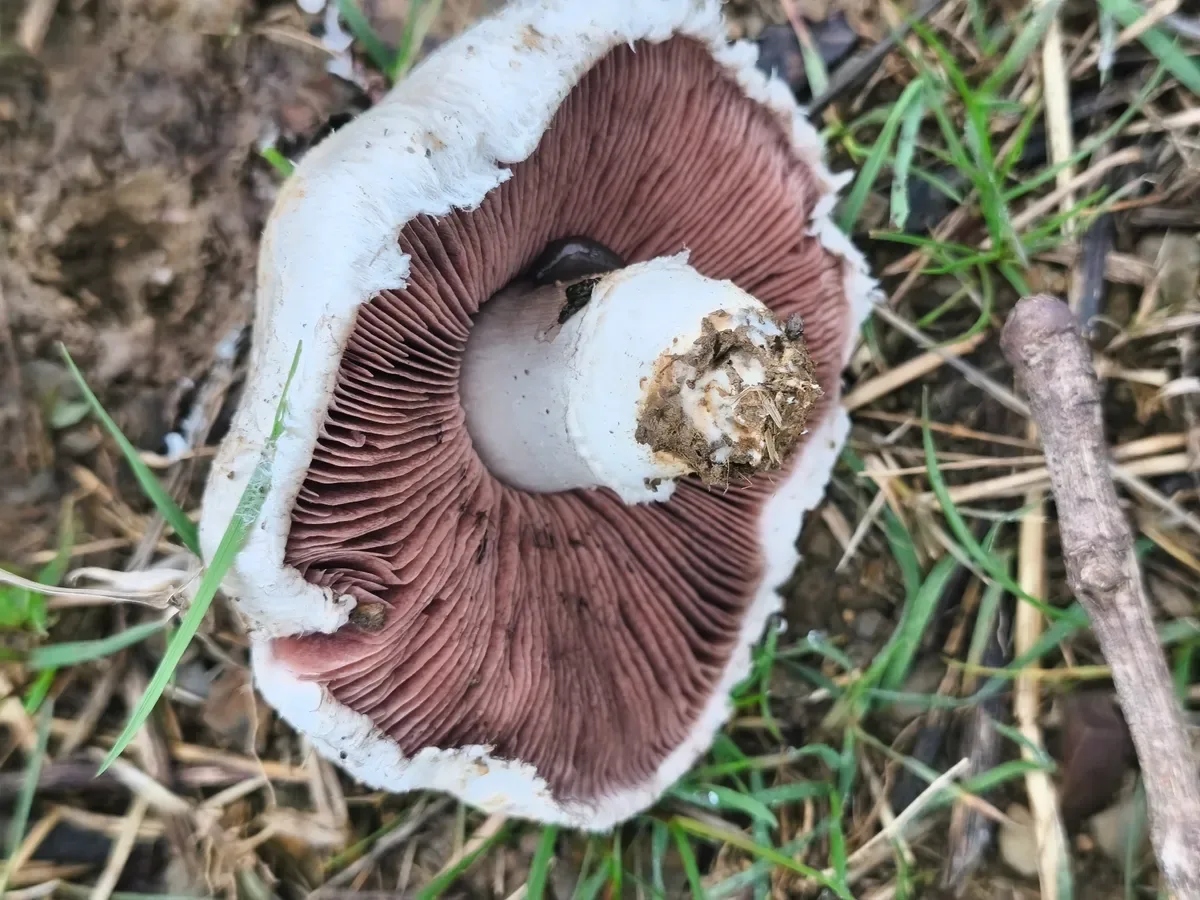 Field mushroom
 Field mushroom
 Field mushroom
 Field mushroomField mushroomField mushroom
Meadow mushroom
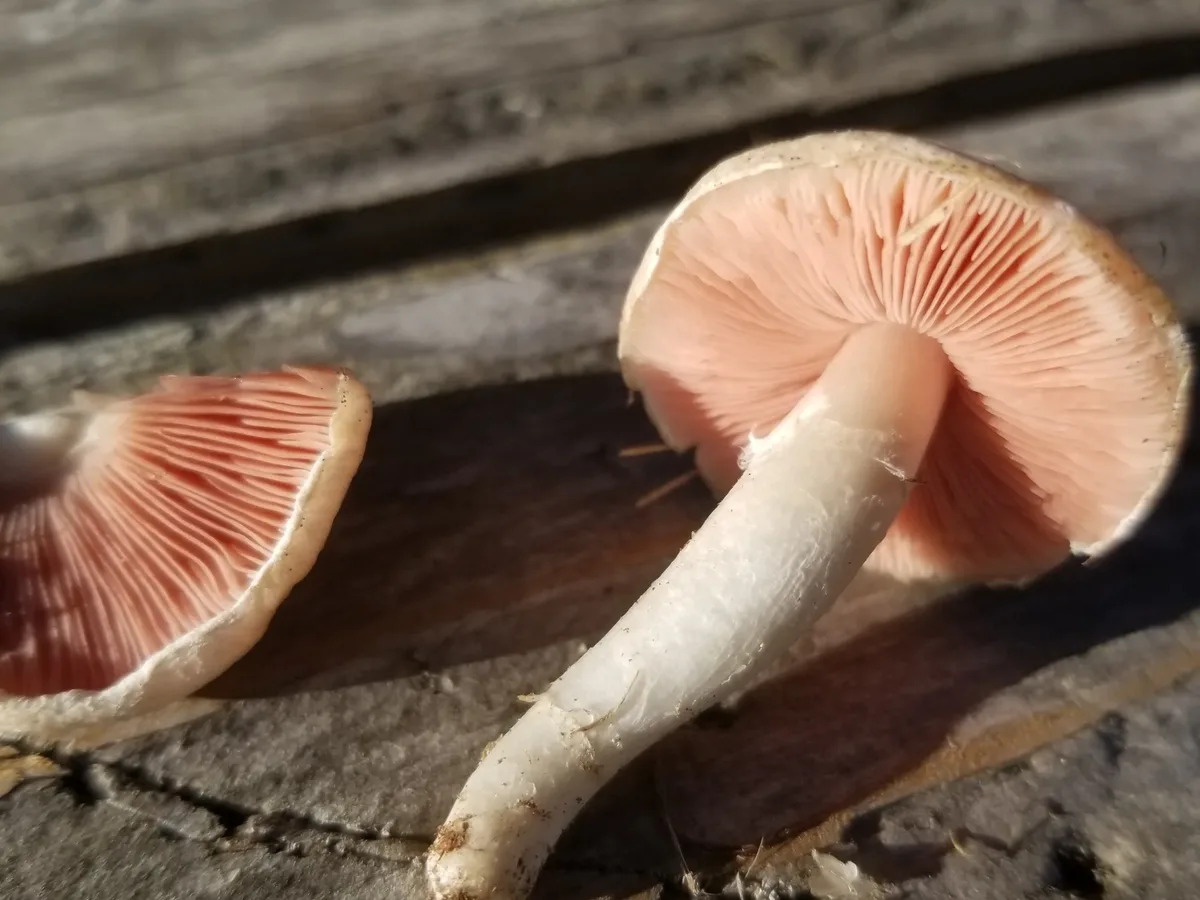
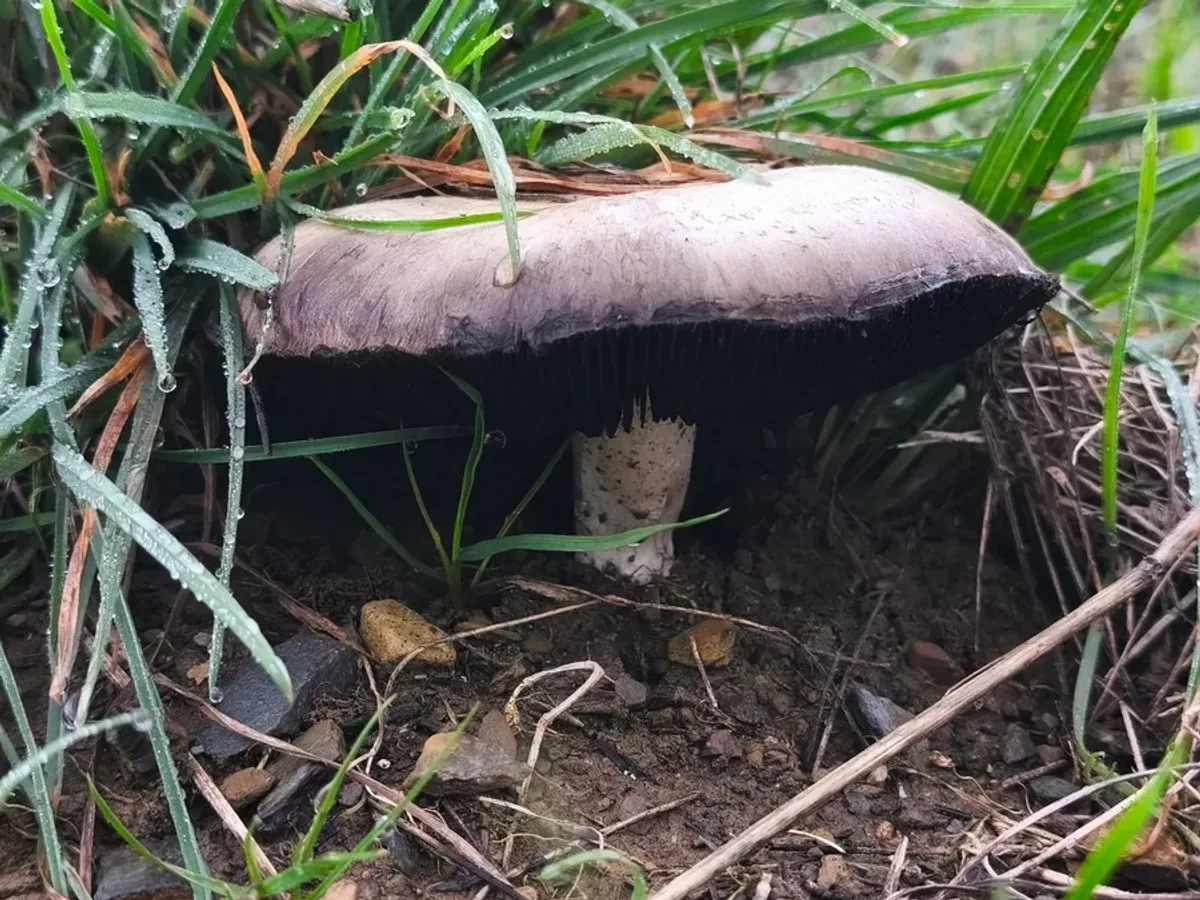
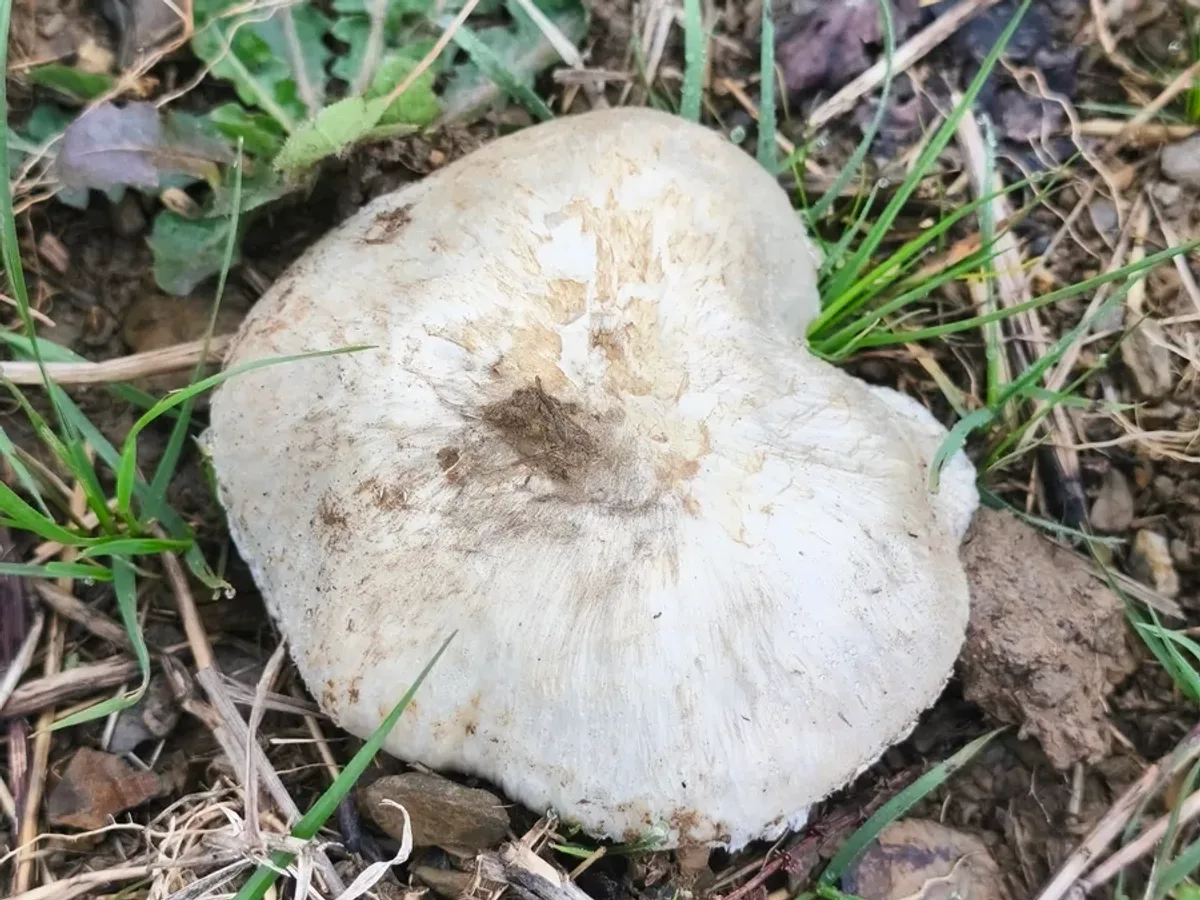
Agaricus campestrisThe wild cousin of the supermarket button, dotting grassland after rain - but always check for pink-to-brown gills and no volva.
How to recognise it
Cap 3-12 cm, white, dry (never slimy), sometimes developing fine scales or surface cracks with age; never with a green tint. Gills begin bright pink, deepen to reddish-brown as the spores mature, and finish a rich chocolate brown - this colour journey is one of the species' best identity checks. Gills are free from the stem. Spore print dark brown. Stem carries a thin ring and has no volva at the base. Flesh is firm and white; the smell is pleasantly mushroomy.
Where it grows
Grazed meadows, pastures, lawns, parks and sports fields - nutrient-rich, manured soil (cow/horse/sheep). A saprophyte on dead grass and roots. Widely distributed in Australia and New Zealand.
Cooking
Like the cultivated button mushroom but moister - field mushrooms on toast (an Australian breakfast classic), fried, in sauces, omelette, soup.
Look-alikes
White gills at every stage (never pink or brown), a sack-like volva at the stem base (may be buried - dig it up), and a white spore print. A. phalloides additionally shows a greenish-yellow cap; destroying angels (A. virosa, A. bisporigera) are pure white with no green coloration at all. Do not rely on colour alone: the presence of a volva is the definitive structural feature. Never pick any white gilled mushroom without confirming the absence of a volva.
Stains strongly yellow at the stem base and smells of phenol/ink/iodine; the most common cause of mushroom poisoning.
The dangerous ones
 Death capDeath cap
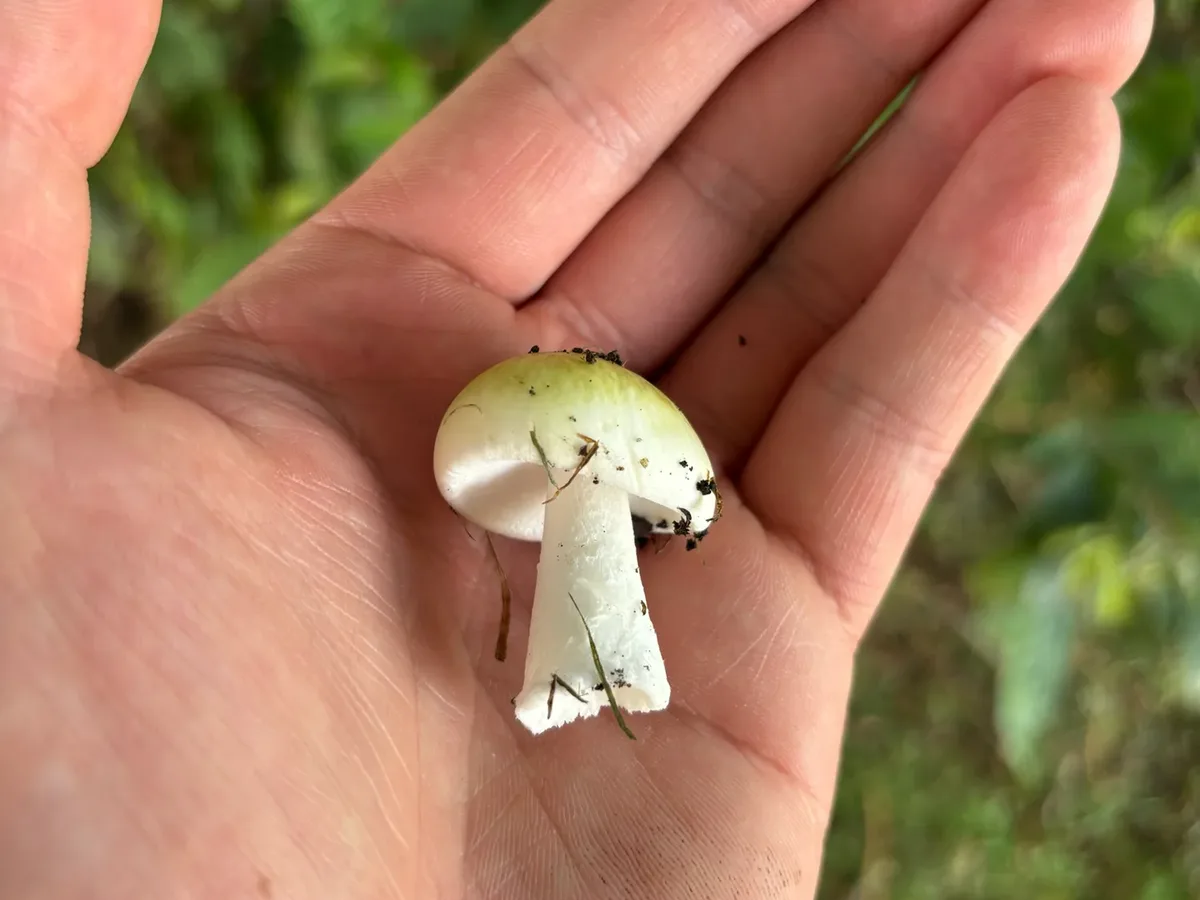 Death capDeath capDeath cap
Death cap
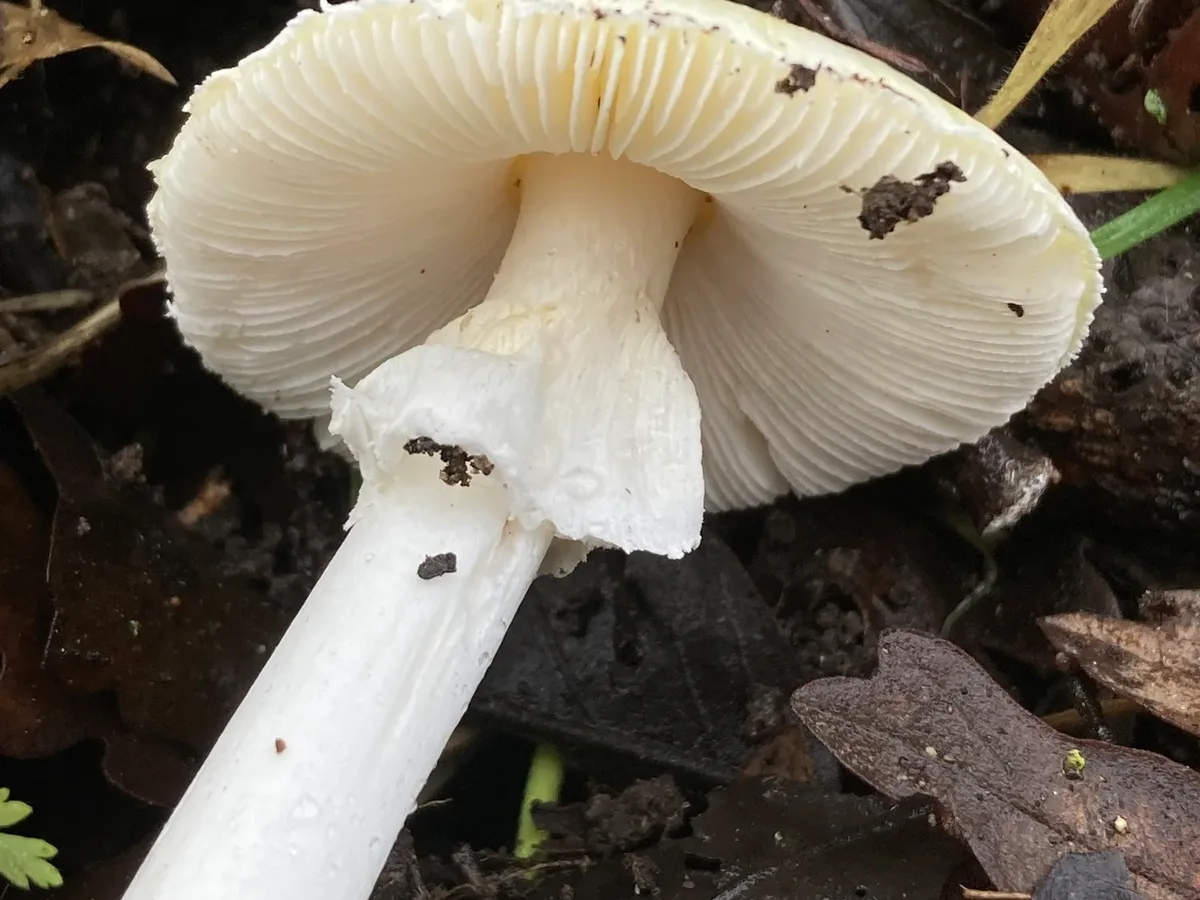
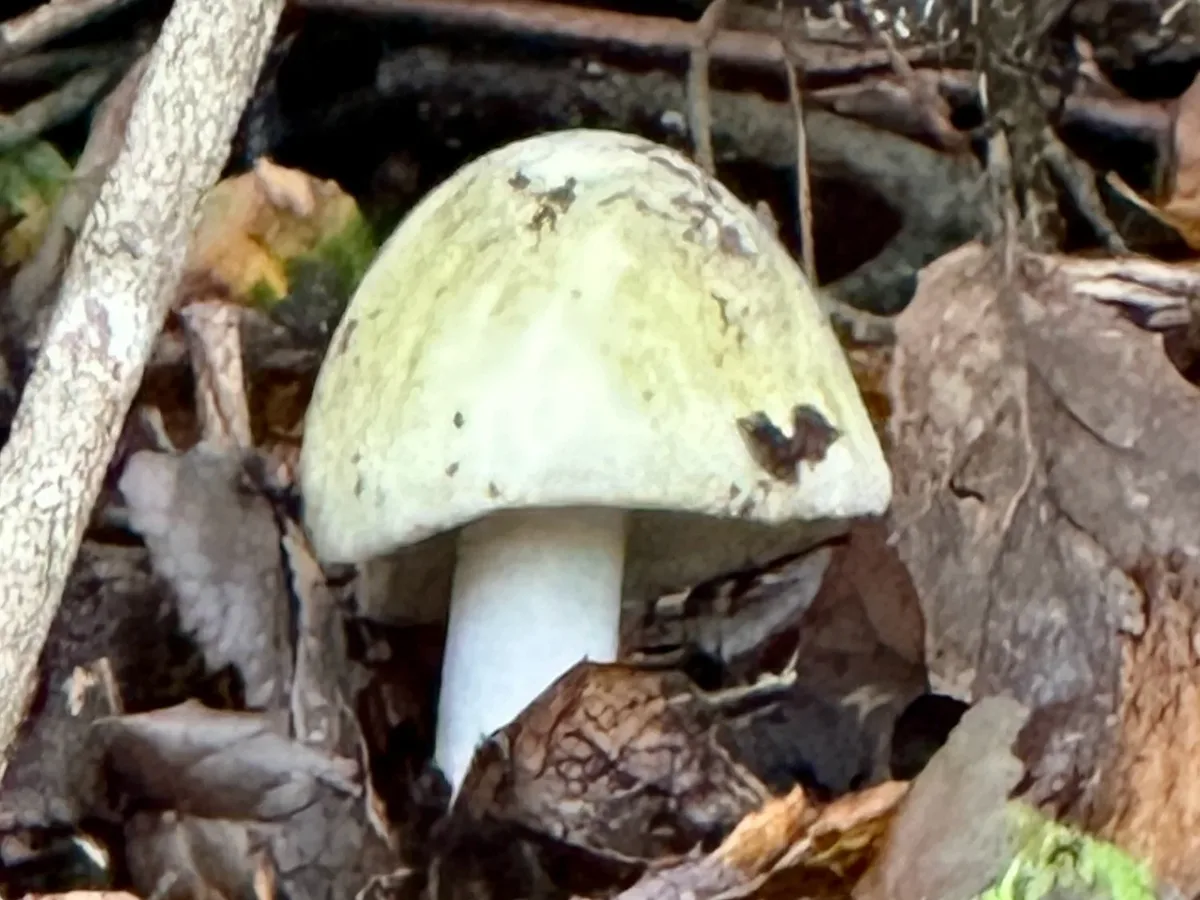
Amanita phalloidesIntroduced from Europe and spreading on the West Coast - a greenish cap, white gills and a sac-like volva; a single cap can kill an adult.
How to recognise it
Cap 40-160 mm, hemispherical, becoming convex, then flat, smooth, slimy in wet conditions and glossy when dry; most often pale yellow/greenish to pale brown, but can be almost white (colour is not a reliable feature). White gills, a white stem, a membranous ring, and a sac-like volva at the base. Amyloid spores (white spore print).
Where it grows
Found only under exotic/introduced trees, especially oak (Quercus), also in gardens, lawns and parks. In Australia it has only been recorded in SA, Victoria and the ACT (Canberra). In Victoria it is widespread across Melbourne (Kew, Camberwell, South Yarra and others) and regionally (Bendigo, Bright, Castlemaine). In New Zealand it grows under introduced oaks and chestnuts; it has also been reported in association with Leptospermum/Kunzea (potentially invasive). There are no confirmed finds in undisturbed native forest.
Cooking
Not edible under any circumstances. The toxins are not inactivated by cooking, drying, freezing or soaking.
Danger
World's deadliest mushroom; as little as half a cap can kill an adult human. Documented fatalities: Canberra, New Year's Eve 2011/2012 - cook Liu Jun picked death caps in Braddon (mistaking them for straw mushrooms) and put them in a stir fry; he and the kitchen hand Tsou Hsiang (a 52-year-old Chinese national) died, of four poisoned. According to the Canberra Times there have been in total "four fatalities and 12 reported incidents of poisoning associated with death cap mushrooms in the ACT". Of nine poisoned in the Canberra region 1988-2011, three were from Laos and two from China. Leongatha, Victoria, July 2023: Erin Patterson, 50, served death caps in individual Beef Wellingtons; Don Patterson, Gail Patterson and Heather Wilkinson died, while Ian Wilkinson survived. She was convicted on 7 July 2025 of three murders and one attempted murder, and on 8 September 2025 sentenced by Justice Christopher Beale to three concurrent life sentences with a 33-year minimum (plus 25 years for the attempted murder), parole no earlier than 2056; Beale found the murders required "substantial premeditation" and an "elaborate cover-up". (The conviction is under appeal.)
Look-alikes
The fully white form of the death cap resembles the white Amanita; both are deadly. Treat any white gilled mushroom with a ring and a sac-like volva as lethal.
Edible Asian mushroom that has caused several deaths among East/Southeast Asian migrants through confusion with the death cap. Both have a volva; check gill colour (straw mushroom develops pink to brown gills and a pink spore print, whereas the death cap has white gills and a white amyloid spore print).
Edible Amanita that can be confused with the death cap; distinguish by colour and spore features, but never rely on colour alone.
Agaricus species have pink-to-brown gills and a dark spore print and lack a volva, whereas the death cap has white gills, a white spore print and a sac-like volva at the base.
Native species (A. austrophalloides, A. marmorata, A. murina, A. murinaster) with a sac-like volva, ring and amyloid spores are untested but likely toxic; do not eat.
Young death cap buttons resemble Agaricus and puffballs, but Agaricus has pink to chocolate-brown gills, a brown spore print and no volva; the death cap always has white gills, a white spore print and a sac-like volva.
The green/greenish-yellow death cap form can be confused with green Russula species; check for the white free gills, ring and sac-like volva, which Russula lacks.
Russulas lack a volva and a ring; always dig up the base to check for the sac-like volva and look for the skirt-like ring and white free gills of the Death Cap.
Agaricus has pink to brown gills (not white) and no volva; the Death Cap has white free gills and a sac-like volva at the stem base.
Agarics lack a sac-like basal volva and have pink-to-brown gills and a brown spore print; the death cap has white free gills, a white spore print, and a volva in the soil.
The pale form of the death cap can be mistaken for puffballs; cutting a puffball reveals uniform white flesh, whereas a young death cap button shows the outline of a developing capped mushroom.
Green russulas lack a ring and volva and have brittle flesh.
Easily confused at the young, egg-like stage; always dig up the base and check the diagnostic combination of white gills + white ring + white sac-like volva.
Field mushrooms have pink to brown gills (not the death cap's white gills) and lack a basal volva/sac.
Distinguished by the death cap's combination of ring plus volva and its olive-green cap colour.
Young egg-stage Death Caps can resemble puffballs; always slice any 'puffball' in half - a developing mushroom with cap, gills and stem inside means it is not a puffball.
In Chile, warnings are given about confusing the death cap with Macrolepiota; look for the death cap's volva, ring and greenish cap with white gills.
In Chile, warnings are given about confusion with Russula; Russula lacks a ring and volva.
In Chile, warnings are given about confusion with Agaricus; Agaricus has a ring but no volva and develops pinkish-to-brown gills with a brown spore print, unlike the death cap's persistently white gills.
In Chile, warnings are given about confusion with Tricholoma; Tricholoma lacks the ring and volva of the death cap.
Locally eaten edible Amanita (also A. loosii); the central confusion in African ethnomycology - the deadly white Amanita are mistaken for these.
An unopened white egg-stage deadly Amanita can resemble a puffball; cut it in half - a developing capped mushroom outline reveals the Amanita.
A globally risky lookalike that also has a volva; check for the ring (present in Amanita, absent in Volvariella) and spore colour (white in Amanita, pinkish in Volvariella).
Same deadly section (Phalloideae) by appearance but lacks the toxins and is eaten locally in Rwanda/Burundi/Tanzania; cannot be told apart by eye alone, underscoring why species-level knowledge is essential.
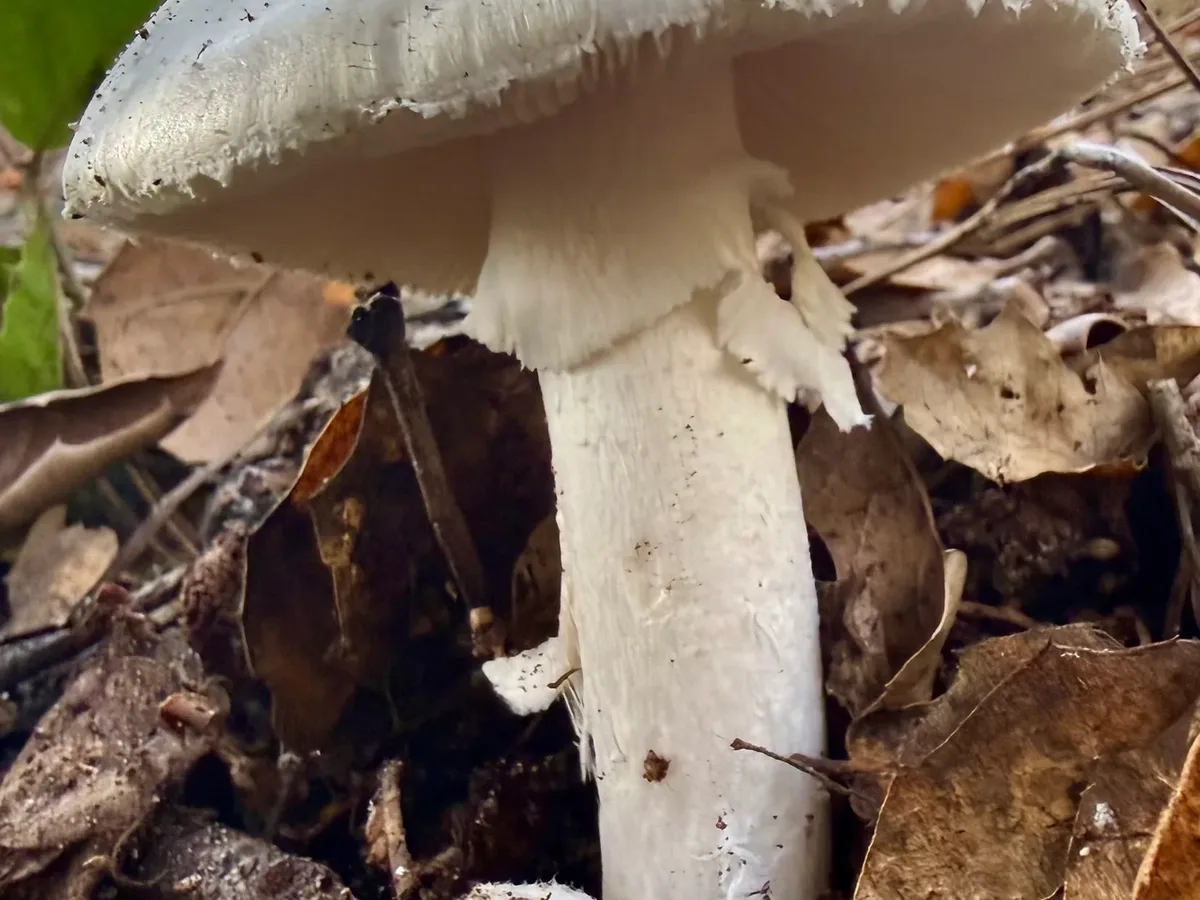 Western destroying angel
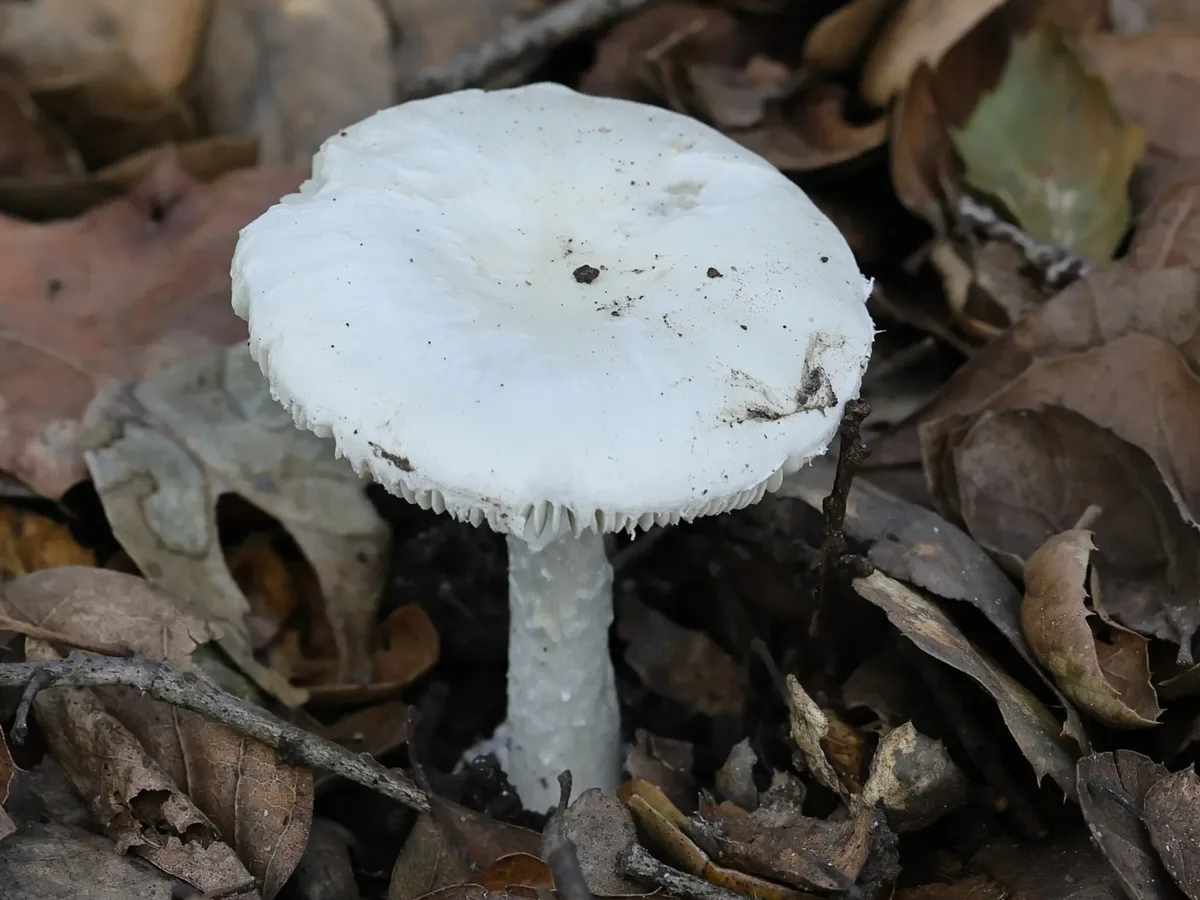 Western destroying angel
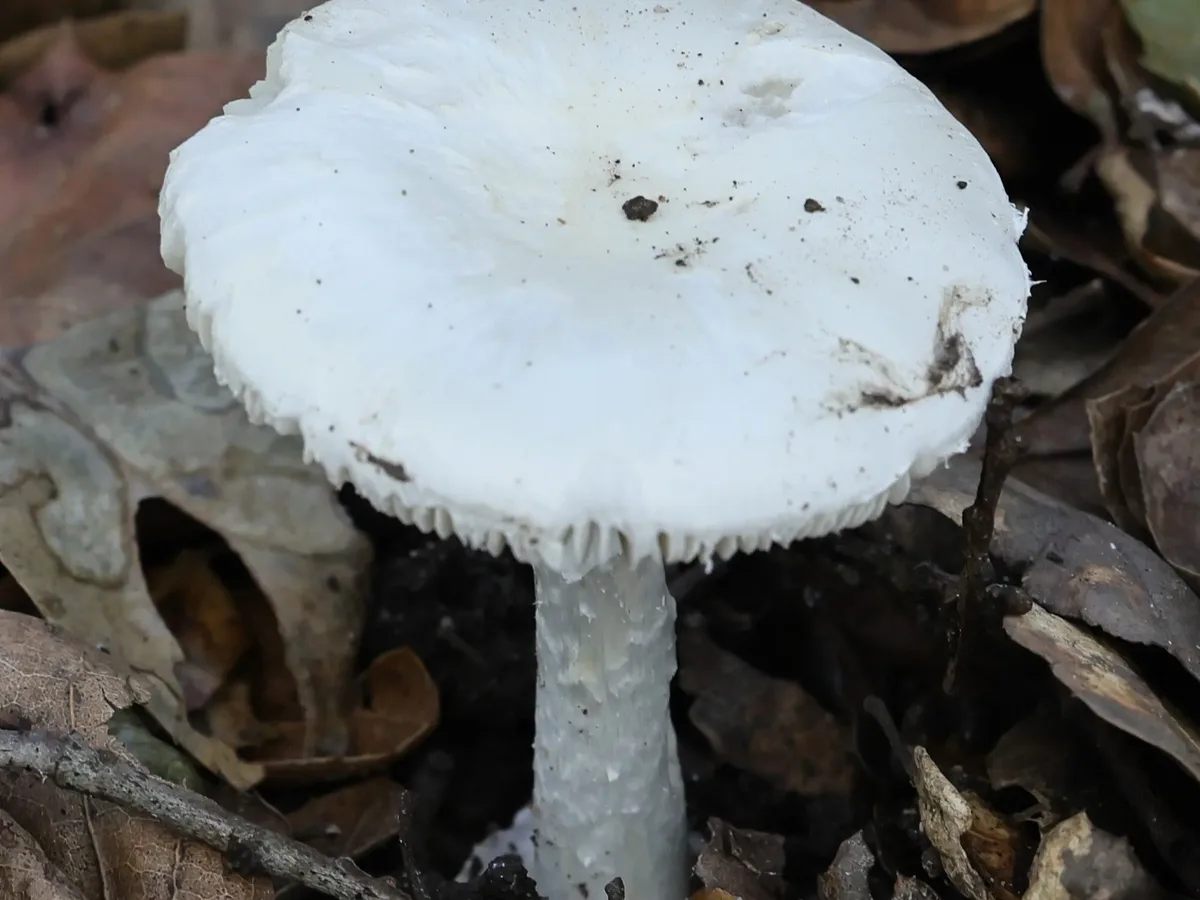 Western destroying angelWestern destroying angelWestern destroying angel
Western destroying angel
Amanita ocreataThe pure-white killer of the West Coast, fruiting in spring under oak - all amatoxin, and easily taken for a young edible button.
How to recognise it
Cap 5-15 cm, white to ochre, often with a brownish center; egg-shaped when young, expanding to broadly convex. Gills white and free from the stem. A white skirt-like ring sits on the upper stem, though it may drop away as the cap opens. The base emerges from a white sac-like volva, often partly buried in soil. Spore print white. Young specimens smell mild; older ones may take on an unpleasant odour of chlorine, fish, or iodine. Flesh stains yellow with KOH (potassium hydroxide).
Where it grows
Found in California and the Pacific Northwest, ranging from Washington south through California into Baja California, with records possibly reaching Vancouver Island. Grows almost exclusively under oaks - coast live oak and Garry oak especially - and occasionally hazel, living as a long-term mycorrhizal partner with these trees.
Cooking
Never - deadly poisonous.
Danger
DEADLY. Causes most of the fatal mushroom poisonings on the West Coast every spring. Dogs are also deadly sensitive. There is no antidote; a liver transplant may be required.
Look-alikes
Edible; lacks a ring and has a striate (grooved) cap margin.
Also known as A. calyptroderma; has a darker cap.
Young Agaricus can be confused with young (egg-stage) specimens; Agaricus has pink-to-brown gills and lacks a volva.
Young egg-stage specimens can resemble puffballs; cut in half to reveal the developing mushroom with cap, gills, and stem inside.
 Green-spored parasol
 Green-spored parasol
 Green-spored parasol
 Green-spored parasolGreen-spored parasolGreen-spored parasol
Green-spored parasol
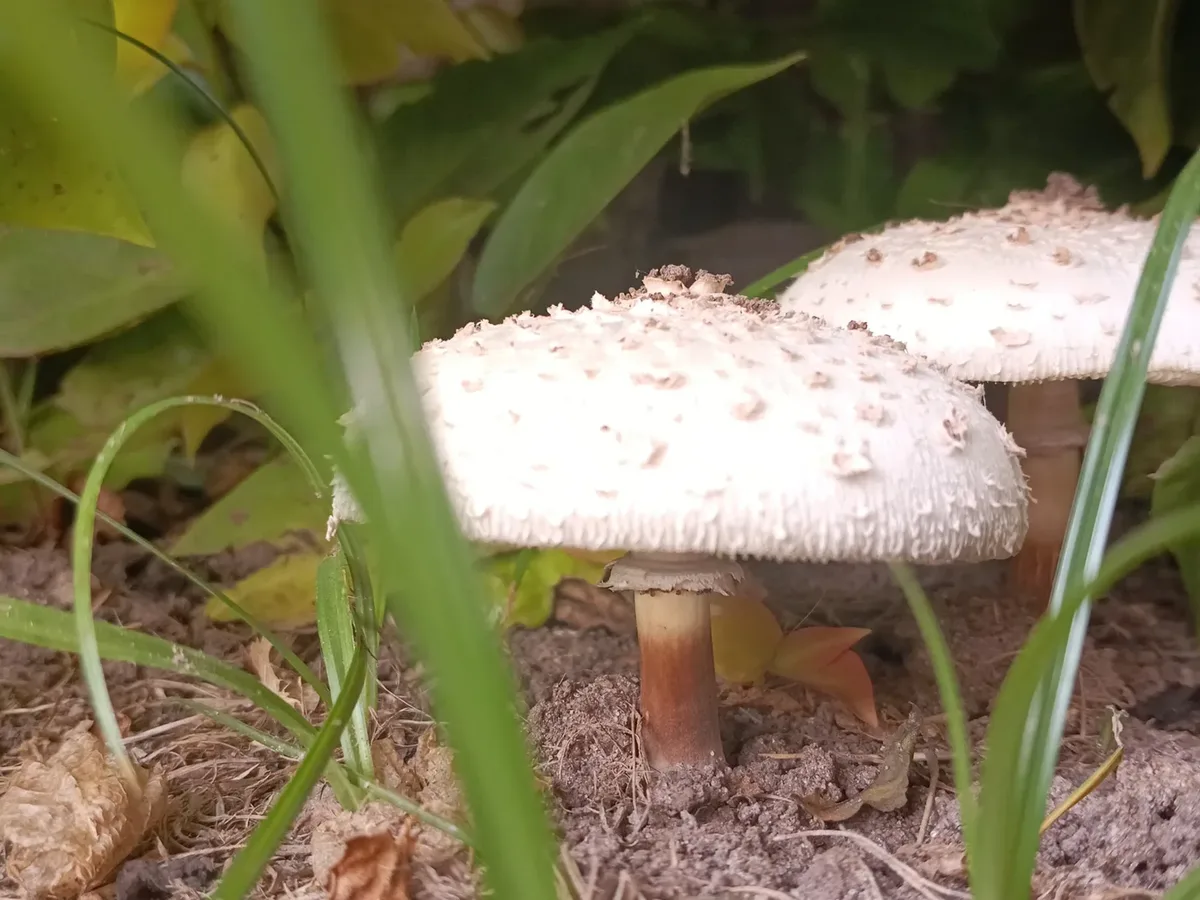
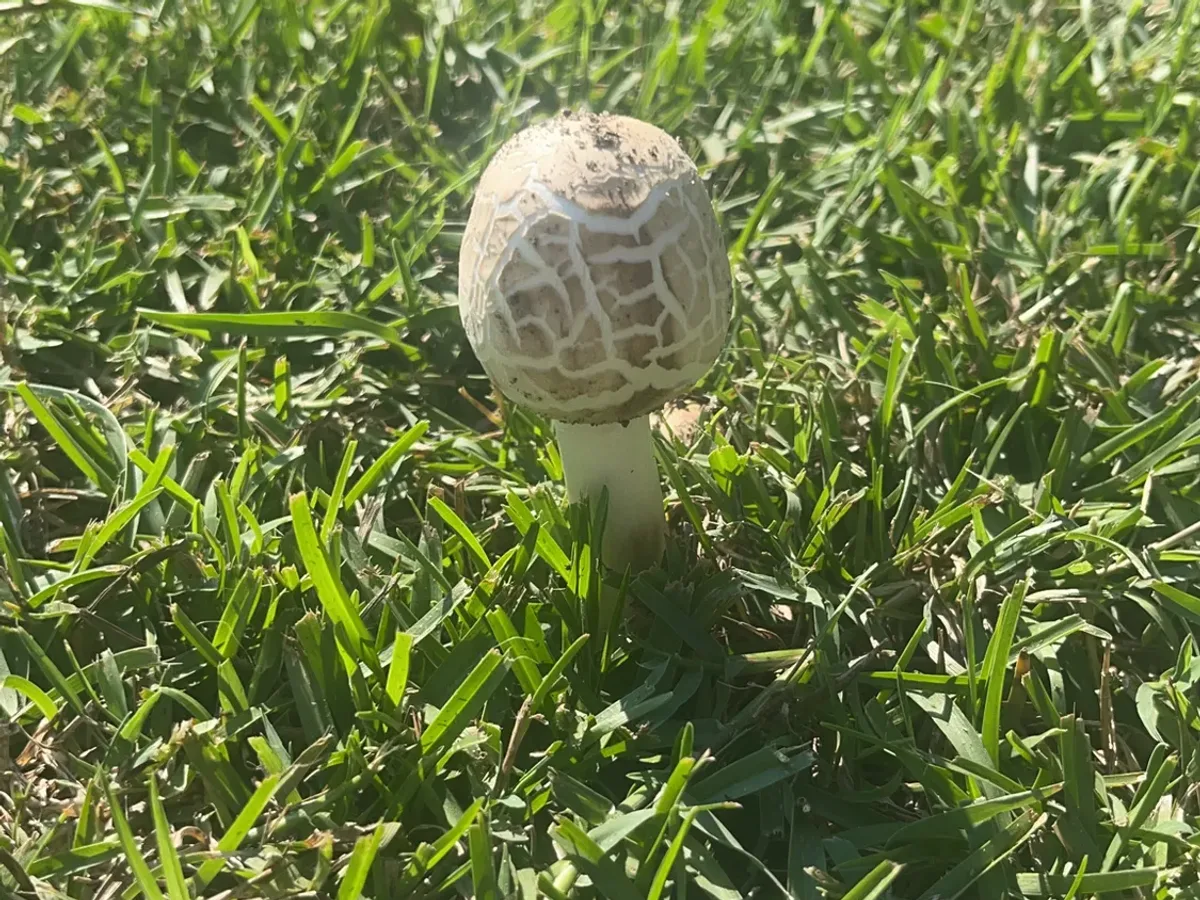
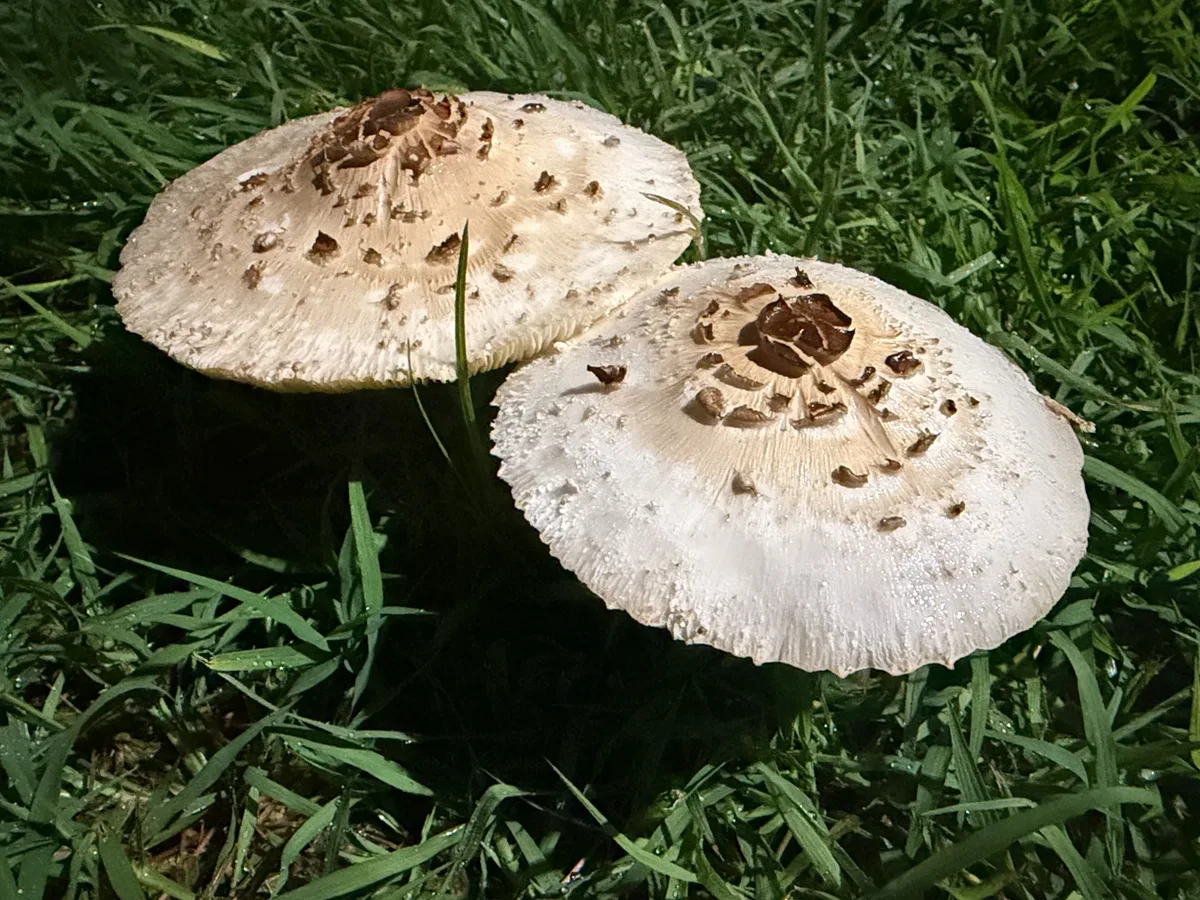
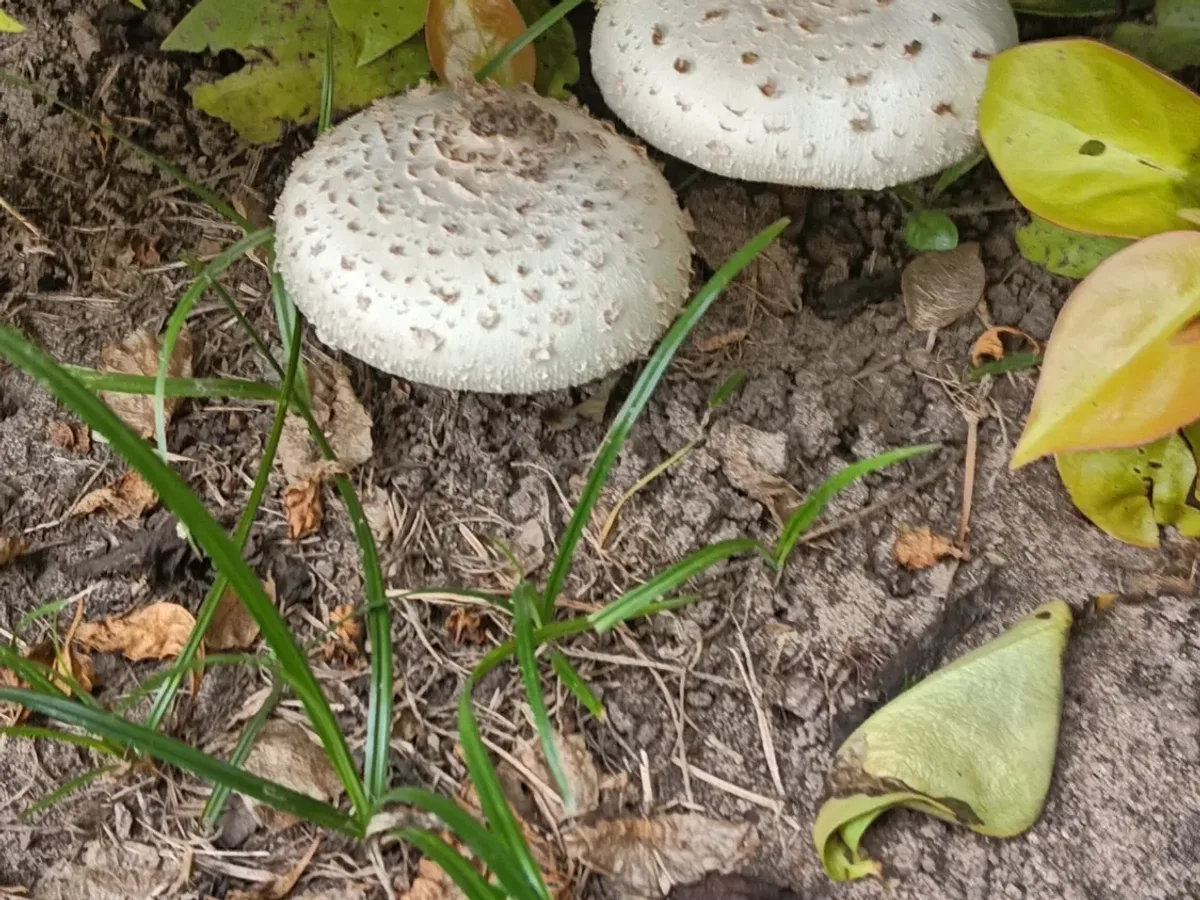
Chlorophyllum molybditesNorth America's most common poisoner, fruiting on lawns and parks where children and dogs play - the giveaway is a green spore print.
How to recognise it
Large, stately, white cap with brown scales toward the center, at first drumstick-shaped then broad and flat. The gills are white in young specimens but turn grayish-green to green at maturity, and the spore print is green (very unusual, diagnostic). Free gill attachment, ring around the stem. The flesh may blush faintly. Often grows in fairy rings on lawns.
Where it grows
Lawns, pastures, parks, open grassy surfaces, and near human habitation. Common in Florida and the southeastern/southern USA, less common in the north.
Cooking
Not applicable - poisonous even when cooked.
Danger
Causes the most mushroom poisonings in North America, leading to severe gastrointestinal distress, sometimes with blood in the vomit and excrement. Rarely fatal, but children, the elderly, and pets can become seriously dehydrated and need hospital care. Especially risky because it grows where children and dogs play.
Look-alikes
The edible parasol has white gills and a white spore print; Chlorophyllum molybdites develops grayish-green to green gills and a green spore print at maturity.
The shaggy parasol has white gills and a white spore print, not the green gills/green spore print of Chlorophyllum molybdites.
Shaggy mane gills turn black and deliquesce (dissolve into ink) rather than turning green, and it produces a black spore print.
The green spore print distinguishes C. molybdites from related Chlorophyllum species.
Edible termite-associated mushrooms; confusion documented especially in Asia, and considered a risk even for T. titanicus per field guides. Check for the green spore print of C. molybdites.
True parasol mushrooms have a white spore print and white gills; Chlorophyllum molybdites has a greenish to grey-green spore print and greenish gills in age.
Distinguish by spore print colour and the presence of a stem ring (Volvariella lacks one and has a volva).
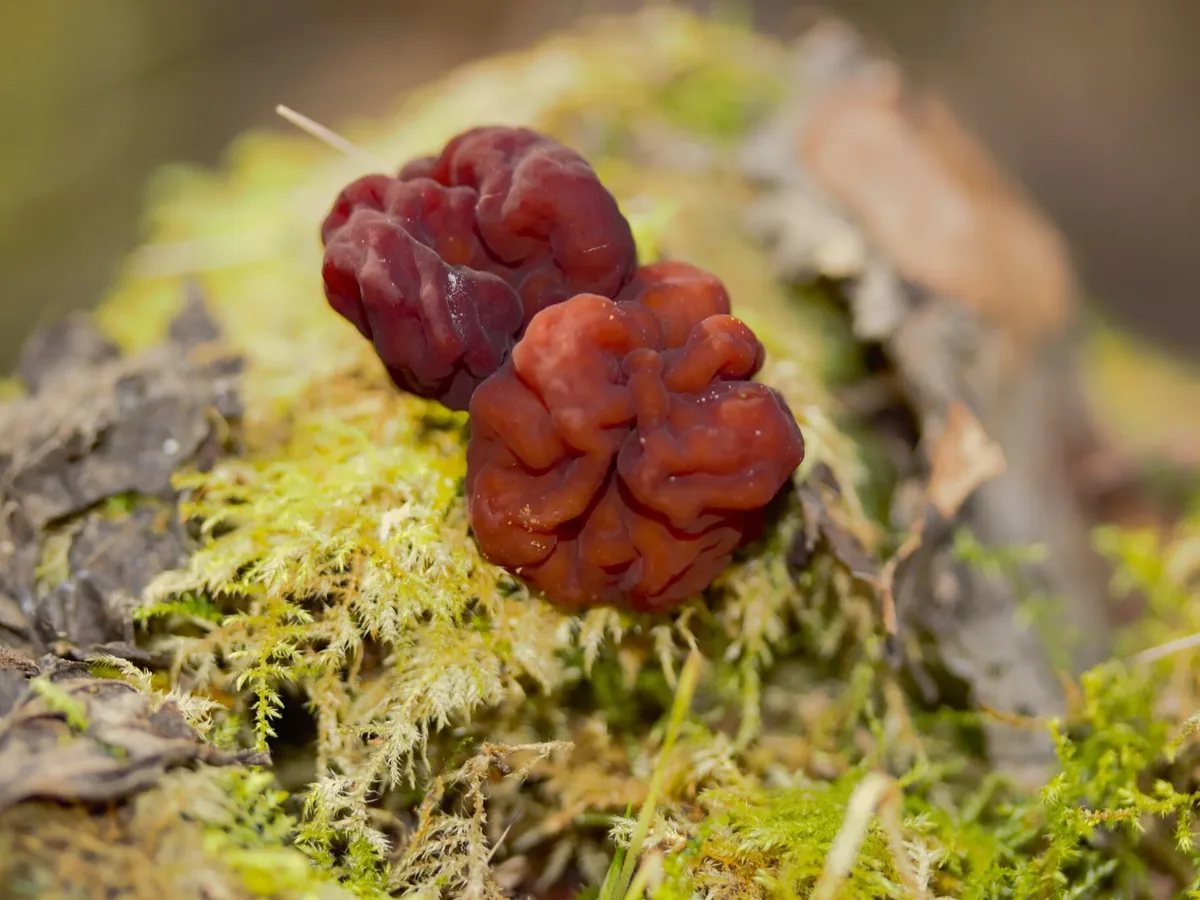 False morel
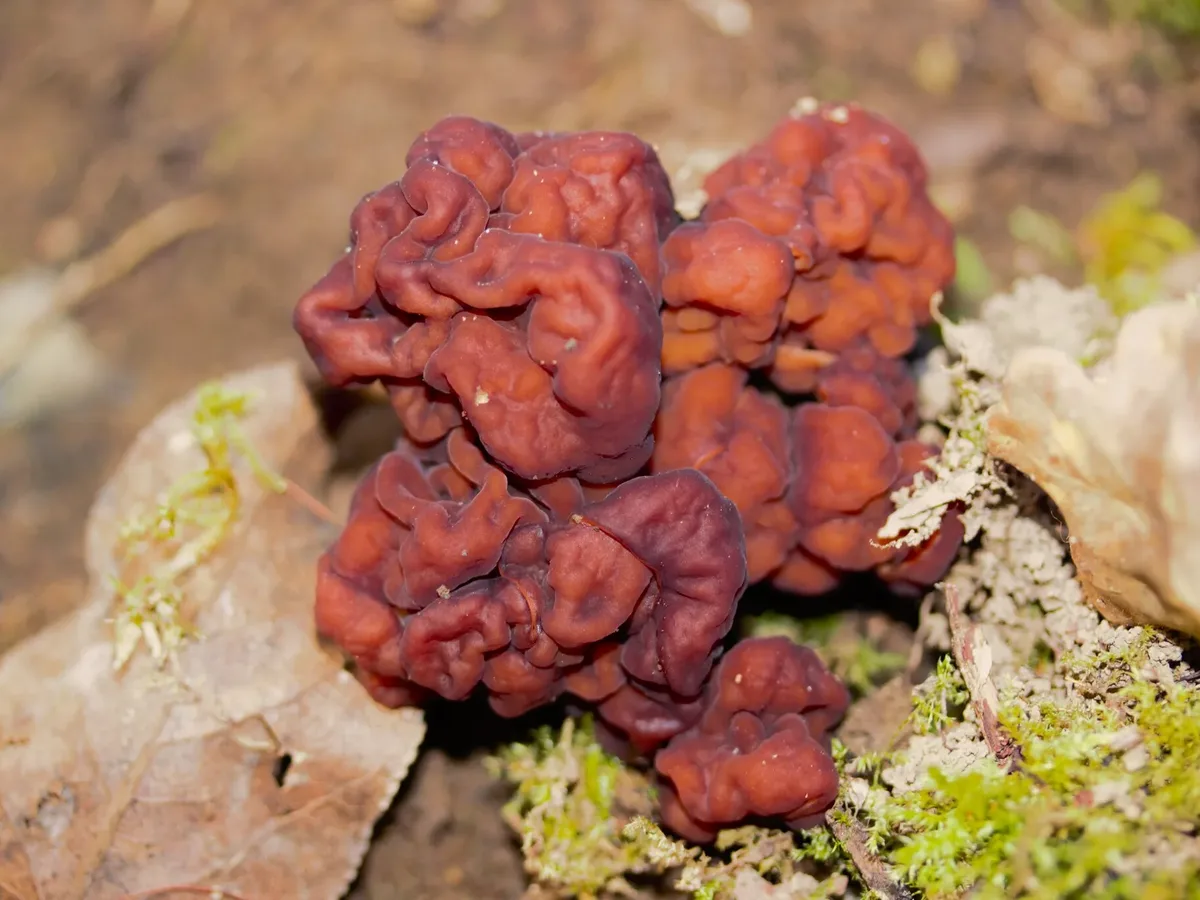 False morel
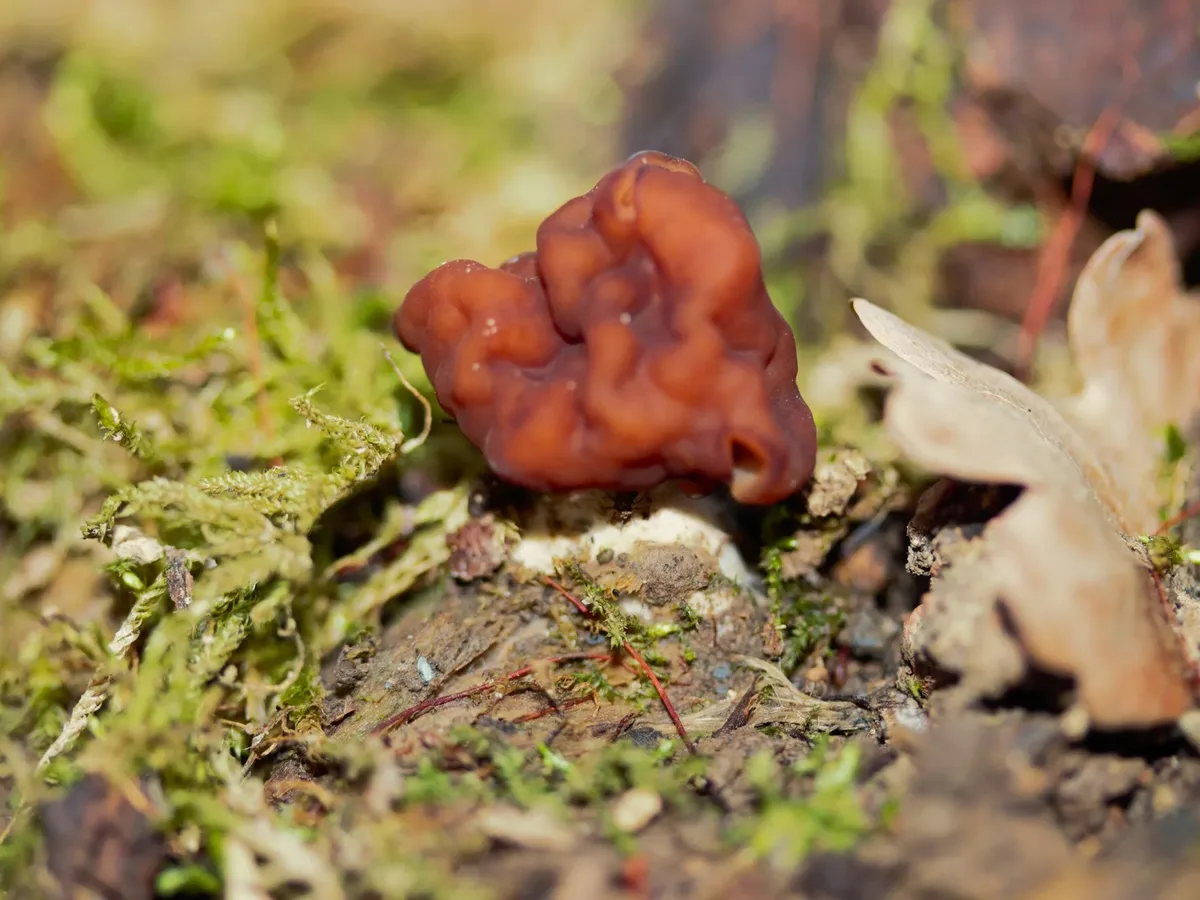 False morelFalse morelFalse morel
False morel
Gyromitra esculentaBrain-like and chambered, never honeycombed - its gyromitrin can poison you through the steam as it cooks.
How to recognise it
Irregular, brain- or walnut-shaped cap, reddish-brown to dark brown - wrinkled and convoluted rather than pitted in a honeycomb. The stem is short; the interior is hollow or chambered, not cleanly hollow throughout.
Where it grows
Sandy coniferous forest floor, especially under pine. Also turns up on burned ground and other disturbed soils where the forest floor has been opened up.
Cooking
In the Nordic countries and Eastern Europe it is traditionally eaten after repeated parboiling, but this is considered risky - the toxin content is reduced but not entirely eliminated, and the vapors are poisonous.
Danger
Contains gyromitrin which is converted in the stomach to monomethylhydrazine (MMH): vomiting, dizziness, liver damage, in severe cases convulsions and death. Individual sensitivity varies. Although traditionally eaten after repeated parboiling in the Nordic countries and Eastern Europe, this is regarded as risky - the toxin content is reduced but not fully eliminated, and the vapors are poisonous.
Look-alikes
True morels have a regularly pitted honeycomb cap and are completely hollow inside; the false morel is brain-like and filled/chambered.
A safe edible; has a pitted, honeycomb-like cap rather than a wrinkled/convoluted one.
Also a Gyromitra; likewise to be avoided.
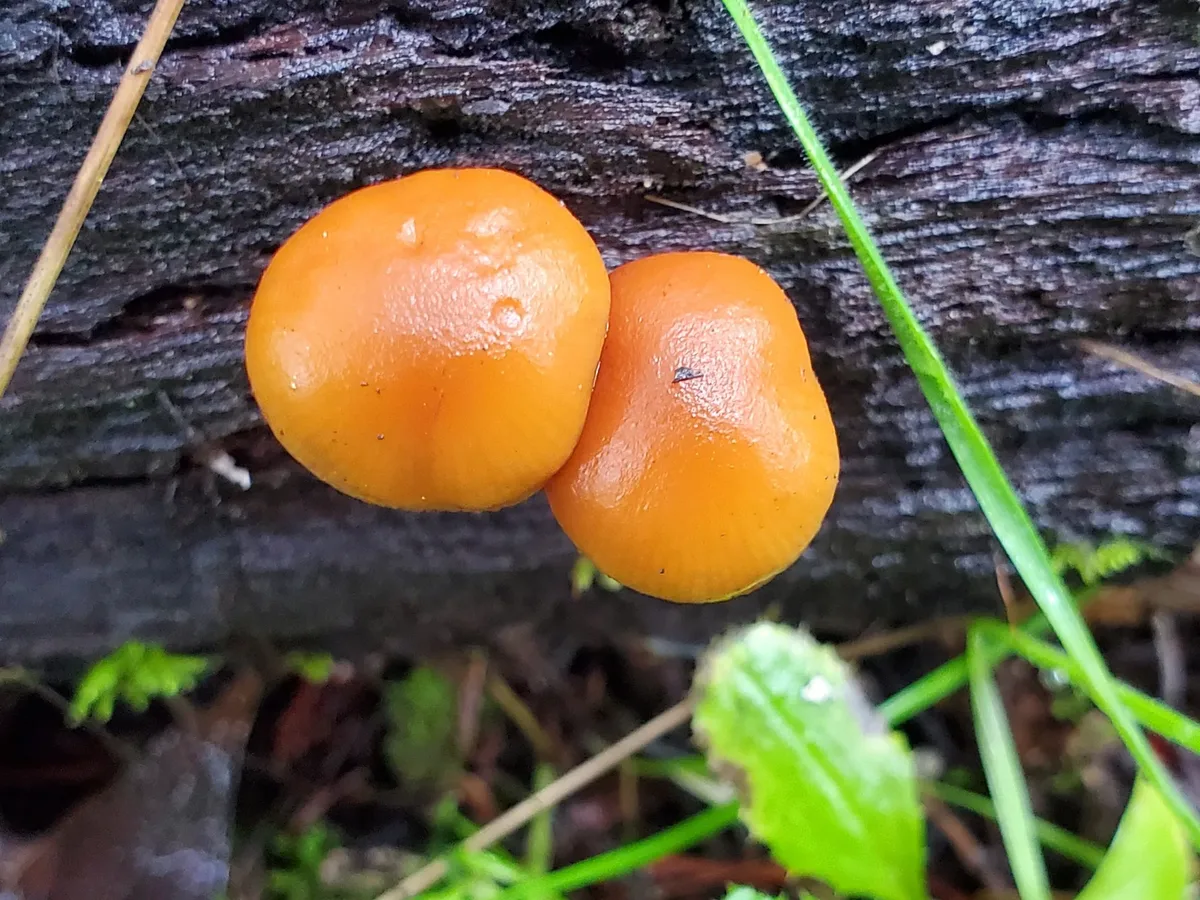 Funeral bell
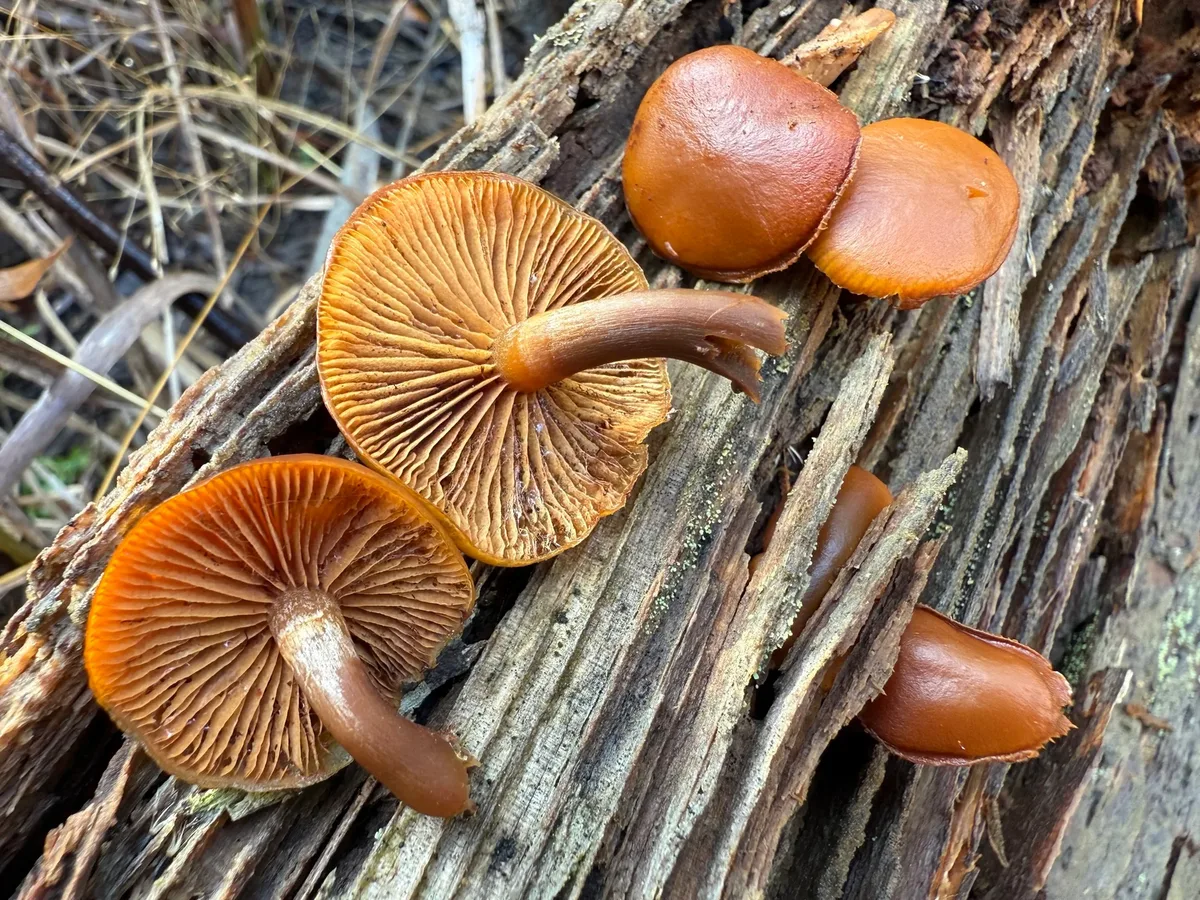 Funeral bell
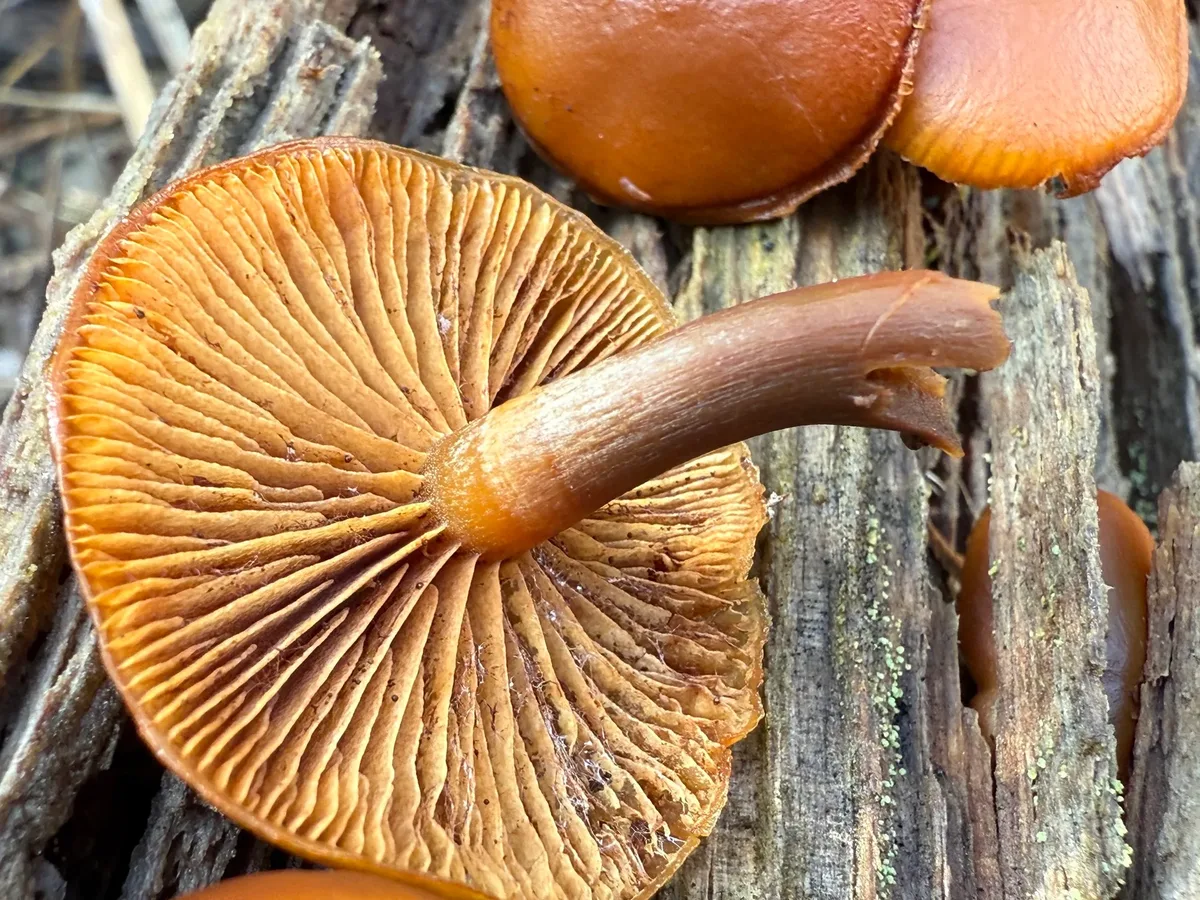 Funeral bellFuneral bellFuneral bell
Funeral bell
Galerina marginataA small brown mushroom on dead wood carrying the same amatoxins as the death cap - a handful of caps is enough to kill.
How to recognise it
Small - cap 1-4 (-5) cm, honey- to yellow-brown, hygrophanous (dark brown when moist, pale yellow when dry), smooth. Gills brownish, giving a rust-brown spore print. Stem thin with a (often disappearing) ring; darkens towards the base. Grows on wood.
Where it grows
Saprotroph on dead wood (deciduous and coniferous), on rotting logs and stumps, often in moss; from the lowlands to alpine settings.
Cooking
Galerina marginata must never be eaten. There is no preparation method - boiling, parboiling, frying, drying, or any other technique - that destroys or neutralises its amatoxins. Alpha- and beta-amanitin are heat-stable proteins: they survive cooking temperatures completely intact and are absorbed unchanged through the gut. Eating even a single cooked cap can cause fatal liver and kidney failure. The insidious danger is a deceptive latency period of 6-24 hours during which no symptoms appear, followed by violent gastrointestinal illness, a brief false recovery, and then organ failure within days. By the time symptoms are undeniable, irreversible damage has already begun. This species has killed people who deliberately ate what they believed were edible wood-growing mushrooms and who had removed or discarded the ring as an unimportant detail. If there is any possibility that this species entered a dish, seek emergency medical care immediately - do not wait for symptoms.
Danger
Contains the same amatoxins as the death cap; a single cap can be fatal.
Look-alikes
Edible; grows on wood but gives a white spore print, whereas funeral bell gives a rust-brown spore print.
Edible; also grows on wood. Distinguish by spore print (rust-brown in funeral bell) and overall features. Many fatalities have occurred from picking funeral bell along with this species.
Edible wood-growing mushroom that can be confused with Galerina marginata; lacks the fragile ring and has white spore powder rather than rust-brown.
Wood-dwelling like Galerina; very different in appearance, but beginners can mistake it.
Small brown hallucinogenic mushrooms that can be dangerously confused with deadly Galerina.
Edible small brown-gilled mushrooms can resemble Galerina marginata; confirm features carefully before eating any small brown mushroom from wood.
Psilocybe has a purple-brown to black spore print and bruises blue; galerina has a rust-brown print and does not bruise blue. At least one death in the PNW resulted from confusing galerina with Psilocybe stuntzii.
Flammulina velutipes has a white spore print.
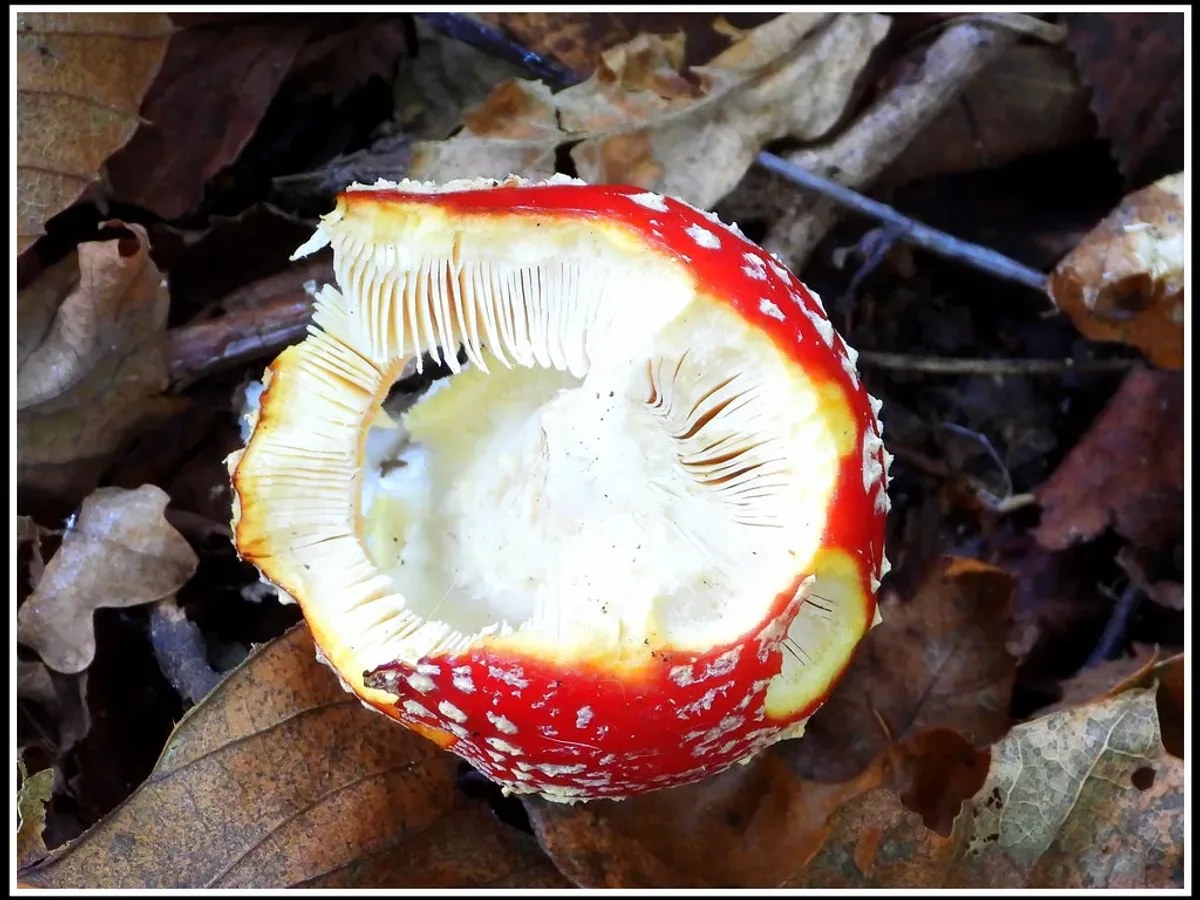 Fly agaricFly agaric
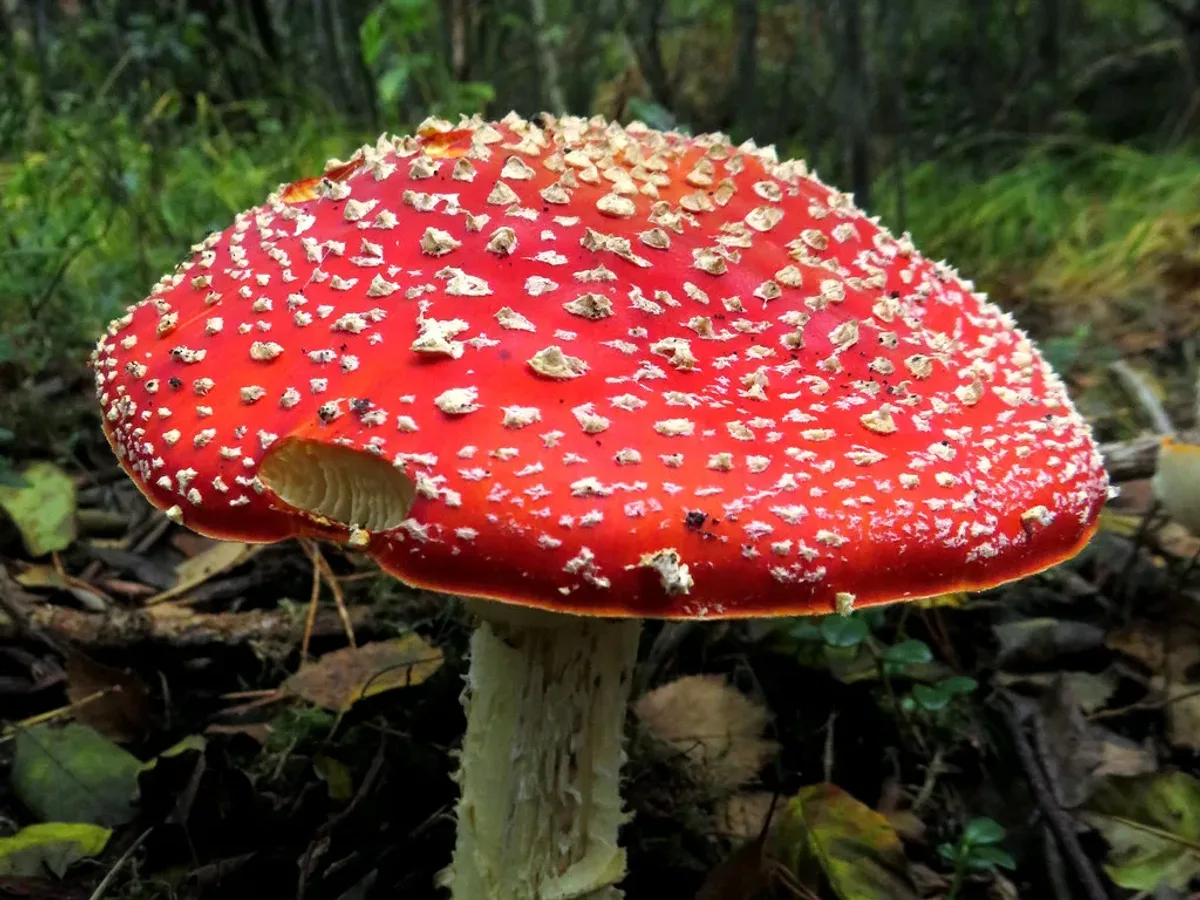 Fly agaricFly agaricFly agaric
Fly agaric
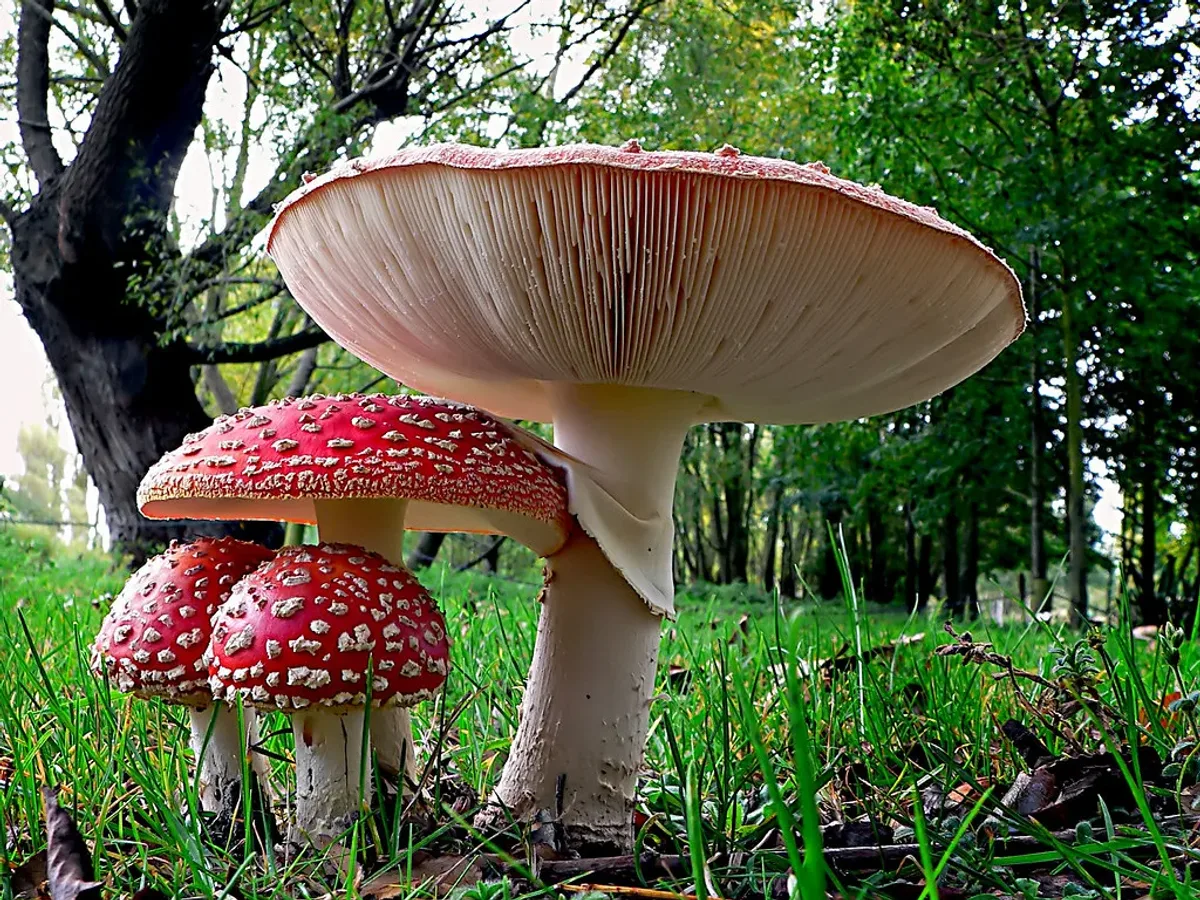
Amanita muscariaThe storybook red-and-white toadstool of mountain conifers - beautiful, intoxicating, and never to be eaten.
How to recognise it
Cap 8-20 cm, vivid red with white warts that can be washed off by rain or simply fade with age, leaving a plain orange-red cap. White gills, white stem with a pendant ring, and a white bag-like volva at the base. Young specimens emerge as white "eggs" wrapped in a universal veil before the red cap breaks through.
Where it grows
Introduced to Australia and New Zealand alongside pine and birch plantations, where it has since formed mycorrhizal relationships with native southern beech (Nothofagus, including Myrtle Beech N. cunninghamii) in Victoria, Tasmania and New Zealand - spreading into ecosystems it was never meant to reach and displacing native fungi as it goes. Range is expanding northwards (towards Port Macquarie, NSW); also found under silver birch in Manjimup, WA (2010).
Cooking
None - poisonous/psychoactive.
Danger
Deaths extremely rare. Easy to recognise, so poisoning is uncommon.
Look-alikes
The guide advises beginners to avoid the entire Amanita genus; faded specimens of the fly agaric can mislead the inexperienced, and the genus includes deadly amatoxin-containing species.
Native Australian species, eucalyptus-associated, lacking white warts and a ring.
Caesar's mushroom (edible, southern Europe) has a yellow cap, yellow gills and yellow stem; a young rain-washed fly agaric lacking warts could theoretically be confused with it, but the fly agaric has white gills and white stem.
At the button stage the fly agaric is a white ball that can resemble a puffball; cut it lengthwise to reveal the developing cap, gills and stem of the agaric.
Brown cap with white warts, ring, and banded volva; the more toxic of the two and can be confused by inexperienced foragers with edible grey- or brown-capped species.
The red color plus white warts plus a volva at the base distinguish the fly agaric; rely on these warning features even when the cap color has faded.
The rules that save lives
- White mushroom with a volva = mortal danger. Dig up the whole base: a sac-like cup, a ring, white gills and a white spore print mean a deadly Amanita. Amatoxin poisoning is deceptively delayed (6-24 h) - seek care at the first suspicion, never wait for 'improvement'.
- Always cut puffballs in half. Pure white and featureless inside is a true puffball; the faint outline of a cap, gills and stem is a deadly Amanita button.
- Take a spore print on any big parasol. Green spores mean the green-spored parasol (Chlorophyllum molybdites) - never eat a lawn parasol with greenish gills.
- Morel vs false morel: a true morel is hollow and honeycombed; a false morel (Gyromitra) is solid and brain-like. Cook morels thoroughly and never with alcohol.
- Chanterelle vs jack-o'-lantern: chanterelles have blunt forking ridges and grow singly on the ground; jack-o'-lanterns have sharp true gills and grow in clusters on wood.
- Leave small brown mushrooms on wood to the experts - the deadly funeral bell (Galerina marginata) hides among them.
- Never eat any Amanita, however choice a few of them are - the cost of one mistake is your liver.
- Cook every wild mushroom, try only a small amount of anything new, and wait 24 hours.