Bleeding milkcap
Lactarius rubrilacteussyn. Lactarius sanguifluus var. rubrilacteus
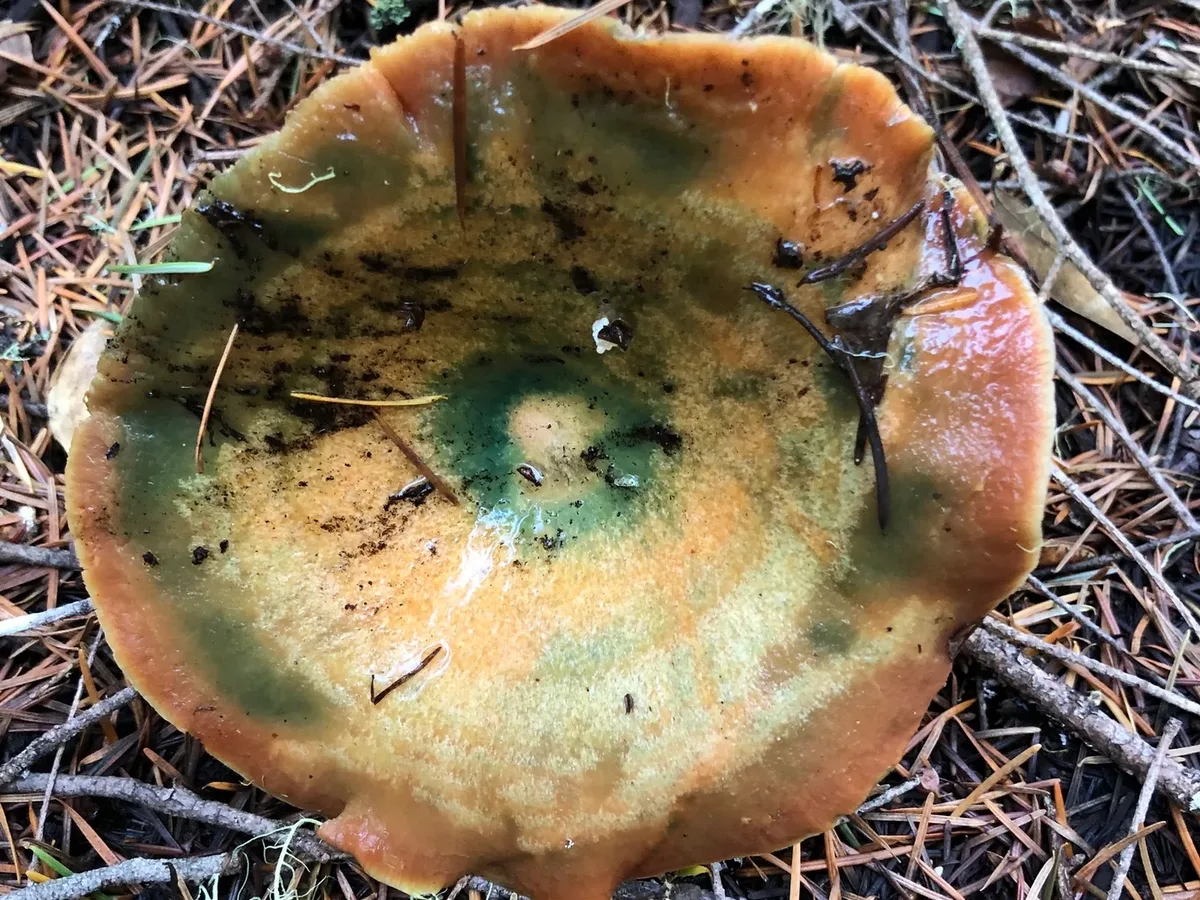 © Arvel Hernandez (CC BY-SA 4.0)
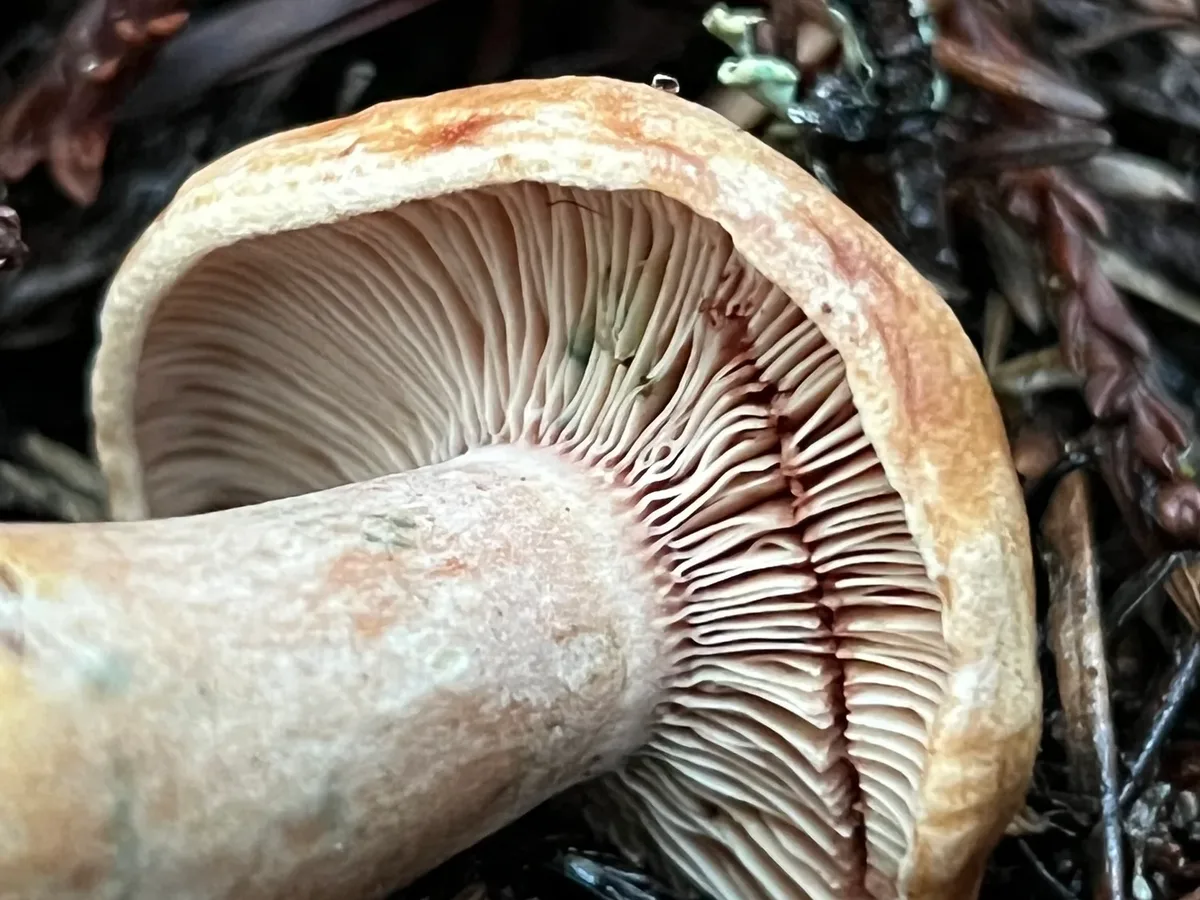 © reagan peschke (CC BY 4.0)
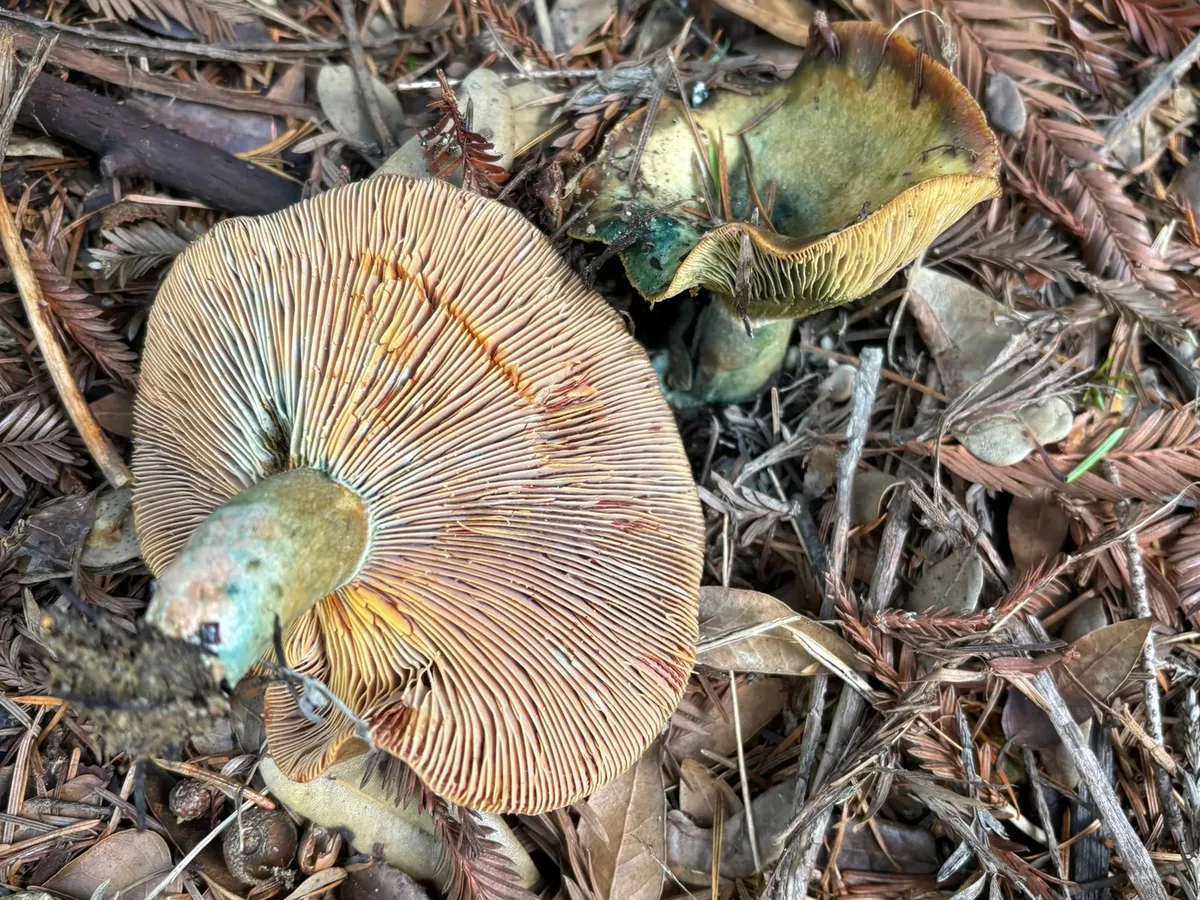 © reagan peschke (CC BY)
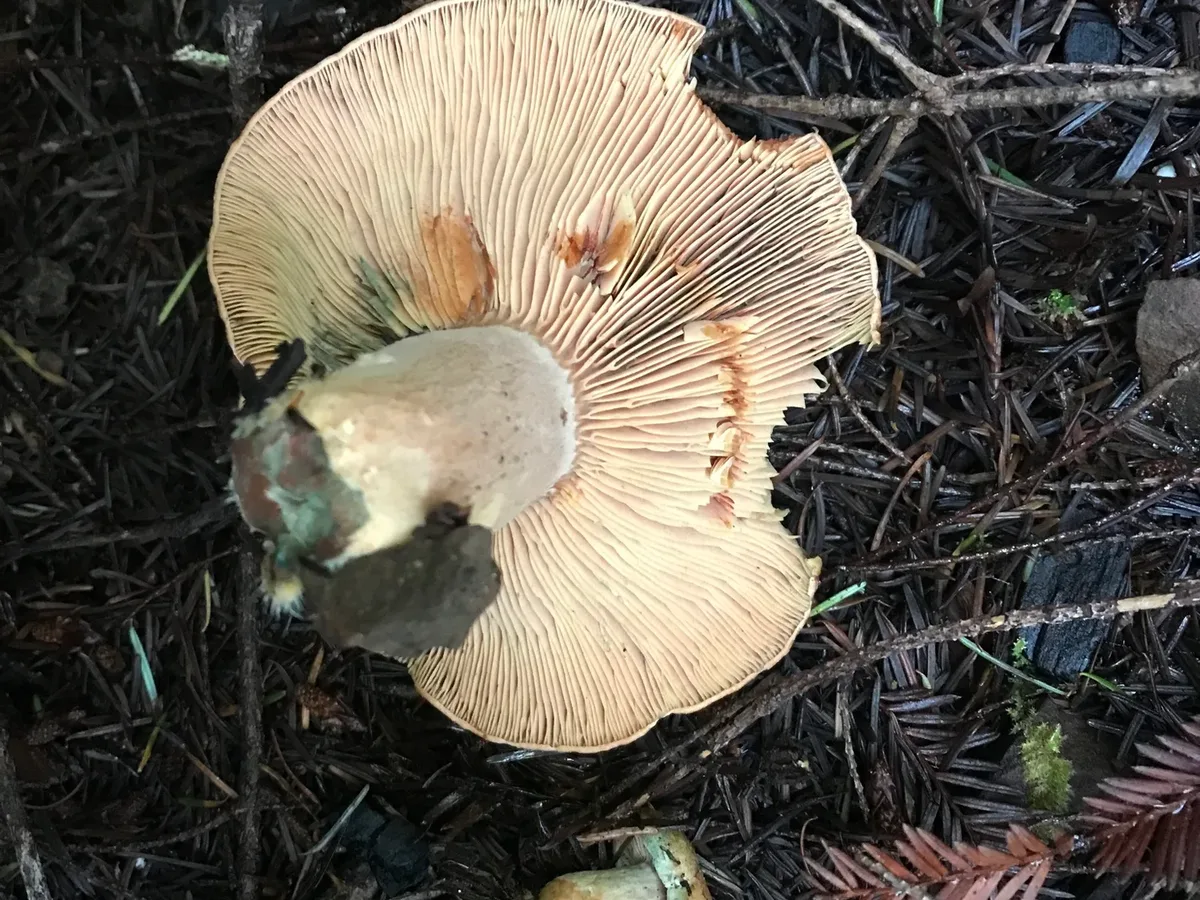 © Matthew Rozanoff (CC BY)
 © Matthew Rozanoff (CC BY)
 © Matthew Rozanoff (CC BY)
 Chuck Wilson (CC0)
 Chuck Wilson (CC0)
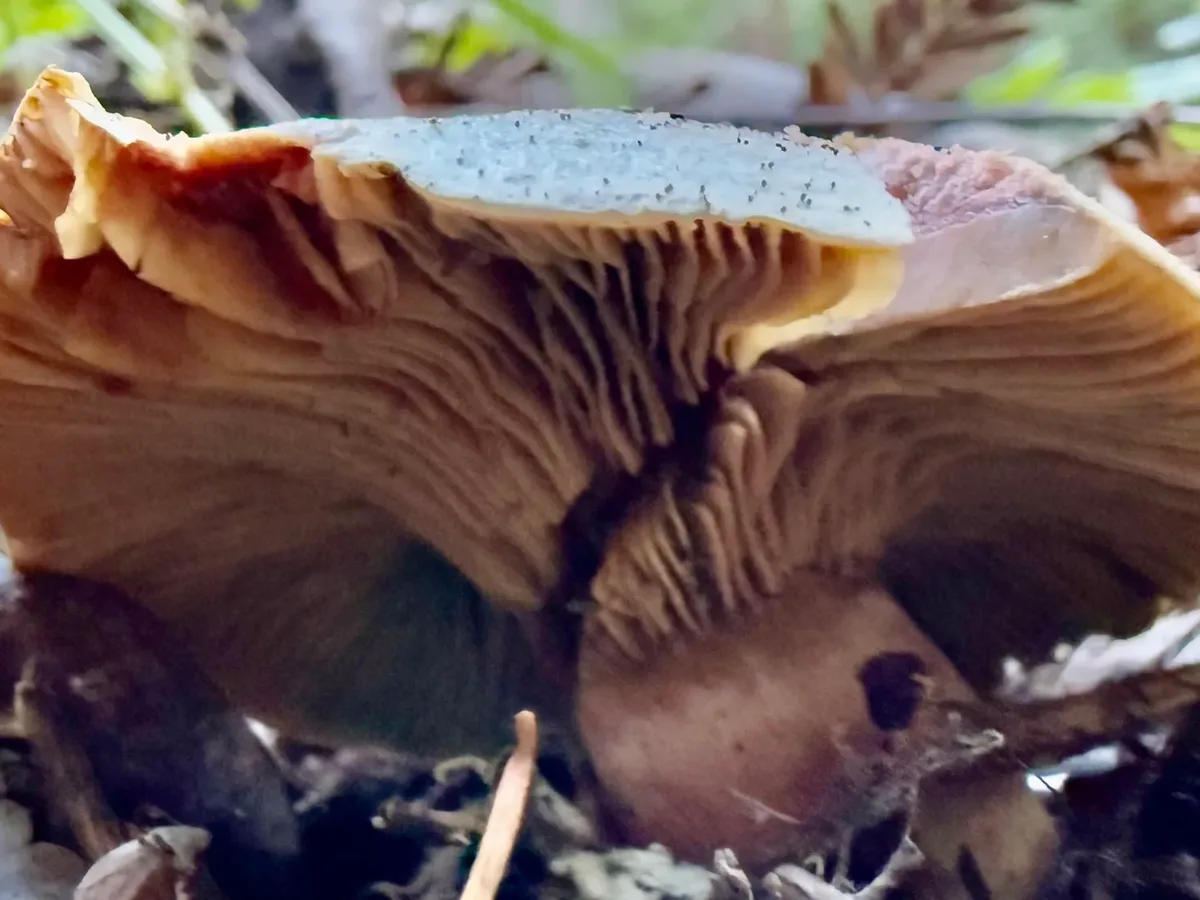 Chuck Wilson (CC0)
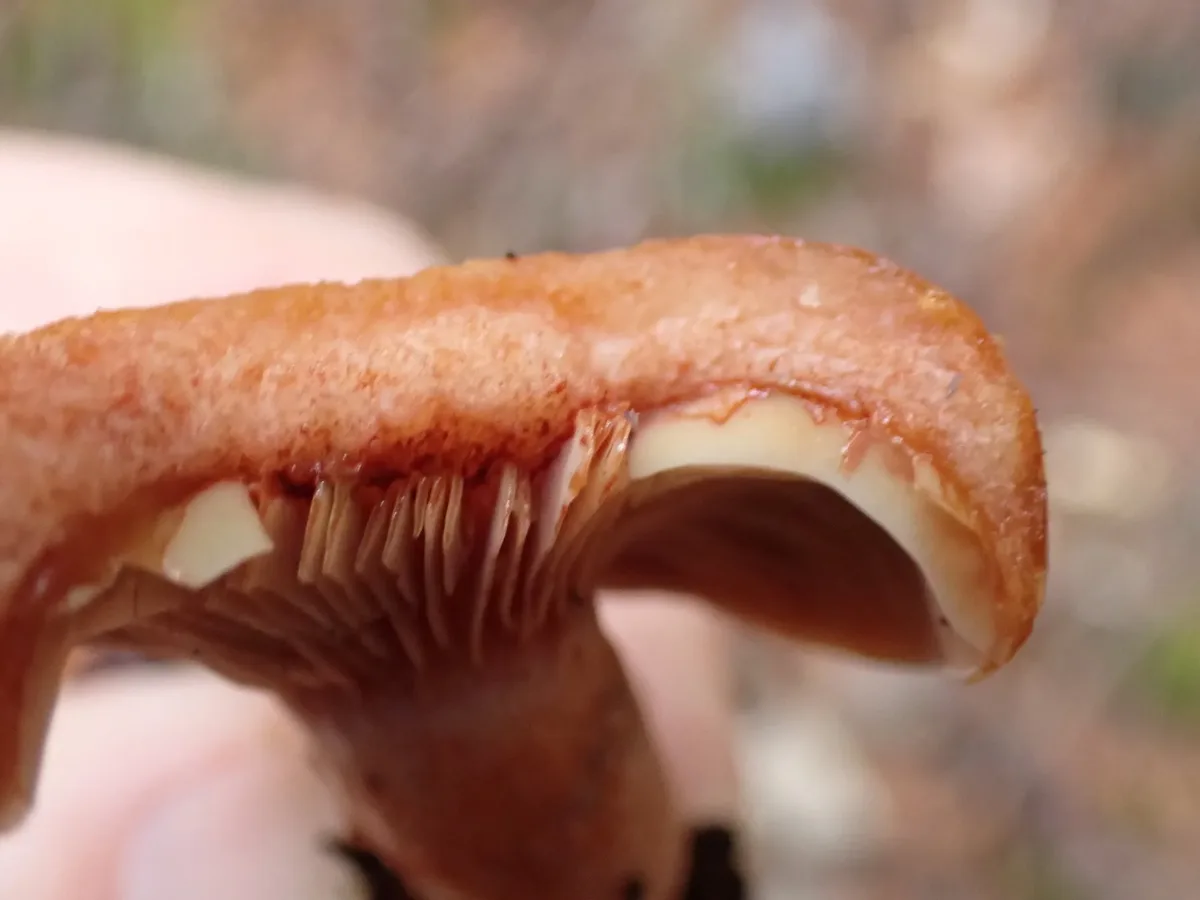 Randal (CC0)
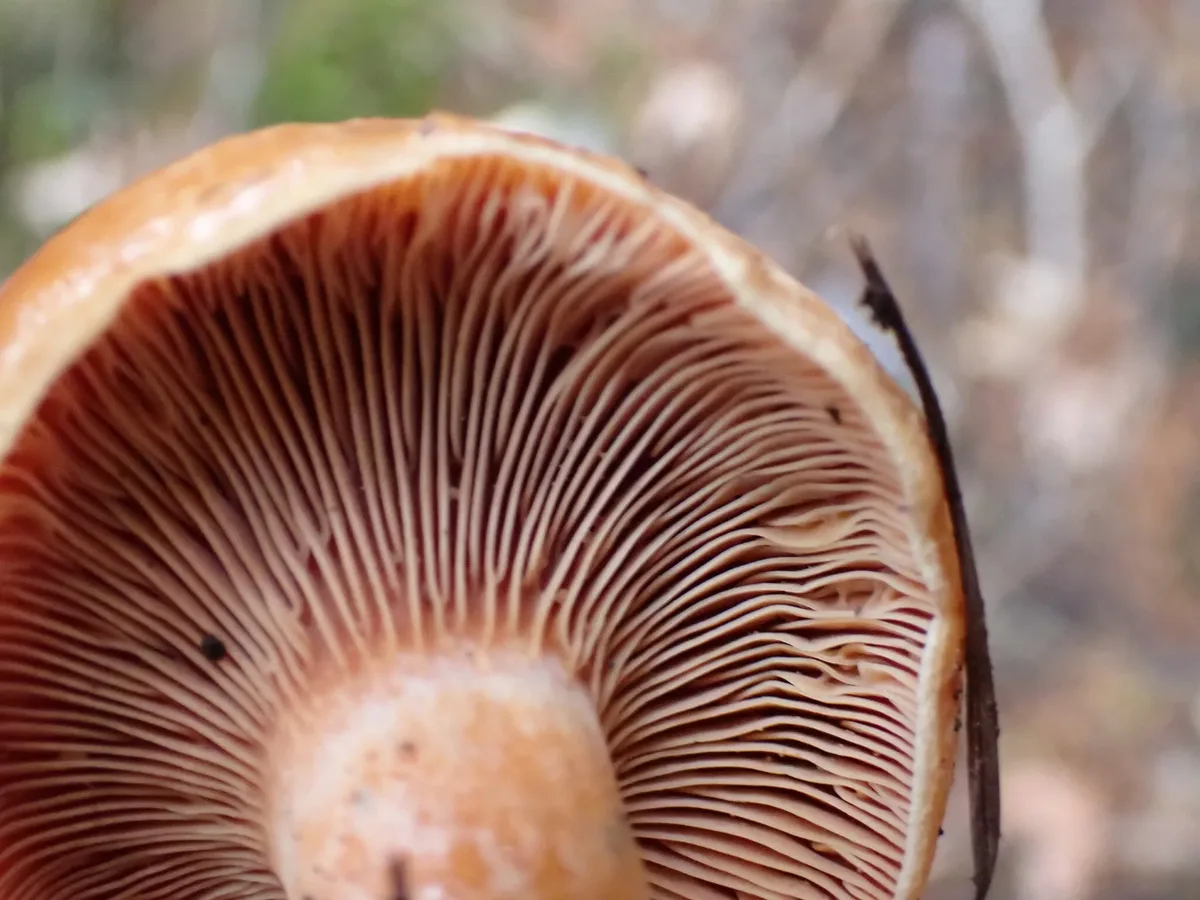 Randal (CC0)
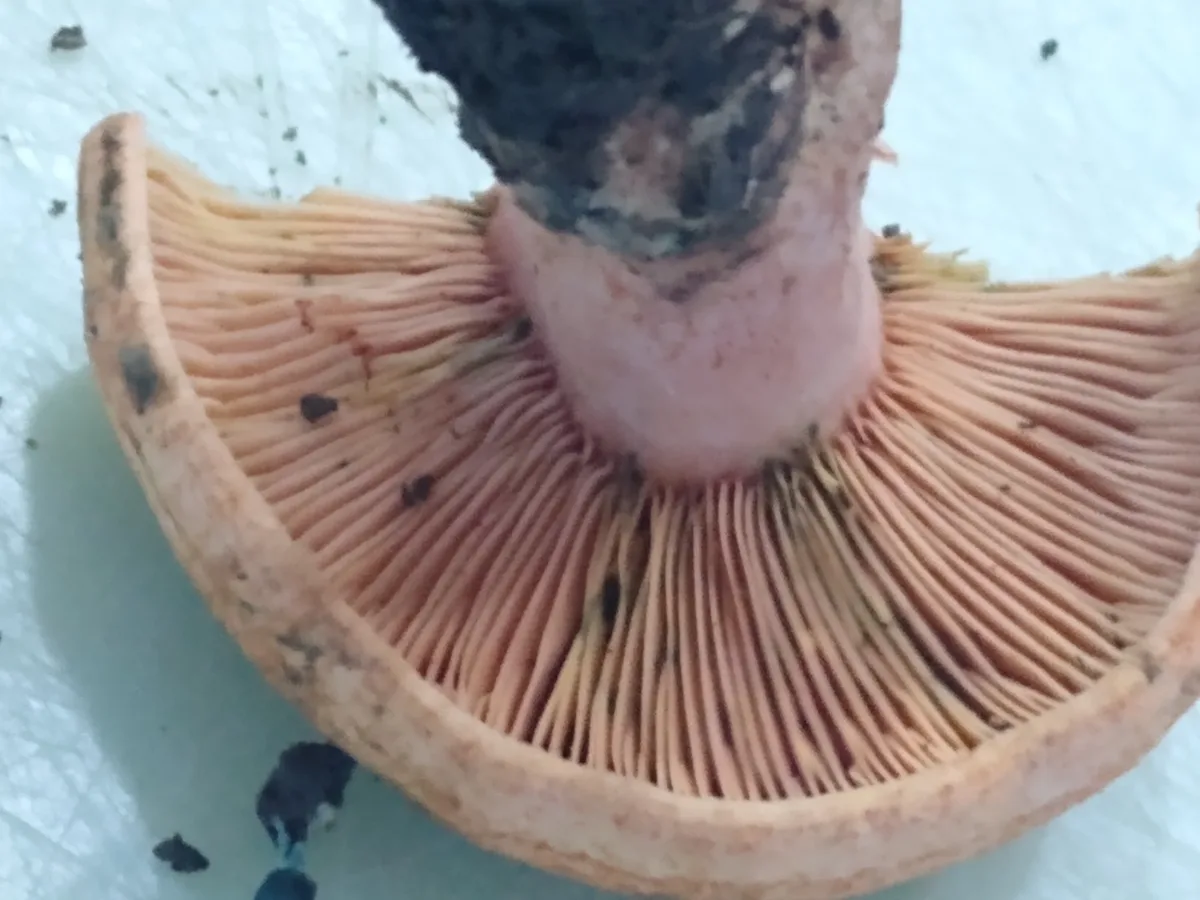 Tom Gulya (CC0)
 © pinonbistro (CC BY-SA 4.0)
 Tom Gulya (CC0)© Arvel Hernandez (CC BY-SA 4.0)© reagan peschke (CC BY 4.0)
Good to eat, once you have identified it with certainty and cooked it through.
How to recognise it
Lactarius rubrilacteus is the Pacific Northwest's answer to the Old World bloody milkcap, Lactarius sanguifluus, and shares with it the single most dramatic identification feature in the genus: blood-red latex that flows immediately and copiously from any cut or wound.
Cap
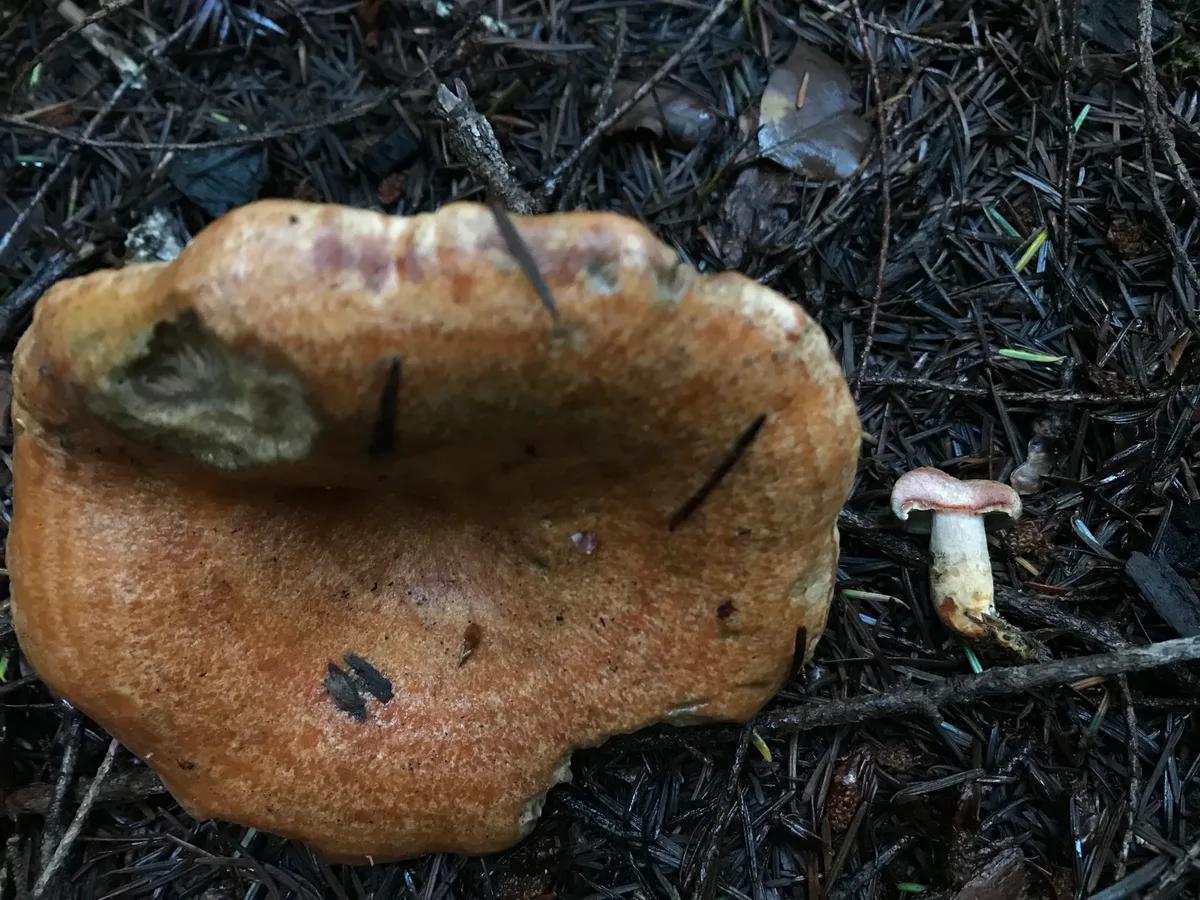
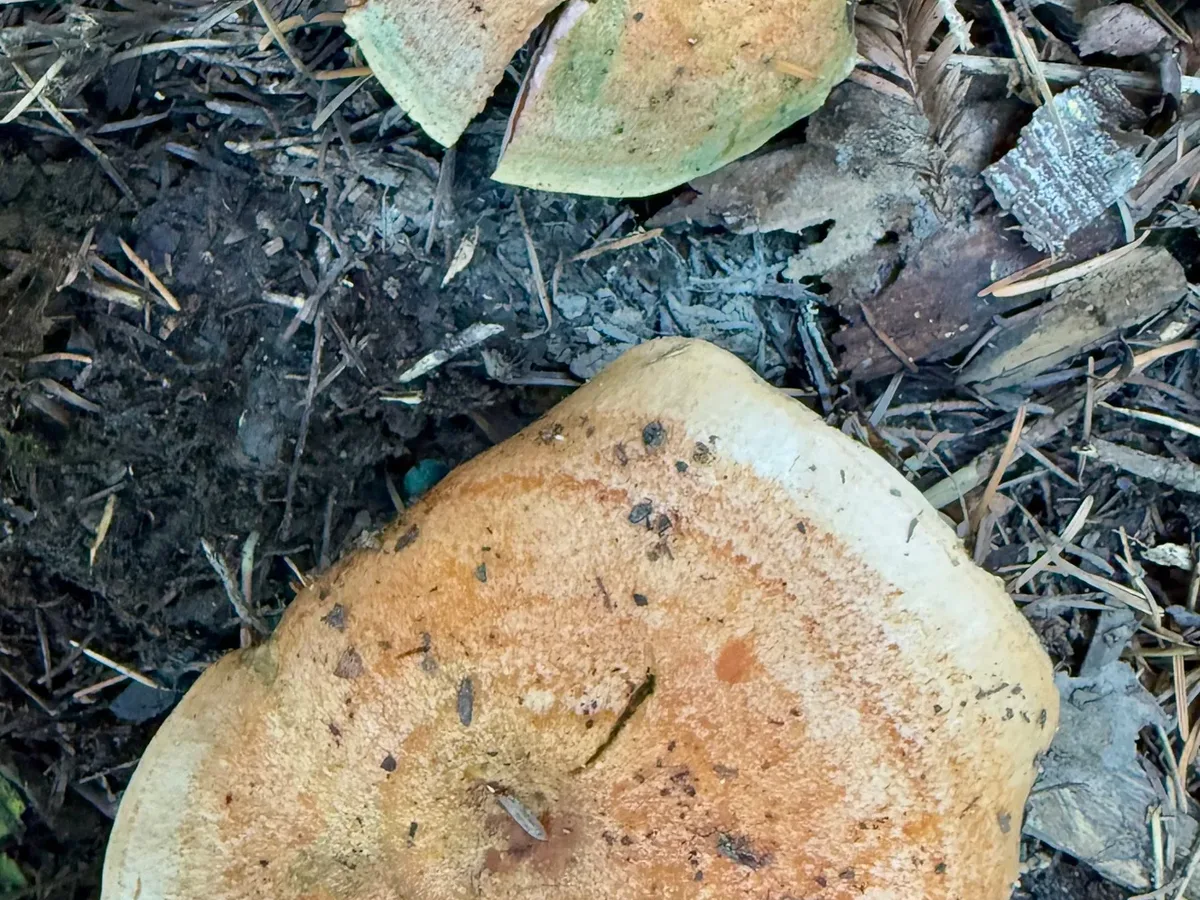
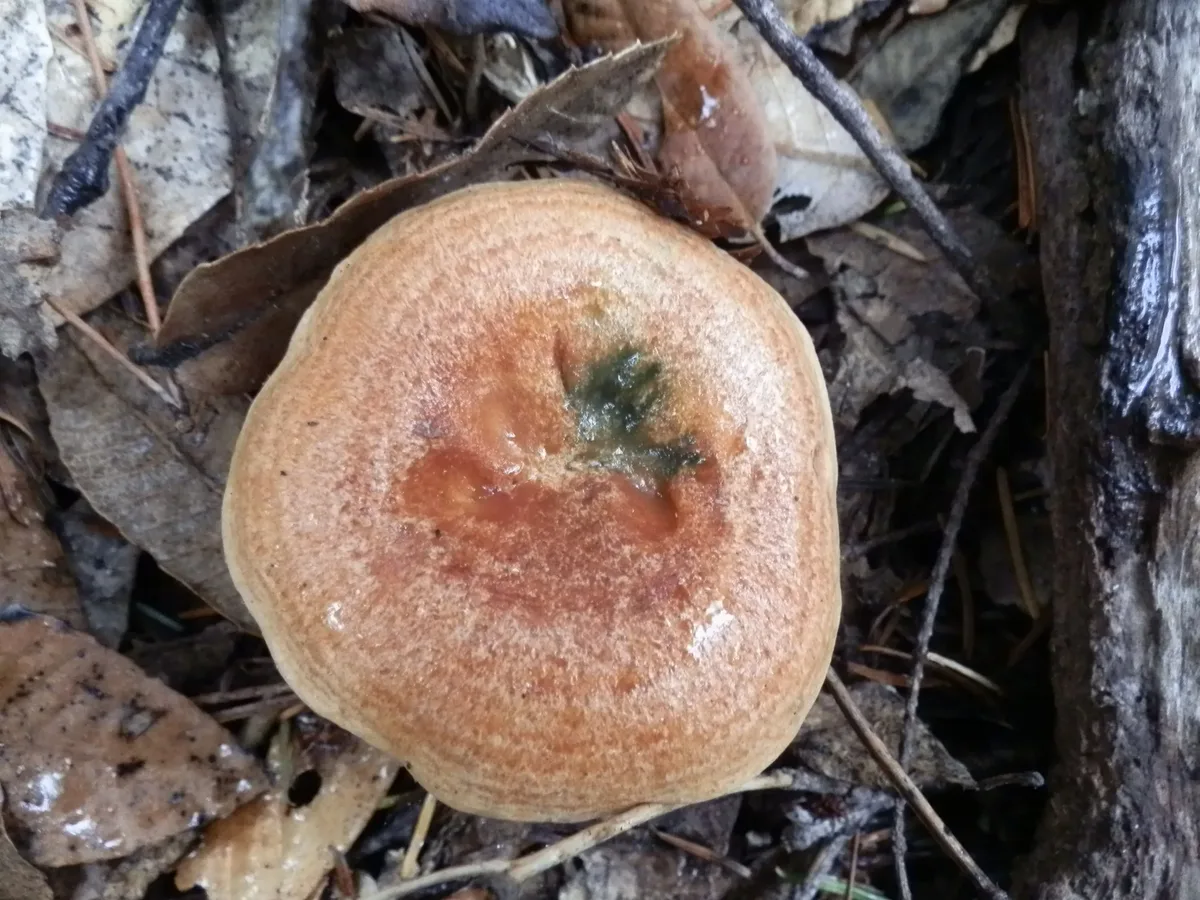
The cap begins as a firm, convex button with a tightly inrolled margin, the surface a dark, saturated reddish-brown to brick-red or liver-red, often with faint concentric banding.
As it matures the cap flattens then becomes centrally depressed, sometimes funnel-shaped, and the margin relaxes to wavy and irregular.
Old caps frequently show patches of dull greenish stain near the margin - the dried residue of old latex slowly oxidising - and in very mature or wet specimens the surface may develop an irregular, almost mottled appearance.
Gills
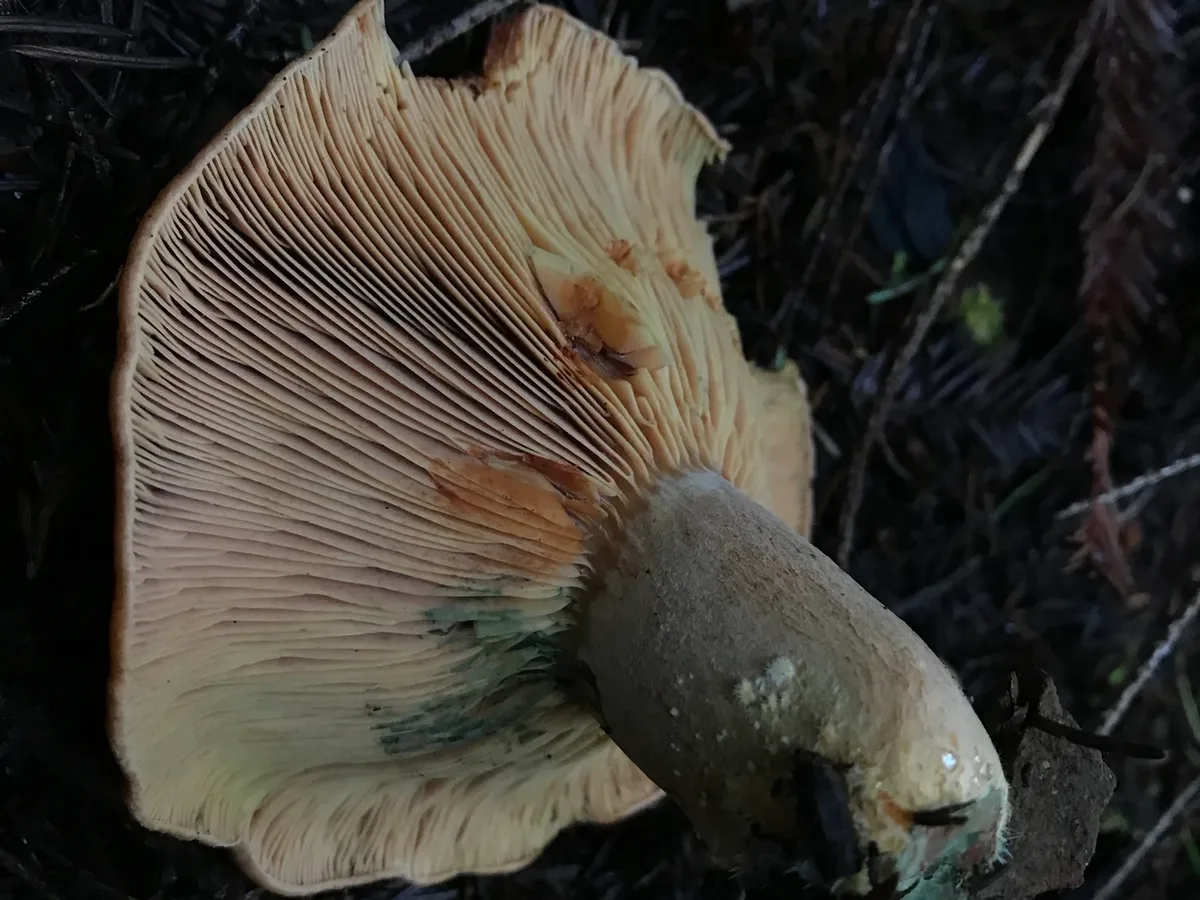
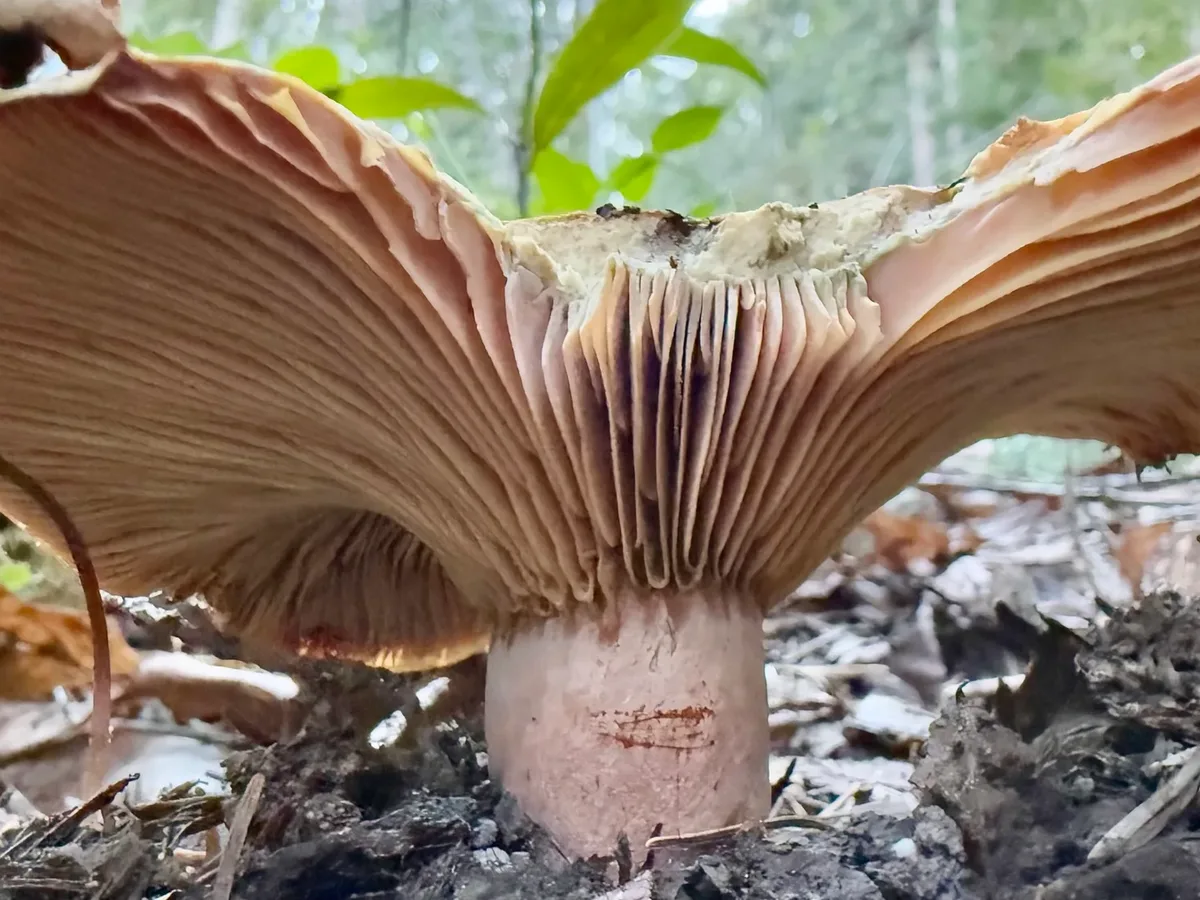
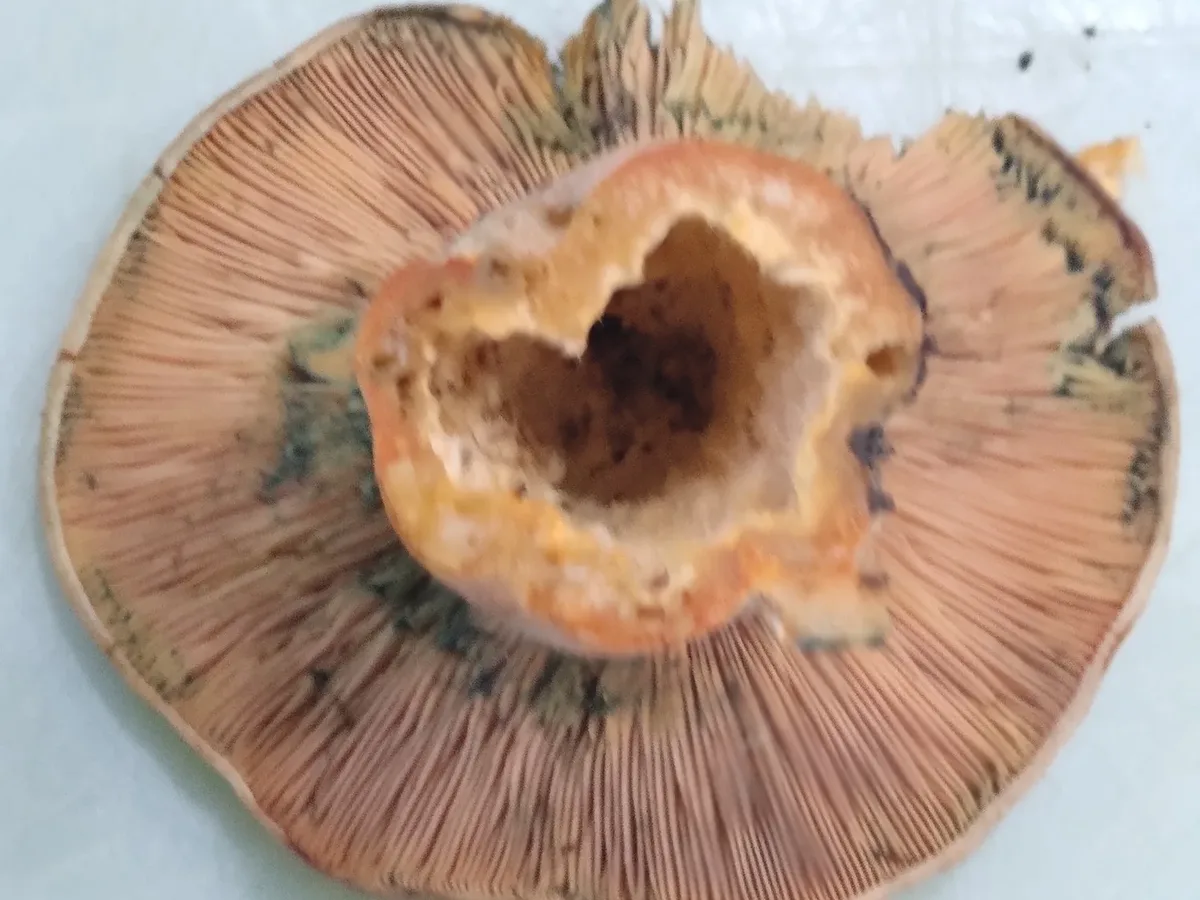
The gills are the most reliably diagnostic feature in a fresh specimen: pale salmon-apricot when untouched, they transform within seconds of any damage, releasing dark blood-red latex that saturates the tissue and leaves a permanent carmine stain.
Leave it for 15-30 minutes and the stained area shifts further, from carmine toward dull greenish-olive - a slow oxidation sequence that echoes the more pronounced green-staining reaction seen in L. deliciosus, though the end colour in L. rubrilacteus is greener-brown and less vivid green than in that species.
Stem
The stem matches the cap in colour, is solid and stout, and - a helpful field mark on well-developed specimens - may bear scrobiculate pitting, small rounded depressions on the surface, coloured slightly brighter orange-red than the surrounding cortex.
Flesh
Slice the stem: the flesh is pale, nearly white, and immediately bleeds the same dark red latex.
The spore print is pale cream-yellow.
Where & when it grows
Habitat
In the Pacific Northwest, L. rubrilacteus is a creature of the great conifer forests, growing most reliably in the Douglas-fir zone from the coast ranges to the western slopes of the Cascades, and less commonly in the drier mixed-conifer forests of the eastern Cascades and the Sierra Nevada foothills of northern California.
It is most productive in mature or old-growth stands where undisturbed duff and well-established mycorrhizal networks allow the mycelium to persist for decades.
Look for it on forest floors carpeted with oxalis, bunchberry, or sword fern, under Douglas-fir with Pacific silver fir or western hemlock as co-dominants, at mid-elevations where autumn moisture arrives early.
In Oregon and Washington it is especially consistent in the western foothills of the Cascades and in the Olympics. In northern California it reaches into the mixed Douglas-fir / tan-oak forests near the coast.
It does not venture far from conifers and is essentially absent from pure deciduous woodland.
When
The bleeding milkcap belongs to the great autumn flush that transforms Pacific Northwest conifer forests each October. The first significant rains of the wet season - typically arriving in September in the north, October in the south - trigger fruiting after the long summer drought.
- In British Columbia and the Washington Cascades, prime picking begins in early to mid-October.
- In the Oregon coast ranges, the best flushes are typically mid-October to mid-November.
- In northern California and at lower elevations with milder, wetter conditions, fruiting may extend through December and occasionally into January.
The peak consistently falls in the six-to-seven-week window of weeks 40-47 (early October to late November), when soils have cooled but have not yet approached freezing. Hard freezes terminate the season abruptly.
In exceptional years with early rains, scattered fruitbodies appear as early as late September at higher elevations near the fir-hemlock transition.
How it grows
Strictly mycorrhizal with Pacific Northwest conifers, L. rubrilacteus fruits singly or in loose groups of two to five, scattered across the duff rather than clustered at a single point. It does not grow in fairy rings or dense colonies.
Young buttons push up through the needle duff as firm, rounded, dark-red humps that can be easy to overlook against the dark forest floor until you know the colour.
A productive site - a particular stand of mature Douglas-fir with established mycelium - will fruit reliably year after year and is worth returning to annually.
Growth from pinhead to full maturity takes approximately five to eight days in cool, moist autumn weather.
Fruiting conditions
Fruiting is triggered by the first sustained autumn rains (≥30 mm over 14 days) ending the Pacific summer drought, once soil temperatures have dropped into the 6-15 °C range. In the Pacific Northwest this corresponds to mid-September through November, with the core flush in October-November. A lag of one to two and a half weeks from significant rain to visible fruitbodies is typical for ectomycorrhizal milkcaps of this type. Hard frost terminates the season.
Look-alikes
No deadly species reliably resembles Lactarius rubrilacteus given its specific combination of dark reddish-brown cap, dark blood-red latex, and conifer habitat.
The most important comparison is with Lactarius deliciosus (saffron milkcap) and its Pacific coast relative Lactarius rubidus (candy cap lookalike - though L. rubidus is distinct from L. rubrilacteus).
- Lactarius deliciosus sensu lato in North America has distinctly carrot-orange latex (not dark blood-red) and develops vivid green staining much more rapidly and intensely than L. rubrilacteus.
- Lactarius semisanguifluus has latex that starts pale orange-red and only slowly darkens to wine-red over five to fifteen minutes, whereas in L. rubrilacteus the latex is dark blood-red from the first instant of cutting.
- Lactarius chrysorrheus has yellow latex that turns slowly yellow-green and grows under oak.
- White-latex species such as Lactarius piperatus, L. vellereus, and L. controversus can share conifer or mixed-forest habitat but are immediately separated by their white to cream caps, the complete absence of red or orange colouration, and their white (never coloured) latex; most are also strongly acrid-peppery in taste.
- The indigo milkcap (Lactarius indigo), a species of eastern North America and Mexico, exudes blue latex and is easily separated by its blue-grey colouration and geography.
No deadly Lactarius or Lactifluus species produces dark blood-red latex of the type seen in L. rubrilacteus, making this an unusually safe identification target once the coloured-latex character is confirmed.
A different Pacific Northwest milkcap, L. rubidus (candy cap) has a much smaller, thin-fleshed pale orange-brown cap and exudes sparse, watery, pale-coloured latex with no blood-red character. Fresh specimens smell faintly sweet; dried specimens develop a powerful maple-syrup aroma - entirely absent in L. rubrilacteus. A very different species in practice.
Very large, white, velvety-tomentose cap; white acrid latex; no colour resemblance whatsoever. Inedible (acrid, mildly toxic raw). Distinguished instantly by white colour, velvety cap texture, and strongly peppery-bitter taste.
Very similar latex colour but L. semisanguifluus has latex that begins pale orange and only slowly (5-15 minutes) darkens to wine-red. In L. rubrilacteus the latex is immediately and intensely dark blood-red. L. semisanguifluus is primarily a Mediterranean and European species; range overlap with L. rubrilacteus is limited.
White cap, white gills, copious white latex that is intensely acrid-peppery. No orange, red, or reddish-brown colouration at all. Shares some conifer and mixed-forest habitat. Separated immediately by colour and burning taste.
L. deliciosus has bright carrot-orange latex (not dark blood-red) from the first instant of cutting, and develops vivid, rapid green staining on cut surfaces - more intense and faster than in L. rubrilacteus. Cap banding is more vivid orange-carrot. Both are edible; confusion is harmless but worth resolving for accurate ID records.
In the kitchen
Picking & cleaning
Select young to medium-aged specimens with caps still somewhat convex or at most flat, the margin still slightly inrolled, and the flesh firm throughout. Fully expanded, flattened, old caps are past their prime and often show extensive greenish staining; they are still edible but of inferior texture and flavour.
- Cut at the base with a knife - do not pull, as this disturbs the mycelium and compacts the duff.
- Always carry out a field-cut before bagging: slice through the stem with a knife and observe the latex colour on the freshly cut surface. Dark blood-red (not pale orange, not white) appearing within seconds is the key confirmatory sign.
- The red latex will permanently stain fingers, clothing, and light-coloured baskets; experienced collectors use a dark basket or plastic bag.
- Brush off debris with a soft brush rather than washing in the field - the flesh is dense and does not absorb water readily.
- Insects rarely infest young specimens but may enter the stem base of older ones; split the stem to check.
Cooking
The flesh is firm, dense, and holds its texture well through cooking, making it a genuinely useful culinary mushroom.
The flavour is mild and pleasant, reminiscent of other milkcaps in the L. deliciosus group - a subtle, resinous, slightly nutty quality without the sweetness of L. rubidus or the sharpness of acrid species.
It is best appreciated simply: sautéed in butter or olive oil over medium-high heat until the released moisture has evaporated and the flesh has browned lightly. It pairs well with garlic, shallots, thyme, and cream.
The dark red colouration largely disappears on cooking, leaving a pale greyish-brown flesh; the greenish staining in older specimens similarly fades.
It can be incorporated into pasta sauces, risotto, omelettes, and meat pies, and holds up in braises and slow-cooked preparations. It does not dry particularly well (the texture becomes tough and leathery on rehydration) but is acceptable frozen after a quick blanch.
Pacific Northwest foragers sometimes prepare it grilled whole on the campfire, in the style of Spanish a la brasa preparations for L. deliciosus - the caps hold their shape well and develop a pleasant, slightly smoky-resinous aroma.
Good to know
Lactarius rubrilacteus has a solid safety record as an edible mushroom, and no credible toxicological reports are known for this species consumed as a normal cooked food. It is collected and eaten by a significant number of experienced Pacific Northwest foragers.
The main precautions are identical to those that apply across the milkcap group:
- Always cook before eating, as consuming raw milkcaps can cause mild gastric irritation in some people.
- Confirm the latex colour in the field on every collection, because the dark blood-red response is the species' most reliable field mark.
- Avoid any milkcap with white or acrid latex, as several white-latex Lactarius species cause gastro-intestinal upset.
The greenish staining that develops on cut surfaces over time can alarm novice foragers, but it is a completely benign oxidation reaction involving lactarazulene-related pigments and is harmless.
The stain is also a helpful positive identification confirmation: blood-red that slowly shifts green on the cut flesh and gills, combined with a dark reddish-brown cap and conifer habitat, is sufficient to identify this species with confidence.
A reference guide - never an edibility guarantee. When in doubt, leave it out.