Cauliflower mushroom
Sparassis radicatasyn. Sparassis americana, Sparassis spathulata
 Drew Meyer (CC0)
 © roundabout1812 (CC BY 4.0)
 © Nelson Balcar (CC BY)
 © Garth Harwood (CC BY)
 © Garth Harwood (CC BY)
 Chuck Wilson (CC0)
 Chuck Wilson (CC0)
 Andrew (CC0)
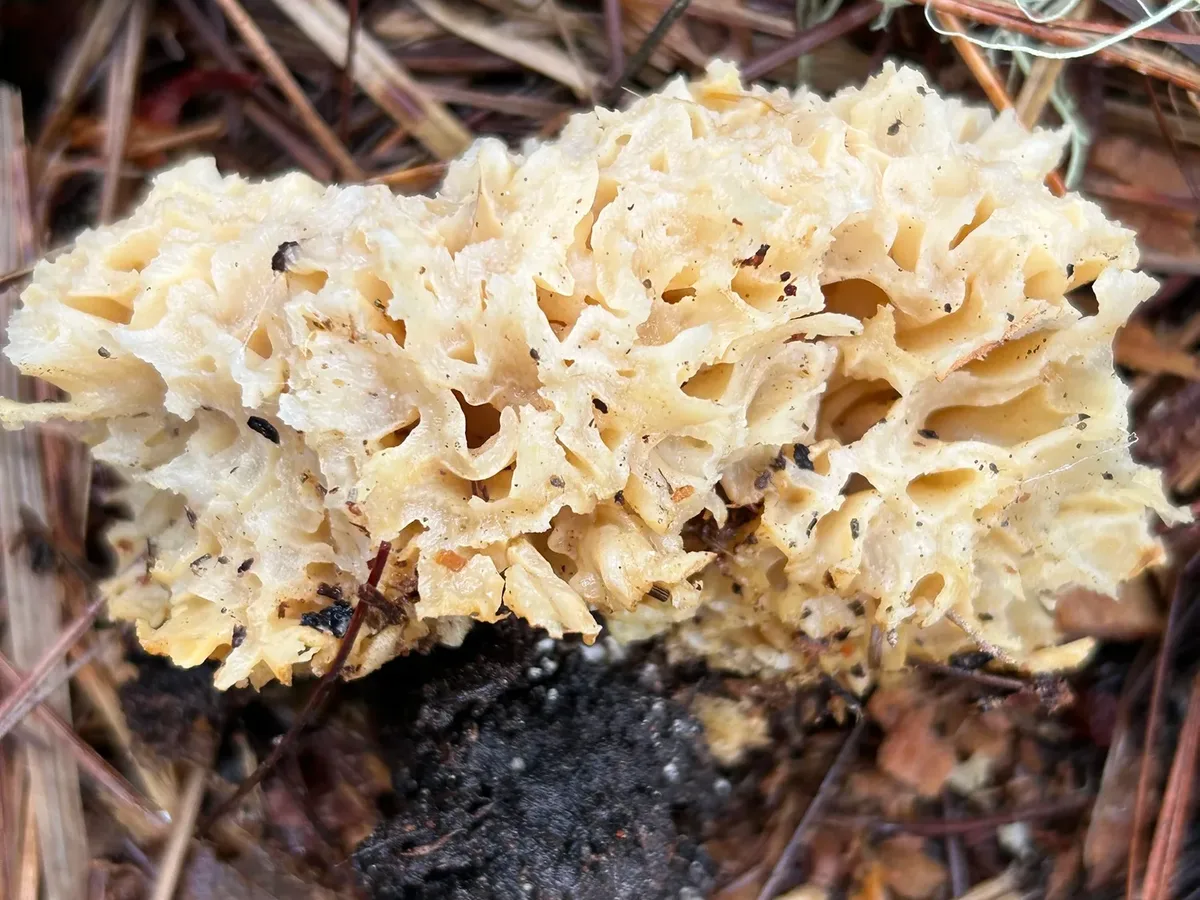 Alex Heyman (CC0)
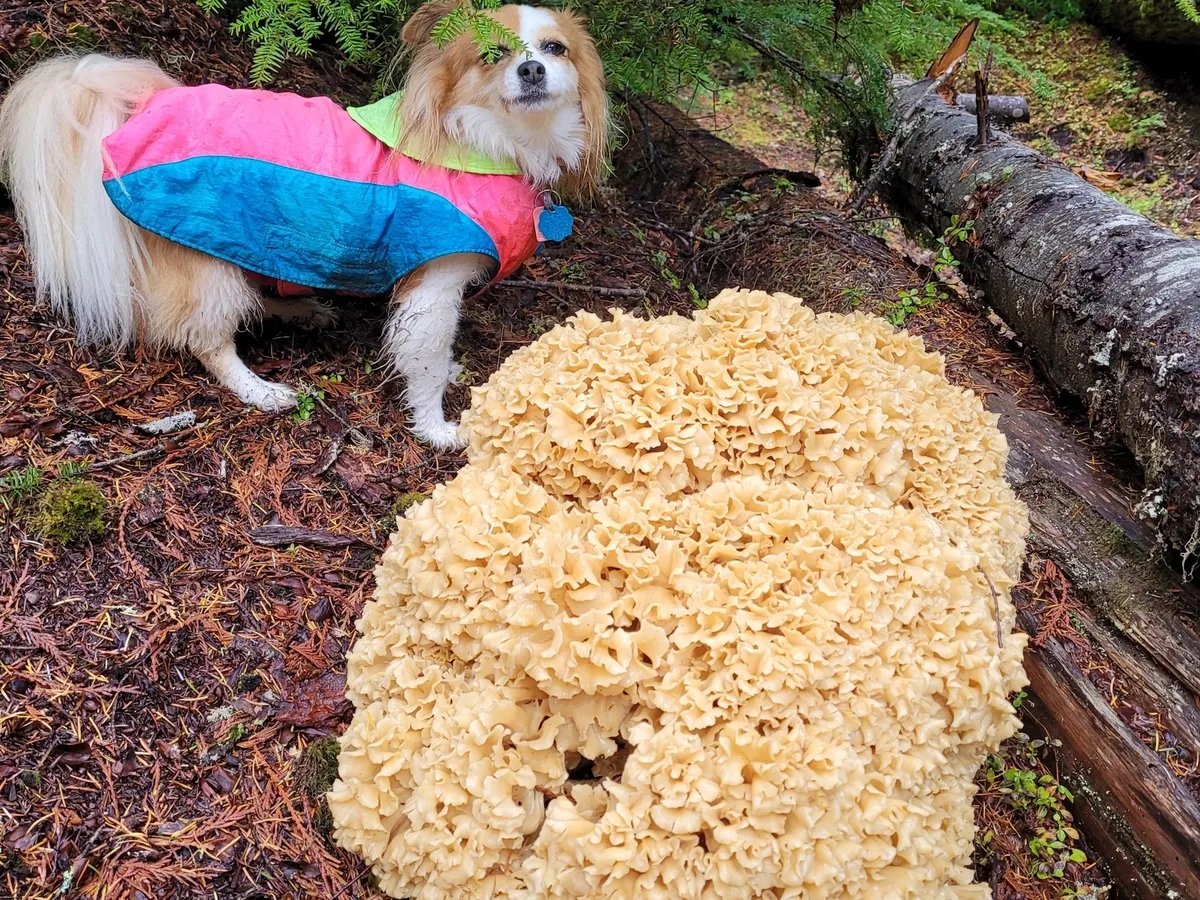 © Kathleen Dobson (CC BY 4.0)
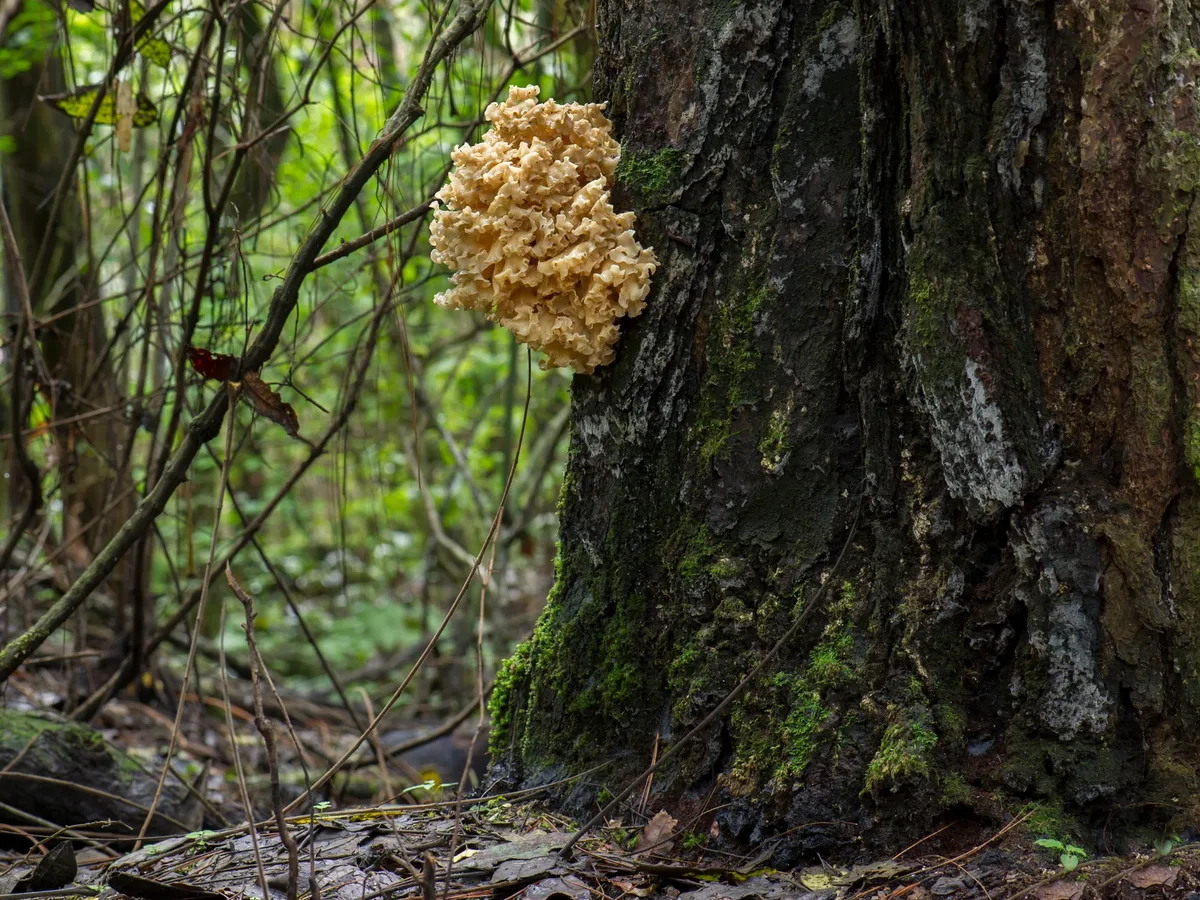 © Alan Rockefeller (CC BY 4.0)Drew Meyer (CC0)© roundabout1812 (CC BY 4.0)
One of the best mushrooms you can bring home - once you are certain of the identification.
How to recognise it
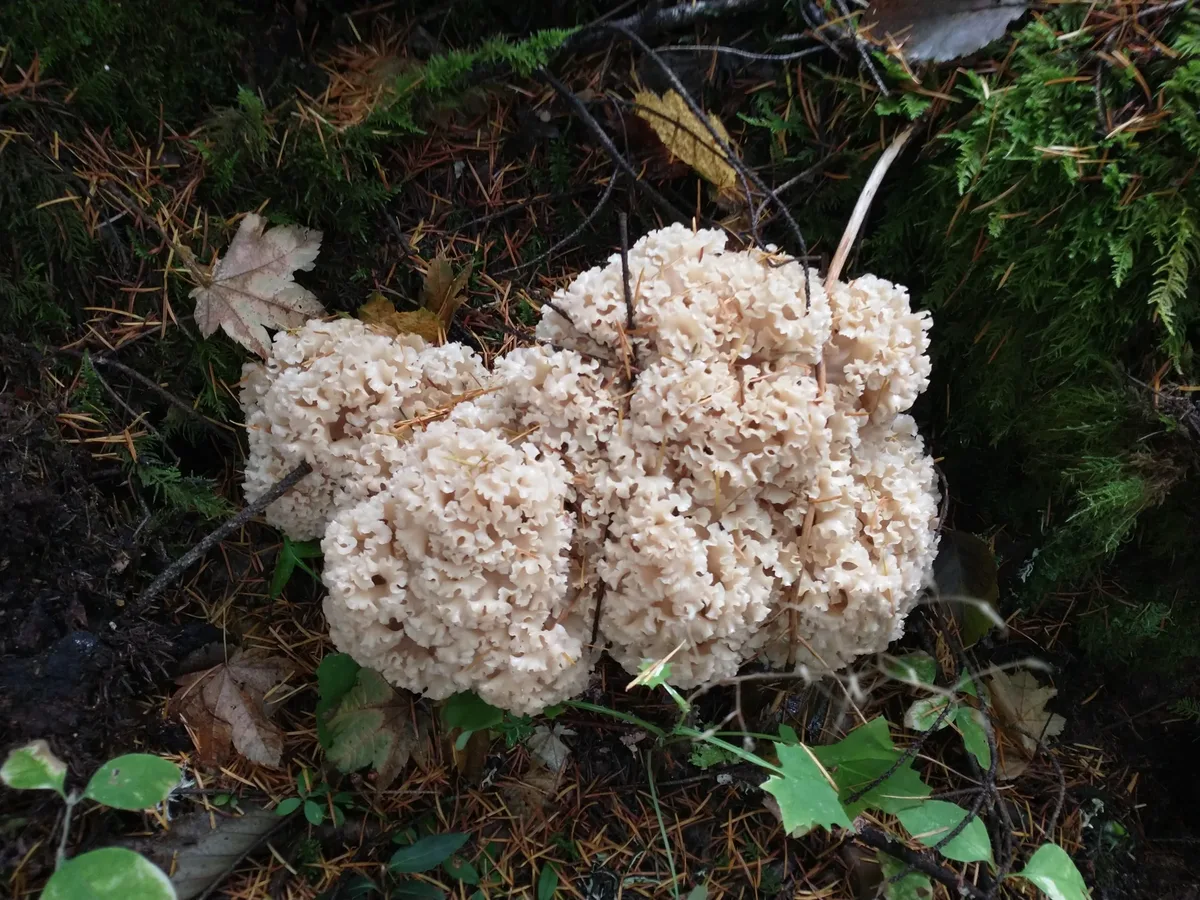
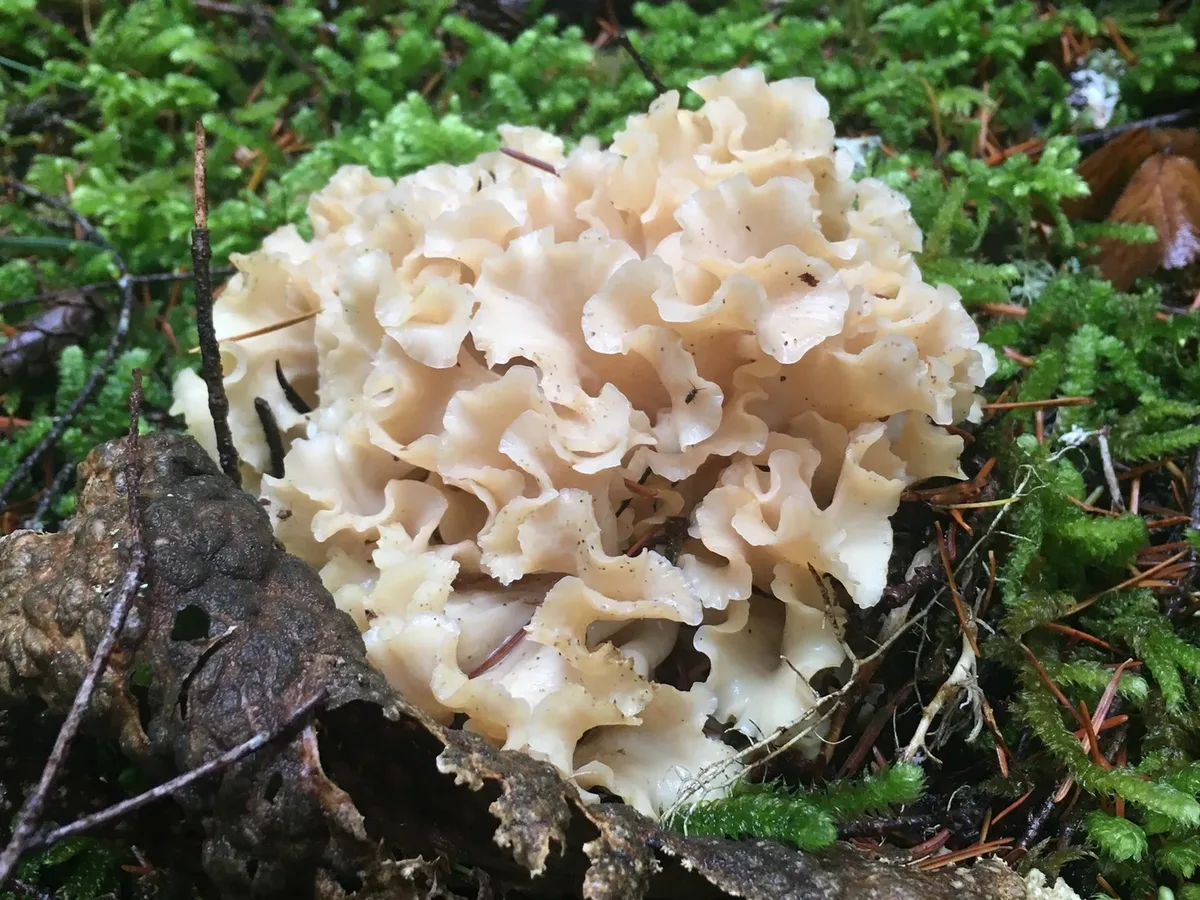
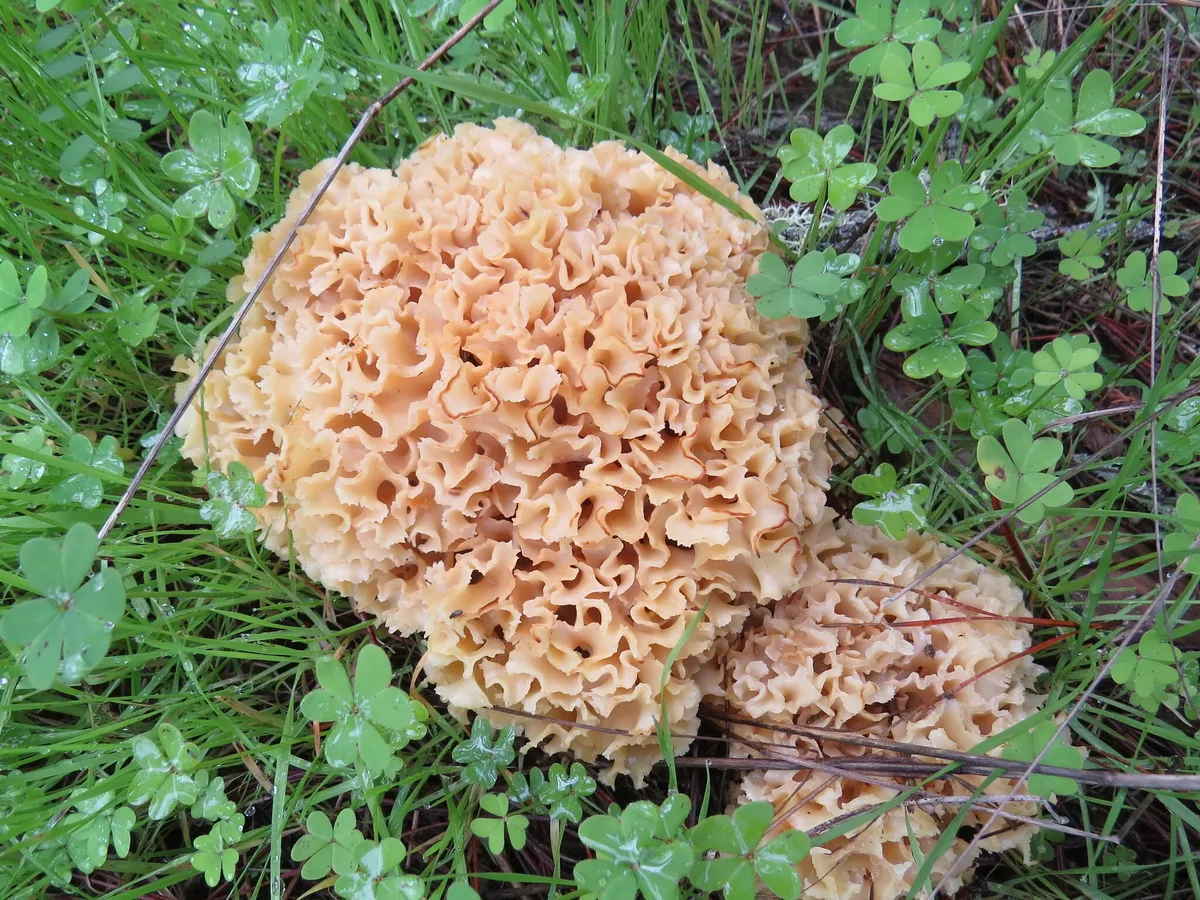
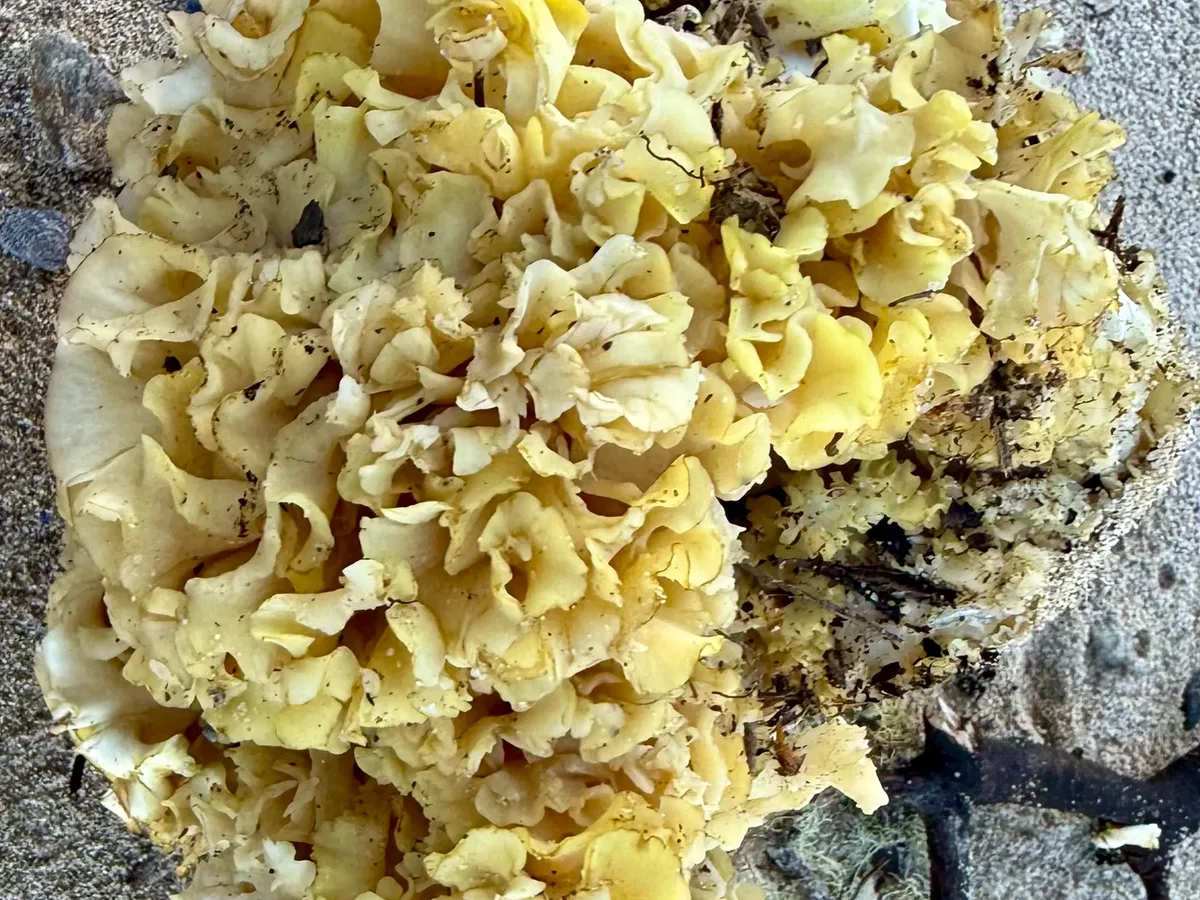
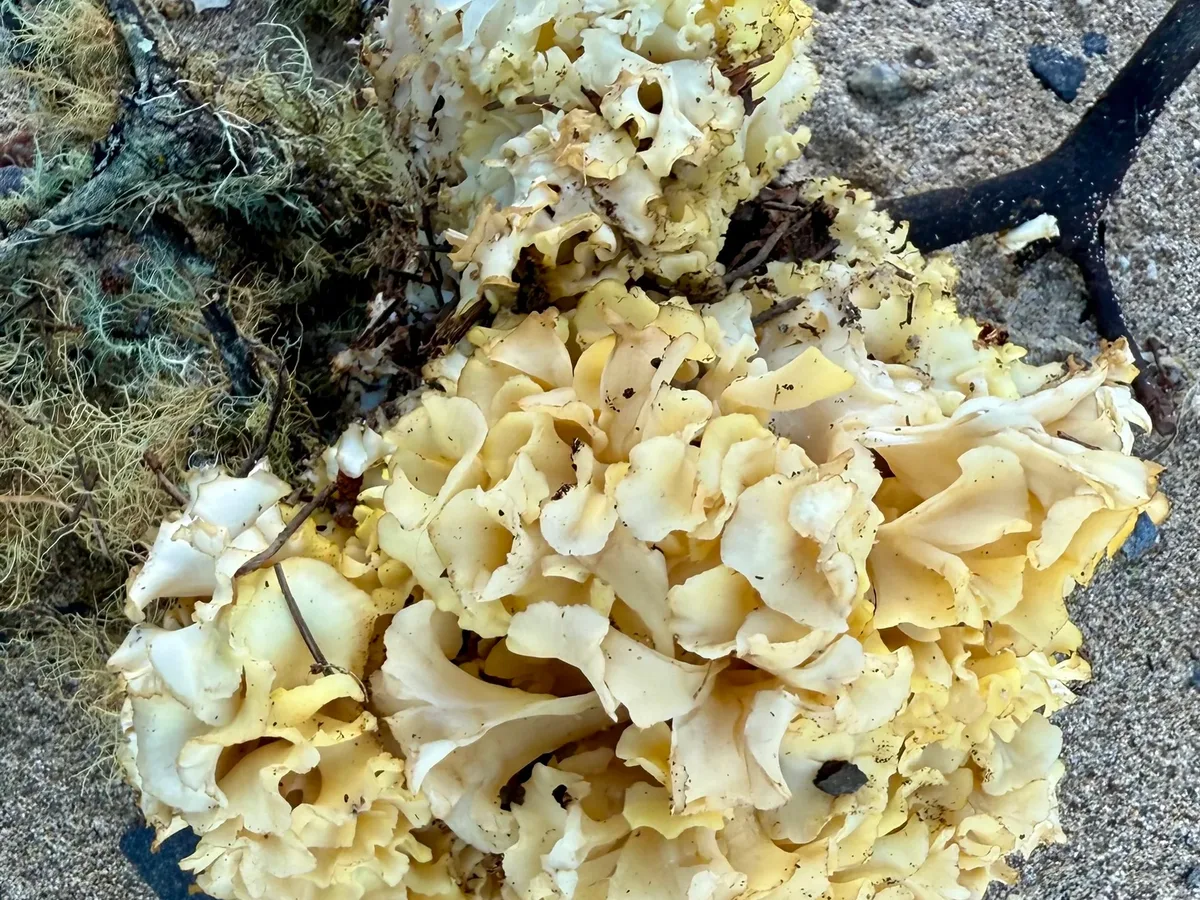
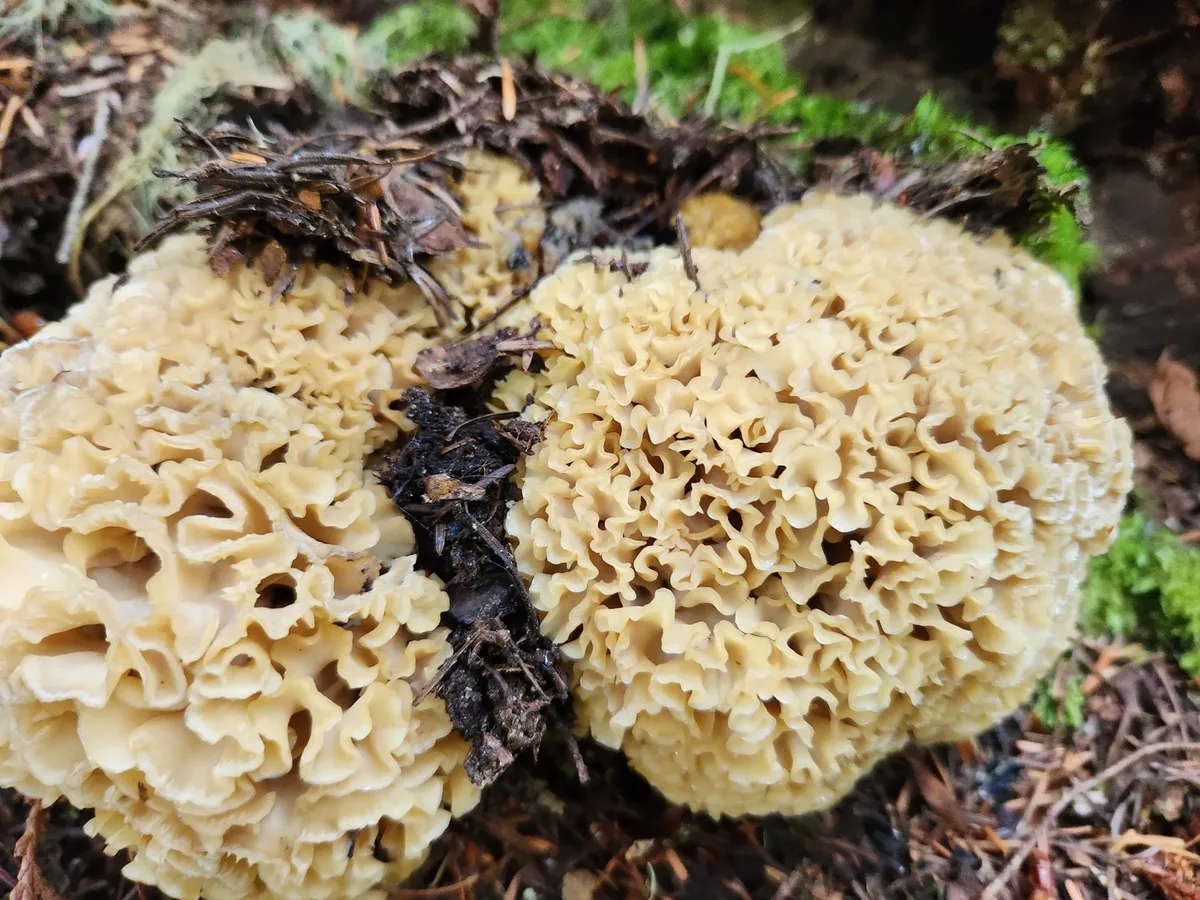
Sparassis radicata is one of the most structurally distinctive fungi in North America - a dense, globe-shaped mass of flat, wavy, ribbon-like lobes that branch repeatedly from a thick central base, producing an overall silhouette that genuinely resembles a head of cauliflower or a bleached brain.
Mature specimens range from 10 to 60 cm across and can weigh several kilograms; a full-sized fruitbody is unmistakable at distance.
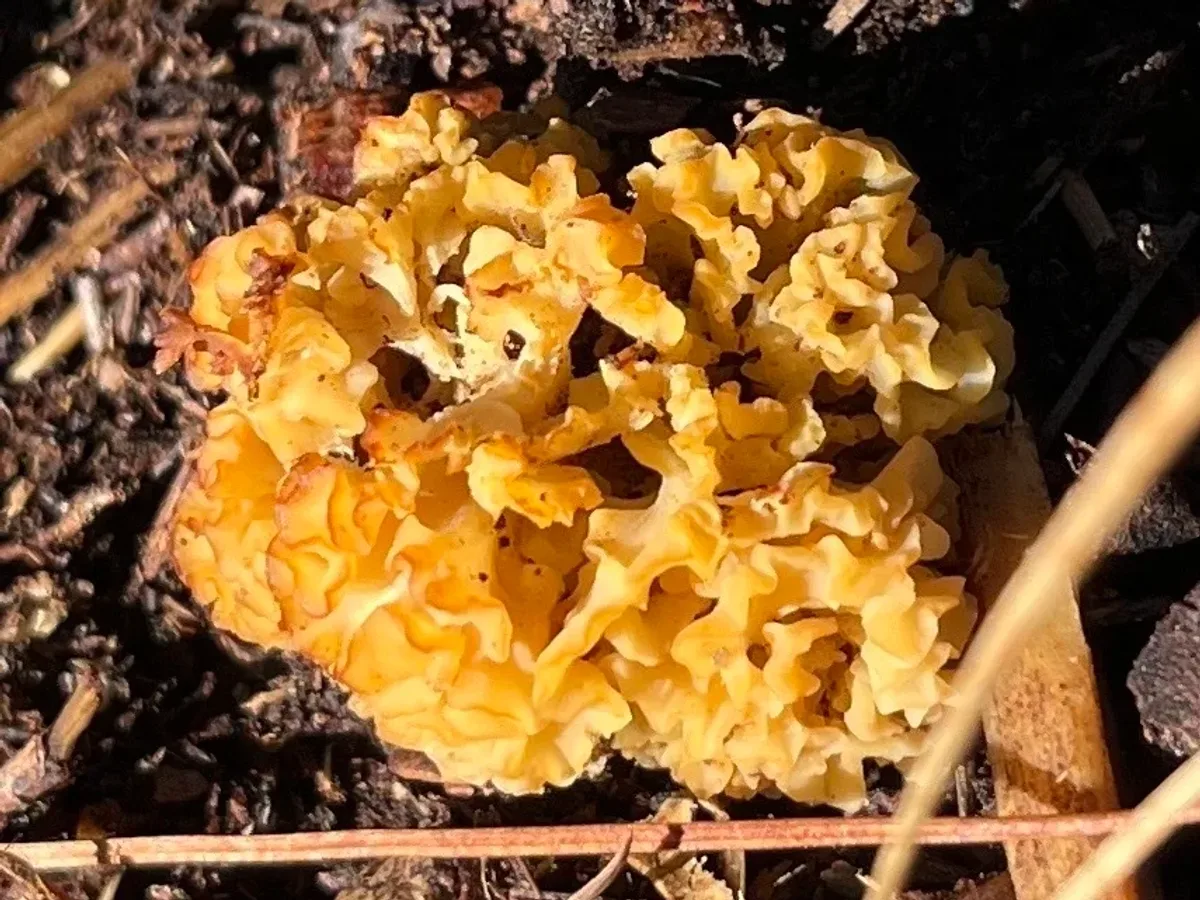
The lobes themselves are thin and somewhat elastic when fresh, their margins slightly undulating and often cream-white near the tips shading toward pale yellowish-tan at their bases. As the mushroom ages the entire structure gradually deepens to a warm golden-brown or ochre, and the lobes become progressively more rigid and brittle.
Stem
The central stem and "root" - sometimes reaching 10 cm wide and 30 cm deep - is dark brown to blackish, woody in texture, and buries itself into the host wood or soil at the base of the tree.
Flesh
When you cut a fresh lobe across the grain it has a firm, almost rubbery consistency. The spore print is white.
Smell & taste
The odor is one of its most useful field characters: distinctly spicy and faintly resinous, reminiscent of fennel or anise, nothing like the earthy or yeasty smell of typical gilled mushrooms.
That scent is partly attributable to aromatic compounds produced during active growth and is most pronounced in young, cream-colored specimens.
Where & when it grows
Habitat
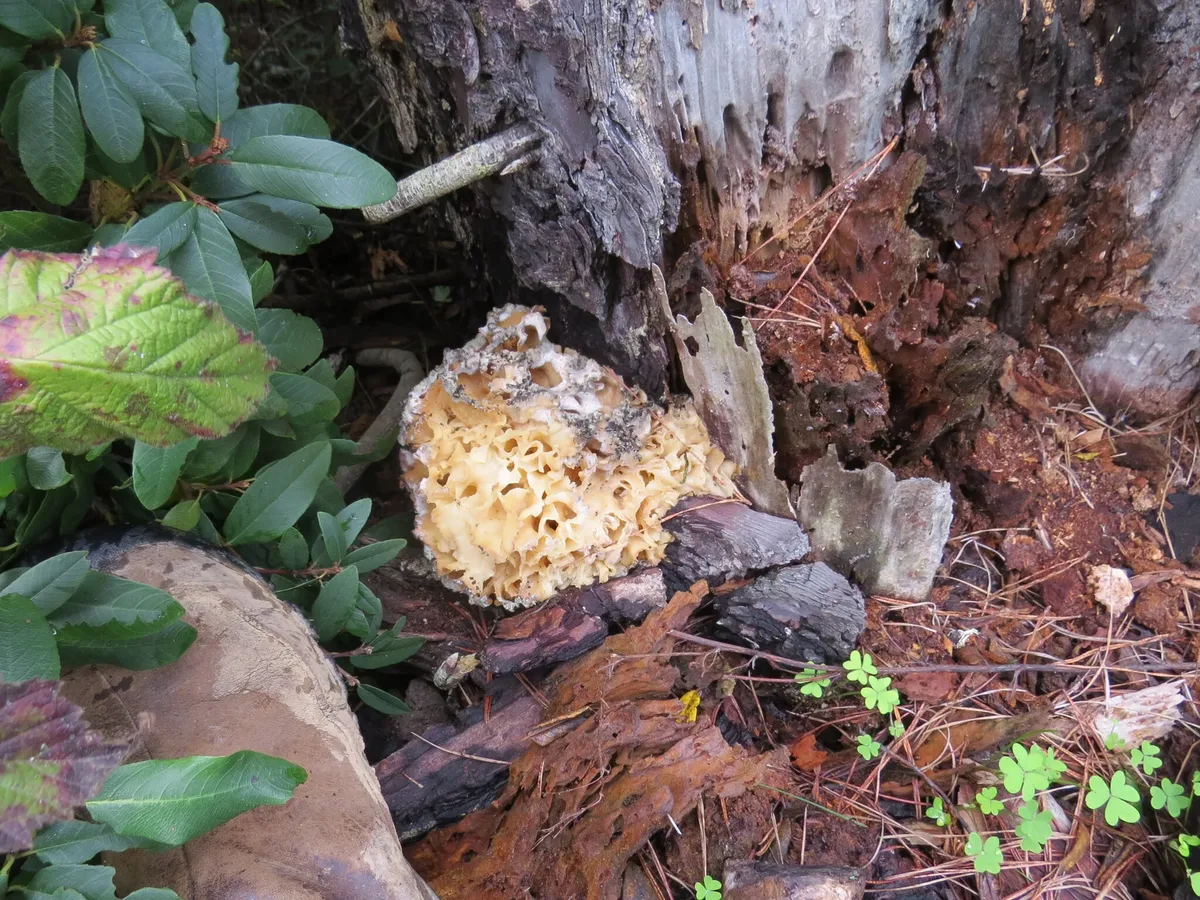
This species is a parasite and eventual saprobe of live conifers, colonizing the woody root tissue of its hosts and causing a brown cubical butt rot that can hollow out the base of a large tree over many years.
Its hosts vary by region:
- Pacific Northwest - Douglas fir (Pseudotsuga menziesii), its primary host.
- Wetter coastal forests - Sitka spruce.
- California - several pine species, particularly ponderosa and sugar pine.
The fruitbody emerges at or very near the soil line, typically within a meter or two of the main trunk, sometimes appearing to grow directly from the ground when the host root it is attacking runs shallow.
Old-growth and mature second-growth forests with large-diameter trees support the most consistent populations, though Sparassis radicata does appear in younger managed stands wherever susceptible hosts have developed substantial root systems.
Because the mycelium is embedded in living wood rather than in leaf litter, the fruitbody location is almost always predictable from year to year - the same tree or stump can produce a fruitbody for a decade or more, making once-found spots genuinely valuable to the forager who records them carefully.
When
Sparassis radicata fruits from late summer through late autumn, with the main flush across the Pacific Northwest typically running from August into November.
Peak emergence in inland Douglas fir country often follows the first substantial autumn rains after summer drought, when soil temperatures are still warm enough to drive fungal metabolism but cooling air slows evaporation from the exposed lobes.
Coastal forests with more consistent summer moisture can see earlier fruiting, sometimes in July.
Fruiting can be staggered across weeks at a single site: a fruitbody killed by an early frost may be followed a few weeks later by a second emergence from the same root network. The species is not found in spring.
Year-to-year variation in fruiting is tied more strongly to the timing and volume of late-summer rainfall than to temperature alone - a dry August followed by heavy September rain is a classic trigger.
Because the underground mycelium is perennial and deeply embedded in its host, a site that produces one year is likely to produce again in subsequent years under similar conditions, a reliability rare among large edible fungi.
How it grows
The biology of Sparassis radicata centres on a large, persistent mycelium that penetrates and digests the cellulose and hemicellulose of living conifer root wood, while largely sparing lignin - the defining chemistry of brown rot. This slow degradation can continue for years, weakening the structural base of its host.
The fruitbody forms as a single compound structure from one point of origin at the root collar, emerging already branched from the soil rather than unfolding from a simple cap-and-stem plan.
Within days of emergence a fruitbody can expand from a softball-sized nub to a 30 cm mass; under good conditions the growth rate is visible day to day.
Spores are produced over the entire surface of the lobes rather than from distinct gills or pores, and are released over an extended period.
After the main fruiting season the exposed tissue dies and collapses, but the mycelium overwinters in the root, ready to produce another fruitbody the following year if the host is still living and conditions align. The recurrence means that experienced foragers often return to exactly the same GPS point annually, sometimes for many years in succession.
Fruiting conditions
Fruits at the base of conifer hosts in late summer through late autumn following rainfall; can recur in the same spot over multiple years.
Look-alikes
No North American mushroom that shares the cauliflower-mushroom's wavy, ribbon-like, lobed structure is toxic.
The most commonly cited comparison is with coral fungi of the genus Ramaria, but the differences are structural and immediately obvious: Ramaria species are composed of cylindrical, finger-like, upright branches arising from a central base - they resemble a branching coral or antler. Sparassis radicata has flat, ribbon-like lobes that are folded and layered rather than cylindrical and upright, producing the compact cauliflower silhouette.
Additionally, Ramaria typically lacks the distinctive spicy-resinous odor of Sparassis, and its spore print ranges from buff to ochre rather than white.
The substrate and root attachment of Sparassis radicata are further distinguishing characters: the dark buried taproot connected to a conifer host is not found in any Ramaria.
No Ramaria species found in the Pacific Northwest produces a massed lobe structure that could realistically be confused with a mature Sparassis fruitbody by a careful observer.
Any forager uncertain about the identification should confirm all of the following before collecting:
- the white spore print
- the spicy odor
- the lobe shape (flat ribbon vs. cylindrical branch)
- the conifer host
Ramaria/coral fungi have a different, branched form; the cauliflower mushroom's flat, wavy, ribbon-like lobes are unique.
In the kitchen
Picking & cleaning
Sparassis radicata is among the easiest large edible fungi to identify in the Pacific Northwest - the combination of shape, substrate, scent, and host tree makes confusion with anything dangerous essentially impossible for an observer who pays attention to all four characters at once.
When harvesting, locate the attachment point and cut the fruitbody at the base of the lobe cluster rather than pulling, which can disturb the root and reduce the likelihood of recurrence. Leave the woody taproot and root interface in the ground; the underground mycelium is the productive organ, not the fruitbody.
Cleaning is the most labour-intensive part of working with this species: the sinuous lobes trap soil, pine needles, small invertebrates, and debris at every crease.
Working through the lobes under running water with a soft brush, or soaking them in salted water to float out insects, is standard practice.
Discard lobes that are slimy, very dark brown, or that have a sour smell - these are signs of bacterial breakdown in the deeper folds.
Younger, cream-coloured specimens clean far more easily and have firmer texture; very mature, brownish specimens are still edible but require more effort and have a coarser mouthfeel.
Cooking
The flavour of Sparassis radicata is mild, faintly nutty, and subtly resinous - closer to a good quality noodle than to a strongly flavoured mushroom.
Its defining culinary property is textural: the lobes retain a pleasant, slightly chewy firmness through most cooking methods, not turning soft or collapsing the way many mushrooms do. This resilience makes it especially well suited to applications where texture matters.
- Sautéing in butter or oil over moderately high heat until the edges begin to brown and crisp produces a straightforward preparation that lets the flavour speak.
- In soups and braises it holds its structure through long cooking, absorbing surrounding flavours while keeping its form.
- Separating the lobes into individual pieces and treating them as a pasta or noodle substitute in Asian-style dishes - stir-fries, hotpots, ramen - has become one of the more celebrated applications among foragers familiar with this species.
It takes seasoning readily and pairs well with conifer-adjacent flavours: butter, cream, thyme, aged cheese, smoked meats.
Dried Sparassis reconstitutes acceptably but loses much of the textural character that makes fresh specimens distinctive; refrigerated in a paper bag it keeps for up to a week, longer than most fresh wild fungi.
Good to know
Sparassis radicata is considered choice when properly prepared, and is consumed without incident across its range by experienced foragers.
The primary caution is that older specimens - those showing significant yellowing or browning, or with a sour smell in the deeper lobes - can cause gastrointestinal upset in some individuals. This is not a toxin effect in the classical sense but rather a consequence of bacterial decomposition in the dense, moisture-trapping lobe structure: breakdown products in overripe tissue can irritate the gut.
Selecting young, cream-coloured fruitbodies and discarding any discoloured or malodorous portions eliminates this risk for most people.
Thorough cooking is important, as with most large fleshy fungi; raw consumption is not advised.
As with any newly tried wild mushroom, eating a small amount on the first occasion and waiting several hours before eating more is a sensible precaution for individuals who have not eaten this species before.
There are no known severe or systemic toxic reactions attributed to correctly identified and properly cooked Sparassis radicata.
A reference guide - never an edibility guarantee. When in doubt, leave it out.