The great East & Southeast Asia mushroom guide
10 edibles to fill your basket with, 8 to recognise
The great East & Southeast Asia mushroom guide

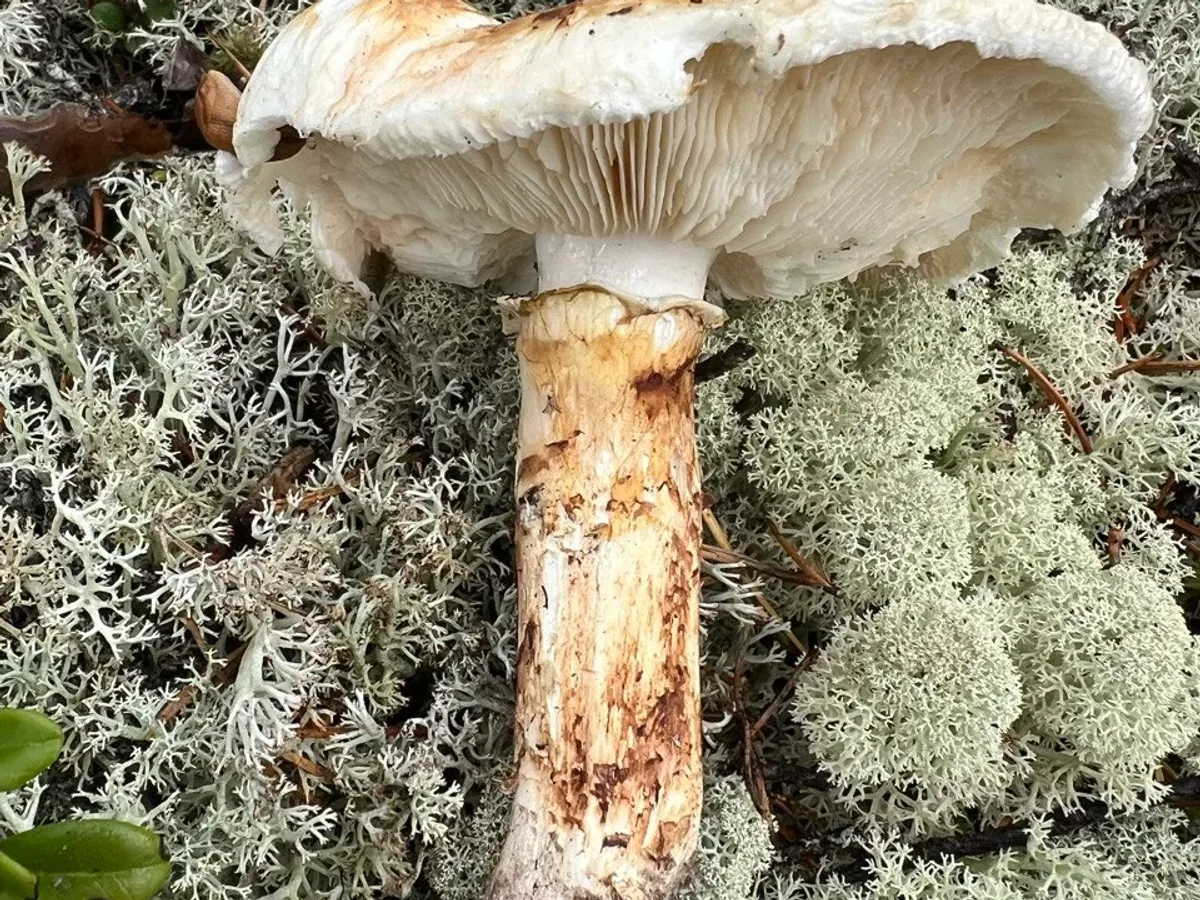 Matsutake
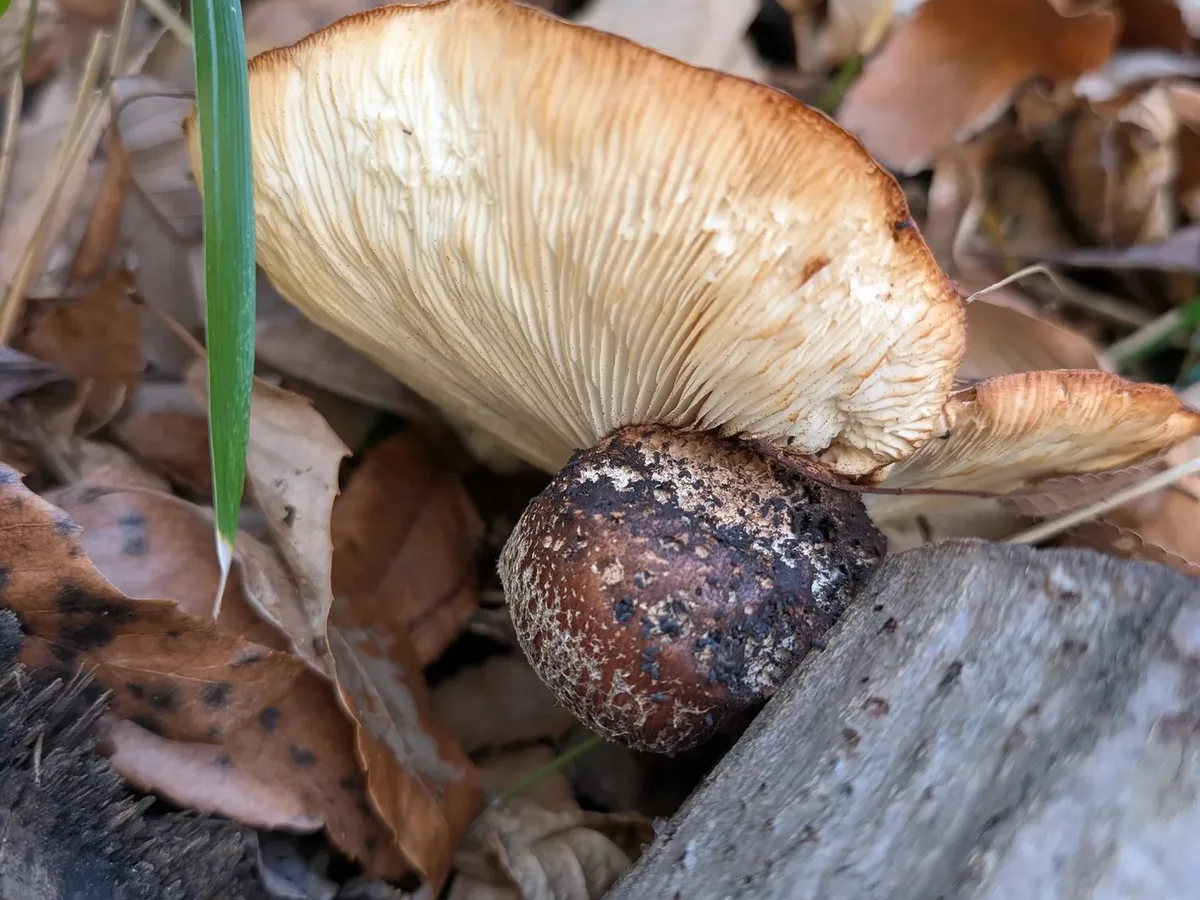 Shiitake
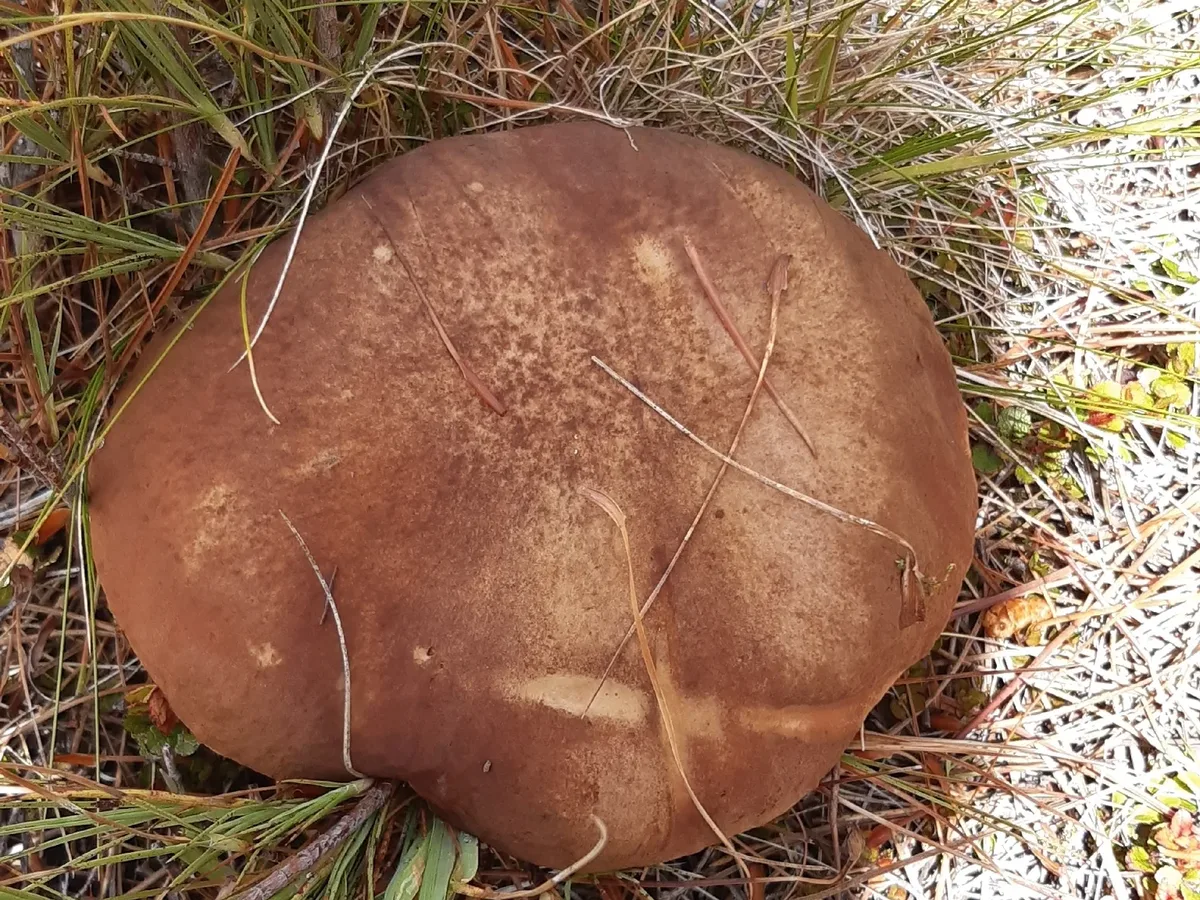 Cep
Cep
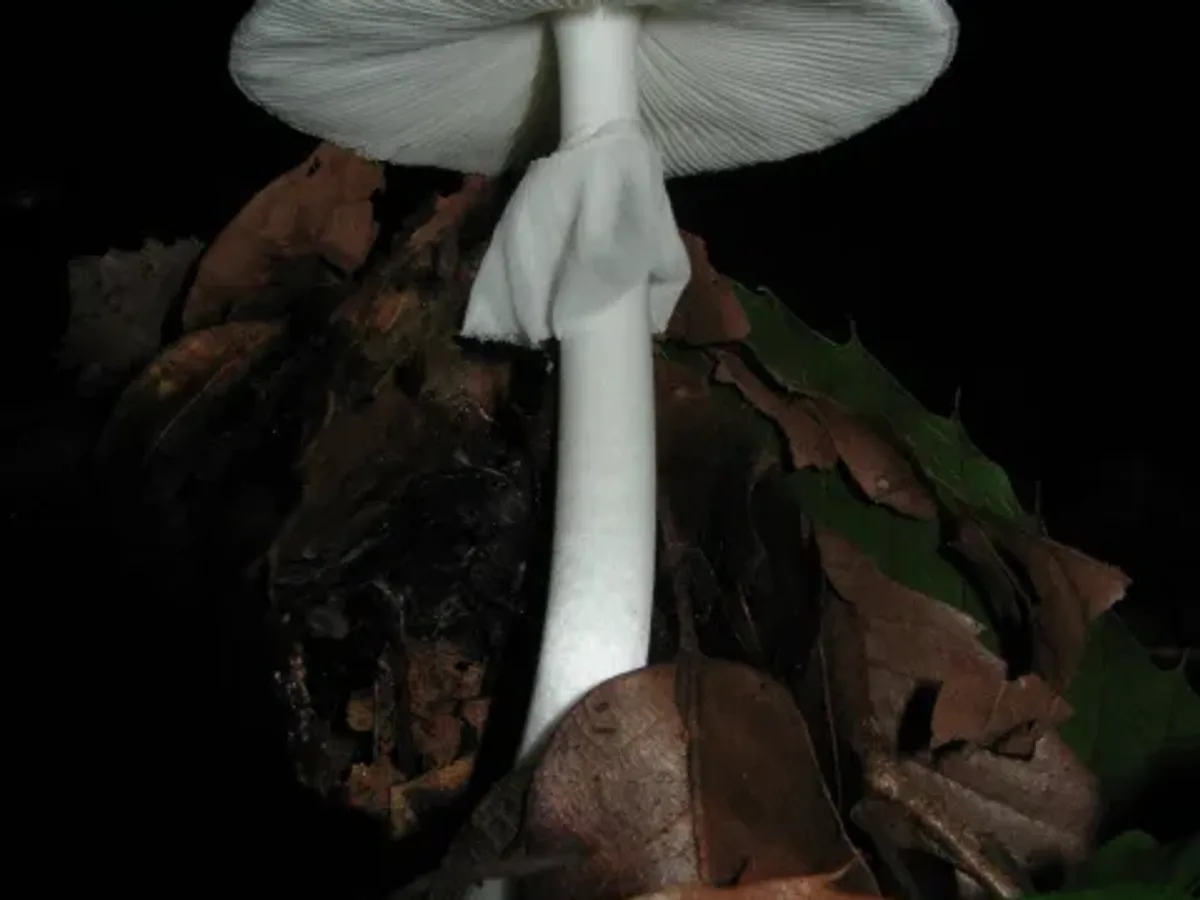 Guangzhou destroying angel
 Matsutake
From Japan's red pine forests and Yunnan's vast mushroom markets to the termite mounds of Southeast Asia, this is the world's richest mushroom region - culinary and commercial. We celebrate around ten central edibles here, but the region also holds the planet's most dangerous mushroom situation: deadly white and dark Amanitas, Japan's most common poisoning, and species that kill in ways found nowhere else. Calm, honest, never a guarantee.
What matters most
- Shiitake (Lentinula edodes) is one of the world's safest and most-used edibles - but always cook it, and never confuse the wood-growing kinds for the glowing tsukiyotake.
- The deadliest trap is the white and dark Amanita group: in southern China 1994-2012, Amanita caused 78% of poisoning cases and 70% of deaths. Learn them by heart.
- Three toxin groups dominate: amatoxins (liver/kidney failure), rhabdomyolysis from Russula subnigricans, and the trichothecenes of the lethal poison fire coral.
- Taxonomy is in motion: many 'Asian' species were recently split from European ones (Auricularia heimuer 2014, Lanmaoa asiatica 2014, the Japanese Entoloma rhodopolium is a species complex).
- Handling and storage matter: never wash matsutake, and never soak dried wood ear at room temperature overnight - bongkrekic acid from bacterial growth has killed.
- In this region the safe path starts at the market (Kunming, Nanhua), not in the forest with unknown species.
The great toxin groups
A handful of toxin families account for the region's deaths and its most common poisonings. Each behaves differently, and several cannot be cooked away.
Found in the deadly white and dark Amanitas (and in Galerina marginata). α- and β-amanitin halt RNA polymerase II so cells stop making protein, leading to liver and kidney failure. Classic course: a symptom-free latency of 6-24 hours, then severe vomiting and watery diarrhoea, a deceptive recovery, then organ failure. Not destroyed by cooking, drying or freezing.
The toxin of Russula subnigricans, cycloprop-2-ene carboxylic acid, is one of nature's smallest toxic molecules. It causes muscle breakdown: vomiting first, then muscle pain, sharply raised creatine kinase and myoglobin in the blood, and in severe cases kidney and respiratory failure. Can be mistaken for a heart attack (raised troponin).
The toxins of poison fire coral (Trichoderma cornu-damae) - satratoxin H, roridin E, verrucarin J - the same class as the notorious 'black mould' Stachybotrys. They block protein synthesis. Early: diarrhoea, vomiting, dehydration, fever, numbness; later: low blood pressure, skin peeling and multi-organ failure, with death possible within hours.
Raw or undercooked jian shou qing (Lanmaoa asiatica and relatives) causes 'little people' hallucinations - patients see hundreds of tiny figures marching about. Onset 12-24 hours, with nausea, dizziness and fatigue; usually resolves in 1-5 days without death. The active substance is unidentified; it contains neither psilocybin nor ibotenic acid.
Omphalotus japonicus contains the sesquiterpenes illudin S and illudin M. They cause violent nausea, vomiting and diarrhoea for several hours; rarely fatal but extremely common - Japan's single most frequent poisoning.
The Entoloma rhodopolium complex contains muscarine, muscaridine and choline, producing cholinergic and gastrointestinal symptoms - nausea, vomiting, cramps, diarrhoea, dizziness - within 30 minutes to 3 hours. Rarely fatal but one of Japan's commonest autumn traps.
Trogia venenata holds three unusual toxic amino acids (including a convulsant, γ-guanidinobutyric acid). It caused 'Yunnan Sudden Unexplained Death': sudden cardiac death, often preceded by nausea, palpitations and seizures. Public education campaigns cut cases by 73%.
The edibles
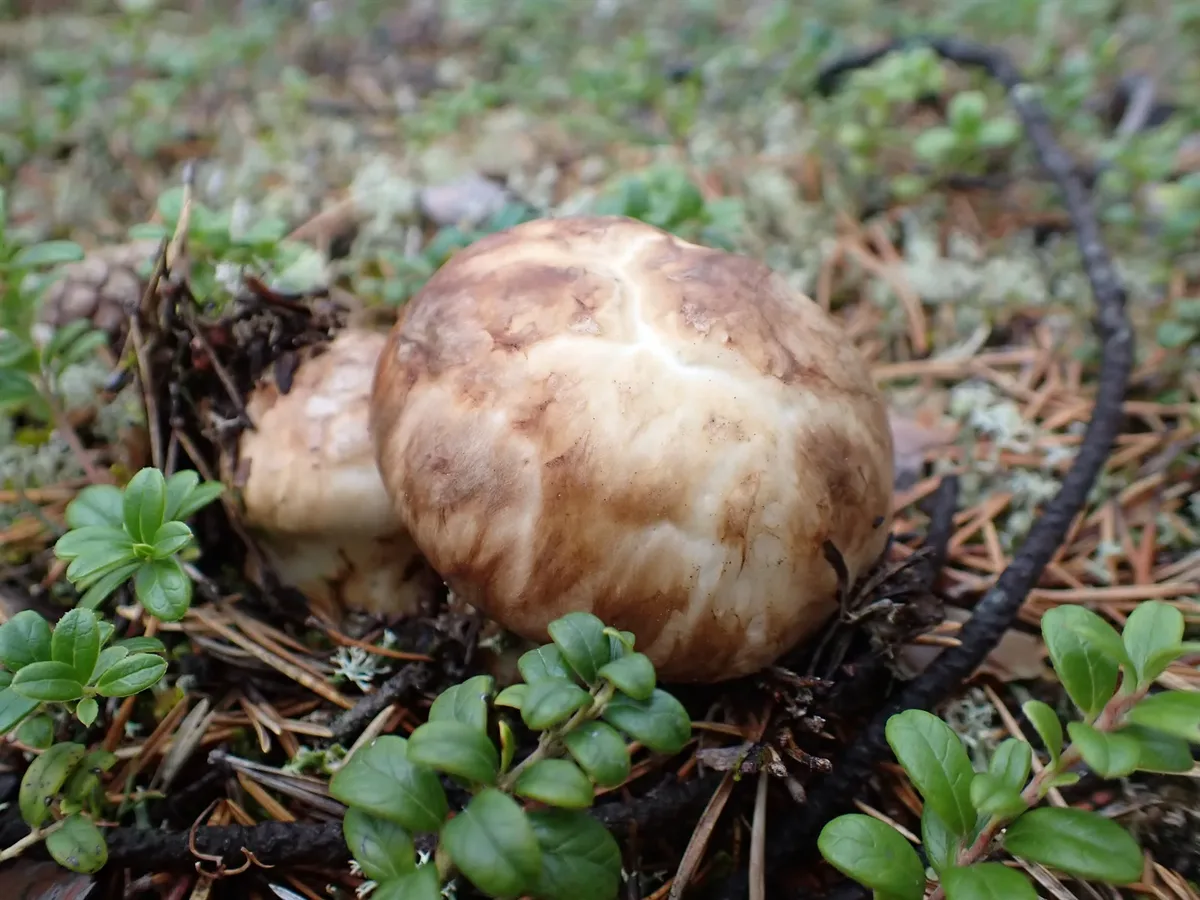 Matsutake
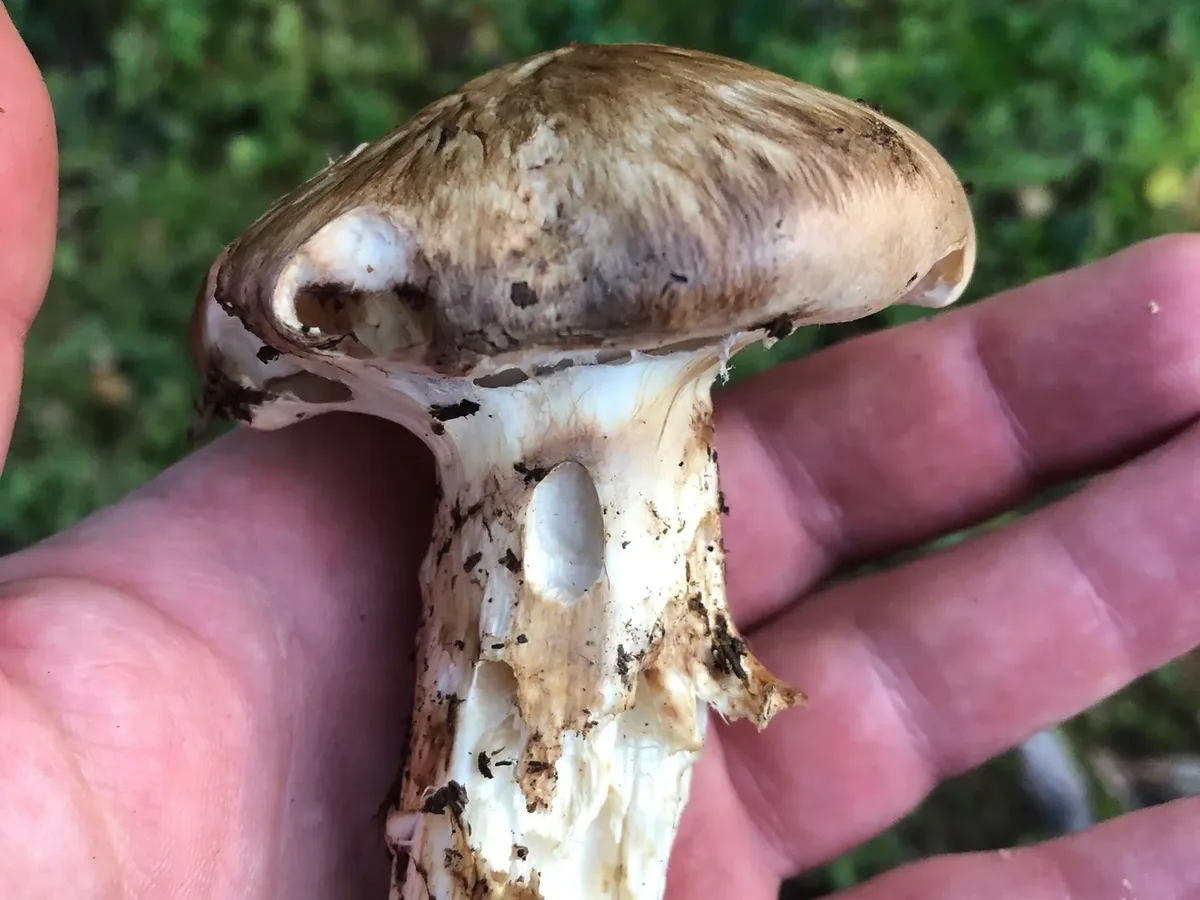 MatsutakeMatsutake
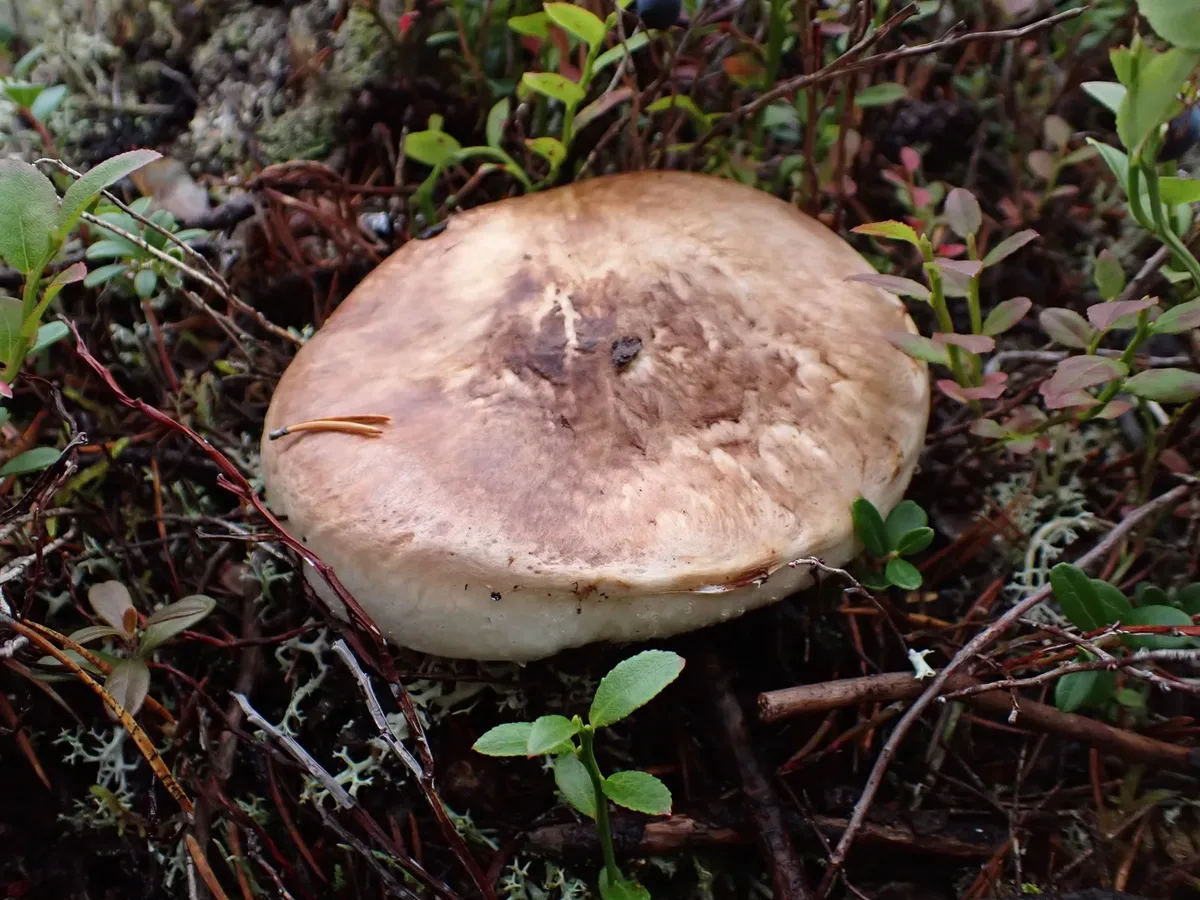 MatsutakeMatsutakeMatsutake
Matsutake (pine mushroom)
Tricholoma matsutakeAutumn's king in Japan and Korea - a wild, uncultivable mushroom whose spicy pine-and-cinnamon aroma is the whole point.
How to recognise it
A large, firm and fleshy mushroom with an unmistakable presence. The cap reaches up to 35 cm across (usually 8-20 cm), opening from white to pale brown, and soon dressed with dark brownish fibrils and scales. The stem is stout - up to 15 cm tall and 5 cm thick - with a well-defined hanging ring; below the ring the surface is covered in the same fibrillose scales. The gills are white and densely packed. The flesh is white, firm, and does not discolour when cut. Spore print white. The most distinctive feature of all, though, is the scent: a powerful, spicy-aromatic fragrance combining cinnamon and fresh pine resin, driven by octenol (1-octen-3-ol, often called mushroom alcohol). No other pine mushroom smells quite like this.
Where it grows
Matsutake lives its life mostly underground, woven invisibly into the roots of its host trees as a mycorrhizal partner. In Japan and Korea it grows almost exclusively with Japanese red pine (Pinus densiflora); elsewhere it associates with other pines, oaks, and in southwestern China with Pinus yunnanensis and local oak species. The relationship demands very specific conditions: well-drained, nutrient-poor, acidic soil (pH around 4.5-5.5) - the kind of lean ground that most plants avoid. Over years the mycelium forms a "shiro", a ring-shaped mat of fungal threads extending outward from a central point, sometimes reaching several metres in diameter. The shiro can persist for decades, quietly tending its root partnerships, before the fruiting bodies push up through the needle litter. Distributed across Japan, Korea, northeastern and southwestern China (Yunnan, Sichuan, Tibet), the Russian Far East, and Bhutan; closely related species occur in Europe, North Africa, and North America.
Cooking
Japanese philosophy: bring out the aroma, cook minimally. Classics: dobin mushi (steamed in a small clay pot with dashi, chicken, shrimp, white fish, ginkgo nuts, served with sudachi/yuzu); matsutake gohan (sliced and steamed on top of rice in kombu dashi with soy, sake, salt); grilled over charcoal (yaki-matsutake) with a squeeze of sudachi; tempura. In Korea, songi is often eaten raw dipped in sesame oil and salt, or thinly sliced in broth. In Yunnan, where the local population has historically valued it less than porcini, it is often sliced raw with soy or boiled in chicken broth with goji.
Look-alikes
Matsutake has NO volva (no sac at the stem base), bears fibrillose brown scales, and has a very characteristic spicy pine aroma. Amanitas have a volva, white gills, softer flesh, and lack the matsutake scent.
In North America, false matsutake is confused with Amanita smithiana, which is a kidney toxin. Check for absence of a volva and presence of the spicy pine aroma.
Similar in appearance but bitter.
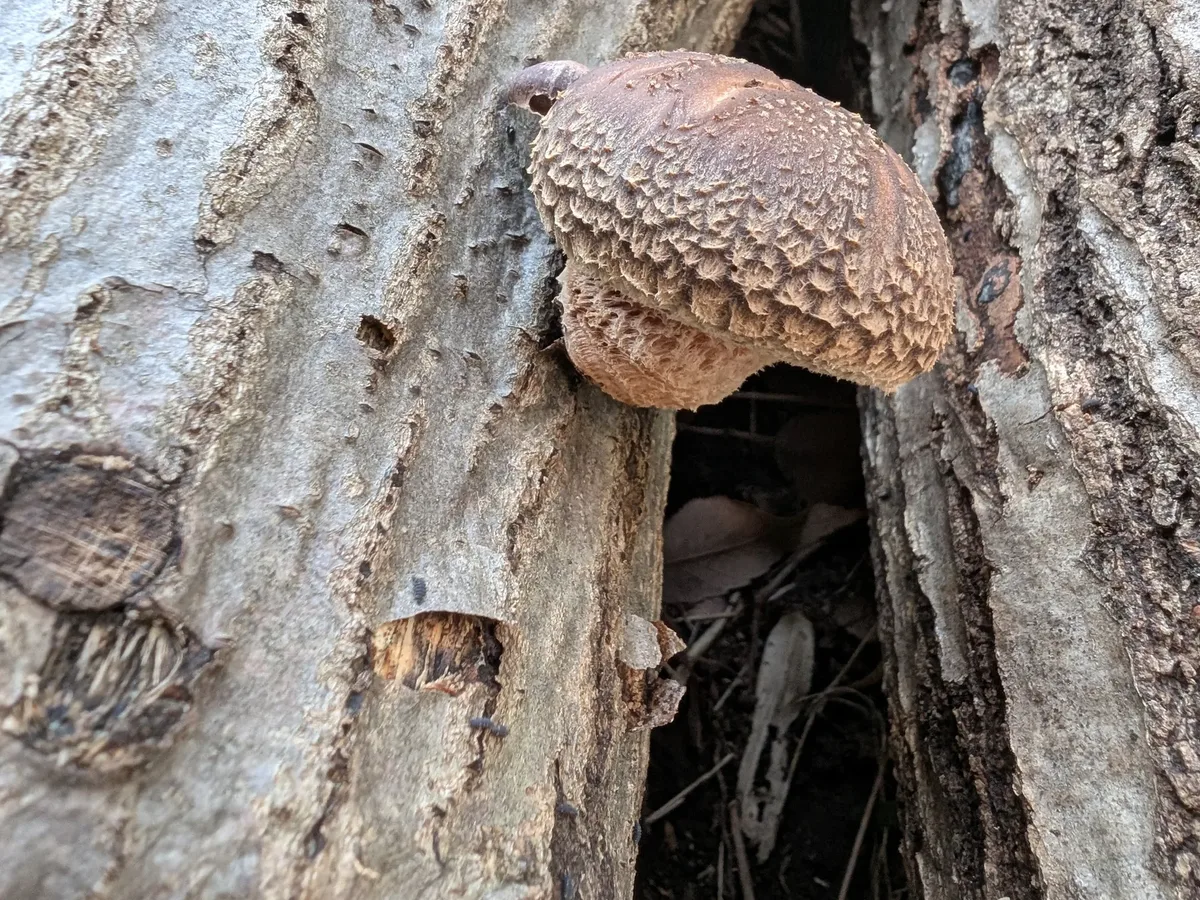 Shiitake
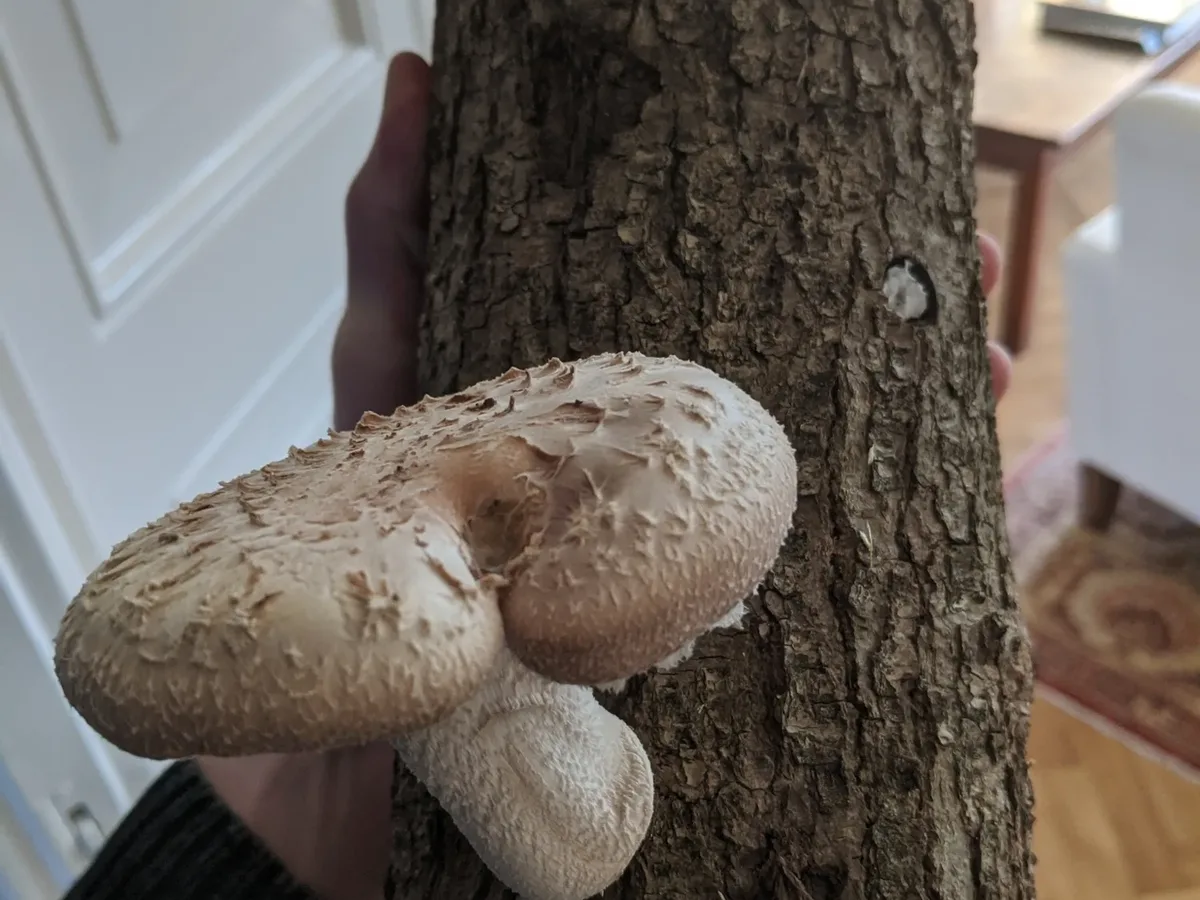 ShiitakeShiitake
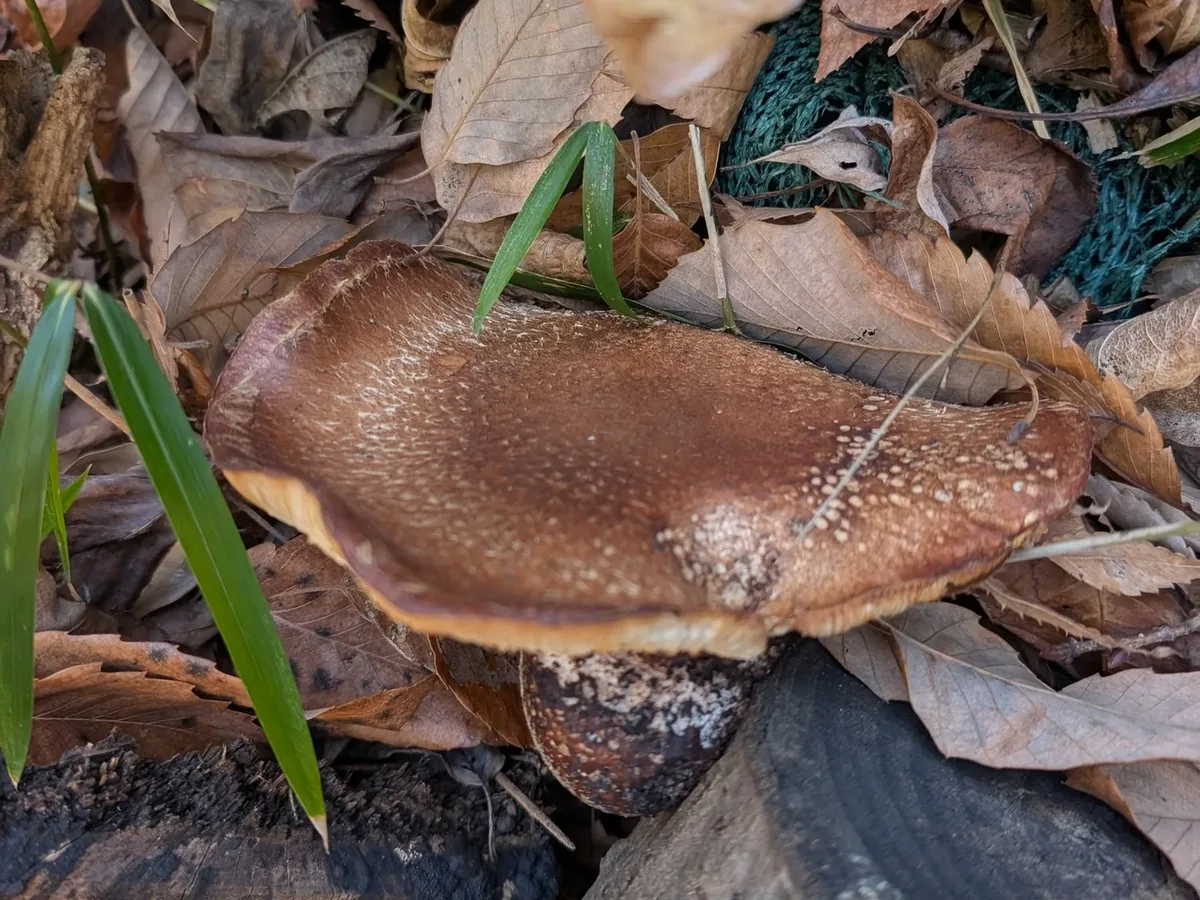 ShiitakeShiitakeShiitake
Shiitake
Lentinula edodesOne of the world's safest and most-used edibles, with umami that deepens when dried - cook it always.
How to recognise it
Cap 5-25 cm, convex broadening to nearly flat with age, light to dark brown. In dry conditions the surface cracks into white or tan patches, giving the cap a distinctive marbled look. Gills white to cream, free from the stem. The stem is fibrous and tough, light wood-brown - cooks almost always cut it away. Flesh white and firm. Spore print white. The aroma is unmistakably umami-rich, and drying concentrates it further into something close to savoury perfume.
Where it grows
A wood-decaying saprophyte on dead hardwood - shii/chestnut oak (Castanopsis), oak, chestnut, beech, maple, mulberry and others. At home in the warm, humid broadleaf forests of East Asia and mainland Southeast Asia, where fallen logs can host flushes for years as the mycelium slowly converts wood into nutrients.
Cooking
Rehydrate dried shiitake in lukewarm water and save the soaking liquid - it is ready-made stock. Use in Japanese dashi and miso soup, Chinese braised shiitake (slow-cooked in soy, caramel colour, and sake or Shaoxing wine), stir-fries, nikujaga, and ramen. Fresh shiitake sautés quickly and works well in anything that benefits from a deep, savoury base note. The dried form is the backbone of countless East Asian broths.
Look-alikes
Poisonous; Japan's most common cause of mushroom poisoning. Grows on dead beech wood in overlapping shelves, shows a dark/blackish-purple stain in the flesh at the stem base when split lengthwise, and glows faintly in the dark.
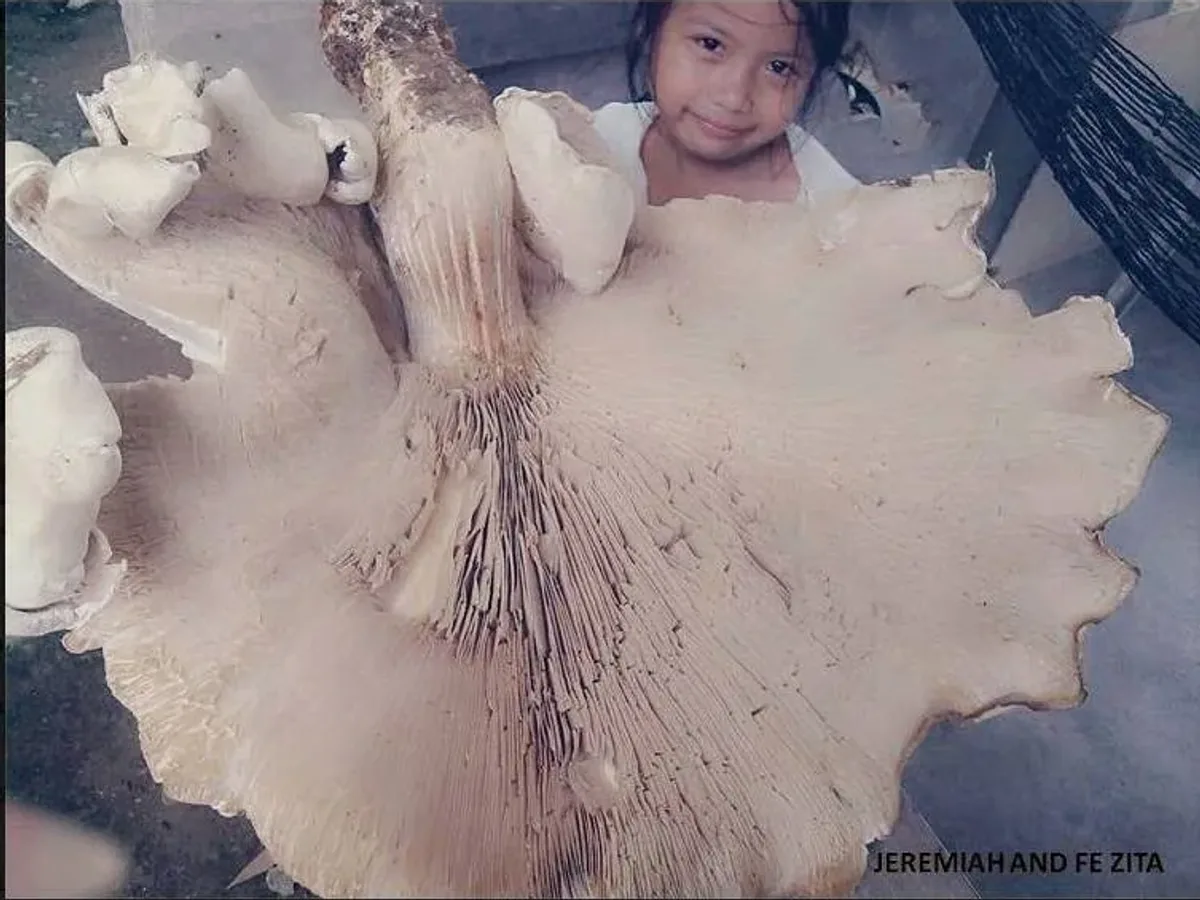 Termite mushroom
Termite mushroom (chicken mushroom)
Termitomyces titanicusGrown by termites in their mounds, prized across Yunnan and Southeast Asia for a chicken-like taste and texture.
How to recognise it
Highly variable in size. Common to all: a long, root-like pseudorrhiza (an underground, rhizome-like continuation of the stem running down into the termite nest), often a pointed central knob (umbo/perforatorium) on the cap, white to cream-colored gills that can become pinkish, and a white spore print. T. titanicus: cap up to 1 m, stem up to 57 cm. T. schimperi: cap 15-28 cm, sometimes 40 cm, white with scales. T. microcarpus: only a few cm. The flesh is firm and meaty; the flavor is described as rich, meaty and smoky (umami).
Where it grows
On or next to termite mounds (Macrotermes, Microtermes, Odontotermes), in savanna, miombo woodland, farmland and grassland. Bound to the fungus gardens (combs) of the termite nest.
Cooking
Fried in oil with onion, tomato and chili; in soups; as a relish (ndiwo/umunani) with nshima/ugali. In Namibia, omajowa (T. schimperi) is often fried in butter or oil. Dried for storage - sometimes parboiled before drying.
Look-alikes
Some white Amanita superficially resemble pale termite mushrooms, but Amanita has a volva (ring-shaped sac at the stem base) and lacks a pseudorrhiza.
Can resemble young Termitomyces and causes severe gastrointestinal poisoning. Check for a greenish spore print and the absence of a pseudorrhiza.
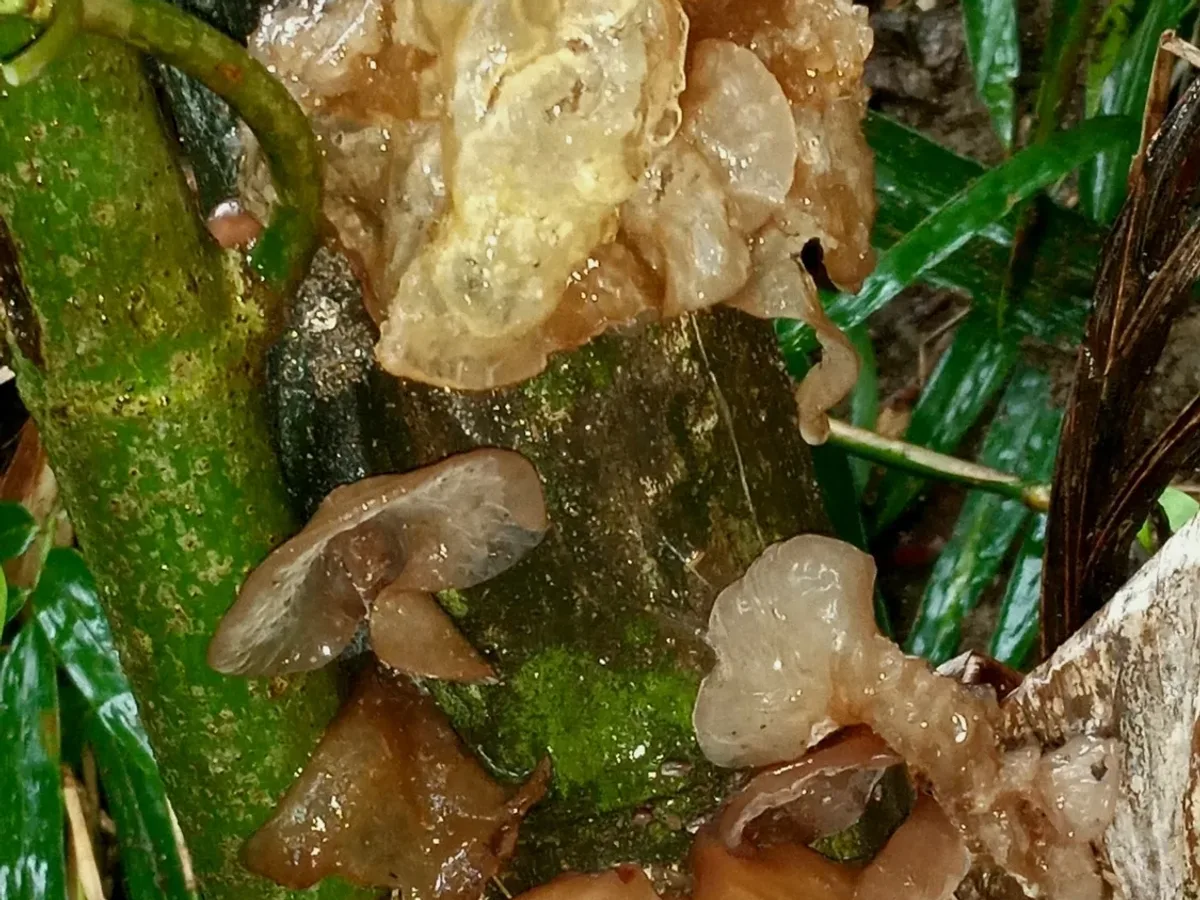 Black wood ear
 Black wood ear
 Black wood ear
 Black wood earBlack wood earBlack wood ear
Wood ear (black fungus)
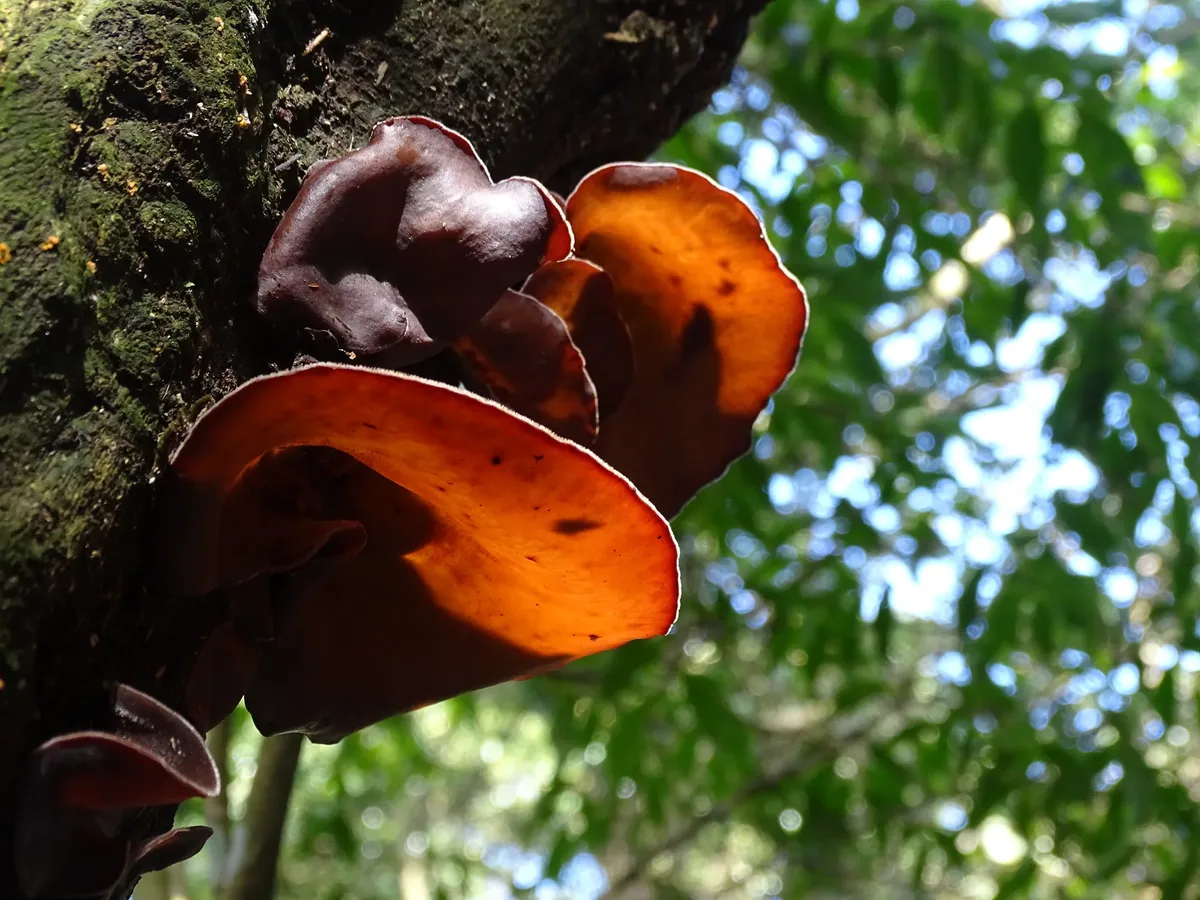
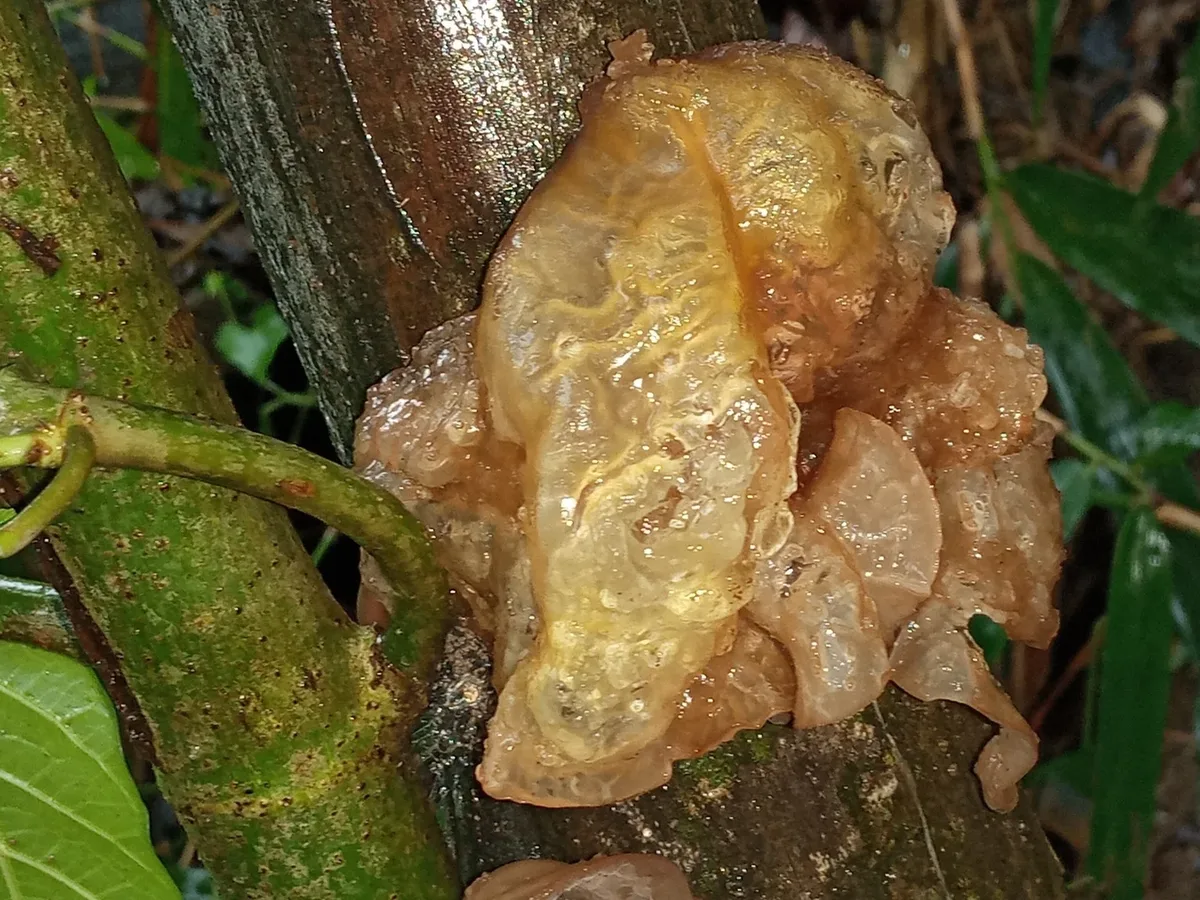
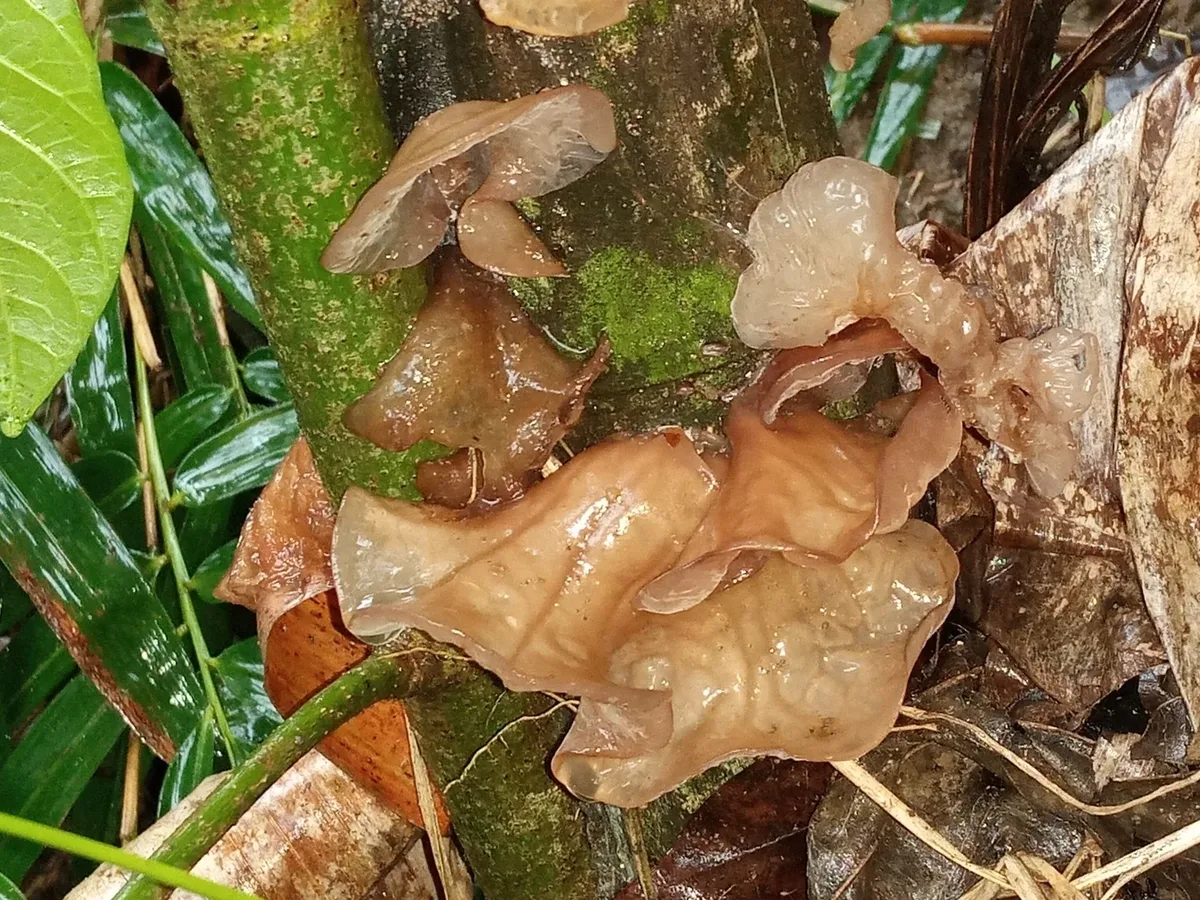
Auricularia heimuerA mild, gelatinous texture-ingredient sold almost always dried - soak it briefly and in the fridge, never overnight at room temperature.
How to recognise it
Gelatinous, ear-shaped fruiting body attached to wood at the side, without a true stem, 3-12 cm across, brown to almost black. The upper surface is glossy; the underside is finely downy. Fresh specimens are rubbery and surprisingly resilient; dried ones become hard and brittle, yet almost fully reconstitute when soaked.
Where it grows
A wood-rotting saprophyte on dead hardwood, especially oak, in temperate and subtropical East Asia - found wild in northern China, Korea, Japan, and the Russian Far East.
Cooking
Valued almost entirely for its texture rather than flavour - it has a mild, neutral taste but a satisfying crunchy-slippery bite that holds up in heat. Classic in hot and sour soup, stir-fries (such as mu shu dishes), cold dressed salads, and dumpling fillings. Notably, it does not shrink or go mushy when boiled.
Look-alikes
When dried, wood ear can be confused with dried silver ear (Tremella), but those are harmless.
 Snow fungus
 Snow fungus
 Snow fungus
 Snow fungusSnow fungusSnow fungus
Silver ear (snow fungus)
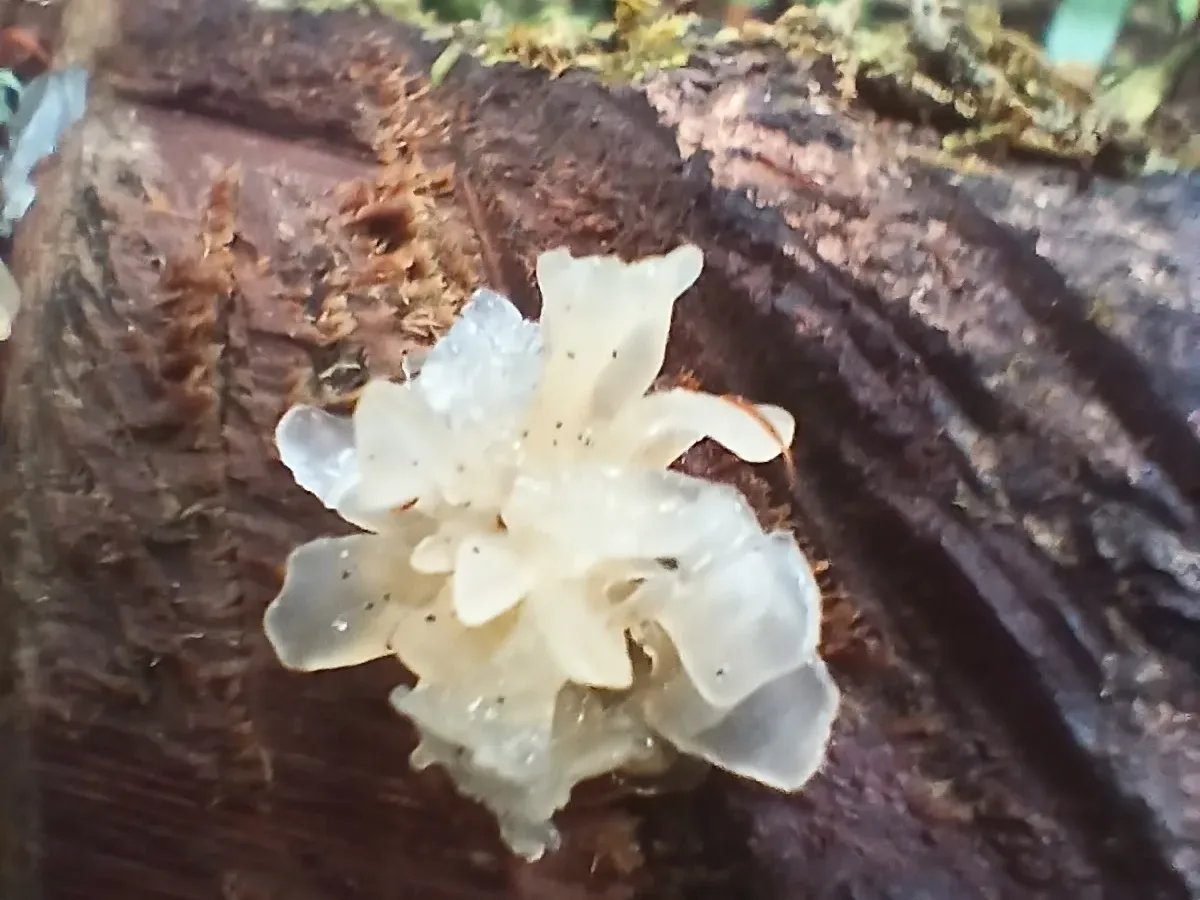
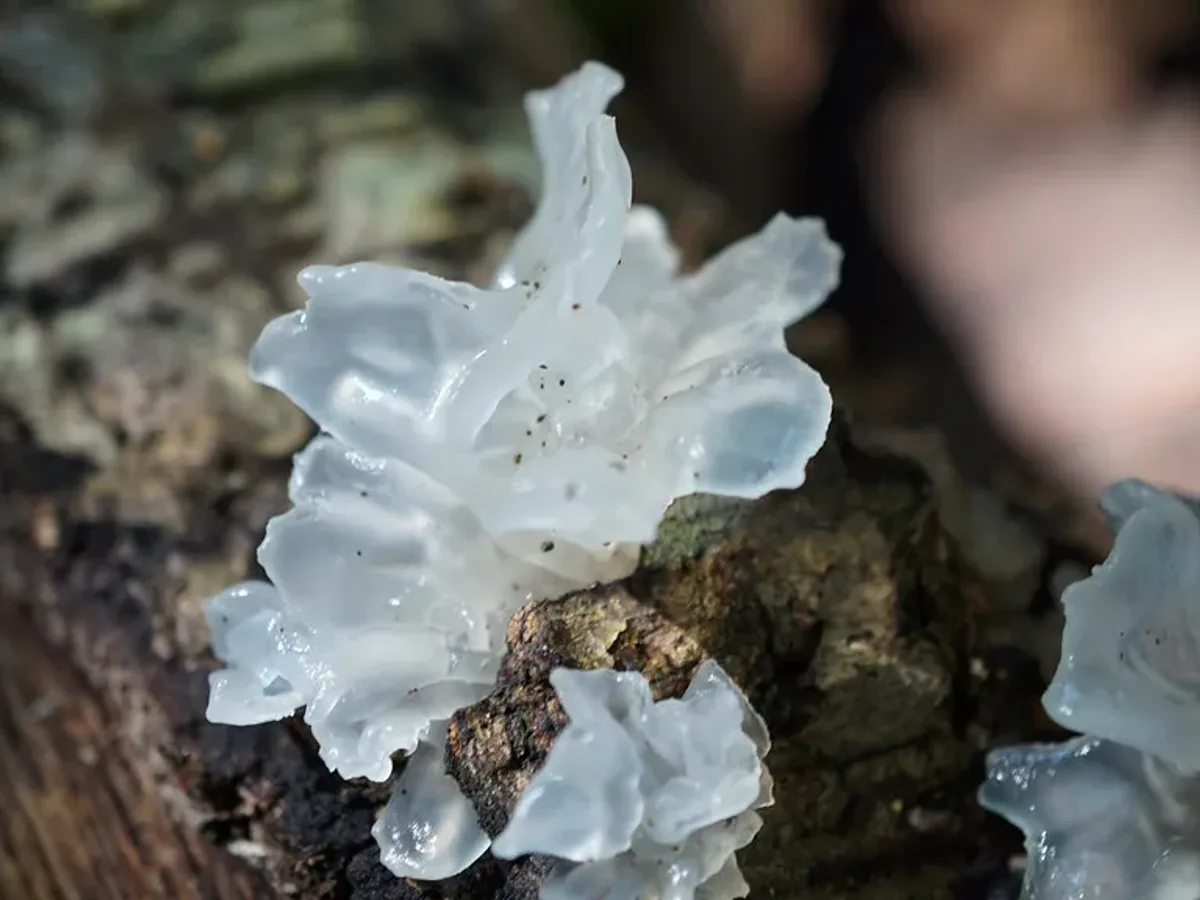
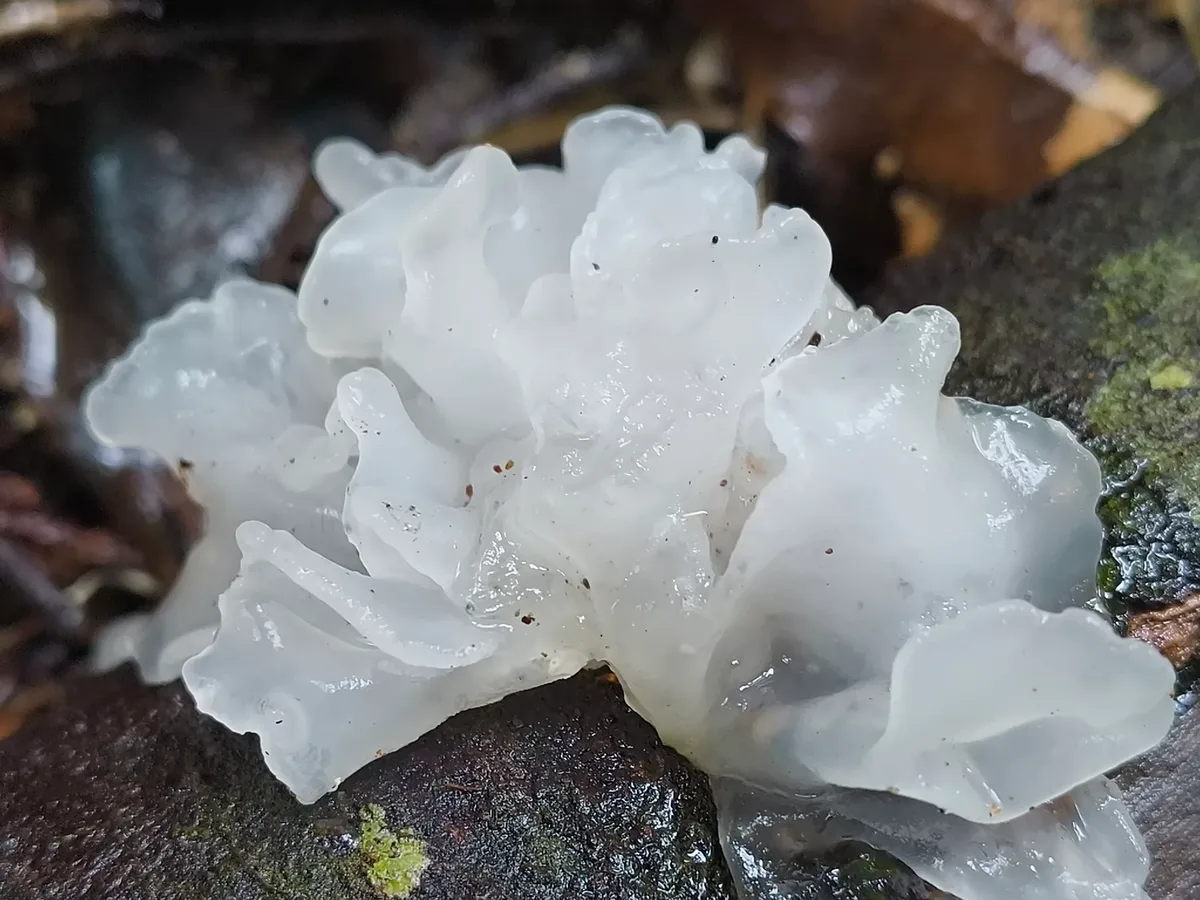
Tremella fuciformisThe 'beauty mushroom' - flavourless and valued for its jelly-like texture in sweet dessert soups.
How to recognise it
White to translucent-white, gelatinous fruiting body with a leafy, frilly form - somewhere between a sea coral and a ruffled snowflake - reaching around 7 cm in the wild, larger when cultivated. Flavourless on its own; it is grown entirely for its silky, yielding texture.
Where it grows
On dead branches of broadleaf trees in tropical and subtropical Asia, extending into temperate zones. Unusually, it is a mycoparasite: before it can fruit, it needs to colonise another fungus, Annulohypoxylon, living in the same wood.
Cooking
The classic use is sweet dessert soup (tong sui): simmered slowly with rock sugar, red dates, goji berries, lotus seeds, and longan until the fungus turns glossy and jelly-soft. In Vietnam it appears in chè in much the same role. Because commercial cultivation made it widely affordable from the late twentieth century, it has also found its way into savoury dishes where its neutral flavour and gentle chew complement rather than compete with other ingredients.
Look-alikes
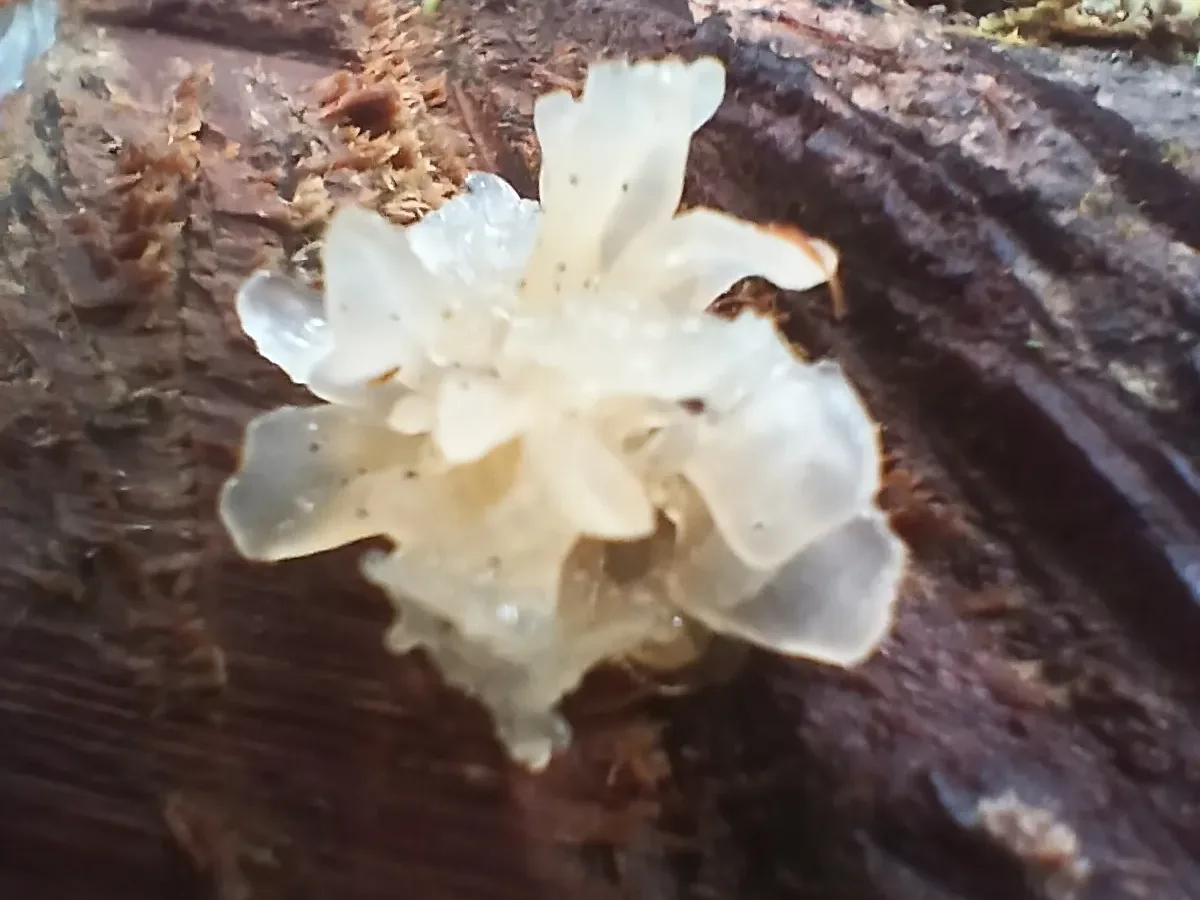
Yellow and brain-like rather than white; harmless.
 Paddy straw mushroom
 Paddy straw mushroom
 Paddy straw mushroom
 Paddy straw mushroomPaddy straw mushroomPaddy straw mushroom
Paddy straw mushroom
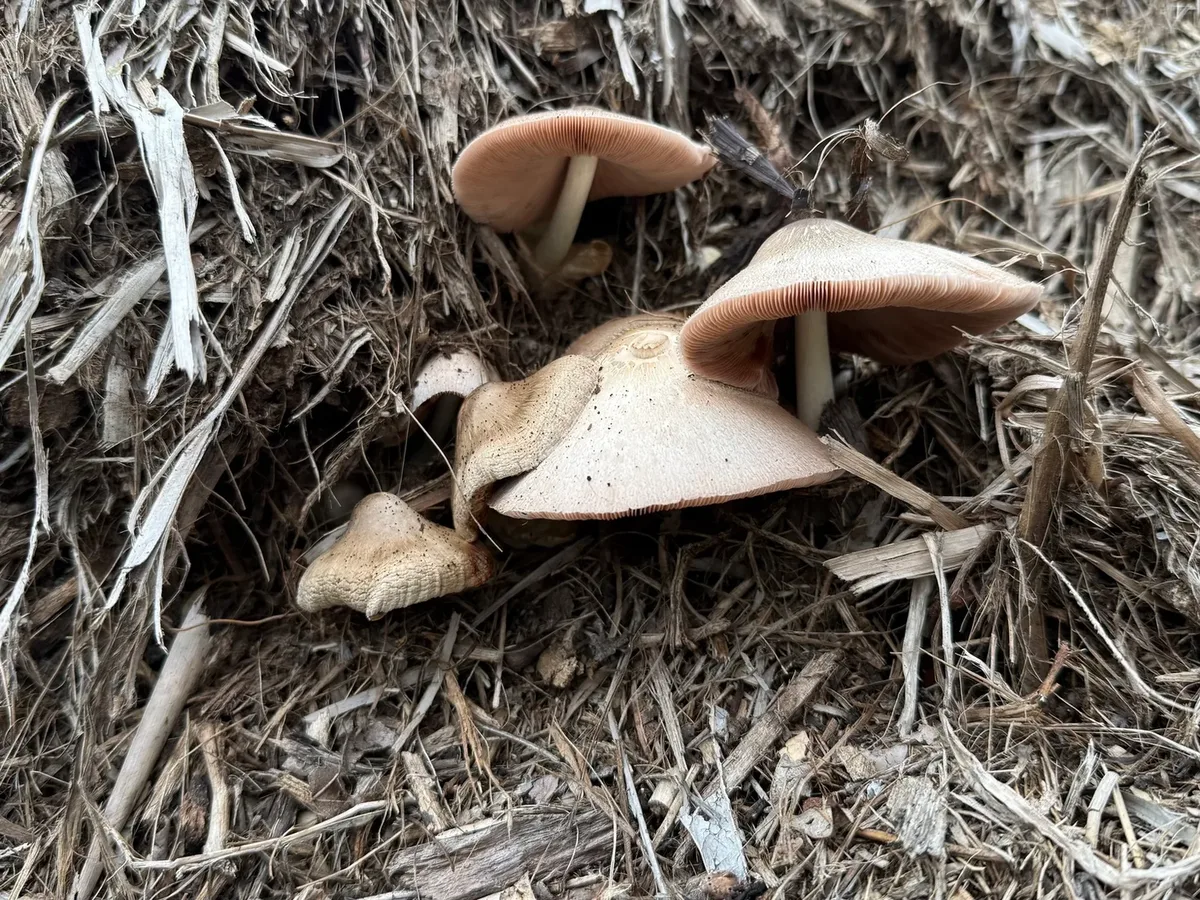
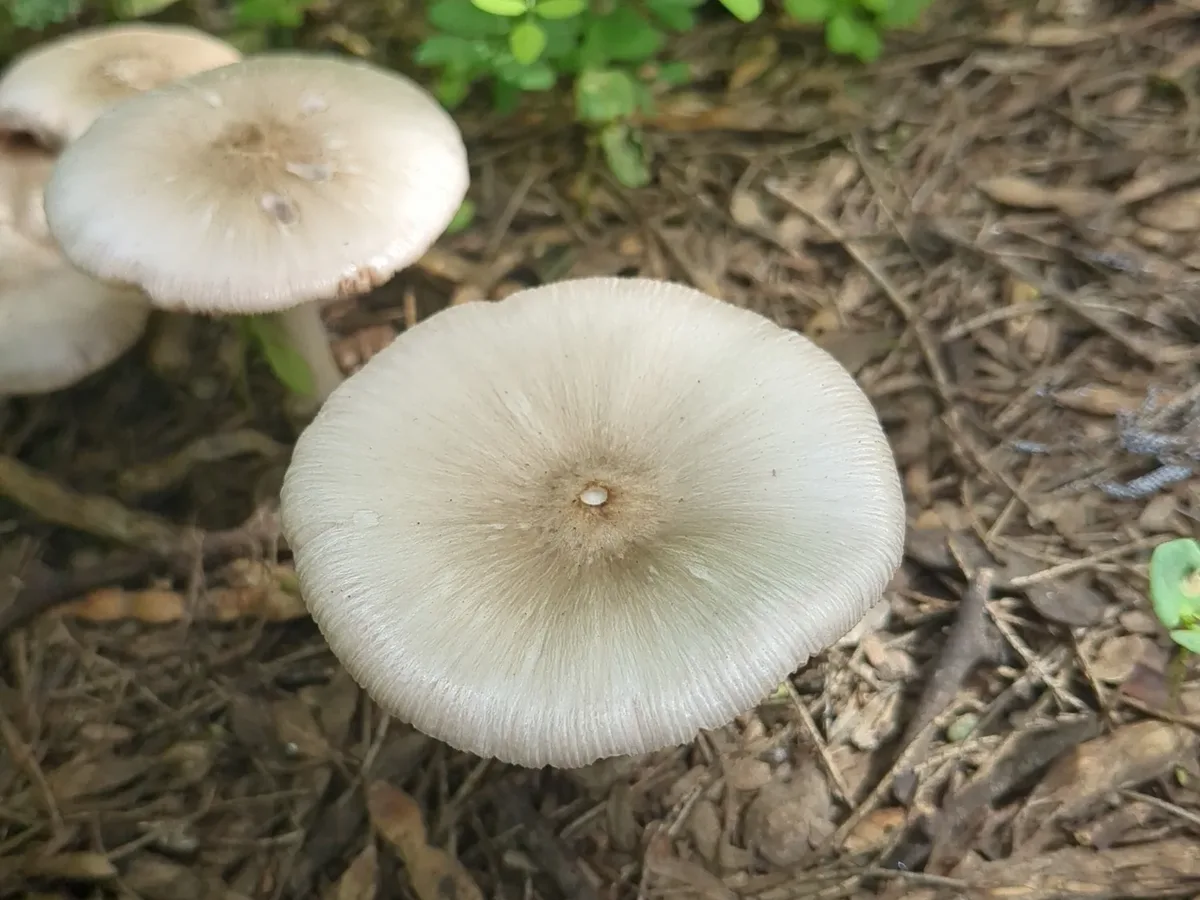
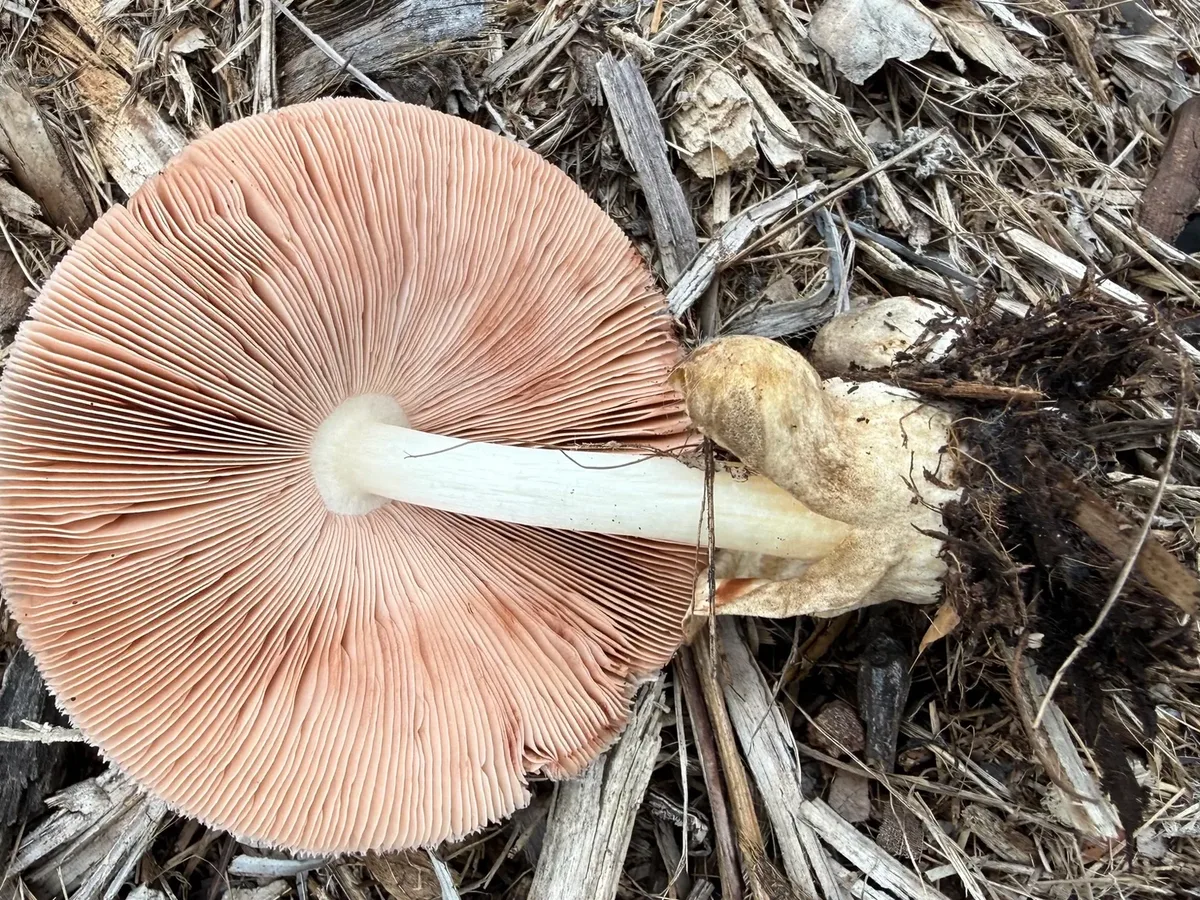
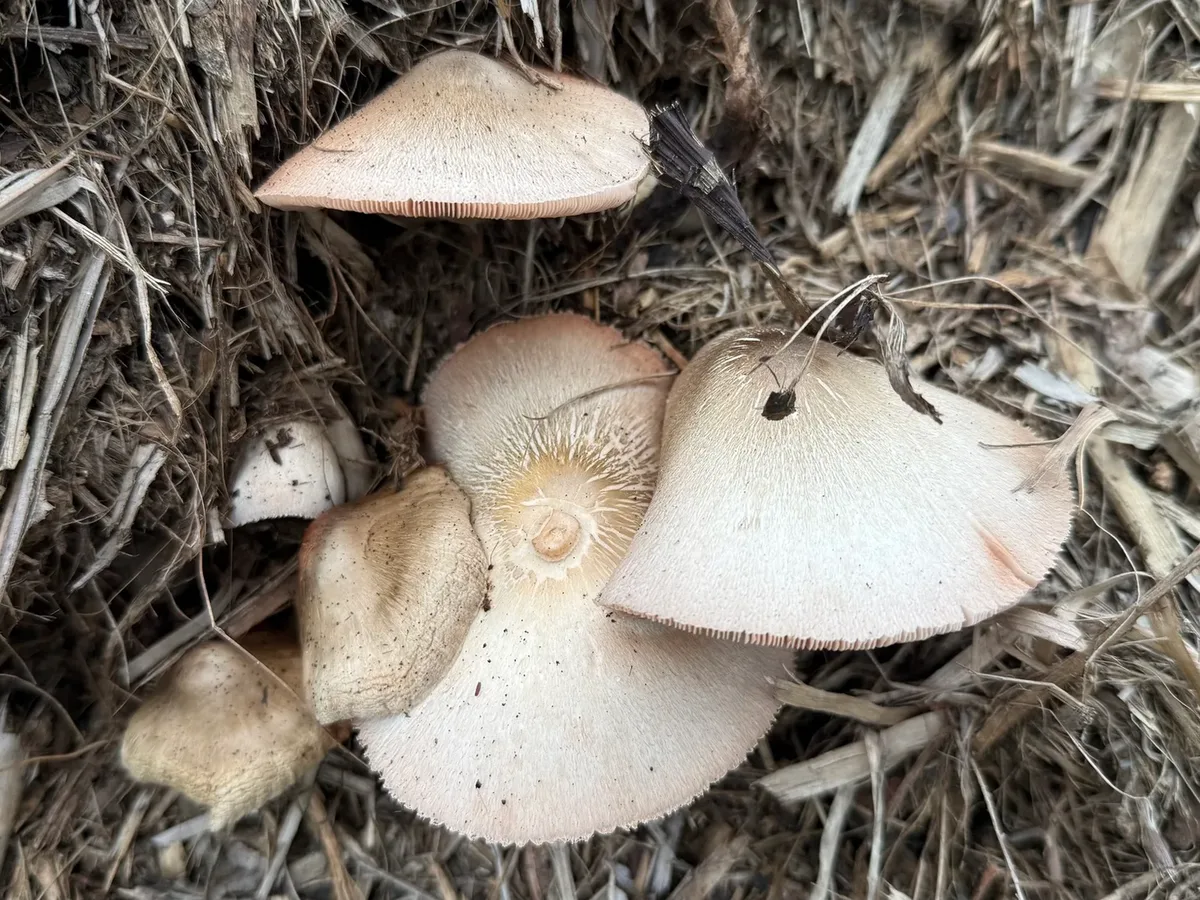
Volvariella volvaceaThe world's third most-consumed mushroom, picked young in the egg stage - its pink spore print is what separates it from a deadly Amanita.
How to recognise it
Most commonly harvested in the "egg stage", when the young fruitbody is still entirely wrapped in its white-to-grey volva - smooth, egg-shaped, and easy to miss in the rice straw. Left to open, the cap expands to 5-12 cm, grey-brown, conical to convex, and silky-fibrillose. Gills start white and slowly blush pink-brown as the spores ripen. The stem (6-12 cm) sits in a prominent grey-brown to black cup-shaped volva at the base, with no ring - a crucial detail. Spore print pink. Spores 7-9 × 4-5 µm.
Where it grows
A decomposer of warm, carbon-rich substrates: rice straw, compost heaps, and sugarcane waste. Thrives in the hot, humid tropics and subtropics and has been cultivated on rice paddy beds for centuries.
Cooking
In stir-fries (wok), soups, hot pot and curries; common in Thai tom yum. Cooked quickly so it keeps its springy texture.
Look-alikes
Especially dangerous in the egg stage. The paddy straw mushroom has a pink spore print and pink gills; Amanita species have a white spore print and white gills. Slice a button lengthwise to check.
 Porcini
Yunnan porcini (white bolete)
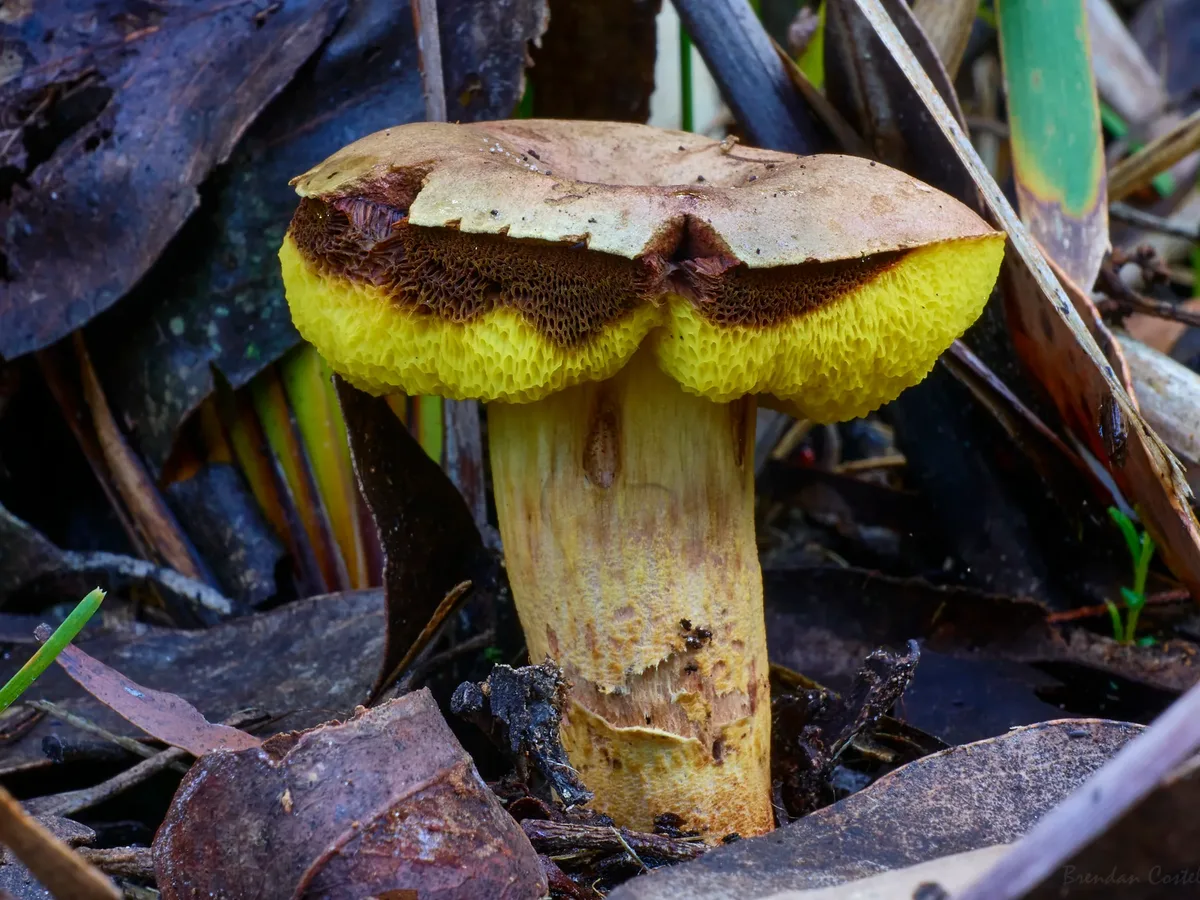
Boletus bainiuganAmong the safest wild mushrooms - true white niugan does not blue, and much of Italy's 'Italian' dried porcini is in fact Yunnanese.
How to recognise it
A large, handsome bolete with a broad brown cap that can reach 30 cm across. The underside carries a spongy layer of pores - white when young, aging to yellow-green - rather than gills. The stem is thick and pale, marked with a fine raised net pattern (reticulation). The flesh is white and firm throughout; in true white porcini it stays that way when cut, with no blue staining.
Where it grows
Lives in a close partnership with the roots of pine (especially Pinus yunnanensis), oak, and chestnut - a mycorrhizal bond that can persist for many years as unseen threads of mycelium lacing through the soil. Found in the mountain forests of Yunnan at 800-3,500 m.
Cooking
In Yunnan it is most often fried with garlic, fresh green chili, and soy, or added to hot pot. Dried, it deepens broths with a rich, earthy depth that travels well across cuisines - which explains why so much of it ends up in Italian kitchens. The flesh stays firm even through long cooking.
Look-alikes
Has a red stem and stains blue, unlike true white porcini which does not turn blue.
Intensely bitter, making a dish inedible; lacks the firm, mild flesh of porcini.
Jian shou qing (blueing bolete)
Lanmaoa asiaticaBeloved in Yunnan but only when thoroughly cooked - undercooked, it brings 'little people' hallucinations. Cook 15-20 minutes, never raw, never with alcohol.
How to recognise it
A stout, reddish-to-brown bolete with a thick clubbed stem and a spongy pore surface ranging from lemon-yellow to blood-red. Touch or slice the flesh and it turns indigo blue within seconds - a rapid enzymatic oxidation of gyrocyanin that gave the mushroom its Chinese name, 见手青, meaning 'green on touching.' The colour change is dramatic and unmistakable.
Where it grows
An ectomycorrhizal species that lives in root partnership with trees, particularly Pinus yunnanensis in the highlands of Yunnan, China. A related blueing bolete known locally as 'sedesdem' grows in the northern Philippines under similar conditions.
Cooking
ONLY thoroughly fried / thoroughly boiled (at least 15-20 min), traditionally with plenty of garlic and chili. Never raw, never undercooked, never with alcohol.
Danger
Caused only by raw or undercooked mushrooms; it usually resolves within 1-5 days without fatalities. More than a hundred cases per year are treated at a single Yunnan hospital.
Look-alikes
Another blueing bolete sold under the same jian shou qing name; in practice it is mixed in and treated the same. What matters is not telling the species apart but cooking it thoroughly.
Another blueing bolete grouped under jian shou qing; in practice it is confused with and prepared the same as Lanmaoa asiatica.
 Enoki
Enoki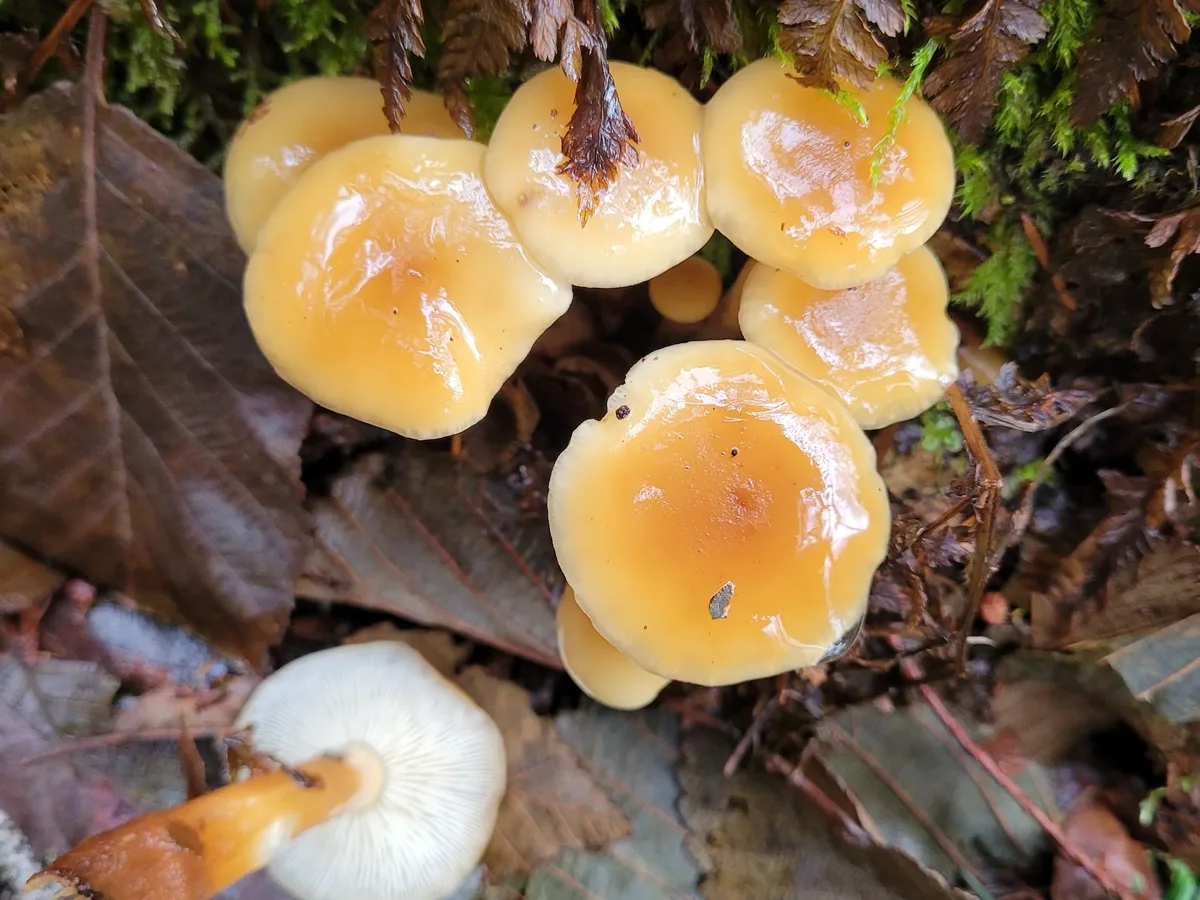 Enoki
Enoki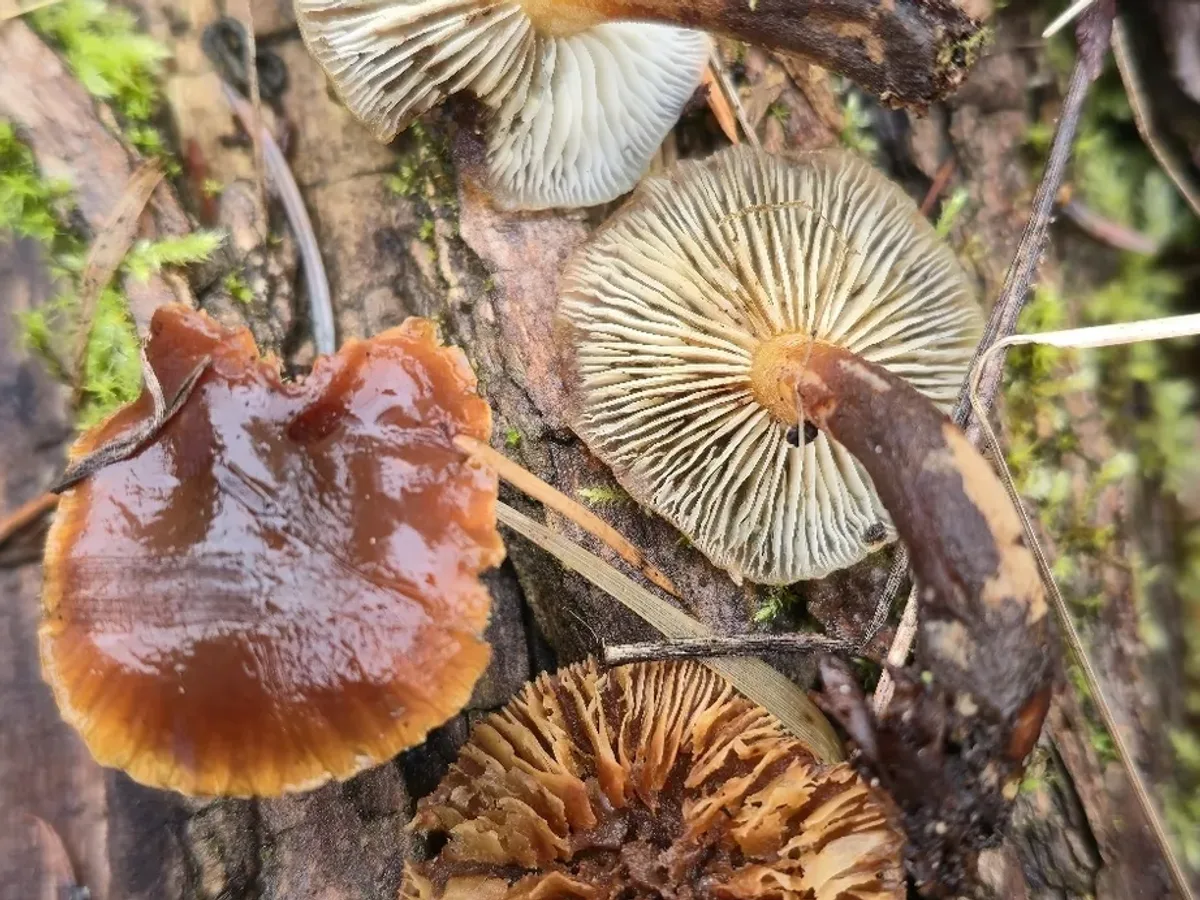 Enoki
Enoki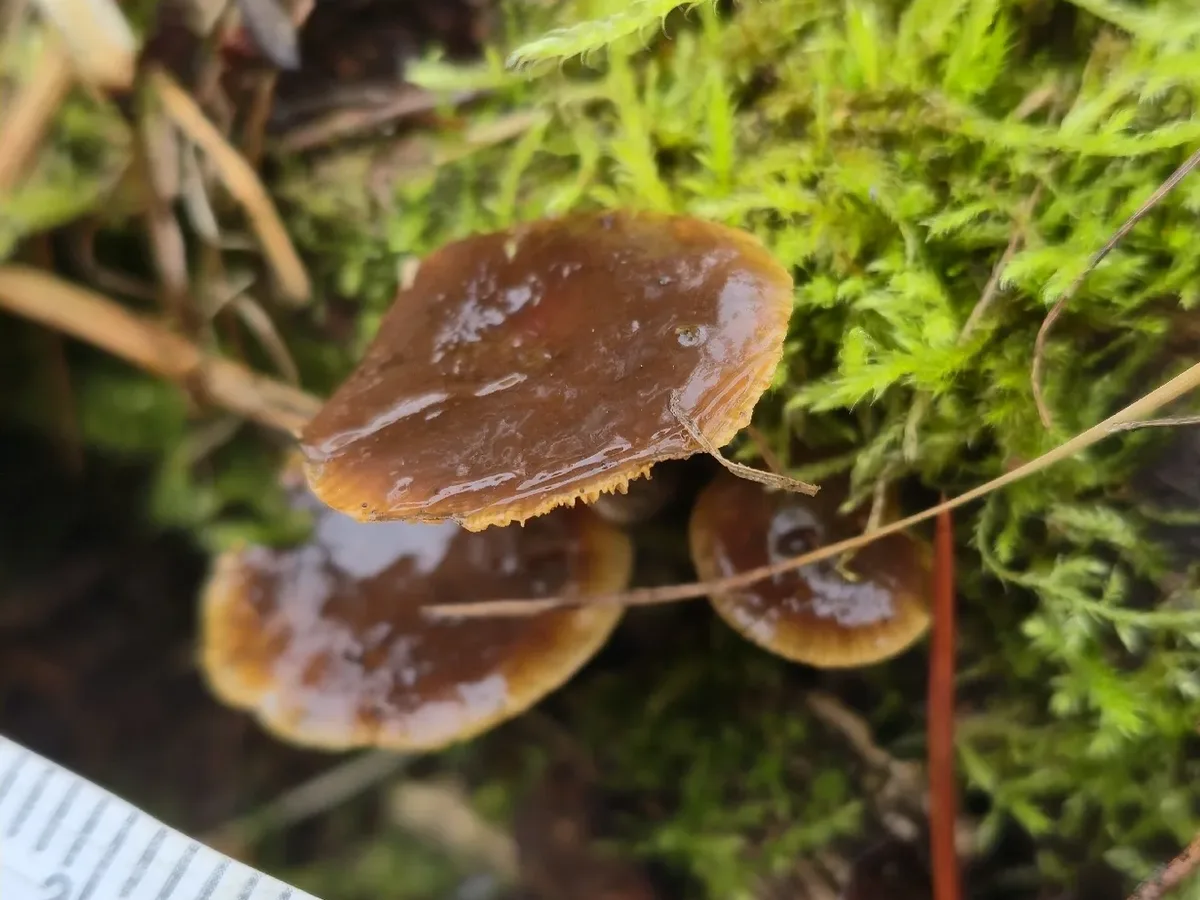 EnokiEnokiEnoki
Enoki
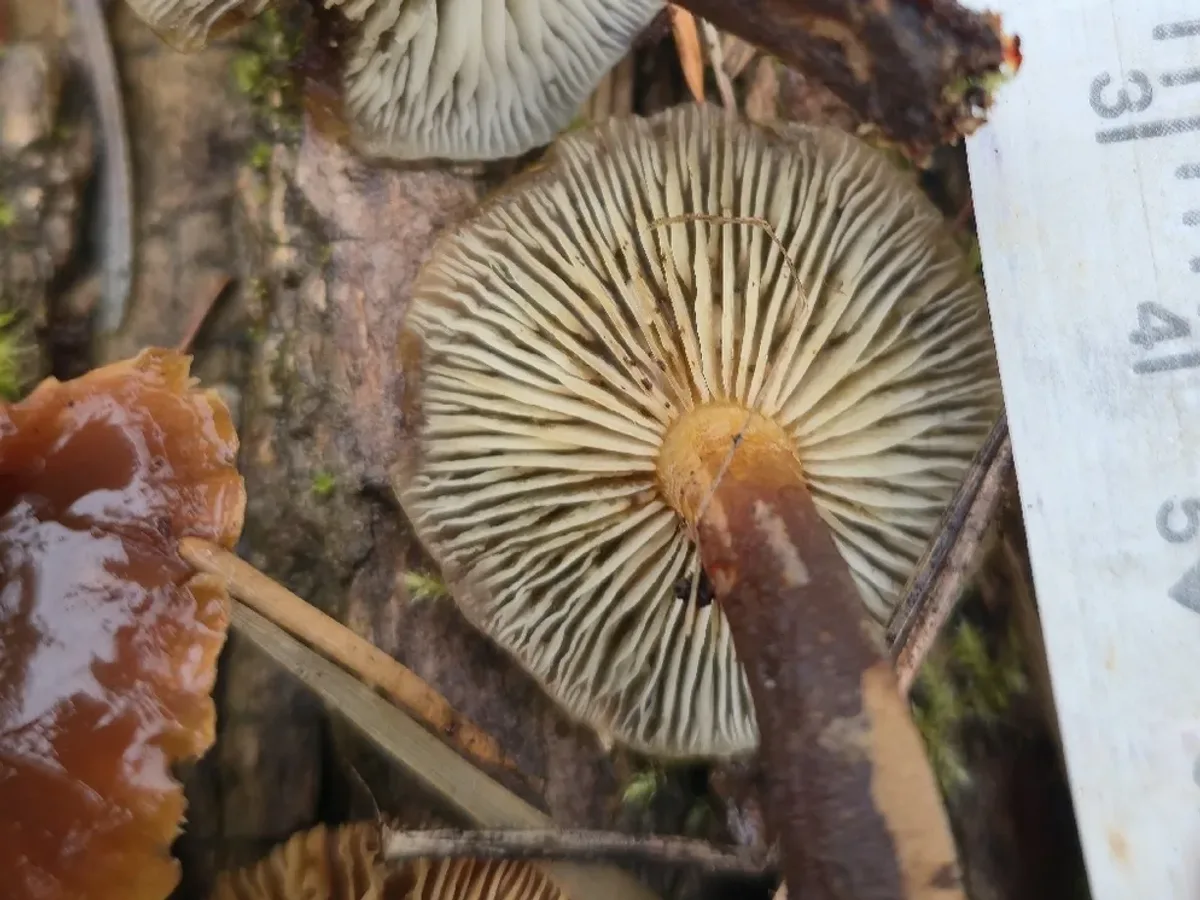
Flammulina filiformisSafe and ubiquitous when cultivated; the wild brown winter form dangerously resembles deadly Galerina, so leave foraging to experts.
How to recognise it
The cultivated enoki most people know from supermarkets is a study in human ingenuity: grown in near-darkness, the mushroom etiolates into long, slender white stalks topped by small pale caps - entirely different from the wild form, which is shorter, sturdier, and honey-brown. Bunashimeji develops compact brown caps with a faint marbled or mottled pattern, growing in tight clusters; the cultivated white variant (bunapi) is paler throughout. Nameko is small and distinctly orange-brown, its convex cap sheathed in a thick, transparent slime that is key to recognising it.
Where it grows
All three are saprotrophs - wood decomposers rather than root partners. Wild enoki favours stumps and fallen logs of hardwoods such as birch and paper mulberry; shimeji and nameko prefer beech. In the wild they are native to China, Korea, and Japan, but centuries of cultivation have made their farmed forms familiar worldwide.
Cooking
Enoki in soups, hot pot, or bacon-wrapped; shimeji in stir-fries and soups (it retains its firmness); nameko classically in miso soup and with grated daikon radish (its slime gives a smooth texture).
Look-alikes
Galerina marginata grows on wood in the same winter season as wild enoki and shares the brown-capped, clustered habit. Distinguish by three structural features absent in Flammulina: (1) a fibrous annulus (ring) on the stipe, usually visible as a ragged skirt; (2) a rusty-brown spore print - Flammulina prints white; (3) a smooth stipe lacking the dark velvety texture characteristic of wild enoki. Contains alpha-amanitin; confirmed fatal cases are documented.
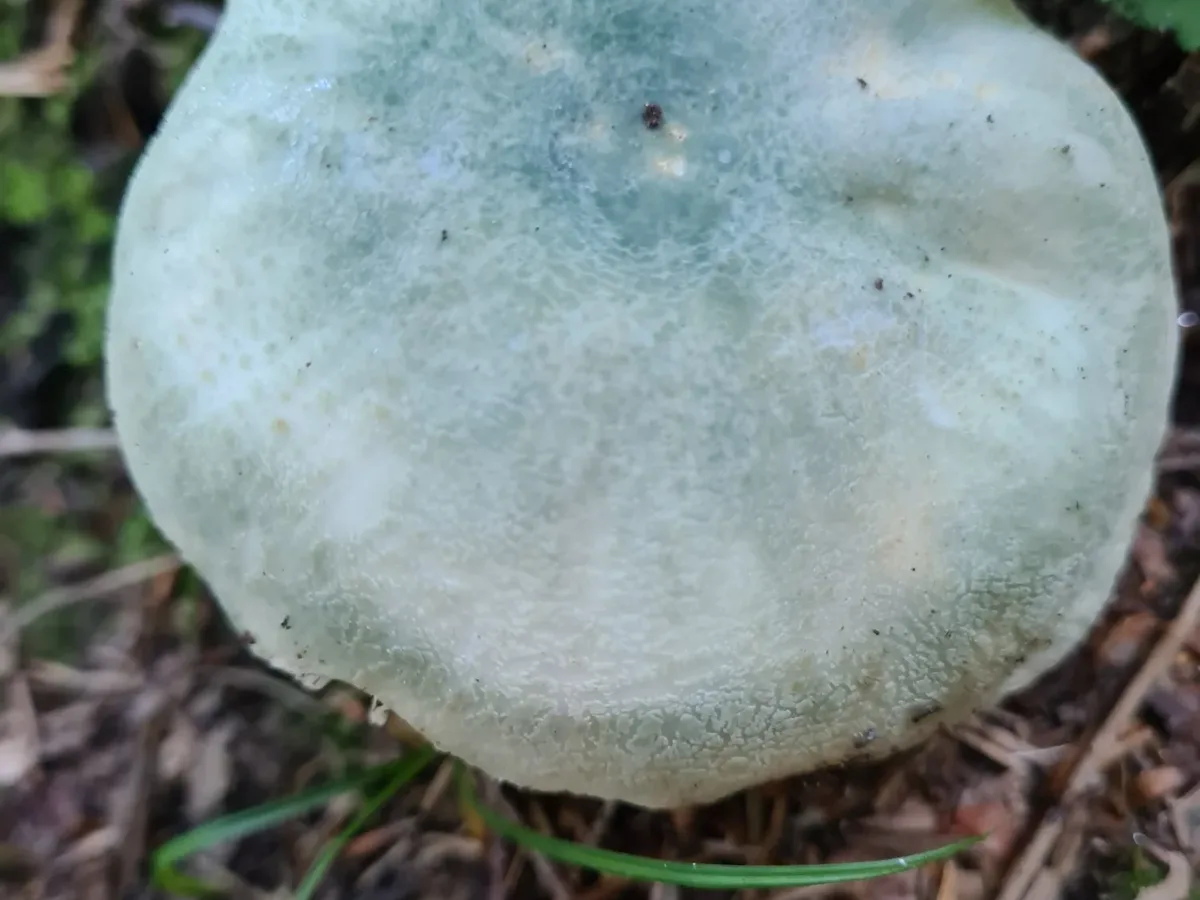 Green-cracking russula
Green russula (qingtoujun)
Russula virescensA prized green-capped russula of Yunnan markets - but russulas as a group demand experience, and the deadly Russula subnigricans is close by.
How to recognise it
Russulas come in almost every color - green, red, yellow, brown - but share a distinctive trait: the flesh is genuinely brittle and crumbles when broken, like dry chalk. Gills are straight and typically white. There is no milky latex, no skirt-like ring, and no volva at the base.
Where it grows
Ectomycorrhizal partners of forest trees - they live woven into the roots of both conifers and broadleaves and appear wherever there are trees, making them one of the most widespread and numerous genera in European forests.
Cooking
Fried; mild ones are salted or boiled; often mixed into mushroom dishes.
Danger
Deadly confusion risk: Russula subnigricans causes rhabdomyolysis. Russulas as a group demand great experience to identify, and green amanitas can also be mistaken for this mushroom.
Look-alikes
Green amanitas can be confused with the green russula; amanitas have a volva and/or ring and are not brittle like russulas.
The death cap can also have a greenish cap, but it has both a skirt-like ring and a sac-like volva, plus fibrous flesh; the russula has neither ring nor volva and brittle flesh that snaps like chalk.
Deadly; causes rhabdomyolysis. R. subnigricans has a dull gray-brown cap (not green) and flesh that reddens when broken before eventually darkening - absent the pale sea-green color and angular mosaic patch pattern of the green russula. Always confirm the distinctive cracked-mosaic cap and verify the stem base has no ring or volva.
Poisonous blackening russulas resemble the green russula; the green color and mosaic pattern are the distinguishing clue, but russulas as a group require great experience.
A harmless green russula.
A harmless green russula.
The dangerous ones
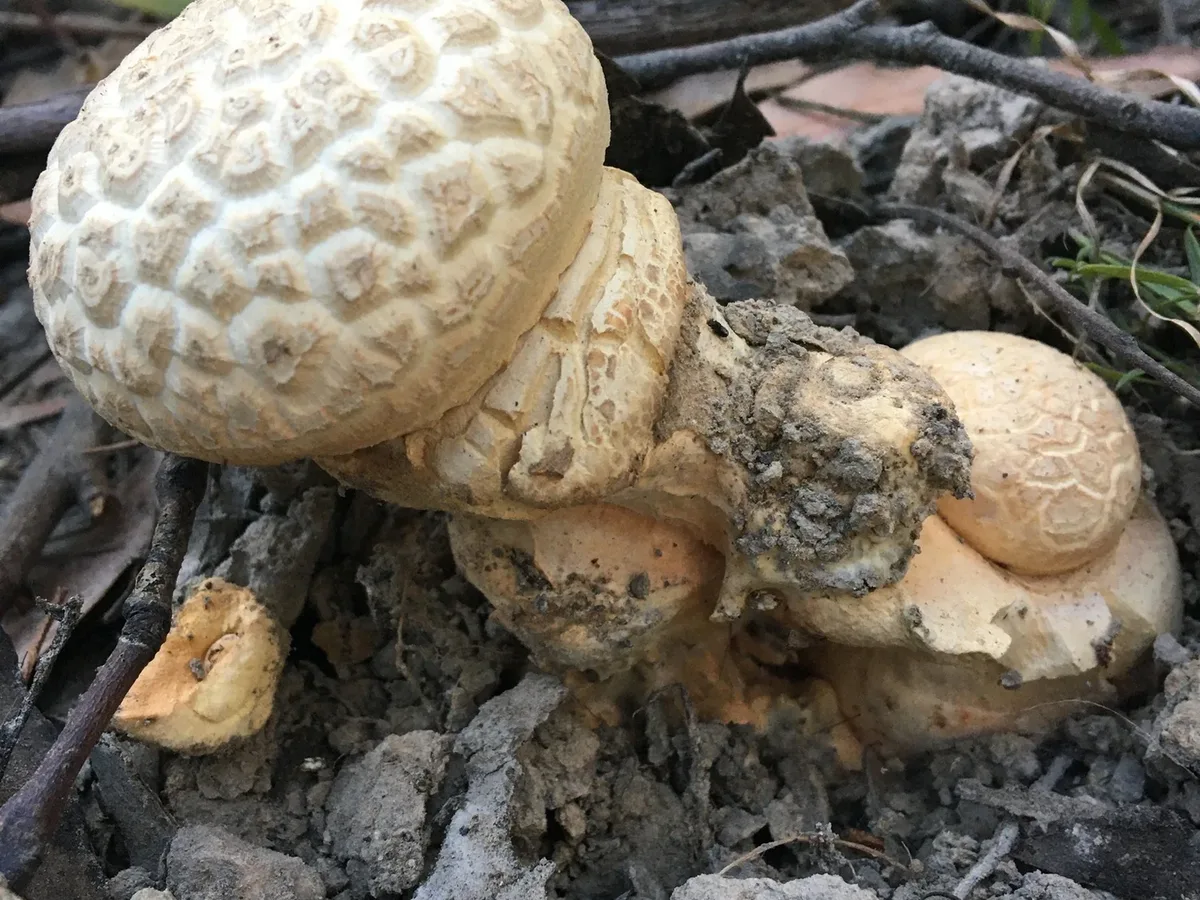 Guangzhou destroying angelGuangzhou destroying angelGuangzhou destroying angelGuangzhou destroying angel
Guangzhou destroying angel
Amanita exitialisA small, pure-white killer: about 50 g of fresh mushroom is enough to kill a 50 kg adult, and amatoxins survive any cooking.
How to recognise it
A. exitialis is small to medium and entirely white - cap up to about 7 cm - with a fragile skirt-like ring and a firm, sac-like volva at the base of the stem. One subtle distinguishing feature: its basidia bear only 2 spores instead of the usual 4, though this requires a microscope. The closely related A. fuliginea has a convex cap ranging from dark grey to near-black (4-9 cm), white free gills, a white stem, and a volva. A. subjunquillea shows a yellow-brown to olive cap. The shared signature of all these deadly relatives: pure white gills, white spore print, a ring partway up the stem, and a volva - the papery sac half-buried at the base. Always dig out the entire stem base to check for it.
Where it grows
These are ectomycorrhizal species, spending most of their lives as invisible mycelium threaded through the roots of oak and Castanopsis trees. A fruiting body is just the brief, above-ground tip of that relationship. A. exitialis is found mainly in southern and southwestern China (Guangdong, Jiangxi, Yunnan); A. fuliginea is widespread across China and Japan.
Cooking
Not applicable - deadly poisonous and never eaten. The toxins are not destroyed by cooking, drying or freezing.
Danger
In a review of southern China 1994-2012 (Chen et al.), Amanita accounted for 64.70% of poisoning outbreaks, 78.05% of cases and 70.49% of deaths (852 patients, 183 dead, 21.48% lethality). A. fuliginea is the single deadliest - in the same region 352 poisoned and 79 dead 1994-2012, and according to one study responsible for about 41% of poisoning cases and about 43% of deaths. A. exitialis: in Guangzhou in March 2000, 8 of 9 people died after eating white wild mushrooms (only 1 survived, per Sun et al., J Toxicol 2018); 2000-2022 saw 73 reported outbreaks (72 in China) with 257 patients and 74 dead (about 29% lethality). The amatoxins are NOT destroyed by cooking, drying or freezing.
Look-alikes
Deadly Amanita have a volva (sac) at the stem base and a white spore print; always uproot to check the base.
Volvariella has a pink spore print and no ring; deadly Amanita have white spores and a ring on the stem plus a volva.
Agaricus has pink-to-brown gills and a brown spore print and no volva; deadly Amanita have white gills, white spores and a basal volva.
A. virosa has been confused with this Tricholoma in Japan; the Amanita has a ring and a volva at the base.
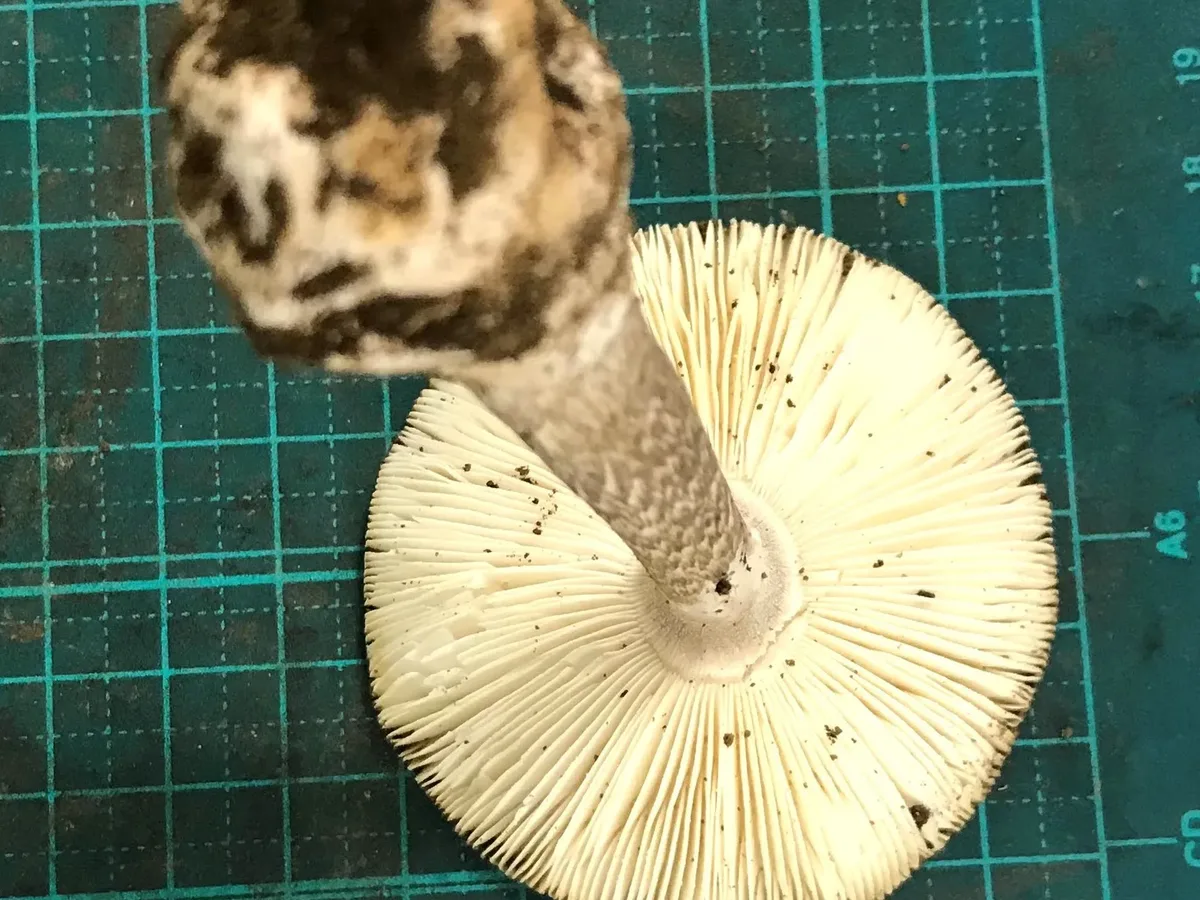 East Asian brown death cap
East Asian brown death cap
Amanita fuligineaThe single deadliest mushroom of the region - responsible for roughly 41% of poisoning cases and 43% of deaths in southern China.
How to recognise it
A small-to-medium Amanita with a smoky, radially-streaked cap 4-9 cm ranging from dark ashy grey to nearly black - the feature that names it. Beneath are pure white free gills; the white stem carries a ring and rises from a firm, sac-like white volva. The spore print is white.
Where it grows
Ectomycorrhizal with oak and Castanopsis in the subtropical and warm-temperate broadleaf forests of eastern and southern China and Japan, often in secondary woodland close to villages.
Cooking
Not applicable - deadly poisonous and never eaten. Cooking, drying and freezing do nothing to the toxin, and even the water it was boiled in is lethal.
Danger
The deadliest species in southern China's poisoning statistics - amatoxins that no cooking can destroy, in a plain dark mushroom easily taken for an edible. In one 1994-2012 regional cohort it caused an estimated 41% of cases and 43% of deaths.
Look-alikes
A pure-white sister species in the same deadly group; both carry amatoxins and share the same fatal course.
Its young 'egg' resembles a deadly Amanita button; Volvariella has no ring and a pink spore print, never white gills with a ring.
White gills + white spore print + ring + volva mark the deadly Amanita; edible look-alikes lack the buried sac-like volva.
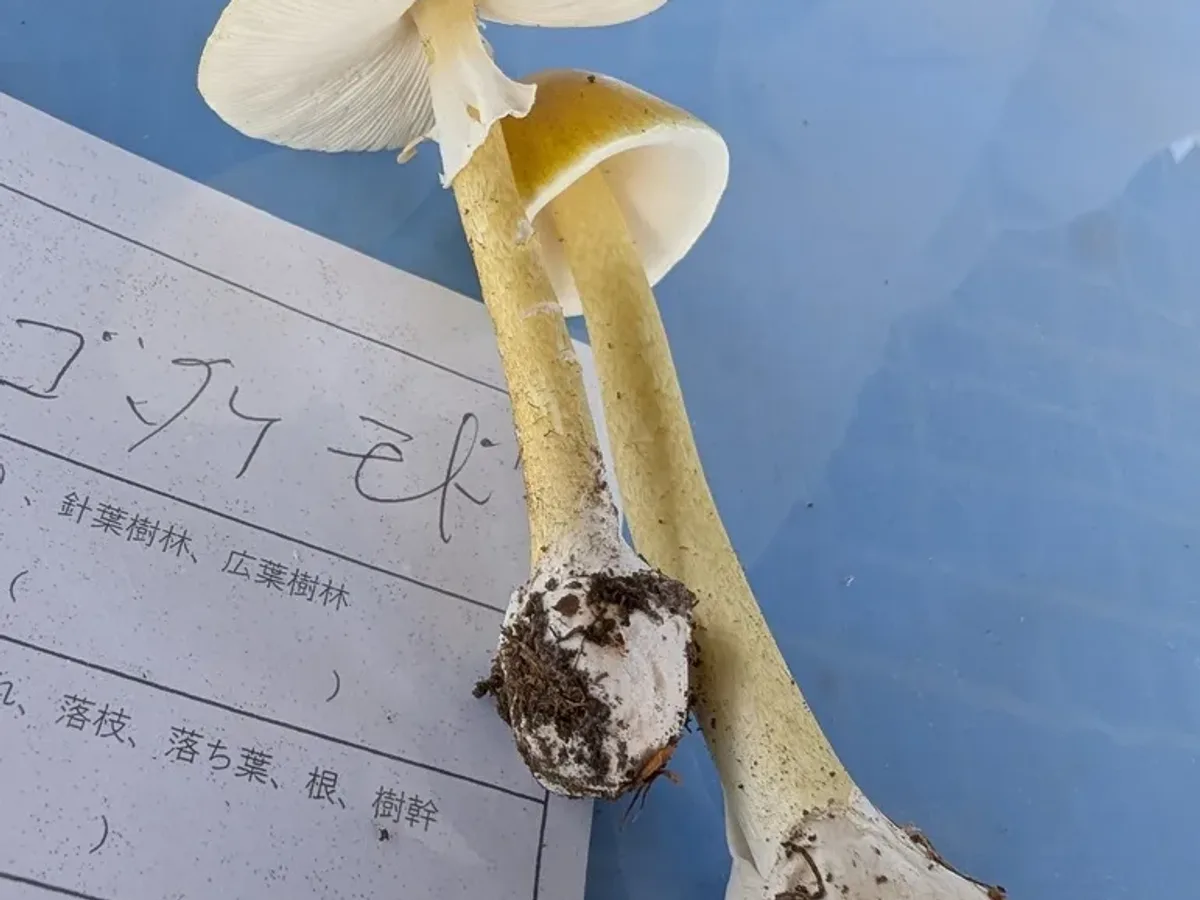 East Asian death cap
East Asian death cap
Amanita subjunquilleaYellow-brown to olive cap, white gills and spores, ring and volva - another lethal amatoxin Amanita of the region's forests.
How to recognise it
A modest mushroom with a yellow-brown to olive-brown cap 3-7 cm, sometimes darker at the centre and occasionally bearing veil flecks. The gills are white and free, the stem whitish to pale yellow with a ring, and the base is wrapped in a sac-like white volva. Spore print white.
Where it grows
Ectomycorrhizal with conifers and broadleaf trees in temperate and subtropical forests of China, Japan, Korea and the Russian Far East.
Cooking
Not applicable - deadly poisonous and never eaten. Cooking, drying and freezing do nothing to the toxin, and even the water it was boiled in is lethal.
Danger
A lethal amatoxin Amanita whose dull olive-brown colour makes it easy to dismiss as an ordinary edible. Like all its relatives, the toxin survives cooking and the illness begins only after a deceptive delay of many hours.
Look-alikes
Fellow deadly East Asian death caps; all share white gills, white spores, a ring and a volva.
Tricholoma and other edibles lack the sac-like basal volva and the white spore print; always dig up the base.
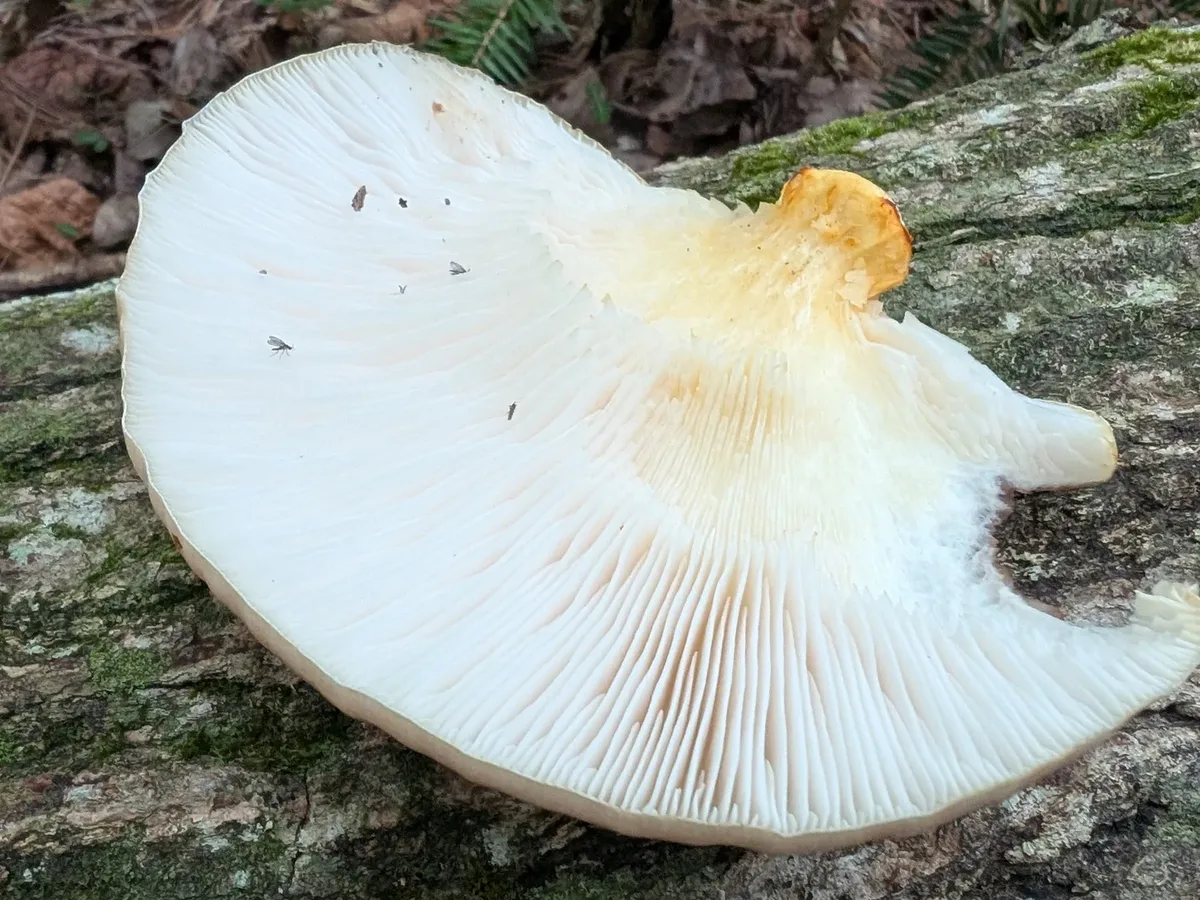 Jack-o'-lantern mushroom
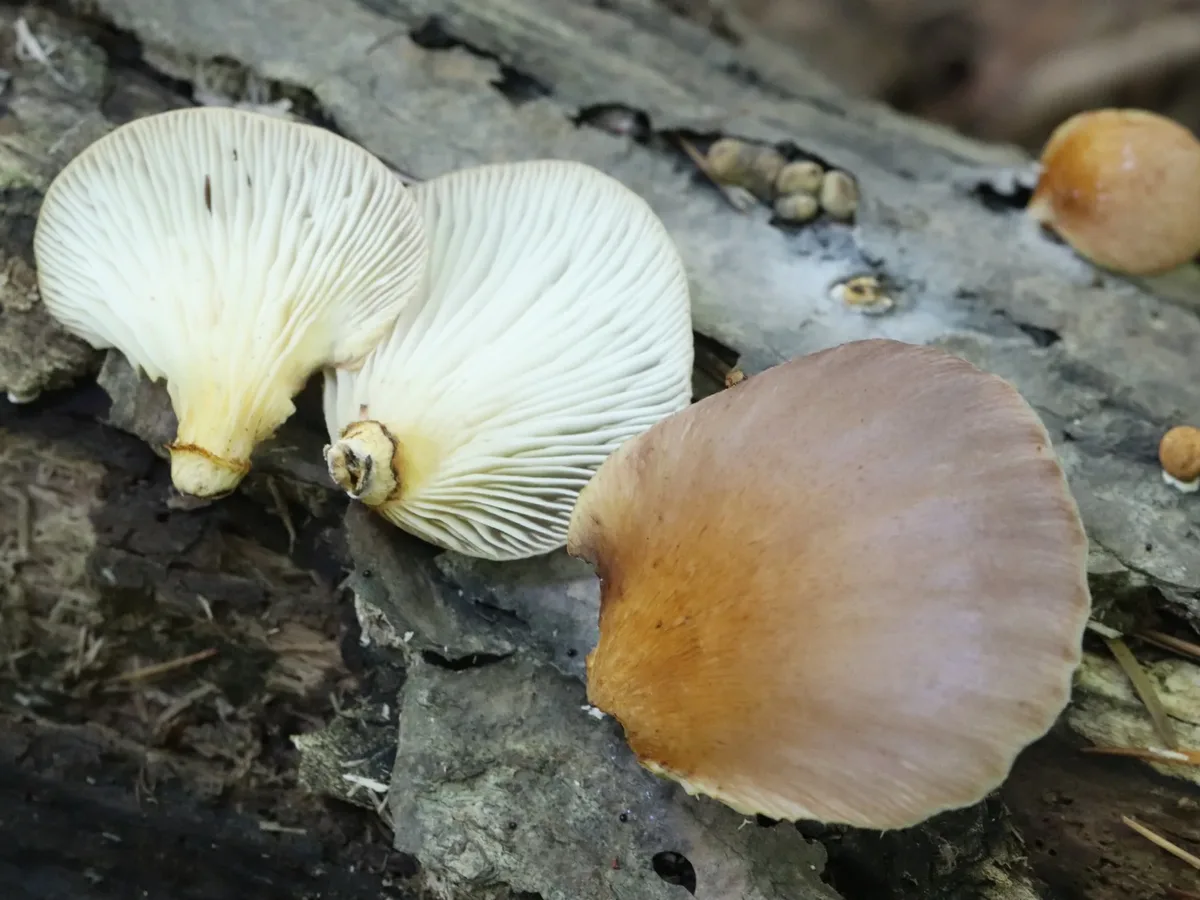 Jack-o'-lantern mushroom
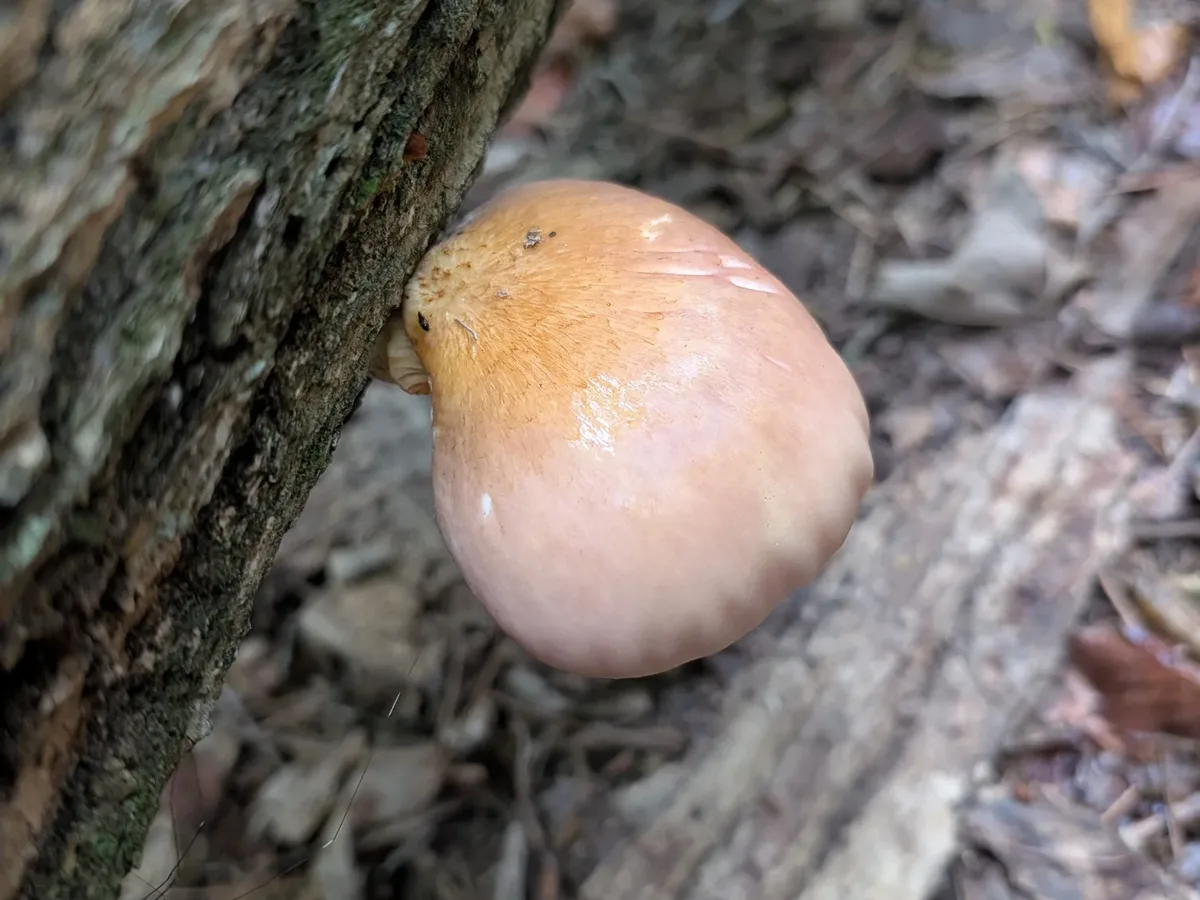 Jack-o'-lantern mushroom
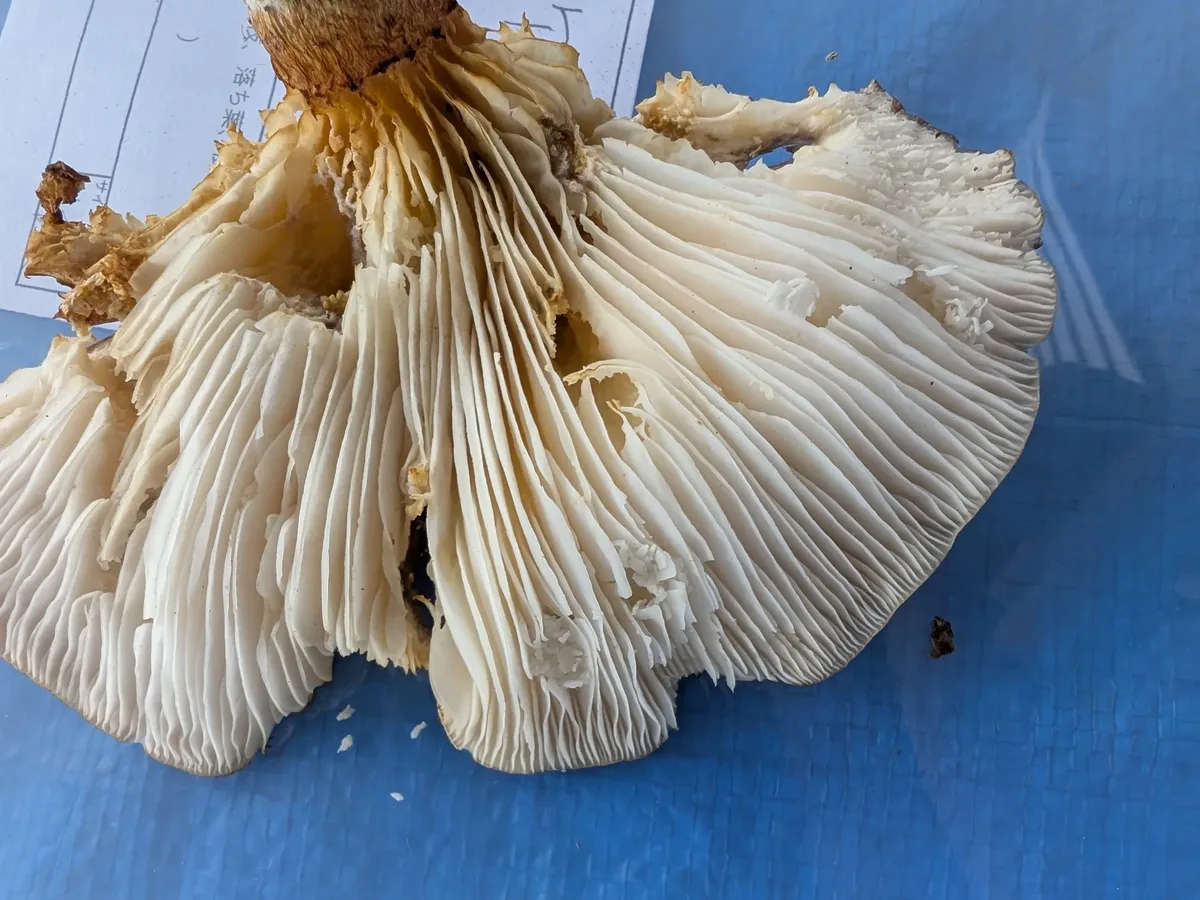 Jack-o'-lantern mushroomJack-o'-lantern mushroomJack-o'-lantern mushroom
Tsukiyotake (jack-o'-lantern)
Omphalotus japonicusJapan's most common poisoning, glowing faintly in the dark and mimicking shiitake and oyster mushrooms - look for the dark purple-black stain in the split stem base.
How to recognise it
Large and fleshy, orange-brown to brown, shaped much like an oyster mushroom - gills running down the short, off-centre stem, growing in overlapping bracket clusters on dead wood. One property sets it apart from every edible lookalike: in complete darkness its gills emit a real, faint green bioluminescence. The other diagnostic is structural - split the stem base lengthwise and look for a dark, blackish-purple spot in the flesh.
Where it grows
On dead beech logs and stumps (Fagus) in mountain forest, across Japan, Korea, China, and the Russian Far East.
Cooking
This mushroom must never be eaten. No preparation method - including cooking, frying, drying, boiling, or blanching - removes or destroys the illudin toxins (illudin S and illudin M) responsible for poisoning. These sesquiterpene compounds are heat-stable, so standard kitchen processes that would neutralise many other toxins have no meaningful effect here. Eating O. japonicus causes severe and rapid-onset gastrointestinal illness (intense nausea, repeated vomiting, and profuse diarrhea) typically beginning within 30 minutes to 3 hours of ingestion. The illness is rarely fatal in healthy adults but can require hospital treatment for dehydration and electrolyte loss, particularly in the elderly, children, or those with underlying health conditions. If you or someone with you has eaten a wood-growing mushroom and begins experiencing these symptoms, seek medical attention promptly and, if possible, bring a sample or photograph of the mushroom for identification.
Danger
Rarely life-threatening but extremely common - the classic "shiitake/oyster-mushroom trap" in Japan. Always cut every wood-growing "edible" mushroom lengthwise and check for the dark spot.
Look-alikes
Edible oyster mushroom; O. japonicus mimics it. The dark spot in the lengthwise-split stem base and faint green glow distinguish O. japonicus.
Edible wood-growing mushroom; readily confused with O. japonicus. Check for the dark flesh spot at the stem base and bioluminescence.
Edible cultivated/wild mushroom; O. japonicus is confused for it. Tell apart by the dark blackish-purple spot in the split stem base of O. japonicus and its green bioluminescence.
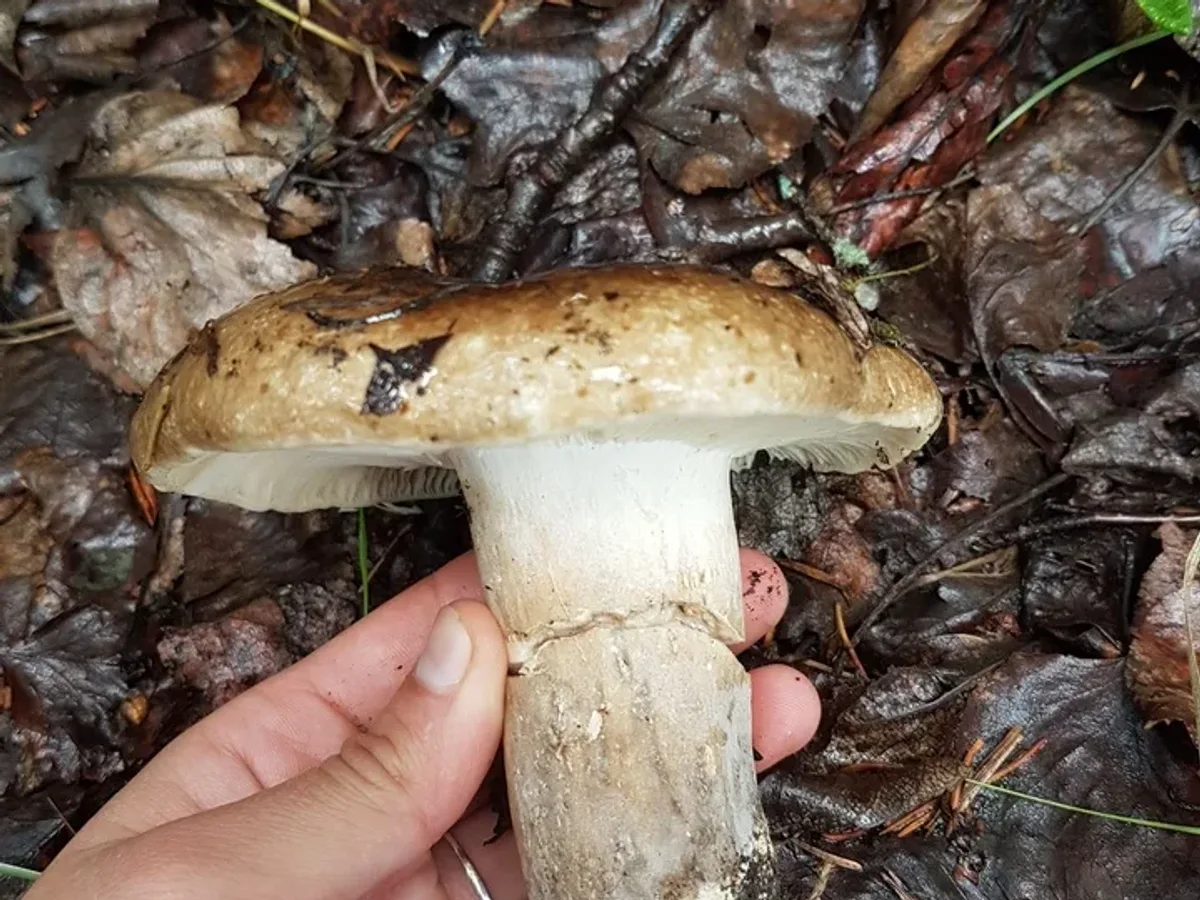 Poison Russula
False blackening russula
Russula subnigricansOne of very few deadly russulas - its flesh reddens but does not fully blacken, and it causes rhabdomyolysis.
How to recognise it
A fleshy, grey-brown to dark blackish-brown brittlegill. The flesh reddens slightly when cut but does NOT blacken completely - that subtle difference from the harmless R. nigricans is the single most important field mark. Cap and gills are brittle, as with all russulas.
Where it grows
Grows under broadleaf trees, particularly oak, in East Asian forest - Japan, Taiwan, China and Korea. It shares the same forest floor as the edible kurohatsu-type brittlegills it so closely resembles.
Cooking
Russula subnigricans must never be eaten, and no preparation method makes it safe. Unlike many poisonous fungi whose toxins degrade with heat, the cycloprop-2-ene-carboxylic acid responsible for its lethal effects is heat-stable: boiling, parboiling, frying, drying, pickling, or any other treatment does not neutralise it. The toxin causes rhabdomyolysis - a catastrophic breakdown of skeletal muscle - and even small amounts can trigger a cascade leading to kidney failure, cardiac arrhythmia and death. There is no antidote and no preparation shortcut that changes that outcome. If you have already eaten a suspected specimen: do not wait for symptoms. Seek emergency care immediately, bring a photograph or sample of the mushroom, and tell the treating team you suspect Russula subnigricans poisoning so they can monitor creatine kinase, myoglobin, renal function and electrolytes from the outset - the rhabdomyolysis pattern is sometimes misread as a cardiac event and valuable treatment time is lost.
Danger
One of very few deadly brittlegills. High mortality in cases of serious poisoning. Family clusters reported in China, Japan and Korea. Early recognition and intensive care are decisive.
Look-alikes
The harmless R. nigricans blackens completely; R. subnigricans reddens slightly on cut but does not fully blacken. Confused with edible blackening/grey brittlegills (kurohatsu types) eaten in Japan.
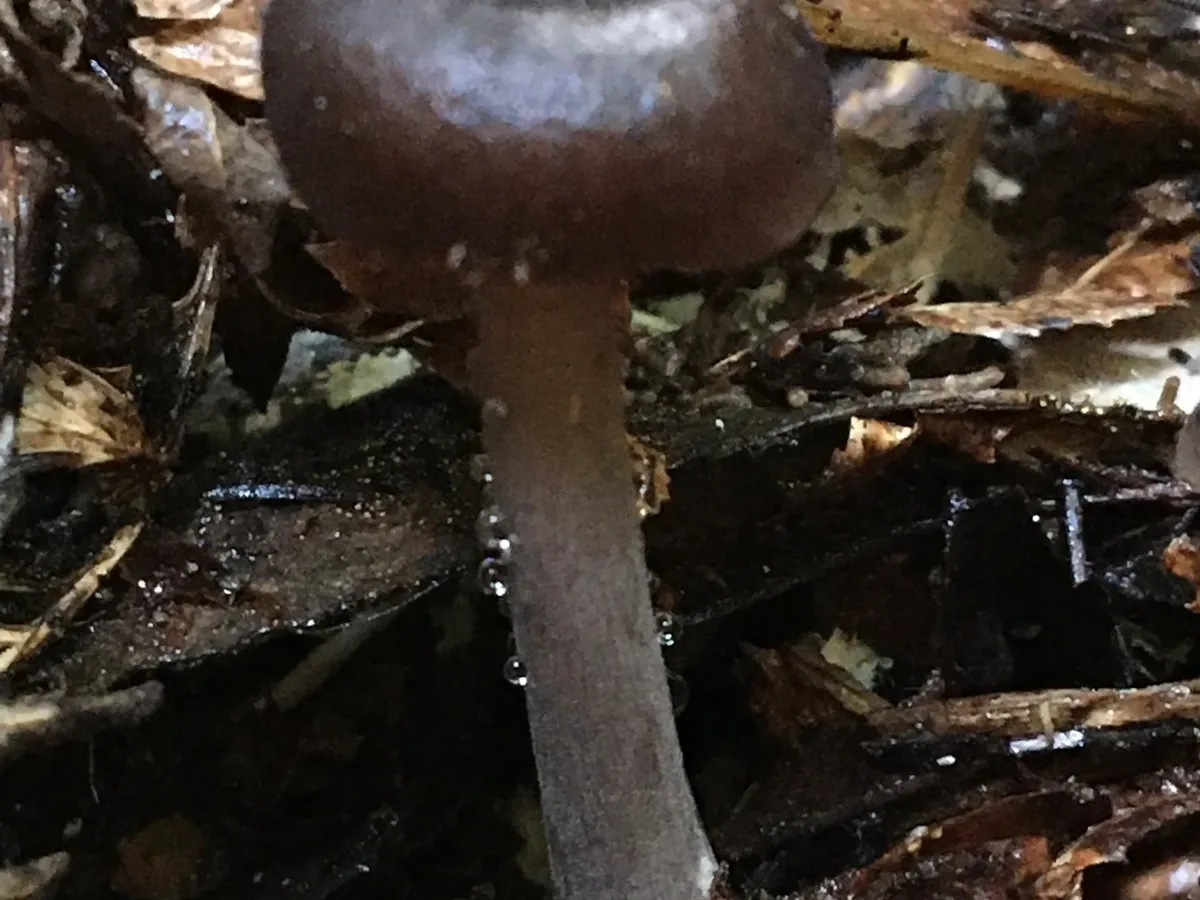 Little white mushroom
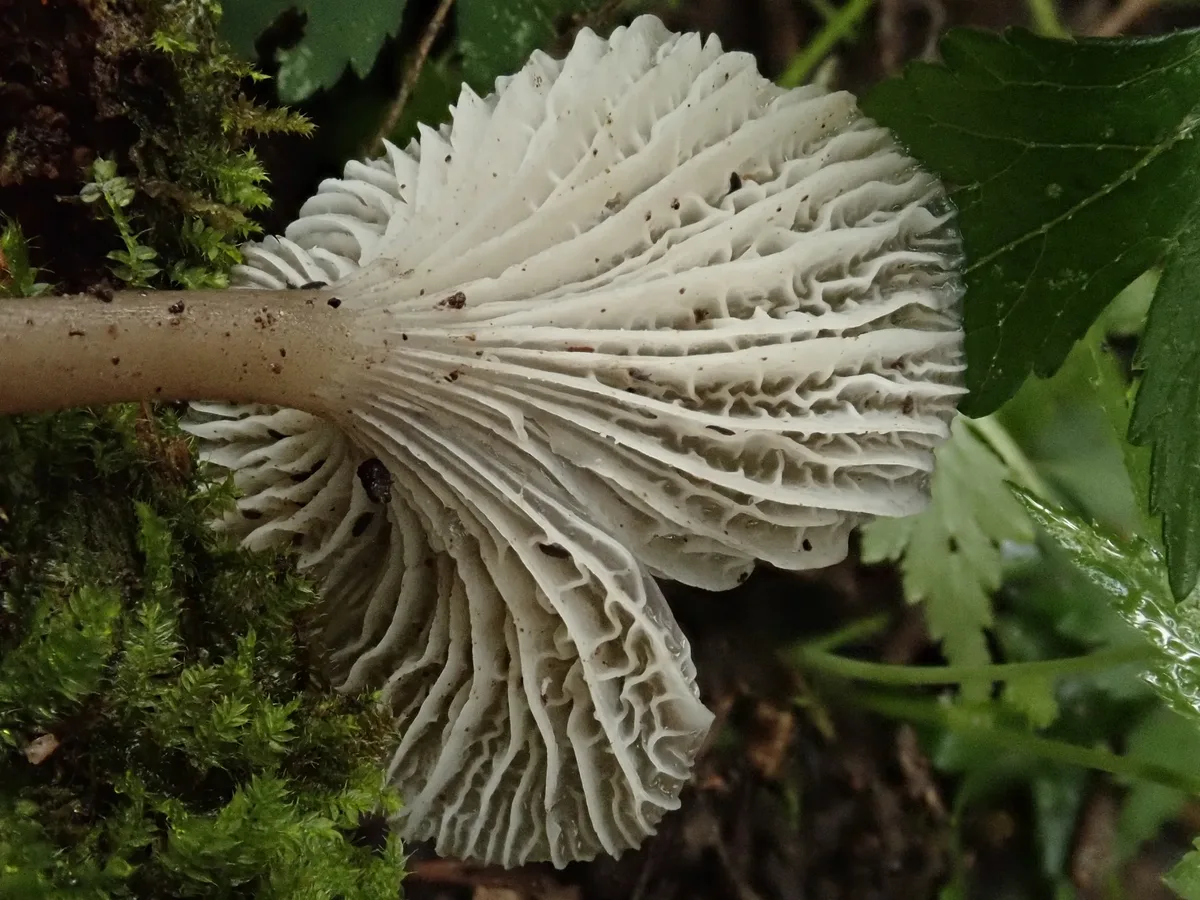 Little white mushroom
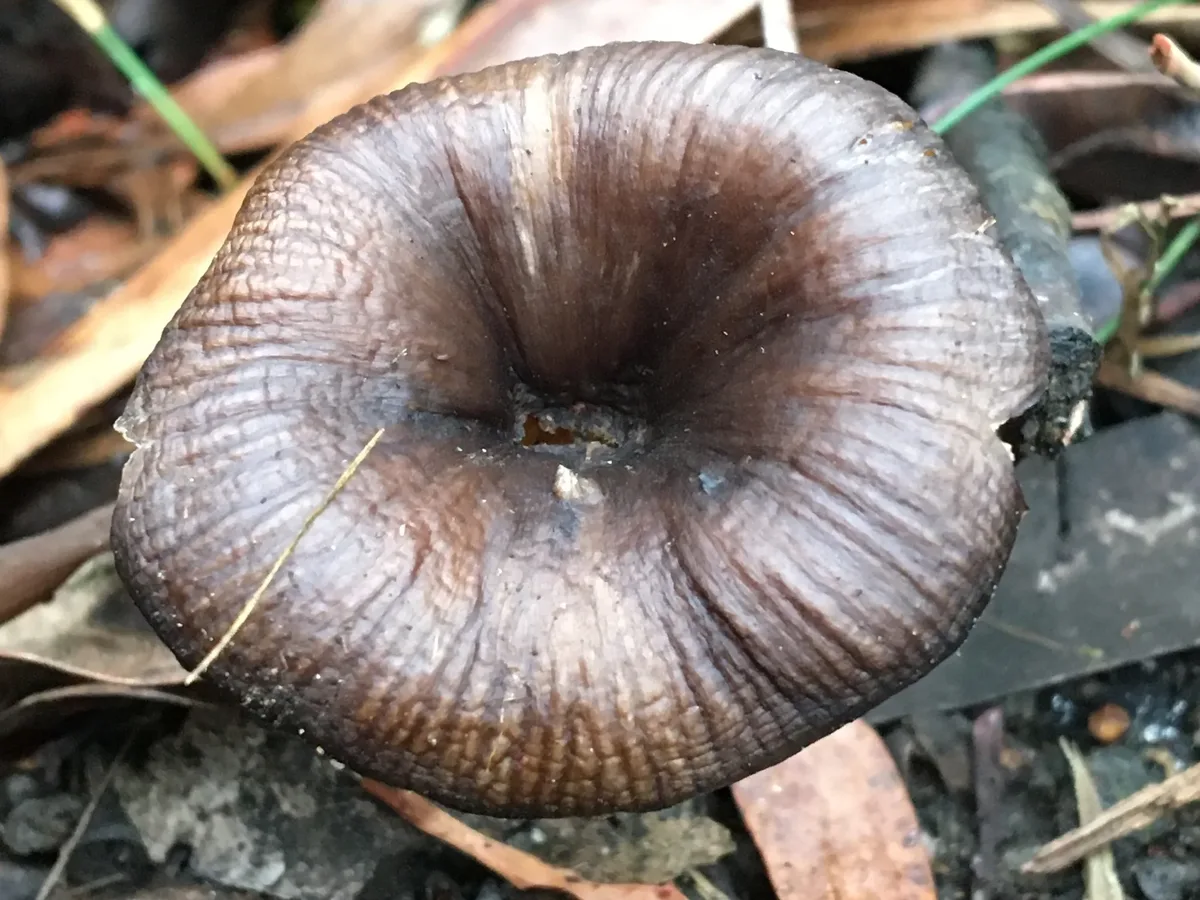 Little white mushroomLittle white mushroomLittle white mushroom
Little white mushroom (Yunnan sudden death)
Trogia venenataA small, plain white mushroom behind hundreds of 'Yunnan Sudden Unexplained Death' cases - the lesson is simply: never eat unknown little white mushrooms.
How to recognise it
A small, pale white to creamy-white gilled mushroom (family Marasmiaceae). It is genuinely unremarkable in appearance - modest in size, plain in colour - and that is exactly what makes it dangerous.
Where it grows
Endemic to the mountain forests of northwestern Yunnan, China, growing at 1,800-2,400 m elevation in the high-altitude terrain where summer monsoon rains define the season.
Cooking
Not applicable - deadly poisonous, never eat.
Danger
According to Shi et al. (PLOS One 2012, Chinese CDC + Kunming Institute of Botany) a total of 395 SUD cases were identified between 1975 and 2009 (averaging about 21/year from 1990-2005), almost always during the summer rains at 1,800-2,400 m elevation. After public-education campaigns the cases dropped sharply: "We identified 33 SUD, a 73% decline from 2002-2005" (for the period 2006-2009).
Look-alikes
Locals mistook it for an edible small white mushroom; because it is genuinely hard to distinguish, the public-health advice became simply to never eat unknown small white mushrooms.
 Poison Fire Coral
 Poison Fire Coral
 Poison Fire CoralPoison Fire CoralPoison Fire Coral
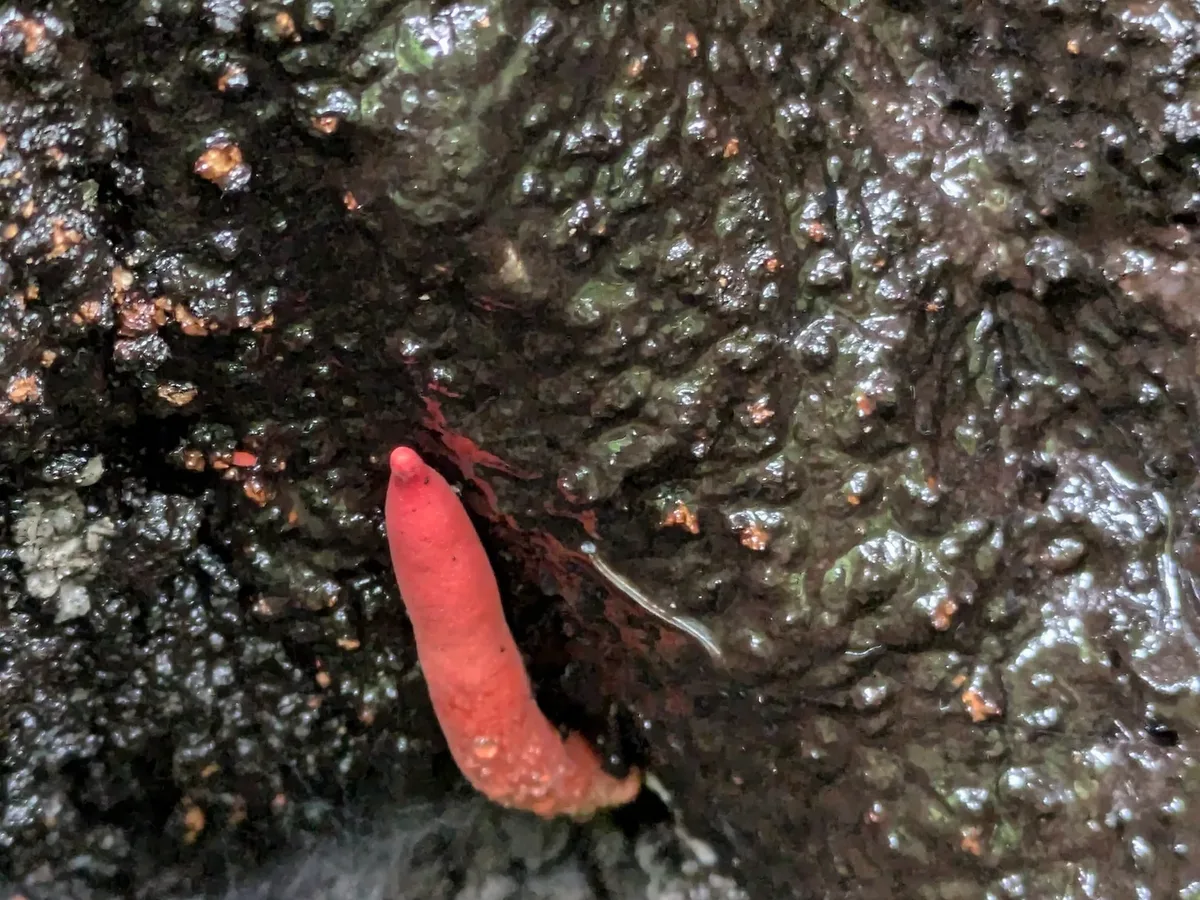
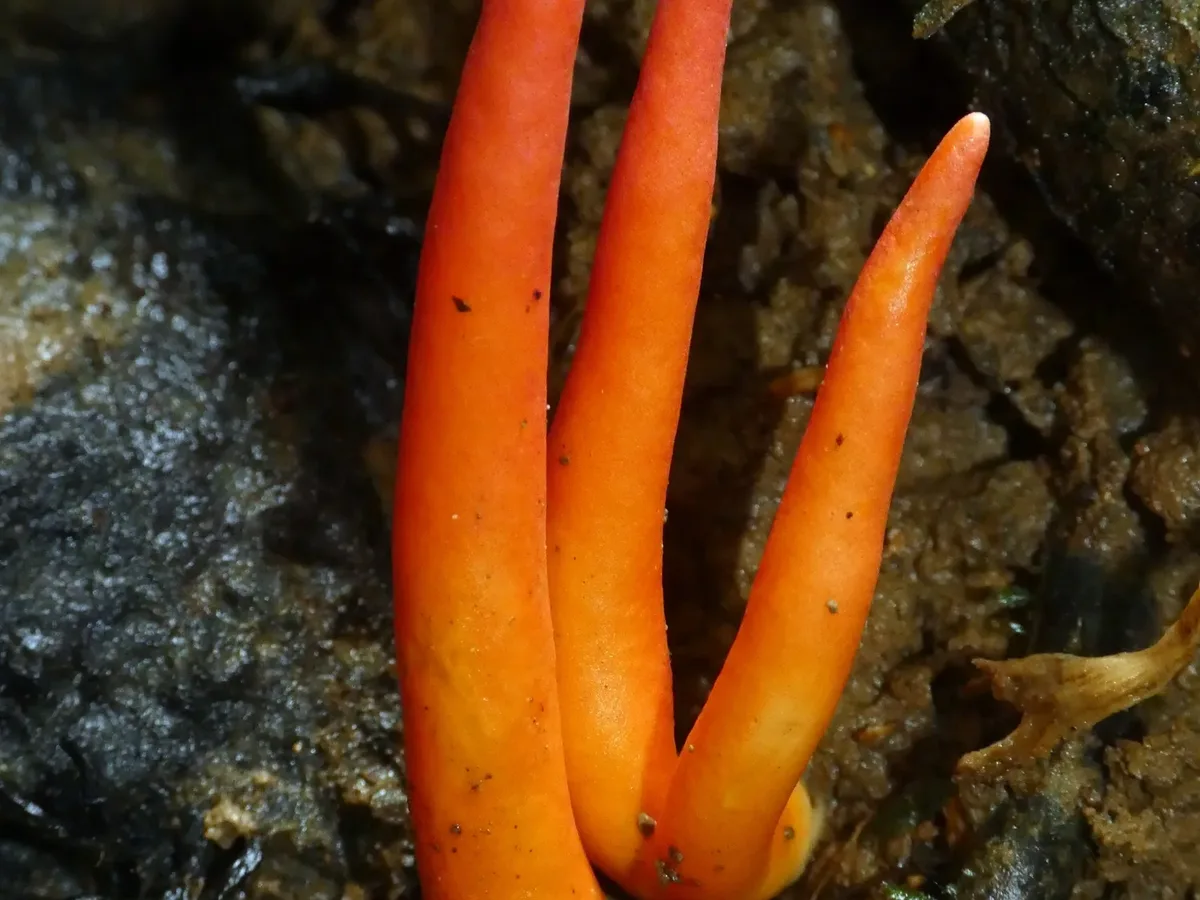
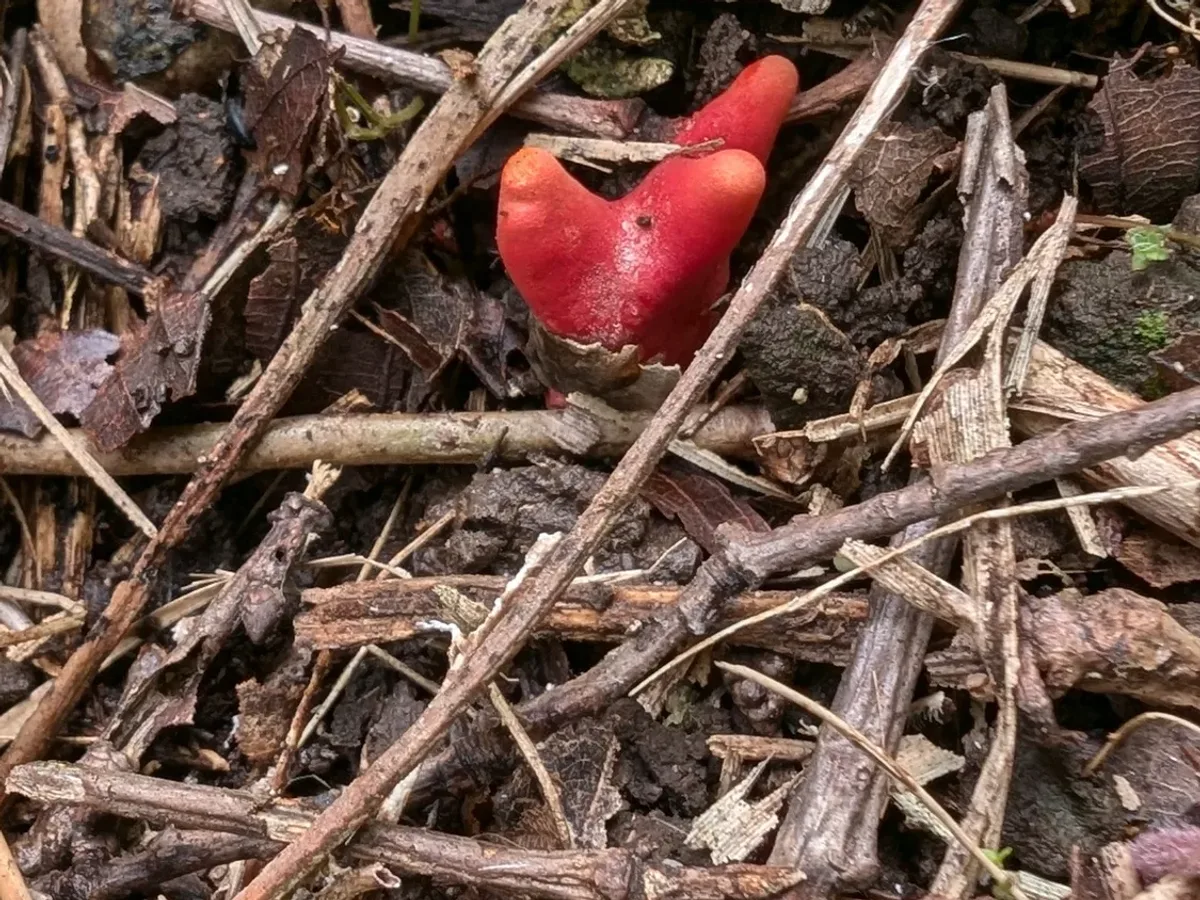
Poison fire coral
Trichoderma cornu-damaeReckoned one of the world's deadliest mushrooms - its scarlet coral-like fingers are unmistakable; never eat or taste it, especially in mushroom liquors.
How to recognise it
Brilliant red-orange fingers or antler-like branches rising from the soil near dead wood or oak roots - coral-shaped, branched, and unnervingly vivid. The color is an almost arterial red-orange, making it visually unlike nearly anything else on the forest floor.
Where it grows
At the base of trees or on dead wood, particularly oak. A wood-decay fungus rather than a soil dweller. Found in Japan, Korea, and China; also recorded in Java, Papua New Guinea, and tropical Australia.
Cooking
This species must never be eaten. No method of preparation - cooking, boiling, drying, powdering, or prolonged steeping in alcohol - destroys or neutralizes its trichothecene mycotoxins. This is critical to understand: the documented fatal poisonings in Japan involved mushroom liquor made by steeping the fungus in sake, meaning the victim believed the alcohol extraction would either render it safe or produce a medicinal concentrate. It did not - trichothecenes are stable in ethanol and heat, and the alcohol extraction actually concentrates the toxins. Even a gram or two of material is sufficient to cause fatal multi-organ failure. Discard any food or drink that may have come into contact with Trichoderma cornu-damae; do not attempt to neutralize it. If ingestion is suspected, seek emergency medical care immediately - do not wait for symptoms, as onset may be delayed several hours while internal damage is already occurring.
Danger
Considered one of the world's deadliest mushrooms. Documented deaths in Japan, including a man in Niigata in 1999 (ate 1-2 g in sake) and a man in Gunma in 2000; one case died 12 hours after consuming mushroom liquor. Never eat or taste it.
Look-alikes
A medicinal mushroom that the poison fire coral is tragically confused with, especially when preparing mushroom liquor (steeped in sake/spirits).
A medicinal mushroom confused with the poison fire coral during preparation of mushroom liquor.
 Entoloma rhodopolium complex
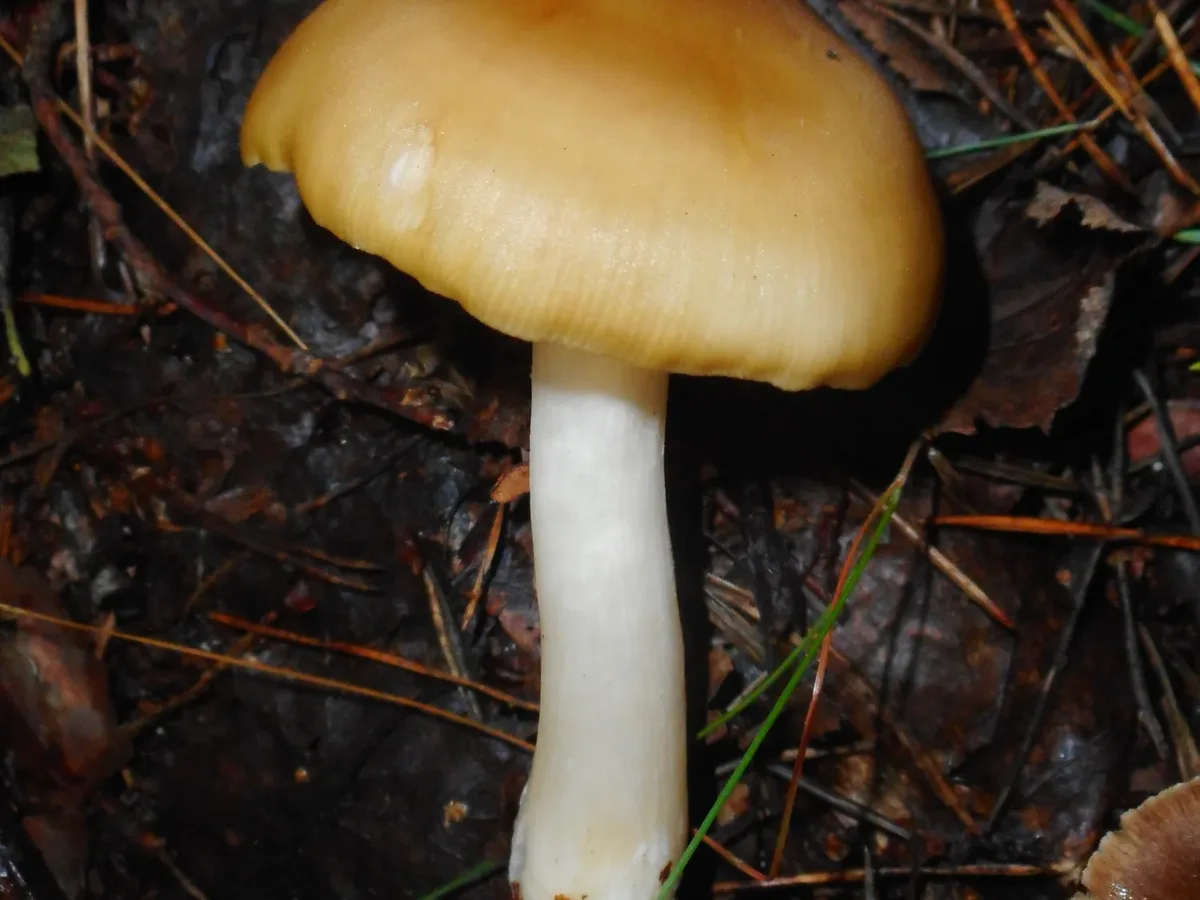 Entoloma rhodopolium complex
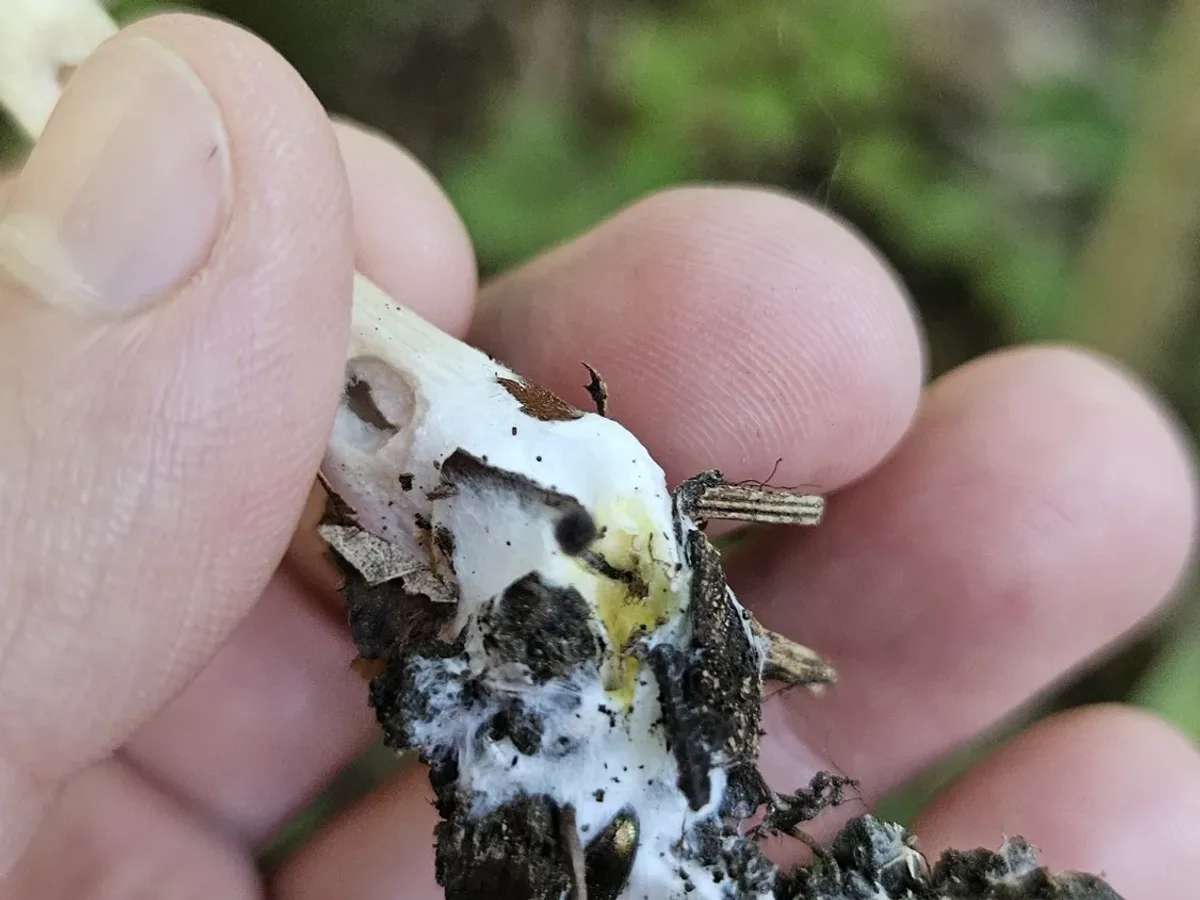 Entoloma rhodopolium complexEntoloma rhodopolium complexEntoloma rhodopolium complex
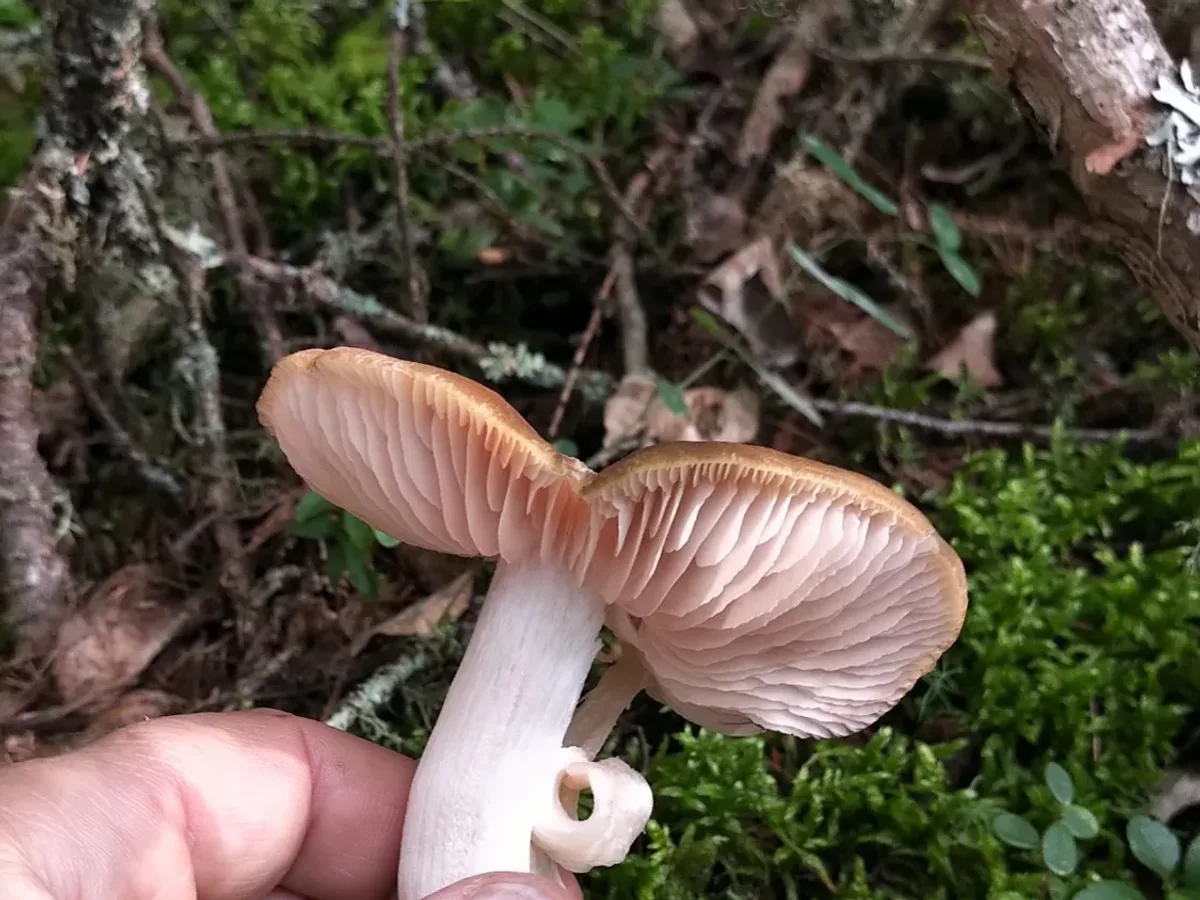
Livid pinkgill (kusaurabenitake)
Entoloma rhodopoliumOne of Japan's three most common poisonings - a grey-brown pinkgill mistaken for edible shimeji, betrayed by its pink spore print.
How to recognise it
Cap grey to grey-brown, conical or bell-shaped when young, then flattening to up to about 20 cm across. The gills are pale at first and gradually shift to pink as the spores ripen. Stem white, up to 13 cm tall; flesh firm and white, sometimes with a faint mealy or floury smell. The single most useful field marker: a spore print taken on white paper will come up salmon-pink, the signature of the genus Entoloma.
Where it grows
Found in deciduous and mixed forest, where it lives as a mycorrhizal partner threaded into the roots of the surrounding trees.
Cooking
Entoloma rhodopolium must never be eaten. No method of preparation - boiling, parboiling and discarding the water, drying, pickling, or prolonged cooking - removes the toxins. The active compounds (muscarine, muscaridine, and choline) are water-soluble and heat-stable enough that they survive normal culinary treatment and are absorbed in the gut. Even a small serving of a mushroom from this complex can cause cholinergic poisoning with onset in as little as 30 minutes: nausea, vomiting, abdominal cramps, diarrhoea, excessive salivation, and dizziness. The only correct response when this mushroom is found in a basket is to discard it and wash hands. There is no edible preparation.
Danger
The Entoloma rhodopolium complex is among the three most common causes of mushroom poisoning in Japan (together with tsukiyotake/Omphalotus japonicus and kakishimeji/Tricholoma ustale). According to Ting et al. (2024), O. japonicus and E. rhodopolium together caused 52% of Japanese mushroom poisonings from 2001 to 2010. A very common 'autumn gilled-mushroom trap.'
Look-alikes
Contains lethal amatoxin and resembles wild enoki/nameko; a separate deadly trap to be aware of.
An edible relative in the same genus; the toxic E. rhodopolium complex is frequently mistaken for it.
Edible cultivated/wild gilled mushrooms confused with the grey-brown E. rhodopolium; look for the pink spore print of Entoloma to distinguish.
The rules that save lives
- Start at the market, not in the forest: in this region the safe, authentic path is buying from established markets and restaurants, not picking unknown species yourself.
- Learn the deadly Amanitas by heart - white/grey cap + white gills + white spore print + ring + volva - and always dig up the whole stem to check for a volva.
- Cut every wood-growing 'edible' lengthwise and discard any with a dark stain in the stem base - that is the tsukiyotake trap.
- Cook all Yunnan boletes and hot-pot mushrooms thoroughly: the 20-minute rule. Jian shou qing only fully cooked, never raw, never with alcohol.
- Remember that amatoxins and most toxins are NOT destroyed by cooking - for those, only correct identification protects you.
- If poisoning is suspected: keep a piece or photo for ID, seek emergency care immediately, and do not induce vomiting yourself - the treatment window after the latency phase is decisive.