Termite mushroom
Termitomyces titanicussyn. Termitomyces schimperi, Termitomyces letestui, Termitomyces eurrhizus, Termitomyces microcarpus, Termitomyces clypeatus, Termitomyces robustus, Termitomyces striatus, Termitomyces umkowaan, Termitomyces fuliginosus
 © sparkle (CC BY-SA)
 © sparkle (CC BY-SA)© sparkle (CC BY-SA)© sparkle (CC BY-SA)
Good to eat, once you have identified it with certainty and cooked it through.
Never eat a mushroom you are not 100% sure of - check the look-alikes below, and always cook wild mushrooms.
How to recognise it
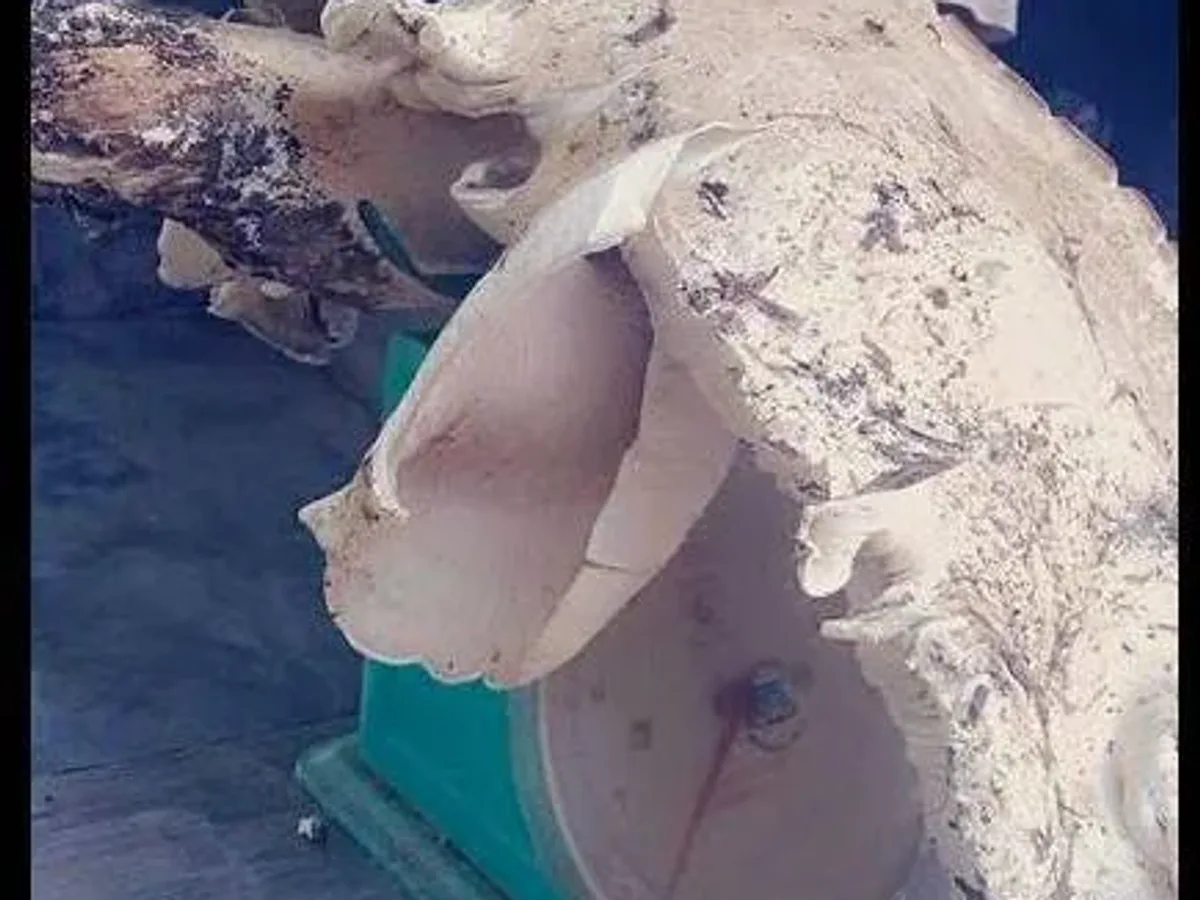
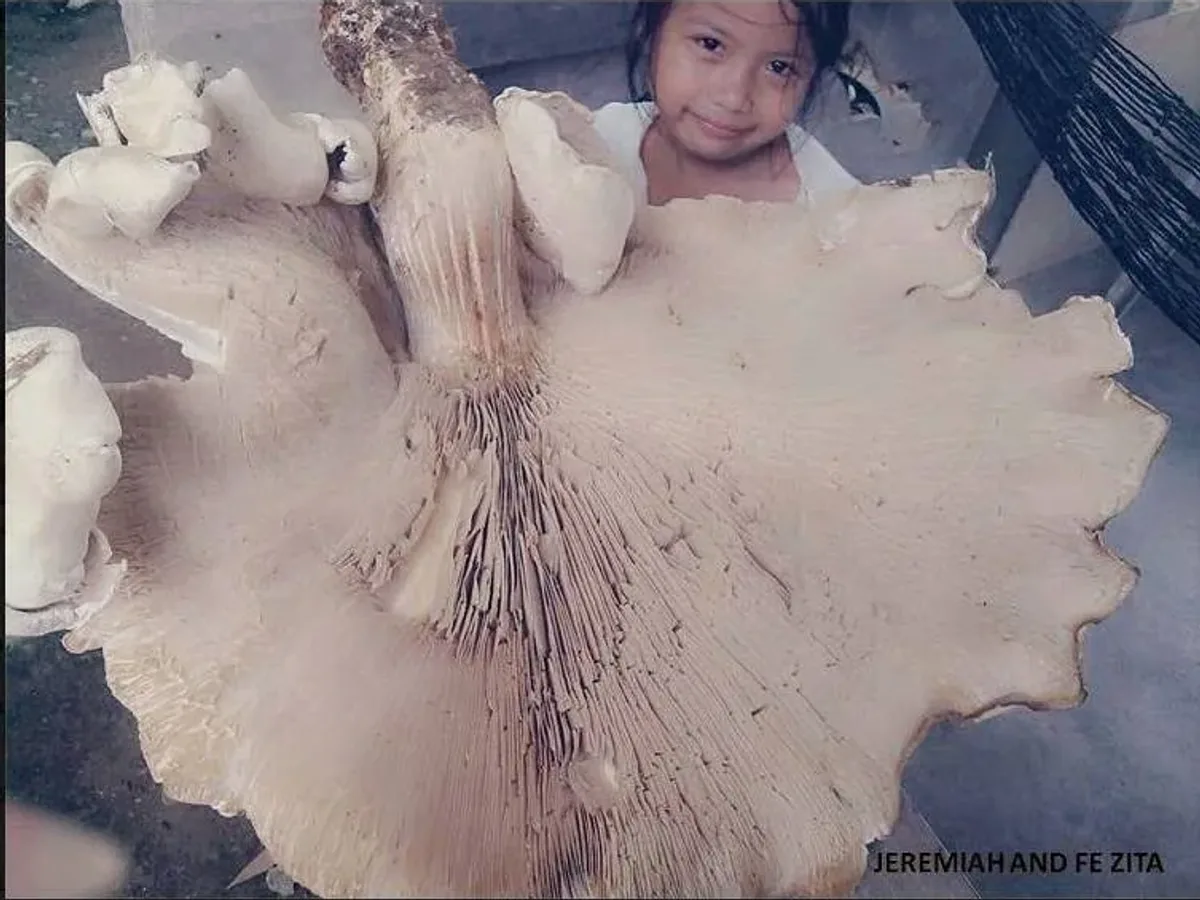
Termitomyces titanicus holds the record as the world's largest edible mushroom, with caps documented at up to one metre across and stems reaching 57 cm - dimensions that strain the imagination when you hold one in both hands and the cap still droops over your arms.
Yet even within this genus of giants, the family resemblance is precise: every member carries the same structural signature.
Cap
The cap surface ranges from off-white to warm buff or pale ochre-brown, often drying to a slightly scaly texture. It converges at its centre to a pronounced pointed umbo - technically called the perforatorium - that marks the spot directly above the pseudorrhiza below.
Gills
The gills are crowded, free or slightly adnexed, white to cream at first, softening to a faint blush pink as the cap matures and the spores develop. That spore print is consistently white, a fact that matters enormously for safe identification.
Stem
The stem is stout, pale, and fibrous, and it narrows downward into the pseudorrhiza: a root-like, sometimes branched cord that descends through the soil and connects the fruitbody mechanically and nutritionally to the fungus garden deep inside the termite mound.
Flesh
The flesh is firm, dense, and ivory-white throughout, with a distinctive aroma - rich, savour-forward, often described as smoky or meaty before any cooking begins.
Smaller congeners like T. microcarpus are a few centimetres across and easy to overlook; T. schimperi sits in between at 15-28 cm. The size span across the genus is larger than in almost any other group of fungi, yet the shared anatomy keeps them botanically coherent.
Where & when it grows
Habitat
The entire genus Termitomyces is locked to a single ecological partner: fungus-growing termites of the subfamily Macrotermitinae, principally the genera Macrotermes, Microtermes, and Odontotermes.
These termites do not digest plant cellulose directly - they chew it into paste, carry it underground, and inoculate it with Termitomyces mycelium. The mycelium breaks down the lignocellulose in structures called fungus combs (or fungus gardens), releasing nutrients the termites then consume.
The relationship is one of the most tightly co-evolved obligate symbioses in nature: neither partner completes its life cycle without the other, and the fungi cannot be grown commercially because no lab can replicate the precise conditions of an active, living termite colony.
Above ground, the ecological footprint follows the termites: savanna, miombo woodland (dominated by Brachystegia and Julbernardia), open farmland cleared from woodland, moist grassland, and the margins of cultivation where old mounds persist.
T. titanicus is found across humid parts of sub-Saharan Africa, particularly Zambia, the Democratic Republic of the Congo, and adjacent countries, almost always in areas with enough clay-loam soil to support large Macrotermes colonies.
The mounds themselves - sometimes two metres high and many decades old - are permanent landmarks for foragers, who map them and return season after season to the same sites.
When
Fruiting is triggered by the rains. Across southern and central Africa the relevant window runs from November to April, roughly aligned with the Inter-Tropical Convergence Zone as it moves south.
T. titanicus and the other large early species typically push their fruitbodies in the first flush of the rainy season, responding quickly once cumulative rainfall saturates the soil above the mound.
The lag from significant rain to visible cap is commonly just one to seven days - among the fastest flush responses in fungal ecology. The mycelium is already metabolically active inside the warm, humid mound year-round and needs only the external moisture cue to initiate carpophore development.
By contrast, T. microcarpus may continue fruiting in scattered waves throughout the wet season, emerging from fragments of garden that worker termites carry to the surface.
In years with a strong first rain event, large crops of T. titanicus can appear simultaneously across a wide area, which is why roadsides in Zambia and the DRC fill with sellers after the first good downpour.
Dry-season quiescence is total above ground: the mycelium retreats into the comb, and only the mound itself signals what lies beneath.
How it grows
The development of a Termitomyces fruitbody is unlike that of any free-living or mycorrhizal fungus. The mycelium lives permanently inside the termite mound, colonising and continuously degrading the fungus combs that worker termites replenish with freshly chewed plant matter.
When environmental conditions are right - primarily soil moisture and temperature signals transmitted through the substrate - the mycelium initiates carpophore primordia within or just below the comb. The developing fruitbody pushes a pseudorrhiza upward through packed soil, sometimes through a metre or more of dense termite-worked earth, before the cap emerges at the surface.
This pseudorrhiza is not a true root but a rhizomorph: a cable of aggregated hyphae with a differentiated rind, capable of directional growth and mechanical penetration. In T. titanicus the pseudorrhiza can itself be several centimetres in diameter.
Once the cap breaks soil, expansion is rapid - the largest caps can reach full size within 24 to 48 hours under warm, humid conditions.
T. microcarpus follows a different developmental pathway: workers actively transport pieces of comb to the mound surface, and tiny fruitbodies develop from these fragments in enormous numbers, sometimes carpeting the soil around a mound.
No strain of Termitomyces has been successfully maintained through more than a few generations outside a living termite colony, making this genus one of the last major edible fungi that can only be sourced from the wild.
Fruiting conditions
Fruits during the rainy season, typically within days after significant rainfall in warm tropical/subtropical conditions; tied to the activity of fungus-growing termite colonies rather than to host trees.
Look-alikes
Two lookalike risks are documented for Termitomyces.
The more common hazard in Africa is Chlorophyllum molybdites, the green-spored parasol. Young C. molybdites buttons can superficially resemble young Termitomyces caps - rounded, pale, and emerging from disturbed or grassy ground.
The distinguishing features are unambiguous: C. molybdites produces a clearly greenish spore print (never white), its gills turn green-grey as the cap matures, and it entirely lacks a pseudorrhiza. It causes severe gastrointestinal poisoning - violent vomiting and diarrhoea within 1-3 hours - and is one of the most common causes of mushroom poisoning in tropical regions worldwide.
Never eat a pale, broadly-gilled mushroom emerging near a mound without confirming the white spore print and the pseudorrhiza.
The second risk is certain white Amanita species, some of which can have a superficially similar pale cap and gills. Amanita is immediately distinguishable by two features absent in Termitomyces:
- A volva - a cup-shaped or bag-like sac at the base of the stem, often partially buried.
- In many deadly species, a skirt-like ring on the stem.
Amanita also has no pseudorrhiza. Several Amanita species cause fatal amatoxin poisoning. If you cannot see a pseudorrhiza clearly, take a spore print before eating.
Some white Amanita superficially resemble pale termite mushrooms, but Amanita has a volva (ring-shaped sac at the stem base) and lacks a pseudorrhiza.
Can resemble young Termitomyces and causes severe gastrointestinal poisoning. Check for a greenish spore print and the absence of a pseudorrhiza.
In the kitchen
Picking & cleaning
Foragers across sub-Saharan Africa have developed a practiced harvesting technique that respects both the fruitbody and the mound beneath it.
The pseudorrhiza must come out intact: a cap snapped off at soil level will be free of the distinctive feature needed for safe identification, and a broken pseudorrhiza left in the soil may or may not regenerate - evidence on this is mixed, so most experienced pickers prefer to extract the whole structure cleanly to keep the mound productive for future seasons.
A short knife or digging stick is used to loosen the soil in a circle around the point of emergence, then the pseudorrhiza is drawn out steadily by hand.
T. titanicus caps are so large that a single fruitbody may require two people to carry it; a clean specimen sold at a roadside market in Zambia or the DRC can weigh several kilograms. The base is cleaned of soil and the pseudorrhiza trimmed for market or transport.
If the cap has opened fully, it should be used within a day or two - the flesh softens quickly in equatorial heat.
For storage, large caps are sliced 1-2 cm thick and sun-dried on mats or racks; parboiling for 5-10 minutes before drying extends shelf life and reduces the risk of mould. Dried slices reconstitute well in water and retain much of the umami depth.
Do not harvest from mounds that show signs of disturbance or chemical treatment, and avoid picking every fruitbody from a mound - leaving some to sporulate supports the long-term persistence of the colony.
Cooking
Termitomyces has a flavour profile that stands apart from the more familiar temperate fungi: the raw flesh smells and tastes distinctly savoury, with a smoky, almost meaty depth that intensifies on cooking.
Across the many cuisines of sub-Saharan Africa it is used in broadly similar ways:
- Fried in oil with onion, tomato, and fresh or dried chili.
- Simmered in soups and stews, where it contributes body and umami.
- Served as a relish (called ndiwo in Zambia and Malawi, umunani in parts of southern Africa) alongside the starchy staple - nshima, ugali, sadza, or pap.
In Namibia, omajowa (T. schimperi) is particularly prized fried quickly in butter or sunflower oil over high heat until golden, with a light salt finish and nothing else. The large thick slices of T. titanicus hold up well to this treatment without disintegrating.
For drying: slice the cleaned caps 1-2 cm thick, parboil briefly, then sun-dry or dry in a low oven (50-60 °C) until leathery. Dried slices keep for months in a sealed container in a cool place and reconstitute in warm water in 20-30 minutes; the soaking liquid is rich and worth adding to the pot.
Termitomyces does not pair naturally with the delicate butter-and-white-wine approach common in European mushroom cooking - it is robust enough to take bold heat, strong spices, and long cooking times without losing character.
Avoid eating raw or very lightly cooked specimens; full heat penetration is both safer and improves texture.
Good to know
All Termitomyces species are considered edible and are consumed widely and safely across sub-Saharan Africa wherever they are found. The genus contains no known toxins.
The key to safe consumption is correct identification, which rests on three confirming features that must all be present:
- 1The pseudorrhiza - the long, cord-like underground extension of the stem connecting to a termite mound.
- 2A white spore print - take a print by resting the cap gill-side down on dark paper for 30-60 minutes.
- 3Emergence directly from or immediately beside an identifiable termite mound.
All three should be confirmed before eating.
One exception to the general safety profile: T. fuliginosus, documented in Ivory Coast, has been associated with digestive upset when undercooked. The local recommendation - thorough cooking for this species - generalises usefully to all large Termitomyces, since the dense flesh benefits from full heat penetration anyway.
The genus is nutritionally significant: independent analyses of several species show protein content of 20-30% dry weight, substantial folic acid, and measurable vitamin C - rare among fungi.
There is no known interaction with medications and no documented allergic sensitisation specific to Termitomyces beyond the ordinary caution of introducing any new food gradually.
A reference guide - never an edibility guarantee. When in doubt, leave it out.