Guangzhou destroying angel
Amanita exitialissyn. Amanita pallidorosea, Amanita subpallidorosea, Amanita rimosa, Amanita fuligineoides, Amanita phalloides, Amanita virosa
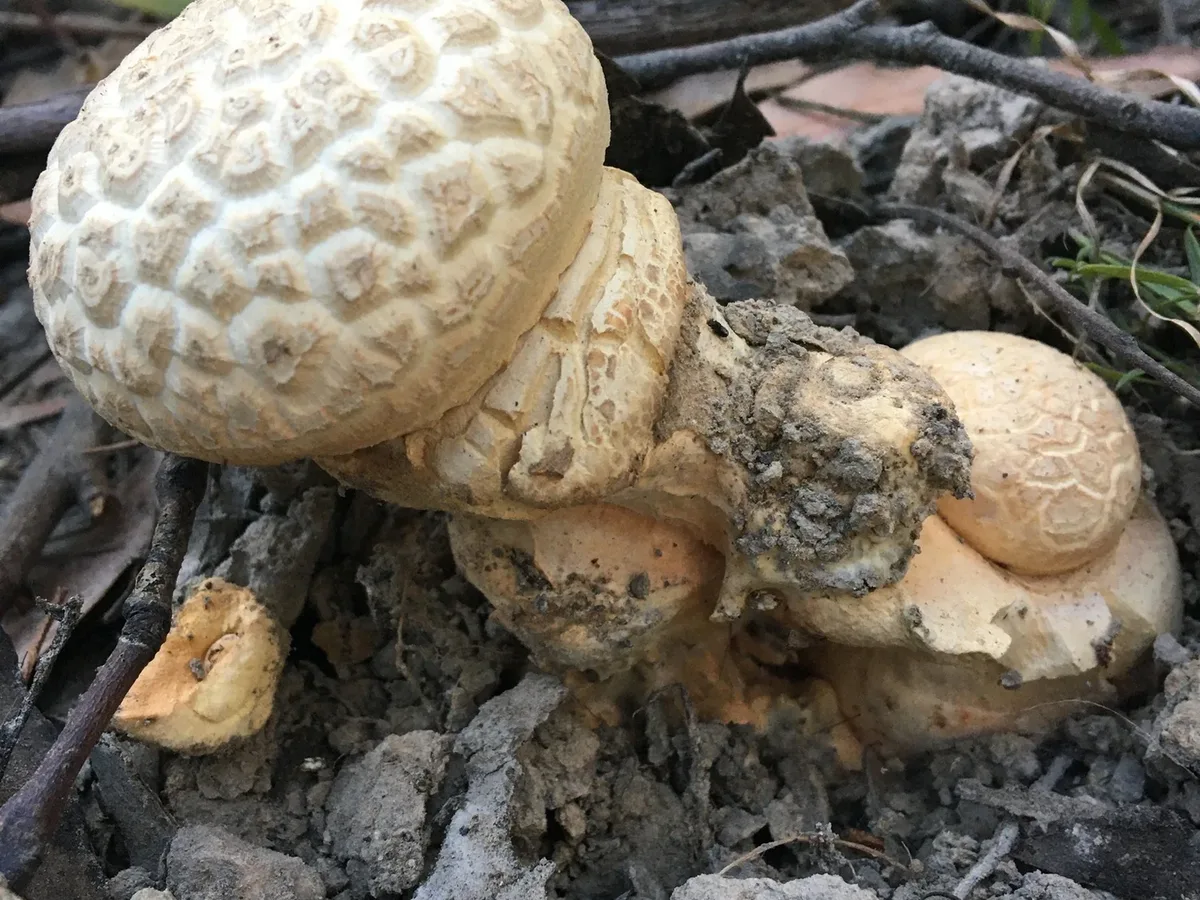 Atlas of Living Australia (CC0)
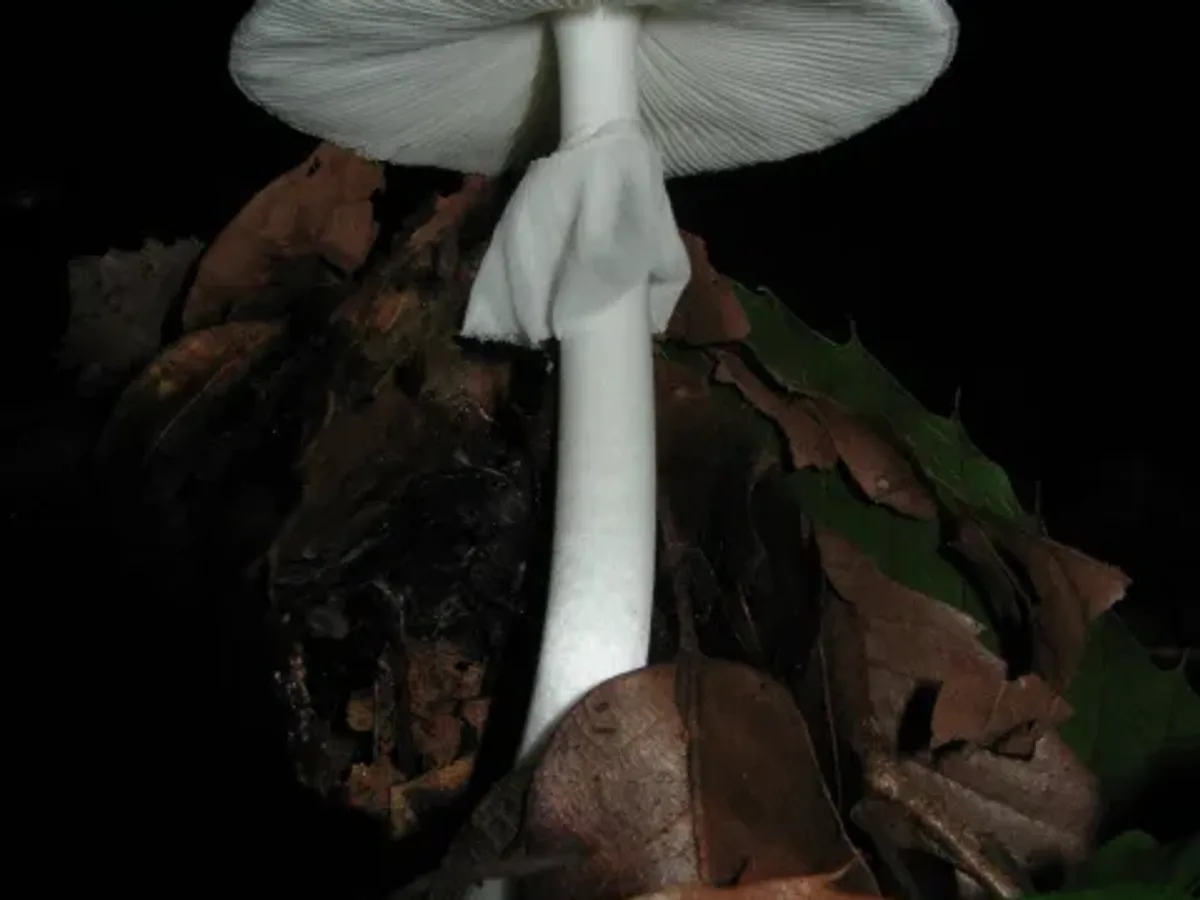 Pieria(Uploader and Photographer) (Public domain)Atlas of Living Australia (CC0)Pieria(Uploader and Photographer) (Public domain)
Toxic - and the most serious cases can be fatal. Never eat it, and wash your hands after handling.
Never eat a mushroom you are not 100% sure of - check the look-alikes below, and always cook wild mushrooms.
How to recognise it
Amanita exitialis is deceptively unassuming.
The cap reaches roughly 4-7 cm across, starting as a smooth, rounded button before flattening slightly with age. In colour it is an almost luminous white, sometimes faintly cream toward the centre in older specimens.
Gills are free from the stem, crowded, and pure white - a colour they hold at every stage of maturity.
The stem is white, slender to slightly club-shaped, and stands 6-12 cm tall; its surface is smooth or very finely powdery toward the apex. Partway up the stem hangs a fragile, skirt-like annulus (ring), often collapsed or tattered in rain-exposed specimens but always present in young fruitbodies.
The most critical structure is the volva: a firm, white, cup-like sac enclosing the swollen stem base, largely buried in the soil or leaf litter. The spore print is white.
One microscopic detail distinguishes A. exitialis within even its own genus: its basidia are predominantly 2-spored rather than the standard 4-spored configuration, a character that requires a microscope but matters for mycological identification.
The closely related A. fuliginea differs in cap colour - convex, 4-9 cm, ranging from dark ashy grey to near-black - yet shares the same white gills, white stem, white ring, and basal volva. A. subjunquillea presents a yellow-brown to olive-toned cap.
All three are small enough to be dismissed as unremarkable, and all three are equally fatal.
Why it's dangerous
Amanita exitialis and A. fuliginea are among the deadliest mushrooms known to mycotoxicology, and together account for a substantial majority of fatal mushroom poisonings in southern China.
In an authoritative review of Guangdong, Guangxi and adjacent provinces for 1994-2012 (Chen et al.), Amanita species accounted for:
- 64.7% of all poisoning outbreaks
- 78.1% of all cases
- 70.5% of all deaths
That is 852 patients, 183 dead - a case-fatality rate of 21.5%.
A. fuliginea alone was responsible for an estimated 41% of cases and 43% of deaths in that cohort, making it the single deadliest species in the dataset: 352 people poisoned and 79 dead over 18 years in one region.
A. exitialis data are separately documented. A single outbreak in Guangzhou in March 2000 resulted in the death of 8 of 9 people who ate the mushrooms (one survivor, documented by Sun et al., Journal of Toxicology 2018).
From 2000 to 2022, 73 reported outbreaks were attributed to A. exitialis - 72 in China, 1 outside - with 257 patients and 74 deaths, a lethality rate of approximately 29%. These figures are likely underestimates due to under-reporting in rural areas.
The amatoxins are NOT destroyed by cooking, drying, or freezing.
Anyone who suspects amatoxin poisoning following consumption of wild mushrooms must seek emergency hospital care immediately, without waiting for symptoms to worsen.
Toxin
The primary toxins in A. exitialis are amatoxins - a family of bicyclic octapeptides. Alpha-amanitin is the most clinically significant, with beta-amanitin and gamma-amanitin also present.
Alpha-amanitin is a potent and highly specific inhibitor of RNA polymerase II, the enzyme responsible for transcribing most protein-coding genes in eukaryotic cells.
The toxin's journey through the body:
- 1Absorbed through the gut wall, amanitin is carried to the liver in the portal circulation.
- 2There it is actively taken up by hepatocytes via the OATP1B3 transporter.
- 3Inside the cell it arrests mRNA synthesis; the cell cannot replace degraded proteins and begins to die.
- 4The toxin is excreted into bile, re-absorbed from the intestine, and returned to the liver - an enterohepatic cycle that amplifies and prolongs hepatocyte exposure.
Kidney proximal tubule cells are similarly vulnerable.
Secondary phallotoxins (phalloidin) are also present but are poorly absorbed through the gut in humans and contribute little to clinical toxicity compared to amatoxin.
The lethal dose of alpha-amanitin in humans is estimated at approximately 0.1 mg per kilogram of body weight; a fresh fruitbody of A. exitialis contains roughly 1-2 mg of amatoxins per gram of dry tissue.
Symptoms
Amatoxin poisoning follows a characteristic four-phase clinical course.
- 1Latent period: typically 6 to 24 hours (occasionally up to 36 hours) after ingestion, the patient feels entirely well. This delay is one of the features that most often prevents early treatment, as the connection to a meal eaten many hours earlier is not obvious.
- 2Gastrointestinal phase: abrupt onset of profuse watery (sometimes bloody) diarrhoea, severe nausea, vomiting, and cramping abdominal pain, typically lasting 1-2 days and causing significant fluid and electrolyte loss.
- 3Apparent recovery: GI symptoms subside and the patient may feel subjectively better for 24-72 hours. Liver enzymes (ALT, AST) begin rising during this deceptive window even when the patient reports improvement.
- 4Hepatorenal failure: 3-5 days after ingestion, progressive liver failure (jaundice, coagulopathy, encephalopathy) and acute kidney injury develop. Without intensive supportive care or liver transplantation, death from multi-organ failure typically occurs 6-16 days after eating.
Survivors of severe poisoning may sustain permanent hepatic damage. There is no antidote; treatment is aggressive supportive care, and liver transplant is the last resort.
Staying safe
No part of A. exitialis or its close relatives (A. fuliginea, A. subjunquillea) is safe to eat.
Amatoxins are heat-stable, water-stable, and resistant to all common preservation methods - boiling, frying, drying, salting, and freezing do not reduce toxin load.
A single cap of A. exitialis (approximately 50 g fresh weight) contains enough amatoxin to kill a 50 kg adult.
Because the latent period between ingestion and first symptoms is 6-24 hours, victims often do not connect their illness to the meal they consumed the previous day or evening, which delays diagnosis and treatment critically.
All white mushrooms gathered from forests in southern China, Japan, or adjacent East Asian countries should be treated as suspect unless positively identified by an expert.
If any member of a group who ate the same foraged mushrooms develops gastrointestinal symptoms within 24 hours, all individuals who ate the meal should seek emergency medical attention immediately, regardless of their own current symptom status - amatoxin dosing varies and some individuals may absorb less but still sustain organ damage.
Where & when it grows
Habitat
Amanita exitialis lives primarily as mycelium - a web of microscopic threads colonising the fine rootlets of oak (Quercus) and Castanopsis trees in a mycorrhizal partnership that both partners depend on.
The fungus delivers mineral nutrients and water to the tree; in return it draws photosynthetic carbon from the root. This exchange can persist for years or decades, the mycelium growing silently through the topsoil while no surface sign appears. Fruitbodies emerge only when the partnership is mature and conditions align.
A. exitialis is concentrated in the subtropical and warm-temperate forests of southern and southwestern China - Guangdong, Jiangxi, Guangxi, and Yunnan provinces account for most documented outbreaks - where lowland mixed forest and montane oak-Castanopsis stands both support it.
The related A. fuliginea has a broader range across eastern China and Japan, often in secondary forests where oaks are common.
Both species favour well-drained mineral soils beneath closed canopy. They are not grassland, disturbed-ground, or dung-decomposing fungi; finding either species in open or cultivated ground would be exceptional.
Forest paths, picnic spots under oaks, and the margins of woodlands in southern China are precisely the settings where lethal confusion with gathered wild food has repeatedly occurred.
When
The fruiting phenology of A. exitialis is one of its most dangerous properties: it peaks in spring, aligning almost perfectly with the period when Chinese rural communities traditionally gather wild vegetables and mushrooms after winter.
The main flush follows the warm rains of March and April - southern China's plum-rain (meiyu) precursor - when soil temperatures at shallow depths reach 12-18°C and surface moisture is sustained for several days. A secondary flush extends through May and into July.
At its peak, fruitbodies can appear within five to fourteen days of adequate rainfall, sometimes emerging in loose clusters of two or three from the same mycelial network.
The related A. fuliginea fruits later, with a summer and autumn peak more typical of the broader Amanita genus in East Asia. A. subjunquillea is similarly a summer species.
The spring-fruiting window of A. exitialis - coinciding with festivals, foraging customs, and the first warm mushroom weather of the year - explains why it appears disproportionately in poisoning statistics from Guangdong and Guangxi even though it is not the most geographically widespread of the group.
How it grows
Like all mycorrhizal Amanita, A. exitialis does not fruit on cue - the mycelium waits, sometimes for many years, establishing and deepening its root-association before investing the carbon and water needed to push a fruitbody above the soil.
When conditions are met (sustained moisture, soil warmth, an established host), the primordia form below ground as white, egg-like buttons enclosed entirely in the universal veil - the same membranous structure that will later rupture to leave the volva at the base and scattered remnants on the cap surface.
The primordia expand rapidly; a full fruitbody can emerge in 24-72 hours after heavy rain breaks a dry spell.
Mature fruitbodies stand singly or in small scattered groups of two to five, usually within the root zone of a host tree but not necessarily directly at its trunk.
The mycelium itself is perennial, capable of outlasting its host tree and colonising new root partners as the forest composition shifts. Individual fruitbodies are ephemeral - they collapse and autolyse within days - but the underground network that produced them may be decades old.
Fruiting conditions
Fruits abundantly after warm spring rains in subtropical southern China; conservative mycorrhizal Amanita estimates.
Look-alikes
The lookalike risk for A. exitialis and its relatives is acute and well-documented in forensic toxicology records. Edible white mushrooms with superficially similar appearance include:
- Lepiota and parasol relatives (Macrolepiota) - lack a volva and have a double or sliding ring; careful examination of the stem base distinguishes them.
- Paddy straw mushroom (Volvariella volvacea) - a particularly dangerous trap, as its young egg stage closely resembles the button stage of a deadly Amanita. The critical difference is that Volvariella has no ring on the stem and produces a pink, not white, spore print.
- Button mushrooms (Agaricus species) - pink-to-brown gills in youth, a brown spore print, and no basal volva, all clearly different from A. exitialis, yet confusion has been documented in immigrants and visitors unfamiliar with local species.
Any 'egg' mushroom that reveals white gills and a ring on cutting should never be consumed.
In Japan, A. virosa has been misidentified as Tricholoma (shiromatsutake-modoki) and as Agaricus (haratake/champignon).
The safest rule: white cap + white gills + white spore print + ring + volva = deadly, with no exceptions known in the field literature for East Asia.
Agaricus has pink-to-brown gills and a brown spore print and no volva; deadly Amanita have white gills, white spores and a basal volva.
Deadly Amanita have a volva (sac) at the stem base and a white spore print; always uproot to check the base.
Volvariella has a pink spore print and no ring; deadly Amanita have white spores and a ring on the stem plus a volva.
A. virosa has been confused with this Tricholoma in Japan; the Amanita has a ring and a volva at the base.
A reference guide - never an edibility guarantee. When in doubt, leave it out.