Green-cracking russula
Russula virescenssyn. Russula, Russula aeruginea, Russula emetica, Russula subnigricans, Russula orientalovirescens, Russula griseocarnosa
 © Lazar Popović (CC BY 4.0)
 © Jacek Pietruszewski (CC BY 4.0)
 © gailhampshire (CC BY 2.0)
 © Lukas Large (CC BY-SA 2.0)© Lazar Popović (CC BY 4.0)© Jacek Pietruszewski (CC BY 4.0)
Good to eat, once you have identified it with certainty and cooked it through.
Never eat a mushroom you are not 100% sure of - check the look-alikes below, and always cook wild mushrooms.
How to recognise it
Russula virescens, the green-cracking russula, is one of the more distinctively marked members of a genus already renowned for its colour diversity.
Cap
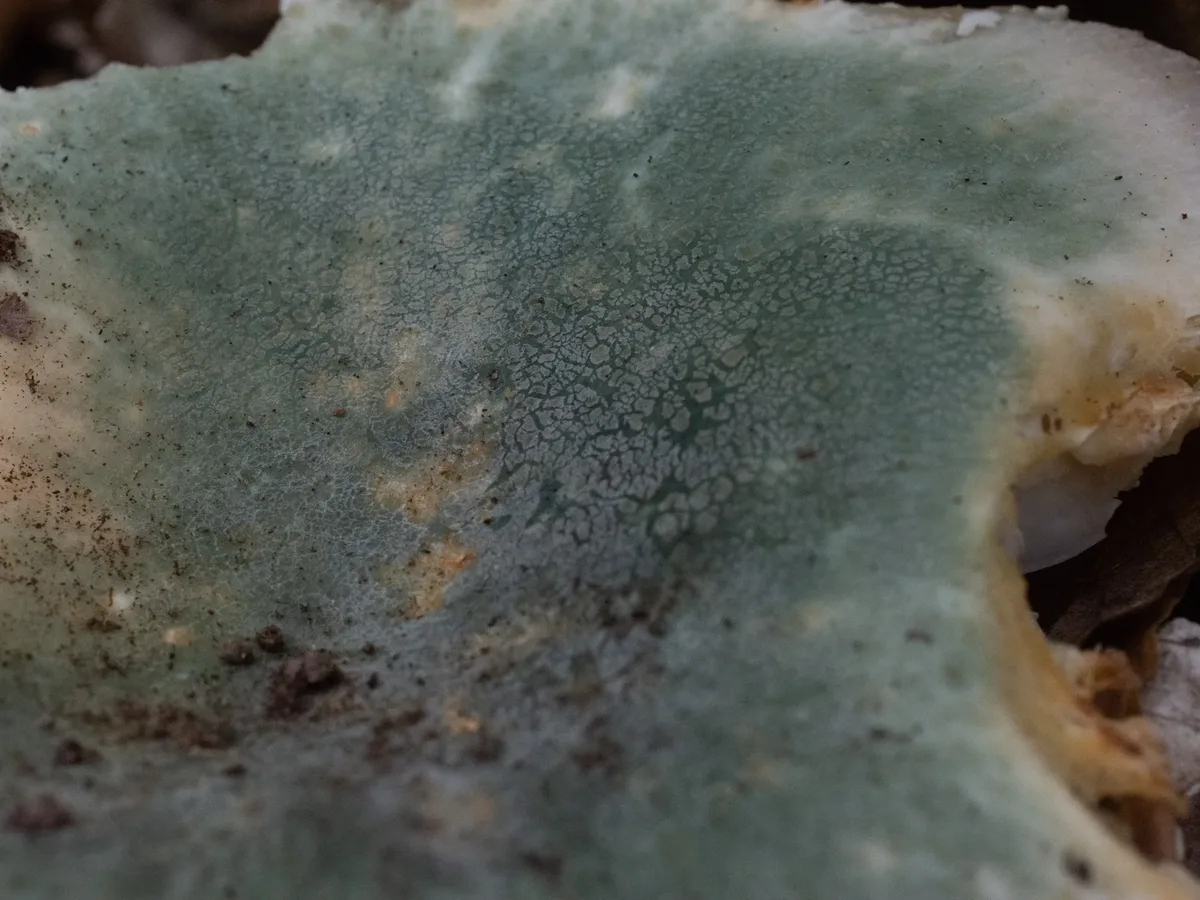
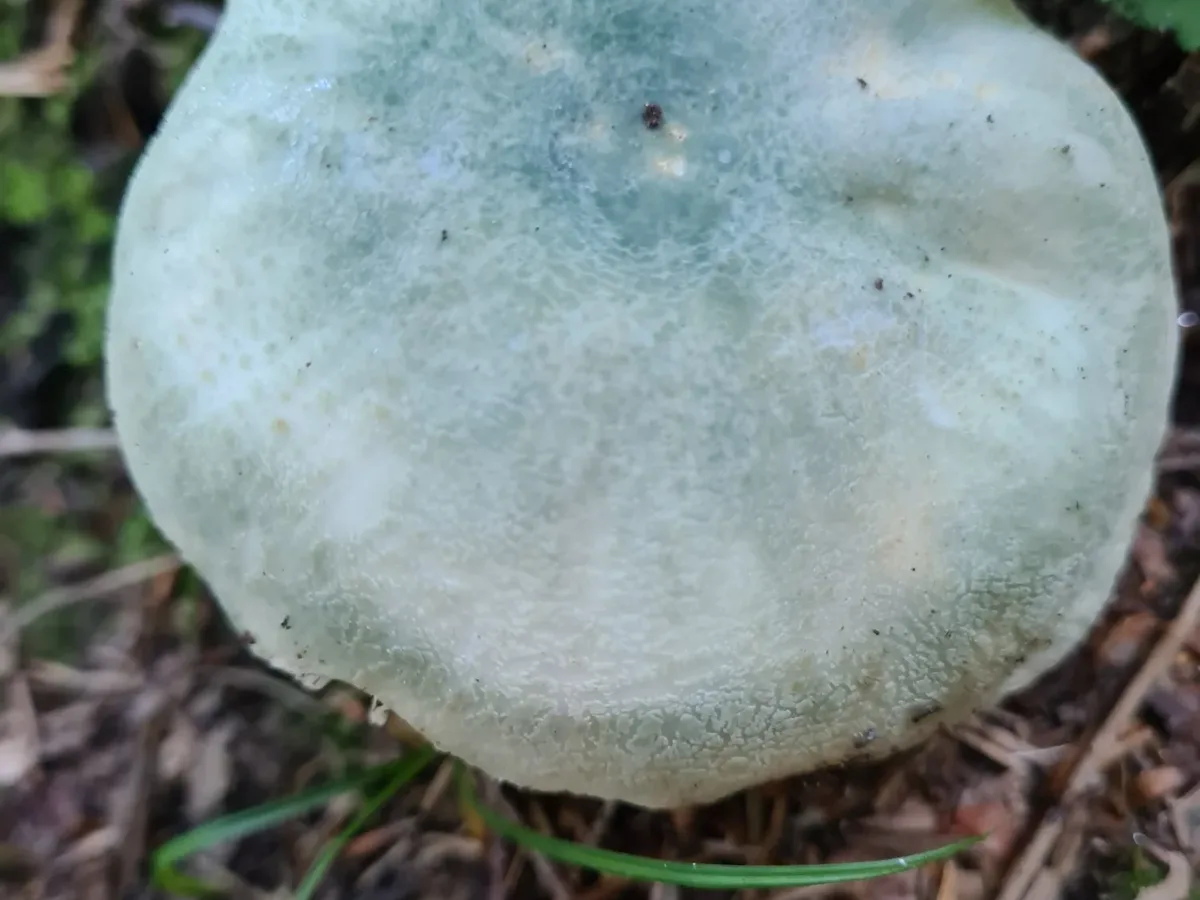
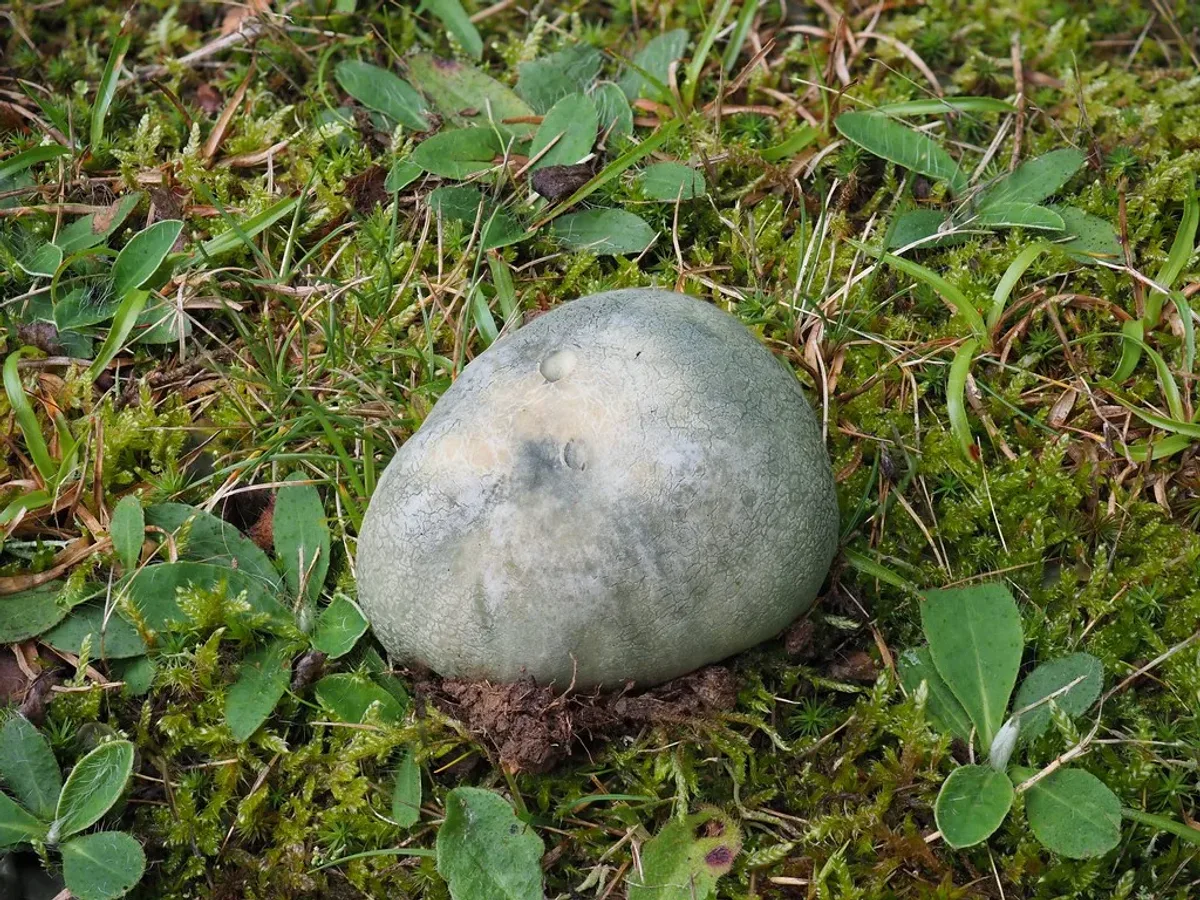
The cap ranges from 5 to 12 cm across, opening from a tight hemisphere into a broadly convex then flattened disc. Its surface performs a trick that makes this species almost unmistakable at a glance: the greenish skin breaks into irregular, slightly raised patches as the cap expands, producing a cracked, mosaic-tile texture over a paler background - something between sage, olive, and grey-green, though individual caps shade toward blue-green or grey depending on light and age.
Flesh
Beneath this, the firm white flesh does not stain on cutting and, unlike many forest fungi, carries no ring and no swollen basal cup.
Gills
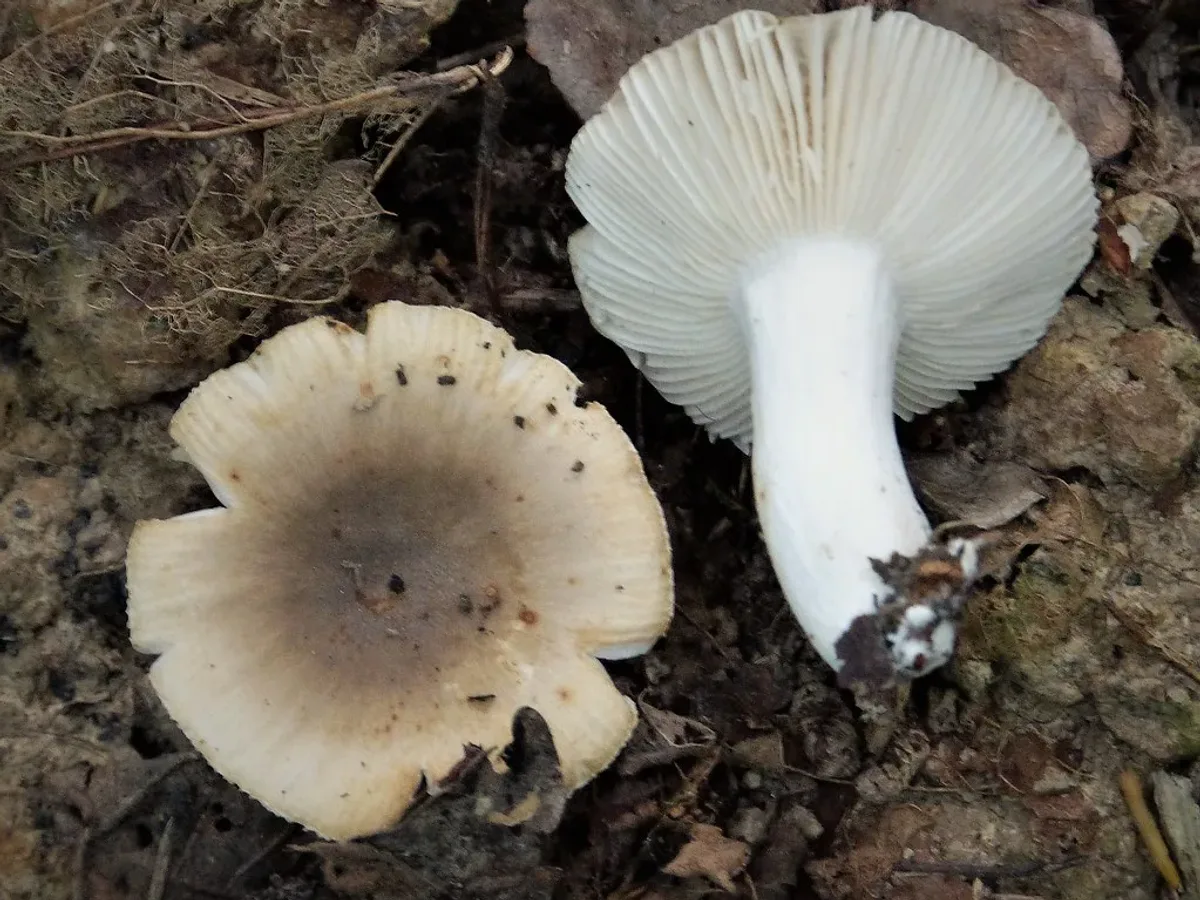
The gills are crowded, brittle, ivory-white, and run straight to the stem without forking or decurrent attachment.
Stem
The stem itself is solid, white, 4-8 cm tall, and shares the genus-defining characteristic of genuinely crumbling when snapped across: not fibrous, not rubbery - more like compressed chalk or a piece of dry bread.
There is no latex whatsoever. Spore print is white to cream.
This combination - cracked green cap, chalk-brittle flesh, white crumbling stem, absence of ring or volva - defines the species and separates it from the only dangerous confusion partner the habitat offers.
Where & when it grows
Habitat
Russula virescens is an obligate ectomycorrhizal fungus, meaning it can only exist in partnership with living tree roots and cannot be cultivated in isolation.
The partnership is ancient - the molecular ancestry of the Russulales traces back more than 100 million years, long predating many of the tree genera it now colonises. The mycelium forms a dense sheath around feeder roots, trading mineral salts, water, and phosphorus for fixed carbon that the tree synthesises above ground.
R. virescens shows a strong preference for deciduous and mixed forest. Oak (Quercus spp.) and beech (Fagus sylvatica) are the classic hosts across Central and Eastern Europe and European Russia, though it also associates with hornbeam and lime. It rarely fruits under pure conifer stands.
Ecologically it favours well-drained, mildly acidic soils with a reasonable organic layer and some canopy shade, appearing most reliably in older forest stands where the mycorrhizal network has had decades to establish.
In the forest understory, a single mycelium can persist for many years, waiting out drought, frost, and disturbance, producing above-ground fruit bodies only when conditions allow.
When
The fruiting season runs from early June through October, with the main flush concentrated in July and August across the Eastern European and Russian range. In the Baltic states and western Russia, peak abundance typically coincides with the stretch of warm soil and intermittent rain that follows the summer solstice.
Like all mycorrhizal species, R. virescens does not fruit predictably on a calendar. Fruitbodies emerge in response to a specific sequence of events:
- 1Several weeks of adequate soil moisture.
- 2Soil temperatures in roughly the 10-22 °C band.
- 3A lag of 5-12 days after significant rain while the mycelium mobilises resources and assembles the primordia.
A dry July will produce almost nothing; a wet June followed by warm August nights can yield dense patches across the same woodland floor that appeared empty the week before.
By October, falling soil temperatures end the season in most northern localities, though southern and lower-altitude sites in eastern Europe may see scattered specimens into early November.
How it grows
Fruitbodies emerge singly or scattered in loose groups across the forest floor, rarely in tight clusters.
Young specimens push up through the leaf litter as small, firm buttons with a tightly inrolled cap margin and a skin that is still smooth and intact. The characteristic cracking pattern develops as the cap surface expands faster than the underlying tissue, splitting the outer layer into its mosaic of raised patches. This process is visible over a span of just a few days.
The underground mycelium - a living network woven through soil and root - may be decades old and many metres across, though it produces no visible trace at the surface.
Fruitbodies are relatively robust for a russula, lasting several days in cool, humid conditions before softening or being consumed by invertebrates. Slugs in particular are attracted to the mild, slightly nutty flesh, and heavily slug-grazed specimens are common in wet years.
The spores are dispersed passively from mature gills, and the white spore print is a useful confirmation character when a specimen is left cap-down overnight.
Fruiting conditions
Mycorrhizal brittlegills fruit through summer and autumn after rain when soils are warm; conservative standard mycology, not stated in the source.
Look-alikes
The single most dangerous confusion risk for green russulas is Amanita phalloides, the deathcap. Amanita phalloides produces a cap that can be greenish-yellow to olive-green when young, and when only the cap is visible emerging from leaf litter the colour overlap with R. virescens is real.
The distinction is absolute and structural. Amanita phalloides has:
- A skirt-like ring (annulus) on the upper stem.
- A swollen basal bulb enclosed in a membranous cup (volva) that is partially buried in soil.
- Flesh that is not brittle - it tears in fibrous strands rather than crumbling.
A deathcap stem does not snap like chalk. Dig the base out of the ground and examine it every time if there is any uncertainty.
R. aeruginea (charcoal burner) is a related mild-tasting green russula with a smoother, uncracked cap surface and a tendency toward birch association. It is edible and the confusion is benign, but the smooth vs. cracked cap surface is a reliable separator.
No other common Central or Eastern European species reliably produces the specific combination of cracked green cap, white crumbling stem, absence of ring, and absence of volva that characterises R. virescens.
Deadly; causes rhabdomyolysis. R. subnigricans has a dull gray-brown cap (not green) and flesh that reddens when broken before eventually darkening - absent the pale sea-green color and angular mosaic patch pattern of the green russula. Always confirm the distinctive cracked-mosaic cap and verify the stem base has no ring or volva.
The death cap can also have a greenish cap, but it has both a skirt-like ring and a sac-like volva, plus fibrous flesh; the russula has neither ring nor volva and brittle flesh that snaps like chalk.
Green amanitas can be confused with the green russula; amanitas have a volva and/or ring and are not brittle like russulas.
Poisonous blackening russulas resemble the green russula; the green color and mosaic pattern are the distinguishing clue, but russulas as a group require great experience.
A harmless green russula.
A harmless green russula.
In the kitchen
Picking & cleaning
Pick R. virescens when the cap has expanded enough to confirm the cracking green surface but before the flesh begins to soften or slug damage becomes extensive.
The stem snaps cleanly; there is no need to dig down to the base for identification purposes in the way required for Amanita species - but doing so is still advisable as a safety habit, to confirm the absolute absence of a bulbous base or volva.
The coloured skin peels away from the cap edge with a clean strip and comes off easily in most weather, which is a helpful secondary confirmation.
Taste a small fragment of the raw flesh before collecting in quantity: R. virescens is mild, with no bitterness or acrid heat. Any persistent sharpness or peppery burn on the tongue indicates a different russula species and that individual should not be eaten without further preparation.
Collect into a basket rather than a plastic bag to limit sweating and deterioration. The brittle gills travel poorly; keep collected specimens loosely packed and process within a day.
Cooking
Russula virescens has firm, dense, white flesh with a mild, slightly nutty flavour and a pleasantly clean finish. It holds its shape better than many soft-fleshed species during cooking, making it suited to preparations where texture matters.
Pan-frying in butter over moderate heat, allowing moisture to evaporate before browning begins, produces the best flavour - the flesh firms up and develops a light golden surface. It mixes well with other mild edible species or stands alone as a side.
It can be added directly to soups and stews where it thickens the broth slightly and absorbs surrounding flavours while contributing its own mild earthiness.
In the Slavic tradition across Eastern Europe and Russia, wild russulas (collectively syrojezjka or gołąbki) are also salted raw or after a brief blanch: layers of clean caps packed with coarse salt and weighted in crocks, then left to ferment lightly over several weeks, producing a firm, slightly brined preserved mushroom eaten as a condiment or appetiser through the winter. For mild species like R. virescens this process is one of preservation and seasoning rather than toxin neutralisation.
Drying is possible but not the highest-value application - the flesh is dense enough when fresh to justify eating it that season rather than dehydrating.
Good to know
Russula virescens is edible and mild-tasting, without acrid compounds, and does not require pre-treatment such as boiling or salting. It is one of the most straightforwardly edible russulas in the European flora.
The safety risk associated with this species is entirely one of misidentification: the deathcap (Amanita phalloides) can occupy the same forest, fruit at the same time, and produce a greenish cap that resembles a young russula.
Amanita phalloides contains amatoxins that are not destroyed by cooking, not detectable by taste, and lethal in small doses. The onset of serious symptoms is delayed 6-24 hours after ingestion, by which point significant organ damage may already be occurring.
The structural differences between the two genera are absolute and learnable:
- Russulas have brittle chalk-like flesh and no ring, no volva, no basal bulb.
- Amanitas are fibrous, with a ring, a volva, and a swollen base.
Always dig the base free before eating any mushroom you intend to identify as a russula.
The broader Russula genus also includes acrid species (such as R. emetica) whose peppery compounds cause gastrointestinal upset if eaten raw in quantity. The taste test on a raw fragment distinguishes them reliably from the mild R. virescens.
A reference guide - never an edibility guarantee. When in doubt, leave it out.