The great Australia & New Zealand mushroom guide
9 edibles to fill your basket with, 6 to recognise
The great Australia & New Zealand mushroom guide

 Saffron milk cap
 Slippery jack
 Death cap
 Ghost fungus
 Saffron milk cap
In practice almost everything safely gathered here is two introduced pine mushrooms, while the ancient native flora is vast but largely untested for the table. The deadliest trap, the death cap, is also an import, growing only under exotic trees. This guide is calm and honest about what is known and what isn't, and it is never a guarantee.
What matters most
- The beginner-safe edibles are introduced pine mushrooms: saffron milk cap and slippery jack, found only under planted pines.
- Learn the dangerous species first. The death cap (Amanita phalloides) is deadly and introduced; the yellow stainer is the most common poisoning; the bioluminescent ghost fungus mimics oyster mushrooms.
- The native flora is enormously diverse but largely untested for edibility - Fungimap and Royal Botanic Gardens Victoria advise against eating native wild mushrooms.
- Latin names keep changing: Auricularia cornea (not A. polytricha), Hericium novae-zealandiae, Cyclocybe parasitica (was Agrocybe).
- Handling and storage matter: saffron milk caps bruise easily, slippery jacks age fast and must be peeled, and amatoxin survives cooking, drying and freezing.
- Collecting is heavily restricted - national parks and most DOC land (~30% of NZ) generally forbid it.
The great toxin groups
A handful of toxin families account for the region's serious poisonings. Knowing the timing of symptoms - and that some toxins survive cooking - is what keeps you alive.
Cyclic octapeptides that halt RNA polymerase II and cause cell death, mainly liver failure. Not destroyed by cooking, drying, freezing or soaking. Symptoms are delayed 6-24 (up to 36) hours: stomach pain, vomiting, diarrhoea, then a deceptive recovery before liver and kidney failure. Found in the death cap and in Galerina.
A kidney toxin found in some Cortinarius (webcaps). Symptoms are badly delayed - 1 to 2 weeks - before kidney failure sets in, making the link to the meal easy to miss.
Sesquiterpenoids (illudin S/M) in the ghost fungus. Cause violent gastrointestinal upset - cramps, nausea, vomiting, diarrhoea - 30 minutes to 3 hours after eating, lasting up to 48 hours. Rarely fatal in healthy people but deeply unpleasant.
Phenol (with hydroquinone and catechol) in the yellow stainer, the region's most-ingested poisonous mushroom. Brings nausea, cramps, vomiting, diarrhoea, dizziness and sweating 30 minutes to 2 hours after eating. The phenolic smell intensifies on cooking.
The psychoactive toxins of the fly agaric. Cause nausea, vomiting, diarrhoea, sweating, agitation and hallucinations - highly variable. Deaths are extremely rare, and the mushroom is easy to recognise, so poisoning is uncommon.
The edibles
 Saffron milk cap
 Saffron milk capSaffron milk cap
 Saffron milk capSaffron milk capSaffron milk cap
Saffron milk cap
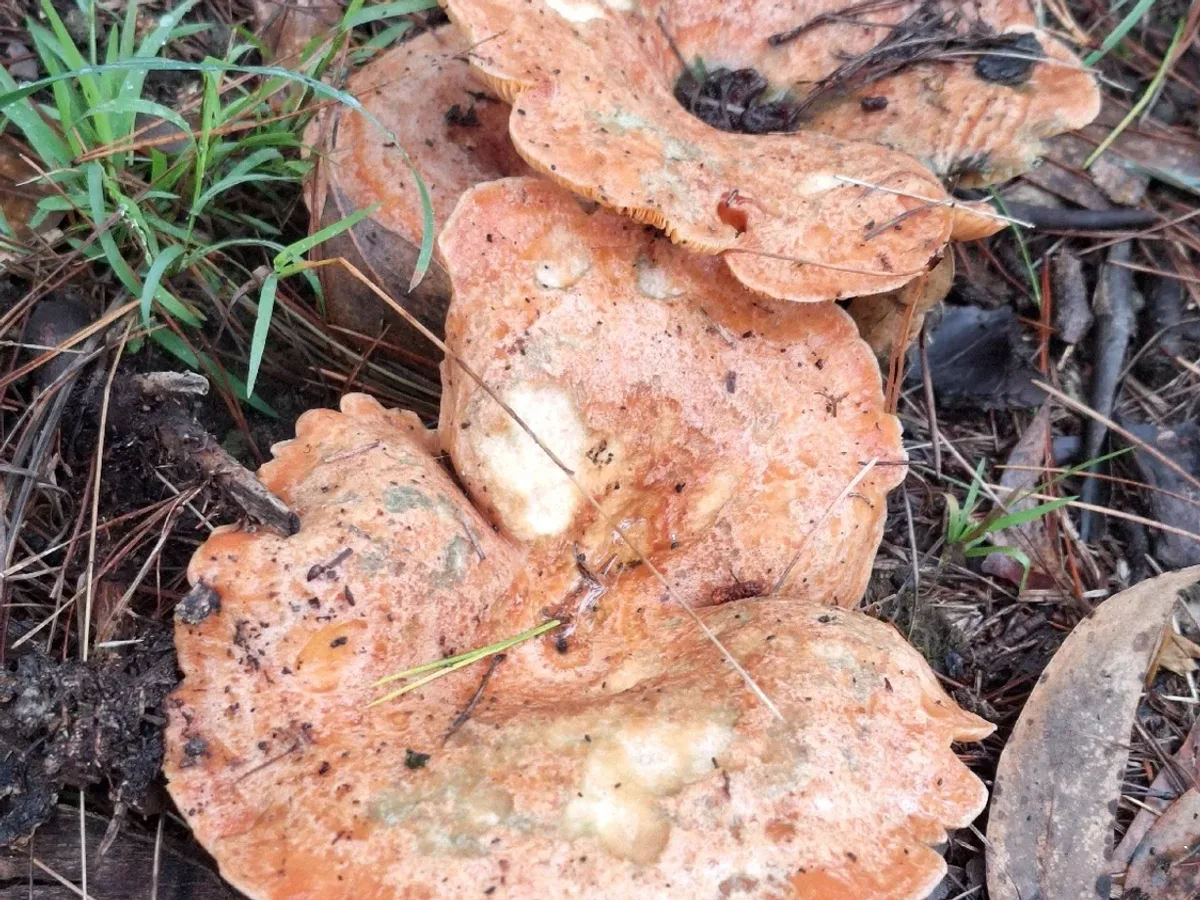
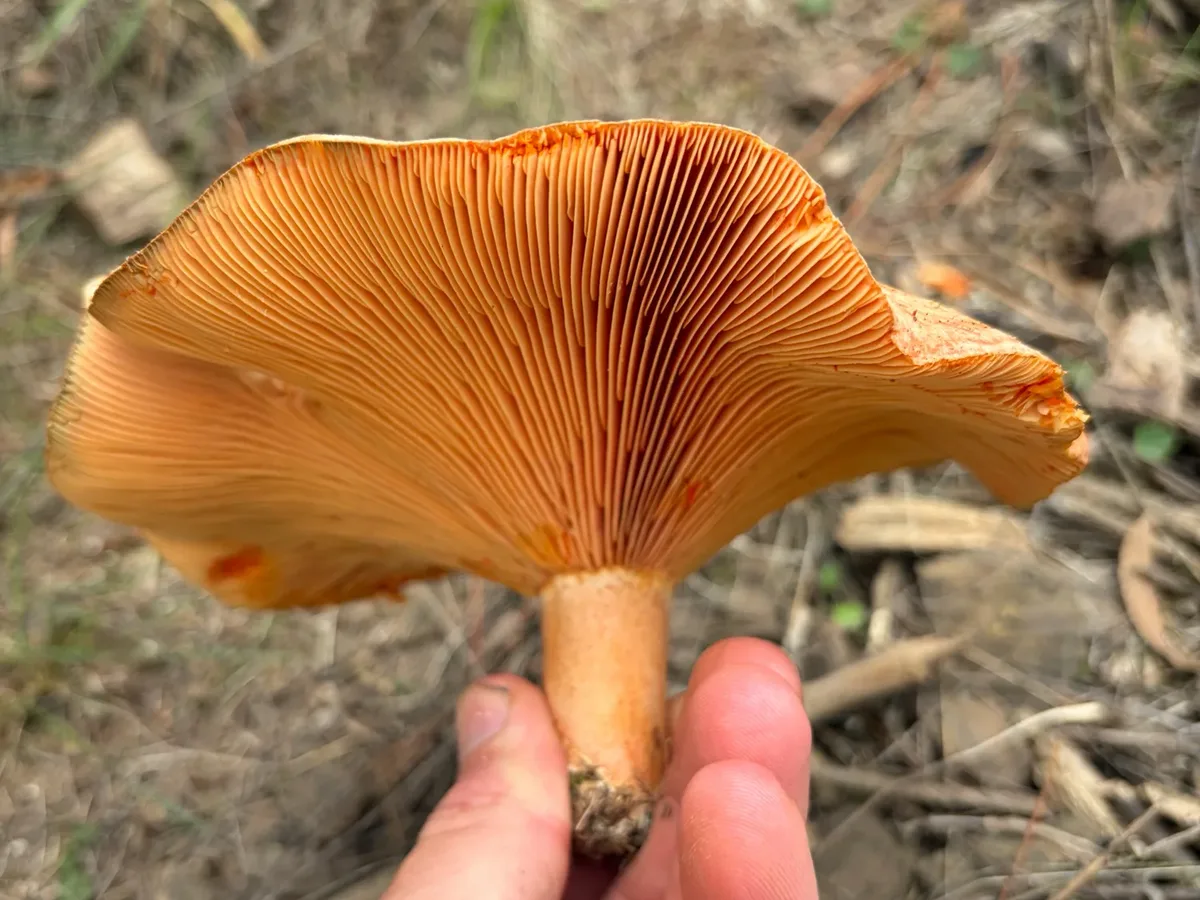
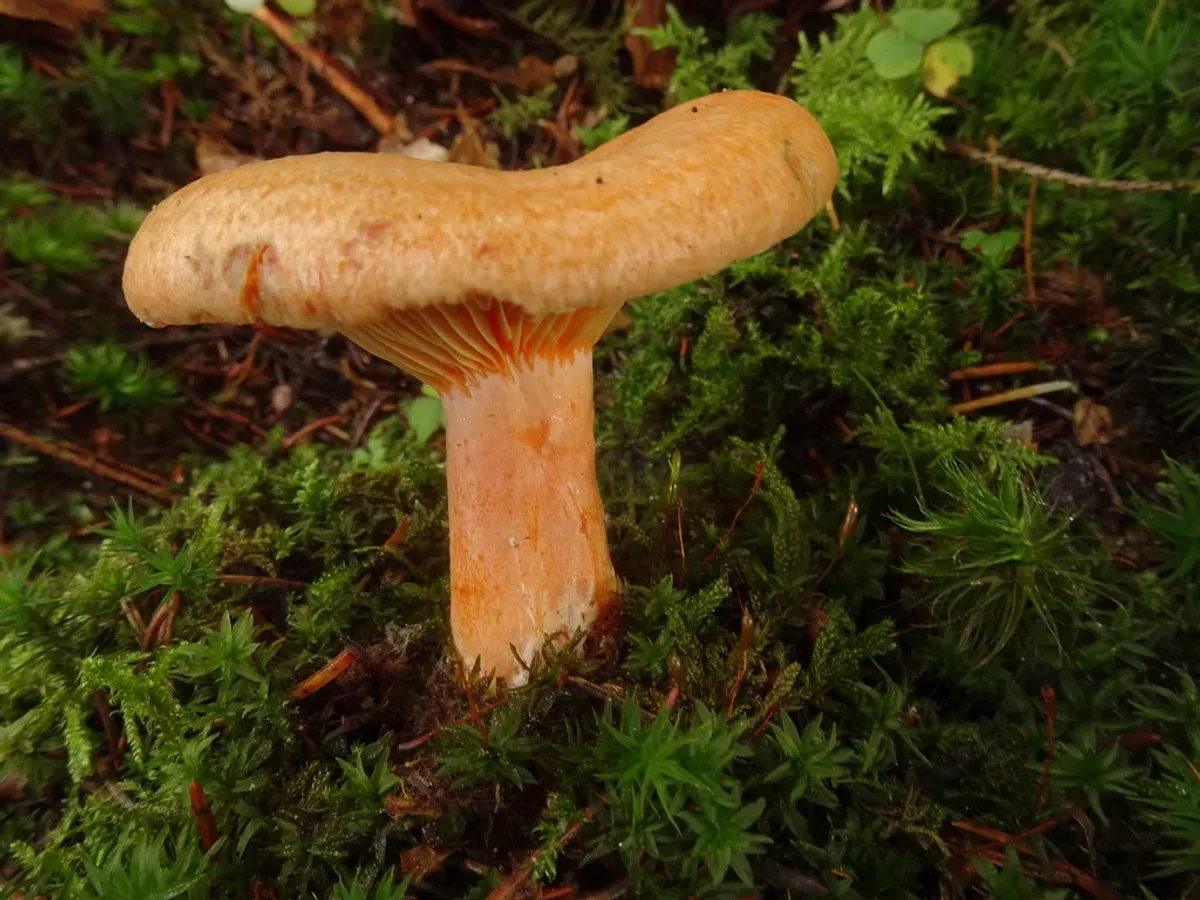
Lactarius deliciosusBreak it and clear orange-carrot milk flows - the region's safest beginner mushroom under planted pines.
How to recognise it
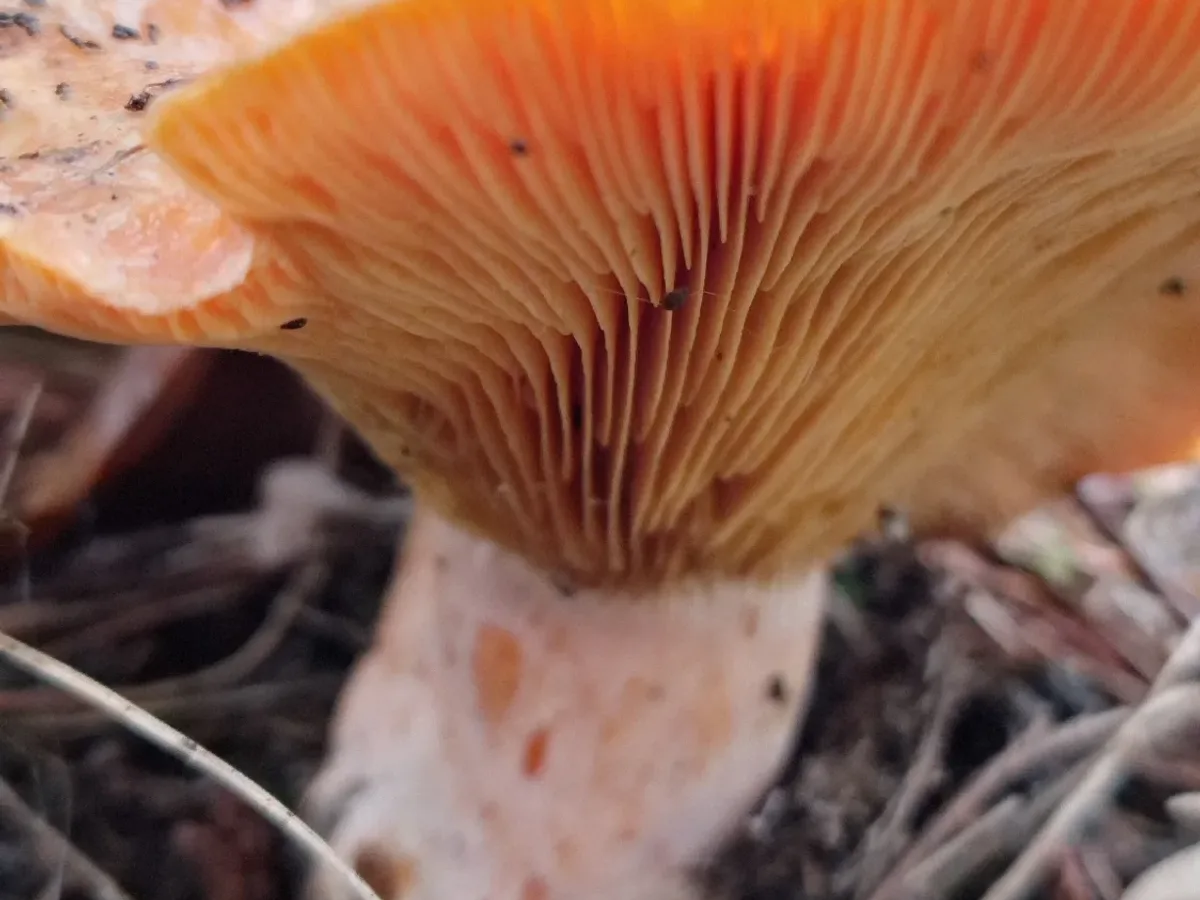
Cap 6-20 cm, bright orange-gold with darker concentric rings - striking even under the pine litter. Young specimens are convex with the margin curled under; with age the cap opens out to a funnel or vase shape. Gills are orange and densely packed. Cut the stem or break a gill and it immediately bleeds a clear, carrot-orange milk (latex) - the species' unmistakable calling card. Any bruising produces a telltale green discoloration. Stem hollow, 5-8 cm, pitted with orange dimples (scrobiculations). Mild, slightly peppery taste and a pleasant aromatic smell.
Where it grows
Found exclusively under introduced pines (Pinus radiata, P. pinea, P. halepensis) in plantations and pine plantings, on moist but well-drained ground beneath thick pine-needle litter. Key locations: NSW (Oberon, Blue Mountains/Hampton, Jenolan, Vulcan State Forest), Victoria (Macedon Ranges, Mornington Peninsula, Bright), SA (Mt Crawford/Adelaide Hills), Canberra; and in New Zealand under introduced pines. It arrived with the trees and has colonised wherever they were planted.
Cooking
Grill/fry quickly over high heat (otherwise they become "stewed"/tough). A classic Australian preparation: BBQ'd in a forest picnic area with olive oil, garlic, chili, parsley, served with sourdough bread. Also risotto, soup, pie, schnitzel (dipped in egg and breadcrumbs), pickling in oil/brine, drying into mushroom powder/mushroom salt.
Look-alikes
Amanita species lack the saffron-orange milk and have a volva. If the cap spots wash off and there is no orange milk, do not eat.
These lack the clear saffron color and the combination of orange latex, pine habitat and green bruising.
Greenish-tinged and less tasty, but harmless.
All edible. Only milkcaps with orange/red milk are safe here; those with white, burning milk should be avoided.
Lacks milk and grows on wood.
Also edible; like L. deliciosus it shows orange milk, which distinguishes it from bitter milk caps.
Also edible; distinguished from bitter milk caps by the orange milk.
Distinguish the edible saffron milk caps from bitter milk caps by the carrot-orange milk.
Has white/pink latex and a woolly (shaggy) cap margin, unlike the orange/red milk and smooth margin of the edible milk caps. Avoid it.
The orange latex and its greening reaction are reliable distinguishing features.
 Slippery jack
 Slippery jackSlippery jack
 Slippery jackSlippery jackSlippery jack
Slippery jack
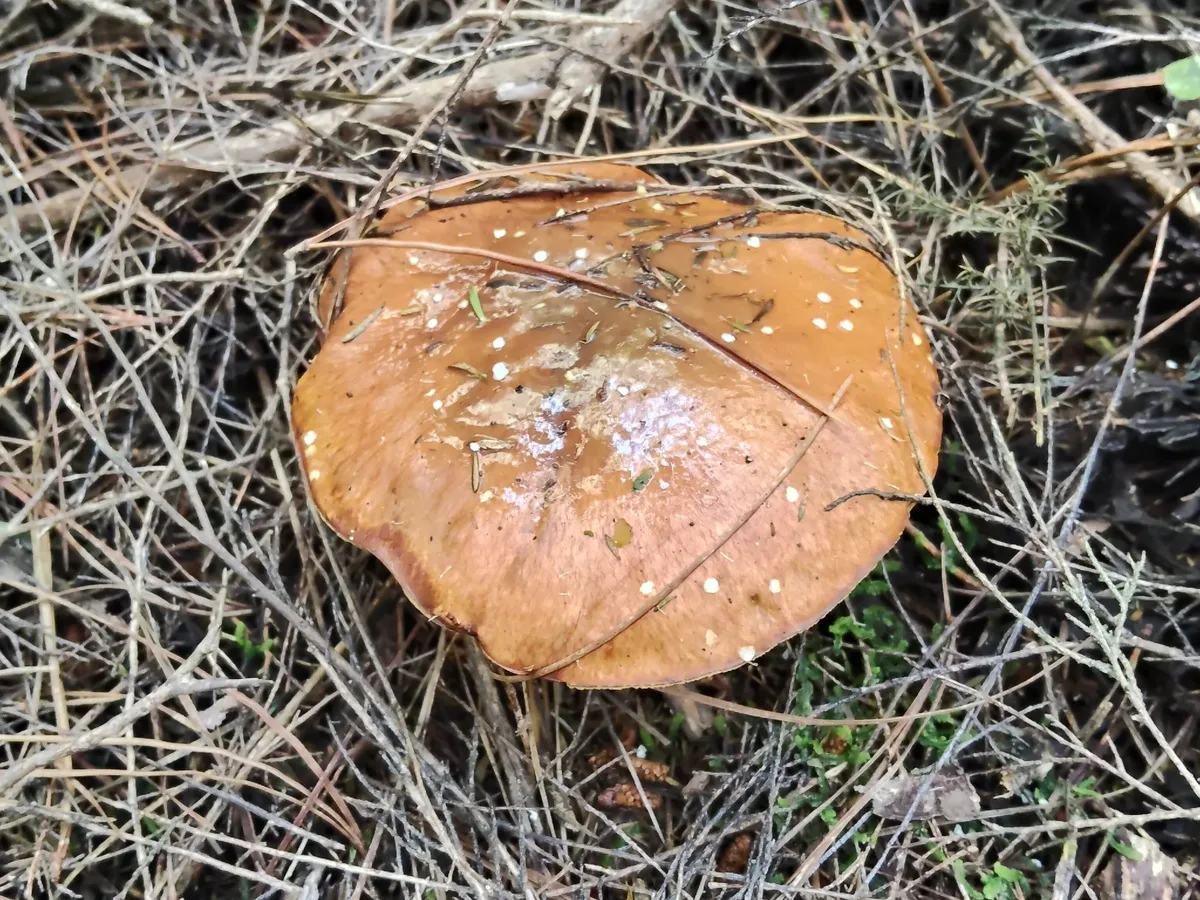
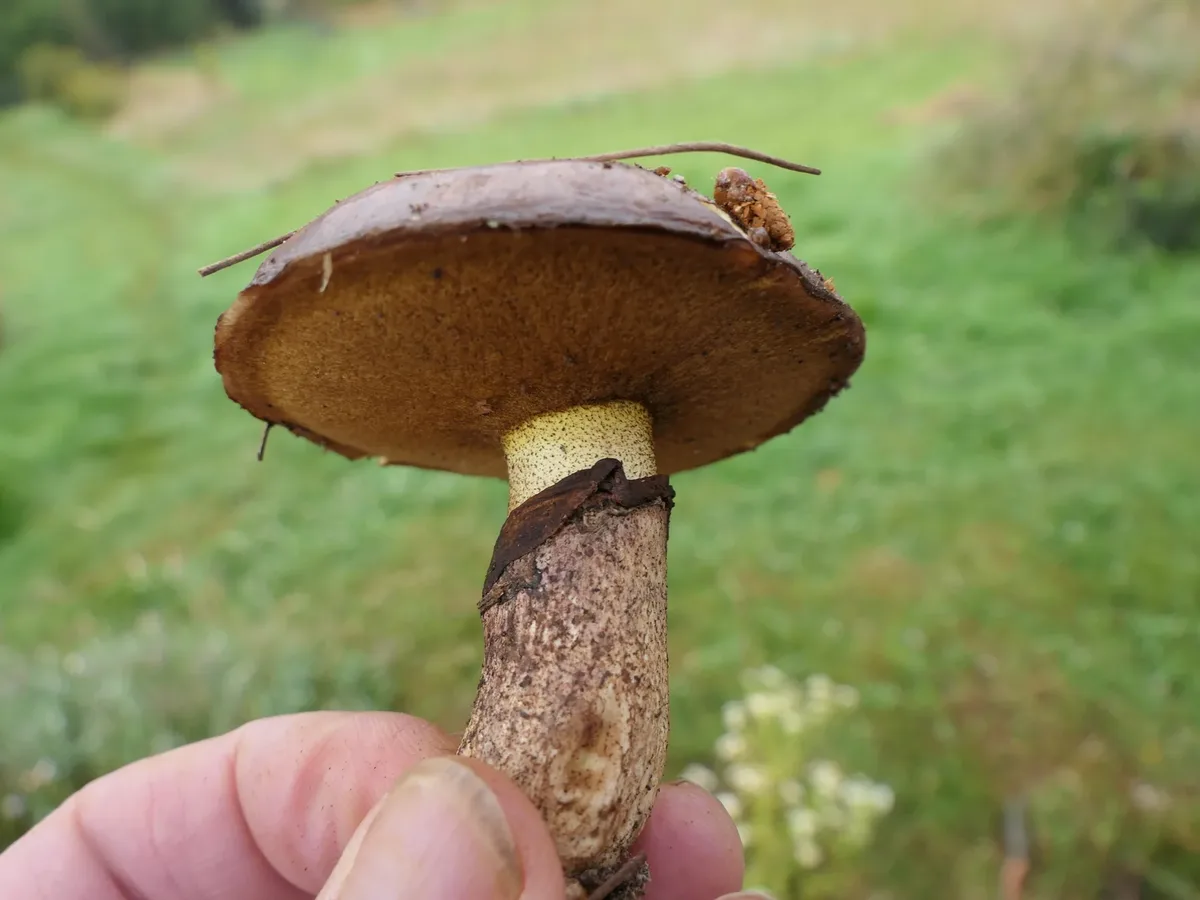
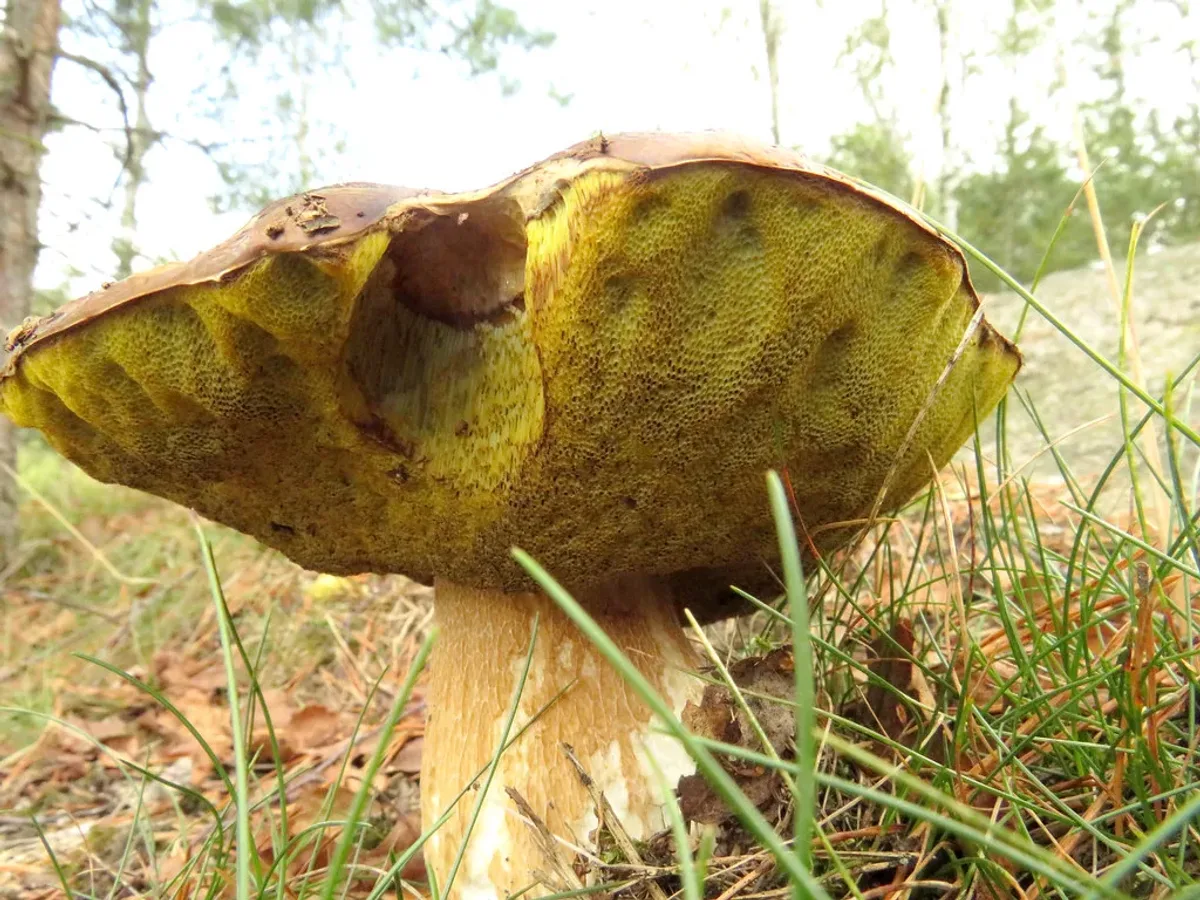
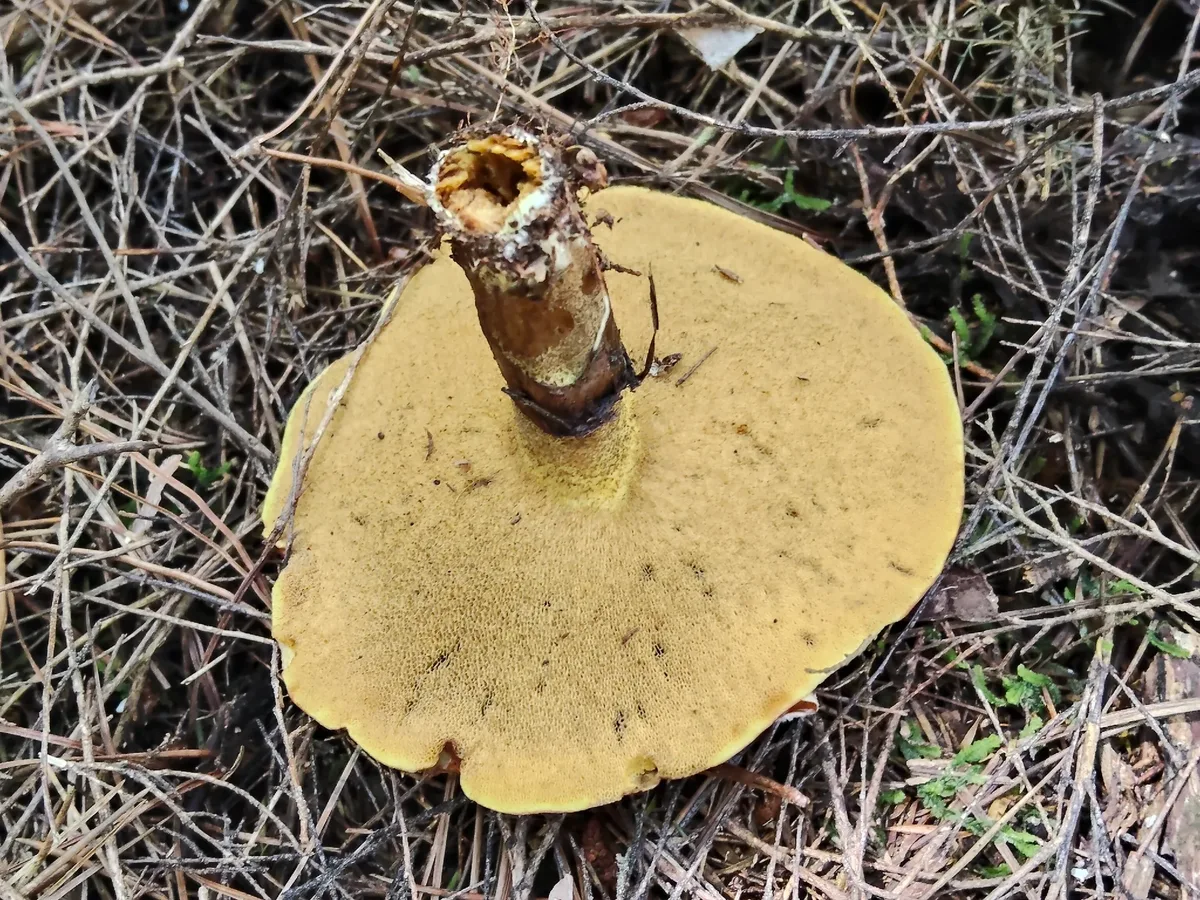
Suillus luteusA glistening brown cap with yellow pores under pines; peel the slimy skin before cooking.
How to recognise it
Cap 5-12+ cm, brown to grey-brown or purple-chestnut, the surface very slimy and glossy even in dry weather. Instead of gills it has pores - a sponge-like layer that is pale yellow when young and turns olive-yellow with age. Suillus luteus carries a purple ring on the stem; S. granulatus lacks the ring and weeps white latex droplets from its pores when fresh; S. bovinus has larger pores and less slime. Pale yellow flesh that does not bruise blue.
Where it grows
Found under introduced pines in plantations across south-eastern and south-western Australia - often sharing ground with the saffron milkcap at forest edges - and in New Zealand. The fungus arrived with its pine host and has no natural foothold here without it. S. granulatus favours calcareous ground under Pinus halepensis and Pinus pinea.
Cooking
Peeled and chopped in Asian-inspired soups, fried in butter, in omelettes, pasta, pies. Well suited to drying (crispy golden "half-moons") and blending into umami powder; suitable for pickling.
Look-alikes
Deadly Amanita species can grow under the same introduced trees in plantations. Unlike the bolete-type Suillus (which has yellow pores under the cap and a slimy brown cap), Amanita have gills, a ring and a basal volva.
The combination of a slimy brown cap, yellow pores and pine habitat is distinctive for the slippery jacks; following the beginner rule of picking nothing else avoids confusion.
Other Suillus boletes are also edible; the guide notes there are no dangerous lookalikes.
Edible Suillus that lacks a ring on the stem.
Edible Suillus that grows with spruce.
Edible Suillus that grows with larch.
Edible Suillus with a dry, matte cap and no ring.
 Field mushroom
 Field mushroom
 Field mushroom
 Field mushroomField mushroomField mushroom
Field mushroom
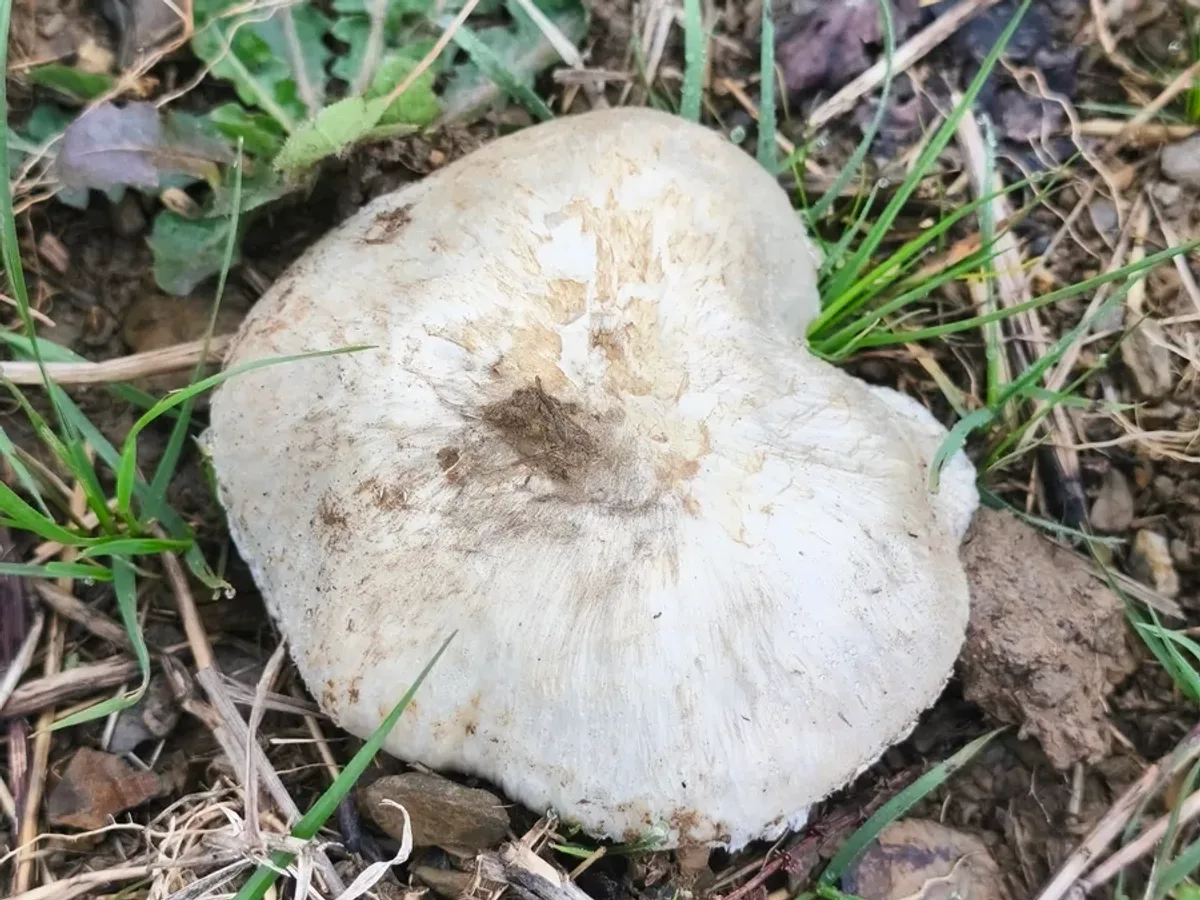
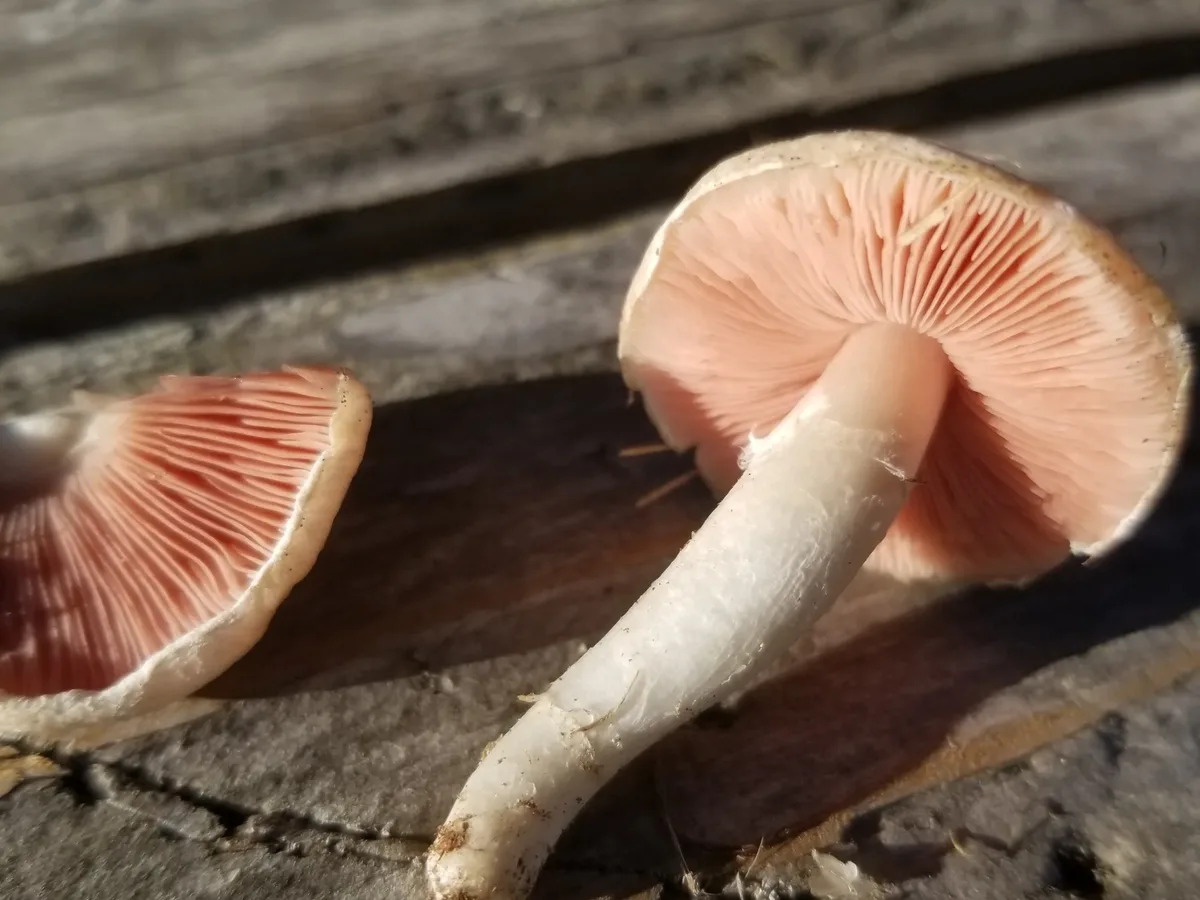
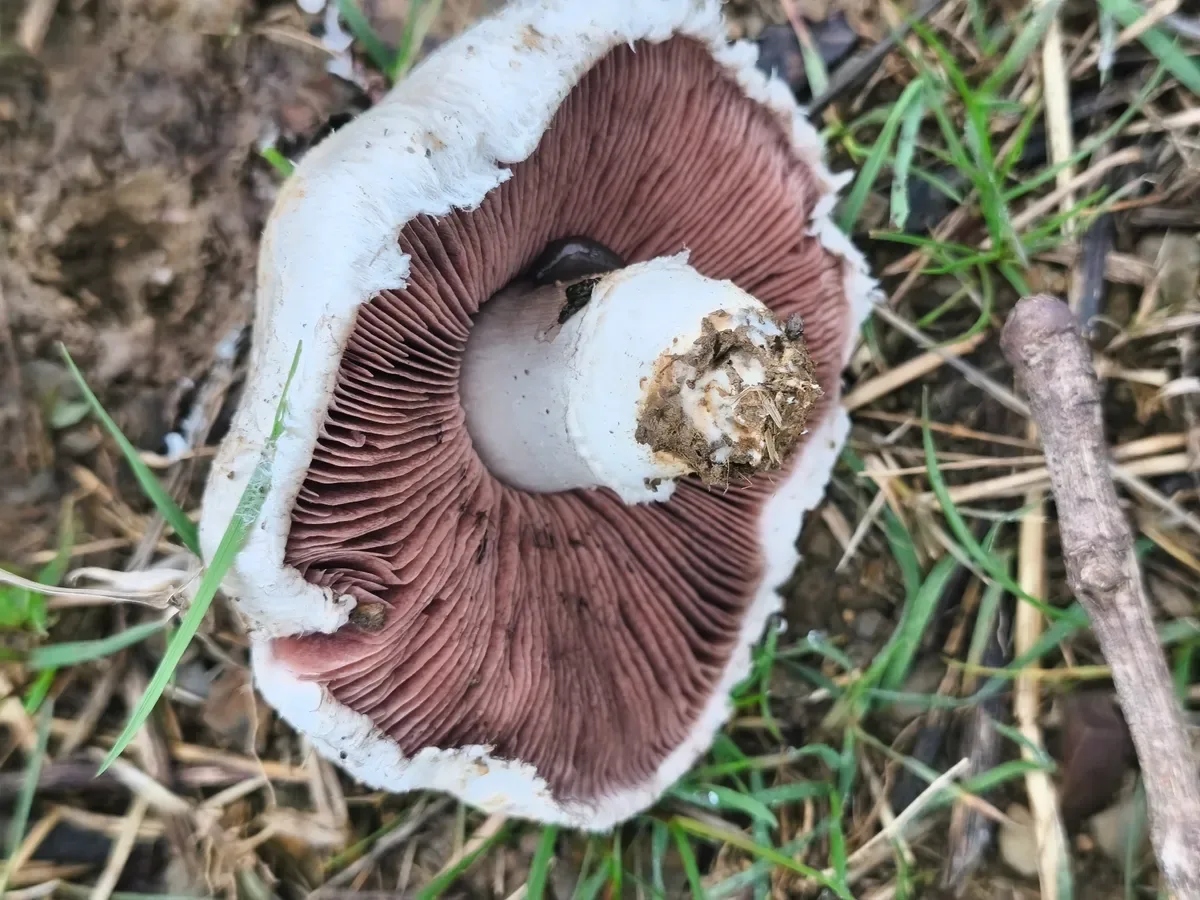
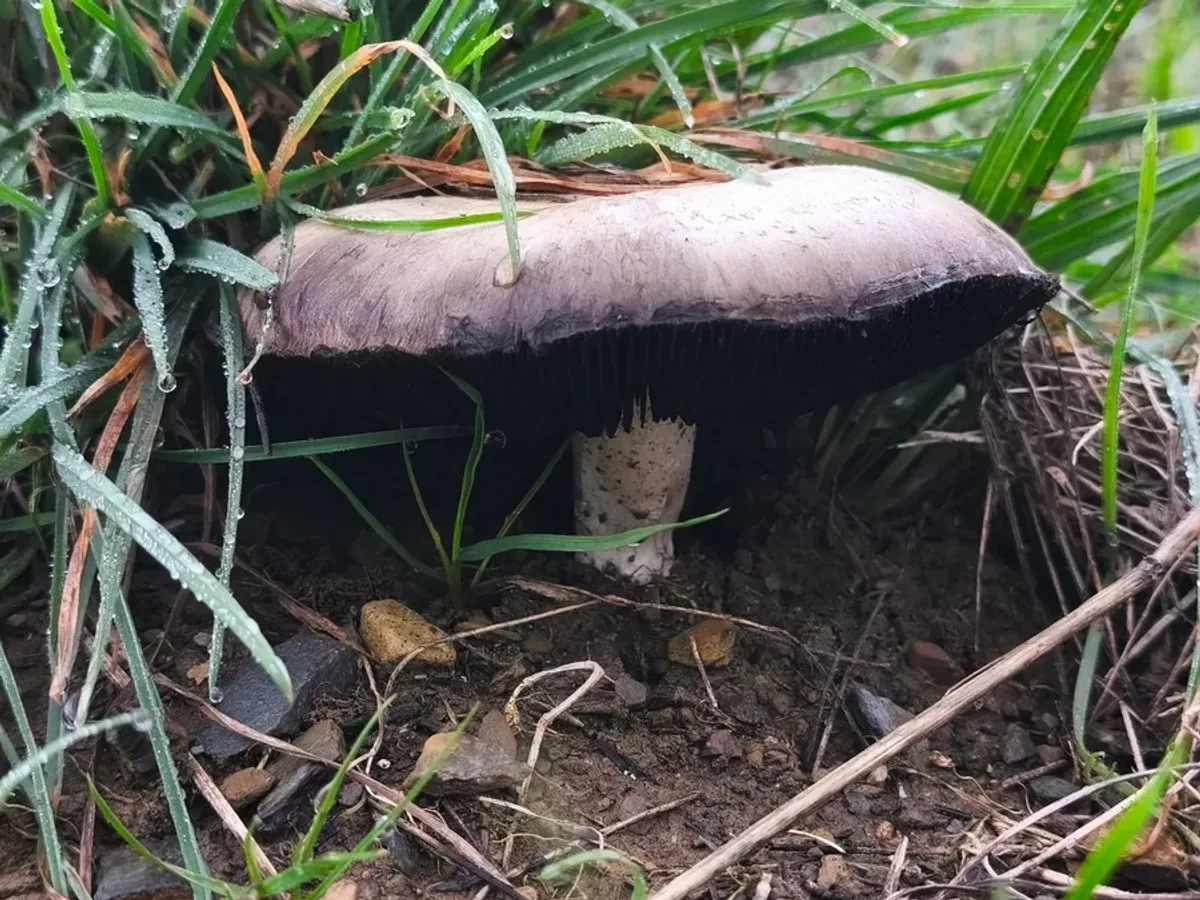
Agaricus campestrisThe meadow classic - but only pick it once you can rule out the yellow stainer and Amanita.
How to recognise it
Cap 3-12 cm, white, dry (never slimy), sometimes developing fine scales or surface cracks with age; never with a green tint. Gills begin bright pink, deepen to reddish-brown as the spores mature, and finish a rich chocolate brown - this colour journey is one of the species' best identity checks. Gills are free from the stem. Spore print dark brown. Stem carries a thin ring and has no volva at the base. Flesh is firm and white; the smell is pleasantly mushroomy.
Where it grows
Grazed meadows, pastures, lawns, parks and sports fields - nutrient-rich, manured soil (cow/horse/sheep). A saprophyte on dead grass and roots. Widely distributed in Australia and New Zealand.
Cooking
Like the cultivated button mushroom but moister - field mushrooms on toast (an Australian breakfast classic), fried, in sauces, omelette, soup.
Look-alikes
White gills at every stage (never pink or brown), a sack-like volva at the stem base (may be buried - dig it up), and a white spore print. A. phalloides additionally shows a greenish-yellow cap; destroying angels (A. virosa, A. bisporigera) are pure white with no green coloration at all. Do not rely on colour alone: the presence of a volva is the definitive structural feature. Never pick any white gilled mushroom without confirming the absence of a volva.
Stains strongly yellow at the stem base and smells of phenol/ink/iodine; the most common cause of mushroom poisoning.
 Wood ear
 Wood ear
 Wood earWood earWood ear
Wood ear (hakeke)
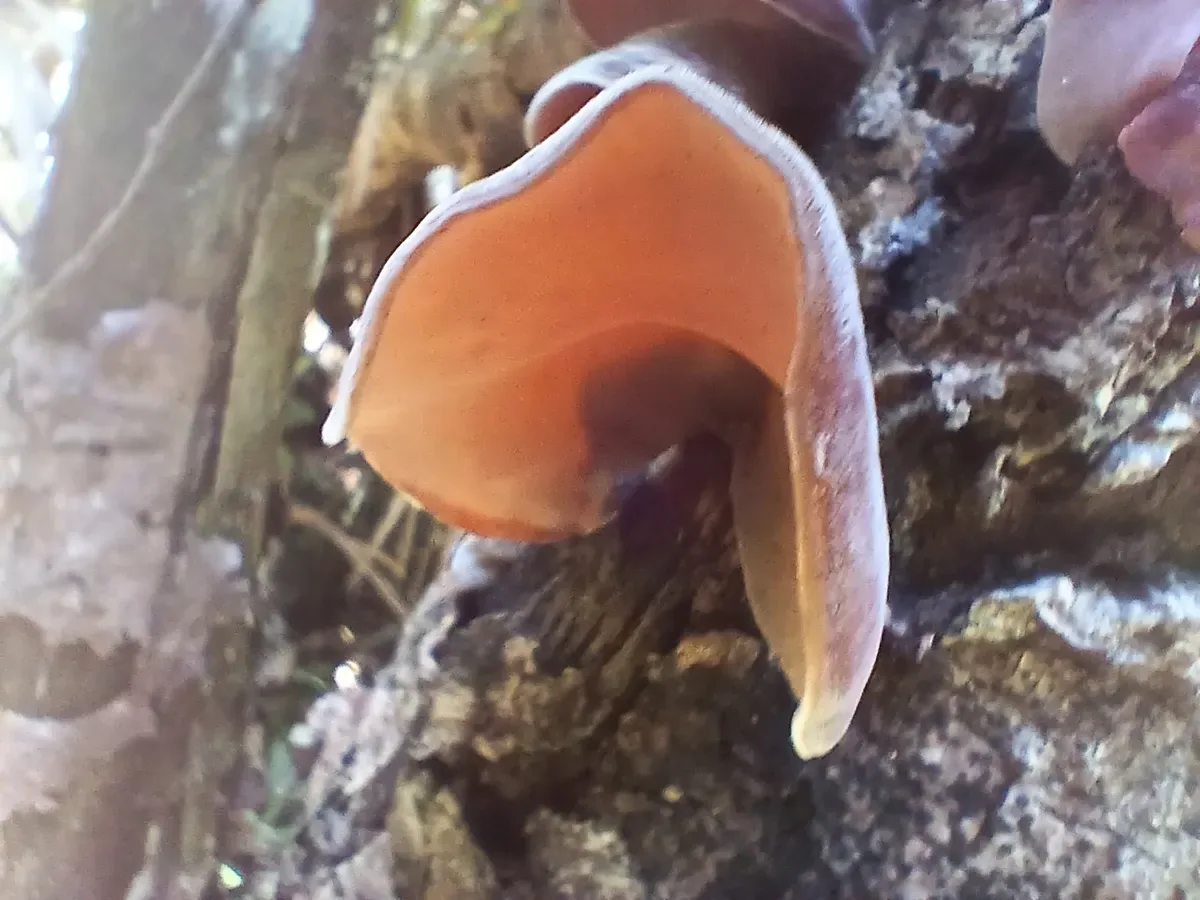
Auricularia corneaA gelatinous ear on dead wood, once exported to China as "Taranaki wool."
How to recognise it
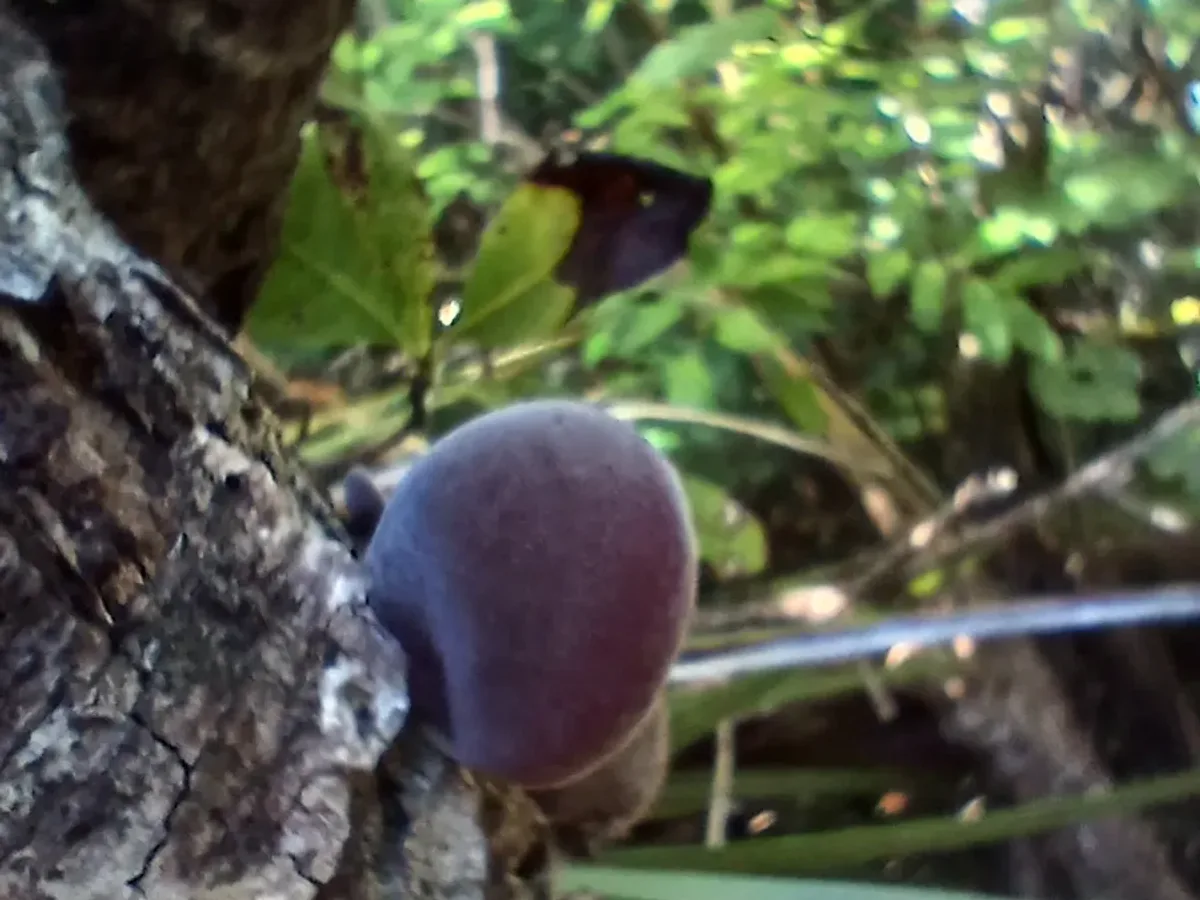
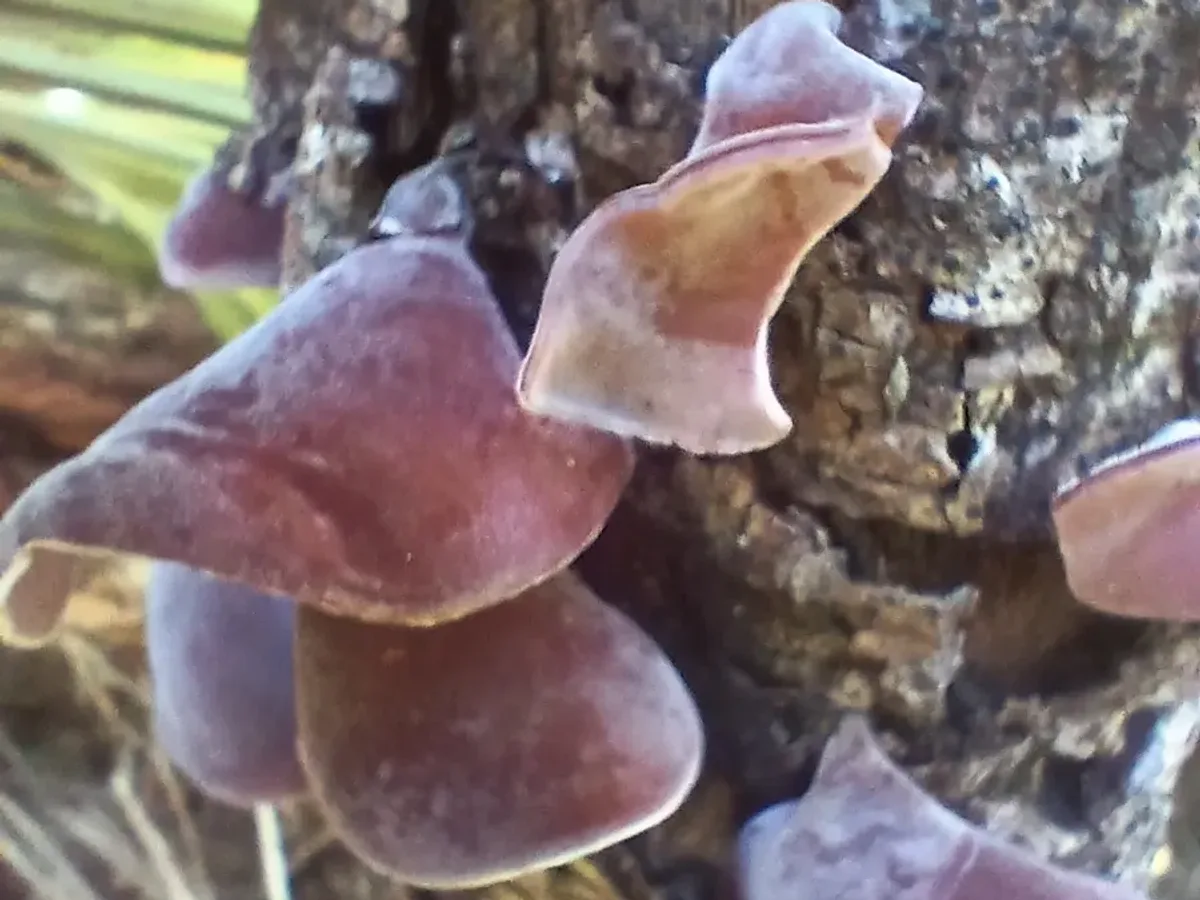
A rubbery, ear-shaped bracket, 2-9 cm across, ranging from warm brown to red-brown when young and shifting toward blue-grey as it ages. The upper surface is covered in fine hairs; the lower, spore-bearing surface is smooth. No stem, no gills - just the bracket itself clinging to the wood. One of its more curious traits: it dries to a hard, almost papery chip but swells back to full size when rehydrated. Flavour is mild to neutral; the draw is textural - slick on the outside, satisfyingly crunchy within.
Where it grows
On dead hardwood and dead parts of living trees (tawa, mahoe, pukatea, karaka) in native forest; wet regions (West Coast, Taranaki). A saprophyte (decomposer).
Cooking
Maori steamed it in an earth oven (hangi/umu) with puha (sow thistle) and potatoes. In Chinese cooking it is used in soups and stir-fries; prized for its crunchy texture. Cultural history: Maori (including women and children) gathered and dried enormous quantities for export to China from about the 1870s to the 1950s; the trade was initiated by the New Plymouth merchant Chew Chong and was so lucrative it was called "Taranaki wool". Today hakeke is instead imported from China.
Look-alikes
The guide notes few dangerous look-alikes - the gelatinous ear shape on wood is distinctive.
 Honey mushroom
 Honey mushroom
 Honey mushroom
 Honey mushroomHoney mushroomHoney mushroom
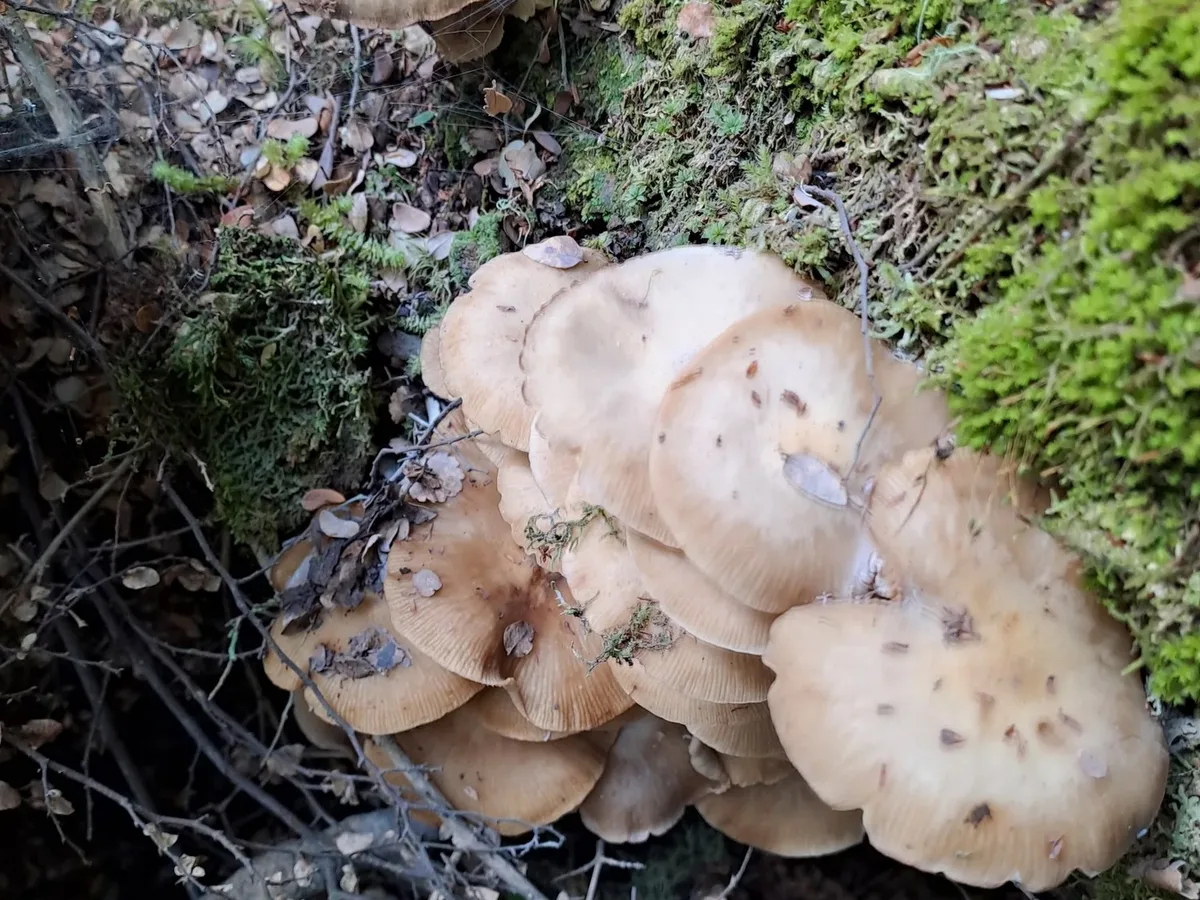
Honey mushroom (harore)
Armillaria novae-zelandiaeA traditional Māori food, edible only when well cooked - and faintly glowing in the dark.
How to recognise it
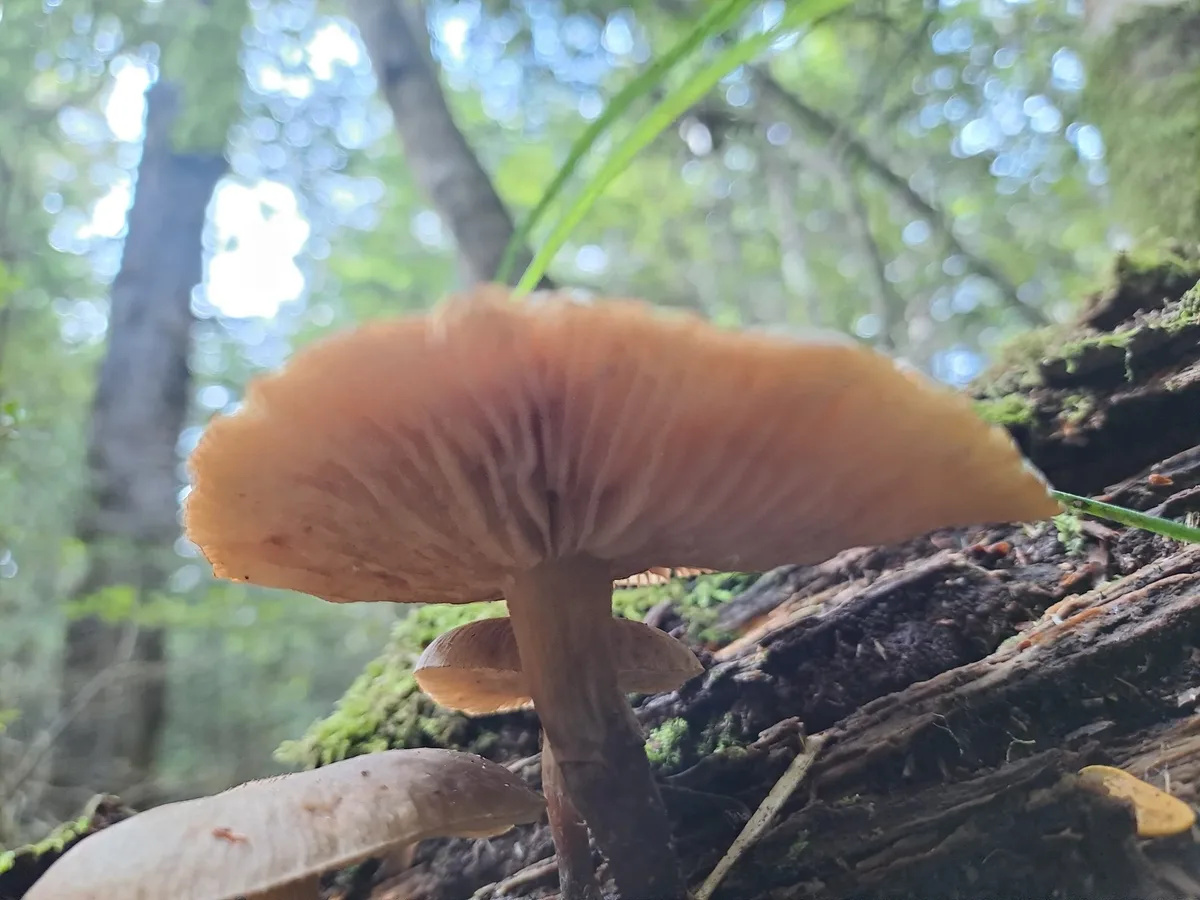
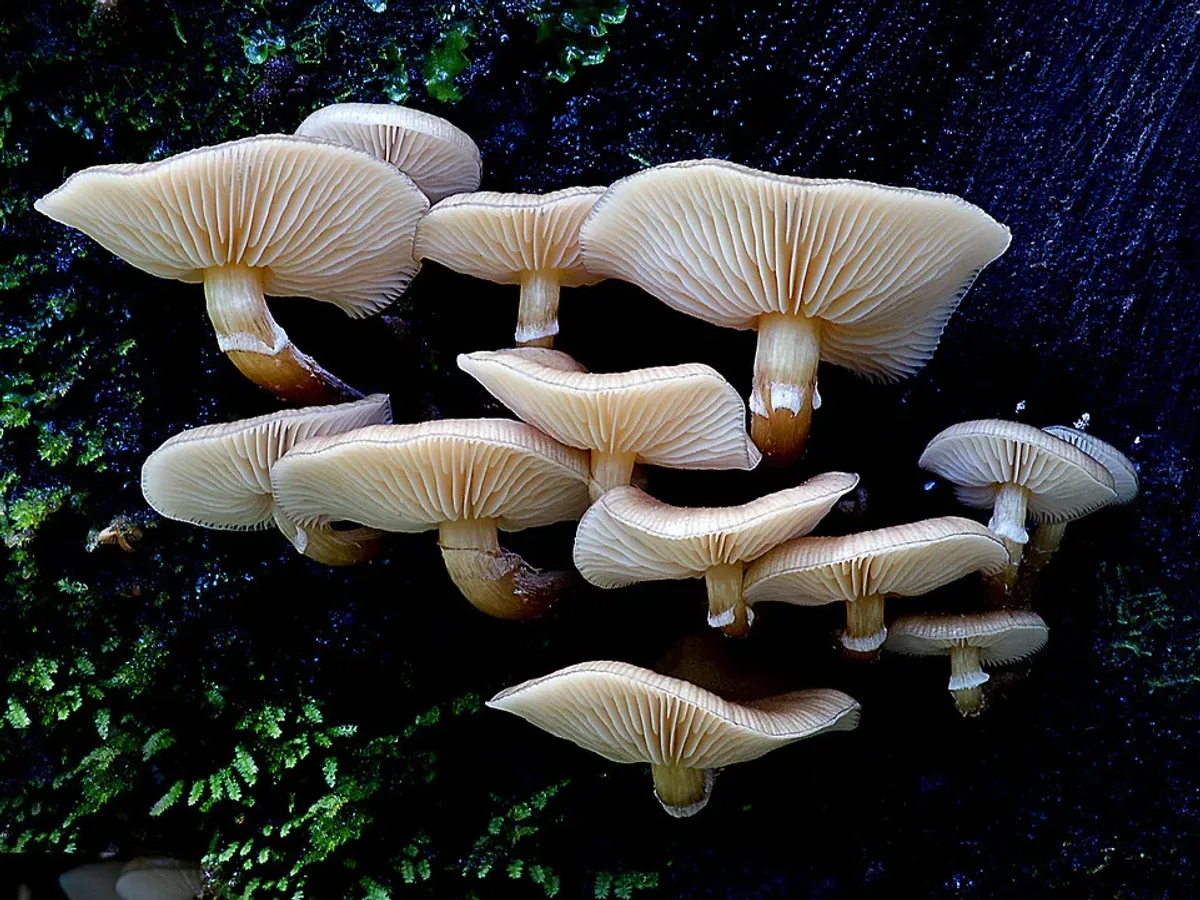
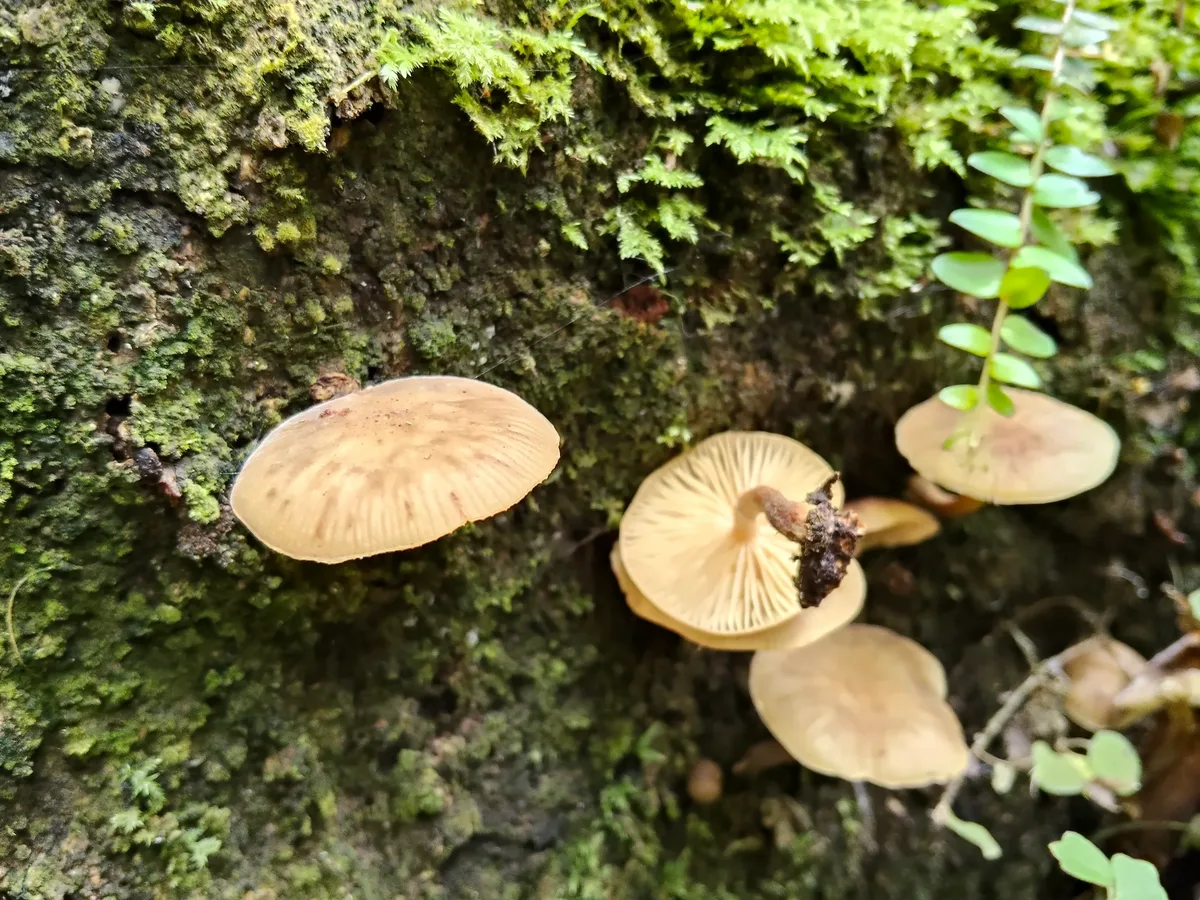
Cap 3-8 cm, olive-beige to olive-brown with small brown scales clustered at the centre; convex with a strongly inrolled margin in young specimens, flattening to shallowly concave with age; moist, with a finely striate margin. The ring on the stem is the classic honey-mushroom calling card. Curiously, the wood it rots can glow faintly in the dark - a phenomenon known as foxfire, caused by the living mycelium within the decaying timber.
Where it grows
At home in southern beech (Nothofagus) and broadleaf podocarp forests, where it has long threaded its mycelium through root systems and rotting wood. It acts as a plant parasite, causing root rot on both native and introduced trees - a reminder that not all forest partnerships are benign.
Cooking
Must be cooked thoroughly - raw or undercooked specimens can cause stomach upset. Works well stewed or boiled; the firm flesh holds up to long, gentle cooking.
Look-alikes
A related Armillaria that is bitter and inedible; the Maori language (te reo) does not clearly distinguish it from the edible species, so taste and experience are needed to tell them apart.
 Coral tooth fungus
 Coral tooth fungus
 Coral tooth fungus
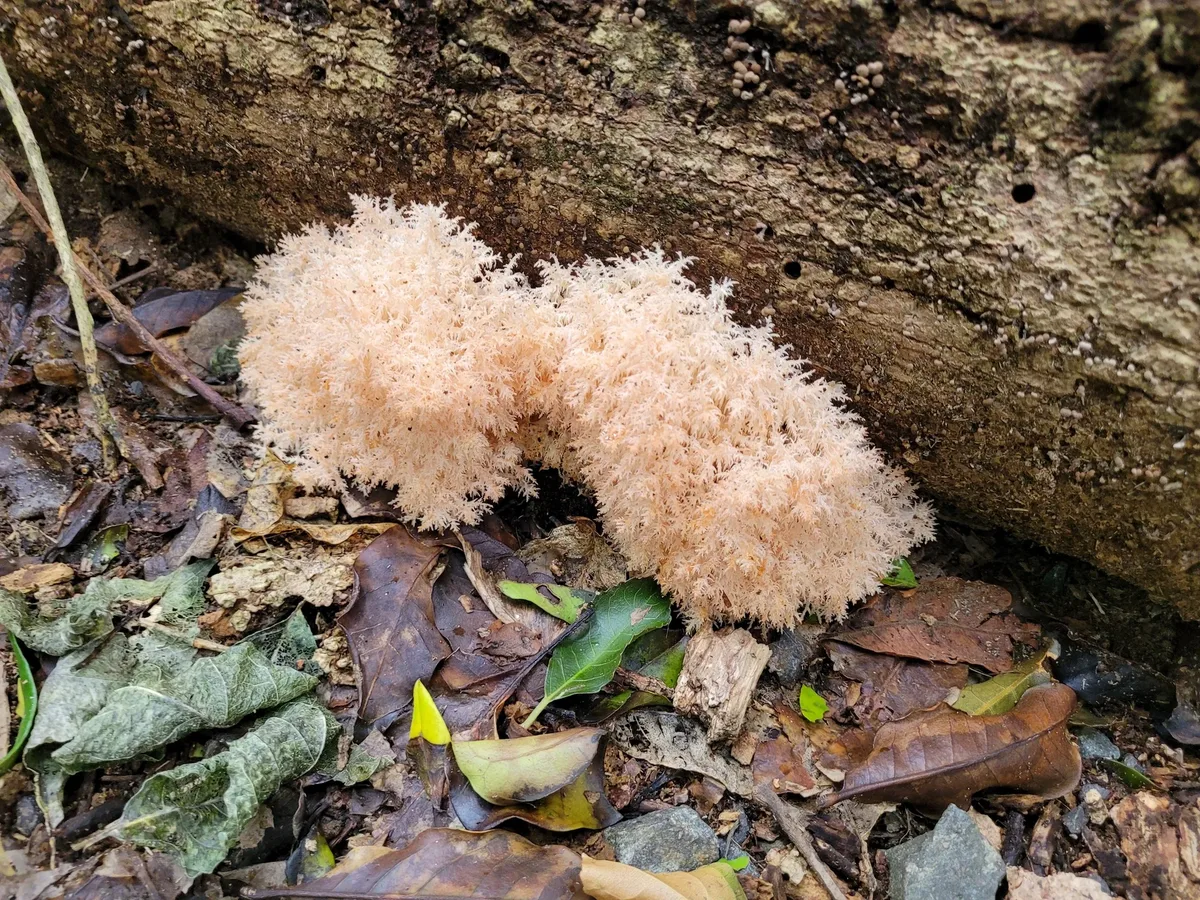 Coral tooth fungusCoral tooth fungusCoral tooth fungus
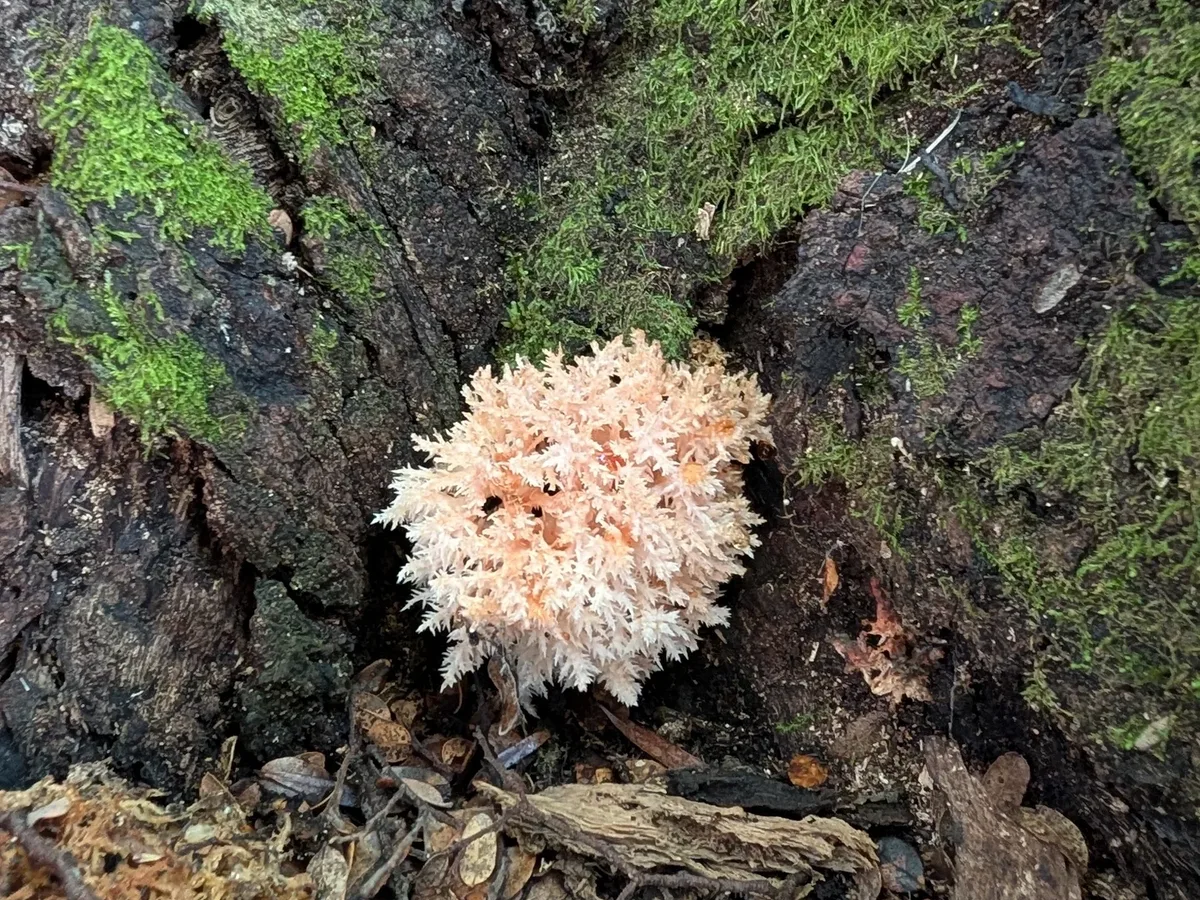
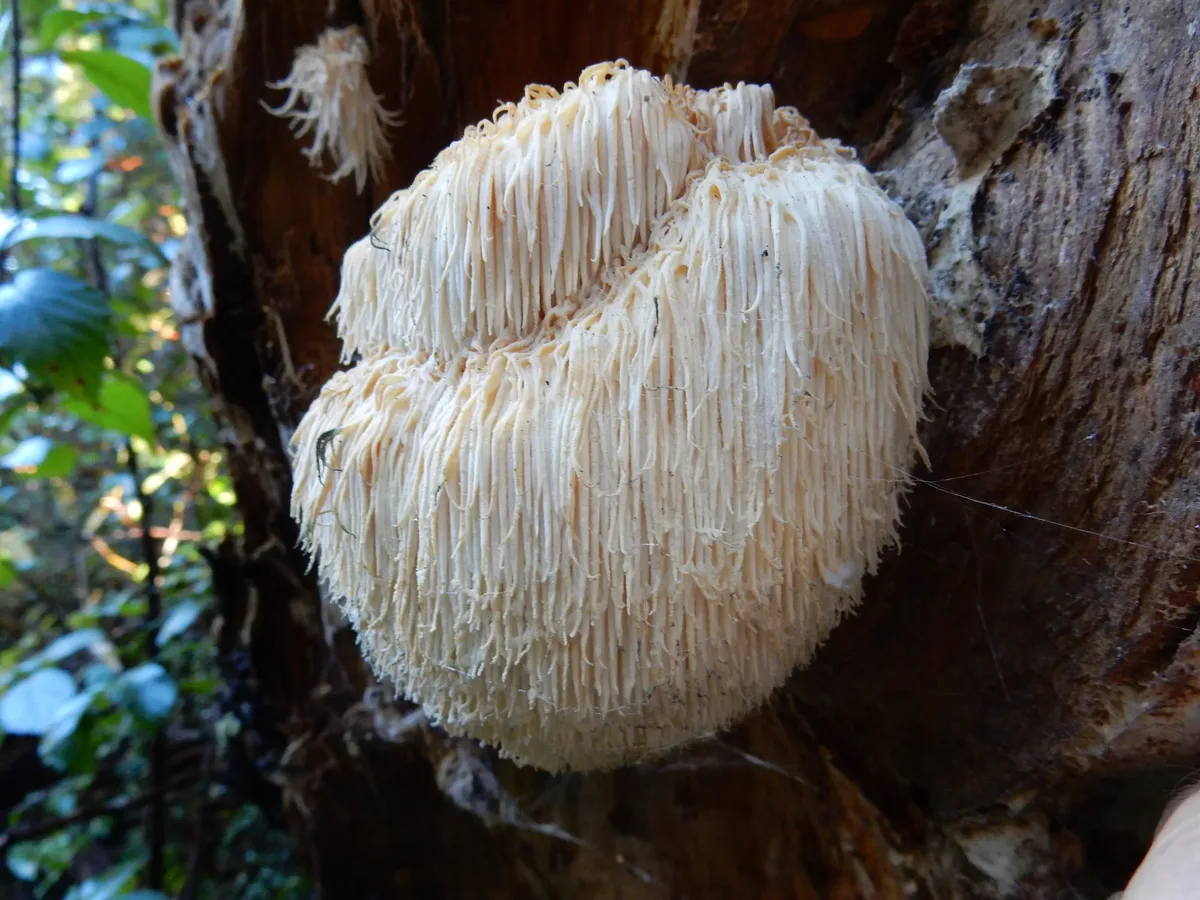
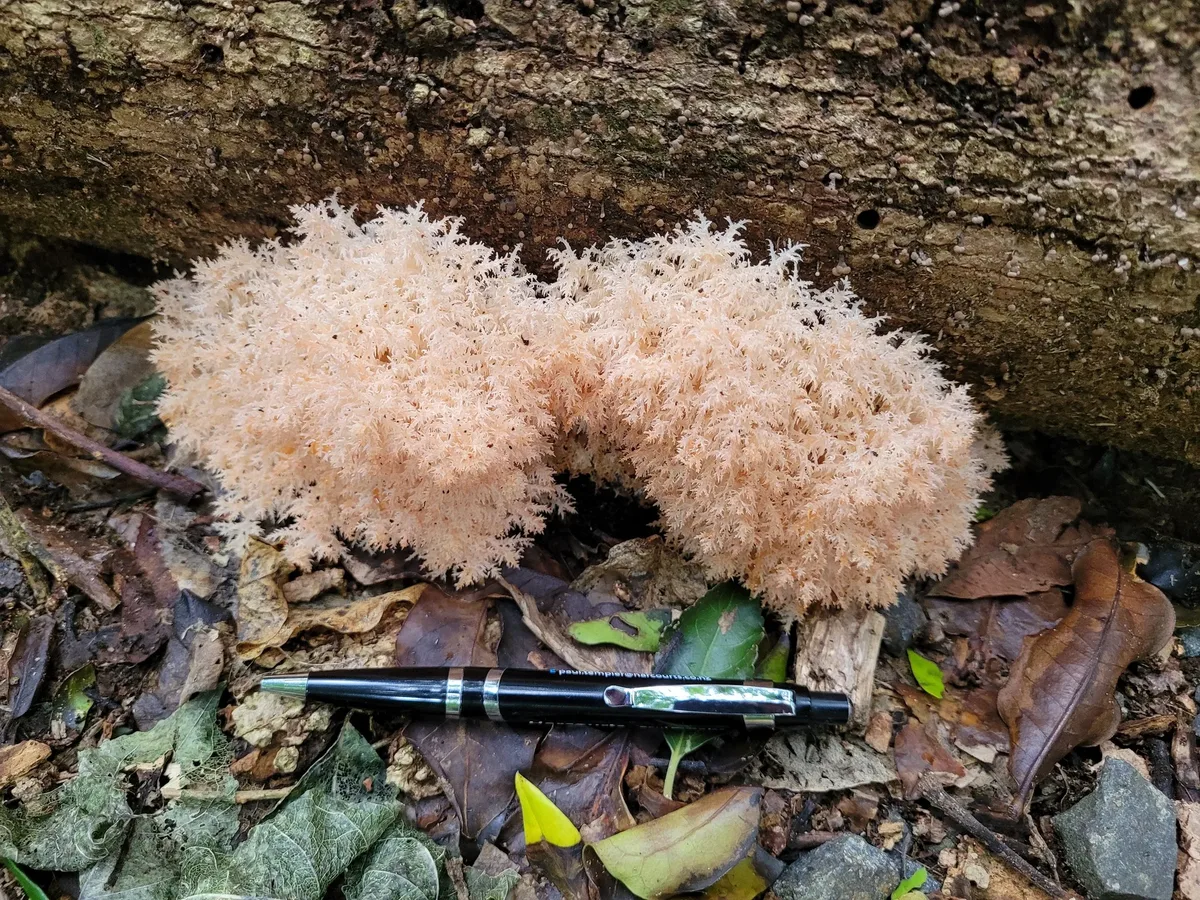
Coral tooth fungus (pekepekekiore)
Hericium novae-zealandiaeA white, cascading toothed coral, sweet and good when young - a New Zealand endemic.
How to recognise it
A ghostly white fruiting body built from branching coral-like arms, each tipped with fine, hanging teeth or spines. Young specimens are soft and pliable with a mild sweet-umami scent; older ones turn brittle and fragile. The whole structure can be fist-sized or larger, and its cascading form makes it one of the most visually distinctive fungi in the New Zealand bush.
Where it grows
Found on fallen or standing dead hardwood in native broadleaf forest. This species is endemic to New Zealand. As a saprotroph it colonises dead wood and slowly recycles it back into the forest - doing quiet, essential work out of sight until it suddenly erupts into its dramatic fruiting body.
Cooking
Best pan-fried over medium-high heat. It has a sweet umami flavour and a pleasantly firm, slightly stringy texture often compared to crab or lobster - making it a satisfying meat substitute.
Look-alikes
A related species; the white spiny coral form of H. novae-zealandiae is distinctive. Few dangerous lookalikes.
 Poplar mushroom
 Poplar mushroom
 Poplar mushroom
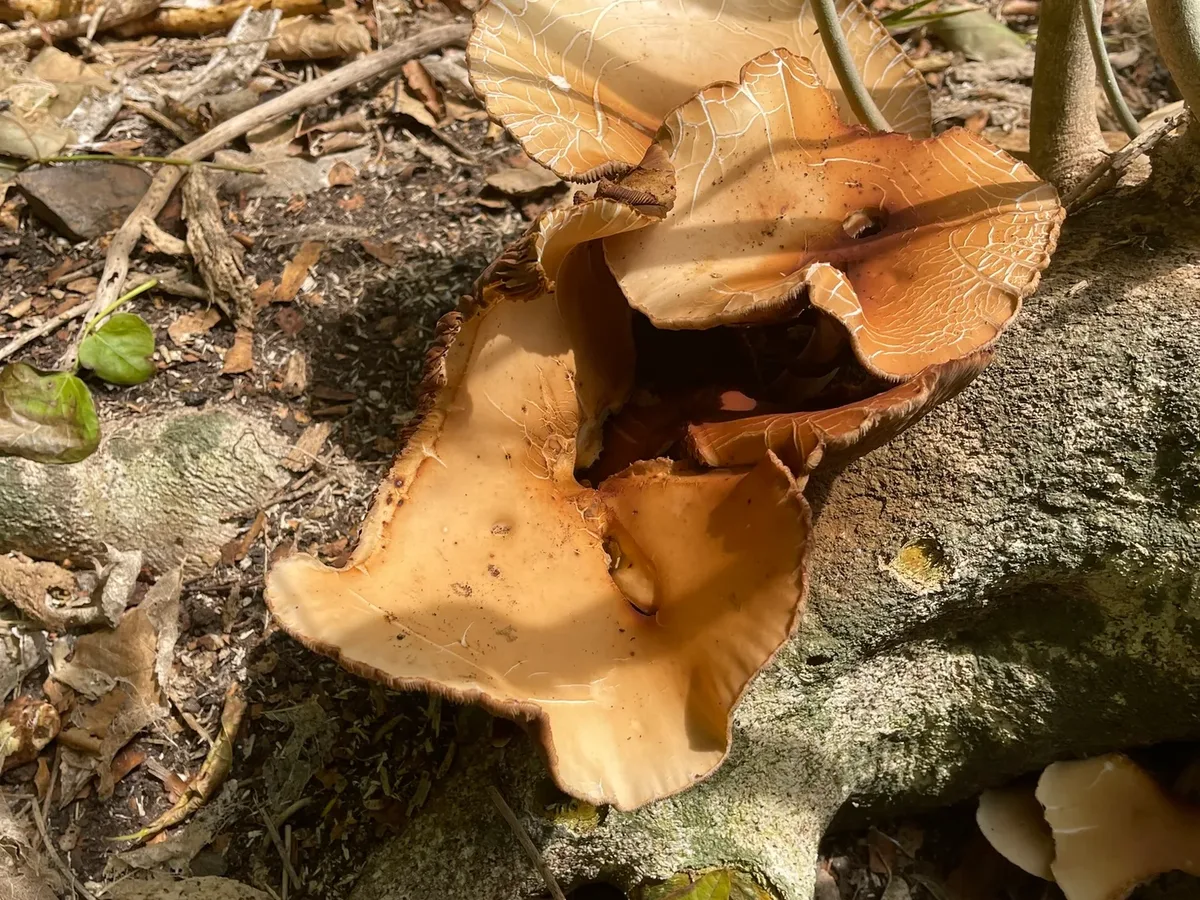
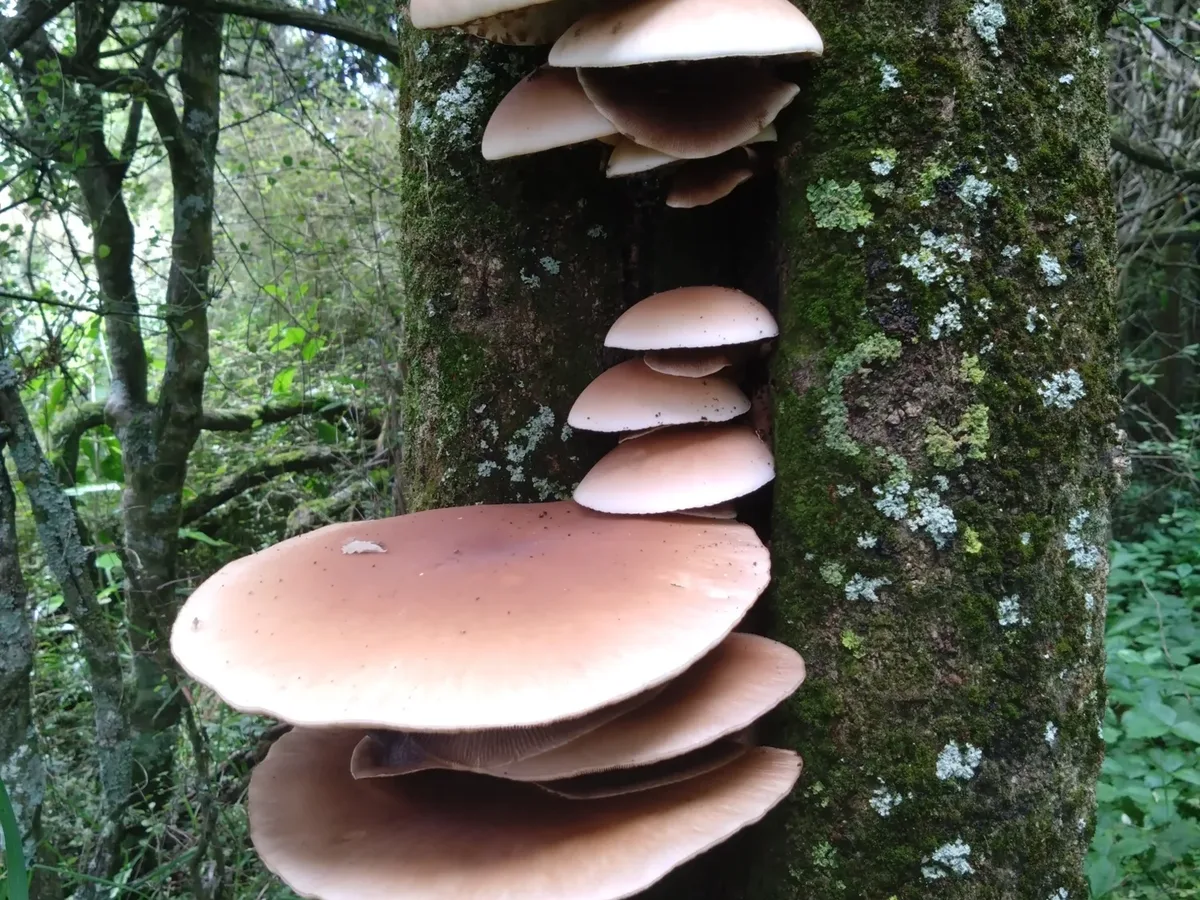
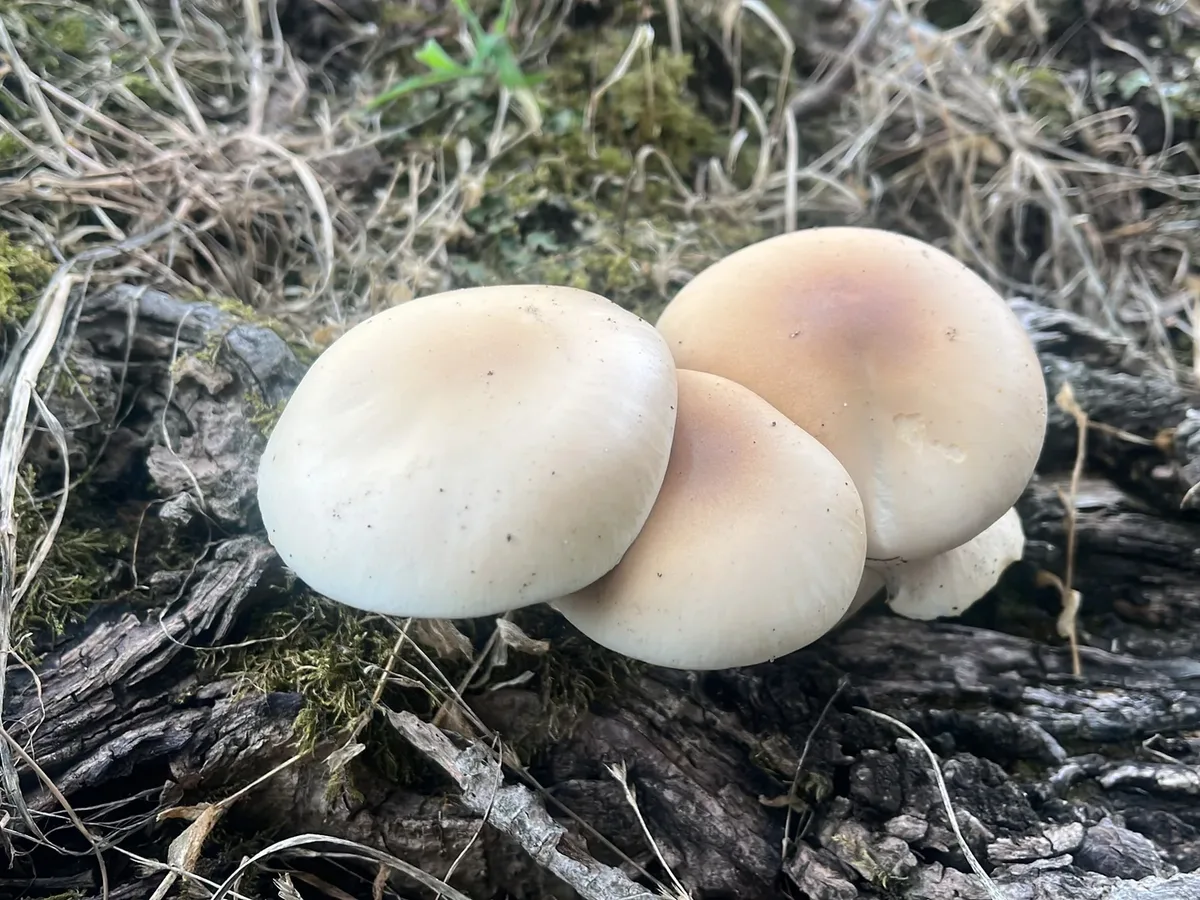
 Poplar mushroomPoplar mushroomPoplar mushroom
Poplar mushroom (tawaka)
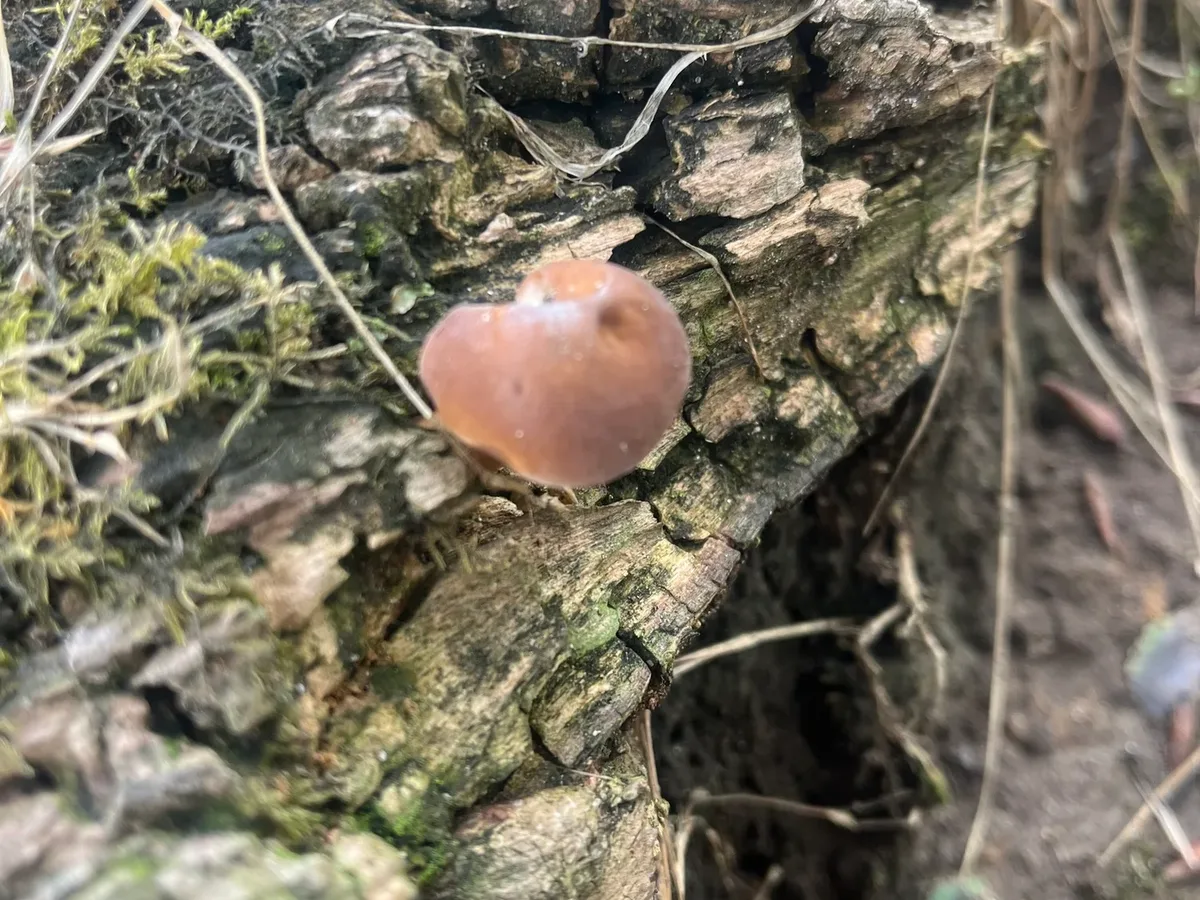
Cyclocybe parasiticaA meaty native fruiting high on living trees - look up - and now grown commercially as NZ's own pioppino.
How to recognise it
The cap is beige to buff, a shade darker in the center, and can grow impressively large - up to 30 cm (12 in) across. The pale stem carries white flesh throughout. A partial veil tears as the cap expands and leaves a persistent ring, often dusted dark by falling spores. Gills begin pale pink and deepen to brown as spores mature. The flesh is substantial and carries a pleasantly savory, nutty aroma.
Where it grows
Tawaka grows on both dead and living hardwood - mahoe, lacebark, ribbonwood, tawa, and kanuka among the natives, plus poplar and willow. It causes heart rot, slowly breaking down wood from the inside out. It never fruits on conifers. It is most common in New Zealand, particularly the South Island, with a smaller presence in Australia.
Cooking
Maori traditionally steamed or stone-cooked tawaka in the huahua and kohua methods. The robust, meaty texture holds its shape well during cooking, making it a good choice for burgers, sausages, soups, and hearty stews.
Look-alikes
More orange-colored and bitter-tasting. Distinguish by checking the ring and the habitat.
 Giant puffball
 Giant puffball
 Giant puffball
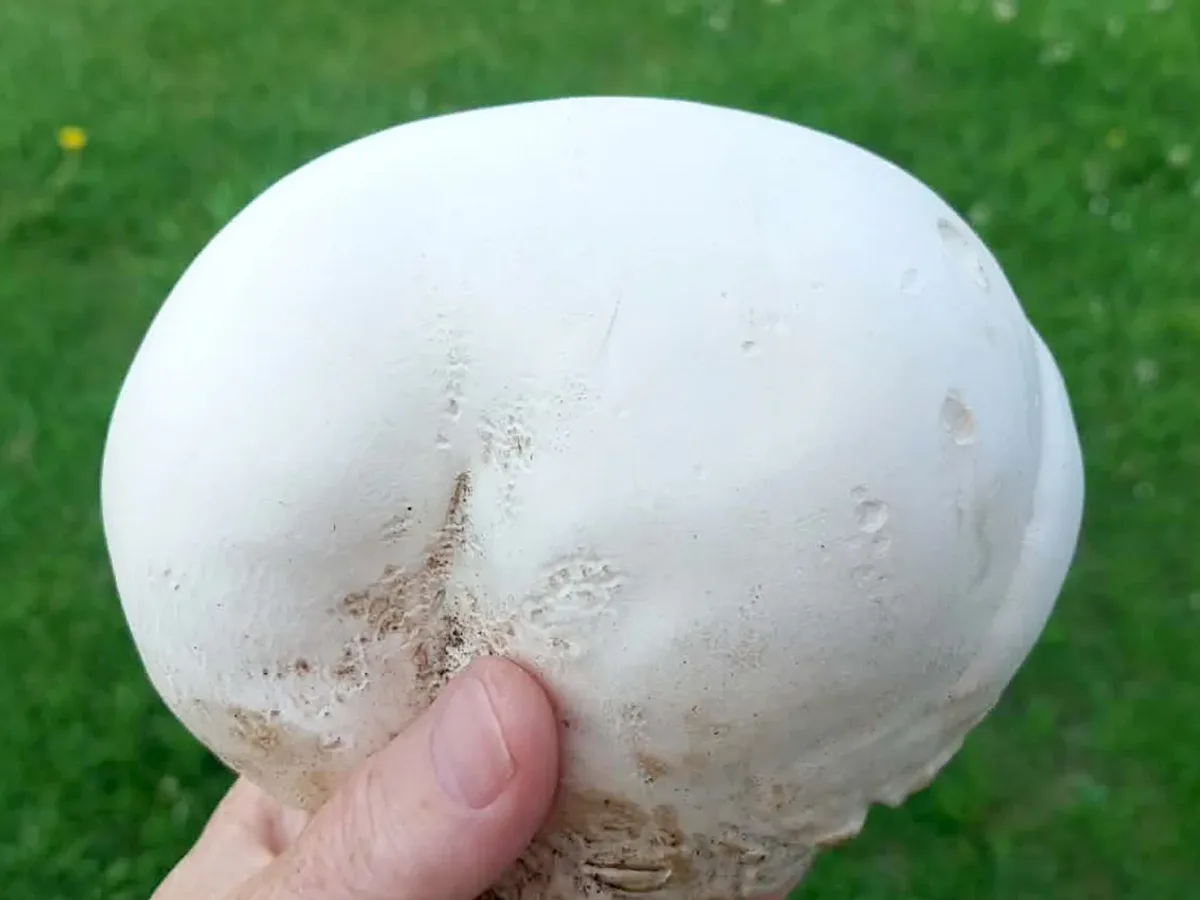 Giant puffballGiant puffballGiant puffball
Giant puffball (pukurau)
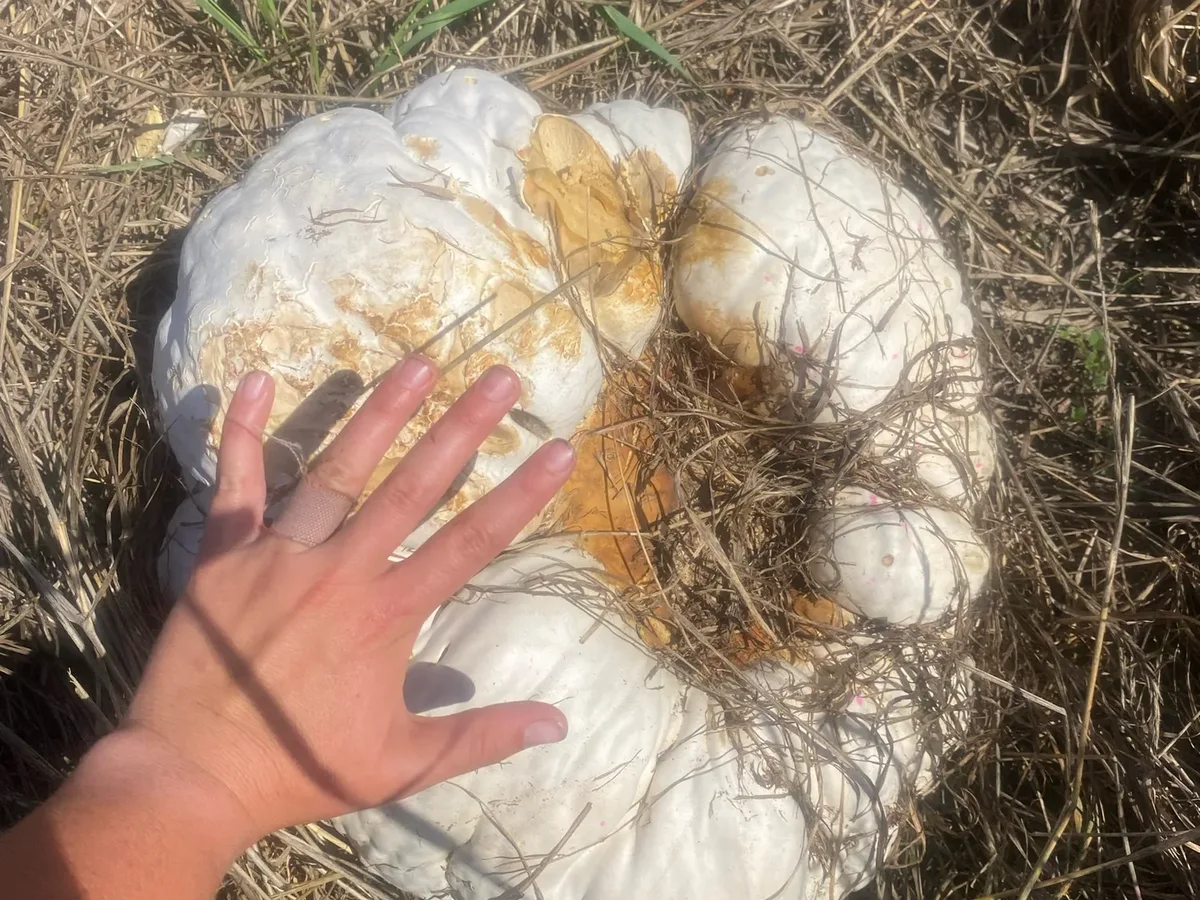
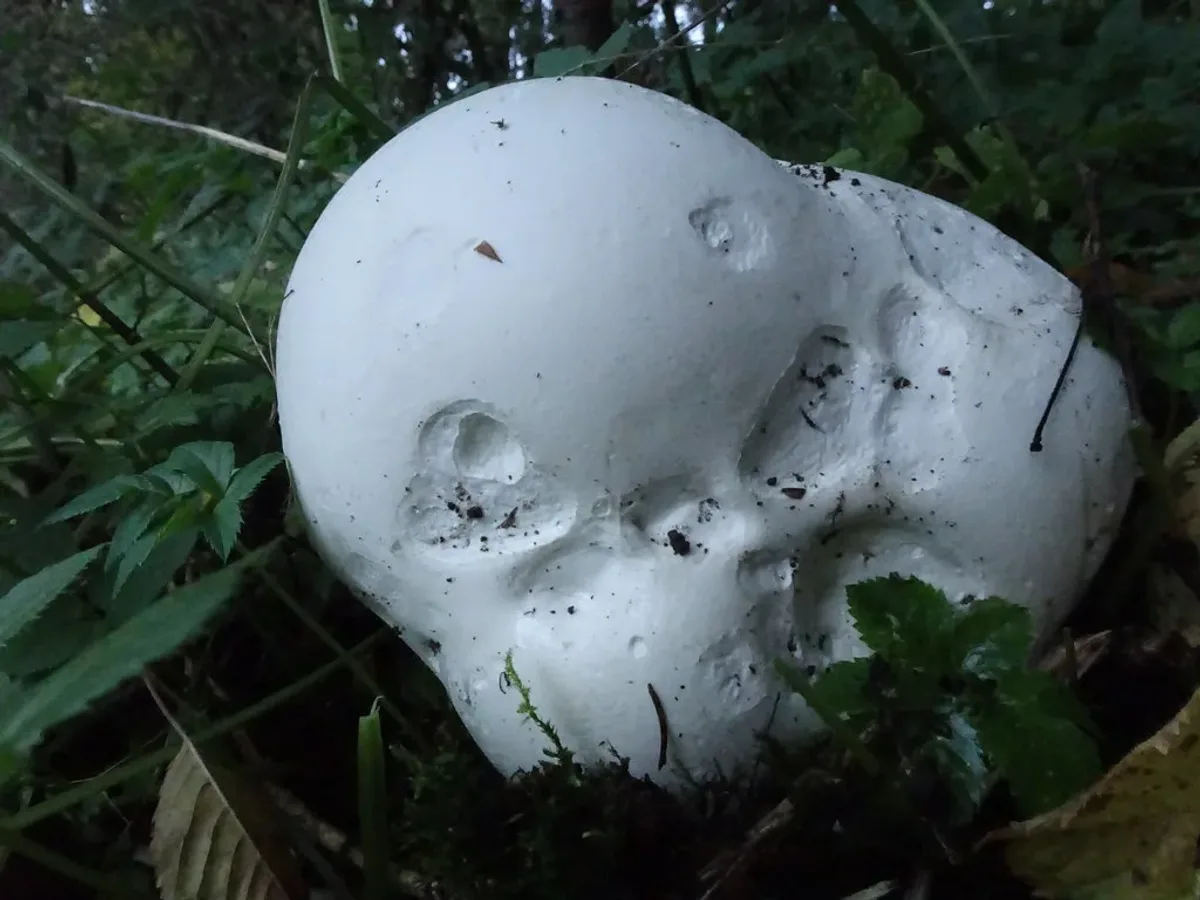
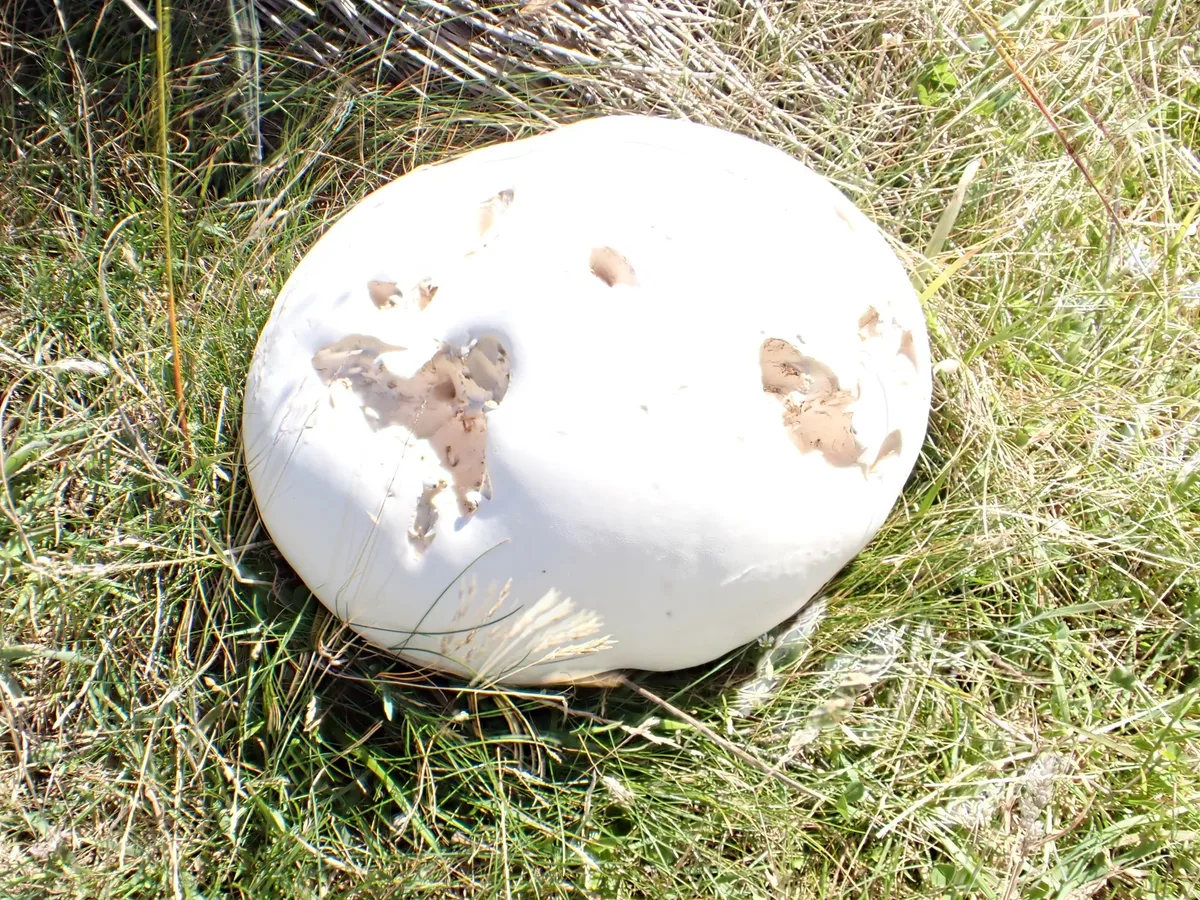
Calvatia giganteaA football-sized white ball - edible only when pure white inside; always cut through to check.
How to recognise it
A large white ball, often the size of a football (can grow to more than 1 m across and weigh several kilograms). When young it has solid white inner flesh. When older it yellows on the outside and the interior becomes brown spore powder.
Where it grows
Disturbed soil, farmland and pasture. Self-introduced in New Zealand. Found February to June throughout New Zealand.
Cooking
Sliced and fried; Maori also boiled or steamed it fresh. Must be eaten immediately as it rots quickly.
Look-alikes
Always cut lengthwise. An Amanita button shows a fully formed mushroom in miniature (gills, stem, volva), whereas a true puffball is homogeneously white with no internal structure. Never cut into a 'puffball' smaller than a ball.
Much firmer than a puffball and has a dark purple-black interior even when young.
If the inner flesh is gelatinous rather than solid white, it may be a stinkhorn.
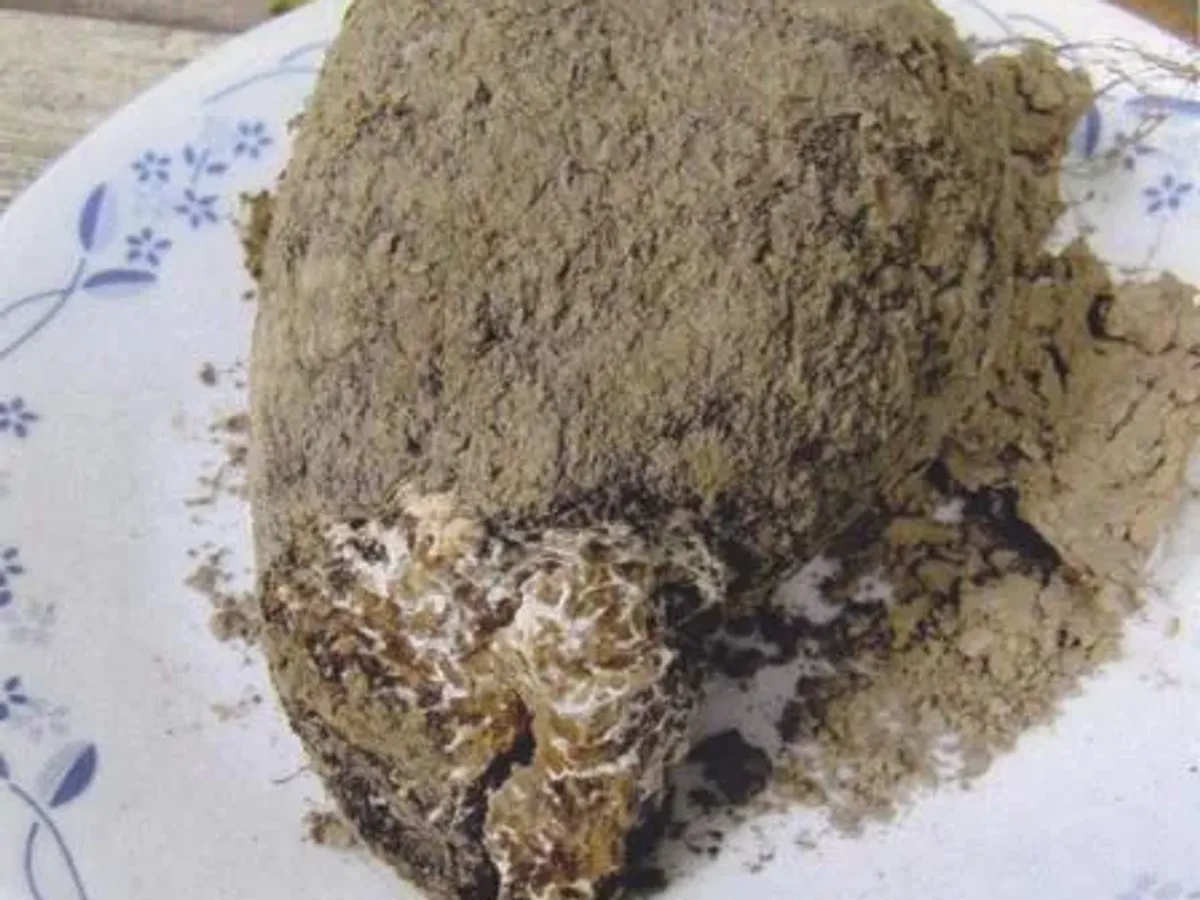 Native bread
Native bread
Laccocephalum mylittaeA huge underground tuber, a vital Aboriginal famine food tasting mild, "like boiled rice."
How to recognise it
Native bread hides in plain sight - an enormous underground sclerotium that looks more like a misshapen stone than a fungus. Ranging from apple- to football-sized (up to 20-30 cm, 15-20 kg), it sits buried beneath the forest floor, quietly hoarding energy. Slice through it and the interior is firm, rubbery, and densely marbled - reminiscent of pumpernickel bread, which likely inspired the common name. When fire or disturbance triggers fruiting, a knobbly whitish dome or disc erupts at the surface, up to 20+ cm across, with a wavy, lobed margin and a white pore layer underneath.
Where it grows
Rainforest and eucalypt forest (including karri forest in Western Australia); the sclerotium forms in the soil near buried wood and logs, which the fungus breaks down by brown rot.
Cooking
The sclerotium was eaten raw or roasted on coals - a simple, filling meal with a mild, starchy flavour. Foresters and bushworkers who discovered them reportedly cooked them around the campfire much as Aboriginal people had for generations.
Look-alikes
The sclerotium is distinctive and is not confused with common edible mushrooms.
The dangerous ones
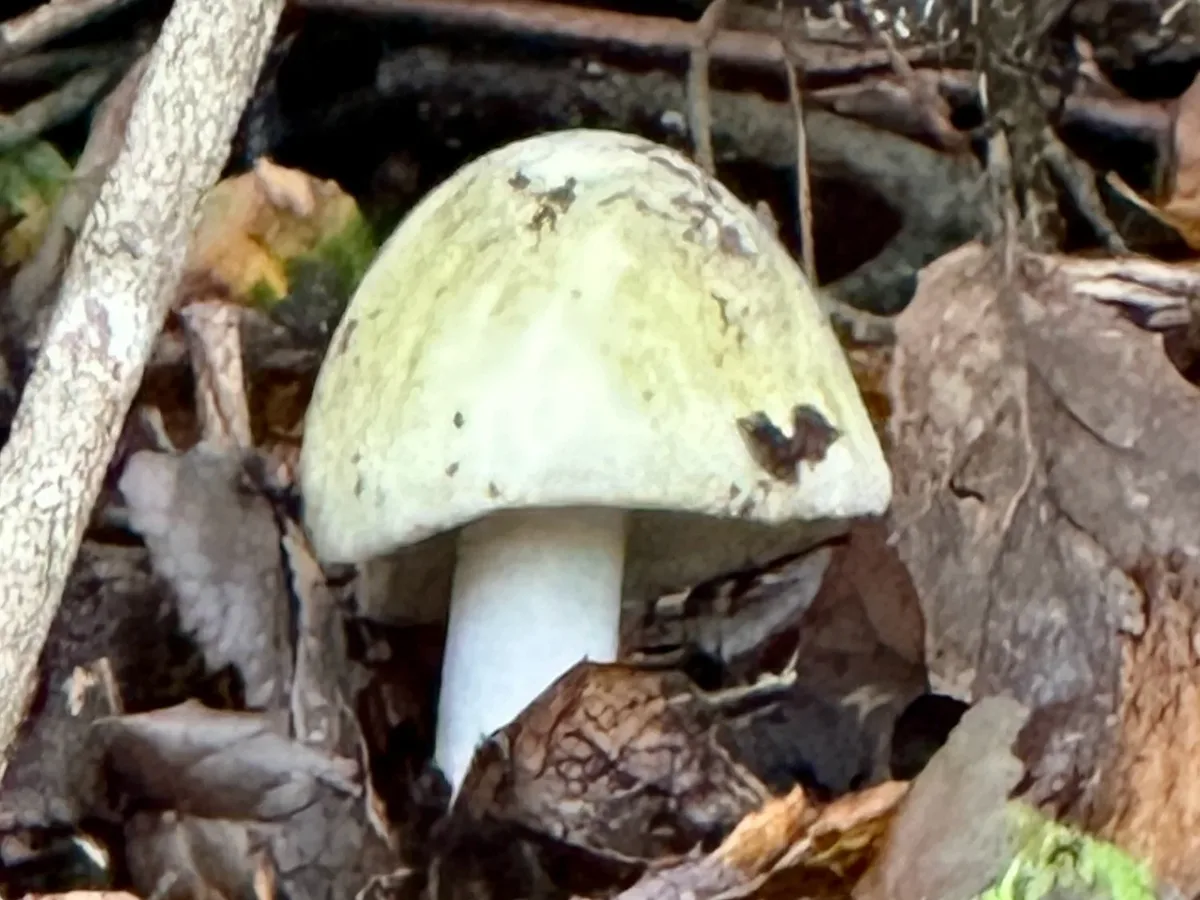 Death capDeath cap
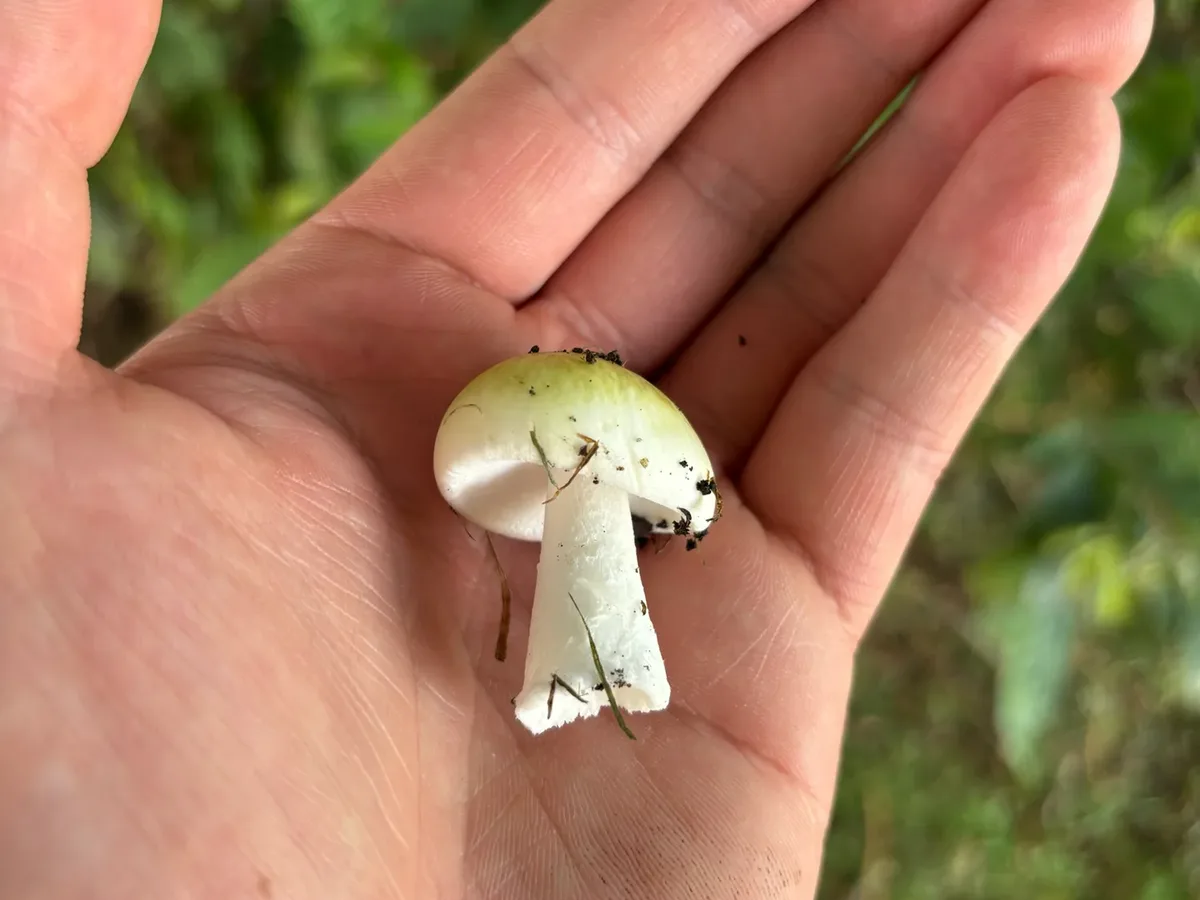 Death capDeath capDeath cap
Death cap
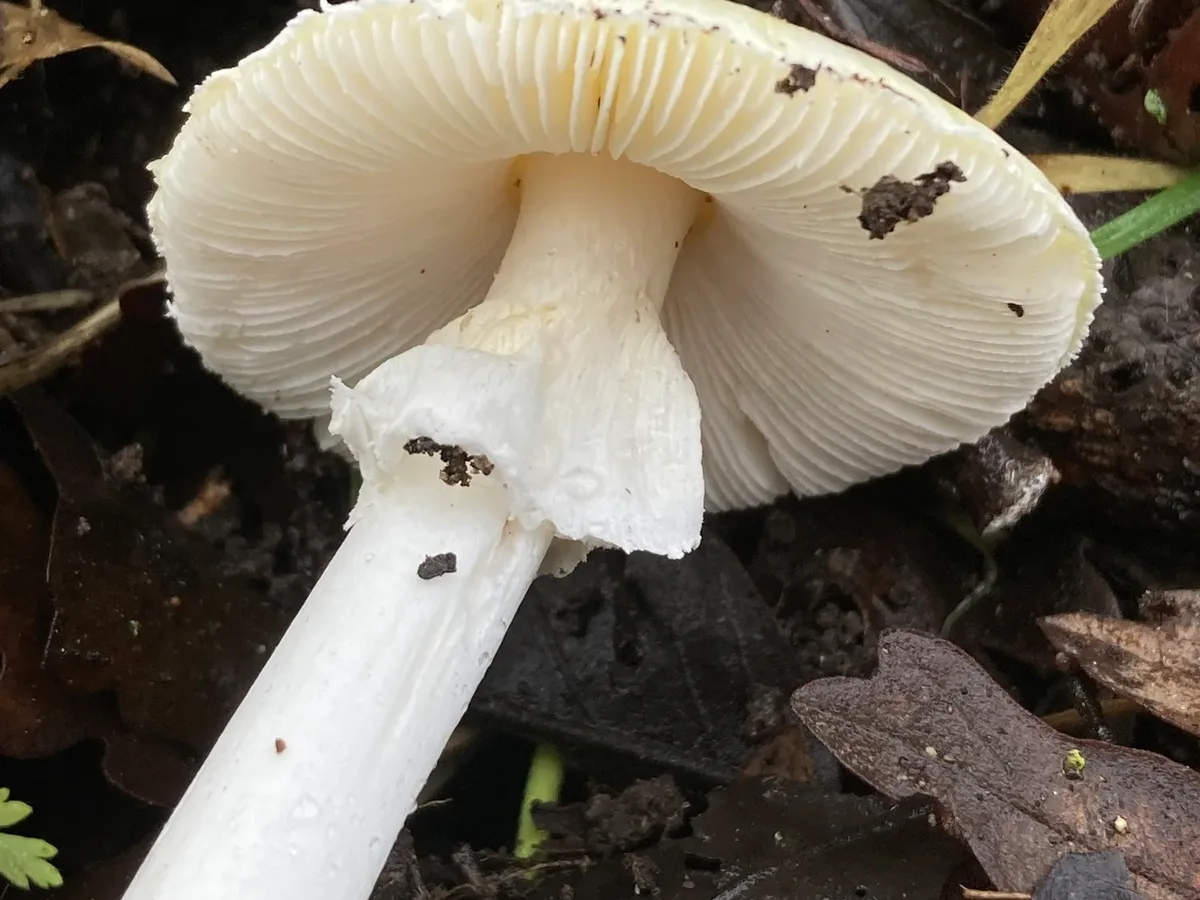
Amanita phalloidesDeadly and introduced, growing only under exotic trees like oak - as little as half a cap can kill an adult.
How to recognise it
Cap 40-160 mm, hemispherical, becoming convex, then flat, smooth, slimy in wet conditions and glossy when dry; most often pale yellow/greenish to pale brown, but can be almost white (colour is not a reliable feature). White gills, a white stem, a membranous ring, and a sac-like volva at the base. Amyloid spores (white spore print).
Where it grows
Found only under exotic/introduced trees, especially oak (Quercus), also in gardens, lawns and parks. In Australia it has only been recorded in SA, Victoria and the ACT (Canberra). In Victoria it is widespread across Melbourne (Kew, Camberwell, South Yarra and others) and regionally (Bendigo, Bright, Castlemaine). In New Zealand it grows under introduced oaks and chestnuts; it has also been reported in association with Leptospermum/Kunzea (potentially invasive). There are no confirmed finds in undisturbed native forest.
Cooking
Not edible under any circumstances. The toxins are not inactivated by cooking, drying, freezing or soaking.
Danger
World's deadliest mushroom; as little as half a cap can kill an adult human. Documented fatalities: Canberra, New Year's Eve 2011/2012 - cook Liu Jun picked death caps in Braddon (mistaking them for straw mushrooms) and put them in a stir fry; he and the kitchen hand Tsou Hsiang (a 52-year-old Chinese national) died, of four poisoned. According to the Canberra Times there have been in total "four fatalities and 12 reported incidents of poisoning associated with death cap mushrooms in the ACT". Of nine poisoned in the Canberra region 1988-2011, three were from Laos and two from China. Leongatha, Victoria, July 2023: Erin Patterson, 50, served death caps in individual Beef Wellingtons; Don Patterson, Gail Patterson and Heather Wilkinson died, while Ian Wilkinson survived. She was convicted on 7 July 2025 of three murders and one attempted murder, and on 8 September 2025 sentenced by Justice Christopher Beale to three concurrent life sentences with a 33-year minimum (plus 25 years for the attempted murder), parole no earlier than 2056; Beale found the murders required "substantial premeditation" and an "elaborate cover-up". (The conviction is under appeal.)
Look-alikes
The fully white form of the death cap resembles the white Amanita; both are deadly. Treat any white gilled mushroom with a ring and a sac-like volva as lethal.
Edible Asian mushroom that has caused several deaths among East/Southeast Asian migrants through confusion with the death cap. Both have a volva; check gill colour (straw mushroom develops pink to brown gills and a pink spore print, whereas the death cap has white gills and a white amyloid spore print).
Edible Amanita that can be confused with the death cap; distinguish by colour and spore features, but never rely on colour alone.
Agaricus species have pink-to-brown gills and a dark spore print and lack a volva, whereas the death cap has white gills, a white spore print and a sac-like volva at the base.
Native species (A. austrophalloides, A. marmorata, A. murina, A. murinaster) with a sac-like volva, ring and amyloid spores are untested but likely toxic; do not eat.
Young death cap buttons resemble Agaricus and puffballs, but Agaricus has pink to chocolate-brown gills, a brown spore print and no volva; the death cap always has white gills, a white spore print and a sac-like volva.
The green/greenish-yellow death cap form can be confused with green Russula species; check for the white free gills, ring and sac-like volva, which Russula lacks.
Russulas lack a volva and a ring; always dig up the base to check for the sac-like volva and look for the skirt-like ring and white free gills of the Death Cap.
Agaricus has pink to brown gills (not white) and no volva; the Death Cap has white free gills and a sac-like volva at the stem base.
Agarics lack a sac-like basal volva and have pink-to-brown gills and a brown spore print; the death cap has white free gills, a white spore print, and a volva in the soil.
The pale form of the death cap can be mistaken for puffballs; cutting a puffball reveals uniform white flesh, whereas a young death cap button shows the outline of a developing capped mushroom.
Green russulas lack a ring and volva and have brittle flesh.
Easily confused at the young, egg-like stage; always dig up the base and check the diagnostic combination of white gills + white ring + white sac-like volva.
Field mushrooms have pink to brown gills (not the death cap's white gills) and lack a basal volva/sac.
Distinguished by the death cap's combination of ring plus volva and its olive-green cap colour.
Young egg-stage Death Caps can resemble puffballs; always slice any 'puffball' in half - a developing mushroom with cap, gills and stem inside means it is not a puffball.
In Chile, warnings are given about confusing the death cap with Macrolepiota; look for the death cap's volva, ring and greenish cap with white gills.
In Chile, warnings are given about confusion with Russula; Russula lacks a ring and volva.
In Chile, warnings are given about confusion with Agaricus; Agaricus has a ring but no volva and develops pinkish-to-brown gills with a brown spore print, unlike the death cap's persistently white gills.
In Chile, warnings are given about confusion with Tricholoma; Tricholoma lacks the ring and volva of the death cap.
Locally eaten edible Amanita (also A. loosii); the central confusion in African ethnomycology - the deadly white Amanita are mistaken for these.
An unopened white egg-stage deadly Amanita can resemble a puffball; cut it in half - a developing capped mushroom outline reveals the Amanita.
A globally risky lookalike that also has a volva; check for the ring (present in Amanita, absent in Volvariella) and spore colour (white in Amanita, pinkish in Volvariella).
Same deadly section (Phalloideae) by appearance but lacks the toxins and is eaten locally in Rwanda/Burundi/Tanzania; cannot be told apart by eye alone, underscoring why species-level knowledge is essential.
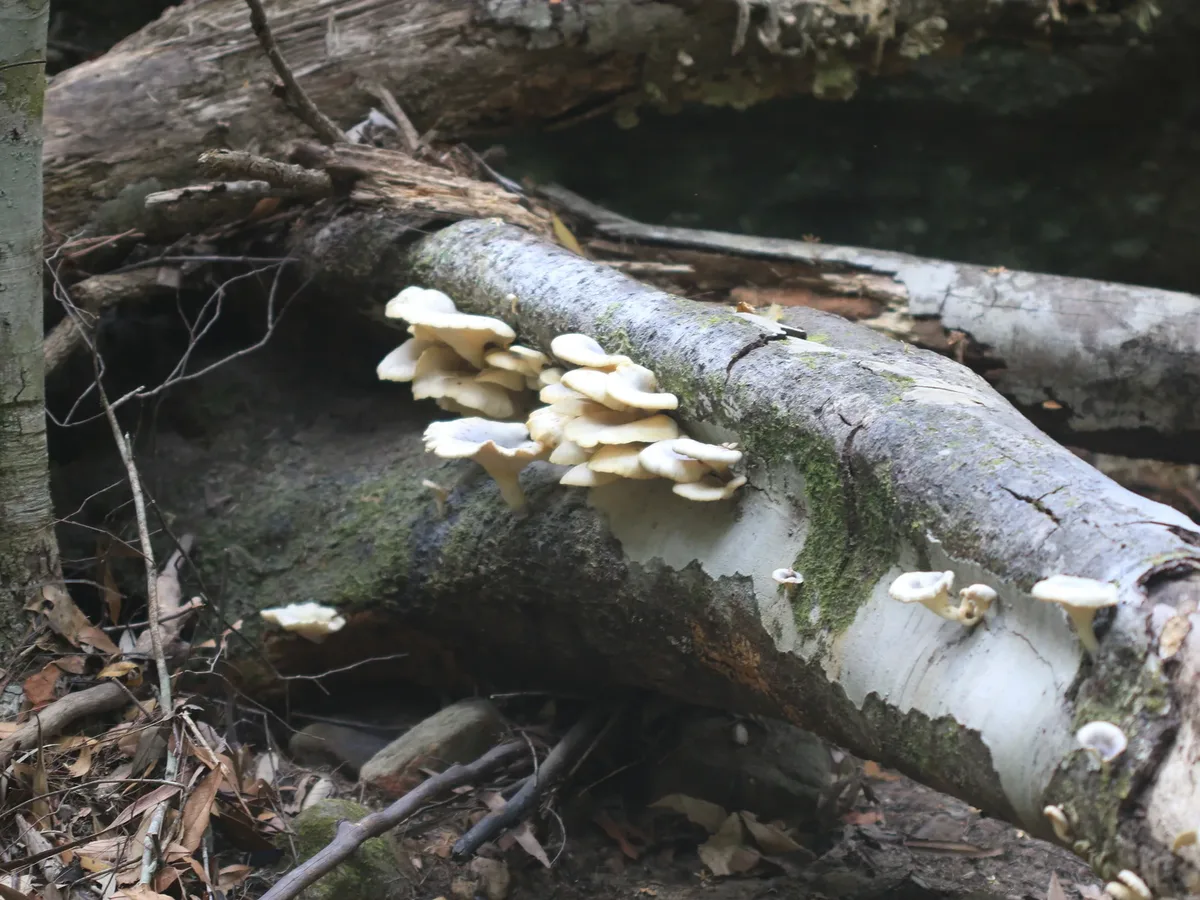 Ghost fungus
 Ghost fungusGhost fungus
 Ghost fungusGhost fungusGhost fungus
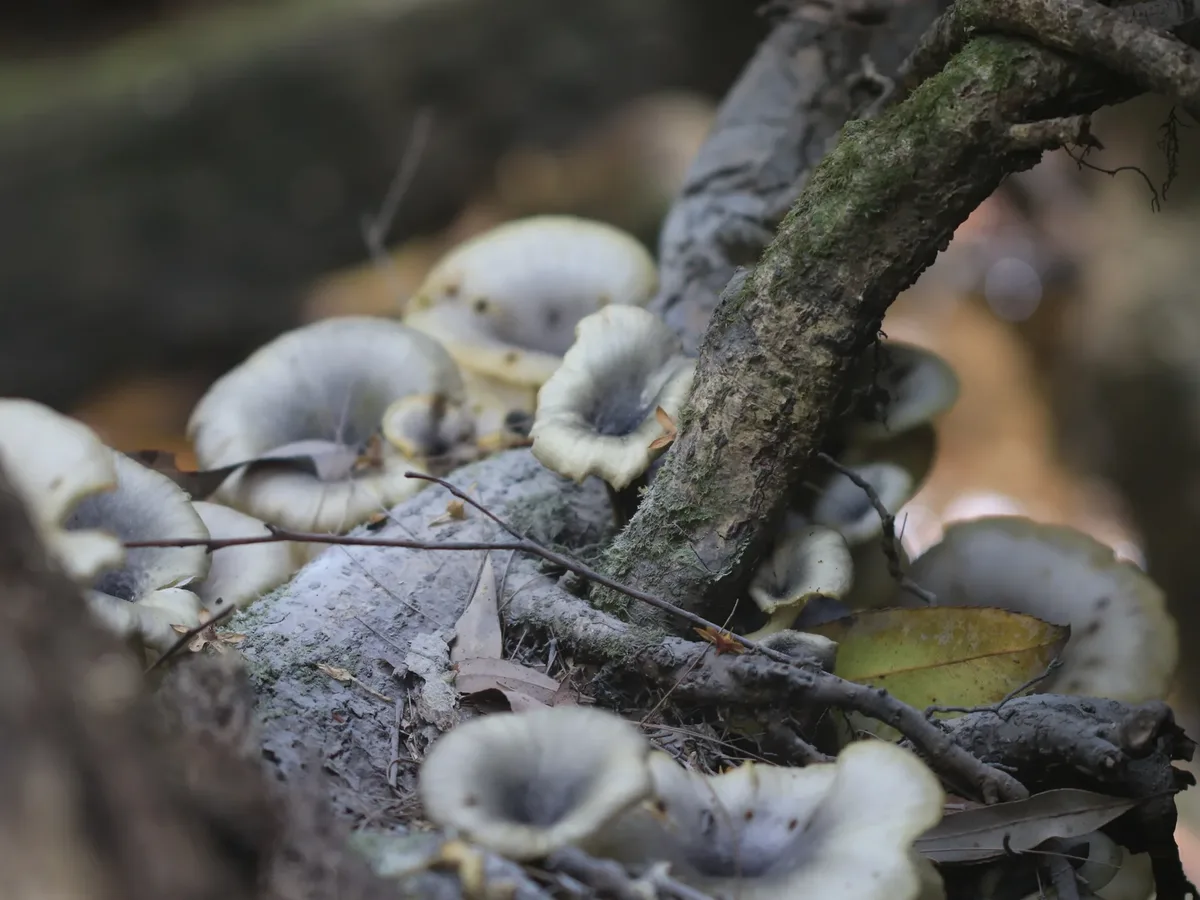
Ghost fungus
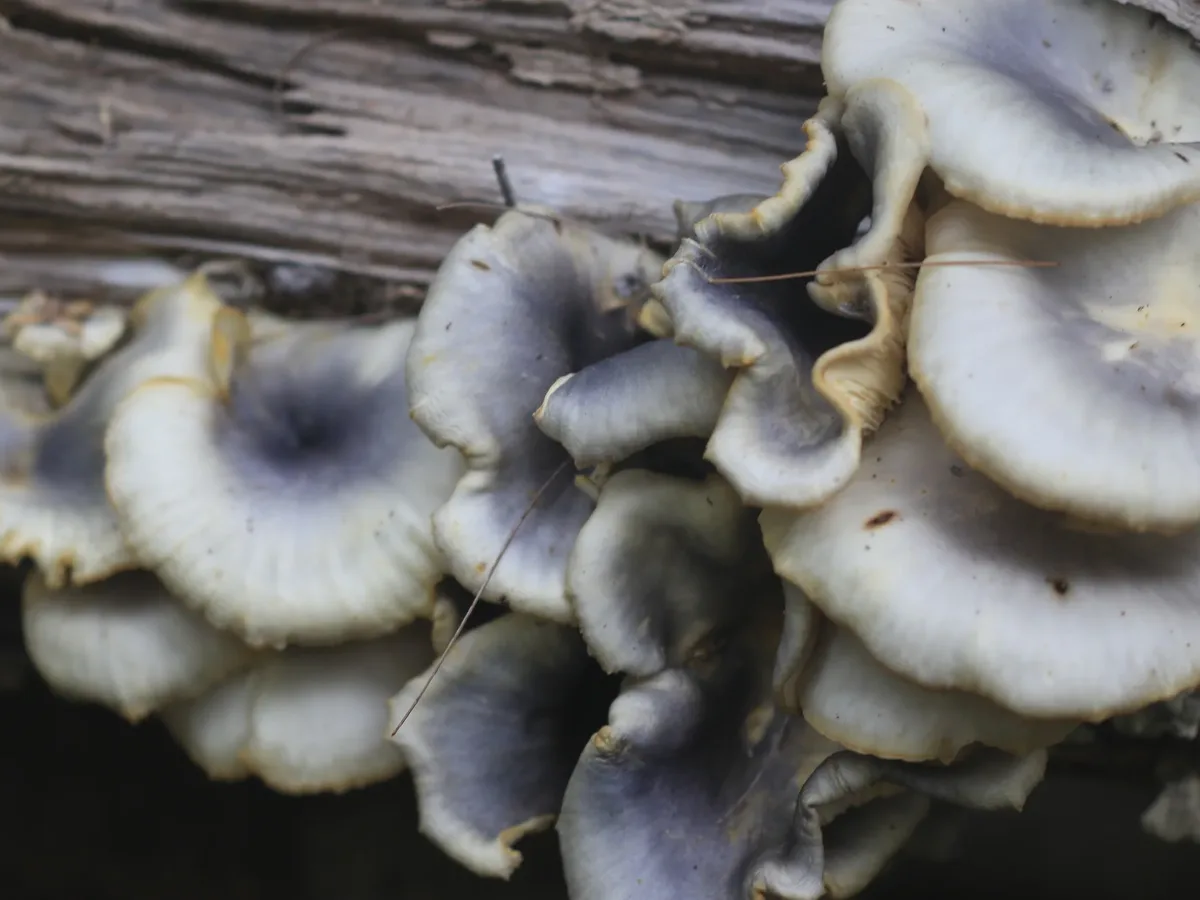
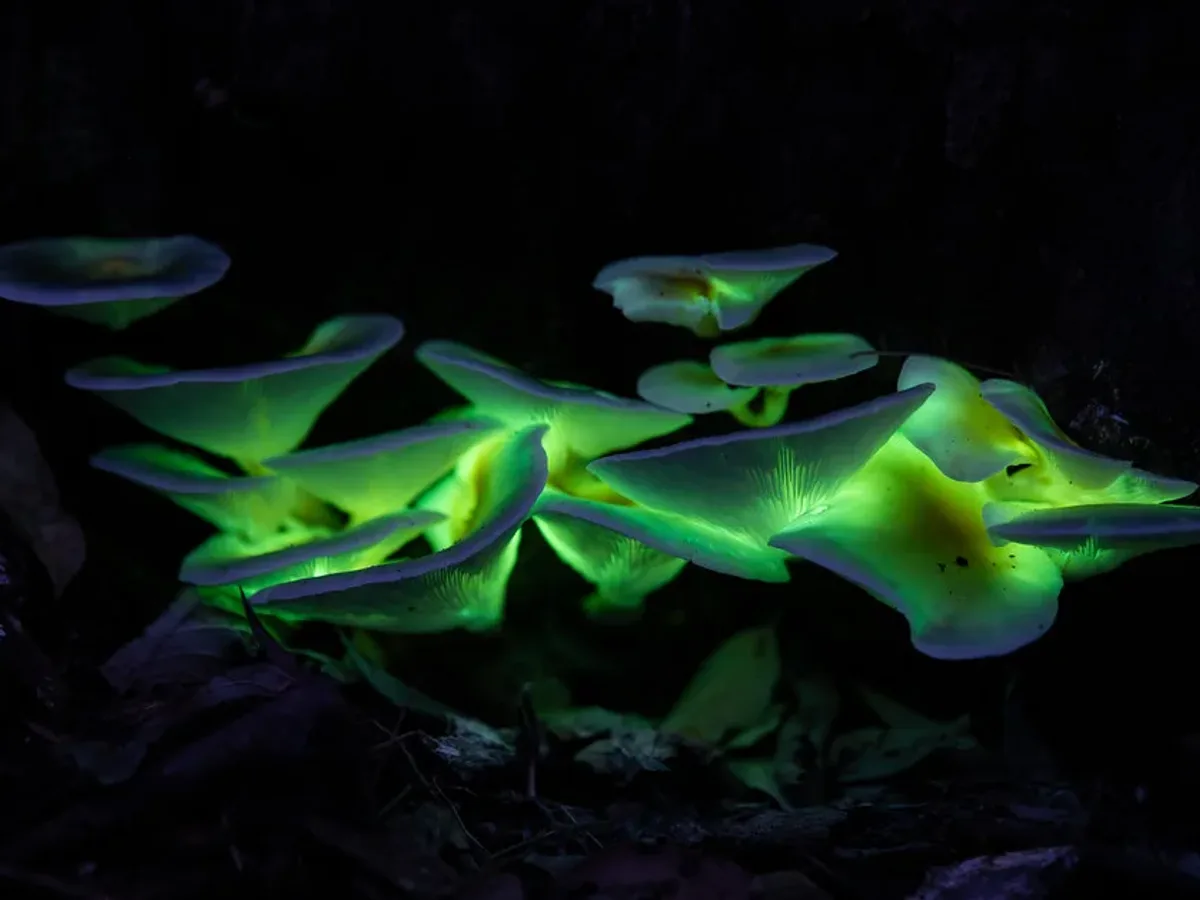
Omphalotus nidiformisA native oyster look-alike whose gills glow green in the dark - oysters never do.
How to recognise it
Oyster-, fan- or funnel-shaped cap up to 30 cm across, cream-white to smoky brown or grey, with decurrent gills that run down the stem. In the dark, fresh gills emit a cold green glow - genuine bioluminescence, strongest in newly opened specimens. Firm, woody stem. Fruits in overlapping clusters on dead wood.
Where it grows
A wood-decay fungus found on native trees and stumps along the entire east coast of Australia and into South Australia, with two separate distributions in the south. Native to Australia; also recorded in Indonesia (2021).
Cooking
None - it is toxic.
Danger
Rarely fatal in healthy people, but very unpleasant.
Look-alikes
Edible oyster mushrooms (Pleurotus ostreatus / P. australis) never glow; ghost fungus gills glow green in the dark after dark adaptation. Several poisonings in Australia have resulted from this confusion.
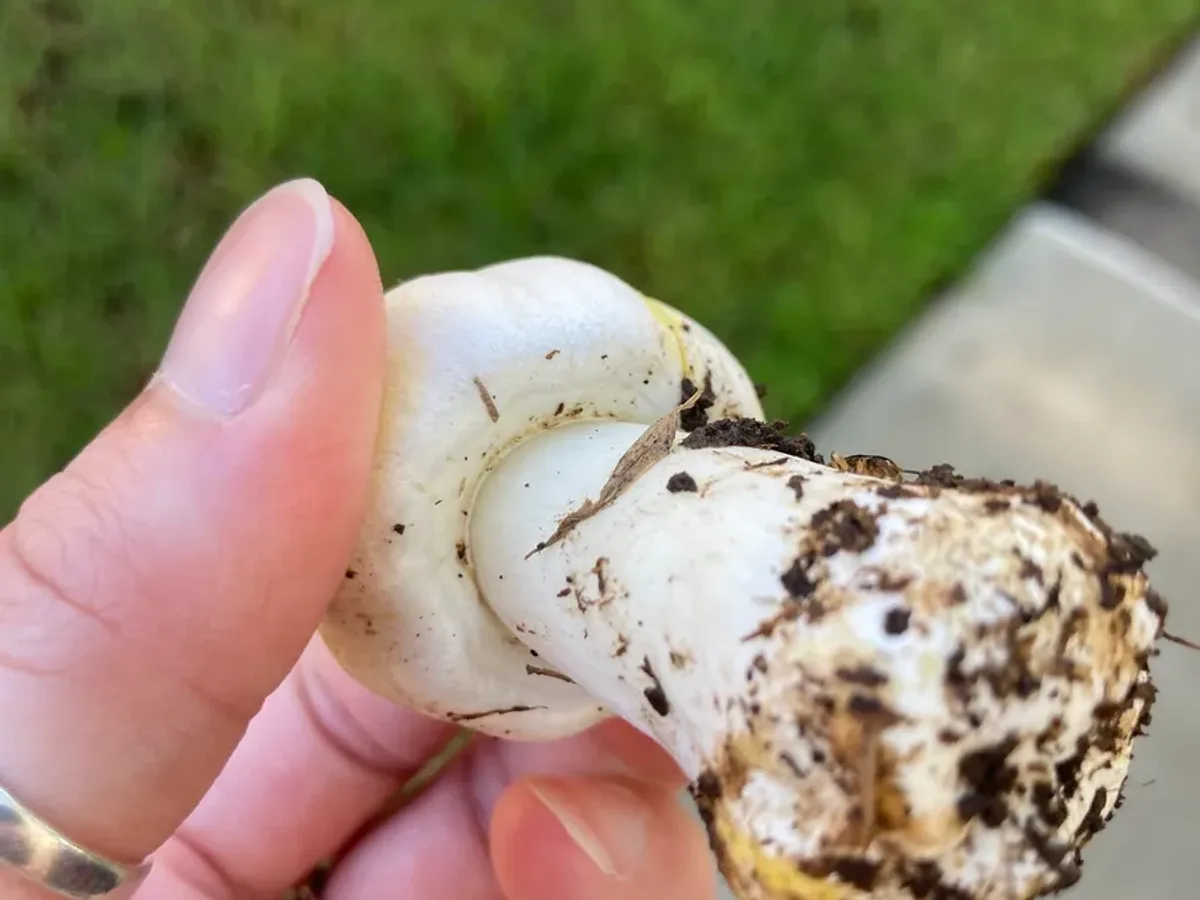 Yellow stainer
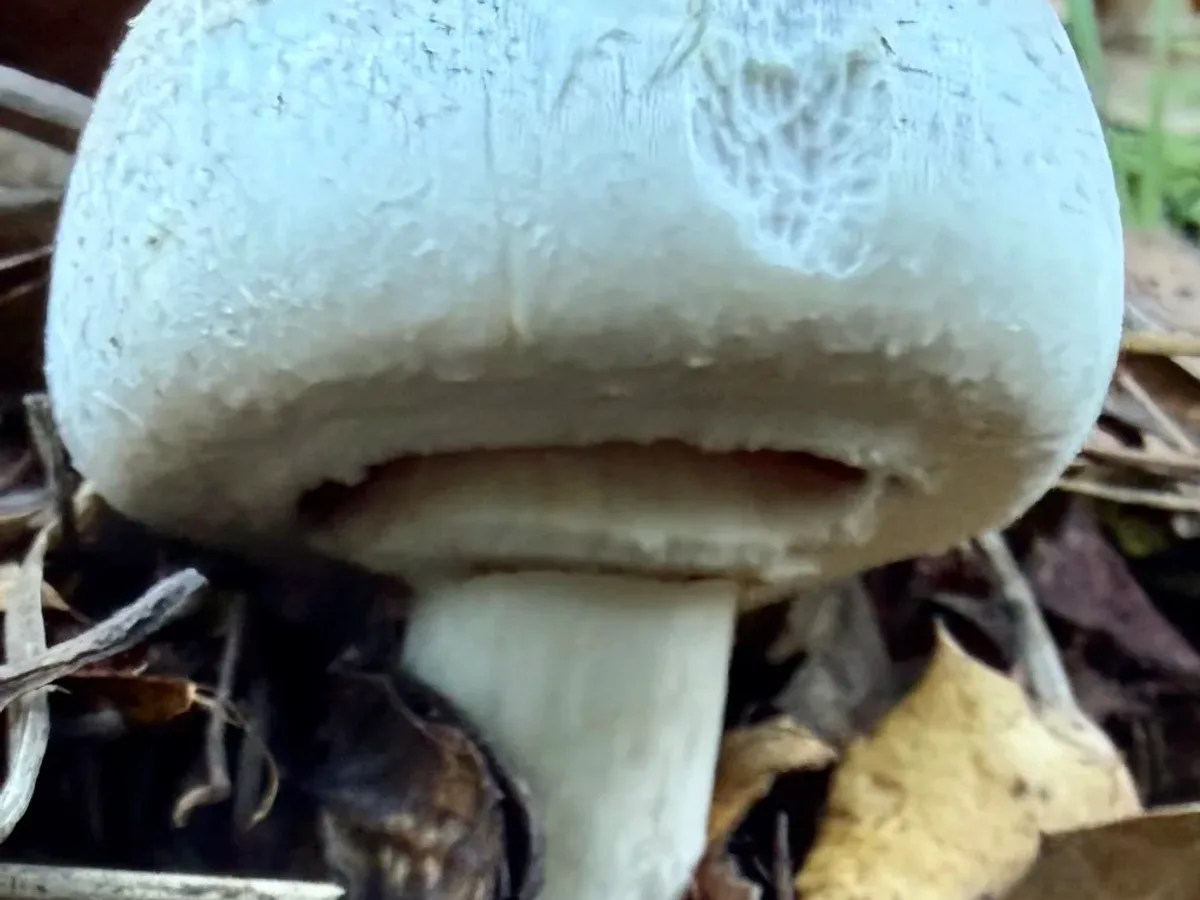 Yellow stainer
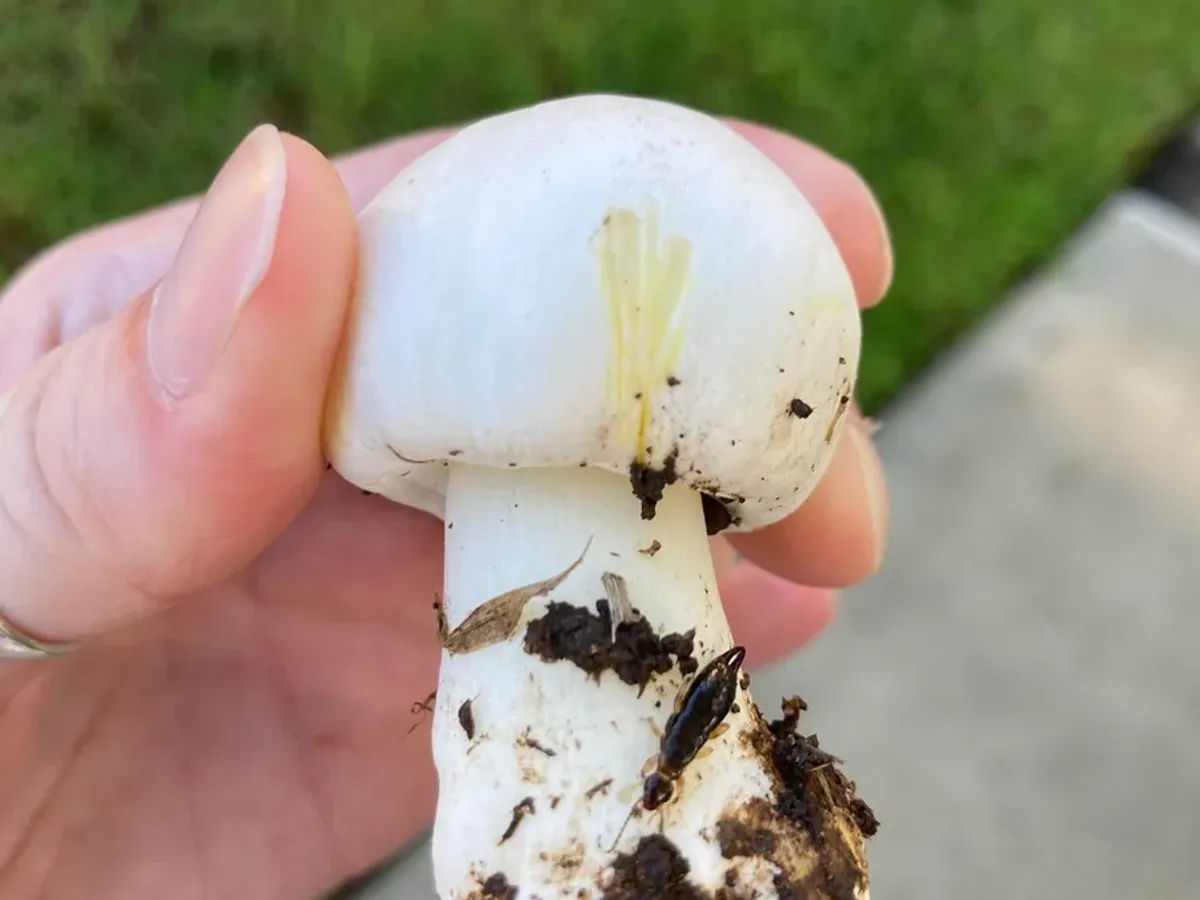 Yellow stainerYellow stainerYellow stainer
Yellow stainer
Agaricus xanthodermusThe region's most common poisoning: stains bright chrome-yellow at the stem base and smells of phenol.
How to recognise it
A large, white, button-mushroom-like fungus with a cap 50-200 mm across. Young caps are often notably square-shouldered; older ones flatten out with straight sides. The gills age from white through pink to dark purple-brown - the pink stage appearing deeper and more vivid than in the field mushroom. The most reliable test: scratch or cut the cap surface or, especially, the stem base, and it flushes an immediate chrome-yellow that later fades to a dirty brown. A membranous ring sits on the stem, and the whole mushroom carries a sharp phenolic smell - inky, chemical, faintly like iodine or kerosene - that grows stronger with heat.
Where it grows
Gardens, lawns, parks, and roadsides; often turns up in clusters or tracing the arc of a fairy ring on cultivated ground.
Cooking
None - the phenolic smell is intensified by boiling.
Danger
Variable toxicity; some people tolerate it. The phenol content is higher in the cap, in mature specimens, and in mushrooms growing on wood chips. It is the most-ingested poisonous mushroom in Victoria and NSW.
Look-alikes
Edible. Has a pleasant smell and no chrome-yellow staining; cut the stem base - the field mushroom does not flash chrome-yellow.
Edible. Smells pleasantly of anise rather than phenol; the cut stem base does not turn an immediate chrome-yellow.
Edible. No phenolic smell and no chrome-yellow staining of the cut stem base.
Similar phenol-staining poisonous Agaricus (also known as A. placomyces); likewise stains yellow and smells phenolic.
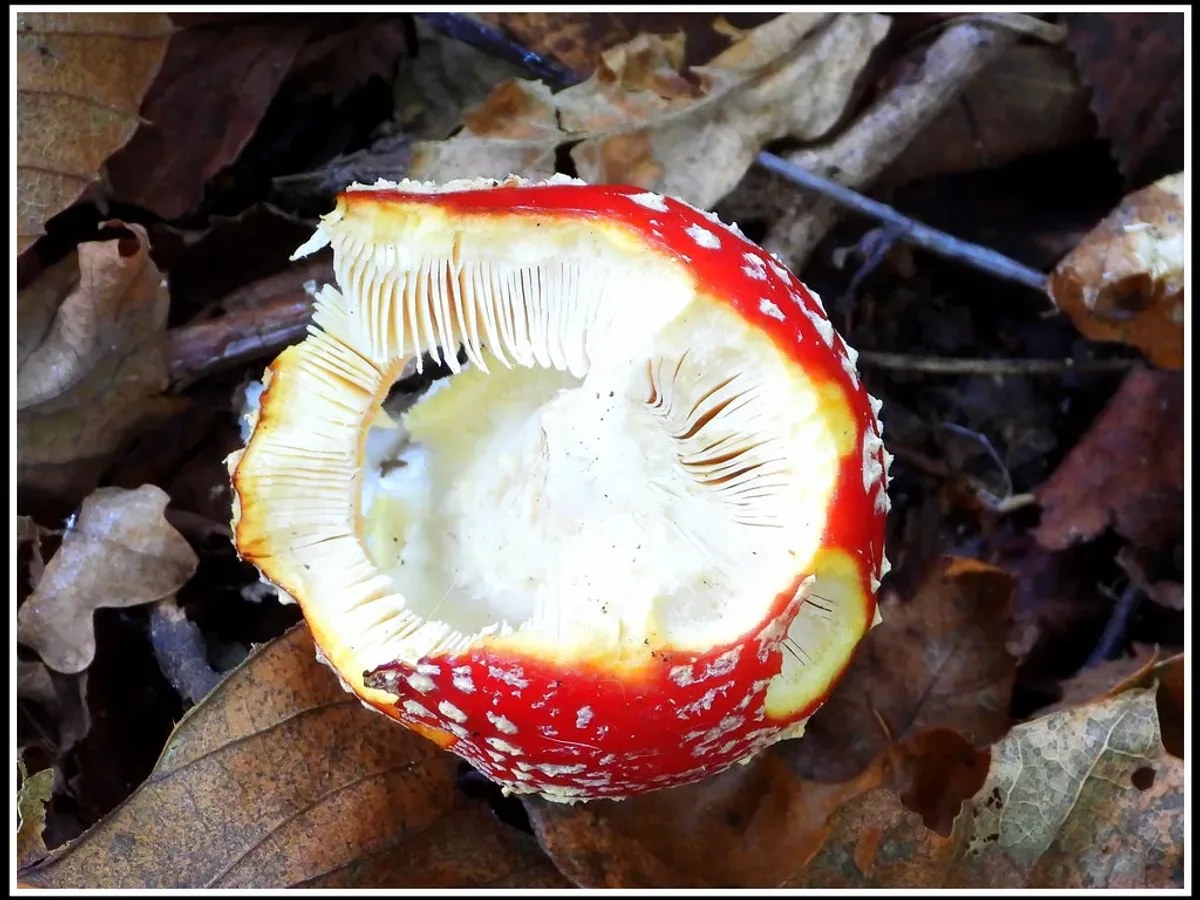 Fly agaric
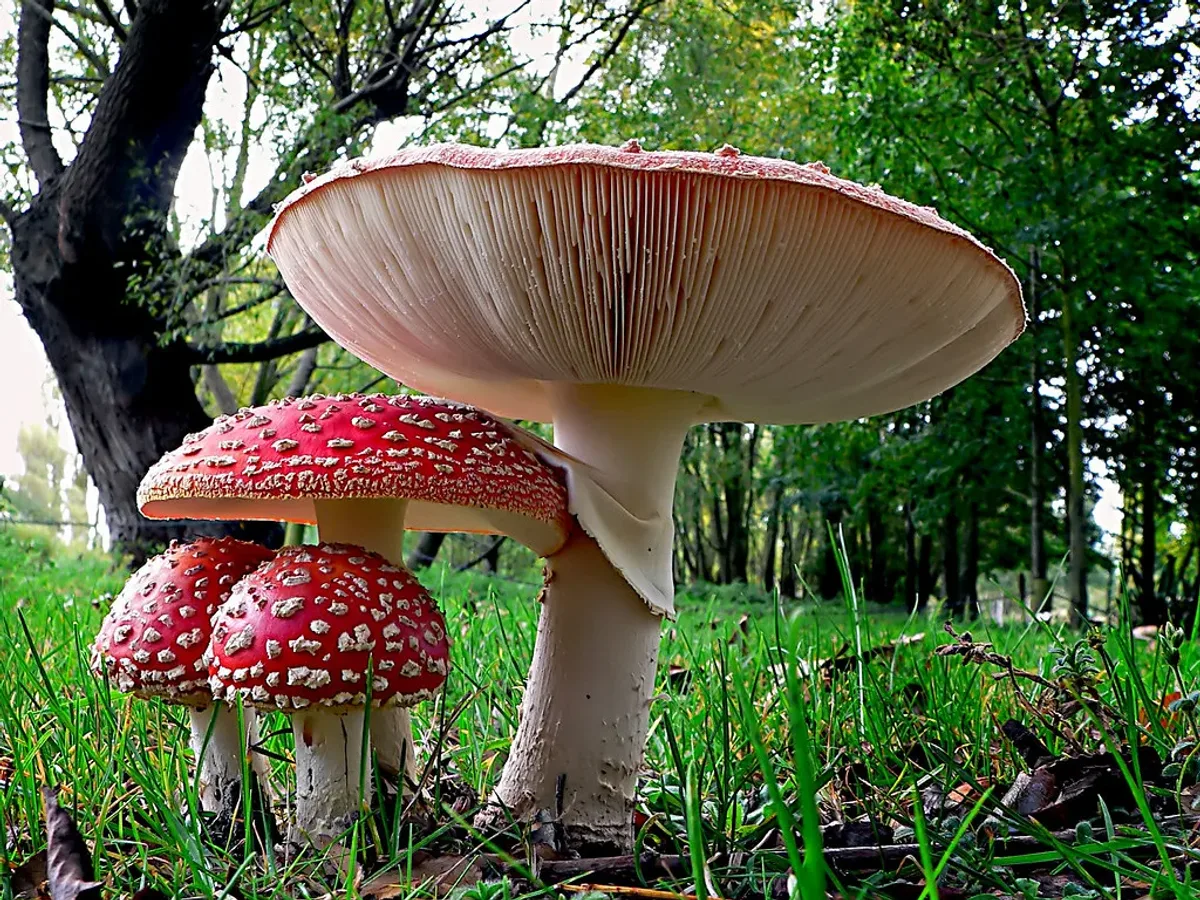 Fly agaric
 Fly agaricFly agaricFly agaric
Fly agaric
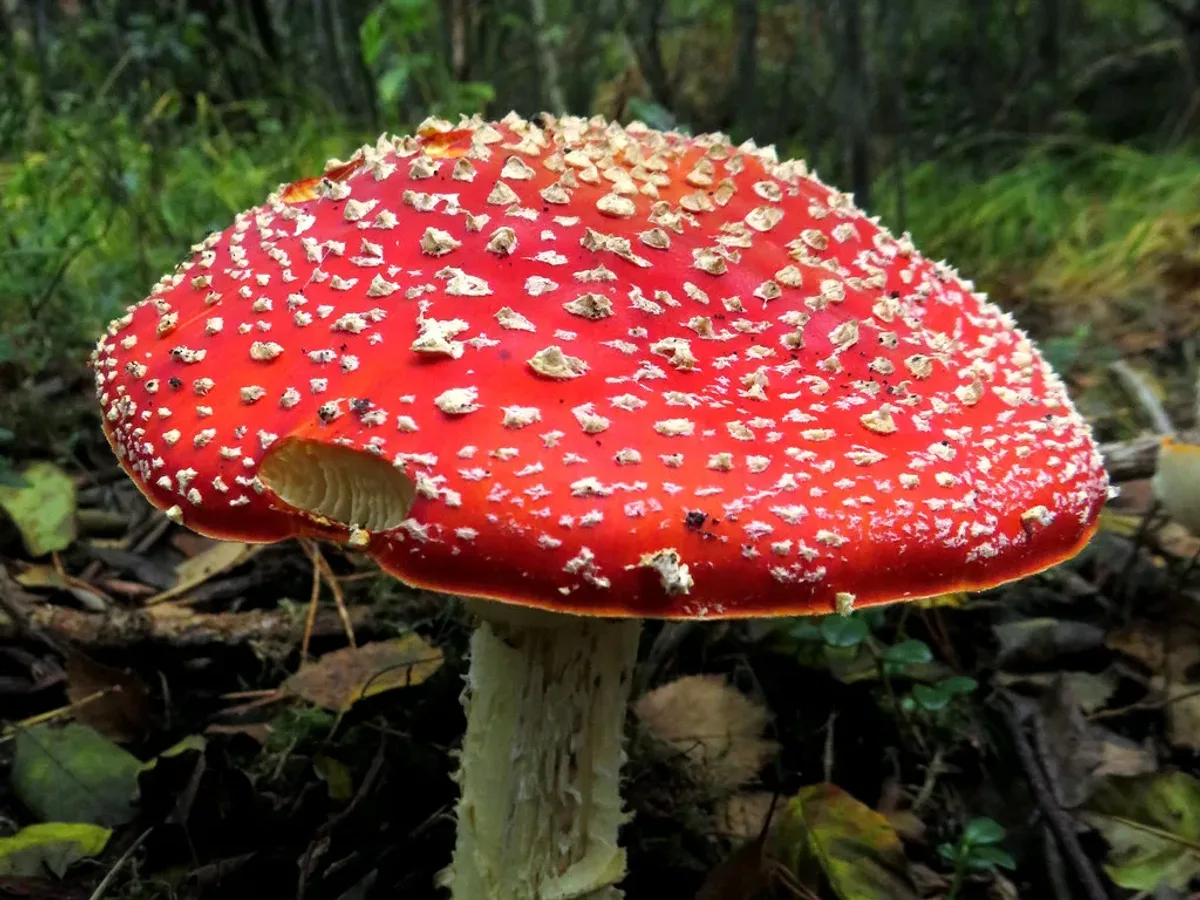
Amanita muscariaThe classic red cap with white warts - introduced, now invasive even under native beech.
How to recognise it
Cap 8-20 cm, vivid red with white warts that can be washed off by rain or simply fade with age, leaving a plain orange-red cap. White gills, white stem with a pendant ring, and a white bag-like volva at the base. Young specimens emerge as white "eggs" wrapped in a universal veil before the red cap breaks through.
Where it grows
Introduced to Australia and New Zealand alongside pine and birch plantations, where it has since formed mycorrhizal relationships with native southern beech (Nothofagus, including Myrtle Beech N. cunninghamii) in Victoria, Tasmania and New Zealand - spreading into ecosystems it was never meant to reach and displacing native fungi as it goes. Range is expanding northwards (towards Port Macquarie, NSW); also found under silver birch in Manjimup, WA (2010).
Cooking
None - poisonous/psychoactive.
Danger
Deaths extremely rare. Easy to recognise, so poisoning is uncommon.
Look-alikes
The guide advises beginners to avoid the entire Amanita genus; faded specimens of the fly agaric can mislead the inexperienced, and the genus includes deadly amatoxin-containing species.
Native Australian species, eucalyptus-associated, lacking white warts and a ring.
Caesar's mushroom (edible, southern Europe) has a yellow cap, yellow gills and yellow stem; a young rain-washed fly agaric lacking warts could theoretically be confused with it, but the fly agaric has white gills and white stem.
At the button stage the fly agaric is a white ball that can resemble a puffball; cut it lengthwise to reveal the developing cap, gills and stem of the agaric.
Brown cap with white warts, ring, and banded volva; the more toxic of the two and can be confused by inexperienced foragers with edible grey- or brown-capped species.
The red color plus white warts plus a volva at the base distinguish the fly agaric; rely on these warning features even when the cap color has faded.
 Deadly webcap
Webcaps
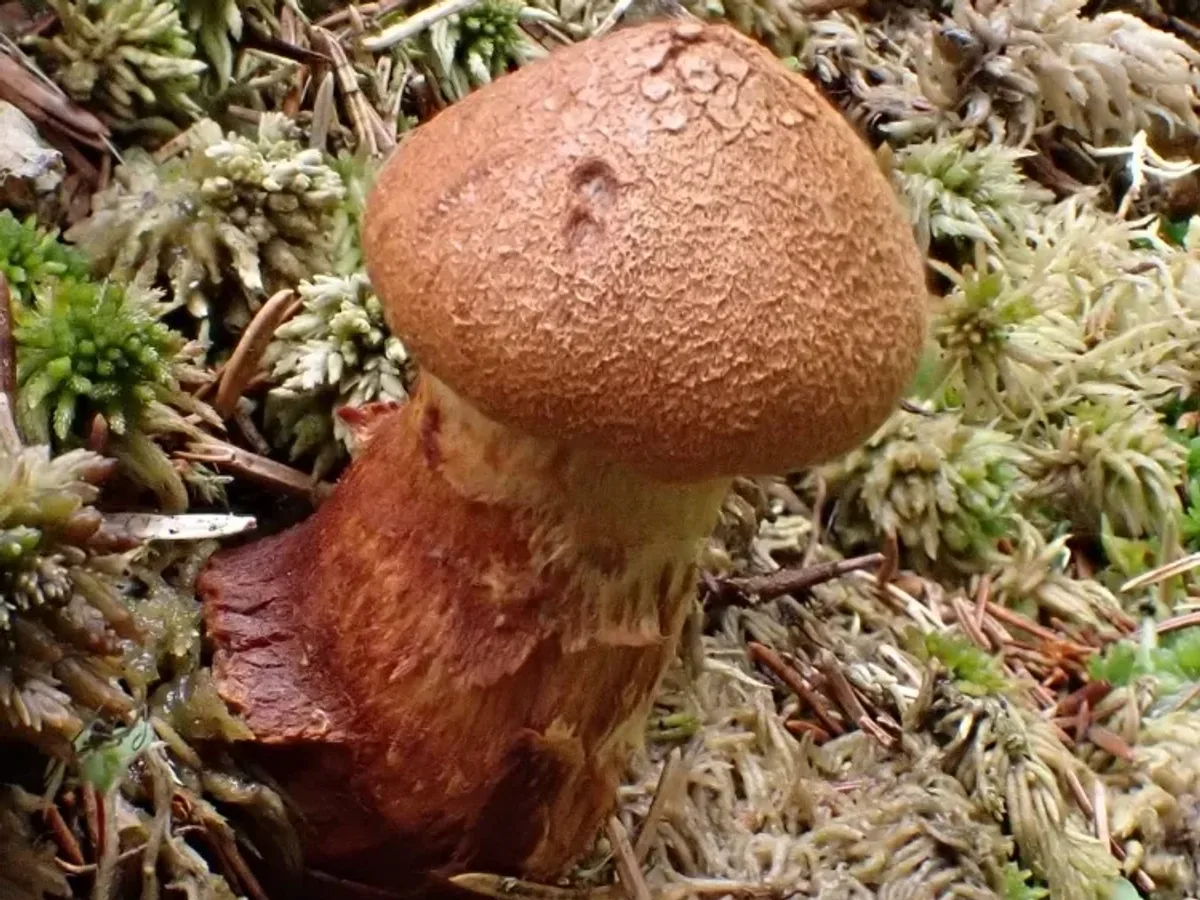
Cortinarius rubellusSome carry orellanine, a kidney toxin whose symptoms can take one to two weeks to appear.
How to recognise it
Cap 3-8 cm, reddish-brown to cinnamon-brown or orange-brown, with a characteristic pointed umbo - C. rubellus keeps this point even at maturity, unlike most mushroom caps that flatten as they age. Surface dry and fibrous. Gills sparse and widely spaced, rust-brown. Stem yellow-brown, often marked with yellow veil bands - the remnants of the cobweb-like cortina that all young Cortinarius mushrooms carry stretched between cap and stem. Take a spore print: it will be rust-brown, a key identifying feature.
Where it grows
Mycorrhizal in coniferous and mixed forest, living in an unseen root partnership with its host tree. C. rubellus grows with spruce on moist ground; C. orellanus with broadleaf trees and oak on drier ground.
Cooking
Not edible under any circumstances. The toxin is not destroyed by cooking, drying or freezing.
Danger
Orellanine gives a very long latency (2 days to 3 weeks) - no, or only flu-like, early symptoms, then kidney failure. In a western Swedish cohort 1979-2012 (Nilsson et al., BMC Nephrology 2017), 28 cases with medical records were included out of a total of 39 poisonings by the deadly webcap (toppig giftspindling); "22 of 28 patients developed acute kidney injury requiring dialysis." There is no specific antidote; treatment is dialysis, sometimes transplantation. The toxin is not destroyed by cooking, drying or freezing.
Look-alikes
A close relative that is likewise deadly, also containing orellanine.
The orange/reddish-brown colour can tempt chanterelle pickers. The webcap has true sparse rust-brown gills, a rust-brown spore print, a cobweb-like cortina when young and yellow veil bands on the stem, whereas the chanterelle has blunt, forked, decurrent false gills (ridges), a paler spore print and no cortina.
Check for the rust-brown spore print, rust-brown gills, the cobweb-like cortina and the yellow-brown stem with yellow veil bands, which together identify a deadly webcap.
Shares the same habitat, so they are easily confused. Inspect each mushroom: the deadly webcap has a pointed cap and true gills, whereas the funnel chanterelle has ridges (false gills) and a hollow stem.
 Funeral bell
 Funeral bell
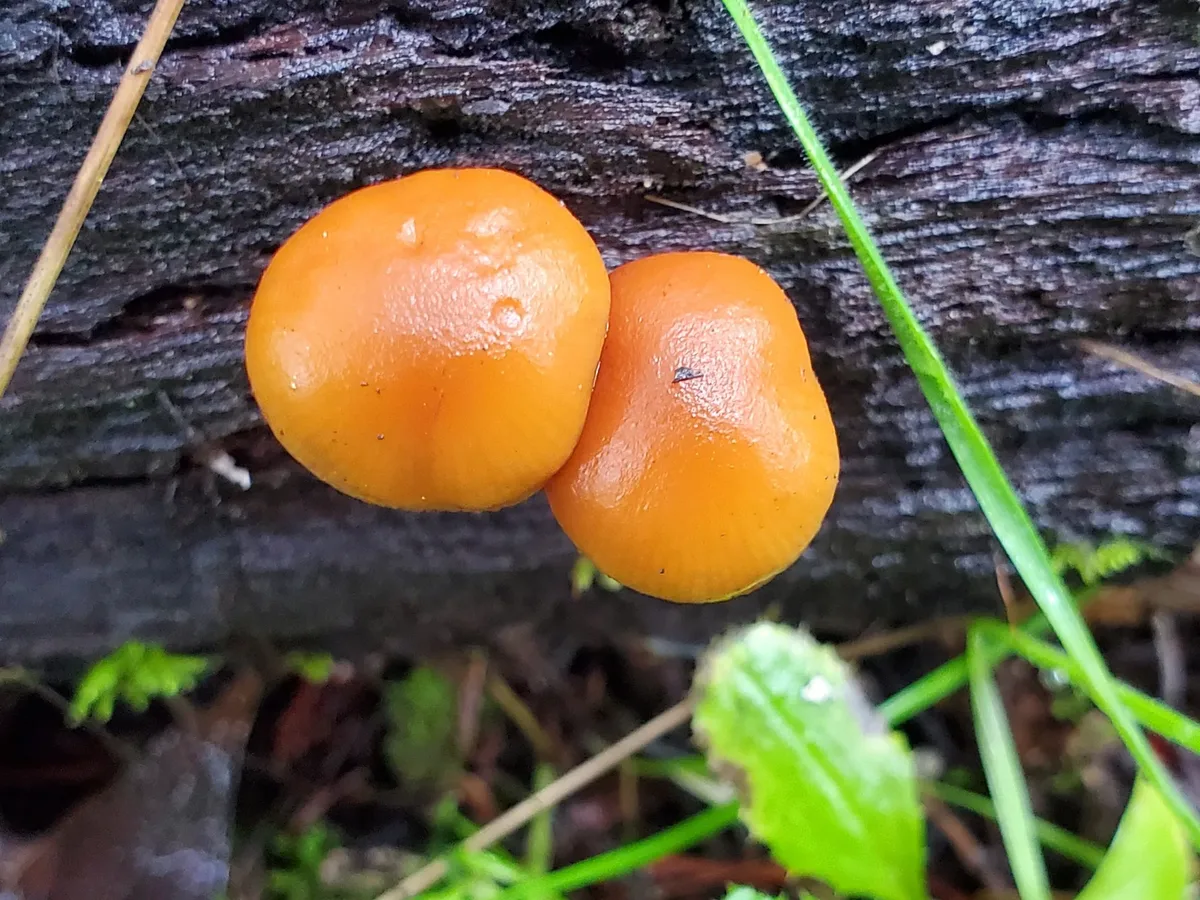 Funeral bellFuneral bellFuneral bell
Funeral bell
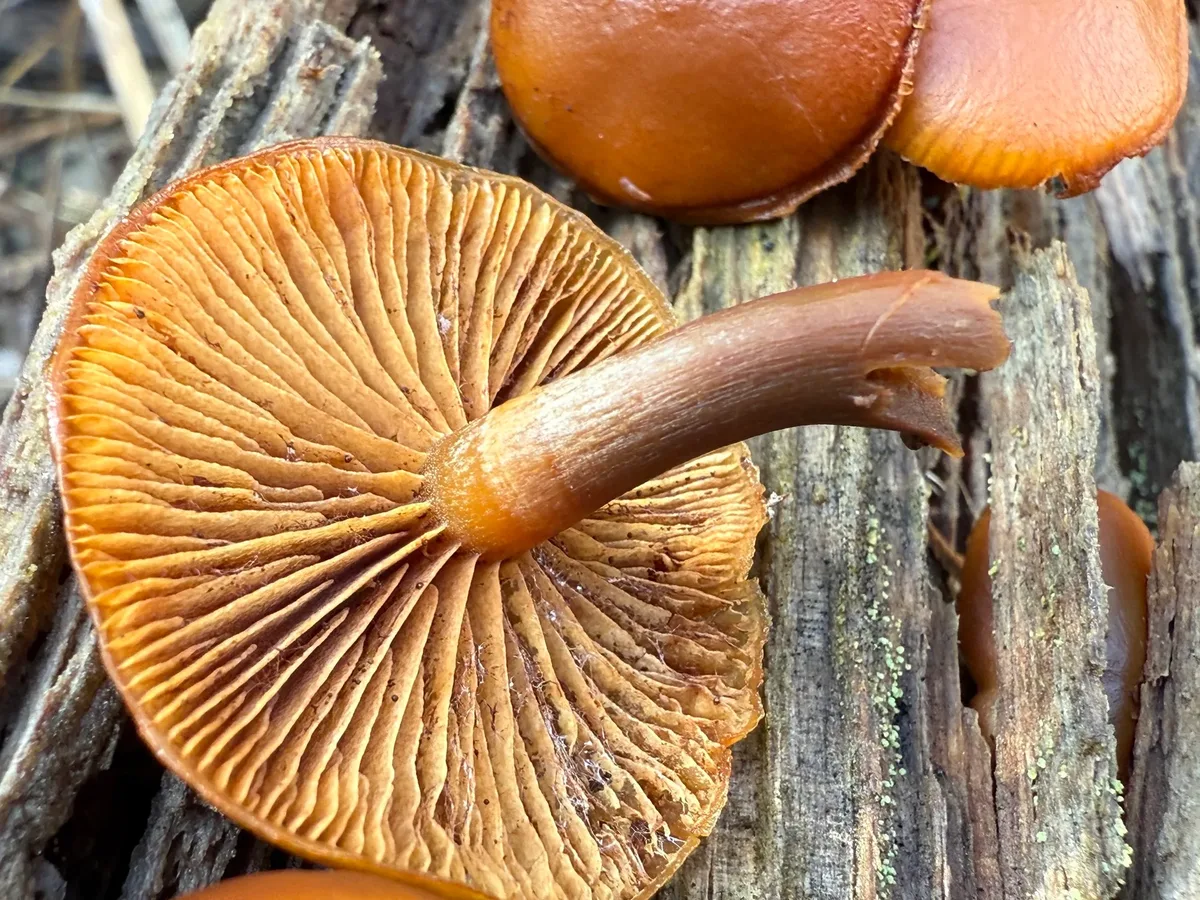
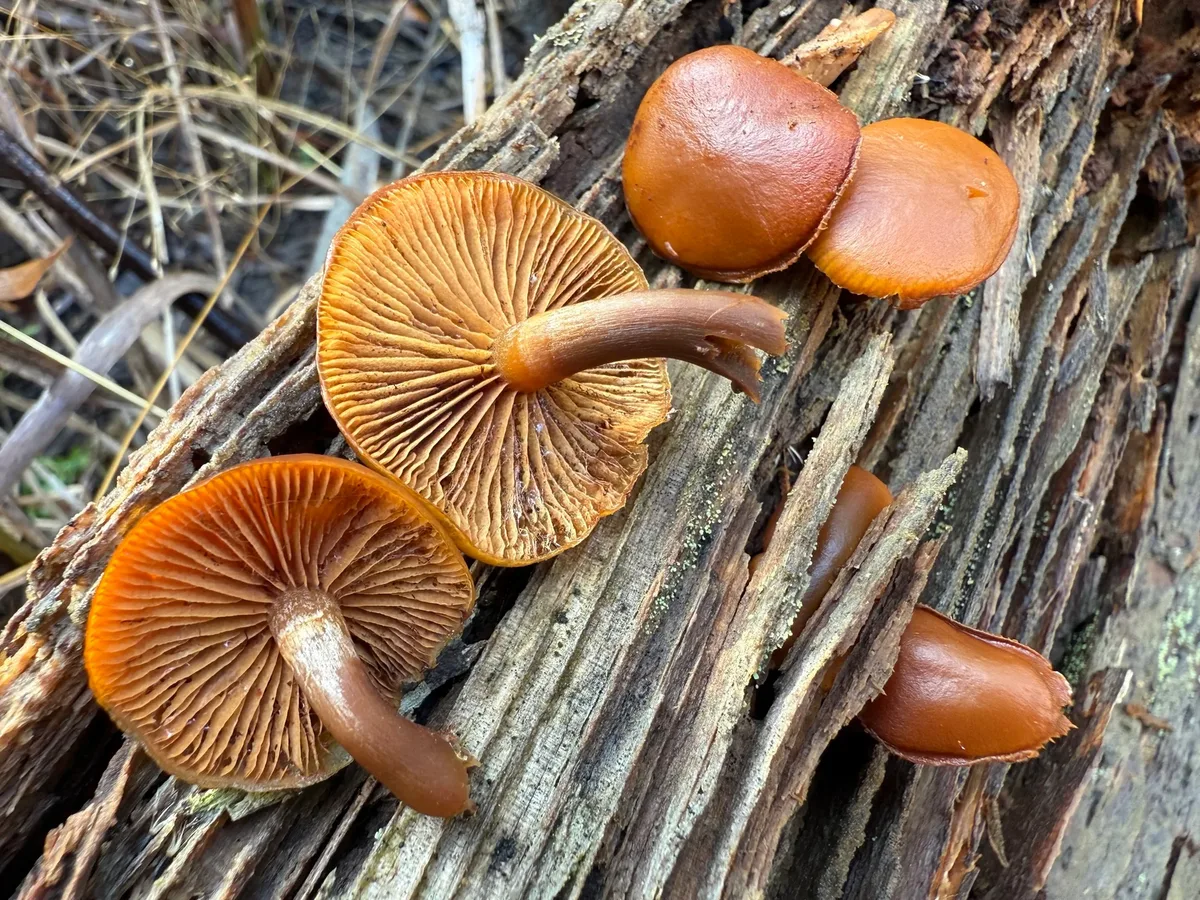
Galerina marginataA small brown mushroom carrying the same amatoxins as the death cap, dangerously like hallucinogenic Psilocybe.
How to recognise it
Small - cap 1-4 (-5) cm, honey- to yellow-brown, hygrophanous (dark brown when moist, pale yellow when dry), smooth. Gills brownish, giving a rust-brown spore print. Stem thin with a (often disappearing) ring; darkens towards the base. Grows on wood.
Where it grows
Saprotroph on dead wood (deciduous and coniferous), on rotting logs and stumps, often in moss; from the lowlands to alpine settings.
Cooking
Galerina marginata must never be eaten. There is no preparation method - boiling, parboiling, frying, drying, or any other technique - that destroys or neutralises its amatoxins. Alpha- and beta-amanitin are heat-stable proteins: they survive cooking temperatures completely intact and are absorbed unchanged through the gut. Eating even a single cooked cap can cause fatal liver and kidney failure. The insidious danger is a deceptive latency period of 6-24 hours during which no symptoms appear, followed by violent gastrointestinal illness, a brief false recovery, and then organ failure within days. By the time symptoms are undeniable, irreversible damage has already begun. This species has killed people who deliberately ate what they believed were edible wood-growing mushrooms and who had removed or discarded the ring as an unimportant detail. If there is any possibility that this species entered a dish, seek emergency medical care immediately - do not wait for symptoms.
Danger
Contains the same amatoxins as the death cap; a single cap can be fatal.
Look-alikes
Edible; grows on wood but gives a white spore print, whereas funeral bell gives a rust-brown spore print.
Edible; also grows on wood. Distinguish by spore print (rust-brown in funeral bell) and overall features. Many fatalities have occurred from picking funeral bell along with this species.
Edible wood-growing mushroom that can be confused with Galerina marginata; lacks the fragile ring and has white spore powder rather than rust-brown.
Wood-dwelling like Galerina; very different in appearance, but beginners can mistake it.
Small brown hallucinogenic mushrooms that can be dangerously confused with deadly Galerina.
Edible small brown-gilled mushrooms can resemble Galerina marginata; confirm features carefully before eating any small brown mushroom from wood.
Psilocybe has a purple-brown to black spore print and bruises blue; galerina has a rust-brown print and does not bruise blue. At least one death in the PNW resulted from confusing galerina with Psilocybe stuntzii.
Flammulina velutipes has a white spore print.
The rules that save lives
- Death cap rule: never pick a white or pale-green mushroom with a volva and ring under oak or exotic trees. A green tinge on the cap means reject it. Learn the death cap before anything else - its toxin survives cooking, drying and freezing.
- Mushroom rule: always cut and smell the stem base - chrome-yellow plus phenol means yellow stainer (discard). Confirm pink-to-brown gills and a dark-brown spore print. White gills plus a volva mean a possible deadly Amanita.
- Oyster rule: check a suspected oyster mushroom in the dark - if it glows green, it is the poisonous ghost fungus.
- Pine-forest rule: in a plantation, pick only saffron milk cap and slippery jack. Leave everything else, including fly agaric.
- Puffball rule: cut through it - it must be pure white inside. Outlines of a cap, gills and stem mean a young Amanita.
- When in doubt, throw it out. No home tests work; identify every single fruitbody individually, always cook your finds, and go with a knowledgeable guide the first times.
- If you suspect poisoning, seek care immediately - don't wait for symptoms - and bring the mushroom remains. Poisons Information in Australia: 13 11 26.