Saffron milk cap
Lactarius deliciosussyn. Lactarius sanguifluus, Lactarius deterrimus
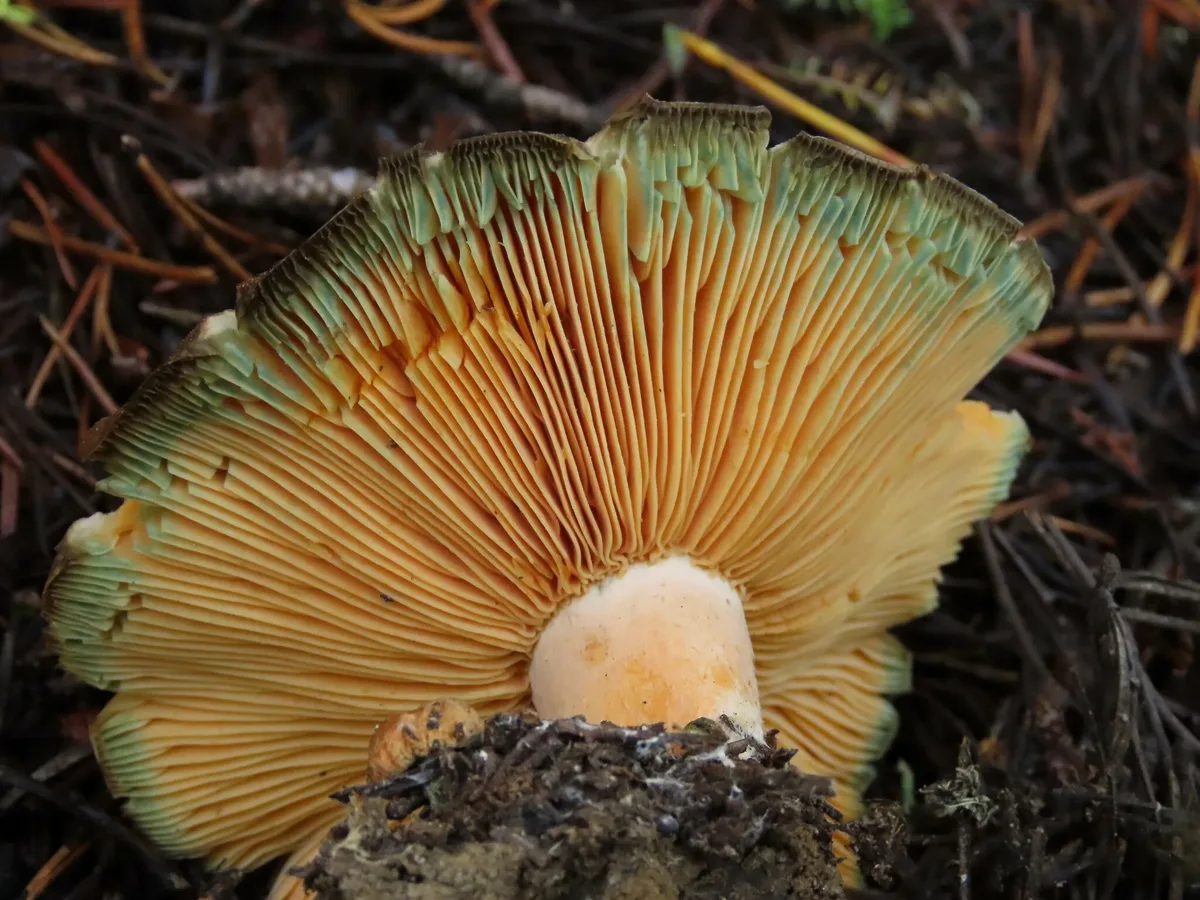 © Kathleen Dobson (CC BY 4.0)
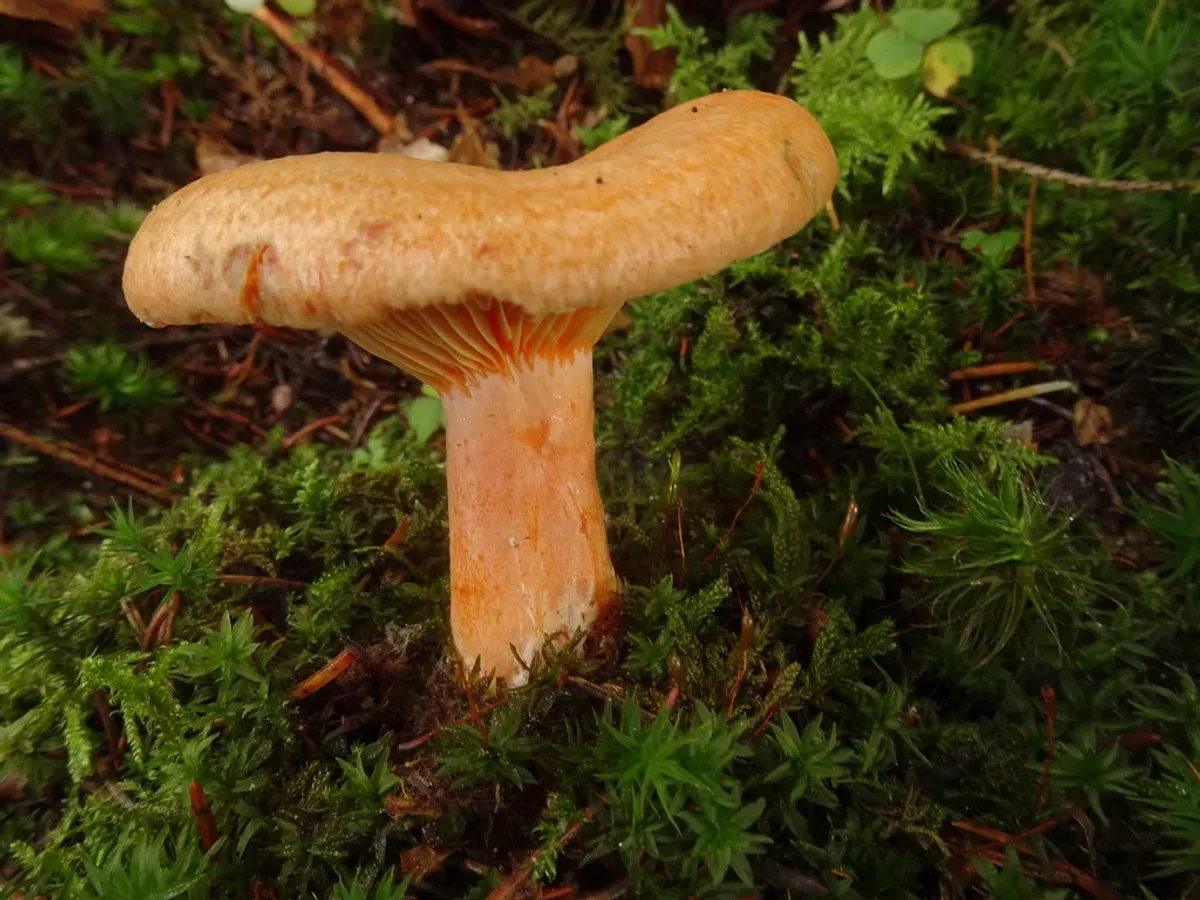 © Ephemeral Impressions (CC BY-SA 2.0)
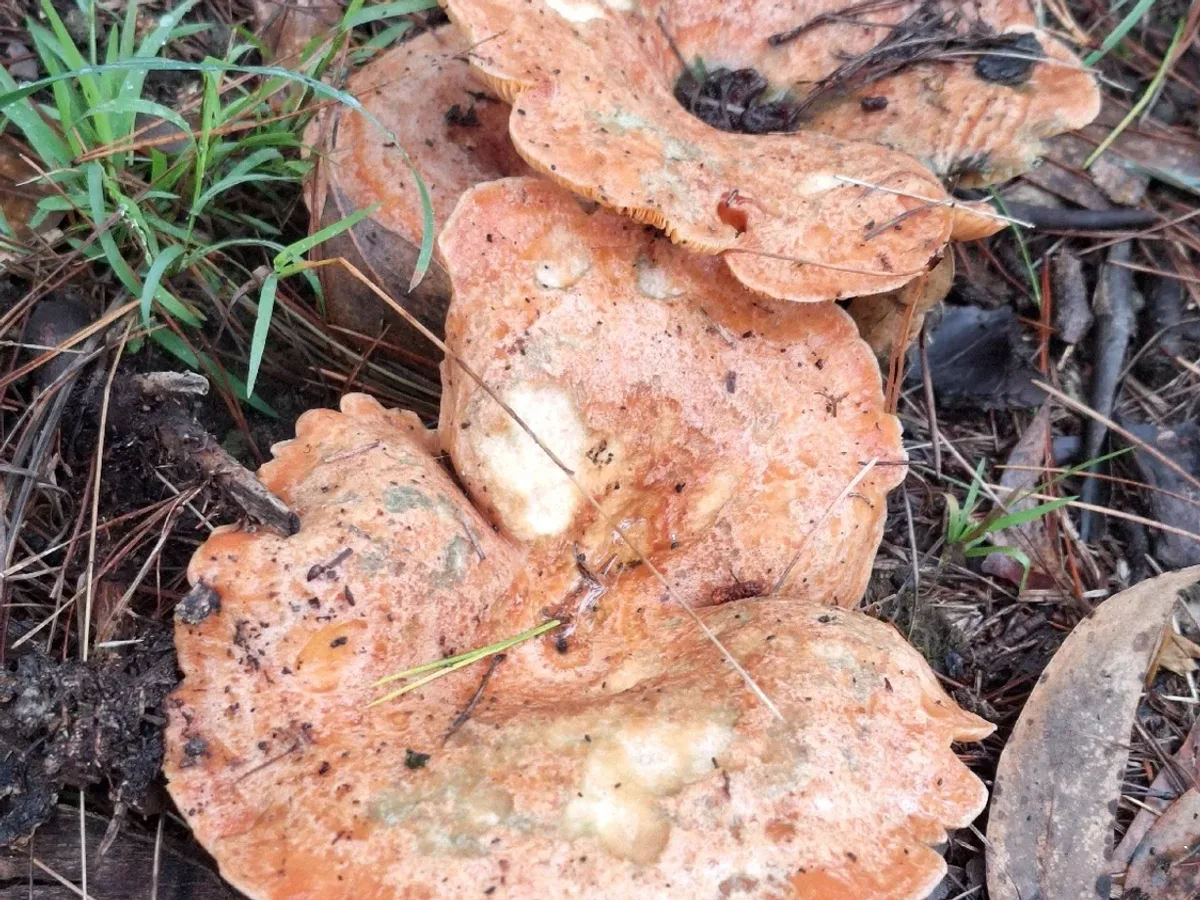 insiderelic (CC0)
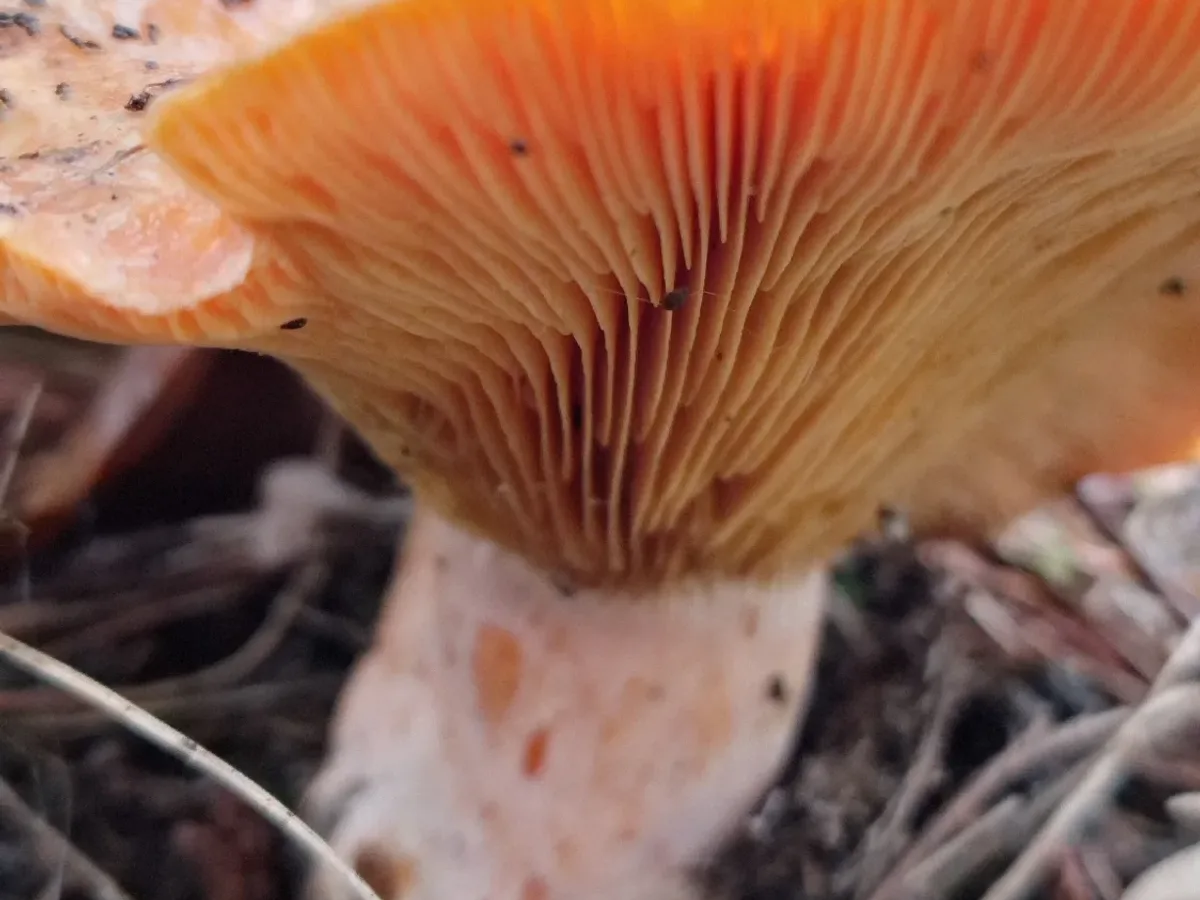 insiderelic (CC0)
 © Lukas Clews (CC BY)
 © koalabi (CC BY)
 © Duarte Frade (CC BY)
 © Duarte Frade (CC BY)
 © Lukas Large (CC BY-SA 2.0)
 © Paul and Jill (CC BY 2.0)
 © Paul and Jill (CC BY 2.0)
 © Lukas Large (CC BY-SA 2.0)
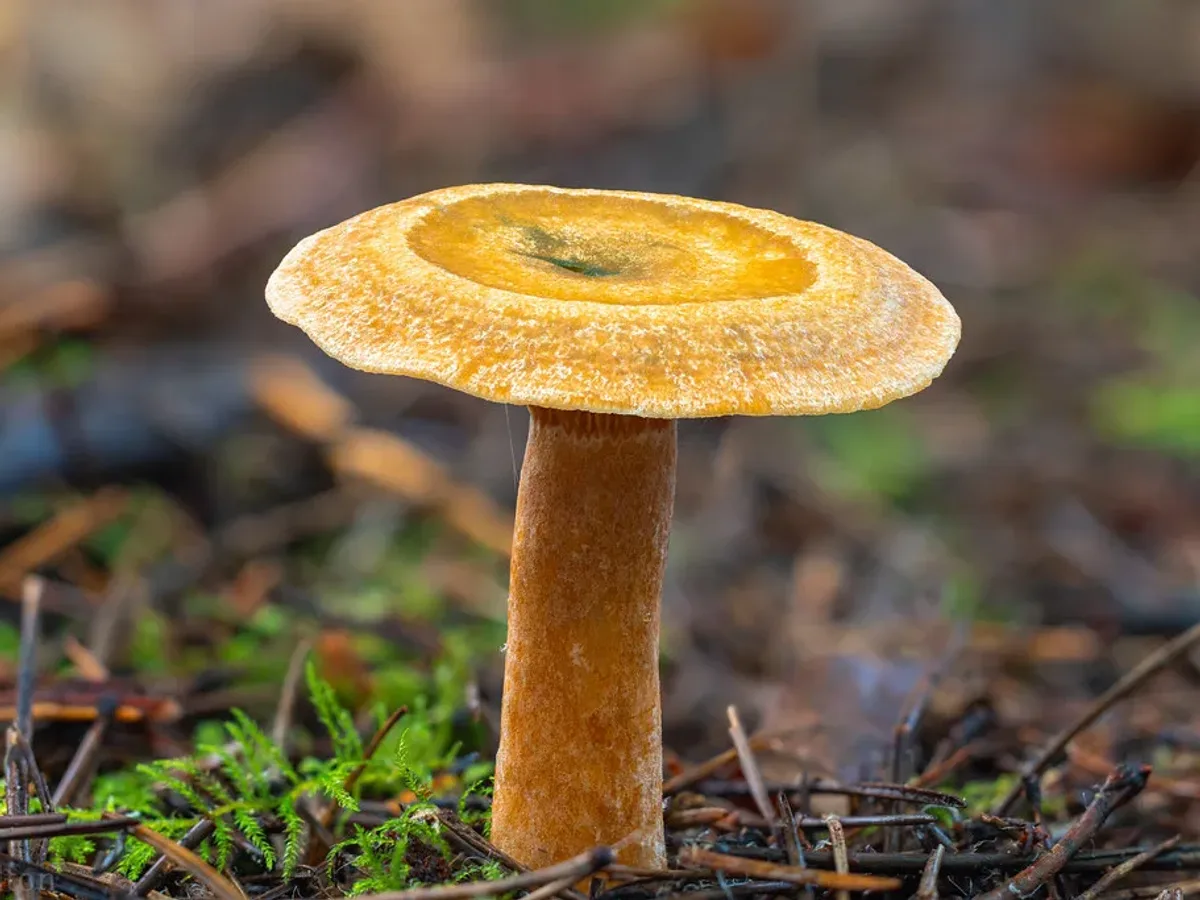 © Casey Helton Photography (CC BY 2.0)
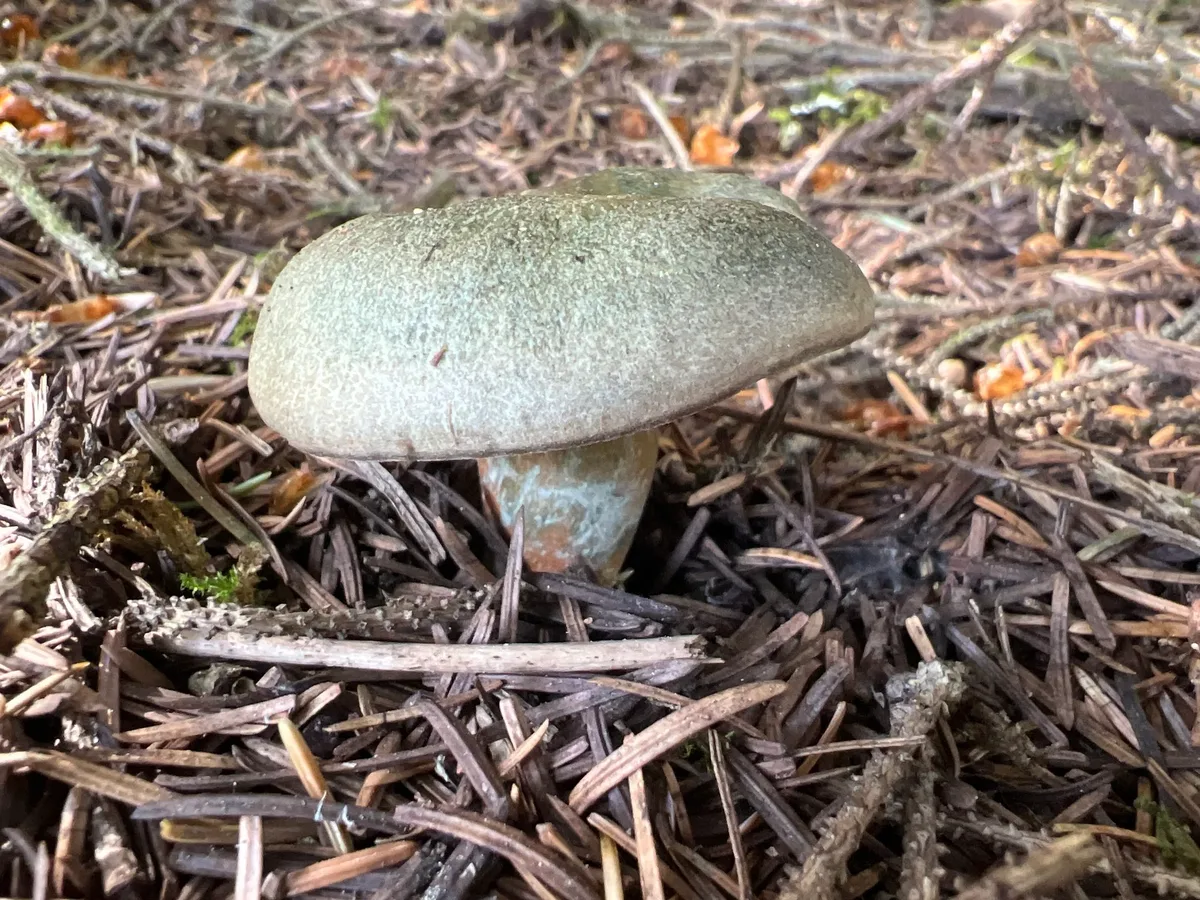 moorebuesing (CC0)© Kathleen Dobson (CC BY 4.0)© Ephemeral Impressions (CC BY-SA 2.0)
Good to eat, once you have identified it with certainty and cooked it through.
How to recognise it
Lactarius deliciosus is one of the most visually arresting fungi in any southern-hemisphere pine plantation.
Cap
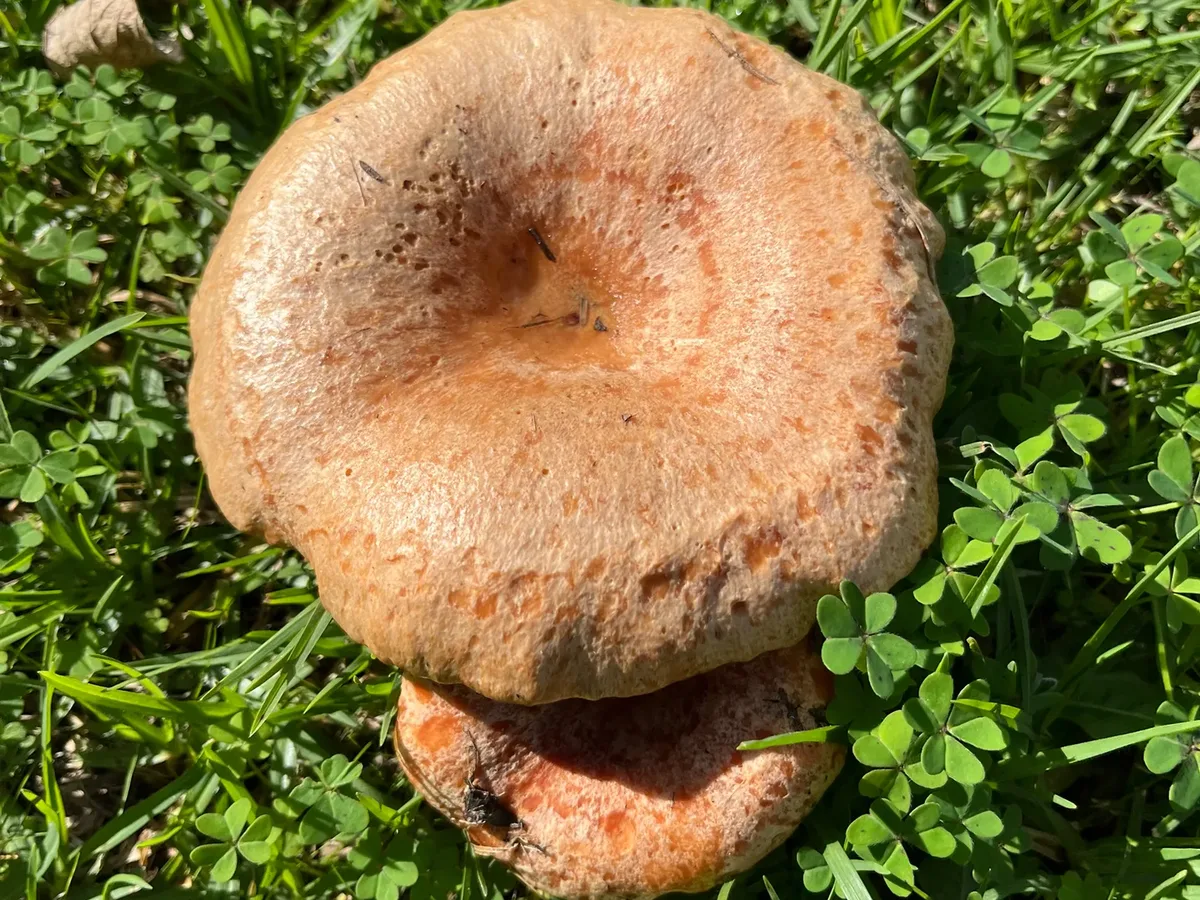
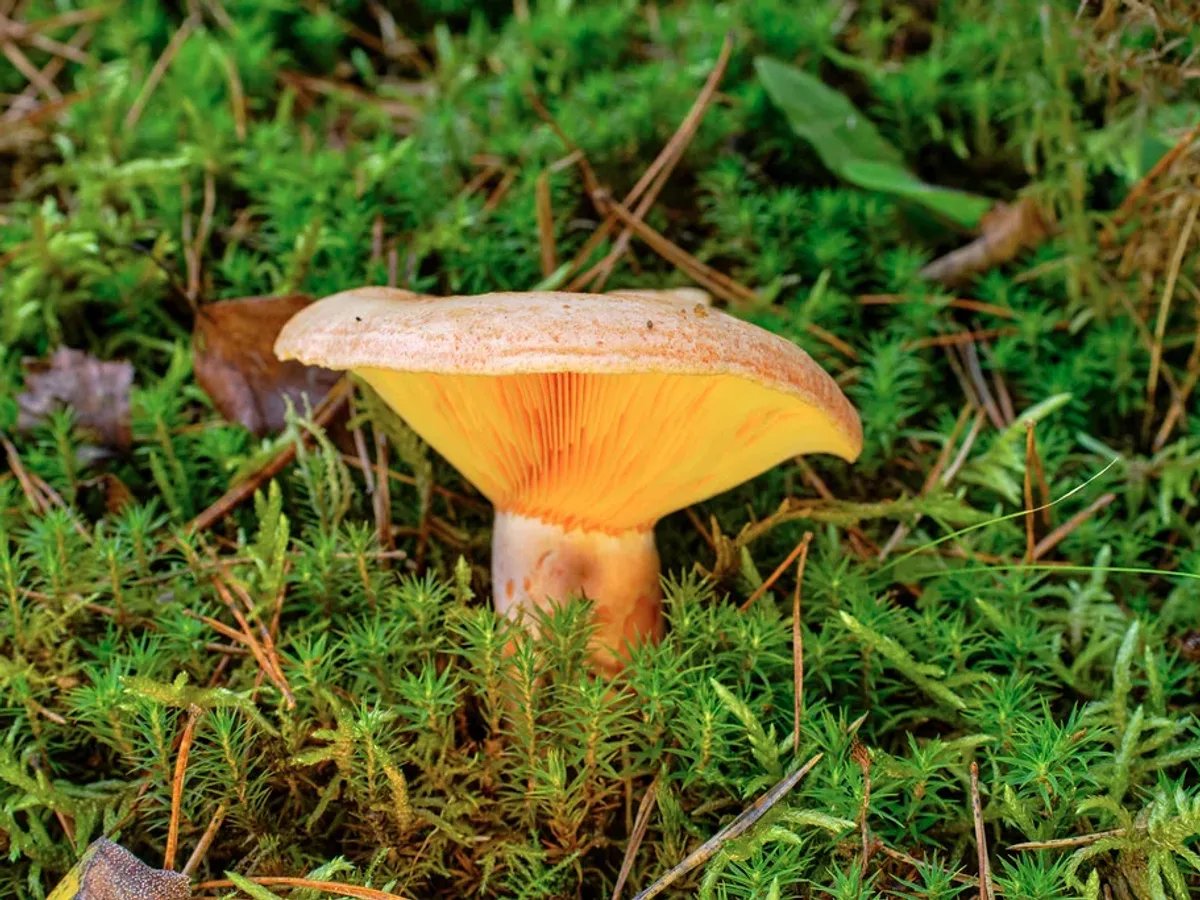
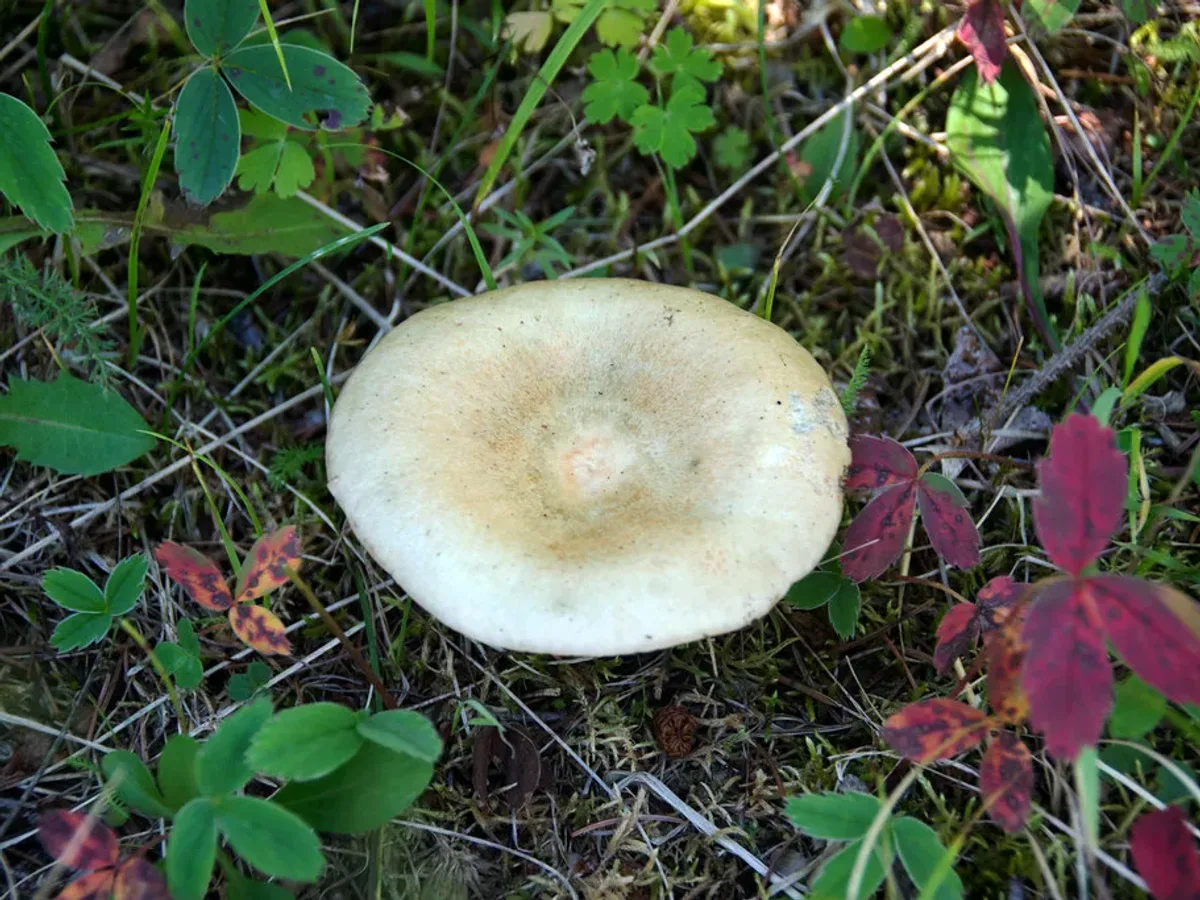
The cap emerges from the litter as a tight, convex button - already a vivid orange-gold - and expands progressively through a broadly umbonate stage before flattening and finally curling upward into a shallow funnel or vase, sometimes reaching 20 cm across in mature specimens.
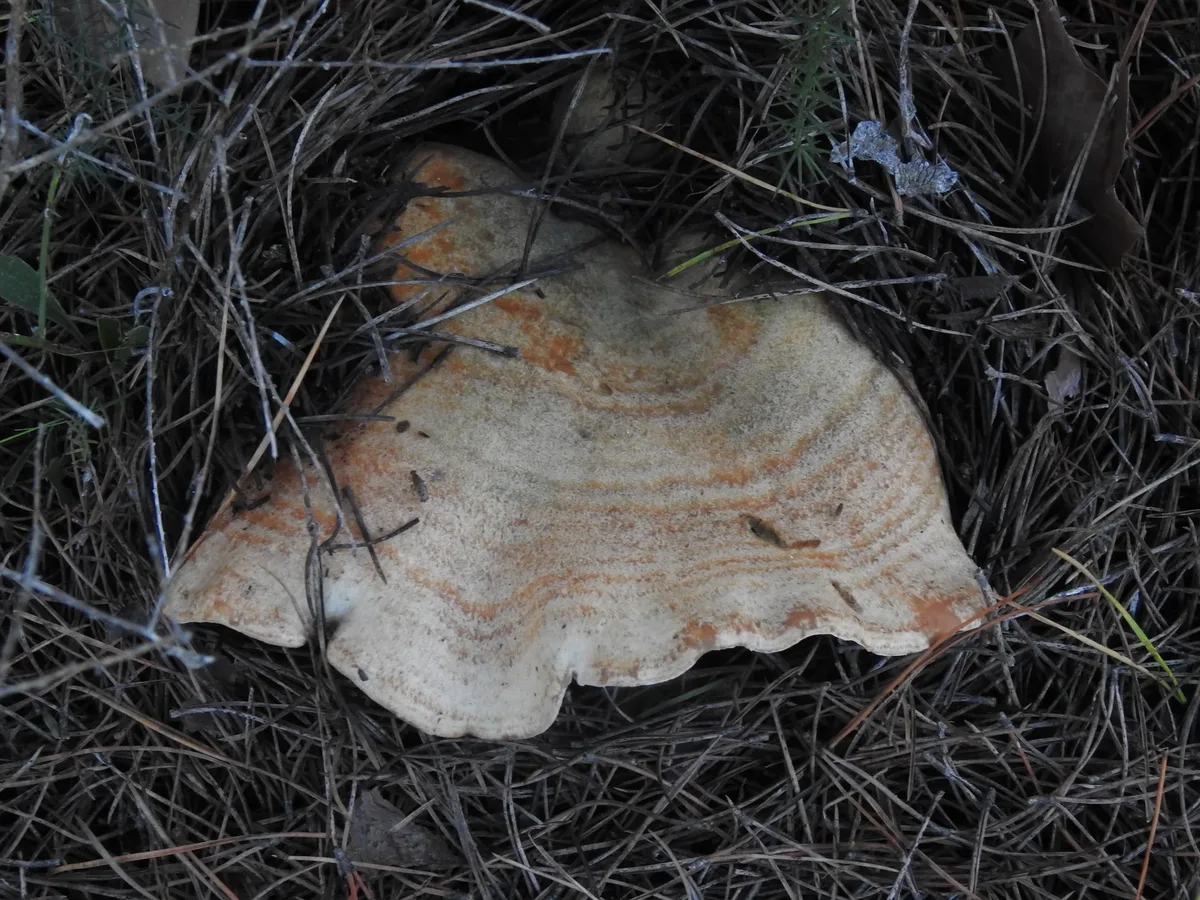
The surface is dry to slightly sticky when wet, and carries a system of darker, orange-brown concentric zones arranged in rings that become more pronounced toward the cap margin. Those rings are not markings on a skin but structural variation in the cap flesh itself, a subtle texture difference readable with a fingertip.
Gills / Pores
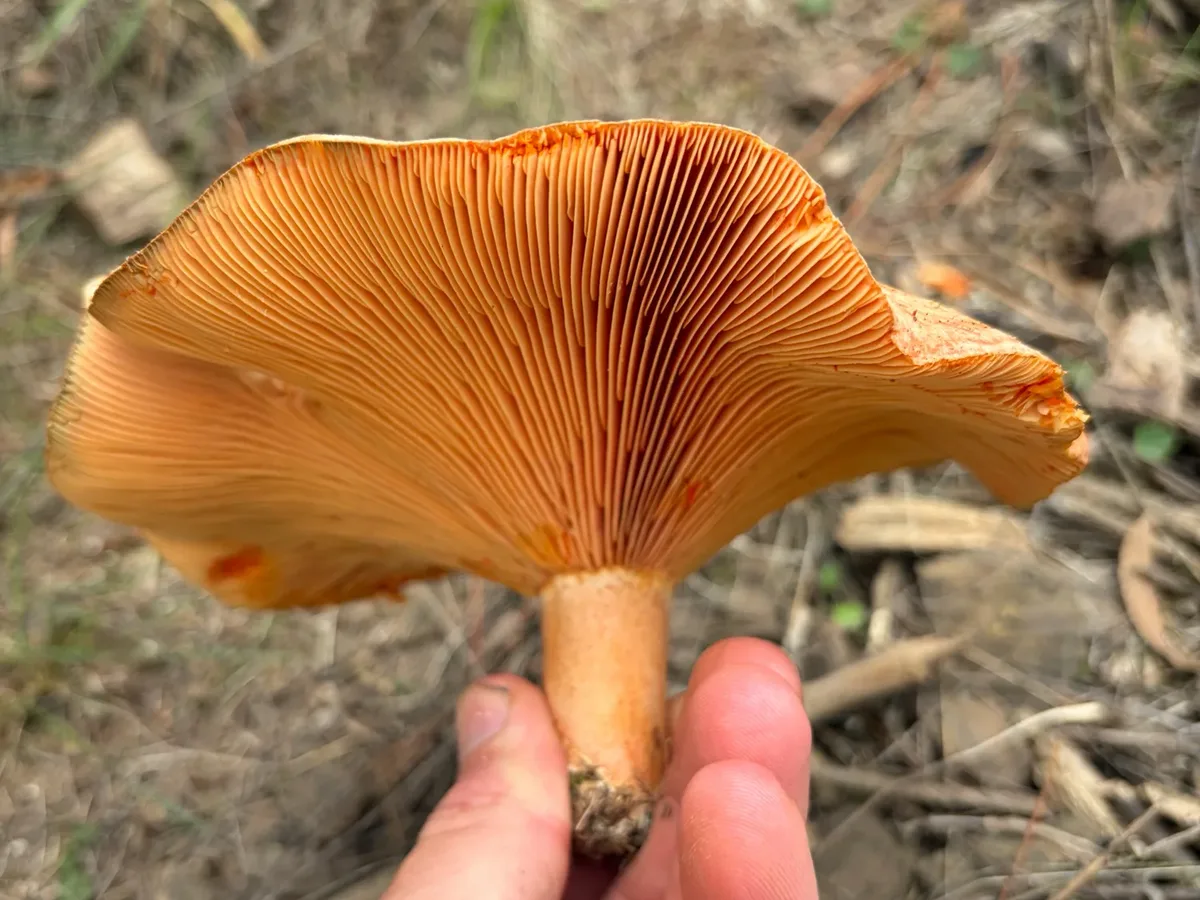
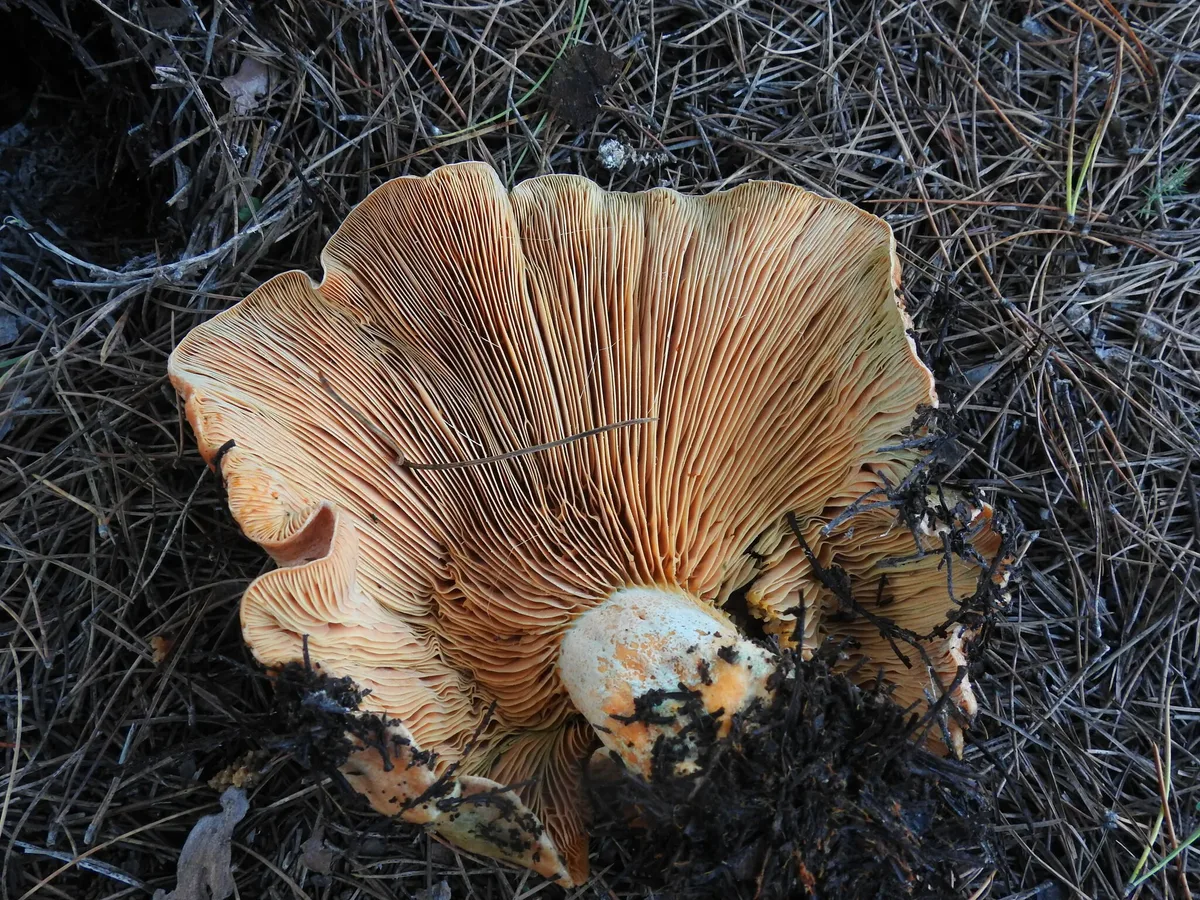
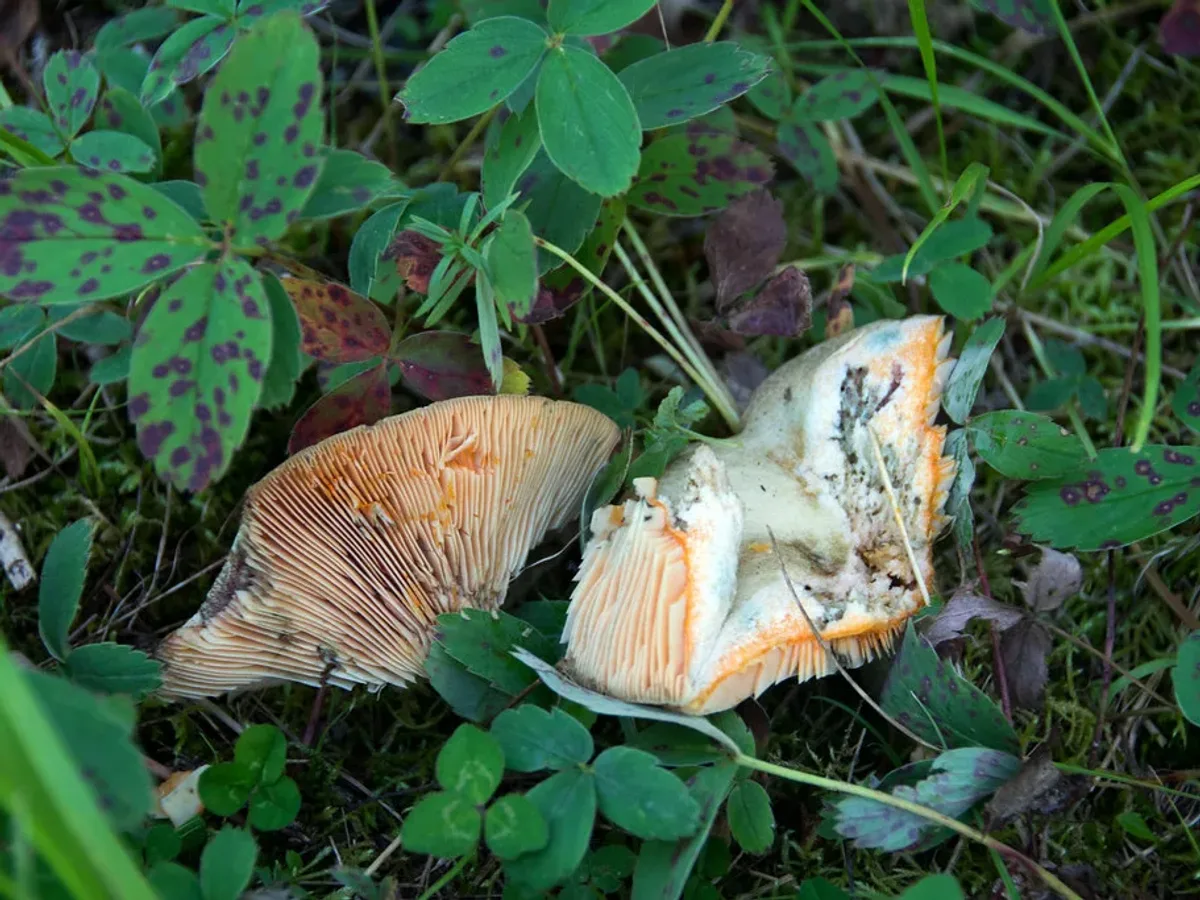
The gills run slightly down the stem (decurrent), are densely packed and fork toward the margin. They start out the same vivid orange as the cap and retain that color in vigorous specimens, though old or damaged ones acquire blue-green stains.
Spore print pale cream to pale pink-buff.
Stem
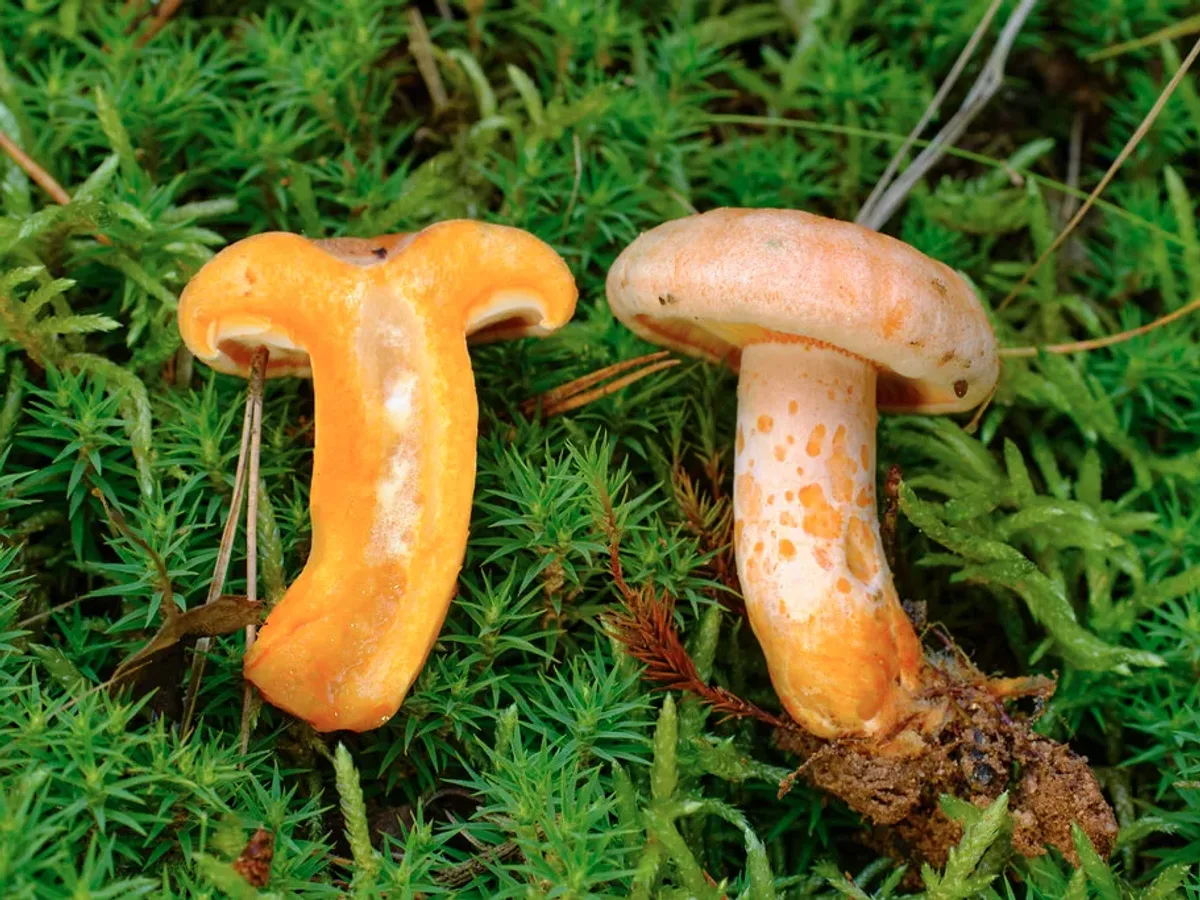
The stem is stout and hollow, 5-8 cm tall, and scattered over its outer surface with shallow orange pits - scrobiculations - that are unique to the saffron milk caps among fungi likely to be found under Australian pines.
Flesh
The flesh is pale orange within, not white. The crucial test is the latex: nick a gill or slice the stem and within seconds a clear to pale-orange fluid wells up, carrot-colored and plentiful.
Exposure to air and handling turn any damaged surface a distinctive blue-green - a reaction driven by enzymatic oxidation of sesquiterpene compounds in the latex - and this bruising is diagnostic.
Dried specimens turn olive-brown and the latex reaction fades, so always confirm on fresh material.
Where & when it grows
Habitat
Lactarius deliciosus is an obligate mycorrhizal partner of pines, and in Australia and New Zealand it exists entirely within the envelope of introduced plantation forestry.
The species travelled here not as a windblown spore but almost certainly embedded in the soil balls around nursery pine seedlings shipped from the Mediterranean basin or northern Europe during the plantation establishment era of the late nineteenth and early twentieth centuries.
Today it is found wherever its host trees have had time to build mature litter layers - plantations and shelterbelts of Pinus radiata, P. pinea and P. halepensis being the primary sites.
The main collecting zones by region:
- New South Wales: the Oberon-Bathurst tablelands, the Blue Mountains fringe around Hampton and Jenolan, and state forests in the Central Tablelands
- Victoria: the Macedon Ranges, around Mornington Peninsula pine blocks, and the Ovens Valley near Bright
- South Australia: the Adelaide Hills (Mt Crawford Forest) hold some of the most productive stands
- Canberra: its plantation suburbs have long supported good fruitings
- New Zealand: South Island pine blocks host equally reliable populations
The substrate is deep, loose pine-needle duff over mineral soil that is moist after rain but not waterlogged; compacted or drought-stressed ground rarely fruits well.
Tree age matters: stands younger than ten or fifteen years seldom fruit, because the mycorrhizal network has not yet reached the complexity needed to divert enough photosynthate to sustain fruitbodies. The same patch can fruit year after year once established.
When
In the southern hemisphere the saffron milk cap's window is tightly compressed into six to ten weeks of autumn. It typically runs from late February through to late April or May, with the peak flush most reliably falling around the Easter long weekend in late March or early April.
The trigger is a convergence of soil cooling and soil moisture. Nights must drop toward single digits Celsius while the soil retains the warmth of summer long enough to sustain metabolic activity, and at least 20 mm of rain in the preceding two weeks is typically required to initiate a flush. Once conditions align, fruiting bodies can push through the needle litter within seven to fourteen days of rain.
Because the southern-hemisphere autumn compresses what would be a longer Nordic season into a few brief weeks, the foraging community tracks weather forecasts obsessively, and a wet Easter weekend can see thousands of pickers across Oberon and the Macedon Ranges.
Warm, dry autumns delay or truncate the season entirely; early cold snaps without adequate rain produce scattered, stunted fruitbodies.
After the season closes, the mycelium persists quietly in the root zone of its pine partners, re-establishing the underground carbon exchange that will fuel the next year's fruiting. Season length can vary year to year by two or three weeks depending on ENSO-driven rainfall patterns across southeastern Australia.
How it grows
Lactarius deliciosus forms a classic ectomycorrhizal association with its pine hosts. Fine fungal threads (hyphae) ensheathe the pine's feeder roots without penetrating the root cells, creating the Hartig net - a lattice of hyphae between root cells. Through it, sugar flows from tree to fungus, and mineral nutrients (particularly phosphorus and water) flow from fungus to tree.
The relationship is ancient in the evolutionary sense: the Lactarius lineage has been colonising pine roots for tens of millions of years. The bond is sufficiently specific that the fungus will not fruit under eucalypts or other native trees growing beside the pines.
The visible fruitbody is only the reproductive tip of an extensive mycelial web that can permeate many cubic metres of soil and litter. Before erupting through the surface, developing caps create small, dome-like mounds in the needle litter that experienced foragers learn to read from several metres away.
Fruitbodies emerge gregariously - rarely singly - often in loose arcs or rings that trace the extent of the underground mycelial front. A single productive patch can yield dozens of caps over successive days as the flush progresses.
Growth is rapid once initiated: a cap can expand from a 2 cm button to a fully open 15 cm specimen in two or three days under warm, moist conditions.
Older caps accumulate insect larvae, slugs and squirrel damage (in New Zealand, where possums and hares also browse them), so the ideal picking window is narrow.
Fruiting conditions
Fruits after autumn rain once nights turn cold; needs established mycorrhizal pine litter and moist, well-drained ground.
Look-alikes
Two categories of confusion species exist in the Australian-NZ pine context, and the saffron milk cap's combination of features makes it unusually resistant to misidentification when all are checked together.
The first category is Amanita species - notably fly agaric (Amanita muscaria) and its relatives - which can appear in pine plantations and superficially share an orange to red-orange colour.
The critical differences are structural. Amanita species have:
- white gills (never orange)
- white to pale spore prints
- a cup-like volva at the base of the stem (sometimes buried)
- no latex whatsoever
The white cap markings of fly agaric wash off in rain and can be absent on older specimens, but the absence of any latex bleed, the white gills, and the volva at the base are conclusive. Never eat an orange-red mushroom under pines without confirming orange latex and the absence of a volva.
The second category is other Lactarius species - milk caps - including L. quieticolor and related taxa that share a superficially similar orange appearance. These typically produce a darker, more ochre or brownish latex, or latex that is white rather than orange, or they lack the distinctive saffron-orange colouration of the cap and gills, and most do not produce the same vivid green bruising.
None of the Lactarius species likely to be encountered in Australian and New Zealand pine plantations is known to be deadly, but some cause gastrointestinal upset. Confirming the full suite of features - clear saffron-orange latex, vivid orange gills, orange-pitted stem, strong green bruising - before eating remains essential.
The rule is simple and reliable: if there is no flowing orange latex within seconds of cutting, do not eat it.
Distinguish the edible saffron milk caps from bitter milk caps by the carrot-orange milk.
Also edible; like L. deliciosus it shows orange milk, which distinguishes it from bitter milk caps.
Amanita species lack the saffron-orange milk and have a volva. If the cap spots wash off and there is no orange milk, do not eat.
Lacks milk and grows on wood.
These lack the clear saffron color and the combination of orange latex, pine habitat and green bruising.
All edible. Only milkcaps with orange/red milk are safe here; those with white, burning milk should be avoided.
The orange latex and its greening reaction are reliable distinguishing features.
Also edible; distinguished from bitter milk caps by the orange milk.
Greenish-tinged and less tasty, but harmless.
Has white/pink latex and a woolly (shaggy) cap margin, unlike the orange/red milk and smooth margin of the edible milk caps. Avoid it.
In the kitchen
Picking & cleaning
Lactarius deliciosus rewards methodical searching more than speed. Walk slowly through a productive pine stand, eyes scanning for the subtle disturbance of needle litter - a slight dome, a crack, an orange blush at ground level - rather than looking for caps already in the open.
Gently brush the needles aside with a finger before committing to a pick. Very young buttons barely 3 cm across are already identifiable by their orange colour and the immediate latex response if you nick a gill, but they are tastier and firmer at 6-10 cm.
Cut the stem cleanly at the base with a knife rather than twisting and pulling. Pulling risks disturbing the mycelial mat and bringing away unnecessary substrate, and a clean cut allows the remaining base to dry and seal rather than rot into the network.
Confirm the latex on every specimen before it goes in the basket - a clear to pale-orange bleed within seconds of cutting is the key check.
- Handle caps gently; pressure bruising turns flesh blue-green quickly and, while harmless, makes the mushroom less appealing in the pan and harder to photograph for records.
- Place caps gills-down in a wide, rigid basket rather than a plastic bag: a bag traps moisture, accelerates spoilage, and can cause the latex to pool and degrade the flesh.
- Wipe caps clean in the field or shortly after; if rinsing is needed, do it briefly and dry immediately.
State-forest regulations in NSW and Victoria set personal bag limits (typically 2 kg per person per day) and prohibit commercial harvest without permits - know the rules for your specific site before you pick.
Cooking
The saffron milk cap is a genuinely versatile culinary mushroom with a flavour that is meaty, faintly resinous, and subtly peppery - qualities that respond well to high heat and fat but that can be overwhelmed by low, slow cooking.
The single most important rule is speed and heat. A crowded pan at low heat steams the mushrooms and produces a watery, tough result, while a wide, very hot pan with a generous film of olive oil or butter (in small batches) yields golden, slightly crisped surfaces and a tender interior within two to three minutes per side. This pan-fried or grilled preparation is the baseline and the best showcase of the mushroom's natural flavour.
The classic Australian forest-picnic preparation - halved caps on a portable gas burner or BBQ grate with olive oil, crushed garlic, chilli flakes and chopped flat-leaf parsley, served on thickly cut sourdough - has become almost ceremonially associated with the Easter-long-weekend foraging culture in NSW and Victoria.
Beyond the grill, saffron milk caps perform well in:
- risotto (added partway through the rice's cooking to preserve texture)
- robust pasta sauces with pancetta and white wine
- pies and tarts, where their firmness holds up to pastry enclosure
- schnitzel - thick slices dipped in beaten egg and breadcrumbs, then pan-fried until crisp
Drying concentrates their flavour and produces a good mushroom powder that works as a seasoning or soup base. Pickling in white wine vinegar brine, or submerging in olive oil with herbs, produces a condiment that keeps for months.
The blue-green discolouration that develops on cut surfaces fades mostly during cooking and has no effect on flavour or safety. Pair with dry white wine, Pinot Noir, or a malt-forward ale.
Good to know
Lactarius deliciosus is widely regarded as one of the safest edible wild mushrooms for beginners, provided the identification criteria are met in full.
The required combination of features is so specific that false positives are rare among people who actually apply all the checks:
- orange cap with concentric rings
- orange gills
- hollow stem with orange pits
- immediate flow of carrot-orange latex on cutting
- subsequent blue-green bruising
- exclusive pine-habitat occurrence
The only toxicological footnote is a harmless phenomenon: a proportion of consumers (not all) notice that their urine turns a reddish-orange colour in the hours after eating. This is not a sign of kidney damage or poisoning but a direct result of the excretion of beta-carotene and related pigments from the mushroom's latex. It is self-limiting and disappears within a day.
Always cook the mushrooms thoroughly - eating them raw is not recommended and may cause mild gastrointestinal irritation.
Pregnant individuals, small children, and people with compromised immune systems should exercise the usual caution with any foraged food and consult a health practitioner if uncertain. If any unusual symptoms beyond the orange-urine effect occur after eating, seek medical advice and, if possible, retain a sample of the mushroom for identification.
State forest regulations exist in NSW and Victoria; pick within personal-bag limits and do not harvest from National Parks where collection is generally prohibited.
A reference guide - never an edibility guarantee. When in doubt, leave it out.