The great Sub-Saharan Africa mushroom guide
10 edibles to fill your basket with, 6 to recognise
The great Sub-Saharan Africa mushroom guide

 African chanterelles
 Zambian slender Caesar

 African chanterelles
Across the miombo woodlands and the Kalahari sands, this is one of the most mushroom-loving and biologically rich regions on Earth, where women and children gather termite mushrooms, chanterelles and even edible amanitas as a vital seasonal source of protein and income. We cover ten prized edibles and six dangerous look-alikes worth knowing by sight. This is a calm, honest guide, not a guarantee: identification is everything, and local knowledge always comes first.
What matters most
- African chanterelles (Cantharellus) are the safest beginner's basket: prized, widely sold, and with no deadly look-alikes in the miombo.
- Termitomyces are the backbone of the harvest, all edible, and T. titanicus is the largest edible mushroom in the world, big enough to feed ten people from one cap.
- The deadliest trap is confusing edible African amanitas with deadly white amanitas of section Phalloideae; the second is Chlorophyllum molybdites, the 'vomiter', which mimics young Termitomyces.
- The main toxin groups to fear are amatoxins (liver, deadly), the gastrointestinal toxin of Chlorophyllum, and the neurotoxins of Amanita pantherina.
- Taxonomy is in flux: Amanita zambiana and A. loosii are sometimes treated as one, and the chanterelle genus was heavily revised by Buyck and colleagues in 2013.
- Handling and storage matter: cooking does NOT destroy amatoxin, bitter Lactarius and Russula must be parboiled, and surplus is sun-dried for the dry season.
The great toxin groups
Most African mushroom deaths come not from the famous death cap but from other species. These are the toxin groups the guide warns about, and how each one announces itself.
Found in the deadly white amanitas of section Phalloideae, amatoxins (alpha- and beta-amanitin) kill liver cells and are heat-stable, so cooking, drying and freezing do not destroy them. The course is treacherous: no symptoms for 6 to 12+ hours, then severe vomiting and diarrhoea, a deceptive recovery phase, and liver and kidney failure on days 3 to 5. This group is responsible for about 90% of fatal mushroom poisonings worldwide.
The toxin molybdophyllysin causes violent stomach and bowel illness, vomiting, diarrhoea, sometimes bloody stool and abdominal pain, 1 to 4 hours after eating. Rarely fatal but severe, and especially dangerous for children through dehydration, with documented hypovolemic shock.
Ibotenic acid and muscimol produce a 'pantherina syndrome': drowsiness 30 to 90 minutes after eating, confusion, alcohol-like intoxication, hallucinations, muscle spasms and sometimes coma, particularly in children. Rarely fatal but serious. Related Inocybe species carry muscarine, causing sweating and salivation.
The edibles
 Termite mushroom
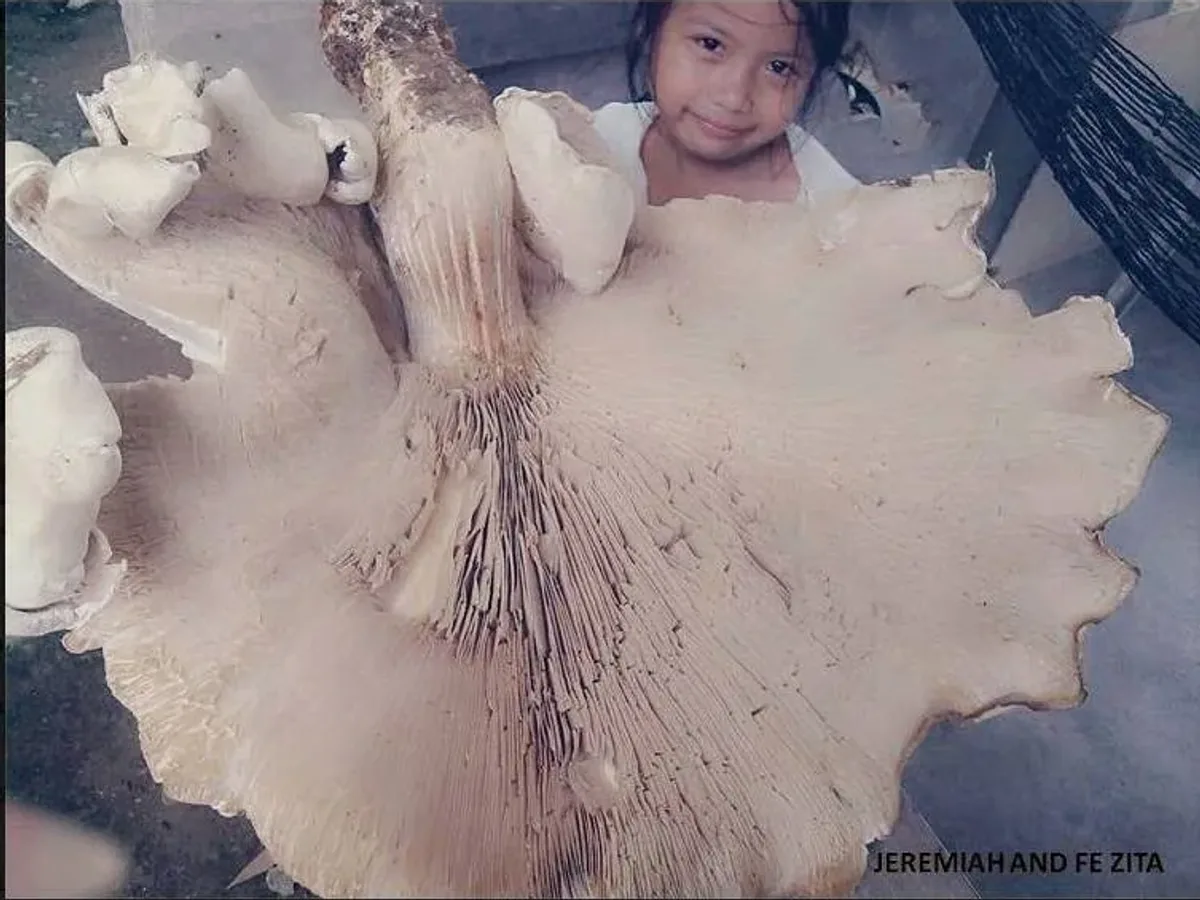
Giant termite mushroom
Termitomyces titanicusThe largest edible mushroom on Earth: a single cap, up to a metre across, can feed ten people.
How to recognise it
Highly variable in size. Common to all: a long, root-like pseudorrhiza (an underground, rhizome-like continuation of the stem running down into the termite nest), often a pointed central knob (umbo/perforatorium) on the cap, white to cream-colored gills that can become pinkish, and a white spore print. T. titanicus: cap up to 1 m, stem up to 57 cm. T. schimperi: cap 15-28 cm, sometimes 40 cm, white with scales. T. microcarpus: only a few cm. The flesh is firm and meaty; the flavor is described as rich, meaty and smoky (umami).
Where it grows
On or next to termite mounds (Macrotermes, Microtermes, Odontotermes), in savanna, miombo woodland, farmland and grassland. Bound to the fungus gardens (combs) of the termite nest.
Cooking
Fried in oil with onion, tomato and chili; in soups; as a relish (ndiwo/umunani) with nshima/ugali. In Namibia, omajowa (T. schimperi) is often fried in butter or oil. Dried for storage - sometimes parboiled before drying.
Look-alikes
Some white Amanita superficially resemble pale termite mushrooms, but Amanita has a volva (ring-shaped sac at the stem base) and lacks a pseudorrhiza.
Can resemble young Termitomyces and causes severe gastrointestinal poisoning. Check for a greenish spore print and the absence of a pseudorrhiza.
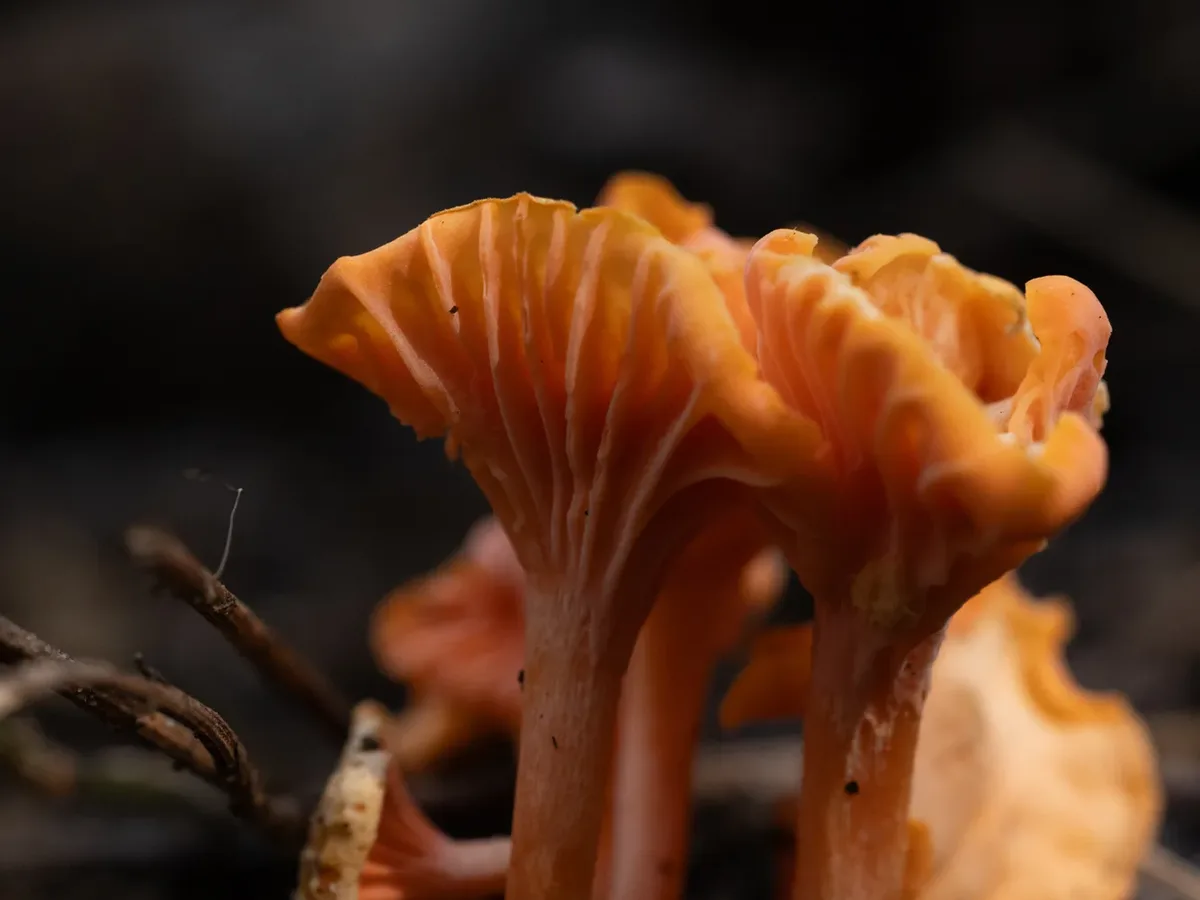
African chanterellesAfrican chanterelle
Cantharellus isabellinusThe best-selling chanterelle in Tanzania's markets, and among the safest baskets a beginner can fill.
How to recognise it
Funnel-shaped with firm, pale to orange-yellow flesh and the characteristic ridges - blunt, forking folds that run partway down the stem - rather than true gills. Color varies across the group: C. isabellinus runs beige to ochre, while C. rufopunctatus carries warm red flecks and C. symoensii is notably larger. The flesh has a mild, pleasant smell and holds its texture well after cooking.
Where it grows
Grows in miombo woodland, the vast Brachystegia and Julbernardia savanna that stretches across central and southern Africa. These chanterelles live as ectomycorrhizal partners of those trees - exchanging minerals from the soil for carbohydrates the trees produce - and will not fruit where the host trees are absent. Some species favor Uapaca-dominated patches; C. congolensis reaches into lowland rainforest and Madagascar.
Cooking
Fried with onion and tomato; in relish with nshima; in peanut sauce; dried chanterelles are used in stews during the dry season.
Look-alikes
A global risk rather than the main danger in miombo; check for true ridges/folds (not thin gills) and firm, non-brittle flesh.
A global risk rather than the main danger in miombo; check for true ridges/folds (not thin gills) and firm, non-brittle flesh.
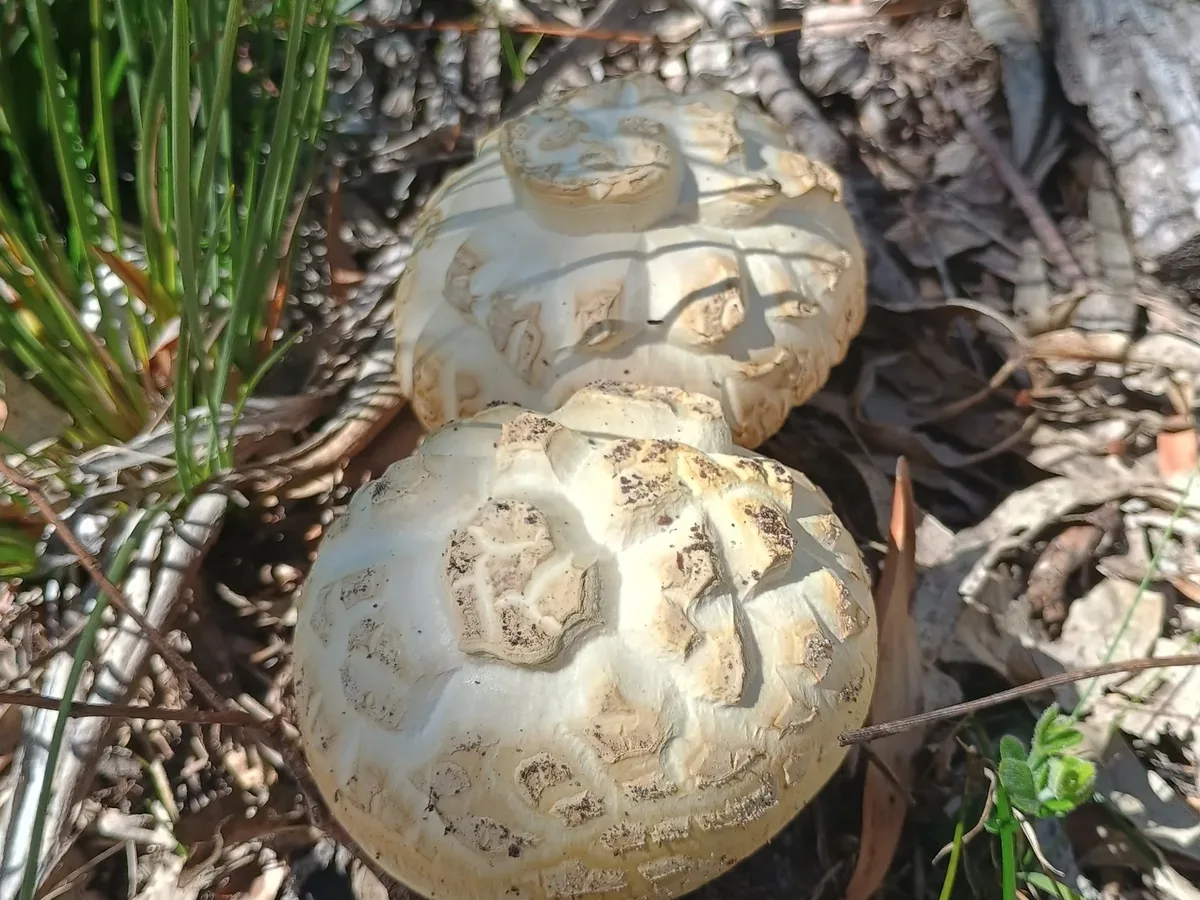
 Zambian slender CaesarZambian slender CaesarZambian slender CaesarZambian slender Caesar
Zambian slender Caesar (tente)
Amanita zambianaZimbabwe's beloved 'Christmas mushroom', delicious but demanding flawless identification, since deadly amanitas share its family.
How to recognise it
A substantial mushroom, cap 10-25 cm across, starting hemispherical and opening broadly as it matures. The centre is warm brown, fading to a pale margin edged with neat, distinct grooves (striations) - a key identification mark. Gills are white to cream-yellow, the stem is white, and the base sits inside a prominent sac-like volva. Spore print white. Taste mild and sweet.
Where it grows
Tied to miombo woodland through a mycorrhizal partnership with Brachystegia trees - it cannot fruit without them. Often appears in small groups along gravel road verges where the woodland edge meets open ground.
Cooking
Traditionally eaten as a relish (ndiwo) alongside nshima, or fried, or prepared in peanut (groundnut) sauce. Cooking does NOT destroy amatoxin - safety lies entirely in the identification, not in the cooking.
Look-alikes
Native deadly amatoxin-containing white Amanita species occur in tropical Africa. Never eat a white/pale Amanita; avoid all Amanita whose cap is pure white without a striate margin. The edible species has a brown cap centre with a distinctly striate (grooved) white margin.
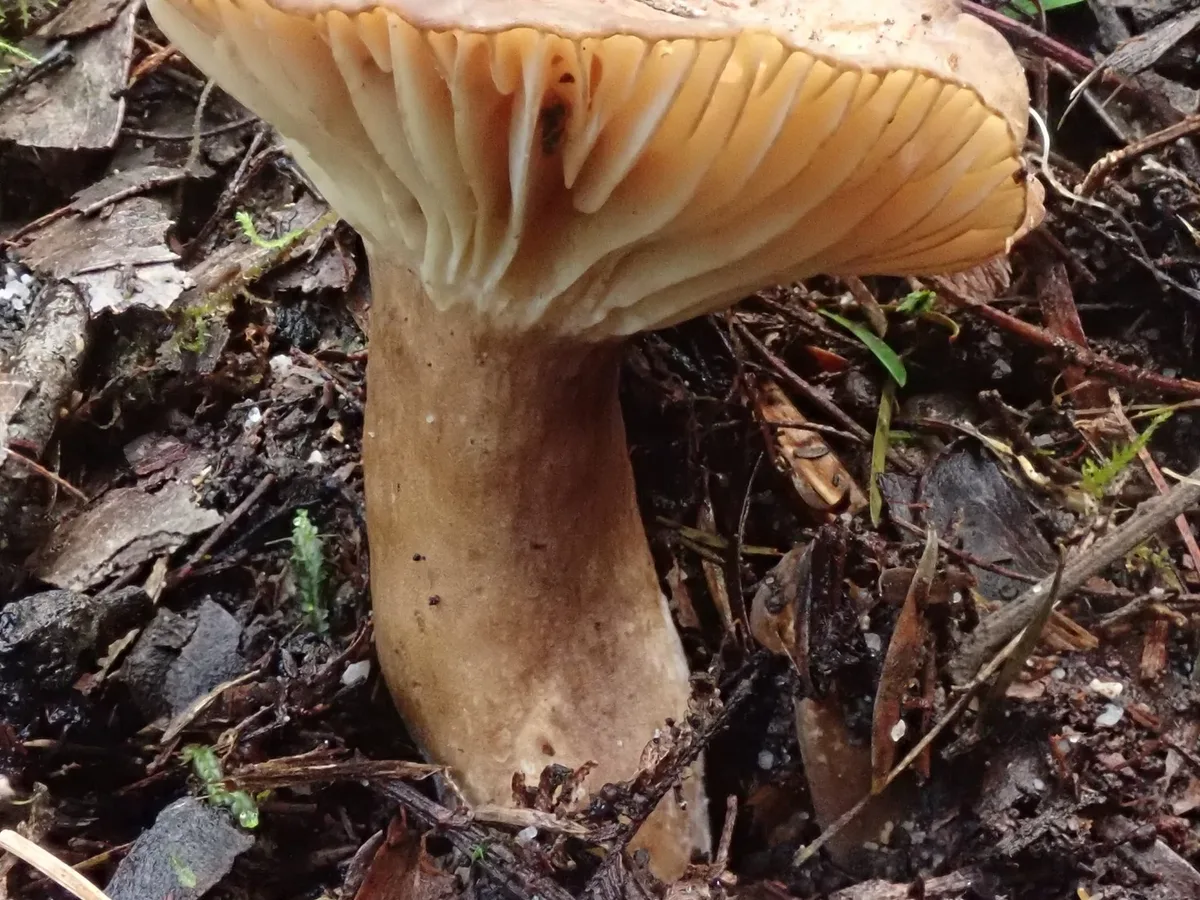 Edible milkcap
Edible milkcap (uboa)
Lactifluus edulisMass-gathered across the miombo and, in Tanzania's Selous-Niassa corridor, said to be preferred over all other food, even meat.
How to recognise it
These milkcaps release a latex - watery to white - when the flesh is broken, which is the most reliable field sign. Lactarius kabansus (the form most prized locally) has a dry, leathery-textured cap that develops noticeable lengthwise wrinkles toward the centre as it matures. The taste is mild, and some people eat it without cooking. Gills are decurrent, running partway down the stem; the flesh breaks cleanly and brittly, with no fibrous tear.
Where it grows
Miombo woodland, ectomycorrhizal with Brachystegia/Julbernardia, across the entire Zambezian miombo belt.
Cooking
In relish with nshima/ugali; with peanuts; dried for storage.
Look-alikes
Amanita lacks latex (milky sap). The milky sap and the gills distinguish edible milkcaps from Amanita; always check for latex when broken.
Some Lactifluus, including L. gymnocarpoides, are rejected locally and not eaten.
African brittlegill
Russula ciliataKnown on the Ila tongue as 'the bride of tente', it fruits early in the season with brittle flesh and no latex.
How to recognise it
Russula ciliata has the hallmarks of the brittlegill group: flesh that is pure white inside and snaps like chalk rather than bending, gills that crumble at the touch, and no ring or volva. The cap is a blend of olive-green and purple shading to blood-red at the center, with a grooved margin. No latex - unlike milkcaps, it will not bleed when broken. The mild taste in edible species is the traditional gateway to use.
Where it grows
Miombo woodland, where it grows as an ectomycorrhizal partner of the dominant trees. Also recorded from Mozambique, Burundi, DR Congo, and Tanzania.
Cooking
In relish, soups, and with peanuts (groundnuts).
Look-alikes
Amanita has a volva; brittlegills lack a volva.
Lactarius exudes latex; brittlegills have no latex. The brittle flesh of Russula is also characteristic.
 Bushveld bolete
 Bushveld bolete
 Bushveld bolete
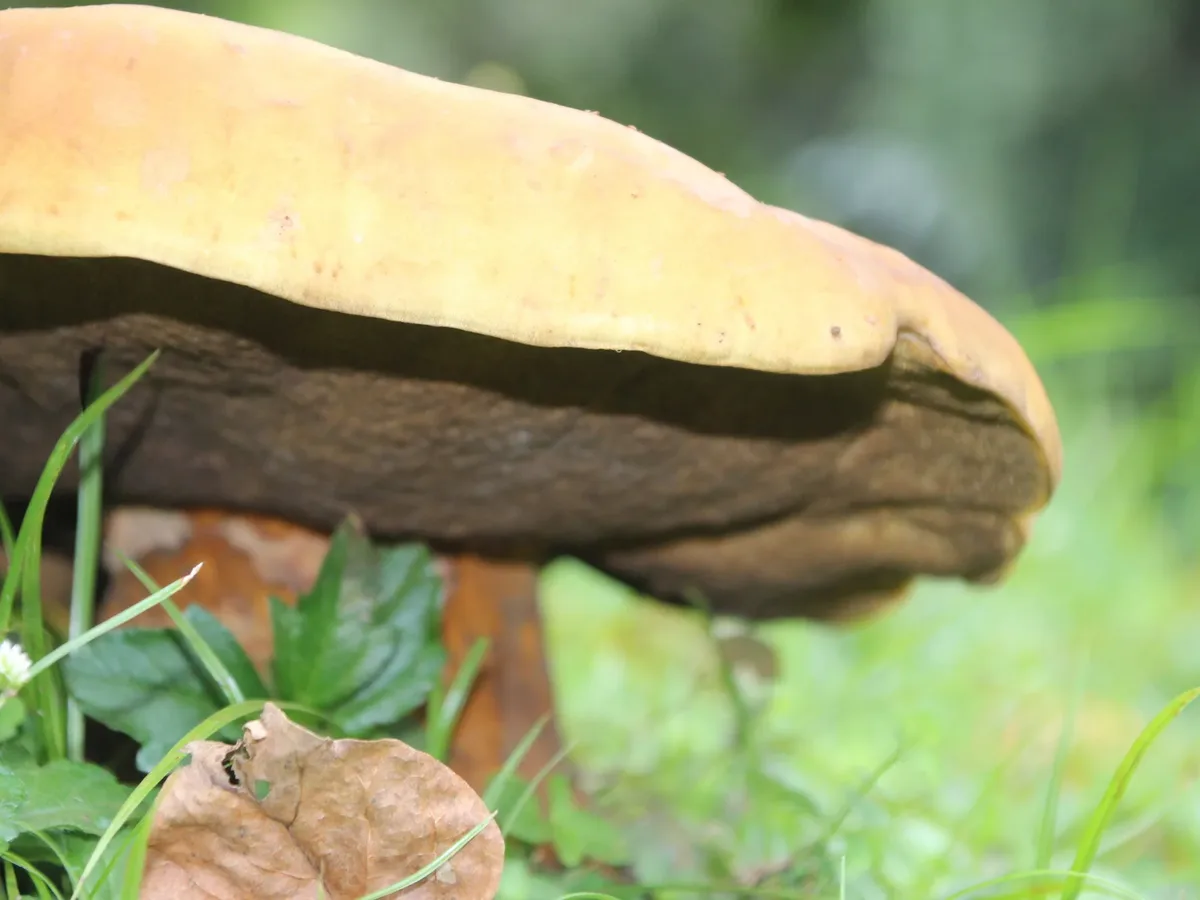 Bushveld boleteBushveld boleteBushveld bolete
Bushveld bolete
Phlebopus sudanicusCalled 'the meat of the Bobo people' in Burkina Faso, but it must be cooked or dried and never eaten raw.
How to recognise it
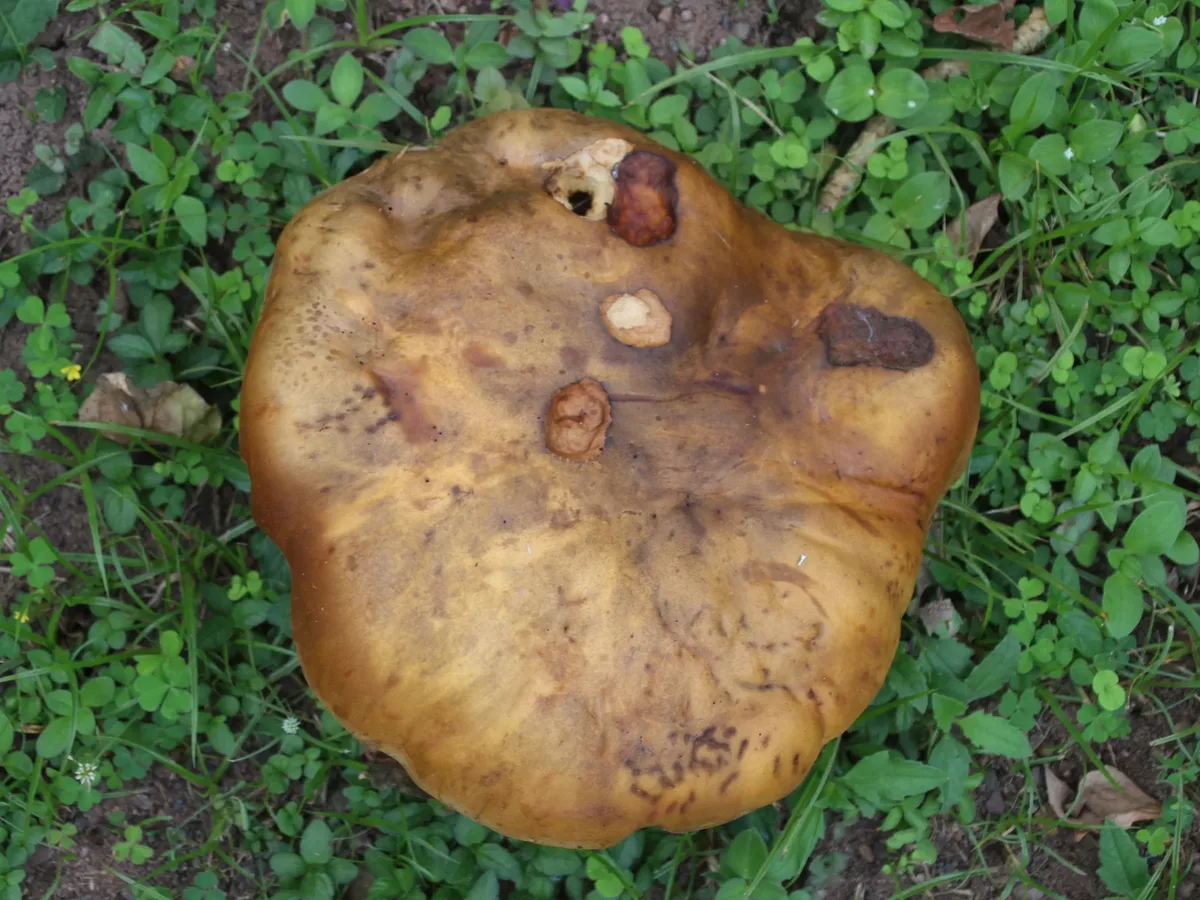
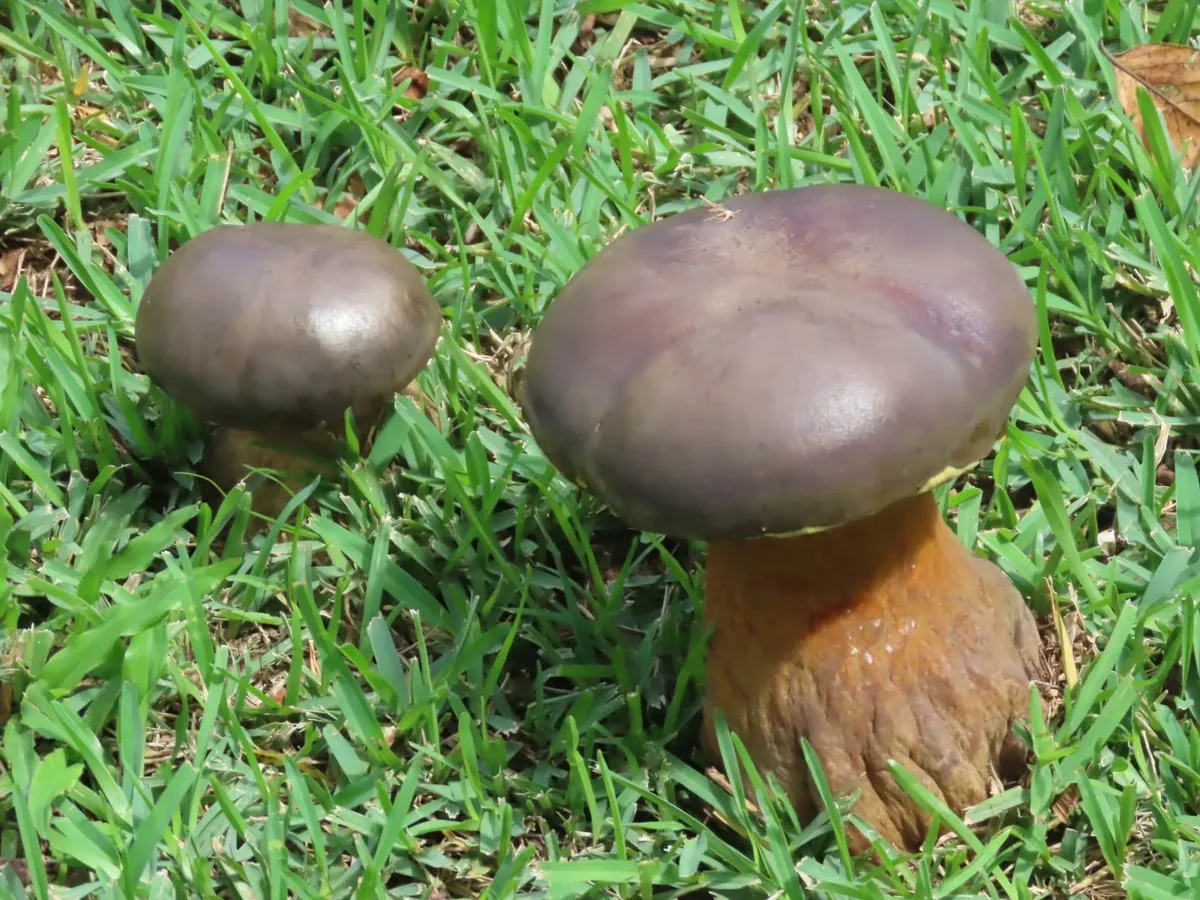
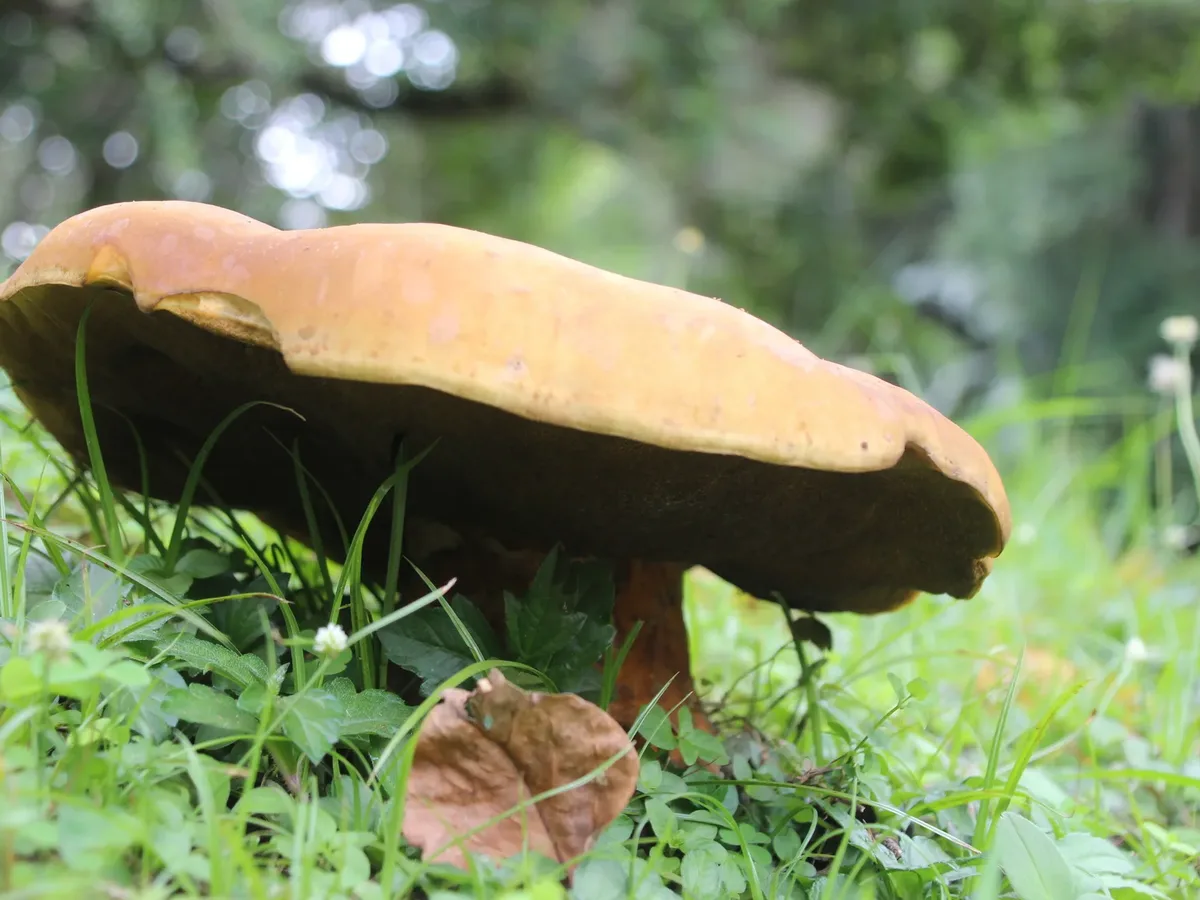
A genuinely imposing mushroom: the cap spans 20-35 cm, starting convex and gradually spreading and lobing outward. The surface is finely downy when young, smoothing with age; colour runs dark brown at the centre and olive-yellow toward the margin. Beneath the cap are dense pores rather than gills - the bolete's signature. The stalk is central and stout; there are no rings or veils.
Where it grows
Found in disturbed miombo woodland and plantations of Acacia, Casuarina, Citrus and related trees - a bolete equally comfortable in secondary and cultivated landscapes.
Cooking
After boiling or drying (never skip this step), the flesh holds up well to frying or stewing. In Burkina Faso it is celebrated as la viande des Bobos - the Bobo people's meat - valued for its substantial texture and bulk. Add it to stews where it will absorb the surrounding flavours; or fry it in oil until golden after the initial boil.
Danger
Not deadly. Becomes safe when properly boiled or dried before cooking; raw consumption should be avoided.
Look-alikes
Another bolete cited in the same group; eaten by the Gbagyi people in Nigeria.
A related African bolete grouped with Phlebopus under the African boletes.
 Split gill
 Split gill
 Split gill
 Split gillSplit gillSplit gill
Split gill
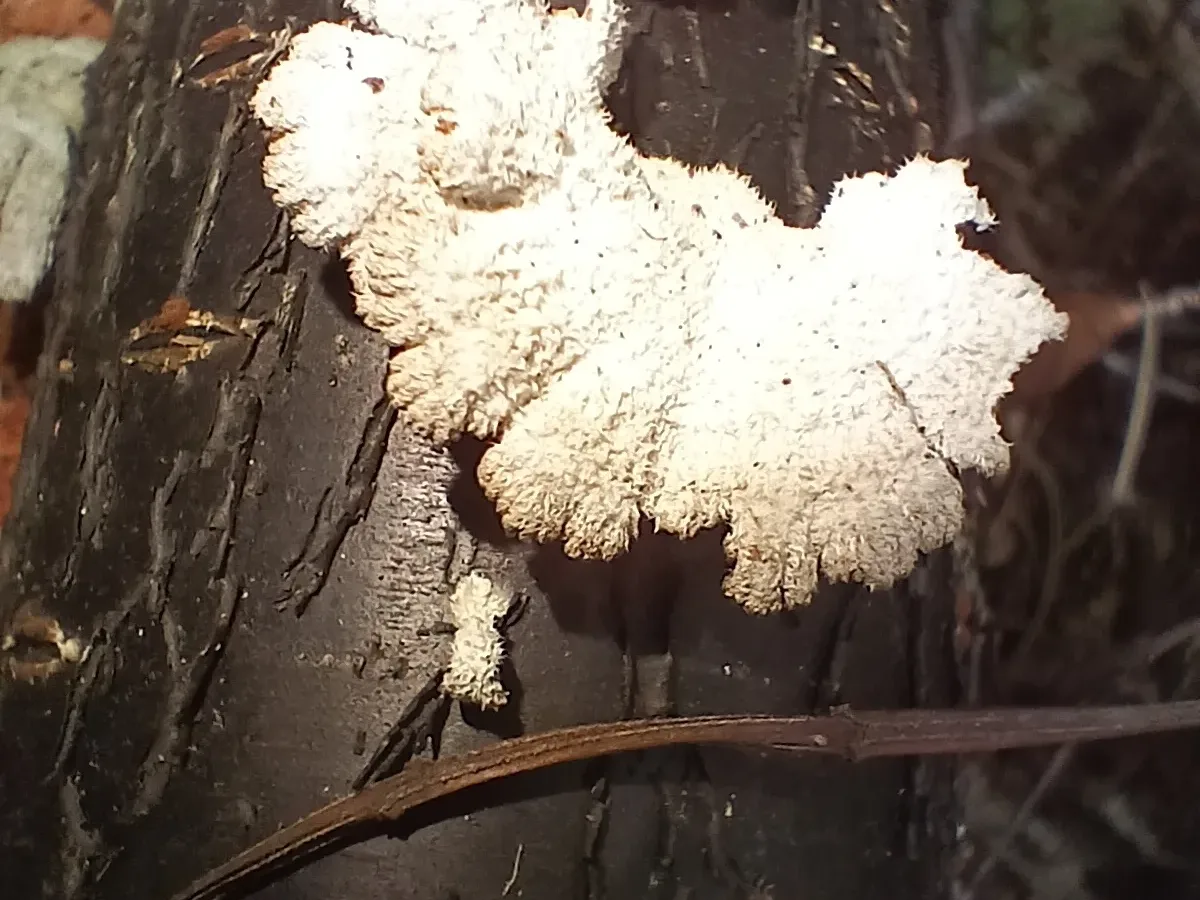
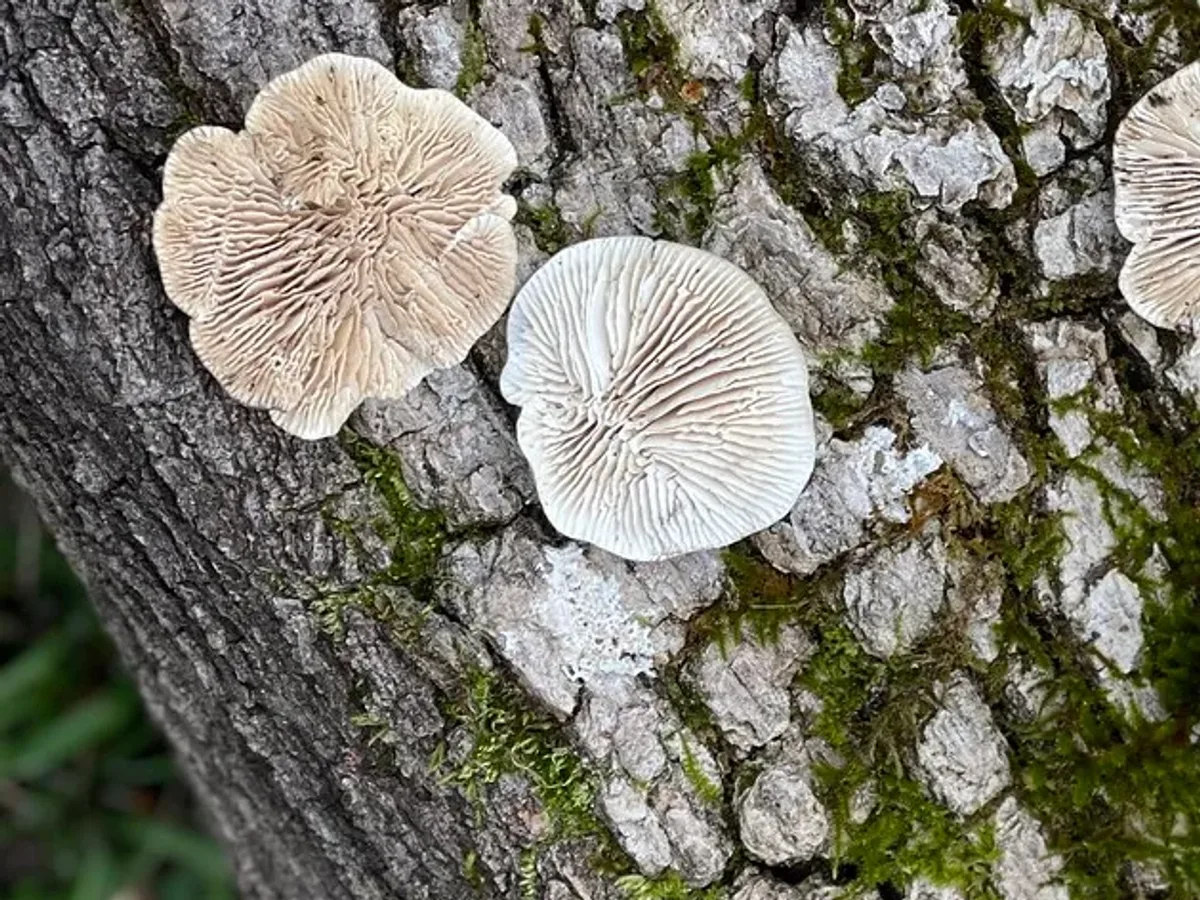
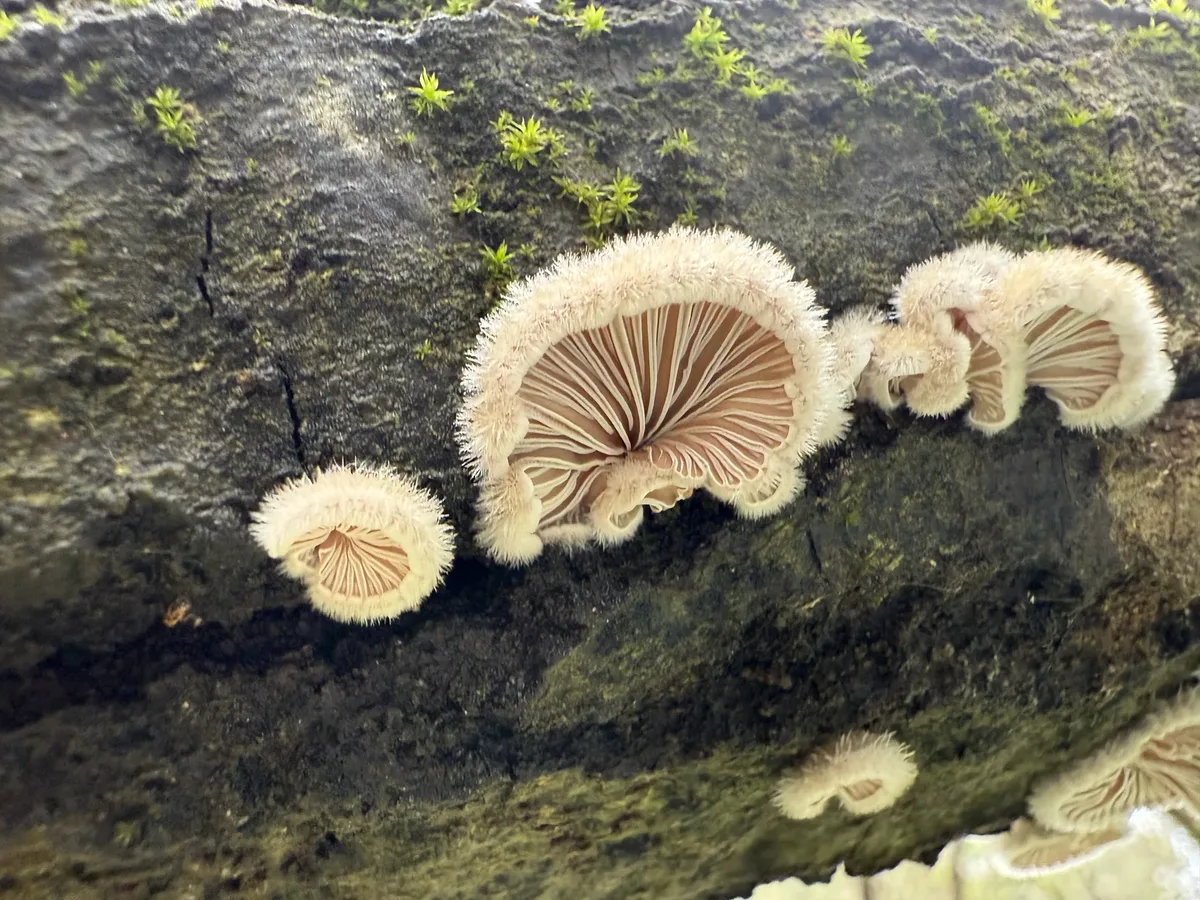
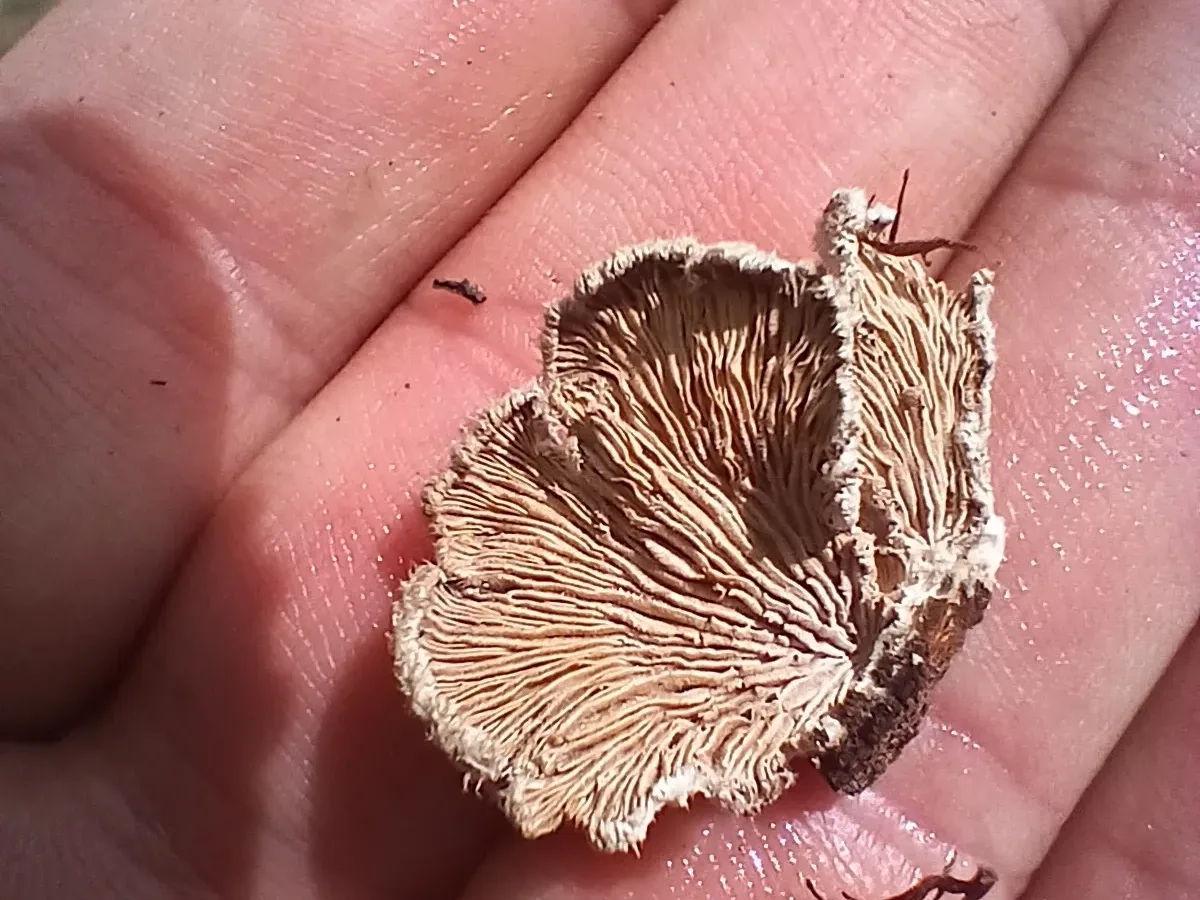
Schizophyllum communeA tough little fan that survives extreme drought and revives with rain, making it one of Nigeria's most eaten wood mushrooms even in the dry season.
How to recognise it
Small (1-4 cm) and fan- or whisk-shaped, with a felty, hairy upper surface and a greyish-white colour that deepens slightly when wet. Turn it over and you find its signature: lengthwise-split "gills" that peel open along their edges like the pages of a tiny book - unlike anything else in the forest. The flesh is tough and leathery, built to last through drought and rain alike.
Where it grows
A wood-decaying saprotroph that makes its living slowly breaking down dead logs, stumps, and fallen branches. Widespread across West African savanna and rainforest as well as East and southern Africa; one of the most commonly encountered wild mushrooms on the continent.
Cooking
Most often added to soups and stews - a classic pairing is alongside fufu or eba in Nigerian cooking. Long boiling is needed to soften the leathery texture.
 Scaly Lentinus
 Scaly Lentinus
 Scaly Lentinus
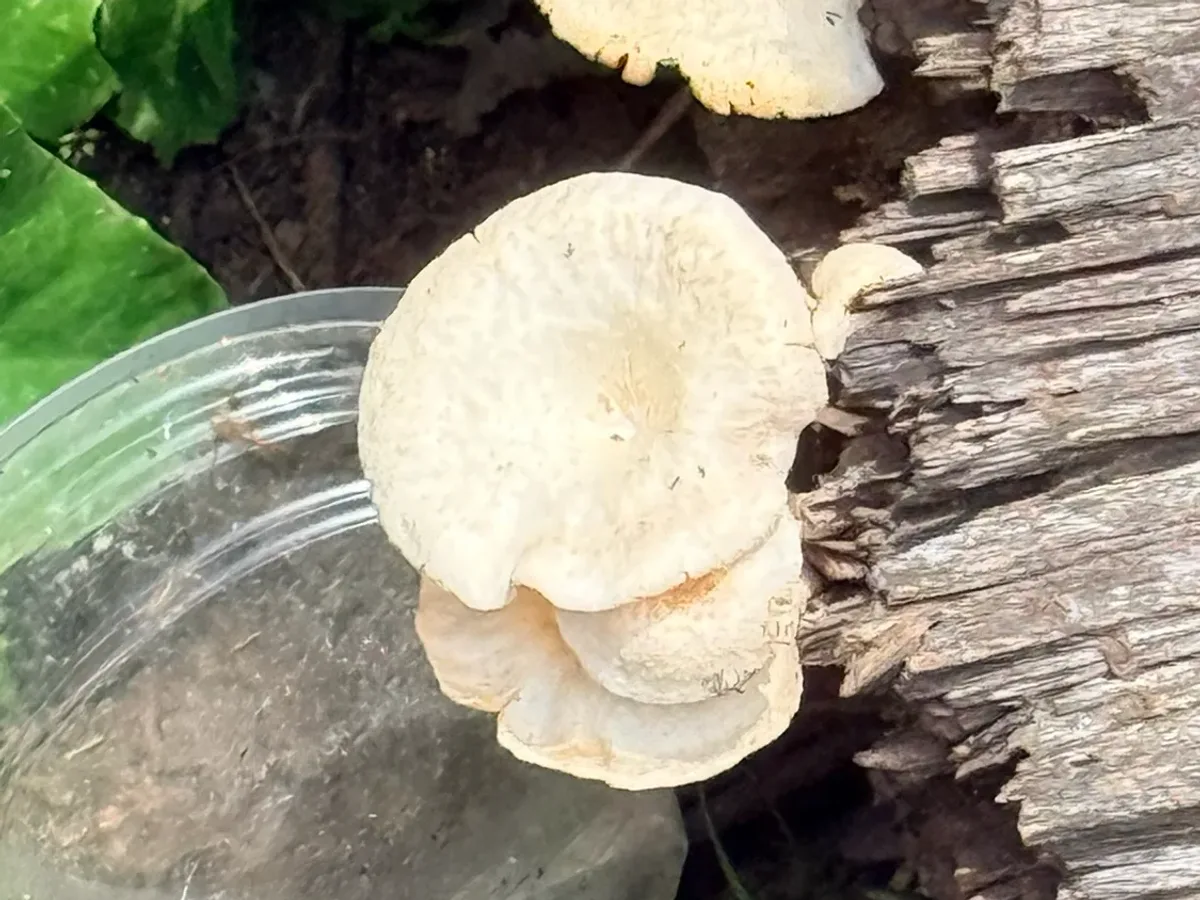 Scaly LentinusScaly LentinusScaly Lentinus
Tropical lentinus
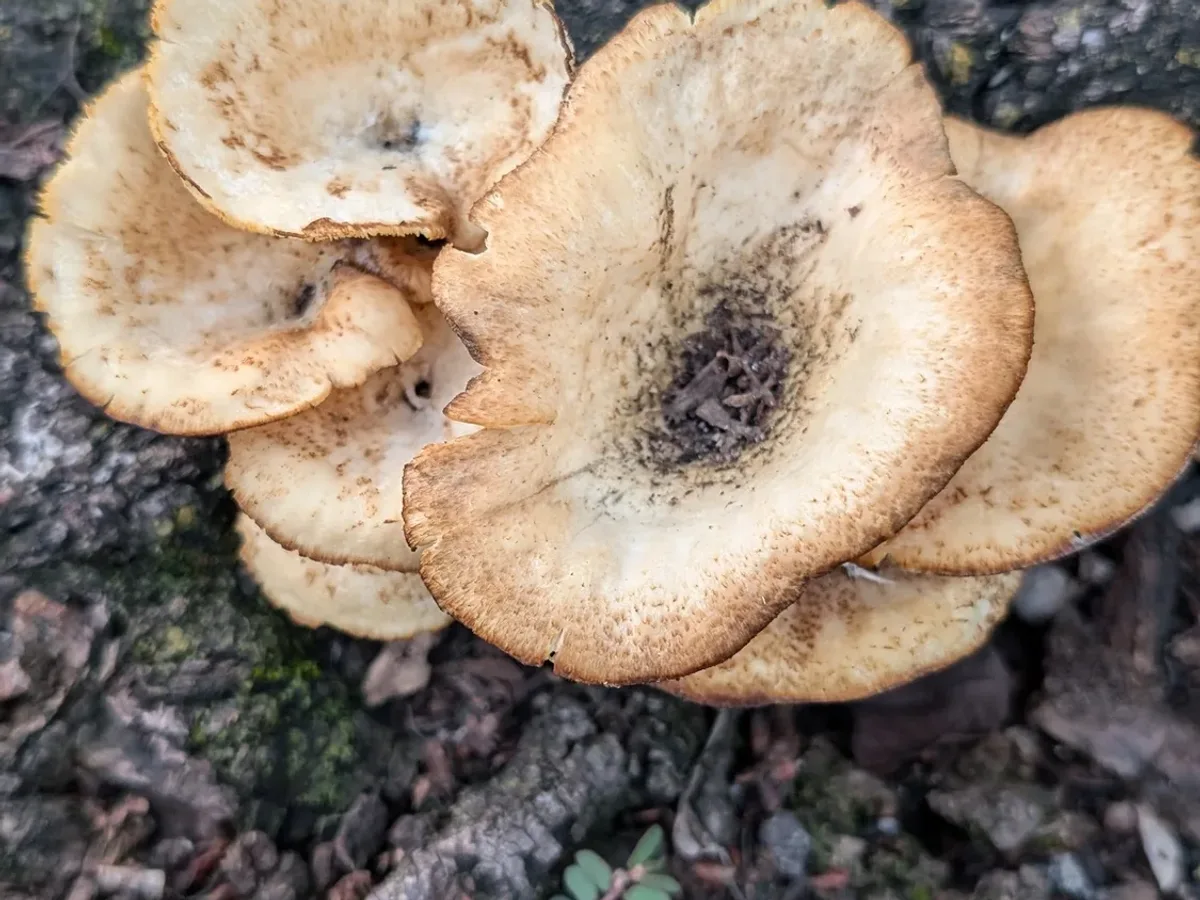
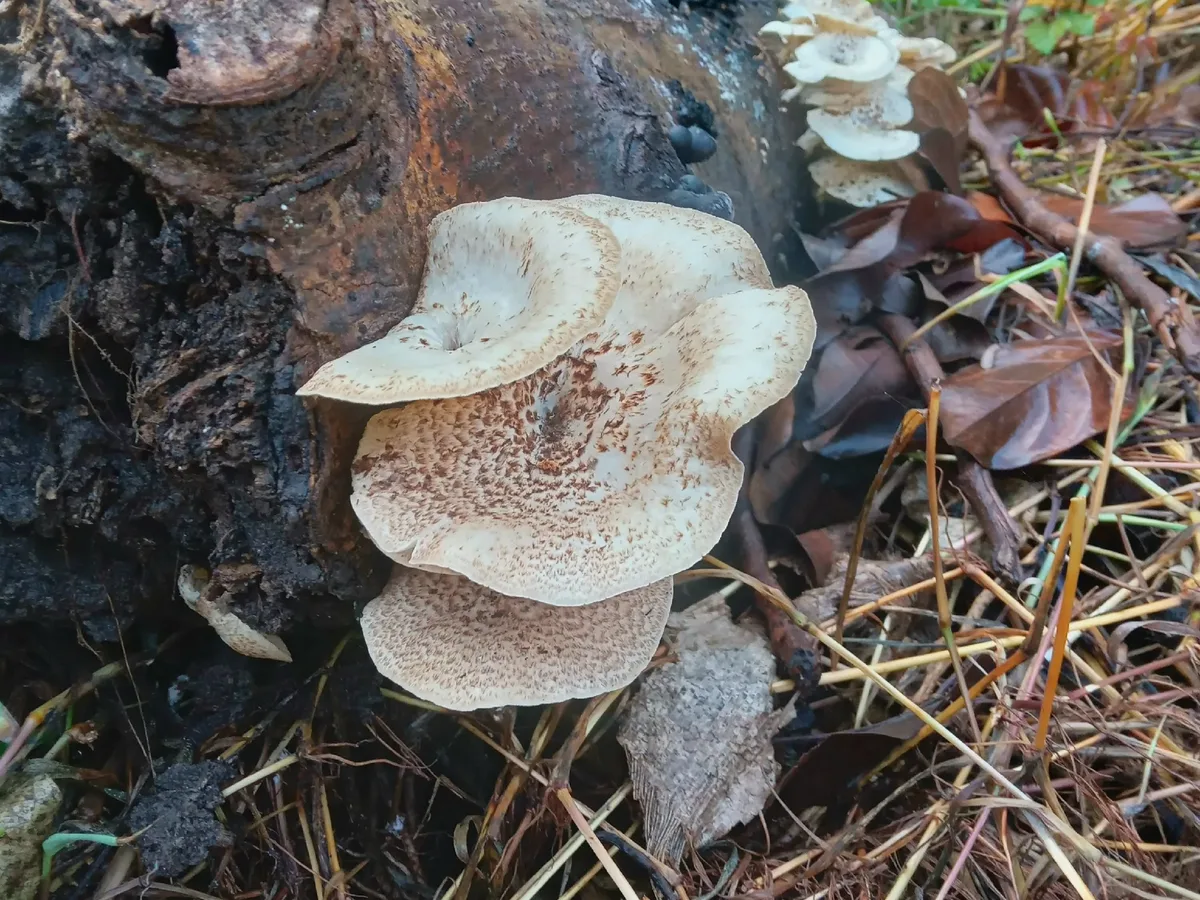
Lentinus squarrosulusA tough wood-rotting mushroom increasingly cultivated in Nigeria and Ghana for food and income.
How to recognise it
Cap funnel- to navel-shaped, pale cream to buff, typically 3-10 cm across, with a surface that develops small upturned scales with age. The flesh is tough and leathery - characteristically so, and an important identification marker. Gills are decurrent (running down the stem), crowded, and whitish. Stem central to slightly eccentric, firm, pale, often darkening toward the base.
Where it grows
A white-rot saprotroph that feeds on dead and dying wood - rotting logs, felled stumps, and exposed or buried roots. Found at forest edges, in open woodland, and around cultivated timber in tropical West Africa.
Cooking
The tough flesh needs thorough cooking to soften - it will not tenderize with a quick sauté. Traditional preparation simmers it in soups and stews, where it absorbs broth and contributes a meaty bite alongside fufu or other starchy sides. It dries well and can be stored and rehydrated later.
Look-alikes
Few dangerous lookalikes; the tough, leathery texture combined with growth on wood is typical of this species.
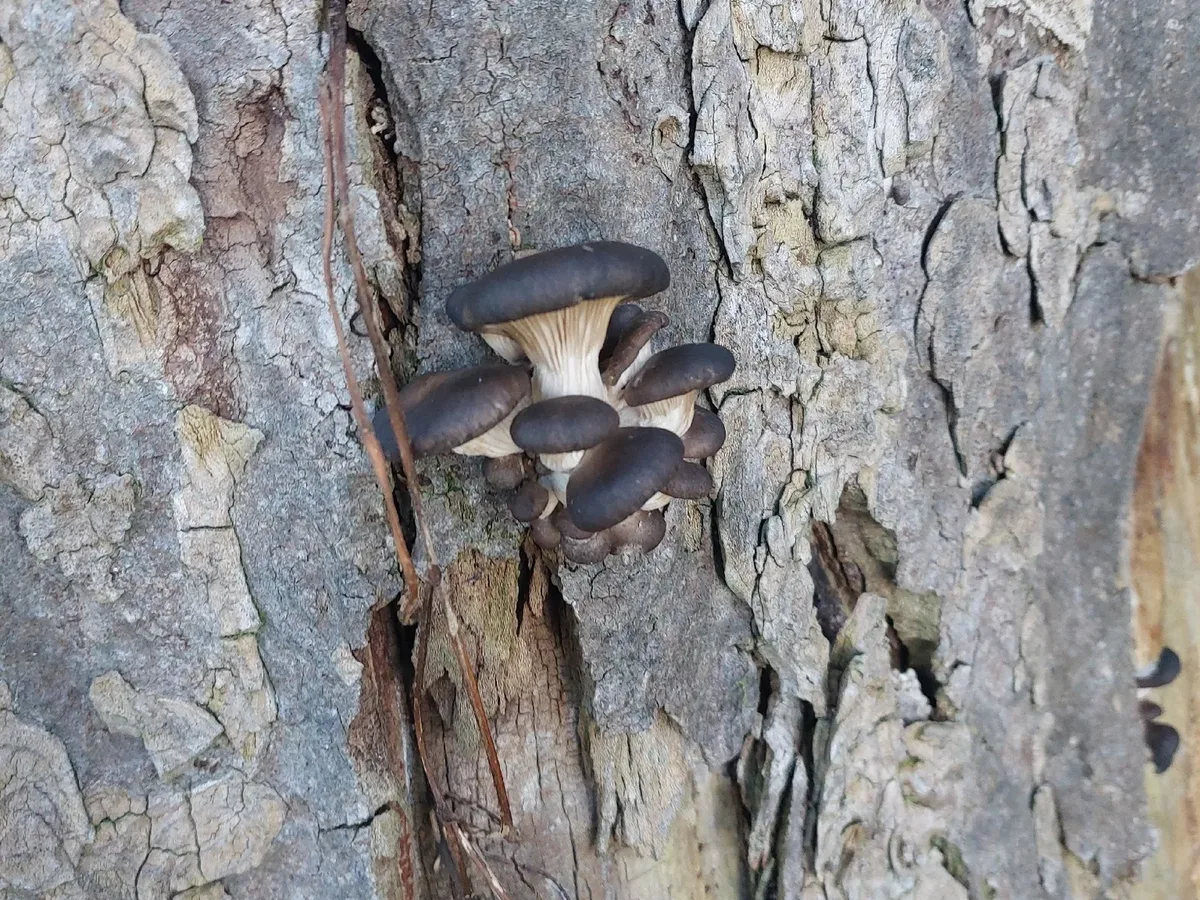 Oyster mushroom
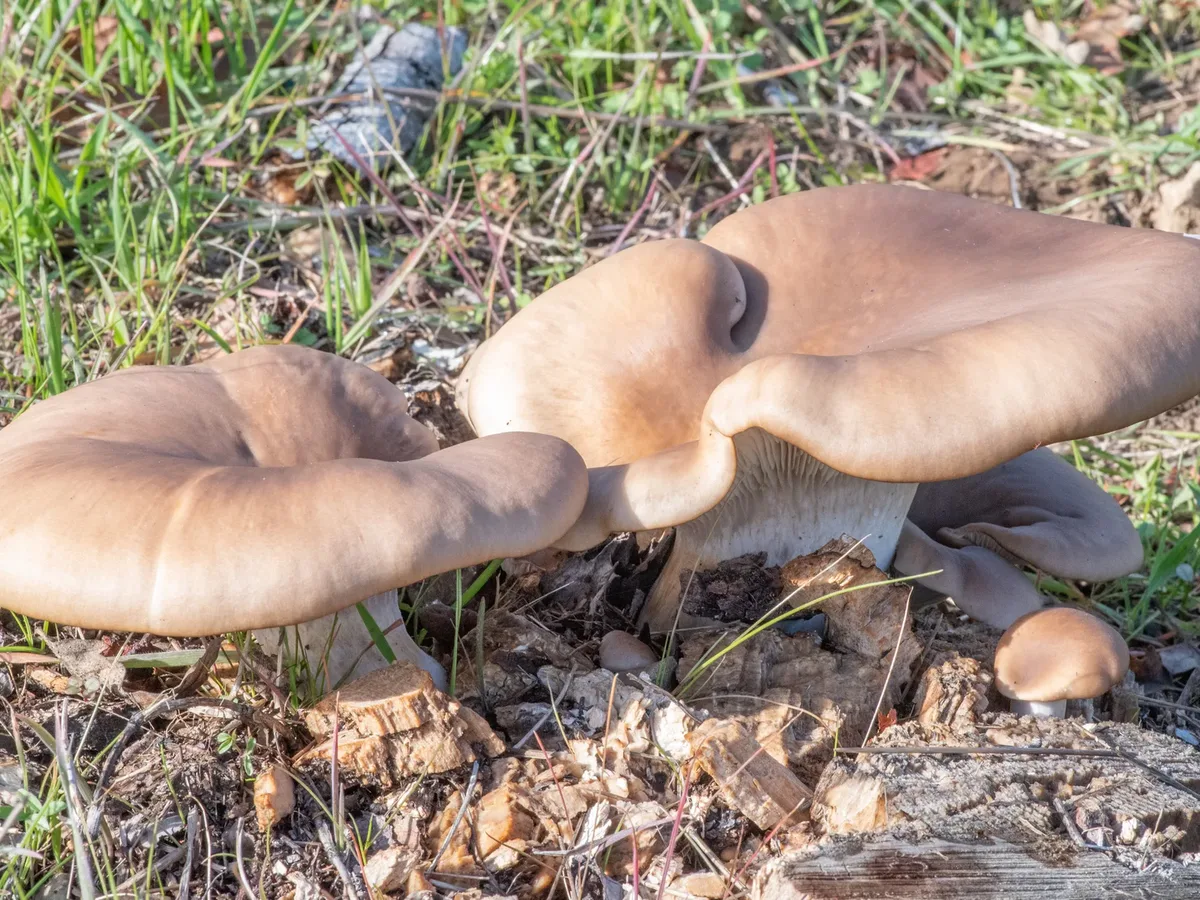 Oyster mushroom
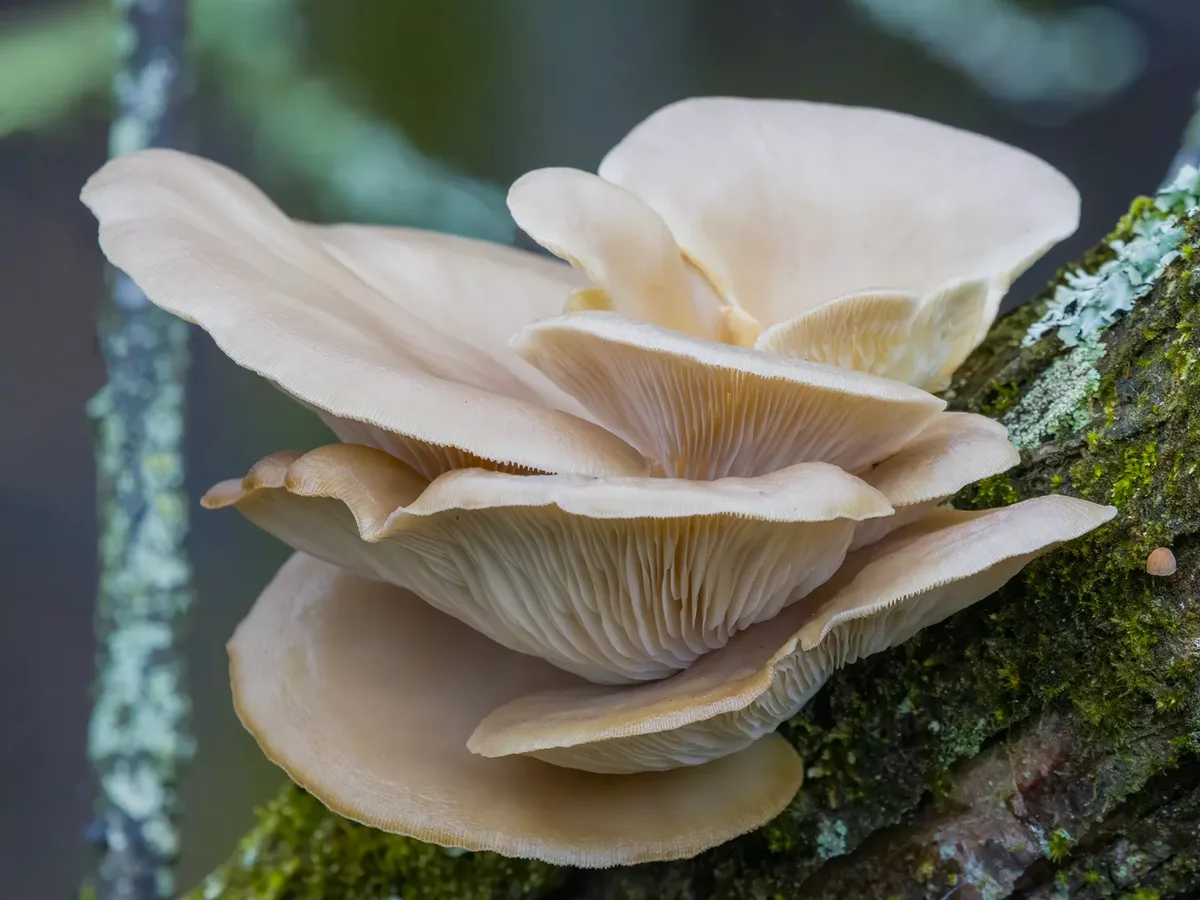 Oyster mushroom
 Oyster mushroomOyster mushroomOyster mushroom
Oyster mushroom
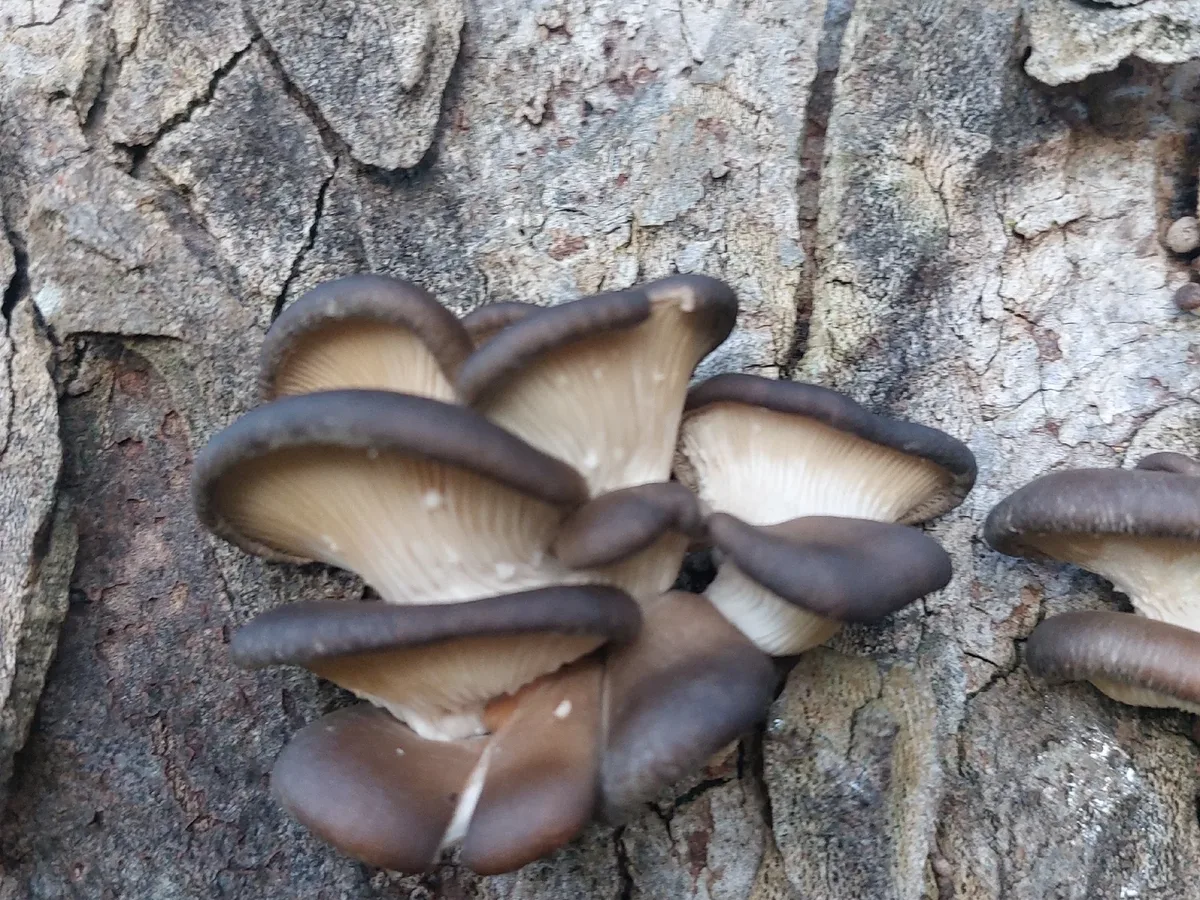
Pleurotus ostreatusEasy and safe to cultivate, it is the most widely farmed edible mushroom in Africa.
How to recognise it
The cap is fan-shaped or oyster-shaped, 5-25 cm across, and ranges from white through pale grey or beige to darker brown depending on light and temperature. White gills run decurrently down the short, often off-centre or absent stem, giving the whole fruitbody a clean, sculpted look. Spore print white to greyish-lilac. Clusters can stack into impressive overlapping shelves on a single log.
Where it grows
Grows on dead or dying deciduous wood - especially beech, oak, birch and poplar - colonising fallen trunks, exposed stumps and standing dead trees. It is rarely found on the ground: if you spot it, look up or look closer for the buried wood beneath.
Cooking
Versatile in the kitchen - fry or sear it for a lightly crisp edge, toss it into stir-fries, or let it simmer into soups and stews. The flavour is mild with a faint seafood undertone; the texture softens readily with heat. Large caps can be sliced; small clusters are good left whole.
Look-alikes
Poisonous; grows in clusters but is orange-coloured and has true luminous (bioluminescent) gills.
Also edible.
Also edible.
Kalahari truffle
Kalaharituber pfeiliiPrized by the San since prehistoric times as 'the eggs of the thunderbird', this desert truffle swells up and cracks the red Kalahari sand after the rains.
How to recognise it
A smooth, potato-shaped truffle that spends its whole life underground, growing up to 12 cm across. The skin is beige to brown; the flesh inside is pale and firm.
Where it grows
Deep red Kalahari sand across Northern Cape South Africa, eastern Namibia, Botswana, and Angola. It lives as a mycorrhizal partner of the tsamma melon (Citrullus lanatus), sorghum, and acacia - a quiet underground alliance in soil that is 94-97% pure sand, mildly acidic at pH 5.5-6.5.
Cooking
Clean thoroughly of sand before cooking - it gets into every crack. From there it is versatile: boiled, fried, or added to stews, much as you would use a European truffle or a firm root vegetable.
Look-alikes
Another Kalahari desert truffle and also edible.
Another Kalahari desert truffle and also edible.
The dangerous ones
West African death cap
Amanita albolimbataThe first confirmed deadly Amanita in West Africa, proven to carry amanitins and phallacidin; never eat any white or pale amanita.
How to recognise it
A pale, whitish-to-greyish Amanita distinguished by a white-bordered (albo-limbate) rim to the sac-like volva at the stem base. It carries the section's diagnostic combination: white free gills, a ring on the stem, and a basal volva. Detailed morphology is still sparsely documented.
Where it grows
Ectomycorrhizal with African woodland trees such as Isoberlinia and Uapaca in the Sudanian and Guinean zones of West Africa, fruiting with the rains.
Cooking
Not applicable - deadly poisonous and never eaten. Cooking, drying and freezing do nothing to the toxin, and even the water it was boiled in is lethal.
Danger
The first Amanita confirmed to cause fatal amatoxin poisoning in West Africa. It grows in the same wooded ground where edible Amanitas ('tente', A. loosii and relatives) are traditionally gathered, so a mistake here is deadly. Data are limited, but its placement in section Phalloideae and confirmed poisonings mark it clearly.
Look-alikes
Introduced into some African planted forests; another deadly amatoxin Amanita with white gills, ring and volva.
Locally gathered edibles of the same woodlands; distinguishing them from the deadly white/grey Phalloideae species is the core skill - when unsure, do not eat.
Harkonen's amanita
Amanita harkonenianaA suspected deadly species from Tanzania and Madagascar, one more reason that a sack-like volva on a pale amanita means leave it.
How to recognise it
A whitish-to-pale Amanita of section Phalloideae bearing the group's lethal signature - white free gills, a ring on the stem and a sac-like basal volva. Its detailed appearance is still poorly documented, which is itself a reason for caution.
Where it grows
Ectomycorrhizal with miombo woodland trees (Brachystegia, Uapaca) in Tanzania and Madagascar, fruiting with the rains.
Cooking
Not applicable - deadly poisonous and never eaten. Cooking, drying and freezing do nothing to the toxin, and even the water it was boiled in is lethal.
Danger
Placed in the deadly Phalloideae section and suspected to carry amatoxins, it grows in the miombo woodlands where edible wild Amanitas are a staple - exactly the setting where a deadly look-alike is most dangerous. Because it is so little studied, treat any unidentified white or pale Amanita here as potentially lethal.
Look-alikes
Introduced in some African plantations; a confirmed deadly amatoxin Amanita of the same section.
Widely eaten in the region; telling them from the deadly pale Phalloideae species demands local expertise - when in doubt, leave it.
 Death cap
 Death cap
 Death capDeath capDeath cap
Death cap
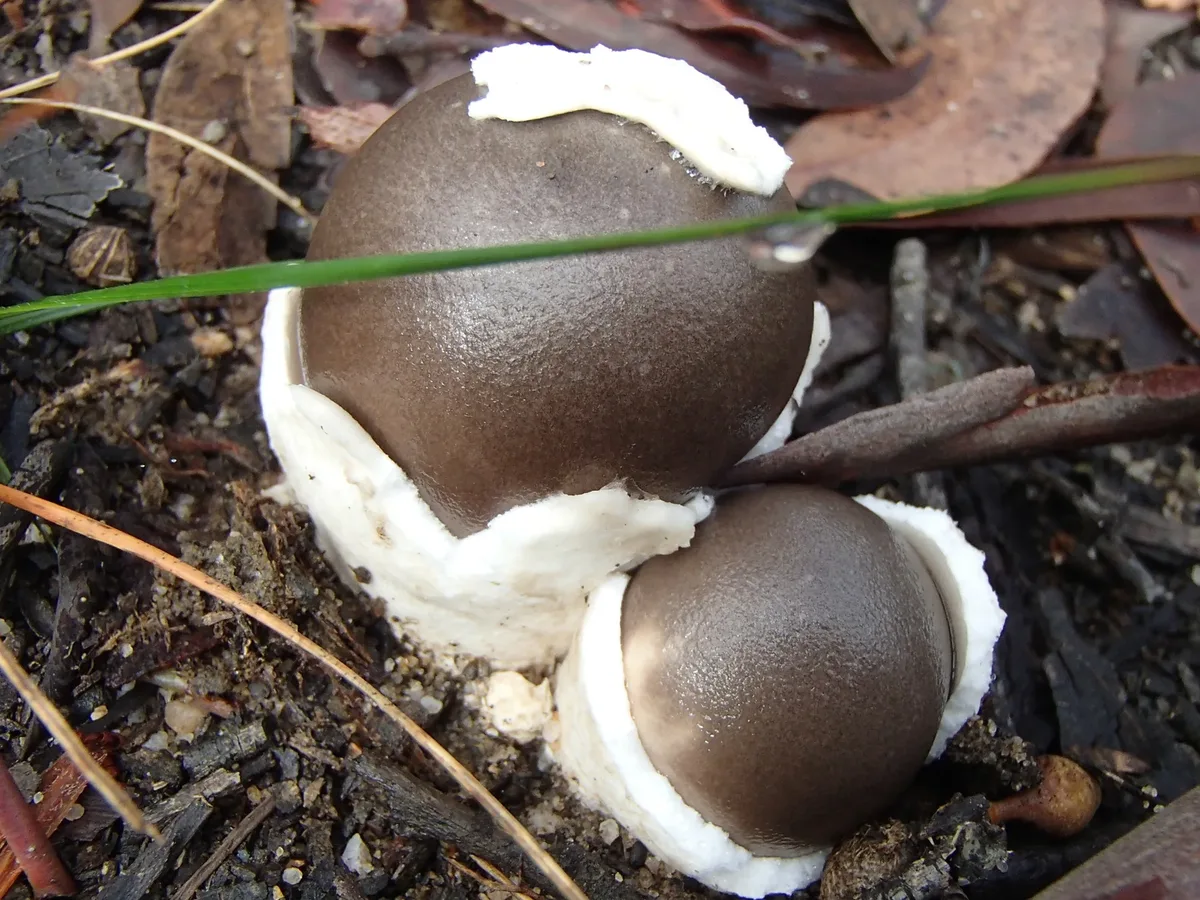
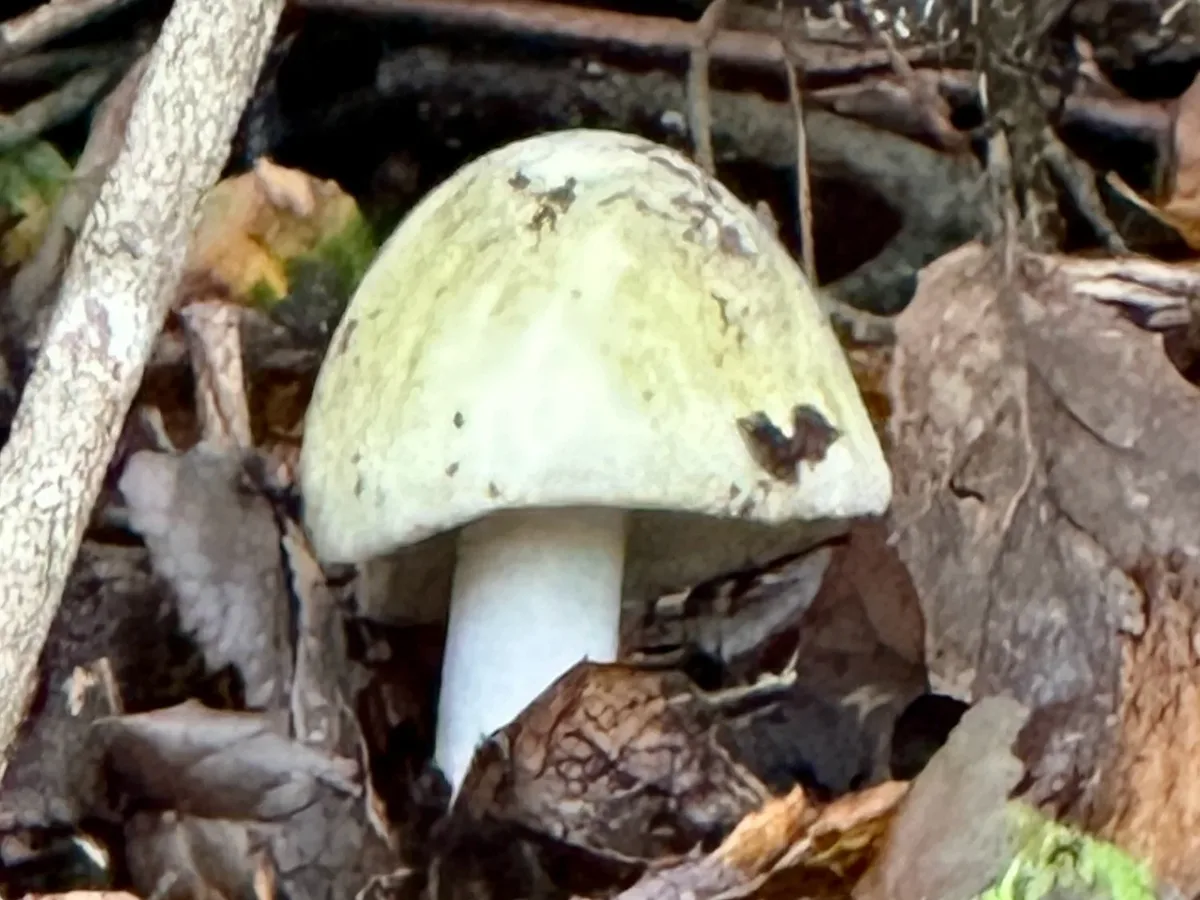
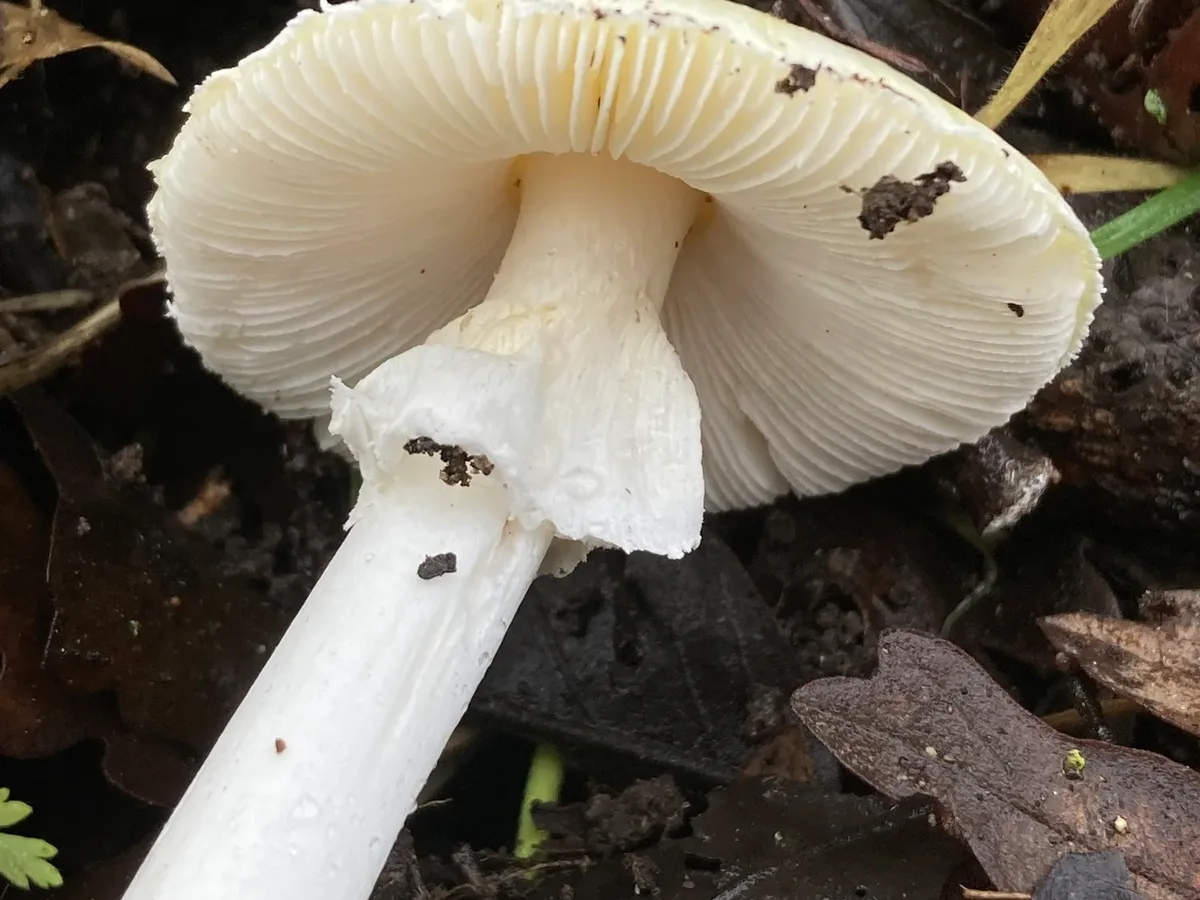
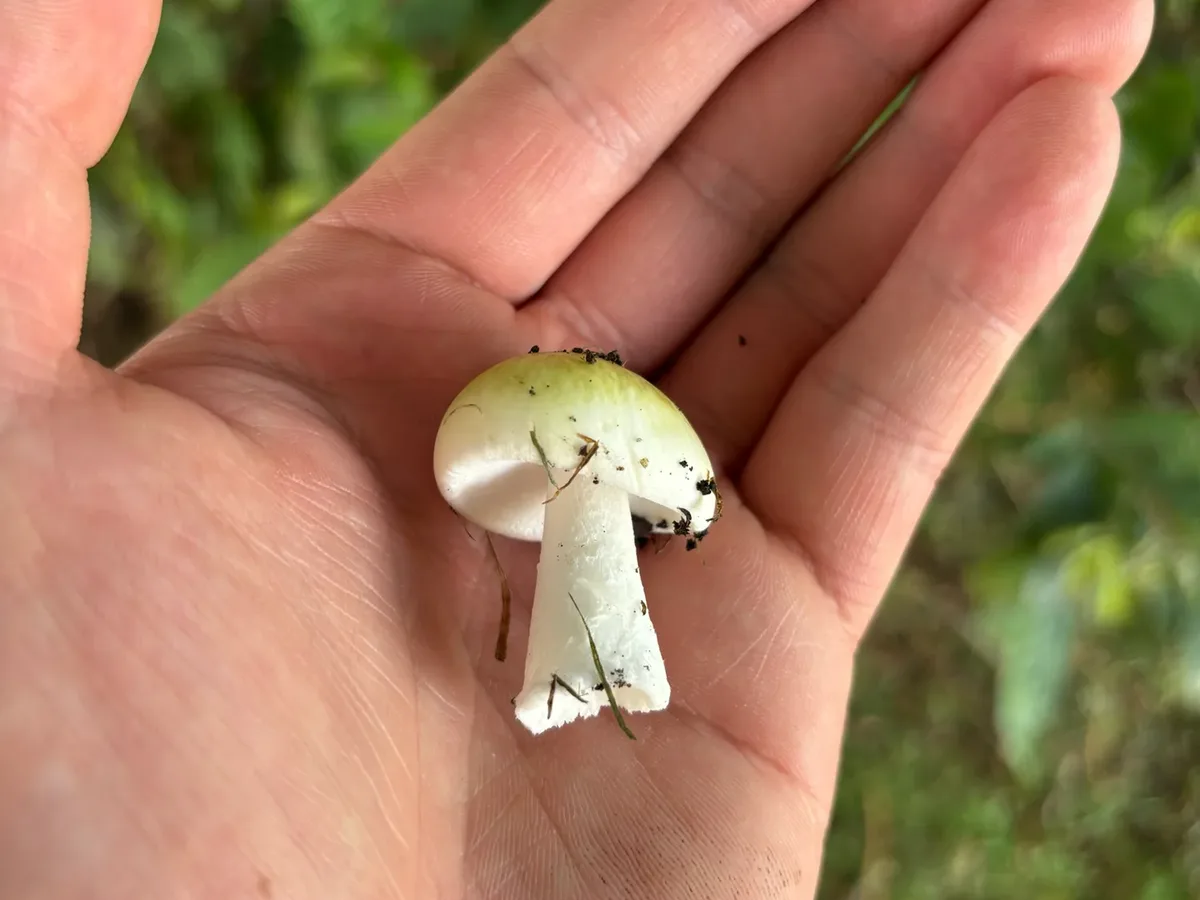
Amanita phalloidesNot native to most of the region, but introduced under exotic plantation trees around Cape Town, where it has killed.
How to recognise it
Cap 40-160 mm, hemispherical, becoming convex, then flat, smooth, slimy in wet conditions and glossy when dry; most often pale yellow/greenish to pale brown, but can be almost white (colour is not a reliable feature). White gills, a white stem, a membranous ring, and a sac-like volva at the base. Amyloid spores (white spore print).
Where it grows
Found only under exotic/introduced trees, especially oak (Quercus), also in gardens, lawns and parks. In Australia it has only been recorded in SA, Victoria and the ACT (Canberra). In Victoria it is widespread across Melbourne (Kew, Camberwell, South Yarra and others) and regionally (Bendigo, Bright, Castlemaine). In New Zealand it grows under introduced oaks and chestnuts; it has also been reported in association with Leptospermum/Kunzea (potentially invasive). There are no confirmed finds in undisturbed native forest.
Cooking
Not edible under any circumstances. The toxins are not inactivated by cooking, drying, freezing or soaking.
Danger
World's deadliest mushroom; as little as half a cap can kill an adult human. Documented fatalities: Canberra, New Year's Eve 2011/2012 - cook Liu Jun picked death caps in Braddon (mistaking them for straw mushrooms) and put them in a stir fry; he and the kitchen hand Tsou Hsiang (a 52-year-old Chinese national) died, of four poisoned. According to the Canberra Times there have been in total "four fatalities and 12 reported incidents of poisoning associated with death cap mushrooms in the ACT". Of nine poisoned in the Canberra region 1988-2011, three were from Laos and two from China. Leongatha, Victoria, July 2023: Erin Patterson, 50, served death caps in individual Beef Wellingtons; Don Patterson, Gail Patterson and Heather Wilkinson died, while Ian Wilkinson survived. She was convicted on 7 July 2025 of three murders and one attempted murder, and on 8 September 2025 sentenced by Justice Christopher Beale to three concurrent life sentences with a 33-year minimum (plus 25 years for the attempted murder), parole no earlier than 2056; Beale found the murders required "substantial premeditation" and an "elaborate cover-up". (The conviction is under appeal.)
Look-alikes
The fully white form of the death cap resembles the white Amanita; both are deadly. Treat any white gilled mushroom with a ring and a sac-like volva as lethal.
Edible Asian mushroom that has caused several deaths among East/Southeast Asian migrants through confusion with the death cap. Both have a volva; check gill colour (straw mushroom develops pink to brown gills and a pink spore print, whereas the death cap has white gills and a white amyloid spore print).
Edible Amanita that can be confused with the death cap; distinguish by colour and spore features, but never rely on colour alone.
Agaricus species have pink-to-brown gills and a dark spore print and lack a volva, whereas the death cap has white gills, a white spore print and a sac-like volva at the base.
Native species (A. austrophalloides, A. marmorata, A. murina, A. murinaster) with a sac-like volva, ring and amyloid spores are untested but likely toxic; do not eat.
Young death cap buttons resemble Agaricus and puffballs, but Agaricus has pink to chocolate-brown gills, a brown spore print and no volva; the death cap always has white gills, a white spore print and a sac-like volva.
The green/greenish-yellow death cap form can be confused with green Russula species; check for the white free gills, ring and sac-like volva, which Russula lacks.
Russulas lack a volva and a ring; always dig up the base to check for the sac-like volva and look for the skirt-like ring and white free gills of the Death Cap.
Agaricus has pink to brown gills (not white) and no volva; the Death Cap has white free gills and a sac-like volva at the stem base.
Agarics lack a sac-like basal volva and have pink-to-brown gills and a brown spore print; the death cap has white free gills, a white spore print, and a volva in the soil.
The pale form of the death cap can be mistaken for puffballs; cutting a puffball reveals uniform white flesh, whereas a young death cap button shows the outline of a developing capped mushroom.
Green russulas lack a ring and volva and have brittle flesh.
Easily confused at the young, egg-like stage; always dig up the base and check the diagnostic combination of white gills + white ring + white sac-like volva.
Field mushrooms have pink to brown gills (not the death cap's white gills) and lack a basal volva/sac.
Distinguished by the death cap's combination of ring plus volva and its olive-green cap colour.
Young egg-stage Death Caps can resemble puffballs; always slice any 'puffball' in half - a developing mushroom with cap, gills and stem inside means it is not a puffball.
In Chile, warnings are given about confusing the death cap with Macrolepiota; look for the death cap's volva, ring and greenish cap with white gills.
In Chile, warnings are given about confusion with Russula; Russula lacks a ring and volva.
In Chile, warnings are given about confusion with Agaricus; Agaricus has a ring but no volva and develops pinkish-to-brown gills with a brown spore print, unlike the death cap's persistently white gills.
In Chile, warnings are given about confusion with Tricholoma; Tricholoma lacks the ring and volva of the death cap.
Locally eaten edible Amanita (also A. loosii); the central confusion in African ethnomycology - the deadly white Amanita are mistaken for these.
An unopened white egg-stage deadly Amanita can resemble a puffball; cut it in half - a developing capped mushroom outline reveals the Amanita.
A globally risky lookalike that also has a volva; check for the ring (present in Amanita, absent in Volvariella) and spore colour (white in Amanita, pinkish in Volvariella).
Same deadly section (Phalloideae) by appearance but lacks the toxins and is eaten locally in Rwanda/Burundi/Tanzania; cannot be told apart by eye alone, underscoring why species-level knowledge is essential.
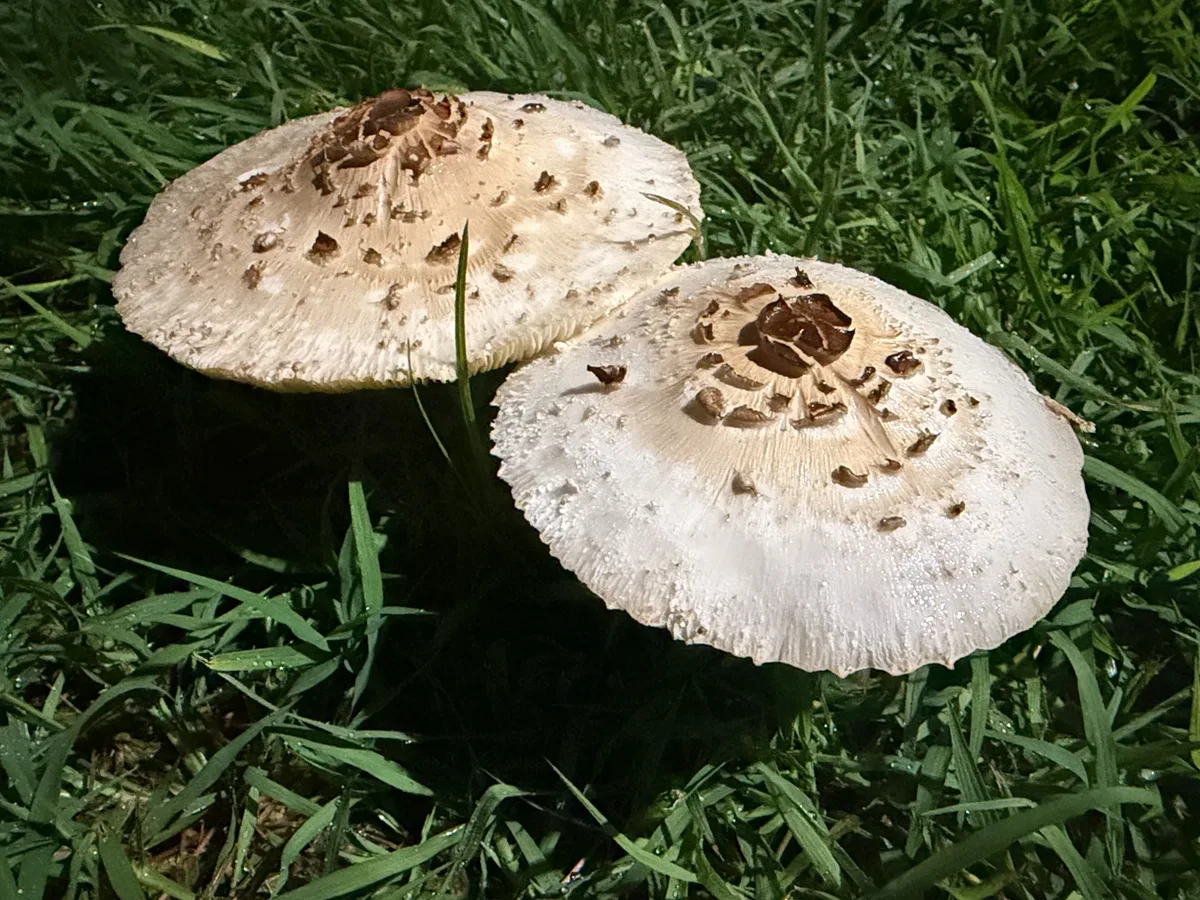 Green-spored parasol
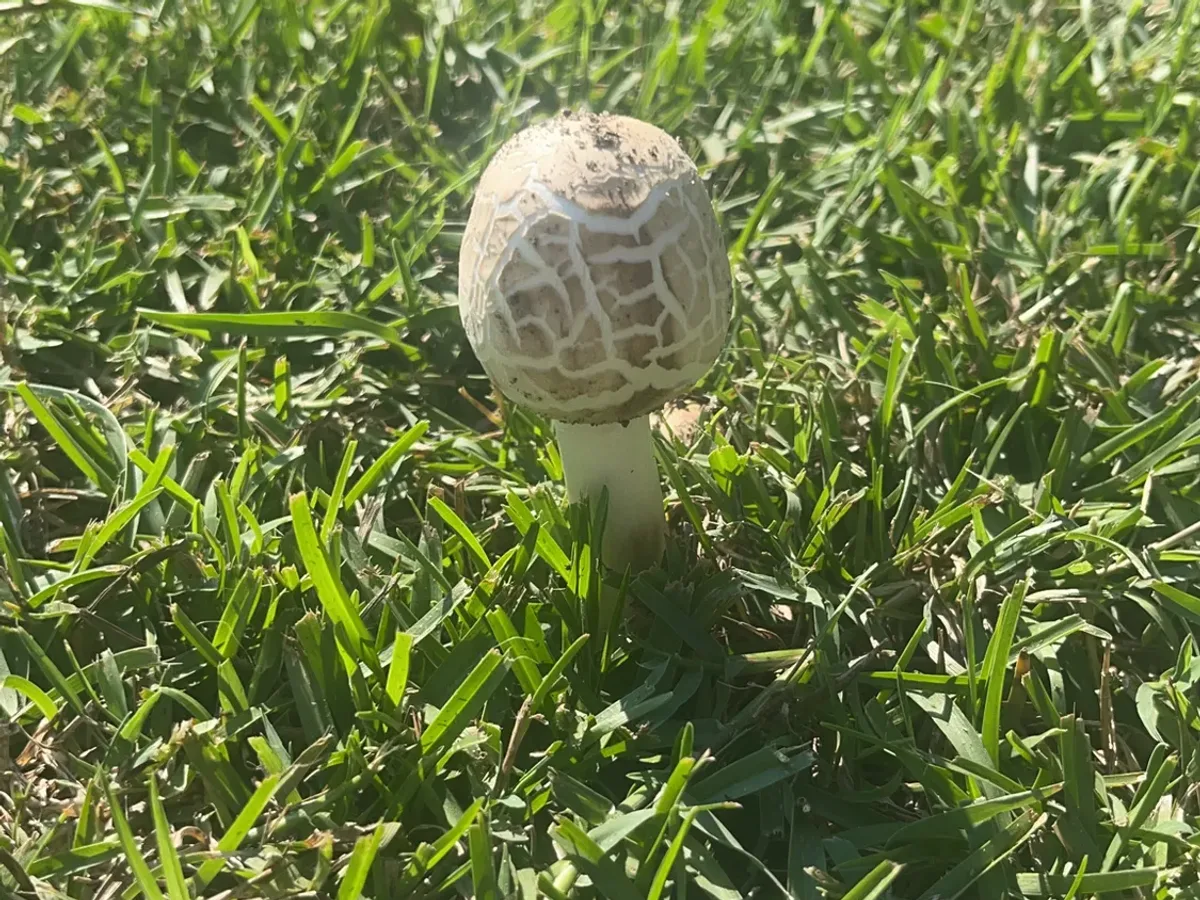 Green-spored parasol
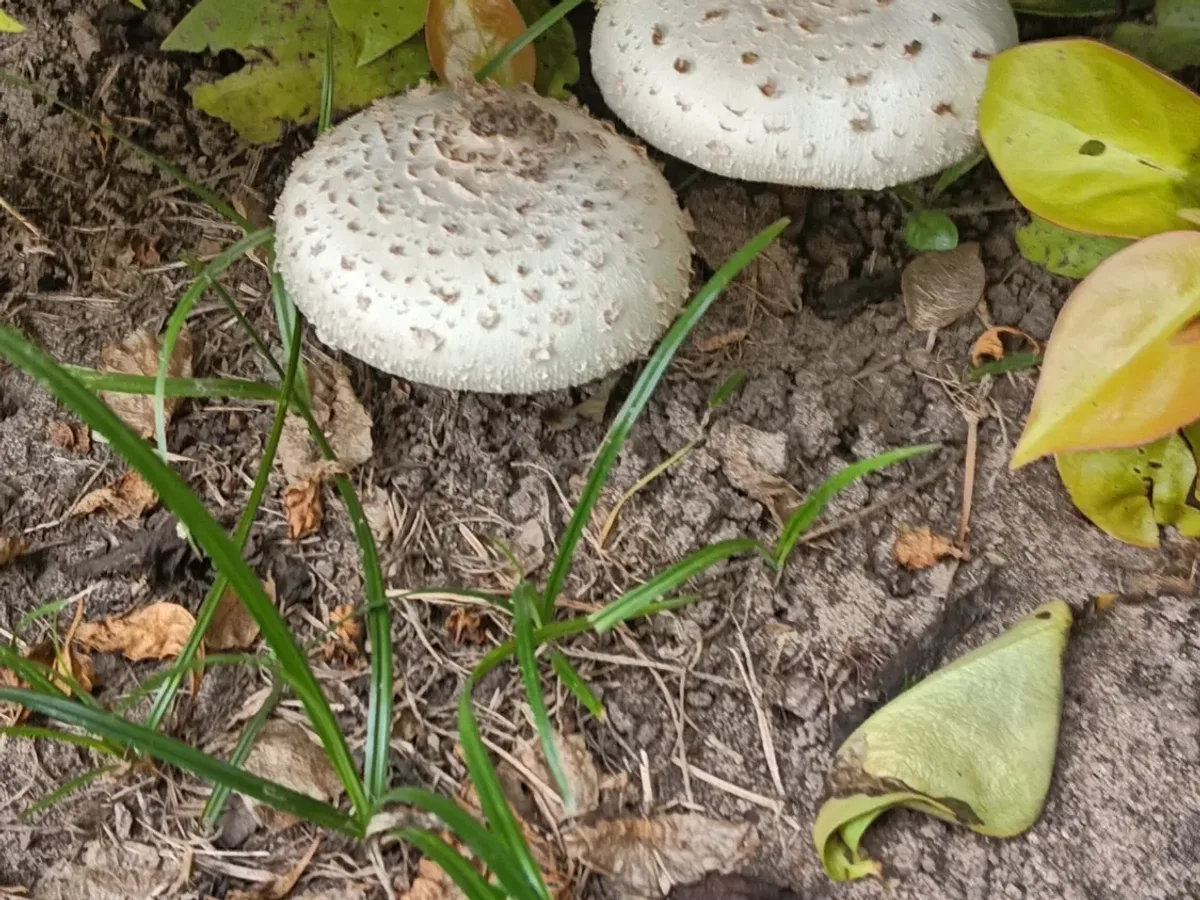 Green-spored parasol
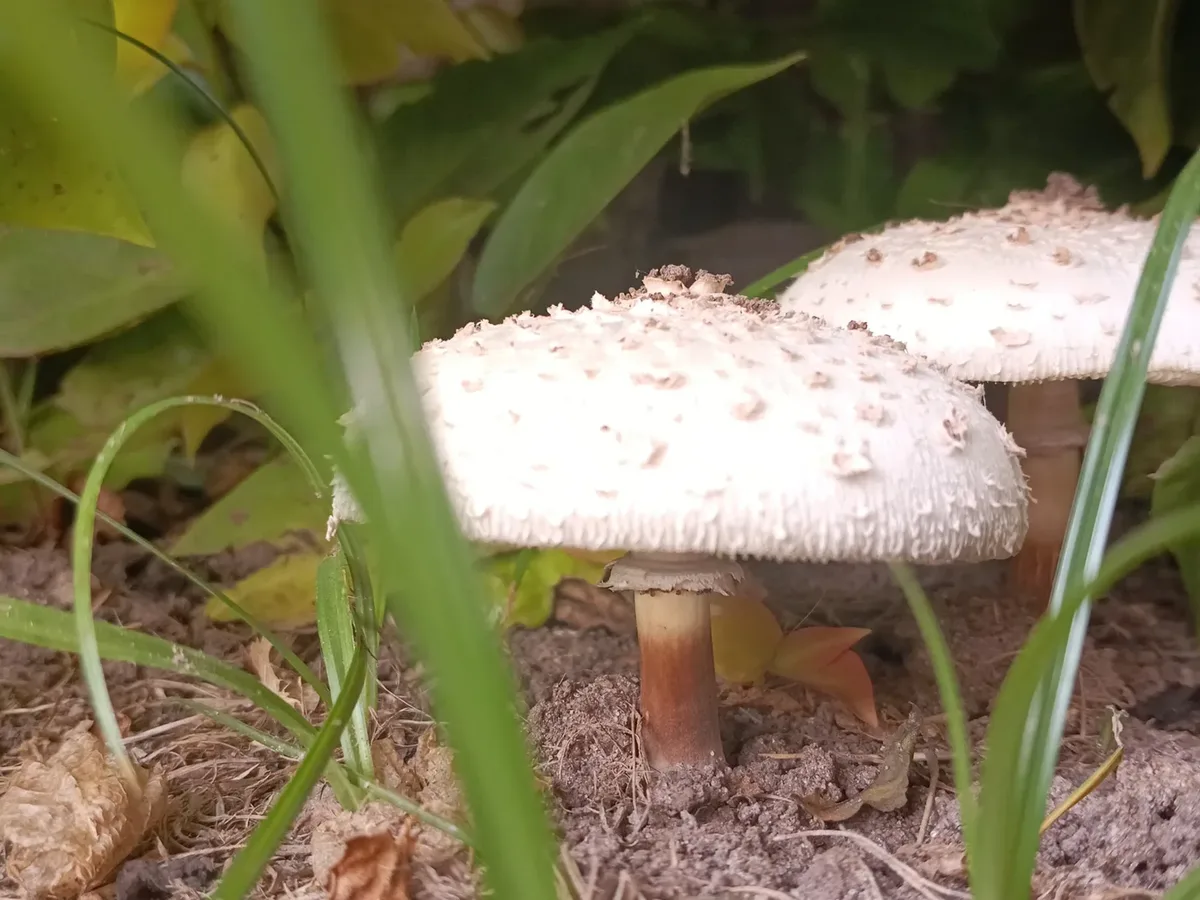 Green-spored parasolGreen-spored parasolGreen-spored parasol
Green-spored parasol (the vomiter)
Chlorophyllum molybditesMimics young Termitomyces and edible parasols, but a greenish spore print gives it away; always take a spore print when in doubt.
How to recognise it
Large, stately, white cap with brown scales toward the center, at first drumstick-shaped then broad and flat. The gills are white in young specimens but turn grayish-green to green at maturity, and the spore print is green (very unusual, diagnostic). Free gill attachment, ring around the stem. The flesh may blush faintly. Often grows in fairy rings on lawns.
Where it grows
Lawns, pastures, parks, open grassy surfaces, and near human habitation. Common in Florida and the southeastern/southern USA, less common in the north.
Cooking
Not applicable - poisonous even when cooked.
Danger
Causes the most mushroom poisonings in North America, leading to severe gastrointestinal distress, sometimes with blood in the vomit and excrement. Rarely fatal, but children, the elderly, and pets can become seriously dehydrated and need hospital care. Especially risky because it grows where children and dogs play.
Look-alikes
The edible parasol has white gills and a white spore print; Chlorophyllum molybdites develops grayish-green to green gills and a green spore print at maturity.
The shaggy parasol has white gills and a white spore print, not the green gills/green spore print of Chlorophyllum molybdites.
Shaggy mane gills turn black and deliquesce (dissolve into ink) rather than turning green, and it produces a black spore print.
The green spore print distinguishes C. molybdites from related Chlorophyllum species.
Edible termite-associated mushrooms; confusion documented especially in Asia, and considered a risk even for T. titanicus per field guides. Check for the green spore print of C. molybdites.
True parasol mushrooms have a white spore print and white gills; Chlorophyllum molybdites has a greenish to grey-green spore print and greenish gills in age.
Distinguish by spore print colour and the presence of a stem ring (Volvariella lacks one and has a volva).
 Panther cap
 Panther cap
 Panther capPanther capPanther cap
Panther cap
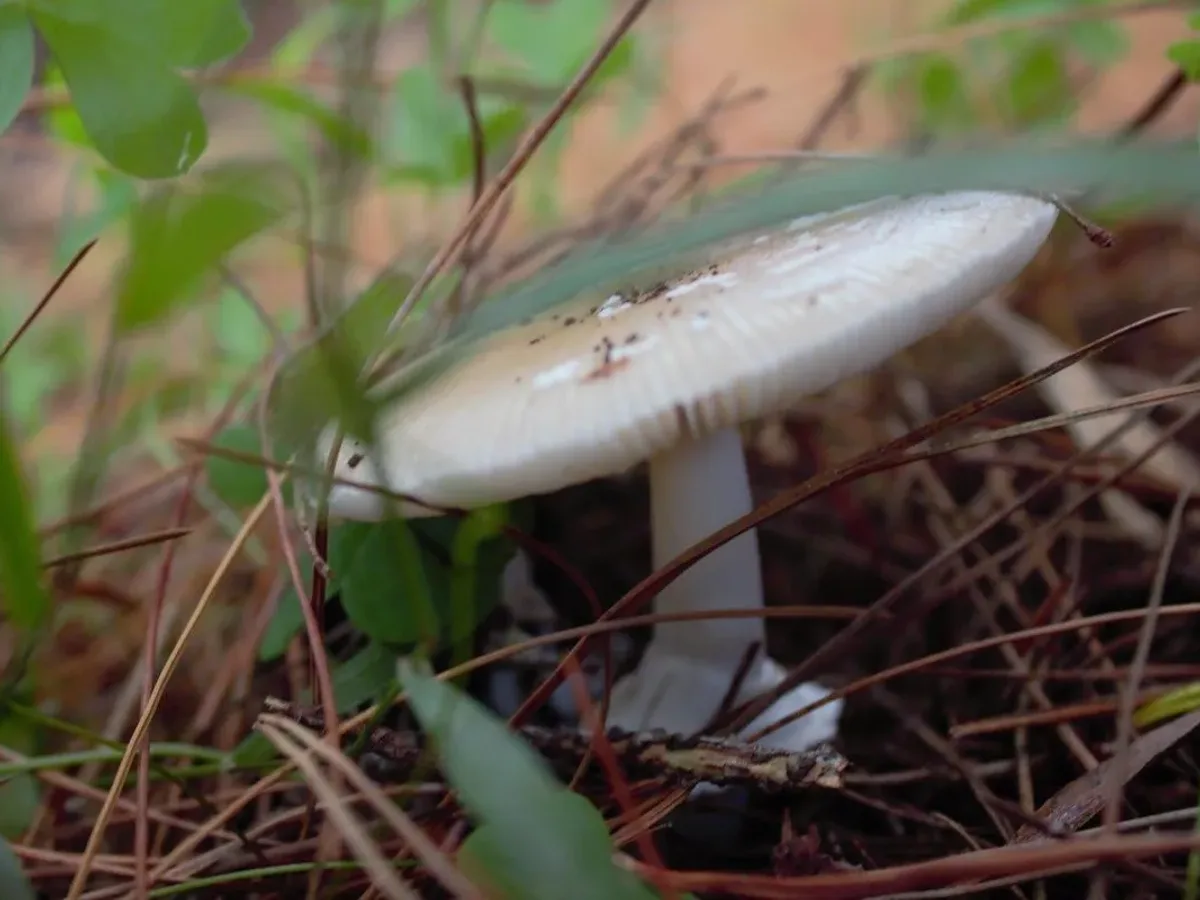
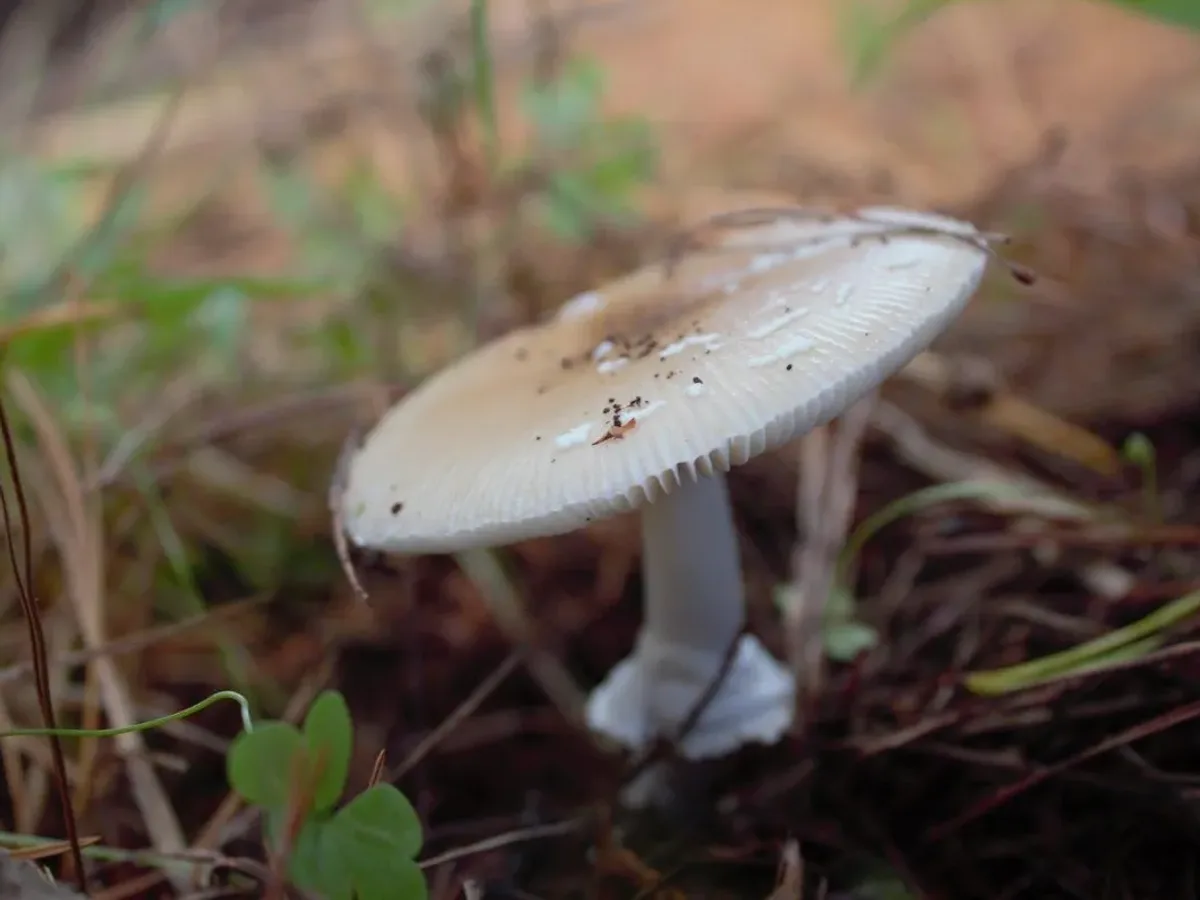
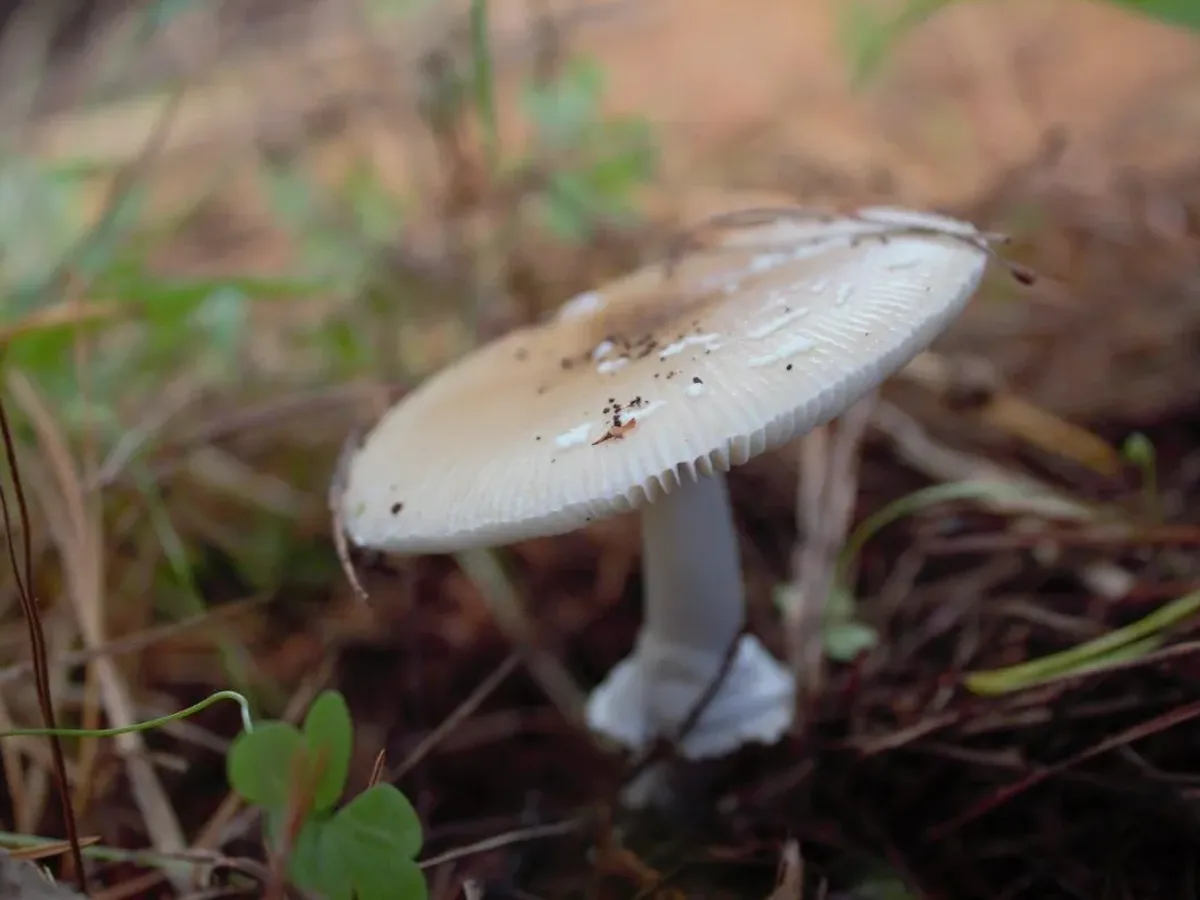
Amanita pantherinaA brown cap with white warts and a ringed base; its neurotoxins bring confusion, hallucinations and sometimes coma.
How to recognise it
Cap 5-12 cm, brown to grey-brown, dotted with clean bright-white spots - fragments of the universal veil left behind as the cap expanded. The margin is distinctly grooved (striate). Gills white, crowded. Stem white, ringed, with a collar-like, sharply rimmed volval ring encircling the bulbous base. Spore print white.
Where it grows
Grows in woodland, forming mycorrhizal partnerships with deciduous and coniferous trees - beech and oak especially. Has a preference for calcareous (lime-rich) soils.
Cooking
The panther cap must never be eaten. No cooking method - boiling, parboiling, drying, frying, or any other preparation - reliably removes or neutralises its toxins. The principal toxins are ibotenic acid and muscimol, both water-soluble isoxazole compounds that act on glutamate and GABA receptors in the brain. Some ibotenic acid converts to muscimol during cooking or drying, but the total psychoactive and toxic load is not reduced to a safe level; indeed, partial conversion can make the preparation more potent. Critically, the panther cap contains significantly higher and more variable concentrations of these toxins than the superficially similar fly agaric (Amanita muscaria), meaning a dose that might cause only mild symptoms in one individual can cause severe poisoning - confusion, agitation, hallucinations, convulsions, or coma - in another. There is no antidote. Treatment in hospital is supportive. Discard any specimen and wash your hands after handling it.
Danger
Contains higher and more variable levels of ibotenic acid / muscimol than the fly agaric (Amanita muscaria). Rarely fatal but serious. Most poisonings are accidental.
Look-alikes
White/pale Amanita with a volva should be left alone; deadly amatoxin-containing Amanita are responsible for most lethal mushroom poisonings. Introduced to South African plantations with exotic trees.
Edible Amanita with which the panther cap is most often confused unintentionally; distinguished by its overall reddening flesh rather than the panther cap's clean white spots on a brown cap with striate margin and collar-like volva.
An edible Amanita that can be confused with the panther cap.
Rule of thumb: dark scales on a light background = parasol; light (white) patches on a dark background = Amanita (panther cap).
Edible Caesar-type Amanita are confused with A. pantherina; the panther cap has white warts (which can wash off in rain), a ring, and a ringed/concentric stem base.
 Fly agaric
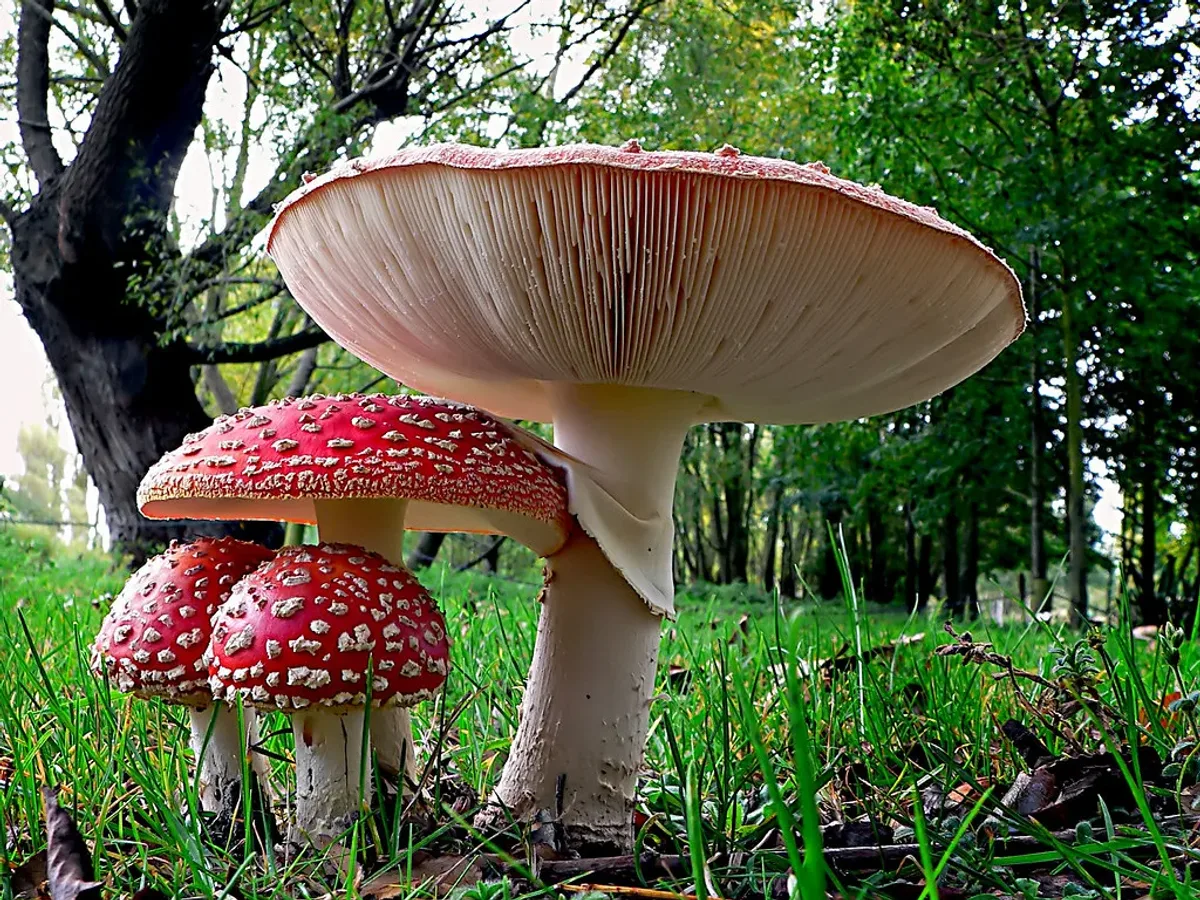 Fly agaric
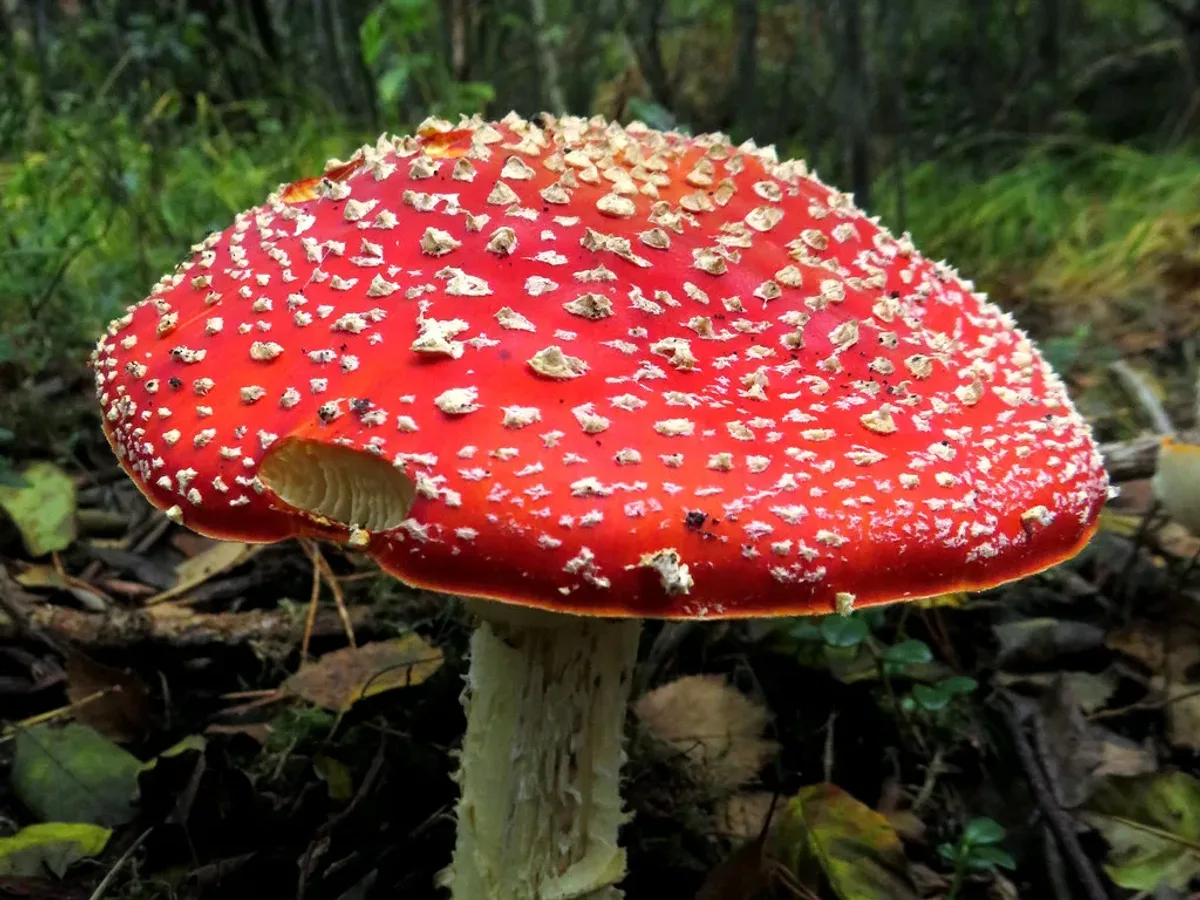 Fly agaricFly agaricFly agaric
Fly agaric
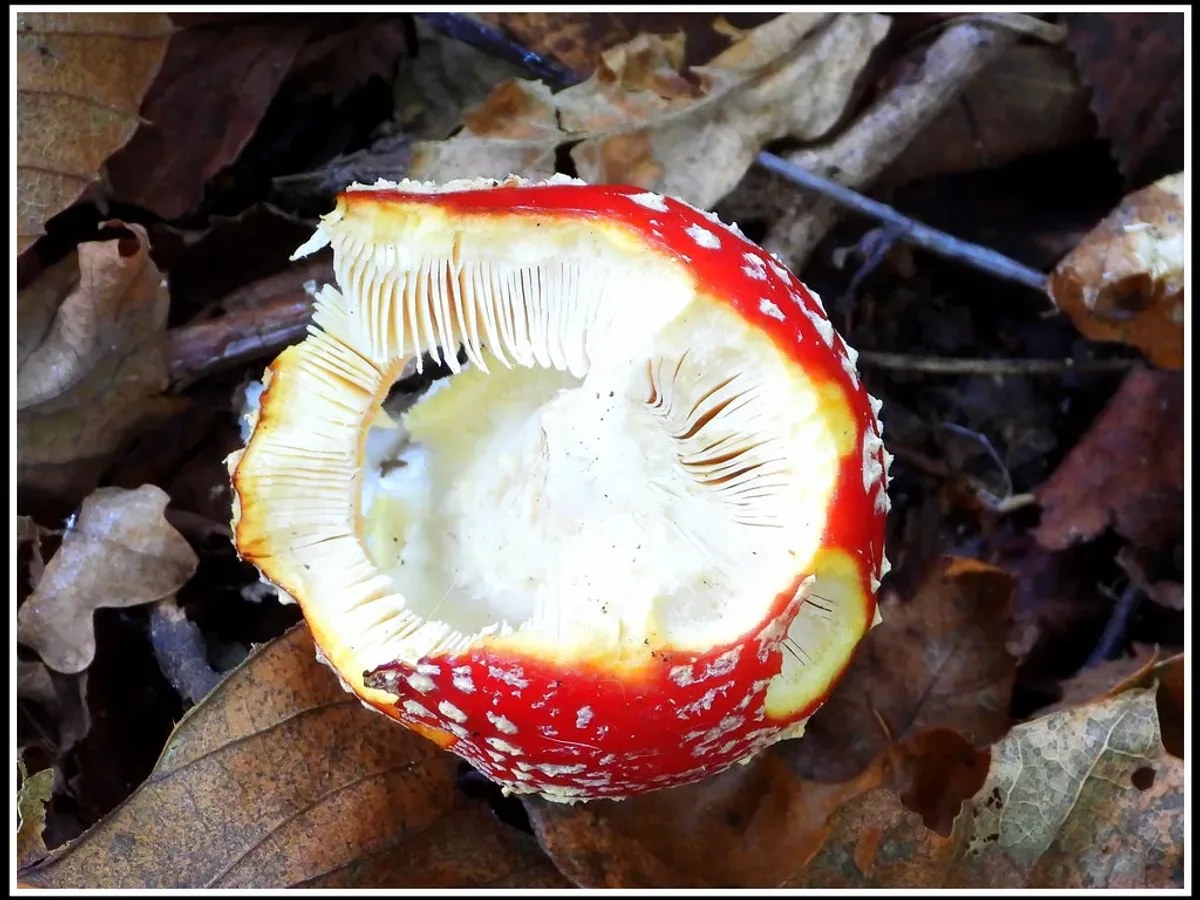
Amanita muscariaThe classic warted amanita; never eat any amanita bearing warts on the cap.
How to recognise it
Cap 8-20 cm, vivid red with white warts that can be washed off by rain or simply fade with age, leaving a plain orange-red cap. White gills, white stem with a pendant ring, and a white bag-like volva at the base. Young specimens emerge as white "eggs" wrapped in a universal veil before the red cap breaks through.
Where it grows
Introduced to Australia and New Zealand alongside pine and birch plantations, where it has since formed mycorrhizal relationships with native southern beech (Nothofagus, including Myrtle Beech N. cunninghamii) in Victoria, Tasmania and New Zealand - spreading into ecosystems it was never meant to reach and displacing native fungi as it goes. Range is expanding northwards (towards Port Macquarie, NSW); also found under silver birch in Manjimup, WA (2010).
Cooking
None - poisonous/psychoactive.
Danger
Deaths extremely rare. Easy to recognise, so poisoning is uncommon.
Look-alikes
The guide advises beginners to avoid the entire Amanita genus; faded specimens of the fly agaric can mislead the inexperienced, and the genus includes deadly amatoxin-containing species.
Native Australian species, eucalyptus-associated, lacking white warts and a ring.
Caesar's mushroom (edible, southern Europe) has a yellow cap, yellow gills and yellow stem; a young rain-washed fly agaric lacking warts could theoretically be confused with it, but the fly agaric has white gills and white stem.
At the button stage the fly agaric is a white ball that can resemble a puffball; cut it lengthwise to reveal the developing cap, gills and stem of the agaric.
Brown cap with white warts, ring, and banded volva; the more toxic of the two and can be confused by inexperienced foragers with edible grey- or brown-capped species.
The red color plus white warts plus a volva at the base distinguish the fly agaric; rely on these warning features even when the cap color has faded.
The rules that save lives
- Never eat a white or pale Amanita, and never pick Amanita on your own; if you cannot clearly see the volva and ring and take a spore print, leave it.
- Go with an experienced local gatherer: the orally handed-down knowledge of where and which species is invaluable, and it differs from region to region.
- If you move to a new area, assume your old species knowledge no longer applies, as misidentification rises when people relocate.
- Take a spore print at the least doubt with any parasol-like mushroom: a green print means Chlorophyllum molybdites, so discard it.
- Never give wild mushrooms to small children without fully certain identification, as children suffer worst from Chlorophyllum dehydration.
- Dry surplus in the sun for the dry season, and parboil bitter Lactarius or Russula, pouring the water away.
- If amatoxin poisoning is suspected, seek medical care IMMEDIATELY even without symptoms: the course is delayed and treacherous, and cooking or drying does not destroy the toxin.