Panther cap
Amanita pantherinasyn. Amanita muscaria, Inocybe spp., Omphalotus
 © Роман D. (CC BY)
 Jean-Max Van Pul (CC0)
 Jean-Max Van Pul (CC0)
 Jean-Max Van Pul (CC0)
 Jean-Max Van Pul (CC0)
 Jean-Max Van Pul (CC0)© Роман D. (CC BY)Jean-Max Van Pul (CC0)
Toxic - and the most serious cases can be fatal. Never eat it, and wash your hands after handling.
Never eat a mushroom you are not 100% sure of - check the look-alikes below, and always cook wild mushrooms.
How to recognise it
Cap
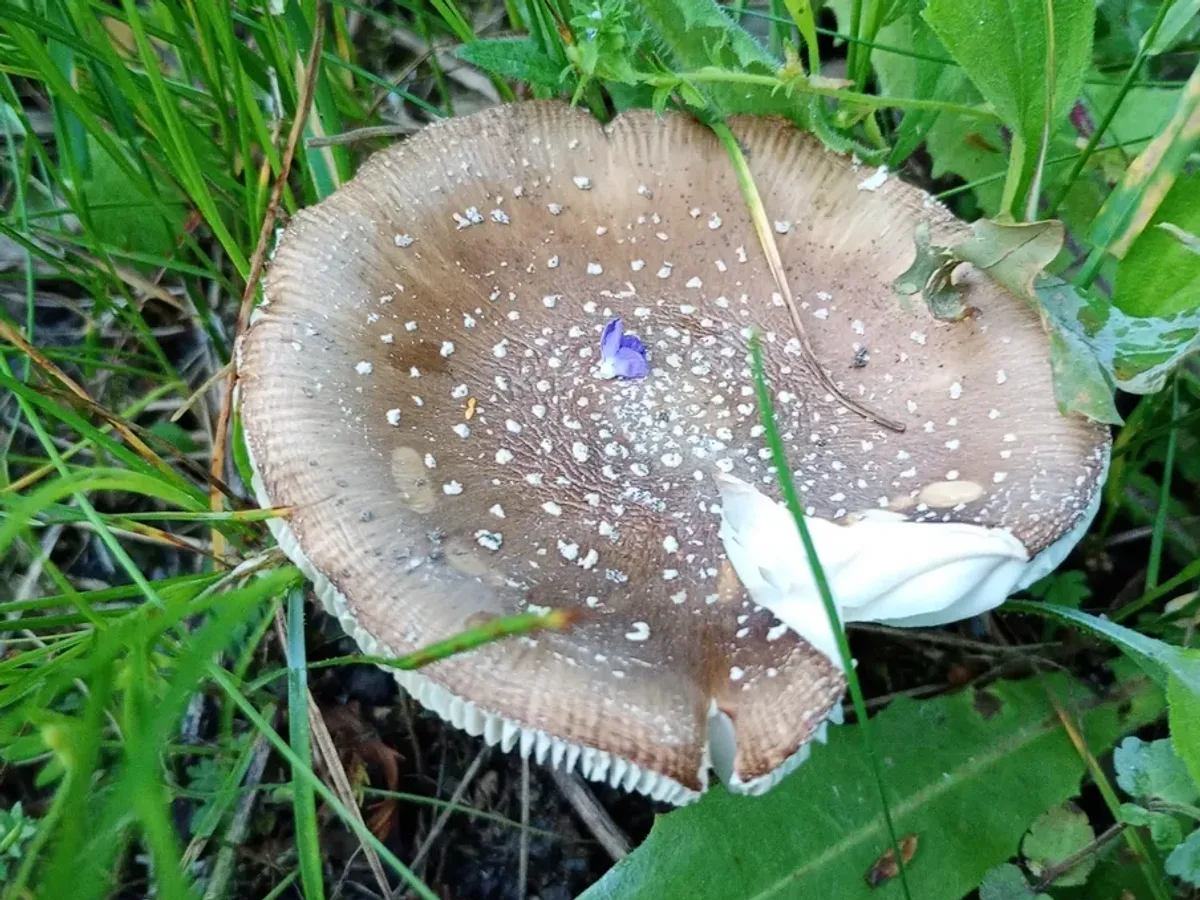
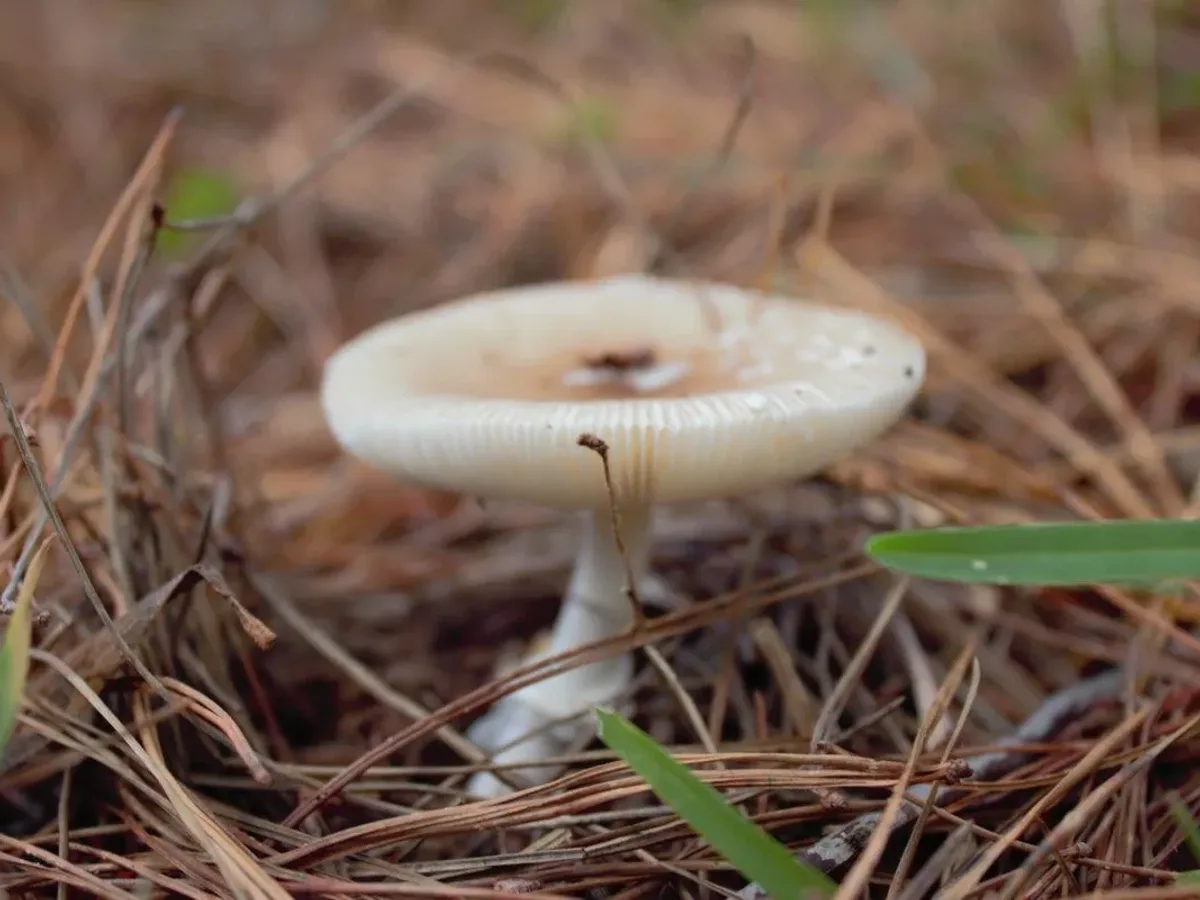
Opens from a rounded egg shape to broadly convex or nearly flat at maturity, spanning 5-12 cm across. The ground colour is a rich, saturated brown to grey-brown - sometimes described as tawny or umber - consistent across the whole surface and notably uniform compared to the more variable blotching of A. rubescens.
Scattered across this background are small, neat, bright-white warts: the remnants of the universal veil, a membranous sheath that once enclosed the entire young fruitbody like an egg. These spots are clean, roundish, and sit as distinct separate patches rather than the fibrous, brownish scales seen on parasol mushrooms. Rain can wash them away, leaving a plain brown cap that is even more deceptive.
The cap margin is one of the most reliable features: it is distinctly striate, with fine radiating grooves pressed into the edge - a feature visible to the naked eye and shared with the fly agaric but absent from A. rubescens and A. spissa.
Gills
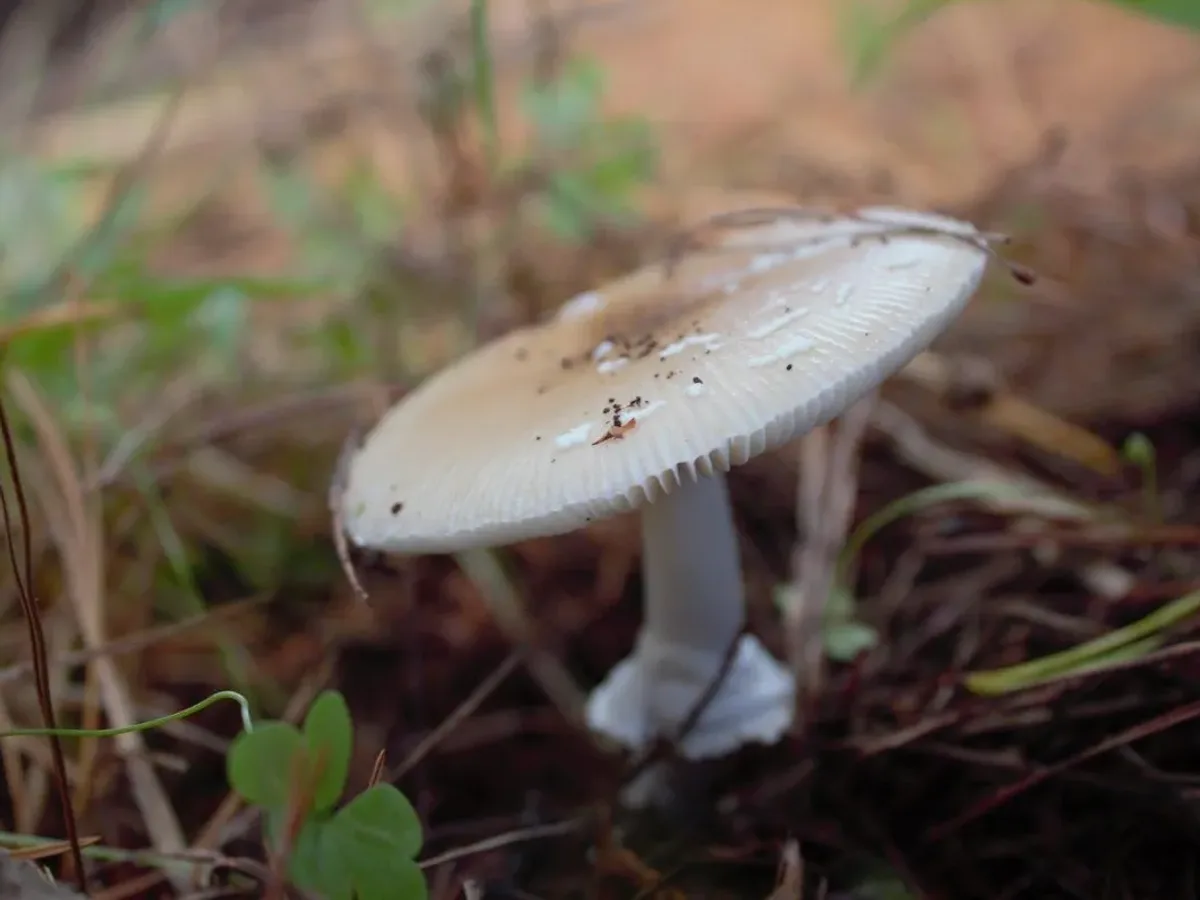
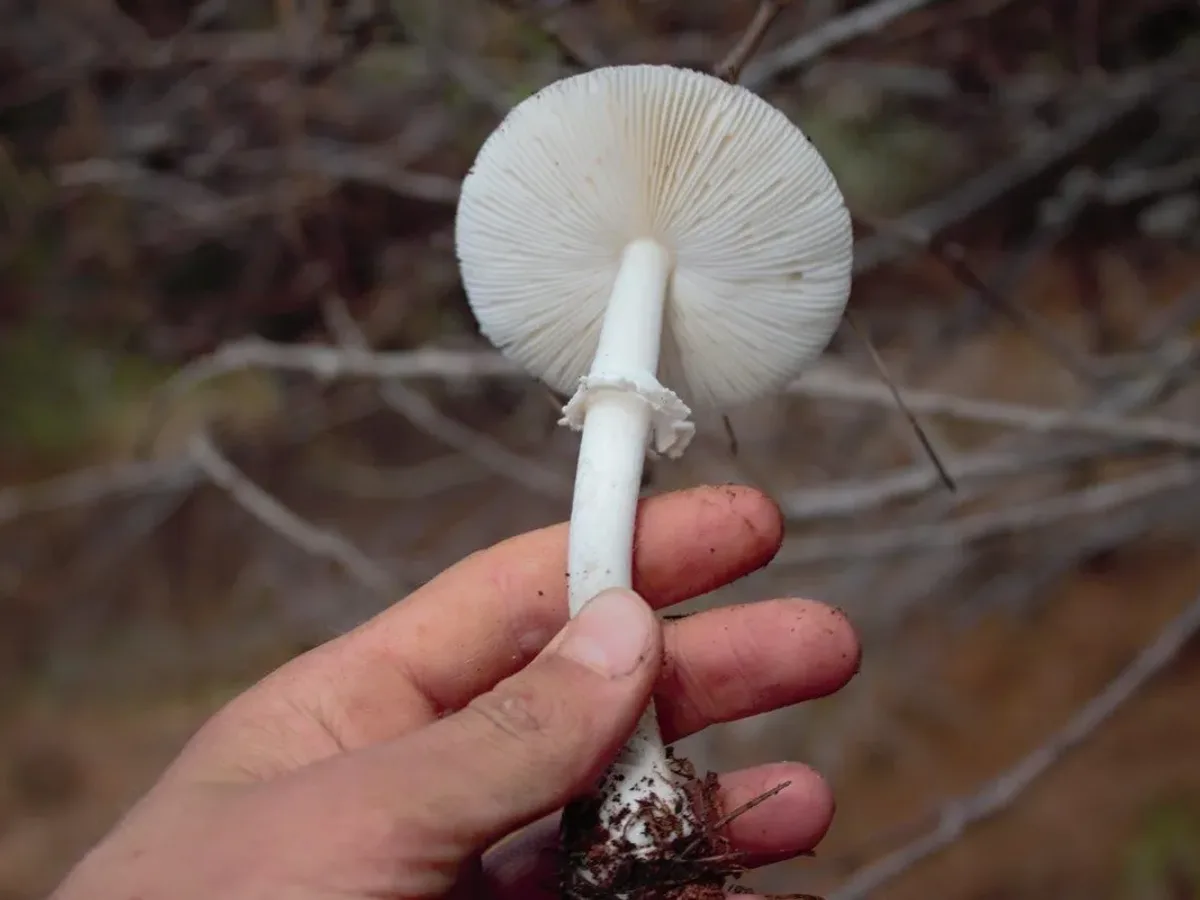
White, free from the stem, and densely crowded. Spore print is white.
Stem
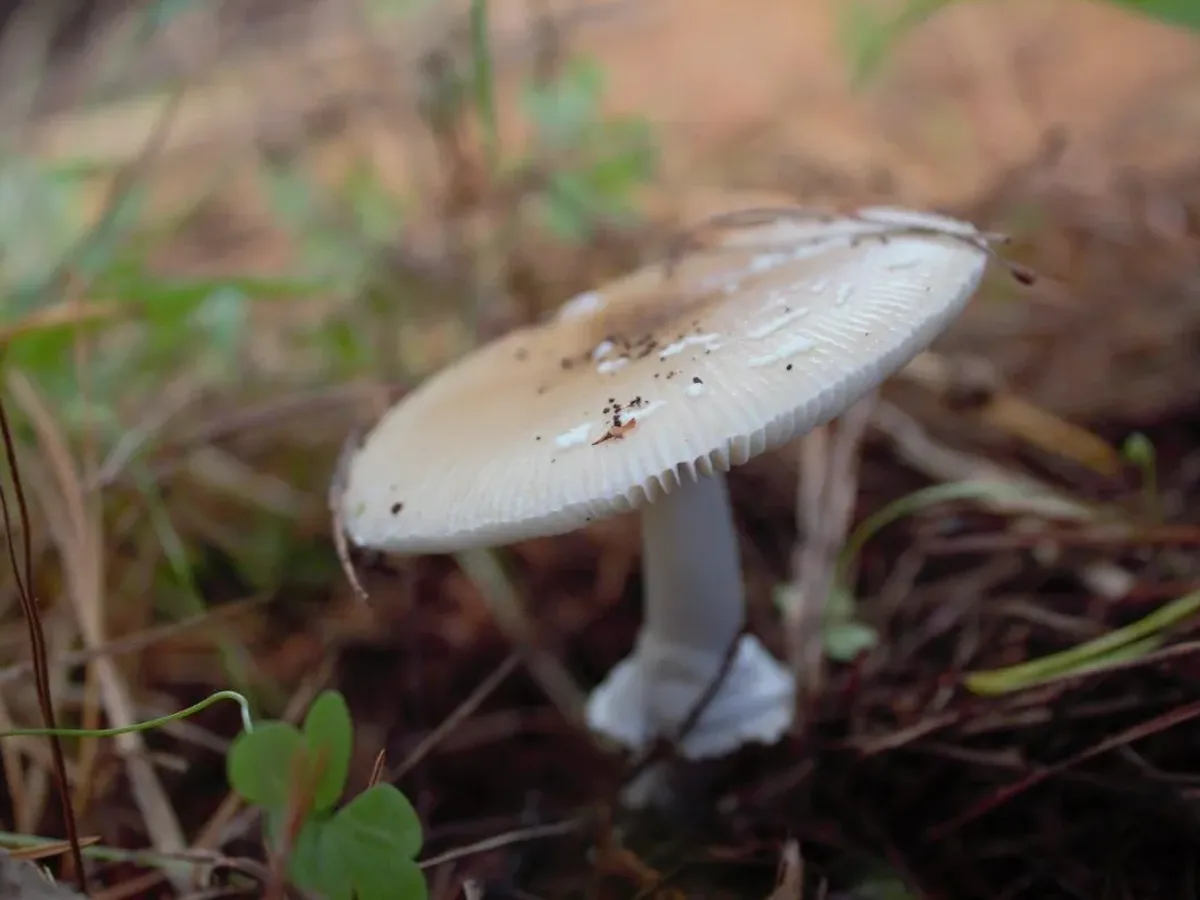
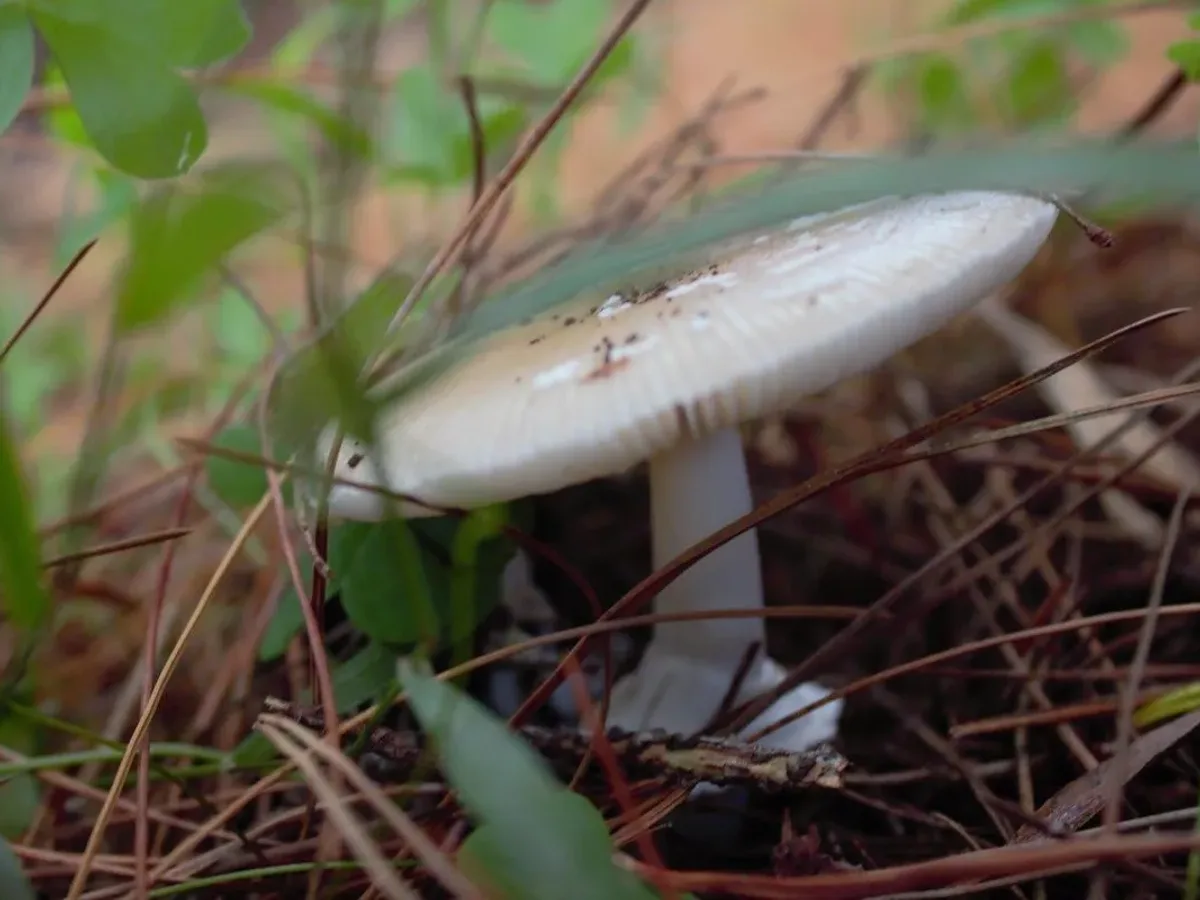
5-12 cm tall, smooth to slightly powdery white above the ring, with a pendant, skirt-like ring (annulus) that may be fragile and wear away with age.
The base of the stem swells into a distinct bulb that is capped by a tight, collar-like volva with a sharply defined upper rim - often described as gutter-like - rather than the loose sack typical of Amanita phalloides.
Why it's dangerous
Amanita pantherina is considered more dangerous in practice than the fly agaric (A. muscaria) for two compounding reasons:
- 1Its ibotenic acid and muscimol concentrations are higher on average.
- 2The inter-specimen variability is wide, so no safe dose can be estimated from appearance or size.
It is also more likely to be eaten accidentally than A. muscaria because its brown colouring and smaller size make it less obviously 'the red mushroom with spots' that most people know to avoid.
Poisonings are almost always accidental - misidentification as A. rubescens, A. spissa, or occasionally parasol mushrooms. European poison centre data record serious neurological poisonings every season.
There is no antidote. Treatment is entirely supportive:
- activated charcoal if presentation is very early
- sedation for convulsions or extreme agitation
- monitoring of vital signs
Do not attempt to induce vomiting without medical direction. Do not administer atropine - the toxin syndrome here is not muscarinic.
If ingestion is suspected, call emergency services immediately and bring a photograph or the actual specimen for identification.
Toxin
The primary toxins are ibotenic acid and muscimol, both isoxazole compounds.
- Ibotenic acid is a potent agonist of ionotropic glutamate receptors (NMDA and AMPA subtypes) and produces excitatory neurotoxic effects.
- Muscimol is the main psychoactive metabolite: a potent, selective agonist of GABA-A receptors that produces sedative, dissociative, and hallucinogenic effects.
In the body, ibotenic acid is partly converted to muscimol through decarboxylation - a conversion that also occurs outside the body when specimens are dried or cooked at sustained temperatures.
Amanita pantherina consistently contains higher concentrations of both compounds than A. muscaria, and the ratio between them varies substantially between individual fruitbodies, between habitats, and between seasons.
This inter-specimen variability is clinically significant: a dose calculated as 'mild' based on one encounter can cause severe intoxication from a different specimen of identical size.
No structural antidote exists. The syndrome these compounds produce is distinct from the cholinergic (muscarine-driven) syndrome of other poisonous Amanita species and does not respond to atropine, which can worsen outcomes if administered inappropriately.
Symptoms
Onset is rapid: symptoms typically begin within 30 minutes to 2 hours of ingestion - significantly faster than the deadly amatoxin syndrome of A. phalloides, which has a characteristic 6-24 hour latency.
Early signs are neurological rather than gastrointestinal: dizziness, drowsiness, confusion, disorientation, and a dreamlike or dissociated state. These can progress to agitation, involuntary movements, visual and auditory hallucinations, profuse sweating, and loss of coordination.
In moderate to severe cases: convulsions, extreme agitation or stupor alternating unpredictably, and loss of consciousness. Nausea and vomiting occur but are less prominent than in amatoxin poisoning.
Children are at substantially higher risk of severe neurological effects per unit body weight.
Recovery in adults who have ingested a moderate dose typically occurs within 4-8 hours with supportive care, but severe cases can require 24 hours or more in hospital. Deaths are uncommon but documented, particularly in children and in cases where the specimen ingested was unusually potent.
Any suspected ingestion warrants immediate emergency care - do not wait for symptoms to worsen before calling emergency services.
Staying safe
Amanita pantherina is classified as seriously to life-threateningly toxic in all major European mycological references.
Its toxin concentrations are higher and more variable than those in the fly agaric (A. muscaria), which means the dose required to produce severe poisoning cannot be predicted from one individual specimen to the next. A single cap can be sufficient to cause hospitalisation.
The key identification cluster that must all be present before you can be confident you are not looking at a panther cap:
- 1brown cap with white spots plus a striate (grooved) margin
- 2a pendant ring on the stem
- 3a collar-like, sharply rimmed volva at the base, partly buried, often gutter-shaped
- 4white flesh that does not redden when cut
If you are working through the Amanita rubescens confusion specifically: always cut the flesh and wait for reddening. No reddening = do not eat.
The rule of thumb for the parasol confusion is useful but must not be used in isolation: white on dark = Amanita, dark on pale = parasol; but you must still check the base - a bulbous, volva-bearing base rules out all Macrolepiota and Chlorophyllum species immediately.
If in doubt, photograph the whole specimen including the base excavated cleanly from the soil, and consult a local expert or mycological society before eating anything.
Where & when it grows
Habitat
Amanita pantherina is an obligate ectomycorrhizal species, meaning it cannot fruit without a living tree partner whose fine root tips it colonises.
It forms associations principally with broadleaved species - beech (Fagus sylvatica) and oak (Quercus) are its most frequent hosts across central and western Europe - but also recruits conifers, particularly pine and fir, in mixed or purely coniferous stands.
It shows a marked preference for calcareous, lime-rich soils: chalk downland edges, beech hangers on limestone scarps, and the well-drained mineral soils of ancient oak woodland are its most reliable habitats. It tends to be less abundant on acidic, peaty substrates where A. muscaria thrives.
Once a mycelium has established underground and built its web of fine threads through the soil and tree roots, it may persist for decades, occasionally suppressed by drought, occasionally fruiting heavily after ideal autumn rains.
The fruiting bodies emerge singly or in loose scattered groups - rarely in the dense flushes seen with saprotrophic species - because each cluster reflects a single mycelium's resource allocation rather than a decomposing log's sudden surge of available carbon.
When
The panther cap fruits from June through October across most of its central and western European range, with the main flush concentrated in late summer and early autumn - August through September - when soil temperatures remain above 10 °C and autumn rain follows the drier warmth of midsummer.
In beech woodland on chalk, peak emergence often coincides with the first substantial rain after a dry August, when the soil-temperature window is still wide open. In warmer or more maritime climates the season can extend well into October or even November in mild years.
Early summer finds are genuinely possible in warm years following a wet May and June; they tend to be smaller and quicker to age.
The fruiting body rises fast: primordia (pin-head stages) can be at picking size within 48-72 hours of a triggering rain event, and the cap flattens and begins to decay within another few days. The aboveground body is brief; the mycelium underneath is not.
How it grows
Like all Amanita species, A. pantherina begins its visible life as a compact white or grey-brown egg buried just at or below the soil surface, enclosed in the universal veil.
As the veil ruptures, the cap and stem elongate rapidly, powered by the pre-formed cells expanding by water uptake rather than by new cell division - which is why a fruitbody can grow several centimetres overnight. The white spots on the cap are pieces of that outer veil torn apart by cap expansion and left stranded on the surface.
Internally the flesh is white throughout; it does not redden, discolour, or react when cut or damaged, which is one of the most important contrasts with A. rubescens.
The mycelium sustaining all this is ancient by comparison. The network of fine hyphae in the soil may be years or even decades old, trading photosynthate from the trees above in exchange for phosphorus, water, and mineral ions it extracts from the soil matrix - a bargain struck at the root tips where fungal mantle tissue wraps each short root in a close chemical embrace.
The single fruitbody is just a spore-dispersal event in a long ongoing relationship.
Fruiting conditions
Conservative standard mycology for a temperate ectomycorrhizal Amanita: fruits after summer-autumn rains once soils have warmed; not specified in the source.
Look-alikes
Three species account for the great majority of accidental panther cap poisonings.
The blusher (Amanita rubescens) is the most dangerous confusion because it is genuinely common, edible when cooked, and has a similar brown-capped, white-spotted appearance in some forms. The single most reliable separation: cut the flesh of any brown Amanita and watch it for 2-3 minutes.
- A. rubescens flesh reddens distinctly - a faint but unmistakable pinkish flush that spreads from cut surfaces and especially from insect-damaged areas.
- A. pantherina flesh stays white.
The rubescens cap margin is also non-striate (smooth-edged), and its volva forms a less sharply rimmed structure.
Amanita spissa (grey-veiled amanita) is edible but has similar colouring; it too lacks the striate margin and has a stouter, more rooting stem base and grey-brown, less vivid veil fragments. Neither rubescens nor spissa should be eaten without expert confirmation precisely because of this confusion risk.
The third lookalike, the parasol mushroom (Macrolepiota procera) and shaggy parasol (Chlorophyllum rhacodes), is superficially similar only at a glance: a pale, whitish cap covered in dark brown, fibrous, shaggy scales is the opposite pattern to white spots on a dark brown cap.
Parasol also has a moveable double ring, a pale cap, and a long slender stem with snakeskin patterning - and crucially lacks the bulbous, volva-bearing base entirely. Any forager who confuses these two has not examined both the cap surface texture and the stem base.
White/pale Amanita with a volva should be left alone; deadly amatoxin-containing Amanita are responsible for most lethal mushroom poisonings. Introduced to South African plantations with exotic trees.
An edible Amanita that can be confused with the panther cap.
Edible Caesar-type Amanita are confused with A. pantherina; the panther cap has white warts (which can wash off in rain), a ring, and a ringed/concentric stem base.
Rule of thumb: dark scales on a light background = parasol; light (white) patches on a dark background = Amanita (panther cap).
Edible Amanita with which the panther cap is most often confused unintentionally; distinguished by its overall reddening flesh rather than the panther cap's clean white spots on a brown cap with striate margin and collar-like volva.
A reference guide - never an edibility guarantee. When in doubt, leave it out.