Zambian slender Caesar
Amanita zambianasyn. Amanita loosii, Amanita masasiensis, Amanita tanzanica, Amanita flammeola, Amanita annulatovaginata
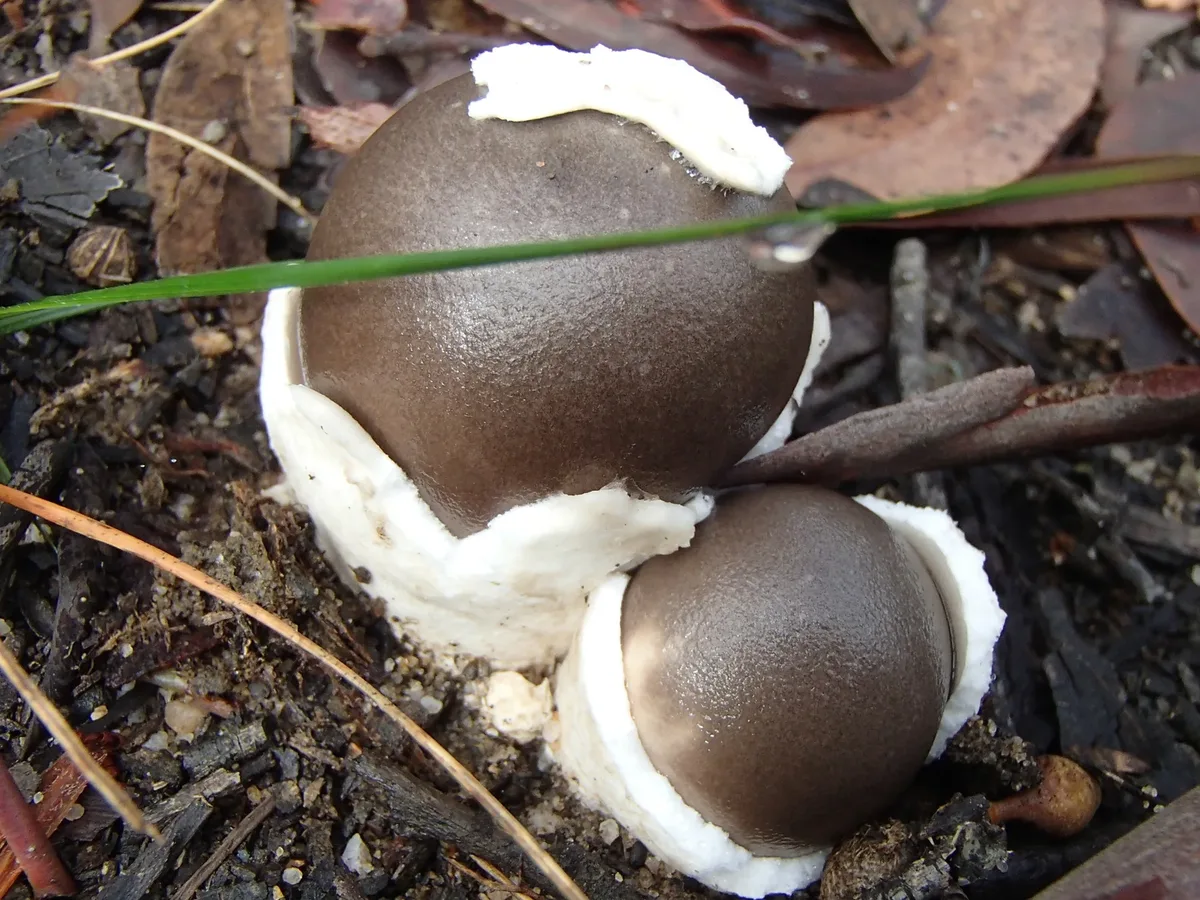 Atlas of Living Australia (CC0)
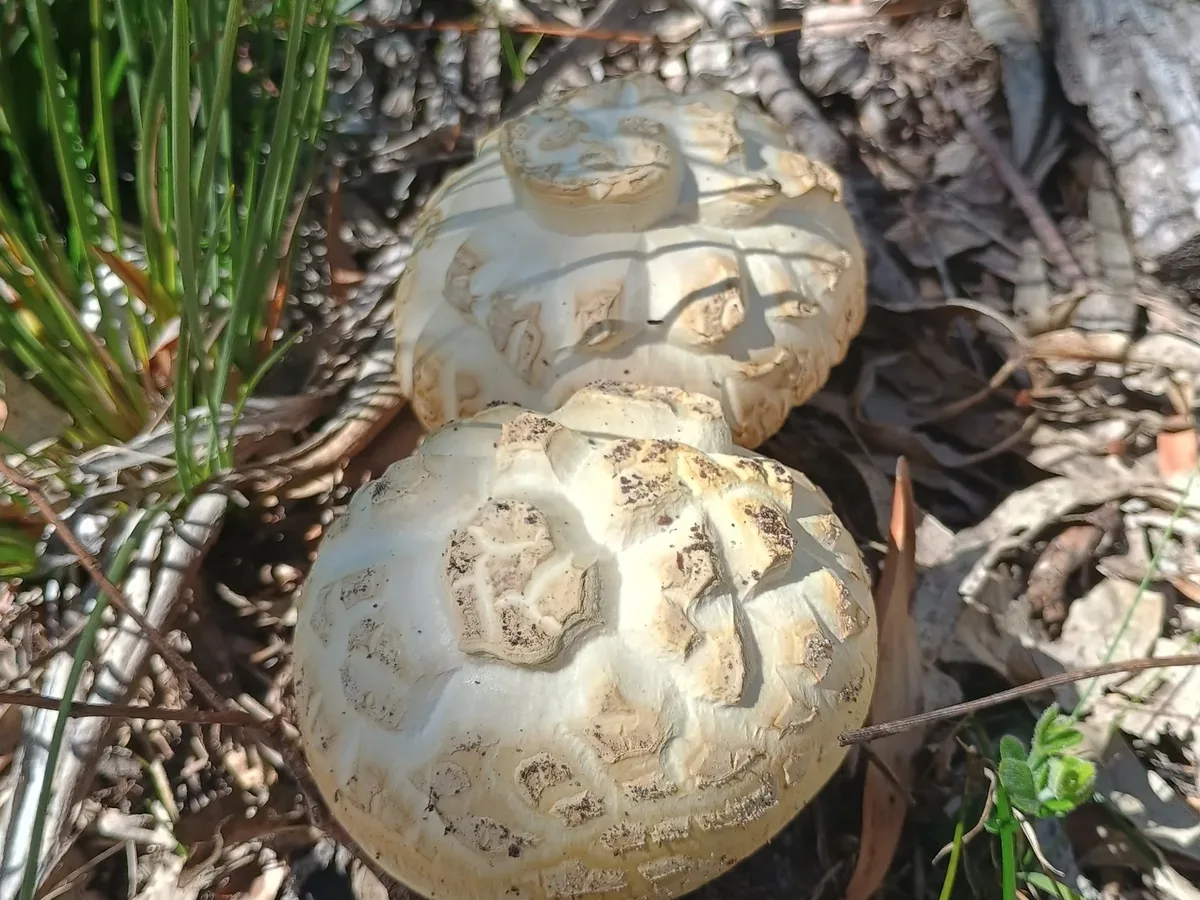 Atlas of Living Australia (CC0)Atlas of Living Australia (CC0)Atlas of Living Australia (CC0)
Good to eat, once you have identified it with certainty and cooked it through.
Never eat a mushroom you are not 100% sure of - check the look-alikes below, and always cook wild mushrooms.
How to recognise it
Amanita zambiana is one of sub-Saharan Africa's largest and most visually striking edible mushrooms. Young specimens emerge from the soil as pale, egg-shaped buttons still entirely enclosed in a membranous universal veil - this veil tears as the cap expands, leaving the characteristic sac-like volva cupping the stem base.
Cap
At maturity the cap spans 10-25 cm. The centre is a warm tawny or umber-brown that is darkest at the disc and fades progressively outward, washing into a creamy buff that becomes almost white toward the well-defined, distinctly grooved margin.
These marginal striations, visible as neat radial furrows corresponding to the gills beneath, are one of the most reliable identification features and set it apart from the plain-edged caps of its dangerous relatives.
Gills
The gills are free or barely touching the stem, crowded, white to cream-yellow, soft and fairly broad. A hand lens reveals a finely fringed (flocculose) gill edge.
Stem
The stem is white, stout - typically 10-20 cm tall and 1-3 cm wide - often widening slightly at the base where it tucks into the volva.
A fragile, skirt-like ring (annulus) persists on the upper stem in fresh specimens but can shred and disappear with age or handling.
The volva itself is a prominent, thick-walled, sac-like structure, white to pale brownish. Digging carefully around the base to confirm it is present is critical in identification.
Flesh
Flesh white throughout. Spore print white, ellipsoid spores, inamyloid.
Smell & taste
Mild in smell and pleasantly sweet in taste - no unpleasant odour.
Where & when it grows
Habitat
Amanita zambiana is a specialist of miombo woodland, the vast, semi-arid to sub-humid savanna woodland that stretches across Zambia, Malawi, Zimbabwe, Mozambique, Tanzania, and adjacent countries from roughly 8° to 20° S latitude.
The keystone trees of miombo are Brachystegia species - broad-crowned legumes whose roots host the fungal mycelium of A. zambiana in one of the continent's most ecologically important mycorrhizal partnerships.
Without a living Brachystegia rootlet as a partner, the fungus cannot form a fruitbody; this obligate dependency means A. zambiana is as much an indicator of intact miombo woodland as any plant.
Fruiting most often occurs at the woodland edge - along gravel road verges, in clearings, beneath open canopy - where the soil is loose and the tree density allows enough light and rainfall penetration. Soil type tends to be coarse, well-drained, and low-nutrient, a feature of classic miombo terrain.
The species occasionally fruits in small groups of two to five fruitbodies, each connected underground to the same extensive mycelial network, but solitary fruitings are equally common.
Where woodland has been cleared or degraded, A. zambiana disappears entirely, making it an unintentional sentinel of forest health.
When
Fruiting is tightly coupled to the southern African rainy season, which sweeps northward across the miombo belt from roughly November in the south to February in the north.
In Zambia and Zimbabwe the peak is December and January - a window so reliable that Zimbabwean pickers call it the 'Christmas mushroom'.
The trigger is the arrival of sustained convective rainfall after the long dry season. The mycelium, which has been dormant in the desiccated woodland soil for eight or more months, responds within days to soil moisture and rising root-zone temperature.
Fruitbodies typically emerge two to four days after a soaking rain event once soil temperatures are consistently warm. In wetter years or at higher altitudes the season may extend slightly into February; in drought years fruiting can be sporadic and late.
Because the rainy season straddles the Southern Hemisphere summer solstice, A. zambiana is one of the few high-value edible mushrooms on Earth that peaks around Christmas rather than autumn.
Markets in Lusaka, Harare, and Blantyre fill with fresh caps and dried slices through December and January, representing a significant source of seasonal income for rural households.
How it grows
Every fruitbody of Amanita zambiana begins as a compact underground 'egg' - a dense, spherical structure in which all the tissues of cap, gills, stem, ring, and volva are already preformed, wrapped in the universal veil.
This egg stage allows rapid, virtually overnight eruption through the soil once conditions are right. The cells in the stem elongate dramatically and irreversibly when water is available, driven by osmotic pressure rather than cell division - which is why a fruitbody can reach full height in twelve to twenty-four hours.
The mycelium beneath - a web of white hyphae threaded through the top 10-30 cm of soil - is perennial. The same individual genotype may have been living in partnership with the same Brachystegia trees for decades, transferring phosphorus, nitrogen, and micronutrients from the soil matrix to the tree in exchange for photosynthetically fixed sugars.
Fruiting is the fungus's reproductive act: the gills produce white spores by the billions, released passively into air currents rising through the warm, humid woodland understory.
Each group of nearby fruitbodies is almost always a single genetic individual expressing itself at several points, an arrangement that concentrates reproductive effort when conditions are suitable.
Fruiting conditions
Fruits during the rainy season in tropical/subtropical miombo woodland, triggered by the onset of seasonal rains.
Look-alikes
The single most dangerous lookalike situation for Amanita zambiana is accidental confusion with native African members of Amanita section Phalloideae - deadly white or pale Amanita species that produce amatoxins and grow in the same miombo woodland, sometimes in the same season and same soil type.
Unlike most European foraging contexts where the Death Cap (A. phalloides) is the primary hazard, sub-Saharan Africa hosts its own complement of amatoxin-producing Amanita whose taxonomy is incompletely resolved; several unnamed or recently named species remain in the scientific literature.
These deadly species typically have a pure white or very pale cap without the warm brown disc colouring of A. zambiana, and critically, their cap margin is smooth - not striate.
The reliable distinguishing features of the edible species are the combination of:
- 1A clearly brown-centred cap that fades to cream at the margin.
- 2Distinctly grooved (striate) margin visible as radial furrows.
- 3White free gills.
- 4White stem with a fragile ring.
- 5A thick, sac-like white volva at the base.
Any specimen that lacks the brown disc or the marginal striations must not be eaten.
Young button-stage specimens are inherently harder to assess because the cap colour and margin structure are not yet visible; in this stage extra caution is required.
Identification from local experienced pickers who know the specific forms in their area is the most reliable safeguard.
Native deadly amatoxin-containing white Amanita species occur in tropical Africa. Never eat a white/pale Amanita; avoid all Amanita whose cap is pure white without a striate margin. The edible species has a brown cap centre with a distinctly striate (grooved) white margin.
In the kitchen
Picking & cleaning
In market trade across the miombo region, the button stage - when the fruitbody is still partly or fully enclosed in the universal veil, roughly egg- to fist-sized - commands the highest price and has the longest shelf life. At this stage the gills have not yet been exposed to insects or spore dispersal, the flesh is dense, and the distinctive striate margin is not yet visible, making identification slightly harder for beginners.
For home harvesting, specimens just beginning to open - cap 8-15 cm, margin striations clearly visible, ring still intact - are ideal: identification is easier, yield is high, and quality remains excellent.
To pick correctly, lever the base out of the soil with a gentle twisting motion and excavate the volva fully. Leaving the volva in the ground risks confusion at that spot on a future visit and also discards a useful identification feature.
Inspect the base carefully before eating: the volva must be present.
Collected fruitbodies keep well for one to two days at ambient tropical temperatures if placed cap-down on a flat surface without stacking.
For longer preservation, traditional practice is to:
- 1Parboil for five minutes in boiling water.
- 2Discard the blanching liquid.
- 3Sun-dry the parboiled caps.
This produces a shelf-stable product traded widely in local markets.
Cooking
Amanita zambiana is the central ingredient in several traditional sub-Saharan dishes and is prized for its mild, subtly sweet flavour and firm, satisfying texture.
The most characteristic preparation in Zambia and Malawi is as ndiwo, a savoury mushroom relish served alongside nshima (maize porridge): caps are broken or sliced, then simmered in a little water with onion, tomato, and salt until the liquid reduces into a thick, richly flavoured sauce. The cooking liquid is retained and forms the body of the relish, carrying much of the mushroom's umami.
A second common preparation is dry-frying in a hot pan with minimal oil until the edges colour and slightly caramelise, then finishing with groundnut (peanut) paste stirred through - a combination that balances the mild mushroom sweetness against the earthy, slightly bitter peanut base.
Dried specimens, produced by parboiling and sun-drying, are reconstituted in warm water for fifteen to twenty minutes before use and produce a deeply savoury broth that is itself used as a stock base. The dried form is traded far from miombo areas and extends access across the year.
In all preparations the key point remains identification, not technique: once correctly identified, A. zambiana is a versatile, flavourful, and nutritionally significant food - a good source of protein, B-vitamins, and minerals in a region where dietary diversity can be limited during the rainy season.
Good to know
Amanita zambiana is a genuinely important food source - nutritious, widely traded, and culturally embedded across the miombo belt - but it demands accurate identification every single time.
The amatoxins produced by deadly lookalike Amanita species in the same woodland are among the most lethal biological toxins known: they destroy liver and kidney tissue in a delayed, biphasic pattern that can be mistaken for a minor stomach upset before organ failure sets in, and there is no antidote.
Cooking does not inactivate amatoxins; drying does not inactivate them; no preparation method makes a deadly species safe. The only safety margin is correct identification before eating.
The rules that apply here are absolute:
- Confirm the brown disc and striate margin of the cap.
- Confirm the volva at the base by digging.
- Confirm the white spore print if in doubt.
Do not eat any specimen that fails even one of these checks.
Beginners should go out with an experienced local picker for several seasons before harvesting independently. Children should never be given unidentified Amanita of any kind.
If poisoning is suspected after eating a foraged Amanita, seek emergency medical care immediately - do not wait for symptoms to worsen.
A reference guide - never an edibility guarantee. When in doubt, leave it out.