Edible milkcap
Lactifluus edulissyn. Lactarius kabansus, Lactifluus gymnocarpoides, Lactifluus velutissimus, Lactarius gymnocarpoides
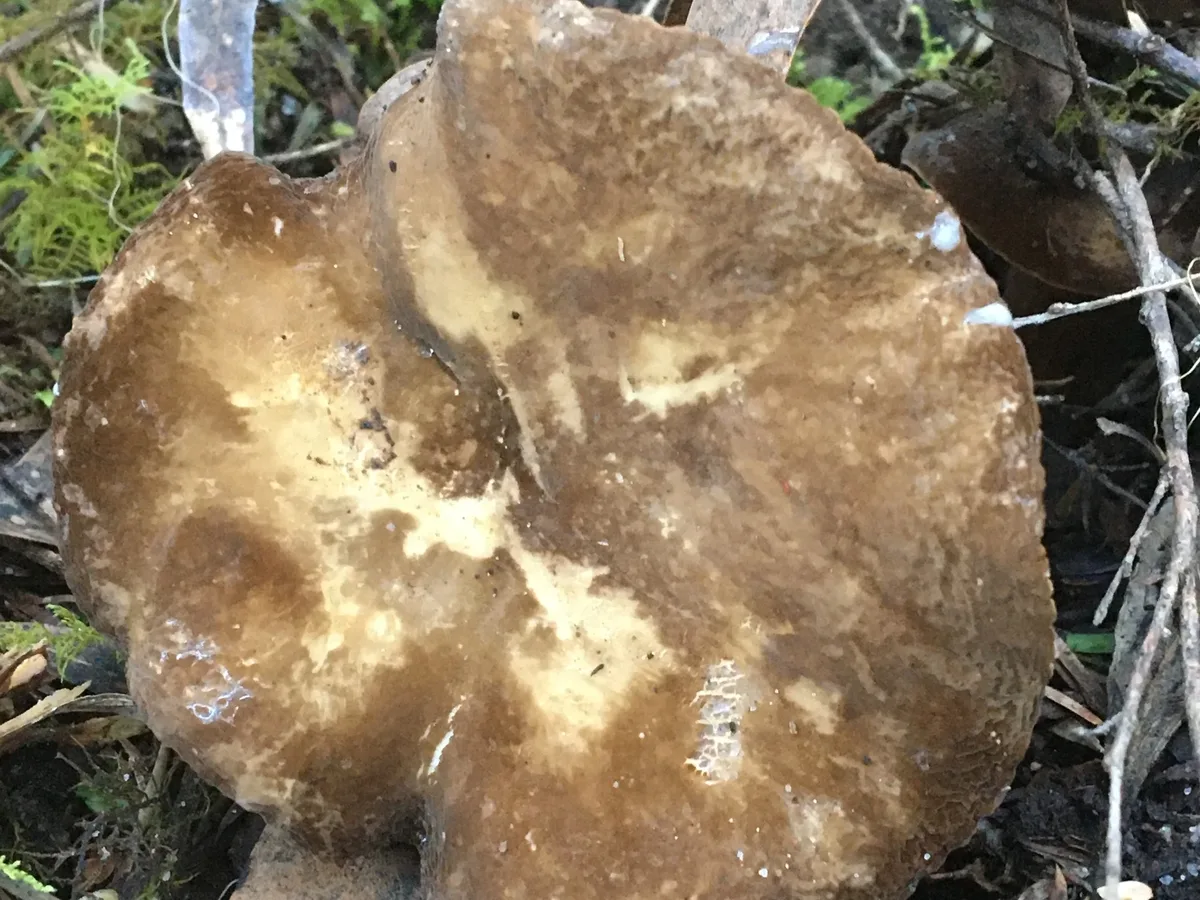 Atlas of Living Australia (CC0)
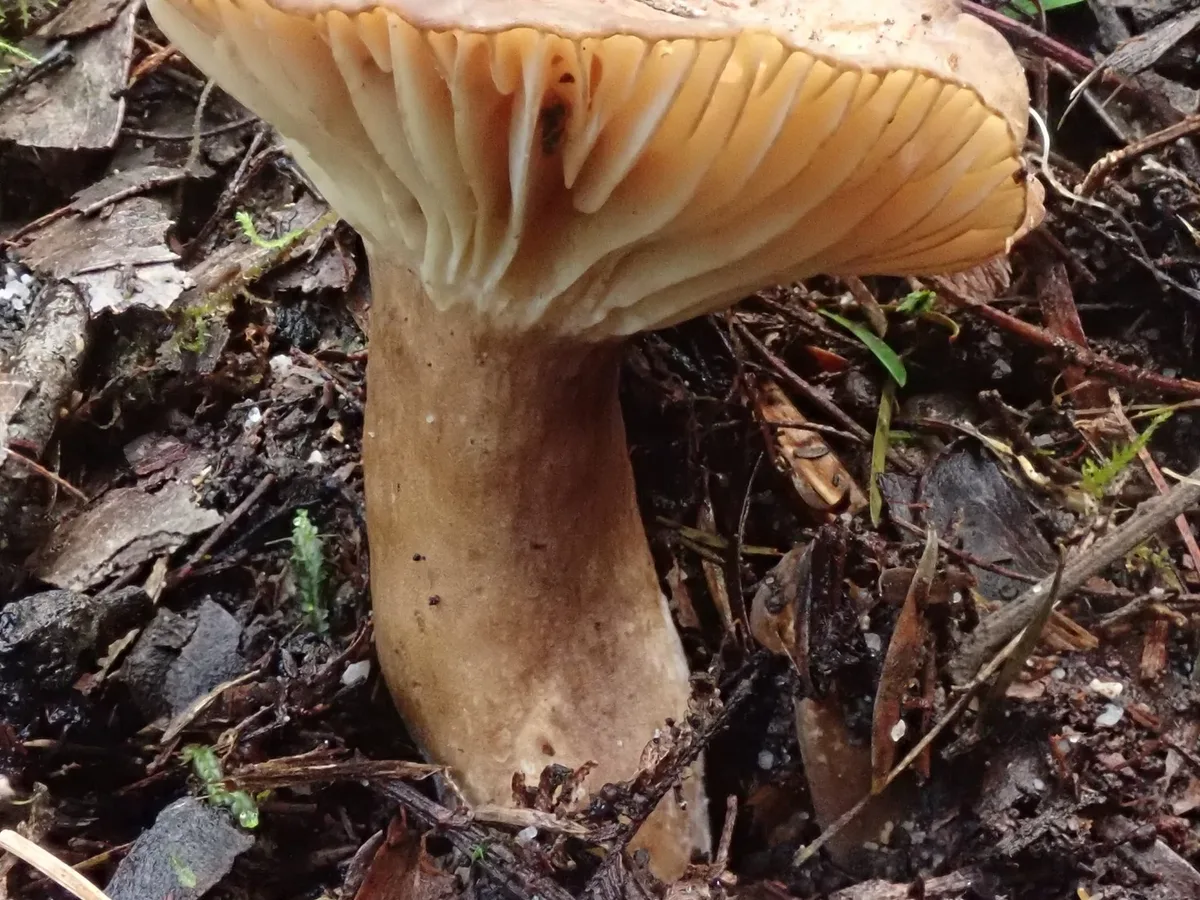 Atlas of Living Australia (CC0)
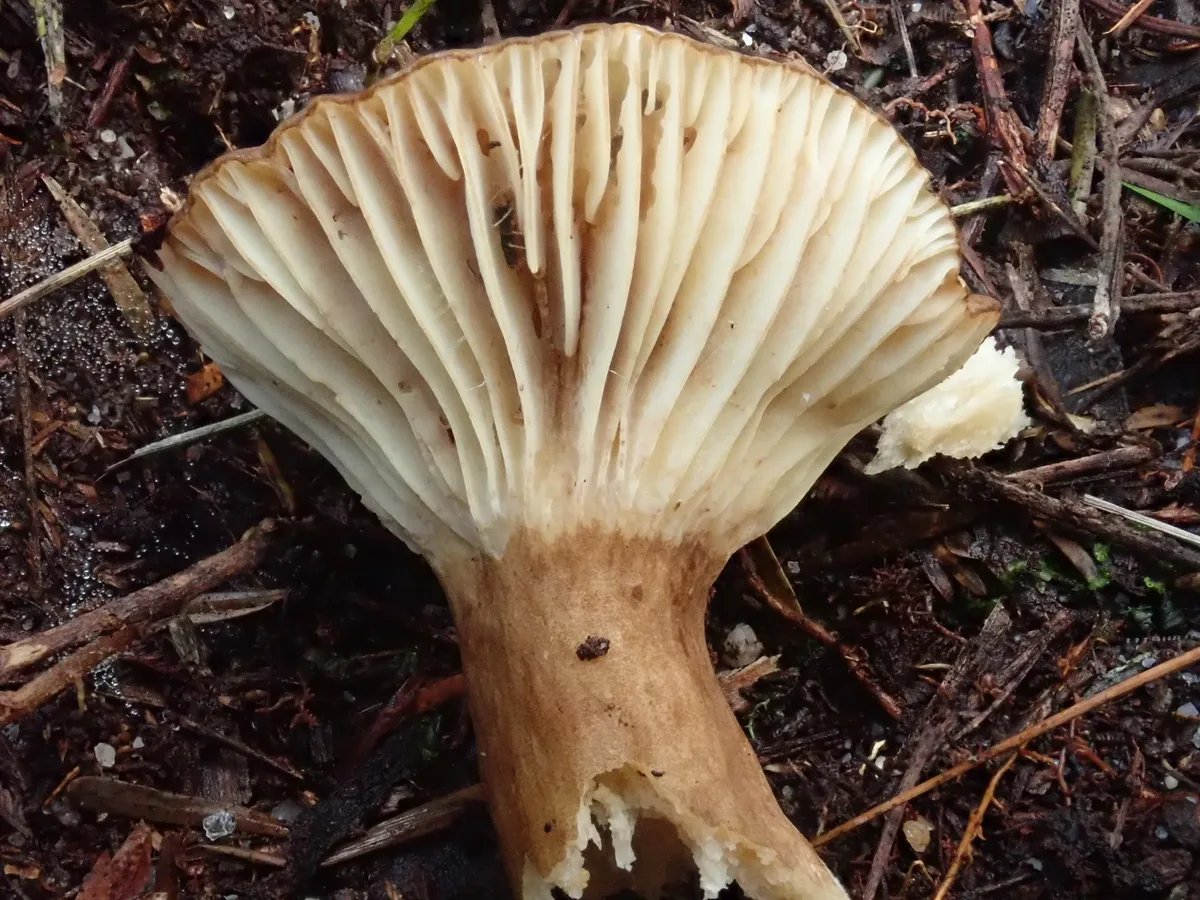 Atlas of Living Australia (CC0)
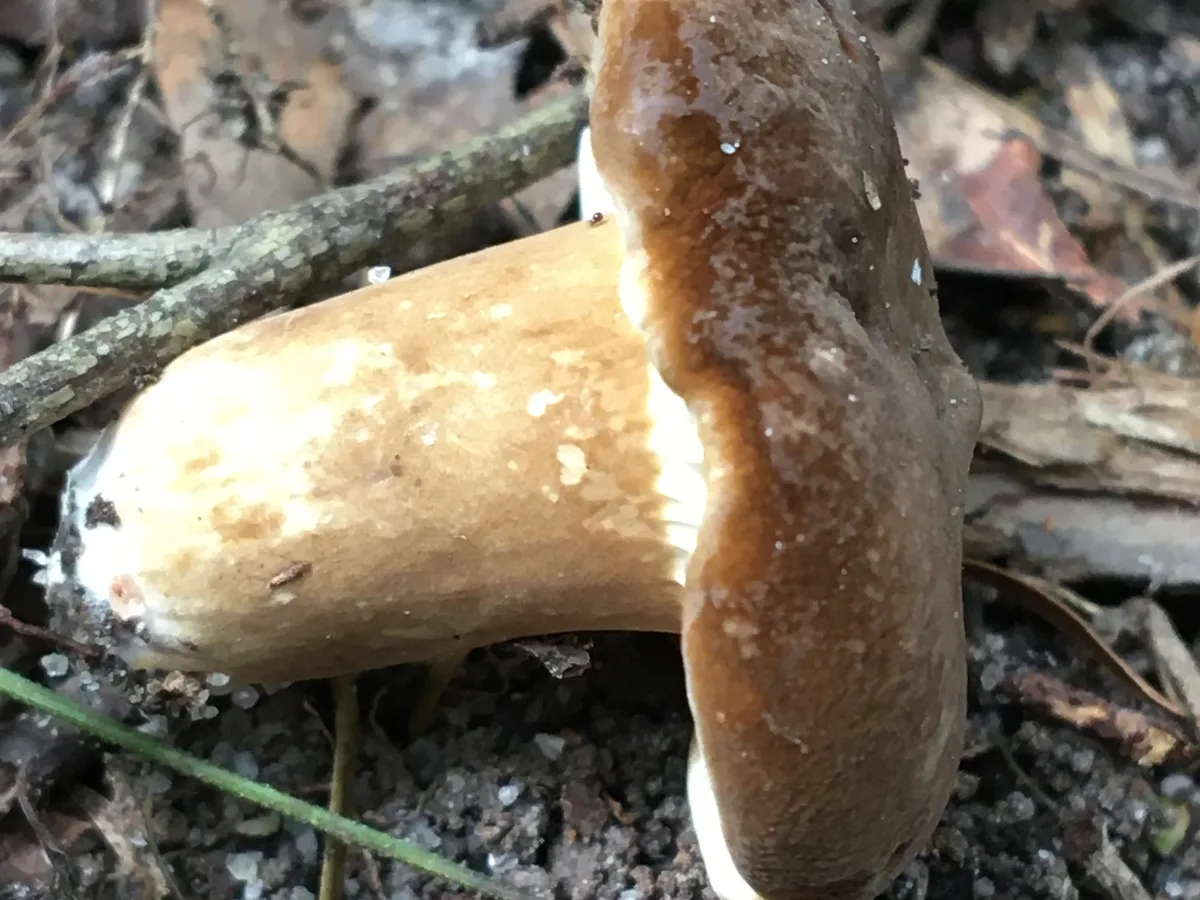 Atlas of Living Australia (CC0)Atlas of Living Australia (CC0)Atlas of Living Australia (CC0)
Good to eat, once you have identified it with certainty and cooked it through.
How to recognise it
Lactifluus edulis and its close ally Lactarius kabansus belong to the milkcap lineage - a group defined not by colour or cap shape alone but by a single anatomical feature: spherical cells called sphaerocysts scattered through the flesh that make it snap cleanly rather than tear, and secretory hyphae called lactifers that release latex the instant the tissue is cut or bruised.
Cap
In the kabansus form, the cap surface is distinctly dry and has a fine, velvety-leathery texture when young that matures into a dull, slightly rough skin.
The most visually diagnostic trait develops with age: the cap centre becomes radially wrinkled, with shallow ridges running outward from the disc like the grain on seasoned wood.
Coloration sits in the buff-to-ochre-tan range, often paler at the margin and slightly deeper at the disc, though it can bleach or darken with moisture.
Gills
The gills are cream to pale buff, closely spaced, and decurrent - they run a short way down the stem rather than ending cleanly at the cap edge - a feature visible to the naked eye once you know to look.
Spore print is white to cream.
Smell & taste
The latex itself is the most important field character: snap a gill or nick the flesh and a watery-to-white droplet appears within seconds. In the mildest forms it is essentially tasteless; in others it carries a faint peppery nip that intensifies slowly on the tongue rather than hitting immediately.
Stem
The stem is firm, solid or only slightly pithy when very old, and roughly concolorous with the cap.
Where & when it grows
Habitat
These milkcaps are obligate partners of the miombo woodland, one of the world's most ecologically distinctive savanna-woodland biomes. Miombo is defined by its dominant trees - primarily Brachystegia and Julbernardia - leguminous hardwoods that have co-evolved with an extraordinary guild of ectomycorrhizal fungi over tens of millions of years.
Lactifluus edulis plugs into this network by sheathing the fine feeder roots of those trees with a fungal mantle, extending hyphal threads outward into the soil for meters in every direction. In exchange for photosynthetically fixed sugars, the fungus delivers water, phosphorus, and micronutrients the tree cannot easily access on its own.
This is not a casual association: the mycelium is host-specific, and the mushroom will simply not appear outside genuine Brachystegia-Julbernardia woodland, which stretches across an enormous arc from Tanzania and the DRC southward through Zambia, Malawi, and Zimbabwe into Mozambique and northern Botswana.
Within that belt, fruiting bodies emerge directly on the woodland floor among leaf litter and sparse grass, often in the shade of the larger canopy trees. Ant mounds, old termitaria, and areas where roots are close to the surface tend to be productive microsites, as are places where last year's harvest was found - the mycelium does not move quickly.
When
The entire fruiting season is governed by the rains of the southern-hemisphere wet season, which arrive in November-December across most of the Zambezian miombo zone and taper off by March or early April.
Lactifluus edulis is a wet-season obligate: the mycelium spends the long dry months between April and November in a state of arrested activity, conserving resources and waiting.
When the first significant rains saturate the sandy-loamy miombo soils - typically after a run of 25 mm or more within two weeks - soil temperatures rise into the 18-28 °C band that triggers mycelial activation. Fruiting bodies typically emerge five to fourteen days after those trigger rains, so experienced foragers track the onset of the rains carefully and plan accordingly.
Peak abundance usually falls in January-February in Zambia and Tanzania, though the exact peak shifts with latitude and local rainfall patterns. A single dry spell within the rainy season can suppress a flush; a second sustained wet period often produces a second wave, sometimes as large as the first.
How it grows
The mycelium of Lactifluus edulis has almost certainly persisted in its woodland patch for longer than any single tree above it. Ectomycorrhizal networks can survive for decades in suitable soil, with individual genets - clonal hyphal networks descended from a single spore - potentially spanning hundreds of square metres.
Through the dry season this underground network is metabolically quiet, drawing down stored carbon compounds and maintaining minimal activity. When rains return and soil moisture climbs, the mycelium resumes growth within hours, extending new hyphae toward roots and eventually redirecting resources into forming fruitbodies.
The primordia that will become visible mushrooms are largely preformed underground - button-stage fruitbodies that can emerge and expand rapidly once conditions are right. In a good flush, dozens of fruitbodies may appear in a circle or spreading arc, sometimes separated by only centimetres, reflecting the architecture of the underground hyphal network.
Individual fruitbodies can grow to full size in forty-eight to seventy-two hours after the right rain event, which is why experienced harvesters check their spots daily during peak season.
Fruiting conditions
Fruits during the rainy season in miombo woodland; warm tropical soils and sustained rainfall trigger large flushes.
Look-alikes
The most important diagnostic character that separates Lactifluus edulis from dangerous look-alikes is the latex: any Amanita species - including Amanita phalloides and its tropical relatives responsible for most fatal mushroom poisonings worldwide - produces no latex whatsoever.
If you break a gill or cut the stem and no milky or watery droplet appears within a few seconds, do not eat it.
Amanita species also differ structurally in ways that are visible before cooking:
- They typically emerge from a cup-shaped volva at the base (a sack in the soil that the young fruitbody bursts through).
- Many have a skirt-like ring (annulus) on the stem.
These features are entirely absent in milkcaps.
Within the Lactifluus genus itself, Lactifluus gymnocarpoides is known locally to be rejected and not eaten; in some accounts it causes digestive upset. It produces latex but may be distinguished by its more slender build and different cap texture, and local knowledge is the most reliable guide in this case.
The consistent rule:
- 1Confirm latex is present.
- 2Then taste a tiny piece of gill - mild or very faintly peppery is acceptable for the edible forms; intensely acrid or burning means set it aside.
Never eat a milkcap from this region without the latex check.
Amanita lacks latex (milky sap). The milky sap and the gills distinguish edible milkcaps from Amanita; always check for latex when broken.
Some Lactifluus, including L. gymnocarpoides, are rejected locally and not eaten.
In the kitchen
Picking & cleaning
Harvesting is traditionally done by hand, twisting the stem gently to free it cleanly from the substrate rather than cutting, which leaves a stub that can harbour competing organisms.
The picking window is wide - from very young button stage through fully expanded cap - because the flesh stays firm and the latex remains abundant even in mature specimens.
A small piece of stem can be left in the soil to avoid disturbing the mycelium unnecessarily, though there is no strong evidence that picking method significantly affects future flushes of ectomycorrhizal species, whose productivity depends far more on tree health and rainfall than on harvesting technique.
In local practice, harvested mushrooms are often kept in open baskets or bags to allow spore dispersal during transport - a habit that may inadvertently contribute to inoculation, though intentional cultivation of ectomycorrhizal species has not been successfully achieved.
Freshness matters: the flesh of milkcaps can sour within a day in hot conditions. Foragers working in areas of mixed species should always check for latex before adding an unknown milkcap to the basket.
Cooking
Lactifluus edulis is primarily a relish ingredient across its range, cooked alongside tomato, onion, and sometimes peanut paste and served with the stiff maize porridge known as nshima in Zambia and Malawi or ugali in Tanzania and Kenya.
The texture is firm and holds up well to the simmering that relish preparation requires, and the flavour is mild and slightly earthy, making it a good backdrop for bolder seasonings.
- In areas where the harvest is abundant, the surplus is sliced and sun-dried for several days until completely desiccated, then stored in cloth or paper bags for use through the dry season; dried milkcaps reconstitute reasonably well in hot water and can be added directly to stews and relishes.
- Roasting over coals is a field preparation - whole young caps placed directly on embers, eaten warm with a pinch of salt.
- More intense bitter forms are always parboiled first: brought to a boil in plenty of water for five to ten minutes, drained, and then incorporated into the relish as usual.
The mushrooms should not be eaten raw in large quantities even in the mild forms, though small tastes in the field to check bitterness are traditional and unproblematic.
Good to know
Lactifluus edulis is an edible species with a long record of safe use across sub-Saharan Africa. The principal safety consideration is not toxicity but species confirmation: the latex test is mandatory, and only individuals who have made that check reliably should use this mushroom.
Preparation depends on taste:
- The mild-tasting forms (including L. kabansus) are used without parboiling in local tradition.
- Forms that taste noticeably bitter or acrid should be parboiled and the water discarded before further cooking, as this removes water-soluble irritant compounds.
There are no reports of systemic toxicity or serious poisoning attributable to correctly identified L. edulis. The species is not implicated in any known fatal poisoning event.
Dried mushrooms retain their edibility and are safe to reconstitute and cook. As with any wild-harvested food, individuals with known mushroom protein sensitivities should exercise caution on first exposure.
A reference guide - never an edibility guarantee. When in doubt, leave it out.