Silky Rosegill
Volvariella bombycinasyn. Agaricus bombycinus, Volvaria bombycina, Pluteus bombycinus, Volvariella bombycina var. bombycina
 © Francois Jordaan (CC BY)
 Di Turner (CC0)
 Di Turner (CC0)
 © Northcut (CC BY)
 © Michelle W. (鍾偉瑋) (CC BY)
 © Michelle W. (鍾偉瑋) (CC BY)
 © Northcut (CC BY)
 © Northcut (CC BY)
 © Stefan Curth (CC BY)
 © Stefan Curth (CC BY)© Francois Jordaan (CC BY)Di Turner (CC0)
Good to eat, once you have identified it with certainty and cooked it through.
Never eat a mushroom you are not 100% sure of - check the look-alikes below, and always cook wild mushrooms.
How to recognise it
Volvariella bombycina is one of the most visually striking saprotrophic mushrooms of the hardwood zone - even veteran foragers pause at a large specimen emerging from an old elm wound high on a trunk.
Cap
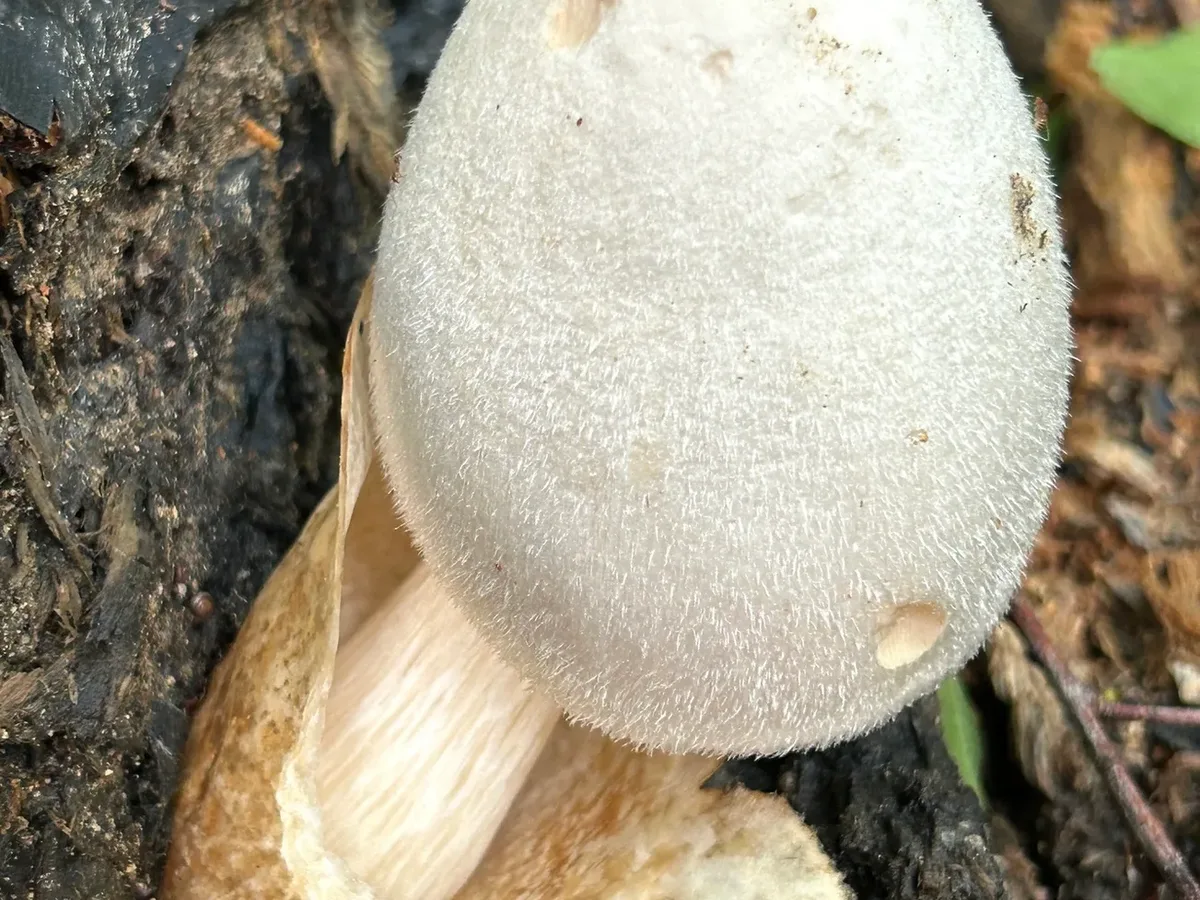
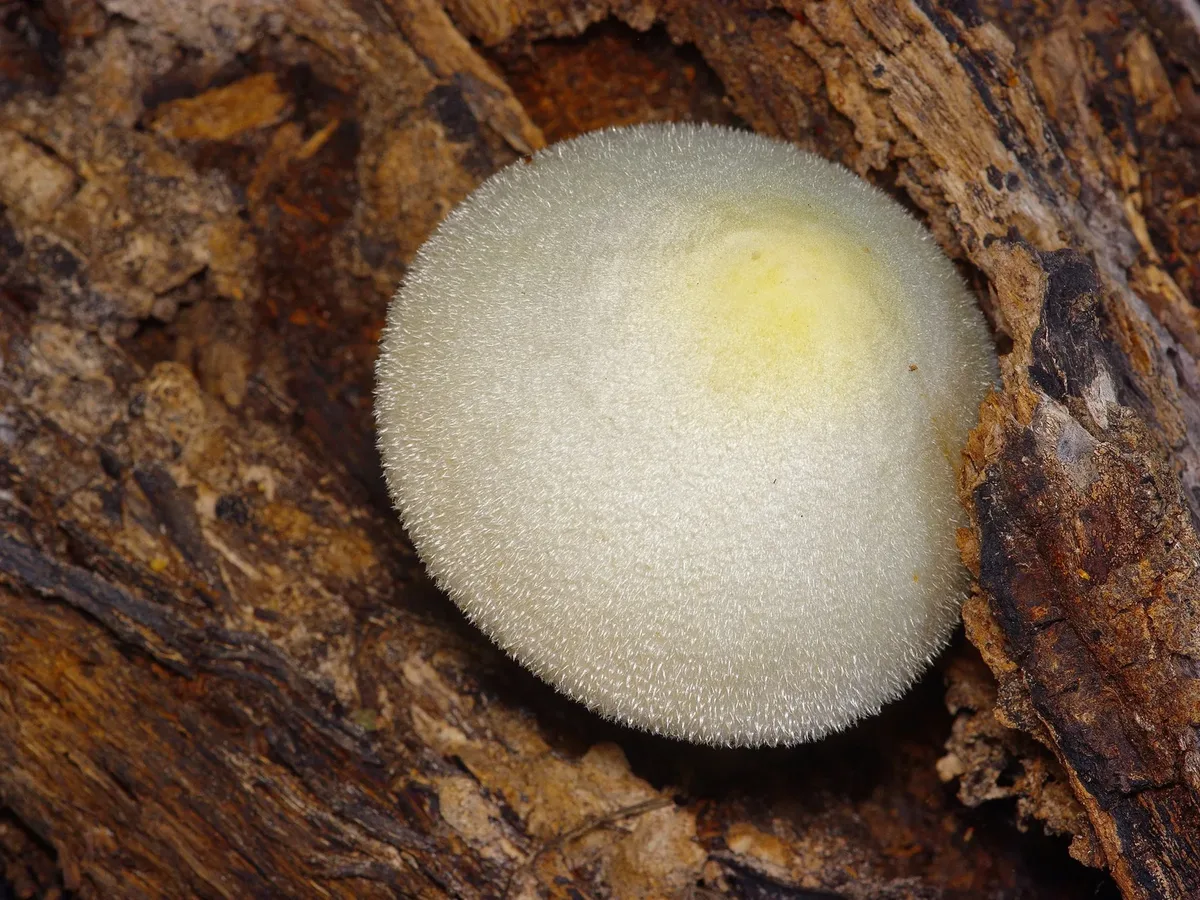
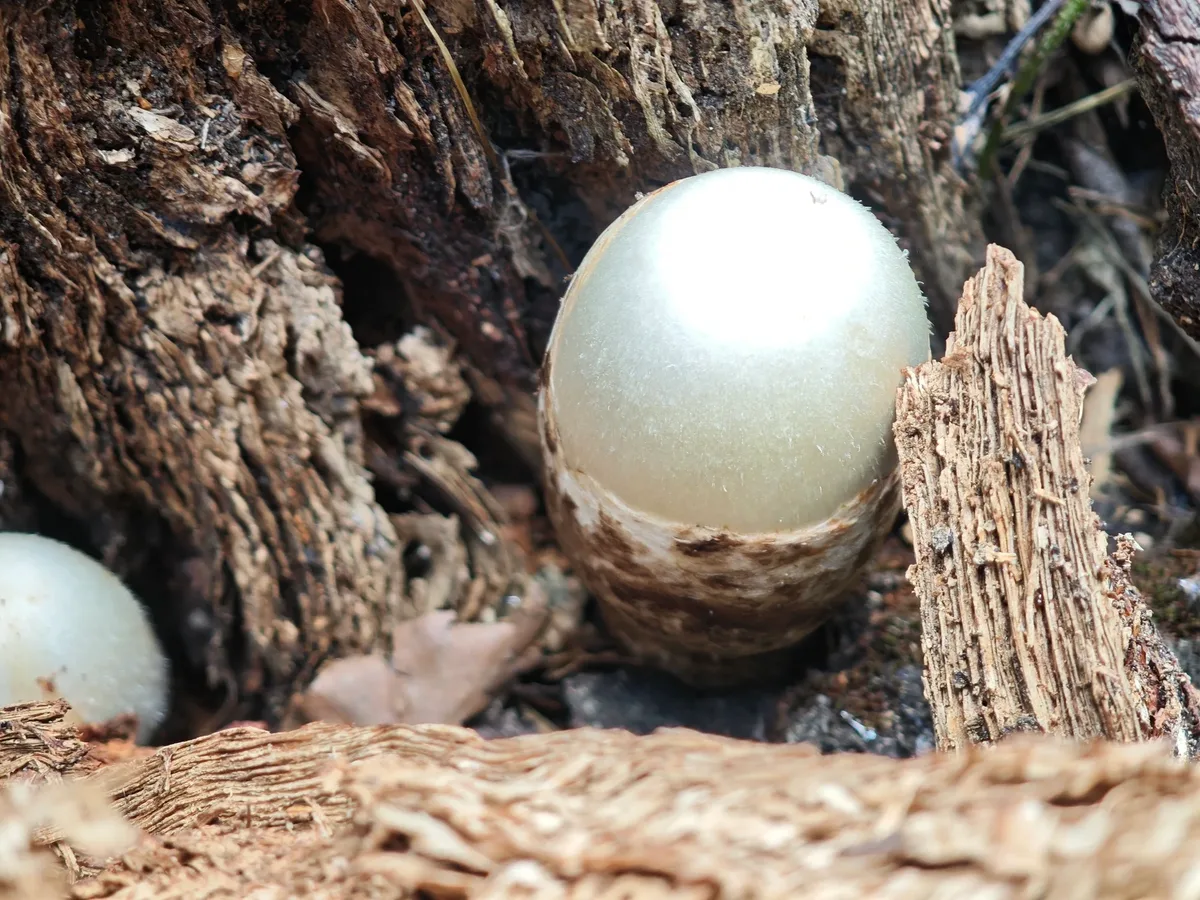
The earliest visible stage is a tightly sealed, smooth white egg or oval, sometimes 60-80 mm long, sitting at or just below the bark surface where the volva is anchored.
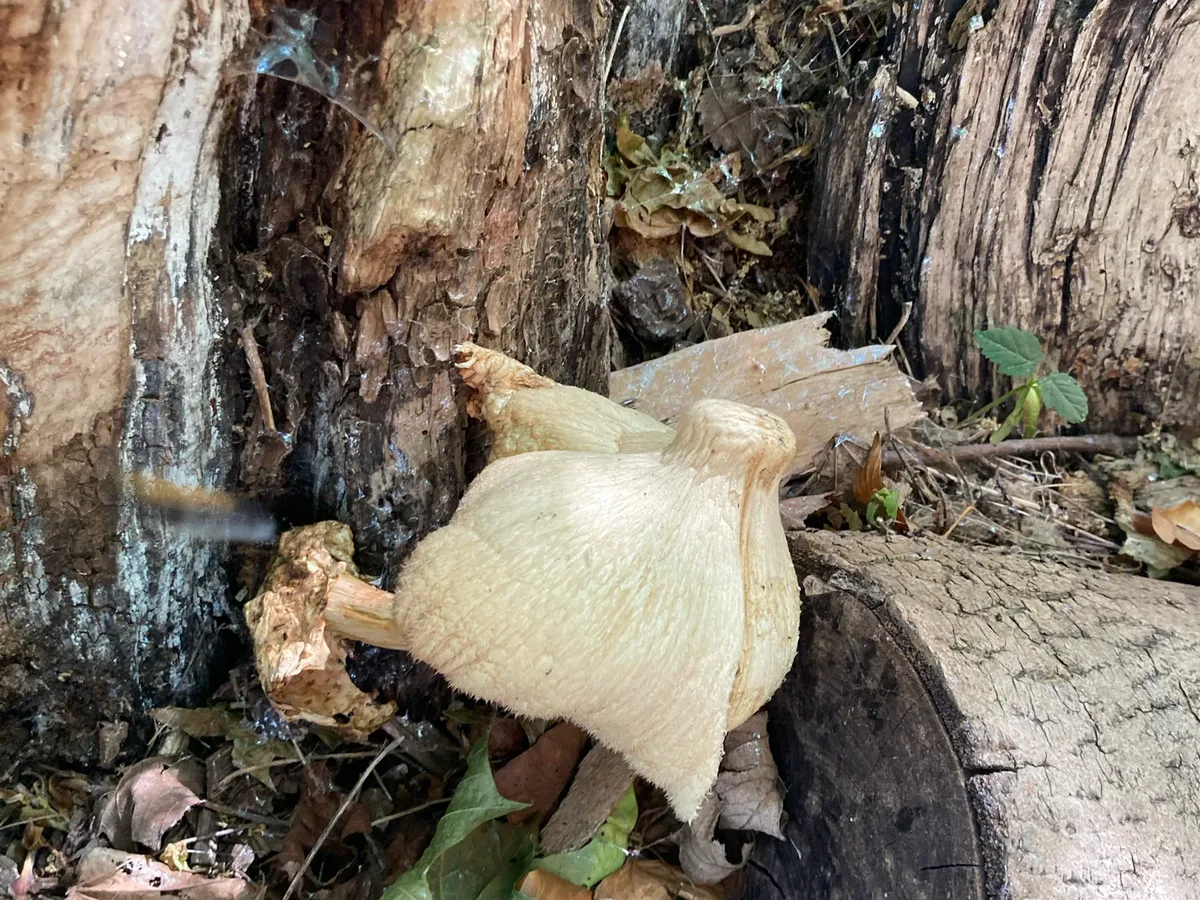
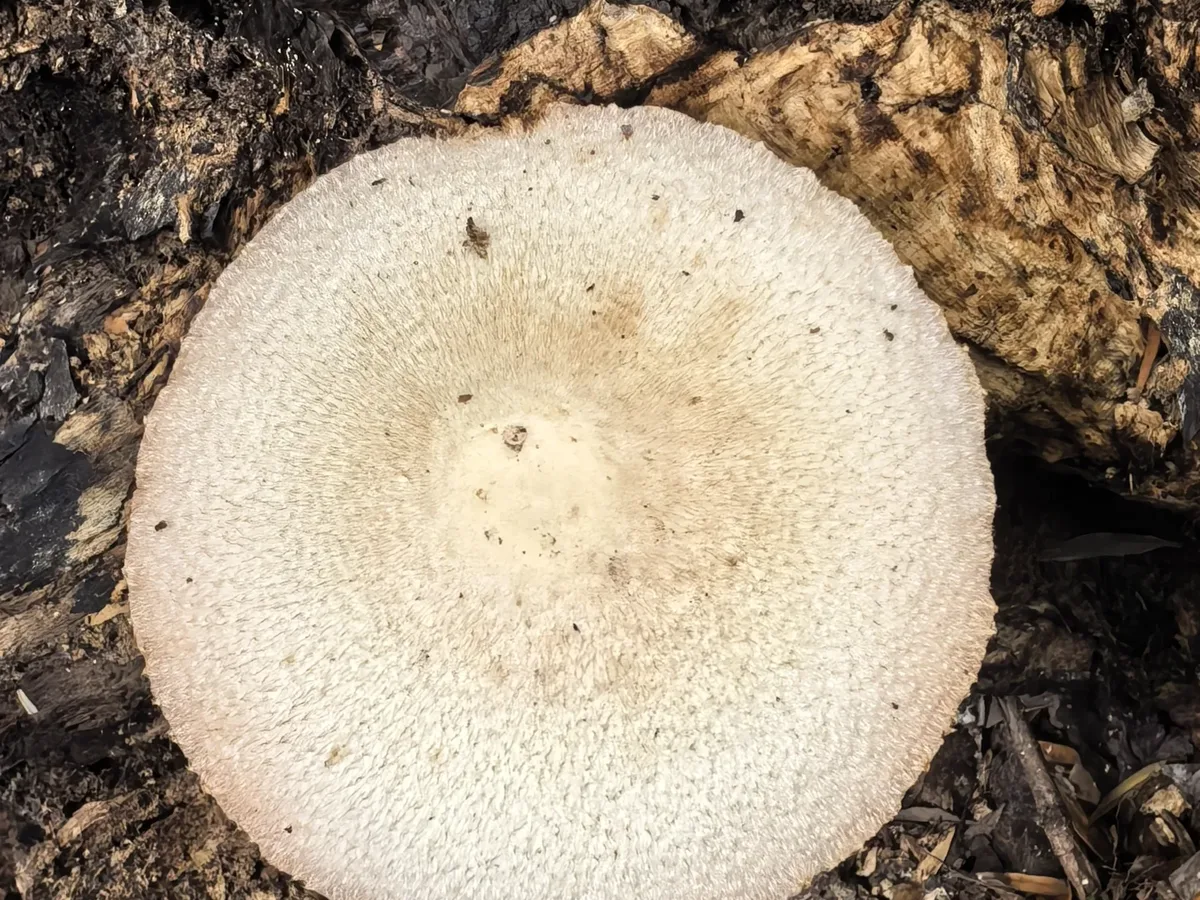
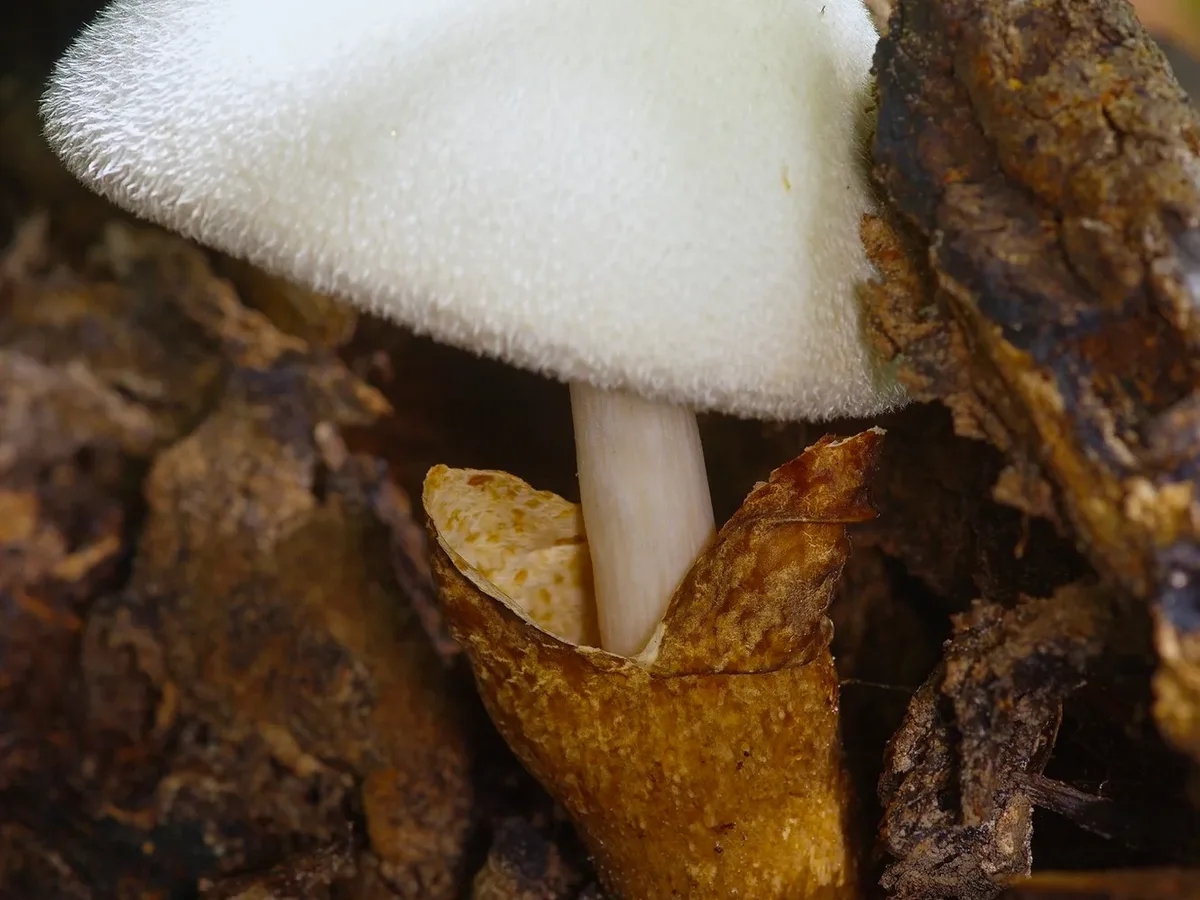
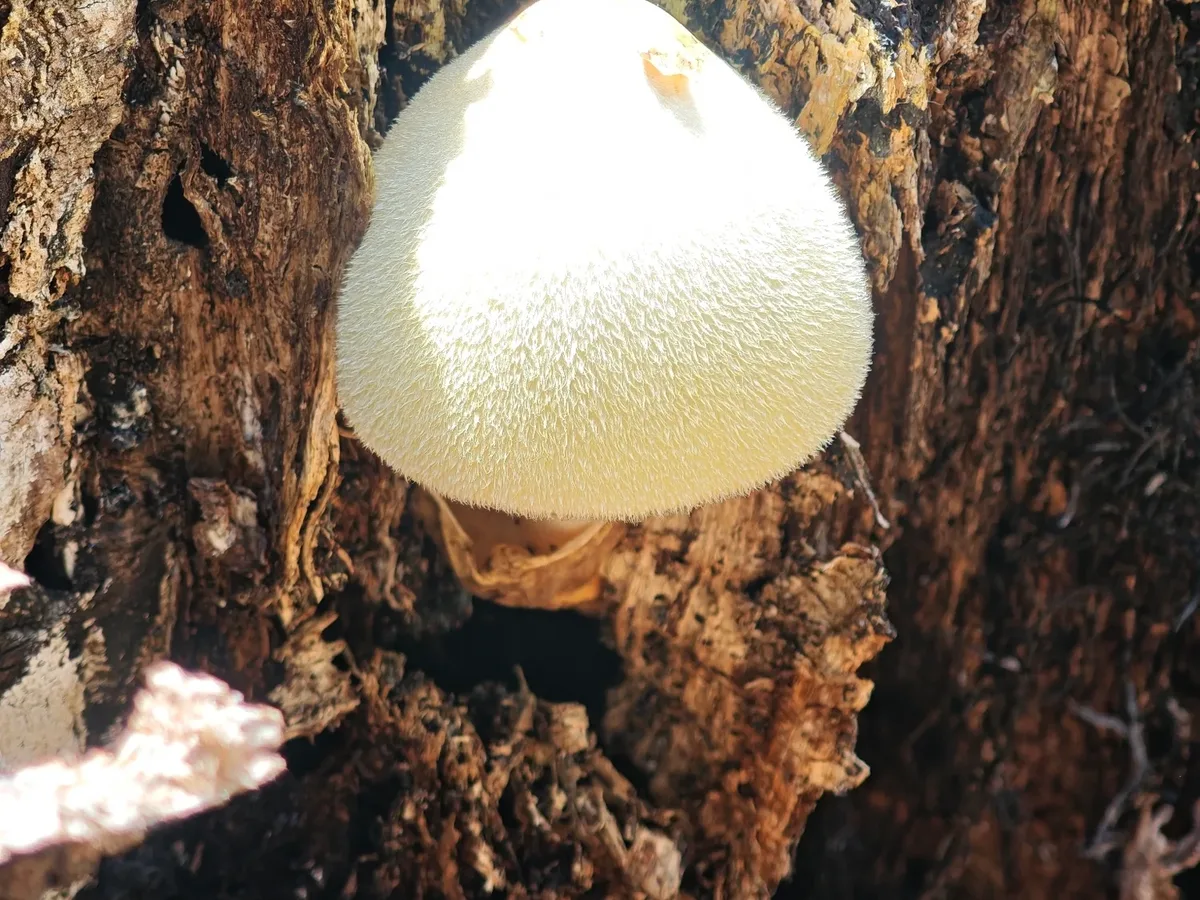
As this egg splits at the top and the cap begins to push out, the white fibrous surface of the expanding cap is immediately apparent: it is covered in dense, adpressed, almost lustrous silky fibres that catch the light and give the cap a satiny appearance unlike almost anything else growing from wood.
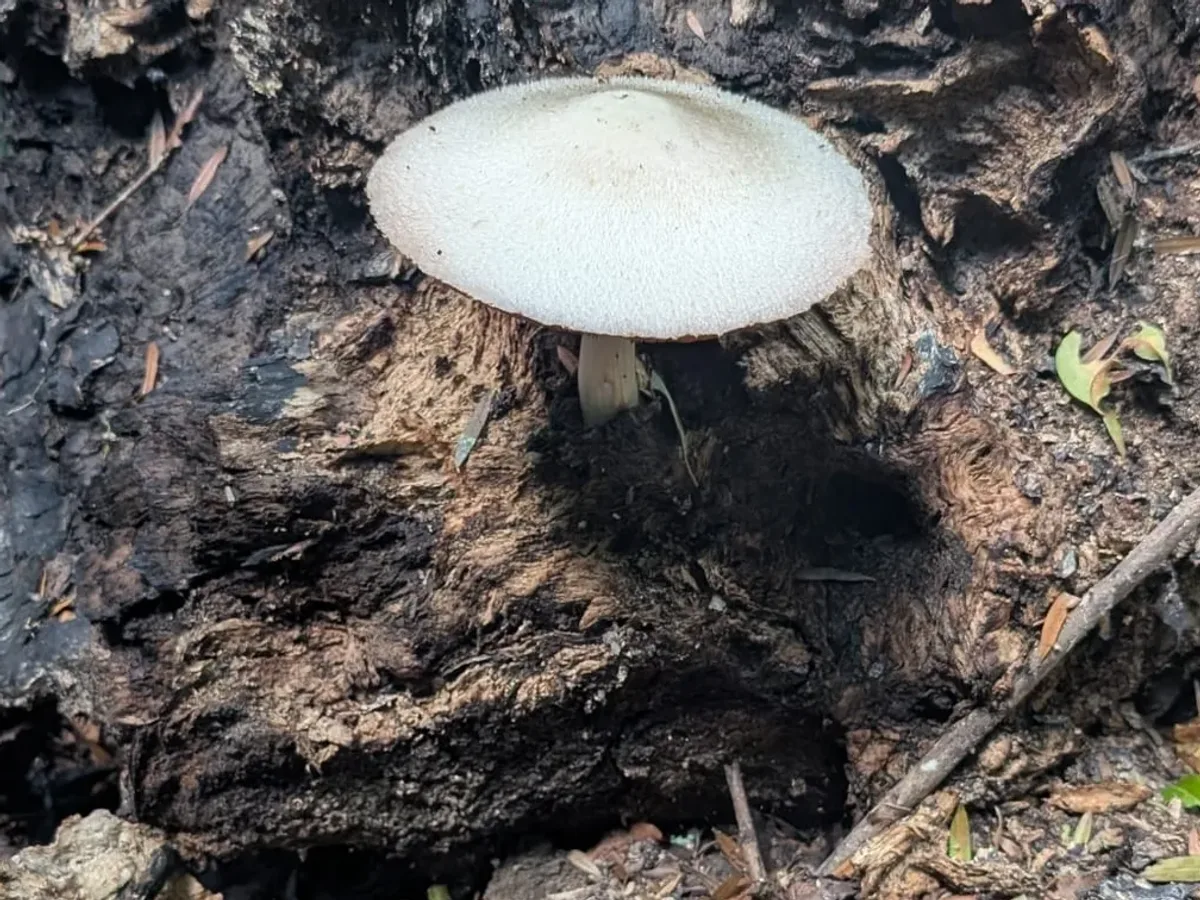
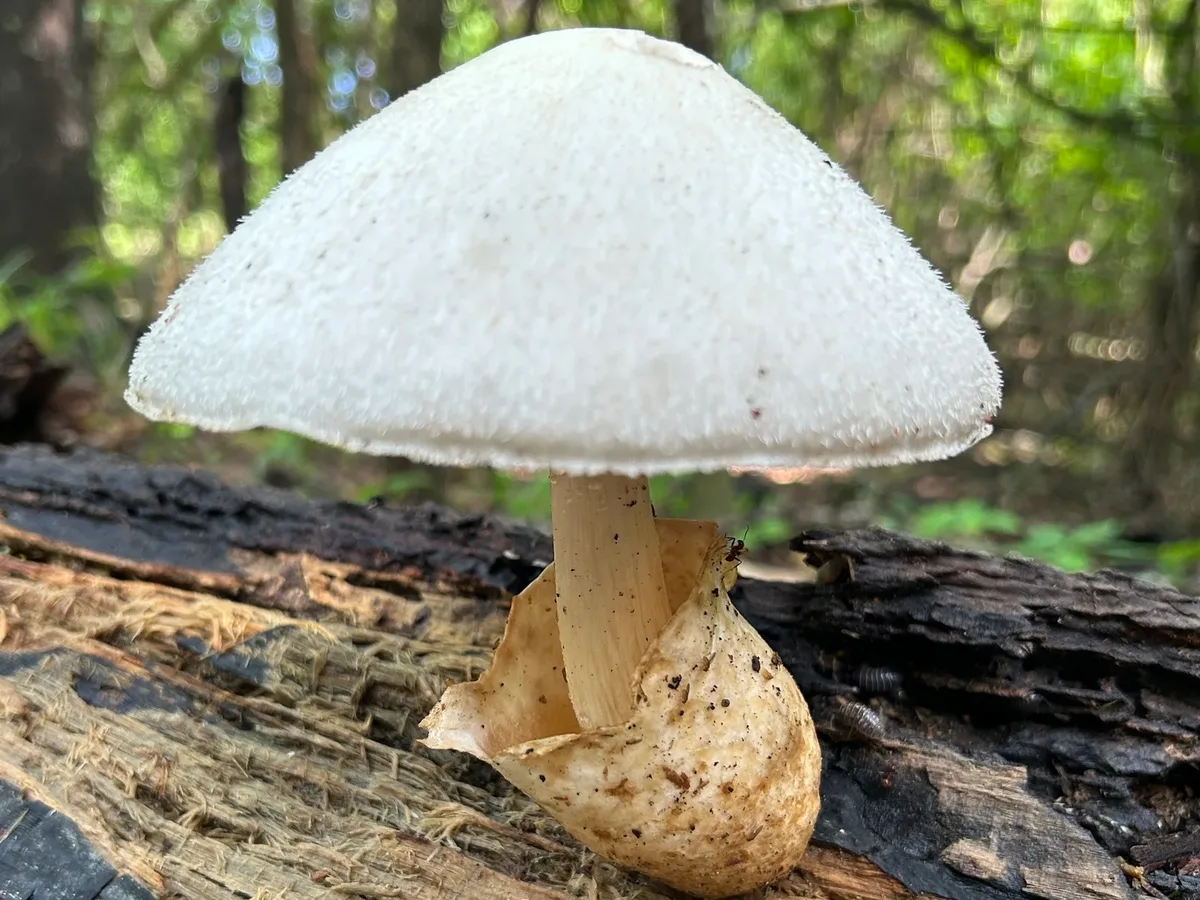
The fully expanded cap reaches 50-200 mm across - large individuals can be impressive - and is broadly convex to bell-shaped rather than flat, remaining dome-shaped rather than widely spreading.
The colour throughout is white to pale straw, sometimes ageing very slightly to pale ochre at the centre, but never strongly coloured.
Stem
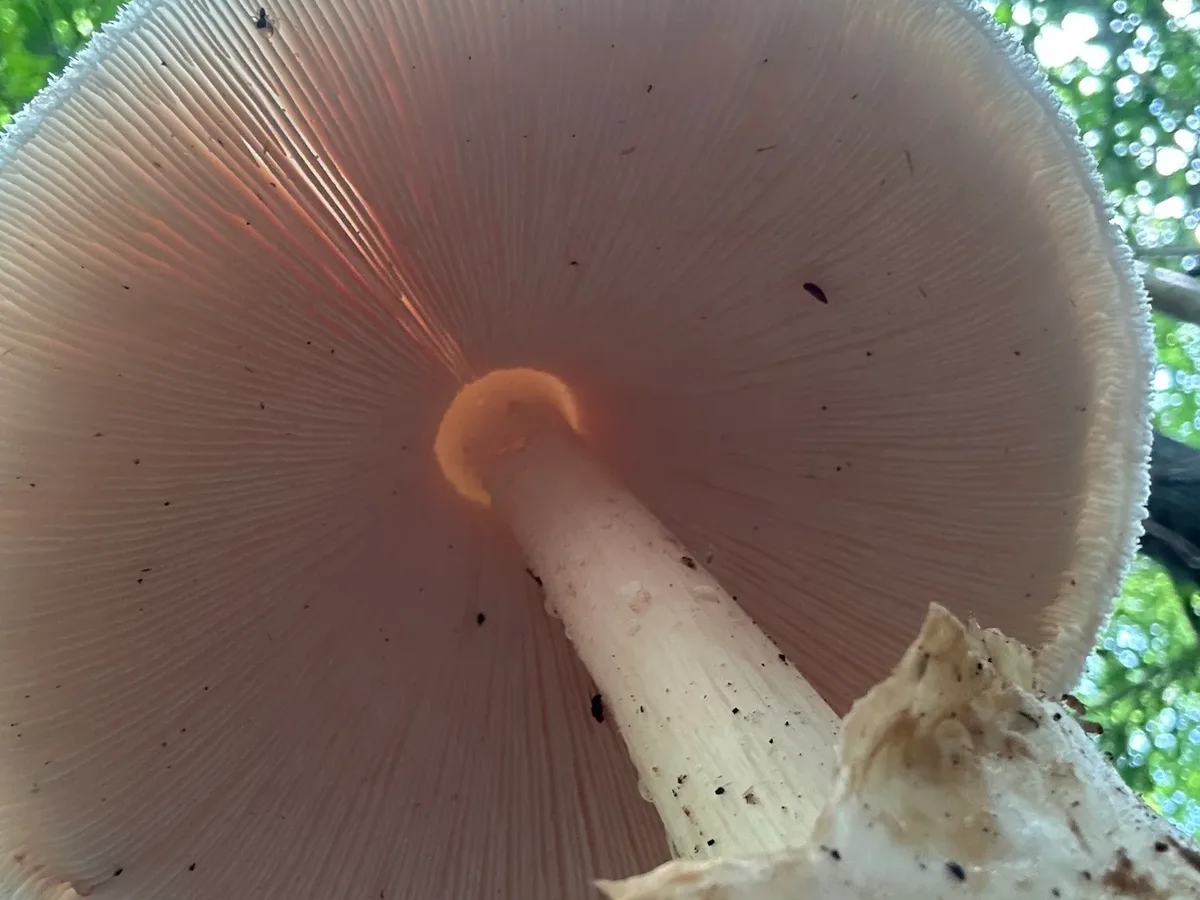
There is no ring at any stage; the stem is smooth and clean above the volva.
The thick white-to-cream volva at the base is usually the most substantial structure: when growing from bark it may cup or collar the stem base tightly, and on ground-level wood it may be partially buried and require gentle excavation to see in full.
Gills
The gills progress from white through pale pink to a clear salmon-pink as spores mature - taking a spore print of a mature specimen confirms an unambiguous pink.
Flesh
Flesh is white, firm, mild in smell.
Where & when it grows
Habitat
In stark contrast to its close relative the paddy straw mushroom (Volvariella volvacea), the silky rosegill is a creature of wood rather than agricultural debris. It grows from the substrate of old, hollow, or wounded hardwood trees, and finding one high on an elm trunk or in the fork of a mature maple is a genuinely delightful discovery.
The species is a white-rot saprotroph - its mycelium secretes enzymes that attack lignin and cellulose, slowly converting the heartwood or sapwood of dying trees into the organic matter that sustains the forest floor.
Parks and mature avenues of old elms and maples are classic search ground in Europe and North America; in East and Southeast Asia it also appears on tropical hardwoods, rubber trees, and orchard species.
Because it occupies elevated positions on trunks and large branches, specimens are sometimes first spotted from a distance as a pale dome or silky cluster on dark bark - worth binoculars in a productive park.
The species is rarely gregarious; single fruitbodies or two or three together near the same wound or hollow are typical.
When
The silky rosegill is a warm-season fungus, appearing from early summer well into autumn in the Northern Hemisphere - June through October in temperate regions, peaking July through September when night temperatures stay warm and rainfall or high humidity follows periods of summer heat.
Hot, muggy conditions after rain are ideal, and the species tends to appear suddenly and develop quickly over a few days.
In tropical Southeast Asia it is not constrained by the same cool-season cutoff and can appear through the wet season.
Individual fruitbodies are relatively short-lived; the silky white cap degrades to a soggy, pinkish-grey mound fairly rapidly, so the fruiting window for collecting a given specimen is a matter of days.
How it grows
Volvariella bombycina grows singly or in small clusters from the surface of dead or decaying wood, pushing out from:
- bark wounds
- hollow cavities
- exposed heartwood
- cut surfaces
Because the volva often anchors on vertical bark, the mushroom can appear to grow sideways or at an angle from the wood face - the stem base is held by the sac, not by ground soil.
Growth from the egg to full cap expansion can happen within two to three days under warm, humid conditions.
The mycelium lives within the decaying wood, often in tree tissue that appears structurally intact from the outside but has lost mechanical strength through decay. So the presence of this mushroom on a standing tree is a useful indicator of internal decay.
It is not uncommon to find the species returning to the same tree for multiple seasons if the wood substrate persists.
Fruiting conditions
Warm-season wood-decay saprotroph. Fruitbody development is triggered by warm air and wood-surface temperatures (above roughly 18 °C) combined with high humidity or rainfall; individual eggs develop to maturity within 3-7 days of initiation under favourable conditions. Does not require mycorrhizal soil temperatures; responds to ambient warmth and moisture penetrating the host wood. Peak fruiting in July-September in temperate Northern Hemisphere; broader wet-season window in tropical Southeast Asia.
Look-alikes
The most critical lookalike situation is the egg stage, where a closed Volvariella bombycina egg sitting in a volva is externally indistinguishable from the deadly buttons of Amanita phalloides and related Destroying Angel-group species. This ambiguity has caused fatal poisonings.
At maturity, the Silky Rosegill is quite distinctive if all features are checked - but several important comparisons are worth knowing.
- Amanita species possess a ring (annulus) on the stem, which Volvariella bombycina NEVER has; Amanita gills and spore print are WHITE, while V. bombycina produces a clear pink spore print.
- Volvariella volvacea (the Paddy Straw Mushroom) is closely related and shares the pink spore print and sac-like volva, but has a grey-brown to dark smoky cap rather than a silky white one, is smaller on average, and grows on agricultural substrates (rice straw, compost) rather than on woody tissue.
- Pluteus cervinus (Deer Shield) and other Pluteus species also have pink spores and free gills but completely lack a volva, and their caps are brown rather than white-silky - these are the mushrooms most commonly confused with V. bombycina on wood at the fully-expanded stage.
The combination of white silky cap + pink gills and spore print + no ring + prominent white sac-like volva, growing on or from hardwood, is essentially conclusive for V. bombycina in its range.
Deadly - amatoxin. In the egg stage, Amanita phalloides produces a white sac-like button that is externally indistinguishable from a Volvariella bombycina egg. Cutting an A. phalloides egg reveals white undifferentiated flesh with no pink gills and no fibrous cap outline; a V. bombycina egg shows a hint of the future white cap and pale to very faintly pink gills inside. At maturity, A. phalloides has a greenish-yellow to olive-brown or whitish cap with radial fibres, WHITE gills (never pink), a white to pale ring on the stem (Volvariella has NO ring), and a white spore print (Volvariella spore print is clearly pink). The presence of a ring and white spore print on A. phalloides versus no ring and pink spore print on V. bombycina are the definitive separation at maturity. Never collect the egg stage.
Deadly - amatoxin. Entirely white at all stages and found in broadleaf and mixed woodland. At the button stage it produces a white egg enclosed in a volva indistinguishable externally from a V. bombycina egg. At maturity, A. virosa has a conical to broadly bell-shaped white cap (sometimes superficially similar in shape to V. bombycina), white gills, a shaggy-fibrous stem texture, a skirt-like ring, and a white spore print. Volvariella bombycina has no ring whatsoever, gills that turn pink, and a pink spore print. In Europe and parts of Asia, both species can grow in or near the same woodland; the presence of large white-capped, ringed, white-gilled specimens with white spore print near wood should immediately raise suspicion of Amanita.
Deadly - amatoxin. A lethal species from southern China (Guangdong and beyond) and parts of Southeast Asia, entirely white, with a ring and white spore print. Fatal mass poisonings have been attributed to this species in Guangdong. Its egg stage is white and enclosed in a volva, resembling V. bombycina eggs. At maturity it is entirely white including ring and gills; a pink-gilled, ringed Volvariella is a different organism but the egg stage overlap demands extreme caution in the co-distribution zone of southern China.
Also grows on dead hardwood with free gills and a pink spore print, making it a plausible confusion at a glance. The cap is brown to grey-brown, not white-silky; there is no volva whatsoever at the base; the stem base sits flat on the wood surface. Pluteus species have a characteristic network of raised veins at the gill face (visible with a hand lens) and never have a sac-like enclosure. Edible but much less substantial. Easy to distinguish from V. bombycina once the absence of a volva and the brownish cap are noted.
Closely related and also with a volva and pink spore print. Distinguishable by its grey-brown to dark smoky grey cap lacking the white silky fibrous covering; smaller average size; preference for agricultural substrates (rice straw, compost, decomposing plant matter) rather than standing or fallen hardwood. In practice the two species rarely occur in the same microhabitat: V. volvacea is a compost/paddy species, V. bombycina is strictly on woody substrate. Confusion between them is toxicologically inconsequential as both are edible, but the substrate difference and cap colour are reliable separation points.
In the kitchen
Picking & cleaning
Only collect fully open, clearly expanded specimens where all key features are unambiguous:
- white silky fibrous cap
- free gills progressing to pink
- NO ring anywhere on the stem
- a prominent white sac-like volva visible at the base
Do not collect egg-stage specimens under any circumstances - closed Volvariella eggs are externally indistinguishable from the deadly egg-stage buttons of Amanita species, including Amanita phalloides, Amanita virosa, and related Amanitas in Europe, and Amanita exitialis, Amanita subjunquillea, and Amanita bisporigera in Asia and North America.
The context (growing directly from wood rather than from soil) is a helpful pointer, but it is not infallible: Amanita buttons can occasionally appear near woody debris at soil level, and a volva buried in leafy substrate near a log can be ambiguous.
The safest rule: never harvest a closed white egg on or near wood, regardless of substrate.
When collecting mature specimens from high on a trunk, ensure you can safely reach the volva; the volva must be confirmed. Carry the whole base intact to preserve the volva structure for final identification.
Cooking
The silky rosegill has a mild, pleasant flavour and a reasonably firm texture that holds up to gentle heat.
It is most commonly eaten in parts of China and Southeast Asia, where it is prepared simply:
- sautéed in oil with garlic
- added to stir-fries
- simmered in soups and broths
The white caps discolour to a gentle pinkish-buff during cooking as the pigments interact with heat, and the flesh softens without becoming rubbery.
The flavour is delicate rather than intense and benefits from aromatic companions such as ginger, spring onion, and soy sauce.
As with any Volvariella, ensure full cooking - do not eat raw.
The species does not appear prominently in Western cuisines, where it is uncommon and seldom cultivated, but where it is foraged in Asia it is regarded as a respectable wild edible.
Good to know
The Silky Rosegill is considered a safe edible species with no known toxins and a history of consumption in parts of Asia.
However, it carries one significant and non-negotiable danger: the egg stage of this mushroom is externally identical to the deadly egg-stage buttons of Amanita phalloides (Death Cap), Amanita virosa (Destroying Angel), and related species.
Fatal amatoxin poisonings have resulted from harvesting white-veiled eggs on or near woody substrates. There is no antidote for amatoxin poisoning; it causes progressive liver and kidney failure over several days, and the outcome of severe cases is frequently fatal.
This makes the following rule absolute: NEVER harvest a closed white egg from any substrate, even if it appears to be on wood, unless you are confident no deadly Amanita grows in the area.
Only collect mature, fully expanded fruitbodies where all diagnostic features are simultaneously and clearly confirmed:
- white silky cap
- pink gills
- NO ring
- white sac-like volva
- confirmed wood substrate
When in doubt, leave the specimen.
The edibility of confirmed mature specimens is well-established, but the risk at the egg stage is severe enough to warrant treating it as potentially lethal.
A reference guide - never an edibility guarantee. When in doubt, leave it out.