Orson's bitter bolete
Tylopilus orsonianus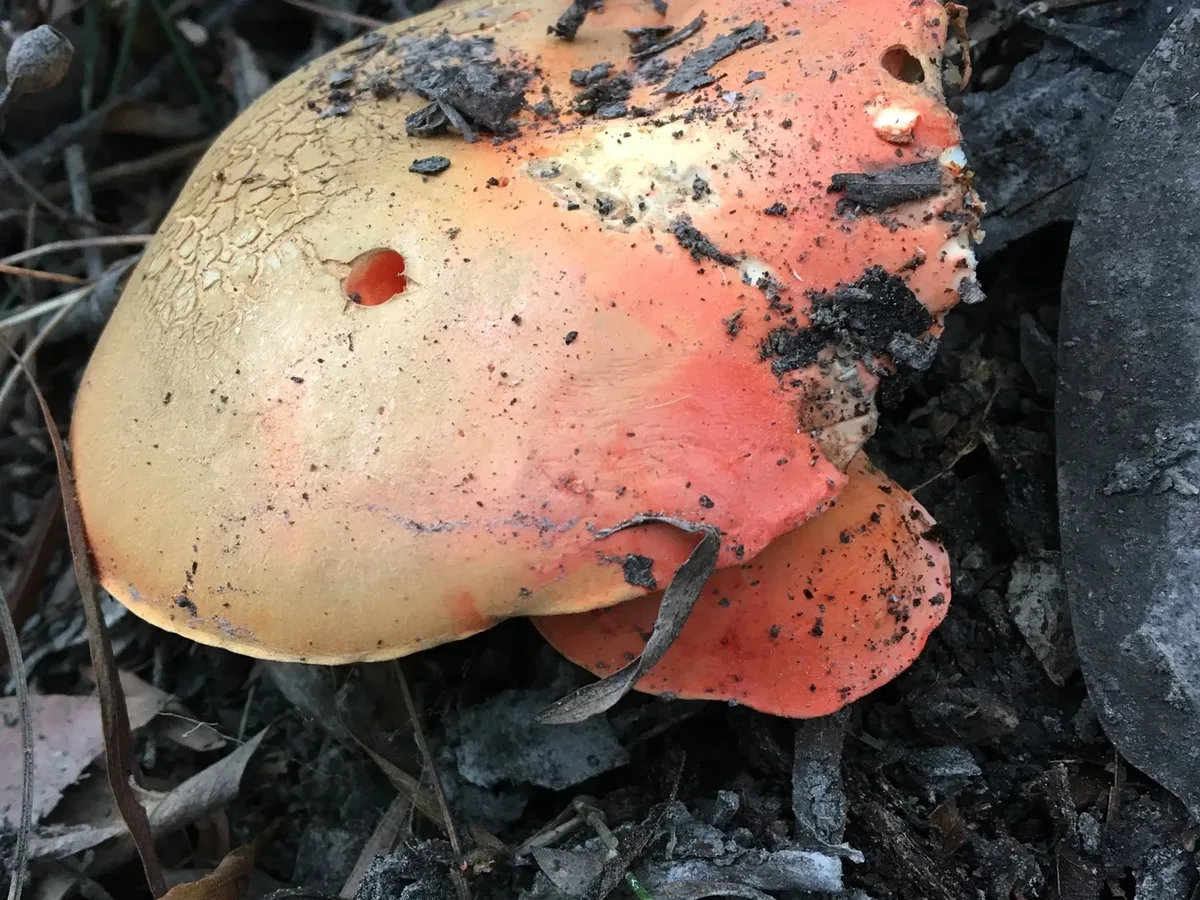 Atlas of Living Australia (CC0)
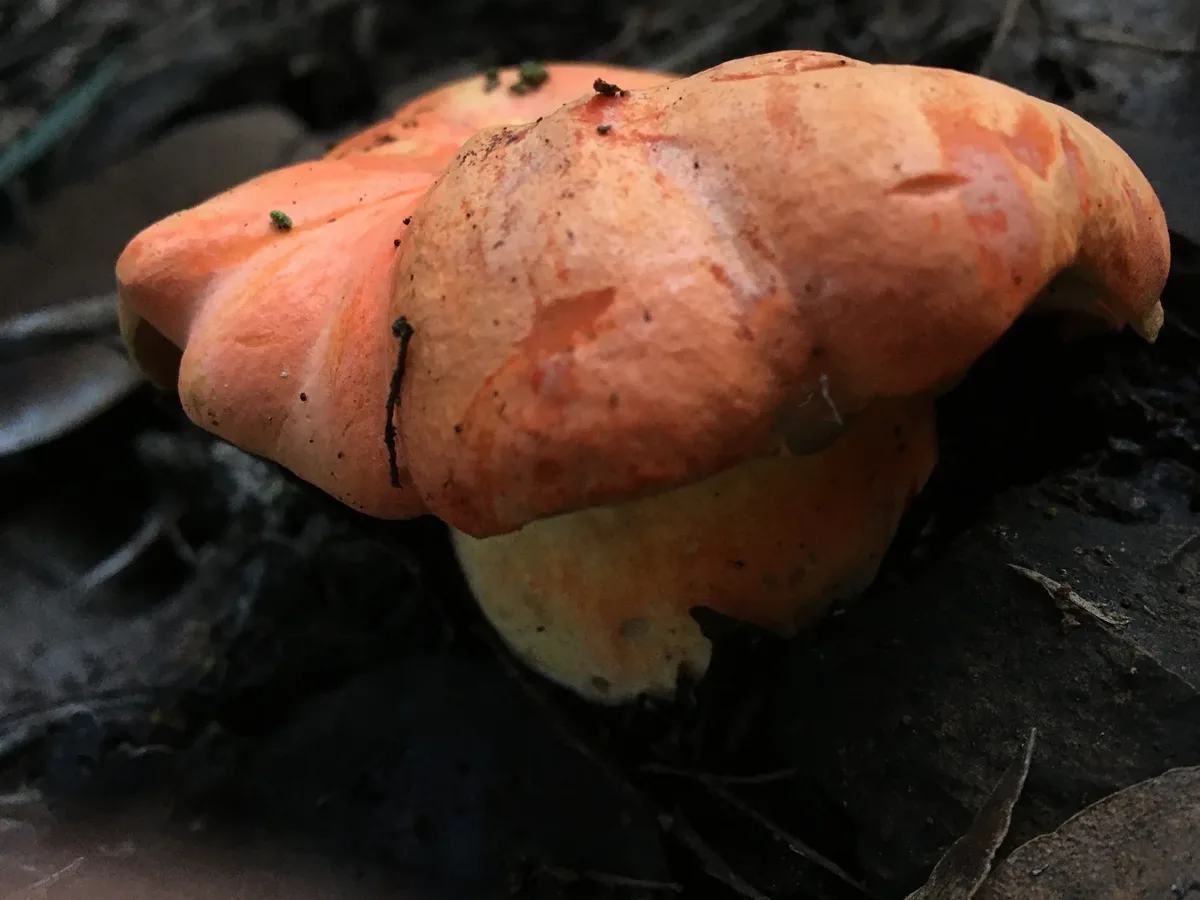 Atlas of Living Australia (CC0)Atlas of Living Australia (CC0)Atlas of Living Australia (CC0)
Not poisonous, but not worth eating - too tough, bitter, or bland for the pot.
How to recognise it
Tylopilus orsonianus follows the classic blueprint of its genus: a bolete in overall architecture, but one that announces its identity most clearly on the inside - in the taste rather than the look.
Cap
The cap opens as a firm buff-to-hazel-brown hemisphere and expands gradually to a broad, slightly wavy disc up to 10 cm across, its surface dry and minutely felted when young, smoothing with age.
The colour is warm and unremarkable - the sort of mid-brown that could, at a glance in forest shadow, pass for a juvenile edible bolete.
Pores
Beneath the cap the pore surface begins white but ages through cream to a soft, unmistakable pinkish or rose-buff - a Tylopilus signature that already puts the collector on notice.
Stem
The stem is solid and pale, carrying a fine reticulate network most visible in its upper portion, pale ridges on a cream ground.
Flesh
The flesh, cut cleanly, is white and firm, and it does not blue, does not redden, does not change in any visible way - a detail that might reassure the incautious.
Smell & taste
The definitive identifier is the taste: touch a fragment of raw flesh to your tongue and the bitterness hits within a second, sharp and persistent, and leaves no doubt at all.
That bitterness is the species' entire story in a single sensation.
Where & when it grows
Habitat
Tylopilus orsonianus lives in the Atlantic Forest, one of the most biodiverse and most threatened biomes on Earth.
The Mata Atlântica once cloaked the entire eastern seaboard of Brazil in layers of subtropical and tropical broadleaf forest; today less than twelve percent of the original cover remains, fragmented into islands of forest in Rio Grande do Sul, Santa Catarina, Paraná, and São Paulo states.
It is in these fragments - and in the Serra Gaúcha uplands where larger patches persist - that T. orsonianus makes its mycorrhizal life.
Like all Tylopilus species it is obligately linked to living tree roots, extracting mineral phosphorus from the soil and returning photosynthate-derived sugars to its host in a partnership that can span decades.
It needs intact forest floor:
- undisturbed leaf litter
- fungal continuity
- the acid, freely draining soils that characterise mature Mata Atlântica stands
Degraded pasture edges, plantations, and secondary scrub do not host it. Finding it is, in a small way, a sign that a fragment of forest is still functionally intact.
When
Southern Brazil's subtropical summers are warm and wet, and the cycle of rain and warmth that drives the Mata Atlântica's fruiting season runs from October through April - spring to early autumn in the Southern Hemisphere.
Tylopilus orsonianus fits this pattern precisely, waiting for soil temperatures to cross the 16 °C threshold and for the first sustained rains of late spring before pushing up its first fruitbodies.
November, December, and January - the heart of the subtropical summer - represent the peak, though good fruiting can continue through March in wetter years.
Higher elevation sites in the Serra Gaúcha, where mists and cloud forest conditions moderate summer temperatures, may see a more compressed season concentrated in December and January.
The pattern is familiar to anyone who has foraged mycorrhizal boletes: rain triggers the flush, the mycelium responds within a week to a fortnight, and the flush peaks and subsides over ten to twenty days before the next event.
How it grows
Fruitbodies emerge singly or in small scattered groups of two to four, never in dense clusters.
As an ectomycorrhizal species it is rooted in long-running partnership with the broadleaf trees of the Atlantic Forest, and that partnership determines where it grows with precision - the same productive sites tend to be productive across multiple seasons when conditions align.
The mycelium can persist in the soil for years or decades, and the visible fruitbody is simply the reproductive investment the fungus makes when the season's conditions are right.
Buttons emerge from the soil surface and develop to full size over five to ten days, pushed forward primarily by water uptake once the initial cellular structure is in place.
Fruiting conditions
Subtropical summer fruiter; flushes follow sustained warm-season rainfall once soil temperature is above 15 °C. The typical lag from soaking rain event (25+ mm over 14 days) to visible fruitbody emergence is 6-14 days, consistent with other mycorrhizal boletes in warm humid climates. Season runs October-April (Southern Hemisphere spring/summer/early autumn), peaking November-March in Rio Grande do Sul and adjacent areas.
Look-alikes
In the subtropical Atlantic Forest of southern Brazil, several edible or at least non-bitter boletes may grow in the same habitat and at the same season.
Young specimens of Tylopilus orsonianus, before the pores have developed their diagnostic pink tint and before the full bitterness is assessed, could be confused with various brownish-capped edible or uncharacterised boletes in the diverse South American bolete flora.
The taste test is decisive: no edible bolete native to this region produces the sharp, lasting bitterness characteristic of Tylopilus.
Tylopilus felleus, the widely known bitter bolete of the Northern Hemisphere, is closely related and shares virtually identical edibility status and field characters, but occurs in temperate Eurasia and is not a South American species.
Among other South American boletes that might briefly be confused with T. orsonianus, none are known to be deadly in this region. However, the general bolete safety rules apply:
- never eat a bolete with red or orange pores
- never eat one that blues intensely and has red pore mouths
- always apply the taste test before committing any brown-pored bolete to the basket
The well-known Northern Hemisphere bitter bolete; extremely similar in macro-morphology (pale brown cap, pinkish pores, reticulate stem, bitter flesh) and equally inedible. Tylopilus felleus occurs in Europe, eastern North America, and parts of Asia under oak, beech, and spruce, not in South America. In the Atlantic Forest of Brazil, any Tylopilus encountered is most likely T. orsonianus or another native species. The bitterness and pinkish pore discoloration are shared by both species - both are inedible, and the distinction matters taxonomically rather than for safety.
Various brownish-capped edible or uncharacterised boletes occur in the Atlantic Forest alongside T. orsonianus. Distinguished from T. orsonianus by the absence of intense bitterness on tasting a small raw fragment, and in most cases by pore surfaces that remain white to yellow-green rather than developing a pinkish flush. The taste test is definitive: always taste a tiny raw fragment before collecting any brown-pored bolete in this region.
A prized edible bolete of central Chile, occurring primarily in Nothofagus obliqua forests of the Chilean Andes foothills; does not normally co-occur with T. orsonianus in the subtropical Atlantic Forest. Distinguished by bright yellow pore surface, yellow flesh, pleasant nutty smell, and absence of bitterness. Mentioned for completeness as a regional bolete comparison point.
In the kitchen
Picking & cleaning
Tylopilus orsonianus should not be collected for eating.
The extreme bitterness that defines this species is heat-stable, water-insoluble, and unaffected by any culinary preparation. No amount of parboiling, soaking, frying, or drying removes it; indeed, heat tends to concentrate bitter compounds as water is driven off.
A single specimen mixed into a basket of edible boletes will contaminate and ruin the entire preparation once cooked.
The practical field advice is the same as for any Tylopilus: any bolete in subtropical South American forest with white flesh that turns pinkish at the pores, combined with a distinctly bitter taste on a tiny raw fragment, is a Tylopilus and should be left out of the basket.
Photograph it - the species is scientifically interesting in the relatively poorly documented South American bolete flora - and leave it to sporulate.
Good to know
Tylopilus orsonianus is not known to contain any mycotoxin and is not poisonous in a toxicological sense.
Its inedibility is entirely organoleptic: the bitter compounds - likely terpenoids distributed through the flesh - make consumption naturally self-limiting, as the taste is sufficiently aversive to prevent ingestion of significant quantities in virtually all circumstances.
No cases of serious toxicological harm attributable to this species are documented. Accidental consumption of a small amount as part of a mixed dish would not be expected to cause medical emergency.
If consumed in quantity and any gastrointestinal symptoms develop, consult a medical professional as a precaution and bring a photograph or specimen for identification.
The more relevant safety concern is its potential to be confused with genuinely edible boletes. Always apply the taste test - a tiny fragment of raw flesh to the tongue, then spit - before any brown-pored bolete from Atlantic Forest habitat enters the basket.
A porcini relative tastes mild and pleasant; a Tylopilus tastes unmistakably bitter within seconds.
A reference guide - never an edibility guarantee. When in doubt, leave it out.