Dark bolete
Tylopilus obscurus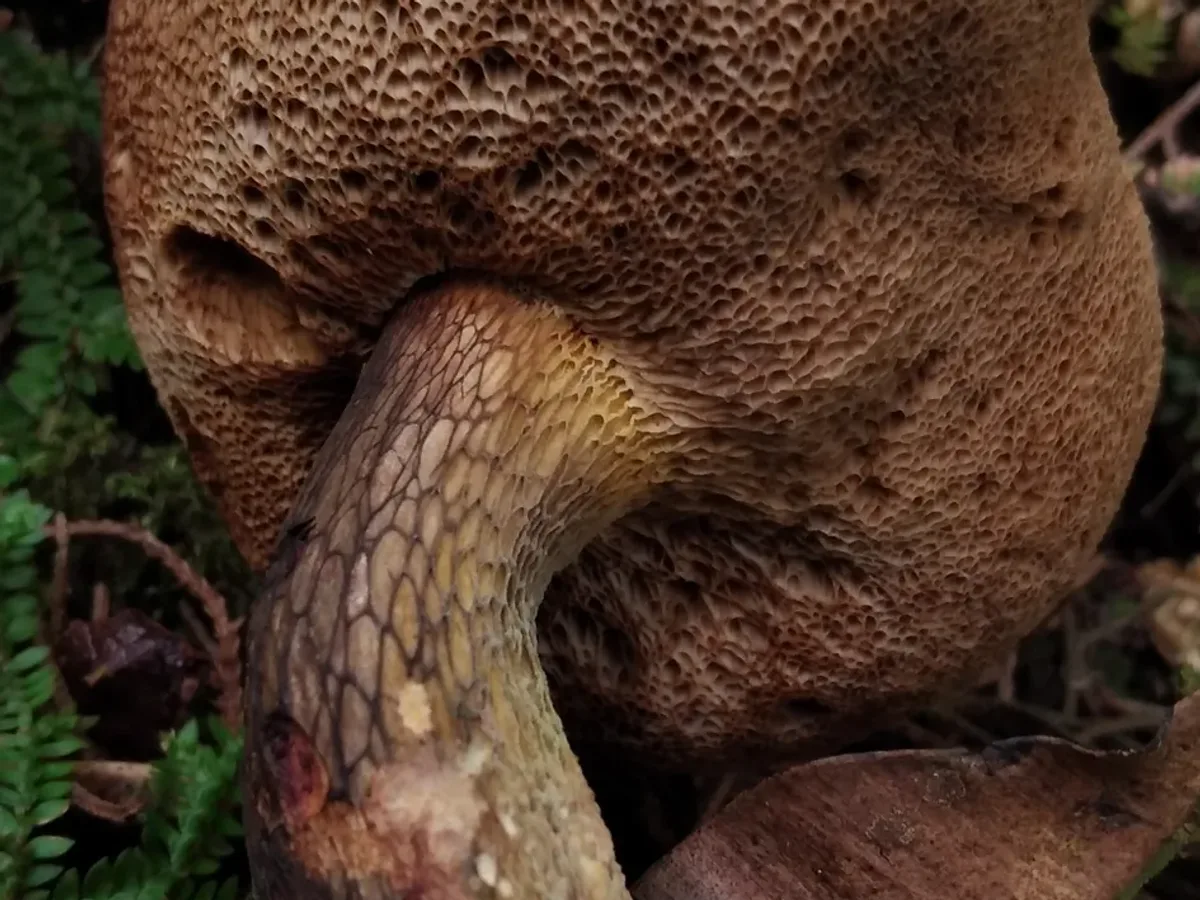 © Andrey Loria (CC BY)
 © Andrey Loria (CC BY)
 © Andrey Loria (CC BY)
 © Andrey Loria (CC BY)
 © Andrey Loria (CC BY)
 © Andrey Loria (CC BY)© Andrey Loria (CC BY)© Andrey Loria (CC BY)
Not poisonous, but not worth eating - too tough, bitter, or bland for the pot.
How to recognise it
Cap
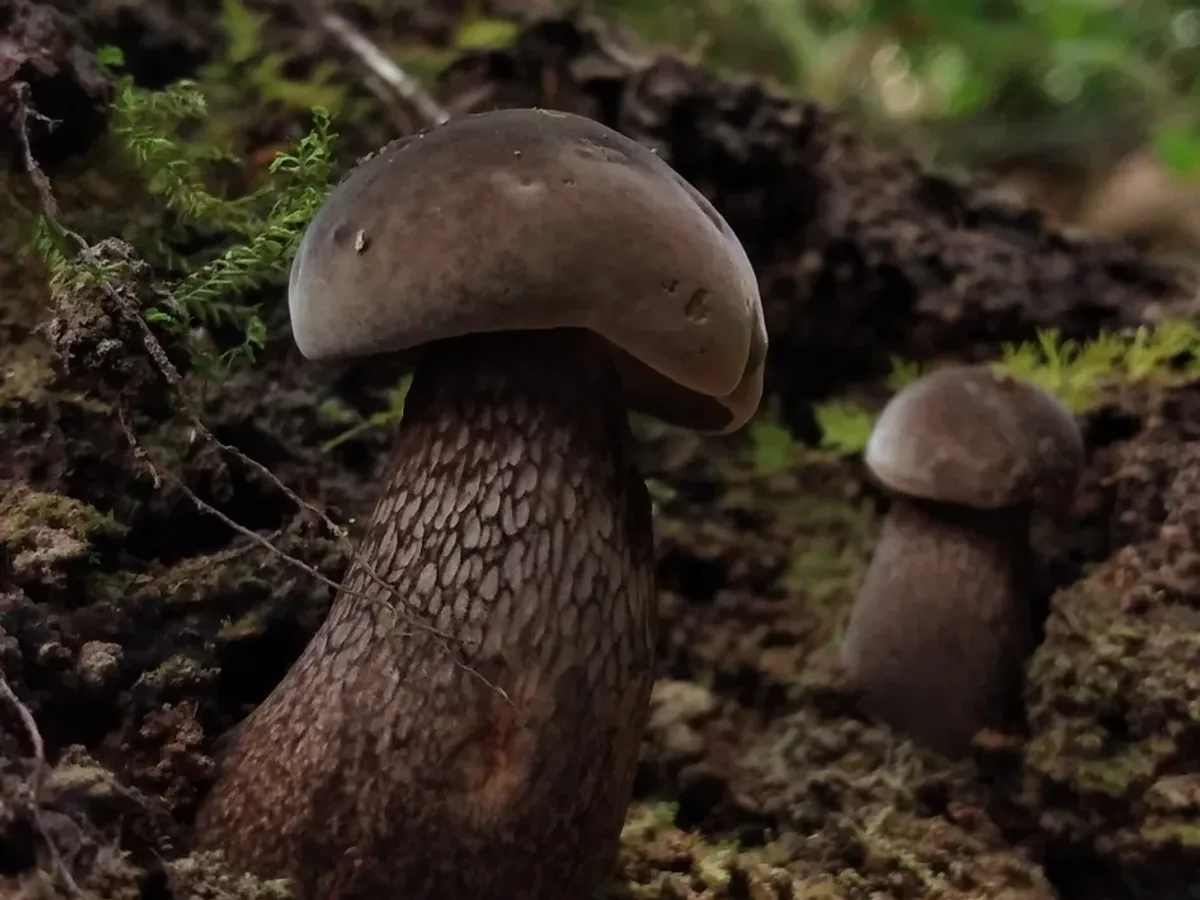
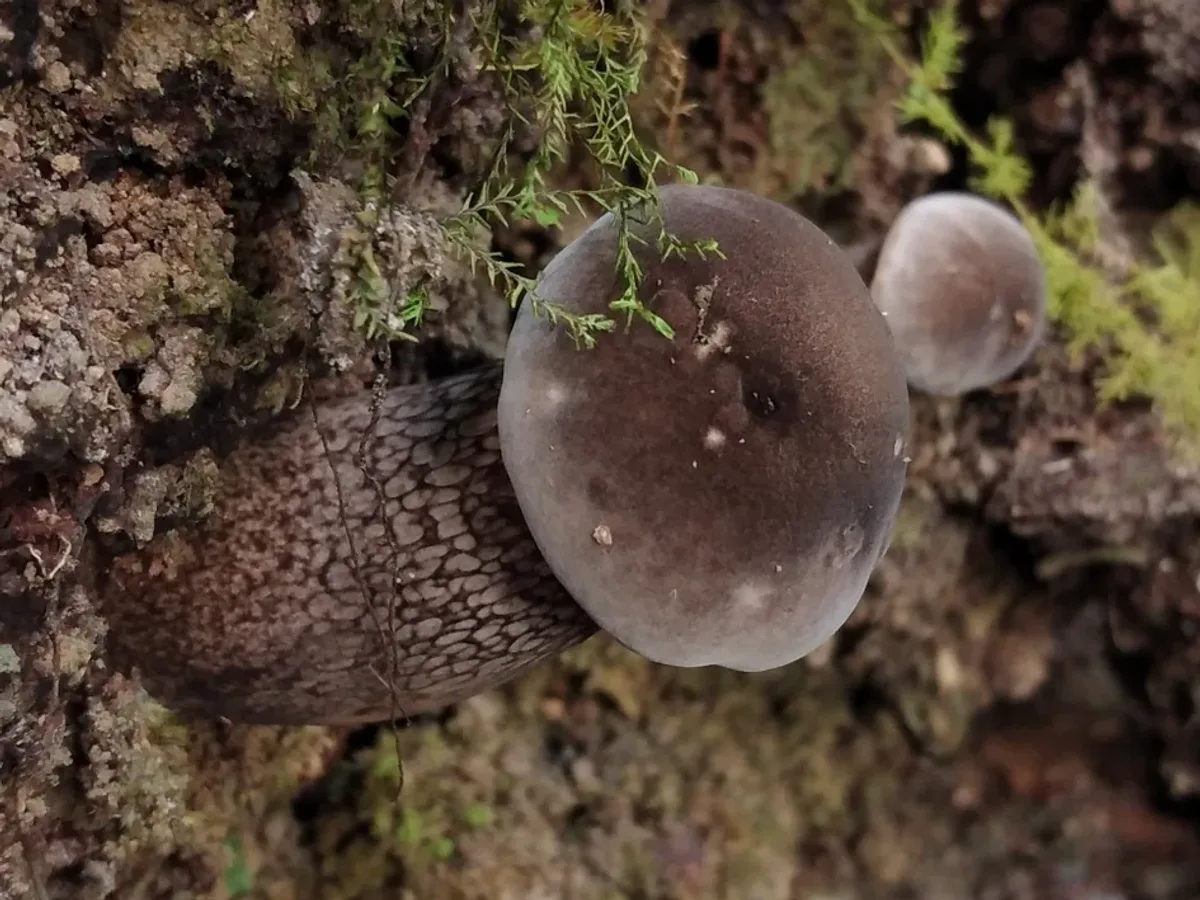
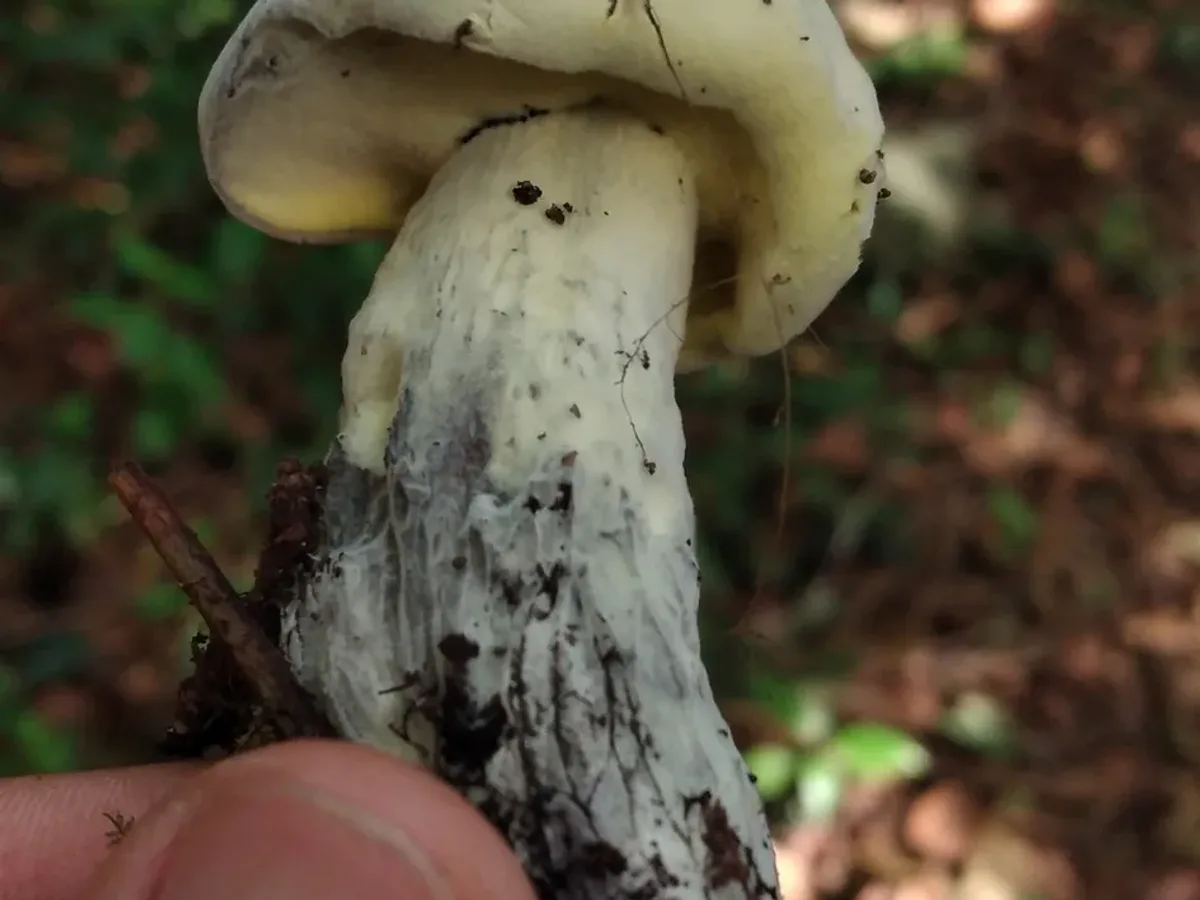
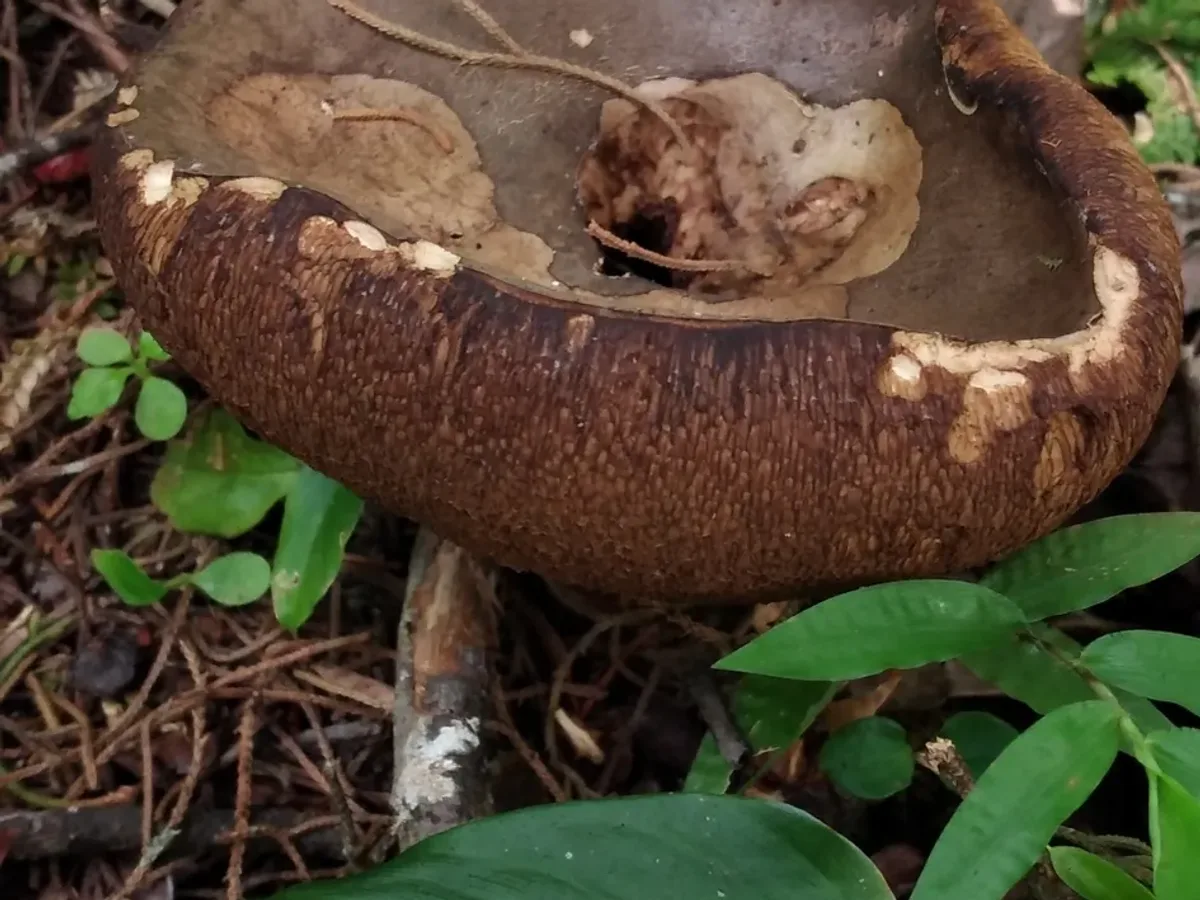
Tylopilus obscurus wears its darkest colours in youth: the cap opens as a tightly rounded hemisphere that is dark brown to nearly black, the dry, slightly velvety surface absorbing light and contributing to its sombre look.
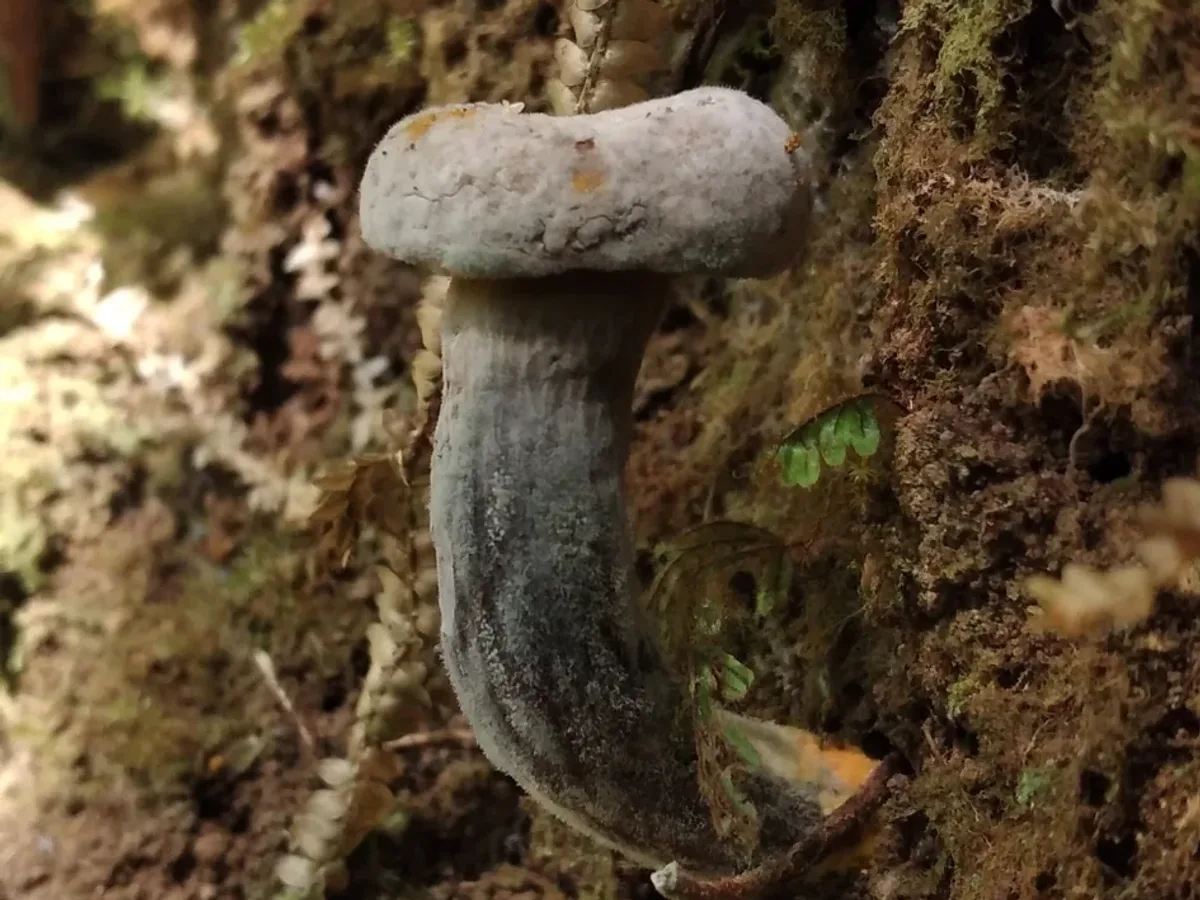
As the fruitbody expands and flattens, the colour may soften marginally to a dark umber or sooty grey-brown toward the margin, but it never brightens into the warm hazel tones characteristic of edible porcini relatives.
At 4-12 cm across and of sturdy proportions, it has the classic architectural blueprint of a forest bolete - stout, solid, planted firmly in the leaf litter with a clear cap-over-stem hierarchy.
Pores
The feature that most reliably identifies any Tylopilus, and that matters most practically to a forager, is the pore surface. When the fruitbody is young and fresh it is white to cream, indistinguishable at first glance from the pores of an edible porcini.
But as the cap ages, the pores develop an unmistakable pinkish to pale rose-pink blush - something no Boletus edulis or related porcini species ever shows. Press the pores and they stain pinkish-buff rather than turning blue. This non-bluing, pink-ageing pore character is the genus Tylopilus telling you what it is.
Stem
The stem is pale whitish-buff with pinkish tones, bearing a fine, pale-on-pale reticulate net at the apex that is subtle - less dramatic than the bold dark net of Tylopilus felleus, but present.
Flesh
The flesh is white, firm, and resolutely refuses to blue when cut.
Smell & taste
Taste is bitter - a clean, persistent, sometimes intense bitterness that the tongue detects immediately on even a small raw fragment.
That bitterness, confirmed on a tiny piece that is spat out immediately afterward, is the definitive field test that separates this species (and every Tylopilus) from any edible porcini relative in Australian forests.
Where & when it grows
Habitat
Tylopilus obscurus is a creature of intact native Australian forest, tying its existence to the root systems of mature eucalypts and, in the cooler and wetter south, to Nothofagus cunninghamii (myrtle beech).
Like all ectomycorrhizal fungi, it sustains itself through a hidden underground partnership: its mycelium weaves around the finest root-tips of its host trees, exchanging phosphorus and trace minerals drawn from the mineral soil for photosynthetic sugars from the tree above.
The fruitbody that appears on the forest floor is the iceberg's tip - the mycelium beneath may thread through the soil for many metres in every direction and persist for years or decades.
This dependency on living mature trees makes T. obscurus a faithful indicator of undisturbed habitat. You will not find it in logged, heavily thinned, or recently regenerating forest where the mycelial networks have been disrupted.
In practice, look for it in old or older-growth eucalypt woodland in Victoria, New South Wales, and southeastern Queensland - sclerophyll forest on well-drained, mildly acidic soils where the leaf litter is deep and the canopy continuous.
In Tasmania and the ranges of eastern Victoria, Nothofagus rainforest gullies extend its habitat into a cooler, moister niche. Recorded sites are generally in shaded to semi-shaded forest interior, not at exposed woodland edges.
When
Tylopilus obscurus belongs to the austral autumn. The signal the mycelium waits for is the same signal that drives most of Australia's ectomycorrhizal bolete community: soil temperatures cooling from summer highs down through the mid-teen Celsius range, combined with the arrival of meaningful autumn rainfall.
In southeastern Australia this alignment typically occurs from March through June, with April and May the most reliably productive months.
The biology behind the timing is worth understanding. After a long, often dry Australian summer, the soil dries and the mycelium lies metabolically quiet.
When the first sustained autumn rains arrive - enough to penetrate to depth, not just moisten the surface - and temperatures begin to drop, the mycelium resumes active growth and begins investing in fruiting.
The fruitbodies that emerge represent a significant physiological commitment; they will be aborted if conditions deteriorate. On average, once triggering conditions align, expect caps to break the surface 10-18 days later.
Timing shifts with elevation: higher sites in the Victorian Alps or the Tasmanian highlands may see first fruiting in March; warmer coastal lowlands may not peak until May. Once sustained cold or drought returns, the season ends.
How it grows
Solitary or in small, scattered groups - typical behaviour for an ectomycorrhizal species that does not reproduce vegetatively or cluster on decaying substrate.
The mycelium is the perennial organism; the fruitbodies are an annual reproductive event, appearing at roughly the same spots in the forest from one year to the next as the mycelium revisits the same productive points on its host's root network.
Experienced observers return to known sites year after year, as the fungal network is long-lived and site-faithful.
Development from button to mature cap typically takes one to two weeks. Young buttons push through the leaf litter tightly closed, and the cap expands gradually as cells pre-formed in the primordium take on water and nutrients.
Individual fruitbodies persist for several days to about two weeks before softening, darkening with age, and collapsing - shorter if temperatures warm unexpectedly or insect larvae are active within the flesh.
Fruiting conditions
Fruiting triggered by the classic Australian autumn bolete signal: soil temperatures cooling from summer highs through the 10-16 °C range combined with at least 20 mm of rainfall in the preceding two weeks. The mycelium resumes growth once both moisture and the cooling temperature threshold are met, producing fruitbodies 10-18 days after the triggering rain event. Season runs March-June (Southern Hemisphere autumn), peaking April-May. Does not fruit in summer heat or winter cold.
Look-alikes
The most important practical lookalike question in eastern Australian forests is the risk of confusing any dark-capped bolete with Boletus austroedulis, the southern porcini - an edible species found under Eucalyptus and Nothofagus in southeastern Australia that has a dark brown to reddish-brown cap.
The critical differences:
- pores white when young but ageing to yellow-green or olive (never pink)
- the stem may have pale reticulation
- the flesh is mild and pleasantly nutty with no bitterness
- the flesh is white and firm without staining
A taste test is decisive: edible boletes in Australia taste mild to faintly nutty; Tylopilus obscurus is intensely bitter within seconds.
Austroboletus lacunosus, the pitted austroboletus of southeastern Australia, shares the general bolete form and mycorrhizal habitat, but has a uniquely deeply pitted (lacunose) stipe surface that makes it unmistakable even without tasting. Its pores are white to cream, also not pink.
Boletellus obscurecoccineus (rhubarb bolete) is immediately distinguished by its dark scarlet shaggy cap and dramatically bluing yellow pores - no resemblance.
Within the genus, Tylopilus neofelleus, the neotropical bitter bolete, is a closely related species but is an Asian and Pacific species not established in mainland Australian native forest.
No deadly species in Australia is a documented realistic lookalike for T. obscurus; the risk of encountering a lethal fungal toxin from this species or its confusibles in its eastern Australian range is not established.
A Northern Hemisphere relative occasionally recorded from introduced-tree plantations; shares the bitter taste and pink-ageing pores that define the genus. T. felleus typically has a much paler, buff to tan-brown cap rather than the dark brown to near-black of T. obscurus. Both are inedible for identical reasons. In native Australian forest, T. felleus is not established; T. obscurus is the characteristic dark bitter bolete.
Another dark-capped bolete of southeastern Australia and Tasmania. The deeply lacunose (pit-carved) stipe surface of A. lacunosus is unique and instantly distinguishing - no other common Australian bolete has that deeply pitted texture. Its pores are white to cream and do not turn pink. Its flesh is mild and edible. The deeply pitted stem is unmistakable.
A genuinely distinct species despite both occurring in eastern Australian eucalypt forest. The rhubarb bolete has a deep dark scarlet to crimson-red shaggy cap with coarse scales, bright yellow pores that instantly blue on touching, and flesh that turns vivid blue when cut - the direct opposite of T. obscurus, whose pores age pink and whose flesh never blues. No realistic confusion in the field.
A prized edible bolete of southeastern Australian eucalypt and Nothofagus forest with a similarly dark brown cap. Distinguished from T. obscurus by pores that age white to yellow-green or olive (never pinkish), mild and pleasant nutty-tasting flesh (never bitter), and a spore print that is olive-brown rather than pinkish-brown. The taste test is decisive: B. austroedulis is mild; T. obscurus is intensely bitter.
In the kitchen
Picking & cleaning
Tylopilus obscurus should not be collected for the table. The defining bitterness - identical in mechanism to that of the cosmopolitan bitter bolete (Tylopilus felleus) - is caused by terpenoid-class compounds distributed throughout the flesh.
These compounds are heat-stable: they neither cook out, nor dissipate with soaking, blanching, or drying. In practical terms this means that a single specimen of T. obscurus mixed into a basket of edible Australian boletes will ruin the flavour of the entire preparation once heat is applied.
If you collect it for study, photography, or voucher deposition, proceed thoughtfully. A firm young cap with clean white-to-pale-pink pores and intact stem shows all the key characters.
Taste a tiny fragment of raw flesh - the bitterness is immediate and unmistakable - then spit it out. Confirm the spore print is pinkish-brown, not olive-brown (which would indicate Boletus or Austroboletus) or white (which would indicate most edible Agaricales).
No part of this species is culinary.
Cooking
Tylopilus obscurus has no culinary use. The bitterness that characterises the raw flesh is heat-stable and concentration-stable: boiling, frying, grilling, drying, and pickling all preserve it.
There is no traditional use of this species as food in Australia, no preparation technique that renders it palatable, and no culinary context in which it appears.
If a specimen enters a mixed mushroom preparation undetected, the bitterness will pervade and ruin the dish once the mushrooms are heated.
The correct action is to identify it in the field - by taste, pore colour, and cap character - and leave it in the forest to sporulate.
Good to know
Tylopilus obscurus is not known to contain true mycotoxins and is not classified as poisonous in formal mycological assessments. Its inedibility is a consequence of intense, pervasive bitterness caused by terpenoid-class bitter compounds - the same mechanism as the well-studied Northern Hemisphere Tylopilus felleus - rather than confirmed chemical toxicity.
That said, the bitter compounds in Tylopilus species are GI-irritant in quantity: consuming significant amounts may cause nausea and abdominal discomfort through the irritant action of concentrated terpenoids on the digestive mucosa. This is not a life-threatening reaction, but it is unpleasant and avoidable.
The most reliable practical protection is the taste test: touch a tiny fragment of raw flesh to the tip of your tongue. A truly bitter response - immediate, sharp, lasting - means this mushroom does not belong in the basket, regardless of how it looks.
The principal safety discipline when hunting edible boletes in eastern Australian forest is learning to consistently apply three checks before a specimen is kept:
- 1Pore colour - pink in Tylopilus, never pink in edible Boletus or Austroboletus.
- 2Taste - bitter means reject.
- 3Macro-morphology - reticulate stem, dry dark cap.
All three point in the same direction for T. obscurus and collectively make misidentification unlikely for anyone applying them. Discard any specimen that fails these checks.
A reference guide - never an edibility guarantee. When in doubt, leave it out.