Asian bitter bolete
Tylopilus neofelleussyn. Tylopilus felleus var. neofelleus
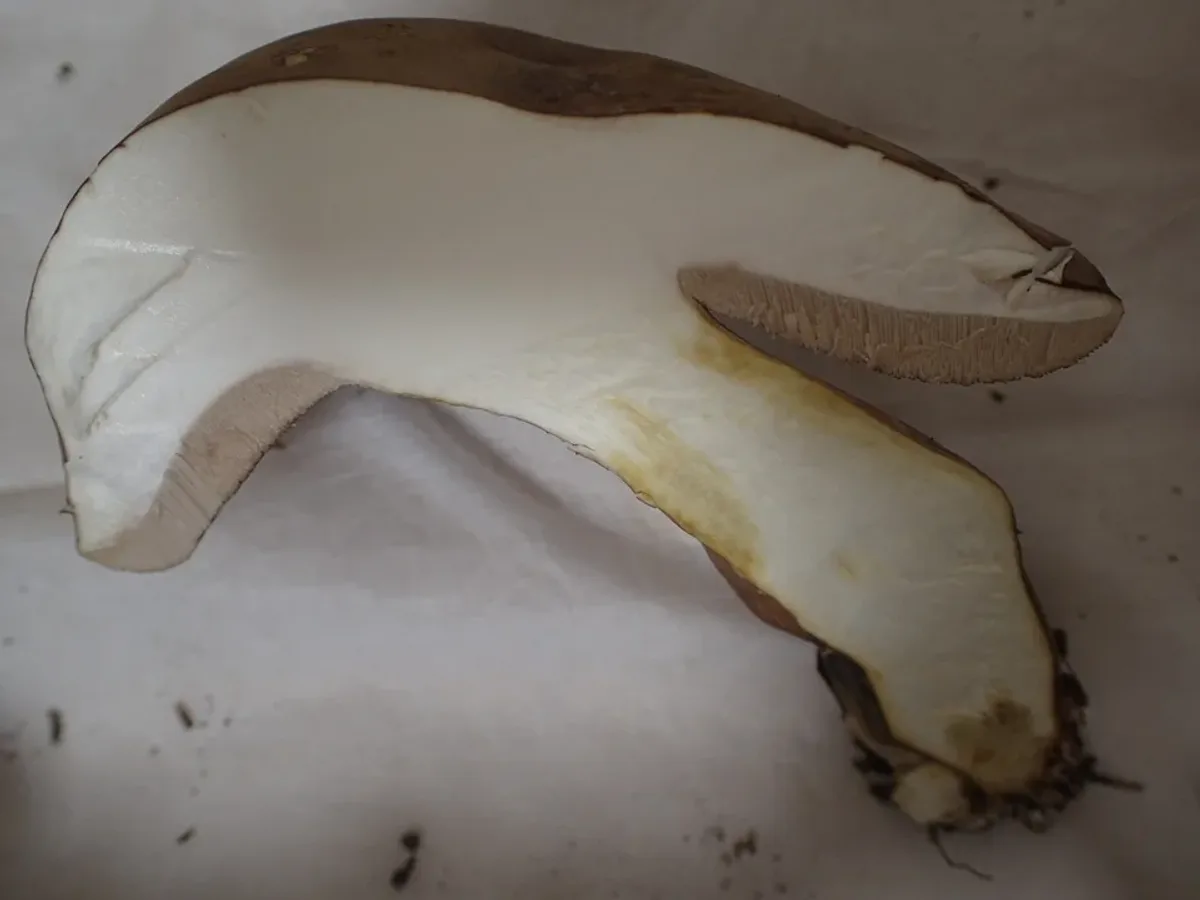 © lxjfx (CC BY-SA)
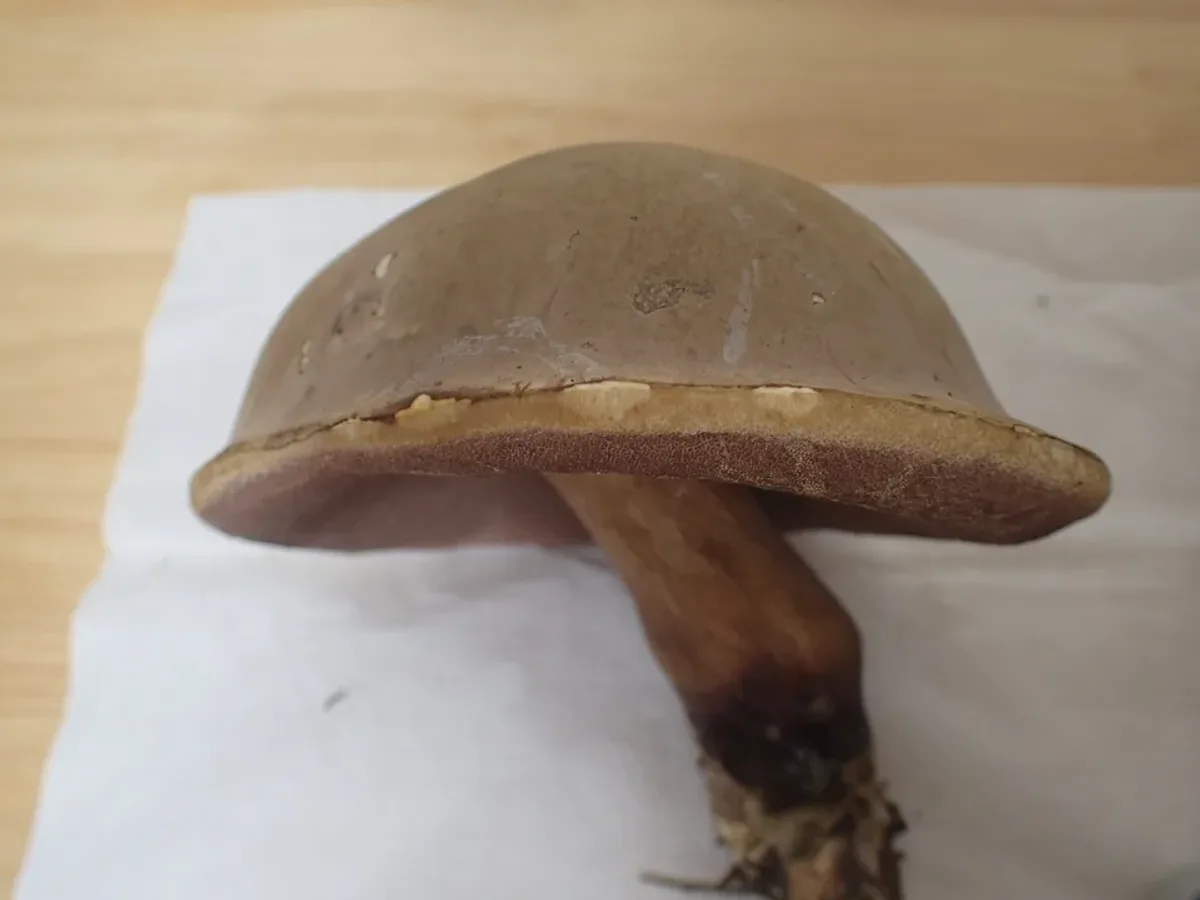 © lxjfx (CC BY-SA)© lxjfx (CC BY-SA)© lxjfx (CC BY-SA)
Not poisonous, but not worth eating - too tough, bitter, or bland for the pot.
How to recognise it
Tylopilus neofelleus is a medium to large bolete with a broadly conventional bolete build that closely resembles its European and North American relative Tylopilus felleus - hence the species epithet 'neofelleus' (new felleus).
Cap
The cap ranges from 5 to 15 cm across, starting convex and dome-shaped in youth before broadening to nearly flat in maturity.
The upper surface is smooth to finely velvety when young, becoming glabrous, and ranges from pale tan to buff-brown - sometimes with a faint pinkish tint - and lighter toward the margin.
The colour is never dark grey-black (as in T. alboater) and never strongly reddish or orange; it sits firmly in the buff-tan part of the spectrum.
Pores
White and clean in very young specimens, the pore surface progressively develops a distinctly pinkish to flesh-pink colouration as the mushroom matures and the spores ripen. Press or scratch the pores and they stain pinkish-brown.
This pinkening of the pore surface - combined with the absence of any bluing reaction - is a hallmark of the genus Tylopilus, and immediately rules out the edible porcini group (which have white-to-yellow pores that may blue but do not turn pink at maturity).
Stem
The stem is stout and substantial, 5-12 cm tall and up to 4 cm thick, often widening toward the base.
Its most diagnostic feature is the coarse, raised pinkish-brown reticulate network covering much of its pale buff surface. This reticulation (like a raised mesh or fishnet) is distinctly more prominent and coarser than on Boletus edulis and is a reliable confirmatory character.
Flesh
The flesh is firm, white, and emphatically does not change colour when cut - no bluing, no reddening.
Taste
The taste is overwhelmingly and persistently bitter even from a tiny piece of raw flesh; this bitterness confirms the identification beyond doubt.
Where & when it grows
Habitat
Tylopilus neofelleus is an ectomycorrhizal species that forms obligate mutually beneficial associations with the roots of hardwood trees, particularly oaks and related Fagaceae (the beech family).
Its core range encompasses the warm-temperate and subtropical broadleaved forests of East Asia - Japan, China, Korea, and Taiwan - where Quercus serrata, Q. acutissima, Q. variabilis, Castanopsis, and Lithocarpus species form the dominant canopy.
It grows on mineral soil or in leaf litter on the forest floor, always in the root zone of host trees, never from wood or stumps.
In Japan it is a familiar summer bolete of satoyama (secondary woodland) landscapes - the mosaic of mixed oak forests, forest edges, and woodland margins that surround rural settlements. In China it is recorded from Yunnan, Sichuan, and other provinces with warm-temperate to subtropical forest.
The species favours well-drained acidic soils and is most commonly found at low to moderate elevations, typically below 1500 m.
Foragers working in East Asian oak forests during the summer rainy season will commonly encounter it, and because its overall silhouette (pale buff cap, reticulate stem, pinkish pores) superficially resembles porcini, it is a species worth knowing well to avoid disappointment.
When
Tylopilus neofelleus is very much a creature of the East Asian summer. Across Japan, China, Korea, and Taiwan it fruits from roughly June through October.
The most productive window is closely tied to the summer rainy season - tsuyu/baiu in Japan, typically mid-June through July - when soils become well-charged with moisture and temperatures are at their warmest (soil temperatures of 16-26 °C). Peak emergence runs from late June through early September.
Like all mycorrhizal boletes, fruit bodies do not appear the day after rain; the mycelium needs time to draw in water and nutrients before pushing up a mushroom, and a flush lag of 7-18 days after a significant rainfall event is typical.
A second, smaller flush can arrive in September if autumn rains come while the soil is still warm. As night temperatures fall in October the species quiets down and largely disappears until the following summer.
How it grows
As an ectomycorrhizal fungus, Tylopilus neofelleus lives in a tightly integrated mutualistic relationship with its host tree. The fungal mycelium forms a sheath (mantle) around the finest root tips of oaks and related trees, extending into the soil as a network of mycelial strands (rhizomorphs) that dramatically expand the effective root surface area.
In exchange for carbohydrates photosynthesized by the tree, the fungus delivers water, phosphorus, nitrogen, and other mineral nutrients from the soil.
The visible mushroom is only the reproductive structure - an ephemeral outgrowth of a perennial mycelial network that may persist for many years in the soil.
This obligate lifestyle means T. neofelleus cannot be cultivated on artificial substrates, and its presence in an area depends on the continuity of mature host trees.
Individual mycelial networks (genets) can be large and may produce fruit bodies in the same general locations year after year, making recurring productive spots possible once identified.
Fruiting conditions
Responds to warm soil temperatures (16-27 °C) combined with the sustained soil moisture of the East Asian summer rainy season (tsuyu/baiu). A flush lag of 7-18 days after significant rainfall is typical for mycorrhizal boletes. Most productive in July-early September in Japan; fruiting window shifts somewhat earlier in warmer subtropical parts of the range (southern China, Taiwan).
Look-alikes
The most practically important lookalike risk for T. neofelleus is with edible boletes in the porcini group, particularly any of the Boletus edulis complex species or the related edible Neoboletus and Aureoboletus species encountered in East and Southeast Asia.
All of these edibles:
- Have white to yellow-green pore tubes (not pink)
- May have reticulation on the stem that is white or pale brownish (not prominently pinkish-brown)
- Have mild to pleasant-tasting flesh with no bitterness
The taste test is definitive and immediately resolves ambiguity: a small piece of raw T. neofelleus flesh is intensely and unmistakably bitter within seconds, whereas all the desirable edibles taste mild, nutty, or pleasant.
Typically the pinkening of the pore surface at maturity is a strong visual warning signal: edible porcini-type boletes have pores that remain white to yellow-white or develop yellowish to olive tones with age, not pink. Seeing pink pores on a bolete in an East Asian forest should prompt immediate confirmation by taste before any collection decision.
Within the genus Tylopilus, T. neofelleus is most similar to the European/North American T. felleus, and the two species are sometimes treated as the same taxon in older literature. They are now distinguished primarily on molecular grounds and some subtle morphological and regional differences, but for field purposes in East Asia the question does not matter - both are equally bitter and inedible.
Tylopilus nigerrimus (black bitter bolete) is another Asian Tylopilus, but is readily distinguished by its very dark blackish-grey to nearly black cap and darker colouration overall.
No deadly species is a realistic confusion risk for T. neofelleus in the field - the deadly Amanita species and toxic boletes (Rubroboletus, Neoboletus venenatus) have sufficiently distinct features (red pores, bluing flesh, gills instead of pores, volva, ring) that careful inspection clearly separates them.
The European/North American T. felleus is morphologically nearly identical to T. neofelleus and was historically treated as the same species. Separation is primarily molecular and biogeographic: T. felleus occurs in Europe and North America under European and North American oaks and conifers, while T. neofelleus is described from East Asia under Asian Quercus and Fagaceae. Both species are equally bitter and inedible. In the field in East Asia, the question of which species you have found is academic - both are Tylopilus, both are inedible.
Tylopilus nigerrimus also occurs in East and Southeast Asia and shares the pink-pored, bitter Tylopilus profile, but is readily distinguished by its very dark cap - blackish-grey to nearly black - and overall much darker colouration throughout. Tylopilus neofelleus is a pale buff-tan colour, never approaching the near-black of T. nigerrimus. Both are inedible.
Boletus edulis and related porcini have pore tubes that are white when young but turn yellowish to olive-yellow with age - they never develop the pinkish colouration characteristic of Tylopilus neofelleus. The stem reticulation on B. edulis is typically white to pale tan and finer, not prominently pinkish-brown. Most definitively, B. edulis flesh is mild and pleasant to taste; T. neofelleus is intensely bitter from the first contact with raw flesh.
Imleria badia and related bay boletes have chestnut-brown caps (not pale buff-tan), pore tubes that blue distinctly and rapidly when pressed or cut (a reaction entirely absent in T. neofelleus), and mild, pleasant-tasting flesh. Any blue colour change in the pores or flesh immediately rules out Tylopilus neofelleus.
In the kitchen
Picking & cleaning
Do not collect Tylopilus neofelleus intending to eat it. The bitterness is extreme and completely inedible - tasting even a very small piece of raw flesh is enough to demonstrate this, and the bitterness persists through all cooking methods (sautéing, boiling, drying, and seasoning all fail to eliminate it).
A single T. neofelleus mixed into a dish of genuine porcini can render the entire dish unpalatable. If you are collecting boletes in East Asian forests, developing a reliable feel for this species is essential to avoid accidentally including it with edible collections.
The key field check: taste a tiny piece of raw cap flesh (chew briefly, then spit it out). Immediate, intense bitterness means Tylopilus - discard it.
If the pore surface is clearly pinkish at maturity and the stem shows coarse pinkish-brown reticulation, also treat with suspicion even before tasting.
Cooking
Tylopilus neofelleus cannot be made edible by any culinary method, and no cooking technique should be attempted with the intention of rendering it palatable. This is not a matter of preference - it is a chemical reality that foragers must understand.
The extreme bitterness of T. neofelleus is caused by heat-stable terpenoid and sesquiterpene compounds concentrated in the flesh. Unlike many bitter plant compounds that denature or volatilise with heat, these molecules retain their full bitter activity after cooking.
None of these treatments neutralises or meaningfully reduces the bitterness:
- Sautéing in butter or oil
- Boiling in water
- Blanching and discarding the water
- Drying
- Rehydrating
- Pickling in vinegar
- Combining any of these methods in sequence
The compounds are lipid-soluble as well as water-soluble, meaning they leach readily into whatever medium surrounds them, regardless of whether that medium is water or fat.
The leaching property creates a specific and serious practical hazard: prolonged boiling or simmering T. neofelleus in a stock or broth does not trap the bitterness inside the mushroom tissue - it extracts the bitter compounds into the cooking liquid itself, contaminating the entire pot.
A stock made with even one T. neofelleus specimen will be rendered bitter and undrinkable, and the bitterness cannot be masked by salt, acid (lemon or wine), sweetness, or the other aromatics typically used to balance stocks and sauces.
The contamination risk extends to mixed mushroom dishes: a single T. neofelleus specimen accidentally included in a mixed bolete dish - such as a porcini risotto, pasta, or sauce - is sufficient to ruin the entire dish. The bitter compounds distribute through the cooking liquid and fat during preparation, affecting every component, and there is no way to remove them once dispersed.
No traditional culinary preparations exist within any part of T. neofelleus's East Asian range - Japan, China, Korea, or Taiwan - that render this species edible. It has been known and correctly identified as inedible throughout the regions where it grows, and the absence of any traditional use reflects generations of direct experience with the impossibility of cooking out the bitterness.
The single most effective preventative measure remains the raw taste test described in the picking section: a tiny piece of raw cap flesh, chewed briefly and spat out, will immediately reveal the bitterness before any collection decision is made. Applying that protocol consistently in the field is the only reliable way to keep T. neofelleus out of your basket.
Good to know
Tylopilus neofelleus is not classified as a poisonous species and does not produce known mycotoxins. Its sole practical hazard is the extreme bitterness, caused by terpenoid or sesquiterpene bitter compounds (similar in nature to those in Tylopilus felleus).
While not lethally toxic, consuming significant amounts may cause nausea and gastrointestinal upset - most likely from the irritant effect of the concentrated bitter compounds on the gastric mucosa. There are no records of serious systemic poisoning or fatalities attributable to this species.
The principal field safety concern is the realistic possibility of accidentally collecting T. neofelleus alongside edible boletes in East Asian forests, especially given that young specimens with pale pores can be superficially similar to porcini.
Because the species is widespread and common in its range, and because edible porcini-group boletes co-occur in the same habitats, foragers must positively confirm the absence of pink pore colouration and bitter taste in every bolete collected for the table.
The raw taste test - a tiny piece of cap flesh, chewed and spat out - is the single most reliable safety step. No species that could be plausibly confused with T. neofelleus is known to be deadly, so the practical risk is limited to digestive upset from a bitter, unpleasant meal rather than serious poisoning.
A reference guide - never an edibility guarantee. When in doubt, leave it out.