Burnt-orange bolete
Tylopilus ballouisyn. Boletus balloui Peck
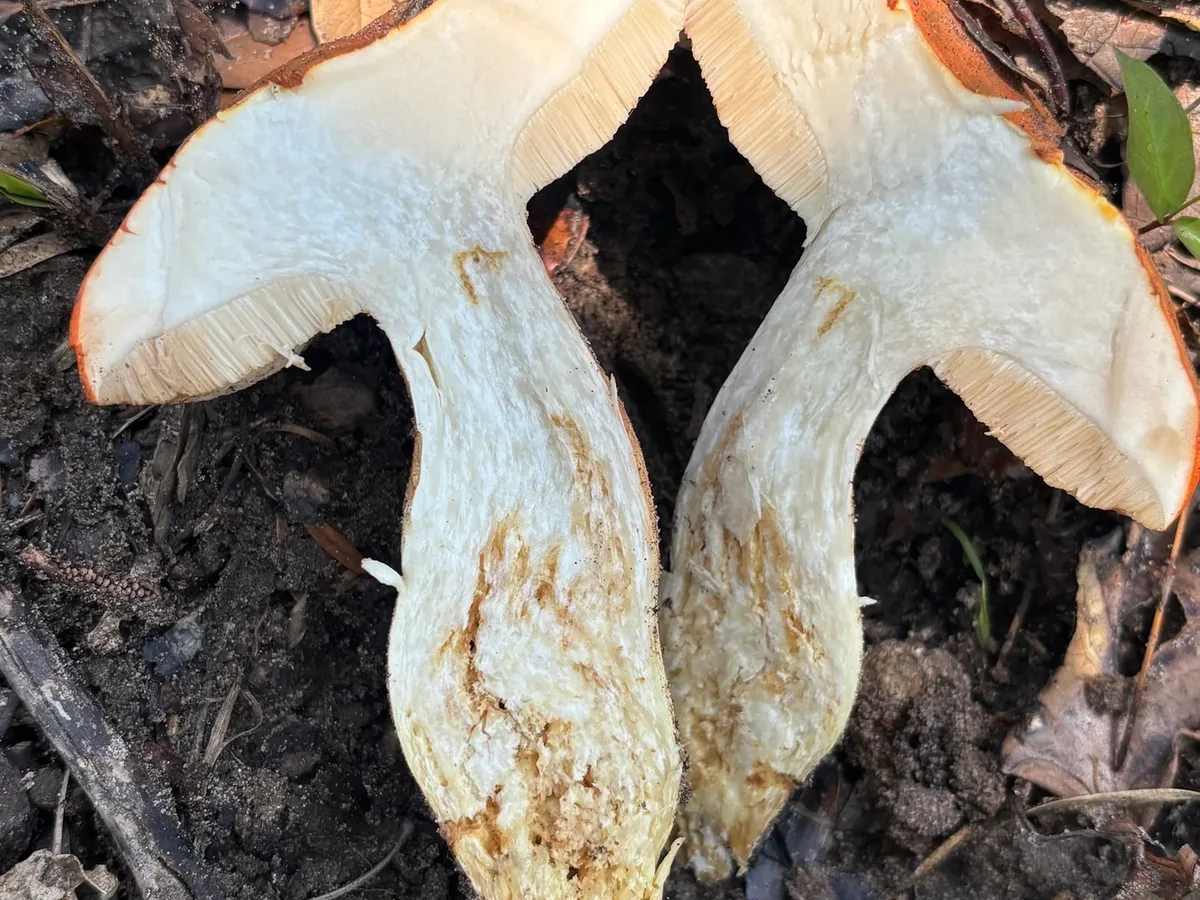 © Jeremy Flint (CC BY)
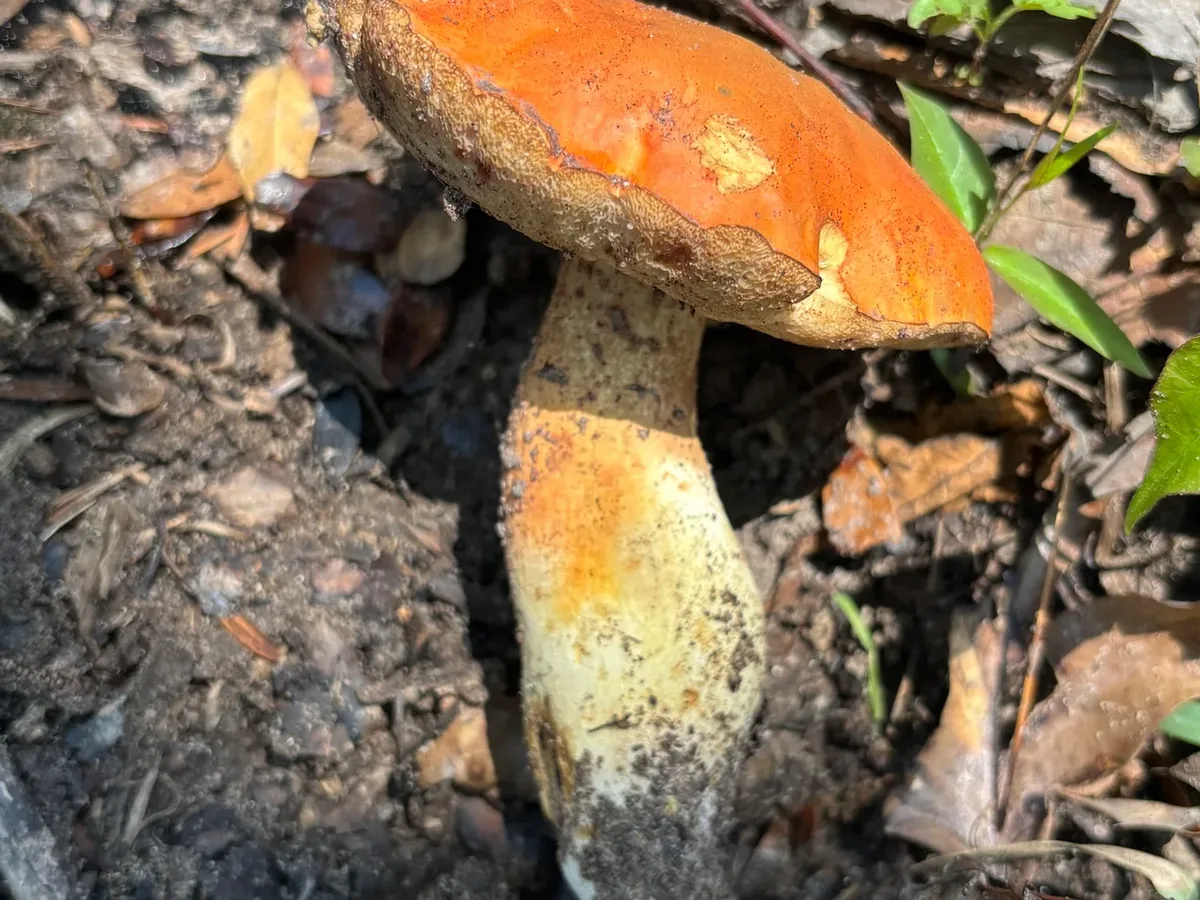 © Jeremy Flint (CC BY)
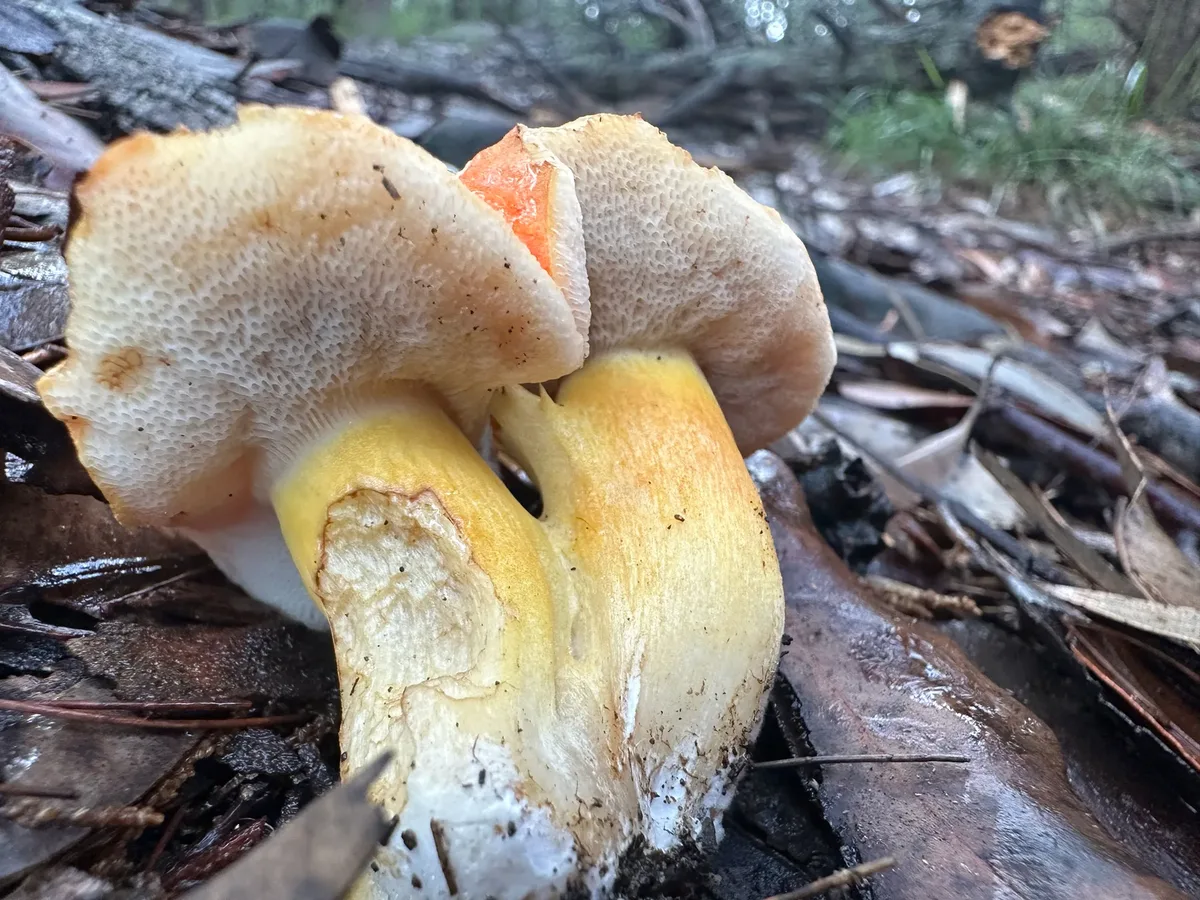 © prossington (CC BY)
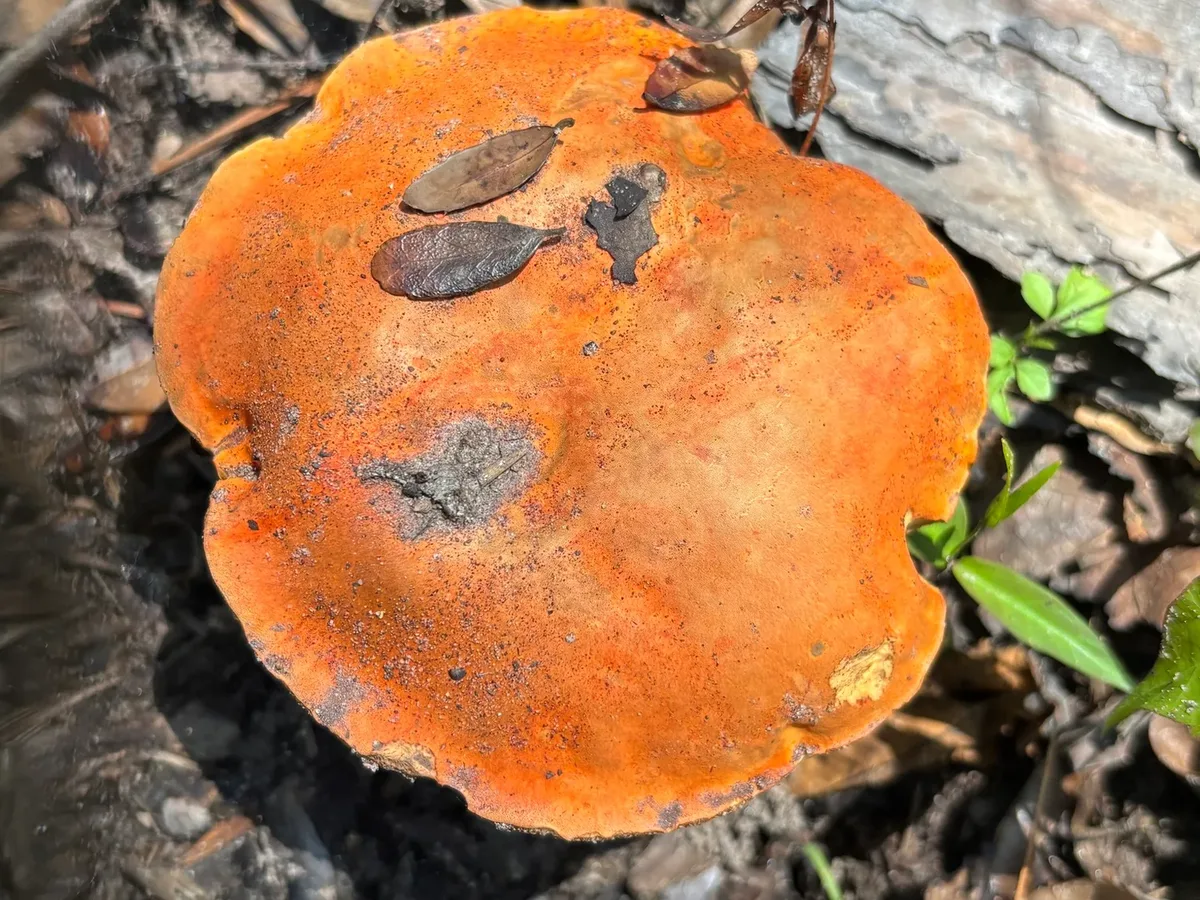 © Jeremy Flint (CC BY)© Jeremy Flint (CC BY)© Jeremy Flint (CC BY)
Not poisonous, but not worth eating - too tough, bitter, or bland for the pot.
How to recognise it
Cap
The burnt-orange bolete stops you in your tracks. Its cap glows a vivid burnt-orange to rusty-orange among the leaf litter of eastern North American oak forests - a colour with no close rival in most other Tylopilus species, which tend toward tan, brown, grey, or black.
The cap runs 4-12 cm across, starting out convex and flattening broadly with age. When fresh, the surface is finely velvety or suede-like, especially toward the centre, giving it a pleasantly matte, satiny look; in wet conditions or very old specimens it smooths out a little and the margin may look slightly washed, but the warm orange persists strongly throughout the life of the fruit body. That orange is your single most useful field mark.
Pores
Flip the cap and you find a clean, white pore surface - a bright white that contrasts nicely with the orange above. With age or handling, the pores slowly develop pale pinkish-buff to pale cinnamon-tan stains, but this is sluggish and mild rather than dramatic.
Critically, there is no rapid bluing reaction: press the pores firmly and hold - they stay white to pinkish, never turning blue-green as they would in some other boletes. The tubes run 0.5-1.3 cm deep beneath.
Stem
The stem is 4-10 cm tall, roughly equal to slightly club-shaped, and pale - whitish to faint yellowish or very pale orange-buff, sometimes flushing pinkish at the base. A fine reticulate pattern (a network of raised ridges) is visible near the apex just under the cap, fading to fibrous below.
Flesh
The flesh is firm and white, cutting to show a pale white interior that may blush faintly pinkish or reddish-brown before stabilising; it does not blue.
A tiny taste of raw flesh is the definitive confirmation: persistently and distinctly bitter, a quality that makes the species completely unpalatable no matter how it is prepared. Spore print is pinkish-brown to vinaceous-brown.
Where & when it grows
Habitat
Tylopilus balloui is a mycorrhizal species with a firm allegiance to oaks. It threads its mycelium through the soil of eastern North American deciduous and mixed forests, building partnerships with white oak, red oak, chestnut oak, and black oak - and less often with American beech and hickories.
The species is most at home in the southeastern United States, with records running from Virginia and the Carolinas south through Georgia and Florida and west to Texas; records thin out progressively northward into the Mid-Atlantic states, Ohio Valley, and southern New England. This southerly lean likely reflects a preference for the warm, well-drained upland oak stands most characteristic of the Southeast.
Within its range, look for T. balloui in mature upland forest stands on well-drained, slightly acidic mineral soils - the classic substrate of these oak communities. It rarely turns up in bottomland forest, seasonally flooded areas, or pure conifer stands. Fruit bodies appear singly or in small scattered groups on the forest floor, typically tucked among fallen leaves near large, mature oaks.
Because the relationship is strictly mycorrhizal, T. balloui cannot be cultivated artificially; its presence at a site depends entirely on living host trees. Sites that produce it reliably tend to keep doing so, because the underground mycelium is perennial and can persist for many years beneath the same stand of oaks.
When
In eastern North America, Tylopilus balloui fruits from early summer through autumn, with the season typically spanning June through October. The peak falls in July through early September, when soil temperatures sit in the warm 15-27 °C range and summer storms deliver the soil moisture the mycelium needs to initiate fruiting.
Like other mycorrhizal boletes, there is generally a flush lag of 7-18 days between a significant rainfall event and the appearance of visible fruit bodies - the time the perennial mycelium needs to absorb and redistribute moisture before pushing up new fruit.
In the southeastern US the season can stretch into October or even early November during mild autumns; further north, in southern New England or the Ohio Valley, the effective window compresses to July-September. Fruiting tails off as overnight temperatures consistently drop below 8-10 °C.
How it grows
As a mycorrhizal fungus, Tylopilus balloui lives in an obligate mutualistic partnership with its oak and hardwood hosts. The mycelium forms ectomycorrhizal sheaths around the fine absorbing roots of host trees, trading mineral nutrients - especially phosphorus and water - for the carbohydrates the tree produces through photosynthesis.
This relationship makes it impossible to cultivate T. balloui on logs or artificial substrates; it depends entirely on living host trees.
The visible fruit body is simply the reproductive structure of a large, perennial underground mycelial network that may persist for many years or decades at the same site, quietly threading through the soil long after each season's mushrooms have come and gone.
Fruit bodies typically appear in one or two distinct flushes per season following major rainfall events, rather than continuously. Individual fruit bodies develop quickly - from pinhead to full size in 5-10 days under warm, humid conditions.
The bitter compounds in the flesh are thought to discourage consumption by mammals, suggesting an evolutionary strategy that favours insect-mediated or passive spore dispersal rather than gut-passage through vertebrates.
Fruiting conditions
Responds to warm soil temperatures (15-27 °C) combined with adequate summer rainfall. Flush lag of 7-18 days after significant rain events is typical for mycorrhizal boletes. Most productive July-September in its eastern North American range, with a southerly bias toward the southeastern US.
Look-alikes
Tylopilus balloui's distinctive orange cap colour significantly reduces the number of realistic confusion species, but the following comparisons are worth knowing.
Tylopilus balloui is most likely to be confused with orange-capped edible boletes:
- Harrya chromapes (formerly Tylopilus chromapes, the chrome-footed bolete) has a similar pinkish-orange to pale orange-tan cap, but the stem base is unmistakably bright chrome-yellow - a vivid yellow that stains the fingers - and the flesh is mild and palatable without any bitterness. The yellow stem base is the single most reliable separator.
- Aureoboletus mirabilis (admirable bolete) shares warm reddish-brown to mahogany cap tones but is a Pacific Northwest species associated with hemlock and conifers, not the eastern hardwood oaks where T. balloui lives. It is also edible and has yellow tubes.
- Tylopilus plumbeoviolaceus (violet-grey bolete) has a markedly different plum-violet cap colour and is easily distinguished by colour alone. It grows in similar oak habitats but is clearly not orange.
- Suillus species with orange or orange-buff caps (such as Suillus pictus or Suillus spraguei) differ in having a slimy or glutinous cap surface (when moist), growing strictly under eastern white pine rather than oaks, and having a partial veil leaving a ring on the stem - none of which apply to T. balloui.
No species that could be realistically confused with Tylopilus balloui in the field is known to be deadly, making misidentification here a matter of culinary disappointment (bitterness) rather than a life safety issue.
The most closely related bitter bolete but with a pale tan to buff or pale brown cap - quite different from the vivid burnt-orange of T. balloui. T. felleus also has a coarser, darker brownish reticulate stem pattern, and the pores stain dirty pinkish-brown. Both are equally inedible due to bitterness, so the practical consequence of confusing them is nil - but the bright orange cap of T. balloui distinguishes it immediately from the dull tan T. felleus.
Similar pinkish-orange to pale orange-tan cap and pink-staining pores, occurring in the same oak woodland habitat. The definitive separator is Harrya chromapes' unmistakably bright chrome-yellow stem base - a vivid, saturated yellow that stains the fingers - which is entirely absent in T. balloui (which has a whitish to pale buff stem). Additionally, H. chromapes is edible and mild-tasting; T. balloui is intensely bitter. Always check the stem base colour before eating any orange-capped bolete.
A common edible bolete in eastern North American oak and mixed forests; some brown-capped specimens could be compared at a glance, but B. edulis has brownish to tan cap colouration (never the vivid orange of T. balloui), white to yellowish-green pore tubes, fine white reticulation on the upper stem, and flesh that is mild and pleasant - not bitter. The taste test alone separates them: mild and nutty (B. edulis) versus persistently bitter (T. balloui).
An orange-red capped bolete of eastern North America, but immediately distinguished by its strict association with eastern white pine (Pinus strobus) rather than oaks, a glutinous to slimy cap surface when moist (dry and fibrillose-scaly in T. balloui), and the presence of a ring on the stem from the partial veil. T. balloui never has a ring and is found under oaks, not pines.
In the kitchen
Picking & cleaning
Do not pick Tylopilus balloui with any intention of eating it - the persistent bitterness makes it thoroughly unpalatable, and no known cooking method reliably eliminates it. The bitter compounds (terpenoids similar to those in the closely related Tylopilus felleus) survive boiling, sautéing, drying, and long slow cooking.
A single specimen accidentally included in a mixed mushroom dish can render the entire dish inedible. The species has no culinary value and is best left in the field.
For identification purposes, confirm all five key features before drawing a conclusion:
- 1the vivid burnt-orange to rusty-orange cap - not tan, not brown, not grey
- 2white pores that stain pinkish slowly on bruising but do not blue rapidly or intensely
- 3white flesh that does not blue on cutting
- 4intensely bitter taste from a tiny raw piece (spit it out)
- 5pinkish-brown to vinaceous spore print
All five together are unambiguous.
Cooking
Tylopilus balloui has no culinary application. The bitter compounds are heat-stable and are not removed by boiling, blanching, sautéing, or drying.
A single bitter bolete mixed into a dish of otherwise edible mushrooms will impart its bitterness to the entire preparation. If you discover a specimen in a batch of foraged mushrooms, discard it rather than attempting to cook around it.
Good to know
Tylopilus balloui is not classified as a toxic or poisonous species in formal mycological literature; it carries no known amatoxins, orellanins, gyromitrin, muscarine, or other dangerous toxins.
However, its intense bitterness - caused by terpenoid bitter compounds similar to those in the closely related Tylopilus felleus - renders it effectively inedible. Consuming significant quantities may cause nausea and gastrointestinal irritation from the irritant effect of these bitter compounds on the gastric mucosa, but there are no records of serious systemic poisoning from this species.
The primary practical safety consideration is the possibility of mistaking an edible orange-capped bolete - particularly Harrya chromapes, which grows in similar eastern North American oak woodland - for this bitter, inedible species and discarding a good edible, or the reverse error of misidentifying T. balloui as an edible orange bolete.
Always confirm the taste (a tiny piece confirms bitterness) and check for the chrome-yellow stem base of H. chromapes before concluding on identity. No deadly species is a realistic lookalike.
A reference guide - never an edibility guarantee. When in doubt, leave it out.