Scaly vase chanterelle
Turbinellus floccosussyn. Gomphus floccosus, Cantharellus floccosus, Nevrophyllum floccosus
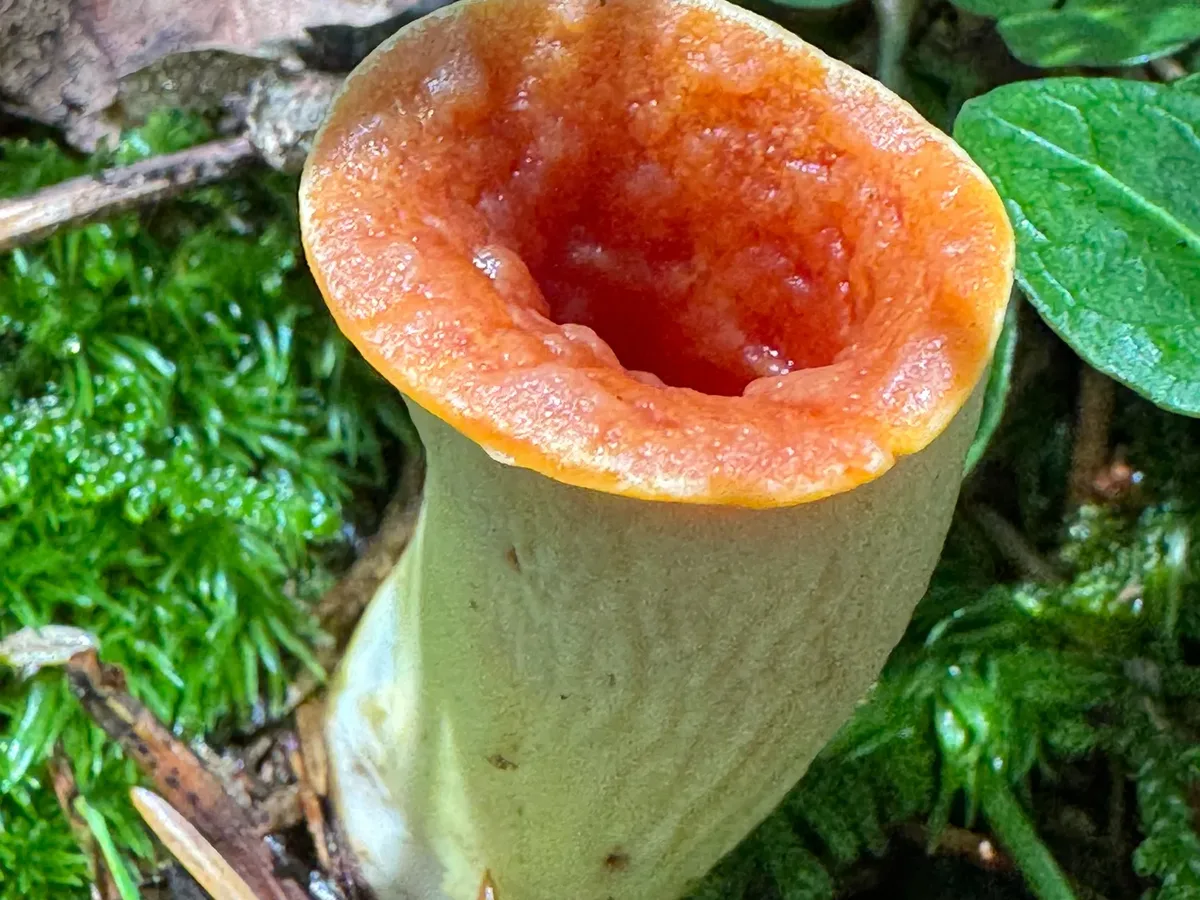 © Jeff Clark (CC BY)
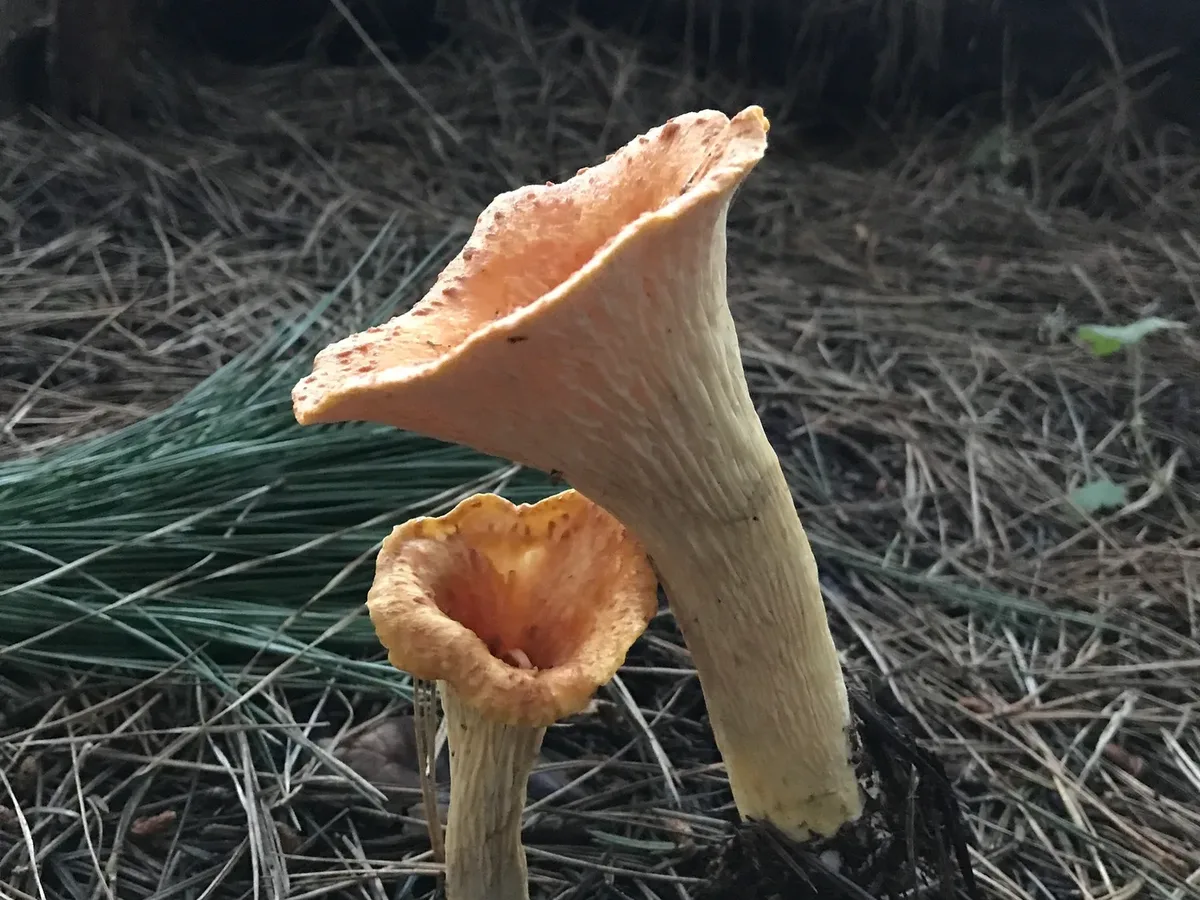 © Matthew Rozanoff (CC BY)
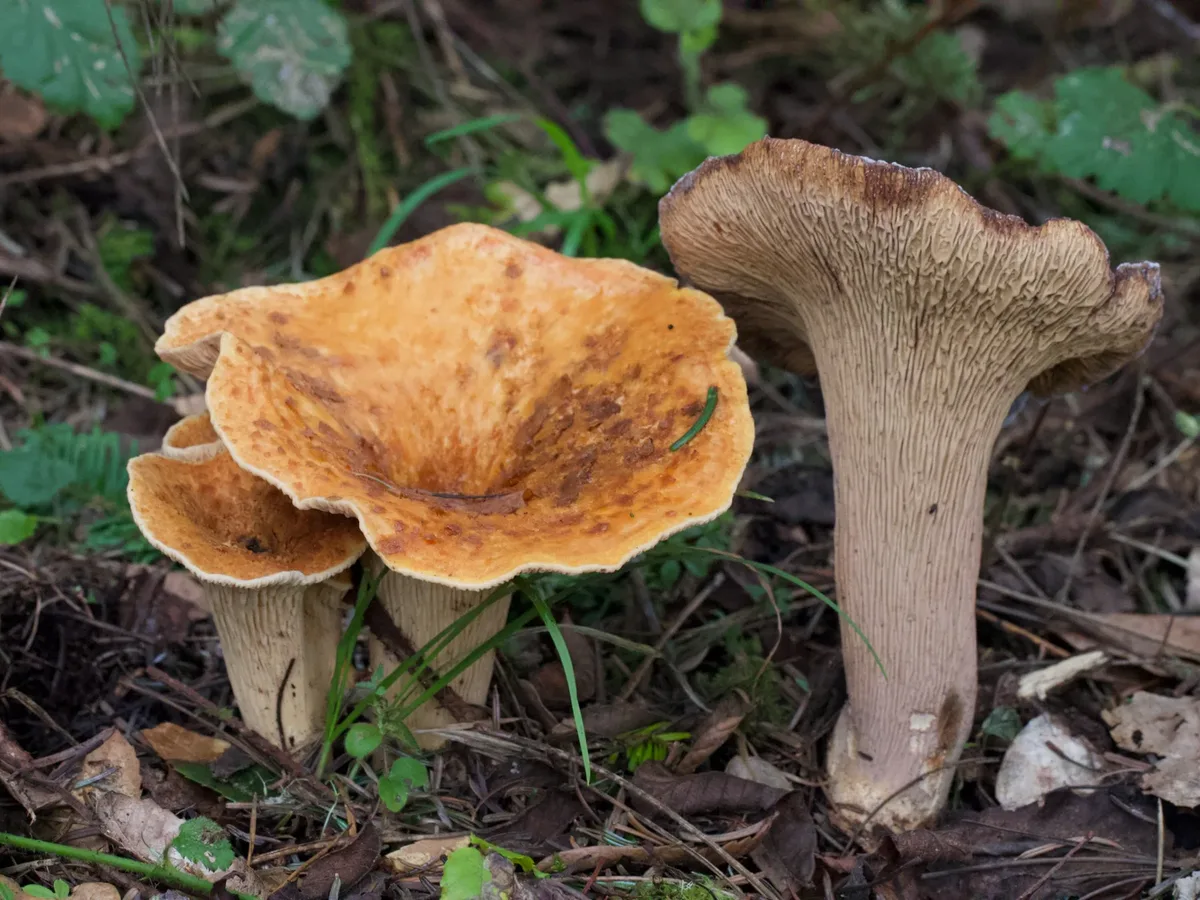 © Arvel Hernandez (CC BY)
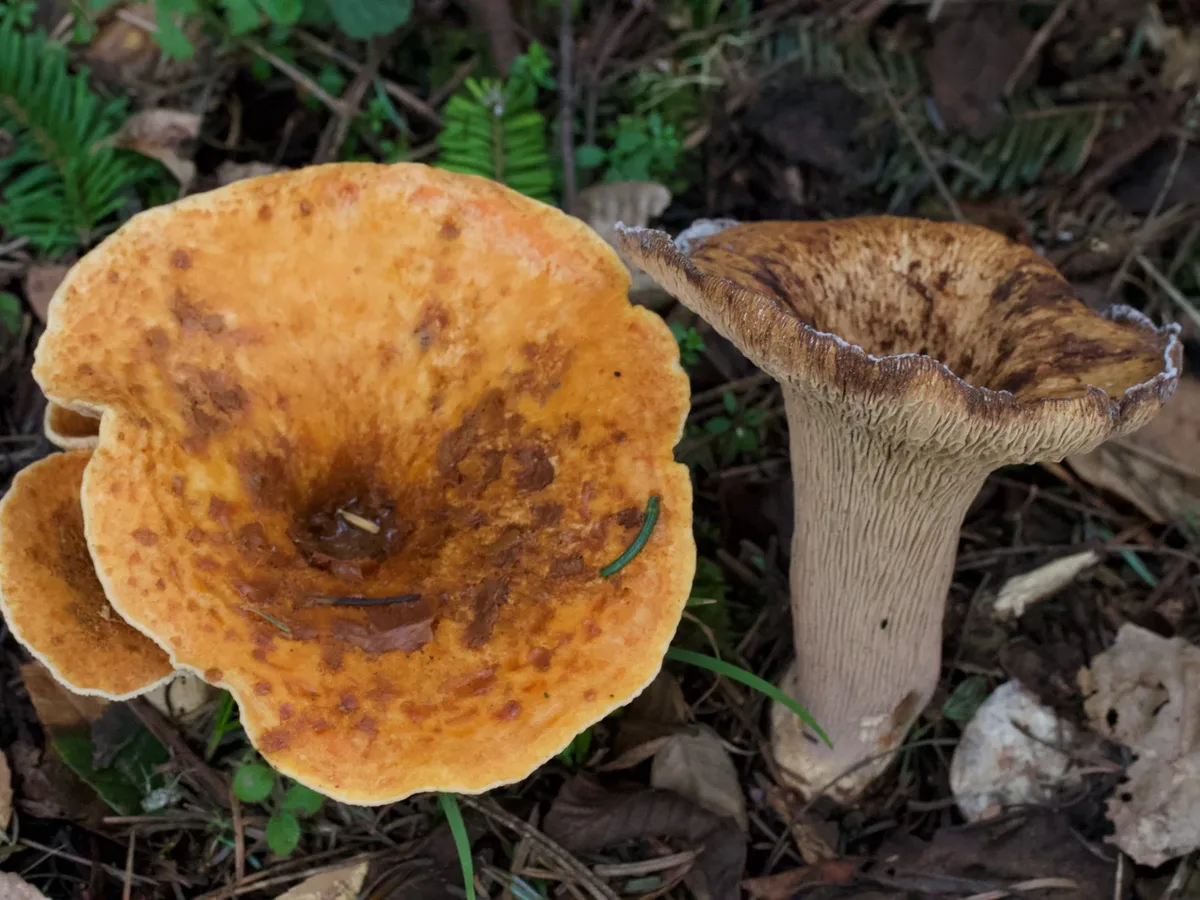 © Arvel Hernandez (CC BY)
 © Arvel Hernandez (CC BY)
 © Leila Dasher (CC BY)
 © Leila Dasher (CC BY)
 © Leila Dasher (CC BY)
 © FUKUDA Kazuhito 福田一人 (CC BY)© Jeff Clark (CC BY)© Matthew Rozanoff (CC BY)
Edible only with the right preparation - or safe for some people but not others. Learn the caveats first.
How to recognise it
Few fungi in the Pacific Northwest announce themselves as boldly as Turbinellus floccosus - and that conspicuousness is exactly the trap.
Cap
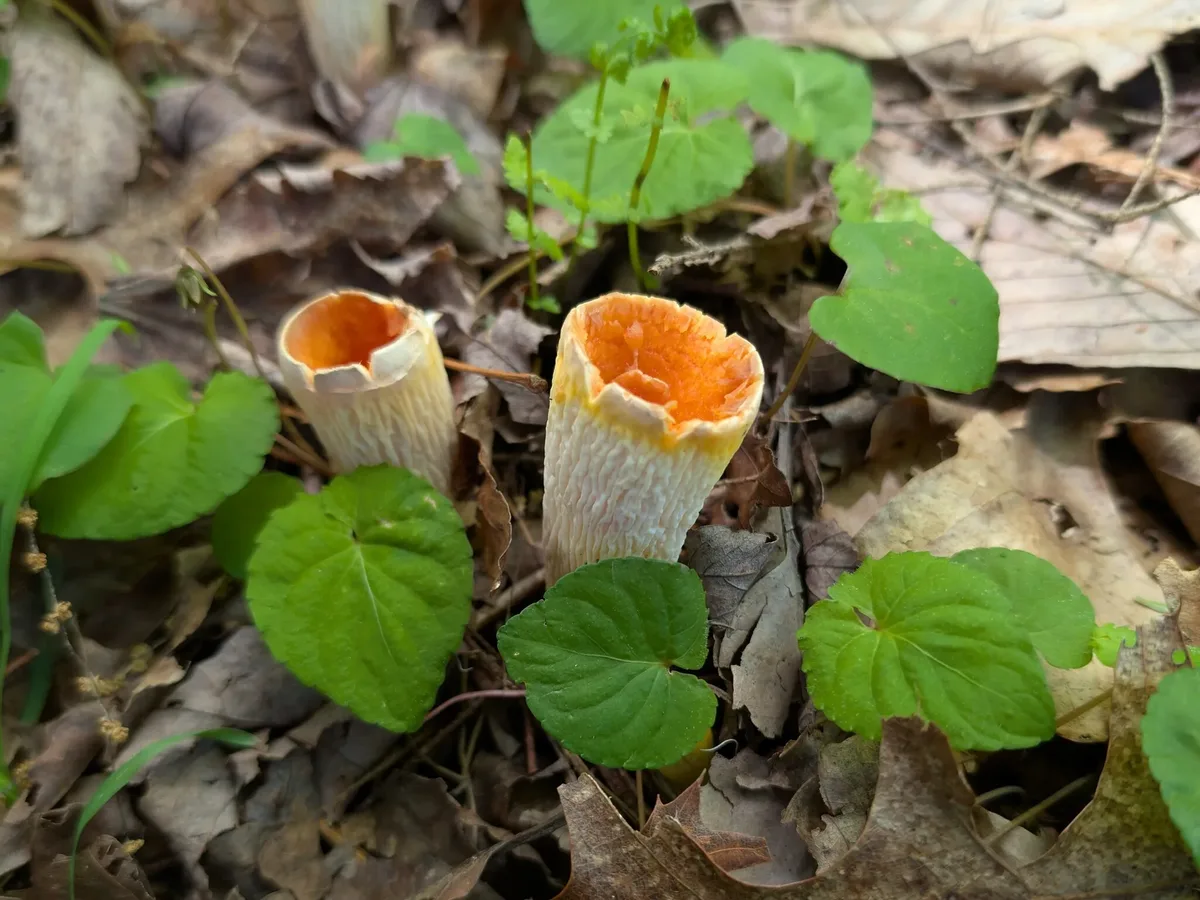
The fruitbody opens as a compact, egg-shaped structure and then expands into a broad, deep vase or funnel reaching 5-20 cm across and 5-17 cm tall.
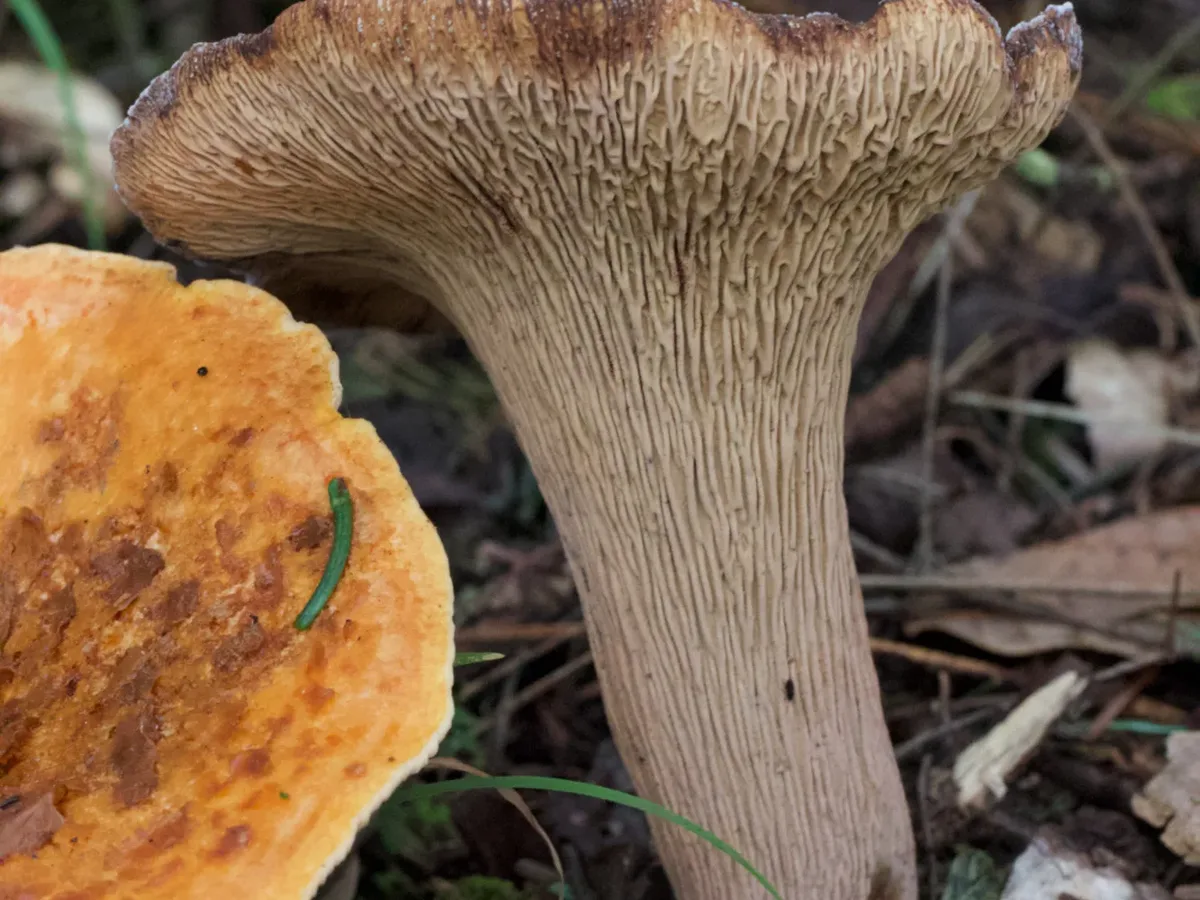
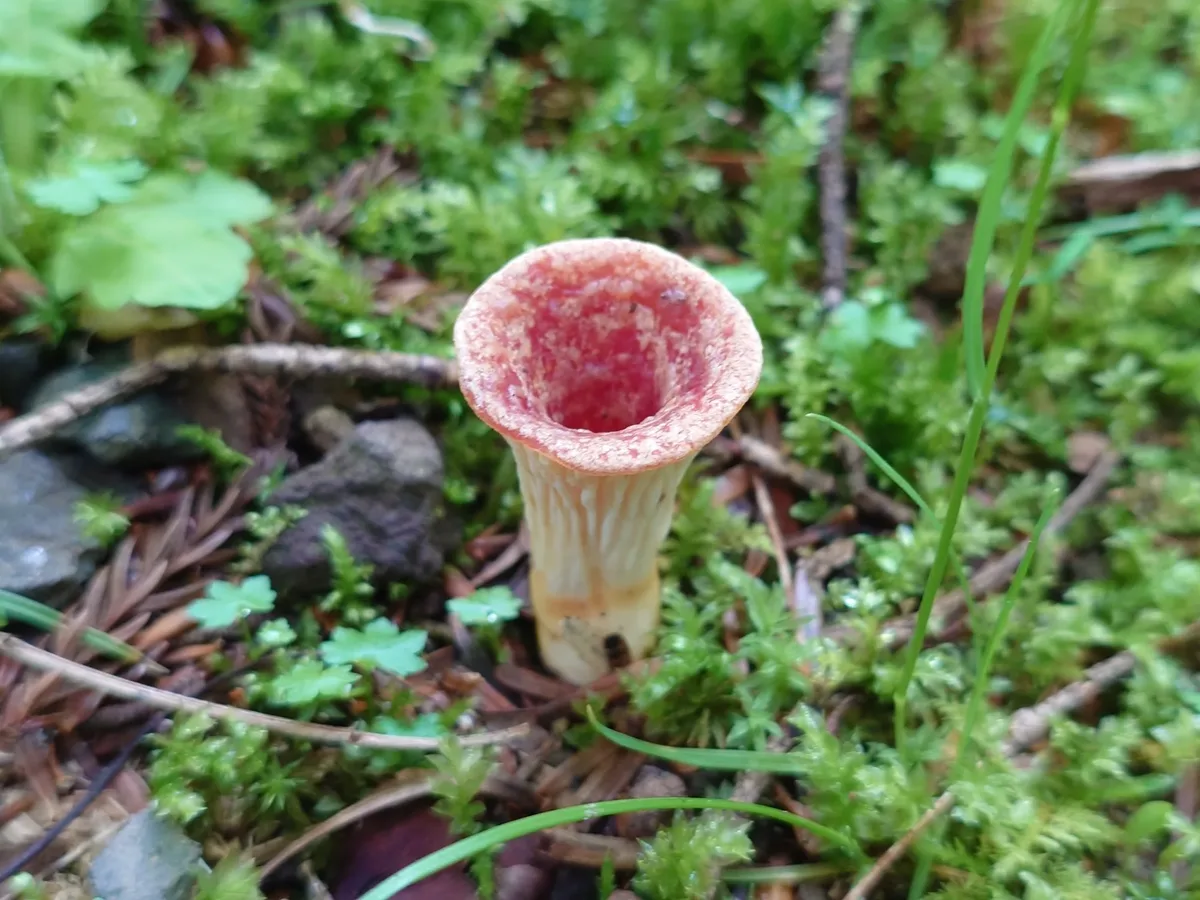
What makes it unmistakable is the outer surface: a dense armour of recurved, fibrous scales, rusty orange-brown to tawny-ochre, densest and most erect at the crown and tapering to flatter, scattered patches toward the wavy, lobed margin. The background between the scales is pale cream to yellow-ochre, giving the whole cap a striking two-toned look that genuinely resembles nothing else in the forest.
Gills / Pores
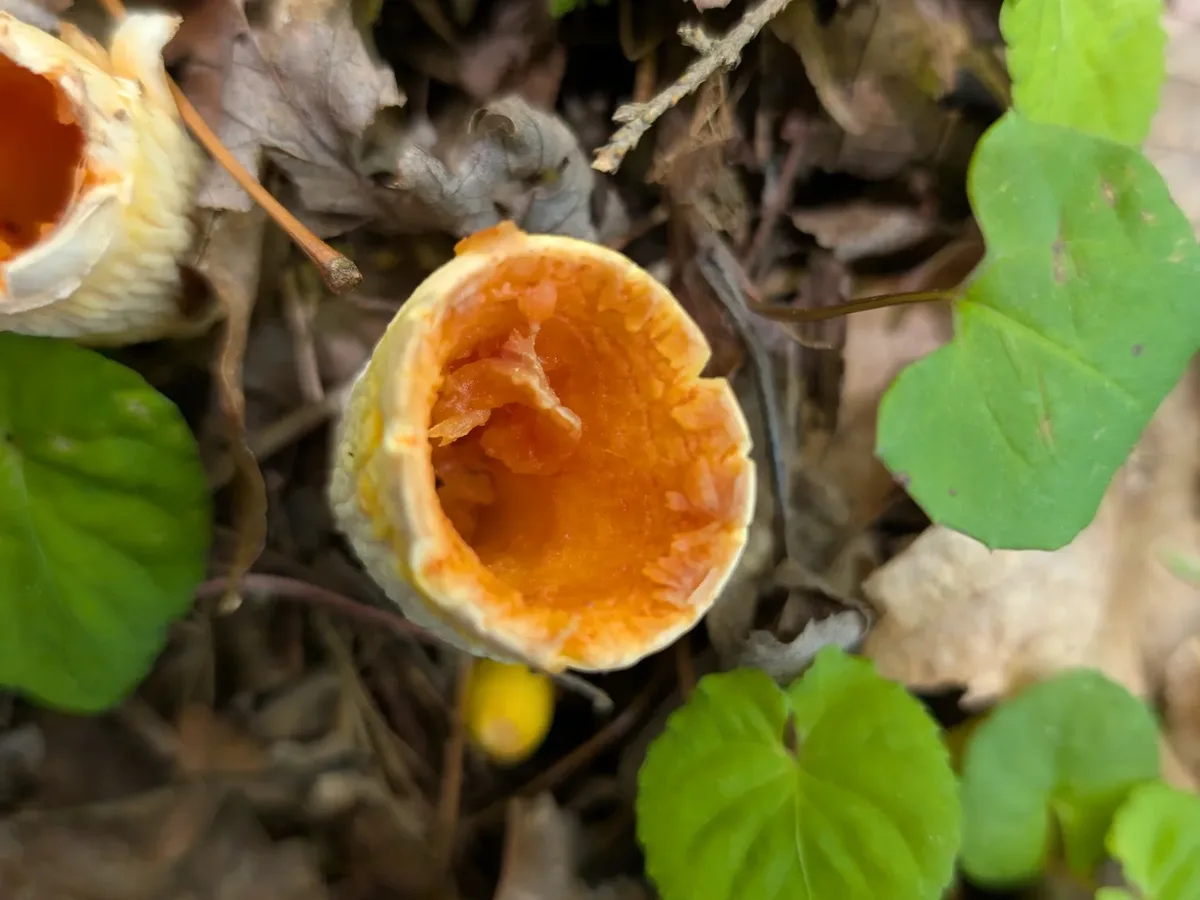
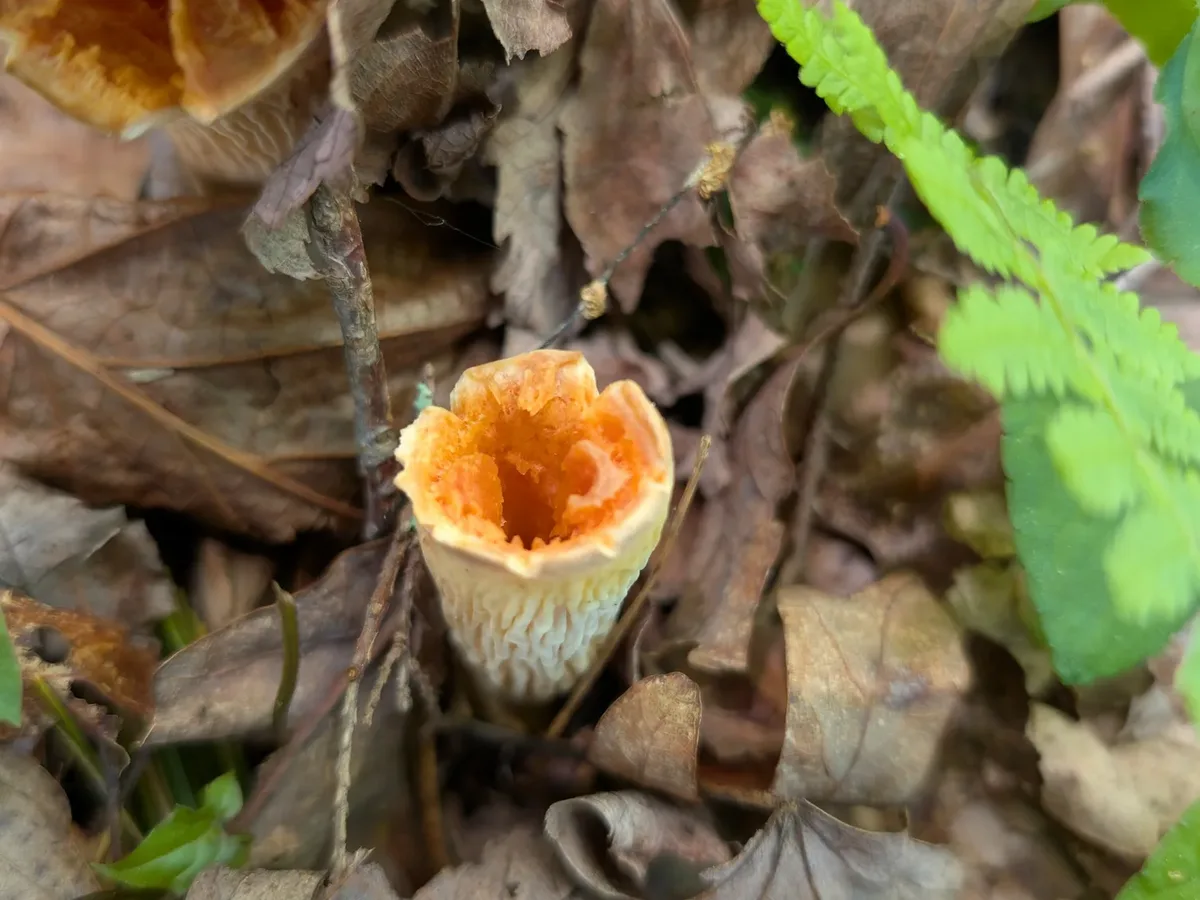
Look inside the vase: the hymenium is cream to pale ochre, lined with shallow, blunt, forking vein-like ridges - not the sharp blade-like false gills of a true chanterelle.
Stem
The stipe is thick, solid, and seamlessly fused with the cap: pale whitish-cream, 3-8 cm tall and 1.5-5 cm thick, tapering slightly at the base. In older specimens the base may become pithy.
Flesh
The flesh is white, firm, and slightly fibrous throughout; cut it and it stays white - no bruising, no colour change.
Smell & taste
The odour is mild and faintly fruity, which is part of why foragers are drawn in. Taste is mild to faintly bitter.
Spore print is pale ochre to yellowish-ochre. Under magnification the spores are ellipsoid with characteristic longitudinal ridges, 10-14 × 5-7 µm.
The diagnostic combination is: deep vase form + shaggy rusty scales + blunt hymenial ridges + pale ochre spore print.
Why it's dangerous
- Moderate-to-serious GI poisoning
- Highly variable individual susceptibility
- Heat-stable toxins
- Onset may be delayed up to 8-14 hours
- Regularly confused with edible chanterelles in prime Pacific Northwest foraging habitat
The attractiveness of the habitat, the season overlap with prized edibles, and the deceptively pleasant odour make this one of the more practically dangerous toxics in the region despite its non-lethal classification.
Toxin
Alpha-tetradecylcitric acid (norcaperatic acid) is the primary suspected compound, a tricarboxylic acid isolated from the closely related Gomphus complex. The full toxin profile of T. floccosus has not been completely characterised.
The compound(s) responsible appear heat-stable, as poisonings have followed thorough cooking. Some secondary irritant compounds may also be present.
Symptoms
Onset is variable and may be delayed: symptoms typically appear 1-3 hours after ingestion but onset can be delayed up to 8-14 hours. This is a critical safety consideration - the delayed-onset pattern means individuals may inadvertently consume additional servings before symptoms begin.
Principal symptoms are gastrointestinal:
- nausea
- vomiting
- abdominal cramps
- diarrhoea
Most cases resolve within 24 hours with supportive care (rest, hydration). Some reports describe prolonged illness and, in heavy consumers, neurological symptoms including dizziness and generalised weakness.
Fatalities are not confirmed for this species, but severe dehydration in vulnerable individuals - elderly, children, those with pre-existing health conditions - is a real risk.
Any person who has consumed the species and feels unwell should seek medical attention and inform the treating physician of what was eaten.
Staying safe
Turbinellus floccosus has caused poisonings across North America, Japan, and Europe following both raw and thoroughly cooked consumption, establishing that the responsible compounds are heat-stable.
Alpha-tetradecylcitric acid (also known as norcaperatic acid), isolated from the related Gomphus complex, is the leading candidate toxin, though the full profile is not completely characterised.
Individual susceptibility varies considerably: some people consume the species without obvious ill effect while others become seriously ill from a modest serving, making trial-and-error exposure inadvisable.
The safe rule is to treat the species as uniformly toxic and not to eat it under any circumstances.
Where & when it grows
Habitat
Turbinellus floccosus is a strictly ectomycorrhizal species - it lives in a long, quiet partnership with the roots of mature conifers, and you will not find it anywhere else.
In the Pacific Northwest it favours closed-canopy montane and subalpine stands, usually between 400 m and 1800 m:
- silver fir (Abies amabilis, A. grandis)
- Engelmann spruce (Picea engelmannii)
- Sitka spruce (P. sitchensis)
- Douglas fir (Pseudotsuga menziesii)
- western and mountain hemlock (Tsuga heterophylla, T. mertensiana)
It fruits singly or in small scattered groups on mossy, humus-rich ground or needle duff, often near the base of large, old trees - the kind of tree whose roots have been feeding a fungal network for decades.
The same pattern holds in East Asia, where the species grows in montane Abies and Picea forest across Japan, Korea, and south-west China (Yunnan, Sichuan). European records come from the Alps and Pyrenees under subalpine conifers. It does not fruit in deciduous woodland.
When
Late summer through mid-autumn is the season across the entire range, and the timing is driven by two things working together: rain and cooling soil.
In the Pacific Northwest, fruiting typically begins in mid-August, peaks through September and October, and ends with the first hard freezes in November. Subalpine fir zones at higher elevations can see the first fruitbodies as early as late July; lower-elevation coastal sites sometimes produce late November flushes after sustained autumn rain.
Japan and Korea follow a closely mirrored pattern. European montane populations are compressed into a shorter September-October window.
The trigger is a sustained rainfall pulse - roughly 20-30 mm over 14 days - arriving after summer drought, combined with soil temperatures beginning to fall below 15 °C. Once that threshold is crossed, fruitbodies emerge and can persist for several weeks, though older specimens deteriorate quickly from insect damage and bacterial breakdown.
How it grows
Fruitbodies appear singly or in loose, scattered groups - never clustered or in tight bunches. They emerge directly from mineral soil or needle duff, and the base is sometimes partially buried.
Growth is unhurried by mushroom standards: the compact egg stage can hold for several days before the vase opens fully.
Once mature, the fruitbodies are robust and can persist for weeks, but they are heavily favoured by insect larvae; older specimens frequently have tunnelled flesh and browning inner surfaces.
Fruiting conditions
Fruiting strongly triggered by late-summer or autumn rainfall pulse (c. 20-30 mm / 14 days) following summer drought, combined with soil temperatures beginning to fall below 15 °C. Subalpine populations at higher elevations may flush with soil temps still around 10-12 °C. Fruitbodies persist 2-4 weeks once emerged.
Look-alikes
The most consequential confusion in the Pacific Northwest is with the Pacific golden chanterelle (Cantharellus formosus), the predominant chanterelle species collected in this region, which grows in the same conifer habitats at the same time of year.
C. formosus is convex to irregularly wavy - never deeply vase-shaped - and its cap surface is smooth to suede-felty, never covered with raised, recurved, tawny scales. Its false gills are sharply ridged, dichotomously forking blades that run well down the stipe; the stipe itself is solid, tapered, and much less massive. Uniform golden to apricot-orange colouring without bicoloured scaling and a white to pale cream spore print complete the separation.
The closely related European golden chanterelle (Cantharellus cibarius) separates by identical features.
The white chanterelle (Cantharellus subalbidus) of the Pacific Northwest is another confusion species: it is ivory to white, broadly convex, with a smooth to suede surface and no scales whatsoever; its false gills are white and prominent.
The closely related Turbinellus kauffmanii (western vase chanterelle) is also toxic and similarly vase-shaped with prominent scales, distinguished by its typically larger size (to 25 cm), darker brown and coarser scales, and association with Ponderosa pine at lower elevations.
The yellowfoot (Craterellus tubaeformis) is much smaller (cap 1-5 cm), thin-fleshed, brownish-grey with a hollow yellow stipe and a grey-lavender hymenium - unlikely to cause confusion except during a very cursory glance.
European species; occasionally encountered outside PNW. C. cibarius is convex to wavy, never deeply vase-shaped. Cap surface smooth to suede-felty - no raised, recurved tawny scales. False gills are sharp, blade-like, dichotomously forking ridges. Overall colour uniform egg-yellow to apricot without bicoloured scaling. Stipe solid but much less massive. Spore print white to pale cream, not ochre.
The primary confusion species in the Pacific Northwest. C. formosus is convex to irregularly wavy - never deeply vase-shaped. Cap surface is smooth to suede-felty, never covered with raised, recurved tawny scales. False gills are sharp, blade-like, dichotomously forking ridges running well down the stipe. Colour is uniform golden to apricot-orange without bicoloured scaling. Stipe solid but much less massive. Spore print white to pale cream, not ochre.
Also vase-shaped and scaly and also toxic/inedible. Distinguished by typically larger size (to 25 cm), darker brown and coarser scales, and primary association with Ponderosa pine at lower elevations. Both species should be avoided.
Ivory to white, broadly convex fruitbody - never deeply vase-shaped. Cap surface smooth to suede, no shaggy scales. False gills white, well-developed, sharp-ridged. Stipe white and fairly slender relative to T. floccosus. Confusion is consequential given its edibility.
Much smaller (cap 1-5 cm), thin brownish-grey cap that becomes perforate or hollow at the centre, hollow yellow stipe, grey-lavender blunt hymenial veins. No scales. Unlikely confusion for anyone familiar with both species but a cursory glance in poor light could mislead a novice.
A reference guide - never an edibility guarantee. When in doubt, leave it out.