Black truffle
Tuber melanosporum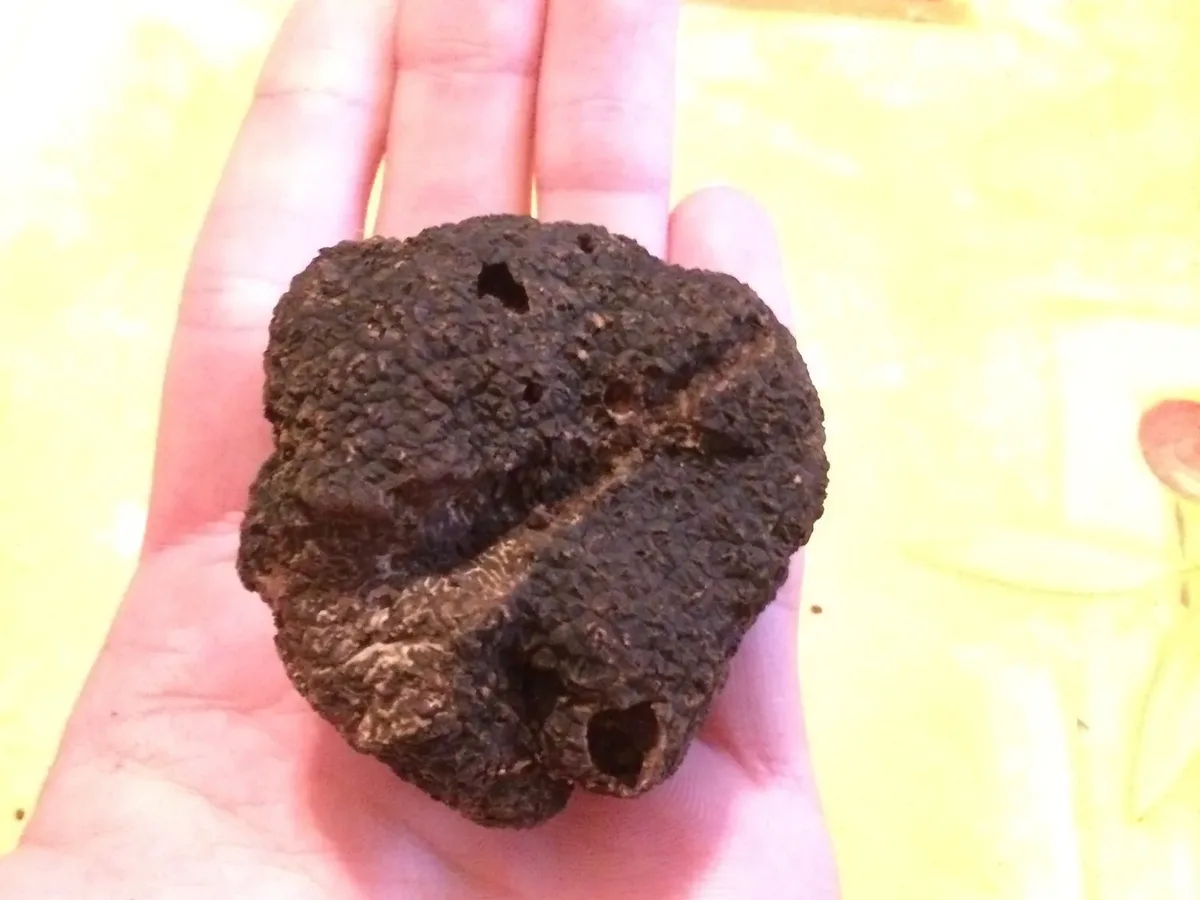 © Adrien Nouailhane (CC BY 4.0)
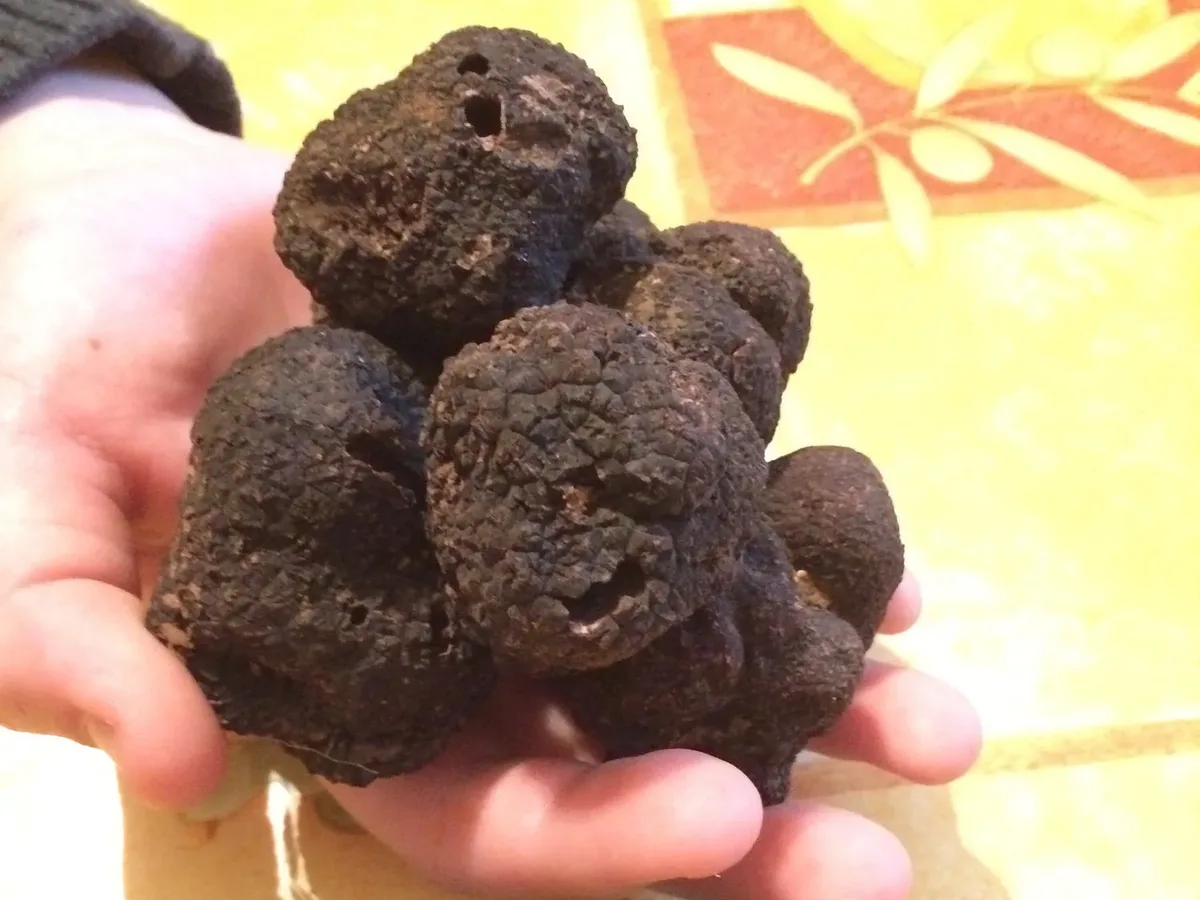 © Adrien Nouailhane (CC BY 4.0)
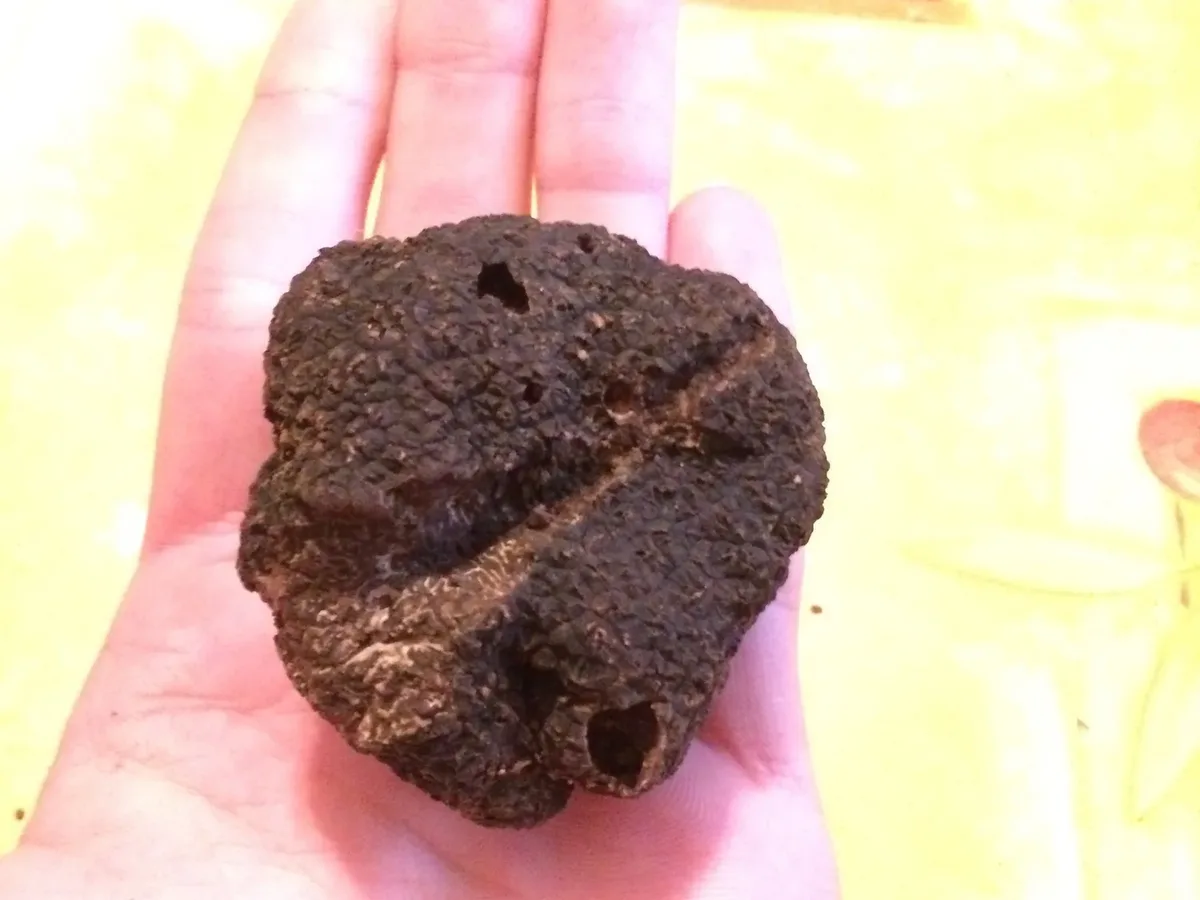 © Adrien Nouailhane (CC BY)
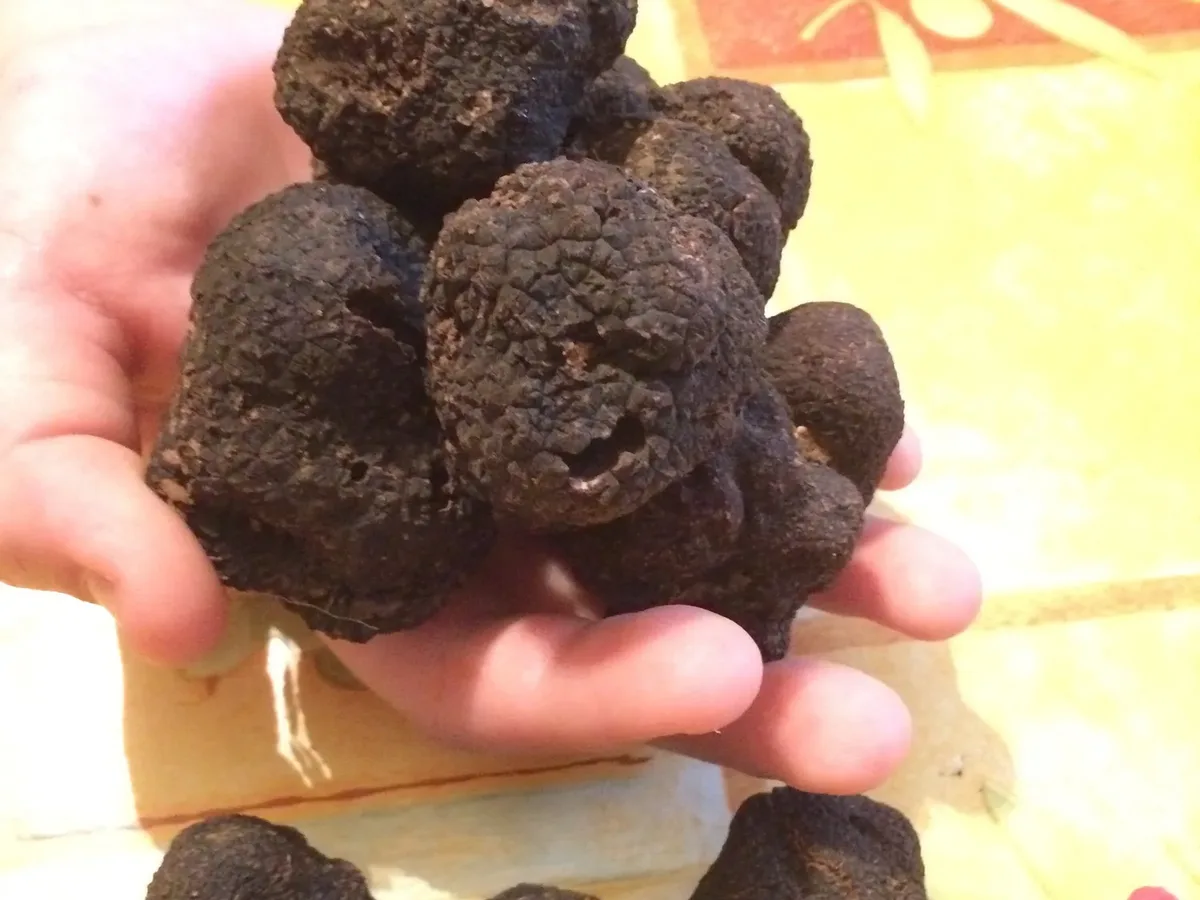 © Adrien Nouailhane (CC BY)
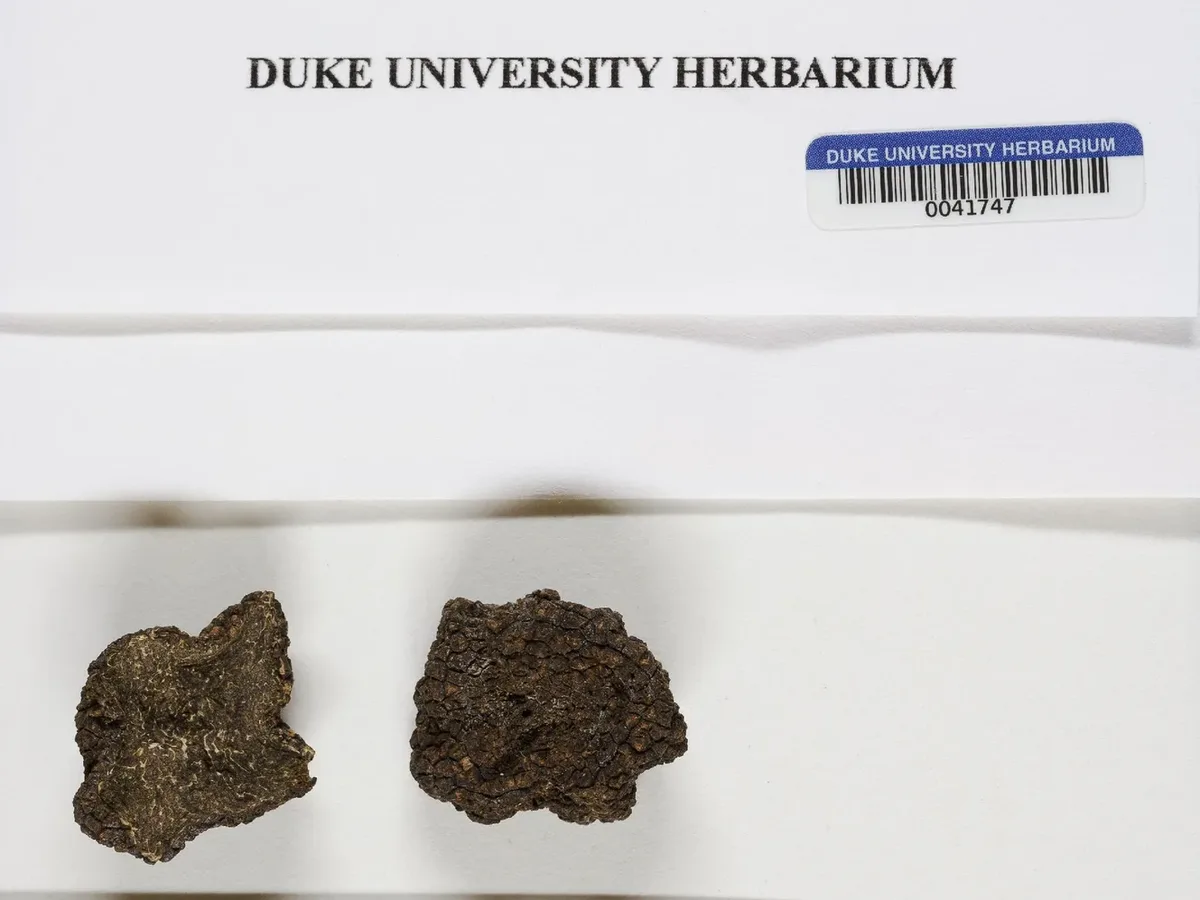 Duke University Herbarium Fungal Collection (DUKE-) (CC0)© Adrien Nouailhane (CC BY 4.0)© Adrien Nouailhane (CC BY 4.0)
One of the best mushrooms you can bring home - once you are certain of the identification.
How to recognise it
Tuber melanosporum produces a compact, nearly spherical to irregularly lobed fruiting body that typically measures 2-10 cm across, though specimens approaching 15 cm and exceeding a kilogram have been reliably documented from the Périgord and Catalonian highlands.
The outer surface - the peridium - is black to dark reddish-brown and armoured with tightly packed, diamond-shaped warts (verrucae) roughly 2-5 mm across, each composed of interlocked hyphae that harden as the truffle matures. Run a thumbnail across the surface and it feels almost like baked earth.
Flesh
The interior flesh, the gleba, undergoes one of the more remarkable colour transformations in the fungal world. Freshly cut, it is cream to pale grey and veined with white; over the following hours and days, enzymatic oxidation drives it steadily toward dark grey, then brown-purple, and finally an intense marbled black-purple laced with fine, persistent white veins that branch like frost on glass.
Those veins are sterile tissue - the fertile chambers bearing the asci lie between them. Mature asci each contain two to five ascospores that are dark brown, elliptical, and covered in short conical spines (echinulate) - visible under magnification as a sea-urchin-like surface that helps the spore cling to an animal's gut wall after ingestion.
Smell & taste
The aroma of a ripe, warm truffle - the volatile bouquet released by dozens of sulphur-containing and aromatic compounds including dimethyl sulfide, 2,4-dithiapentane, and 3-methyl-1-butanol - is so distinctive that it has been commercially synthesised, though no synthetic product yet matches the full complexity of the real thing.
Where & when it grows
Habitat
Tuber melanosporum is a strict calcicole: it does not merely prefer limestone, it depends on the chemistry that limestone drives through the soil. In acidic soils its mycelium cannot establish; even slightly acidic conditions from leaf litter can suppress a bed that was thriving before overstory density changed.
The ideal soil is a shallow, well-drained, calcareous brown earth - often pale, crumbly and almost skeletal - sitting above karstic limestone bedrock. pH typically runs 7.5-8.5 across productive truffle grounds. Soil texture matters too: compaction after rain seals the gas exchange pathways that the truffle mycelium, and the host roots, need.
Altitude in the core zones (Périgord, Provence, Umbria, Aragón) generally runs 200-700 m, where winter cold is reliable enough to interrupt summer drought stress.
The partnership with downy oak (Quercus pubescens) in France and holm oak (Q. ilex) in Spain and Italy is ectomycorrhizal - the truffle's hyphae ensheath the finest root tips in a dense mantle and push between root cells to form the Hartig net, the molecular interface where carbon and minerals are exchanged. This partnership is thought to confer drought resistance on the host tree as well as mineral nutrition, which is why truffle-planted oaks in dry Iberian landscapes often outlast unpaired trees.
Around an established mycelial mass, the truffle's secretions suppress grass, forbs and other fungi by altering the soil microbiome and possibly releasing allelopathic compounds - creating the celebrated brûlé, a bare circle of bare earth that from a hillside looks like a scorched patch. A single brûlé can persist for decades and slowly expand outward at the rate of the mycelial front, sometimes reaching 15-20 m across in old productive beds.
When
The truffle's annual cycle is long and largely invisible to the forager. In late May to June, the first tiny primordia - pin-head-sized balls of densely interwoven hyphae - differentiate on the surface of mycorrhizal roots a few centimetres below the soil surface.
They spend the summer swelling, locked into the darkness and insulated from both the surface heat and the eye, drawing carbohydrate from the host tree through the mycorrhizal connection. By September they are marble-sized and faintly aromatic; by October, perceptibly darker and denser.
The cold months of November through March are when the truffle crosses into maturity: internal enzymatic activity ramps up as soil temperature drops below 10 °C, accelerating the darkening of the gleba and the synthesis of aromatic volatiles.
Harvest is possible from mid-November, but most professional trufficulturists do not dig until December or January, when the spore mass is fully developed and the commercial aroma is at its peak. The absolute peak - highest volatile output and therefore highest price - falls across January and February.
By mid-March, warmer soil temperatures trigger a rapid decline in aromatics, and unsold truffle becomes commercially worthless within days rather than weeks.
Year-to-year yields vary by a factor of three to five, tracking summer rainfall in July and August more than any other single variable: a dry summer produces small primordia that may fail to mature.
How it grows
Few fungal partnerships are as precisely engineered as the one between Tuber melanosporum and its host oaks. Unlike many mycorrhizal fungi that can associate with dozens of tree genera, T. melanosporum is obligately dependent on a narrow roster of hosts and will not fruit without them.
The principal partners are:
- Quercus pubescens
- Q. ilex
- Q. robur
- Q. petraea
- Corylus avellana
The partnership is heterothallic: T. melanosporum has two mating types, MAT1-1 and MAT1-2, encoded at a single mating-type locus. For a fruiting body to form, mycelium of both types must colonise the same root system simultaneously.
This partly explains why natural beds are slow to establish, and why plantations planted with a single mating type (as sometimes happened before molecular sexing of inoculant became routine) produced nothing for years.
Once both types are present, the timeline runs roughly:
- Fruiting bodies can begin to form on roots that have been colonised for two to five years.
- A plantation of inoculated seedlings typically first crops five to eight years after planting.
- It takes ten to fifteen years to reach peak production.
The mycelium overwinters as living hyphae in the mantle around host roots; it does not produce resting structures.
Genome sequencing (Martin et al., 2010; Murat et al., 2018) showed that T. melanosporum has one of the largest fungal genomes known - roughly 125 Mb - due to an extraordinary proliferation of transposable elements that now occupy about 58 % of the genome. This genomic complexity may underlie the species' tight host specificity and sensitivity to soil chemistry.
Fruiting conditions
Hypogeous ectomycorrhizal species; fruiting bodies set in the soil from late spring and mature through the cold winter months. Cultivated plantations first crop 5-8 years after planting and yield about 20-80 kg/ha/year, with large year-to-year variation; irrigation is critical.
Look-alikes
No species in the truffle genus is poisonous, so confusion in this genus carries economic rather than toxicological risk - but that risk can be substantial, given the black truffle's price.
The most common adulterant is the Chinese truffle, Tuber indicum, which shares a nearly identical peridium: black, warty, and round. The reliable distinguishing features are aroma and internal colour:
- T. indicum has a faint, mushroomy smell at best.
- Its gleba remains grey-brown to brown-grey at full maturity - it does not develop the deep purple-black with strongly contrasted white veins that characterises a ripe T. melanosporum.
- Under a loupe or jeweller's eye, the warts of T. indicum are also slightly more rounded and less sharply pyramidal.
In markets, T. indicum is sometimes interleaved with genuine black truffle or lightly scented with synthetic truffle aroma oil; both practices are fraudulent under EU food law but persist.
The summer truffle (Tuber aestivum) and autumn/winter truffle (T. brumale) are European species that overlap with T. melanosporum in range. Both have a grey-black peridium with coarser warts (T. aestivum's warts are star-shaped and rough to the touch), and both have a grey gleba with white veins - the veins do not turn purple-black.
T. brumale fruits in December-February and can appear in the same beds as T. melanosporum; T. aestivum fruits from June-September with a completely different season. Neither is dangerous; both are commercially valuable in their own right but worth a fraction of T. melanosporum.
Terfez species (desert truffles) and Melanogaster species (false truffles) differ radically in gleba structure, smell and geography, and would not normally be confused by anyone who has handled a genuine black truffle.
Milder aroma and a smoother, reddish-brown surface; common in counterfeits passed off as black truffle.
Grey-black gleba with white veins that do not darken on exposure to air.
Grey-black gleba with white veins that do not darken on exposure to air.
In the kitchen
Picking & cleaning
Locating a ripe truffle underground without disturbing unripe neighbours requires a nose far more sensitive than a human's. Trained dogs - chiefly Lagotto Romagnolo, though any breed can learn - detect the dimethyl sulfide plume that a mature truffle emits upward through the soil, sometimes from 15-20 m away in calm air.
Once the dog alerts, the harvest follows a careful sequence:
- 1The dog scratches at the spot and is immediately rewarded and moved aside.
- 2The trufficulturist probes with a narrow-bladed mattock (the cavagnette in France, the vanghetto in Italy) to feel the truffle without cracking it.
- 3The hole is widened carefully and the truffle lifted by hand.
- 4The depression is refilled and tamped down, leaving the surrounding mycorrhizal mat intact.
This matters: the mycelium around a producing root cluster is the productive capital of the entire bed, and compacting or exposing it to drying air sets back the following season's crop.
Truffles must be used within a few days of harvest; their aromatic volatiles dissipate rapidly. Storing them in a sealed glass jar with uncooked eggs for 24 hours is a classic technique to transfer aroma through the porous shell, producing truffle-flavoured eggs without touching a gram of the truffle itself.
Major French markets - Richerenches (Vaucluse), Lalbenque (Quercy) and Périgueux - operate on Tuesday and Saturday mornings from November to March, with experienced buyers assessing aroma, firmness and the peridium texture by touch and smell. Certified auctions at these markets set the weekly reference price, which often runs €700-1,200/kg for premium-grade winter truffle.
Cooking
The volatile aromatic compounds that make Tuber melanosporum so prized are the same compounds that make it uniquely fragile in the kitchen. The chief aroma carriers - dimethyl sulfide, 2,4-dithiapentane and a clutch of other sulphur-containing molecules - begin to dissipate above 50 °C and are largely destroyed by prolonged cooking above 80 °C.
This is why almost every serious truffle preparation either avoids heat entirely or applies it only briefly at the end. A few grams shaved paper-thin over freshly cooked tagliatelle, or over just-scrambled eggs removed from the heat moments ago, is the standard approach: residual warmth volatilises the aroma gently without cooking it away.
Fat is the ideal vehicle - butter, egg yolk, cream - because the truffle's spiny ascospores and waxy peridium absorb lipids readily. Truffle butter (whipped butter folded with raw grated truffle, sealed overnight) concentrates aromatics over hours and keeps refrigerated for a week or frozen for a month.
Classic preparations place the truffle in a warm, fatty envelope:
- pasta al tartufo
- uova al tartufo
- risotto
- poulet en demi-deuil (chicken with truffle slices under the skin, cooked low and slow)
The peridium is edible and aromatic; trim only damaged portions. A microplane or fine mandoline at 0.5 mm gives better, more consistent results than most dedicated truffle slicers.
Three to five grams transform a simple dish - which is the species' oldest paradox: a fungus worth more per kilogram than most metals, deployed in quantities measured in grams.
Good to know
Tuber melanosporum has no toxic properties; it is safe to eat raw or cooked, and no adverse reactions have been credibly documented in the scientific literature for healthy adults. The only meaningful risks associated with wild black truffle are financial.
Fraud is pervasive at every level of the supply chain:
- At harvest, less scrupulous pickers sometimes mix in T. indicum or T. brumale.
- At wholesale, moisture-loaded specimens (truffles absorb water and can be weighted with sand or inserted metal pellets have been documented historically) are sold by weight.
As a consumer, the most reliable protection is to:
- Buy from a known producer or a certified market.
- Insist on smelling the truffle before purchase - a genuine ripe black truffle has an unmistakable, penetrating aroma that T. indicum cannot replicate.
- Be appropriately sceptical of off-season availability (genuine T. melanosporum outside November-March is either preserved or overpriced old stock).
Allergy to truffle, while extremely rare, has been reported in individuals with mould hypersensitivity; it is not a structural risk for the general population.
A reference guide - never an edibility guarantee. When in doubt, leave it out.