Alba white truffle
Tuber magnatum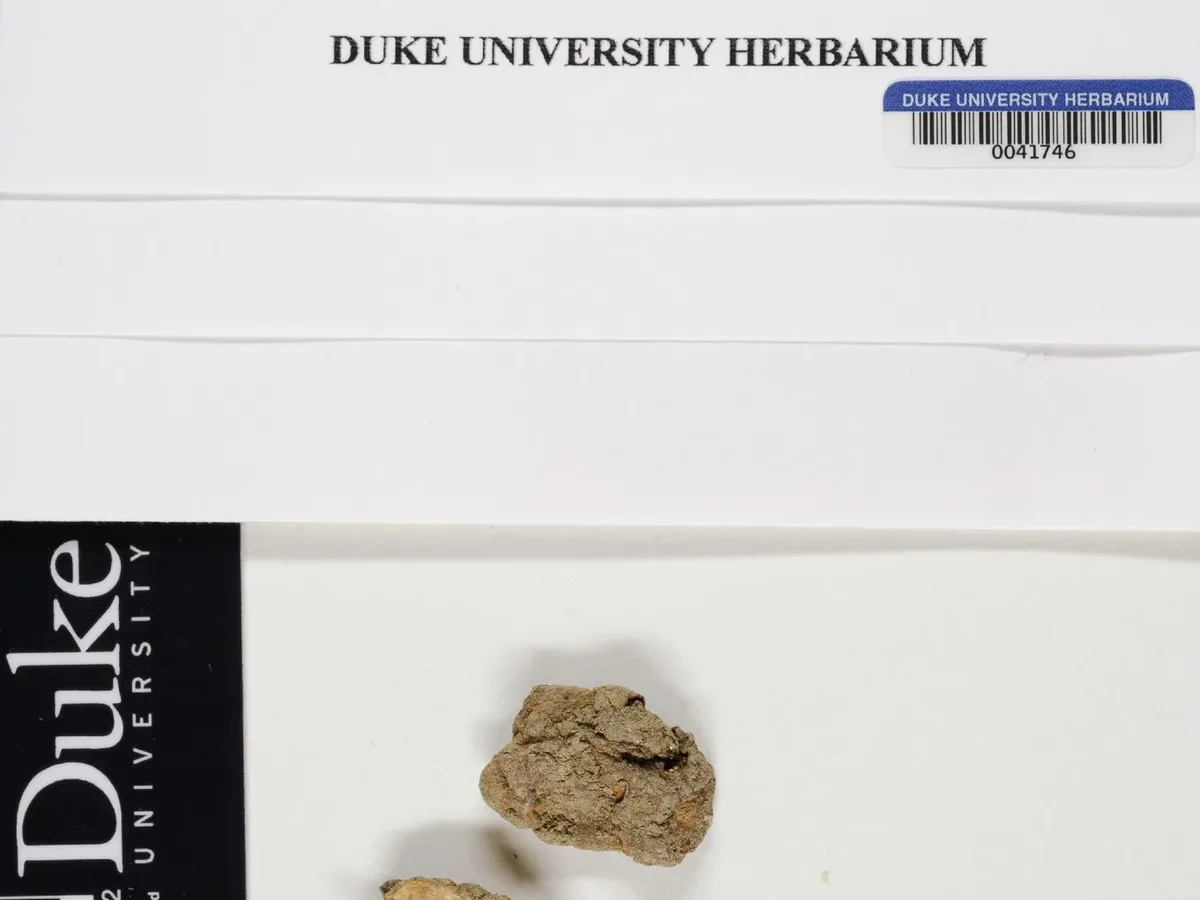 Duke University Herbarium Fungal Collection (DUKE-) (CC0)
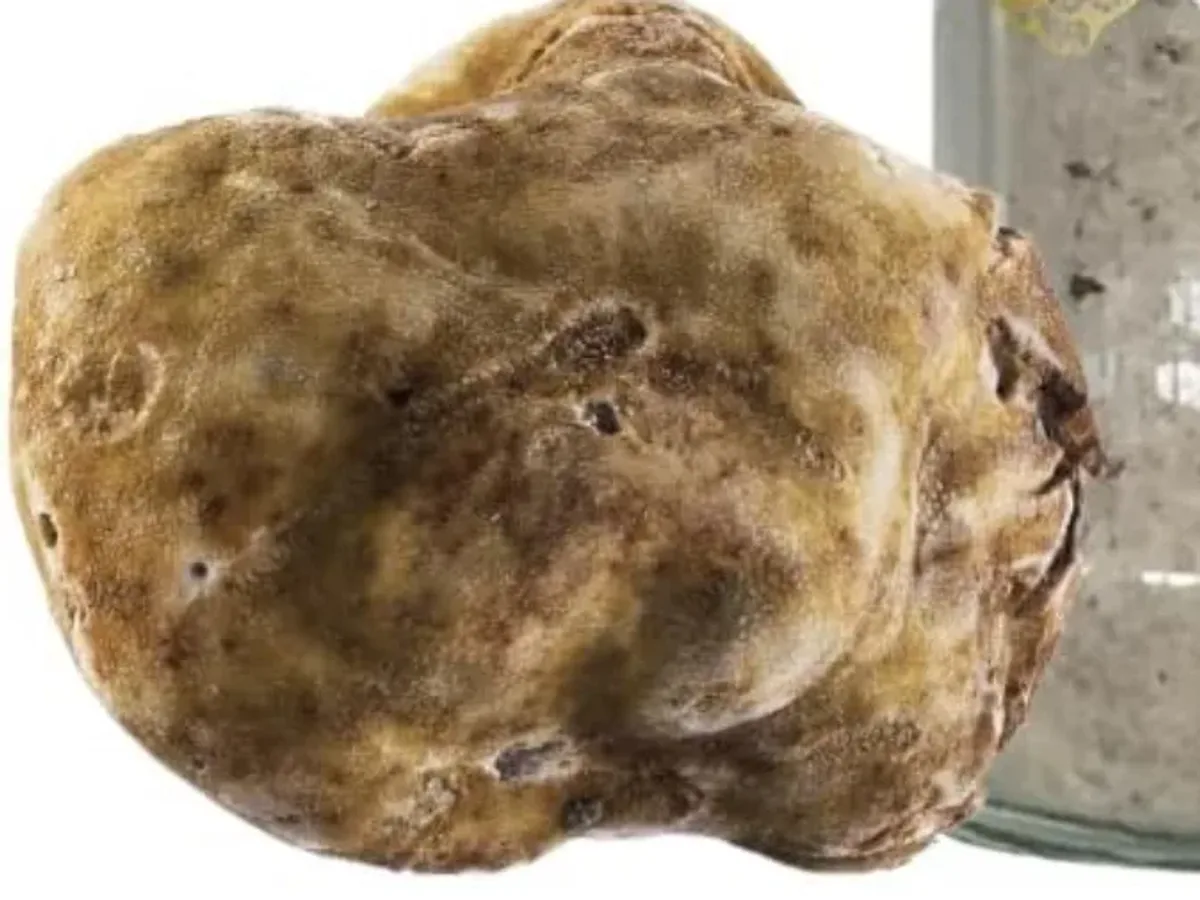 © Brian Hunt (CC BY 4.0)Duke University Herbarium Fungal Collection (DUKE-) (CC0)© Brian Hunt (CC BY 4.0)
One of the best mushrooms you can bring home - once you are certain of the identification.
How to recognise it
Tuber magnatum is defined by what it lacks as much as what it has. Where most truffles are rough and warty, magnatum presents a smooth, entirely unornamented skin - the peridium a pale ochre-yellow to greenish-yellow, sometimes tinged warm beige, occasionally with faint olive patches depending on the soil where it developed. The surface yields slightly under pressure, more pliable than the hardness of Tuber melanosporum or Tuber aestivum.
Shape is characteristically irregular, lobulate, and dimpled rather than spherical: the fruitbody grows where soil pores allow, conforming to stones and roots, and that conformity is written permanently into every contour.
Most specimens are 3-6 cm across and weigh 20-100 g; palm-sized truffles of 200-300 g exist but attract attention; the fabled 700 g or 1 kg specimens sold at auction are genuine rarities shaped by an unusual confluence of space, moisture, and years.
Flesh
Cut cleanly in half, the gleba is the diagnostic core: a cream to pale hazel ground traversed by white veins, marble-like in its patterning, the veins remaining white while the surrounding tissue darkens slightly toward maturity.
Biochemically, the white veins are sterile tissue and the pigmented ground contains the asci bearing four to eight spores each - the reproductive payload of a fungus that reproduces only through the gut of an animal.
Smell & taste
The aroma is the species' defining character: a penetrating, layered scent combining garlic, warm honey, lime blossom, hay, and a faint musky animalic undertone, generated by a suite of sulfur compounds - principally bis(methylthio)methane - at concentrations that diffuse through soil and into the air above the truffle bed.
Uniquely among truffles, Tuber magnatum contains approximately twice the zinc of sister species, a biochemical signature whose ecological function is not yet fully understood.
Where & when it grows
Habitat
Tuber magnatum inhabits a narrow ecological corridor where three conditions converge:
- 1Calcareous or calcareous-clay soils of near-neutral to mildly alkaline pH (typically 7.4-8.0)
- 2High year-round soil moisture fed by proximity to a watercourse or a water-retaining subsoil horizon
- 3Established ectomycorrhizal partnerships with one or more of its host trees - oak (Quercus robur, Q. pubescens, Q. cerris), poplar (Populus spp.), willow (Salix spp.), and lime or linden (Tilia spp.)
The classic habitat is the gentle slope of a riparian woodland or the edge of a poplar plantation beside a river, shaded enough to retain moisture through summer, open enough for the host trees to be well-lit and photosynthetically active.
The Langhe hills around Alba and the Monferrato in Piedmont provide these conditions in concentration, making them the historical heartland of the trade. Significant populations extend through Lombardy, Tuscany, Umbria, Marche, and into the Balkans - particularly the Istrian peninsula, Slovenia's Mirna River valley, and scattered pockets in Hungary and Croatia - wherever the right geology and riparian mosaic align.
The mycelium colonises fine feeder roots as a Hartig net and mantle sheath - the fungal structure wrapping the root tip - and the partnership is thought to be highly host-specific and spatially stable over many years; individual 'beds' are passed down within families of trifolai across generations.
Crucially, successful cultivation trials remain elusive. Inoculated seedlings planted in prepared calcareous soils have produced a handful of truffles at experimental sites in Italy, France, and Croatia, but no reliable commercial cultivation exists, making Tuber magnatum the last major truffle species still sourced exclusively from wild forests.
When
The fruiting window for Tuber magnatum runs from approximately mid-October through late December or early January, with November consistently producing the greatest weight and the highest aromatic maturity.
The season is not merely biological but institutional: the municipality of Alba formally announces the opening date each year, and a biological pause in force from 1-30 September across Piedmont prohibits all harvesting to protect immature developing fruitbodies.
The timing reflects a developmental arc that begins far earlier. Truffles growing in the soil during July and August require sustained soil moisture from summer rainfall during those months - years with dry summers reliably produce reduced autumn crops, and forecasters have tracked the correlation closely enough that August rainfall totals are now used as early proxies for the size of the November harvest.
Ripening accelerates through October as soil temperatures fall below approximately 12°C, and peak aromatic development coincides with cool nights and mild days in November.
By January the soil tends to cool further and remaining fruitbodies deteriorate quickly once ripe, so experienced hunters concentrate effort in the four to five weeks bracketing the peak calendar weeks (approximately weeks 45-48).
Unlike surface mushrooms whose maturity window can be as short as 48 hours, a white truffle has a slightly broader window - perhaps 7-14 days between ripe and overripe - but in a market priced by aroma intensity, even a few days' delay degrades value substantially.
How it grows
Unlike the surface mushrooms most foragers know, Tuber magnatum spends its entire existence underground - hypogeous is the formal term - and its developmental rhythm follows a fundamentally different logic from epigeous fungi.
The mycelium threads through the soil for years before any reproductive effort begins, colonising root tips and expanding the mycorrhizal network incrementally. When conditions align - sufficient moisture held through summer, appropriate soil temperature signals in autumn - it allocates resources to building a fruitbody: a dense, differentiated mass that inflates slowly over several weeks rather than overnight.
There is no rapid cell expansion driven by water absorption as in a gill mushroom. Instead the truffle accumulates dry matter, carbohydrates translocated from the host tree via the shared symbiotic interface, and aromatic compounds synthesised within the fruitbody itself.
The white veins visible in the gleba are the vascular framework of sterile hyphae supporting asci - the spore-bearing cells - and the ratio of vein to gleba shifts as the truffle matures, darkening tissue indicating advancing ripeness.
Spore dispersal depends entirely on animals: mammals and insects are attracted by the aroma, eat the truffle, and void the spores - coated in robust outer walls - at a distance, theoretically seeding new soil.
The effectiveness of this strategy is reflected in the extraordinary investment the fungus makes in volatile chemistry. Producing a penetrating scent detectable through 30-40 cm of soil by a trained dog is energetically costly, but it is the only dispersal mechanism available to an organism that cannot reach the surface.
Fruiting conditions
Requires constant soil moisture year-round; abundant summer rainfall in July-August is decisive for the autumn-winter crop. As a hypogeous ectomycorrhizal truffle it does not produce surface flushes triggered by short-term rain.
Look-alikes
The commercially significant lookalike is Tuber borchii - the bianchetto or whitish truffle - a smaller, somewhat similar-appearing species that ripens earlier (typically February-April) and shares broad habitat preferences.
The key separation points are several and reliable:
- The peridium of T. borchii is typically more finely granular or slightly roughened rather than fully smooth, though young specimens can deceive.
- The gleba of T. borchii darkens to a darker brown at maturity and the veining is less regular and less strikingly white.
- Most decisively, the aroma of T. borchii at maturity is sharper, more sulfurous, and harsher than the layered complexity of magnatum - experienced noses separate them within seconds.
- Microscopically, the spores differ clearly: magnatum spores are broadly ellipsoid with a fine, relatively regular alveolar reticulation; borchii spores bear a more pronounced, irregular reticulation.
Despite these differences, T. borchii is routinely sold fraudulently as magnatum because the price differential is enormous. A 2012 market survey at the Asti truffle market found that more than 90% of truffles labelled or sold as Alba white truffle did not originate from the Langhe region at all, and some were not magnatum at all.
The Jozef Stefan Institute in Slovenia has validated strontium and other stable isotope analysis as an objective tool for confirming both species identity and geographic origin, and it is now used in commercial authentication.
No lookalike species carries any toxicological risk; the harm from confusion is purely economic.
A cheaper species frequently sold fraudulently as Tuber magnatum. Origin and species can be confirmed by isotope analysis.
In the kitchen
Picking & cleaning
Harvesting Tuber magnatum is among the most codified forms of mushroom collection in the world. The hunter - a trifolao in the local Piedmontese dialect - works exclusively with a trained dog, never with a pig as in some older traditions.
The dog, typically a Lagotto Romagnolo (the traditional breed) or a mixed-breed trained to the scent, quarters the woodland methodically, nose low to the soil, until it identifies a concentrating scent plume rising from a ripening truffle.
On alert, the dog is called off before it can bite into the truffle, and the trifolao probes the indicated point with a vanghetto - a small, blunt, hoe-like mattock - excavating carefully to extract the truffle intact. Damaged specimens lose commercial value rapidly: bruising accelerates oxidation of the aromatic compounds and the cut surface desiccates.
After extraction the hole is refilled and tamped down, both as practical etiquette and to protect the mycelium and any smaller developing fruitbodies in the same bed.
By tradition, hunting is conducted at night or before dawn - partly to preserve the location of known beds from rivals, and partly because cooler, calm air carries scent more consistently.
The Roddi village near Alba has maintained a truffle-dog training school since 1880, and the combination of the breed, training methodology, and geographic knowledge constitutes a living heritage now inscribed in Italian cultural practice.
Truffles are typically transported wrapped in dry paper or rice, changed daily, and stored loosely refrigerated - not in sealed containers, which concentrate moisture and accelerate rot.
Cooking
Tuber magnatum is a raw ingredient - this is not a preference but a biological constraint. The complex aromatic compounds that define its value, principally sulfur-based volatiles including bis(methylthio)methane and related molecules, are highly heat-sensitive and dissipate rapidly when warmed above approximately 50-60°C.
Any application of significant heat destroys what makes a white truffle worth its price, reducing it to something indistinguishable from a far cheaper cooked truffle preparation.
The classical preparations honour this by applying the truffle as a finishing element to warm - not hot - foods: tajarin (Piedmontese egg pasta in butter), risotto bianco, soft scrambled eggs, fonduta (a northern Italian cheese fondue), or simply shaved over mild, fresh cheeses.
The technique is shaving: a traditional mandoline-style truffle slicer (the affettaverdure or a dedicated tartufo slicer) cuts translucent slices 1-2 mm thick that drape over the dish and release their scent in the steam rising from it. The fat in butter, egg yolk, or cheese acts as a carrier for the fat-soluble aromatic compounds, amplifying the sensory effect.
Quantity matters proportionally: the scent threshold in food begins at around 2-3 g per portion, with 5-8 g considered generous. Truffle should be added and served within seconds - not rested - because its aromatics are the most volatile thing on the plate.
Storage protocols matter as much as cooking technique. A truffle held at 2-4°C in dry paper, changed daily, and used within 5-7 days of purchase retains its character; longer holding or improper moisture management accelerates the enzymatic degradation that flattens the aroma and softens the texture into an unpleasant mush.
Good to know
Tuber magnatum is entirely safe to eat and carries no toxicological risk. The safety considerations attached to this species are of a different character: economic fraud and mislabelling.
This is routinely the most expensive food product sold by weight anywhere in the world, generally fetching 3,000-6,000 EUR per kilogram retail, with premium-provenance specimens reaching higher. At the 2022 Alba auction, a single 700 g truffle sold for 184,000 euros.
The price gradient creates intense commercial pressure to substitute the species or misrepresent geographic origin, and both practices are widespread. Buyers should be alert to several common forms of fraud:
- T. borchii sold as magnatum
- magnatum from Balkans or Eastern European origin labelled as Langhe or Alba
- magnatum of lower aromatic quality whose aroma has been enhanced with synthetic bis(methylthio)methane sprayed on the surface
Aroma enhancement can be detected by the experienced nose as a flat, uniform sulfur note lacking the honey and hay complexity of a genuinely ripe specimen. It can also be caught by the unnatural persistence of scent even when the truffle is refrigerated for several days - the synthetic compound is more stable than the natural bouquet, which fades as the truffle ages.
For personal foragers entering truffle habitat, collection without a regional permit (tesserino) is illegal across most Italian producing regions, and harvesting during the biological pause (1-30 September in Piedmont) carries fines. Harvest limits per hunter per day are also enforced.
A reference guide - never an edibility guarantee. When in doubt, leave it out.