Himalayan Truffle
Tuber himalayensesyn. Tuber himalayense B. Liu, Ye & Z.W. Ge
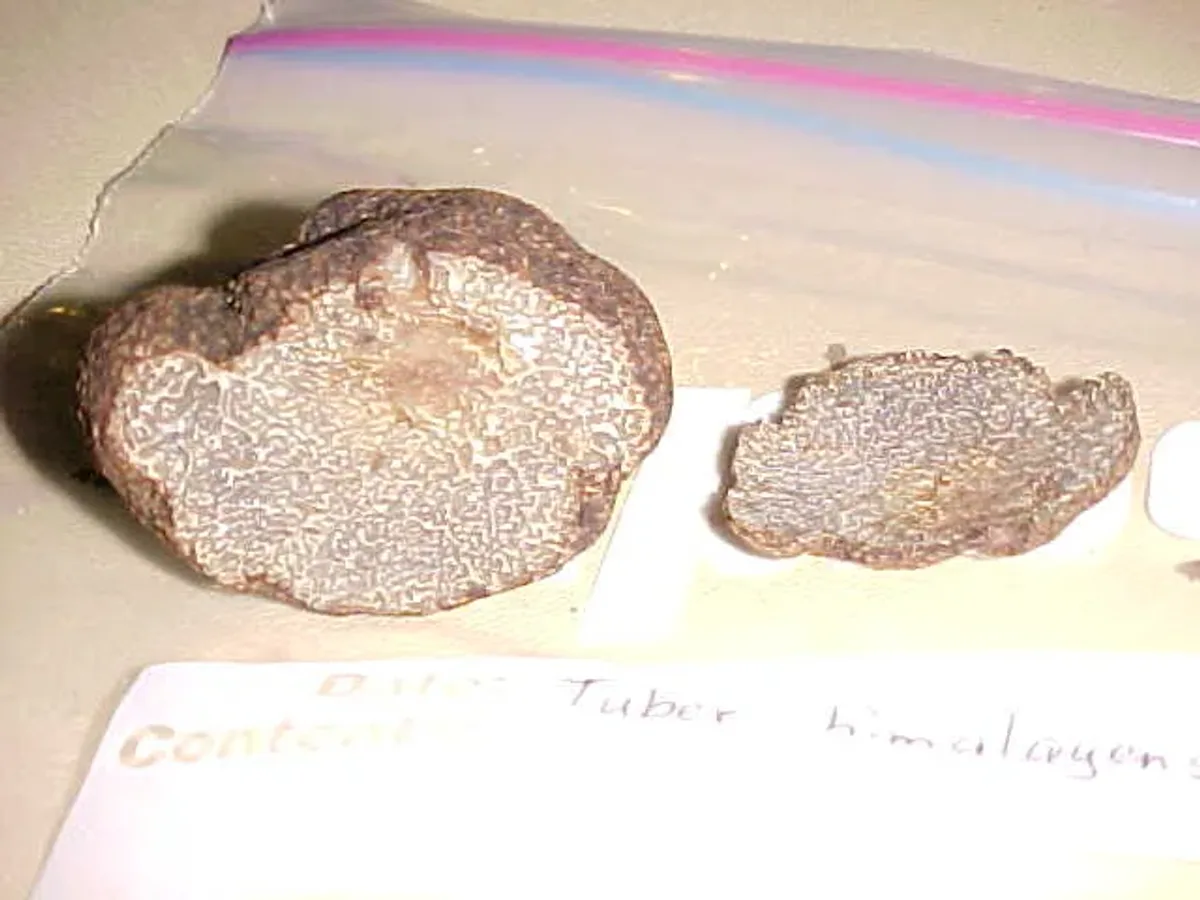 © Daniel B. Wheeler (CC BY-SA)
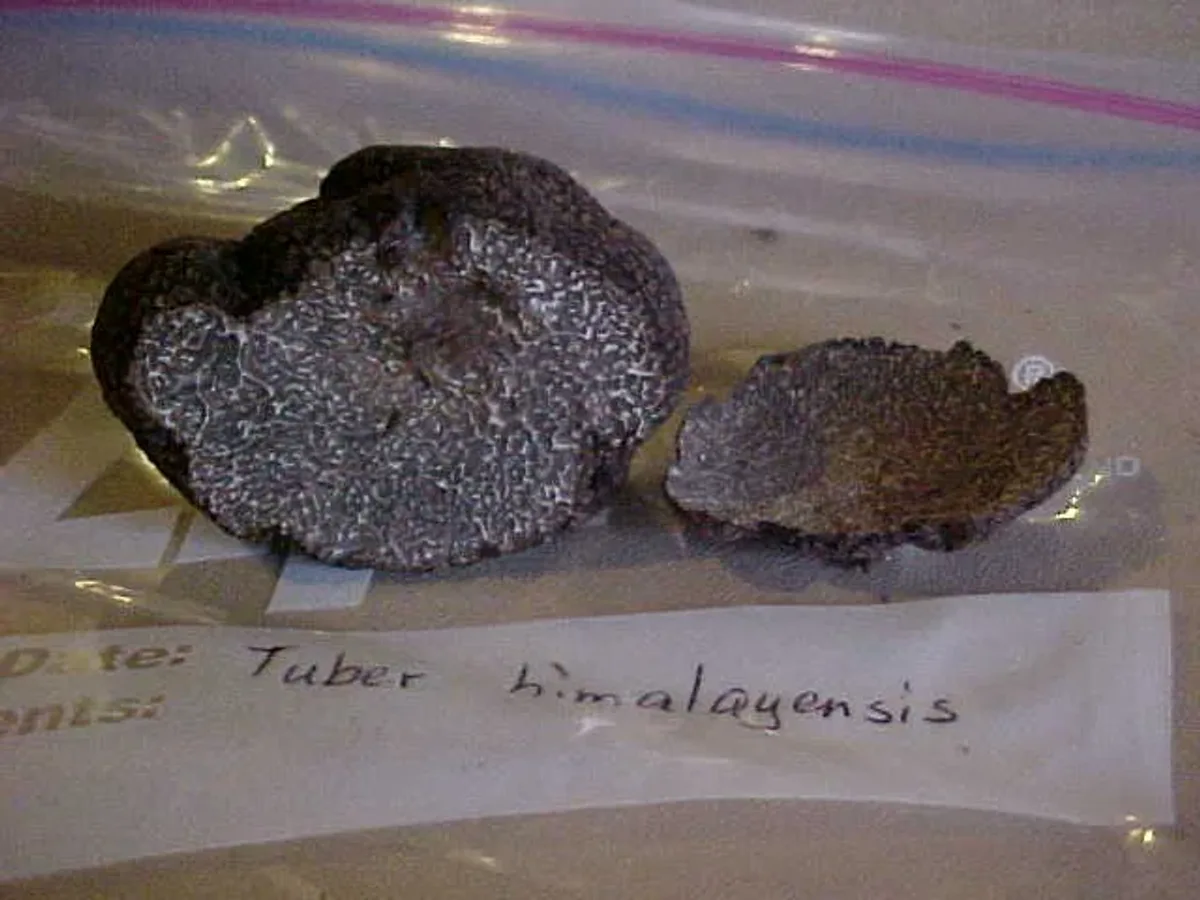 © Daniel B. Wheeler (CC BY-SA)
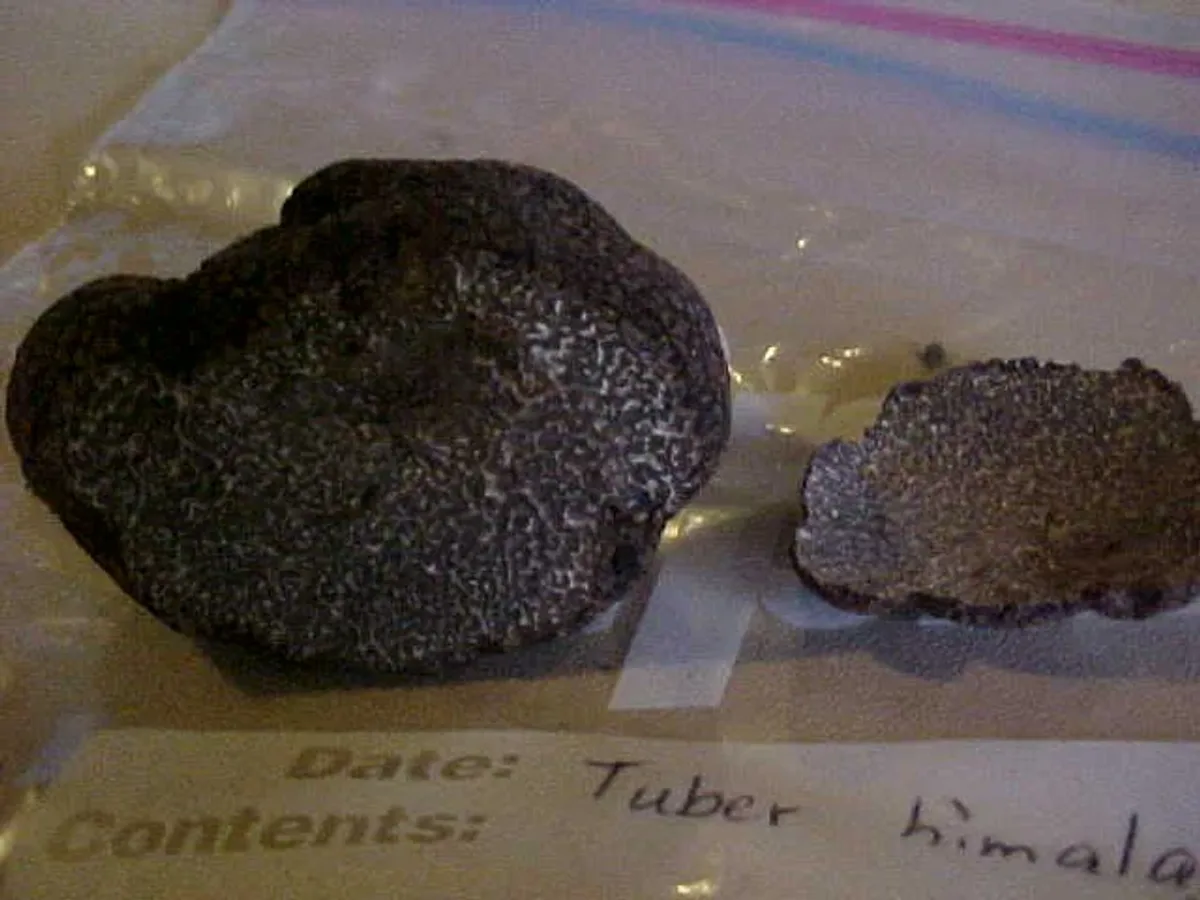 © Daniel B. Wheeler (CC BY-SA)© Daniel B. Wheeler (CC BY-SA)© Daniel B. Wheeler (CC BY-SA)
Good to eat, once you have identified it with certainty and cooked it through.
How to recognise it
Tuber himalayense is an underground truffle that never breaks the soil surface. The outer skin is dark brown to jet-black at maturity, tiled with closely packed, sharp-edged polygonal warts that give it a distinctly armoured texture.
At first glance it resembles the summer truffle (T. aestivum), but with finer, somewhat more numerous warts and a darker overall colour even before full ripeness. The size range is 2-7 cm across, occasionally larger.
The critical diagnostic character is the interior. Slice the truffle in half and look for firm, chocolate-brown to dark greyish-brown flesh shot through with a dense lattice of fine white veins. The veins are narrower and more tightly packed than those in T. aestivum, and the background gleba colour is noticeably darker.
Ripe specimens yield slightly under thumb pressure and emit a mild, earthy, faintly garlicky scent; immature bodies are completely odourless and should be left undisturbed.
Spores, visible only under a microscope, are ellipsoidal with a honeycomb-like alveolate surface pattern.
Where & when it grows
Habitat
This is a montane Himalayan-arc truffle of mixed oak, pine, and fir forest, found exclusively at elevations where soils cool significantly in autumn - broadly 1,200-3,500 m.
It forms the classic ectomycorrhizal partnership with the fine roots of:
- High-altitude oaks (Quercus semecarpifolia and relatives)
- Himalayan pines (Pinus wallichiana, P. armandii, P. yunnanensis)
- Firs (Abies spectabilis, A. forrestii)
- Himalayan cedar (Cedrus deodara)
It also associates with Himalayan hazel (Corylus ferox) in some localities.
The best sites are on brown forest soils that are moist but well-drained - avoid waterlogged hollows and compacted slopes.
In productive years a faint brûlé (a bare or thinly vegetated arc around host tree bases) may be visible at the surface, though it is subtler and less consistent than in European truffle sites.
The primary range runs across the eastern Himalayas through Bhutan, Nepal, northern India (Himachal Pradesh, Uttarakhand), and into China's Yunnan, Sichuan, and Xizang provinces.
When
The window for ripe Himalayan truffles is shaped entirely by the monsoon-then-cold sequence of the Himalayan autumn.
The South Asian summer monsoon (June-September) delivers the soil moisture that initiates primordium formation deep underground. As monsoon rains withdraw and temperatures fall in September-October, the developing bodies enter their final maturation phase.
Harvest windows by elevation:
- Higher elevations (2,000-3,500 m): mid-October through late November or early December
- Lower-elevation edge sites (1,200-1,800 m): late September, extending to January
A weak monsoon or an unusually dry September-October will delay or curtail the season sharply.
The test for ripeness is the same as for all truffles: gentle thumb pressure produces a slight give in the peridium, and a clean earthy aroma is detectable when the body is held to the nose. White-glebaed, odourless bodies are immature and should be reburied.
How it grows
Tuber himalayense grows as an obligate mycorrhizal partner - it cannot complete its life cycle without a living host tree. This roots it permanently to the specific forest ecosystems of the Himalayan arc.
The mycelium forms a dense sheath (ectomycorrhizal mantle) around the fine terminal rootlets of host trees. An external hyphal network (extramatrical mycelium) radiates outward through the surrounding soil horizon, absorbing water and minerals in exchange for photosynthetic carbohydrates from the tree. This relationship can persist for decades at a productive site.
Fruiting primordia are initiated during or shortly after the monsoon when soil moisture is high. They then develop slowly underground over approximately 8-16 weeks, reaching harvestable size only once autumn temperature and moisture conditions are right.
As with all Tuber species, growth is entirely invisible until a trained nose (a dog's, or an experienced forager's) detects the volatile aroma diffusing upward through the soil.
The primary threats to productive natural sites are:
- Disturbance of the root zone
- Soil compaction from livestock
- Removal of host trees
Fruiting conditions
Primordia are initiated during or shortly after monsoon rains saturate the soil in late summer; maturation from initiation to harvest-ready size takes 60-120 days, the final stage requiring cooling autumn soil temperatures (5-14°C at 10 cm depth). Peak harvest October-November at mid-high elevations. A dry monsoon season or unusually warm autumn significantly reduces yield. The long development lag - typical of all Tuber species - means the primordium cohort is set months before any body can be harvested.
Look-alikes
Within its native Himalayan range, T. himalayense is one of several co-occurring black hypogeous fungi.
- Tuber indicum (Chinese black truffle): the most commercially significant confusion species, visually very similar externally - both have a dark warted peridium. Its gleba tends to be slightly darker with a more uniform chocolate-brown colour and a still milder, flatter aroma. Molecular (ITS DNA) analysis is the only reliable way to separate them with certainty; both species are edible and their confusion has no safety consequence.
- Tuber melanosporum (Périgord black truffle): does not naturally occur in this region but may appear in the commercial supply chain as a labelling comparison. It has a considerably more intense, fruity-spicy aroma and a distinctly darker, near-black gleba with veins that turn pinkish-red on exposure to air - characters absent from T. himalayense.
- Elaphomyces species (false or hart's truffles): also found in Himalayan forests, small (1-3 cm) with a powdery, spore-filled interior rather than marbled flesh, and entirely inedible.
- Sclerotinia and other underground sclerotia: can occasionally be confused when tiny, but they lack the warted peridium and the characteristic marbled gleba.
No toxic or deadly species is known to be a realistic confusion risk for T. himalayense.
Externally near-identical; T. indicum's gleba is typically slightly darker and more uniform, the vein network often coarser, and the aroma weaker and flatter still. The two species overlap in range and commercial supply chains. Reliable separation requires microscopy (slight differences in spore pit dimensions) or molecular ITS sequencing. Both are edible; the confusion has no safety consequence, only commercial and culinary implications.
Small (1-3 cm), found in Himalayan conifer forests. The exterior is strongly warted, but slicing it open reveals a uniformly powdery purple-brown interior - a mass of loose spores, not marbled flesh. It has no culinary value and is inedible, but it poses no serious toxicological risk. Immediately distinguished from any true Tuber by its spore-powder interior.
T. melanosporum does not grow naturally in the Himalayan region but appears in trade as a quality reference or adulterant. Its aroma is dramatically more intense, fruity, and spicy than T. himalayense. The gleba of a ripe T. melanosporum is very dark - nearly black - with white veins that distinctly flush pinkish-red on exposure to air, a reaction absent in T. himalayense. The warts of T. melanosporum are flatter and slightly smaller.
T. aestivum is a European species occasionally imported. It has characteristically large, bold, clearly pyramidal warts on a black exterior, but its gleba is notably paler - creamy-white when young, maturing to hazel-brown - and far less dark than T. himalayense at maturity. The aroma is mild, earthy-hazelnut rather than slightly garlicky. Both are edible; this confusion has no safety consequence.
In the kitchen
Picking & cleaning
The traditional method in Himalayan communities is to locate ripe bodies by probing the soil with a pointed stick or knife at the base of known host trees, following the scent during the ripe season. Trained dogs work well and are increasingly used in commercial operations.
Once a truffle is located:
- 1Carefully extract the body with a pointed tool or by hand, removing only the ripe individual and reburying any immature neighbours.
- 2Refill the extraction hole to avoid desiccating the mycelium network below.
- 3Clean off loose soil with a soft brush - do not wash until immediately before use.
- 4Wrap each truffle in a paper towel and store refrigerated at 2-4°C.
The mild aroma is at its best within the first 4-6 days post-harvest.
Commercial harvest is significant in Yunnan and neighbouring provinces, where the species contributes to the broader Chinese truffle trade; much of this material is exported, often marketed as or blended with other Tuber species.
Permission from landowners or relevant forest authorities is required in most jurisdictions across the range.
Cooking
The Himalayan truffle is a pleasant but modest-scented truffle whose mild earthy, faintly garlicky character is most effectively showcased by simple preparations on neutral substrates.
It is most rewarding shaved thinly over warm pasta, rice noodles, or scrambled eggs immediately before serving, where even its restrained aroma can make an impression.
The aroma compounds are volatile: add the truffle raw or at the very last moment off-heat rather than sautéing it directly, which dissipates the scent too quickly.
Ways to capture and keep the flavour:
- Seal fresh specimens in an airtight container with eggs overnight - the aroma migrates through the porous eggshell, amplifying the truffle's contribution significantly.
- Make truffle butter (blended with room-temperature butter and a small amount of salt, then wrapped and chilled) to preserve and concentrate the flavour for use over a week.
In Yunnan and Himalayan communities, the species is also used simply sliced into local stir-fries, soups, and meat dishes, where it contributes earthiness even if the subtler volatile notes are reduced by cooking heat.
As an ingredient it pairs well with mild cheeses, cream, rice, eggs, and pale-fleshed poultry.
Good to know
Tuber himalayense is entirely safe to eat. No toxins have been identified in this species, and there are no documented cases of poisoning attributable to it.
As with all truffles, the most meaningful safety considerations are around commercial fraud - inferior species, artificially flavoured bodies, or simple mislabelling - rather than toxicological risk.
Anyone with known hypersensitivity to fungal proteins should, as a general principle, introduce any new edible fungus in a small first portion.
Eat only ripe (aromatic, slightly yielding) specimens. Immature, odourless bodies are not dangerous but have no culinary value, and their removal reduces future yield at the site.
There are no deadly lookalikes within this species' natural range.
A reference guide - never an edibility guarantee. When in doubt, leave it out.