Plums and custard
Tricholomopsis rutilanssyn. Agaricus rutilans Schaeff., Tricholoma rutilans (Schaeff.) P. Kumm., Gyrophila rutilans (Schaeff.) Quél., Tricholomopsis rutilans var. variegata
 © Justin Paulin (CC BY)
 © Tony KM (CC BY)
 © Tony KM (CC BY)
 © Tony KM (CC BY)
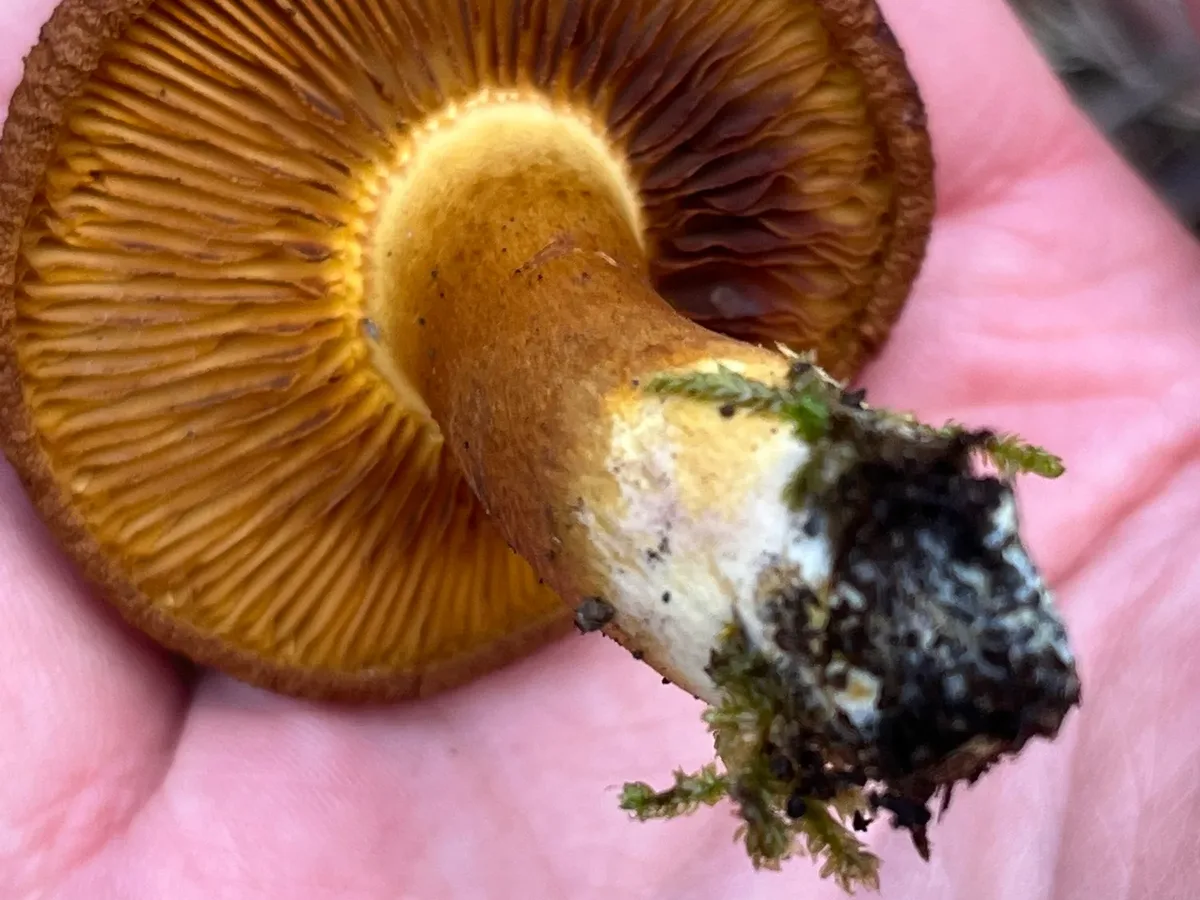 © Tony KM (CC BY)
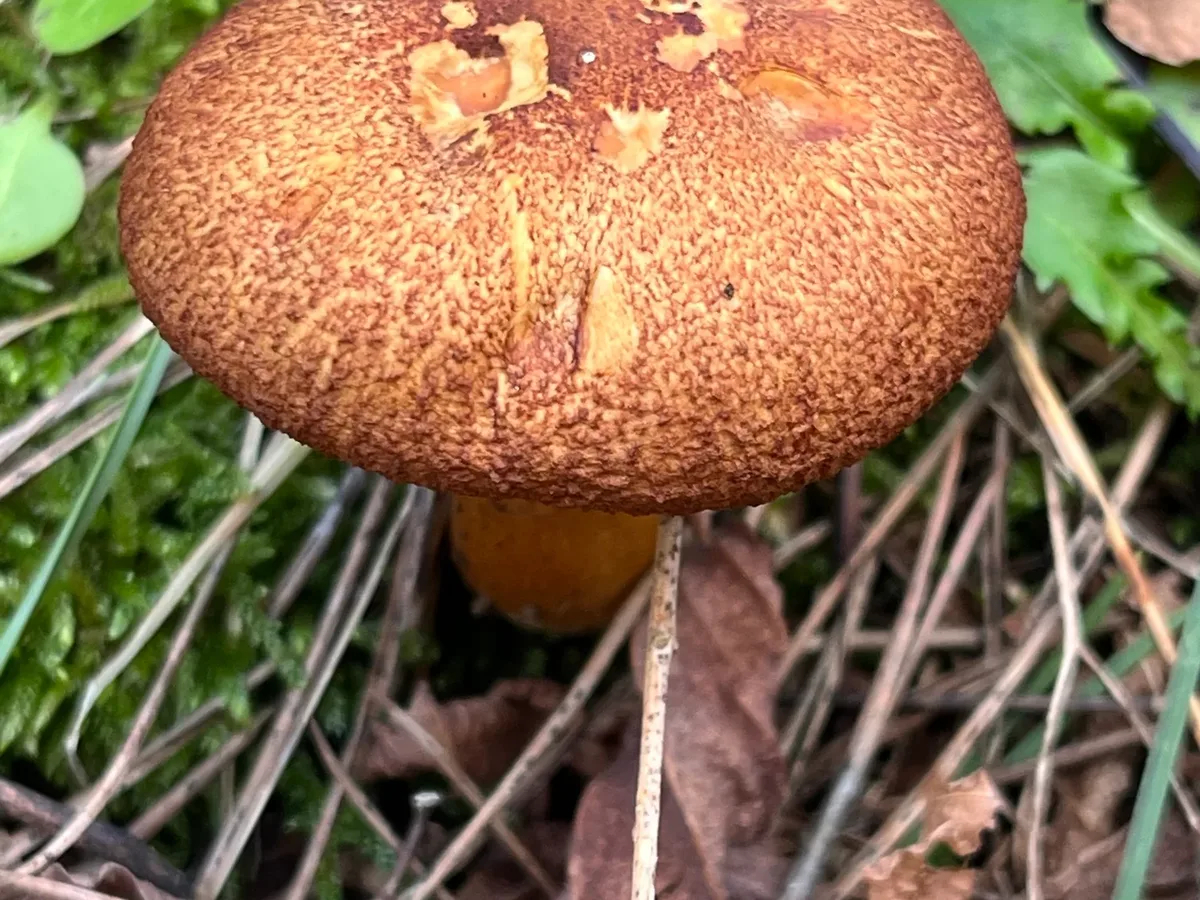 © Tony KM (CC BY)
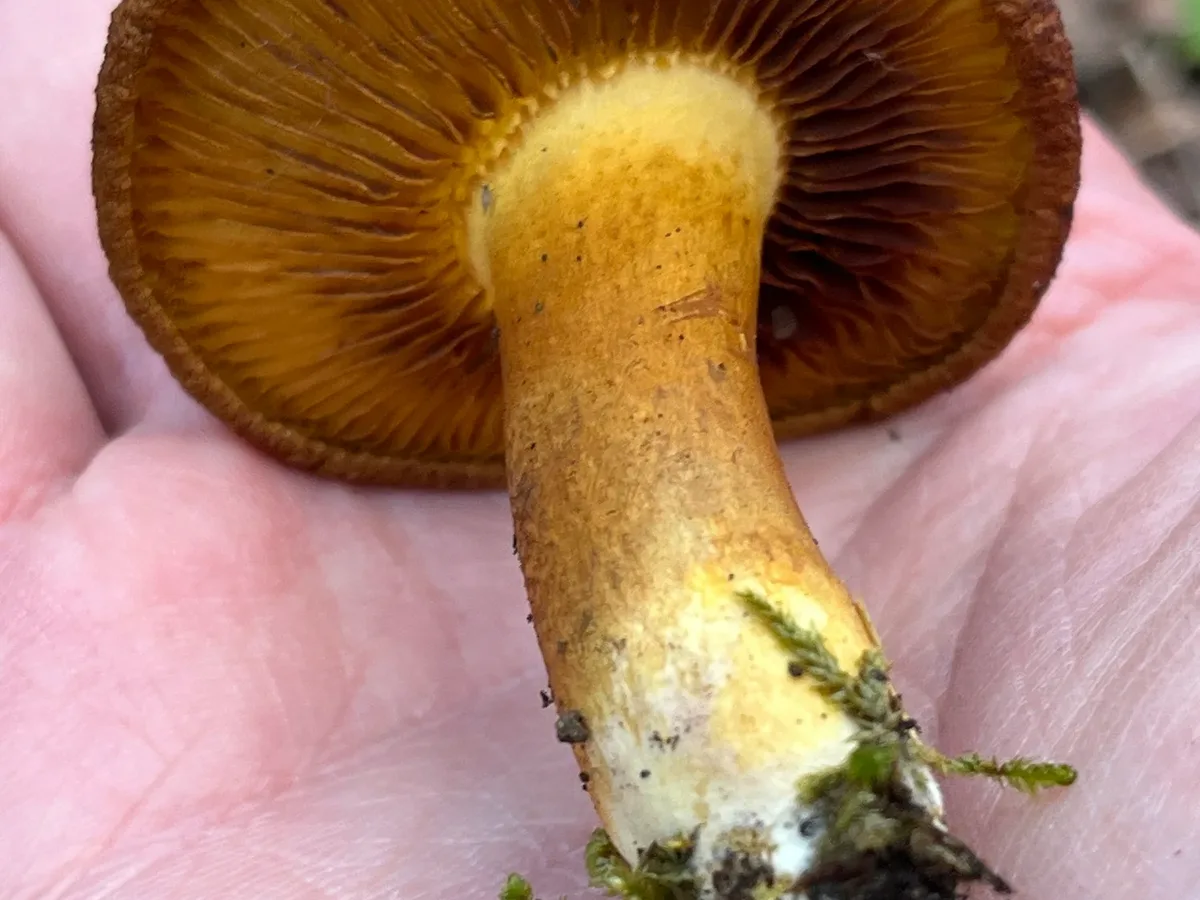 © Tony KM (CC BY)
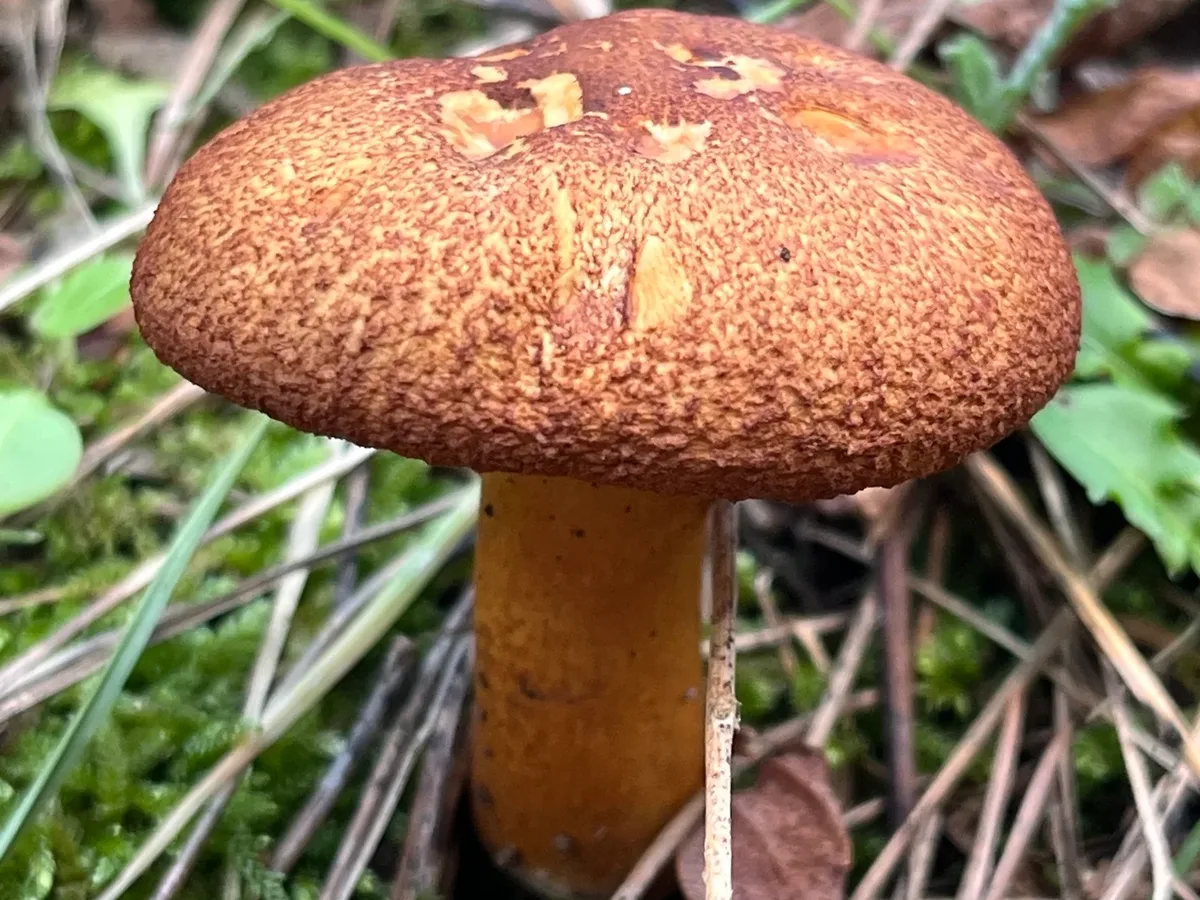 © Tony KM (CC BY)
 © Tony KM (CC BY)
 © Tony KM (CC BY)© Justin Paulin (CC BY)© Tony KM (CC BY)
Not poisonous, but not worth eating - too tough, bitter, or bland for the pot.
Never eat a mushroom you are not 100% sure of - check the look-alikes below, and always cook wild mushrooms.
How to recognise it
Few wood-inhabiting mushrooms catch the eye as quickly as Tricholomopsis rutilans.
Cap
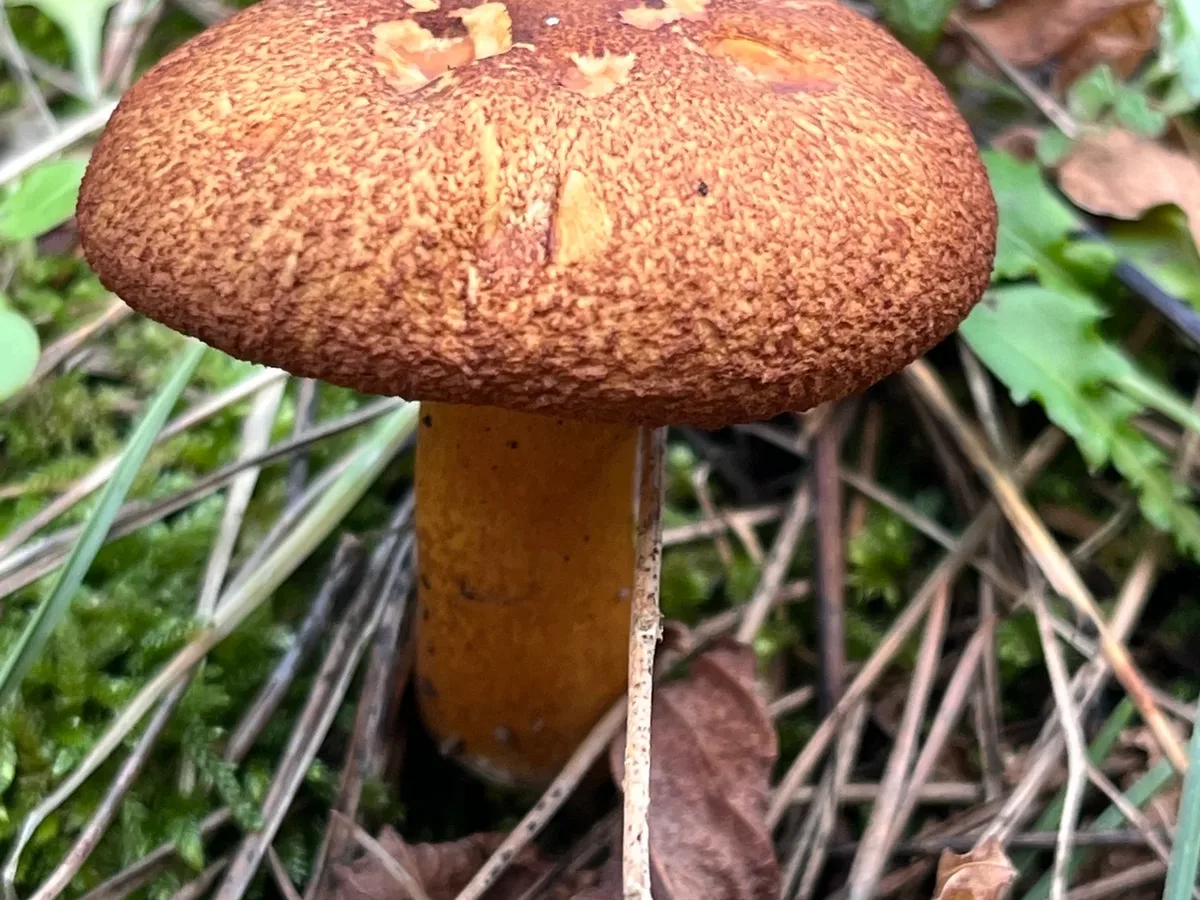
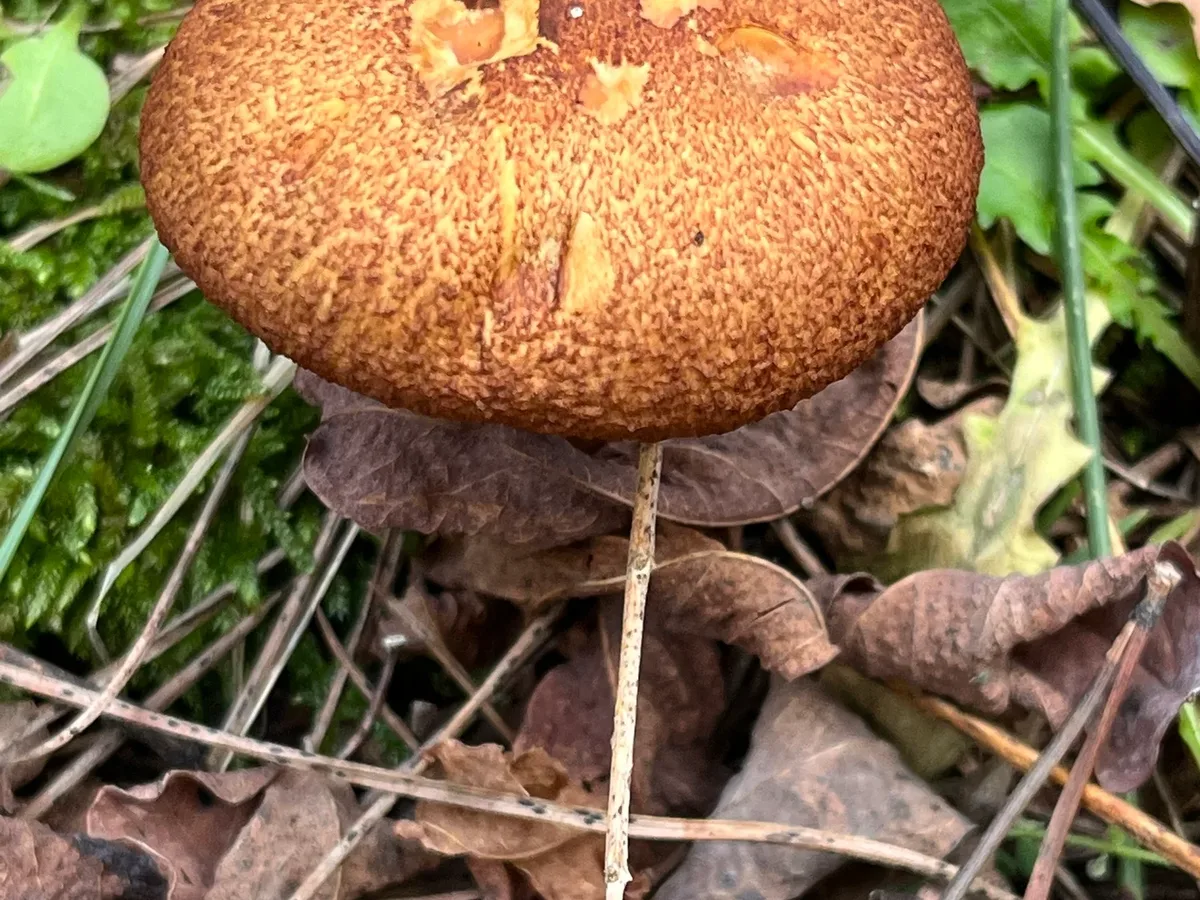
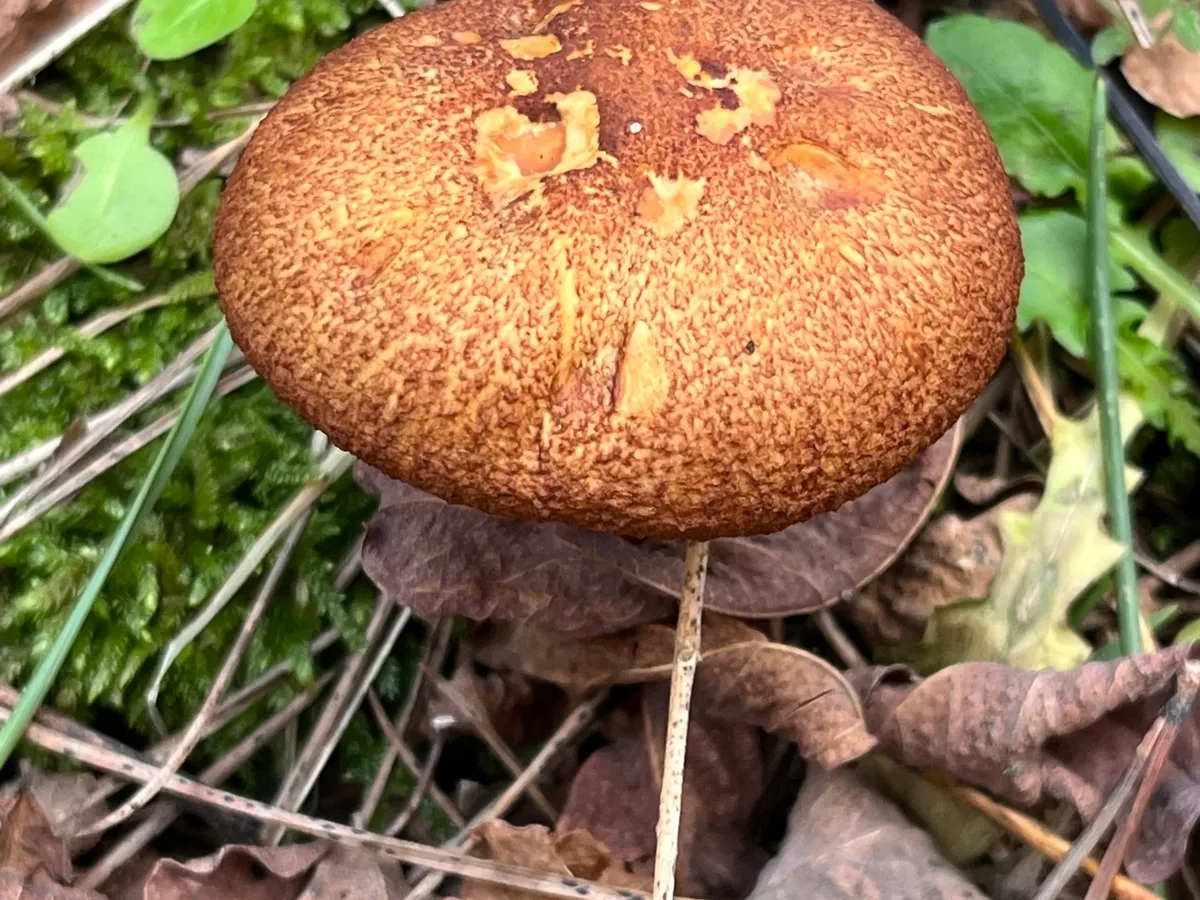
The cap is 4-12 cm across, convex to broadly umbonate, occasionally with a slight central boss. Its ground colour is a vivid egg-yolk to canary yellow, but this is almost completely masked at the disc by a dense covering of fine, hair-like purplish-red to wine-crimson scales.
The scales thin progressively toward the margin so that the yellow background increasingly dominates, creating a gradient from deep plum-purple at the centre to pale custard-yellow at the rim - which is exactly why English speakers call it 'Plums and custard'.
In older specimens the scales may become somewhat matted or partly eroded, but fresh material retains this bold contrast. The margin is incurved and slightly striate in youth, later expanding to irregular.
Gills
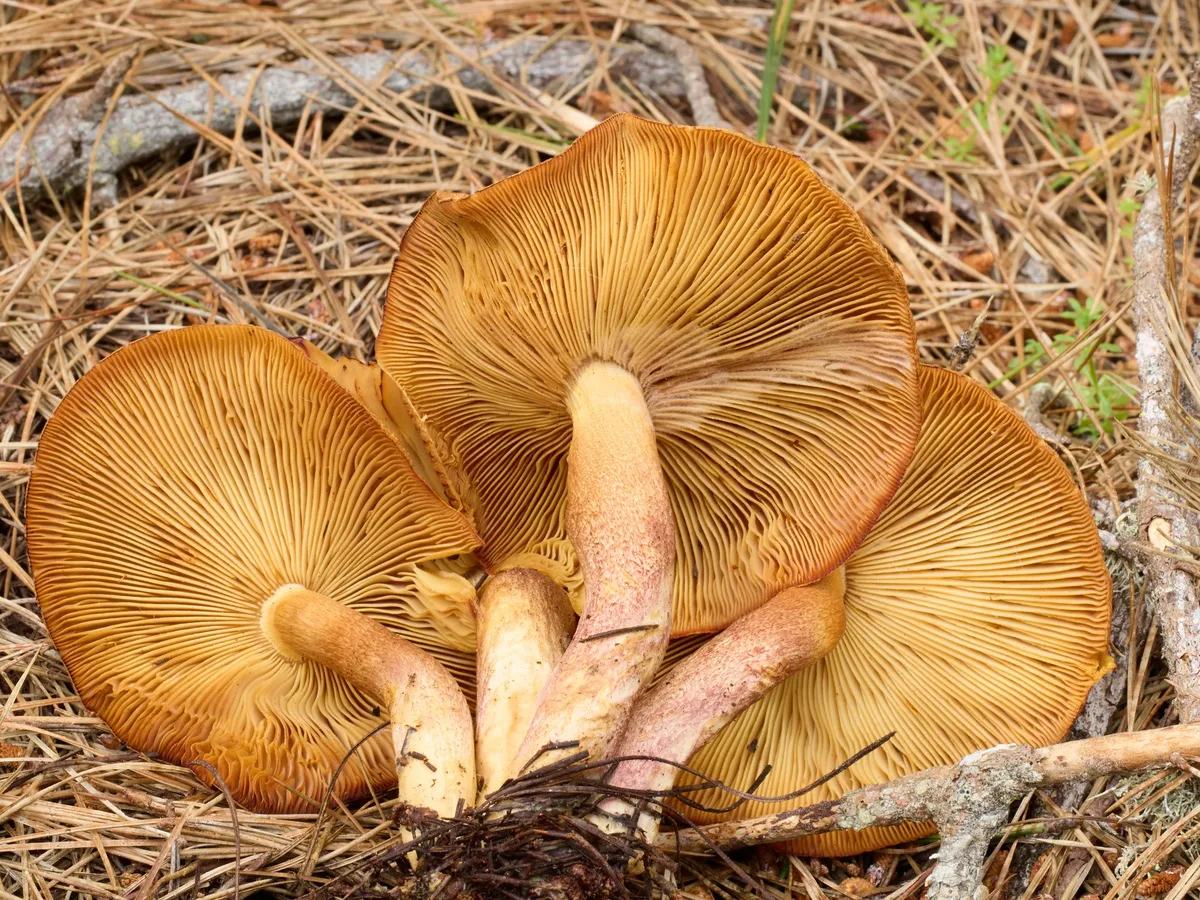
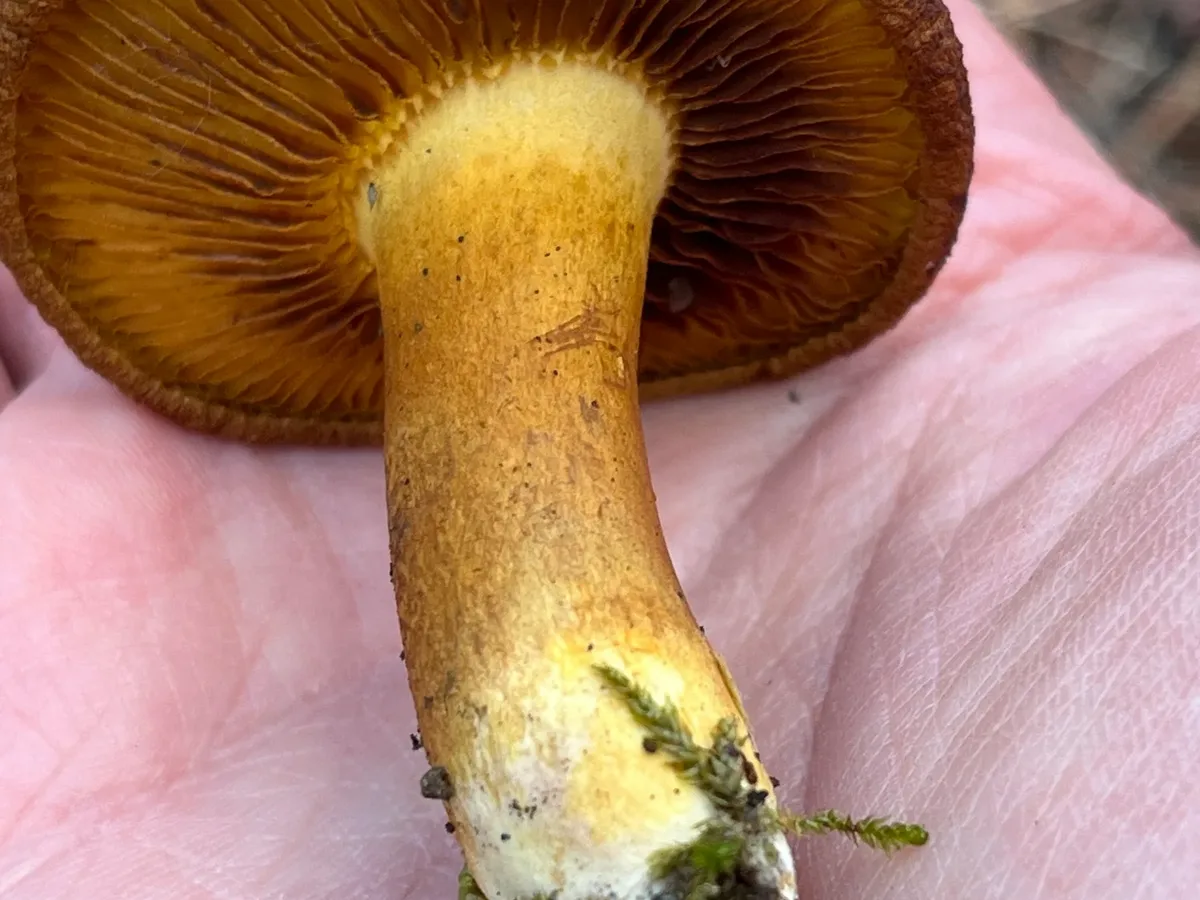
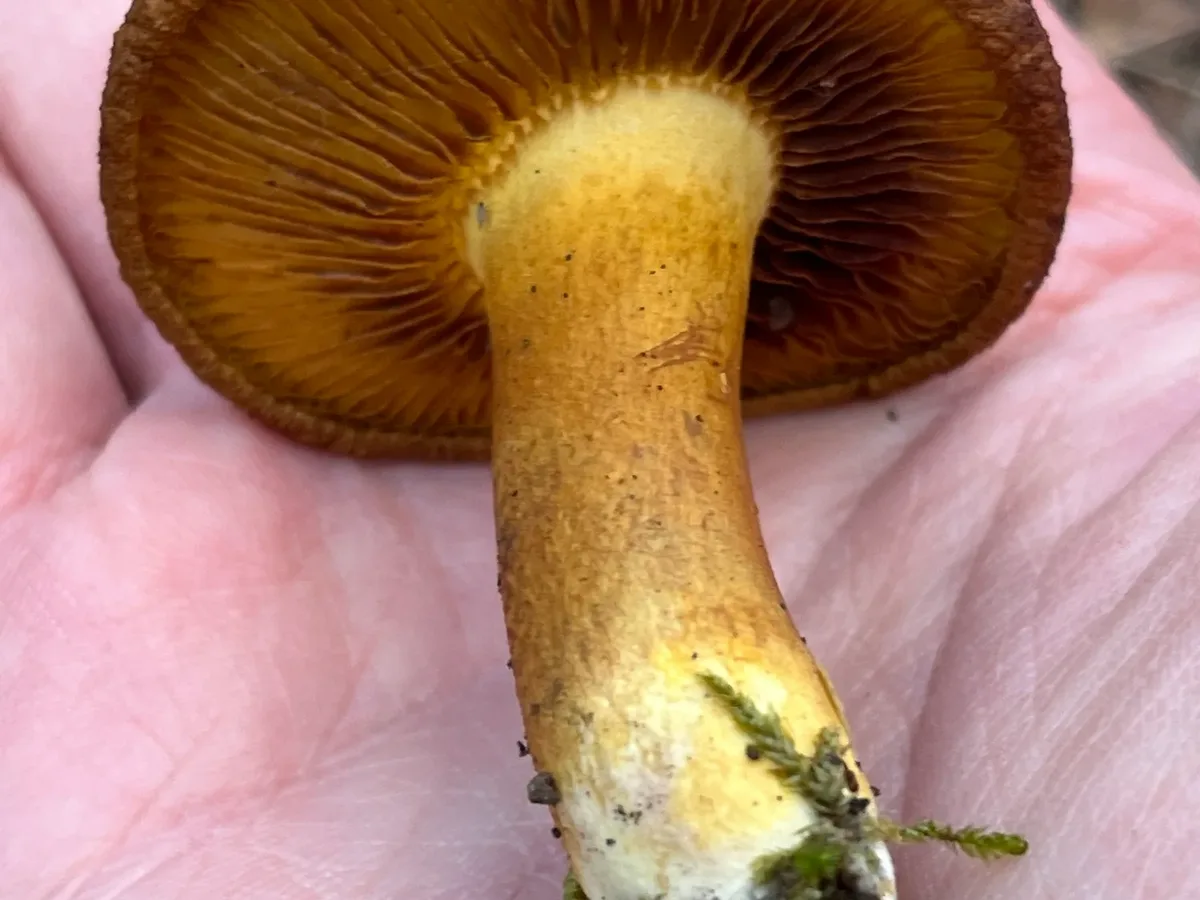
Gills are crowded, sinuate to broadly adnexed, and uniformly bright sulphur- to lemon-yellow - an important feature - not whitish, not reddening. Gill edges are minutely fringed.
Stem
The stem is 4-10 cm tall, 1-2 cm thick, solid throughout, pale to bright yellow, and decorated with fine purplish scales that are especially dense toward the base; the apex is paler and nearly smooth.
Flesh
Flesh is firm and yellow throughout (including at the base of the stem), unchanging on exposure; it does not bruise or discolour.
Smell & taste
The odour is distinctly unpleasant - rancid to acidic, often compared to stale cooking oil or rotten wood - and the taste is bitter and acrid.
Spore print white. Spores are broadly ellipsoid, smooth, 5-7 × 3.5-5 µm, inamyloid.
Where & when it grows
Habitat
Exclusively saprotrophic on conifer wood. Tricholomopsis rutilans grows directly on decaying stumps, fallen logs, partially buried roots, or at the base of dying conifers - overwhelmingly pine and spruce. It does not form mycorrhizas.
It is a consistent indicator of mature or old-growth conifer woodland and is common in managed pine and spruce plantations wherever old stumps and logging debris remain.
In Scandinavia it is particularly abundant in Scots pine (Pinus sylvestris) forest, often appearing on the mossy stumps of trees felled many years previously. It grows singly or in loose clusters of two to five fruiting bodies.
Old-growth mixed forests with embedded conifer logs also host it, and it ranges from coastal lowlands to subalpine elevations in mountain regions of central Europe.
When
Fruiting runs from July through November across the temperate Northern Hemisphere range. The main flush occurs in early to mid-autumn - typically September and October in central Europe and Scandinavia - coinciding with the classic autumn mushroom season.
In warmer or wetter summers an early flush can appear in July or August. Mild autumns extend fruiting to the end of November. Spring records are absent.
How it grows
Tricholomopsis rutilans is a white-rot saprotroph - it earns its living by breaking down the structural lignin and cellulose locked inside dead conifer wood.
Its mycelium threads invisibly through old stumps and fallen logs for months or years before fruiting bodies push out, often appearing singly or in small loose clusters directly from the decaying wood. There is no soil-living mycorrhizal partnership here; the fungus is fully self-sufficient as a decomposer.
That role is quietly important: the white rot it produces in old pine and spruce stumps helps unlock nutrients that would otherwise stay bound in dead wood for decades.
Fruiting conditions
Fruiting is driven more by wood moisture content and air temperature than soil temperature directly; adequate autumn rainfall and cooling temperatures below 18 °C trigger the main flush. The fungus persists in the deadwood substrate independently of soil moisture and can fruit from stumps elevated above the ground.
Handle with care
Toxin
No specific toxins formally characterised. The rancid odour is associated with volatile fatty acid degradation products in the flesh. Gastrointestinal irritants are likely present but have not been identified.
Symptoms
Gastrointestinal distress (nausea, vomiting, diarrhoea) has been reported following consumption; onset is typically within a few hours. Not life-threatening, but ingestion should be avoided.
Look-alikes
The combination of bright yellow gills, purplish-red scales on a yellow cap, and growth on conifer wood is essentially unique, making confident identification straightforward.
The most likely confusion is with Tricholomopsis decora (Decorated mop), which grows on the same substrate but has yellow rather than purplish scales and a yellower overall appearance. T. decora also has an unpleasant odour and is inedible.
Other superficial resemblances are easily separated:
- Tricholoma species are terrestrial, form mycorrhizal associations, and never grow directly from wood.
- Pholiota species growing on wood typically have brown spores and a ring on the stem.
- Hypholoma species on wood have dark purplish-brown spores and lack the characteristic scale colouration.
The yellow gills immediately exclude any potential confusion with dangerous wood-inhabiting species such as Galerina marginata (which has brown spores and a ring). Although direct visual confusion with Galerina is very unlikely given T. rutilans's distinctive appearance, always confirm the substrate (wood, not soil), the yellow gill colour, and take a white spore print before handling any unfamiliar wood-inhabiting mushroom.
Why it matters
Not deadly, but should not be eaten.
The greatest danger in the vicinity of this species is confusing other small brown wood-rotting fungi - particularly Galerina marginata - with edible species. T. rutilans itself is too distinctive to be dangerous, but its habitat (old conifer stumps and logs) is shared with the amatoxin-containing Galerina marginata.
Always identify all mushrooms collected from woody substrates carefully.
DEADLY - contains amatoxins (same as Death Cap). Galerina marginata is small (cap 1-4 cm), honey-brown, with a membranous ring, rusty-brown spore print, and grows on wood. It bears absolutely no visual resemblance to T. rutilans: it lacks yellow gills, yellow flesh, and the vivid purple-red scales on a yellow cap. Visual confusion is very unlikely, but Galerina shares the same conifer stump habitat and must be recognised by every forager working on woody substrates. Always take a spore print - Galerina gives rusty-brown, T. rutilans gives white.
T. decora has yellow (not purplish-red) fibrous scales on a yellow cap, giving a uniformly golden appearance rather than the two-tone purple-and-yellow contrast of T. rutilans. Both grow on dead conifer wood and both are inedible.
Wood-inhabiting Pholiota species have brownish scales on a brownish-yellow cap, a membranous ring on the stem, a garlicky or rubbery odour, and a rusty-brown spore print. None share the vivid yellow cap with purple-red scales.
Hypholoma fasciculare grows in dense tufts on wood and has a yellowish cap, but its gills start yellow-green and become purple-grey as spores mature; spore print is dark purplish-brown, never white. The cap lacks the distinctive purplish-red scales. H. fasciculare is poisonous, causing gastric illness.
In the kitchen
Picking & cleaning
Tricholomopsis rutilans is not collected for food due to its unpleasant rancid odour and bitter taste; it is widely regarded as inedible. No toxins have been formally characterised, but the disagreeable flavour survives cooking and reports of gastric upset following consumption exist.
Leave it in place - it is a beautiful and ecologically valuable decomposer and makes a worthwhile photographic subject.
If collected for study:
- note the substrate (dead conifer wood)
- note whether flesh discolours
- take a spore print
Cooking
Not applicable - this species is inedible and should not be consumed. Its unpleasant rancid odour and bitter taste are not eliminated by cooking.
Good to know
Tricholomopsis rutilans is considered inedible due to its strong, rancid, disagreeable odour and persistently bitter taste. Formal toxicological analysis is limited, but the species should not be eaten. Gastrointestinal distress has been reported after ingestion.
The distinctive appearance and habitat on conifer wood make dangerous misidentification unlikely in practice. Even so, always confirm:
- the substrate (dead conifer wood, not soil)
- the vivid purple-red scales on a yellow cap
- the bright yellow gills
The deadly Galerina marginata grows on similar substrates but is entirely different from T. rutilans. It is small, brown, lacks purple-red scales and yellow gills, has a ring on the stem, and bears a rusty-brown (not white) spore print.
A reference guide - never an edibility guarantee. When in doubt, leave it out.