Burnt Knight
Tricholoma ustalesyn. Agaricus ustalis Fr., Gyrophila ustalis (Fr.) Quél., Tricholoma ustale var. ustale
 © Bente Rian (CC BY)
 © Kurt Hatlevik (CC BY)
 © Bjørn Eidhammer (CC BY)
 © Bjørn Eidhammer (CC BY)
 © Per Marstad (CC BY)
 © Michel Langeveld (CC BY)
 © Michel Langeveld (CC BY)© Bente Rian (CC BY)© Kurt Hatlevik (CC BY)
Edible only with the right preparation - or safe for some people but not others. Learn the caveats first.
Never eat a mushroom you are not 100% sure of - check the look-alikes below, and always cook wild mushrooms.
How to recognise it
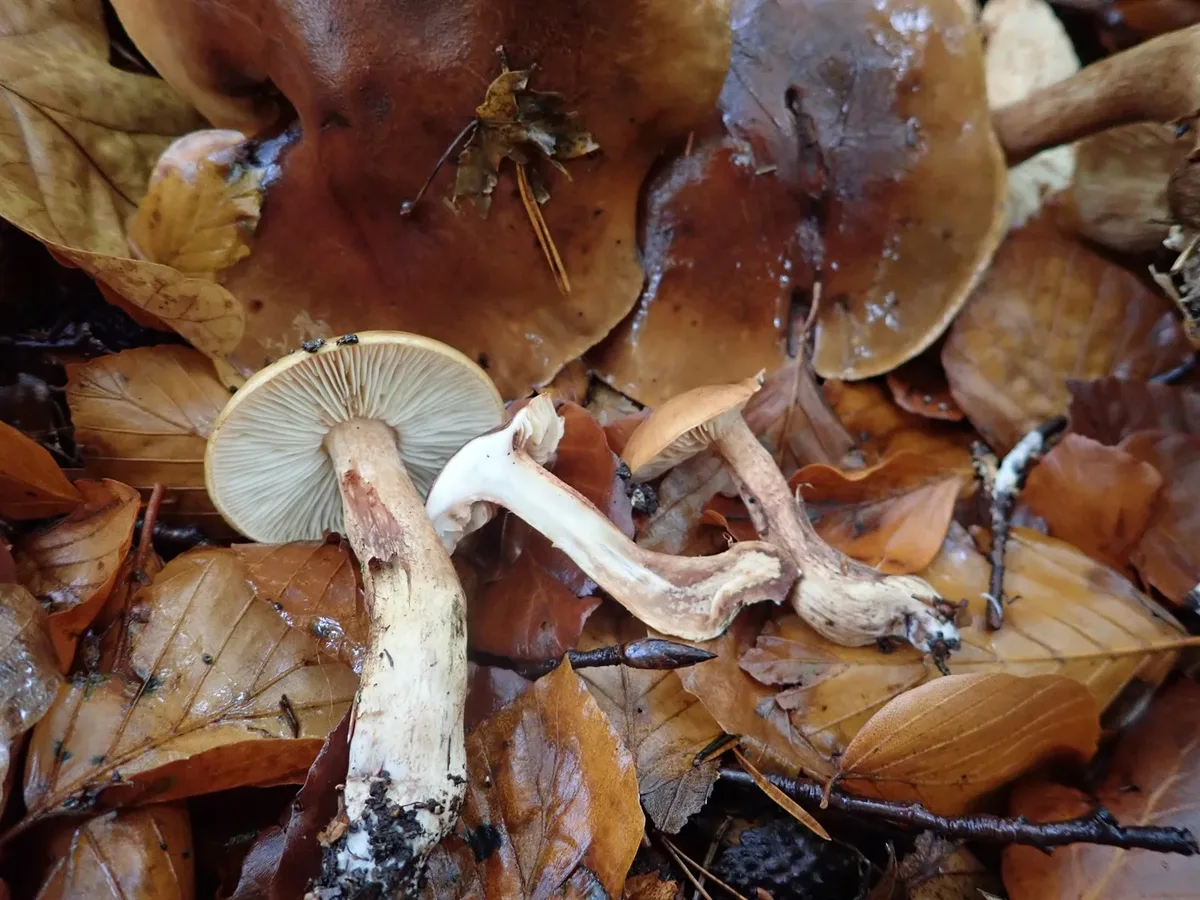
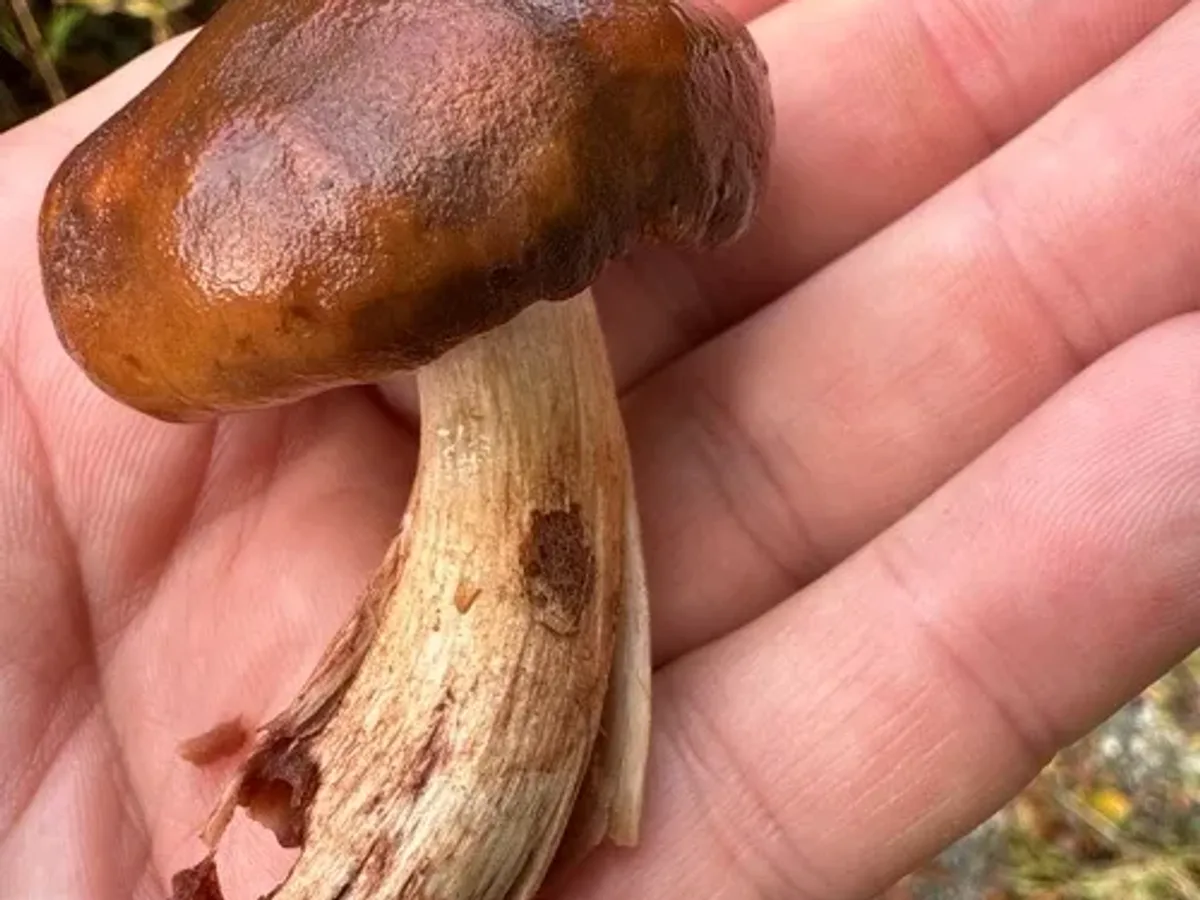
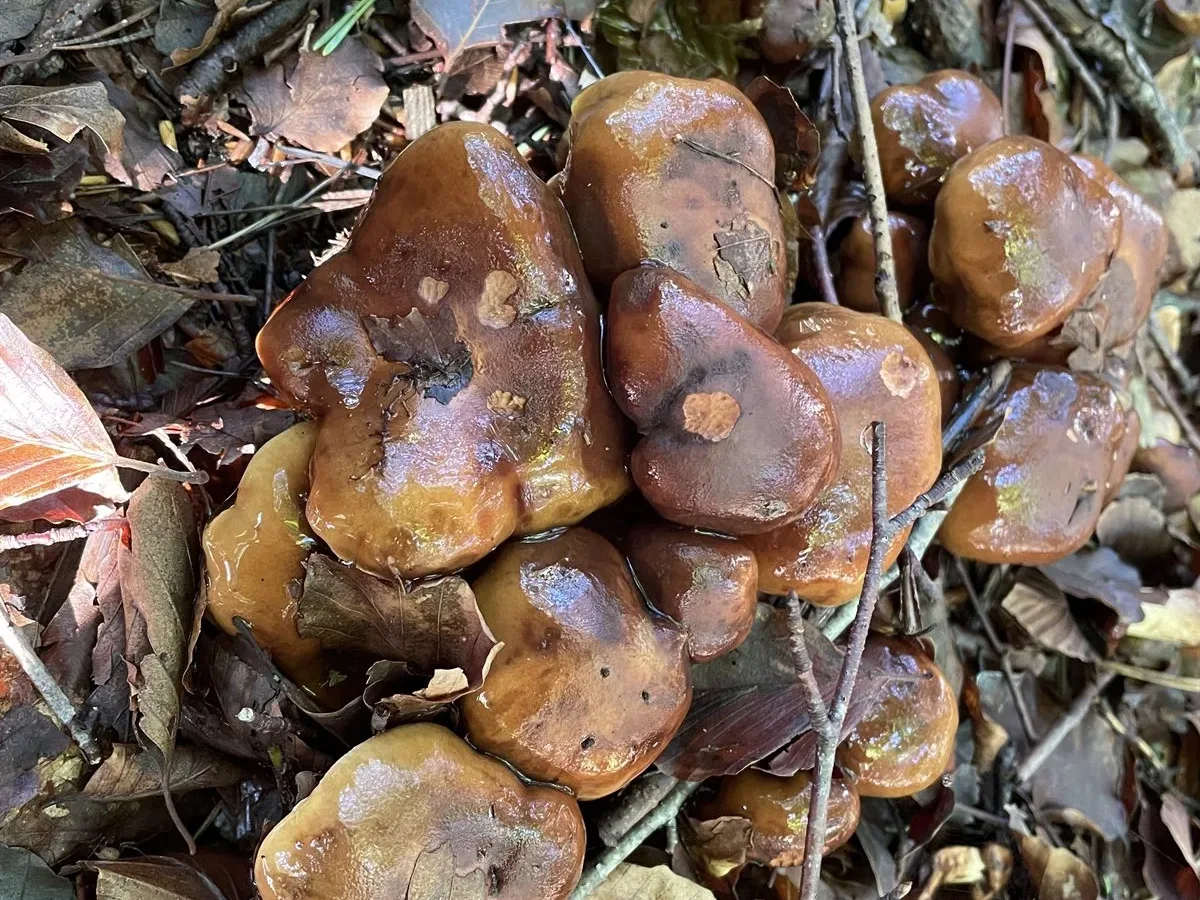
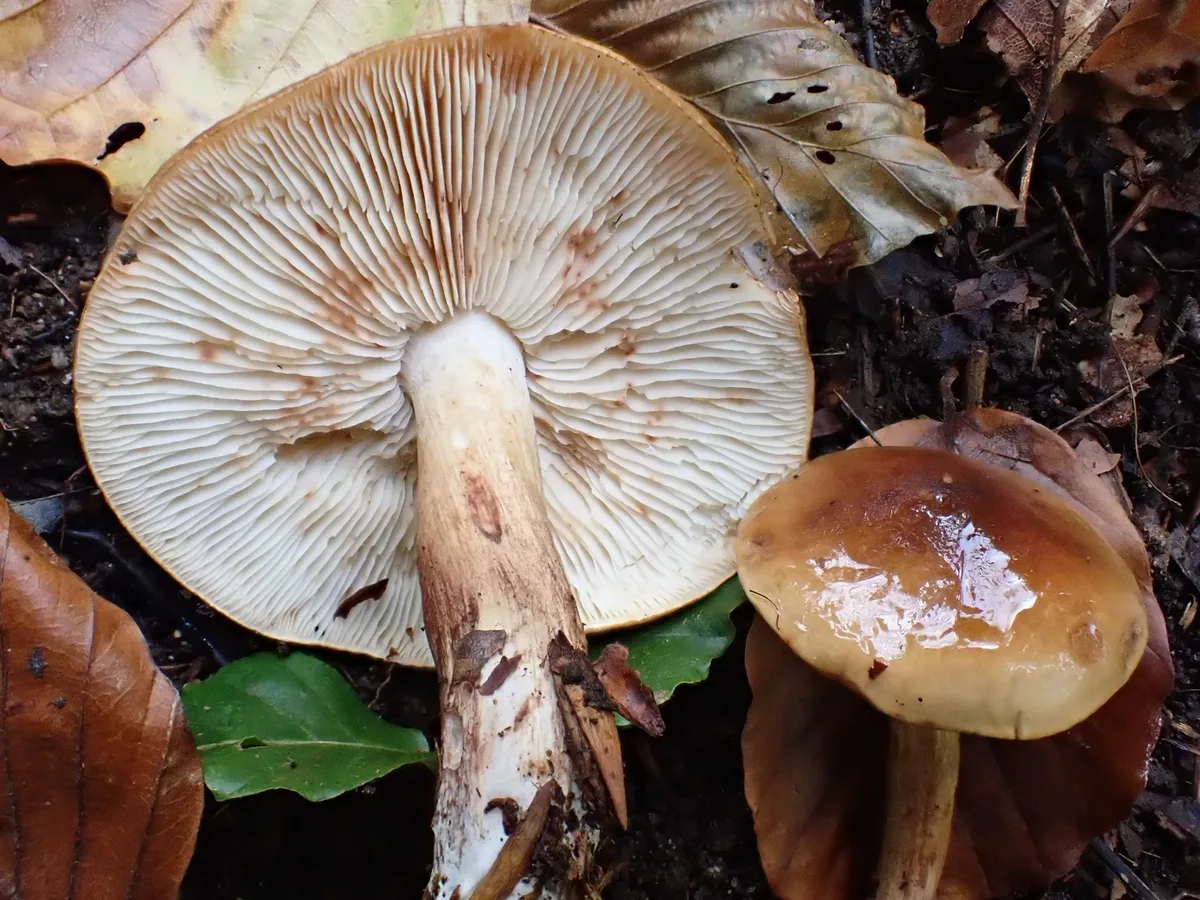
The Burnt Knight is a handsome, robustly built Tricholoma with one character that sets it apart within the genus at a glance: its cap is genuinely slimy or viscid when wet, glistening like polished leather after rain - an unusual trait in a group where most species have dry, fibrillose caps.
Cap
The cap (4-10 cm) opens from a convex to a broadly umbonate dome, retaining an inrolled margin for a long time.
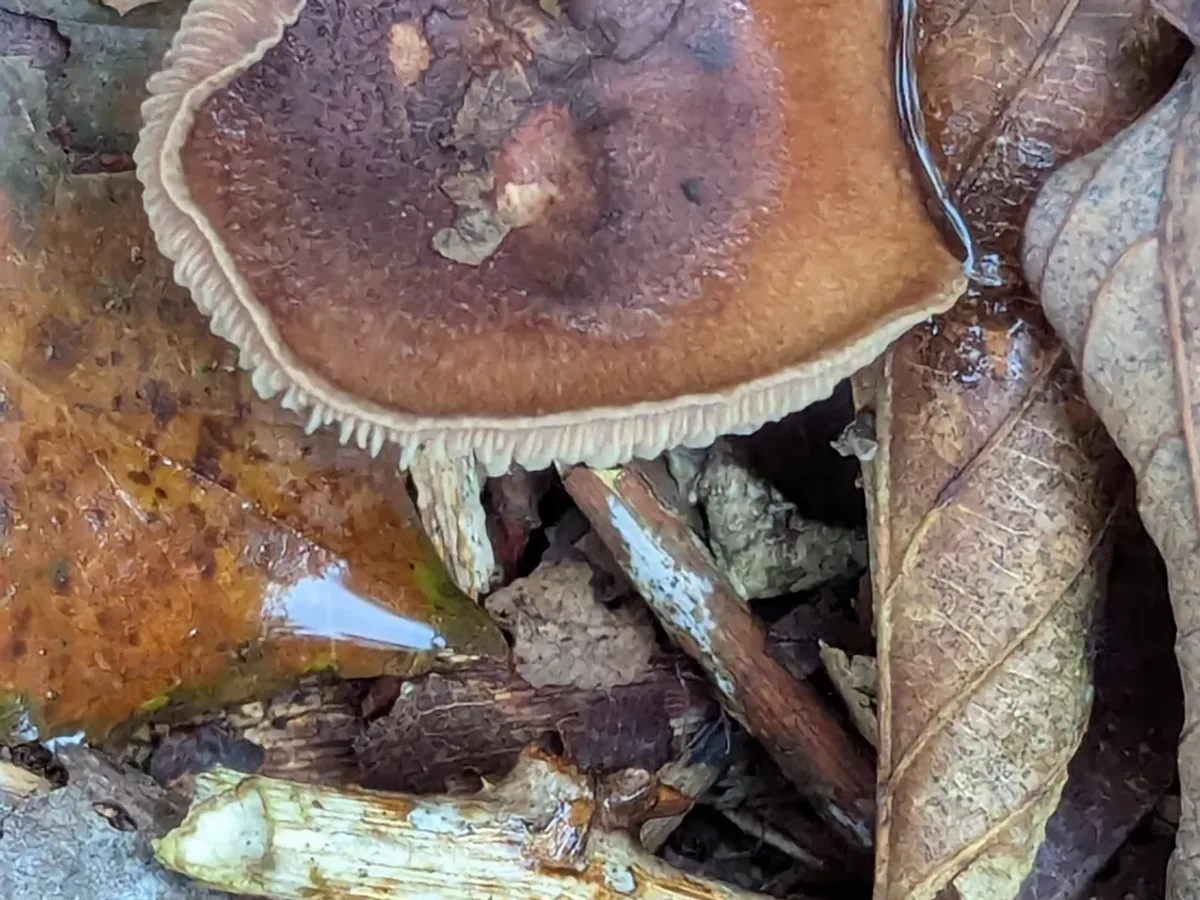
The colour is chestnut-brown to orange-brown, darker at the centre (a rich burnt-russet shade that the common name acknowledges), fading toward the pale margin.
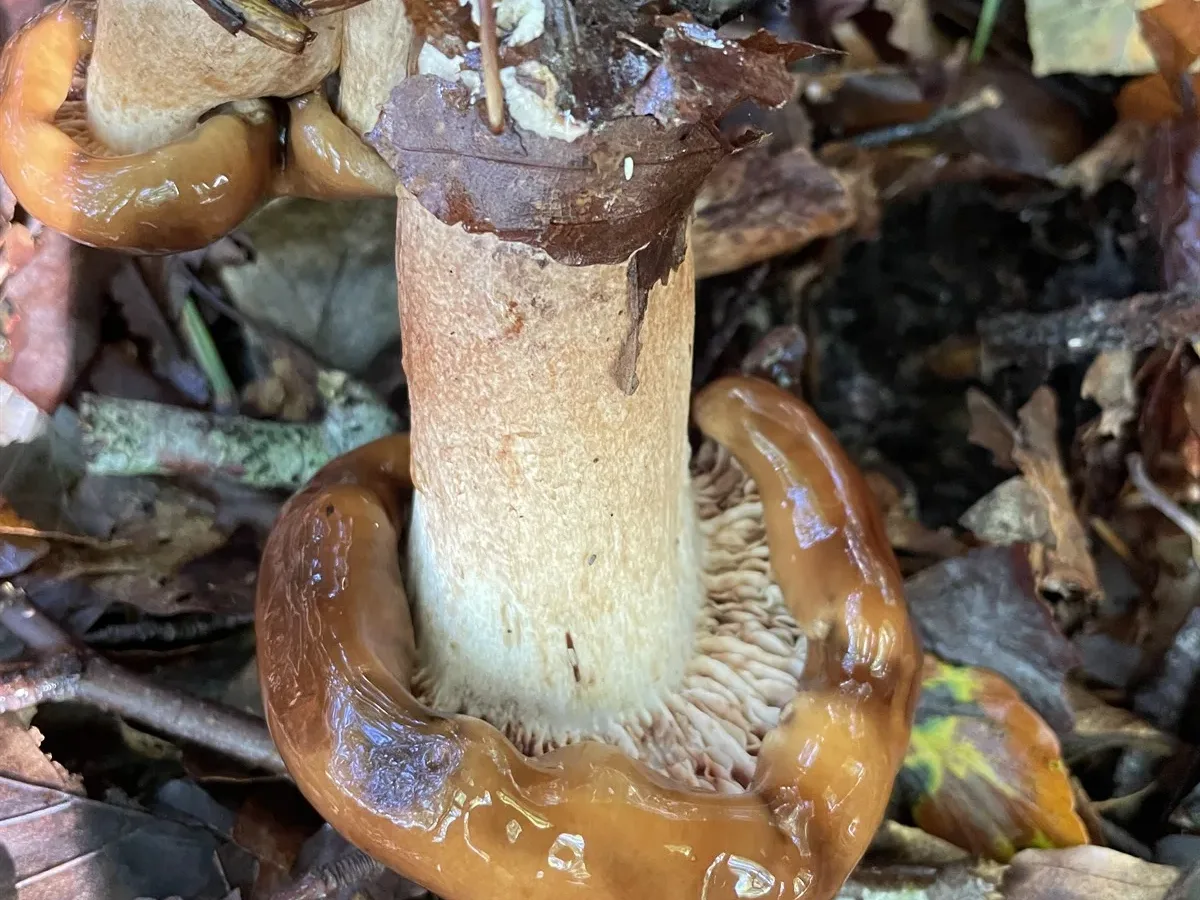
In dry weather the sliminess disappears and the surface becomes matt and slightly polished; in wet conditions the cap is unmistakably glutinous, the margin sometimes bordered by a faint pale line where slime has concentrated.
Gills
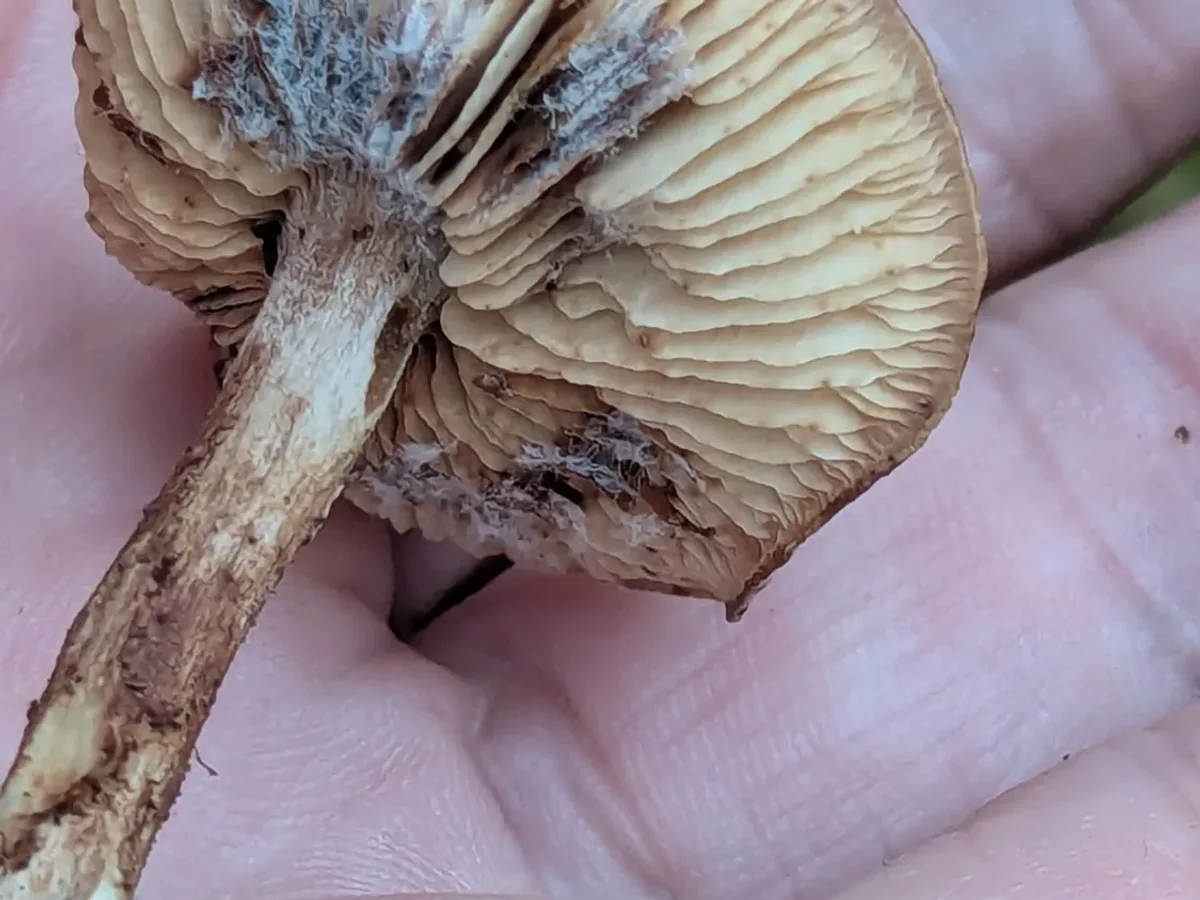
The gills are sinuate (they have the characteristic Tricholoma notch before meeting the stem), fairly crowded, and white when fresh.
Age brings a telling change: the gills develop rusty-brown or reddish-brown spots and patches - a staining reaction seen in a handful of Tricholoma species and useful for narrowing the field.
Stem
The stem is firm, solid, cylindrical, white above but often with a brownish flush and rusty-fibrillose scaling toward the base.
Flesh
The flesh is white throughout, firm, and does not change colour on exposure.
Smell & taste
Smell is faint, occasionally faintly floury; taste is bitter to bitter-acrid, developing within seconds and lasting long after the piece is spat out. The spore print is white.
Why it's dangerous
Tricholoma ustale poses a moderate direct hazard through its GI irritant toxicity, most seriously affecting vulnerable individuals (children, elderly, those with gastrointestinal conditions).
In Japan it is one of the more frequently reported causes of mushroom poisoning and is treated as a species of genuine public health concern.
Paradoxically, its very commonness in beech forest and its superficially inviting appearance (a substantial, firm, apparently healthy woodland mushroom) increases the risk that pickers will collect it without proper identification.
The key protective measures are:
- 1Always apply the taste test - bitter means discard.
- 2Note cap viscidity in wet conditions (slimy-capped Tricholoma under beech should be viewed with suspicion unless confirmed as a known edible, and there are very few such species).
- 3Check for gill spotting in older specimens.
- 4Make a white spore print to exclude Cortinarius and other rusty-brown-spored species.
Anyone who develops gastrointestinal symptoms within hours of eating a wild mushroom collected in deciduous forest should seek medical attention and, if possible, bring a sample of what was eaten for identification.
Toxin
The toxic compounds in Tricholoma ustale have not been fully characterised in the published literature. The bitter taste is presumed to arise from phenolic or terpenoid compounds that act as irritants on the gastrointestinal mucosa.
In Japan, T. ustale is categorised as a GI-toxic species and is a well-recognised cause of poisoning in national mushroom poisoning statistics.
The onset of GI symptoms within 30 minutes to 3 hours of consumption is consistent with a local irritant mechanism rather than a systemic toxin requiring absorption and metabolic activation.
No specific named compound comparable to amatoxin, orellanin, or gyromitrin has been isolated and confirmed as the primary active principle.
Symptoms
Gastrointestinal poisoning with onset within 30 minutes to 3 hours of ingestion (sometimes up to 5-6 hours in cases involving large quantities or cooking).
Typical symptoms, lasting from a few hours to a full day:
- nausea
- profuse vomiting
- cramping abdominal pain
- diarrhoea
Weakness, sweating, and mild dizziness may accompany the acute phase.
Symptoms are generally self-limiting in healthy adults, but significant fluid loss through vomiting and diarrhoea can cause dehydration requiring medical management, particularly in children, the elderly, and those with pre-existing conditions.
There are no documented cases of liver failure, kidney failure, or death specifically and reliably attributed to correctly identified T. ustale alone.
If symptoms are severe, prolonged, or accompanied by neurological signs (confusion, visual disturbance, excessive salivation), seek urgent medical care and report the mushroom consumed.
Staying safe
Tricholoma ustale is a poisonous species responsible for a significant number of mushroom poisoning cases in Japan, where it is one of the better-documented toxic Tricholoma species.
It causes gastrointestinal poisoning: nausea, vomiting, abdominal cramping, and diarrhoea typically beginning within 30 minutes to 3 hours of ingestion.
Poisoning is unpleasant and sometimes requires medical care for dehydration, particularly in children, the elderly, or those who have consumed substantial amounts, but it is not life-threatening in healthy adults under normal circumstances.
The risk of serious harm from correctly identified T. ustale is therefore relatively low - it is an irritant rather than an organotoxic or neurologically active species.
The real danger, as with all Tricholoma, is misidentification: brown-capped, viscid-capped, or beech-associated mushrooms that a picker could plausibly think were an edible species. In Japan this confusion has repeatedly led to group poisoning events involving T. ustale.
The taste test is the single most reliable safety screen: T. ustale is persistently, unmistakably bitter. No edible Tricholoma species worth collecting has a persistently bitter taste. If a mushroom from this habitat tastes bitter, do not eat it, regardless of what it looks like.
This guide classifies T. ustale as CAUTION with isPoisonous true. It is not edible under any circumstances and should not be cooked or consumed.
Where & when it grows
Habitat
Tricholoma ustale is a beech specialist at heart.
In Europe it is most commonly found under Fagus sylvatica, the European beech, in mature, shaded woodland on moist, humus-rich soils, often on calcareous or mildly neutral ground.
In Japan and Korea it associates with Fagus crenata and Fagus japonica, the native beech species of the Japanese archipelago, and is one of the most frequently encountered toxic Tricholoma species in those countries.
It also grows with oak and hornbeam where they intermix with beech, and occasionally in mixed deciduous-conifer stands where the deciduous component dominates the local soil chemistry.
Within the forest it tends to appear in the shadier, moister zones:
- under closed canopy on north-facing slopes
- in valley-bottom beech forest with deep humus
- on gentle slopes where moisture lingers after rain
It is gregarious by habit, fruiting in scattered groups, loose troops, or partial rings that may be generous in productive years.
It tends to reappear in the same patches annually, making a well-kept spot journal genuinely useful for this species.
When
Tricholoma ustale is an autumn species, fruiting from September through November with a distinct peak in October and early November.
This timing tracks the cooling and moistening of deciduous forest soils after summer drought and aligns it with the main flush of beech-associated fungi. In Japan the season mirrors this pattern closely.
The species is reasonably cold-tolerant and may persist into late November in mild, maritime-influenced regions.
Look for it after the first significant autumn rains once night temperatures have dropped, particularly in years with a warm September followed by wet early October.
How it grows
Like all Tricholoma species, T. ustale is an obligate mycorrhizal partner of its host trees - it cannot be cultivated and always grows in direct association with living beech (or oak/hornbeam) roots.
The underground mycelium is perennial and may persist for many years if the host trees are undisturbed.
Above ground, fruit bodies appear in flushes about one to two weeks after soaking autumn rain once soils have cooled to approximately 6-12°C.
Good years in beech-dominated valleys can produce very large troops of this species, which makes the identification challenge particularly important: abundance can create a false sense of familiarity and tempt pickers unfamiliar with its bitterness.
Fruiting conditions
Autumn-fruiting in deciduous and mixed beech-oak forest; flushes follow significant rainfall once soils have cooled below approximately 14°C. The beech-litter association means the best sites are shaded and moisture-retaining, with flushes appearing 1-2 weeks after sustained rain. Productive in years with warm September followed by wet early October.
Look-alikes
The brown-capped Tricholoma complex contains several species that can be confused with T. ustale, and confident identification requires attention to the full character suite.
The cap viscidity when wet is the most reliable single field mark for T. ustale: check by touching the cap surface after rain, or by looking for the glossy wetness of a genuinely slimy cap.
Tricholoma ustaloides (the Girdled Knight) is the closest and most confusing relative: it is similarly coloured (brown, often with a darker centre) and also grows under deciduous trees, but it differs in having a distinctly zonate (girdle-banded) pattern on the cap in many specimens - a faint paler zone or ring near the margin - a more typically dry to moist (not viscid) cap, and it can taste mildly mealy or bitter.
Both species are toxic and both have spotted gills with age. The distinction is important scientifically but does not change the safety outcome: both are inedible.
Tricholoma pessundatum (the Honey-scented Knight) is a slimy-capped species associated with conifers (pines) rather than beech. Its cap is similarly sticky and brown but with a stronger reddish-brown wash and larger size, and it grows strictly with conifers.
Its smell is described as floury to faintly mealy-sweet; it is also inedible and causes GI poisoning. The conifer habitat is the key separation from T. ustale.
Tricholoma imbricatum (the Mat Knight) has a similarly coloured, dry, finely scaly cap but is not viscid when wet - its surface is dry and fibrillose-scaly, not slimy. It grows with pines, not beech. It is regarded as mildly toxic or of uncertain edibility.
Tricholoma focale (the Booted Knight or Ringed Knight) is larger, robustly built, slimy-capped and reddish-brown but has a ring-like zone of scale remnants on the upper stem and grows with pines. An experienced eye separates it readily; a beginner may not.
Edible brown-capped species to consider: in East Asia, a number of brown-capped wood-growing species are traditionally eaten. The taste test (bitter = reject) is the simplest safety filter: none of the edible brown Tricholoma species have a persistent bitter taste.
In Europe, Cortinarius species can share the habitat and a brownish colour, but they have rusty-brown spore prints (not white), and many contain orellanin or other serious toxins - a white spore print firmly rules out Cortinarius.
In Japan, T. ustale (kakishimeji) is one of the most frequent causes of mushroom poisoning, sometimes confused with edible species such as Lyophyllum shimeji complex mushrooms (hon-shimeji type) by inexperienced pickers.
The confusion arises from superficial resemblance in body form and the gregarious growth habit, but L. shimeji relatives have more crowded, white, non-spotting gills and are typically found in different associations. Always apply the taste test.
Several brown-capped Cortinarius species share the deciduous-forest habitat and superficially resemble a brown Tricholoma. Cortinarius species have a rusty-brown (not white) spore print and rusty-brown maturing gills, often remnants of a cobwebby cortina veil on the stem. Some Cortinarius contain orellanin, a nephrotoxin causing potentially fatal kidney failure. A white spore print firmly excludes Cortinarius. Always take a spore print.
Larger and more robustly built, with a viscid reddish-brown cap and a ring-like cortinate zone of scales on the upper stem that resembles a partial ring. Grows strictly with conifers (pines). The pine habitat and stem armature separate it from T. ustale.
The closest relative and the most frequent confusion. Also brown-capped, also grows under deciduous trees, also has spotted gills with age and a bitter taste. The cap in T. ustaloides is often - though not always - marked by a faint paler girdle or zone near the margin (hence 'Girdled') and tends to be dry to moist rather than distinctly viscid. Both are toxic; the distinction matters for taxonomy but not for the safety outcome. If bitter and brown under beech, discard regardless.
Also a viscid-capped, reddish-brown Tricholoma, but strictly associated with conifers (pines), not beech. Typically has a more strongly reddish-brown cap with a mealy-sweet smell and larger fruiting bodies. The habitat difference (pine vs. beech) is the clearest field separator. Also GI-toxic; not edible.
Similar reddish-brown colour but the cap is dry and fibrillose-scaly (not slimy when wet), and it grows with conifers, particularly pines. Cap surface texture is the immediate distinguishing feature.
A reference guide - never an edibility guarantee. When in doubt, leave it out.