Grey Knight
Tricholoma terreumsyn. Agaricus terreus, Tricholoma myomyces, Tricholoma bisporigerum, Gyrophila terrea
 © Manuela Fiorini (CC BY)
 © Manuela Fiorini (CC BY)
 © Manuela Fiorini (CC BY)
 © Manuela Fiorini (CC BY)
 © Manuela Fiorini (CC BY)
 © Damon H (CC BY)
 © Damon H (CC BY)
 © Damon H (CC BY)
 © Manuela Fiorini (CC BY)© Manuela Fiorini (CC BY)© Manuela Fiorini (CC BY)
Edible only with the right preparation - or safe for some people but not others. Learn the caveats first.
Never eat a mushroom you are not 100% sure of - check the look-alikes below, and always cook wild mushrooms.
How to recognise it
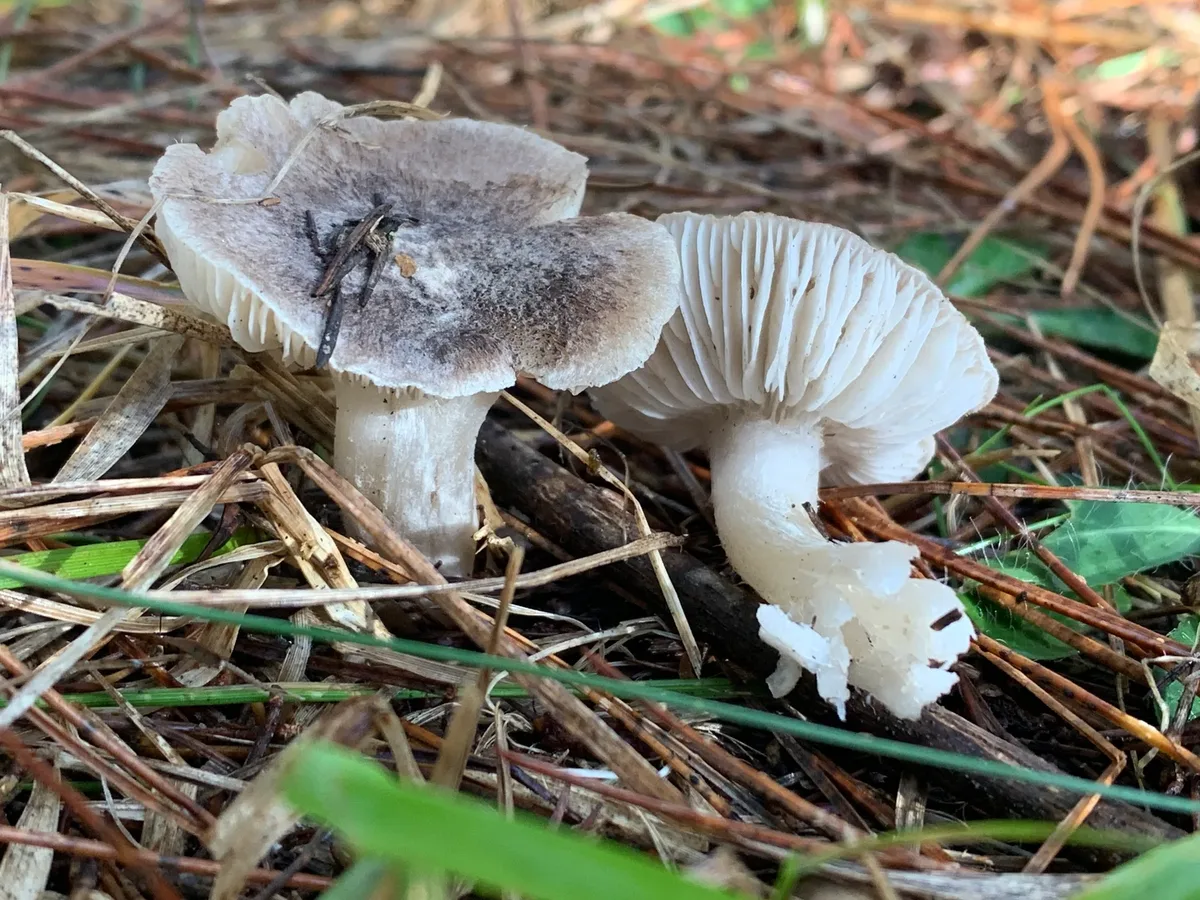
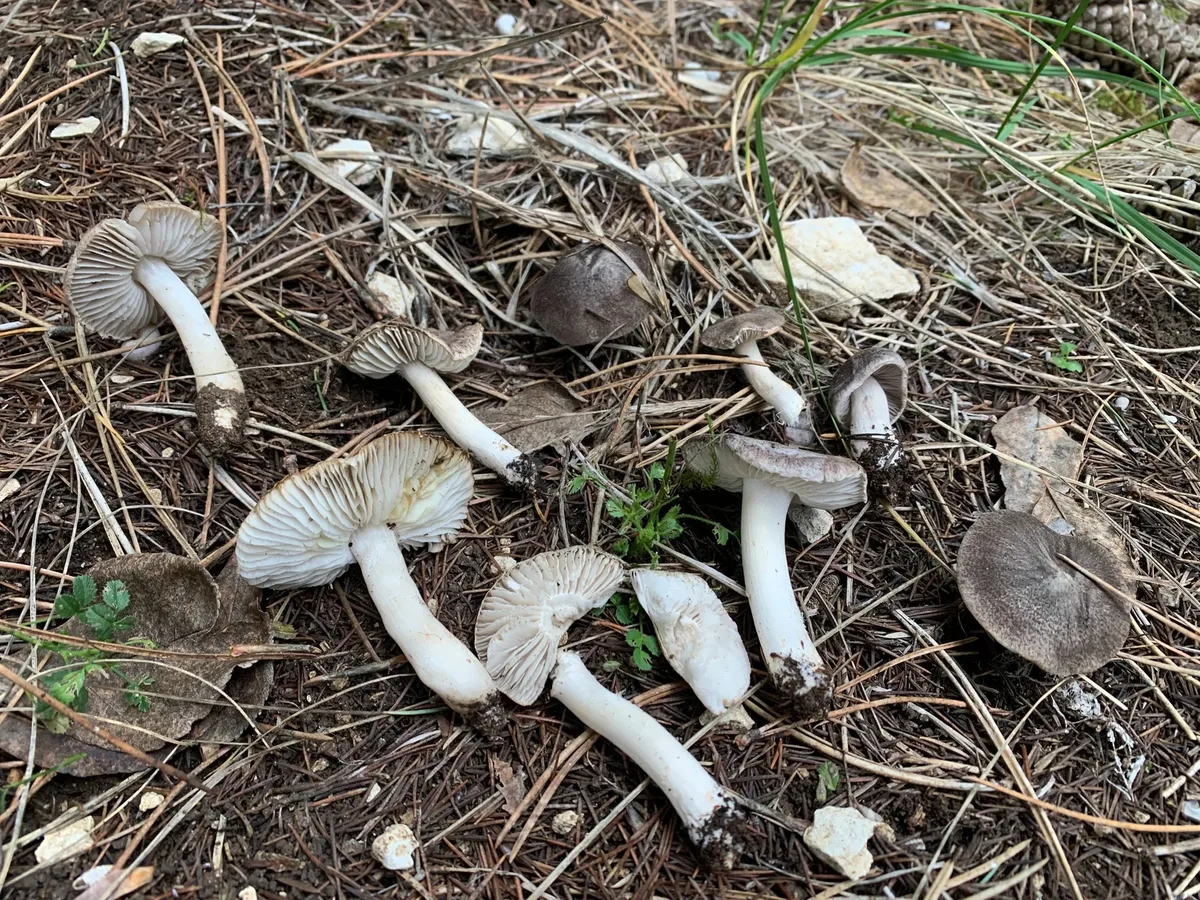
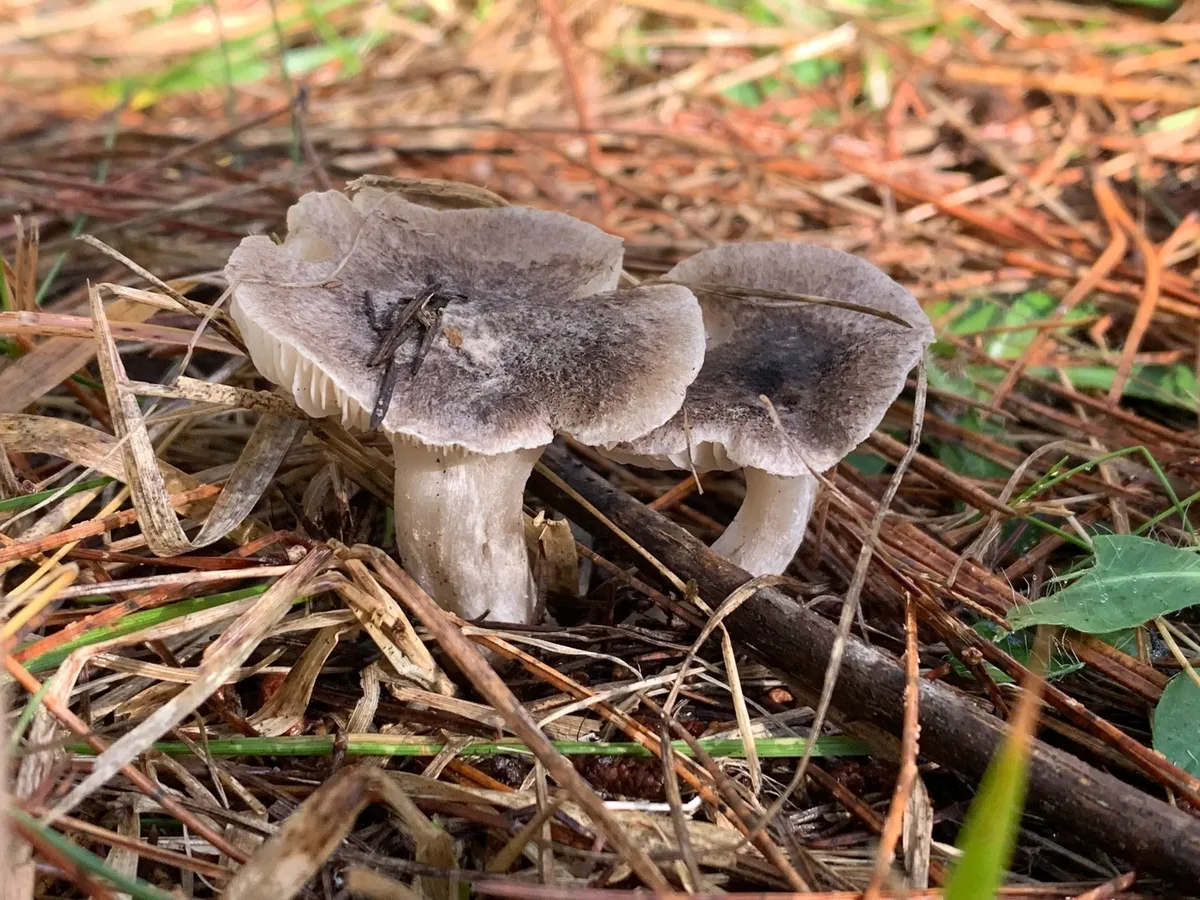
The Grey Knight is a modest, soft-fleshed mushroom built on shades of grey.
Cap
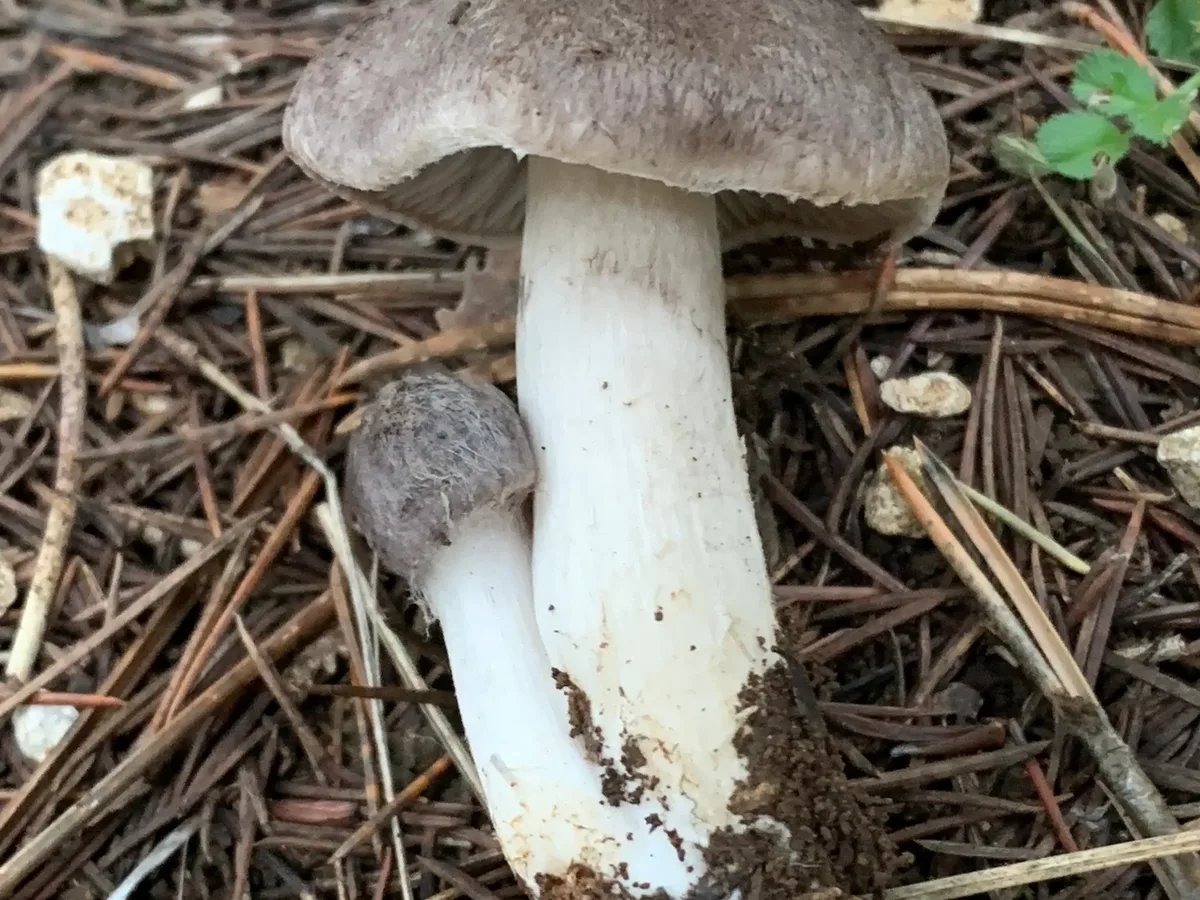
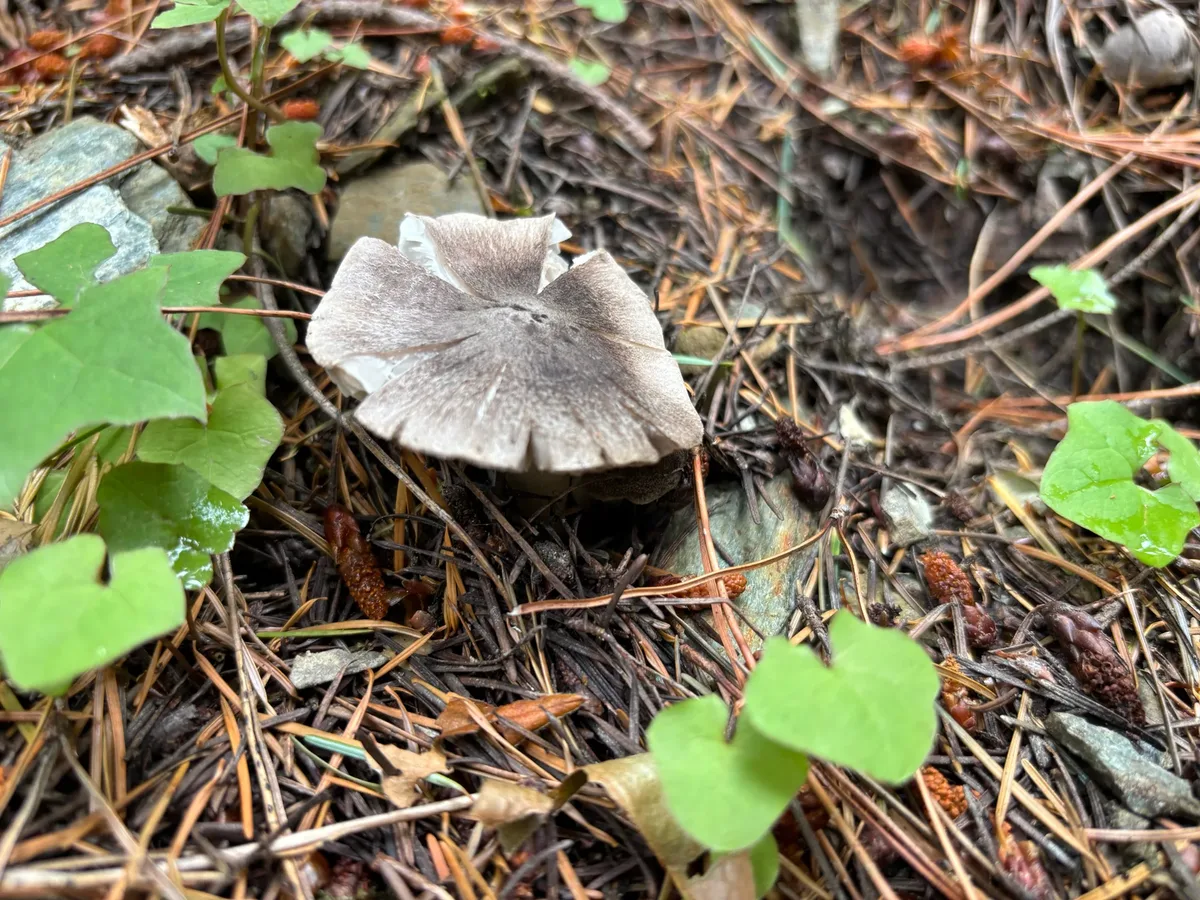
The cap (3-8 cm, occasionally to 10 cm) starts conical or bell-shaped and opens to a broad, often umbonate dome.
Its defining surface character is a dry, dull mouse-grey to grey-brown skin covered in fine radial fibrils that give a felted, slightly streaky or finely tomentose look. With age it may fracture into tiny appressed scales near the margin, but it is never coarsely or concentrically scaly.
Gills
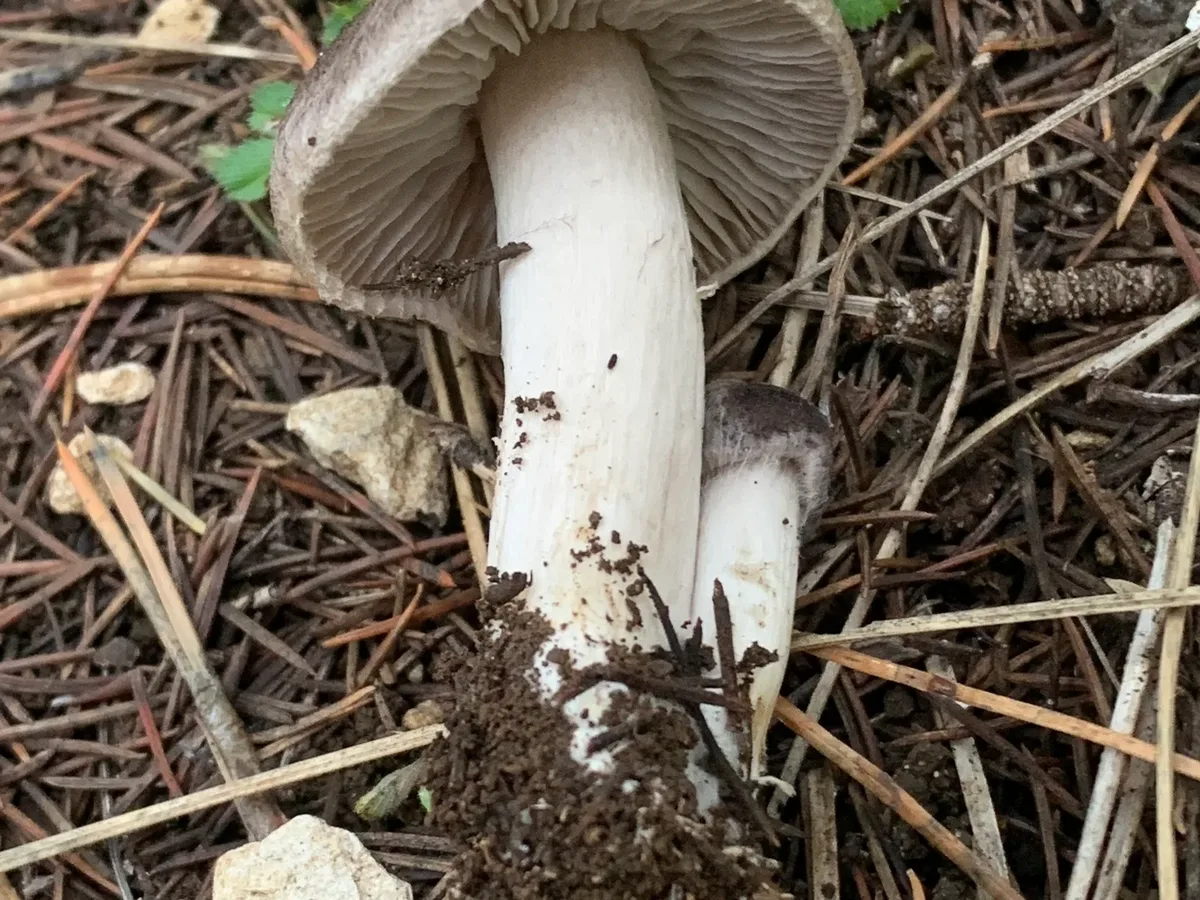
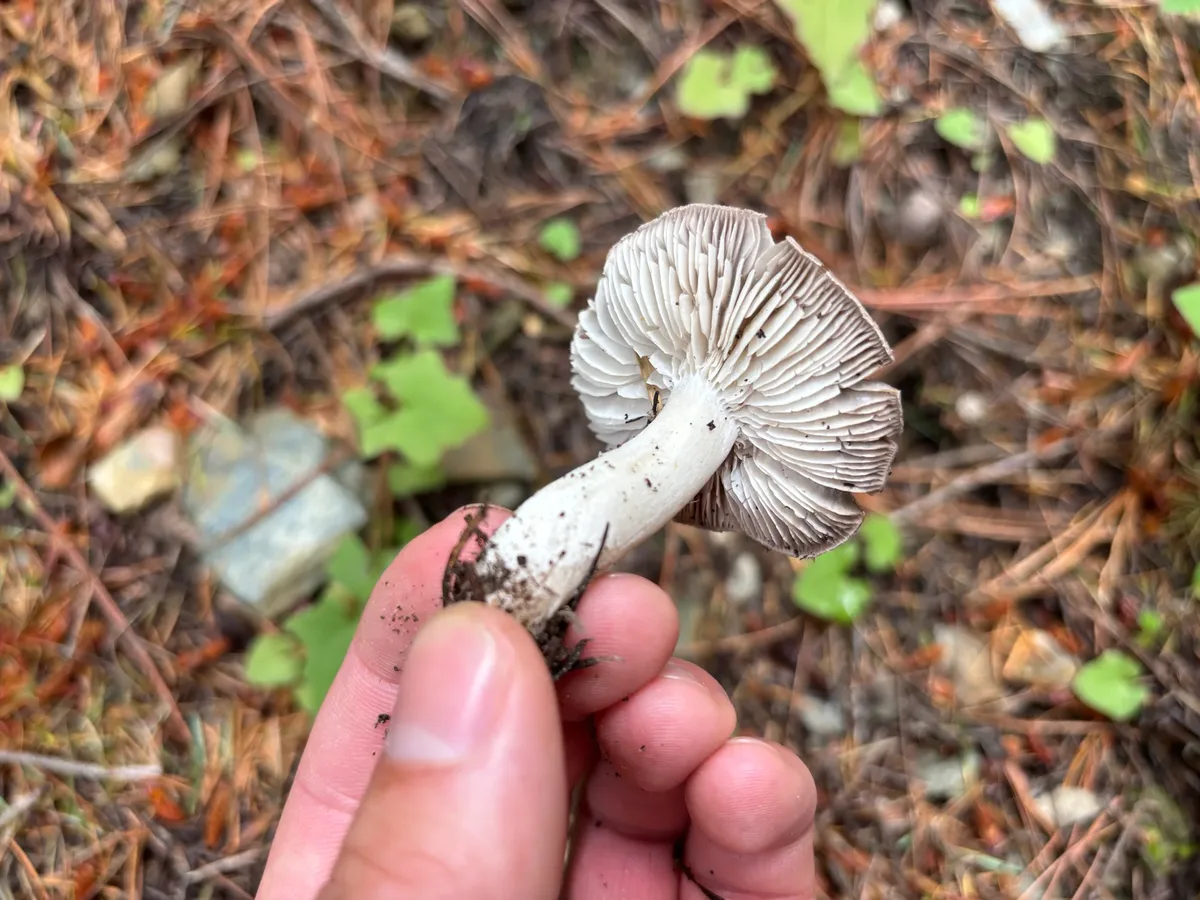
Sinuate (notched where they meet the stem), broad and moderately spaced, white to pale grey when fresh and only weakly yellowing in old age.
Stem
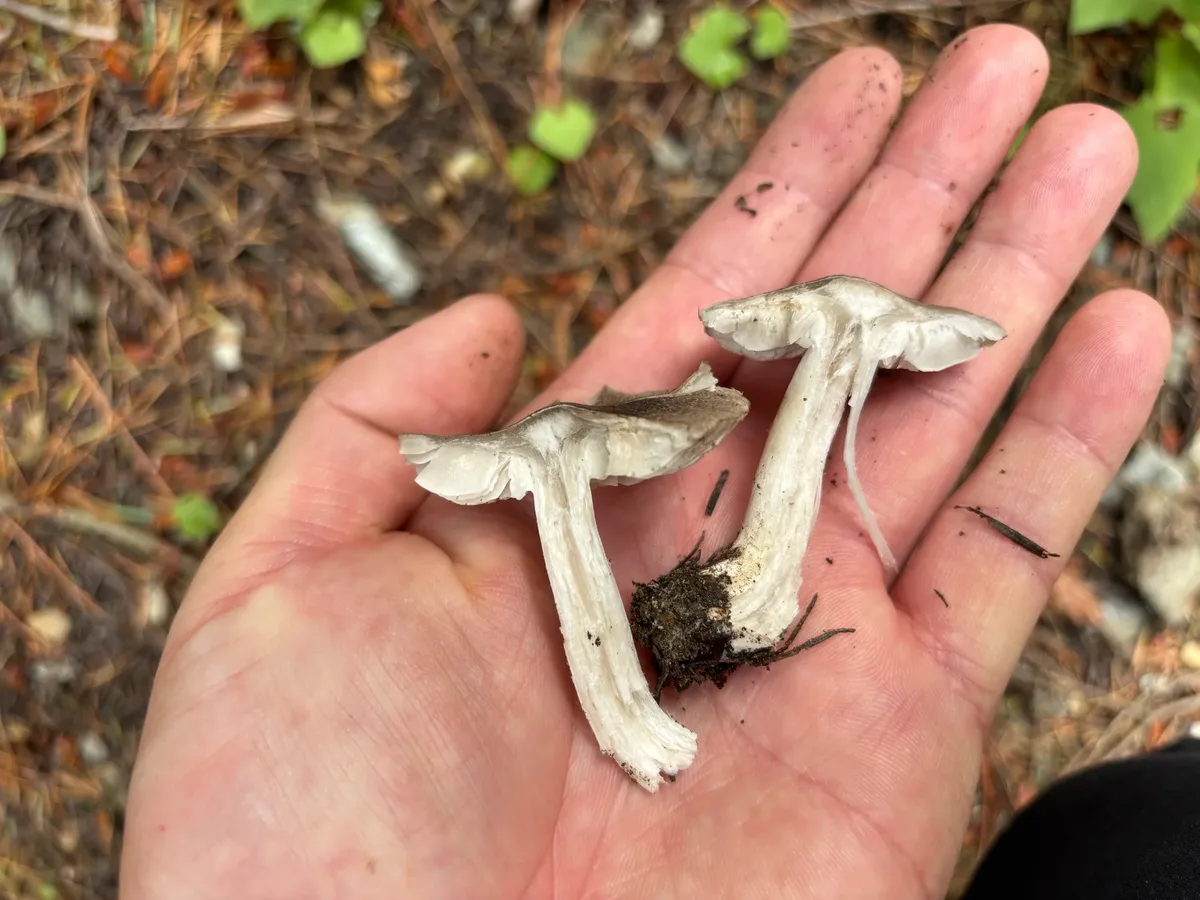
White to greyish-white, cylindrical, dry, faintly silky, ringless, and lacking any swollen base.
Flesh
Cut flesh is thin, soft and white, and does not change colour.
Smell & taste
Mild and unremarkable.
A white spore print and (under the microscope) frequently 2-spored basidia round out the picture.
Where & when it grows
Habitat
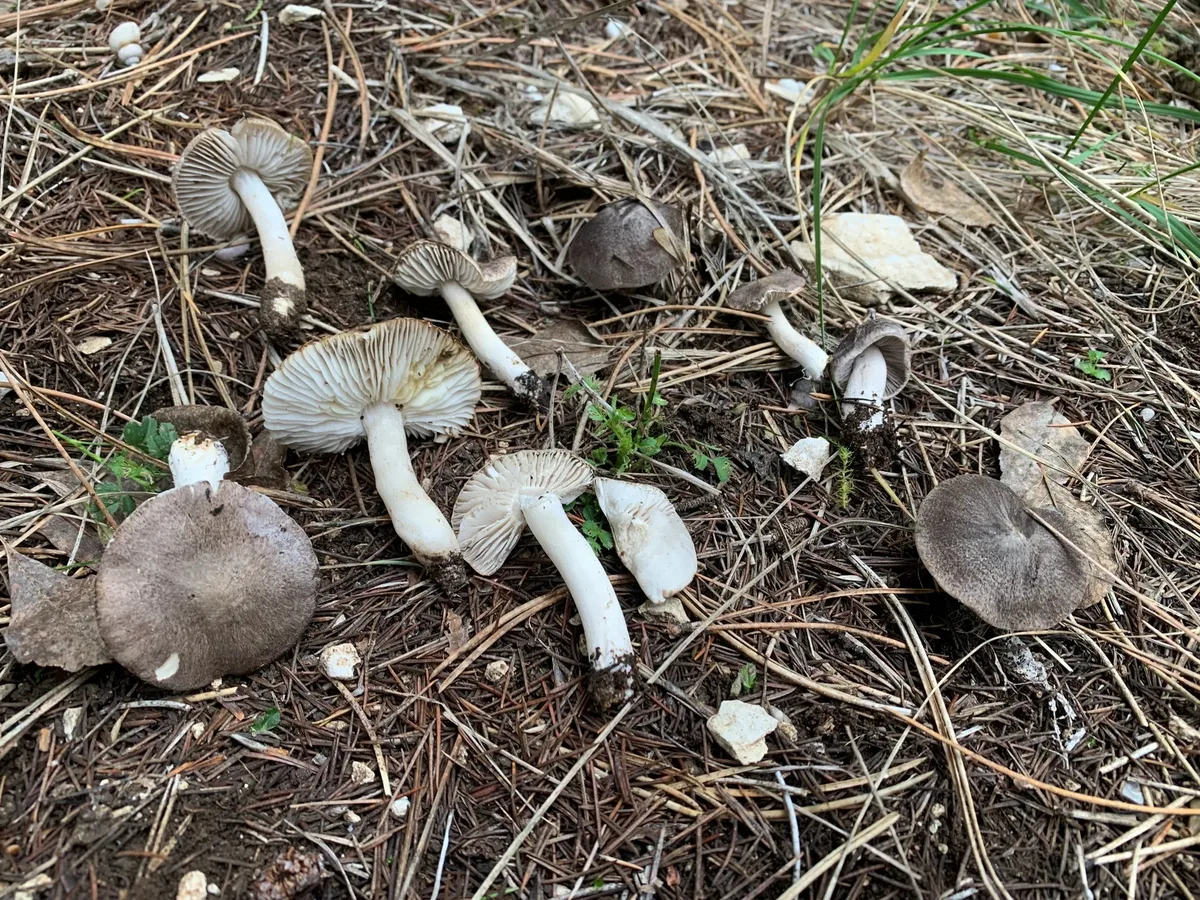
This is a pine specialist. It forms a mycorrhizal (root-partner) association almost exclusively with pines, so it is found on the ground in pine and mixed conifer woods, plantations, dune-pine, and along grassy, mossy or needle-littered woodland tracks.
It strongly favours dry, poor, often sandy or calcareous (lime-rich) soils and open, well-drained stands rather than damp, deep deciduous forest. It usually appears gregariously, in scattered troops, loose groups or partial rings.
It is one of the most common Tricholoma species across temperate Europe and is also reported from North America and parts of Asia, though New World records may include closely related grey species.
When
A creature of the cooler half of the year. Fruiting typically begins in late summer (August) and runs through autumn, peaking in October and November.
In mild winters and in southern Europe it can continue into December, often fruiting after the first gentle frosts when many other mushrooms have finished.
Look for it once the autumn rains have set in and night temperatures have dropped.
How it grows
Like all Tricholoma it is a mycorrhizal fungus, trading sugars with living pine roots rather than rotting wood. So it cannot be cultivated and always grows in the immediate vicinity of its host trees.
The underground mycelium is perennial. Above ground, fruit bodies appear in flushes a week or two after soaking autumn rain, especially on lime-rich ground.
Troops tend to recur in the same patches of suitable pine woodland year after year, making productive spots worth noting in a spot journal.
Fruiting conditions
A cool-season conifer associate. Flushes follow autumn rains once soils have cooled; tolerates low temperatures and fruits after light frosts better than most summer species. Best on lime-rich, well-drained pine ground.
Handle with care
Toxin
A 2014 study reported a series of triterpenoid compounds (saponaceolide-type, plus proposed novel terreolides/terreumols described from the species) that were myotoxic in mouse tests, raising serum creatine kinase (saponaceolide B and M, oral LD50 in mice roughly 88 and 64 mg/kg).
These are chemically distinct from amatoxins, acting on muscle tissue rather than the liver. That places the species alongside T. equestre among Tricholoma linked in the literature to possible delayed muscle toxicity.
A 2024 study of Italian collections, however, found no terreolides or terreumols and only trace saponaceolide B. It calculated that a toxic dose would require well over 100 kg of fresh fruitbodies, and that the compound degrades on cooking.
The human relevance of these compounds at normal dietary amounts is therefore disputed, and the original toxin claims may not apply to genuine T. terreum.
Symptoms
The toxic syndrome of concern is rhabdomyolysis, appearing after repeated or large meals:
- delayed muscle pain and weakness
- fatigue
- dark (tea-coloured) urine
- raised serum creatine kinase
- in severe cases, kidney damage and cardiac involvement
Onset can be delayed by a day or more, and symptoms may build over successive meals rather than from a single dose.
Note: the more immediate practical hazard is misidentification. If T. pardinum or a grey Entoloma pinkgill is eaten by mistake, the picture is different and faster: violent, prolonged vomiting and diarrhoea beginning within roughly 15 minutes to 4 hours, leading to severe, potentially life-threatening dehydration that often requires hospital treatment.
Look-alikes
The grey Tricholoma complex is one of the trickiest in temperate woods.
The gravest danger is Tricholoma pardinum (Tiger Knight / Tiger Tricholoma), a severely poisonous species that is larger, stouter and thick-stemmed, with a paler grey-brown cap broken into distinct concentric, chunky scales, firmer flesh, a clear mealy/farinaceous smell, and a preference for fir, spruce and beech on calcareous ground.
T. terreum by contrast is small, soft, fibrillose-not-scaly, mild-smelling, and tied to pine.
Other grey relatives confuse matters:
- T. virgatum has a sharply conical, silvery silky cap with a markedly acrid/peppery taste (inedible)
- T. scalpturatum yellows distinctly with age and smells mealy
- T. squarrulosum is darker and scurfy on the stem
- T. myomyces is treated by most modern authors as the same species (a synonym of T. terreum)
Beyond Tricholoma, small grey-brown agarics such as some Inocybe (muscarine-toxic) and dull Entoloma can superficially resemble a young Grey Knight from above. Inocybe have brown spore prints and often radially split caps.
Most dangerous of all, grey Entoloma pinkgills (notably Entoloma sinuatum, the lead poisoner) share sinuate gills but have salmon-pink spore prints and pink-tinged mature gills, and can cause severe or rarely fatal poisoning.
Always take a spore print: a white print confirms Tricholoma; a pink one is a warning to discard the lot.
Why it matters
On its own, correctly identified T. terreum poses at most a low, dose-dependent and scientifically disputed risk of muscle/kidney toxicity, with a 2024 re-analysis leaning back toward treating it as edible. This is why it is classed as caution rather than poisonous.
The genuinely serious danger lies in misidentification within the grey-capped crowd:
- The grey Tricholoma look-alike T. pardinum (Tiger Knight) causes one of the most severe gastrointestinal poisonings known among European mushrooms, frequently requiring hospitalisation.
- More dangerously still, grey Entoloma pinkgills (such as Entoloma sinuatum, the lead poisoner) can be mistaken for a young Grey Knight and have caused severe and, in rare cases, fatal poisoning.
A white spore print is essential before any consumption.
Anyone who develops dark urine, muscle pain, or persistent vomiting after eating a grey woodland mushroom should seek urgent medical care and tell clinicians which mushroom is suspected.
Some dull-grey Entoloma resemble a young Grey Knight from above, and like Tricholoma they have sinuate gills, but they drop a salmon-pink to pinkish-brown spore print (not white) and the gills turn pink with maturity. Entoloma sinuatum (the lead poisoner / livid pinkgill) causes violent, prolonged gastrointestinal poisoning with at least one recorded fatality, so this confusion is treated as potentially deadly. ALWAYS take a spore print: a white print confirms a Tricholoma and rules these out.
Cap more sharply conical, silvery-grey with radial silky streaks and a pointed umbo; taste markedly acrid/peppery (T. terreum is mild). Inedible due to bitterness.
Several small grey-brown Inocybe contain dangerous muscarine. Distinguished by a brown (not white) spore print, often a radially fibrillose or split cap, and frequently an unpleasant spermatic smell. Always take a spore print: T. terreum is white-spored.
Treated by most modern authorities as a synonym of T. terreum (the same species); cap can be slightly more felted with a faint cobwebby veil when young. Carries the same toxin concerns; not a safe distinction to rely on for eating.
The most dangerous Tricholoma look-alike. Larger and stouter with a thick stem and firm flesh; cap pale grey-brown broken into distinct concentric chunky scales (not fine fibrils); clear mealy/farinaceous smell; grows under fir, spruce and beech on lime-rich soil. T. terreum is small, soft, fibrillose-not-scaly, mild-smelling, and grows with pine. Causes one of the most severe gastrointestinal poisonings of any European mushroom: violent, prolonged vomiting and diarrhoea (onset roughly 15 min to 4 h) that commonly requires hospitalisation. Rarely fatal in healthy adults, but dehydration can be life-threatening, so it is treated as a serious poisoning.
Cap and gills yellow distinctly with age and bruising; smells mealy; often with deciduous trees. T. terreum stays grey, barely yellows, and smells mild.
In the kitchen
Picking & cleaning
If collecting for study, lift the whole mushroom including the stem base with a knife or by gently twisting, so the (absence of a) bulb and any veil remnants can be checked.
Take a range of ages, and always make a spore print (it must be white) and note the smell.
Because the grey Tricholoma group contains both mild edibles and the dangerously toxic Tiger Knight, only pick specimens you can examine in full. Reject anything coarsely scaly, mealy-smelling, robust or growing under beech and fir.
Keep specimens cool and airy; they are thin-fleshed and deteriorate quickly.
Cooking
Historically the Grey Knight was eaten across France, Italy and Spain (the 'petit-gris', 'moretta' or 'negrilla'), gently fried or added to mixed-mushroom dishes, and it has an agreeable mild flavour.
In light of the disputed but unresolved toxicology, this guide does not provide a recommendation to cook and eat it.
If, despite the warnings, it is consumed where local custom permits, it should only ever be:
- eaten thoroughly cooked
- in small quantities
- on isolated occasions, and never in large repeated meals
- after positive expert identification ruling out T. pardinum and the muscarine-containing Inocybe
Many experienced foragers now simply leave it in the woods.
Good to know
Even setting aside lookalikes, T. terreum sits under a question mark as a table mushroom, and this guide does not treat it as a safe edible.
Although it has a long culinary history in parts of Europe, laboratory research published in 2014 isolated novel triterpenoid toxins (saponaceolide-type) from the fruit bodies that were acutely myotoxic in mouse tests. These raised creatine-kinase levels and, in the same toxin family implicated in poisonings by its relative T. equestre (Yellow Knight), were linked to rhabdomyolysis (muscle breakdown).
Those findings are genuinely disputed. A 2016 rebuttal argued the toxin content of T. terreum is too low to harm humans at normal servings.
A 2024 re-analysis of Italian material went further, finding:
- NO terreolides or terreumols at all (only trace, long-known saponaceolide B)
- that a toxic dose would require eating well over 100 kg of fresh mushrooms
- that the compound breaks down on cooking
- and re-affirming T. terreum as an edible species, suggesting the 2014 toxin claims may have rested on misidentified or atypical material
Real-world poisoning reports specifically attributed to correctly identified T. terreum are essentially absent, so the practical risk from the mushroom itself appears low.
The decisive hazard for a forager is therefore NOT the chemistry but identification: mistaking it for the severely poisonous T. pardinum, or for a deadly grey Entoloma pinkgill, is a realistic field error.
For that reason this guide takes the conservative position and classes it as CAUTION rather than a recommended edible.
Never eat any grey Tricholoma unless an expert has confirmed the species and you have a white spore print.
A reference guide - never an edibility guarantee. When in doubt, leave it out.