Chinese bitter knight
Tricholoma sinoacerbum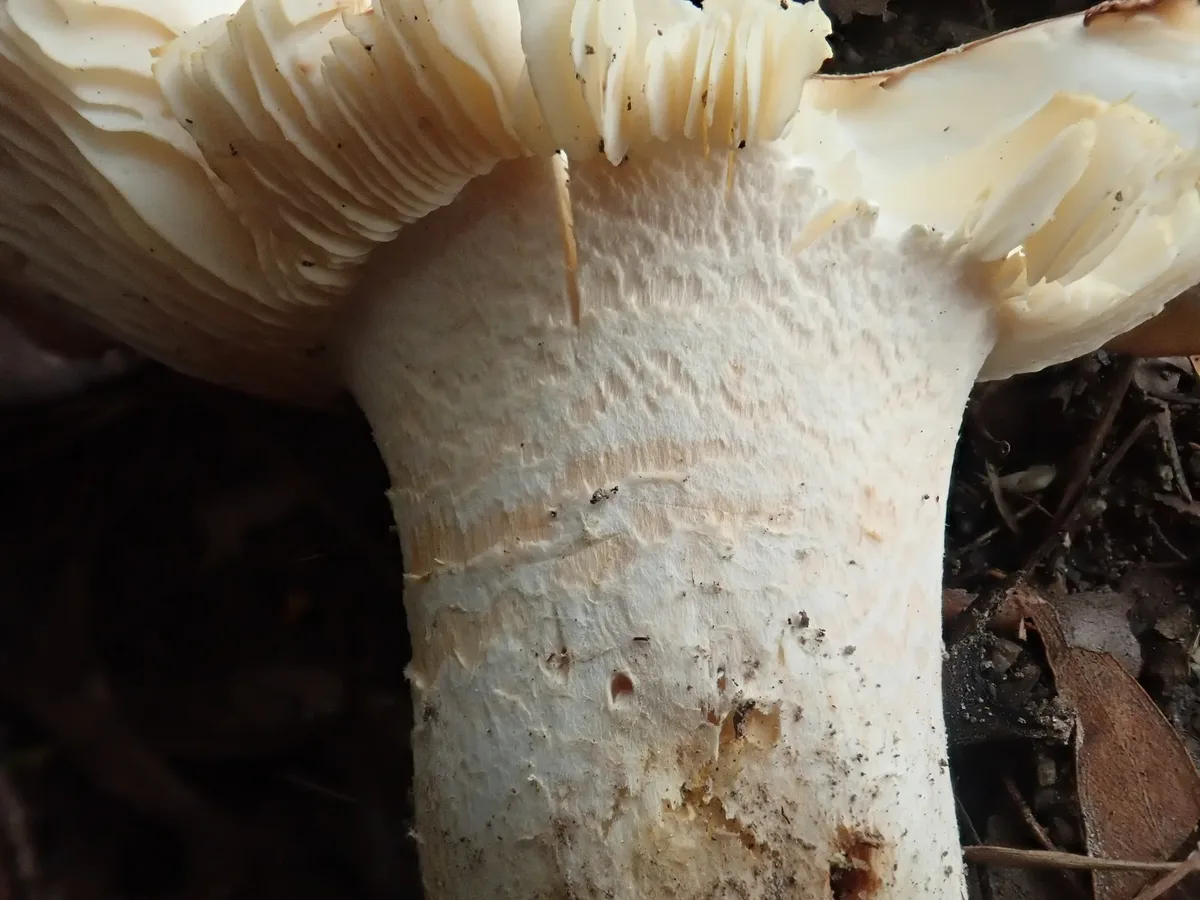 Atlas of Living Australia (CC0)
 Atlas of Living Australia (CC0)Atlas of Living Australia (CC0)Atlas of Living Australia (CC0)
Edible only with the right preparation - or safe for some people but not others. Learn the caveats first.
Never eat a mushroom you are not 100% sure of - check the look-alikes below, and always cook wild mushrooms.
How to recognise it
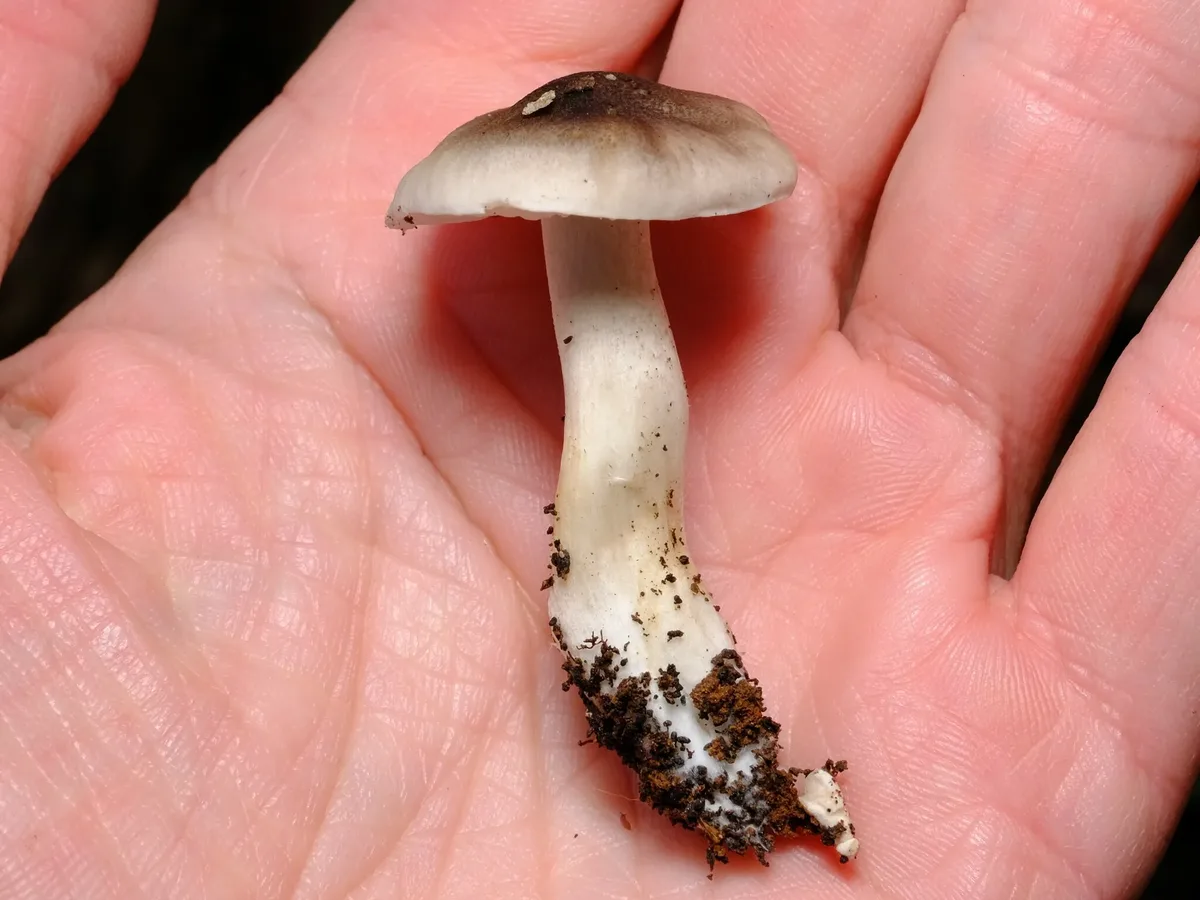
The Chinese bitter knight is a grey to brownish-grey scaly Tricholoma of medium to large size - and its cap is its most recognisable feature.
Cap
The dry, dull surface is dressed in fine radial fibrillose scales of dark ash-grey to brownish-grey pressed against a paler greyish or buff background, creating a pattern similar to that of Tricholoma pardinum, the leopard knight - its toxic European counterpart.
Young caps have a firmly inrolled margin characteristic of the group.
Gills
The white to cream, crowded, sinuate gills and pure white spore print are essential confirmation characters. The white print definitively separates it from Cortinarius (which always deposits rusty-brown to ochre-brown spores) and from other brown-spored genera.
Flesh
Flesh is pure white and firm throughout, never staining or changing colour when cut.
Smell & taste
The smell is mealy-floury, often with a distinctly unpleasant bitter or rancid edge, and the raw taste is markedly bitter or acrid - that bitterness is the source of the epithet 'acerbum' and is the single most useful field character after the scaly grey cap.
Any grey-capped Tricholoma with a bitter raw taste under oaks or chestnuts in East Asia should be treated as suspicious.
Why it's dangerous
This species presents a moderate-to-serious poisoning risk through gastrointestinal irritation, but is not lethal under normal circumstances.
The more serious danger is misidentification of co-occurring species. A forager faces life-threatening risk by:
- confusing T. sinoacerbum with a deadly Cortinarius species (collecting both together)
- relying on colour and shape alone, confusing a deadly species for an edible one in the same habitat
The East Asian monsoon mushroom season presents a concentrated hazard because numerous toxic and edible species fruit simultaneously in the same forests, and local foraging traditions can underestimate the risk of grey-capped knights.
Toxin
The toxin or toxins responsible for the gastrointestinal symptoms caused by T. sinoacerbum and related species in the T. pardinum/acerbum group have not been fully isolated and characterised.
Experimental studies on T. pardinum have identified various proteinaceous and fatty-acid compounds, as well as low-molecular-weight irritants, that cause mucosal irritation of the gastrointestinal tract. A single principal toxin has not been definitively identified.
The syndrome is a classic gastrointestinal irritant pattern: rapid-onset nausea and vomiting with no systemic organ involvement (no hepatotoxicity, nephrotoxicity, or neurological effects). This aligns with a luminal irritant mechanism rather than an absorbed systemic toxin.
Symptoms
Gastrointestinal toxidrome with rapid onset, typically 30 minutes to 3 hours post-ingestion:
- nausea progressing to severe, repeated vomiting
- intense abdominal cramping
- profuse watery diarrhoea
In severe cases, significant fluid and electrolyte loss may result in dehydration requiring hospital treatment.
There are no delayed-onset effects (ruling out amatoxin or orellanin involvement), no liver or kidney damage, and no neurological symptoms.
Recovery is typically complete within 24-48 hours with supportive care (rehydration).
The severity of symptoms appears to correlate with the amount consumed; even small quantities can cause pronounced symptoms in sensitive individuals.
Staying safe
Tricholoma sinoacerbum is a poisonous mushroom and must not be eaten. It belongs to the T. pardinum group of toxic knights, which are among the most frequently involved mushrooms in gastrointestinal poisoning incidents in Europe and Asia.
The toxins responsible for illness in the acerbum/pardinum group have not been fully characterised chemically, but are known to cause rapid-onset gastrointestinal toxidrome: nausea, profuse vomiting, severe abdominal cramps, and watery diarrhoea typically beginning within 30 minutes to 3 hours of ingestion.
Symptoms can be severe enough to require hospital admission for fluid replacement, but fatalities are very rare and recovery is generally complete within 24-48 hours.
The bitter taste of raw specimens is a natural warning signal, but cooking may partially mask the bitterness without eliminating the toxins.
Confusion with other grey-capped, white-gilled Tricholoma species - some edible, some toxic - is a real hazard in East Asian forests where numerous species of this genus fruit simultaneously during the monsoon season.
The region also has deadly Cortinarius and Amanita species in the same habitats, so any uncertainty about identification of a grey-capped agaric should result in the specimen being discarded.
Treat any grey fibrillose-scaly Tricholoma with a bitter taste as this species or a close toxic relative and do not eat it.
Where & when it grows
Habitat
This species is a mycorrhizal partner of broadleaf trees, its mycelium woven invisibly through the root systems of its hosts - a relationship that may persist in the same forest patch for years, fruiting season after season from the same underground network.
It is most at home under Castanopsis (chinquapins), Lithocarpus (stone oaks), and various Quercus that dominate the montane evergreen and semi-deciduous broadleaf forests of southern and central China, northern Vietnam, Laos, Myanmar, and neighbouring regions.
It also appears in mixed forests where pines (particularly Pinus yunnanensis and P. kesiya) grow alongside broadleaf trees, and at higher elevations it may associate with fir (Abies). In Japan and Korea it favours temperate oak and mixed woodland.
The habitat matters beyond ecology: finding a grey-scaled Tricholoma under oaks or chestnuts in this region should immediately raise caution, as this species and its close toxic relatives are regular presences here.
When
Tricholoma sinoacerbum is a summer-to-autumn fruiter, its timing shaped entirely by the East Asian monsoon cycle.
In Yunnan, Sichuan, and Guizhou the first fruitbodies push up in July as monsoon rains saturate the soil. The peak follows in August and September as conditions are warm, wet, and beginning to cool. When the monsoon retreats and October arrives, fruiting slows.
This window overlaps almost exactly with the peak of the regional wild mushroom season - a busy time when local markets fill with forest finds and foragers are most active, making careful identification of grey-capped knights especially important.
At higher elevations (above 2000 m), and in Japan and Korea, the season runs later: September through November.
How it grows
Tricholoma sinoacerbum lives most of its life as mycelium, threads of fungal tissue that wind through forest soil and lace themselves around the fine roots of host trees in a mutual mycorrhizal partnership - the fungus delivers minerals and water, the tree returns sugars fixed by photosynthesis.
This relationship cannot be replicated in cultivation, so the species is found only in established forest.
Fruitbodies emerge singly or in small scattered groups from humus-rich soil, sometimes partly buried with the stem base below the leaf layer.
Fruiting is triggered by the combination of sustained monsoon rainfall and the first gentle cooling as the rains begin to retreat - the same ecological window that brings out many edible and toxic species side by side.
Fruiting conditions
Monsoon-season species in its core East Asian range. Fruiting is triggered by sustained monsoon rainfall maintaining high soil moisture, with an optimal soil temperature window of 16-22 °C. As monsoon rains become reliable in July, first fruitbodies appear; peak fruiting tracks the retreating monsoon through August and September. At higher elevations the optimal window shifts slightly cooler (14-18 °C) and later into September and October. A 30 mm+ rainfall event over 14 days is a reliable precondition; flush lag is shorter than for cold-temperate Tricholoma species due to warm conditions.
Look-alikes
The main identification risks run in both directions.
Most importantly, T. sinoacerbum can be confused with edible Tricholoma species. In the same forests, T. matsutake and T. bakamatsutakei (both prized edibles) can co-occur. They are separated from it by:
- their distinctive spicy-resinous cinnamon aroma (which T. sinoacerbum lacks completely)
- their brown rather than grey-scaled caps (in the case of T. matsutake-group species)
- the presence of a fibrous ring-zone and sheath on the stem of T. matsutake
T. sinoacerbum is most closely related to T. pardinum (the leopard knight), one of the most frequently involved Tricholoma in serious poisoning in Europe and Asia - both share the grey fibrillose scaly cap, white gills, white spore print, and mealy smell.
The bitterness of T. sinoacerbum can actually help distinguish it from T. pardinum, which is more typically farinaceous-rancid without the same sharp acidity. From a safety perspective, however, both are toxic and should be avoided.
The most dangerous realistic confusion is with deadly Cortinarius species (webcaps) growing in the same mixed forest: brownish-grey Cortinarius with a scaly or fibrillose cap surface can superficially resemble T. sinoacerbum before their rusty-brown gill colouration develops fully.
The spore print is absolutely decisive: Cortinarius always deposits rusty-brown to cinnamon-brown spores, never white. Any rust-coloured spore deposit means the specimen is Cortinarius and must be rejected - some species in this genus (C. rubellus, C. orellanus) cause delayed, irreversible kidney failure with no antidote.
Amanita species in the same habitat (particularly A. exitialis and A. subjunquillea in East Asia) are deadly but are morphologically distinct, having a ring on the stem and a volva (sac-like cup) at the base - neither of which is present in Tricholoma.
Brown to brownish-grey Cortinarius species with fibrillose or finely scaly caps growing in mixed and coniferous forest in East Asia can superficially resemble T. sinoacerbum before their gill and spore colouration becomes obvious. The decisive test is always the spore print: Cortinarius deposits rusty-brown, cinnamon, or orange-brown spores - never white. In addition, Cortinarius gills gradually colour rusty-brown as the mushroom matures, and faint cobwebby cortina threads may still be visible on the upper stem. Cortinarius lack the distinctly bitter or mealy smell of T. sinoacerbum. The orellanin-containing webcaps cause delayed, progressive, irreversible kidney failure - symptoms may not appear for 2-3 weeks after ingestion by which time the damage is severe; there is no antidote. A white spore print is non-negotiable before collecting any brown or grey-capped agaric in this region.
Deadly Amanita species occur in the same broadleaf forest habitat and represent the most lethal mushrooms in the region. Although morphologically quite different from T. sinoacerbum - Amanita species always have free (not sinuate) gills, a membranous ring on the stem, and a volva (sac-like cup) at the stem base - inexperienced foragers unfamiliar with these characters can miss them, particularly on young, partly buried specimens. Always dig up the entire fruitbody to check: if there is any volva, ring, or free gills, it is an Amanita and must be discarded. T. sinoacerbum has no ring, no volva, and distinctly sinuate gills. Amanita exitialis and A. subjunquillea contain amatoxins and cause fatal liver and kidney failure.
Another East Asian relative occasionally confused with grey knights in the same forest. T. bakamatsutakei is smaller, with a more brownish cap and similarly mealy smell, but its cap is less distinctly scaly and has a more uniformly brownish tone without the pronounced grey. It is edible but closely related species in the same genus create confusion. The bitter taste of T. sinoacerbum is the clearest separation from edible matsutake relatives, which are bland to mildly pleasant-tasting raw.
Tricholoma pardinum is the closest European/temperate Asian counterpart of T. sinoacerbum and is the primary species in the same toxic group. T. pardinum has a very similar grey fibrillose-scaly cap, white sinuate gills, white spore print, and mealy odour, but is generally larger, the cap ground colour tends to be a colder ash-grey to silvery-grey (versus the warmer brownish-grey of T. sinoacerbum), and the bitterness of raw flesh is less pronounced in T. pardinum than in T. sinoacerbum. Both are poisonous and should never be eaten. Distinguishing them from each other is less important than distinguishing both from edible species.
The prized matsutake is a co-occurring species in many East Asian forests. Separation is usually straightforward: T. matsutake has a warm tawny-brown (not grey) cap with finely pressed brown scales over a pale background, a distinctive fibrous ring-zone and sheath on the lower stem (the 'booted' appearance), and - most importantly - a powerfully distinctive spicy-resinous-cinnamon aroma that is completely absent in T. sinoacerbum. T. sinoacerbum smells mealy-floury and tastes bitter; T. matsutake smells strongly of cinnamon and pine resin. Any grey-capped, bitter-tasting Tricholoma without the matsutake aroma is not matsutake.
A reference guide - never an edibility guarantee. When in doubt, leave it out.