Poplar knight
Tricholoma populinumsyn. Agaricus populinus, Gyrophila populina
 © Marina K (CC BY)
 © Marina K (CC BY)
 © Marina K (CC BY)© Marina K (CC BY)© Marina K (CC BY)
Good to eat, once you have identified it with certainty and cooked it through.
Never eat a mushroom you are not 100% sure of - check the look-alikes below, and always cook wild mushrooms.
How to recognise it
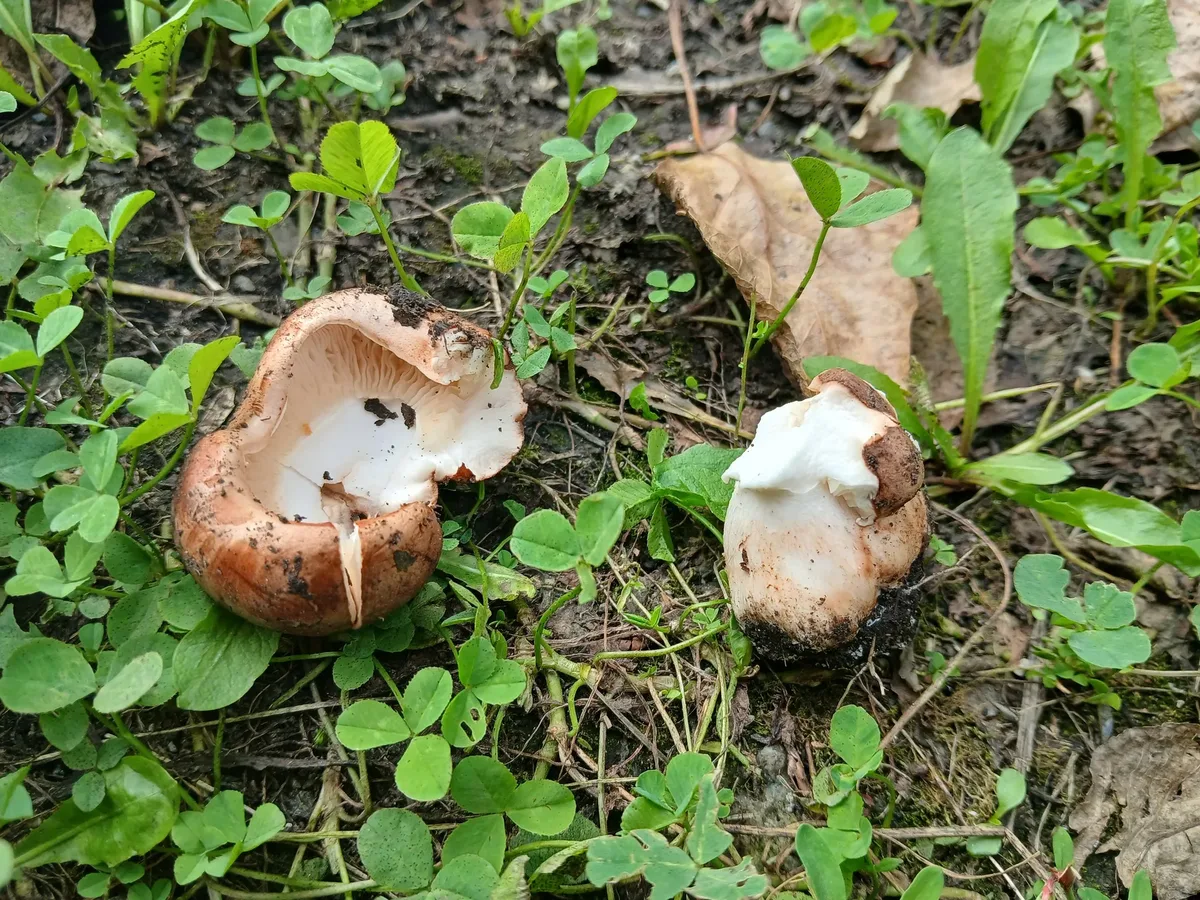
Tricholoma populinum is a robust, handsome mushroom that wears its habitat on its cap - the reddish-brown, viscid surface and strict poplar association are the combination that define it.
Cap
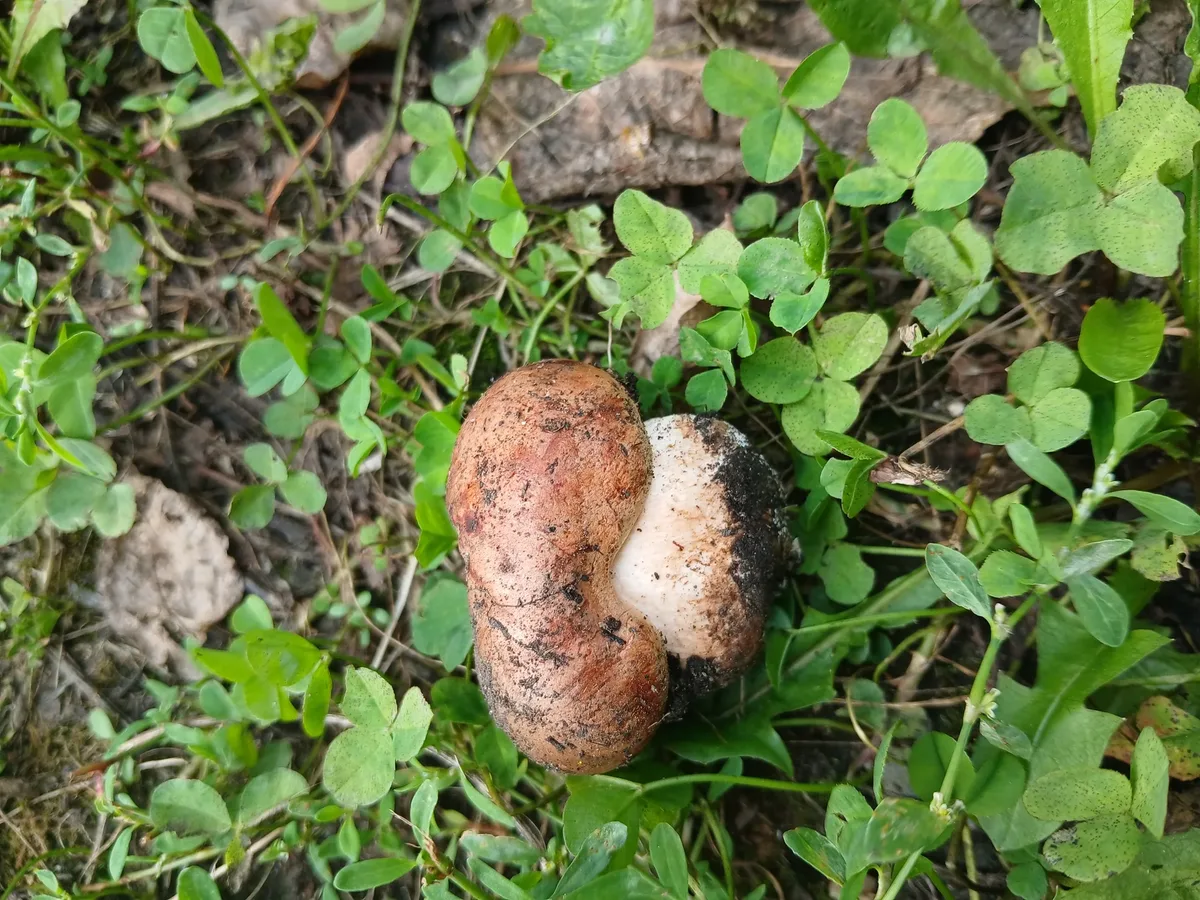
The cap (5-14 cm) starts convex and vaulted with a firmly inrolled margin, then gradually expands to broadly flat or gently umbonate, though the margin often stays incurved and undulating well into maturity.
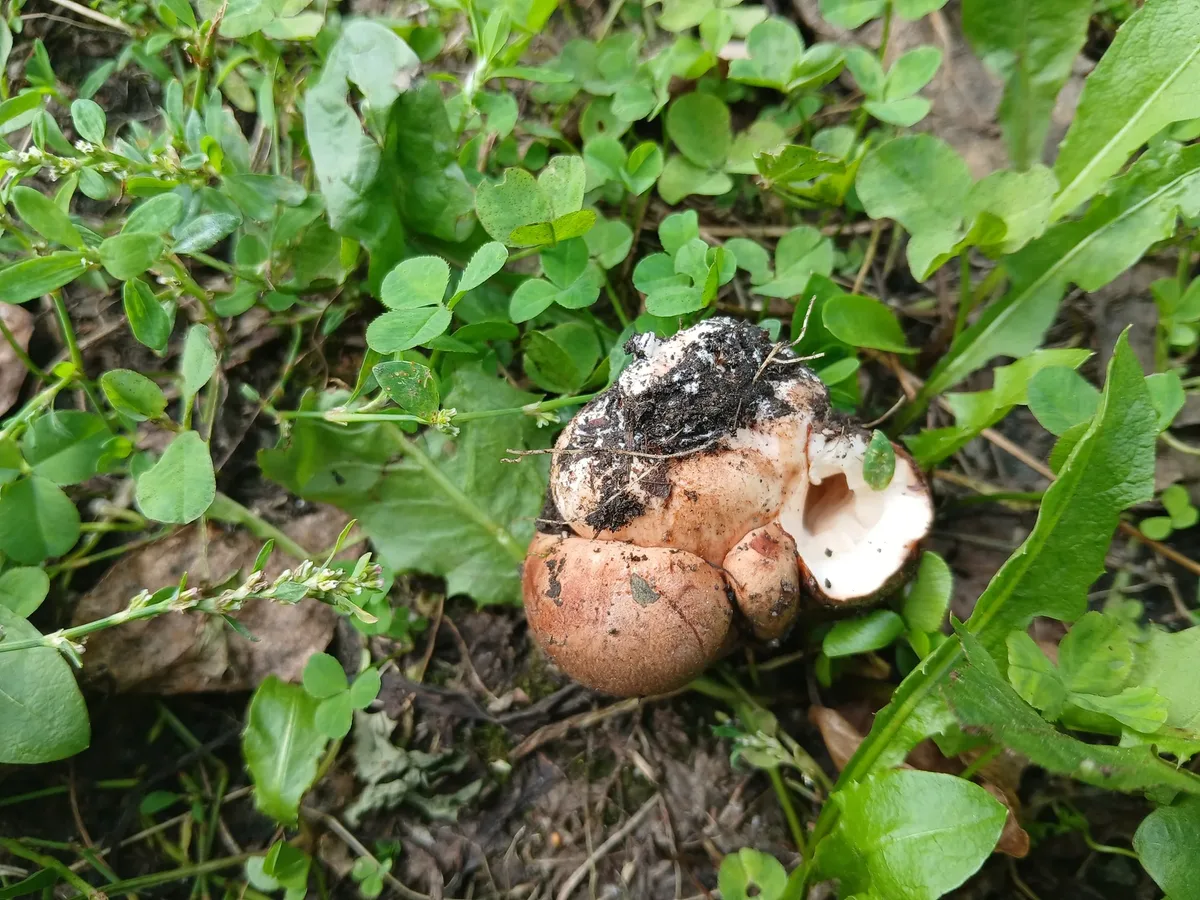
In wet conditions the cap surface is noticeably tacky, glossy, and smooth, and debris from the soil or leaf litter sticks to it readily; in dry spells it dries to a subdued silky or polished finish.
Colour runs from pale ochre-brown and brick-red through date-brown to rich reddish-chestnut, always darker at the centre with a slight gradation toward the paler margin.
With age, the surface and especially the gills develop characteristic brownish spots and blotches - a quirk shared with the related pine-associated Tricholoma pessundatum, but in T. populinum these spots appear against a poplar-woodland backdrop.
Gills
The gills are sinuate (notched at the stem junction), fairly crowded, and white to cream when fresh, later becoming pallid buff with brownish spotting.
Stem
The stem is solid, stout and firm, white to pale buff with fine reddish-brown fibrillose streaks or spots concentrated toward the base, and carries no ring and no volva at any stage.
Flesh
Flesh is firm and white throughout, unchanging on cutting.
Smell & taste
The most memorable character may be non-visual: the overwhelming smell of fresh flour or raw wheat grain (a classic Tricholoma farinae smell) that rises from the flesh and persists even after cooking.
Spore print white.
Where & when it grows
Habitat
This is one of the most habitat-faithful Tricholoma species in the northern hemisphere. Its mycorrhizal partnership with Populus - the genus that includes both the true poplars and the aspens - appears to be exclusive; it does not fruit under pines, oaks, birches, or any other tree genus in the way that many Tricholoma species do.
In eastern North America this fidelity lands it in a distinctive set of places:
- The wide, sandy alluvial plains along major river systems where eastern cottonwood (Populus deltoides) lines the banks.
- The aspen parkland of the northern Great Plains and upper Midwest, and wherever trembling aspen forms substantial stands.
- The shelterbelts and windbreak rows of planted poplars that are a feature of plains agriculture.
In Europe, T. populinum grows under ornamental and amenity poplars in parks, cemetery plantings, riverine alluvial forest, and agricultural windbreaks, wherever the soil is moist, sandy or silty, and at least slightly neutral.
The single most reliable field clue is deceptively simple: look up and confirm that at least one large poplar or aspen is growing within a few metres. If the nearest trees are pines or oaks, you do not have Tricholoma populinum.
When
In eastern North America, T. populinum fruits from late summer into mid-autumn, with the main flush running from late August through October.
The timing is driven by the convergence of two factors:
- 1The cooling of soil temperatures into the rough window of 8-14 °C.
- 2The arrival of substantial autumn rainfall (or post-summer irrigation recharge in drier settings).
Sandy and silty alluvial soils drain quickly, so single light showers are less effective than sustained or repeated rainfall.
The mycelium typically responds with a flush one to two weeks after conditions are met, making the species a somewhat predictable autumn performer in known cottonwood and aspen stands.
In warm years fruiting can extend into November; in very dry autumns the season may be abbreviated. In Europe the timing is similar, though slightly later at higher latitudes.
How it grows
Because T. populinum is an obligate mycorrhizal partner of living Populus trees, it cannot be cultivated. The entire above-ground mushroom is an expression of an underground mycelial network that lives in intimate chemical dialogue with poplar root tips, exchanging mineral nutrients for photosynthetic sugars.
The fruitbodies emerge singly, in small clusters, or in diffuse arching troops that trace the path of the root system beneath the surface.
They often push up through deep drifts of fallen poplar leaves or through sandy soil with only the cap initially visible, the stem buried and the base sometimes quite deep.
This buried habit means that digging out the full specimen - gently, to preserve stem-base detail - is important both for proper identification and for preserving the mycelium.
Fruiting conditions
Fruiting triggered by cooling autumn soils and sufficient rainfall. Sandy and silty alluvial soils beneath cottonwood and aspen drain quickly, so heavier or repeated autumn rain is more effective than a single brief shower. The mycelium responds once soil temperatures descend into the 6-14 °C band; the flush typically follows 8-18 days after precipitation. In drought years fruiting may be absent or minimal in the same stands that are normally productive.
Look-alikes
Tricholoma populinum grows in a habitat - poplar and aspen forest - that is less commonly foraged than pine woods, but identification demands the same rigour as for any Tricholoma.
The most critical confusion risk in North America involves Cortinarius species with brown caps in the same poplar/aspen woodland, particularly members of the subgenus Phlegmacium and the Dermocybe section. Several of these are deadly, containing orellanin - a nephrotoxic compound that causes irreversible kidney failure with an insidiously delayed onset of two to three weeks, by which time treatment options are limited.
Brown-capped Cortinarius in similar habitats are distinguished by:
- A rusty-brown or cinnamon-brown spore print (never white).
- Remnants of a cobwebby cortina (veil) on the upper stem (often stained rust from fallen spores).
- Rustier-brown gills that deepen with age.
A spore print is mandatory: white confirms a white-spored genus like Tricholoma; any brownish or rust tone rules it out and should be treated as a potential deadly Cortinarius.
Within Tricholoma itself, the most important look-alike is T. pessundatum (Spotted Knight), which is nearly identical in cap colour, stickiness, spotting behaviour, mealy smell, and overall stature - but grows exclusively under pines, not poplars. If the trees overhead are pines, do not eat the mushroom on the assumption it is the edible T. populinum.
Tricholoma pardinum (Dirty Knight / Tiger Knight) is a stouter, larger, grey-toned species with a concentrically scaly (not smooth-sticky) cap and a preference for beech and silver fir on calcareous ground; it is severely poisonous and causes violent hospitalisation-requiring gastroenteritis. The habitat differences (poplar-alluvial versus montane calcareous deciduous forest) substantially reduce the confusion risk, but T. pardinum should be on every Tricholoma forager's mental map.
Hebeloma species (soapy knight-like mushrooms) are common under poplars and willows in North America and can look superficially similar; they have a radish or sharp earthy smell (not mealy), a clay-brown spore print, and often a distinctly radish-like or soapy taste. Take a spore print and smell the flesh cut open - both characters are diagnostic.
Amanita species are the perennial safeguard reminder: they always have a persistent ring on the stem and a sac-like volva at the base. T. populinum has neither at any stage.
Brown-capped Cortinarius species can grow under the same poplars and aspens as T. populinum and are among the most dangerous mushrooms in the world, containing orellanin - a nephrotoxin that causes irreversible kidney failure with an onset of 2-3 weeks after ingestion. Distinguished by a rusty-brown or cinnamon spore print (never white), remnants of a cobwebby cortina (veil) on the upper stem often stained rust-orange from spore deposit, and rustier-toned gills that deepen with age. T. populinum has a white spore print, no cortina, white gills with mild brownish spotting, and no ring. A spore print is mandatory before eating any brown mushroom from a poplar stand: white confirms a white-spored genus; any brown or rust tone warrants immediate discarding.
Deadly Amanita species can occur at woodland edges including poplar stands, particularly in North America. They are always distinguished by a persistent skirt-like ring on the stem and a membranous sac-like volva (cup) at the base - characters that are entirely absent in T. populinum at every stage of development. Always dig out the full stem base and examine it carefully before collecting any large white or brownish gilled mushroom from the ground. If a ring and/or volva are present, treat the specimen as a potentially deadly Amanita.
Larger, stouter, more robustly built, with a grey-brown to silvery cap broken into distinct concentric chunky fibrous scales rather than a smooth sticky surface; grows under beech and silver fir in montane calcareous forest, not under poplars in alluvial settings. T. populinum has a smooth-viscid (not scaly), reddish-brown cap and is a poplar-flat species. T. pardinum has caused severe gastroenteritis requiring hospitalisation and at least one documented death in European mycological literature; habitat difference is the key separator but the consequences of confusion demand respect.
Several Hebeloma species are common under poplars and willows in North America and can produce brown-capped, stout fruitbodies at the same season. Distinguished by a distinctly radish-like, sharp, or soapy smell (never the floury/mealy smell of T. populinum), a clay-brown to brownish spore print (not white), and typically a slightly powdery stem surface without the reddish-brown fibrillose streaking of T. populinum. Hebeloma species are toxic, causing gastrointestinal upset. Take a spore print: if it is not white, discard.
Nearly identical in appearance - same reddish-brown sticky cap, spotting on gills and stem, pronounced mealy smell, stout build, and white spore print - but grows exclusively under pines, never under poplars or aspens. The single reliable separator is the host tree: confirm that the nearest trees are poplars or aspens (Populus). If pines are present, do not eat the mushroom as T. populinum. T. pessundatum is toxic, causing gastrointestinal poisoning.
In the kitchen
Picking & cleaning
Lift the complete specimen, stem base and all, to confirm the absence of a ring and a volva; this rules out the most dangerous Amanita species, which always have both.
Confirm the following as a checklist before keeping any specimen:
- Growing under Populus (poplar or aspen).
- No ring on the stem.
- No sac (volva) at the base.
- Cap sticky when moist.
- White spore print.
- Very strong mealy smell.
The mealy smell is potent and characteristic; if the smell is absent, earthy, or radish-like, reconsider identification.
Discard any specimen with a ring, a bulbous base, or a rusty-brown spore print.
- Collect only prime, firm specimens; the flesh is dense and holds well but deteriorates rapidly once damp-damaged.
- Clean the stem base in the field - alluvial poplar soils can coat the base in sand and silt.
- Handle in a wicker basket or paper bag; avoid plastic, which accelerates decay.
Cooking
The Poplar Knight is valued primarily in North America, where it has a modest but real following among experienced foragers in cottonwood-bottom country, and in parts of Europe where poplar plantings are foraged.
The flavour is earthy and mealy - some find it pleasantly nutty and autumnal, others find the mealy intensity overpowering. It is best after thorough cooking, which mellows the farinaceous edge.
Parboiling in salted water for 5-8 minutes and discarding the water before the main cooking removes some of the intensity and is worth doing if you find the raw smell overwhelming.
After that, it works well sautéed in butter or oil over medium-high heat until golden and the moisture has cooked off. It pairs with bacon, onion, thyme, and cream, and holds up in soups and stews without disintegrating.
- Avoid eating raw.
- Avoid large quantities at one sitting until you know how your digestion responds to its strong compounds.
- Do not feed to children until tolerance in adults is established.
The mushroom is not exceptional but is a legitimate addition to the autumn forager's pantry, particularly in regions where few other high-quality edibles share the same poplar-stand habitat.
Good to know
Tricholoma populinum is a genuinely edible species with a long record of consumption in North America and Europe. However, several cautions apply.
- 1The mealy smell and taste, which are pronounced and pervasive, can be off-putting and may cause mild nausea in sensitive individuals, particularly if the mushroom is consumed raw or only lightly cooked. The species should always be thoroughly cooked before eating.
- 2The more important safety point: T. populinum shares its reddish-brown sticky cap, mealy smell, and autumn seasonality with T. pessundatum (toxic, causing gastrointestinal poisoning), and grows in habitats that also host deadly brown-capped Cortinarius species (orellanin nephrotoxins, delayed kidney failure).
The safety of this species on the table is entirely dependent on correct identification in the field. Any uncertainty about the species identity, the host tree, or the spore print should result in the specimen being discarded.
- Take a spore print.
- Confirm the poplar host.
This guide will not soften that requirement. The potential consequences of misidentification - especially with a delayed-toxicity Cortinarius - are severe and irreversible.
A reference guide - never an edibility guarantee. When in doubt, leave it out.