Tiger tricholoma
Tricholoma pardinumsyn. Agaricus pardinus Pers., Tricholoma tigrinum (Schaeff.) Gillet, Gyrophila pardina (Pers.) Quél.
 © vuikaan (CC BY)
 © vuikaan (CC BY)
 © vuikaan (CC BY)
 © vuikaan (CC BY)
 Erin Springinotic (CC0)
 Erin Springinotic (CC0)
 © Daniel Ghyselinck (CC BY)
 © vuikaan (CC BY)
 © vuikaan (CC BY)© vuikaan (CC BY)© vuikaan (CC BY)
Edible only with the right preparation - or safe for some people but not others. Learn the caveats first.
How to recognise it
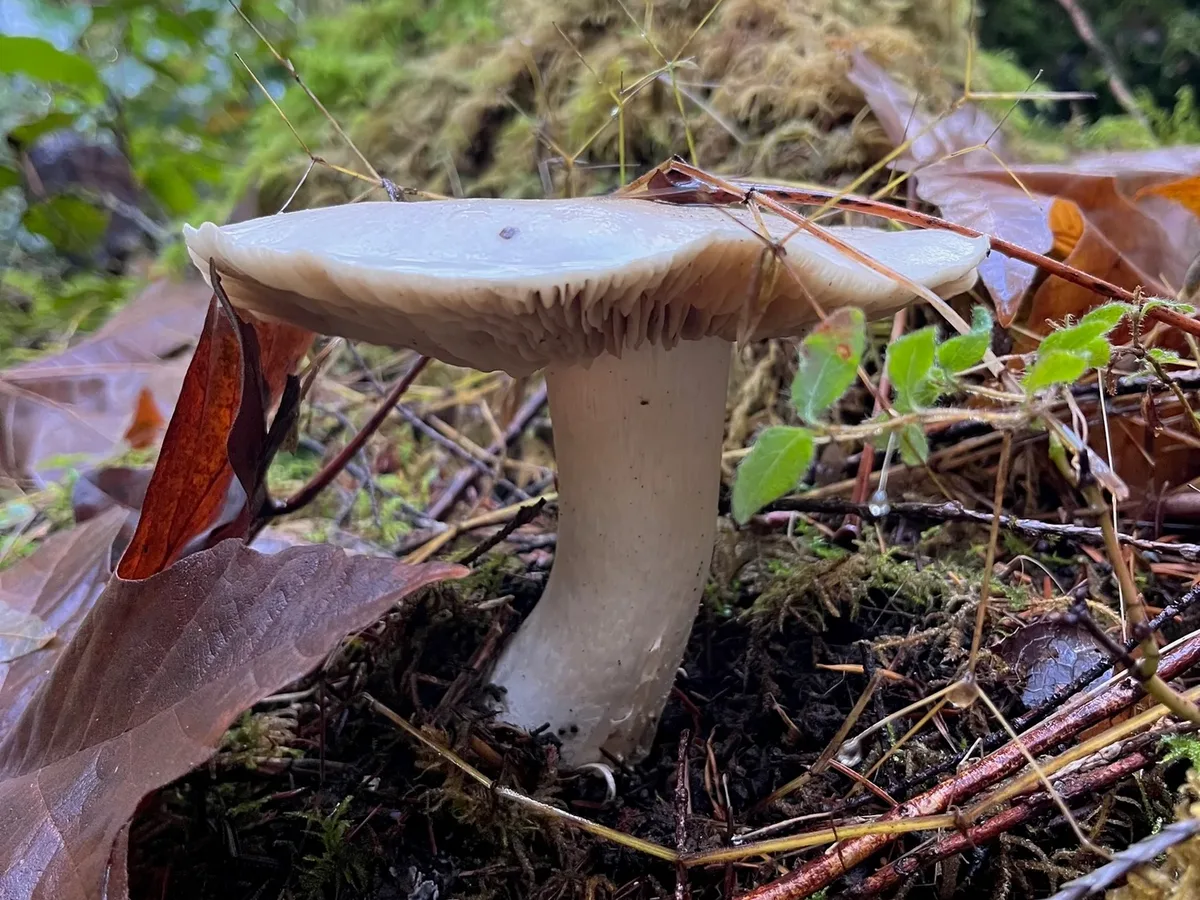
The tiger tricholoma is a robust, medium to large knight mushroom.
Cap
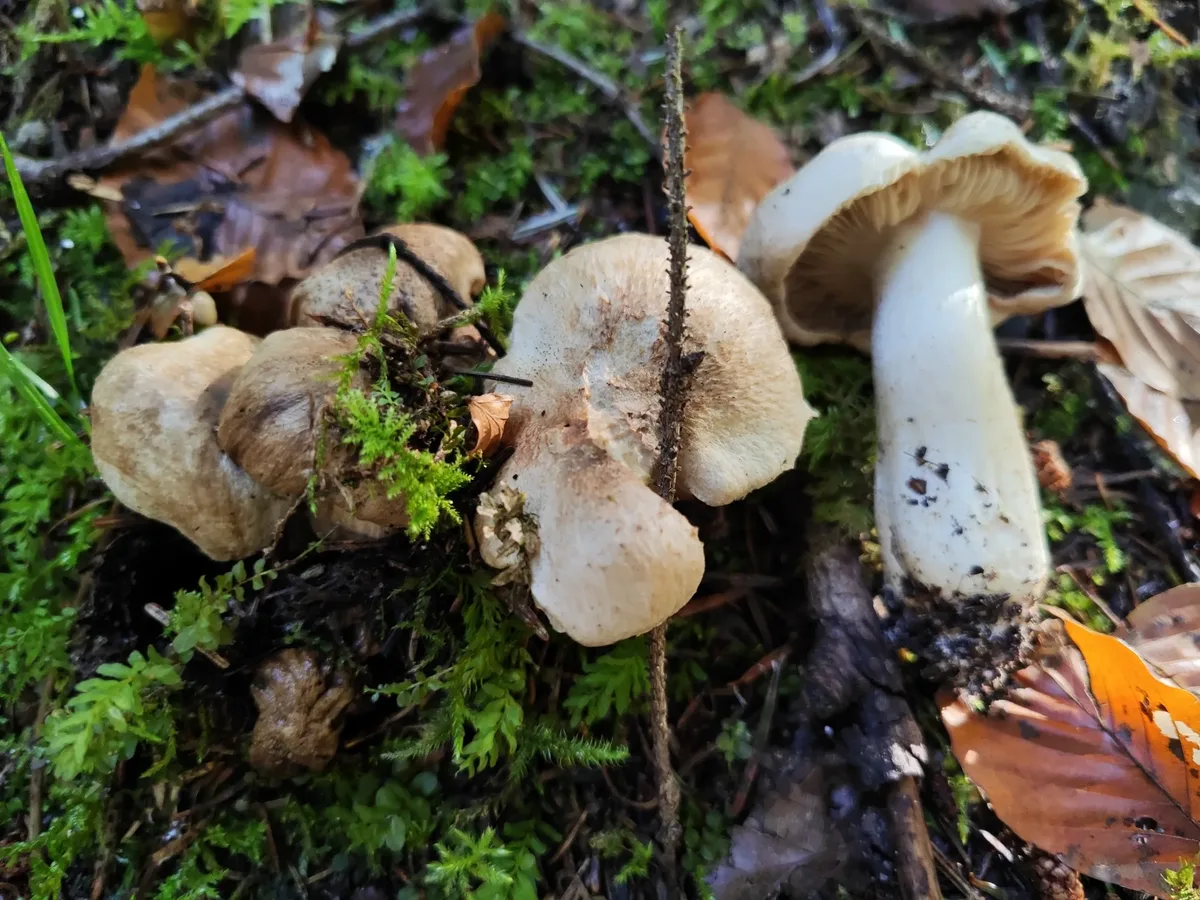
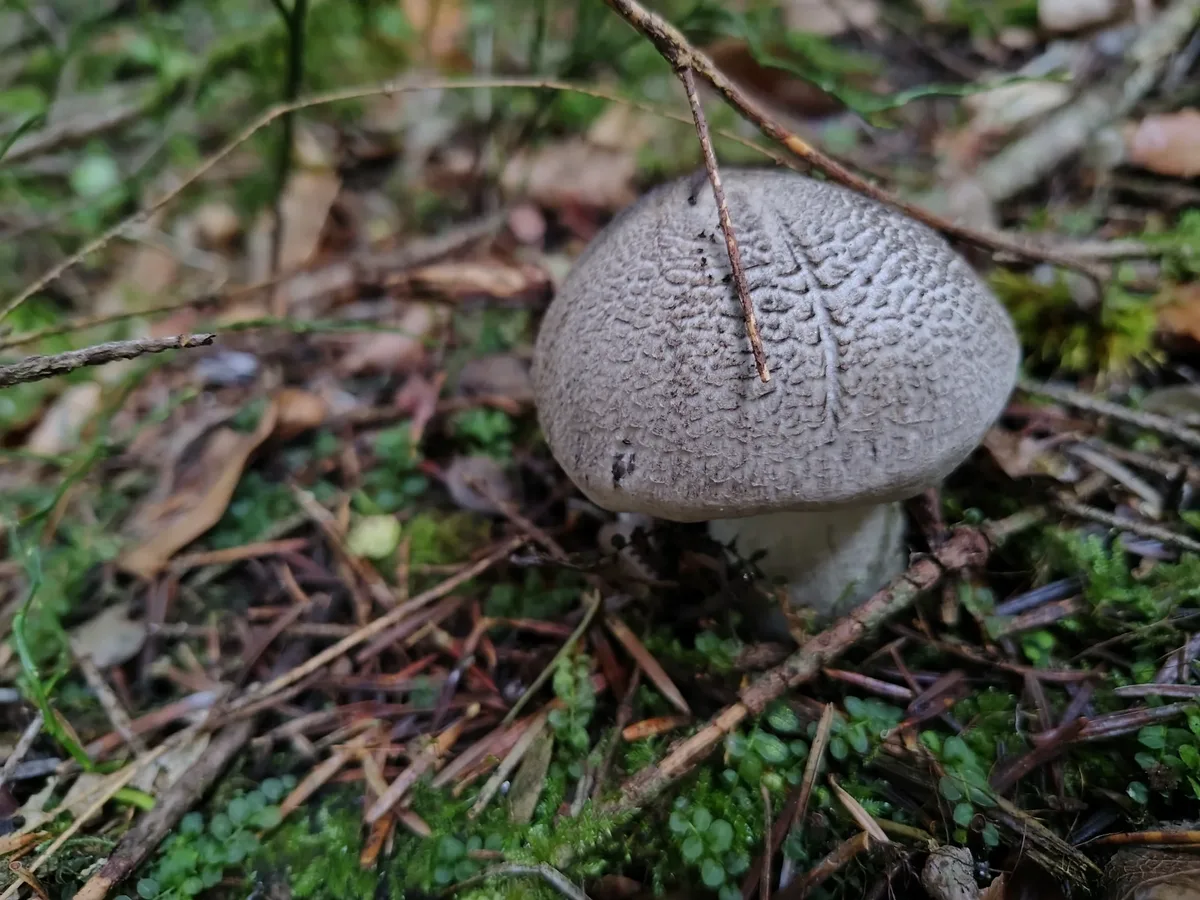
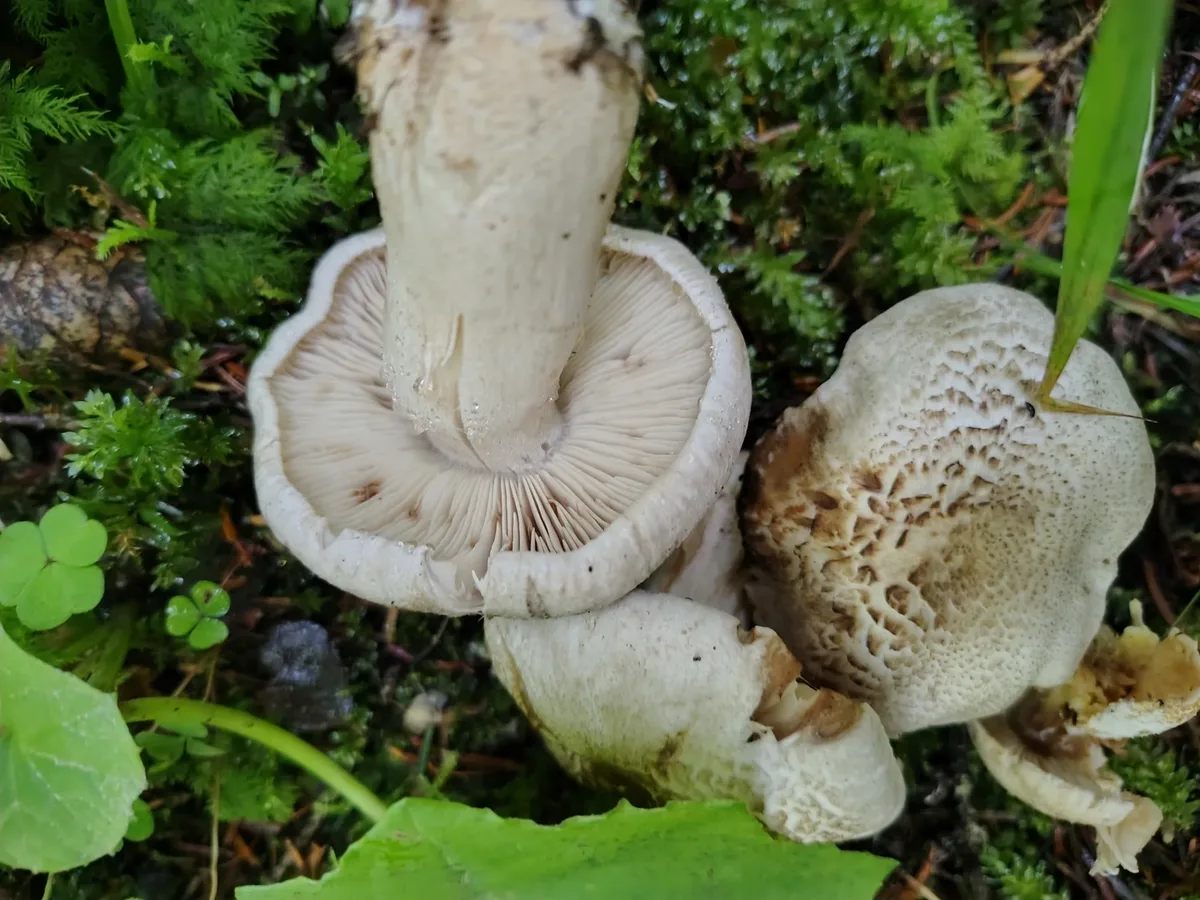
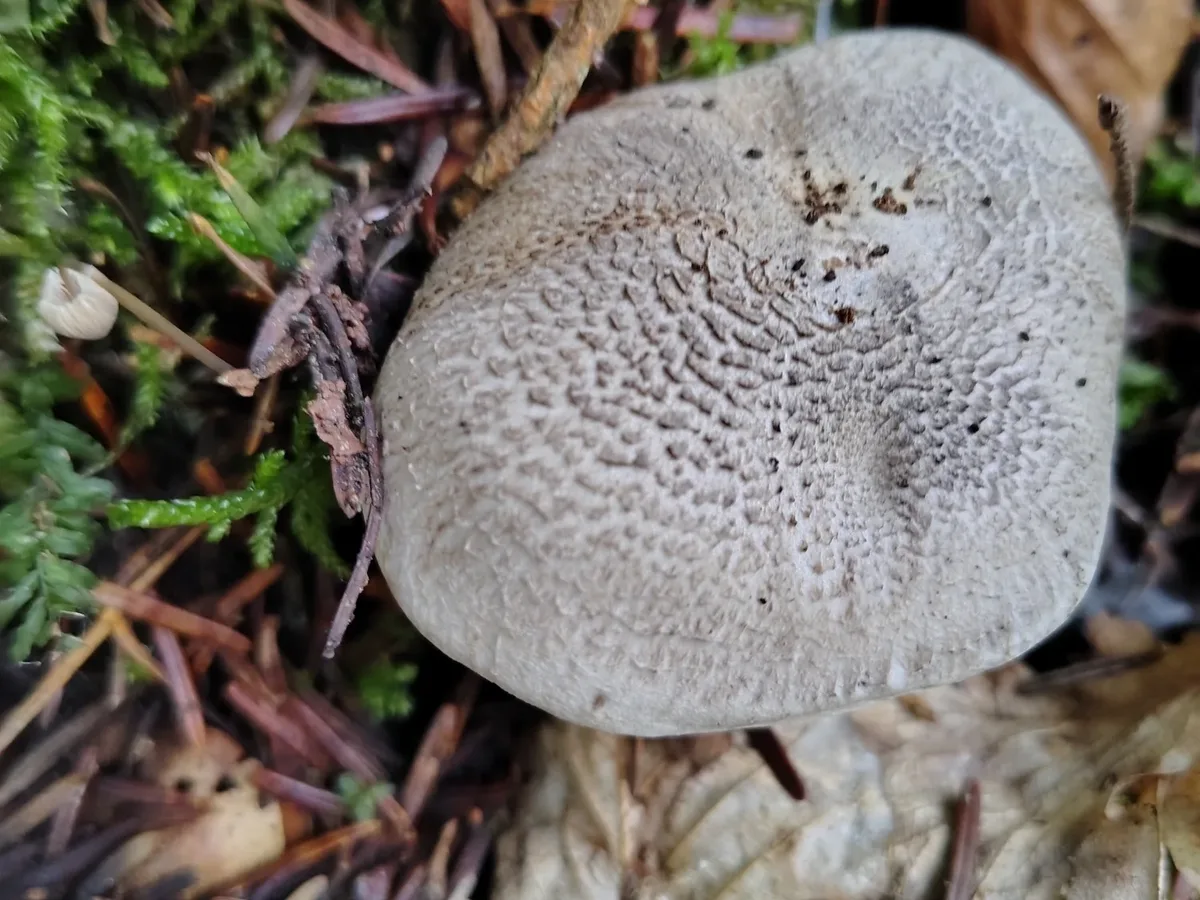
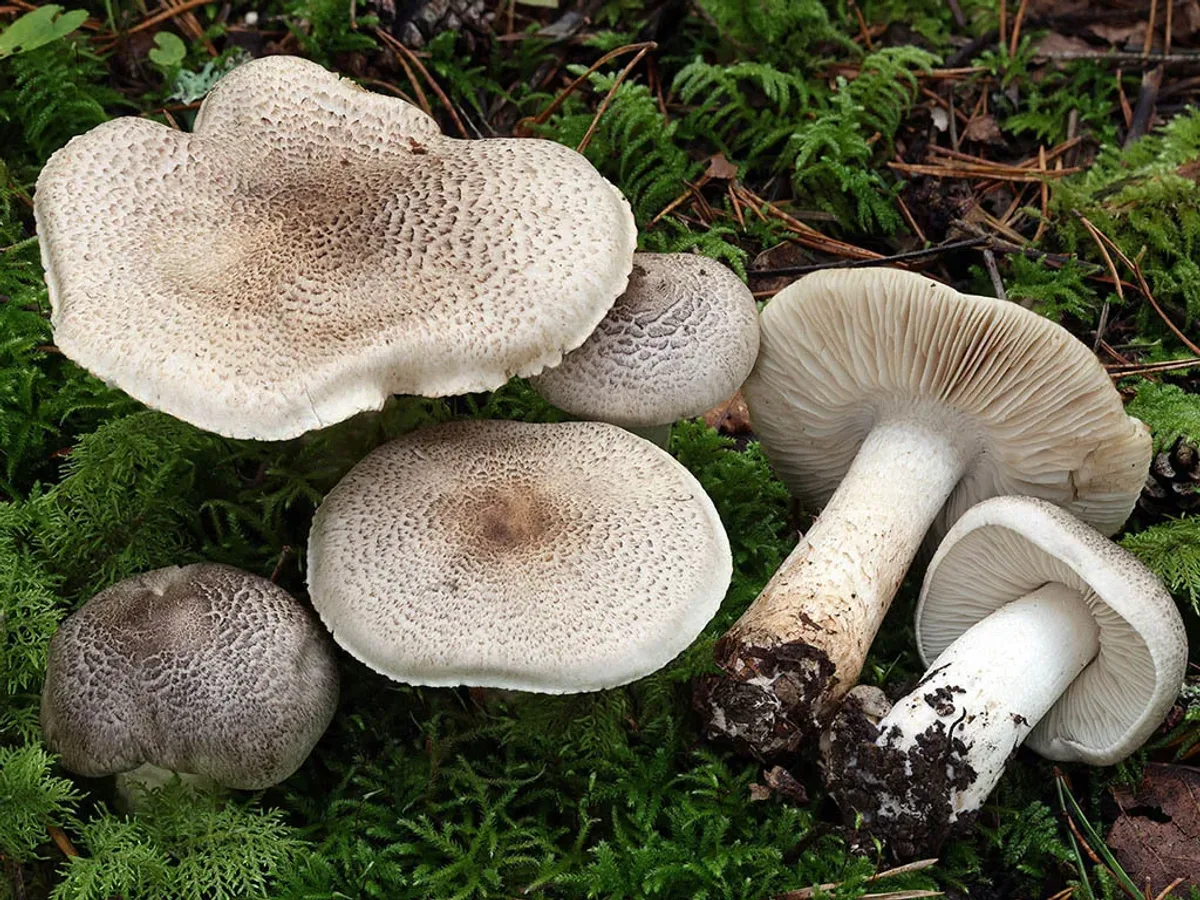
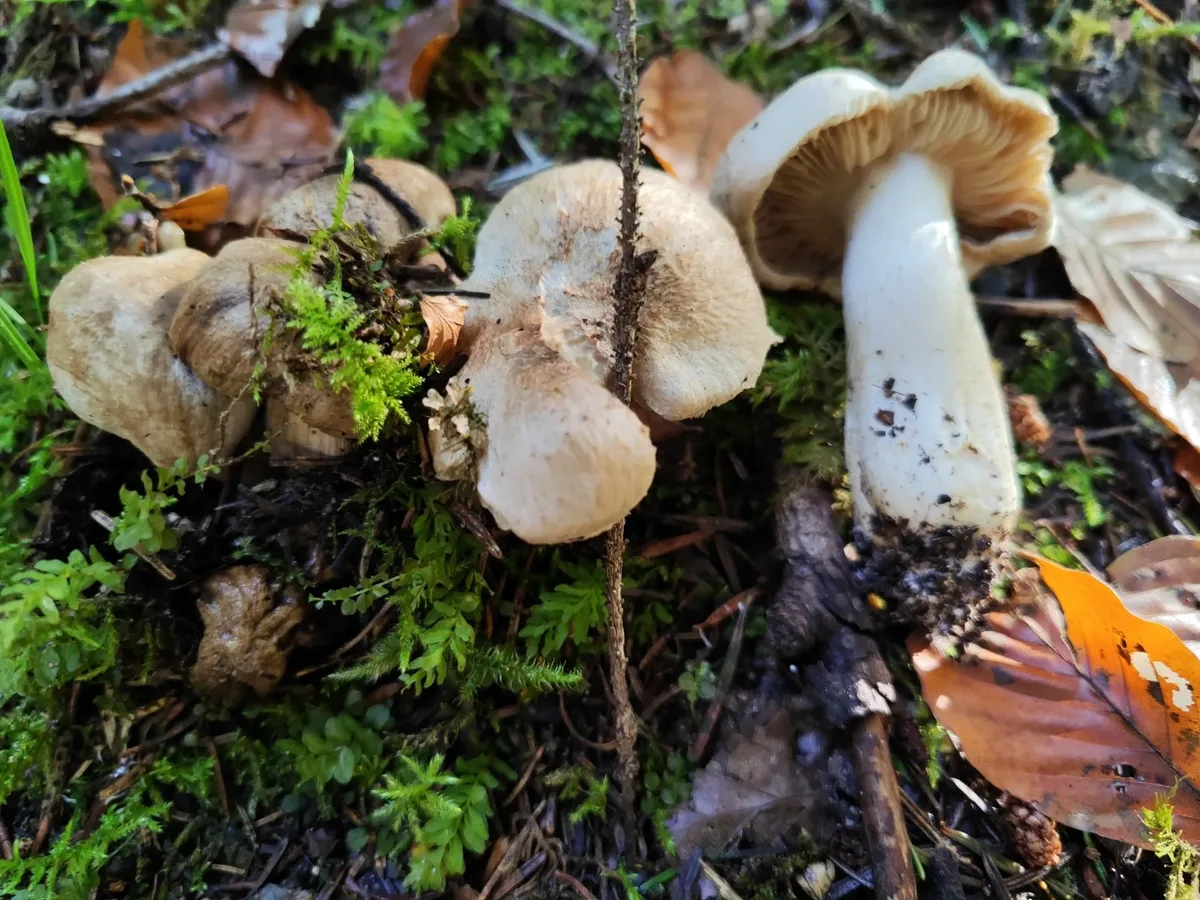
Its defining feature is immediately striking: a pale grey to greyish-white cap surface broken into concentric rings of darker, slightly brownish-grey, flattened, chunky scales - a pattern that genuinely does recall tiger or panther spots, and earns the species every one of its common names.
Young caps are broadly hemispherical with a firmly inrolled margin; they open to convex or broadly umbonate, and in old specimens nearly flat.
The concentric chunky scale pattern on the cap is the feature to hold in mind.
Gills
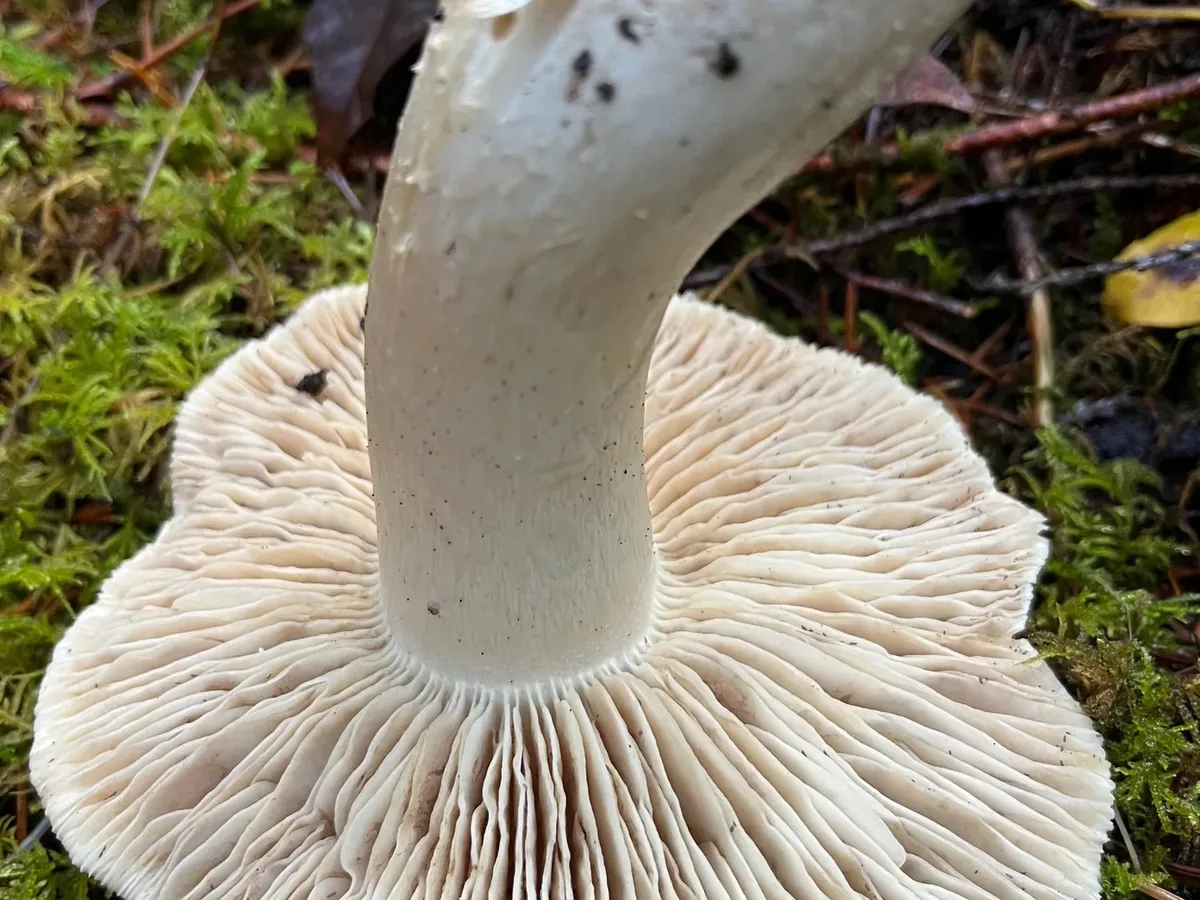
The gills are sinuate - carrying the characteristic Tricholoma notch near the stem - white to pale cream, and crowded.
Stem
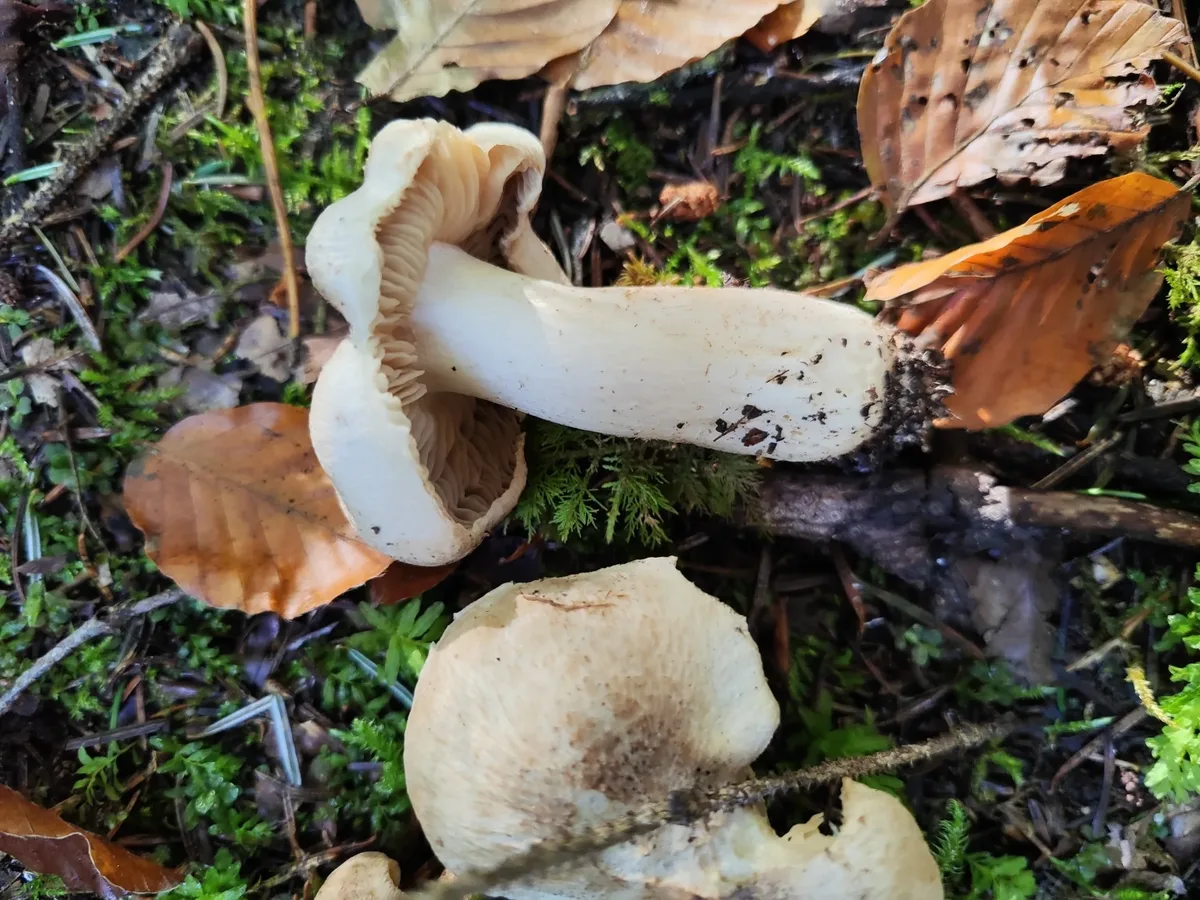
The stem is stout and solid all the way through, pure white to pale grey-white, smooth to finely silky, without ring or volva.
Flesh
Firm white flesh that stays white when cut: it does not stain, discolour, or change in any way when broken or exposed to air.
Smell & taste
The smell is mealy and pronounced - think fresh flour, damp grain, or cucumber - a scent shared with several edible Tricholoma, so it offers no useful safety distinction on its own.
Why it's dangerous
The primary danger is the potential for confusion with edible grey-capped Tricholoma species in beech forest during the autumn season, when foraging is most active.
A single mistake - eating even a small quantity of T. pardinum - causes one of the most physically violent mushroom poisoning experiences produced by any European species.
In historical Swiss statistics, Tricholoma pardinum was among the top causes of serious mushroom poisoning by case count. Though deaths are very rare, hospitalisation for IV fluids and supportive care is common.
Vulnerable groups (elderly, children, anyone with kidney or liver conditions, pregnant individuals) face elevated risk even from relatively small doses.
Always positively identify grey Tricholoma before eating; if uncertain, discard and do not eat.
Toxin
The responsible toxin or toxins have not been fully chemically characterised, despite the species' long history as a poisoning agent.
The toxic compounds are believed to be thermostable, hydrophilic, gastrointestinal irritants - they survive cooking and boiling.
Some researchers have postulated that pardaxin (a tentative name for the isolated irritant fraction) is responsible, but this has not been confirmed to the same standard as, for example, amatoxins or orellanin.
The compounds act primarily on the gastrointestinal mucosa, causing intense irritation.
Symptoms
Onset is characteristically delayed: symptoms typically appear 30 minutes to 2 hours after ingestion. The primary syndrome is severe acute gastroenteritis.
Symptoms include:
- Sudden violent nausea
- Profuse and repeated vomiting (often 20 or more episodes)
- Intense abdominal cramping and pain
- Watery to bloody diarrhoea
The vomiting can be so severe and prolonged that it leads to significant dehydration and electrolyte imbalance, often requiring intravenous rehydration in a hospital setting.
Recovery takes 24 to 72 hours in most cases; seriously ill patients may require longer observation.
Fatalities are extremely rare but have been reported in the literature for vulnerable individuals (elderly, children, or those with pre-existing conditions) following severe dehydration.
The unusual feature of T. pardinum poisoning is its extraordinary severity relative to the small quantity of mushroom required to trigger full-blown symptoms.
Staying safe
Tricholoma pardinum is severely toxic and causes some of the most violent gastrointestinal poisoning episodes on record for any European mushroom.
It is a significant public health concern. In Switzerland alone, T. pardinum has historically been responsible for more reported poisoning cases than almost any other fungal species, and outbreaks occur regularly in France, Germany, Italy, and Austria during the autumn foraging season.
The toxin is not fully characterised, and the poisoning is not prevented by cooking, parboiling, drying, pickling, or any other standard food preparation method. Even a single cap (or part of a cap) can cause severe illness in an adult.
Identification must be absolutely certain before consuming any grey Tricholoma. When in any doubt between T. pardinum and an edible grey knight, do not eat it.
Where & when it grows
Habitat
The tiger tricholoma is at home in mature beech forest on calcareous soils - the lime-rich chalk and limestone woodlands of central and western Europe that it shares with its host trees.
It forms a close ectomycorrhizal partnership with beech (its principal associate), as well as with oak, hornbeam, and silver fir in montane zones, threading its mycelium through the root networks of established, often old-growth stands.
Look among deep beech leaf litter in chalk or limestone country - the Jura, the Vosges, the Swabian Alb, the Cotswolds, the Ardennes.
The trouble is that it fruits in precisely the same places and at precisely the same time as edible grey knights like T. terreum and T. portentosum. That overlap is the most common route to poisoning.
When
The main flush runs from September into October, with fruiting bodies emerging from late August onward.
The trigger is typically a significant autumn rainfall arriving after the first real soil temperature drop of the season - conditions that also bring out chanterelles and porcini across the same woodlands.
Foragers are busy in exactly the right habitats when T. pardinum is at its peak. In mild years, occasional specimens linger into November.
How it grows
Solitary or in small scattered groups, always arising from soil - never from wood.
Fruiting bodies push up with firmly inrolled margins and look deceptively uniform grey when very young. The concentric scale pattern sharpens and becomes much easier to read as the cap matures and expands.
The whole fruiting body is rooted in the ectomycorrhizal mycelium woven through the surrounding tree roots, invisible beneath the leaf litter until the right autumn conditions draw it upward.
Fruiting conditions
Flushes after significant autumn rainfall (25 mm or more over two weeks) when soil temperatures fall into the 6-14 °C range. Calcareous beech forest soils warm slowly in spring and cool evenly in autumn, giving a relatively predictable late-September to mid-October peak flush in most central European years.
Look-alikes
Several edible or less-toxic Tricholoma species grow in the same beech forest habitats during autumn and can be superficially confused with T. pardinum.
- Tricholoma terreum (grey knight) is the most commonly confused edible species: it is smaller (cap 4-8 cm), with a uniformly grey, dry, radially fibrillose to very finely scaly cap without the distinct chunky concentric scale pattern of T. pardinum; the smell is mild and mealy, the flesh white and non-staining; it is edible with caution but shares the grey colouration.
- Tricholoma portentosum (streaky knight) has a grey cap with prominent dark radial streaks (rather than concentric scales) and often a violet tinge at the margin; the smell is floury or radish-like; it is a choice edible.
- Tricholoma scalpturatum (yellowing knight) is grey but with a cap surface that develops yellow staining with age, and the flesh may slowly yellow when cut - useful separation characters.
- Tricholoma saponaceum (soapy knight) is highly variable in colour but identified by its overwhelming smell of cheap soap or detergent and by the pink flushing of the flesh and stem base when cut - neither feature is present in T. pardinum.
- Clitocybe nebularis (clouded funnel) is larger, pale grey-buff, with decurrent gills (running down the stem rather than notched) and a musty or rancid smell.
None of the common lookalikes are deadly, but misidentifying T. pardinum as any of them and consuming it results in one of the most violent and prolonged gastrointestinal poisoning episodes of any European mushroom.
Clitocybe nebularis is larger, pale grey-buff, and has gills that run down the stem (decurrent) rather than notched at the stem (sinuate). Smell is musty or rancid, never mealy. No concentric cap scales.
T. terreum is smaller (cap 4-8 cm), with a uniformly grey, radially fibrillose-to-finely-scaly cap lacking the bold concentric chunky scale pattern of T. pardinum. Smell is mild and mealy. Flesh white and non-staining. Edible with caution; a common autumn woodland species that shares exactly the same habitat.
T. saponaceum is highly variable in cap colour but identified by its overwhelming smell of cheap soap or detergent and by pronounced pink-to-red flushing of the flesh and stem base when cut. T. pardinum smells mealy (not soapy) and its flesh stays pure white. Both are toxic.
T. portentosum has dark radial streaks (not concentric scales) across a grey cap that often has a violet tinge at the margin. Smell floury to radish-like. Flesh white, non-staining. A choice edible found in the same beech and conifer forests.
T. scalpturatum has a greyish cap with fine grey scales but develops distinctive yellow staining on the cap surface and flesh as it ages or when cut - T. pardinum does not yellow. Mild mealy smell. Generally considered inedible due to similarity to T. pardinum.
A reference guide - never an edibility guarantee. When in doubt, leave it out.