Booted Knight
Tricholoma focalesyn. Agaricus focalis Fr., Armillaria focalis (Fr.) P.Karst., Tricholoma robustum sensu auct. mult. (misapplied), Gyrophila focalis (Fr.) Quél.
 © Leila S. Berg (CC BY)
 © Kari Undrum (CC BY)
 © Leila S. Berg (CC BY)
 © Per Marstad (CC BY)
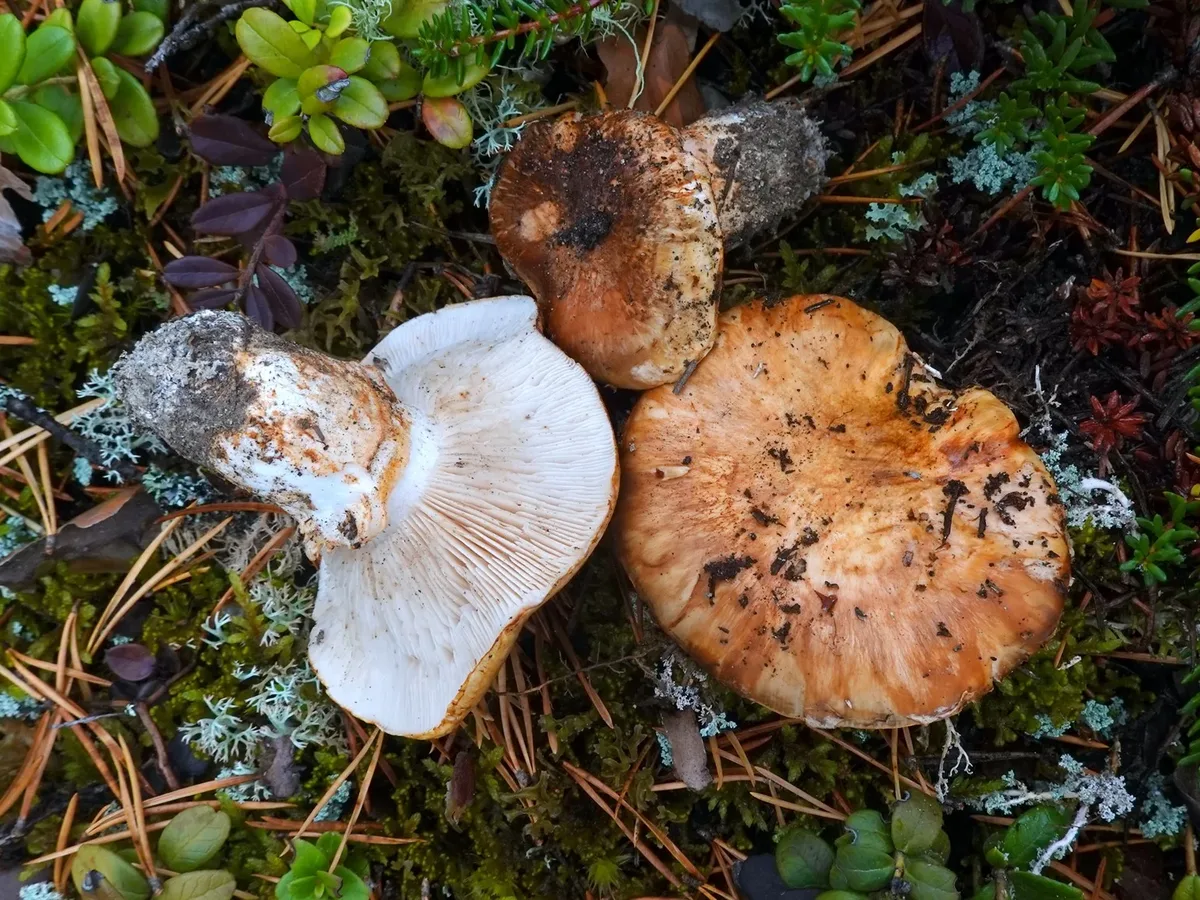 © Perry Gunnar Larsen (CC BY)
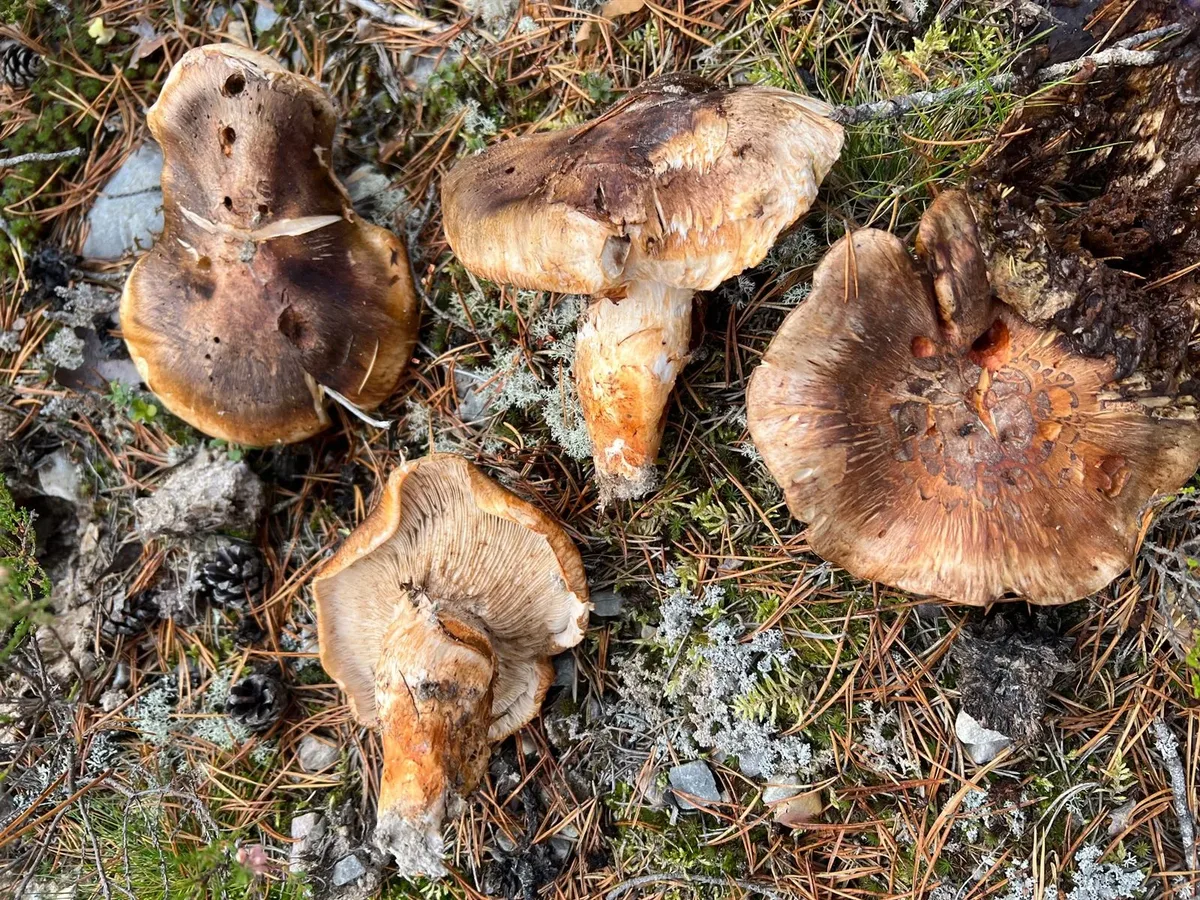 © Kirsti Anne Mandal (CC BY)
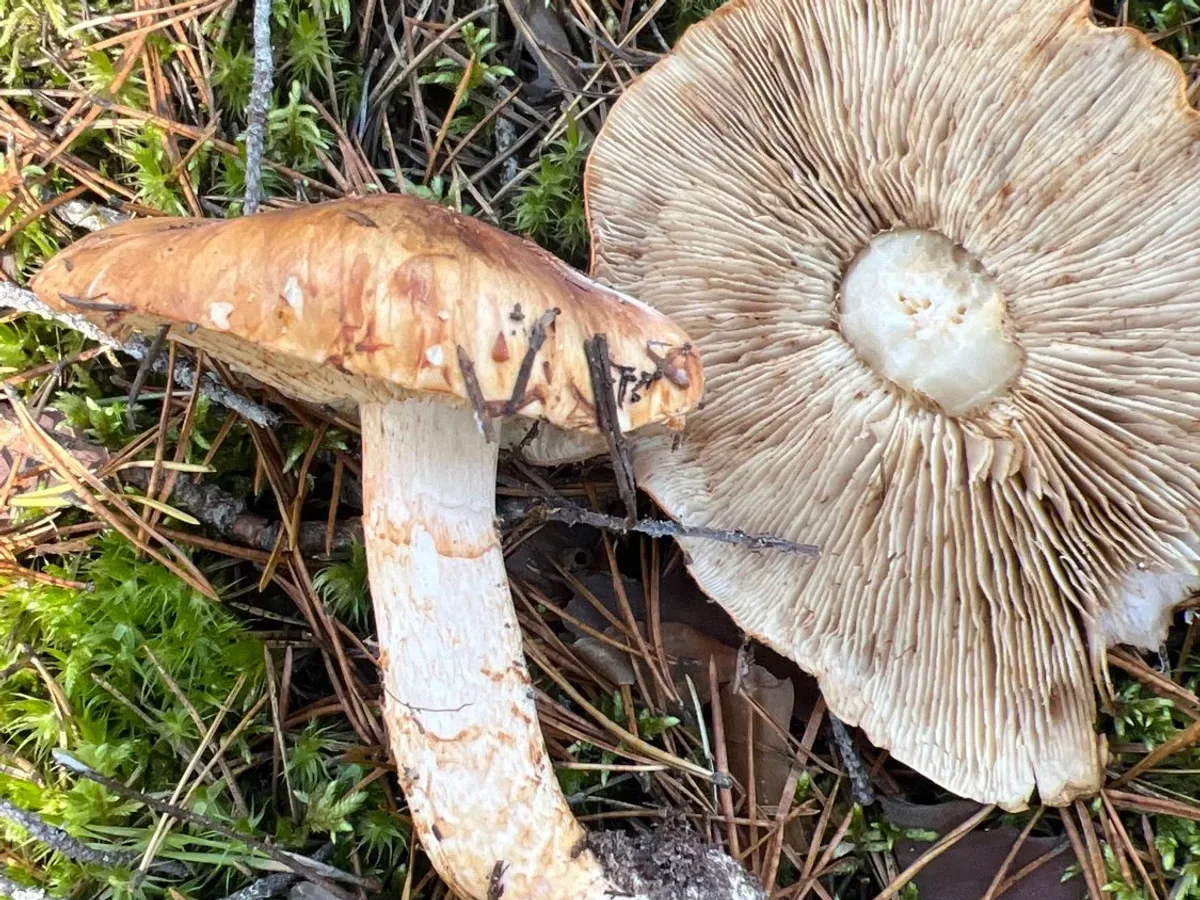 © Leila S. Berg (CC BY)
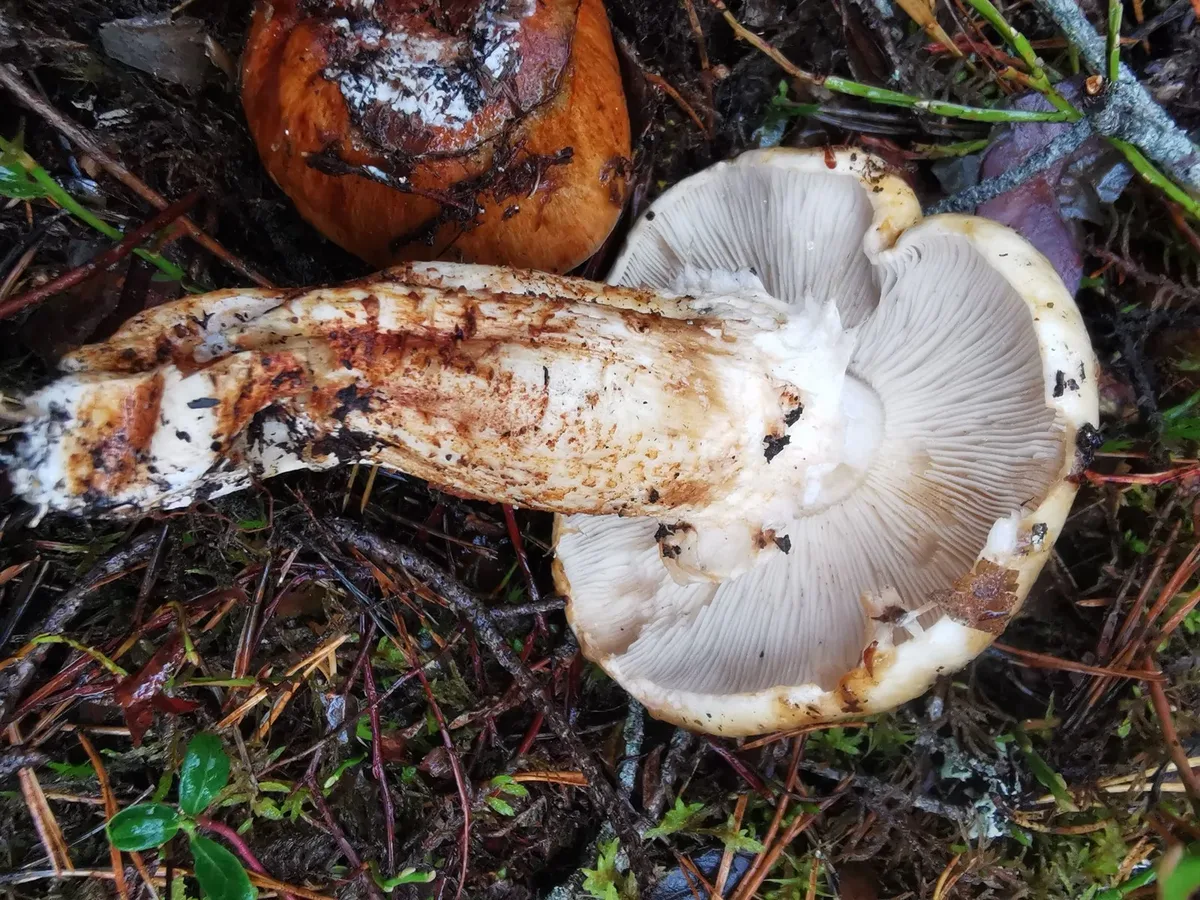 © Lillian Iversen (CC BY)
 © Lillian Iversen (CC BY)© Leila S. Berg (CC BY)© Kari Undrum (CC BY)
Edible only with the right preparation - or safe for some people but not others. Learn the caveats first.
Never eat a mushroom you are not 100% sure of - check the look-alikes below, and always cook wild mushrooms.
How to recognise it
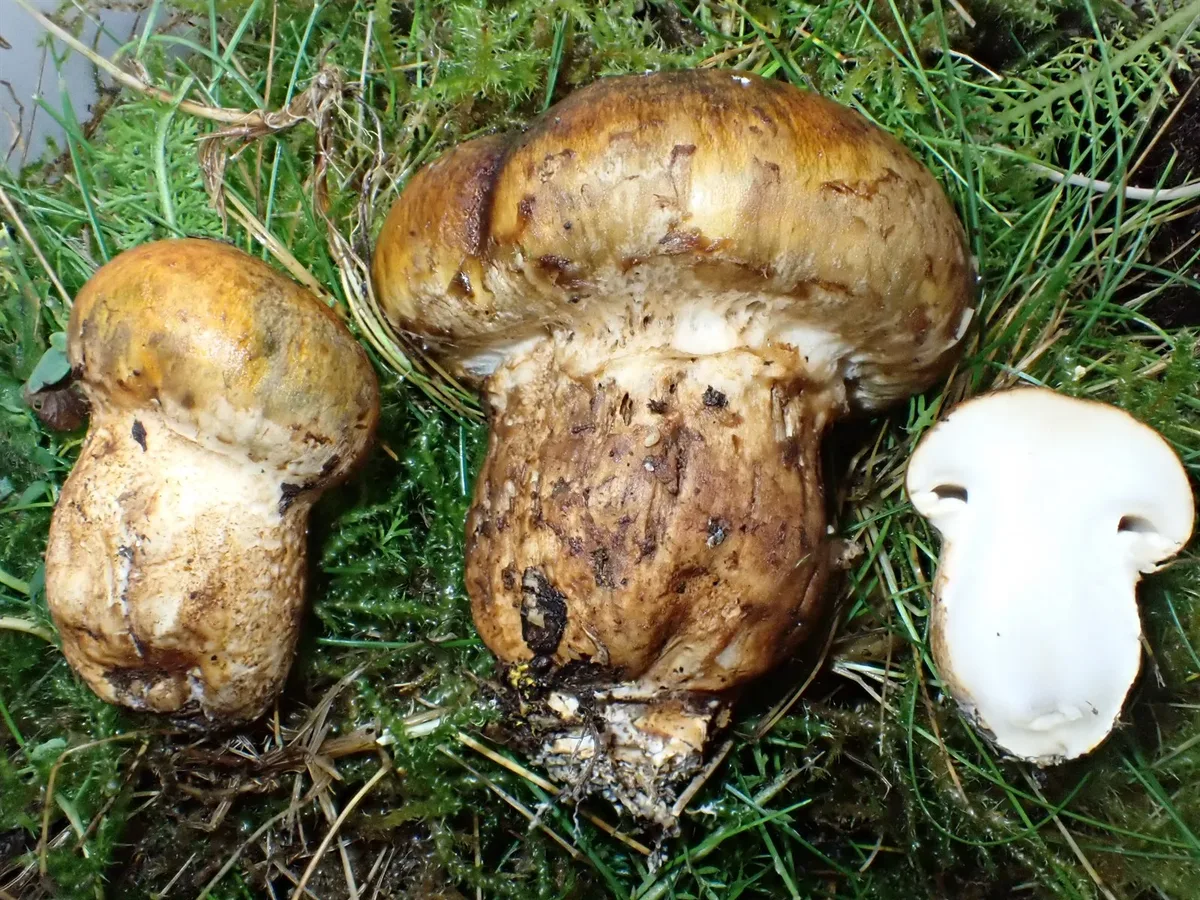
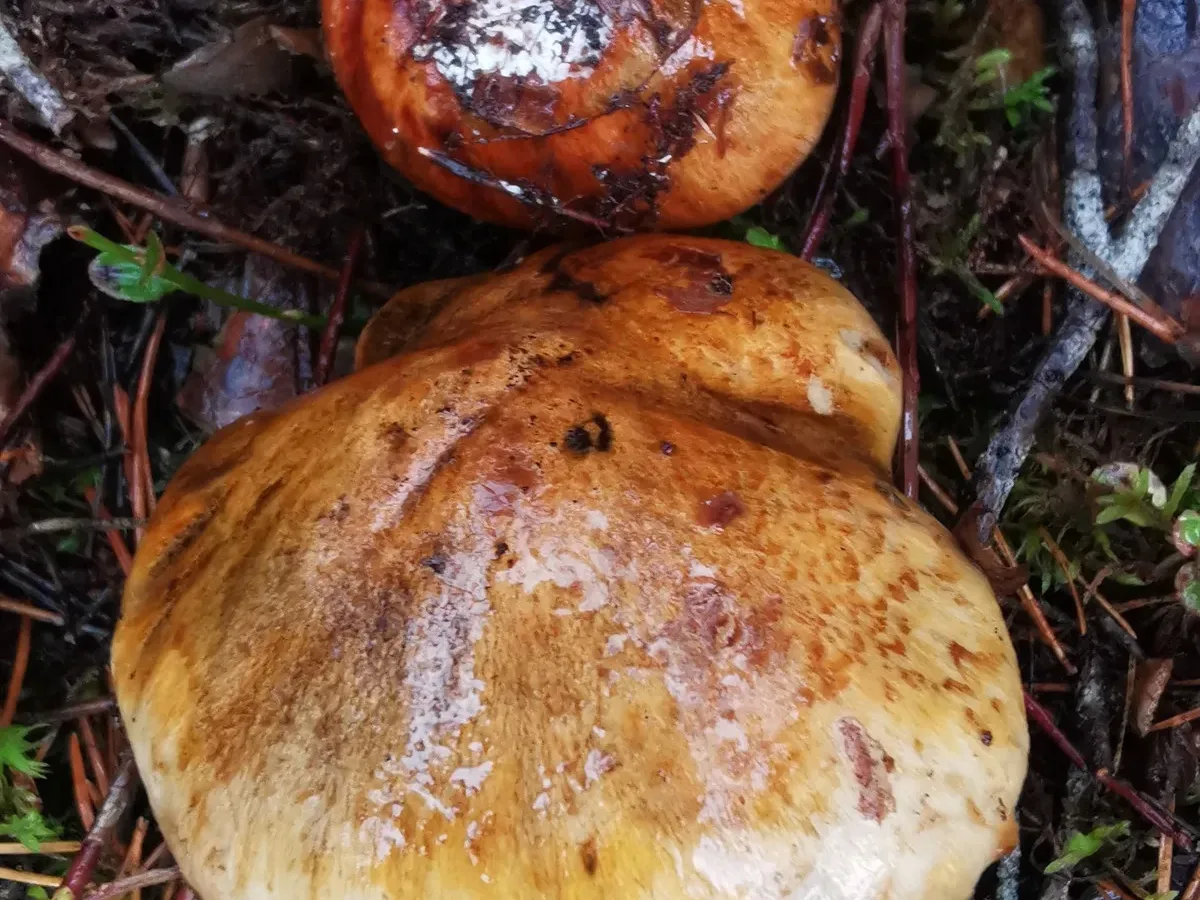
The Booted Knight is one of the most imposing Tricholoma species you are likely to encounter in Pacific Northwest pine forest, and once seen it is hard to forget. Its size alone draws the eye: caps routinely reach 10-14 cm across, set on a thick, solid stem that can be 3 cm or more in diameter - a genuine giant in a genus not known for modesty.
Stem
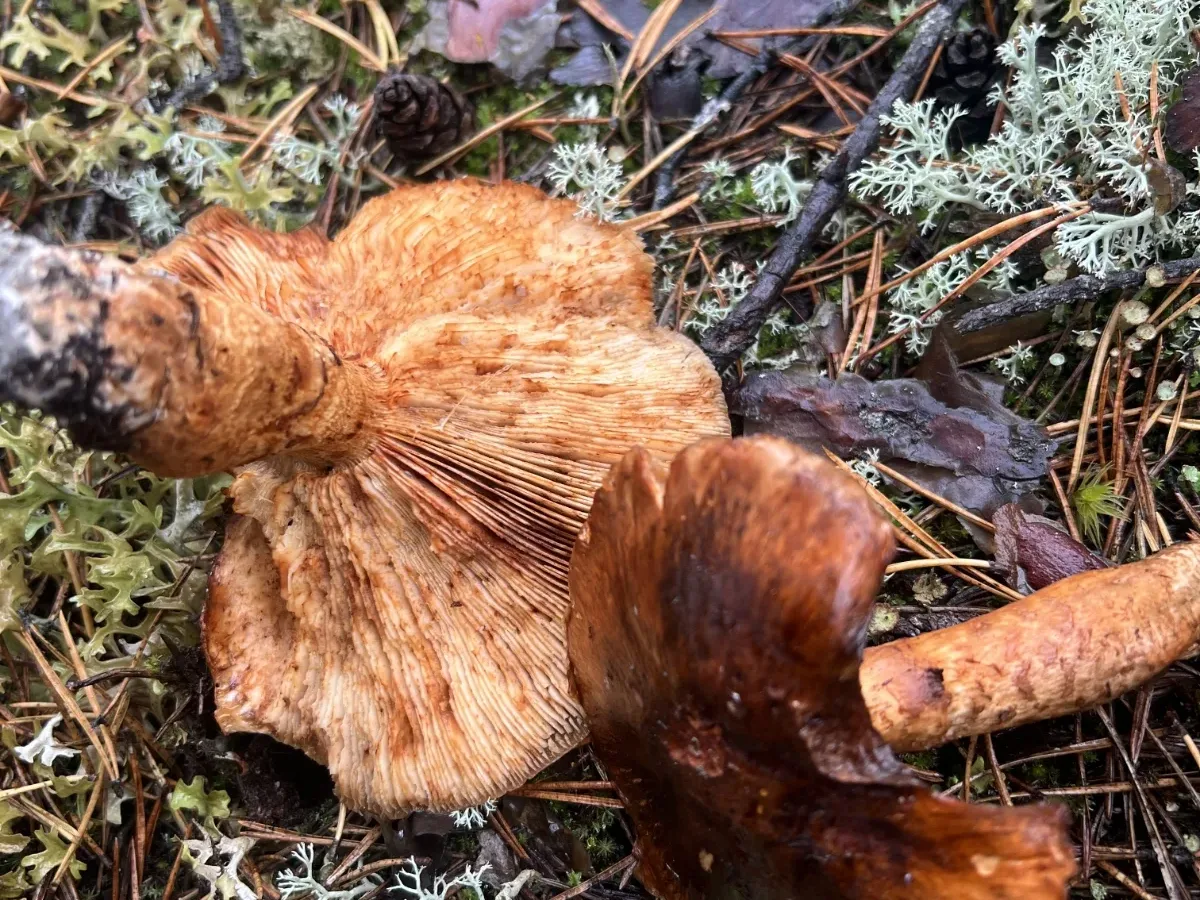
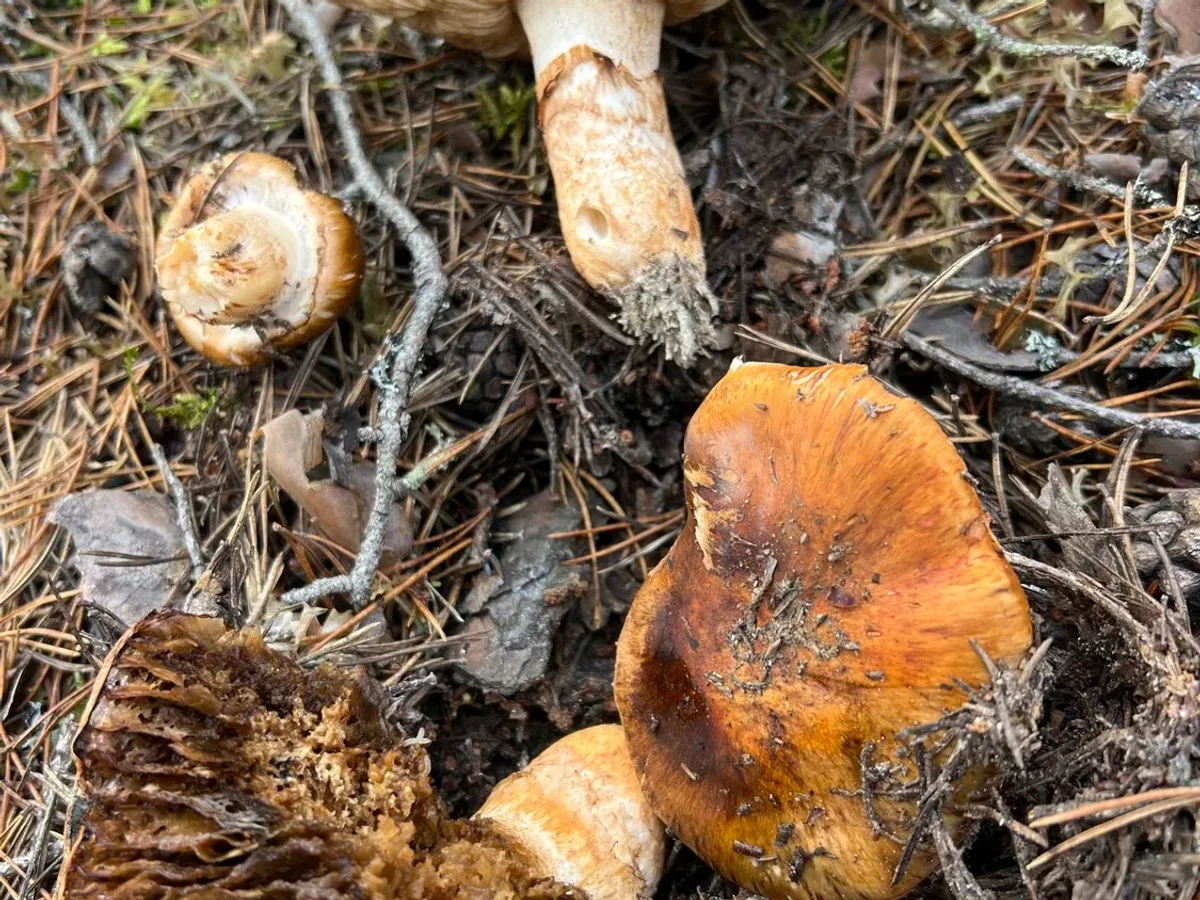
But it is the stem that gives the species its name and its most memorable field character. From roughly mid-stem downward, the pale white or buff stem is clothed in dense, appressed reddish-brown fibrils and scales arranged in a way that looks strikingly like a boot or a fitted gaiter pulled up over the lower leg.
Where this fibrillose sheathing ends, there is a persistent fibrillose ring zone - a cortinate veil remnant that is not a true membranous ring but is distinct, fibrillose, and often coloured with reddish-brown fibrils - that can cause a first-time observer to wonder whether this is an Armillaria (honey fungus) rather than a Tricholoma.
The association with honey fungus was enough that early mycologists actually placed it in Armillaria under the name A. focalis.
Cap
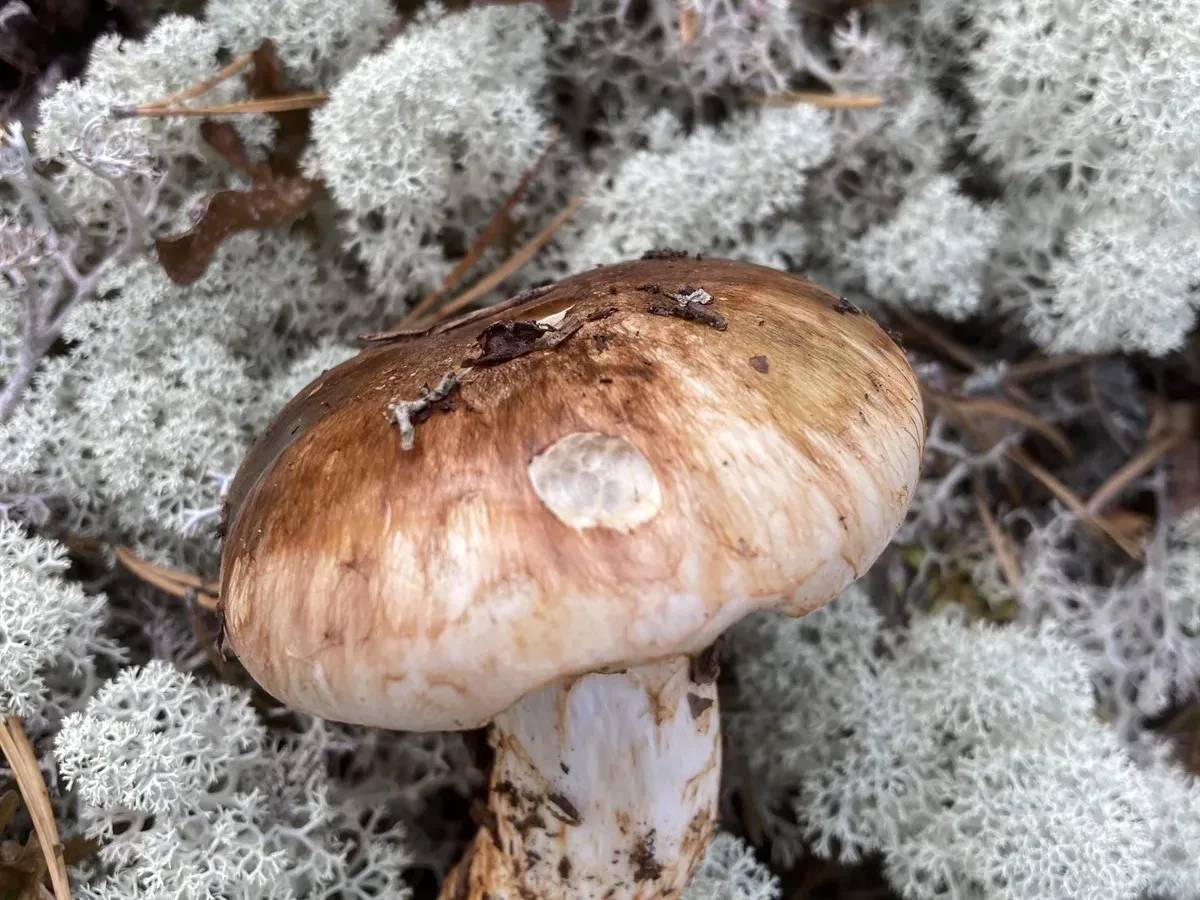
The cap (5-14 cm, occasionally larger) is convex when young with an inrolled margin, and it opens to a broad, gently umbonate dome.
The surface is viscid to distinctly slimy in wet weather - a useful check in the Pacific Northwest where autumn rains are reliable - and reddish-brown to tawny-orange or chestnut-brown, typically darkest at the centre and paler toward the margin.
Gills
The gills are sinuate (the characteristic notch of Tricholoma), white to cream, moderately crowded, and may develop a faint ochre staining with age.
Flesh
Flesh is thick, firm, and white throughout, not changing colour on exposure.
Smell & taste
The smell is strongly mealy/floury - raw grain or starchy flour is the closest analogy - and the taste is bitter and mealy-unpleasant: a useful safety cue, since no edible Tricholoma species worth eating has a persistently bitter taste.
The spore print is white.
Why it's dangerous
The direct toxicity of Tricholoma focale is moderate - it causes unpleasant but not life-threatening gastrointestinal poisoning in healthy adults under typical circumstances.
The more serious hazard is context. This species grows in pine forest alongside Tricholoma pardinum (Dirty Knight), which causes one of the most severe gastrointestinal poisonings in European mycology and has resulted in hospitalisation and rare deaths.
It also grows alongside deadly Cortinarius species (orellanin nephrotoxins), whose initial fruiting appearance in the same environment creates a latent risk for anyone returning to a previously known site and collecting carelessly.
The defining safety rules for this environment are:
- 1never eat any large brown-capped Tricholoma in conifer forest without expert confirmation;
- 2always take a white spore print - this excludes deadly Cortinarius and Inocybe;
- 3dig out the stem base and verify the absence of a volva - this excludes deadly Amanita;
- 4apply the taste test: persistent bitterness means discard;
- 5do not confuse the fibrillose ring zone of T. focale with the true membranous ring of Amanita or Armillaria.
Anyone developing gastrointestinal symptoms within 1-5 hours of eating a wild mushroom from pine forest should seek medical attention and, if possible, retain a sample of what was collected for identification.
Toxin
The gastrointestinal toxic compounds in Tricholoma focale have not been precisely characterised in peer-reviewed literature. The bitter taste suggests terpenoid or phenolic irritants, which are thermolabile to varying degrees but not fully destroyed by ordinary cooking temperatures.
The mechanism is presumed to be local irritation of the gastrointestinal mucosa rather than systemic organotoxicity. No amatoxins, orellanin, gyromitrin, or other named systemic toxins have been documented in this species.
Some European mycological records (including German and French poisoning registries) list it among the mildly toxic Tricholoma GI irritants. North American mushroom poisoning databases echo this classification.
Symptoms
Onset of gastrointestinal symptoms typically 1-3 hours after ingestion of raw or cooked material. Symptoms include:
- nausea;
- vomiting (which may be repeated and forceful);
- abdominal cramping;
- diarrhoea.
The illness is usually self-limiting, resolving within 24 hours with rest and oral hydration.
Larger quantities, or consumption by individuals with sensitive gastrointestinal tracts, children, the elderly, or those with pre-existing conditions, may result in more severe or prolonged symptoms requiring medical management (intravenous fluids).
There is no documented delayed phase, no liver or kidney involvement, and no neurotoxic component in typical T. focale poisoning.
Seek medical attention if symptoms are severe, prolonged, or accompanied by signs outside the gastrointestinal system.
Staying safe
The Booted Knight is not a safe edible and should not be eaten. It is classified as a toxic species, causing gastrointestinal poisoning - nausea, vomiting, cramping, and diarrhoea - in people who consume it.
The GI irritant compounds are of uncharacterised nature (likely terpenoids or phenolics), partially heat-stable, and not reliably eliminated by cooking.
While the species is not among the life-threatening deadly Tricholoma (it does not cause amatoxin-type organ failure, orellanin nephropathy, or the severe rhabdomyolysis seen with T. equestre), it has been listed in European and North American poisoning records as a GI irritant and is widely considered inedible by mainstream field guides.
Beyond its own toxicity, the Booted Knight grows in habitats where genuinely dangerous fungi are present. The bitter, mealy taste is the single most practical safety filter in the field: if a Tricholoma in pine forest tastes persistently bitter, do not eat it.
The taste test is reliable; the visual identification alone is not, because too many similar-looking species exist in the same habitat, some of which are far more dangerous.
This guide classifies T. focale as CAUTION with isPoisonous: true. Do not eat it.
Where & when it grows
Habitat
In the Pacific Northwest, the Booted Knight is a resident of mature pine forest. Its primary tree partners are:
- ponderosa pine on drier, eastern slopes and foothill zones;
- lodgepole pine in montane and subalpine forest;
- western white pine in moister, lower-elevation stands.
It also appears occasionally in mixed conifer forest where Douglas-fir or true firs are present alongside pine, apparently tolerating those associates while still rooting in pine mycorrhizal networks.
Like all ectomycorrhizal Tricholoma species, it cannot grow independently of its host tree; the above-ground mushroom is only the fruiting tip of a perennial underground mycelium that may have been partnering with the same pine for many years.
Look for it on well-drained mineral soils under open, mature pine stands - the type of open, parkland-like ponderosa forest east of the Cascades, or the moister lodgepole parkland at mid-elevation. It does not tend to fruit in dense, closed-canopy stands or in pure Douglas-fir forest.
Fruitbodies often appear singly or in small groups of two to five, sometimes partially buried in accumulated pine needle duff with only the cap visible from above. Lifting the whole specimen reveals the characteristic boot-like lower stem.
When
The Booted Knight is an autumn species, timing its above-ground appearance to coincide with the return of Pacific rains after the long summer dry period.
In the western Cascades and Coast Ranges, the first significant autumn rains typically arrive in October, and this species follows a week or two behind, fruiting through October and into November.
East of the Cascades, where precipitation is more variable, fruiting can begin slightly later in October and persist through November in years with adequate moisture.
In European pine forest, the timing is comparable: September through November with a peak in October.
The species is reasonably cold-tolerant and can persist through early frosts, though hard freezes end the season abruptly.
How it grows
As an obligate mycorrhizal partner of pines, the Booted Knight cannot be cultivated and is entirely dependent on mature, living pines for its carbon source.
The below-ground mycelium is perennial, typically associated with the same trees for many seasons. Productive spots where the species fruits reliably tend to produce fruitbodies year after year as long as the host trees remain.
Above-ground fruitbodies push up through pine needle litter 7-16 days after significant soaking rainfall, once autumn soil temperatures have cooled into the 5-12 °C range.
Because the stem base is often buried in duff and the fruitbody large and fleshy, it can remain in good condition for a week or more before deteriorating, longer than many more delicate species.
Fruiting conditions
Pacific Northwest autumn trigger: the long summer dry season ends with the return of Pacific frontal systems in September-October. Soils in pine stands drain quickly, so sustained rainfall (25 mm or more over 14 days) is more effective than a single heavy event. Fruitbodies emerge 1-2 weeks after soils re-wet and cool below approximately 12 °C, persisting into November or until hard freezes. East-of-Cascades ponderosa pine stands may require slightly cooler soil temperatures (8-10 °C) as the trigger, reflecting the more continental climate.
Look-alikes
The Booted Knight shares its pine-forest habitat with several other large, brown-capped mushrooms, some of which are more hazardous and at least one of which is deadly.
Confident identification requires checking the full character suite:
- viscid cap;
- white sinuate gills;
- fibrillose ring zone on stem;
- boot-like lower stem sheathing;
- white spore print;
- mealy smell;
- strict pine habitat.
Tricholoma pardinum (Dirty Knight / Tiger Knight) is the most dangerous brown-capped Tricholoma in pine and mixed conifer-deciduous forest. It is typically larger (cap to 15 cm), more grey-brown than reddish-brown, with a cap surface broken into concentric, somewhat scaly or tomentose zones rather than smooth-slimy, and it lacks the boot-like fibrillose stem sheathing and ring zone of T. focale.
T. pardinum has a strongly mealy smell and grows under beech, fir, and spruce on calcareous ground. It causes one of the most severe gastrointestinal poisonings known - violent, prolonged vomiting and diarrhoea beginning 30 minutes to 4 hours after ingestion, frequently requiring hospitalisation; rare fatalities are documented.
While the two species are separable by experienced observers, a beginner may struggle, and any brown-capped Tricholoma in conifer forest that lacks the distinctive ring zone of T. focale should be treated with great suspicion.
Tricholoma pessundatum (Spotted Knight) is a medium-to-large pine-specialist with a viscid reddish-brown cap and spotting on the gills and stem, but it lacks a ring zone or boot-like fibrillose stem sheathing entirely - the stem is paler, spotted rather than scaly-sheathed. It is toxic (GI irritant).
Tricholoma imbricatum (Mat Knight) has a dry, fibrillose-scaly rather than viscid cap, lacks the ring zone and boot-like lower stem, and grows with pine. It is of uncertain or mildly negative edibility.
Armillaria mellea (Honey Fungus) was historically confused with T. focale (hence the old synonym A. focalis): it also grows near conifers and has a ring and a brownish cap.
However, Armillaria grows in dense clusters at or around the base of dead or dying trees or stumps (it is a wood decomposer, not a mycorrhizal partner), has a true membranous ring on the stem (not a fibrillose zone), darker brown scales on the cap, and leaves a white spore print. The clustering, wood-associated growth and the true ring (membranous rather than fibrillose) are clear separators.
Cortinarius rubellus (Deadly Webcap) and related orellanin-containing webcaps can occur in the same pine forest habitat. They are smaller and more slender than T. focale, with rusty-orange to cinnamon caps, but could be encountered nearby.
They produce a rusty-brown spore print (not white) and retain remnants of a cobwebby cortina on the upper stem (which stains rust-orange from spore fall). They contain orellanin, a nephrotoxin that causes irreversible kidney failure with onset delayed 2-3 weeks after ingestion - long enough that the victim may not connect the illness to the mushroom.
A white spore print is essential to exclude Cortinarius: T. focale is firmly white-spored.
Deadly Amanita species (A. phalloides, A. virosa) occasionally occur in mixed conifer-broadleaf stands. They always have a true membranous ring on the stem and a sac-like volva at the stem base.
T. focale has neither a true ring nor a volva. Always dig out the stem base to verify the absence of a volva when any uncertainty exists.
Occurs in the same pine forest habitat. It is smaller and more slender than T. focale, with an orange-tawny to brick-red conical-umbonate cap, rusty-orange gills, and a rusty-brown spore print. Remnants of a cobwebby cortina (visible as rusty strands on the upper stem stained by falling spores) are present in young and mid-aged specimens. Contains orellanin, a delayed-action nephrotoxin causing irreversible kidney failure 2-6 weeks after ingestion - a particularly insidious danger because the latency allows victims to attribute illness to an unrelated cause. A WHITE spore print is the definitive test: T. focale leaves white spores; C. rubellus leaves rusty-brown. Never eat any pine-forest mushroom without making a spore print.
Deadly Amanita species occasionally occur in mixed conifer-broadleaf stands adjacent to pine. They are separated from T. focale by two absolute features: a true membranous ring on the stem AND a sac-like volva at the stem base. T. focale has a fibrillose ring zone (not a membranous ring) and NO volva. Always dig the stem base clear of litter and confirm the absence of a volva before handling any large pale or greenish-white mushroom near conifers.
Larger and more grey-brown than reddish-brown; cap surface breaks into concentric zones of fibrous scales (giving a 'tiger' or 'leopard' pattern) rather than being smooth-slimy; LACKS the boot-like fibrillose stem sheathing and ring zone that define T. focale; grows primarily under beech and silver fir in montane forest (not typically under pine). Despite being listed isDeadly:false (it is not reliably lethal in healthy adults), T. pardinum causes one of the most severe GI poisonings in European mycology - violent vomiting and diarrhoea requiring hospitalisation in many cases, and rare fatalities are recorded. Treat any confusion between this species and T. pardinum as a serious safety concern.
Historically confused with T. focale (it carried the synonym Armillaria focalis). Honey fungus grows in dense clusters at or near the base of dead or dying trees, on stumps, or on buried wood - it is a wood decomposer, not a mycorrhizal soil mushroom. It has a true membranous ring (not a fibrillose zone) and dark-brown scales on the cap centre. T. focale grows singly or in small groups in open pine soil, far from any stump, and has a fibrillose (not membranous) ring zone.
Similar build and pine association, but the cap is dry and finely fibrillose-scaly - never viscid or slimy when wet. No ring zone and no boot-like stem sheathing. Typically smaller and less robustly built than T. focale. Of uncertain or mildly negative edibility.
Also a pine specialist with a viscid reddish-brown cap and mealy smell, and also toxic (GI irritant). Separated from T. focale by the complete absence of any ring zone or fibrillose boot-like stem sheathing; the stem of T. pessundatum is pale with irregular brownish spotting but never scaly-sheathed below a ring zone. Both species are inedible; the distinction matters for identification records but not for the safety outcome.
A reference guide - never an edibility guarantee. When in doubt, leave it out.