Eucalyptus knight
Tricholoma eucalypticum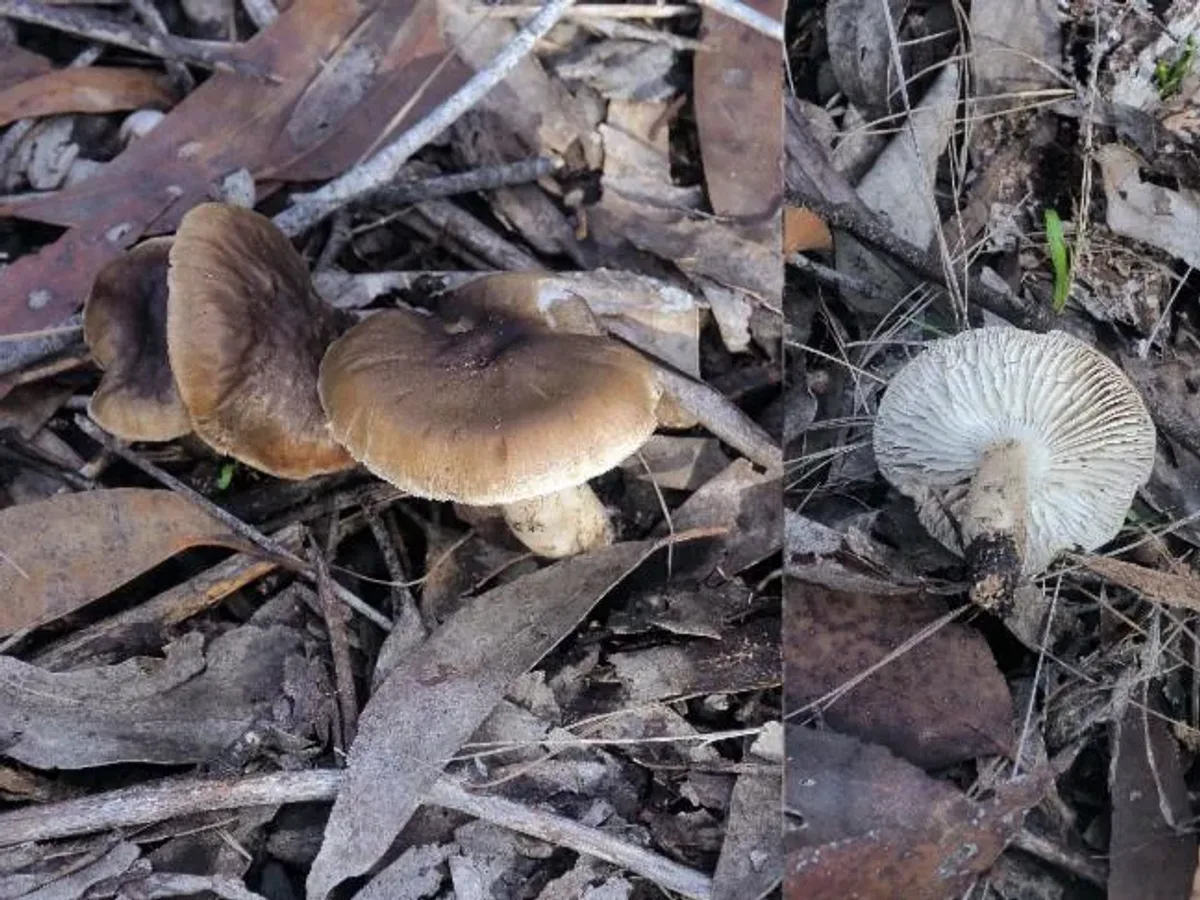 © Richard Hartland (CC BY)
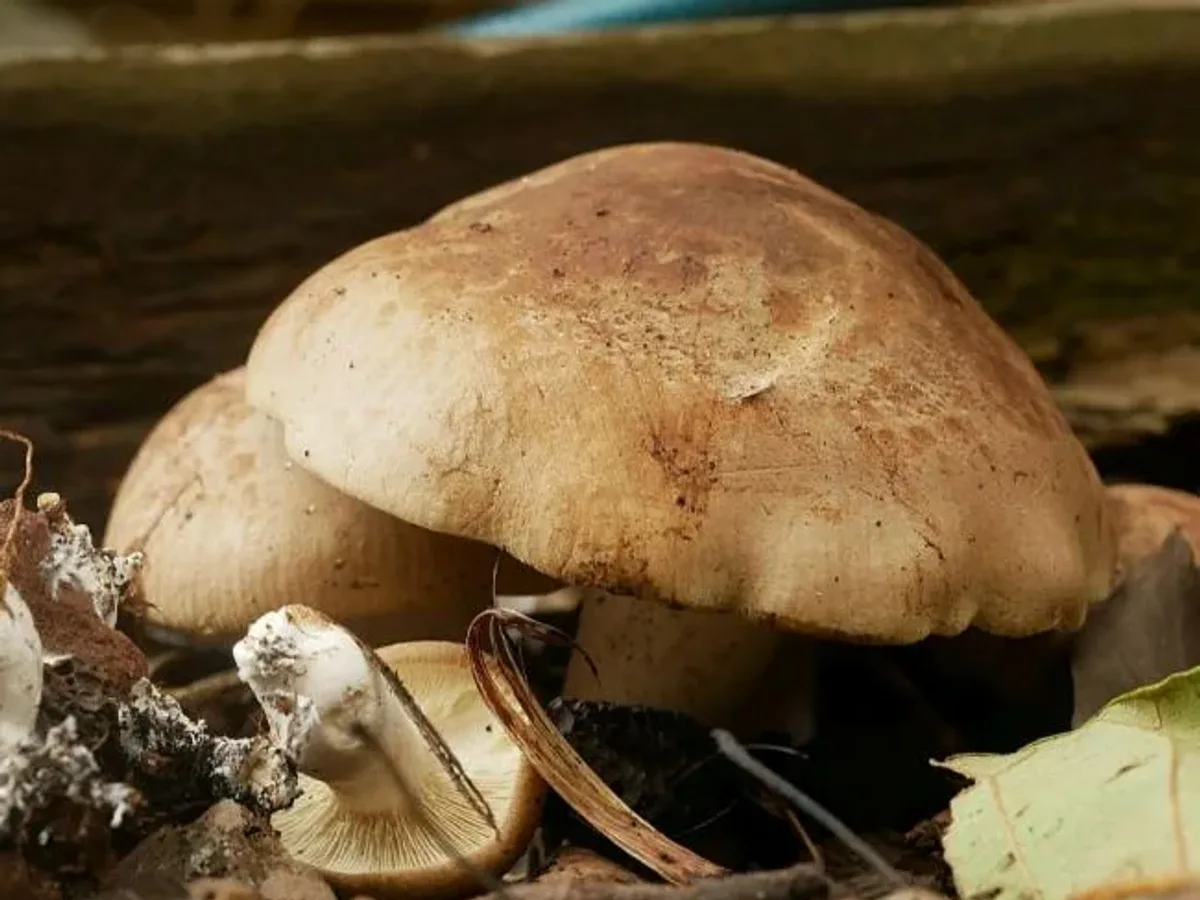 © Torbjorn von Strokirch (CC BY)
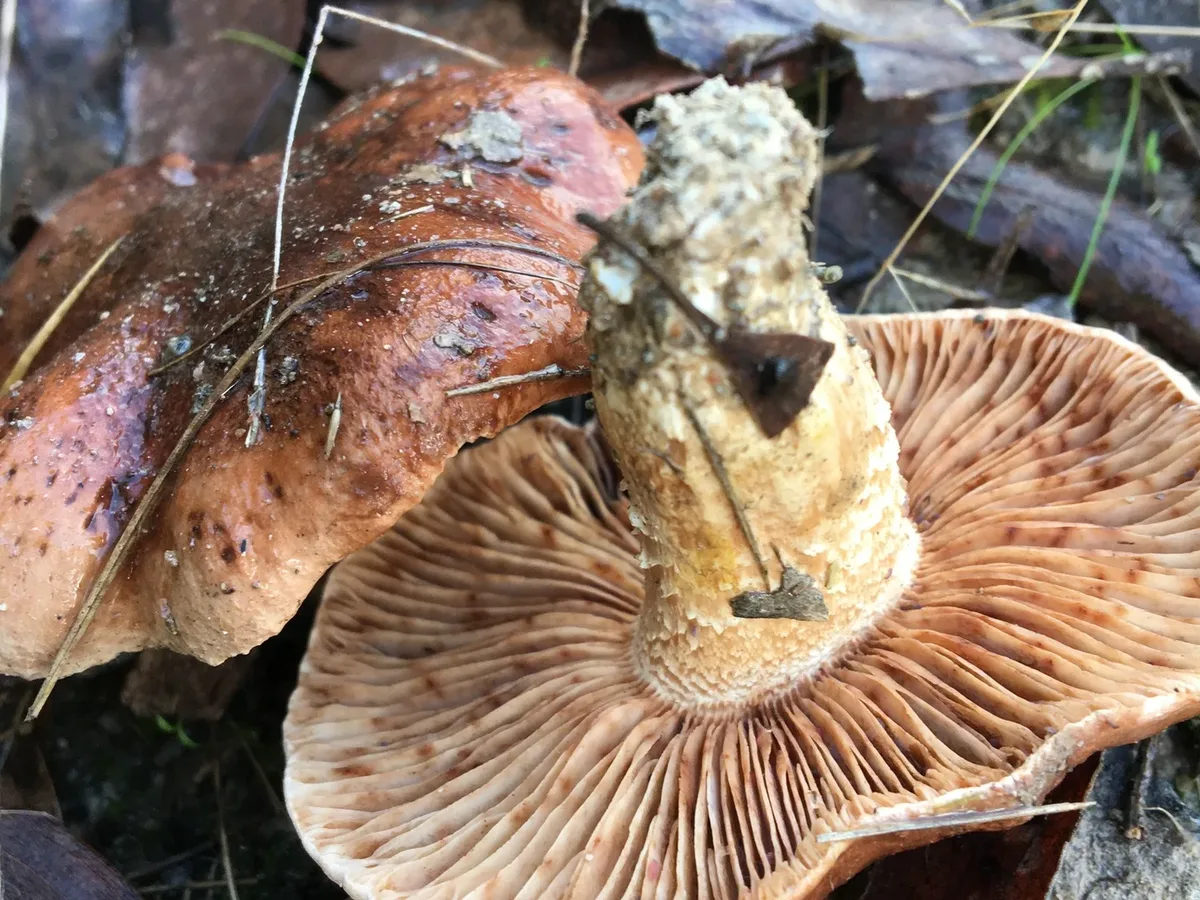 Eileen Laidlaw (CC0)
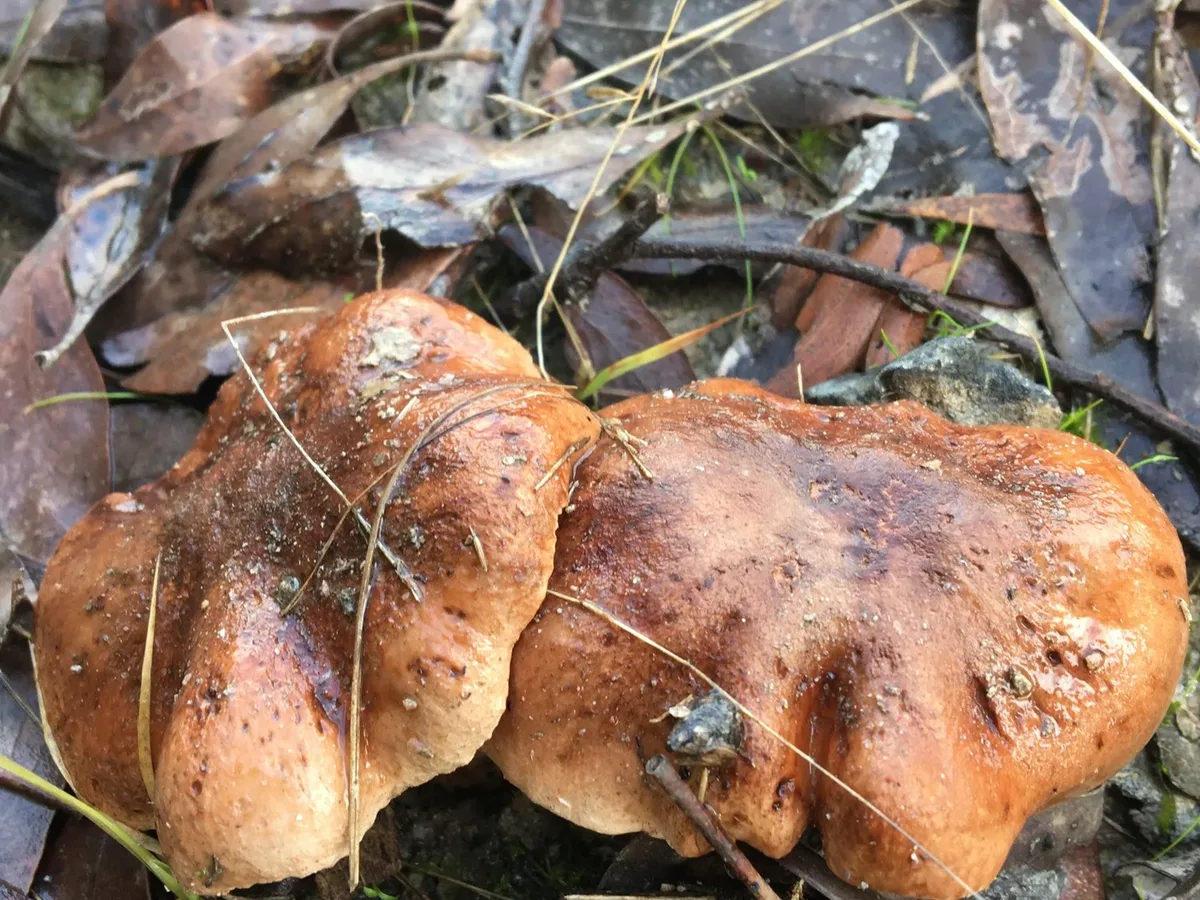 Eileen Laidlaw (CC0)
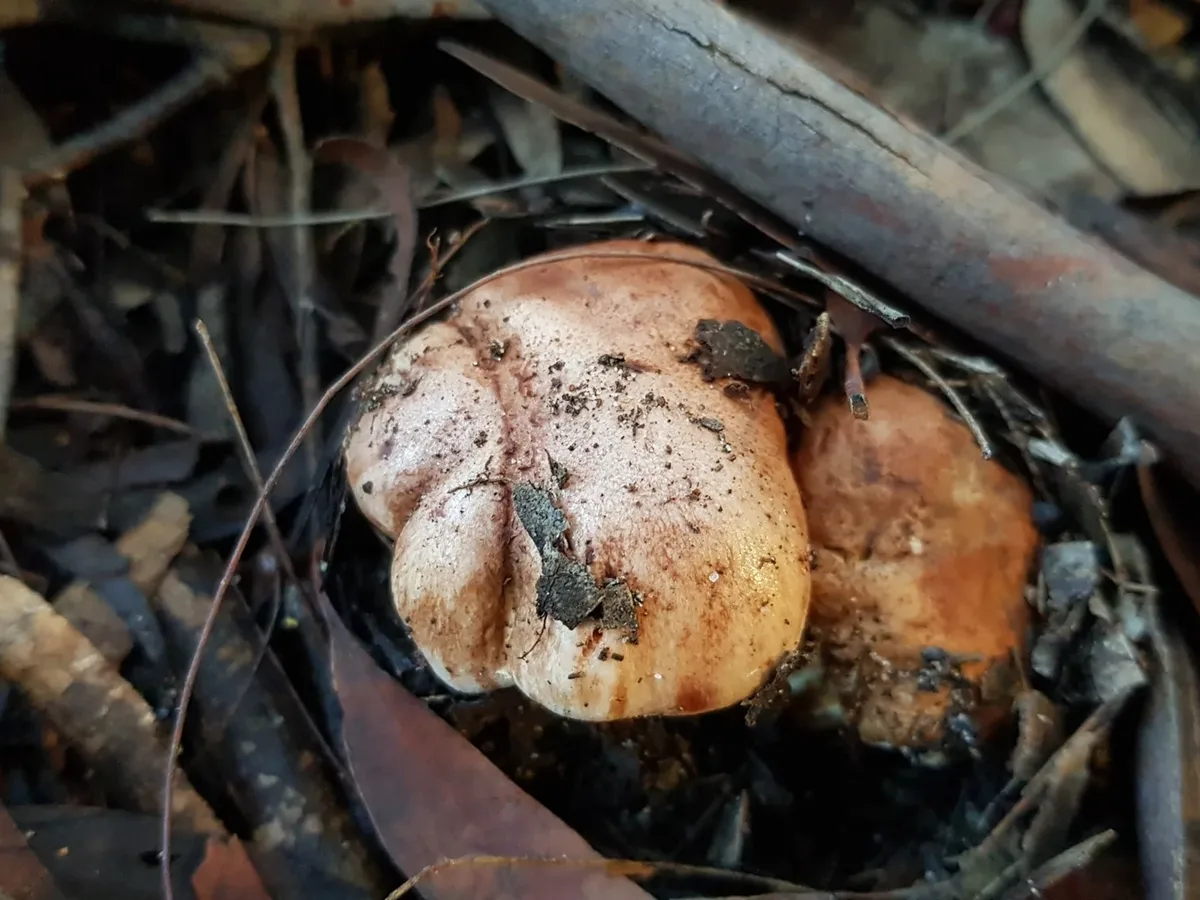 © Sofia Zvolanek (CC BY)
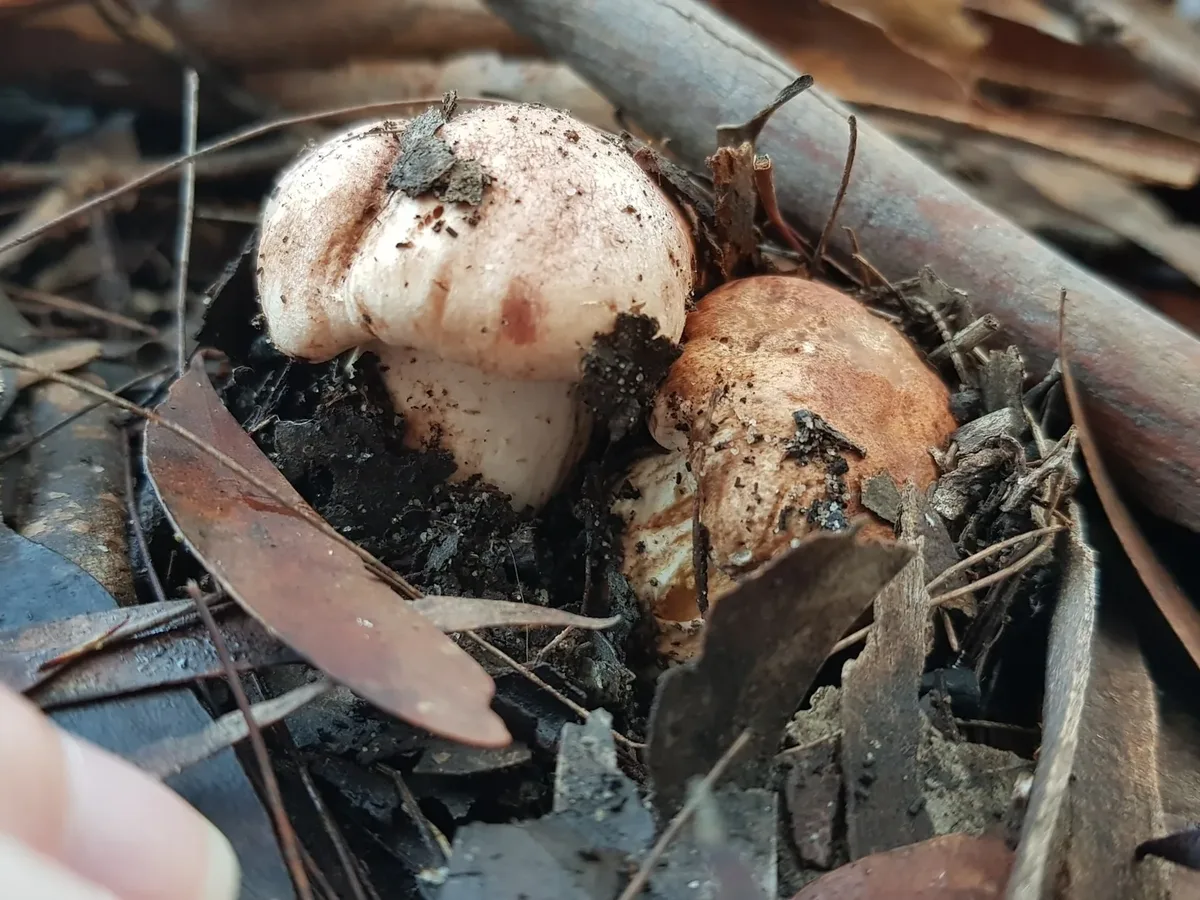 © Sofia Zvolanek (CC BY)© Richard Hartland (CC BY)© Torbjorn von Strokirch (CC BY)
Edible only with the right preparation - or safe for some people but not others. Learn the caveats first.
Never eat a mushroom you are not 100% sure of - check the look-alikes below, and always cook wild mushrooms.
How to recognise it
Tricholoma eucalypticum is a medium-sized grey-brown knight mushroom of Australian eucalyptus woodland.
Cap
The cap surface is characteristically dry and radially fibrillose - covered in fine, silk-like fibres running from centre to margin - giving it a streaked or softly matted look in shades of mouse-grey, grey-brown, or olive-grey, always darkest at the centre and palest toward the incurved margin.
The texture is never viscid or slimy, a reliable point of separation from the slimy-capped webcaps (Cortinarius, Phlegmacium section).
Gills
The gills are white to cream, crowded, and sinuate - notched where they attach to the stem - which is a hallmark of the Tricholoma genus.
They stay white throughout development and drop a white spore print, which is the critical test for ruling out the orellanin-containing webcaps that deposit a rusty-brown powder.
Stem
The stem is pale whitish-grey, fibrous, and carries no ring or volva, immediately ruling out Amanita.
Flesh
Flesh is firm and white throughout, unchanging when cut.
Smell & taste
The most important diagnostic feature is the smell: a pronounced mealy or farinaceous odour, like fresh flour or raw cucumber, that announces the Tricholoma group before anything else is checked.
Where & when it grows
Habitat
This species forms an obligate ectomycorrhizal partnership with living eucalyptus trees - a relationship that may persist for years unseen as mycelium threads through the soil among fine roots, before surfacing as fruitbodies when conditions align.
You will only find it growing in the company of Eucalyptus. Look for fruitbodies in the leaf litter within the root zone - typically 1-4 metres from the trunk, beneath the spread of the canopy.
It is most common in temperate south-eastern Australia and in New Zealand wherever Eucalyptus has been planted.
The tight dependence on eucalyptus is itself a useful diagnostic clue: no other grey-brown, mealy-smelling Tricholoma shares this specific habitat association in Australia.
Fruitbodies are sometimes partly buried under accumulated dry leaf litter; dig carefully to expose the full stem base for a complete identification.
When
In the Southern Hemisphere, Tricholoma eucalypticum fruits in autumn and early winter - broadly March through July, with the peak flush in April and May.
Fruiting is triggered when soil temperatures cool into the 8-14 °C range after summer heat and sufficient autumn rainfall rehydrates the soil. Fruitbodies typically emerge 10-20 days after meaningful autumn rain (15 mm or more over a week).
Warm, dry autumns suppress fruiting strongly or prevent it entirely. The most generous flushes follow cool Aprils with good rain through March and April.
How it grows
As a mycorrhizal species, Tricholoma eucalypticum cannot be grown without its eucalyptus partner.
Fruitbodies emerge singly or in small, loose groups from underground mycelial networks woven through eucalyptus root systems - networks that persist quietly through dry and unfavourable years, fruiting again whenever conditions allow.
Experienced naturalists find that productive spots tend to reappear in the same locations year after year: the mycelium endures even when nothing is visible above ground.
Button-stage fruitbodies push up through accumulated leaf litter and may be partly buried; always dig carefully to uncover the full stem base before attempting identification.
Fruiting conditions
Southern Hemisphere autumn-fruiting species. Best flushes follow 15 mm or more of rain in the two weeks prior, with soil temperatures at 5 cm depth having cooled to 8-13 degrees C after summer. The lag between triggering rain and visible fruitbodies is typically 10-21 days. Warm, dry autumns suppress fruiting strongly; cool, wet Aprils produce the most productive seasons.
Handle with care
Toxin
No specific toxin has been documented in Tricholoma eucalypticum itself.
However, the broader grey-brown Tricholoma complex has been implicated in rhabdomyolysis in Europe, and the exact compounds involved remain under investigation.
The uncertainty about the potential presence of similar myotoxic compounds in Australian grey-brown Tricholoma is one reason the caution rating is warranted.
Symptoms
No confirmed poisoning cases from Tricholoma eucalypticum specifically are documented in the literature.
Gastrointestinal symptoms (nausea, vomiting, diarrhoea) would be expected if any toxic compound were present, similar to what is observed with European grey knights.
Rhabdomyolysis syndrome - muscle pain, weakness, and dark urine - has been associated with some European grey-knight Tricholoma, appearing 1-4 days after consumption.
Misidentification as Cortinarius could result in orellanin poisoning: mild initial symptoms appearing 2-21 days after ingestion, progressing to acute renal failure.
Look-alikes
Several dangerous species must be considered before handling grey-brown, mealy-smelling Tricholoma in Australian eucalyptus woodland.
The most critical concern is the orellanin-containing webcaps (Cortinarius species), which fruit under eucalyptus in the same season and can produce grey-brown fruitbodies of similar stature. The decisive test is the spore print: Cortinarius always deposits a rusty-brown, cinnamon, or orange-brown powder - never white.
Other grey-brown candidates include:
- Hebeloma (radish-smell, not mealy; clay-brown spore print)
- Inocybe (fibrous silky cap that splits radially; brown spore print; distinctive spermatic smell)
- Entoloma (pink spore print, often pink-flushed gills)
Any brown or pink spore print disqualifies the specimen entirely.
The European leopard knight (Tricholoma pardinum), which is a toxic gastrointestinal irritant, does not occur naturally in Australian eucalyptus woodland but is mentioned as a comparative reference because its grey-brown, mealy profile reinforces that this morphological type in Tricholoma should be treated with caution.
Why it matters
The primary danger associated with Tricholoma eucalypticum is the very real risk of fatally misidentifying it as a deadly Cortinarius webcap, which fruits in the same eucalyptus woodland habitat during the same season.
The absence of certainty about its own edibility means it should be left alone by anyone who is not a trained and experienced mycologist.
Cortinarius australiensis and related orellanin-containing webcaps fruit under eucalyptus in the same season and habitat, and can produce grey-brown fruitbodies of similar stature. The single most reliable test is the spore print: Cortinarius always deposits a rusty-brown, cinnamon, or orange-brown powder - never white. Additional clues: young Cortinarius has a cobwebby cortina (veil) between cap margin and stem, leaving faint rust-stained fibrils on the stem; the gills of mature specimens are rust-brown or ochre-brown rather than white. Cortinarius australiensis contains orellanin, a nephrotoxin that causes irreversible kidney damage with symptoms appearing 2-21 days after ingestion, making it one of the most insidious poisons in the Australian fungal flora. A white spore print is non-negotiable before any grey-brown Tricholoma is trusted.
Various Inocybe species grow in Australian eucalyptus woodland and share the fibrous, brownish cap. Inocybe is distinguished by: (1) a distinctive earthy, mouldy, or spermatic smell - not mealy or farinaceous; (2) a brownish spore print, not white; (3) gill colour that develops to clay-brown in maturity; and (4) a cap surface that often splits radially with age. Inocybe species contain muscarine and cause profuse sweating, salivation, and lacrimation - they require urgent medical attention.
Some Entoloma species have grey-brown caps with mealy odours and fruit under eucalyptus. The definitive distinction is the spore print: Entoloma produces a pink to salmon-pink deposit due to its angular, multisided spores - never white. The gills of mature Entoloma often develop a pink flush. Some larger Entoloma species are seriously toxic. Any pink spore print means Entoloma - reject the specimen.
The European leopard knight is a seriously toxic (though rarely lethal) Tricholoma of conifer and beech forest that does not occur naturally in Australian eucalyptus woodland. It is listed here as a comparative reference for foragers with European experience: T. pardinum has a very similar grey-scaly cap and mealy odour profile to T. eucalypticum. T. pardinum causes violent, prolonged gastrointestinal poisoning within 1-3 hours. Its existence in the same genus reinforces that grey-brown, mealy-smelling Tricholoma should never be casually eaten.
Hebeloma species are toxic gastrointestinal irritants that fruit in eucalyptus woodland. They have a clay-brown to ochre cap (often paler, not grey-fibrous), a radish or beet-like odour distinct from the mealy smell of Tricholoma, and clay-brown to brownish gills and spore print. The gills of Hebeloma are often beaded with small drops of moisture when young. A brown spore print immediately rules out Tricholoma eucalypticum.
In the kitchen
Picking & cleaning
Before considering any specimen of Tricholoma eucalypticum for consumption, note that this species has not been rigorously evaluated for edibility in the scientific literature, and the entire Tricholoma genus contains multiple toxic members.
The safest approach is to treat all grey-brown, mealy-smelling Tricholoma as caution status - suitable for observation and documentation rather than eating.
If collection is intended despite the uncertainty, confirm every specimen individually with all of these criteria:
- 1white spore print, not rusty - ruling out deadly Cortinarius;
- 2absence of any ring or volva - ruling out Amanita;
- 3fibrillose dry cap with no sliminess;
- 4growing strictly under eucalyptus; and
- 5the characteristic mealy smell.
Do not collect very young buttons where gills are not yet visible or a spore print cannot be taken.
Never eat raw; cook thoroughly. Consume only a small amount on the first occasion to test for individual sensitivity.
Cooking
Tricholoma eucalypticum is not recommended for culinary use given its unresolved edibility status.
Only a trained, experienced mycologist who has positively identified every specimen to species level, taken a white spore print, and ruled out all Cortinarius lookalikes should consider cooking this mushroom.
If that bar is met: always cook thoroughly - never consume raw. Most Tricholoma should be sauteed over moderate-high heat until all moisture has evaporated and the flesh is fully cooked through.
The mealy flavour is assertive and suits simple preparations: butter, garlic, and parsley, or as an ingredient in soup stock where prolonged heat ensures thorough cooking.
Consume only a small amount on a first occasion to test individual sensitivity. Do not serve to guests or children, and do not consume in quantity before personal tolerance is established.
Good to know
Tricholoma eucalypticum has not been established as a safe edible species in peer-reviewed mycological literature. Anecdotal reports of consumption in Australia without ill effect exist, but no systematic edibility trials have been conducted.
The broader grey-brown Tricholoma complex includes documented toxics: the European Tricholoma terreum was long considered edible until evidence emerged linking it to rhabdomyolysis (muscle breakdown) in some consumers.
Given this context, and applying the precautionary principle that governs edibility ratings in this library, Tricholoma eucalypticum is rated caution: it should not be assumed edible without expert verification, and new foragers should avoid this group entirely.
The primary life-threatening risk is misidentification as a deadly orellanin-containing Cortinarius species, which causes irreversible kidney failure with delayed symptoms.
A reference guide - never an edibility guarantee. When in doubt, leave it out.