Man on Horseback
Tricholoma equestresyn. Tricholoma flavovirens, Tricholoma auratum, Agaricus equestris, Agaricus flavovirens, Gyrophila equestris
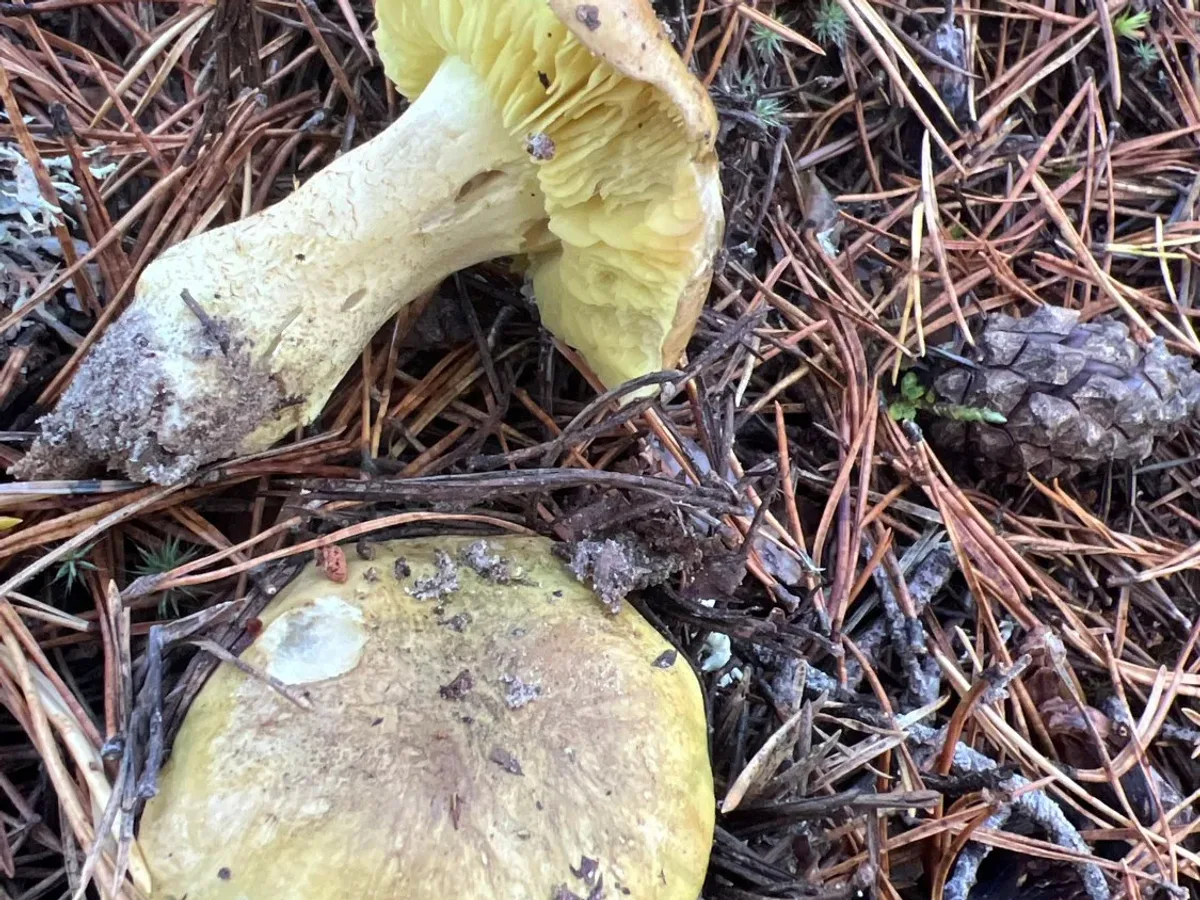 © Leila S. Berg (CC BY)
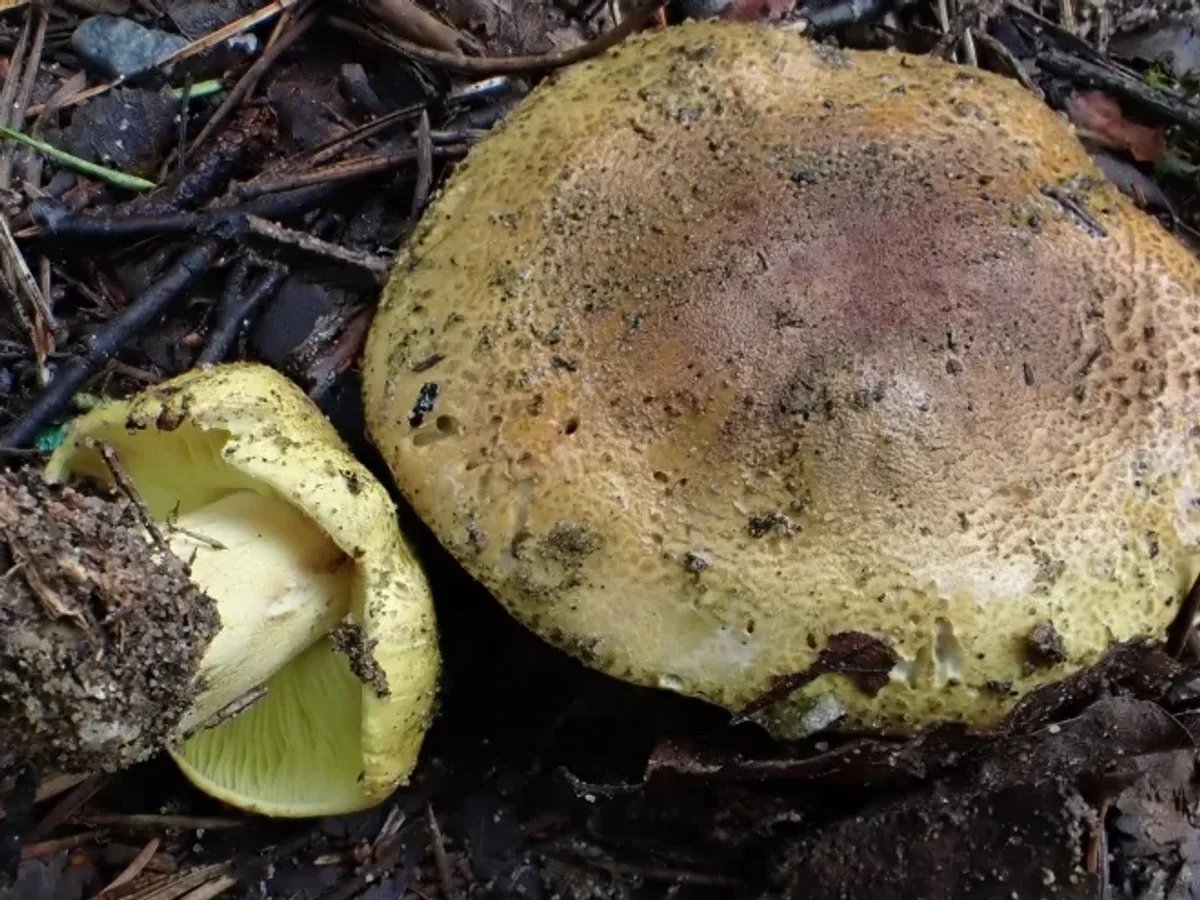 © Morten Pettersen (CC BY)
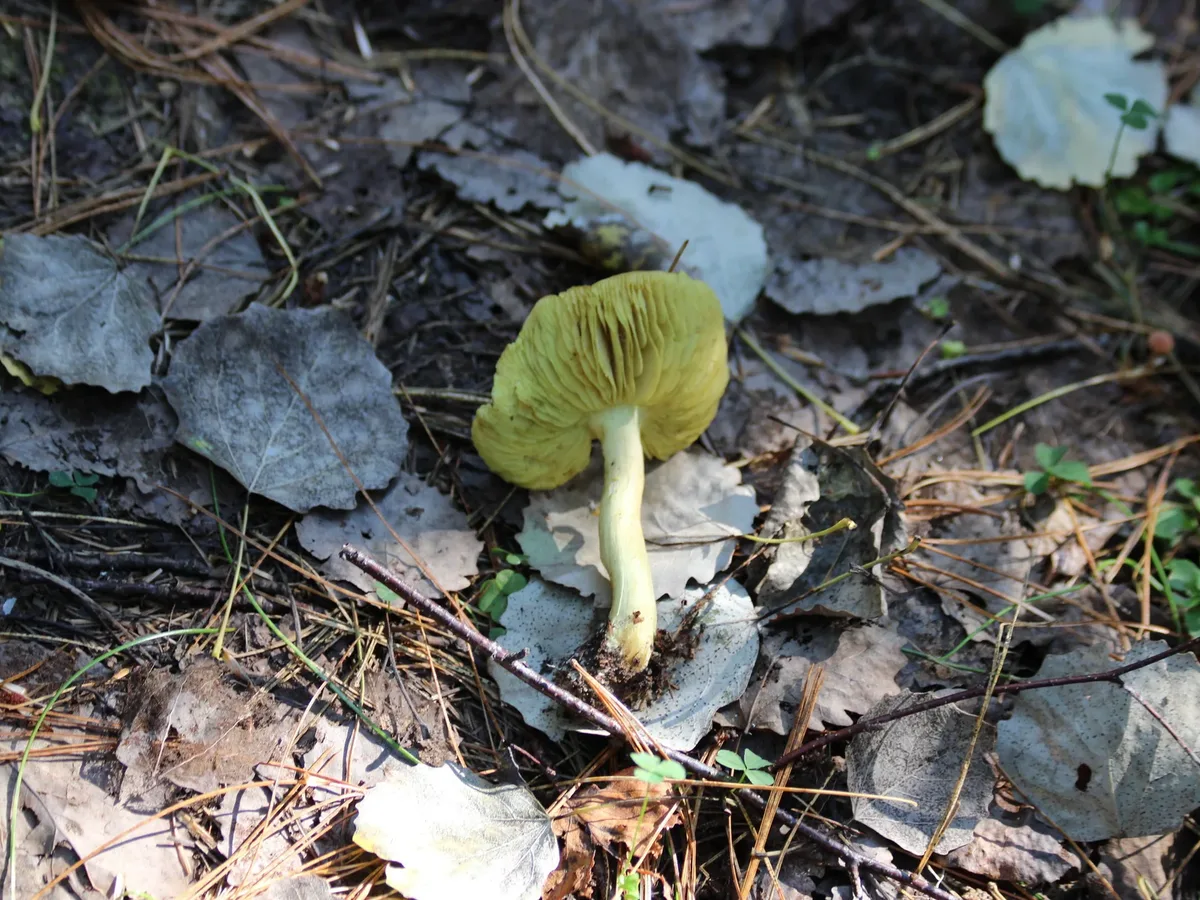 © Tatiana Strus (CC BY)
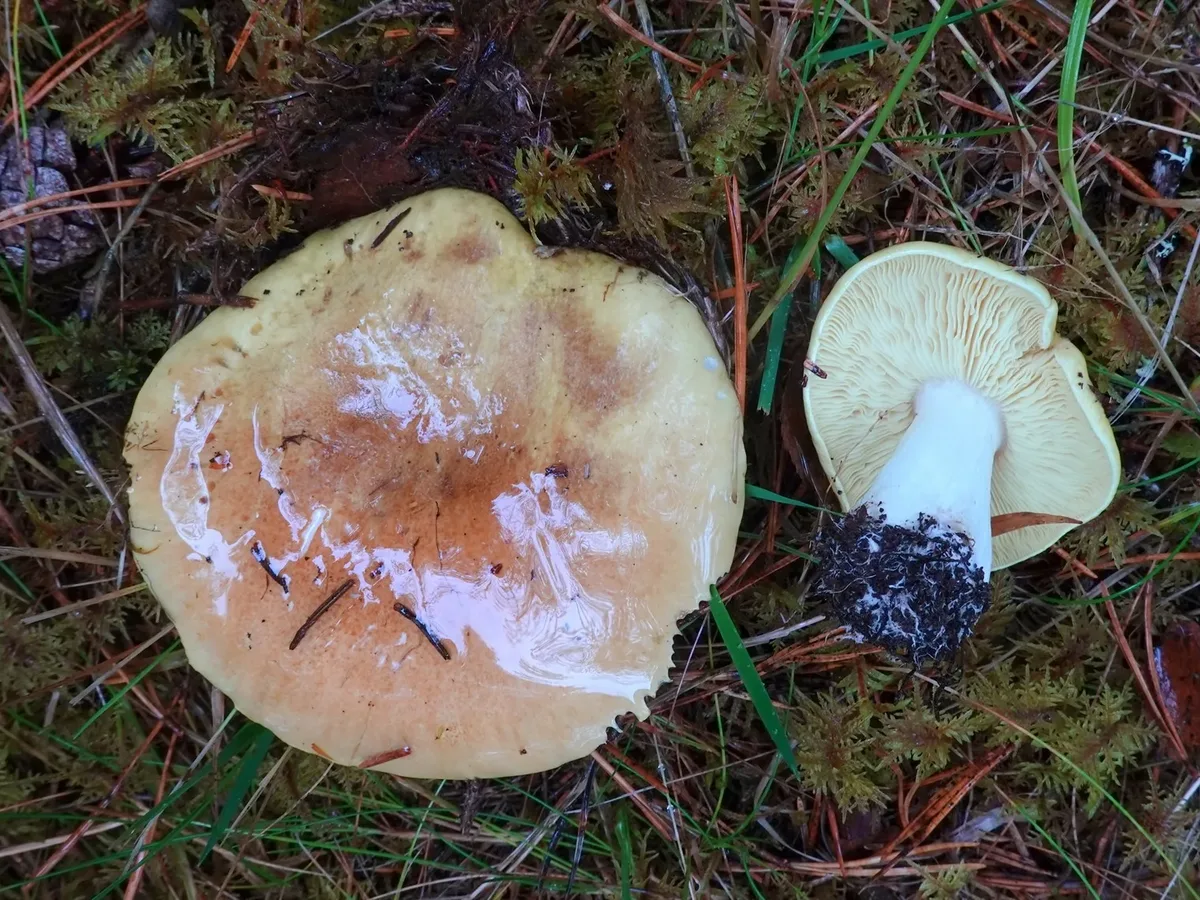 © Perry Gunnar Larsen (CC BY)
 © Leila S. Berg (CC BY)
 © Anne Christenson (CC BY)
 © Anne Christenson (CC BY)© Leila S. Berg (CC BY)© Morten Pettersen (CC BY)
Edible only with the right preparation - or safe for some people but not others. Learn the caveats first.
Never eat a mushroom you are not 100% sure of - check the look-alikes below, and always cook wild mushrooms.
How to recognise it
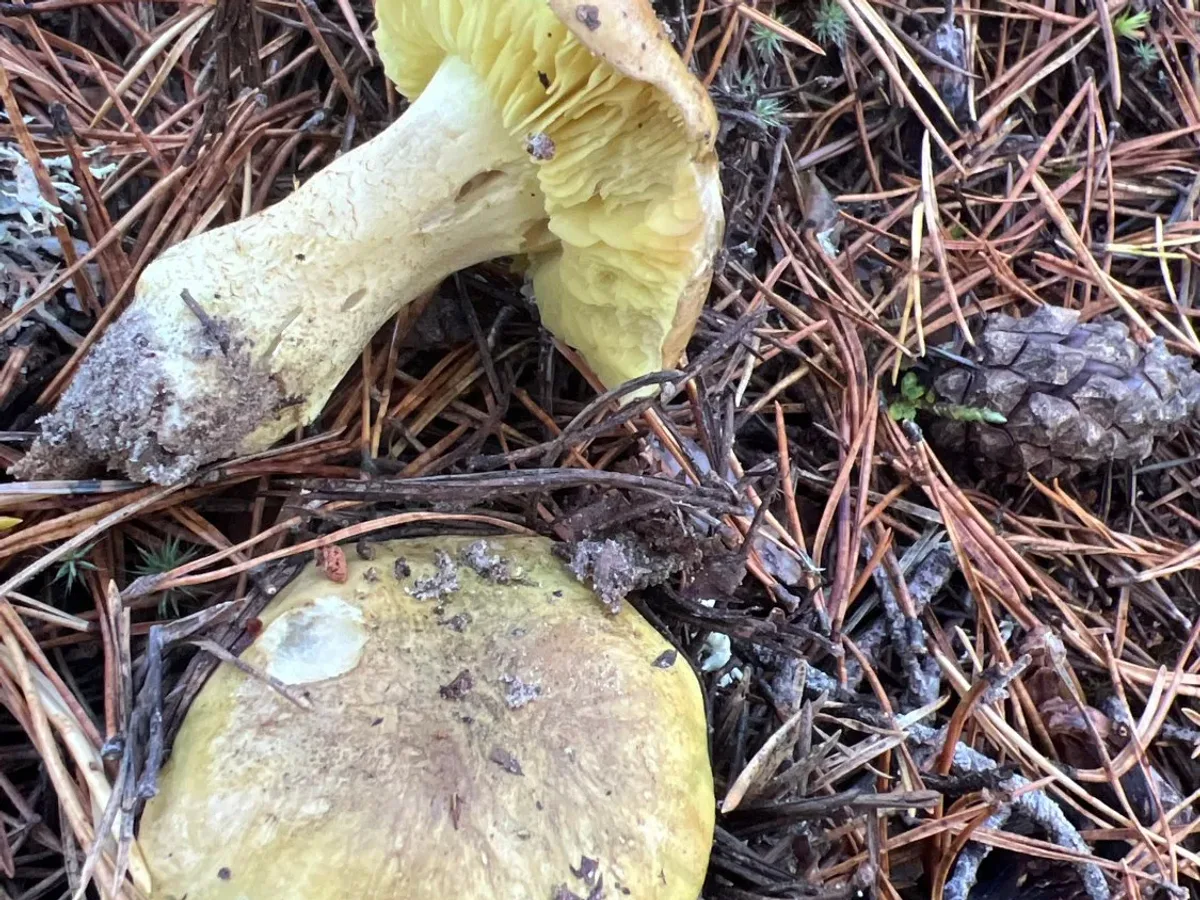
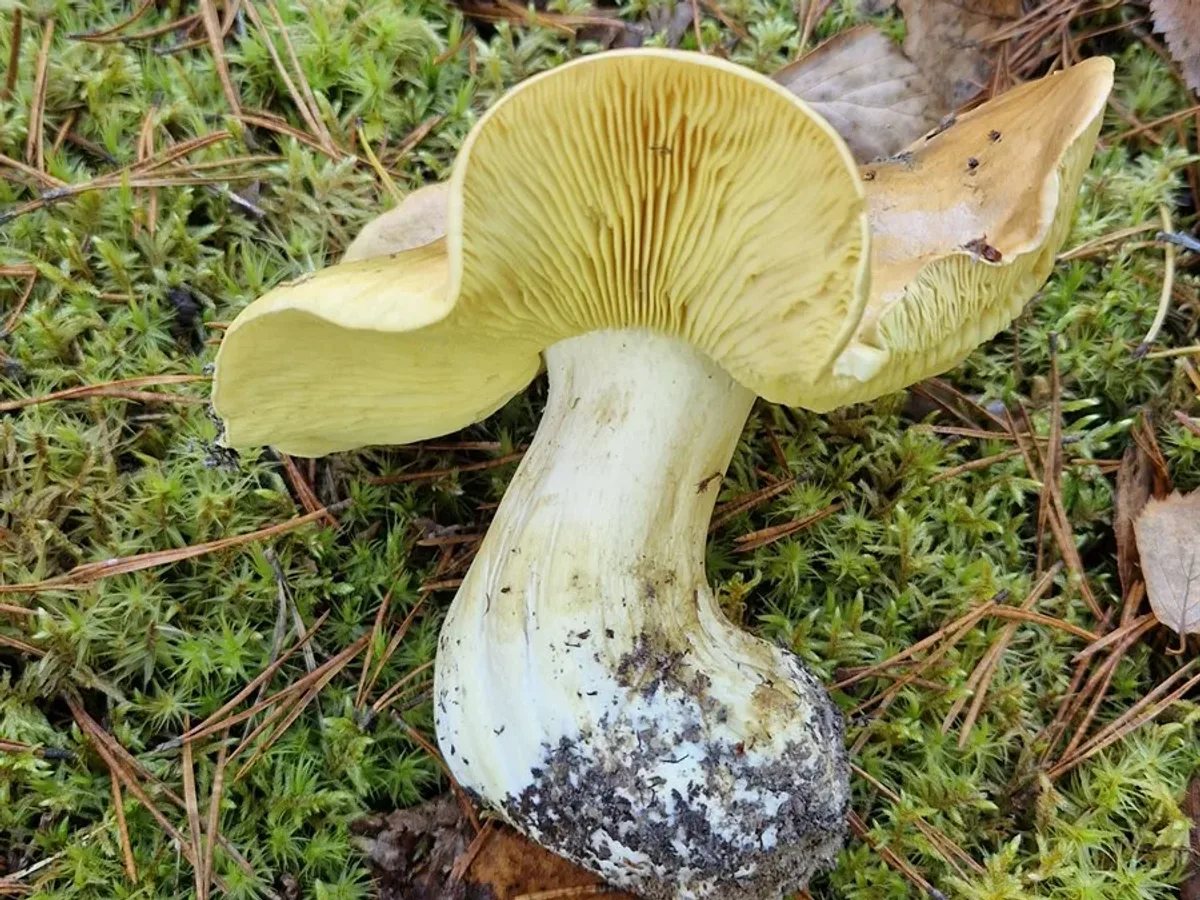
Tricholoma equestre is a robust, fleshy mushroom steeped in yellow from cap to stem base.
Cap
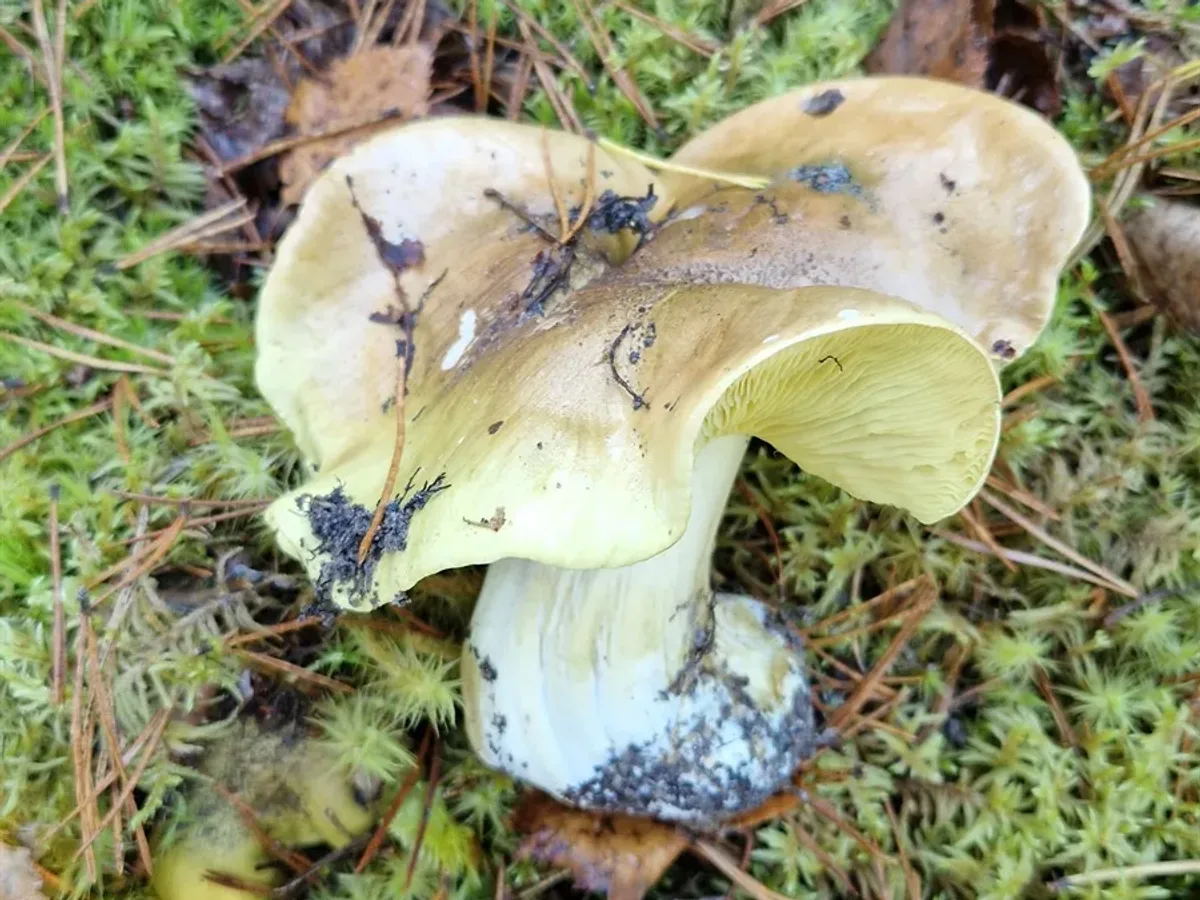
The cap is 5-12 cm across, convex when young and gradually flattening to broadly plane or slightly umbonate, often a little irregular or wavy at the margin.
The colour is yellow to greenish- or sulphur-yellow, typically darkening toward the centre into a reddish- or olive-brown zone, with fine flattened radial fibrils and sometimes small scales.
In damp weather the surface is slightly viscid - tacky enough that sand grains and pine needles cling to it, which is a useful field clue.
Gills
The gills are vivid sulphur- to lemon-yellow, crowded, narrow, and sinuate (notched just before they meet the stem).
Stem
The stem is 4-8 cm tall and 1-2 cm thick, more or less cylindrical or gently swollen at the base, solid and firm, pale to lemon-yellow, with no ring.
Importantly, there is also no volva - no sac or cup at the stem base.
Flesh
The flesh is firm, white to pale yellow (yellower just under the cap skin), and does not change colour when cut.
Smell & taste
The smell is faint and mealy, sometimes faintly cucumber-like.
Spore print white.
Why it's dangerous
Documented human fatalities are rare and were tied to large, repeated meals over several days, with three deaths recorded in France from the 1990s.
The species itself is NOT a deadly look-alike in the sense of acute single-meal lethality, but it is not a safe everyday edible either, AND it can be confused by beginners with genuinely lethal yellow or pale mushrooms (deadly Cortinarius webcaps and the white/pale Amanita species), which is why it is flagged as having a deadly look-alike.
Anyone who develops muscle pain, weakness or dark urine in the days after eating it should seek medical care immediately and mention the mushroom meals.
Avoid completely with pre-existing kidney, muscle or cardiac disease.
Toxin
The toxic principle responsible for the poisonings has not been definitively identified. It is associated with a delayed rhabdomyolytic syndrome - destruction of skeletal muscle tissue - rather than with classic gastrointestinal or amatoxin poisoning.
The toxicity appears cumulative and dose-dependent, linked to large, repeated consumption over a short period. Ordinary single small meals have a long history without obvious harm, which is why the risk remains debated and some recent toxicological and survey work has argued for its continued (cautious) edibility.
Symptoms
Reported poisoning, when it occurs, is delayed - typically 24-72 hours after repeated large meals.
It manifests as rhabdomyolysis:
- progressive muscle weakness, fatigue, muscle pain and stiffness (especially in the thighs)
- dark or reddish-brown urine (myoglobinuria)
- sweating
- sometimes facial reddening, nausea and difficulty breathing
Severe cases can progress to acute kidney failure and, rarely, fatal cardiac and respiratory muscle involvement.
Staying safe
Tricholoma equestre was eaten as a prized edible for centuries and is still considered a delicacy in some regions, but its safety is now seriously disputed.
A cluster of poisonings in France (at least 12 cases from 1992 onward), linked to large repeated meals, caused delayed rhabdomyolysis (breakdown of skeletal muscle) with three recorded deaths, and experimental work in mice reproduced muscle toxicity.
As a result it is treated as toxic or restricted in several countries (for example it is banned from sale in France).
The risk appears dose-dependent and tied to large, repeated consumption, and some authorities note possible confusion with the toxic look-alike Tricholoma sulphureum or with multiple overlapping yellow species within a poorly resolved species complex.
Given this, we classify it as CAUTION:
- do not eat it in large amounts or in successive meals
- avoid it entirely if you have any muscle, kidney or heart condition
- be aware that many experienced foragers now decline to eat it at all
Inexperienced foragers must also be able to confidently rule out the deadly Amanita and Cortinarius species below.
Where & when it grows
Habitat
Man on Horseback is a mushroom of lean, sandy ground. It grows in mycorrhizal partnership with tree roots - chiefly pine - and is most at home in pine woods, pine plantations, and coastal dune forests where the soil is acidic and well drained.
It also partners with spruce and, on suitable sandy ground, with broadleaf trees such as oak, beech, and birch.
Fruitbodies often push up through litter, moss, and loose sand, emerging half-buried with debris stuck to the tacky cap.
Widespread across temperate Europe and North America, it reliably returns to the same nutrient-poor pine stands year after year, following roots it may have run alongside for decades.
When
A late-season species, Man on Horseback comes into its own when many other mushrooms have already finished.
It fruits mainly from late August through November, with the heaviest flushes in late September and October after the first cool, rainy spells.
In maritime and Mediterranean regions it can push on into early winter, shrugging off light frosts as long as the ground below stays unfrozen.
How it grows
It is mycorrhizal, living in symbiosis with conifer (chiefly pine) and some broadleaf roots, so it cannot be cultivated.
Fruitbodies appear singly, in scattered troops, or in loose arcs and rings, frequently emerging partly buried in sand and needle litter. Production is favoured by warm late-summer soils followed by autumn rain.
Fruiting conditions
Late-season conifer-associated species; flushes follow autumn rains once soils cool from summer highs. Favours sandy, well-drained pine ground. Values are typical mycological preferences, not strict thresholds.
Look-alikes
Several yellow or yellow-gilled mushrooms can be confused with it, and some are deadly.
- The sulphur knight (Tricholoma sulphureum) is similar in colour but reeks strongly of coal gas or sulphur and is itself toxic (gastrointestinal).
- Yellow-gilled webcaps and other Cortinarius species can look superficially similar but produce a rusty-brown spore print and have a cobwebby partial veil (cortina) when young; some webcaps (e.g. the Cortinarius rubellus / orellanus group) are deadly, causing delayed, irreversible kidney failure, so a white spore print is an essential check.
- The deadly destroying angel (Amanita virosa) is white, not yellow, but inexperienced foragers must rule it out: Amanita has a ring on the stem, a sac-like volva at the base, free white gills and a white cap.
- The gemmed or jonquil Amanita (Amanita gemmata) is genuinely yellow, sticky-capped and grows in the same sandy conifer ground, so it is a real trap - but it too has a ring and a volva and a white (not yellow) spore-bearing structure.
- Russula species with yellow gills and caps can also resemble it but have brittle, crumbly flesh that snaps like chalk, unlike the fibrous flesh of Tricholoma.
Always take a white spore print and check for the absence of any ring or volva.
Pure white throughout (not yellow), with a ring (skirt) on the stem and a sac-like volva at the swollen base, and free white gills. T. equestre has no ring, no volva, sinuate yellow gills and a yellow cap. Lethal (amatoxins) - rule it out carefully by always checking the stem base for a volva.
Webcaps produce a RUSTY-BROWN spore print (T. equestre is pure white) and have a cobwebby cortina (veil remnants) on the upper stem when young, often leaving rust-coloured fibres. Some webcaps (e.g. C. rubellus / orellanus group) are deadly, causing delayed and often irreversible kidney failure days to weeks later - always take a spore print and reject anything with a rusty print or cortina.
Genuinely yellow, sticky-capped and grows in the same sandy conifer ground, making it a real trap. BUT it has whitish removable warts on the cap, free WHITE gills (not yellow, sinuate), a fragile ring on the stem and a sac-like volva or rim at the base - T. equestre has yellow sinuate gills and NO ring and NO volva. Toxic (ibotenic acid / muscimol, like A. muscaria / pantherina), causing nausea, vomiting and neurological effects; rarely fatal but a dangerous Amanita to mistake. Any ring or volva means reject it.
Several closely related yellow Tricholoma species form a confusing complex; some (e.g. T. aestuans) are acrid and inedible. Check for white spore print, mild mealy smell, sinuate gills, no ring/volva, and sandy conifer habitat, but be aware exact species separation can require microscopy.
Strong, unpleasant smell of coal gas / sulphur / tar (unlike the mild mealy smell of T. equestre); usually a more slender build and a more uniform dull sulphur-yellow without the darker reddish-brown cap centre, with less crowded gills. Toxic - causes gastrointestinal upset, not deadly.
Flesh is brittle and crumbly, snapping cleanly like chalk, and the stem breaks like an apple; T. equestre flesh is firm and fibrous. Russula stems also lack the fibrous texture.
A reference guide - never an edibility guarantee. When in doubt, leave it out.