Booted knight
Tricholoma caligatumsyn. Agaricus caligatus, Tricholoma caligatum var. caligatum, Armillaria caligata
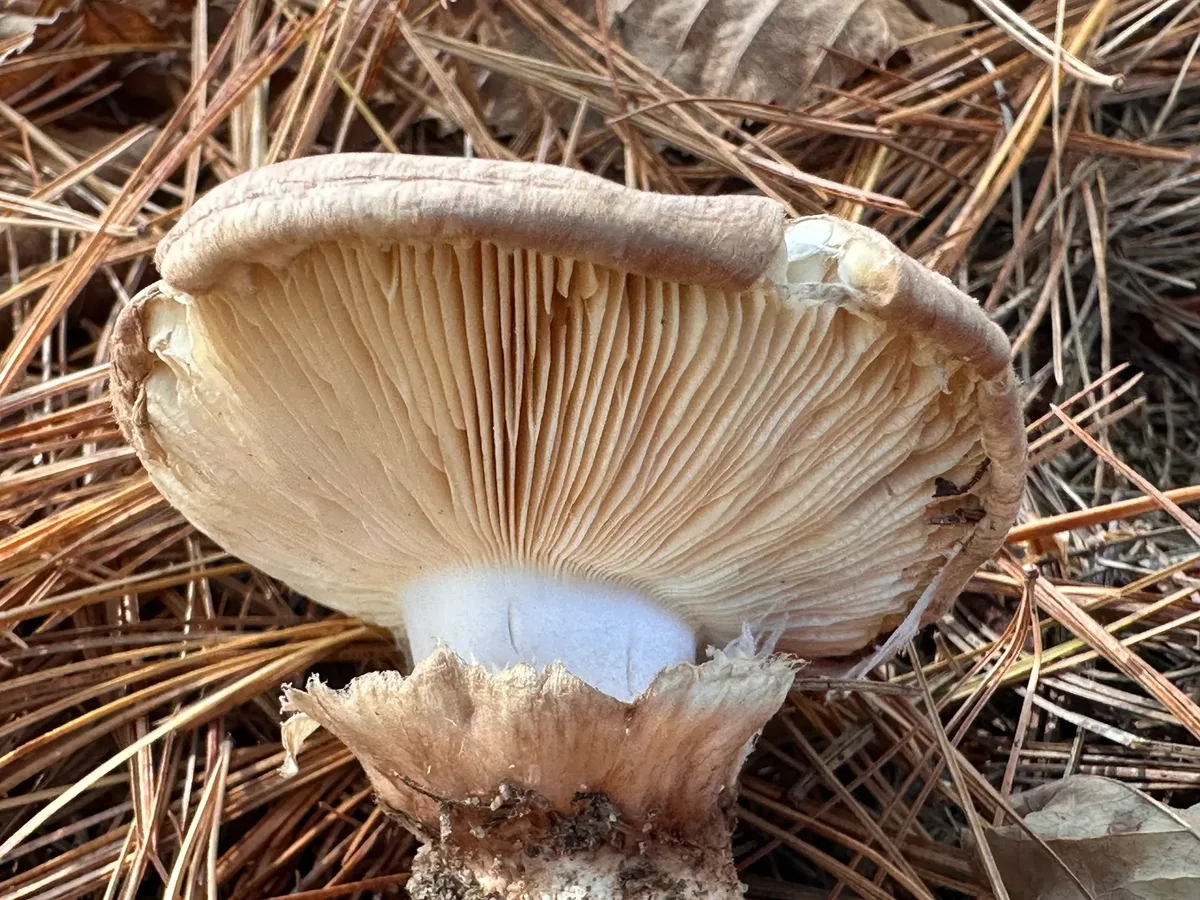 © Deana Tempest Thomas (CC BY)
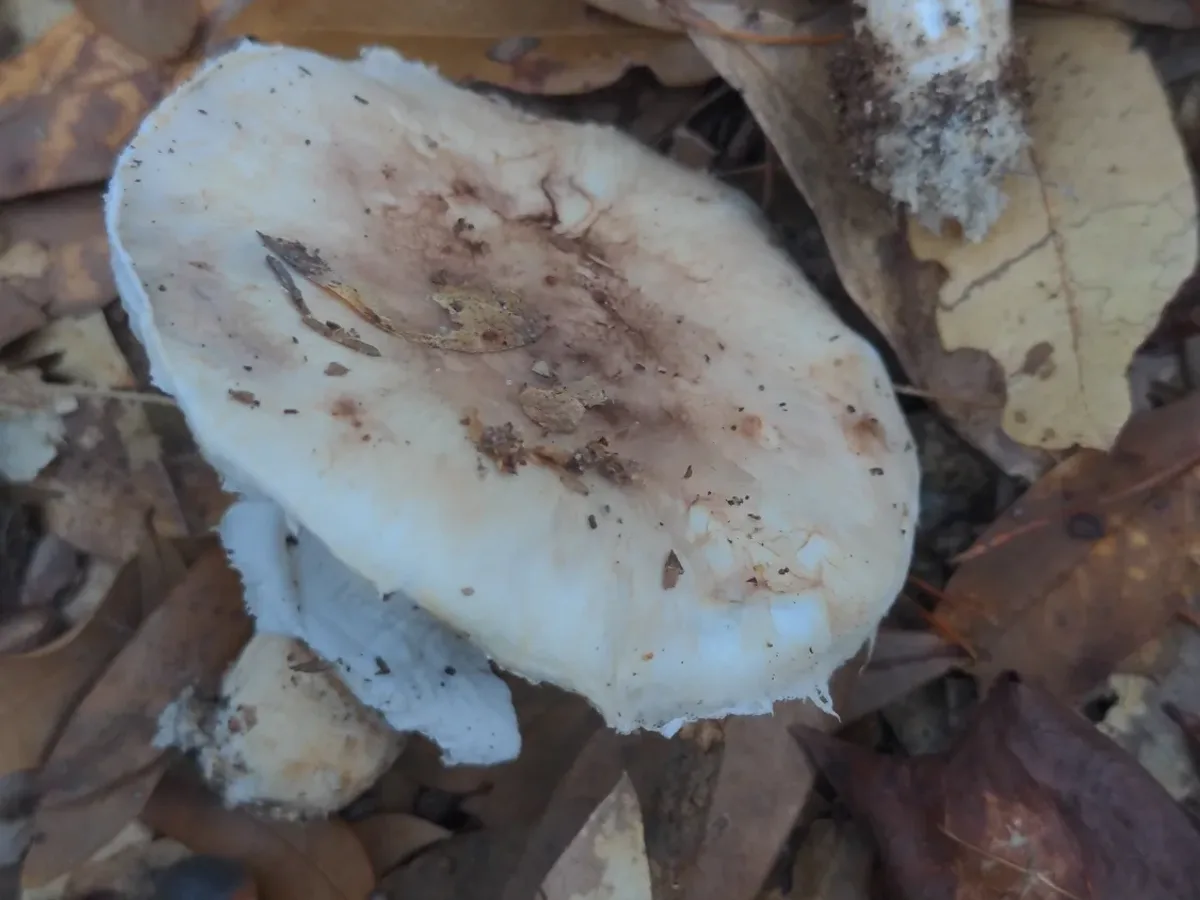 © Kiany Perez (CC BY)
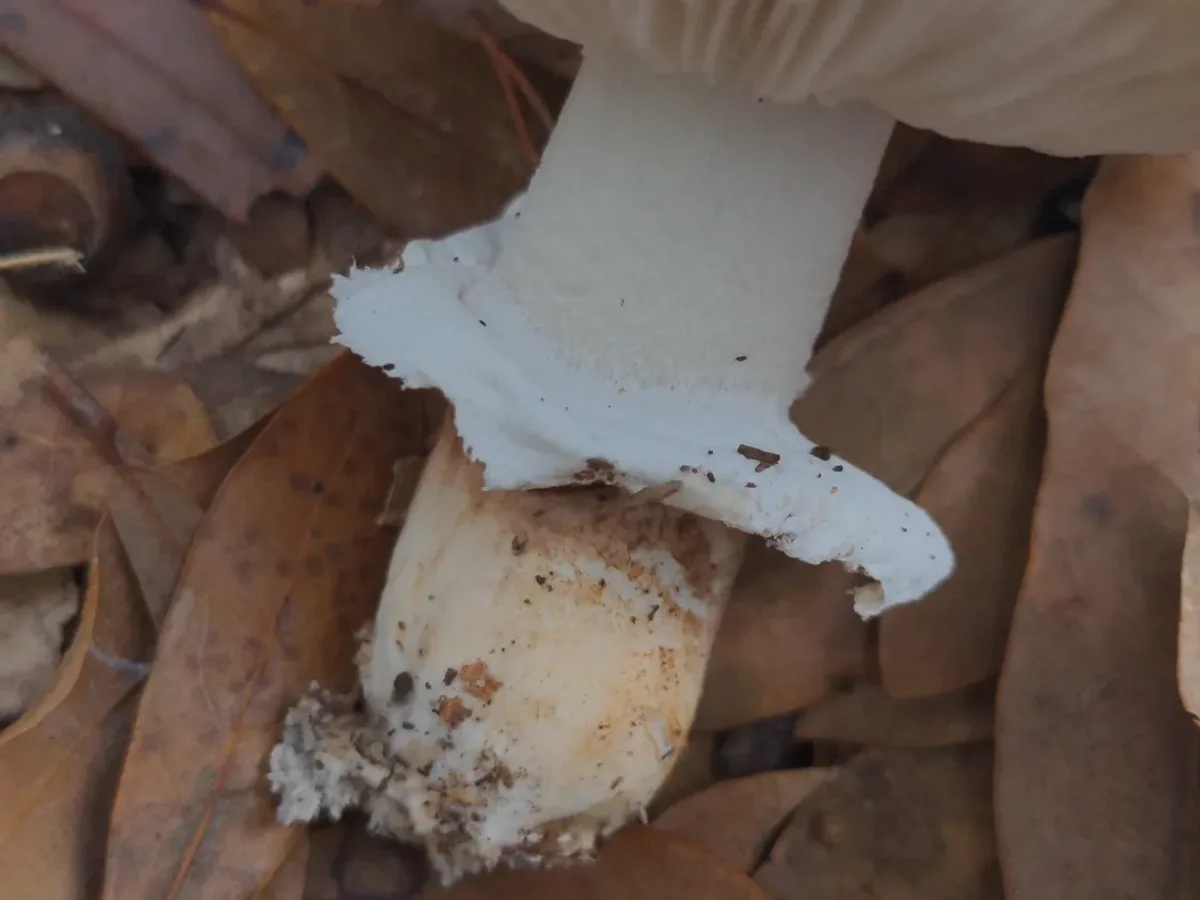 © Kiany Perez (CC BY)
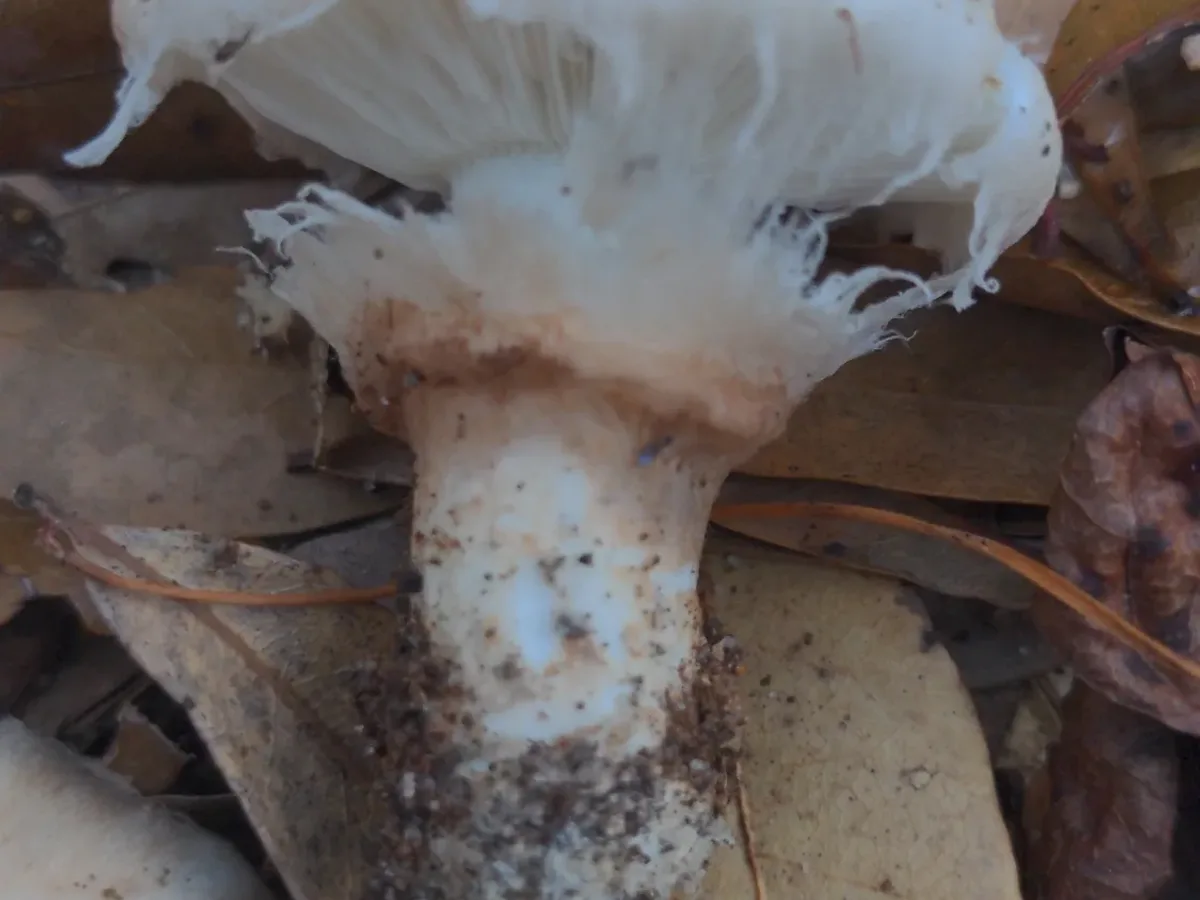 © Kiany Perez (CC BY)
 © Dan Vickers (CC BY)
 © Dan Vickers (CC BY)
 © Deana Tempest Thomas (CC BY)
 © Deana Tempest Thomas (CC BY)© Deana Tempest Thomas (CC BY)© Kiany Perez (CC BY)
Good to eat, once you have identified it with certainty and cooked it through.
Never eat a mushroom you are not 100% sure of - check the look-alikes below, and always cook wild mushrooms.
How to recognise it
The booted knight announces itself with two unmistakable features.
Cap
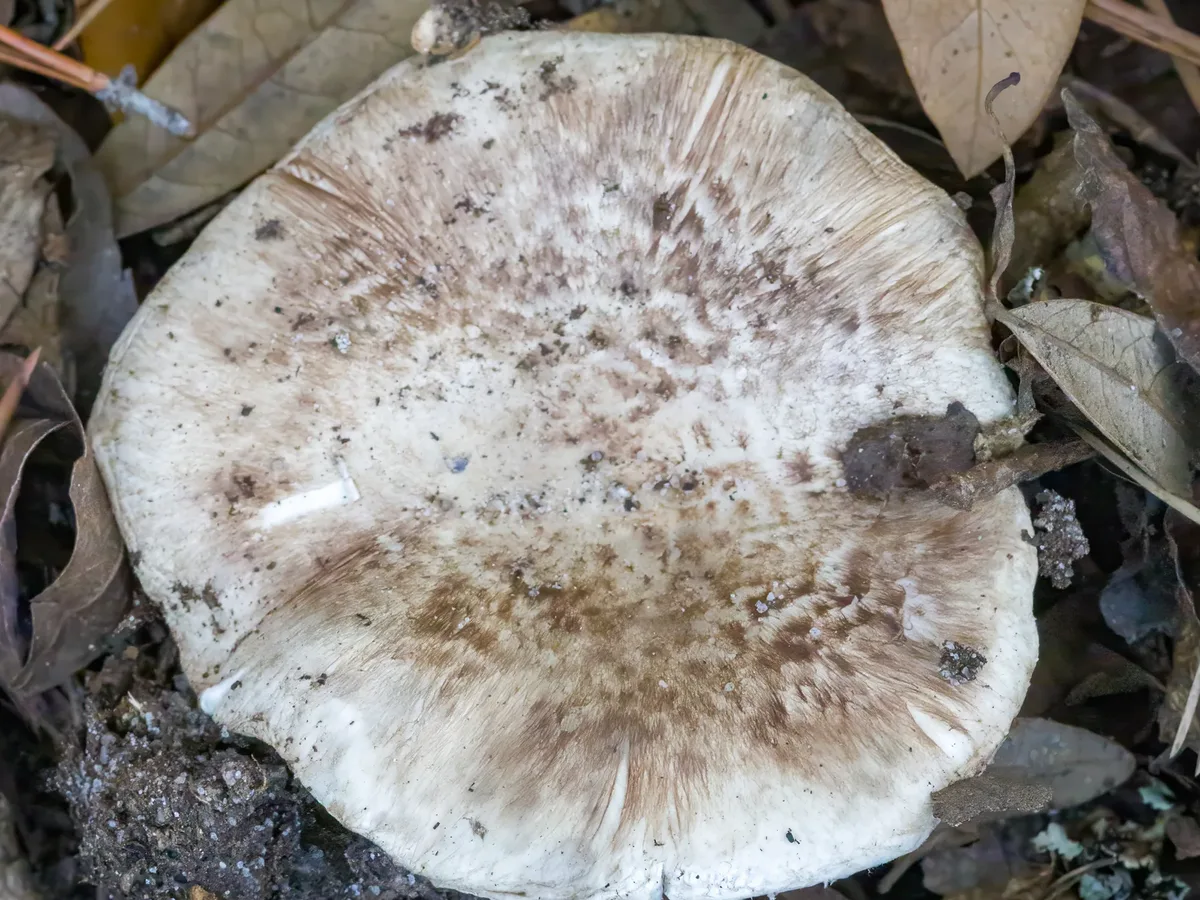
Pale ochre-buff to mid-tawny-brown with darker concentric scales and fibrils pressed flat against the lighter background, producing a tiger-stripe or leopard-spot pattern that is unlike most other forest mushrooms. The scales are finest and most tightly packed toward the centre and may lift a little at the margin on older caps.
Stem
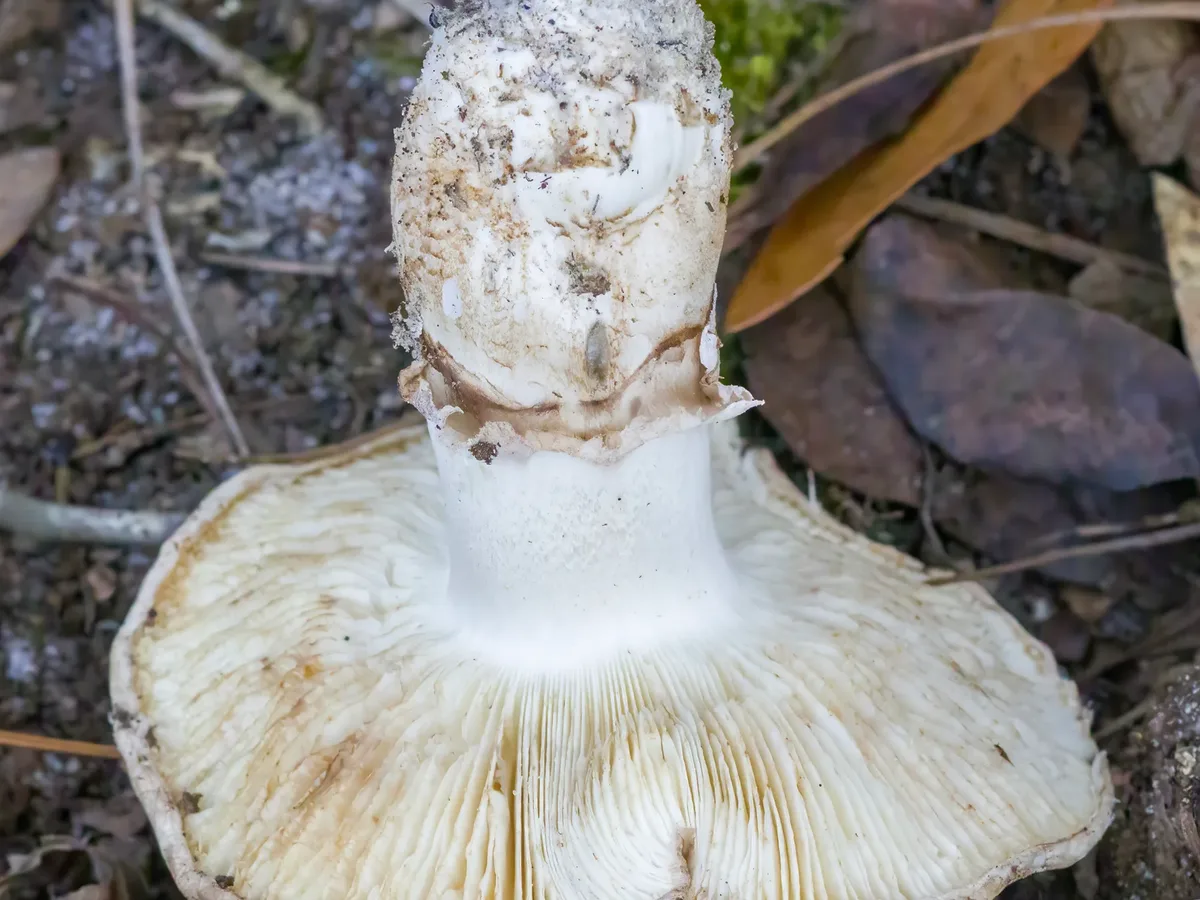
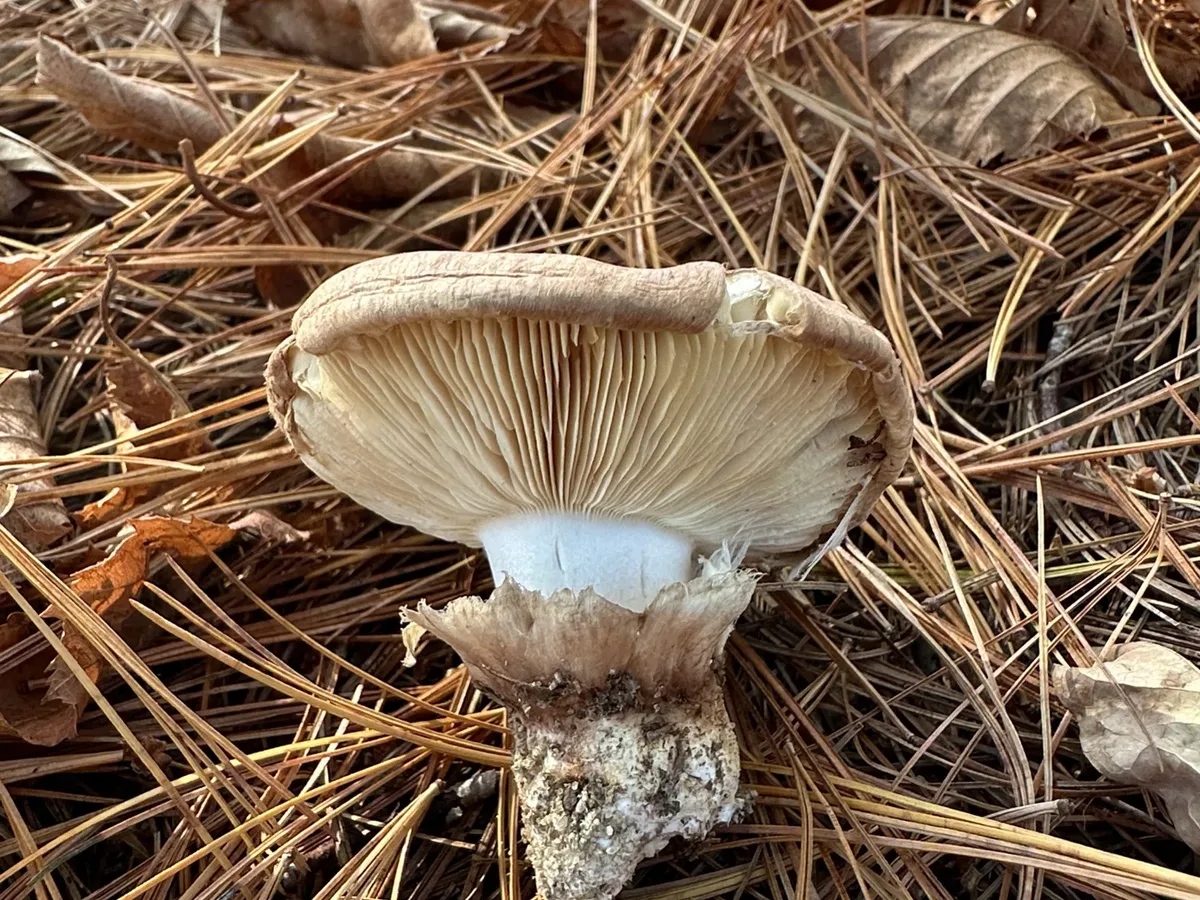
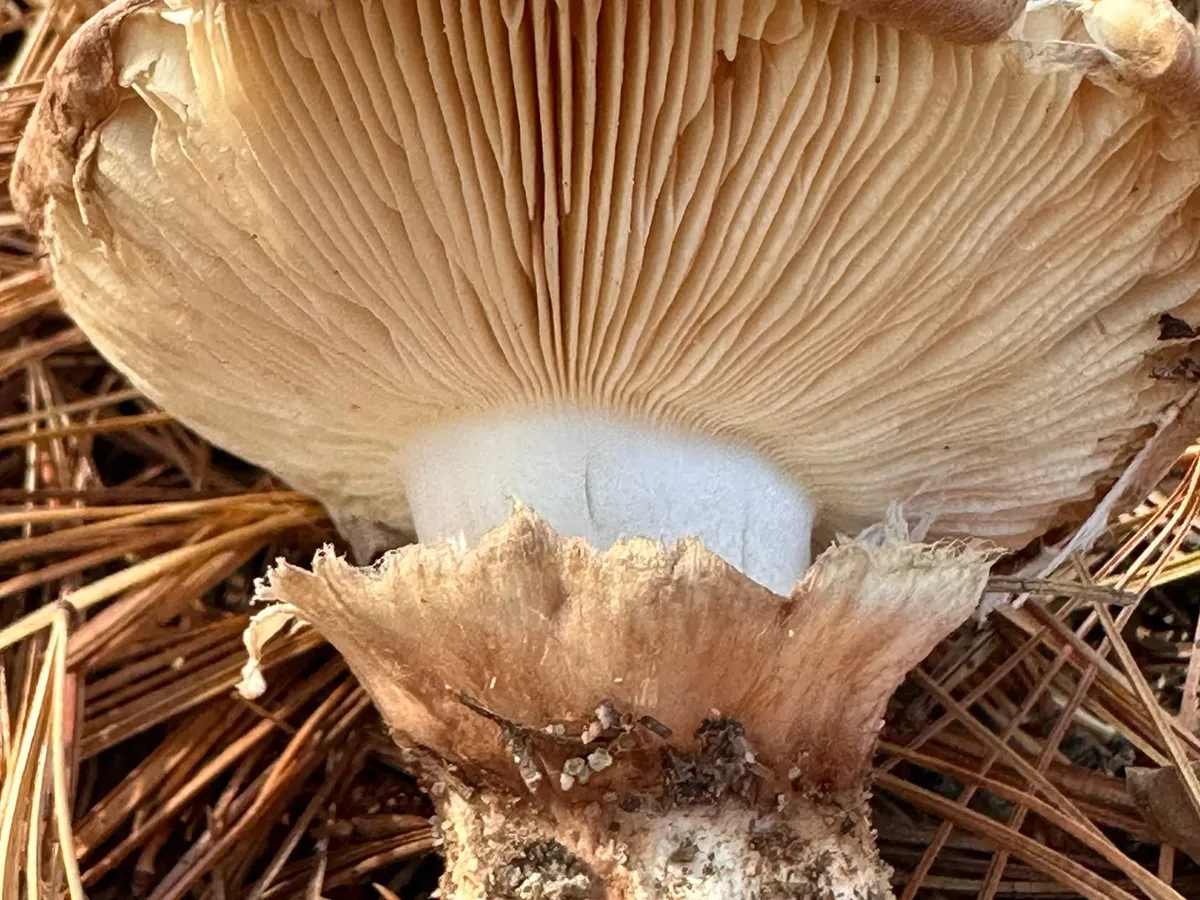
The upper portion above the sheath-zone is smooth and white, while the lower portion is wrapped in a dense, fibrous brownish sheath - the pressed-down remnant of the partial veil, clinging like a stocking pulled over the stem. This 'boot' is tight and frayed, not a free-hanging skirt like an Amanita's ring.
Gills
Pure white to cream, crowded, sinuate, and stay white throughout maturity - never turning rusty, yellowish, or olive, which is one of the key checks when ruling out dangerous lookalikes. The white spore print confirms this: take one on any unfamiliar specimen.
Flesh
Firm, white, and unchanging when cut.
Smell
A penetrating, spicy-resinous-cinnamon aroma that, once you have encountered it, is unmistakable. It is the same scent that makes the related Japanese matsutake so prized, and here in a Mediterranean pine forest it rises from the needle litter to meet you before you even crouch down.
Where & when it grows
Habitat
This is a pine-forest mushroom of the Mediterranean basin and nearby regions. It forms obligate mycorrhizal partnerships with the roots of several pine species, most importantly Pinus pinaster, Pinus sylvestris, and Pinus nigra.
Look for it in open, mature or semi-open pine woodlands on sandy, stony, or well-drained soils - it does not favour dense, dark, humid forest floors.
In southern France, the Iberian Peninsula, Italy, and the Balkans it is the ecological counterpart of the famous Japanese matsutake, filling a similar niche of late-season pine-forest fruiter.
It may appear close to paths or forest margins where soils are compacted and pine litter accumulates.
When
The booted knight is an autumn to early-winter species that bides its time through the long Mediterranean summer, waiting for the first autumn rains to break the drought.
Once significant rain falls and soil temperatures drop into the 8-14 °C range, fruitbodies begin emerging from late September onward. The peak flush typically runs October through mid-November.
At coastal and low-altitude sites in southern Iberia, Italy, or North Africa, a mild year can extend fruiting into December.
In higher-altitude pinewoods of southern France or northern Spain the season compresses to October and November, and a hard early frost ends it quickly.
How it grows
Mycorrhizal with pine, so it cannot be cultivated. Fruitbodies develop singly or in small groups from mycelial networks interwoven with pine roots, often pushing up through accumulated needle litter.
As with the closely related matsutake, the mycelium forms characteristic 'shiro' (fairy ring-like growth zones) in suitable pine forest, and experienced pickers learn to return to productive sites year after year.
Growth is triggered by the combination of soil moisture from autumn rain and a drop in soil temperature after summer heat.
Fruiting conditions
Mediterranean late-season pine-forest species. Fruiting begins once autumn rains break the summer drought and soils cool below 15 °C. Best flushes follow 20 mm or more of rain over two weeks with soil temperatures 8-13 °C. Extended mild autumns can produce a long season into December.
Look-alikes
The risk of dangerous confusion is real and must be taken seriously.
- The most dangerous look-alike is the Webcap group (Cortinarius species, especially the deadly C. rubellus and C. orellanus group). Young Cortinarius can resemble Tricholoma caligatum superficially, particularly before the rusty-brown gills and rusty-brown spore deposit of maturity are obvious. In very young Cortinarius the cortina (cobwebby partial veil) may not be visible, and some Cortinarius growing in pine forest have brownish scaly caps. Always take a spore print - Tricholoma gives a pure white print; any rusty, cinnamon, or orange-brown deposit means Cortinarius and the specimen must be rejected.
- Young death caps (Amanita phalloides) emerging as buttons in Mediterranean pine-oak mixed forest can be confused with various white-fleshed mushrooms, but A. phalloides has a ring on the stem and a sac-like volva at the base: always check the stem base.
- The leopard knight (Tricholoma pardinum / T. tigrinum) is a genuinely dangerous look-alike: it has a similar scaly greyish to brownish cap but the scales are grey-silver rather than warm brown, the smell is mealy (not spicy-resinous), and it is seriously toxic, causing violent and prolonged gastrointestinal poisoning.
- The sticky bun mushroom (Cystoderma amianthinum) is smaller and lacks the mat-suri scent.
- The silky pigskin poison Paxillus involutus has enrolled cap margins and decurrent gills but is also a distinct species.
- Confusion with Tricholoma matsutake proper (the Japanese matsutake) is possible where ranges overlap in east Asia, though in the core Mediterranean range this is not an issue.
Young Cortinarius specimens in pine forest can resemble T. caligatum superficially before their rusty-brown characteristics are fully apparent. The decisive test is the spore print: Cortinarius always gives a rusty-brown, cinnamon, or orange-brown print - never white. Cortinarius also lacks the spicy-resinous matsutake aroma of T. caligatum and has no fibrous stocking-sheath on the stem. When young, look for the cobwebby cortina (veil remnant) on the upper stem - faint rusty fibrils. These webcaps cause delayed, irreversible kidney failure (orellanin toxin) with symptoms appearing days to weeks after ingestion; there is no antidote. A white spore print is non-negotiable before eating any brown-capped, pine-forest mushroom.
Direct visual confusion between T. caligatum and A. phalloides at the button (egg) stage is not mycologically plausible: a white featureless egg shares no structural cues with T. caligatum's tiger-striped scaly cap and fibrous booted sheath. Nonetheless, as a genus-level structural check in any mixed pine-oak habitat: any specimen with a sac-like volva at the stem base, a ring (skirt) on the stem, or free white gills (rather than sinuate gills) must be rejected - T. caligatum has none of these features. The death cap contains amatoxins and is lethal. The documented dangerous lookalikes for T. caligatum are Cortinarius webcaps and Tricholoma pardinum, addressed in separate entries.
Larger, stout Cortinarius in the Phlegmacium section can grow in the same pine forest and have robust fleshy fruitbodies with brownish scaly caps. Check for a rusty-brown spore print (definitive), a slimy or sticky cap surface in many species, and a cortina remnant on the upper stem. Any rusty print or cortina = reject. Note: the confirmed orellanin-bearing killers (C. rubellus, C. orellanus) belong to subgenus Orellani within Cortinarius, not to Phlegmacium specifically; Phlegmacium species as a clade have not had orellanin confirmed across the group. Reject any Cortinarius in pine forest regardless - the spore print check is the only reliable safeguard.
Also known as the 'Spotted Trich,' this seriously toxic mushroom has a similar scaly, brownish-grey cap. Distinguishing features: the scales on T. pardinum are grey-silver to ash-grey rather than warm ochre-brown; the smell is mealy or floury, never the spicy-resinous cinnamon of T. caligatum; and there is no fibrous stocking-sheath on the lower stem. T. pardinum causes violent, prolonged gastroenteritis (nausea, vomiting, severe diarrhoea) within 1-3 hours of consumption - serious enough to require hospitalisation, though rarely fatal. Do not eat any grey-scaled Tricholoma.
The Japanese matsutake is so closely related to T. caligatum that they were once considered the same species; both share the booted stem, scaly brown cap, and spicy-resinous aroma. Where ranges overlap (East Asia), separation requires careful attention to host tree association, minor microscopic differences, and geographic context. T. matsutake is also edible and extremely prized. This is not a safety concern - both are edible - but worth knowing for accurate documentation.
In the kitchen
Picking & cleaning
The base of the sheathed stem is usually buried, so dig the whole mushroom out carefully rather than twisting it off at ground level.
Before any specimen goes into your basket, run through these checks on each one individually:
- White gills (not rusty or yellowish)
- The fibrous brownish stocking-sheath on the lower stem
- White flesh that does not change colour when cut
- The characteristic spicy-resinous-cinnamon smell
- A white spore print
Any specimen missing the aroma, or showing rusty or brownish gills, or with a loose cup or collar at its base (a volva rather than a tight fibrous sheath), should be set aside.
The sheath is distinctly different from the ring-and-volva combination of deadly Amanita species - a volva sits loosely at the base like a sac, not pressed to the stem.
The firm flesh travels well; use it the same day or refrigerate briefly.
Cooking
In Mediterranean cuisine, Tricholoma caligatum is valued for its firm texture and its matsutake-like aromatic quality, which intensifies with heat.
The caps and upper stem are the most desirable parts; trim the base of the sheathed stem, which can be tough and fibrous. Clean with a soft brush rather than washing, as the firm cap absorbs water readily.
Simple preparations show off the spicy aroma best:
- Grilled with olive oil and garlic
- Sliced and sauteed over high heat
It can also be dried for preservation, retaining much of its aroma.
In Japan and East Asia the matsutake (its close relative) is prized in rice dishes, broth, and grilled over charcoal; similar preparations work well for T. caligatum.
Good to know
Tricholoma caligatum is a traditional edible mushroom in Mediterranean countries, particularly in Spain, Portugal, Italy, and parts of France, where it has been gathered and eaten for generations.
It contains no known amatoxins or orellanin and is not considered a poisonous species in the mycological literature. Some individuals report mild gastrointestinal discomfort when consuming poorly cooked or very large quantities, and raw consumption should be avoided. Allergy to related Tricholoma species is possible.
The primary safety concern with this species is misidentification: it can be confused with deadly webcap species (Cortinarius) or, by inexperienced foragers, with deadly Amanita buttons in the same habitat.
A positive identification must include all three:
- 1The white spore print (ruling out Cortinarius).
- 2The absence of any ring-and-volva combination (ruling out deadly Amanita).
- 3The distinctive spicy-resinous-matsutake aroma.
Do not eat any specimen that does not match all three criteria.
A reference guide - never an edibility guarantee. When in doubt, leave it out.