Baka-matsutake
Tricholoma bakamatsutakei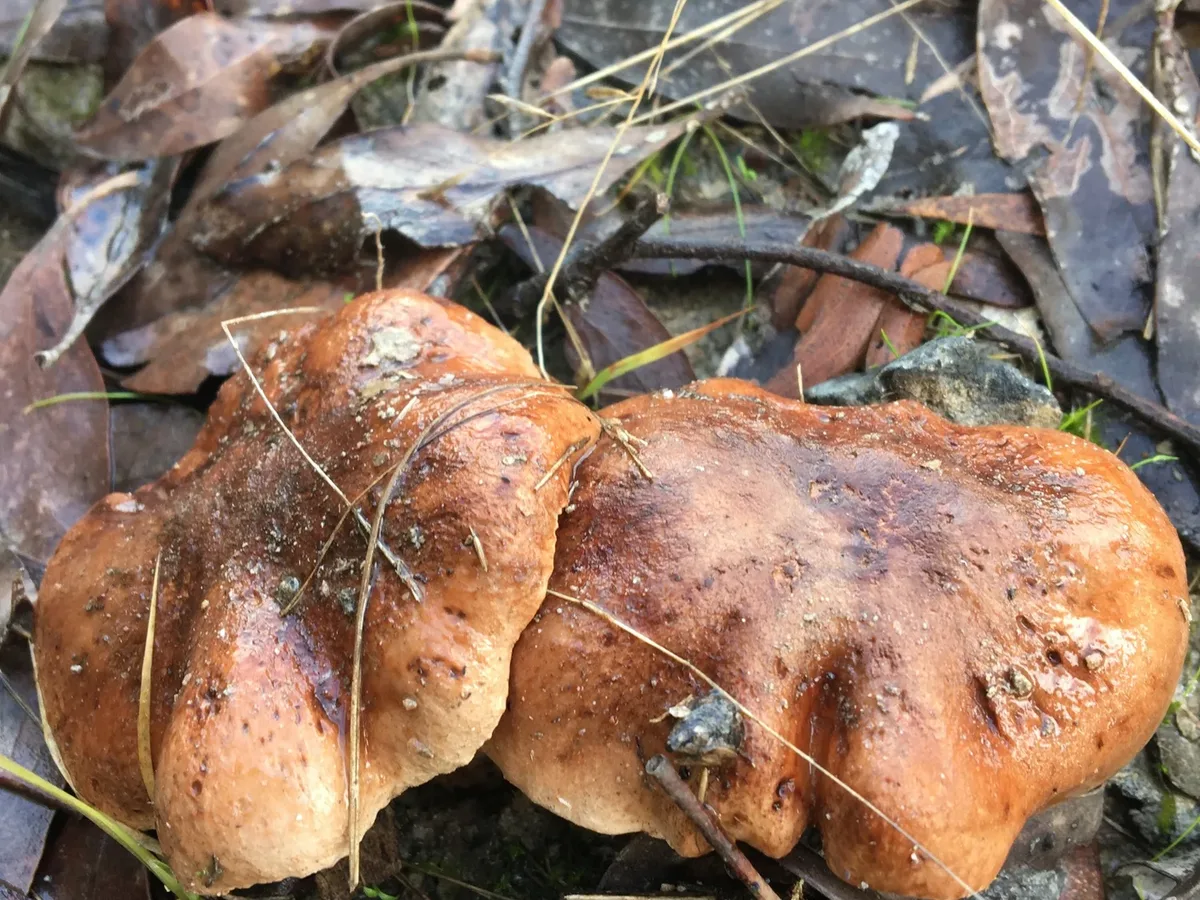 Atlas of Living Australia (CC0)
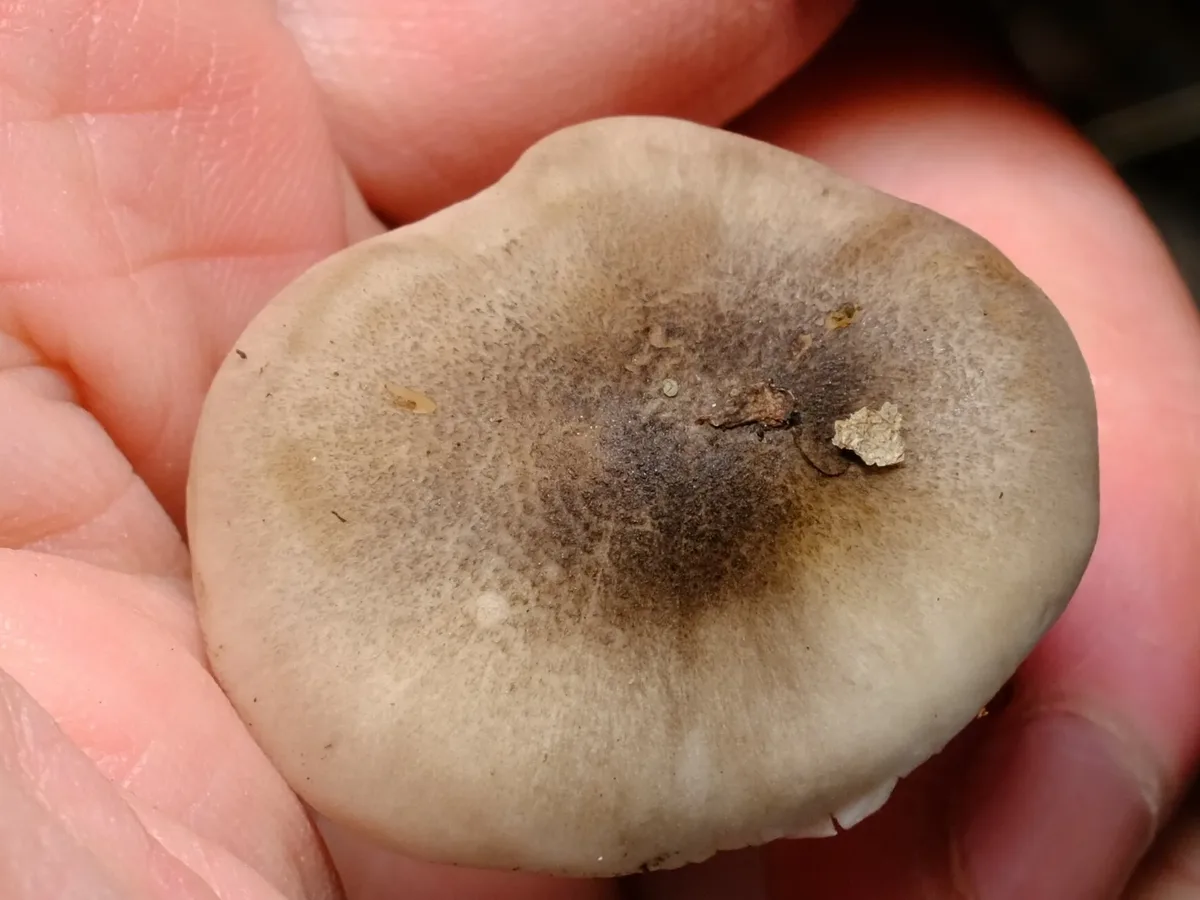 Atlas of Living Australia (CC0)
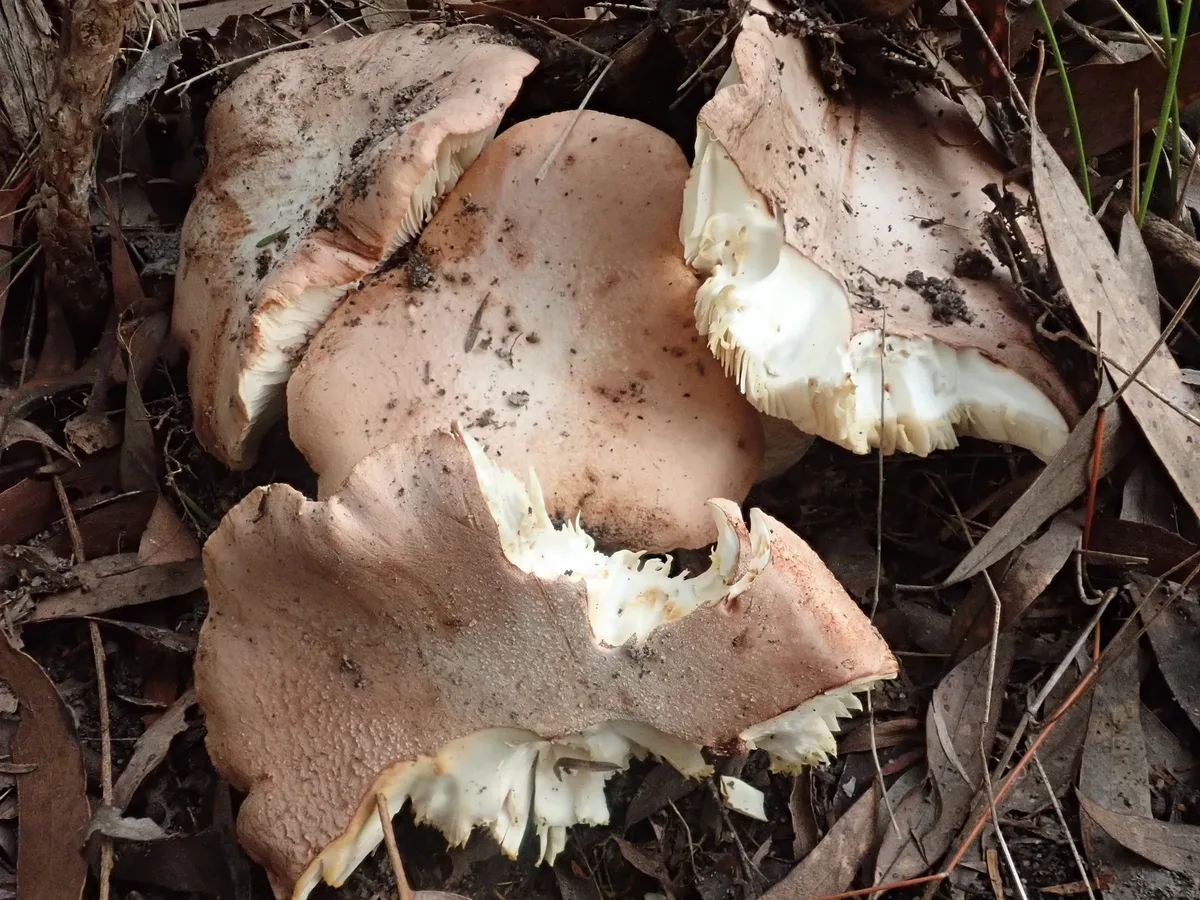 Atlas of Living Australia (CC0)Atlas of Living Australia (CC0)Atlas of Living Australia (CC0)
Edible only with the right preparation - or safe for some people but not others. Learn the caveats first.
Never eat a mushroom you are not 100% sure of - check the look-alikes below, and always cook wild mushrooms.
How to recognise it
Tricholoma bakamatsutakei is strikingly similar to the revered matsutake and is routinely confused with it in Japanese forests, which is the origin of its name (baka = foolish or fake, matsutake = pine mushroom).
Cap
The cap is tawny-brown with fine, dark radial fibrils and scales on a paler buff ground - identical in general appearance to T. matsutake at a glance.
Gills
The gills are white to cream, crowded, sinuate, and show a white spore print, consistent with the T. matsutake group.
Stem
The stem has the same booted architecture: smooth and white above the ring zone, covered by a dense fibrous brownish sheath below. The ring (partial veil) is well-developed and flares upward.
Flesh
Flesh is white and firm throughout, not changing colour when cut.
Smell & taste
The smell is aromatic and spicy, in the matsutake style, though seasoned pickers often describe it as slightly less penetrating or thinner than genuine T. matsutake. On its own, without a T. matsutake for direct comparison, the aroma is still impressive and diagnostic of this group of mushrooms.
Microscopic differences and host-tree associations are the most reliable separators from T. matsutake.
Where & when it grows
Habitat
The key practical habitat clue that distinguishes T. bakamatsutakei from true matsutake in Japan is the host tree.
Tricholoma matsutake is tightly linked to Japanese red pine (Pinus densiflora) and other pine species, and pine-dominated forest is its classic habitat.
Tricholoma bakamatsutakei, by contrast, forms associations primarily with broadleaf oaks - especially Quercus serrata and Q. acutissima - and in mixed oak-conifer or pure broadleaf woodland.
If you find a matsutake-like mushroom in an oak-dominated or mixed oak wood rather than a pine wood in Japan, T. bakamatsutakei is the first hypothesis.
Both species grow in well-drained, acidic soils at low to mid elevations. Like T. matsutake, it tends to form shiro (circular or arc-shaped growth zones from an expanding mycelial front) in suitable forest, and productive patches can be revisited year after year.
When
Tricholoma bakamatsutakei fruits from late August through October in Japan, with a peak in September and early October - typically one to several weeks ahead of the main T. matsutake season in the same region.
This phenological difference is well-known to experienced Japanese mushroom pickers and is part of the reason the species acquired its fake matsutake reputation: it appears first, raises hopes that the matsutake season has begun, and turns out to be the lesser species.
Fruiting is triggered by cooling temperatures and autumn rains after the summer heat, similar to T. matsutake. Watch for:
- the first significant autumn rainfall (15 mm or more over a few days)
- combined with a drop in soil temperatures into the 10-18 degrees C range
A lag of roughly 7-14 days between rain and flush is typical.
How it grows
Strictly mycorrhizal and impossible to cultivate outside its forest host. The fruiting body is just the visible tip of a partnership that may have been threading the oak's roots for years underground.
Fruitbodies push up through leaf litter, sometimes emerging as partly buried buttons, in response to autumn rain and a drop in soil temperature. Fruiting is episodic and flush-based.
The mycelium expands slowly outward over the years, and a productive patch in suitable oak woodland tends to come back to the same spots year after year - provided the site is not overharvested or disturbed.
Fruiting conditions
Autumn fruiter, earlier in the season than true matsutake at the same sites. Fruiting triggered by first significant autumn rainfall (15 mm or more over 7-14 days) combined with cooling soil temperatures in the 10-18 degrees C range. Best flushes follow the end of summer heat; the first autumn rains typically arrive in late August to October in Japan.
Look-alikes
The matsutake group in East Asia includes several closely similar species that can be difficult to separate without microscopy and molecular data.
The most important lookalike from an edibility standpoint is the dangerous Tricholoma pardinum (leopard knight or spotted knight). It has a similar size and build and grows in overlapping habitats, but differs:
- its scales are grey or ash-grey (not warm tawny-brown)
- its smell is distinctly mealy or floury (never spicy-resinous)
- it lacks the well-defined fibrous boot on the stem
T. pardinum causes severe gastroenteritis and is a genuine medical emergency requiring hospital treatment; it is not considered lethal but the poisoning is extreme. Any grey-scaled Tricholoma with a floury smell must be rejected.
Tricholoma matsutake itself is nearly identical but occurs predominantly under pine rather than oak; it is fully edible and more prized.
Some other East Asian Tricholoma with brownish caps (such as T. nauseosum in northern regions) could cause confusion; these should be verified by odour and habitat.
Cortinarius species with brownish caps growing in the same woodland are the greatest safety hazard. They must always be eliminated by checking for a white spore print (Cortinarius gives rusty-brown) and the absence of a cobwebby cortina.
Some Cortinarius species with brownish, fibrous caps grow in mixed oak-conifer woodland and could be confused by an inexperienced forager with any brown-capped Tricholoma. The decisive test is the spore print: Cortinarius always produces a rusty-brown, cinnamon, or orange-brown spore deposit -- never white. Additionally, young Cortinarius show a cobwebby cortina (veil remnant) on the upper stem rather than the firm, flaring ring of T. bakamatsutakei. Cortinarius lack the spicy-resinous matsutake aroma. Some webcaps contain orellanin, a nephrotoxin causing irreversible kidney failure, with symptoms appearing days to weeks after eating; there is no antidote. A white spore print is non-negotiable before consuming any brown-capped mushroom from broadleaf or mixed woodland.
Larger, stout Cortinarius species in the Phlegmacium section can grow in oak and mixed forest and produce robust, fleshy fruitbodies with brownish caps. Identified by their rusty-brown spore print, often sticky or slimy cap surface, and the faint rusty veil remnant (cortina) on the upper stem. Any rusty or cinnamon spore deposit immediately disqualifies a specimen. Some Phlegmacium species are orellanin-toxic and have caused fatal poisonings.
Tricholoma pardinum is a seriously toxic species that grows in broadleaf and mixed forest, overlapping with T. bakamatsutakei habitat. Its cap scales are grey to ash-grey (never warm tawny-brown), and the smell is distinctly mealy or floury -- entirely lacking the spicy-resinous matsutake aroma. T. pardinum causes intense gastrointestinal poisoning (violent vomiting, severe diarrhoea, cramps) within 1-3 hours, sometimes requiring hospitalisation. Reject any grey-scaled Tricholoma with a mealy odour regardless of other features.
The true matsutake is nearly identical in appearance and is also fully edible -- far more prized commercially. The main distinguishing features are ecological: T. matsutake fruits predominantly under pine (Pinus densiflora, P. sylvestris), while T. bakamatsutakei favours oak and mixed broadleaf woodland. T. bakamatsutakei also tends to fruit somewhat earlier in the season at the same sites. Minor microscopic and molecular differences exist but are not field-separable reliably. The confusion is economically significant but not a safety concern, since both species are edible.
In the kitchen
Picking & cleaning
Harvest by grasping the stem low and twisting gently, or dig carefully with a knife to free the base - the full stem base is useful for confirming the species.
Before dropping any specimen into the basket, run through the field checklist:
- 1gills white and sinuate - not rusty, yellow, or olive
- 2fibrous-sheath boot on the lower stem with a well-developed upward-flaring ring
- 3spicy-resinous aroma in the matsutake style
- 4white flesh that stays white when cut
- 5host tree is oak or mixed broadleaf, not pine
If any doubt lingers, take a spore print - it must be white.
Brush off soil and litter; the firm flesh carries well. Use promptly: like T. matsutake, quality fades within a day or two of harvest.
Walk away from any grey-scaled or mealy-smelling Tricholoma - that combination points to the toxic T. pardinum.
Cooking
In Japanese cuisine, T. bakamatsutakei is used in broadly the same ways as matsutake, though it commands far lower prices at market and is considered a second-best option.
The aromatic quality makes it suitable for simple preparations that showcase the flavour:
- grilled over charcoal or in a konro grill
- added to dobin mushi (a traditional savoury broth in a teapot)
- incorporated into takikomi gohan (seasoned rice)
Clean with a damp cloth or soft brush rather than washing. The caps and upper portion of the stem are the best eating parts; the lower sheath can be tough and is typically trimmed.
Like T. matsutake, it pairs well with Japanese flavours - dashi, sake, soy sauce, and yuzu - and should not be overpowered by competing ingredients.
Do not eat raw.
Good to know
Tricholoma bakamatsutakei is considered edible and is eaten in Japan, though it is regarded as an inferior substitute for the highly prized T. matsutake. It contains no known amatoxins or nephrotoxic compounds such as orellanin.
Cooking thoroughly before consumption is advisable as with all wild mushrooms in this genus, since some Tricholoma species cause gastrointestinal upset when eaten raw or undercooked.
The main safety concern is misidentification. It superficially resembles T. matsutake (benign) but shares habitat with dangerous look-alikes:
- Tricholoma pardinum - causes severe gastroenteritis
- various Cortinarius species in broadleaf-conifer woodland - some contain deadly orellanin
A white spore print is the essential safety check before consuming any brown-capped Tricholoma: any rusty-brown, cinnamon, or ochre deposit indicates Cortinarius and that specimen must not be eaten.
Confirm the warm tawny-brown (not grey) scale colour to separate from T. pardinum.
Tricholoma bakamatsutakei must not be eaten raw; thorough cooking is required before consumption as some Tricholoma species cause gastrointestinal distress when undercooked.
This preparation requirement places the species in the caution tier despite the absence of any known systemic toxin.
A reference guide - never an edibility guarantee. When in doubt, leave it out.