Turkey tail
Trametes versicolorsyn. Polyporus versicolor, Coriolus versicolor, Boletus versicolor, Microporus versicolor
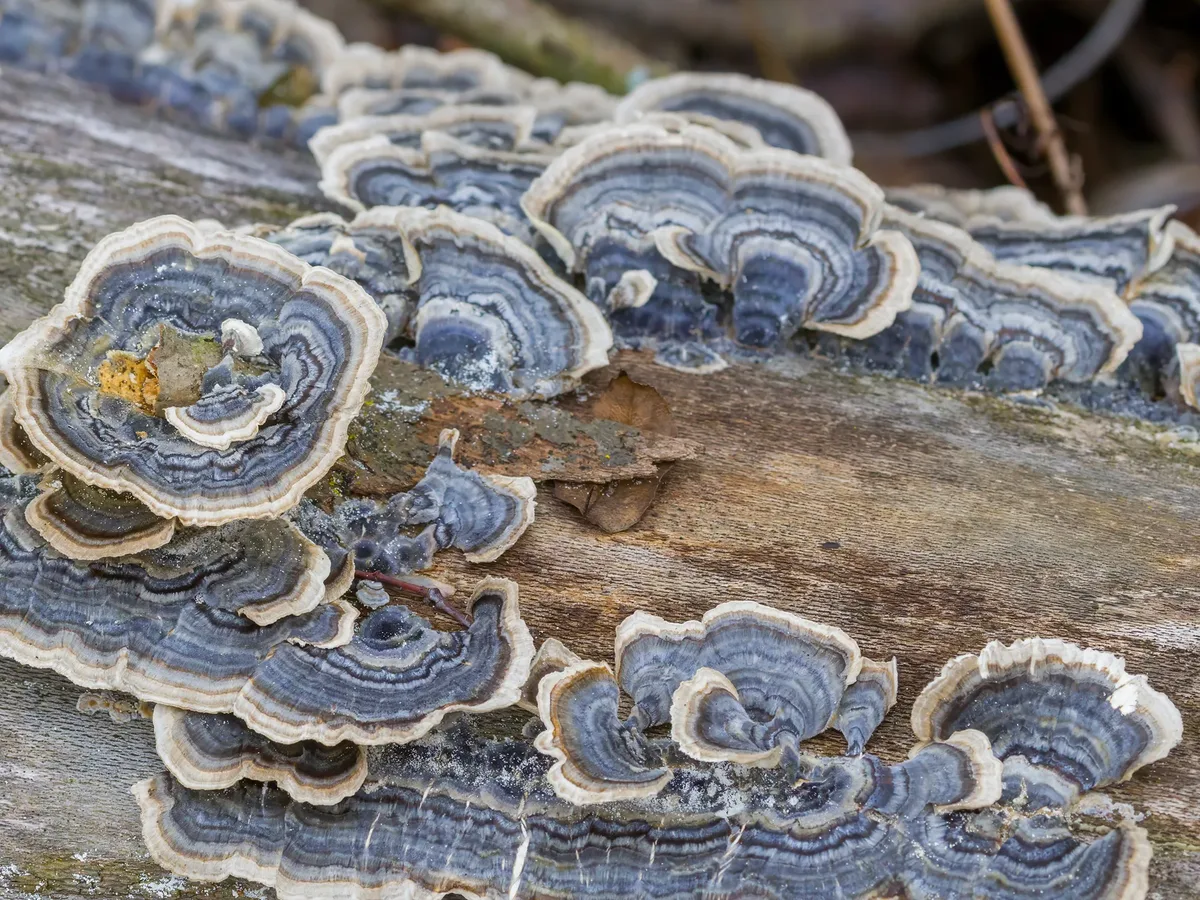 © Dan Vickers (CC BY)
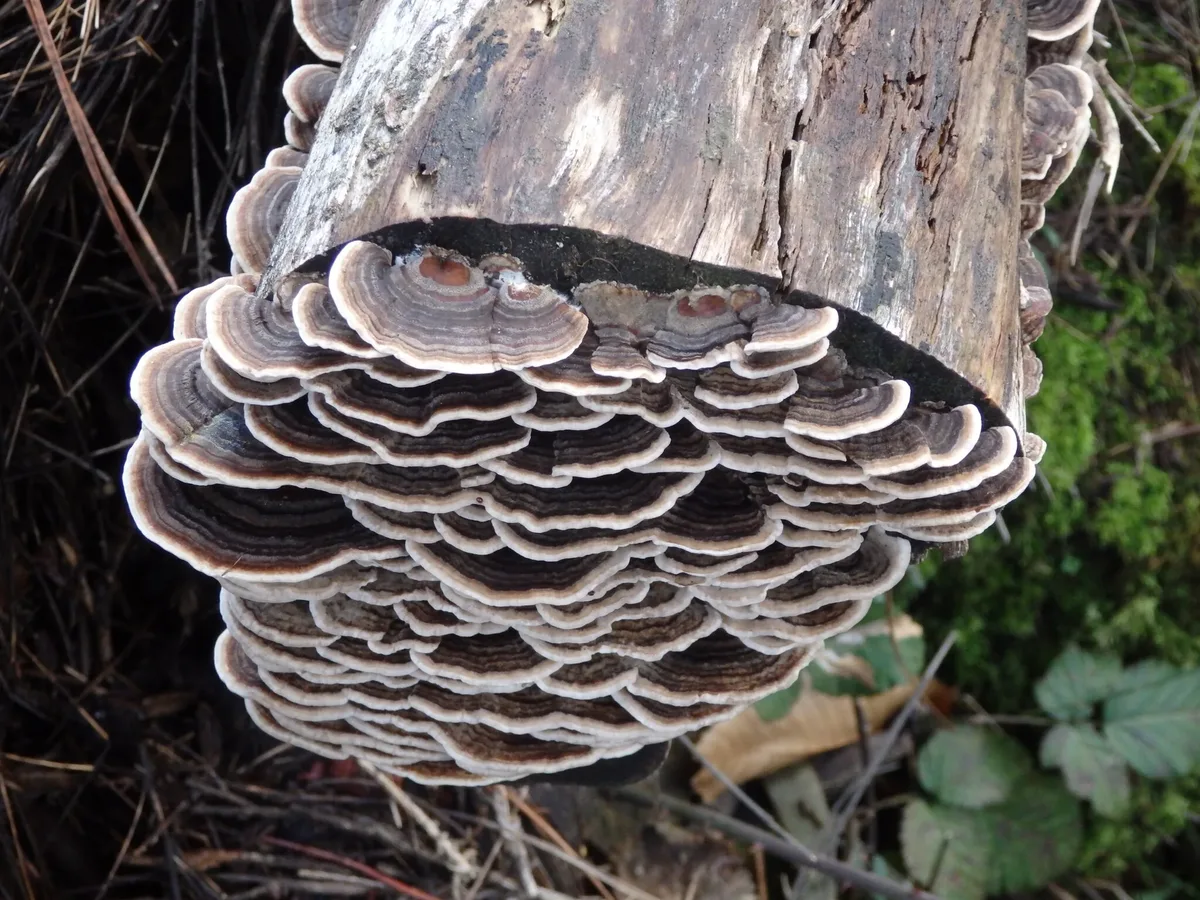 © Carminda Santos (CC BY)
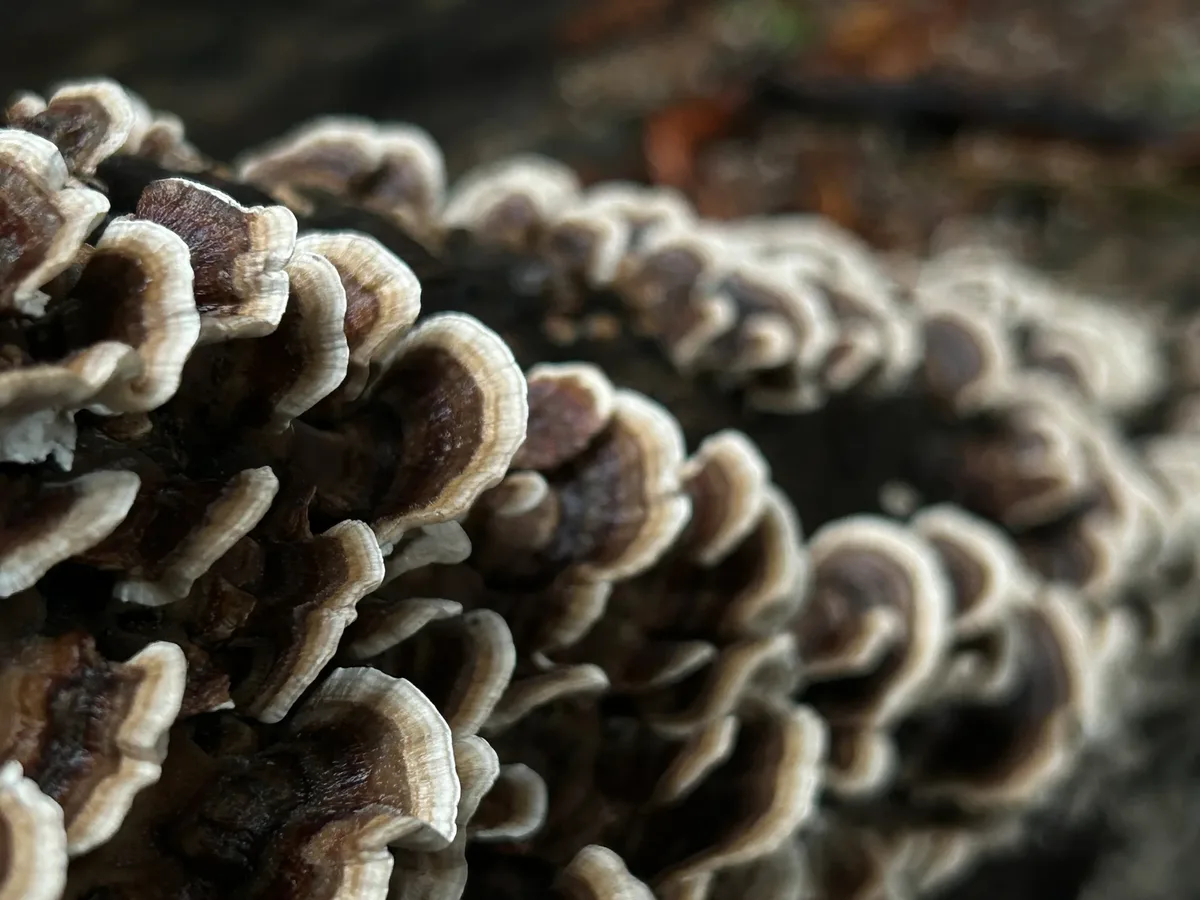 © Annette Herz (CC BY)
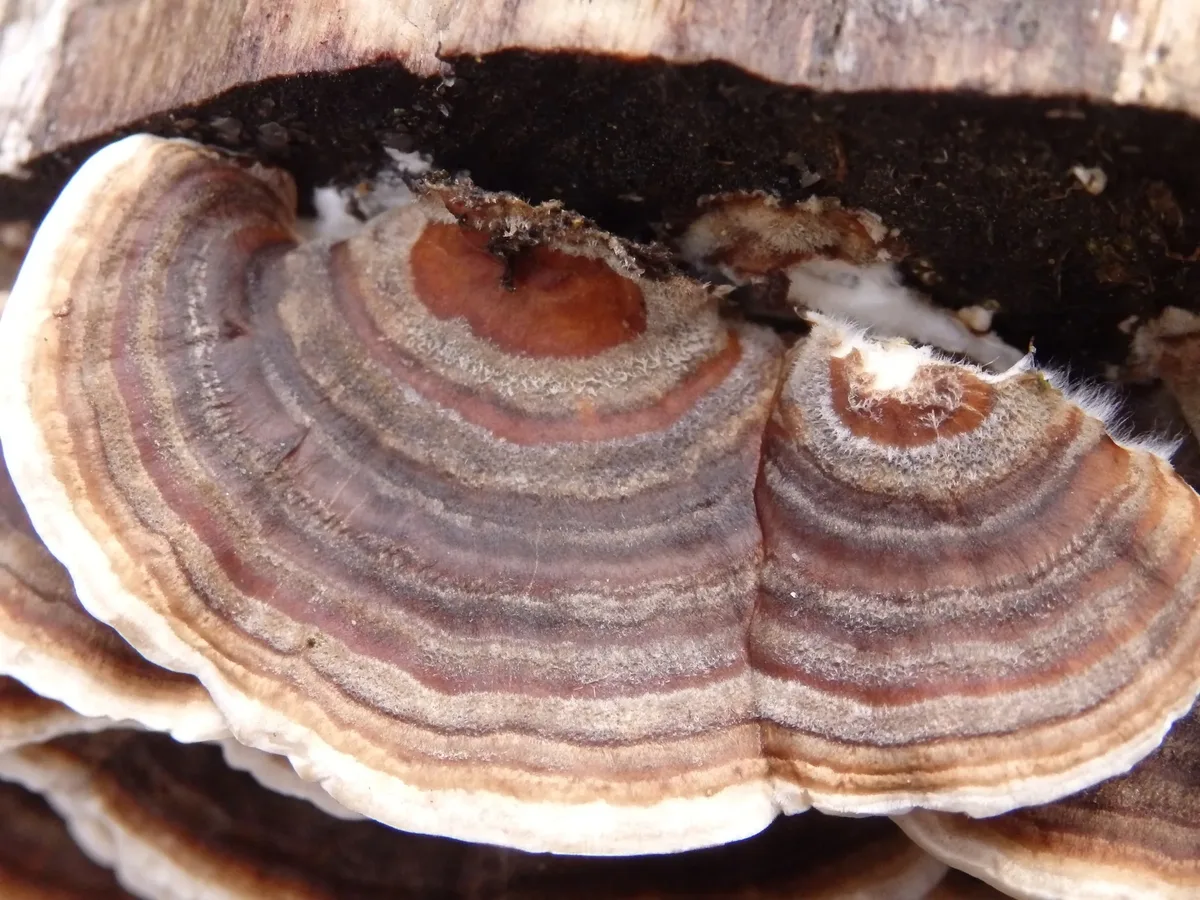 © Carminda Santos (CC BY)
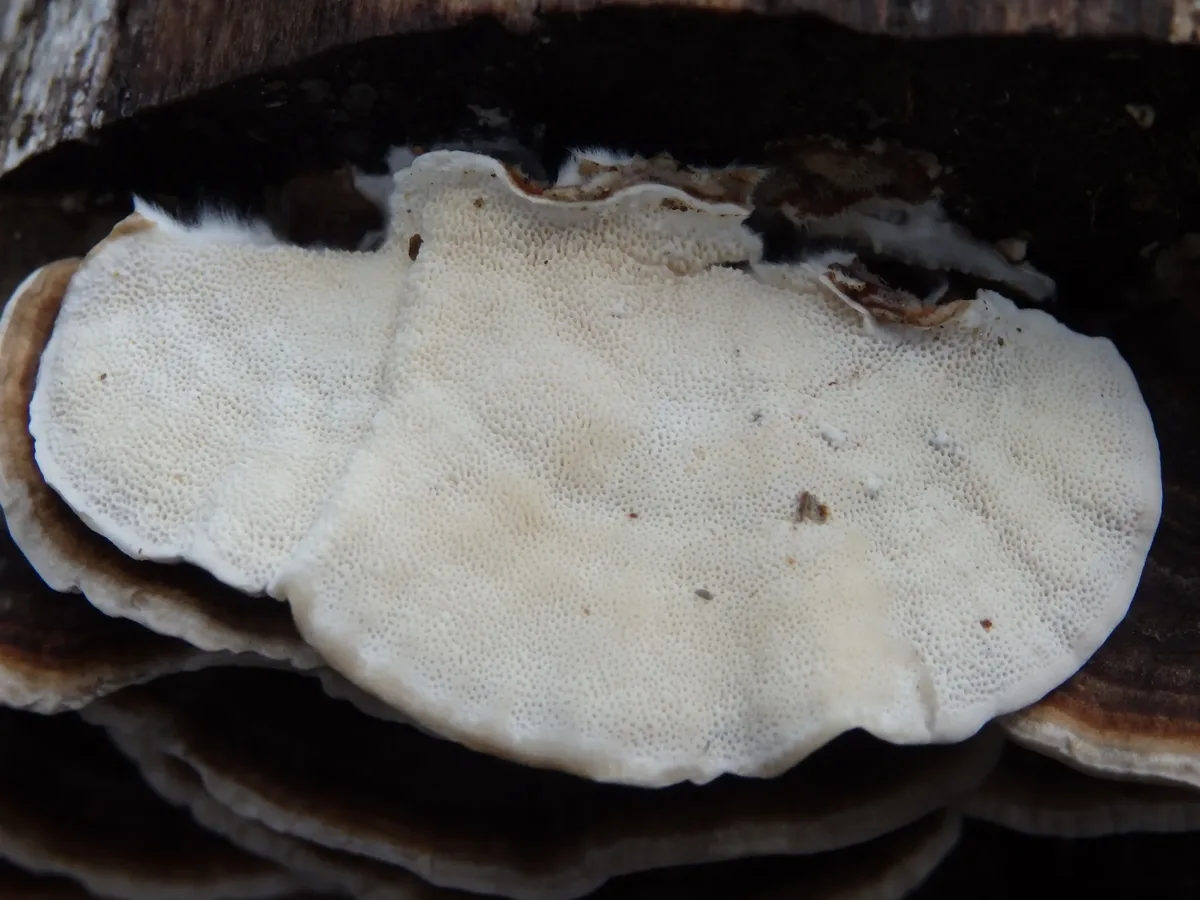 © Carminda Santos (CC BY)
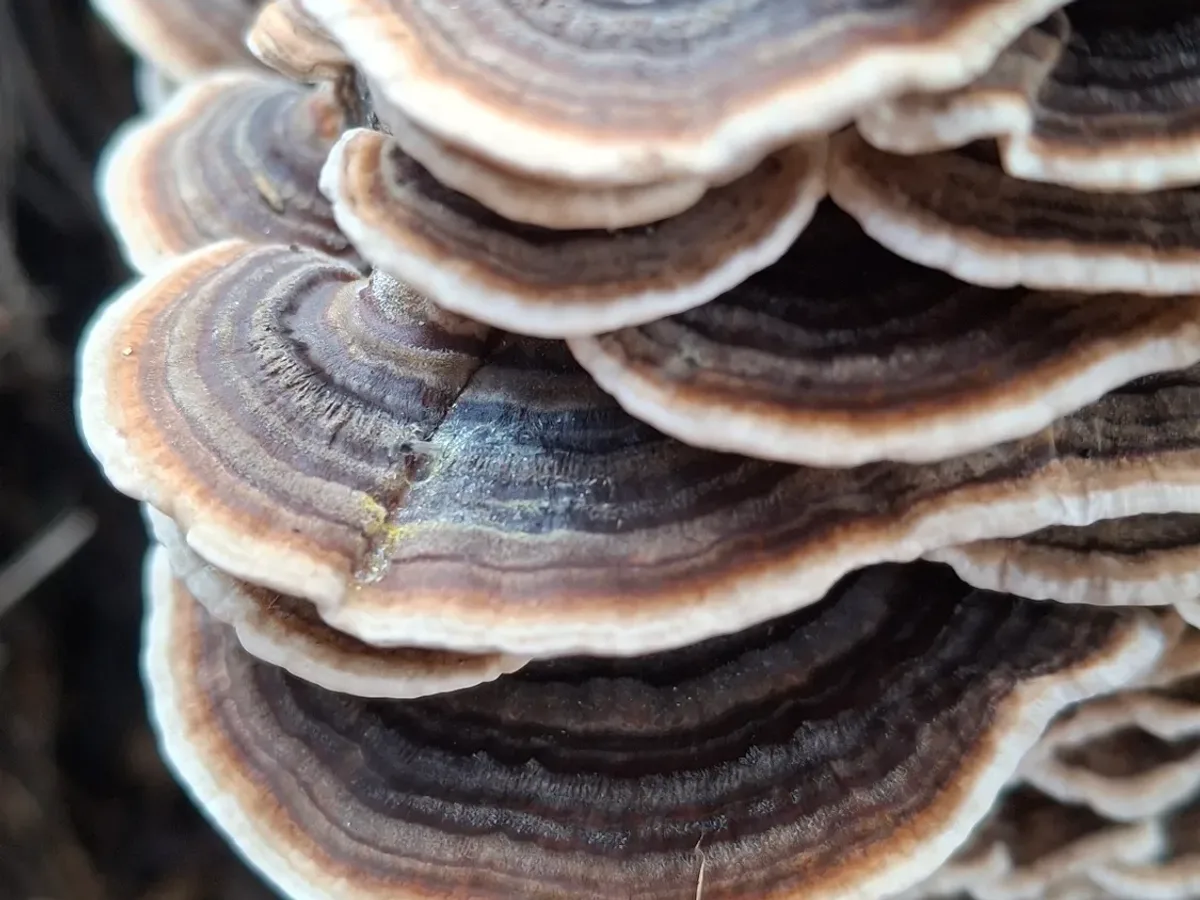 © Carminda Santos (CC BY)
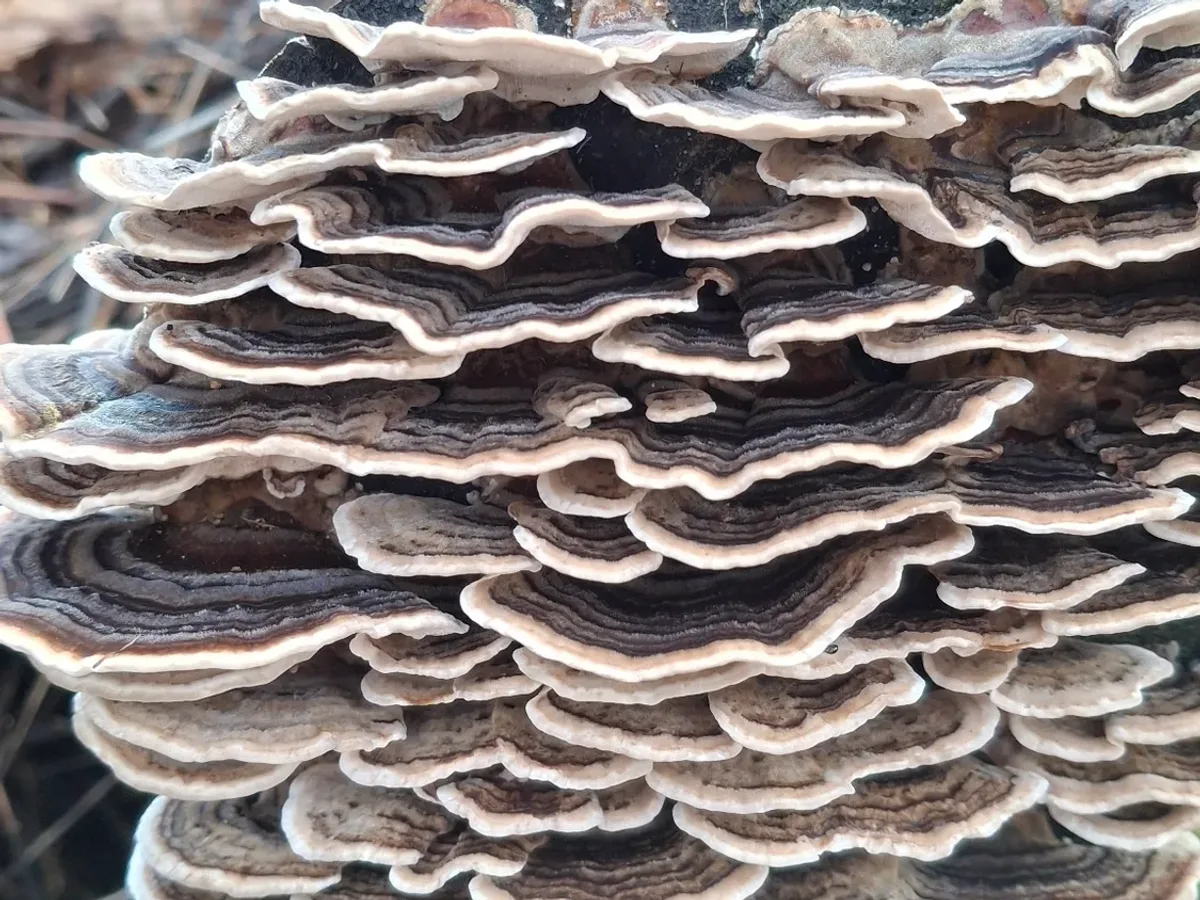 © Carminda Santos (CC BY)
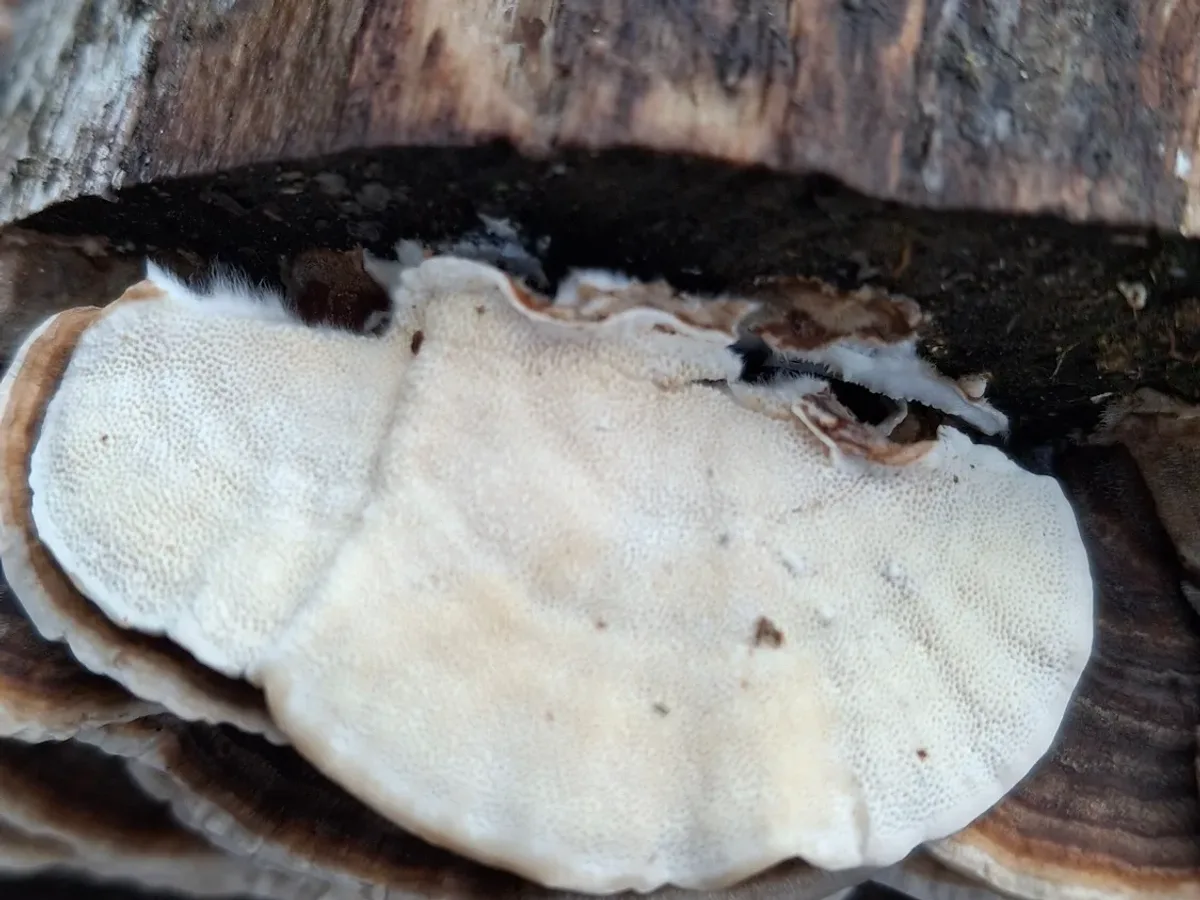 © Carminda Santos (CC BY)© Dan Vickers (CC BY)© Carminda Santos (CC BY)
Not poisonous, but not worth eating - too tough, bitter, or bland for the pot.
How to recognise it
Turkey tail is one of the most recognisable fungi in temperate woodland - a thin, flexible, fan- or kidney-shaped bracket that tiles fallen logs and stumps in dense, overlapping shelves.
Cap
Its upper surface is the giveaway: concentric, alternating bands of contrasting colours and textures - velvety matt zones in shades of tan, buff, ochre, rust-brown, chestnut, olive, and dark grey alternating with silkier, slightly shinier bands, while the outermost growing edge stays a reliable pale cream or white.
The colour palette shifts enormously between individual brackets - on the same log you may find specimens ranging from almost monochrome brown to strikingly banded blue-grey and white - but the characteristic zoning and fine velvet texture are constant across all of them.
Brackets are typically 3-10 cm across and only 1-5 mm thick: they bend rather than snap, feeling like firm leather or stiff fabric.
Gills / Pores
The underside (pore surface) is white to cream, occasionally yellowing with age, and is covered in an extremely fine pore layer - 3-5 pores per mm, so small they can appear almost smooth to the naked eye.
That fine white pore surface is the single most important identification character; check it on every specimen.
Flesh
Flesh is white, thin (1-3 mm), tough, and fibrous with no distinctive odour or taste. Spore print white.
Where & when it grows
Habitat
Trametes versicolor is a white-rot saprotroph of global distribution, found on the dead wood of an enormous range of broadleaved hardwoods - beech, birch, oak, cherry, poplar, willow, alder, maple, and dozens of others are all regularly colonised.
It is just as happy on a weathered orchard stump or a park log as it is deep in ancient woodland, and turns up wherever dead wood sits in a reasonably moist spot. On conifers (spruce, pine) it is occasional rather than regular in Europe.
It grows from sea level to the lower subalpine zone and is present on every continent except Antarctica.
Look for it on:
- fallen trunks
- standing dead trees
- cut stumps
- occasionally, apparently sound trees that have suffered hidden heartwood decay
A well-colonised log can carry hundreds of closely packed brackets.
When
Although new brackets are most abundant and brightly coloured from late summer through autumn (approximately August to November in temperate northern latitudes), Trametes versicolor is effectively a year-round fungus.
Old brackets may persist for several years, becoming dull and often colonised by green algae. In warm, moist conditions flushes of new growth can appear in spring and early summer.
In the southern hemisphere the peak shifts accordingly to March-June.
How it grows
Turkey tail lives as mycelium threading through dead wood year-round, invisible and patient, breaking down the wood from within.
When warmth and moisture align, the mycelium pushes out brackets at the surface - small fan-shaped outgrowths that gradually widen and tile together into the dense, overlapping shelves so characteristic of the species.
Each season's growth adds a fresh pale ring at the margin; a well-established bracket may carry two or three years' worth of concentric increments, each year's contribution visible as a slightly different band.
Brackets have no stem - they spring directly from the wood, sessile. On a freshly felled or storm-thrown log, the first brackets can appear within a single growing season, the mycelium wasting no time on its new substrate.
Fruiting conditions
Saprotrophic on dead wood; fruiting is driven primarily by ambient moisture and temperature rather than soil conditions. New bracket growth is triggered by sustained humid conditions after dry spells. Existing perennial brackets resume active margin growth without requiring a new rainfall event.
Look-alikes
Several related bracket fungi can superficially resemble Trametes versicolor, and correct identification demands checking the fine white pore surface.
- Stereum hirsutum (hairy curtain crust): grows in similar positions and has a similarly zoned, hairy upper surface, but its underside is smooth and ochre-yellow with no pores at all - this is immediately obvious.
- Trametes hirsuta: larger and thicker, with coarser, shaggier hairs on top and larger pores (1-3 per mm); its colour banding is usually duller and less contrasty.
- Trametes ochracea (syn. T. zonata): very similar to T. versicolor and may co-occur; it tends to have duller, more ochre-cinnamon tones and slightly larger pores, and the upper surface hairs are less fine. Microscopical separation can be required.
- Lenzites betulina: has a gill-like, labyrinthine lower surface rather than true pores.
- Bjerkandera adusta (smoky polypore): has a greyish-brown, smoky pore surface that rapidly turns dark grey when bruised.
- False turkey tail (Stereum ostrea): has no pores and a smooth, orange-tinted underside.
None of these confusable species are toxic.
Lenzites betulina's underside has elongated, gill-like or maze-like lamellae rather than circular pores - visible to the naked eye. Not toxic.
Stereum ostrea lacks pores entirely; the underside is smooth, pale orange to buff. Upper surface may show similar colour banding but hairs are coarser.
Trametes hirsuta is thicker, has a coarser, shaggier hairy surface, duller colouration (mostly grey-white with muted brown zones), and distinctly larger pores (1-3 per mm, vs 3-5 per mm in T. versicolor).
Stereum hirsutum has a smooth, pore-free underside that is ochre to orange-yellow - not white with fine pores. The hairy upper surface is similar but the complete absence of pores on the underside distinguishes it immediately.
Bjerkandera adusta has a distinctive smoky dark-grey pore surface that turns almost black when bruised or dried. Upper surface is pale grey-brown, less brightly zoned. Not toxic.
Very similar and may require microscopy for definitive separation. Trametes ochracea tends to be more uniformly ochre-cinnamon without the blue-grey or greenish zones often seen in T. versicolor; pores are marginally larger. Not toxic.
In the kitchen
Picking & cleaning
Trametes versicolor is not used as a table mushroom - the flesh is far too tough and leathery to eat as food. It is however collected extensively for medicinal and wellness purposes (see below).
For this use, select young, vigorously growing brackets where the margin is still white and actively expanding; older brackets with greenish algal coatings and dull colours have degraded active compounds.
Brackets detach easily by hand or with a knife. Dry promptly in a food dehydrator or low oven (40-50 °C) to preserve polysaccharide content; dried brackets keep for a year or more in an airtight container.
Cooking
Turkey tail is not a table mushroom - the brackets are far too tough and leathery to eat as food, and cooking does not soften them.
What it is used for, and has been for centuries across China, Japan, and Korea, is tea. To make it:
- 1Simmer 10-20 g of dried, broken brackets in 1 litre of water for 30-60 minutes.
- 2Strain well.
- 3Drink the liquid.
The bioactive polysaccharides (PSK/Krestin and PSP) are water-soluble and pass readily into the brew.
In Japan, a standardised protein-bound polysaccharide extract (PSK, trade name Krestin) has been evaluated as an adjunct to cancer chemotherapy and is approved for clinical use in Japan and China alongside conventional treatment.
Home-prepared teas and powders are also widely available in Western countries as immune-support supplements.
The polysaccharides' immunomodulatory properties are well-documented in laboratory and clinical research, but claims should not be overstated outside of properly evaluated medical contexts - if you are immunocompromised or on medication, speak to a healthcare provider before using any mushroom supplement.
Good to know
Trametes versicolor is non-toxic. It does not cause poisoning in any known case and is formally listed as inedible rather than poisonous: its only hazard is its woody, indigestible texture.
No deadly lookalikes share its precise combination of thin leathery bracket, concentric multicolour-banded velvety upper surface, and very fine white pore surface. Nonetheless, always confirm the fine pore surface before collecting for any purpose.
Some individuals may experience mild gastrointestinal discomfort if large quantities of poorly prepared material (rough tea, raw powder) are consumed, especially those with sensitive digestion.
If you are immunocompromised or taking prescribed medication, consult a healthcare provider before using any mushroom supplement.
A reference guide - never an edibility guarantee. When in doubt, leave it out.