Heim's termite mushroom
Termitomyces heimii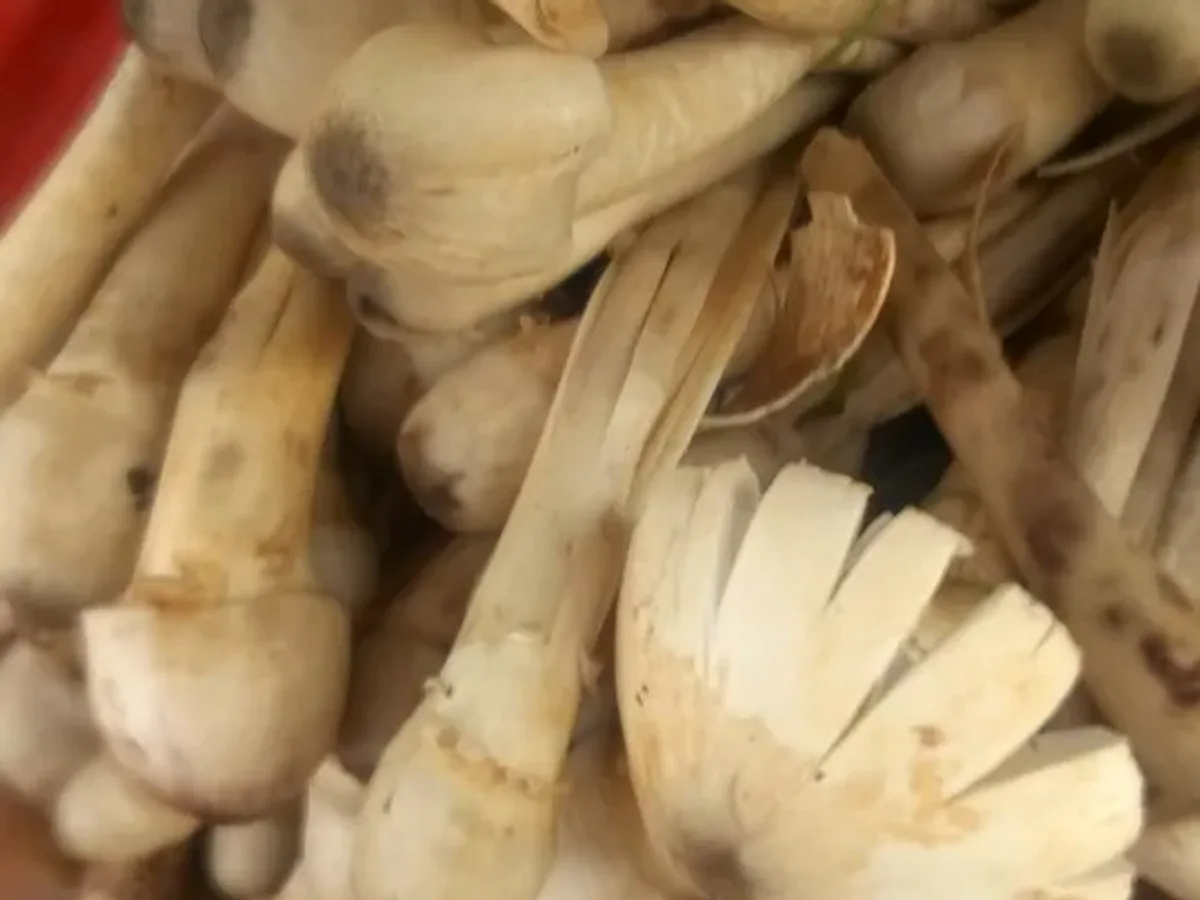 © Vihane (CC BY-SA)
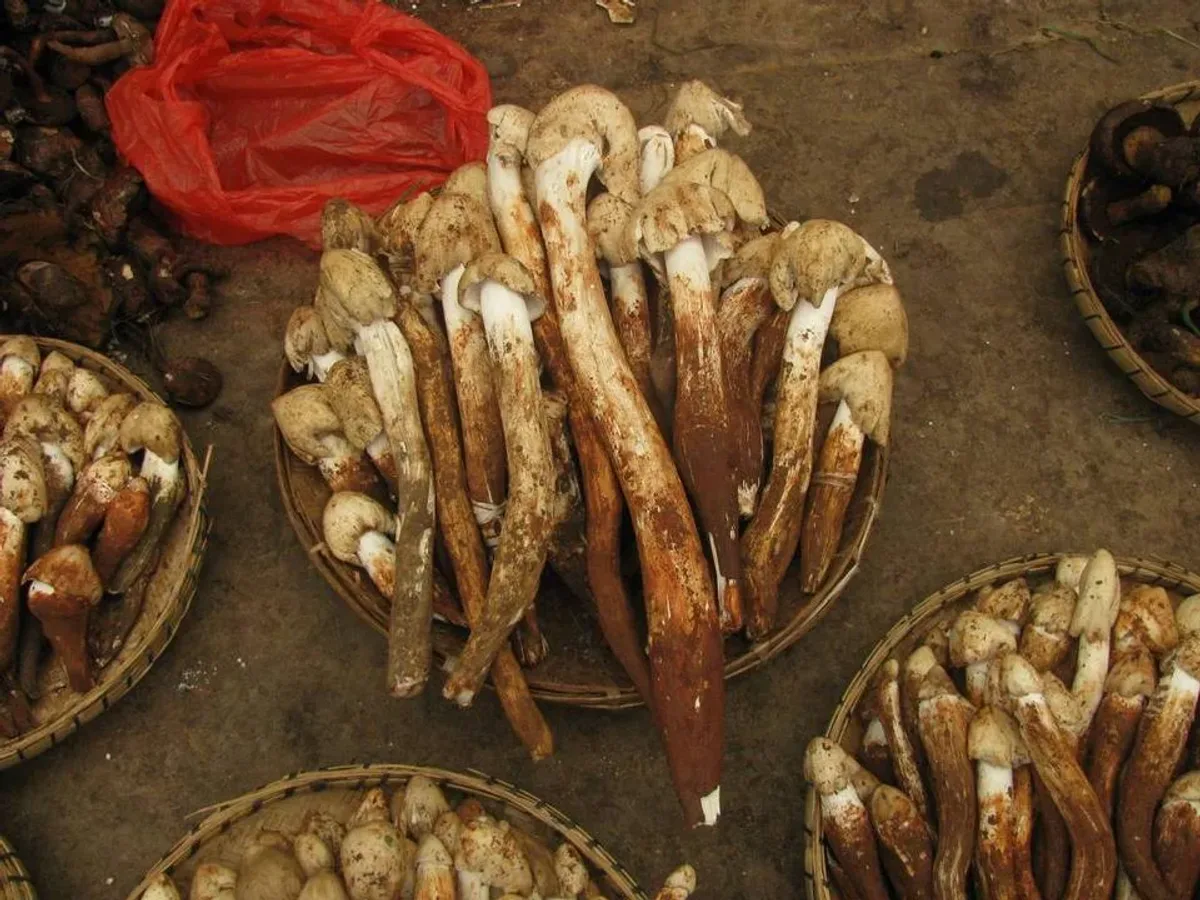 © Ryane Snow (CC BY-SA)
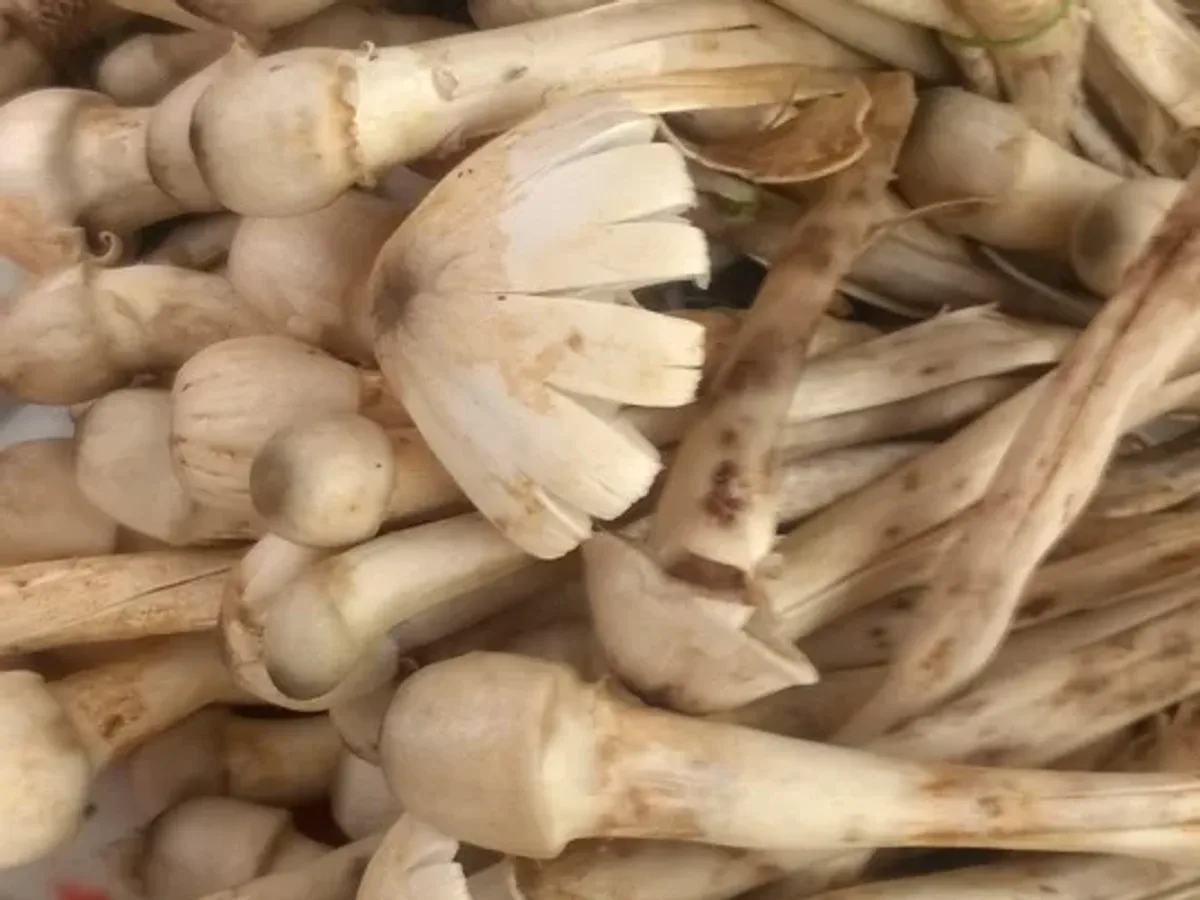 © Vihane (CC BY-SA)© Vihane (CC BY-SA)© Ryane Snow (CC BY-SA)
One of the best mushrooms you can bring home - once you are certain of the identification.
Never eat a mushroom you are not 100% sure of - check the look-alikes below, and always cook wild mushrooms.
How to recognise it
Termitomyces heimii is one of the largest species in its genus, and a freshly emerged large specimen commands immediate attention.
Cap
The cap begins broadly conical and narrows upward to a sharp, spine-like perforatorium - the pointed umbo at the very centre - that gives young fruiting bodies a distinctive peaked silhouette visible from a distance.
As the cap expands it flattens to broadly convex and eventually nearly plane, but the perforatorium persists even on fully opened caps, remaining as a prominent central point that distinguishes Termitomyces from most other large-capped grassland mushrooms at a glance.
Cap colour is pale grey-brown to warm fawn, subtly darker at the centre and paler toward the margin, smooth and slightly silky-glossy when moist.
Gills
The gills below are free, crowded, and white - a detail to check carefully, since white gills on a large umbrella-shaped mushroom can be a dangerous feature in other genera, but here they combine with the pseudorhiza to confirm identity.
Stem
Pull the entire fruiting body free of the soil: the stem continues below the surface as a robust white pseudorhiza typically coated in reddish-brown termite mound soil, and this below-ground cord is the single most decisive field character separating T. heimii from everything dangerous.
Flesh
The flesh is white throughout, firm, and pleasant, with a mild clean odour.
Where & when it grows
Habitat
Termitomyces heimii is locked to one place by an evolutionary contract roughly 30 million years old. Every fruiting body marks the location of an active Macrotermitinae termite colony - most commonly Macrotermes or Odontotermes - whose workers cultivate the mycelium underground on carefully maintained fungus combs.
The termites chew plant material into paste, inoculate it with the fungus, and consume the resulting nutrient-rich nodules of mycelial growth; the fungus, in turn, receives a climate-controlled, high-humidity growing chamber it could not construct on its own. Neither partner can complete its life cycle without the other in natural conditions.
In India, T. heimii tends to be found in open and semi-open landscapes - grasslands, village commons, the margins of dry deciduous forest, roadsides near mounds, and agricultural field edges - wherever large Macrotermitinae colonies are established.
The mound itself may be inconspicuous, weathered flat by years of rain, or as tall as two metres. Experienced foragers in Karnataka and Tamil Nadu know their productive mounds by name and location, returning to the same sites each monsoon.
When
Fruiting is dictated by the arrival of the monsoon, not by calendar dates. In peninsular India the southwest monsoon typically arrives in Kerala in late May or early June and progresses northeastward through Karnataka, Tamil Nadu, Andhra Pradesh, and Maharashtra through June.
T. heimii responds quickly: fruiting bodies can push through the mound surface within one to four days of the first sustained rain event, once soil temperatures are warm enough (roughly 24-32 °C).
Peak abundance runs from July through September across most of the species' Indian range. In the coastal and southeastern peninsular areas influenced by the northeast monsoon, a secondary minor flush may occur in October.
The season is short - six to sixteen weeks - but individual mounds can produce multiple small flushes within it if rains are intermittent. Once the monsoon ends and soils dry, fruiting ceases entirely.
How it grows
The developmental biology of T. heimii is the same as for all obligately termitophilous Termitomyces. The mycelium lives permanently inside the termite mound on the fungus comb, a latticed structure of chewed plant matter kept at approximately 29-31 °C and near-100% relative humidity by the termites' ventilation behaviour.
When the rains arrive and moisture percolates into the soil above the mound, the mycelium receives a cue - possibly a combination of increased atmospheric pressure, temperature fluctuation, and moisture - that triggers carpophore initiation.
Pinheads form within the comb and grow with extraordinary speed, the pseudorhiza extending first like a root toward the surface, followed by rapid cap and gill development at the tip. The emerging fruiting body pushes through compact mound material and surface soil using turgor pressure alone, sometimes lifting small pebbles and clods as it breaches the surface.
From initiation to spore-ready cap can take as little as 24-48 hours. This explosive growth rate is ecologically important: the window of spore dispersal must occur during the rains, when termite colonies of other mounds are most likely to acquire the spores and establish new fungus gardens.
Commercial cultivation of T. heimii without the termite partner has not been achieved and remains an active area of research in Indian agricultural institutes.
Fruiting conditions
Fruiting is triggered by monsoon rain events once soil temperatures exceed about 24 °C. The mycelium is already metabolically active inside the warm termite mound year-round, so the lag from rain to visible cap is very short - typically 1-4 days after the first significant monsoon rain. Peak fruiting aligns with the southwest monsoon in June-September across peninsular India.
Look-alikes
The critical diagnostic feature that separates T. heimii from all dangerous lookalikes is the pseudorhiza. Pull the entire fruiting body free of the soil: the presence of a firm, solid, whitish cord descending from the stem base - typically coated in reddish mound soil and running down to the termite colony - eliminates all deadly species simultaneously. No deadly mushroom growing in the same region produces a pseudorhiza of this character.
- Amanita bisporigera and related destroying-angel Amanita species (the most important dangerous species to know about): these are pure white, have free white gills, and emerge from soil apparently without support - at first glance a white button-stage Termitomyces and a white Amanita button can look superficially similar to an inexperienced eye. Amanita is distinguished absolutely by its volva (a cup-shaped sac at the very base of the stem, often buried below soil level) and, in species with a ring, a membranous skirt on the stem; it entirely lacks a pseudorhiza connecting to a termite mound.
- Chlorophyllum molybdites, the green-spored parasol (the other important non-deadly hazard): large, white to pale buff, emerging from grassland. It lacks a pseudorhiza, produces a distinctly greenish spore print (check by laying the cap gill-side down on white paper for 30 minutes), and its gills turn greenish-grey as the cap matures. C. molybdites causes severe gastrointestinal poisoning.
Confirmation rule: if you cannot clearly trace the stem base to a solid pseudorhiza running into a termite mound, do not eat the specimen.
Pure white at all stages: white cap, white free gills, white stem, white ring, and a white bag-like volva at the stem base - the volva is the definitive anatomical difference. Amanita bisporigera and related white destroying angels completely lack a pseudorhiza and do not emerge from termite mounds. They contain amatoxins and cause fatal liver and kidney failure. Any white button-stage mushroom in grassland or at forest edges that does not have a clearly traceable pseudorhiza running to a termite mound must be treated as potentially deadly.
Large, pale buff to white umbrella-shaped cap emerging from grassland, potentially confused with immature or unexpanded T. heimii before the pseudorhiza is examined. Distinguishing features: no pseudorhiza connecting to a termite mound; gills turn distinctly greenish-grey as the cap matures; spore print is clearly greenish (lay cap gill-side-down on white paper for 30 minutes). Causes severe gastrointestinal poisoning within 1-3 hours of ingestion - violent vomiting and diarrhoea. Not typically lethal but requires hospital attention in severe cases and is one of the most common causes of mushroom poisoning in tropical Asia.
Several other Termitomyces species co-occur in India (notably T. microcarpus, which is very small, cap rarely exceeding 3 cm, and T. clypeatus, which has a pinkish cap with a distinctive rounded perforatorium). All Termitomyces species are considered edible. Distinguishing between them requires attention to cap size, perforatorium shape, and gill colour, but the genus-level identification via pseudorhiza is safe for all members.
The paddy straw mushroom also has a volva and grows in rice-farming regions overlapping with T. heimii's range. At the egg stage it is a dark grey-brown oval rather than emerging from a mound with a pseudorhiza. At maturity the cap is grey-brown to dark smoky brown (never pale fawn with a perforatorium), the gills turn pink with age, and spore print is pink-brown. It does not produce a pseudorhiza and does not emerge from termite mounds. Edible, but confusion in the field is possible near agricultural areas.
In the kitchen
Picking & cleaning
Harvest T. heimii when the cap is still convex and the perforatorium (central point) is well defined but the margin has not yet fully expanded and lifted - this is the prime stage for flavour and texture. Caps that are fully flattened with a lifting, cracked margin are still edible but less desirable.
Do not snap the cap off at soil level. Instead:
- 1Use a small hand trowel or digging stick to loosen the soil in a ring around the emerging stem.
- 2Grasp the stem as low as possible.
- 3Draw the entire fruiting body upward with a steady, slightly twisting pull to extract as much of the pseudorhiza as possible.
The pseudorhiza is edible and confirms identification: it should be a firm, solid, whitish cord typically coated in reddish-brown mound soil.
Brush soil off with a dry cloth; avoid washing before transport as it accelerates spoilage. Shelf life is short - one to two days at ambient Indian summer temperatures; use within three days if refrigerated at 4-6 °C.
The mushroom does not dry as elegantly as some species, though slow sun-drying or low-oven drying (40-50 °C) produces an acceptable dried product with concentrated flavour.
In local markets in Karnataka and Tamil Nadu, sellers often leave mound soil on the pseudorhiza as authenticity proof.
Cooking
In Karnataka and Tamil Nadu, T. heimii (locally known as kaddi ale, kempu ale, or by analogous regional names in various Dravidian languages) is considered a monsoon delicacy of the first order - expensive, deeply seasonal, and unmistakable in flavour.
The taste is mild, clean, and pleasantly savoury, sometimes described as having a light sweetness underpinned by a gentle earthiness, and the firm white flesh holds its texture well through prolonged cooking without dissolving or becoming slimy.
The simplest preparation and often the preferred one is direct: cleaned slices fried in coconut oil or groundnut oil with fresh curry leaves, green chili, and a little salt, finished with grated fresh coconut. The moisture in the mushroom is driven off first over high heat before the oil and aromatics are added, which deepens the flavour considerably.
Regional traditions each treat it differently:
- In Karnataka, a classic dish is a dry-style sabzi (stir-fry): the cleaned mushroom is cut into large chunks and tossed with turmeric, red chili powder, coriander seeds, and coconut in a heavy pan until fully cooked and slightly caramelised at the edges.
- In Tamil Nadu, T. heimii is featured in kuzhambu - a tamarind-based gravy with tomatoes, curry leaves, and mustard seeds - where its firm texture allows it to absorb the tangy sauce without losing cohesion.
- In Andhra Pradesh, preparations tend to be spicier, with green chillies and gongura (sorrel) leaves.
In all traditions, cooking is done fresh on the day of harvest; the mushroom is not typically dried or preserved in this region, unlike in Yunnan.
Pairing with starches - rice, jowar roti, or rice-flour flatbreads - is traditional and appropriate, as the mild savoury quality complements rather than competes with the grain.
Good to know
Termitomyces heimii has been safely consumed across peninsular India for generations and is one of the most prized wild mushrooms in Karnataka, Tamil Nadu, and Andhra Pradesh, commanding premium prices in local markets during the monsoon season.
The genus Termitomyces contains no known toxins, and T. heimii has a well-documented record of safe consumption with no credible reports of toxicity in properly identified material.
The principal safety risk is misidentification at the button stage, when unexpanded caps of various white-gilled or pale-capped species all look broadly similar.
- The definitive check is always the pseudorhiza: dig around the base of any suspected T. heimii and confirm the presence of a firm, whitish, cord-like root extension plunging into the soil toward a termite mound. If no pseudorhiza is present, do not eat the specimen regardless of how similar it looks.
- Take a spore print from any mature cap: white to pinkish-white confirms Termitomyces; greenish spores indicate Chlorophyllum molybdites and the specimen must be discarded.
- As with all wild mushrooms, cook thoroughly - raw consumption is unnecessary and is not part of any established culinary tradition for this species.
Individuals new to wild mushroom foraging should confirm identification with an experienced local guide before eating.
A reference guide - never an edibility guarantee. When in doubt, leave it out.