Long-rooted Termite Mushroom
Termitomyces eurhizussyn. Agaricus eurhizus Berk., Collybia eurhiza (Berk.) Sacc., Termitomyces eurhizus var. eurhizus
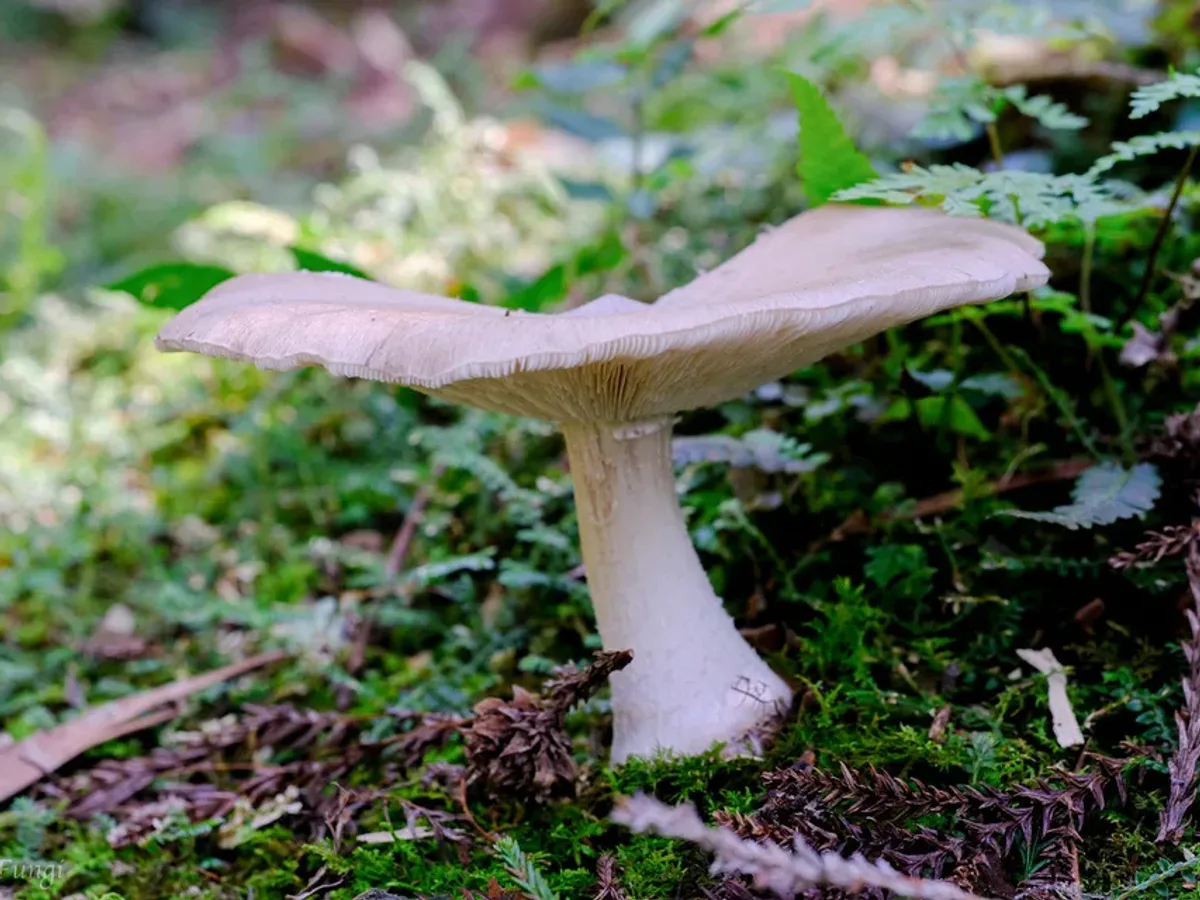 © Cho Fungi (CC BY-SA)
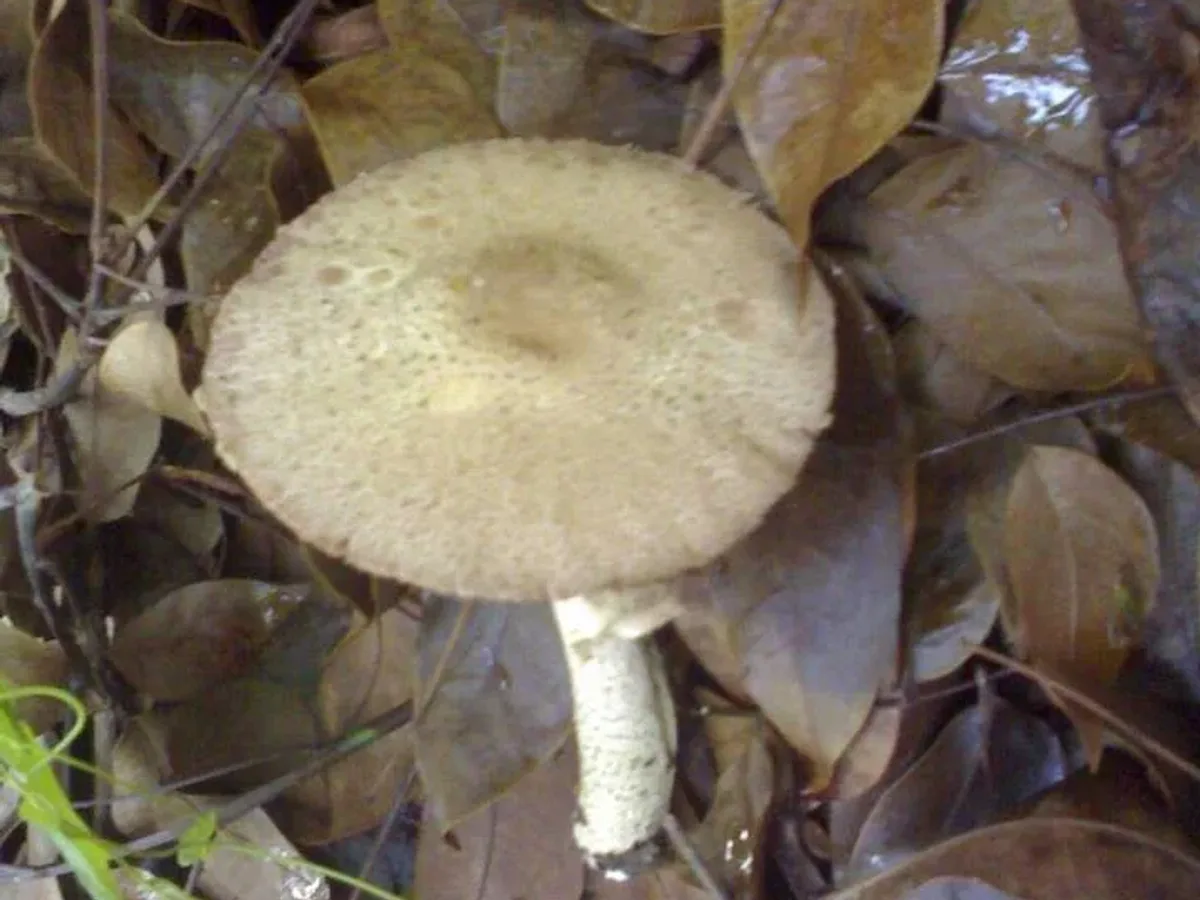 © kabutiphilippines (CC BY-SA)
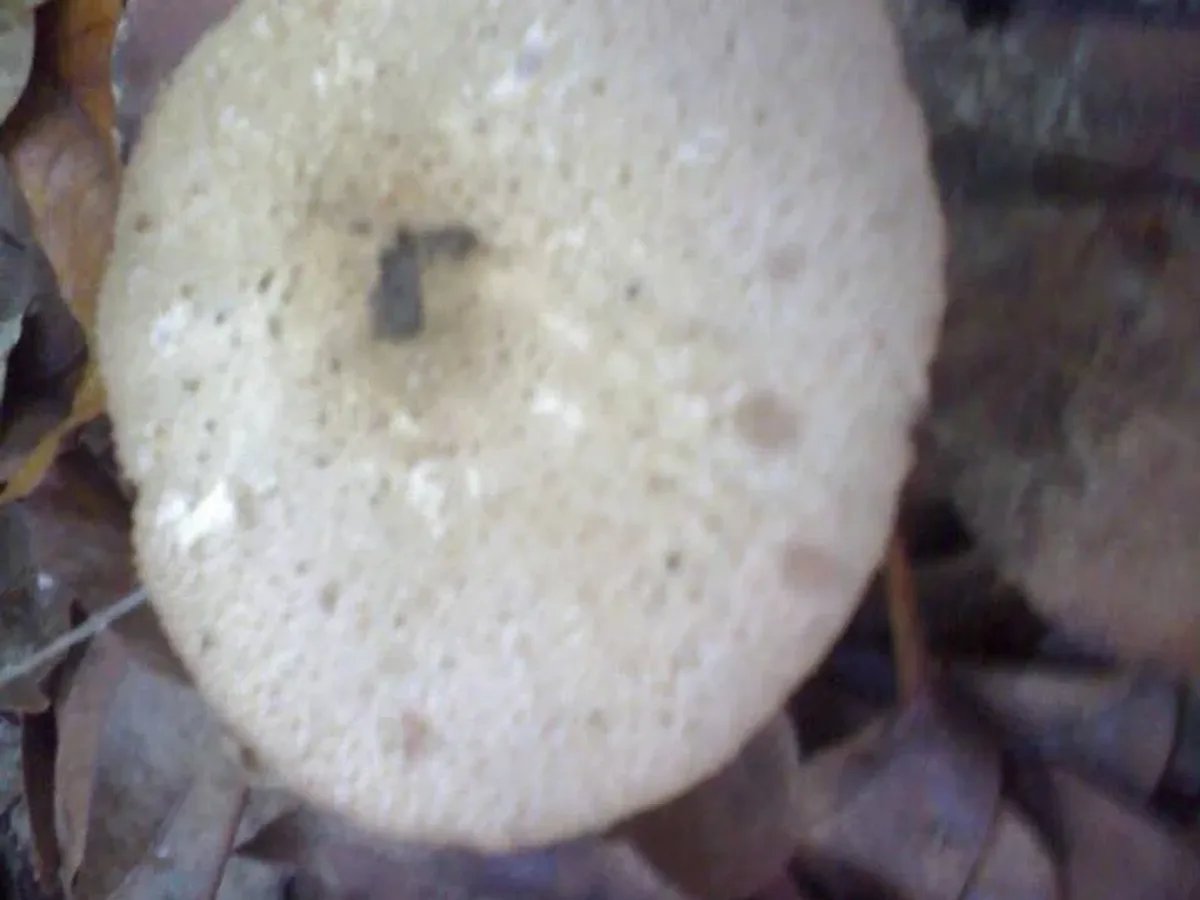 © kabutiphilippines (CC BY-SA)
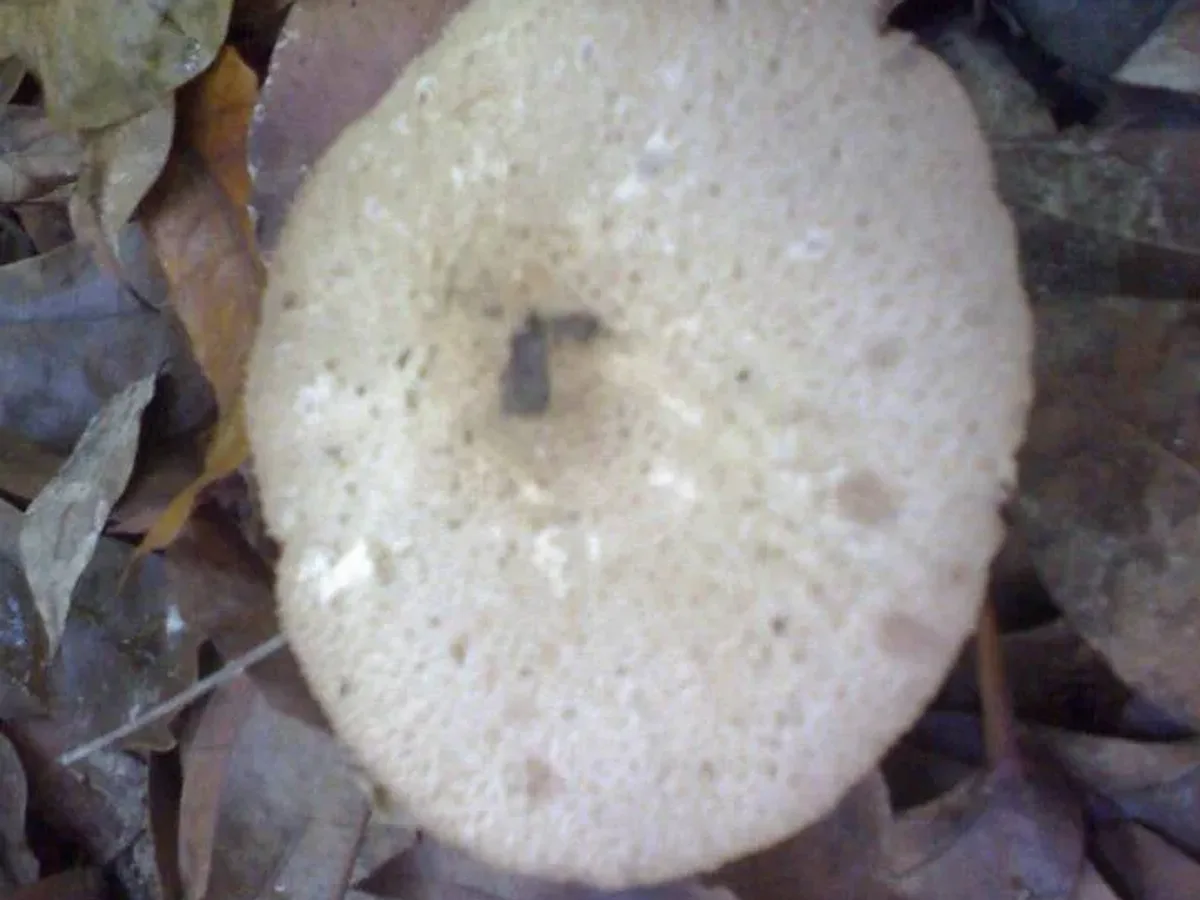 © kabutiphilippines (CC BY-SA)
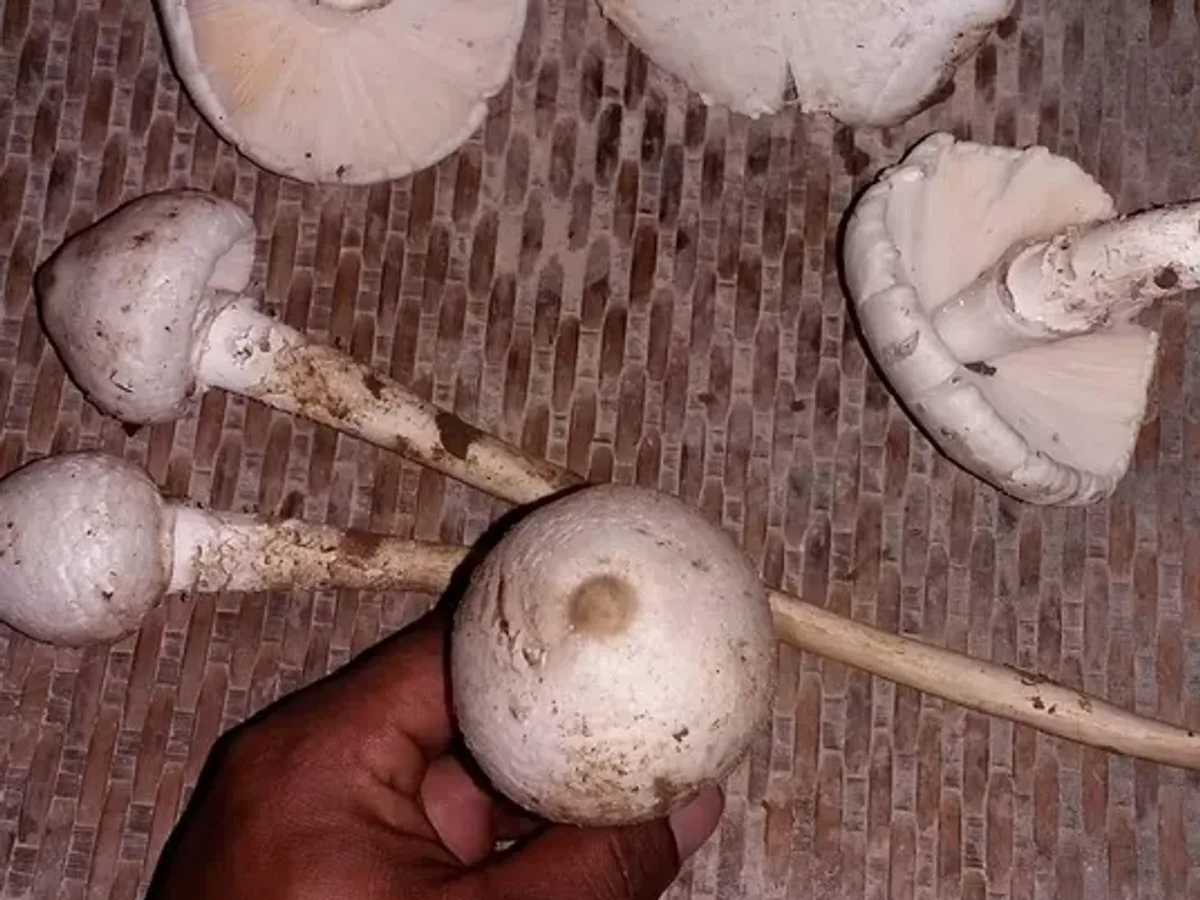 © partha_66bd (CC BY-SA)© Cho Fungi (CC BY-SA)© kabutiphilippines (CC BY-SA)
One of the best mushrooms you can bring home - once you are certain of the identification.
Never eat a mushroom you are not 100% sure of - check the look-alikes below, and always cook wild mushrooms.
How to recognise it
Termitomyces eurhizus is a handsome and distinctive mushroom once you know its anatomy, and learning it matters - it shares forests and grasslands with some dangerous species at first glance.
Cap
The cap opens conically from a narrowly pointed button, carrying a sharply projecting central spike (the perforatorium, a feature shared with all Termitomyces) that distinguishes it even before the cap fully expands.
As the cap broadens to 5-20 cm across, it flattens to broadly convex or nearly plane while the central spike persists, giving mature specimens a characteristic bell-then-flat-with-a-point profile unlike almost anything else in the same habitats.
The cap surface is pale grey-brown to warm fawn - a muted, understated colouring that photographs poorly but is easy to recognise in the field - smooth and slightly silky when freshly emerged and moist, becoming dry and developing faint radial fibres toward the margin with age. Older caps may split radially at the margin and fade to buff.
Gills
The gills beneath are white, densely crowded, and cleanly free from the stem - they neither attach nor run down it - and this whiteness holds throughout the fruiting body's life without turning pink, brown, or any other colour.
Stem
The stem above ground is firm, white to pale buff, without a ring or a volva at the base, and this is where you must do the critical work: instead of snapping the mushroom off at soil level, dig around the base with a stick or small trowel and draw the entire fruiting body free.
What emerges is the pseudorhiza - a rope-like, solid, white to cream cord that in T. eurhizus descends conspicuously deeper than in most congeners, commonly 30-60 cm and sometimes considerably further, anchoring to the fungus comb of the termite colony far below.
This extended pseudorhiza is not merely an identification tool; it is the species' ecological life-support line, the conduit through which the connection between the fruiting body and its termite partners is maintained.
It is typically coated with the distinctive reddish-brown soil of the mound, and this soil signature - the cord plus its red earth coating - is the single most important thing to look for.
Flesh
Flesh is white throughout and does not change colour when cut.
Where & when it grows
Habitat
Every Termitomyces eurhizus fruiting body is a landmark: it marks the precise surface location of an active Macrotermitinae termite colony below. The biology is obligately symbiotic and has been so for tens of millions of years.
The termites cultivate the mycelium underground on a fungus comb - an intricate lattice of chewed plant material inoculated with hyphal threads - in chambers maintained at approximately 29-31 °C and near-saturating humidity, conditions the workers achieve by carefully managing ventilation tunnels.
The Termitomyces mycelium, in turn, enzymatically breaks down lignocellulose in the comb material into sugars and amino acids that the termites absorb.
Both partners are dependent: termite colonies deprived of their fungus garden decline within weeks, and Termitomyces mycelium has never been maintained indefinitely outside a functioning colony.
T. eurhizus is found across a broad arc of tropical and subtropical Asia - from eastern India and Bangladesh through mainland Southeast Asia into southern China - wherever suitable Macrotermitinae species (primarily Macrotermes and Odontotermes) build colonies in warm, seasonally moist environments.
The mound itself may be large and obvious, a metre or more of red earth towering above the grass, or it may be almost invisible - a weathered, grass-covered hump no taller than an ankle.
Experienced local foragers know their productive mounds by location, often returning to the same spot across many years and sometimes across generations.
In open agricultural landscapes the mounds at field edges are particularly productive; in woodland the species favours forest clearings and edges rather than the closed canopy interior.
When
Fruiting is governed almost entirely by rainfall - specifically, by the arrival of the monsoon. The mycelium lives year-round inside the climate-controlled warmth of the termite mound and is metabolically active all year; what it is waiting for is moisture percolating through the mound ceiling.
When sustained monsoon rain arrives, fruiting body initiation can begin within hours, and a cap can push through the soil surface within one to four days of the triggering rainfall event.
This extraordinarily short lag - so unlike the week-or-more typical of many mycorrhizal and saprotrophic species - reflects the mycelium's perpetual readiness and the fact that the entire fruiting body is essentially pre-charged before breaking the surface.
By region:
- Eastern India (West Bengal, Odisha, Bihar, Jharkhand): the season typically runs from June through September, tracking the Bay of Bengal arm of the monsoon.
- Southern India (Karnataka, Tamil Nadu, Andhra Pradesh): the southwest monsoon brings the primary season from June through September, with a secondary possibility under the northeast monsoon in October.
- Thailand and Indochina: the southwest monsoon sets the window from around May-June through October.
- Yunnan: the rainy season runs June through early September.
Within each season, fruiting is not continuous - it comes in flushes following significant rain events, with dry spells in between producing few or no new caps.
A classic productive day is one to three days after a heavy overnight or afternoon rain, when the soil is thoroughly wet but the sky has cleared.
How it grows
The life history of T. eurhizus is inseparable from its termite hosts. Deep within the mound, the mycelium grows as a pale, cottony network on the fungus comb.
Workers consume small mycelial nodules daily as a primary food source and continuously replenish the comb with fresh plant material - a perfect, closed agricultural system.
When rain triggers fruiting, primordia form on the comb surface and begin elongating rapidly downward (pseudorhiza first, like a root seeking the surface in reverse) and then upward.
The pseudorhiza of T. eurhizus is notably elongated compared with many congeners - hence the species name 'eurhizus', from Greek, meaning 'well-rooted' - sometimes growing through half a metre of compacted soil.
The cap and gills differentiate at the tip of this extending cord, and the whole structure breaches the surface within 24-48 hours of reaching the soil.
Once above ground, the cap expands rapidly, driven by turgor pressure in cells that can inflate many times their initial volume without dividing. The spore-producing gills are functional within two to four days of emergence.
Commercial cultivation of T. eurhizus has not been achieved: all attempts to maintain the mycelium on artificial substrates for repeated fruiting have failed. The dependency on a living, actively managed termite colony means that this species - like all obligate termite fungi - remains permanently outside industrial agriculture.
Fruiting conditions
Fruiting is triggered by monsoon rain events once soil temperatures are in the 24-34 °C range. The mycelium inside the termite mound is metabolically active and warm year-round, so the lag between triggering rainfall and visible fruiting bodies is very short - typically 1-4 days. The elongated pseudorhiza of T. eurhizus must traverse more soil than shorter-pseudorhizate congeners, but this does not substantially delay emergence because the structure pre-elongates toward the surface before cap formation. Peak fruiting broadly aligns with the southwest monsoon (June-September) across most of the range.
Look-alikes
The identification of T. eurhizus is anchored by two features working together:
- 1The perforatorium (the persistent sharp spike at the cap centre).
- 2The pseudorhiza (the long, firm, whitish root-like cord descending to the termite mound).
No dangerous species in the region produces both.
The most important dangerous lookalike is Amanita exitialis and related lethal white Amanita species: these have free white gills, grow from soil under trees, and at the button stage can superficially resemble an as-yet-unexpanded Termitomyces. The absolute difference is that Amanita emerges from a sac-like volva (dig carefully - this cup is often buried) and has no pseudorhiza whatsoever.
A second serious hazard is Chlorophyllum molybdites, the green-spored parasol: large, pale buff to white, emerging from grassland, and a common cause of mushroom poisoning in tropical Asia. It has no pseudorhiza and no perforatorium; its gills turn distinctly greenish-grey at maturity; spore print is clearly green (confirm by resting the cap gill-side down on white paper for 30 minutes).
Within the genus Termitomyces all species are considered edible, so confusion between T. eurhizus and its congeners (T. albuminosus, T. clypeatus, T. microcarpus, T. heimii) is not dangerous, though sizes and perforatorium shapes differ.
The golden rule: if you cannot trace the stem to a solid cord descending into a termite mound, do not eat the specimen.
Pure white at all stages - white cap (without the perforatorium of Termitomyces), white free gills, white ring, and a white sac-like volva buried at the stem base. Grows in or at edges of forest under trees, not from termite mounds. Completely lacks a pseudorhiza. Contains amatoxins and causes fatal liver and kidney failure. Button-stage specimens can superficially resemble an unexpanded Termitomyces in grassland or forest margin; the definitive test is always to excavate the base: a volva (cup, sac, or frill of tissue at the very bottom of the stem) means Amanita - stop immediately. Termitomyces has only the pseudorhiza cord; no volva, no ring.
Amanita exitialis is a lethal amatoxin-containing species distributed in southern China (Guangdong, Fujian) and potentially wider Southeast Asia. At the unexpanded button stage it produces a smooth white to pale oval egg superficially resembling an unexpanded T. eurhizus button before the pseudorhiza has been exposed. At maturity the cap is white to faintly grey-white, gills are white - it has a volva (sac at the stem base) and ring, and entirely lacks a pseudorhiza connecting to a termite mound. Fatal mass poisonings have been attributed to A. exitialis in Guangdong. Always dig the base of any suspected T. eurhizus free to confirm the pseudorhiza before collecting.
Large, pale buff to white umbrella-shaped cap emerging from open grassland, sometimes confused with an older or more expanded T. eurhizus before the base is examined. Key differences: no pseudorhiza (the stem ends at soil level or has a bulbous base, not a descending cord); no persistent perforatorium at cap centre; gills turn grey-green as the cap matures and spore print is distinctly green - confirm by resting the cap gill-side down on white paper for 30 minutes. Causes severe gastrointestinal poisoning (violent vomiting and diarrhoea within 1-3 hours) and is one of the most common causes of wild mushroom poisoning in tropical Asia. Not lethal in typical cases but can require hospitalisation.
Multiple Termitomyces species co-occur across the range: T. albuminosus (similar but pseudorhiza typically shorter, cap often larger and more tan), T. clypeatus (smaller cap, more rounded umbo, pinkish tones), T. microcarpus (very small, cap rarely exceeding 3 cm, forms in dense clusters on mounds), T. heimii (larger robust cap up to 40 cm, prominent perforatorium, primarily Indian subcontinent). All Termitomyces species are considered edible - confusion between them has no toxicological consequence. The genus is identified at species level by cap diameter, perforatorium shape, pseudorhiza length, and spore dimensions; genus-level identification via pseudorhiza is sufficient for safe foraging.
In the kitchen
Picking & cleaning
The ideal harvest moment for T. eurhizus is just after the cap breaks the soil surface: still conical to broadly convex, perforatorium sharply defined, margin intact, gills white and unweathered. Caps that have expanded fully flat or begun to show a lifting, splitting margin are still edible but texturally inferior.
The most important step in harvesting is not cutting or snapping but digging:
- 1Use a stick, small trowel, or the fingers to loosen the soil in a ring around the emerging stem.
- 2Grip the stem as low as possible and draw the entire fruiting body upward with a slow, steady, slightly twisting motion.
Recover as much of the pseudorhiza as possible - it can be 30-60 cm, so you may need to dig considerably before the cord comes free.
The pseudorhiza is edible, firm, and flavourful, and its presence on the mushroom you carry home serves the important secondary function of confirming identification to anyone who examines it later.
The reddish-brown mound soil clinging to the pseudorhiza is also, in local markets, a proof of wild origin and correct genus - vendors in Yunnan and Indian market towns leave this soil in place deliberately.
- Brush soil off with a dry cloth rather than washing; moisture accelerates deterioration.
- Shelf life at ambient tropical temperatures is short: one to two days fresh, three days refrigerated between 2 and 5 °C.
- Gentle sun-drying or slow oven-drying at 40-50 °C concentrates the flavour and produces a dried product that stores for months.
- Do not refrigerate unwashed; if washing is needed, dry the surface immediately and cook promptly.
Cooking
Termitomyces eurhizus is a genuinely prized edible wherever it occurs, not simply eaten because it is available but actively sought and sold at premium prices in markets across eastern India, Bangladesh, Yunnan, and mainland Southeast Asia.
The flavour is mild, clean, and pleasantly savoury, with a soft sweetness and a light earthy undertone; some tasters describe a faint broth-like depth that intensifies with heat.
The firm, dense white flesh holds texture well in high-heat cooking without dissolving or becoming slimy, which makes it suitable for a range of preparations where mushroom integrity matters.
In Yunnan, where the species is grouped under the broad jizong (鸡枞) category of wild termite mushrooms, the classic preparation is simple: sliced and stir-fried over high heat in rapeseed oil or lard with garlic, perhaps with Yunnan ham (xuanwei ham), salt, and little else - an approach that showcases the clean, mild flavour without burying it. Longer cooking in braises or stews concentrates the savoury depth.
Jizong oil (鸡枞油) - mushrooms slow-fried in a generous quantity of neutral oil with aromatics until the moisture is fully expelled, then sealed in the cooking oil - is a beloved preservation method: the oil absorbs the flavour and is spooned over rice, noodles, and congee throughout the dry season months.
In eastern India (West Bengal, Odisha, Bihar) the mushroom is frequently prepared as a simple dry-style stir-fry with mustard oil, turmeric, green chili, and nigella seeds - a preparation that pairs the clean mushroom flavour with the assertive punch of Bengali cooking.
In Thailand and Indochina clear broth soups (tom) showcase the ingredient without heavy spicing.
The pseudorhiza, often discarded by less experienced cooks, is worth including: its texture is slightly denser and more yielding than the cap, but the flavour is identical and it contributes meaningfully to any preparation it goes into.
Avoid overcrowding the pan - cook in batches if needed, driving off moisture first before adding fat and aromatics. Pair with rice, flatbreads, or noodles; the mild savoury character is complementary rather than competing.
Good to know
Termitomyces eurhizus has a long record of safe consumption across South and Southeast Asia and southern China, validated both by generations of traditional foraging practice and by modern food chemistry analyses.
The genus Termitomyces contains no known toxins, and T. eurhizus is specifically well-documented in the ethnomycological literature of eastern India, Bangladesh, and Yunnan as a prized edible with no credible reports of toxicity in correctly identified material.
Protein content on a dry-weight basis is consistently high (analyses cite values from 25 to over 35 percent), the amino acid profile is complete, and the species has been studied in India specifically as a high-value wild food resource for rural communities.
The safety risk is exclusively about misidentification, not about any inherent toxicity in the species.
- The critical safeguard is the pseudorhiza: always dig the entire fruiting body free and confirm the presence of the firm, whitish, mound-soil-coated cord descending into the termite colony before collecting.
- Never collect any unexpanded white to buff button-stage mushroom from soil near trees without this confirmation - the egg stage of deadly Amanita species is the specific hazard to avoid.
- Take a spore print from any mature cap if identity is uncertain: T. eurhizus produces a white to pinkish-white print; green or brown prints indicate a dangerous or non-target species.
- Cook thoroughly before eating - raw wild mushrooms are unnecessary and carry general risks; the traditional preparation everywhere is fully cooked.
A reference guide - never an edibility guarantee. When in doubt, leave it out.