Cartilaginous termite mushroom
Termitomyces cartilagineussyn. Termitomyces cartilagineus Heim
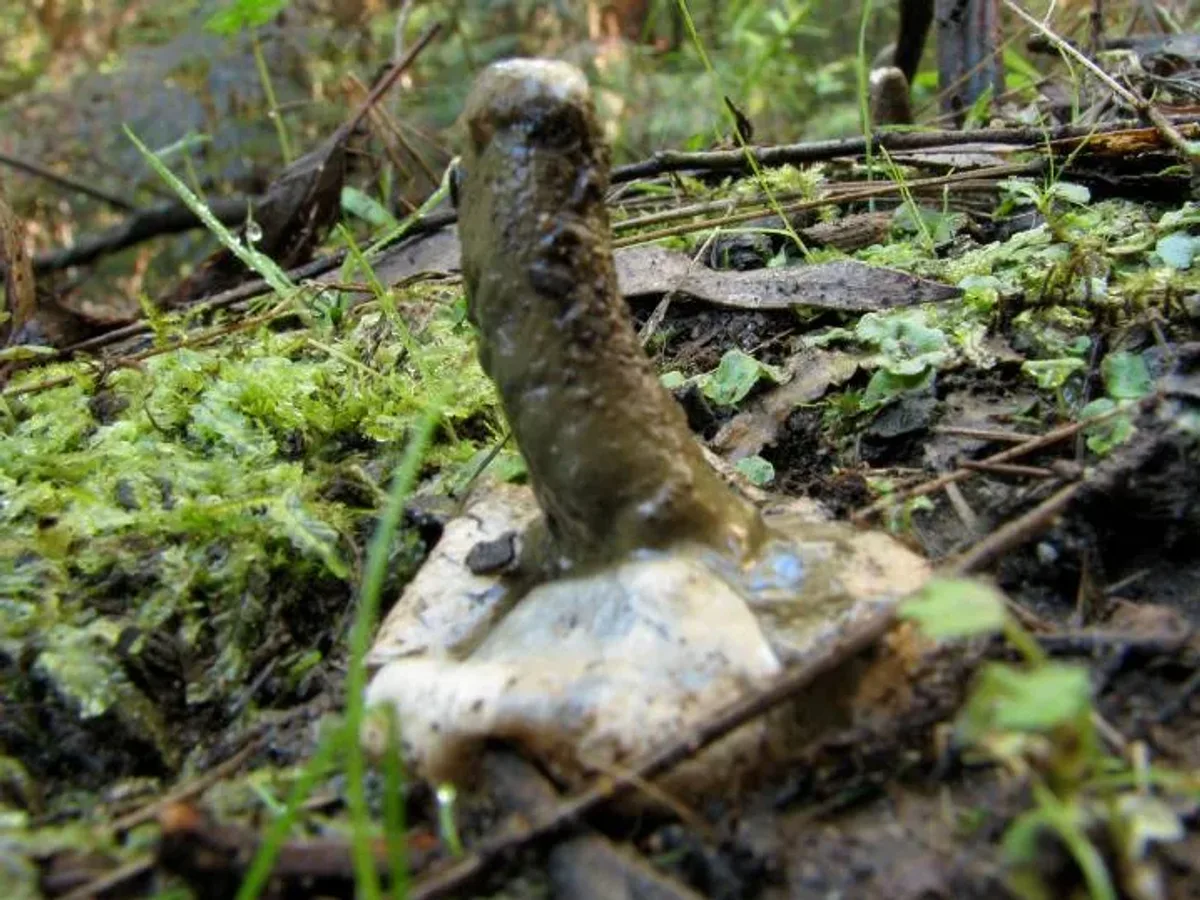 © Atlas of Living Australia (CC BY)
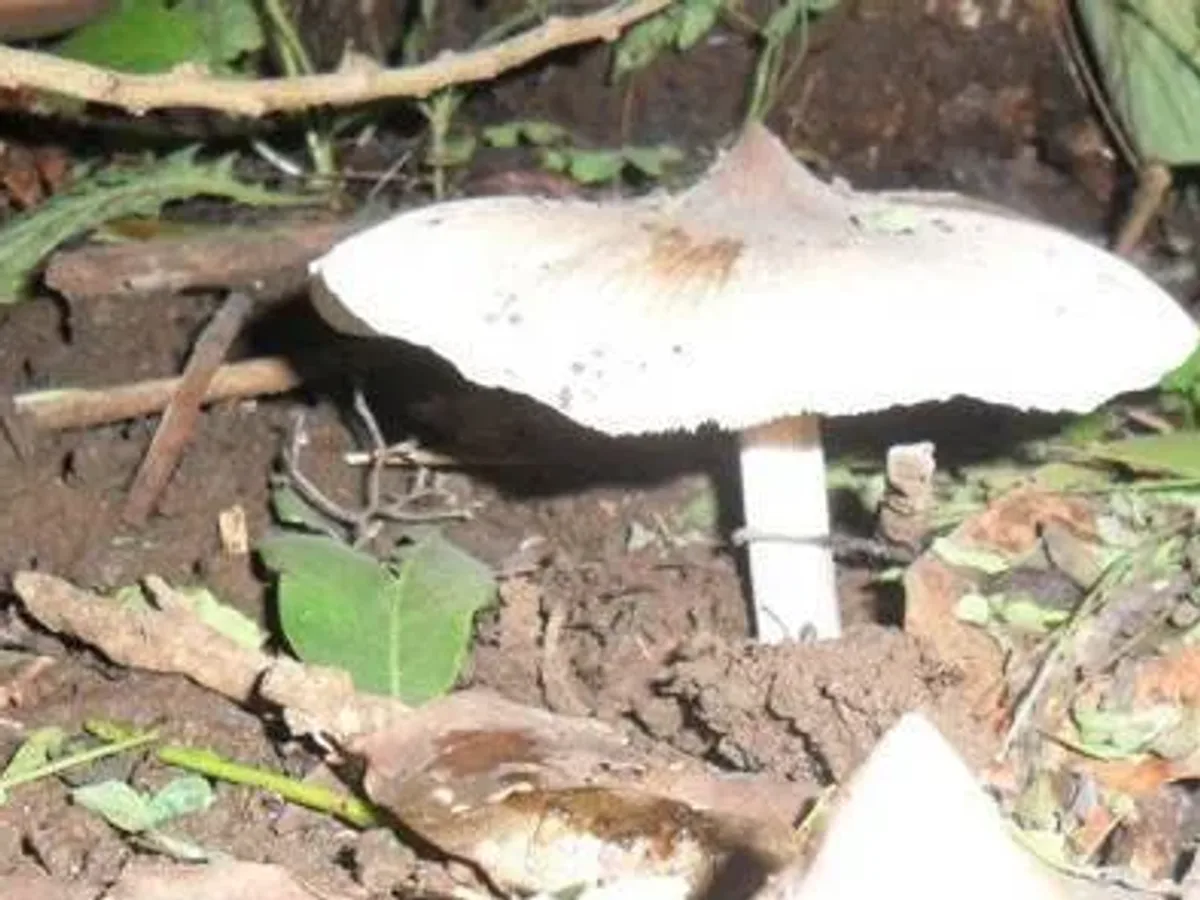 © sparkle (CC BY-SA)© Atlas of Living Australia (CC BY)© sparkle (CC BY-SA)
One of the best mushrooms you can bring home - once you are certain of the identification.
Never eat a mushroom you are not 100% sure of - check the look-alikes below, and always cook wild mushrooms.
How to recognise it
Termitomyces cartilagineus shares the clean, pale-capped silhouette of its genus relatives, but has one feature that sets it apart the moment you pick it up: a stem with an unusually firm, almost rigid cartilaginous core that resists flexing in a way that feels more like gristle than mushroom tissue.
Stem
In the field, this character is noticed when the fruiting body is pulled free - the stem does not yield easily and has a slightly elastic snap when bent hard, unlike the softer, more compressible stems of T. clypeatus or T. microcarpus.
Cap
The cap begins as a pointed cone narrowing to a spine-like perforatorium at the centre, then opens outward as it matures to a broadly convex or nearly flat cap 4-14 cm across. The perforatorium persists as a distinct central point even on fully opened caps, a feature universal in Termitomyces that distinguishes the genus at a glance from Chlorophyllum and other superficially similar large white-gilled species.
Cap colour is pale grey-brown to warm ochre-buff, darker and slightly darker at the centre, paler toward the striate margin in older individuals.
Gills
The gills below are free, crowded, and white - check them carefully: white, free gills combined with a pseudorhiza and no ring or volva are the genus-level fingerprint.
Flesh
The flesh is white throughout, firm, and pleasant. Spore print white to faintly pinkish-white.
Where & when it grows
Habitat
Every fruiting body of Termitomyces cartilagineus is, in essence, the above-ground expression of a complex underground civilisation.
Beneath each mushroom, a Macrotermitinae termite colony - most often Macrotermes or Odontotermes - maintains a structure of fungus combs: layered galleries of chewed and partially digested plant material colonised densely by the white mycelium of this fungus.
The termites eat the nodules (small spherical mycelial structures) that the fungus produces on the comb surface, gaining nutrients and enzymes that allow them to digest lignocellulose they could not process alone. The fungus receives a warm, humidity-controlled growth chamber that it could not construct or maintain unaided.
This relationship, which evolved approximately 30 million years ago, is as obligate as symbioses come - neither partner completes its reproductive cycle without the other under natural conditions.
In the field, T. cartilagineus is found wherever productive Macrotermitinae colonies occur in its range, in open and semi-open tropical landscapes:
- grasslands
- village commons
- agricultural edges
- rubber and teak plantation margins
- forest clearings
Mounds can be conspicuous conical structures or nearly invisible weathered humps. Experienced foragers in Thailand and Myanmar return to the same mound-sites year after year, knowing that a productive colony will fruit predictably once the rains arrive.
When
Fruiting is dictated almost entirely by precipitation.
The mycelium inside the termite mound is warm and metabolically active year-round - the termites regulate mound interior temperatures to approximately 29-31 °C regardless of the season outside. What the fungus waits for is rain.
In Thailand and Myanmar, the first significant monsoon rains of May-June trigger fruiting bodies to emerge within one to four days. The peak season runs from June through September, and fruiting tails off as the rains diminish and soil moisture drops in October.
In Yunnan's southern valleys the equivalent window is roughly June through early October.
The lag between rain and visible cap is short precisely because the mycelium does not need to germinate from spores or rehydrate from dormancy - it is already fully developed and waiting, and the emerging pseudorhiza and cap form through rapid cell expansion driven by water uptake and turgor pressure.
A warm, humid night following a heavy afternoon rain is the classic flush condition; in a good year a mound may produce two or three small flushes within the season if rains are intermittent.
How it grows
The growth biology of T. cartilagineus is typical of the Termitomyces genus but notable for the speed and structural rigidity of the emerging fruiting body.
Inside the mound, the mycelium lives on fungus combs - constructed and maintained by the termite workers - at temperatures of 29-31 °C and near-saturating humidity.
When the rain trigger arrives, primordial pinheads form on the comb surface. The pseudorhiza grows first, extending upward through the compact mound matrix and soil like a drill, before the cap and gills develop at its tip.
The cartilaginous stem texture - the defining feature captured in the species name - results from a particularly dense, tightly interwoven hyphal architecture in the stipe cortex. This gives the emerging fruiting body additional mechanical strength to push through hard-packed mound material and surface soil.
The full aerial fruiting body can develop from initiation to spore-dispersal readiness in as little as 24-72 hours.
Like all Termitomyces, T. cartilagineus has not been successfully cultivated commercially without its termite partner; the fungus comb substrate and mound climate cannot yet be replicated artificially for sustained mycelial maintenance and reproduction.
Fruiting conditions
Fruiting is triggered by monsoon rain events. The mycelium inside the termite mound is metabolically active year-round at mound temperatures of 29-31 °C, so the lag from significant rain to visible fruiting body is very short - typically 1-4 days. The 14-day rainfall threshold reflects the need for sustained soil moisture for mycelial uptake, not germination from dormancy. Peak fruiting follows the southwest monsoon onset in May-June across mainland Southeast Asia, with main season June-September and a tail into October.
Look-alikes
The definitive identification check for all Termitomyces - dig free the entire fruiting body and confirm the pseudorhiza: a firm, solid, whitish cord descending from the stem base, typically coated in reddish-brown mound soil, connecting to an active termite mound below.
No deadly species in the region produces this structure.
The two most important dangerous lookalikes are:
- 1Amanita phalloides and related white Amanita species (destroying angels such as A. bisporigera, A. exitialis, A. virosa) - these are white to pale-coloured, have free white gills, and can produce large buttons in grassland and forest edge, superficially resembling a young Termitomyces before the perforatorium is visible. They are distinguished absolutely by the volva (a cup-like sac at the very base, often buried) rather than a pseudorhiza, and by the presence of a ring on the stem in ringed species. Amanita eggs have no pseudorhiza.
- 2Chlorophyllum molybdites, the green-spored parasol mushroom: a large, pale, umbrella-shaped grassland species without a pseudorhiza; its gills turn distinctly greenish-grey at maturity and its spore print is green - take a print from any mature cap laid gill-side-down on white paper for 30 minutes. C. molybdites causes severe gastrointestinal poisoning.
Within Termitomyces, other co-occurring species (T. clypeatus, T. microcarpus, T. fuliginosus) are all considered edible; confusion among them carries no safety risk.
The cartilaginous stem stiffness of T. cartilagineus distinguishes it from genus-mates in hand but is not a safety-relevant character.
At the button stage a young T. cartilagineus and a young Amanita phalloides can share a superficially similar pale, rounded profile emerging from the soil. Absolute distinctions: A. phalloides has a volva (cup-like sac) at the stem base rather than a pseudorhiza; it is not connected to a termite mound; at maturity its cap is greenish-yellow to olive with radial fibres and its gills are white but not free in the Termitomyces sense (it has a ring); it contains lethal amatoxins causing fatal liver and kidney failure. Always excavate the base - a pseudorhiza plunging toward a termite mound confirms Termitomyces; a volva or a clean soil break confirms Amanita.
Pure white at all stages, with white free gills, a ring (skirt) on the stem, and a cup-like volva at the stem base. They completely lack a pseudorhiza and do not emerge from termite mounds. They contain amatoxins and cause lethal liver failure. Any white or pale button-stage mushroom in grassland or at forest edges that does not have a pseudorhiza running to a termite mound must be treated as potentially a destroying angel and discarded.
A large, pale buff to white umbrella-shaped cap appearing in grassland, potentially confused with a young T. cartilagineus by an inexperienced observer before the pseudorhiza is checked. No pseudorhiza connecting to a termite mound. Gills turn greenish-grey as the cap matures; spore print is distinctly greenish (lay the cap gill-side-down on white paper for 30 minutes to check). Causes severe gastrointestinal poisoning within 1-3 hours of ingestion. Not typically lethal but causes violent symptoms requiring medical care.
Several Termitomyces species co-occur in Southeast Asia: T. clypeatus has a rounder, more dome-shaped cap with a less pronounced perforatorium and a softer stem; T. microcarpus is very small (cap rarely >3 cm); T. fuliginosus has a distinctly darker sooty-brown cap centre. All are considered edible - confusion among genus members carries no safety risk. The genus-level confirmation via pseudorhiza is the key safety check, and all Termitomyces share it. T. cartilagineus's distinctively stiff, cartilaginous stem texture is a useful distinguishing character from congeners in hand.
Also has a volva and can be found in tropical Southeast Asian agricultural environments. Grows on decaying rice straw, compost, and agricultural waste - not in soil connected to a termite mound. At the egg stage it is grey-brown to dark, and at maturity the cap is smoky grey-brown (never the pale ochre-buff of T. cartilagineus), gills turn pinkish as spores mature, and spore print is pinkish-brown. No pseudorhiza. Edible; confusion unlikely once the mound context and pseudorhiza are checked.
In the kitchen
Picking & cleaning
Harvest when the cap is convex and the perforatorium clearly defined but the margin has not yet fully flattened and lifted - prime texture and flavour are at this stage.
Fully flattened, margin-lifting, or cap-cracked specimens are past their best but remain edible.
Never snap the cap off at ground level. Use a small trowel or pointed stick to loosen soil in a ring around the emerging stem, then grip low and draw the fruiting body upward with a steady, slightly rotating pull to extract as much of the pseudorhiza as possible.
The pseudorhiza - the firm, whitish cord typically coated in reddish-brown mound soil - is both the best identification confirmation and an edible part worth keeping.
Brush off soil with a dry cloth; avoid washing before transport as moisture accelerates spoilage significantly.
Shelf life is short: use within one to two days at ambient tropical temperatures, or within three days if refrigerated at 4-6 °C.
The cartilaginous stem, while firmer than in many relatives, softens fully on cooking and is not tougher at the table.
Gentle drying at 40-50 °C is possible and concentrates flavour, though fresh is always preferred.
Cooking
Termitomyces cartilagineus is prized across its range for much the same reasons as the more famous T. albuminosus (jizong of Yunnan): a clean, mildly savoury flavour with a faint sweetness, and firm white flesh that holds its texture through sustained cooking without dissolving.
The cartilaginous stem softens fully with heat and becomes tender at the table.
- In northern Thailand, used in clear broth soups - the clean flavour shines when only minimal seasoning is applied - and in stir-fries with garlic, fish sauce, oyster sauce, and Thai basil.
- In Myanmar, prepared in light curries with lemongrass and galangal, or simply fried in oil with onion and a little turmeric.
- In Yunnan, treated similarly to T. albuminosus: sliced and fried in lard or rapeseed oil with garlic and Yunnan ham, steamed with ginger and Sichuan pepper, or slow-fried in oil until the moisture is driven off and then sealed as a flavoured oil (鸡枞油 jīzōng yóu) that keeps for months.
The mushroom pairs particularly well with light, transparent sauces, clear soups, and gentle aromatics (garlic, ginger, lemongrass, galangal, oyster sauce, fish sauce), where its delicate savoury character is not overshadowed.
High heat and minimal water are preferred cooking principles; steaming or water-heavy preparations dilute the flavour more than sautéing or frying.
Use fresh on the day of harvest when possible.
Good to know
Termitomyces cartilagineus is an established edible species in the regions where it occurs, consumed in Thailand, Myanmar, China (Yunnan), and elsewhere in Southeast Asia without documented toxicity.
The genus Termitomyces contains no known toxins, and T. cartilagineus has a track record of safe use in local culinary traditions.
The sole serious safety concern is misidentification at the button or young-cap stage, when an unexpanded Termitomyces can be confused with a dangerous Amanita or with Chlorophyllum molybdites by inexperienced foragers.
The definitive safety check is always the pseudorhiza: excavate the base of every specimen before collecting and confirm a firm, solid cord plunging into the soil toward a termite mound.
If no pseudorhiza is present, do not eat the specimen regardless of how similar it looks.
For mature caps, take a spore print: white to faintly pinkish-white confirms Termitomyces; a green print means Chlorophyllum molybdites, which must be discarded immediately.
Cook all specimens thoroughly; raw consumption is unnecessary and not part of any established culinary tradition for this species.
A reference guide - never an edibility guarantee. When in doubt, leave it out.