Sticky bolete
Suillus viscidussyn. Boletus viscidus L., Ixocomus viscidus (L.) Quél., Suillus aeruginascens (Secr.) Snell, Boletinus viscidus (L.) Kuntze
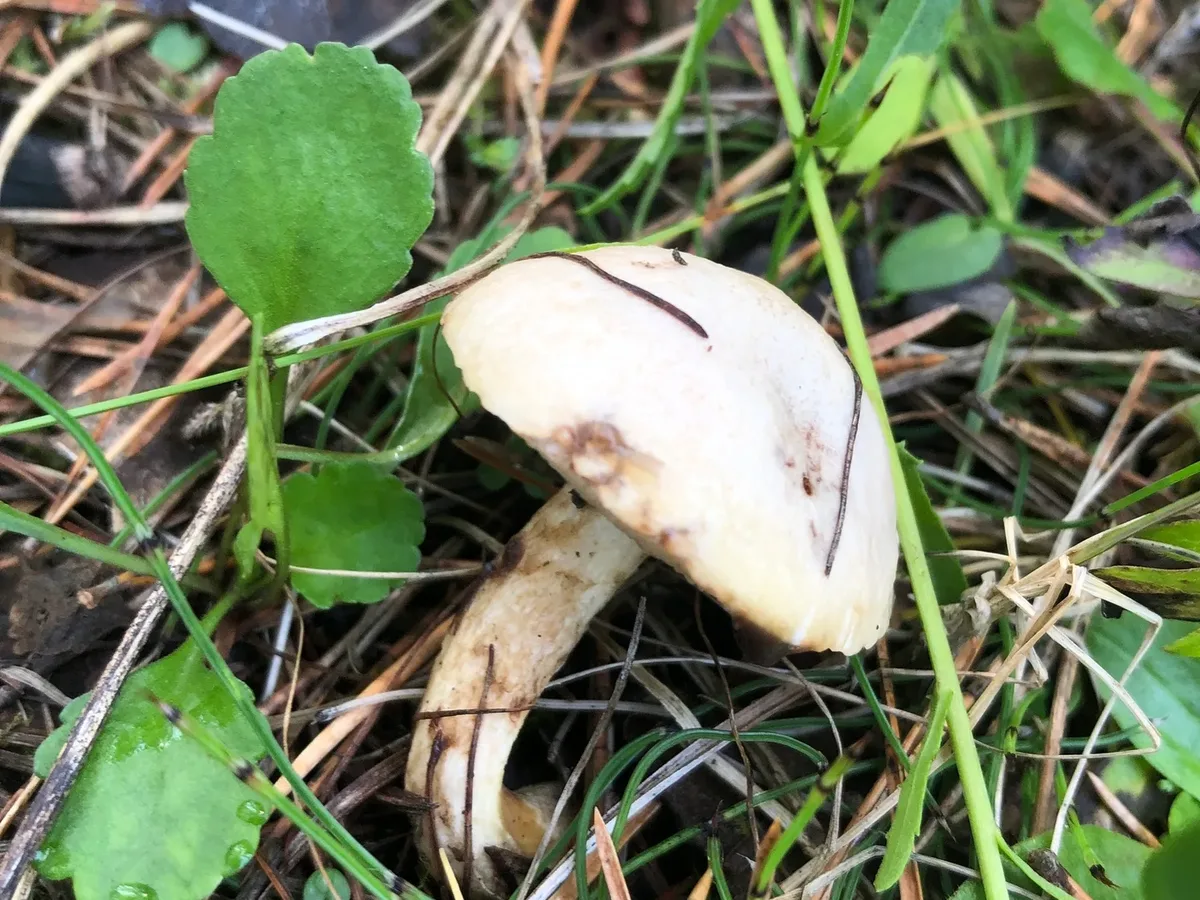 © Roman A. Lagazyuk (Роман А. Лагазюк) (CC BY)
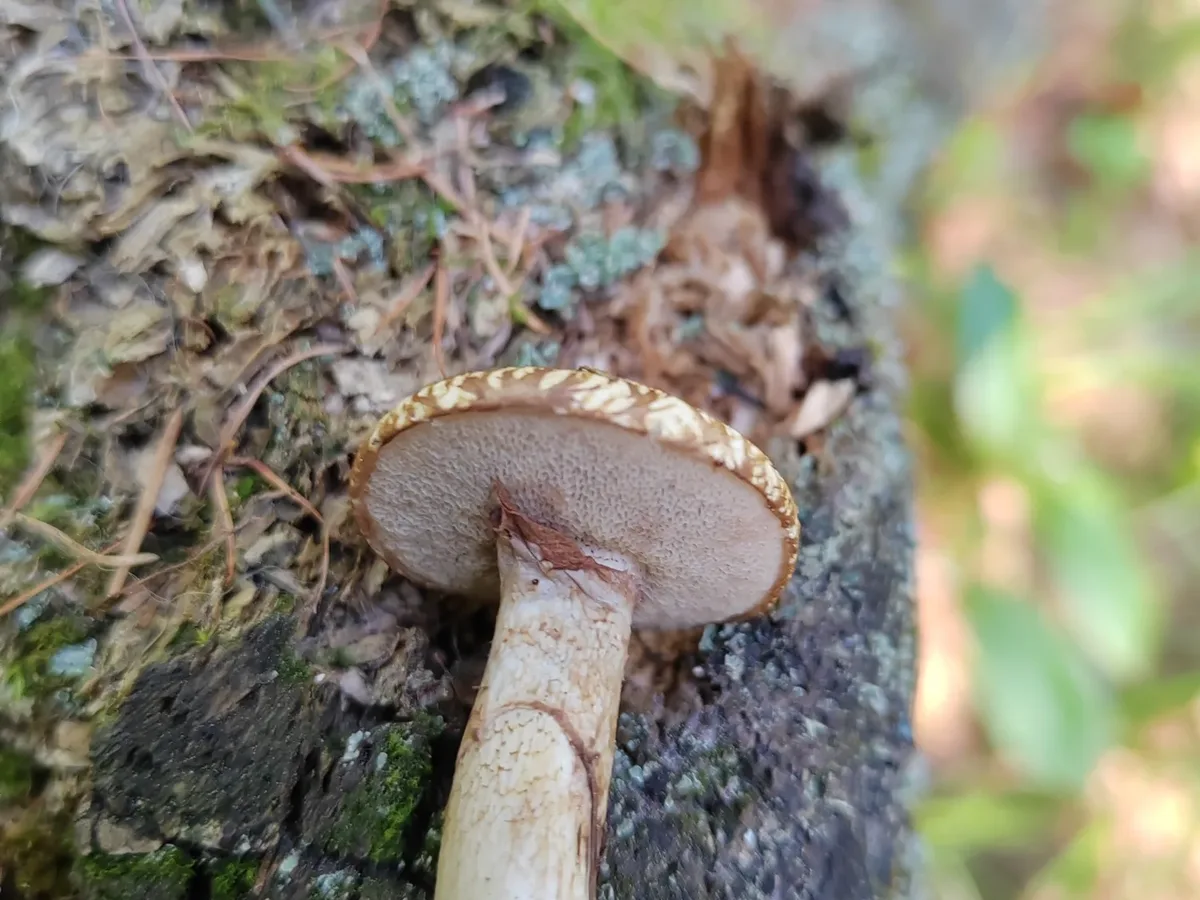 © Виктория Билоус (CC BY)
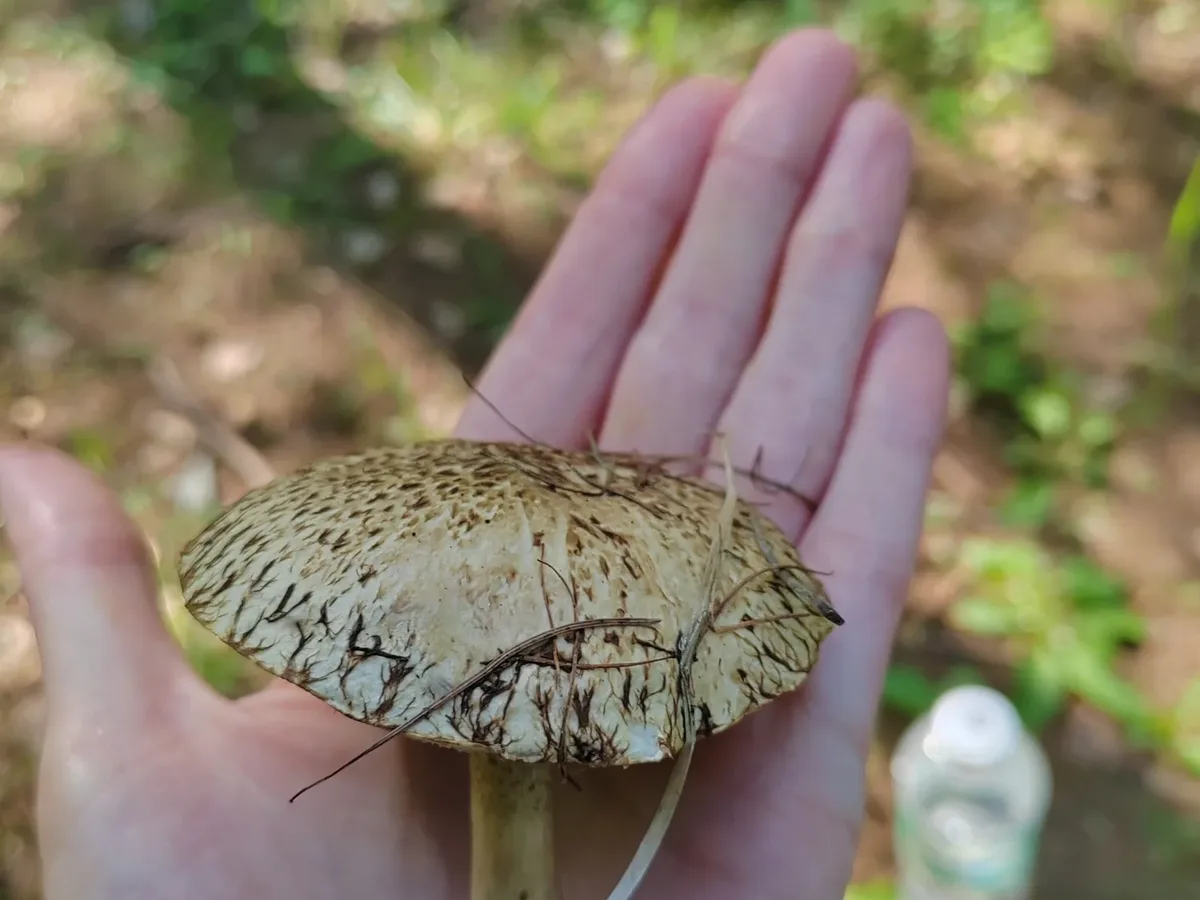 © Виктория Билоус (CC BY)
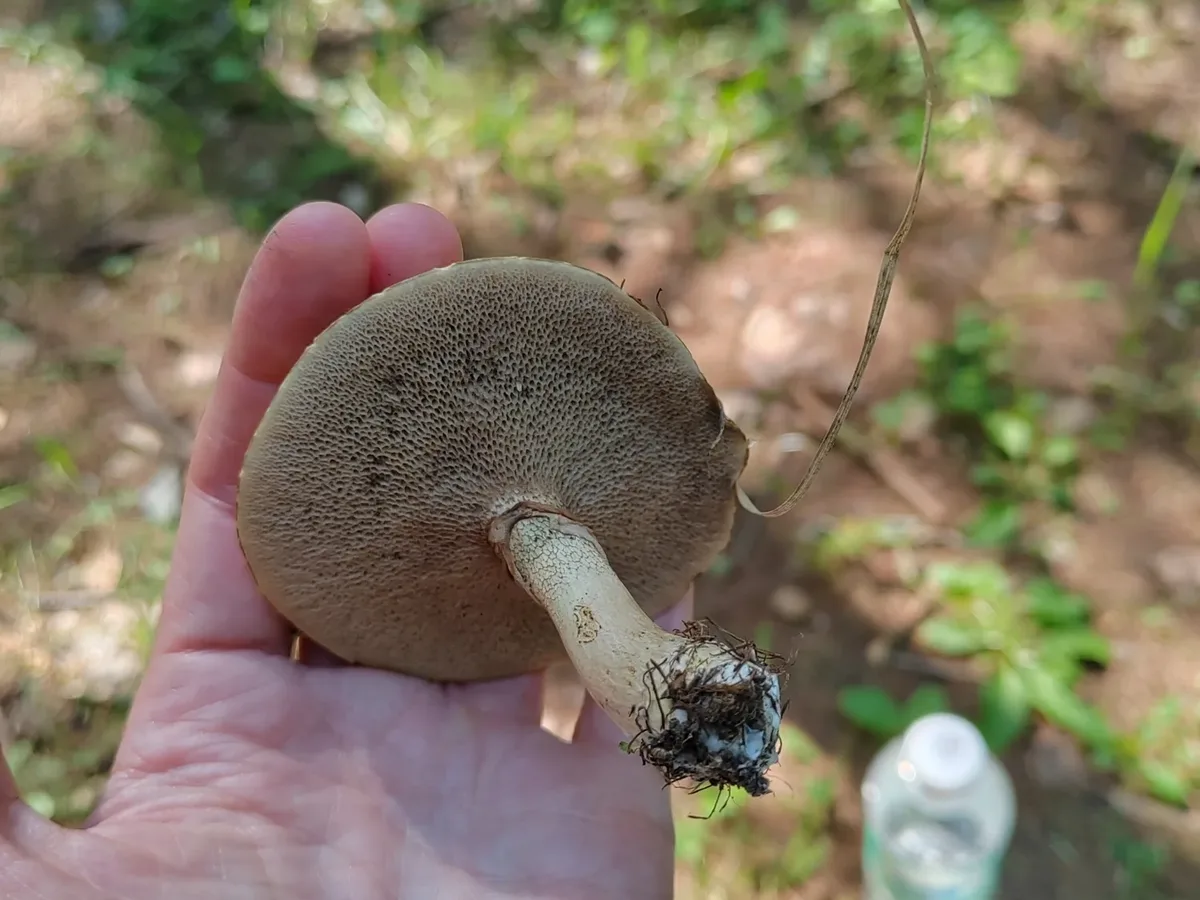 © Виктория Билоус (CC BY)
 Anton Sibiryakov (CC0)
 © Roman A. Lagazyuk (Роман А. Лагазюк) (CC BY)
 © Roman A. Lagazyuk (Роман А. Лагазюк) (CC BY)
 © Ольга Ильина (CC BY)© Roman A. Lagazyuk (Роман А. Лагазюк) (CC BY)© Виктория Билоус (CC BY)
Edible only with the right preparation - or safe for some people but not others. Learn the caveats first.
How to recognise it
Among the slimy-capped boletes, Suillus viscidus stands out for what it lacks: the golden yellows and warm tawny-browns that colour most of its relatives.
Cap
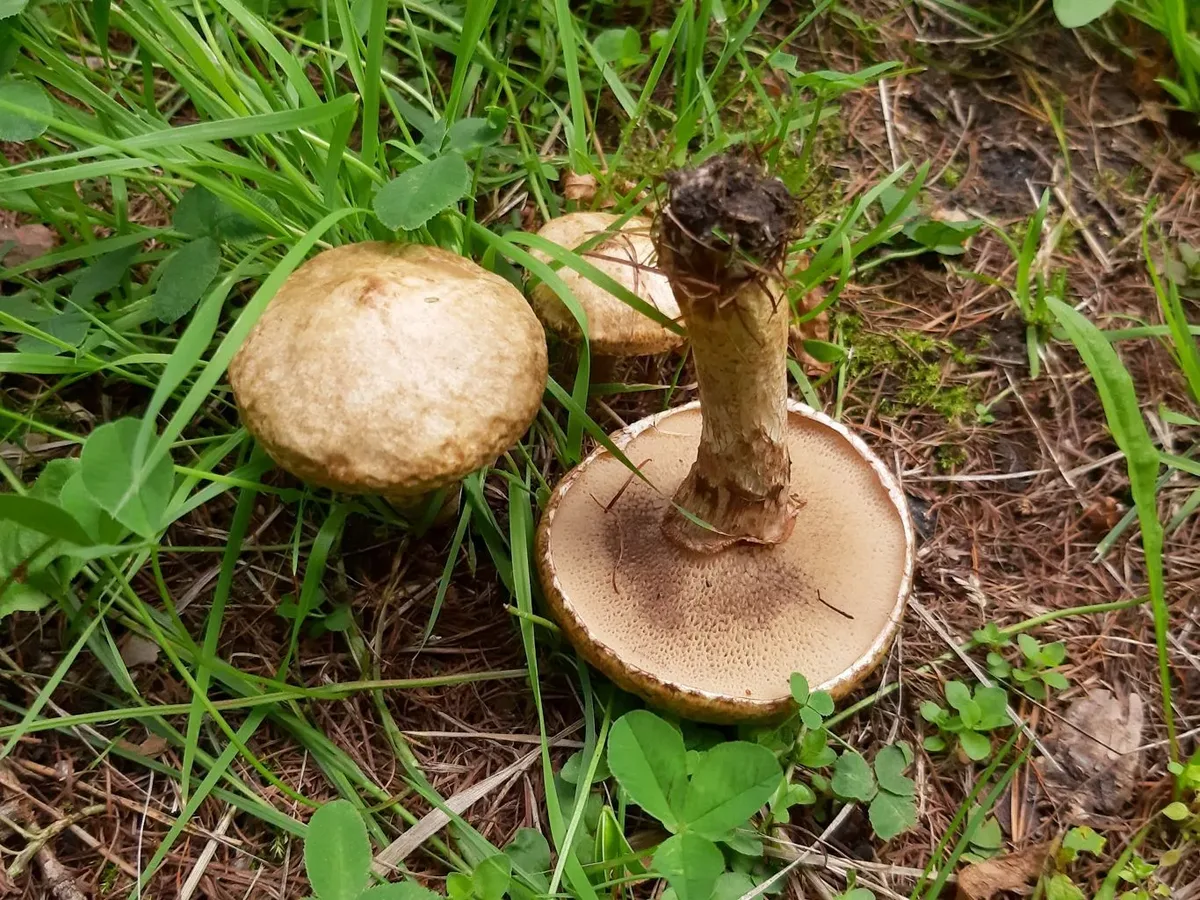
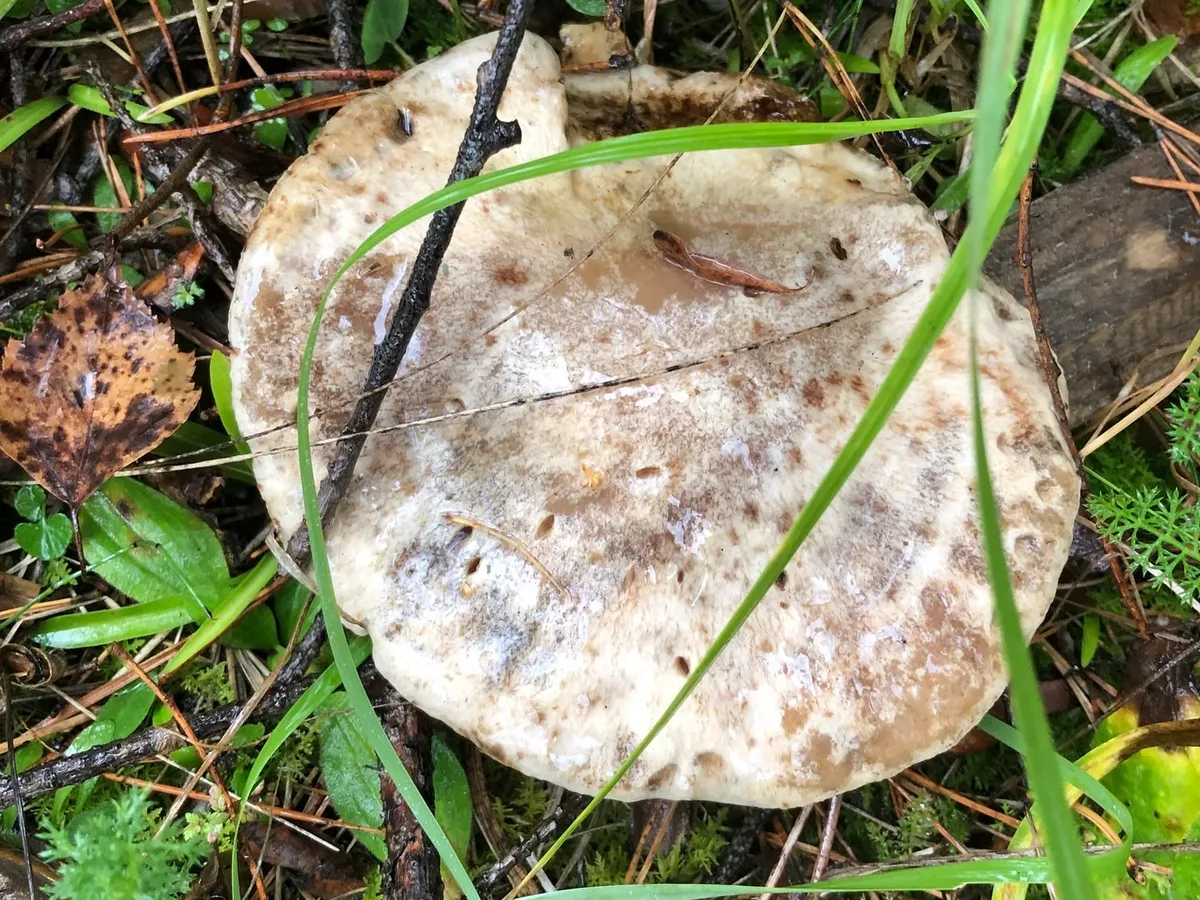
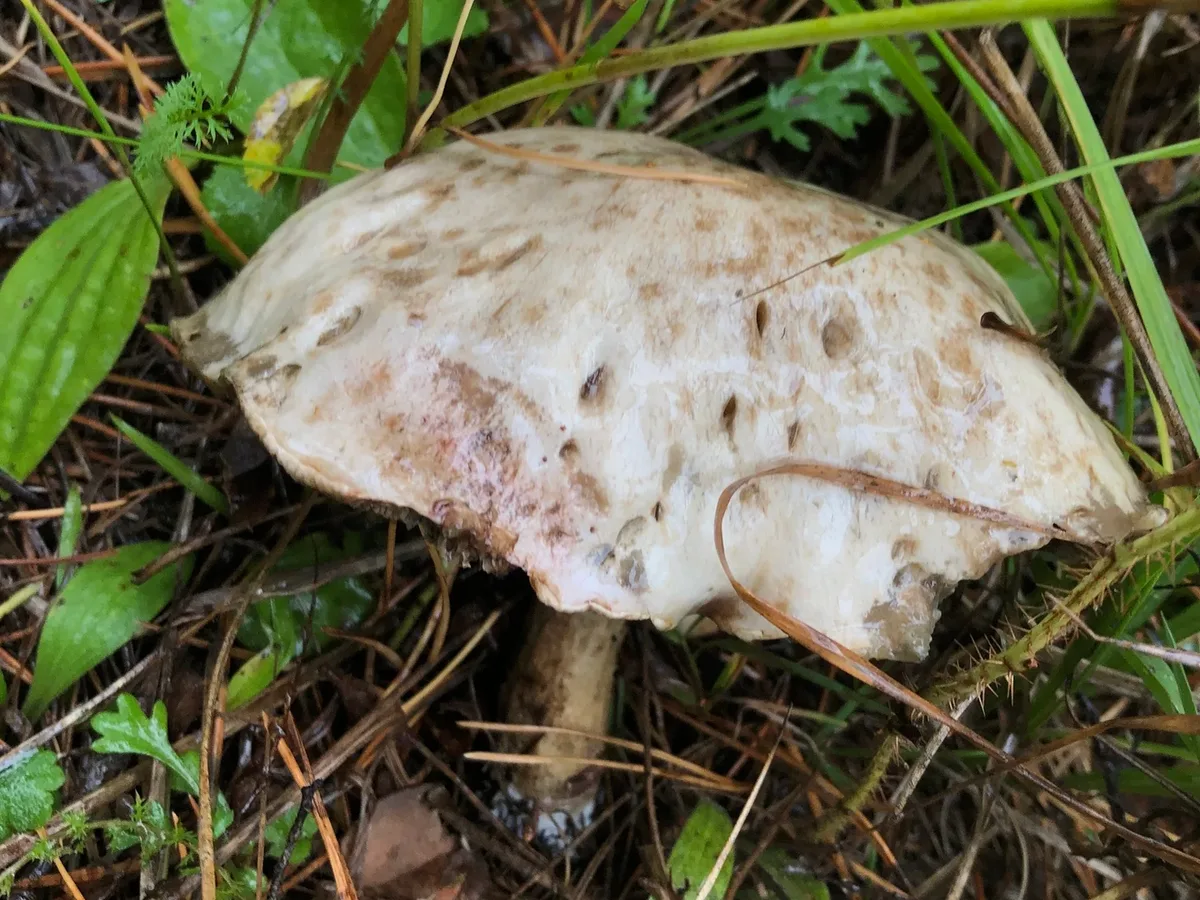
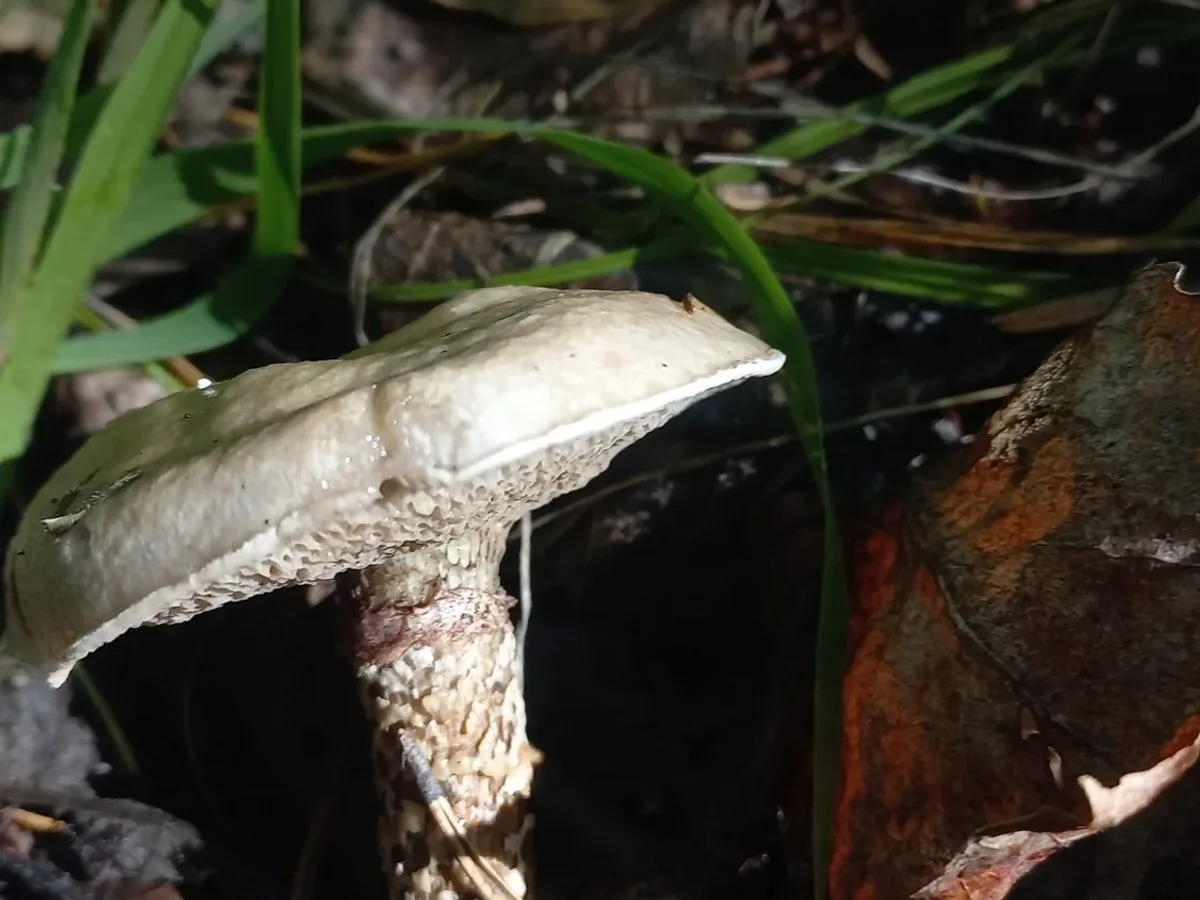
Its cap is a quiet ash-grey to grey-brown - sometimes described as mouse-grey or the colour of old pewter - and plastered in a thick, almost colourless gluten that can drip from the cap edge in wet weather.
That slime is the first thing you notice: a deep, persistent coat that makes the fresh cap glisten like lacquered wood.
Gills / Pores
Beneath the cap the pores are pale greyish-white, not yellow - a single character that immediately sets it apart from the larch bolete (S. grevillei) and slippery jack (S. luteus).
Stem
Young specimens carry a thin, whitish ring on the upper stem, a remnant of the veil that once enclosed those pores; it droops and turns slimy with age and can be easy to miss, so it is worth looking closely near the stem apex.
Flesh
The flesh is white to pale grey throughout and, crucially, does not blue when cut or broken - an important check that rules out the dangerous bluing boletes (Rubroboletus, Neoboletus).
In sum, the combination of grey cap, grey pores, pale ring, and no bluing is a fingerprint unique among the common European Suillus.
Why it's dangerous
LOW. No fatalities have been attributed to Suillus viscidus. There are no confirmed cases of serious organ damage or life-threatening illness.
The hazard is gastrointestinal discomfort that, while unpleasant, is not life-threatening.
Risk is higher when:
- the cap cuticle is not peeled
- the species is eaten raw
- large quantities are consumed
Individuals with sensitive digestive systems or underlying gastrointestinal conditions should avoid this species entirely.
Toxin
Uncharacterized gastrointestinal irritant(s), likely associated with the gelatinous cap cuticle and heat-labile compounds in the flesh.
No classical mycotoxin (amatoxin, gyromitrin, muscarine, ibotenic acid, orellanine) has been identified.
The irritant mechanism is incompletely understood. Peeling the slimy cuticle and parboiling reduces but does not eliminate the risk.
Symptoms
Onset typically 30 minutes to 3 hours after ingestion.
Symptoms are gastrointestinal: nausea, vomiting, abdominal cramping, and diarrhoea. Severity varies widely between individuals; roughly 15-30% of consumers report adverse reactions even after adequate cooking and cuticle removal.
Symptoms are self-limiting, resolving within several hours without medical intervention in the vast majority of cases.
Severe or prolonged symptoms warrant medical assessment to rule out other causes.
Staying safe
The sticky bolete has a documented but modest toxicity: raw specimens are irritant and should never be eaten raw.
Cooked specimens still provoke gastrointestinal symptoms (nausea, vomiting, cramping) in a meaningful fraction of consumers - estimates in European field guide literature suggest roughly 15-30% of people experience adverse reactions.
The irritant mechanism is not a classical named toxin but rather an unidentified gastrointestinal irritant associated with the gelatinous cuticle and certain heat-labile compounds in the flesh. Peeling the cap cuticle and parboiling reduces but does not eliminate the risk.
Given its unremarkable flavour and the GI risk, most experienced foragers consider this species not worth eating.
No fatalities are associated with S. viscidus. There are no deadly species that are realistically confused with it in its natural habitat (Abies-Picea forest), provided bluing boletes are actively checked for at the moment of cutting.
The safety rule is simple: if the flesh blues on cutting, do not eat it - S. viscidus does not blue.
Where & when it grows
Habitat
The sticky bolete is a creature of mountain conifers, and its life is inseparable from the roots of its partners.
Across the Alps, Jura, Vosges, Black Forest, Carpathians, and Apennines it has struck an ancient bargain with silver fir (Abies alba): the fungus threads its mycelium around the tree's fine roots, trading minerals for sugars in the quiet way that mycorrhizal fungi have operated for millions of years.
Wherever Abies alba grows at mid-altitude - roughly 600-1 400 m in the Alps - Suillus viscidus is a characteristic companion under the canopy.
In Scandinavia and northern central Europe, where silver fir is absent, it shifts its allegiance to Norway spruce (Picea abies) in humid, shaded stands.
The practical upshot for foragers is simple: no Abies or Picea within 15-20 metres means no S. viscidus. It favours well-moistened, humus-rich, slightly acidic soils, and is noticeably more productive in years with sustained late-summer rainfall.
When
The main fruiting period runs from late July to October in most of its range, with peak productivity in late August through September.
At high altitudes in the Alpine fir belt, the season is compressed into August and early September before early frosts curtail growth. At lower elevations with spruce, fruiting can extend to late October in mild autumns.
Timing is closely linked to late-summer rainfall: a flush usually appears 8-14 days after 15-25 mm of rain falls while soil temperatures are in the range of 8-16 °C.
Warm, dry summers delay or suppress fruiting significantly.
How it grows
Beneath a silver fir or spruce stand where S. viscidus fruits, the invisible architecture of its mycelium may have been in place for decades - quietly exchanging nutrients with the same trees, year after year.
Individual fruitbodies appear singly or in small groups of two to four, scattered across the needle duff close to the base of host trees.
The emergence is unhurried: rather than producing a sudden massive flush, S. viscidus tends to fruit at moderate density over several weeks.
The characteristic extreme sliminess of the cap has a precise structural explanation - the cuticle is a gel-forming layer of densely intertwined hyphae embedded in gelatinous matrix, which swells and becomes hyper-sticky in wet conditions.
Fruiting conditions
Flushes most reliably after 15-25 mm of rain over 10-14 days with soil temperatures in the range 8-16 °C. Peak soil temperatures for optimal fruiting are 10-14 °C. At high-altitude Abies sites (>1 000 m) the effective fruiting window is narrow (August to early September); at lower spruce sites it can extend to late October. Season ends abruptly with the first sustained frosts.
Look-alikes
Within the Suillus genus, Suillus viscidus is distinguished from nearly all common species by its grey cap and grey pores.
- Suillus aeruginascens - sometimes treated as a synonym, sometimes as a distinct taxon - is essentially identical in appearance and shares the larch habitat in some regions; the key distinctions are its larch (Larix) association versus Abies/Picea for S. viscidus, and subtle microscopic differences.
- Suillus grevillei (larch bolete) shares the ring and slimy cap but is bright golden-yellow rather than grey, and always grows under larch.
- Suillus luteus (slippery jack) has a brown cap with a dark purple-brown ring and grows strictly under pine (Pinus).
- Suillus bovinus (bovine bolete) has a pale buff, slimy cap but lacks a ring entirely and grows under Scots pine.
None of the likely lookalikes in silver fir or spruce forest are deadly, but misidentification risks consuming a species with known gastrointestinal-irritant properties.
The absence of bluing when flesh is cut is an important check: any bolete that turns blue when bruised or cut should not be consumed without expert verification.
No ring on the stem; cap is pale ochre-buff rather than grey; pores are larger, compound, and flesh-coloured. Grows under Scots pine on sandy heathland soils, not under fir or spruce. Edible but also of low quality.
Nearly identical in appearance - pale grey slimy cap, grey-white pores, whitish ring - and sometimes treated as a synonym or variety of S. viscidus. The key separation is host tree: S. aeruginascens is the larch-associated form (Larix spp.), while S. viscidus is the fir/spruce-associated form (Abies/Picea). In regions where their host trees do not co-occur, confusion is unlikely. Both are low-quality edibles with gastrointestinal-irritant potential.
Sharing the ring and slimy cap, but S. grevillei is bright golden-yellow to tawny-orange on both the cap and the pores, versus the pale ash-grey of S. viscidus. Also grows under larch, not fir or spruce. An edible, higher-quality species.
Dark chocolate-brown to reddish-brown slimy cap (not pale grey), yellow pores (not grey), and a dark purple-brown ring rather than a whitish one. Grows strictly under Scots pine or other two-needle pines. Edible and superior in quality.
No ring; cap is ochre-brown to pale tan; pores are pale yellow, conspicuously weeping droplets in youth; grows under two-needle pines. Distinguished from S. viscidus by yellow pores, absence of ring, and pine host.
A reference guide - never an edibility guarantee. When in doubt, leave it out.