Tridentine bolete
Suillus tridentinussyn. Boletus tridentinus Bres., Ixocomus tridentinus (Bres.) Quél., Suillus tridentinus var. tridentinus
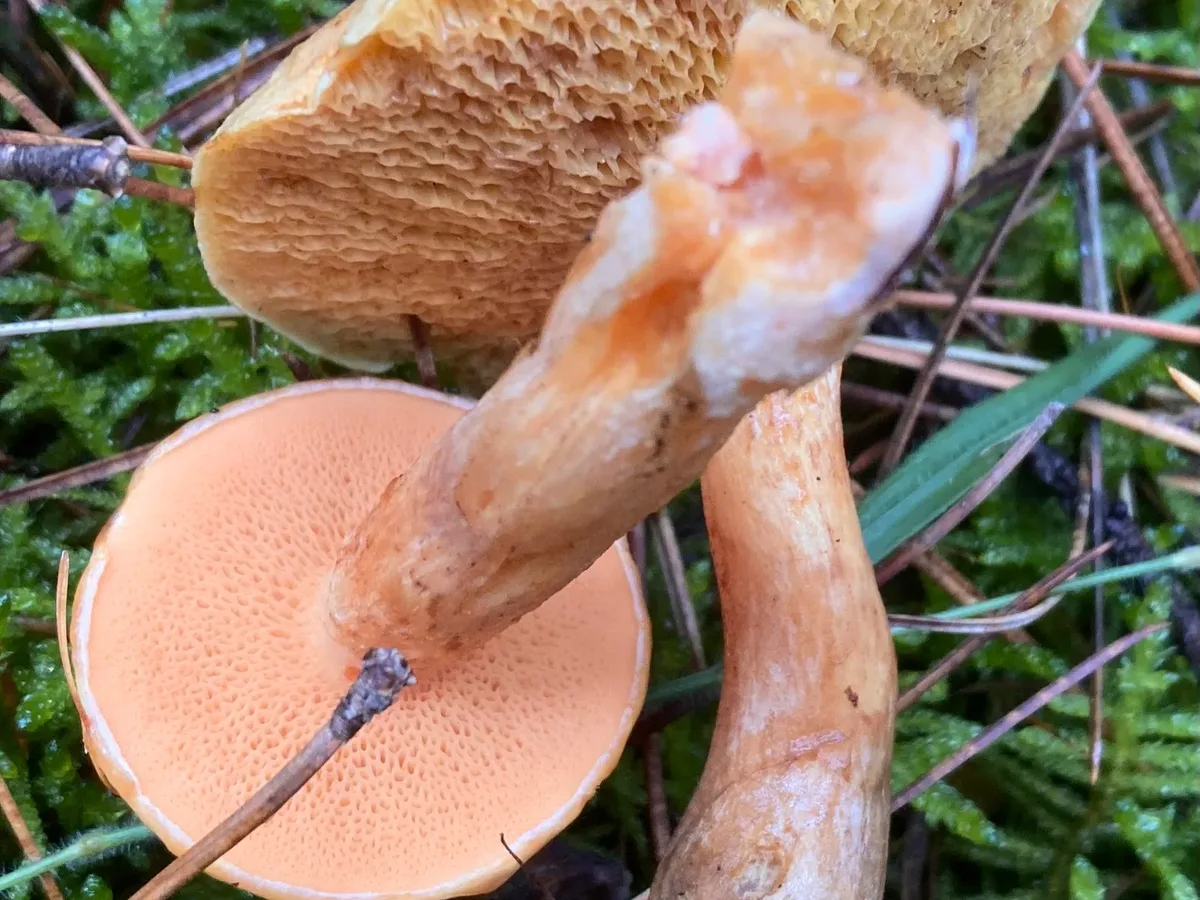 © Lucian Clanet (CC BY)
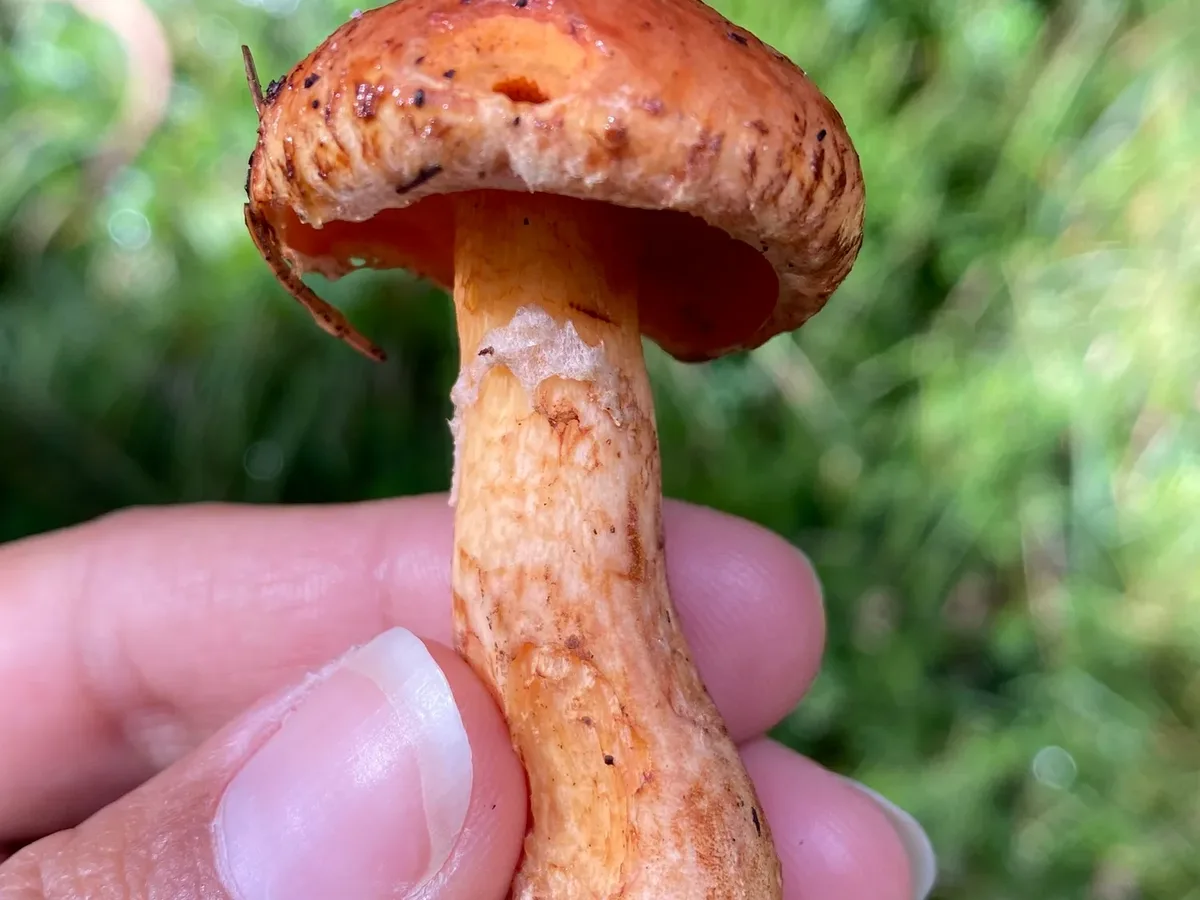 © Katharine Khamhaengwong (CC BY)
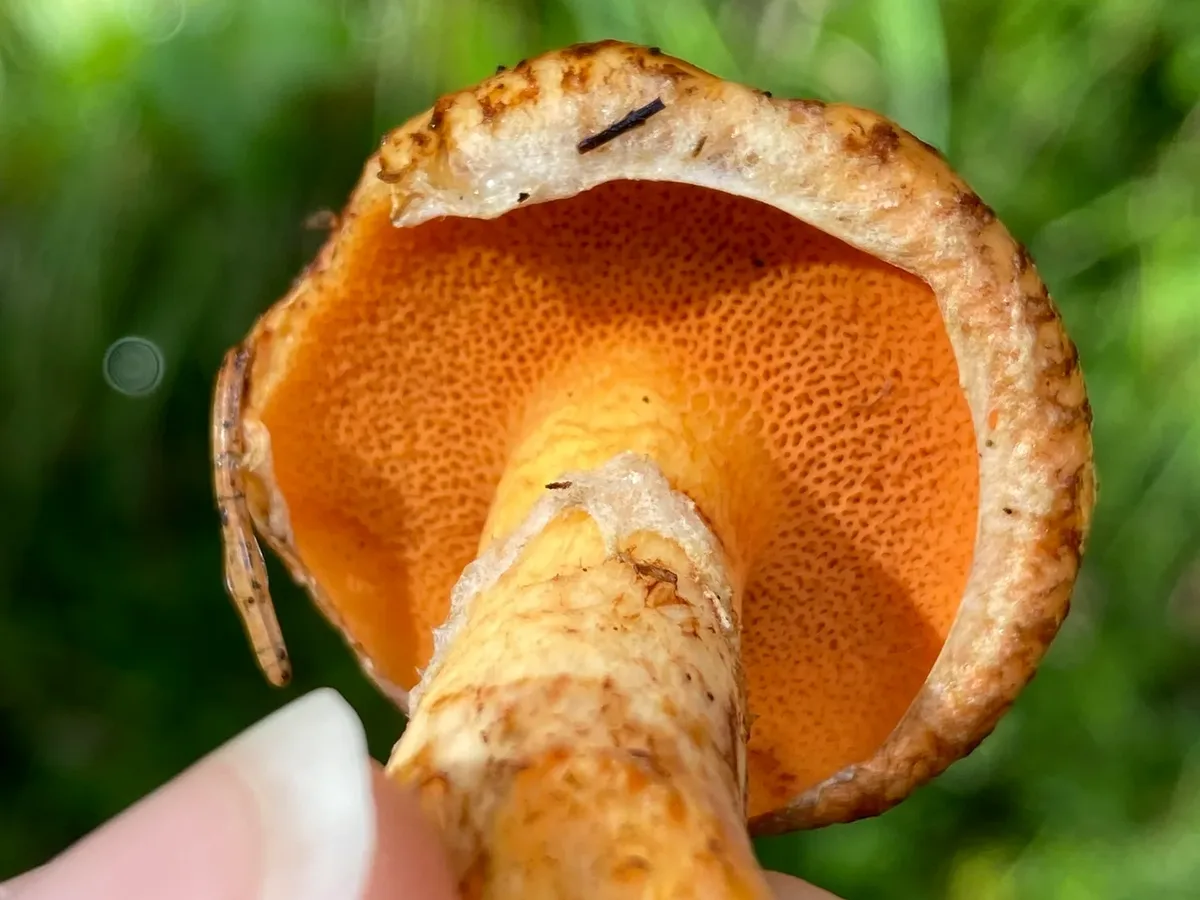 © Katharine Khamhaengwong (CC BY)
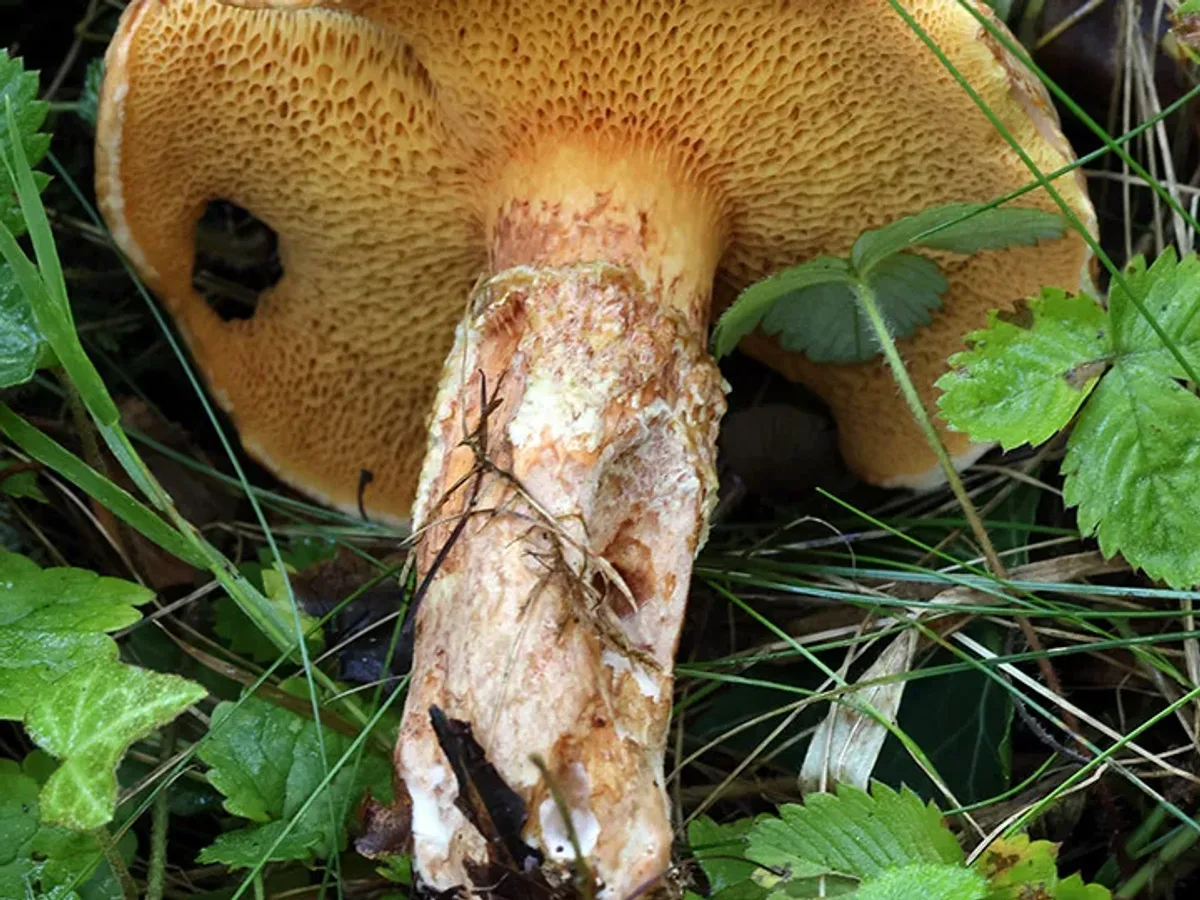 © Daniel Ghyselinck (CC BY)
 © Manuela Fiorini (CC BY)
 © Lucian Clanet (CC BY)
 © Lucian Clanet (CC BY)
 © Lucian Clanet (CC BY)
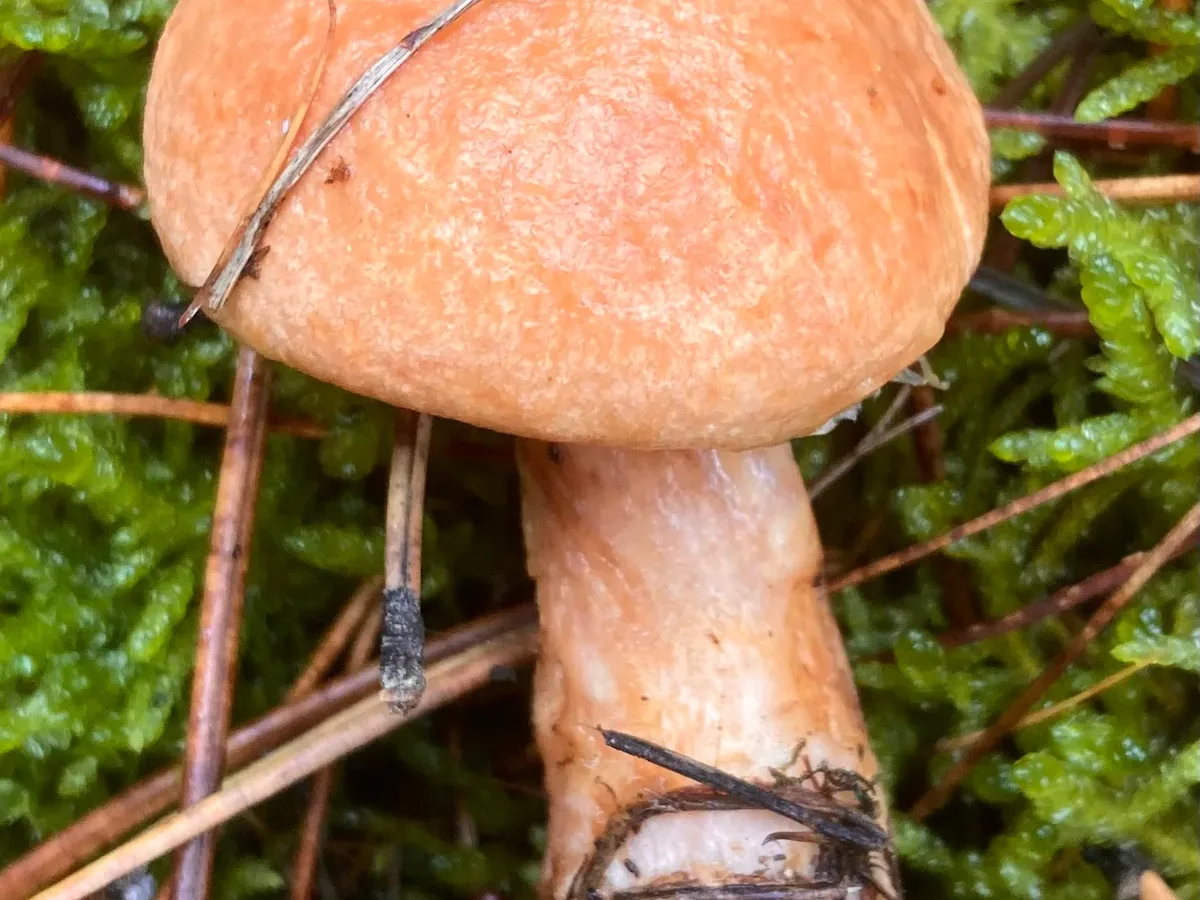 © Lucian Clanet (CC BY)© Lucian Clanet (CC BY)© Katharine Khamhaengwong (CC BY)
Good to eat, once you have identified it with certainty and cooked it through.
How to recognise it
Three features together make Suillus tridentinus recognisable among larch-associated boletes:
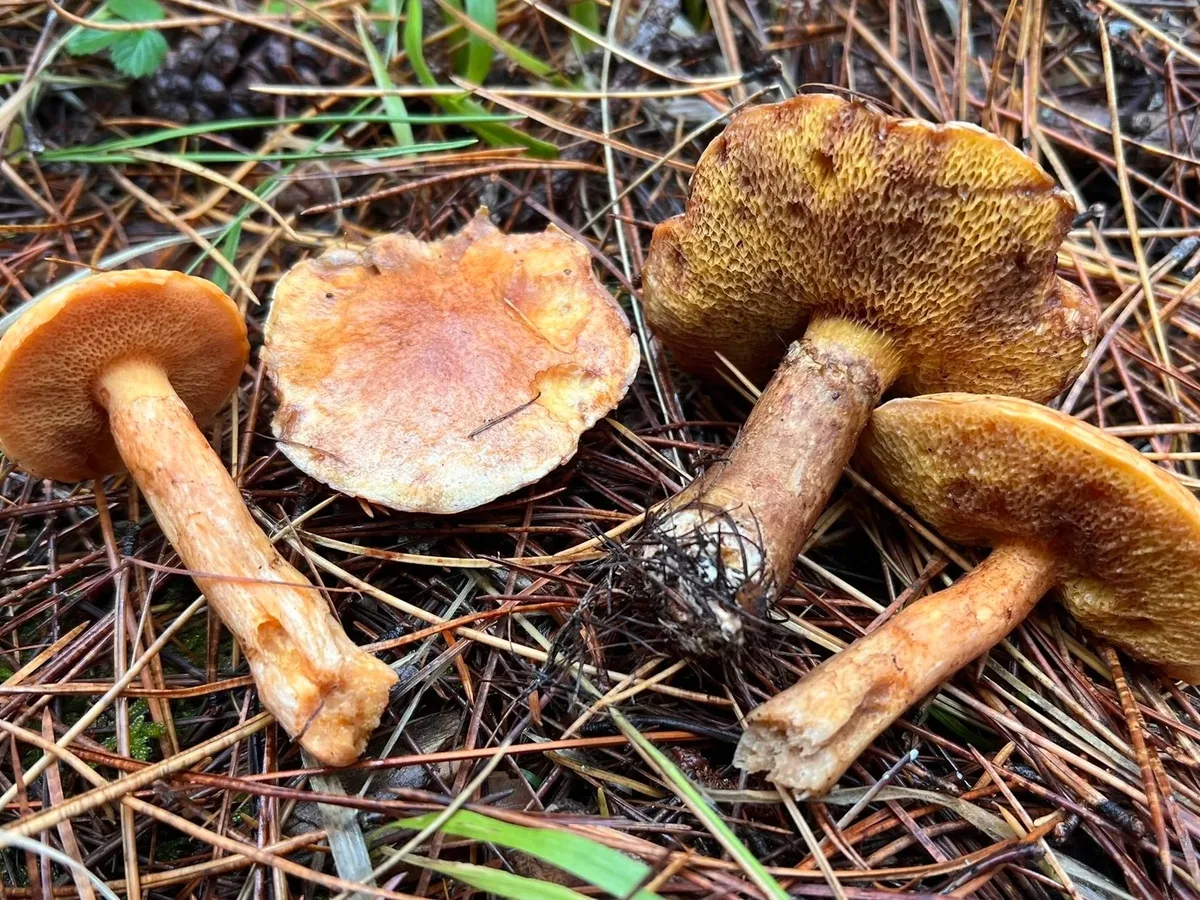
- 1The orange-red to brick-orange cap.
- 2The absence of a ring on the stem.
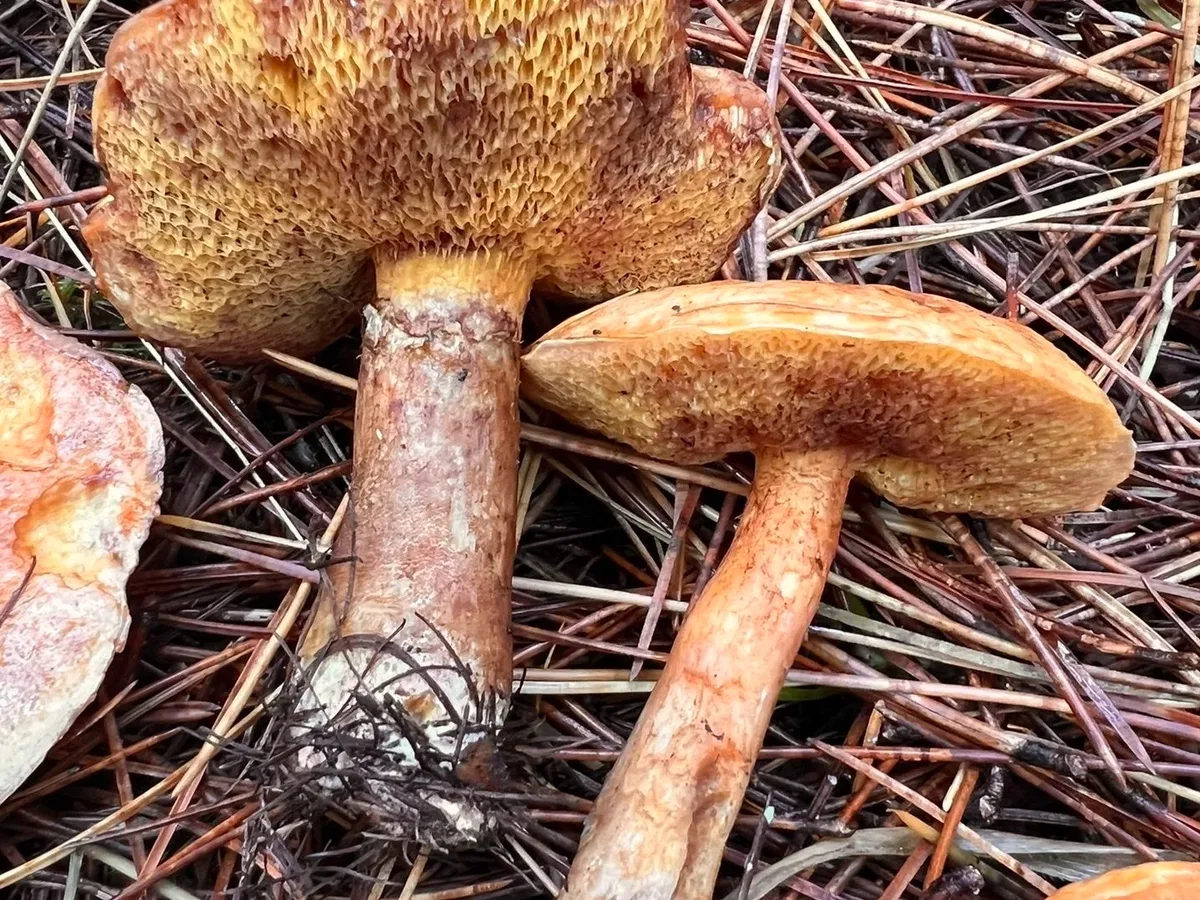
- 3The conspicuous orange-red glandular dots and reticulate ridges that roughen the stem surface.
Cap
The cap colour is the first thing to catch your eye - noticeably redder and more intensely orange than the golden-yellow of Suillus grevillei or the pale ochre-buff of Suillus aeruginascens.
In youth the cap is strongly viscid and the colours are at their most vivid; as the mushroom matures and dries, it fades toward ochre-orange.
Gills / Pores
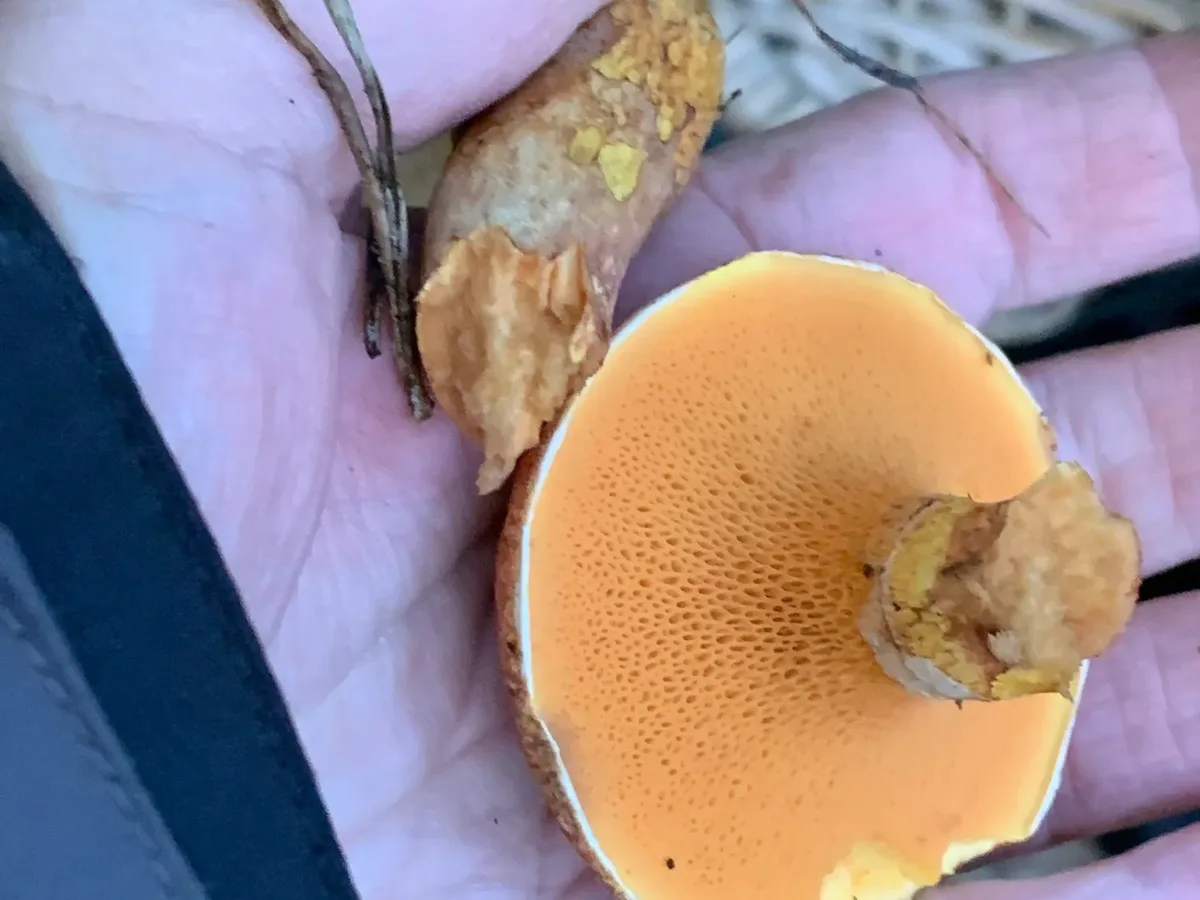
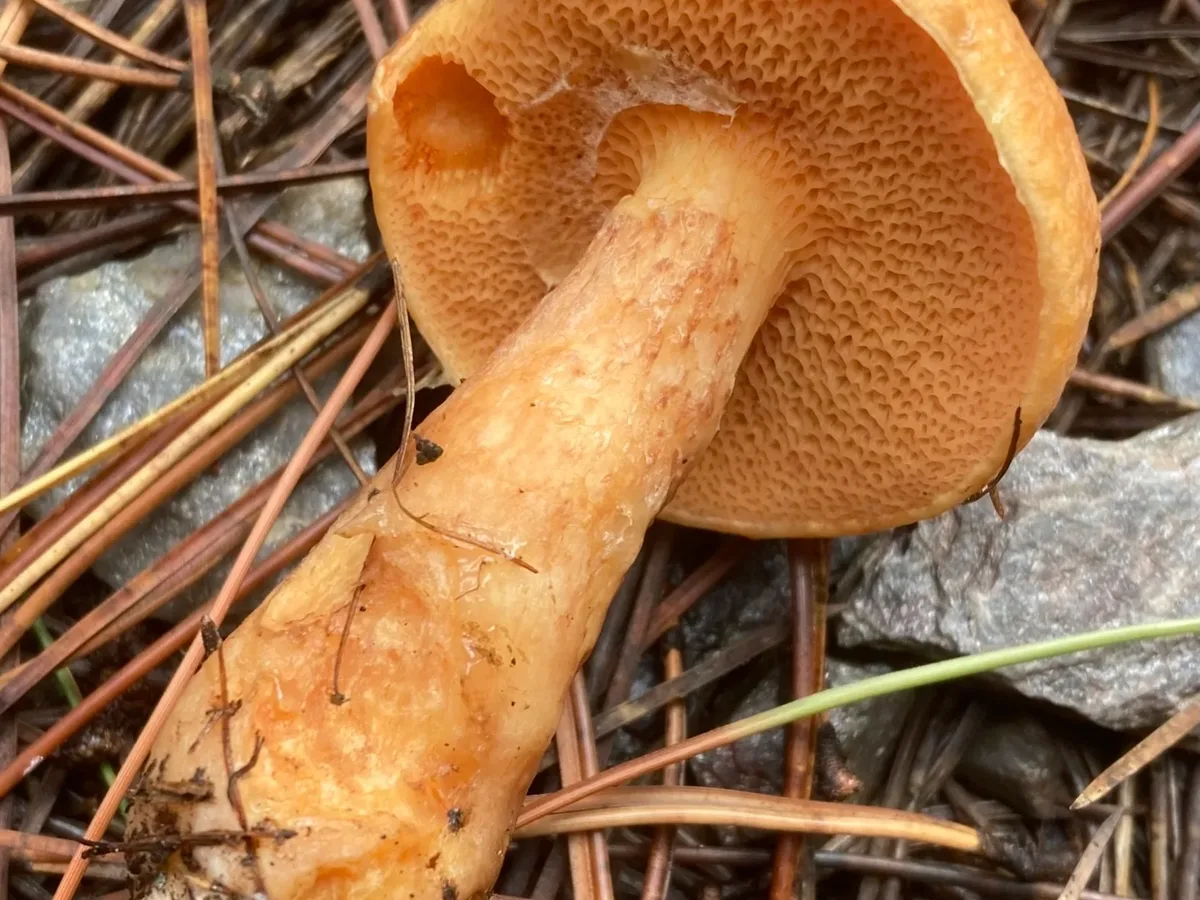
The pores are angular and compound - where you might expect simple round openings, you instead find irregular polygonal mouths each shared by two or three tubes, giving the underside a coarser texture than in most boletes.
The pore surface is golden to orange-yellow; it does not blue when cut or bruised, and the pores are never red.
Stem
The stem is dry and firm; it lacks the slippery quality of the cap.
The longitudinal ridges and coarse dots create an almost reticulate pattern in orange tones that can superficially resemble the netting on Boletus edulis, but here it is coloured and glandular rather than pale and net-like.
Flesh
Flesh is pale yellow to orange-yellow, firm, and unchanging when cut.
Where & when it grows
Habitat
Suillus tridentinus is a strict ectomycorrhizal partner of larch - a relationship that has likely persisted, tree by tree, for many decades in the forests where this species thrives. If no larch is within reasonable distance, the mushroom is not this species.
It is most at home in the classic high-Alpine larch landscape of the Dolomites, South Tyrol, and the broader Alpine arc, where it pushes up through the deep needle duff beneath stands of European larch (Larix decidua).
It ascends to near treeline - around 2 000-2 100 m in the Alps - making it one of the higher-elevation Suillus species in Europe. In the subalpine zone it may turn up in transitional larch-arolla pine forest. It also colonises larch plantations at lower altitudes where climate and soil suit it.
Because larch is a deciduous conifer, the habitat has a distinctive seasonal atmosphere: fruiting often coincides with the early yellowing of larch needles in late summer and autumn, the forest shifting from green toward gold around the same time the mushrooms appear.
When
The main fruiting period in the Alps runs from late July through early October, with the greatest abundance in August and September.
At lower-elevation larch plantations (600-900 m), early flushes can appear in June after summer rainfall. At high elevation the window compresses to roughly six weeks in August and September.
Fruiting is strongly rainfall-dependent: the most productive conditions arise after 15-25 mm of rain over ten days, with night temperatures falling toward 8-12 °C - the cooling that signals the shift from summer to autumn.
This species generally fruits a little earlier in the season than Suillus grevillei sharing the same larch stand.
How it grows
Suillus tridentinus grows singly or in scattered groups, often in loose arcs that hint at the expanding mycelial front reaching outward from the base of a host larch.
The underground mycelium is perennial and can persist for decades under a healthy tree. A good patch, once found, tends to produce mushrooms year after year when rainfall and temperature cooperate.
Fruiting bodies develop quickly - a pinhead can expand to a mature cap in 5-10 days under good conditions.
Maggot infestation (mainly fly larvae of Mycetophilidae) is common and advances fast in warm weather, so collect young, firm specimens and check the stem base with a cross-section cut before keeping them.
Fruiting conditions
Flushes best after 15-25 mm of rain over 7-14 days when soil temperature is in the 7-17 °C range, as is typical of Alpine summer-to-autumn transition. Most productive at 10-14 °C soil temperature. Fruiting ends with first sustained frosts; the season is compressed at high elevation.
Look-alikes
- Suillus grevillei (larch bolete / golden larch bolete) is the most important lookalike concern. It shares the larch habitat but is distinguished by its golden-yellow (not orange-red) cap and a prominent membranous ring on the stem - Suillus tridentinus has no ring.
- Suillus aeruginascens (grey larch bolete) shares the larch habitat but has a grey to grey-brown cap and greying flesh, very different from the vivid orange-red cap of Suillus tridentinus.
- Suillus variegatus and Suillus luteus grow under pines, not larch, and have very different colours and stem features.
- Suillus collinitus is the most serious lookalike risk, though uncommon due to habitat separation: it grows under pines and has a similar orange-ochre cap tone, but lacks the coarsely dotted/reticulate stem of S. tridentinus and grows under Pinus rather than Larix.
The genuinely dangerous confusion potential lies with some Suillus species in the broader context of bolete picking, not with any deadly species in the strict larch habitat.
Also under larch and also lacks a ring, but has a grey to grey-brown cap and flesh that greys with age - completely different palette from the vivid orange-red cap of S. tridentinus. Edible.
Shares the same strict larch habitat but has a bright golden-yellow to tawny-orange cap (not orange-red to brick-red) and a prominent membranous ring on the stem. Suillus tridentinus has no ring and a distinctly redder, more orange-red cap. Both are edible.
Has a dark purple-brown to chestnut-brown ring (a conspicuous one) and grows exclusively under Pinus, never under larch. Cap is slimy ochre-brown. Easily separated by host tree and ring presence.
Causes severe gastrointestinal poisoning (bolesatine; vomiting, diarrhoea, hospitalisation possible) but is not documented as lethal. Confusion is ecologically implausible: R. satanas is a low-elevation calcareous broadleaf-woodland species (oak, beech, hornbeam) that does not grow under larch and is not an alpine species, whereas S. tridentinus is a strict high-altitude larch specialist (800-2200 m). Structurally distinct: pale whitish cap, blood-red pore mouths (versus yellow-orange in S. tridentinus), lurid red reticulation on the stem base, and dramatic rapid bluing of all flesh when cut. S. tridentinus does not blue and has no red pores.
Has bright red-orange pore mouths and instantly blues very strongly when cut; grows under spruce and fir, not larch. The bluing reaction and red pores immediately separate it from S. tridentinus.
No ring, dry granular cap in ochre-brown tones, grows under Scots pine (Pinus sylvestris) rather than larch. The cap texture (granular-scurfy, not slimy) and habitat separate it reliably.
In the kitchen
Picking & cleaning
- Collect young to medium-aged specimens with firm flesh.
- Cut cleanly at the stem base with a knife rather than pulling, to disturb the mycelium as little as possible.
- Carry in a ventilated basket.
- Peel the viscid cap cuticle before cooking - it slips off easily from fresh material - as the glutinous layer can make the cooked mushroom slimy and can concentrate any trace bitterness.
- Inspect the stem by cutting across the base; discard material that is heavily tunnelled by insects.
- Process or refrigerate within 24-48 hours, as the mushrooms deteriorate quickly after picking.
Drying is an excellent preservation method: slice thinly and dry at 40-50 °C until brittle.
Cooking
Suillus tridentinus has a mild, agreeable flavour - mushroomy with a slightly acidic finish.
Preparation follows the standard Suillus approach: peel the slimy cap cuticle and discard it, then slice caps and stems. Sauté in butter or olive oil over moderate heat until the excess moisture evaporates and the flesh takes on a light golden colour.
It works well in risottos, pasta sauces, omelettes, and as a side with polenta - preparations that have been popular in the Trentino-Alto Adige region for generations, where this species is a familiar seasonal ingredient.
The tubes can be removed for a firmer texture if preferred, though this is rarely necessary in young specimens.
Drying is straightforward: thin slices at 40-50 °C produce brittle chips that reconstitute well in warm water for soups, stews, and ragùs. It also pickles nicely in acidulated brine (vinegar, salt, bay, peppercorn), a traditional Alpine preservation.
Pairs well with fresh thyme, garlic, mountain butter, and cured meats.
Good to know
Suillus tridentinus is an edible species with no known serious toxicity.
As with most Suillus species, a minority of consumers - particularly those who eat large quantities or consume it raw - may experience mild gastrointestinal symptoms (nausea, loose stools). Always cook thoroughly; do not eat raw.
The slimy cap cuticle contains compounds that can cause contact dermatitis in sensitive individuals; wear gloves when peeling and preparing in quantity.
The species has a deadly lookalike concern in theory - Rubroboletus satanas (Satan's bolete) is a toxic bolete of calcareous broadleaf woodland - but in practice confusion is extremely unlikely because S. tridentinus grows under larch in montane habitats completely different from those of R. satanas.
The reliable exclusion criteria are:
- 1Confirm the host tree is larch.
- 2Confirm the pores are yellow-orange and do not stain blue when cut or bruised.
- 3Confirm there is no ring on the stem.
All three must be met before eating. No deadly species regularly shares the high-altitude larch habitat with this mushroom.
A reference guide - never an edibility guarantee. When in doubt, leave it out.