Slippery Jill
Suillus subluteussyn. Boletus subluteus, Ixocomus subluteus
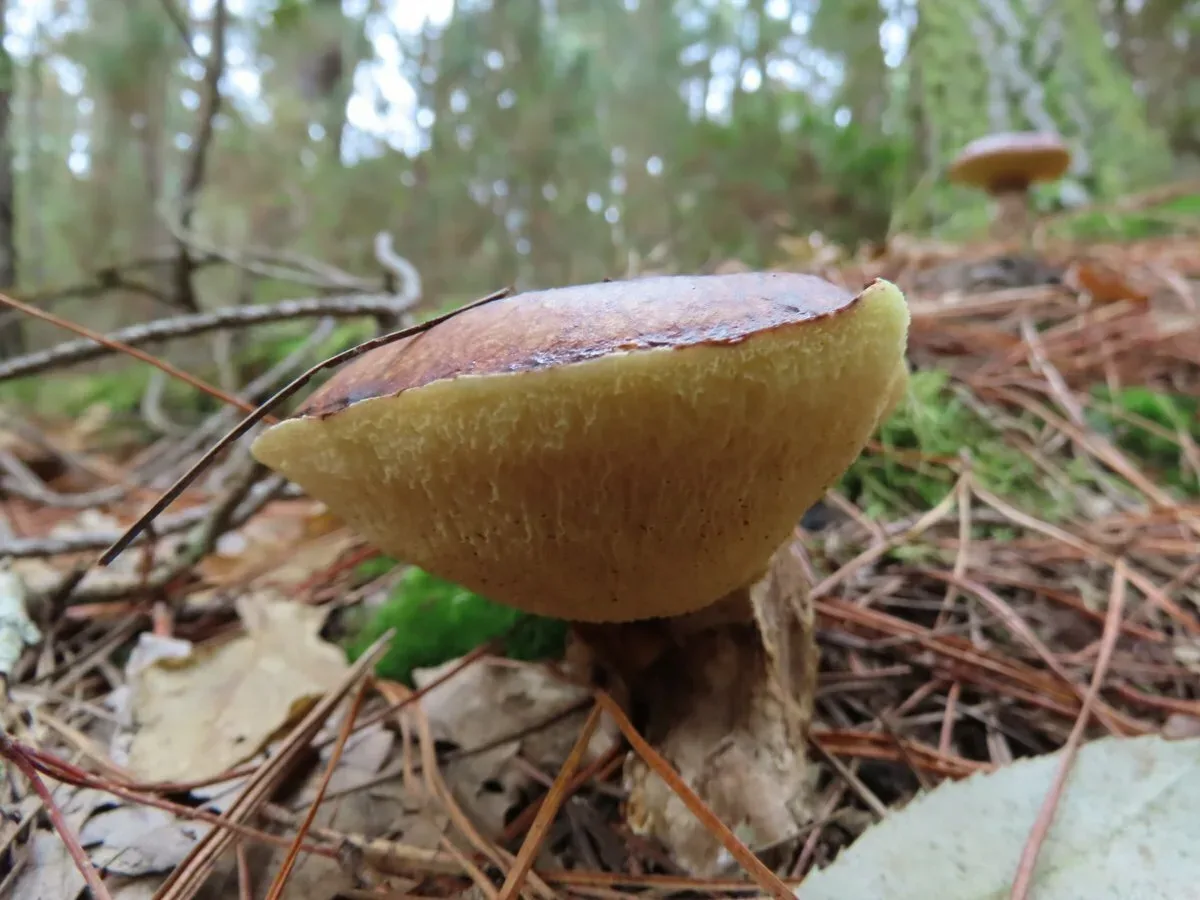 Atlas of Living Australia (CC0)
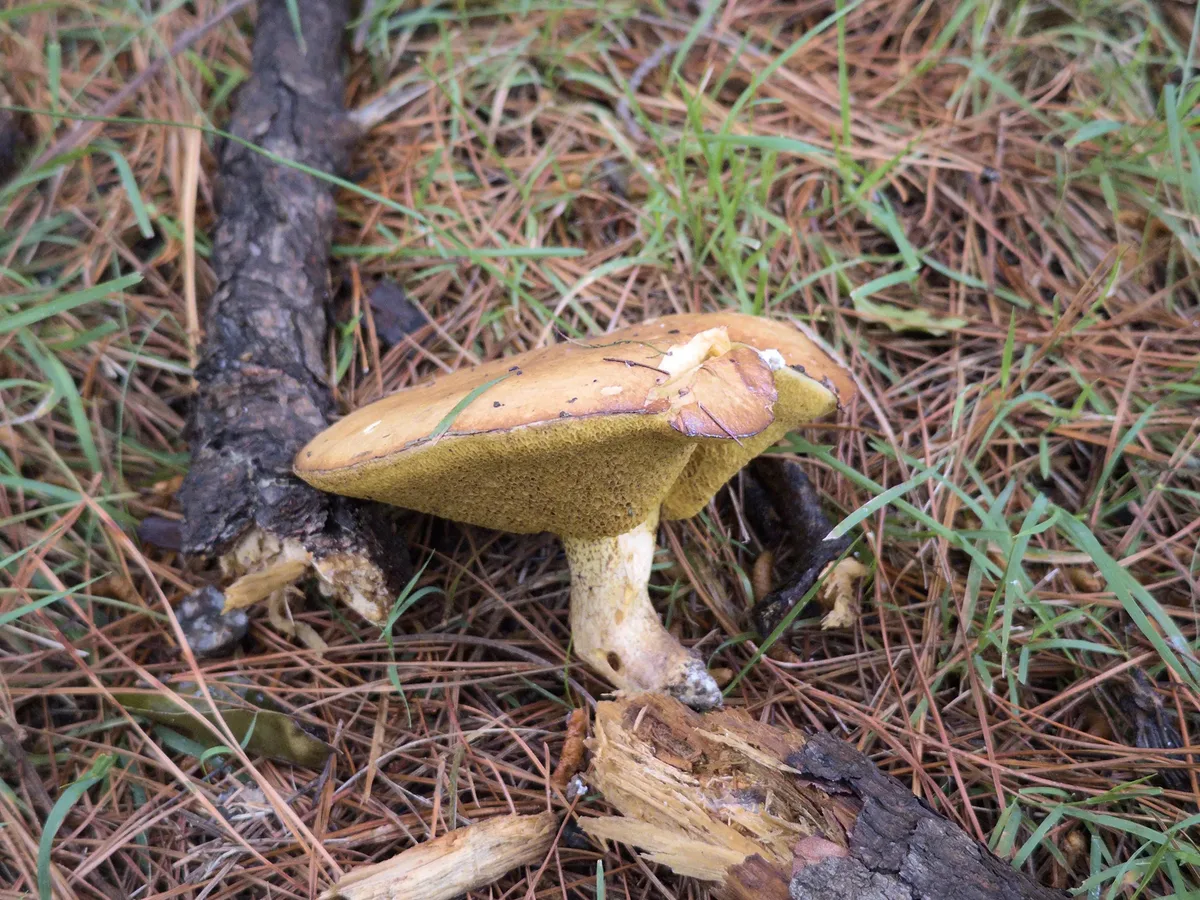 Atlas of Living Australia (CC0)
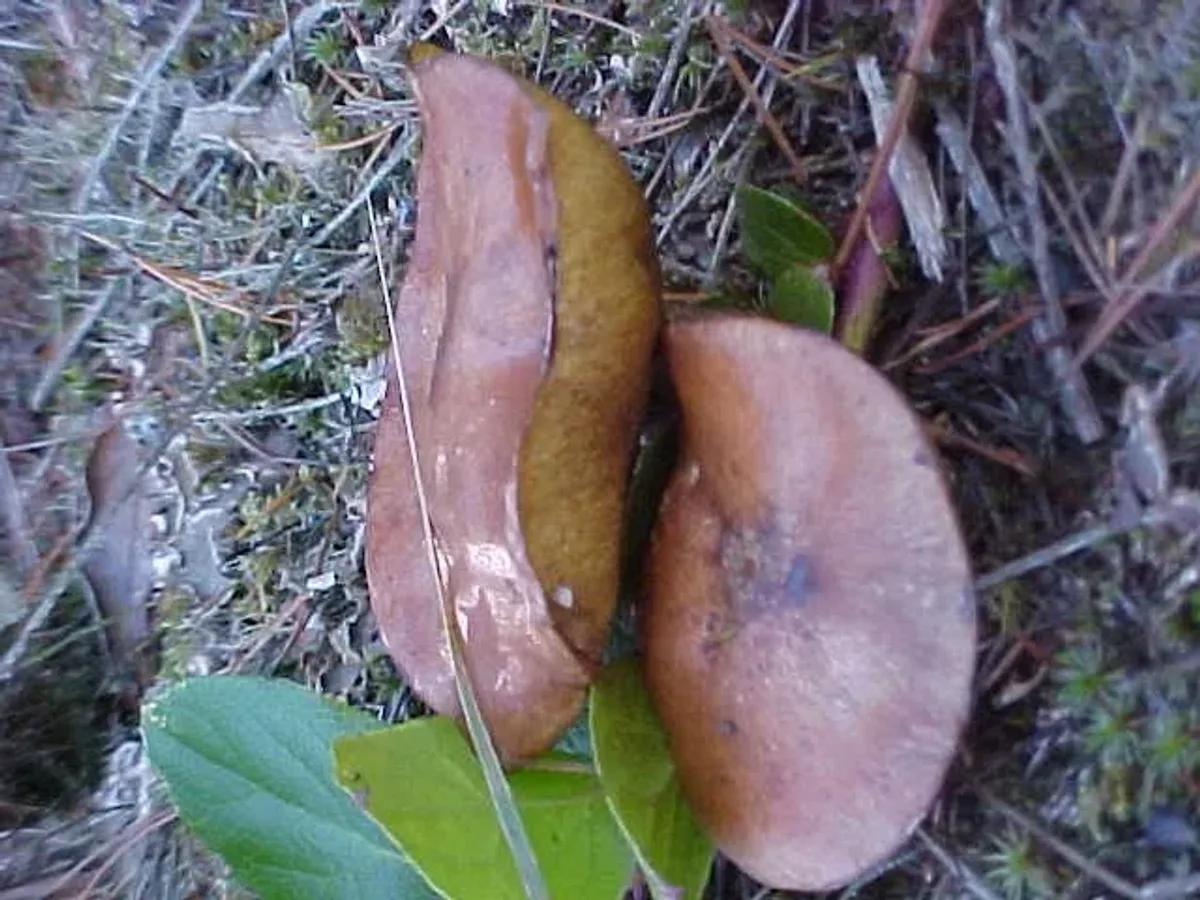 © Daniel B. Wheeler (CC BY-SA)
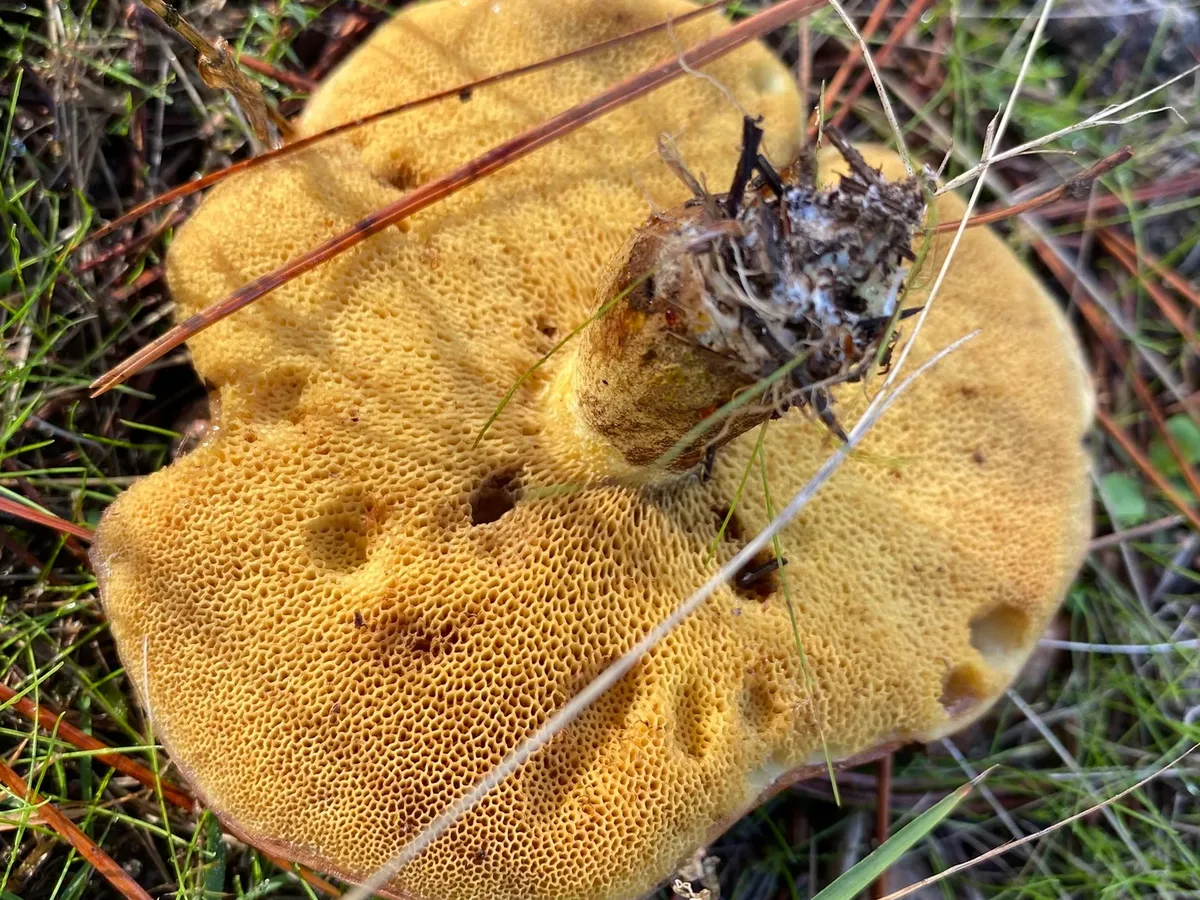 Atlas of Living Australia (CC0)
 Atlas of Living Australia (CC0)Atlas of Living Australia (CC0)Atlas of Living Australia (CC0)
Good to eat, once you have identified it with certainty and cooked it through.
How to recognise it
Slippery Jill is a medium-sized, slimy-capped bolete of white pine forest.
Cap
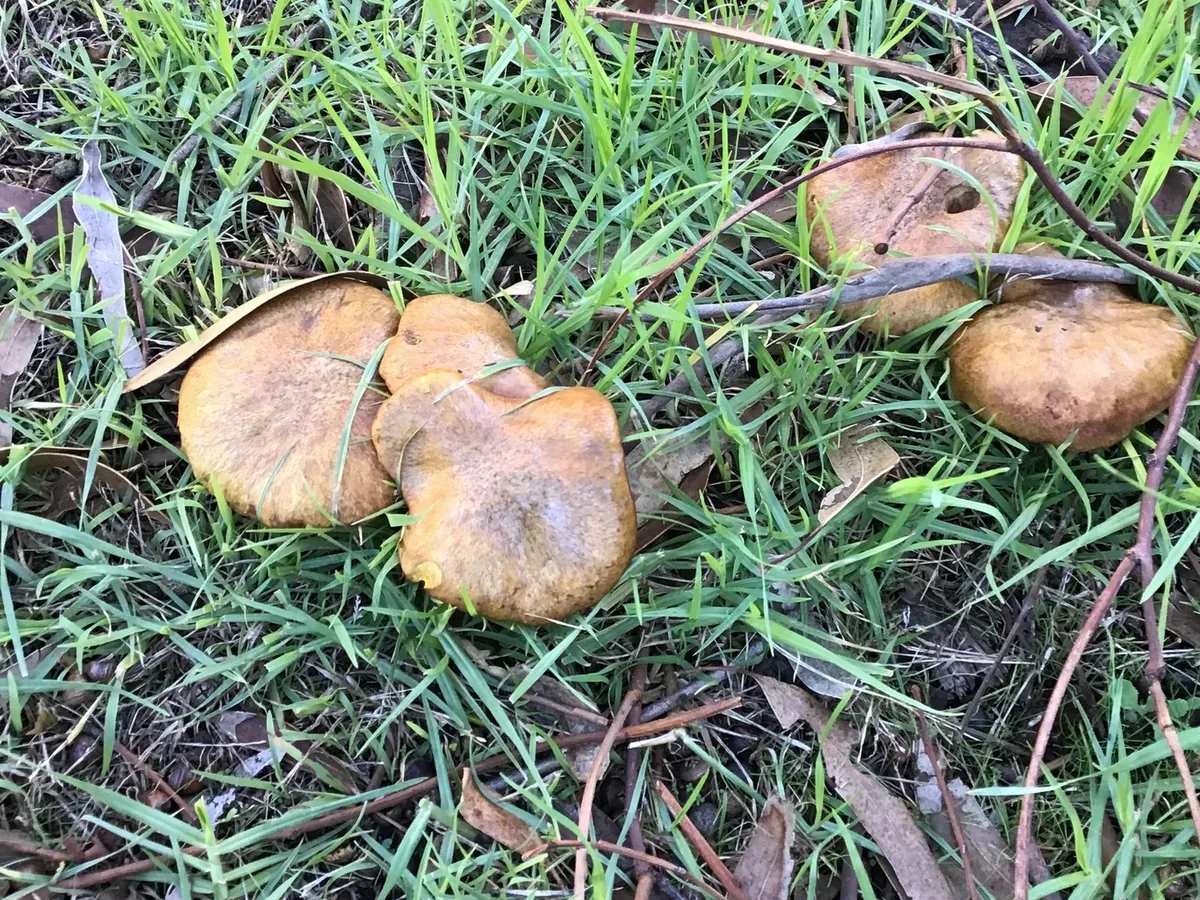
The cap (4-9 cm, occasionally larger) is convex when young, then broadly flattening. Its surface is glutinous and distinctly slippery in wet weather - a classic Suillus hallmark - and cinnamon-brown to tawny or yellowish-brown, sometimes faintly olivaceous, usually paler toward the edge.
Gills / Pores
The underside bears a spongy layer of fine, angular, pale yellow pores (no gills), which dull to ochre-yellow with age. These do not weep milky droplets, distinguishing it from Suillus granulatus.
Stem
The stem is 3-7 cm tall and pale yellowish, peppered above and below with reddish-brown to purplish glandular dots.
The most important feature - and the trickiest, because it is fleeting - is the ring. Unlike the boldly ringed Suillus luteus, Slippery Jill has only a thin, evanescent ring that is often slimy, pale whitish to lilac-violaceous when fresh, and collapses against the stem or disappears entirely as the mushroom matures.
Looking for that delicate ring (or its ghost, a faint zone) on young specimens is essential for confident identification.
Flesh
The flesh is pale yellow, soft, and does NOT stain blue when cut. Spore print dull cinnamon-brown.
Where & when it grows
Habitat
Slippery Jill is tightly bound to eastern white pine (Pinus strobus) and should not be expected away from this host.
It forms ectomycorrhizas with the roots of white pine, so it always grows in or near the root zone of living trees:
- on the forest floor in pine and mixed pine-hardwood stands
- along woodland paths through pine woods
- in plantations
- in old-field successional sites where white pine has established
The soil is usually sandy and acidic. It grows gregariously, sometimes in scattered troops or loose rings.
When
Midsummer to mid-autumn is the window in eastern North America.
The first fruit bodies often appear in July after warm humid periods, but the most reliable, heaviest flushes come in August and September.
October can still produce finds in mild years before the first hard frosts shut the season down.
Like most Suillus species, it responds quickly to warm rain after a dry spell, with fruit bodies emerging within days of suitable conditions.
How it grows
Slippery Jill is an obligate partner of white pine, locked into an ectomycorrhizal relationship that neither species initiates lightly.
The mycelium threads invisibly through the soil, wrapping around pine root tips and exchanging the tree's sugars for water and mineral nutrients - phosphorus above all - in a bargain that may span decades.
The fruit bodies you find above ground are just the visible expression of this underground network; the fungus itself has likely been living beneath that stand of pines for years.
Because the relationship is so specific, the species cannot be cultivated and will not appear where white pine is absent. When conditions align - warm soil, a good soaking rain - a single stand can produce repeated gregarious flushes through the season.
Fruiting conditions
Fruits a few days to about ten days after warm soaking rain in white pine stands; requires soil temperatures above roughly 10 °C and responds quickly to late-summer and early-autumn rain events.
Look-alikes
Several other eastern North American Suillus share pine woodland and can be confused with Slippery Jill, though none are dangerous.
- Suillus luteus (Slippery Jack) is the most similar: larger, with a darker, more chocolate-brown cap and - crucially - a bold, persistent, membranous ring (skirt), often with a violet-brown upper face, compared to Slippery Jill's thin, fleeting, lilac-slimy ring. It is typically associated with two- and five-needle pines and is very common; the ring difference is the key.
- Suillus americanus (Chicken Fat Bolete) also grows under white pine and has a yellow cap with dry, fibrous-cottony scales or streaks on its surface (not uniformly smooth and slimy), a ring present in youth, and flesh that slowly stains pinkish in the cap. Its overall yellower colour and scaly, less uniformly slimy cap separate it readily.
- Suillus brevipes (Short-stalked Slippery Jack) has a short, stout stem, lacks a ring entirely, and is dark brown; it grows under two- and three-needle pines rather than white pine.
- Suillus subaureus (Golden Suillus) is golden-yellow and not slimy.
No Suillus species is known to be lethally toxic, so any confusion within the genus carries low risk; the principal concern is ensuring the forager has not confused a slimy-capped Suillus with something unrelated.
Also under white pine, but cap is distinctly yellow with dry, fibrous-cottony surface markings rather than uniformly smooth and slimy; flesh can stain pinkish in the cap. Edible if confused.
Bright golden-yellow cap, lacks sliminess typical of S. subluteus, associated with hardwood-pine ecotones. Harmless if confused.
Shorter, stockier stem with no ring at all; darker, darker brown cap; typically grows under two- and three-needle pines rather than white pine. Edible if confused.
Has a bold, persistent, membranous ring (often violaceous above) rather than Slippery Jill's thin, evanescent, slimy ring; cap is typically darker chocolate-brown and more robust. Edible if confused.
In the kitchen
Picking & cleaning
Collect young, firm specimens: these have the best texture and are least likely to be waterlogged or heavily infested with fly larvae.
Always check for the thin ring (or its remnant as a slimy zone) on young caps, and confirm the pore layer (spongy, not gills), glandular-dotted stem, and white-pine habitat.
In the field or kitchen:
- Peel off the glutinous cap skin - it comes away easily and is what makes the mushroom slimy and unpleasant in cooking.
- Scrape or cut away the soft spongy pore layer, which becomes mushy when cooked.
What remains is the firm, pale cap flesh and the upper stem.
Carry in an open basket; the slime sticks to other mushrooms. Process within a day of picking as Suillus species deteriorate rapidly.
Cooking
Once the glutinous cap skin is peeled away and the soft spongy pore layer removed, what remains is firm, pale flesh with a mild, agreeable flavour.
It takes well to a simple sauté in butter with garlic and herbs, and blends naturally into soups, stews, and cream-based sauces.
Because the texture softens with heat, Slippery Jill works best alongside firmer mushrooms rather than as the centrepiece on its own.
Drying is the most rewarding way to preserve it:
- Slice thinly and dry at low heat; the flavour concentrates noticeably.
- Reconstitute in warm water before use, and add the soaking liquid to your dish.
Never eat raw, and cook through completely before serving.
Good to know
Slippery Jill has no dangerous lookalikes when correctly understood as a slimy, pored, pine-associated bolete: it cannot be realistically mistaken for any deadly mushroom.
The safety profile is similar to other Suillus species - edible for most people but capable of causing mild gastrointestinal upset (nausea, loose stools, cramps) in sensitive individuals. The slimy cap skin and the soft spongy pore layer are implicated; removing both before cooking significantly reduces the likelihood of digestive problems.
As with all Suillus, eat only a small quantity the first time to test individual tolerance. Always cook thoroughly; Suillus should never be eaten raw.
Discard old, waterlogged, or heavily maggot-ridden specimens, as these are most likely to cause stomach problems.
Confirm every specimen:
- spongy pore layer (not gills)
- slimy brown cap
- evanescent ring (check young caps)
- glandular-dotted stem
- white pine growing nearby
A reference guide - never an edibility guarantee. When in doubt, leave it out.