Painted suillus
Suillus spragueisyn. Boletus spraguei Berk. & M.A.Curtis, Suillus pictus (Peck) A.H.Sm. & Thiers, Boletus pictus Peck, Ixocomus pictus (Peck) E.-J.Gilbert
 © Justin Donahue (CC BY)
 © Alina Martin (CC BY)
 Dan Wilder (CC0)
 © Alina Martin (CC BY)
 © Alina Martin (CC BY)
 © Deana Tempest Thomas (CC BY)
 © Deana Tempest Thomas (CC BY)© Justin Donahue (CC BY)© Alina Martin (CC BY)
Good to eat, once you have identified it with certainty and cooked it through.
How to recognise it
Cap
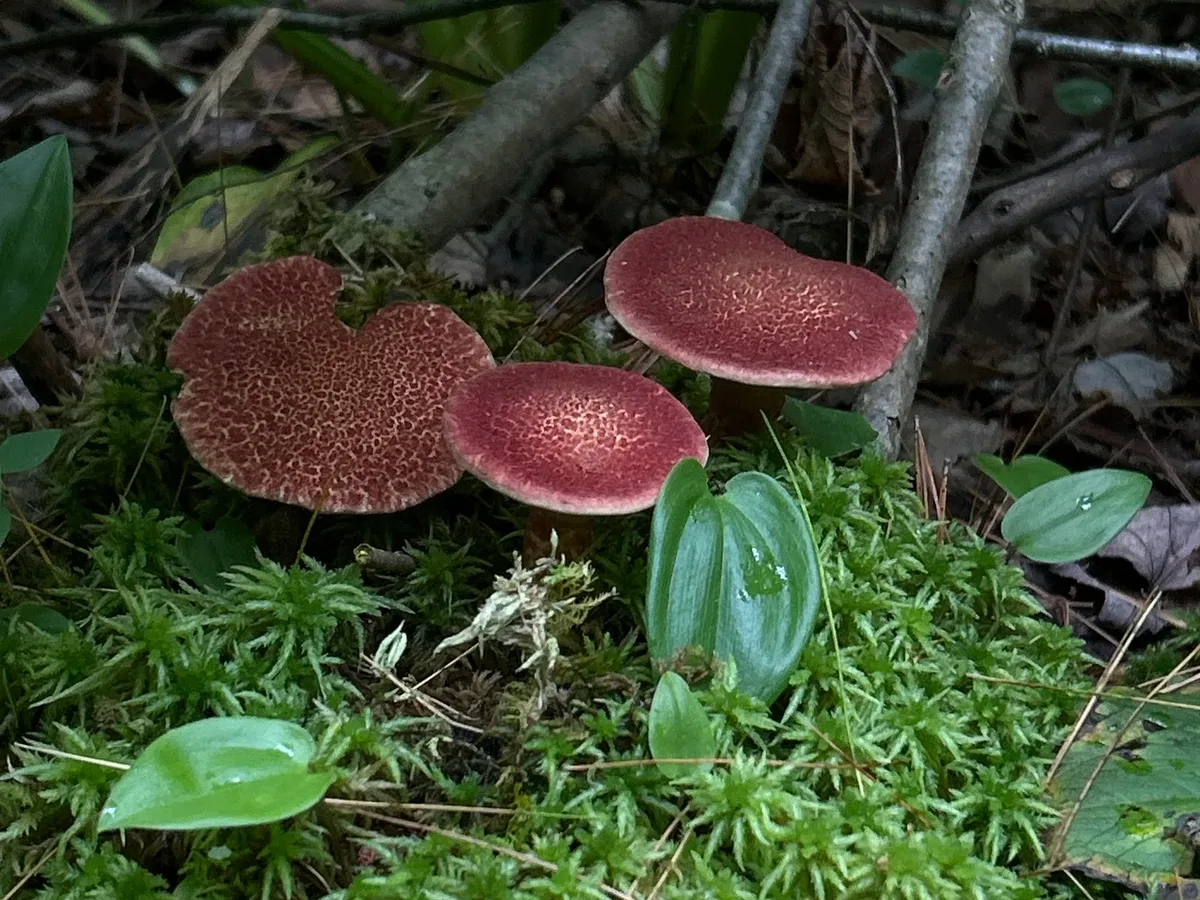
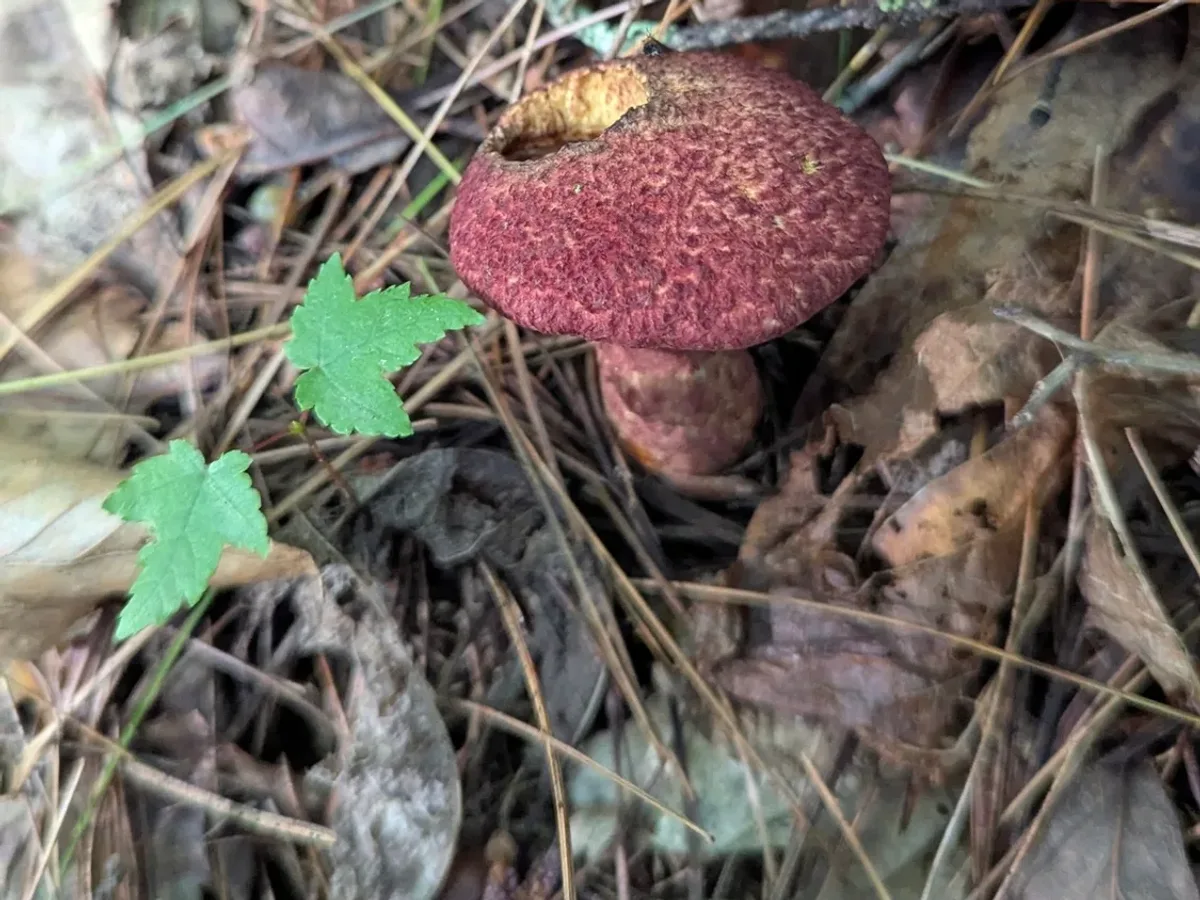
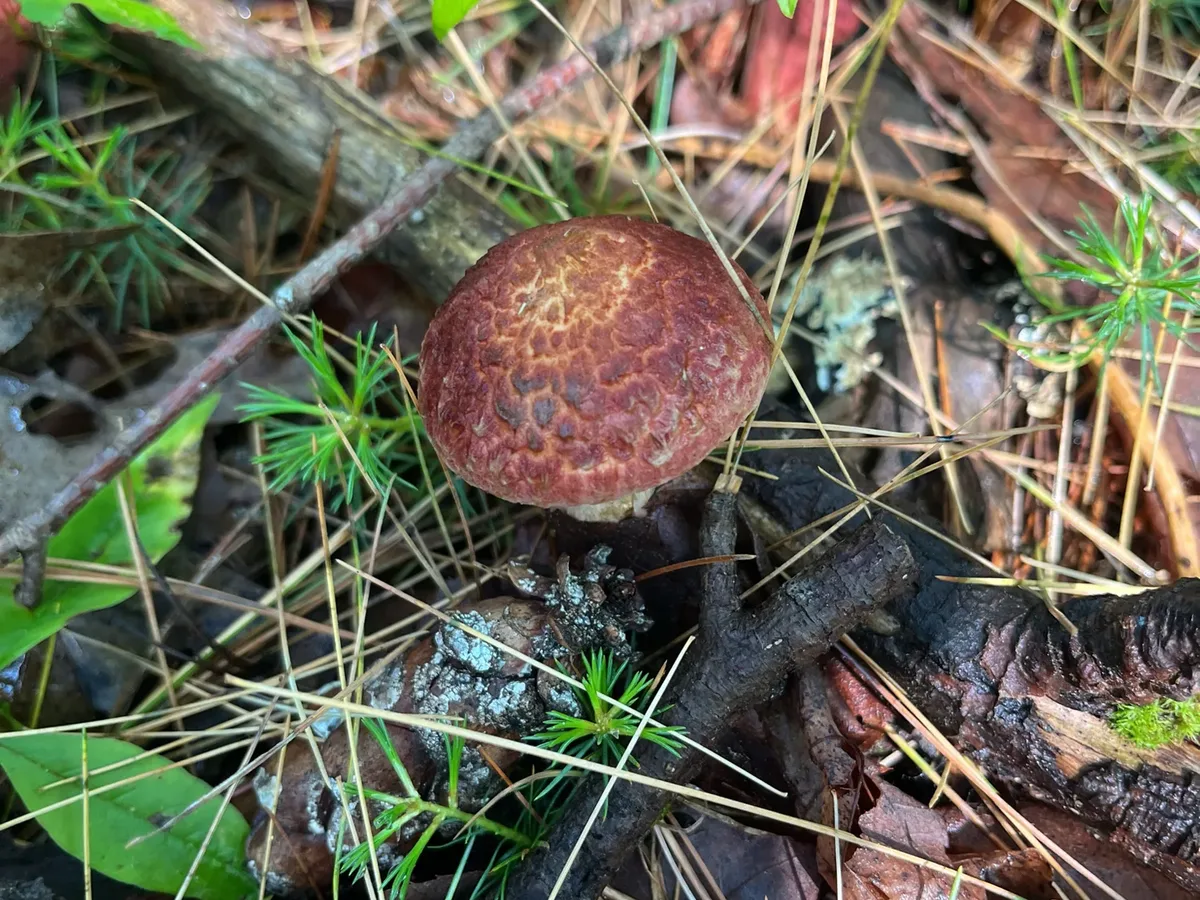
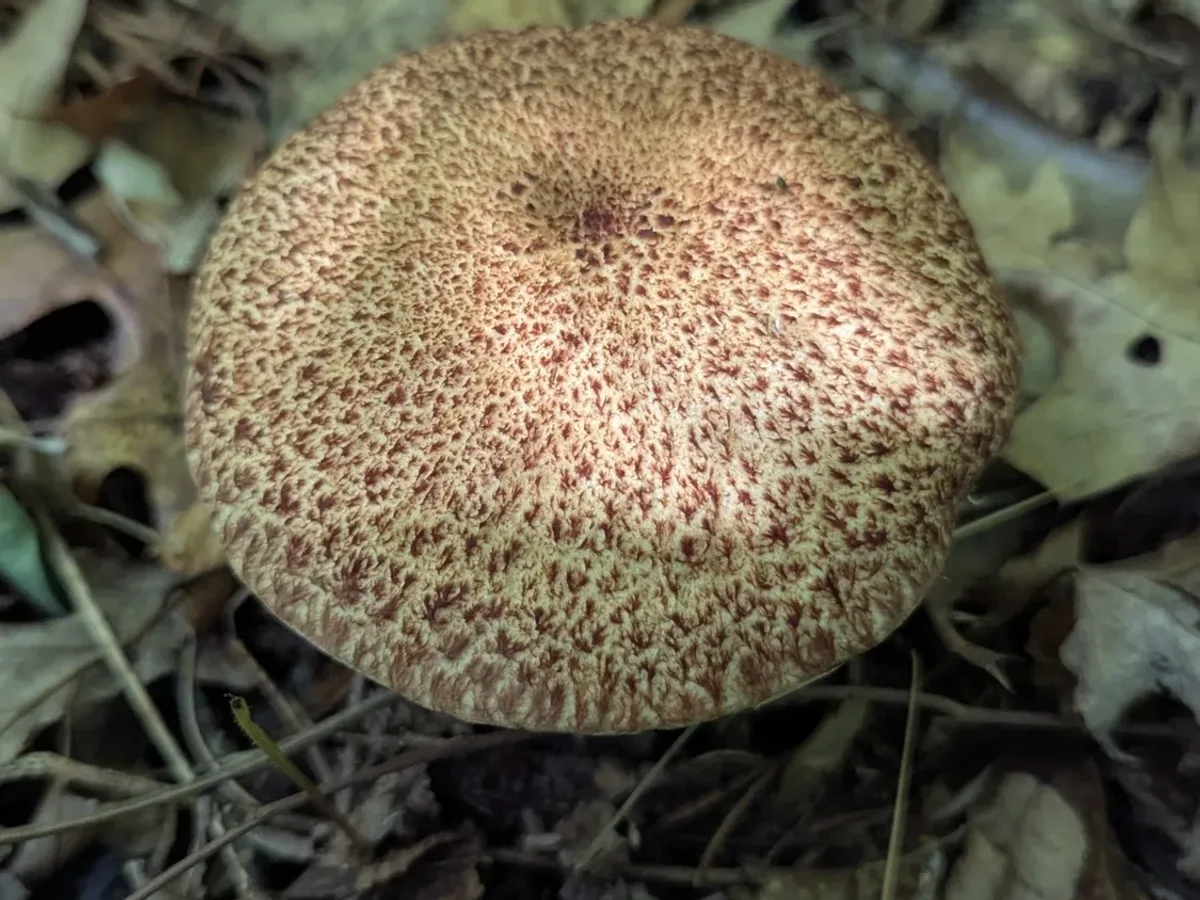
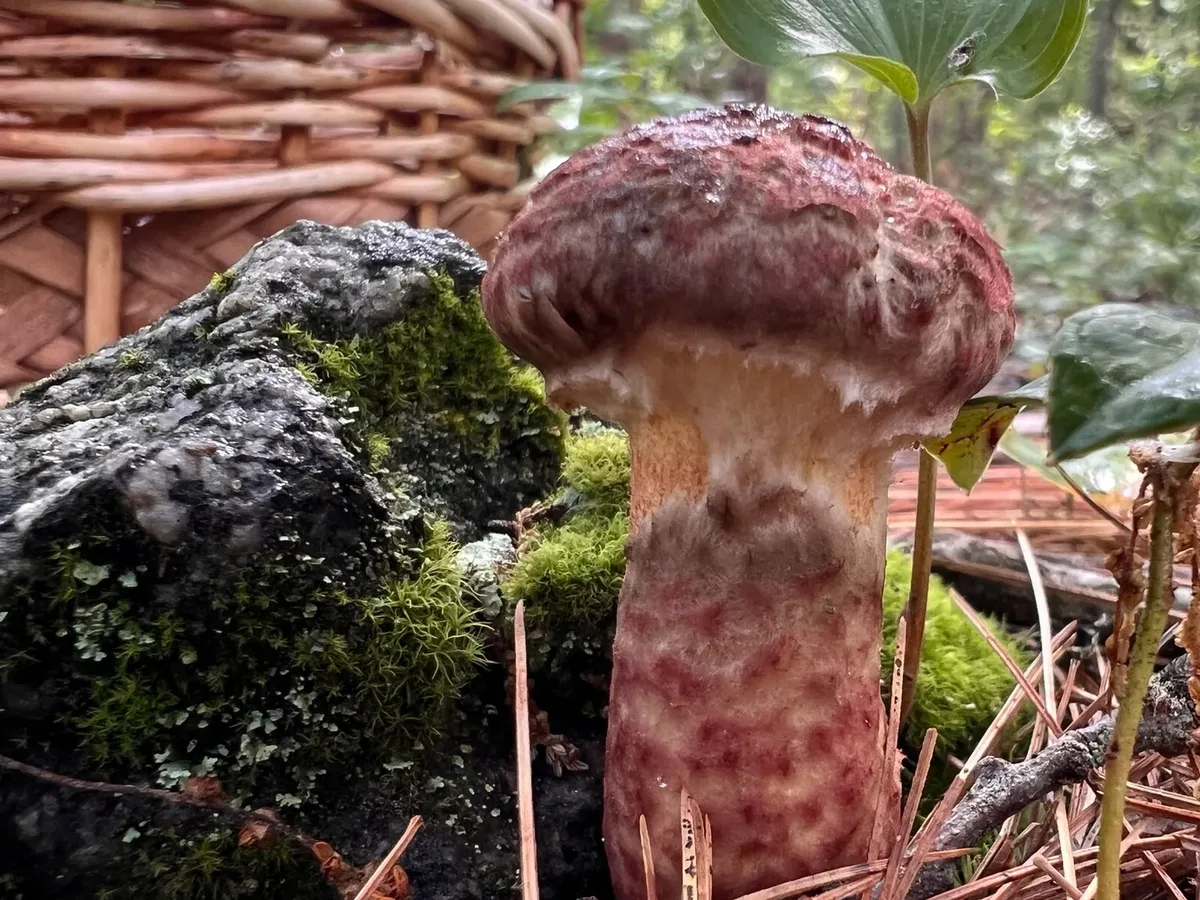
The painted suillus earns its name from the most visually distinctive cap surface in the Suillus genus: a field of brick-red to rosy-crimson fibrous scales overlying a bright sulphur-yellow ground, producing a bicoloured 'painted' effect that is immediately eye-catching among the pine needles.
Where almost every other Suillus has a smooth, slimy, monochrome cap, Suillus spraguei is dry, scaly, and vividly two-toned. The scales are pressed flat in young specimens, exposing the yellow ground only in the gaps between them; in older fruit bodies they become more erect and shaggy as the cap expands, and the pattern intensifies.
Gills / Pores
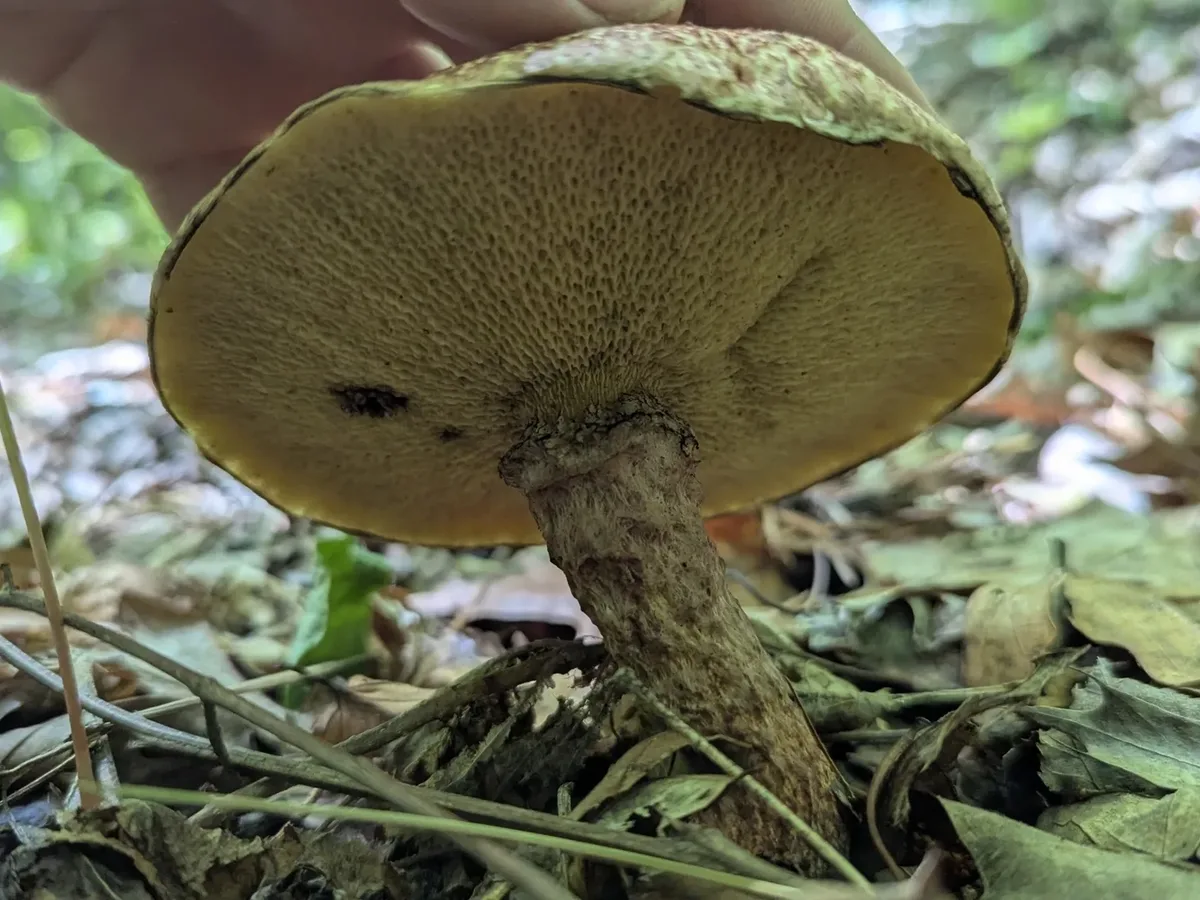
The underside is a sponge-like layer of lemon-yellow pores that do not bruise blue - important for distinguishing it from potentially blue-staining boletes of other genera.
Stem
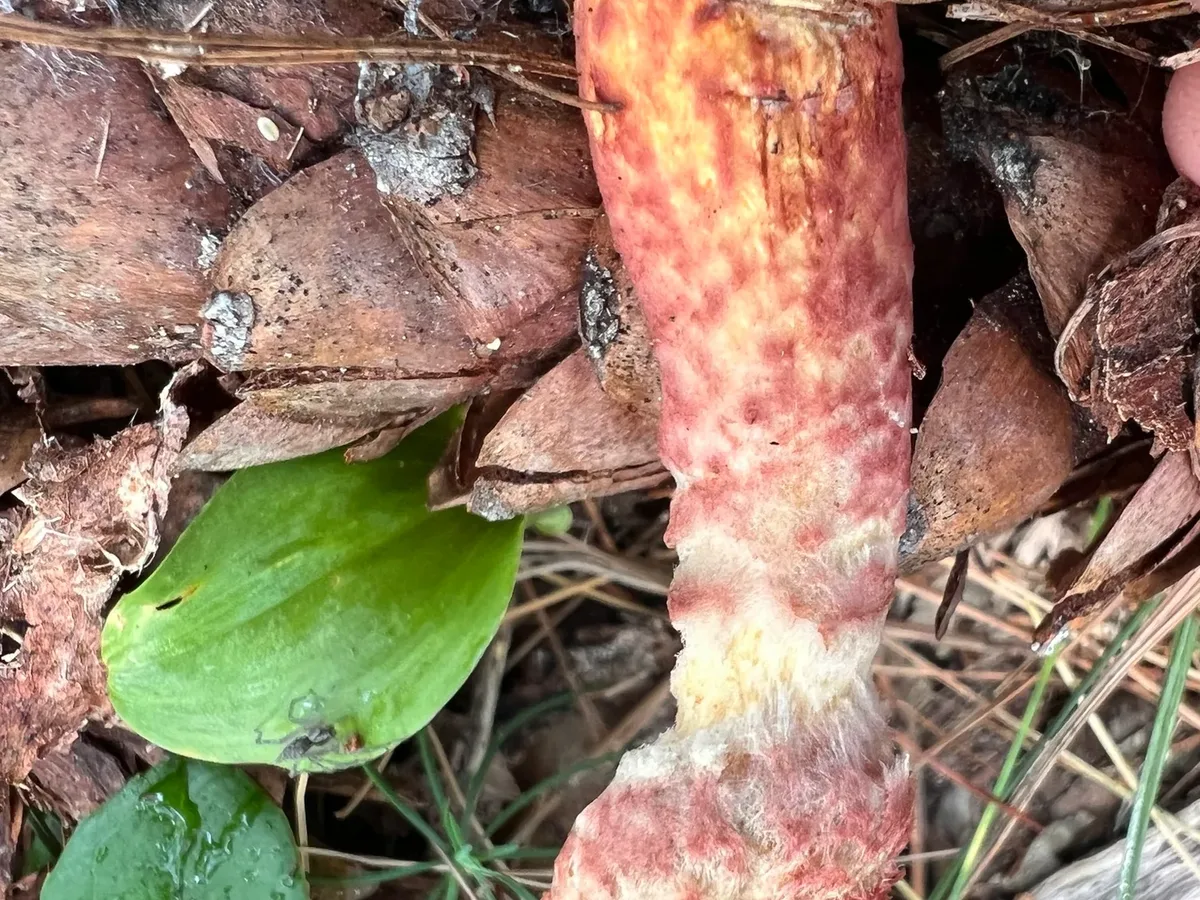
The stem carries a ring, a characteristic it shares with Suillus luteus but not with its fellow white-pine associate Suillus americanus; the ring is cottony and whitish at first, often shredding to a ragged skirt or fragment in age. The stem surface below the ring is fibrous-streaky in red-brown tones, above it pale yellow with finer reddish dots.
Flesh
The flesh is pale yellow throughout, firm in youth, softening with age, and does not change colour appreciably when cut.
Where & when it grows
Habitat
Suillus spraguei is, without exception, a mushroom of eastern white pine. If there is no Pinus strobus within the vicinity, the identification should be reconsidered.
In its heartland - the northeastern United States and the Great Lakes region of Canada - it grows in every habitat type where white pine is present:
- Old-growth remnants
- Managed pine forests
- Young plantation regrowth
- Pine-mixed-hardwood transition zones
- Even ornamental white pine plantings in suburban parks and cemeteries
It follows the Appalachian spine south into the highlands of Tennessee and North Carolina, wherever white pine persists at elevation.
The association is strictly mycorrhizal, meaning the fungal mycelium physically envelops the pine root tips in a sheath, exchanging mineral nutrients from the soil for carbohydrate sugars produced by the tree. This biological partnership is so specific that the fungus cannot persist where the host is absent.
Look for fruit bodies on the ground within the drip line of mature pines, often partially buried in accumulated pine needle duff, with the distinctive red-and-yellow cap just breaking the surface.
When
A summer-to-autumn species across its range. In New England, the Great Lakes, and adjacent Canada, the first fruit bodies typically appear in late July, with fruiting intensifying through August and September as soils remain warm but rainfall becomes more reliable.
Peak abundance in most years falls between early August and late September - the classic late-summer window. Suillus spraguei tends to fruit slightly later in the season than the co-occurring S. americanus, making it relatively more common in the shoulder between summer and autumn.
Warm, moist conditions following summer thunderstorms reliably trigger flushes; cool and dry weather suppresses fruiting even if host trees are present. The season ends abruptly with hard autumn frosts, and fruiting is rare after mid-October except in the southern Appalachians.
How it grows
Individual fruit bodies arise singly or in small groups of two to six from the duff beneath white pine trees. Unlike S. americanus, which can produce large troops, the painted suillus is typically scattered rather than gregarious.
Young buttons emerge as rounded, mostly red shapes with the yellow ground still largely hidden. As the cap expands the scaly pattern opens up and the full painted appearance develops. Growth from button to mature cap takes three to five days in warm, humid weather.
Established mycelial networks under productive white pine trees can be visited for multiple years, producing scattered fruit bodies each season when conditions allow. Old, overmature specimens become soft, strongly maggot-tunnelled, and unpleasant quickly in warm weather.
Fruiting conditions
Flushes reliably after warm summer rain events of 20 mm or more within a 14-day window when soil temperatures are between 12 and 20 °C. Peaks in the late-summer/early-autumn transition (August-September in the northeastern US and Canada) when soils are warm but rainfall regularity increases. Cool, dry conditions suppress fruiting; the season ends abruptly with the first hard frosts of October-November.
Look-alikes
The painted suillus has a highly distinctive appearance that makes serious misidentification uncommon, but a handful of confusions are plausible.
- Suillus lakei (western painted suillus) is the closest counterpart: it is essentially the western North American ecological equivalent, sharing the red-scaly dry cap and similar pore colour, but associates with western conifers - Douglas-fir (Pseudotsuga menziesii) rather than white pine - and is geographically non-overlapping in most of its range.
- Suillus americanus, the chicken fat suillus, shares the eastern white pine habitat but has a brilliantly yellow, slimy cap that is never scaly or dry - the two species are morphologically opposite in cap character and essentially unmistakable side by side, though in degraded or very old specimens the slime of S. americanus can dry and partially mimic a dull surface.
- Suillus cavipes (hollow-footed bolete) has a similarly dry, rusty-fibrous cap with a ring, but grows exclusively under larch (Larix), not pine, and its stem becomes hollow in age.
Importantly, none of these lookalikes are toxic or dangerous; the Suillus genus as a whole contains no deadly species, and Suillus spraguei has no deadly lookalike. The combination of dry red-scaly cap + yellow pores + ring + white pine host is unique in the eastern North American mycota.
Shares the eastern white pine habitat but has a brilliantly chrome-yellow, heavily slimy and glutinous cap that is never scaly or dry - the polar opposite of Suillus spraguei's dry red-scaly surface. Suillus americanus also lacks a ring entirely; S. spraguei has a distinct ring in fresh specimens. Both are edible; confusion is harmless.
Also has a dry, rusty-fibrous scaly cap and a ring, but grows exclusively under larch (Larix spp.), not pine. The stem becomes distinctly hollow with age - a reliable separator - and the overall colour is more uniformly rust-brown without the vivid yellow pore ground of S. spraguei. Harmless if confused.
Has a prominent, persistent, membranous dark purple-brown ring and a very slimy, uniformly dark brown cap without scales. Grows under two-needle pines rather than five-needle white pine. The slimy, non-scaly cap surface makes confusion with S. spraguei unlikely in fresh material. Both are edible.
The western North American ecological counterpart to S. spraguei, with a similar dry, red-brown scaly cap. Distinguished by its host association with Douglas-fir (Pseudotsuga menziesii) rather than white pine, and by its western distribution; geographic and host overlap is minimal. Both are edible.
In the kitchen
Picking & cleaning
Harvest young to medium-aged specimens with firm caps before fly larvae have penetrated the flesh. Cut at the base with a knife rather than pulling - this minimises disturbance to the mycelium and the duff layer.
Unlike most Suillus, S. spraguei does not require the removal of a slimy cap skin, as the cap is completely dry; instead, gently brush away adhering pine needles and debris. The scaly surface itself is somewhat fibrous and benefits from being peeled or scraped away along with the tube layer before cooking, as both can contribute a mildly bitter or tough texture.
Confirm the ring is present on fresh specimens and that the host tree is eastern white pine before collecting. Carry specimens in a basket to avoid compressing them; the caps bruise and darken easily.
Cooking
The painted suillus is a palatable if modest edible. Its flavour is mild - pleasantly mushroomy with a faint piney or resinous undertone - and the texture is moderately firm when young.
Preparation begins in the field or kitchen:
- 1Remove the fibrous red-brown scales by gently peeling back the cap cuticle (it comes away in strips).
- 2Scrape off or cut away the sponge-like pore layer, which turns slimy and unpleasant when cooked.
What remains is the pale yellow cap flesh and the firm stem interior, both of which are worthwhile. Sauté in butter with shallots and garlic for a simple, satisfying side dish; the mild flavour holds up well in cream sauces and pasta.
It dries reasonably well when sliced thinly and dried at 40-50 °C, with the flavour concentrating noticeably; dried and crumbled slices enrich soups, risottos, and bean stews.
It is not typically considered a prime edible of the calibre of Boletus edulis, but it is abundant in good seasons, easy to identify, and a worthwhile harvest in white pine country. As with any wild mushroom, eat only a small amount on the first occasion to assess personal tolerance.
Good to know
Suillus spraguei is a safe, edible species with no deadly lookalikes. The Suillus genus contains no amatoxin-bearing or otherwise lethally toxic species, and the painted suillus has been collected and eaten without serious incident throughout its range.
However, the standard caveats for all Suillus species apply:
- Some individuals experience gastrointestinal upset - nausea, loose stools, or cramping - after eating Suillus species, a response attributed to unidentified heat-labile compounds in the raw mushroom and to the spongy pore layer; always cook thoroughly and never eat raw.
- The fibrous cap scales and pore layer are best removed before cooking, as they can be tough and somewhat bitter.
- Susceptible individuals may develop contact dermatitis from handling fresh specimens; wearing gloves during preparation is a reasonable precaution.
To identify safely, confirm:
- 1The host is eastern white pine (five-needle pine).
- 2The cap is dry, scaly, and brick-red to rosy-red over a yellow ground - never slimy.
- 3A ring is present or remnant on the stem.
- 4Pores are yellow and do not stain blue.
- 5The flesh does not blue when cut.
These five points together uniquely identify Suillus spraguei in eastern North America and exclude all dangerous species.
A reference guide - never an edibility guarantee. When in doubt, leave it out.