Pungent Suillus
Suillus pungenssyn. Ixocomus pungens (Thiers & A.H.Sm.) E.-J.Gilbert
 © Andrianl (CC BY)
 © reagan peschke (CC BY)
 © reagan peschke (CC BY)
 © Andrianl (CC BY)© Andrianl (CC BY)© reagan peschke (CC BY)
Edible only with the right preparation - or safe for some people but not others. Learn the caveats first.
How to recognise it
Suillus pungens introduces itself with its nose before its eyes have even identified the cap.
Smell & taste
The intensely pungent, onion-like or garlicky odour released when the flesh is cut - or even from a whole, undamaged specimen in a warm hand - is unique in the genus and serves as the most reliable single field character for this species. No other Suillus in western North America shares this scent.
Cap
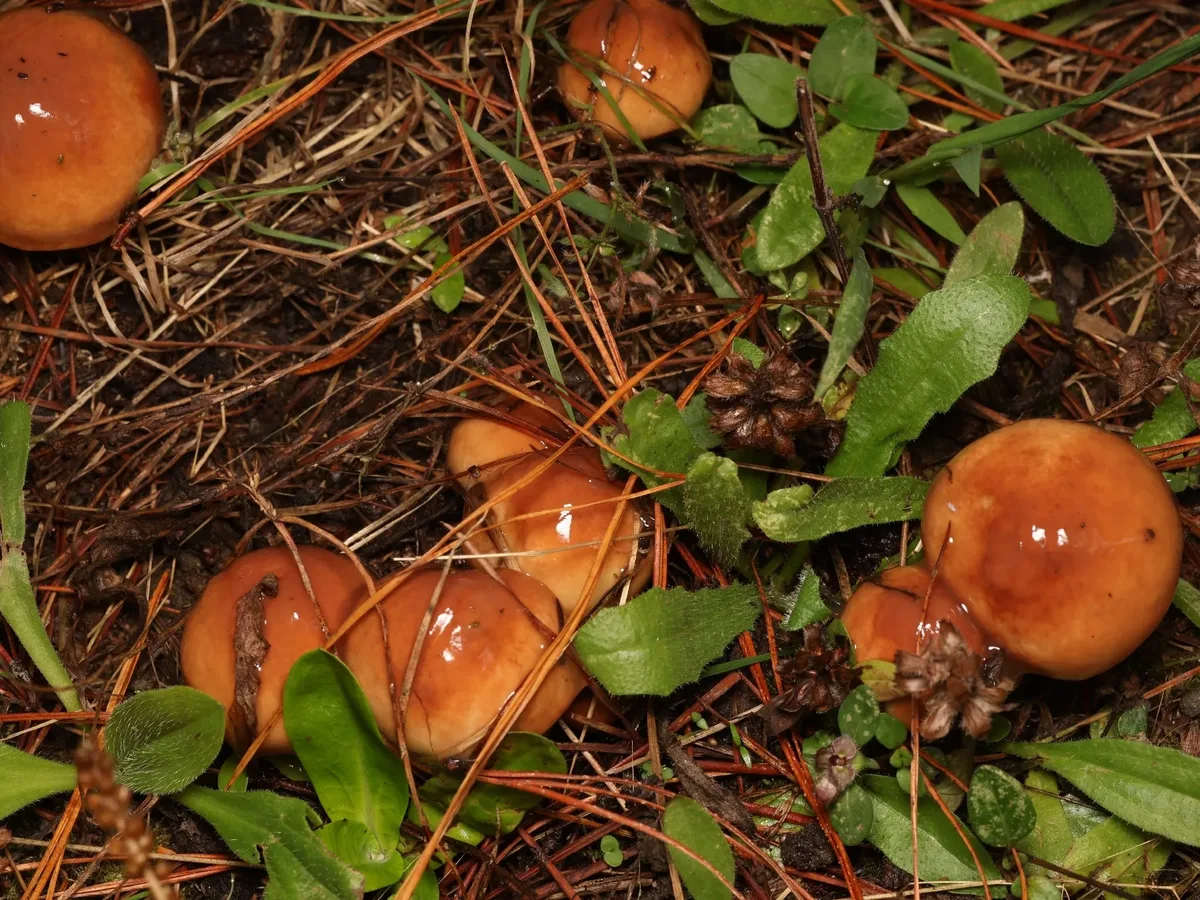
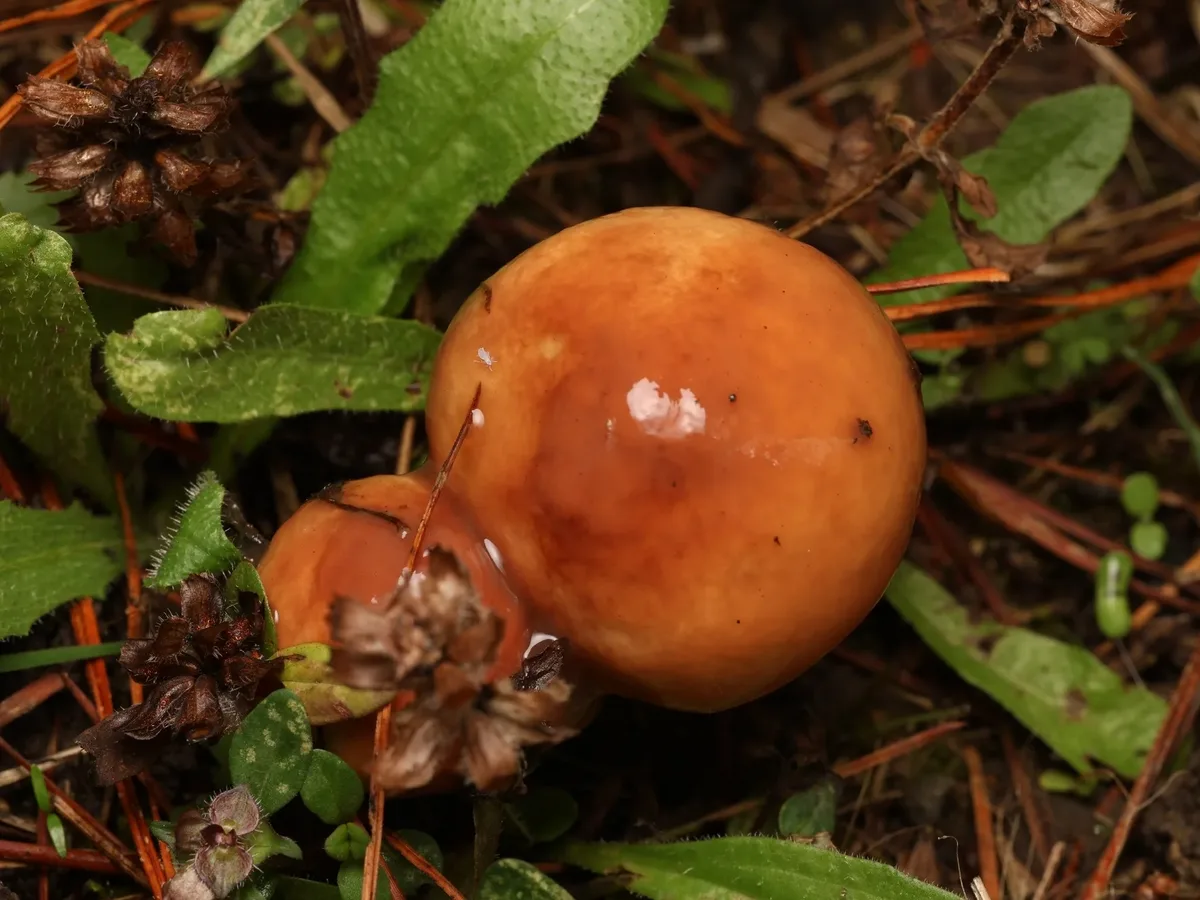
A classic slippery jack in form: broadly convex when young, flattening in maturity to a smooth, very glutinous cap in muted ochre-yellow to olive-brown tones, the slime thick enough to glue fallen pine needles to the surface.
Pores
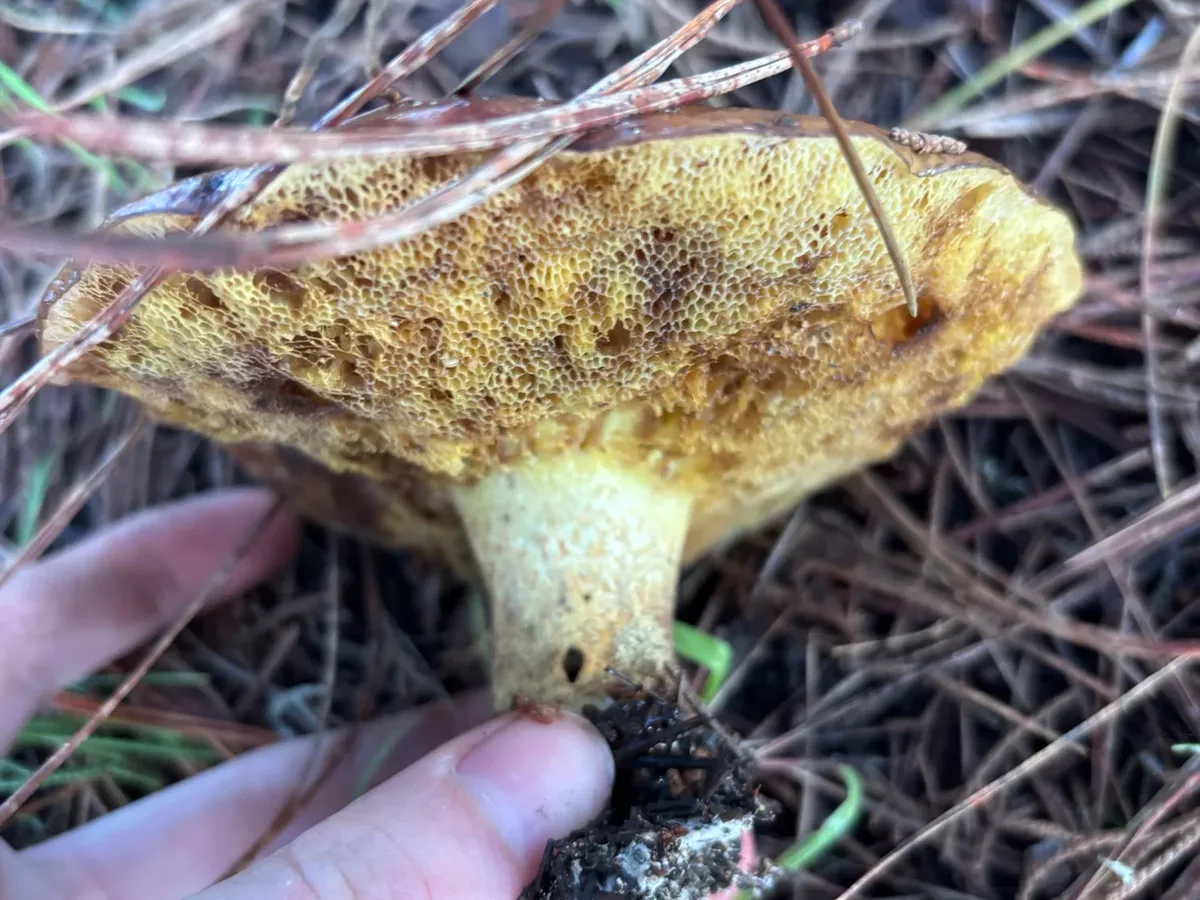
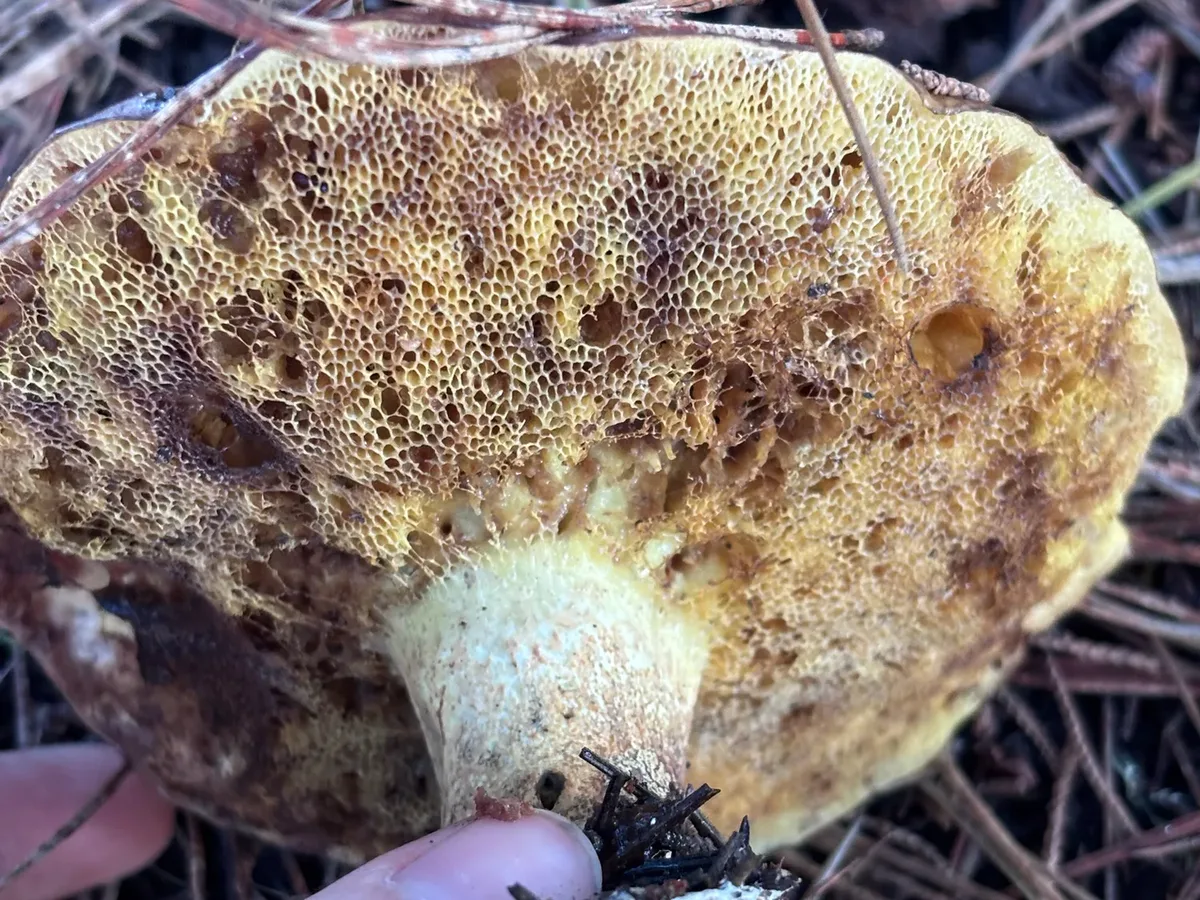
Young buttons often carry distinctly pallid to whitish pores - another good character to note when specimens are fresh - which mature to the usual dull ochre-yellow of the genus.
Stem
A membranous veil is present and typically leaves a visible ring or ring-zone on the upper stem, though in wet conditions the gelatinous veil can disintegrate and leave only a faint ragged collar. The stem is pale buff, dotted with dark resin granules below the ring in the typical Suillus fashion.
Flesh
The flesh is firm, whitish to pale yellow, and does not change colour when cut.
The combined package - very slimy cap, pallid young pores, ring on stem, glandular-dotted stem, and above all the unmistakable pungent odour - identifies this species with confidence wherever it occurs.
Where & when it grows
Habitat
Suillus pungens is essentially a mushroom of the Monterey pine belt.
Monterey pine (Pinus radiata) is one of the most range-restricted native conifers in North America - naturally confined to five small coastal groves in California (the Monterey Peninsula, Año Nuevo Point, Cambria, and the Channel Islands) and two sites in Mexico - yet it has become one of the most widely planted trees in the world for timber and landscaping.
Suillus pungens follows this planted host wherever it goes along the California and Oregon coast, appearing in city parks, university campuses, suburban gardens, and golf courses with mature Monterey pine plantings as readily as in natural coastal scrub forest.
Bishop pine (Pinus muricata), another closed-cone pine of the California coastal fog belt, hosts this species where their ranges overlap around Marin and Mendocino counties.
Shore pine and beach pine (Pinus contorta var. contorta), the twisted, wind-sculpted pine of coastal dunes and bogs, can also serve as host.
Because all of these pines are coastal fog-belt species adapted to the Mediterranean precipitation regime, Suillus pungens is strictly a cool-season, wet-season fruiter - it has no summer season at all in its natural coastal habitat.
When
The coastal Mediterranean climate that defines the range of Suillus pungens's host pines dictates an unusual fruiting calendar for a bolete: this species fruits not in summer or early autumn but through the winter rainy season, from October or November through February or March.
Summer is completely dry along the fog-belt coast, and fruiting is entirely suppressed.
The first significant autumn rains - when 20-30 mm or more falls within a fortnight and the summer-warmed soil begins to cool - trigger the first flushes, typically in October or November.
Fruiting continues through the heart of winter as long as episodic rain keeps the soil moist and temperatures remain mild (soil temperatures in the 8-15 °C range are ideal).
January and February can be particularly productive in wet years when warm Pacific frontal systems push through repeatedly. The season ends as soils dry in March and April.
How it grows
Fruits singly or in scattered to loosely gregarious groups, occasionally in clusters of two to four fruit bodies from a shared mycelial base, always beneath the drip-line of host pines.
Like all Suillus species, S. pungens lives as a perennial mycorrhizal partner in the soil, its mycelium threading through the fine root tips of Pinus radiata and other hosts in an exchange of sugars for minerals and water that is mutually essential. The species cannot fruit without a living pine host, and newly planted Pinus radiata in pots without the fungal partner establishes more slowly on poor soils.
Once a mycelial network is established under a mature Monterey pine, it can produce fruit bodies year after year through successive wet seasons, and productive individual trees are worth revisiting.
Young buttons emerge quickly after rain, reaching full size in three to five days under mild, wet coastal conditions. Old specimens become very slimy and are rapidly colonised by fungal gnats.
Fruiting conditions
Suillus pungens follows the coastal California winter rainy-season pattern. Reliable flushes require 20 mm or more of rain over a 14-day period, with soil temperatures in the 7-16 °C range typical of mild coastal winters. After significant Pacific frontal rain events, fruit bodies emerge 7-14 days later. The summer drought of the Mediterranean coastal climate completely suppresses fruiting from April through September; this species has no summer season whatsoever in its native range. Peak window is November through January in most years.
Look-alikes
Suillus pungens shares its coastal pine habitat with only a handful of other Suillus species, and the pungent odour alone is sufficient to distinguish it from all of them once the scent is learned.
The realistic confusions are:
- Suillus granulatus (granulated bolete) - also has a slimy cap, dotted ringless stem, and yellow pores, but lacks any ring, lacks the pungent odour, has a more uniformly tan to ochre-brown cap, and exudes milky droplets from the pores in young specimens.
- Suillus luteus (slippery jack) - has a very similar slimy cap and ring but is darker chestnut-brown with a distinctive purple-brown to dark-brown well-formed membranous ring, and grows primarily under two-needle pines (Pinus sylvestris and relatives) rather than closed-cone coastal pines.
- Suillus caerulescens (blue-staining suillus) - grows exclusively under Douglas-fir, an entirely different host, and blues weakly on cutting.
None of these species share the strongly pungent odour of S. pungens, and none are dangerously toxic. No deadly species can be confused with Suillus pungens in the coastal pine belt of California and Oregon.
Suillus caerulescens grows exclusively under Douglas-fir (Pseudotsuga menziesii), not under coastal closed-cone pines. Its flesh and pores blue noticeably when cut; S. pungens does not blue. It has a slimy brown cap but lacks the pungent smell.
Suillus granulatus has a slimy ochre-brown to tan cap and a dotted stem but entirely lacks a ring - the presence of a ring or ring-zone on S. pungens is an immediate differentiator. Young S. granulatus pores exude white milky droplets, which are absent in S. pungens. S. granulatus also lacks the pungent onion-garlic odour; the smell alone is diagnostic if the ring is not yet evident in a young specimen.
Suillus lakei has a dry (not slimy), coarsely reddish-scaly cap and grows under Douglas-fir, not coastal closed-cone pines. The dry, distinctly scaly cap texture immediately separates it from S. pungens's smooth, very slimy cap.
Suillus luteus has a well-formed, prominent purple-brown to dark-chocolate membranous ring (more robust than the often-ragged veil remnant in S. pungens), a darker chestnut-brown to date-brown cap, and grows primarily under two-needle pines (particularly Pinus sylvestris) rather than the coastal closed-cone pines hosting S. pungens. S. luteus lacks the pungent onion-garlic odour; the smell is the fastest field separator.
In the kitchen
Picking & cleaning
Harvest young to medium-aged specimens with firm caps and undamaged ring zones; very old or waterlogged fruit bodies deteriorate quickly and are rarely worth collecting.
Cut cleanly at the base with a knife.
The thick slime layer is the most important preparation step: the cap cuticle peels away easily in fresh specimens, taking the gluten with it, and this step is strongly recommended before cooking.
The slime contributes a slightly bitter, gluey note and an unappealing texture if left on; its removal transforms the eating quality of the mushroom.
After peeling, the pungent odour - which can be quite pronounced in the field - diminishes considerably with cooking, leaving a mild, pleasantly mushroomy flavour.
Inspect the stem and flesh for insect galleries; this species is frequently visited by fungal gnats in warm, wet conditions.
Collected specimens should be used within a day or two: Suillus species with high water content deteriorate rapidly, especially in mild coastal winter weather.
Cooking
The pungent smell that makes Suillus pungens so easy to identify in the field largely cooks away, leaving a mild, pleasant mushroom flavour that pairs well with bold companions.
- 1Peel the slimy cap cuticle - it lifts cleanly in fresh material - and discard it.
- 2Slice the cap and stem and allow cut slices to sit briefly before cooking, which further dissipates the volatile compounds responsible for the smell.
- 3Sauté over medium-high heat in butter or olive oil with garlic and shallots until moisture evaporates and the slices begin to colour.
The cooked mushroom has a soft, slightly spongy texture and mild flavour. S. pungens works well in soups, pasta sauces, risotto, cream sauces, omelettes, and as a pizza topping.
The pore layer of older specimens can become mushy; removing it before cooking preserves texture if desired.
The mushroom also dries reasonably well at 40-50 °C, with drying concentrating and mellowing the flavour; dried slices reconstitute in warm water and are useful in stocks and braises.
As with all Suillus species, peel the cap, cook thoroughly, and test individual tolerance with a modest portion on first use.
Good to know
Suillus pungens is a safe edible mushroom with no deadly lookalikes in its coastal pine habitat and no meaningful toxin risk. The practical safety considerations are the same as for the genus as a whole.
- 1Like all Suillus species, raw fruit bodies contain compounds - including polysaccharides and resinous components - that can cause mild gastrointestinal irritation in sensitive individuals; always cook thoroughly.
- 2Some people experience mild nausea or loose stools from Suillus species even when cooked, suggesting individual sensitivity rather than universal toxicity; test tolerance with a modest first portion.
- 3The slimy cap cuticle should be peeled before cooking both for flavour reasons and to remove the component most likely to cause irritation.
- 4The strong pungent smell, while striking, is NOT an indicator of toxicity - it is a naturally occurring volatile sulfur compound that is largely dispelled during cooking.
When identifying, confirm:
- 1Host is a coastal closed-cone pine (Pinus radiata, P. muricata, or P. contorta on the coast).
- 2Cap is very slimy and ochre-yellow to olive-brown.
- 3A ring or ring-zone is present on the stem.
- 4Pores are not blue-staining.
- 5The pungent onion-garlic odour is present.
These five characters together are diagnostic.
A reference guide - never an edibility guarantee. When in doubt, leave it out.