Dotted-stalk suillus
Suillus punctipessyn. Boletus punctipes Peck, Ixocomus punctipes (Peck) Kuntze
 © Mical (CC BY)
 © Annie Weissman (CC BY)
 © Annie Weissman (CC BY)
 © Annie Weissman (CC BY)
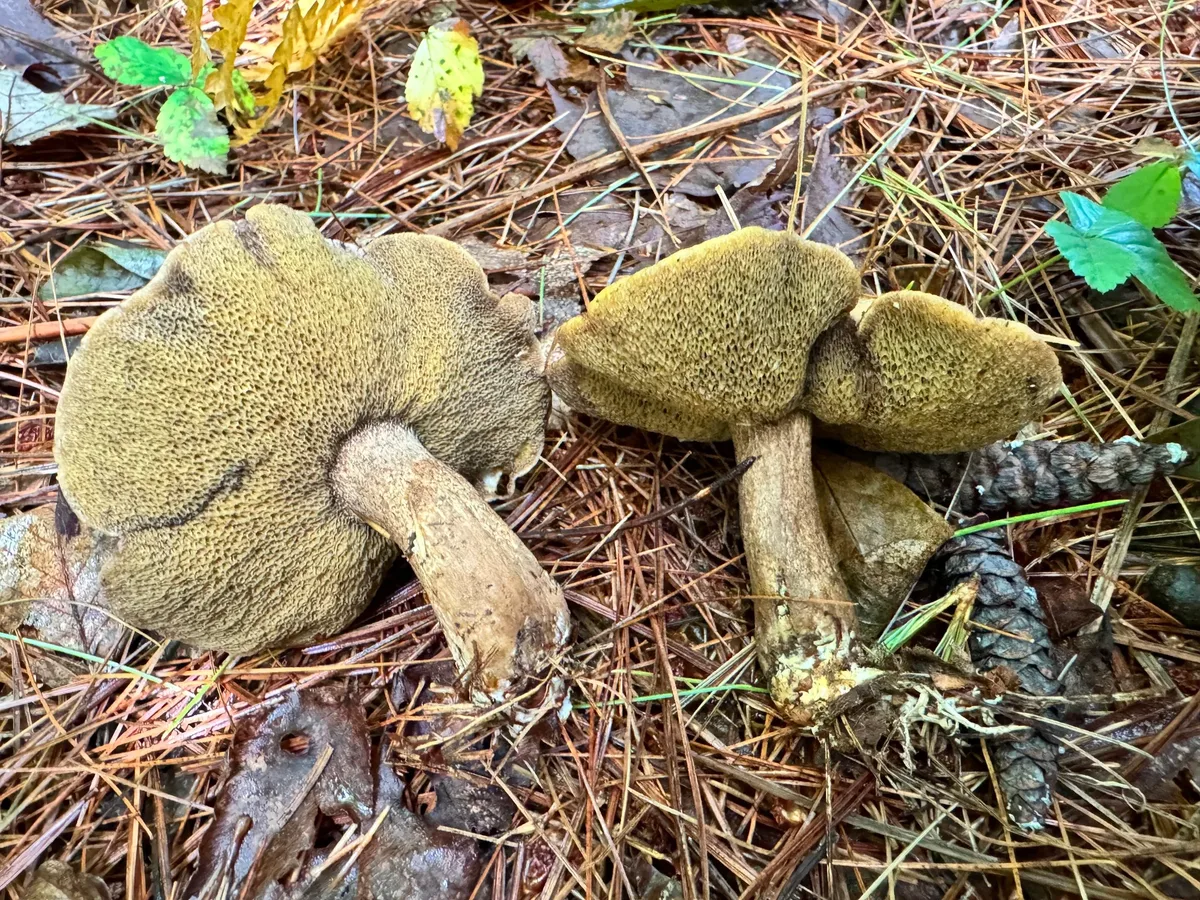 © Annie Weissman (CC BY)
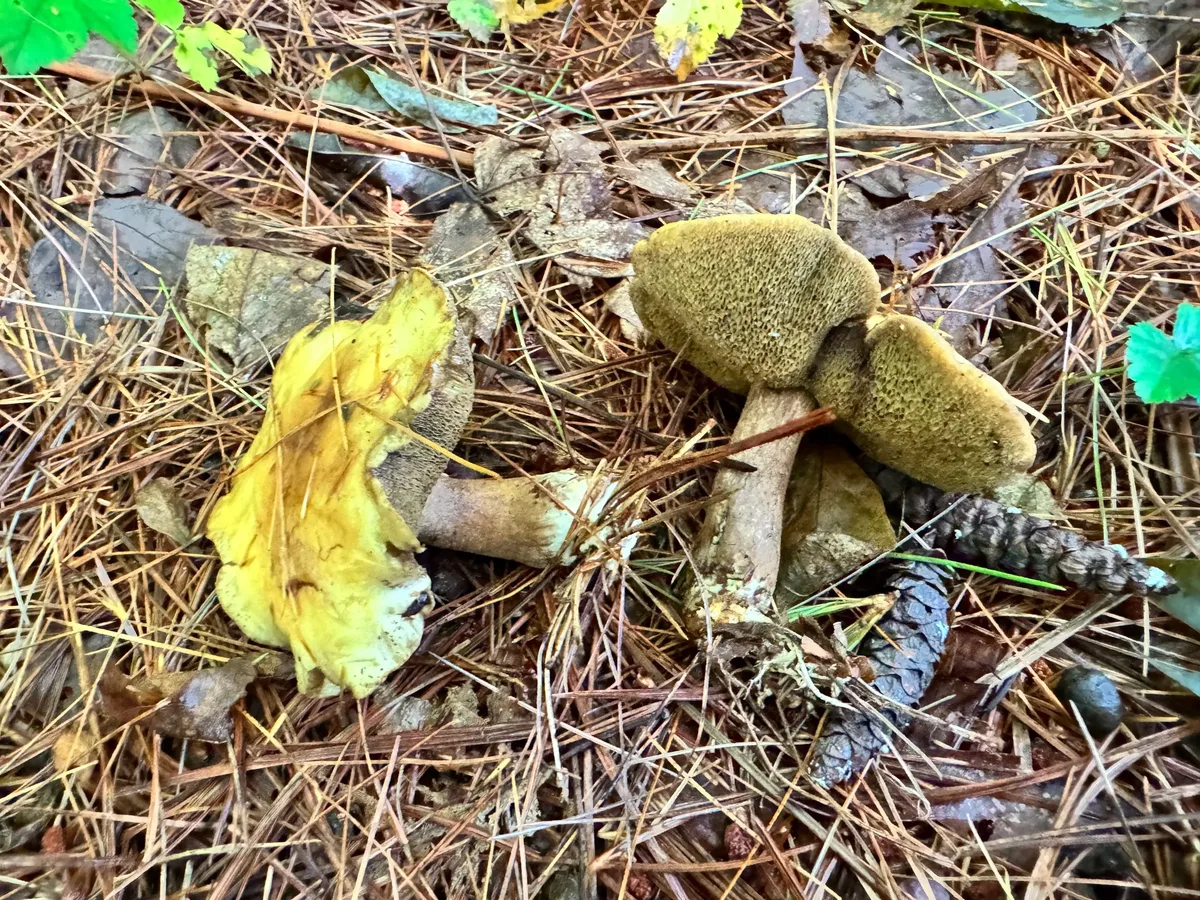 © Annie Weissman (CC BY)
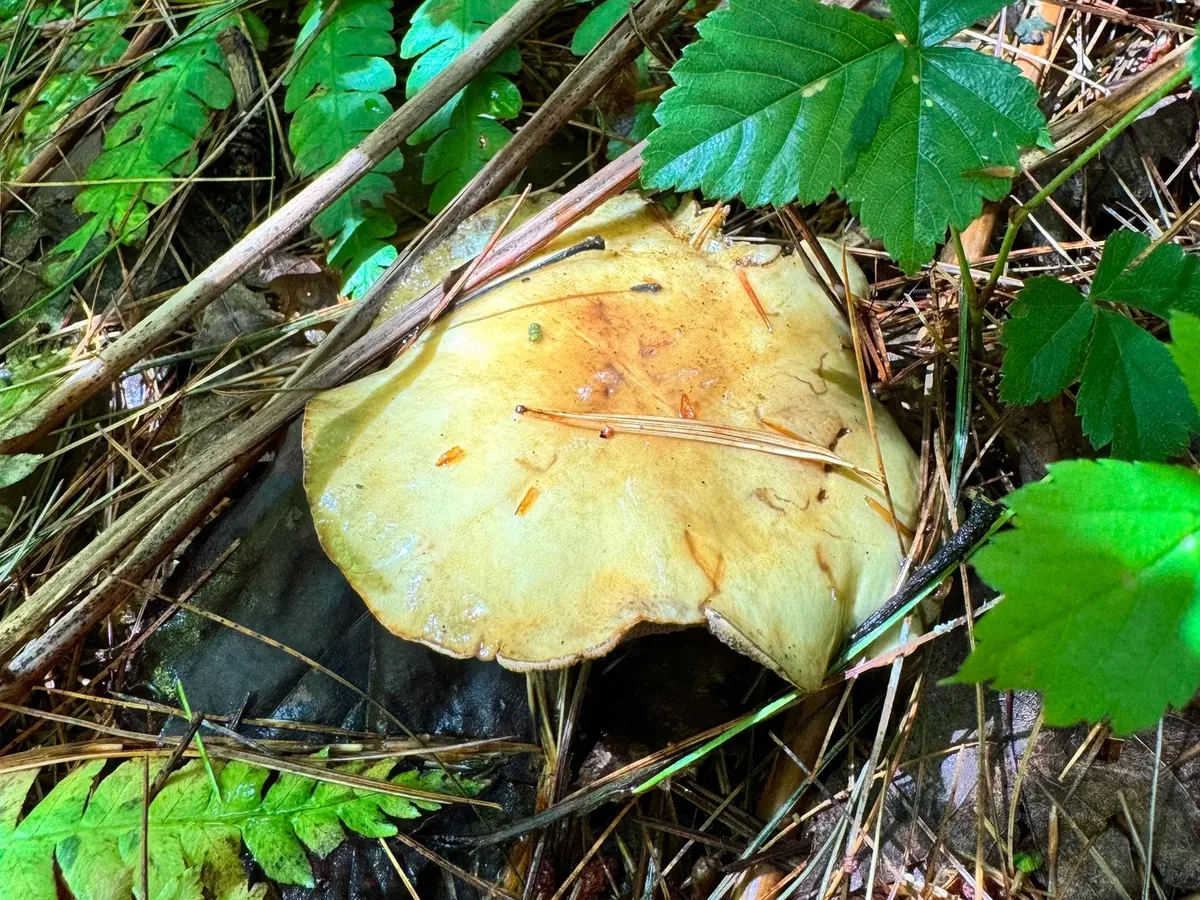 © Annie Weissman (CC BY)© Mical (CC BY)© Annie Weissman (CC BY)
Good to eat, once you have identified it with certainty and cooked it through.
How to recognise it
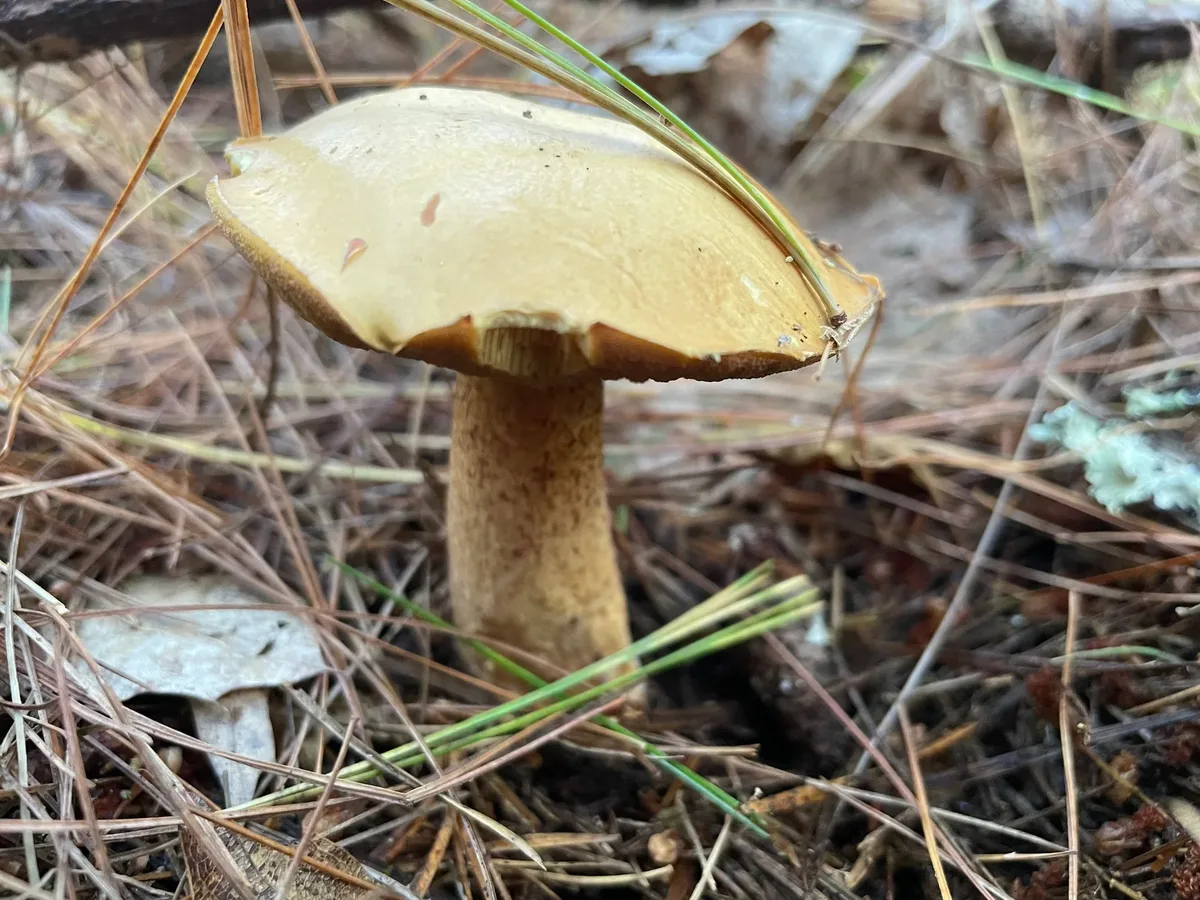
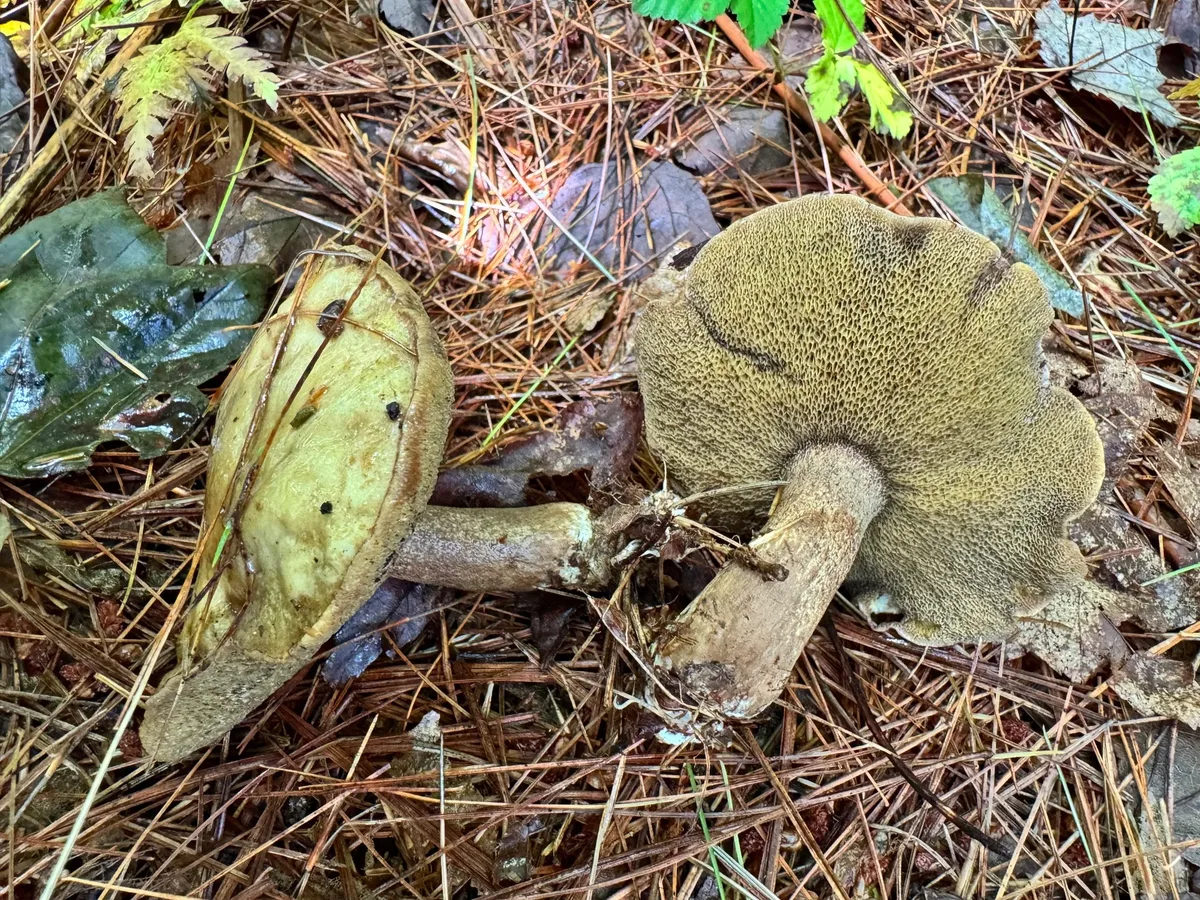
Suillus punctipes earns its common name honestly: the stem is peppered from base to apex with dense, fine glandular dots so dark they are nearly black, a feature more pronounced than in many of its relatives and visible to the naked eye even in dull light.
Cap
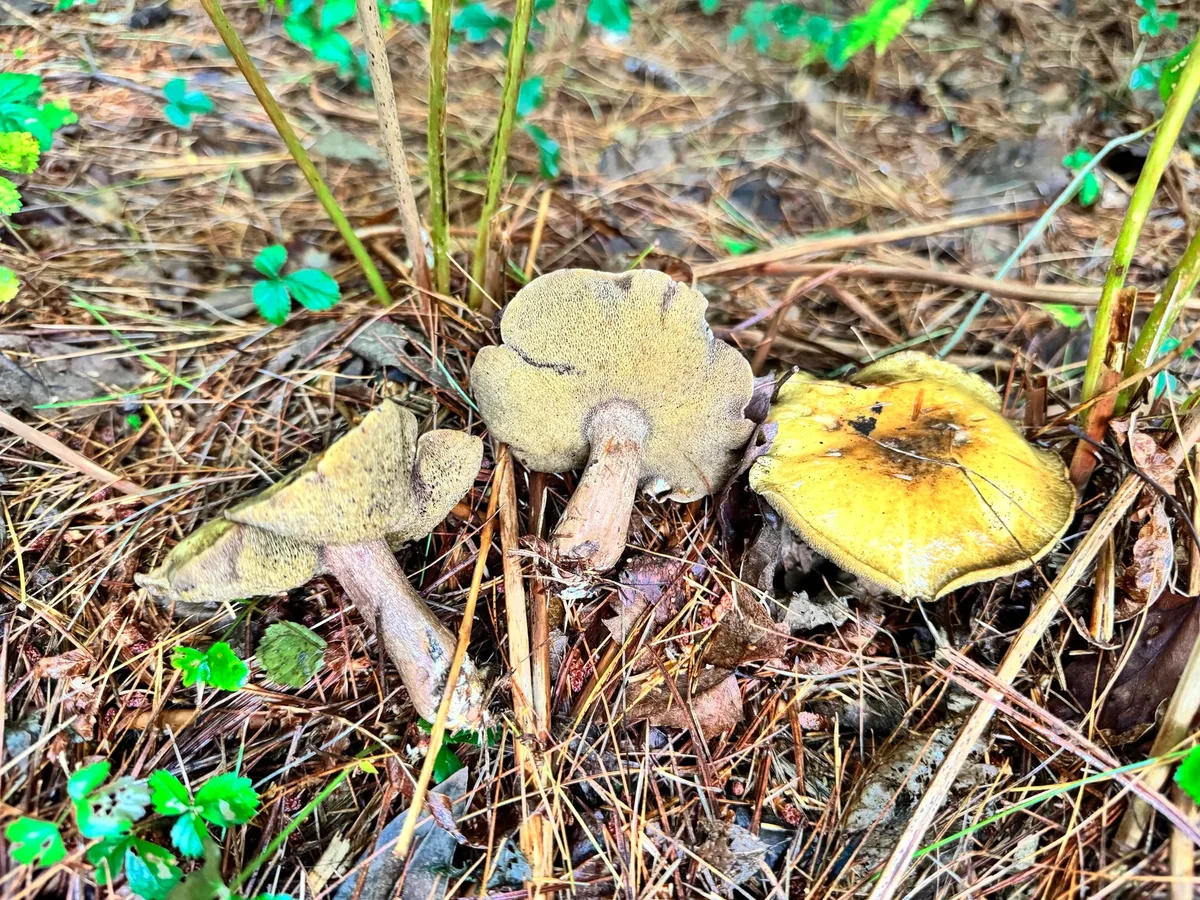
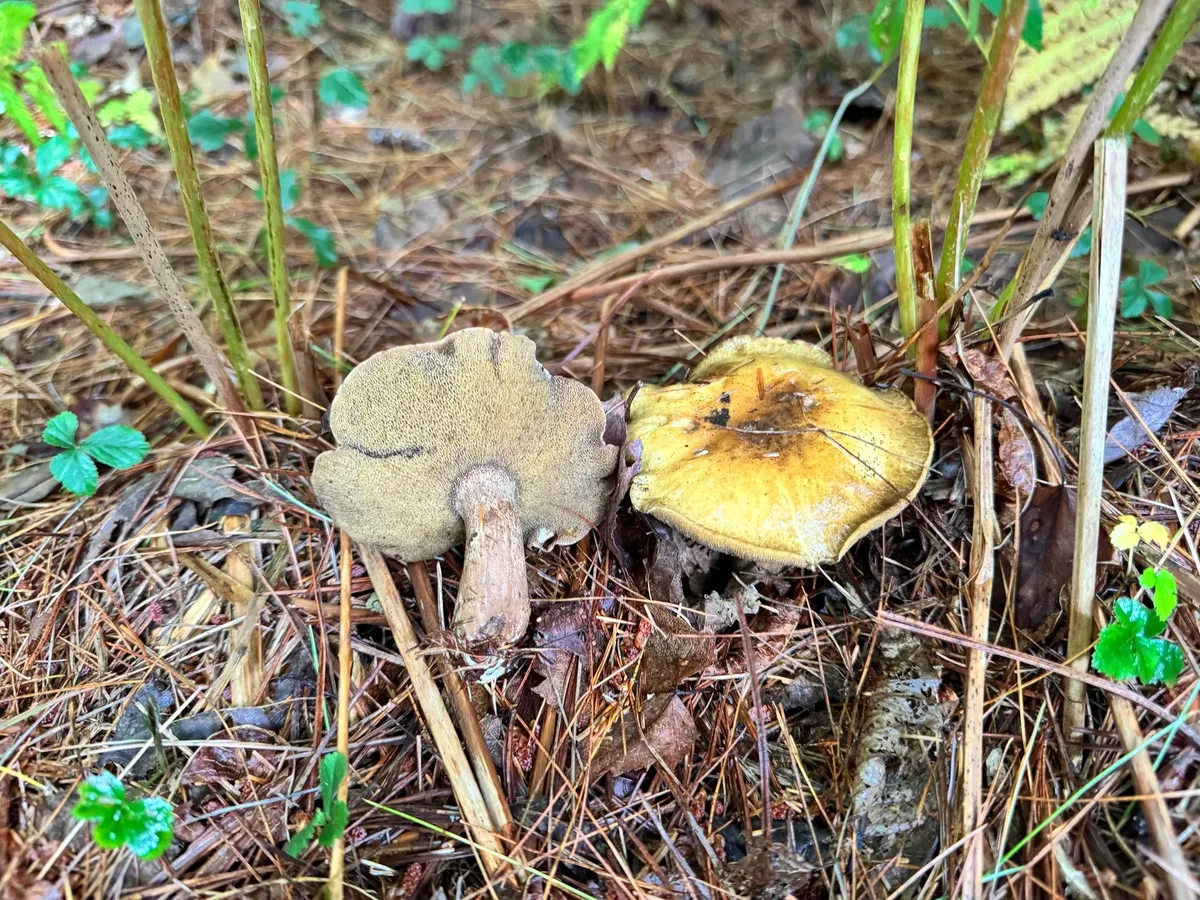
The cap is a muted, earthy colour - ochre-yellow to tawny-honey-brown, lacking the vivid chrome-yellow of Suillus americanus. It is coated in a moderately heavy layer of clear to pale gluten that makes it slippery in fresh condition and slightly tacky when dry. The slime often traps fallen pine needles, giving older caps a dishevelled appearance.
Gills / Pores
The pore surface is bright yellow when young, shifting to ochre in age. The pores are angular and moderately large (1-2 mm). Neither the pores nor the cut flesh show any blue discoloration - the flesh remains pale cream-yellow throughout.
Stem
The stem is solid, somewhat stout relative to its height, and the thick carpet of dark glandular dots covers it uniformly, with no ring or ring-zone at any stage of development.
This combination - slimy ochre-brown cap, yellow pores without bluing, heavily dotted ringless stem, and white pine habitat - is the identification suite for this species.
Where & when it grows
Habitat
This species is tightly bound to eastern white pine (Pinus strobus), one of the most widespread and ecologically important five-needle pines of eastern North America.
Wherever white pine grows in sufficient numbers to maintain a live root network, Suillus punctipes can appear:
- mature mixed forests of pine, birch, maple, and hemlock
- open pine barrens
- suburban street plantings
- golf-course woodlots
- secondary-growth stands regenerating on old farmland
Because the association is mycorrhizal, the fungus lives in an intimate metabolic partnership with the pine's fine roots, exchanging mineral nutrients and water for tree-produced sugars. The relationship is obligatory on both sides, which is why no fruiting occurs away from living white pine.
Look for fruit bodies among the accumulated layer of brown pine needles beneath the drip line of the trees, where the mycelium is densest and moisture is retained longest after rain.
When
Suillus punctipes is primarily a warm-season to early autumn bolete, overlapping in calendar range with Suillus americanus, which shares its white pine host.
The first fruit bodies appear in mid-July when summer heat and moisture align. Fruiting continues through August and September - the peak months - tapering into October as nights cool.
The species is more tolerant of summer warmth than many boreal boletes, and extended dry spells are the main check on fruiting during the core season.
A rain event of 15-20 mm within a fortnight, falling on soils already warmed above about 12 °C, reliably triggers a flush.
In the northern parts of the range (Maine, Ontario, Quebec), hard frosts in early October often end the season abruptly. In the southern Appalachians and coastal New England, fruiting may persist through most of October.
How it grows
Fruit bodies arise singly or in scattered groups from the needle duff, never in tight clusters or from wood.
Young buttons emerge as small domed caps, pale yellow and viscid, rapidly expanding over two to four days in warm humid conditions.
The underlying mycelial network is perennial. An established colony under a large white pine can be productive across many consecutive seasons, and repeat visits to a known patch are a sensible harvest strategy.
Older specimens degrade quickly in warm weather, becoming waterlogged, malodorous, and heavily colonised by fungal gnat larvae. It pays to harvest young to mid-age individuals before larval tunnelling becomes extensive.
Fruiting conditions
A warm-season bolete fruiting from mid-July through October across eastern North America. Reliable flushes follow 15 mm or more of rain over a 14-day window when soil temperatures are between 12-22 °C. Peaks in August and September; ends with the first sustained autumn frosts. Shares its white pine host - and broadly its fruiting phenology - with Suillus americanus, and the two species often fruit together under the same trees.
Look-alikes
Within the eastern white pine forests that are this species' home, no dangerous or deadly species is a realistic confusion. The realistic identifications to distinguish are all within Suillus itself.
- Suillus americanus (chicken fat suillus) shares the same white pine host and the same dotted, ringless stem, but is immediately distinguished by its vivid, bright chrome-yellow to egg-yolk cap colour - much more saturated than the muted ochre-brown of S. punctipes - and its narrower, more slender stature.
- Suillus granulatus (granulated bolete) grows under two- and three-needle pines rather than white pine, and young specimens exude characteristic milky droplets from the pore surface; cap colour is similar but the host mismatch is decisive.
- Suillus luteus (slippery jack) has a darker, chocolate-brown slimy cap and a conspicuous purple-brown membranous ring on the stem - the ring alone separates it immediately.
- Suillus spraguei (painted suillus) occurs in white pine forests but has a completely dry, fibrous-scaly brick-red to rosy cap, with no slime at all.
- Suillus tomentosus has a dry, woolly-scaled cap and its flesh and pores turn distinctly blue on cutting - S. punctipes shows no bluing.
No deadly species is a realistic field confusion for a careful observer. Confirm pores (not gills), ochre-brown slimy cap, heavily dotted ringless stem, and white pine as the host tree.
Has a dry, woolly-tufted (tomentose) scaly cap and flesh that turns conspicuously blue when cut - S. punctipes has a slimy cap and shows no bluing. Primarily a western North American species under 5-needle pines in the Pacific Northwest.
Shares the eastern white pine host and the same dotted, ringless stem, but S. americanus has a vivid chrome-yellow to egg-yolk cap - far more saturated in colour than the muted ochre-brown of S. punctipes. The two species are close ecological partners under white pine and can fruit together; cap colour is the fastest separator.
Similar muted slimy cap and dotted ringless stem, but grows primarily under two- and three-needle pines (Scots pine, red pine), not white pine. Young specimens exude distinctive milky white droplets from the pore surface - a unique and reliable character absent in S. punctipes.
Occurs in eastern white pine forests alongside S. punctipes, but the cap is completely dry and covered in fibrous-scaly brick-red to rosy-pink fibrils - never slimy, never ochre-brown. The dry, decorated cap surface is an immediate and unambiguous separator.
Has a prominent purple-brown to dark chocolate membranous ring on the stem - the single most reliable separator from any ringless Suillus. Cap is darker, more chocolate-brown. Grows under two-needle pines (especially Scots pine, Pinus sylvestris), not five-needle white pine.
In the kitchen
Picking & cleaning
Cut at the stem base with a clean knife and leave a stub to minimise soil disturbance; pulling the whole fruit body disrupts the mycelial mat unnecessarily.
The slimy cap cuticle should be peeled before cooking: it separates easily when the cap is fresh, simply by lifting an edge and pulling toward the centre. Removing the cuticle eliminates the gluey texture the gluten contributes to cooked dishes and removes a potential source of mild GI irritation in sensitive individuals.
Inspect the stem and cap flesh for insect galleries before placing specimens in the basket; heavily tunnelled material should be left in the field.
Collect only firm, young to mid-age specimens; old, soft, or discoloured fruit bodies are not worth carrying home.
Suillus mushrooms deteriorate quickly in warm weather - use within one to two days, or process immediately.
Cooking
A decent, if mild-flavoured, edible mushroom whose modest taste rewards uncomplicated treatment.
Always peel the cap cuticle first - it slips off neatly in fresh material - and discard it. The yellow-ochre flesh is soft and faintly spongy with a pleasantly mild, mushroomy flavour without the complexity of prime boletes.
Dry-sauté sliced caps in butter or olive oil over moderate heat, allowing moisture to evaporate before the mushrooms begin to colour; rushing this step produces a soggy result.
Once golden, they pair well with garlic, shallots, thyme, or tarragon in cream sauces, pasta toppings, omelets, or grain dishes. Removing the spongy tube layer from older specimens improves the final texture.
For preservation, thin slices dry acceptably at 40-50 °C, concentrating the flavour; reconstituted dried slices work in soups and risottos. The species is also suitable for brief pickling in vinegared brine with bay, peppercorns, and dill.
As with all new wild mushrooms, begin with a modest portion to assess personal tolerance before eating larger quantities.
Good to know
Suillus punctipes is a safe, non-toxic edible species with no deadly lookalikes in its white pine habitat. Three practical cautions apply.
- 1All Suillus species contain compounds - mainly the glutinous cap cuticle and certain terpenoids in the flesh - that can provoke gastrointestinal upset, including nausea, loose stools, or cramping, if consumed raw or only lightly cooked; always cook thoroughly before eating.
- 2The slimy cuticle can cause mild contact dermatitis or skin sensitisation in susceptible individuals after repeated exposure; using gloves during preparation is prudent.
- 3As with all mycorrhizal forest mushrooms, avoid collecting near roadsides, industrial sites, or old mining areas where heavy metal accumulation in the soil is a possibility, since Suillus species are known bioaccumulators of certain metals.
When confirming identification in the field, check all four points:
- 1Host is eastern white pine (five-needle).
- 2Cap is slimy ochre-brown.
- 3Stem is densely dotted with no ring.
- 4The cut flesh does not turn blue.
These points together exclude all dangerous species.
A reference guide - never an edibility guarantee. When in doubt, leave it out.