Larch bolete
Suillus grevilleisyn. Boletus grevillei Klotzsch, Boletus elegans Schumach., Suillus elegans (Schumach.) Snell, Ixocomus elegans (Schumach.) Quél.
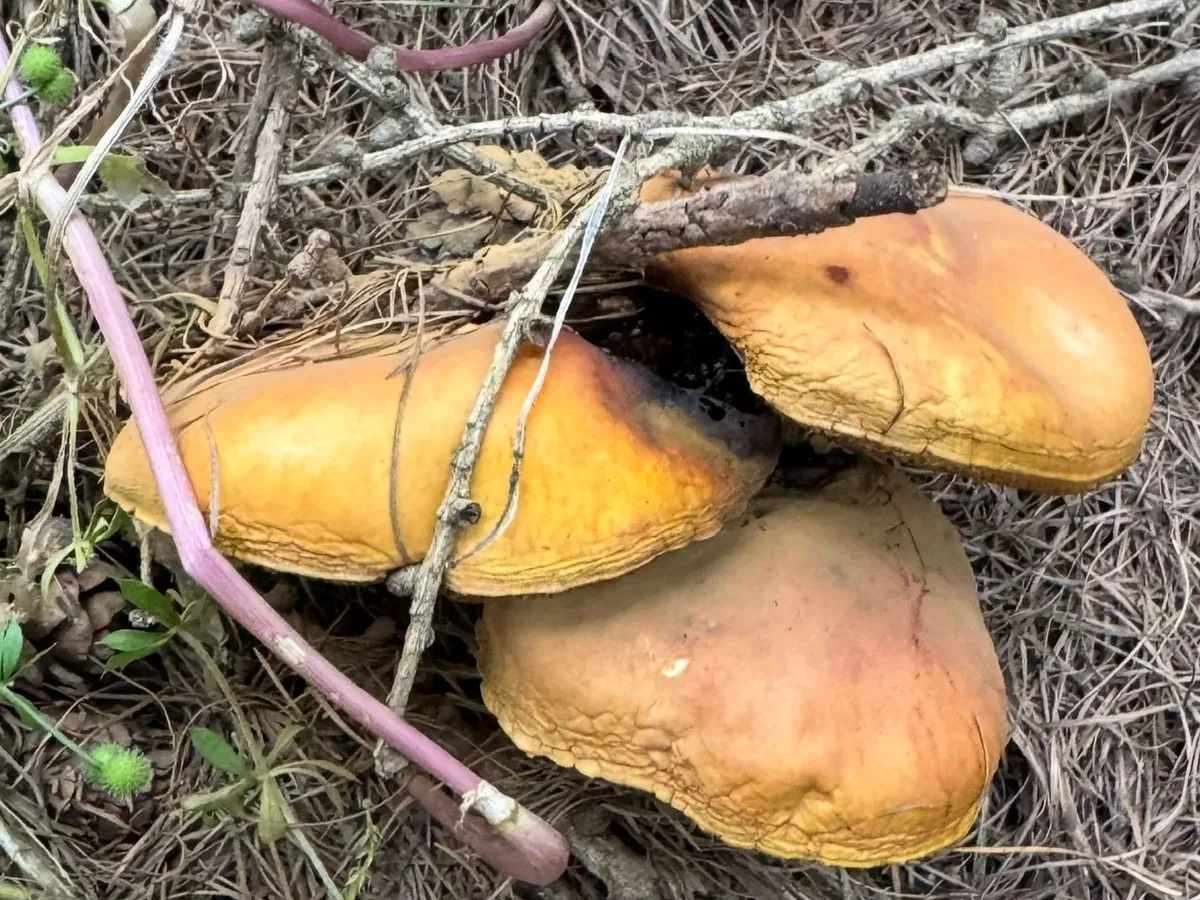 © Frank Ashwood (CC BY)
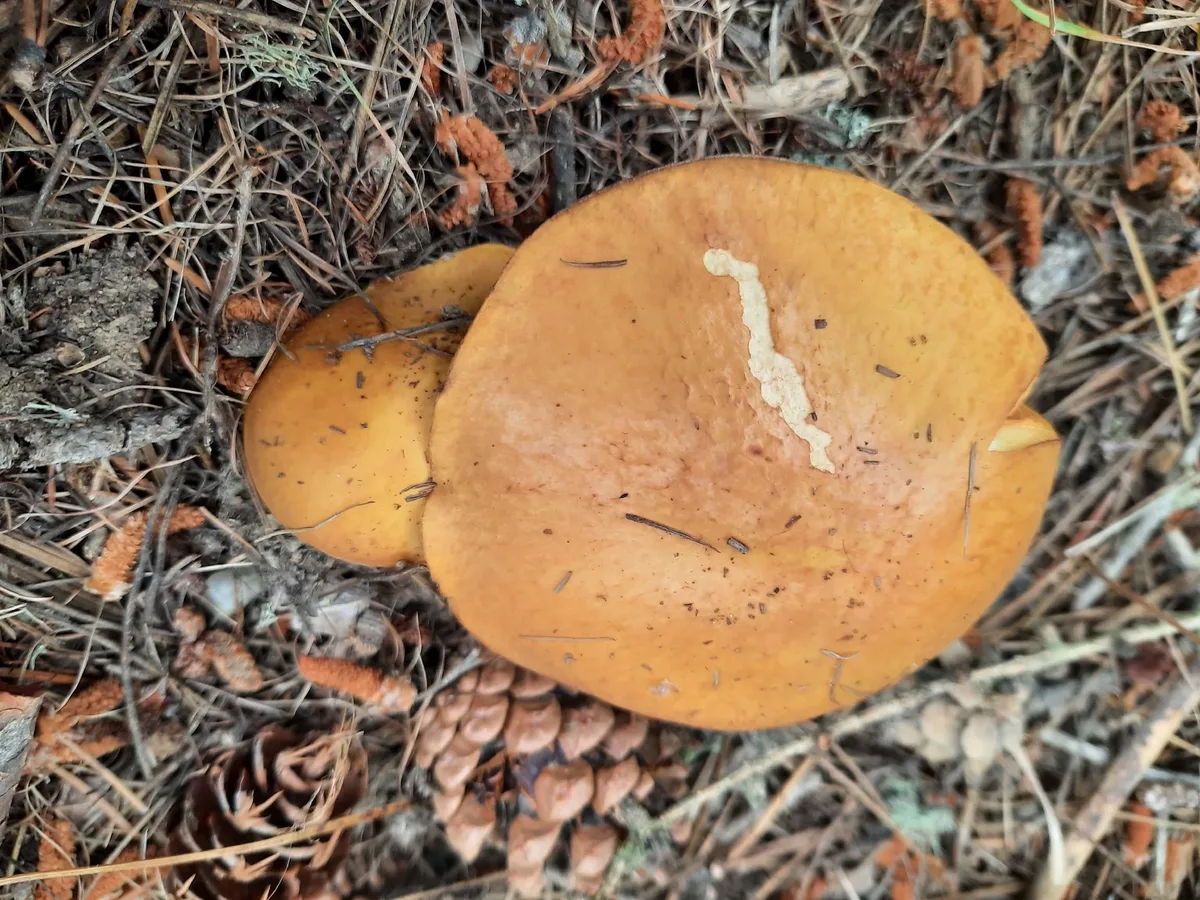 Kirsten Barkla (CC0)
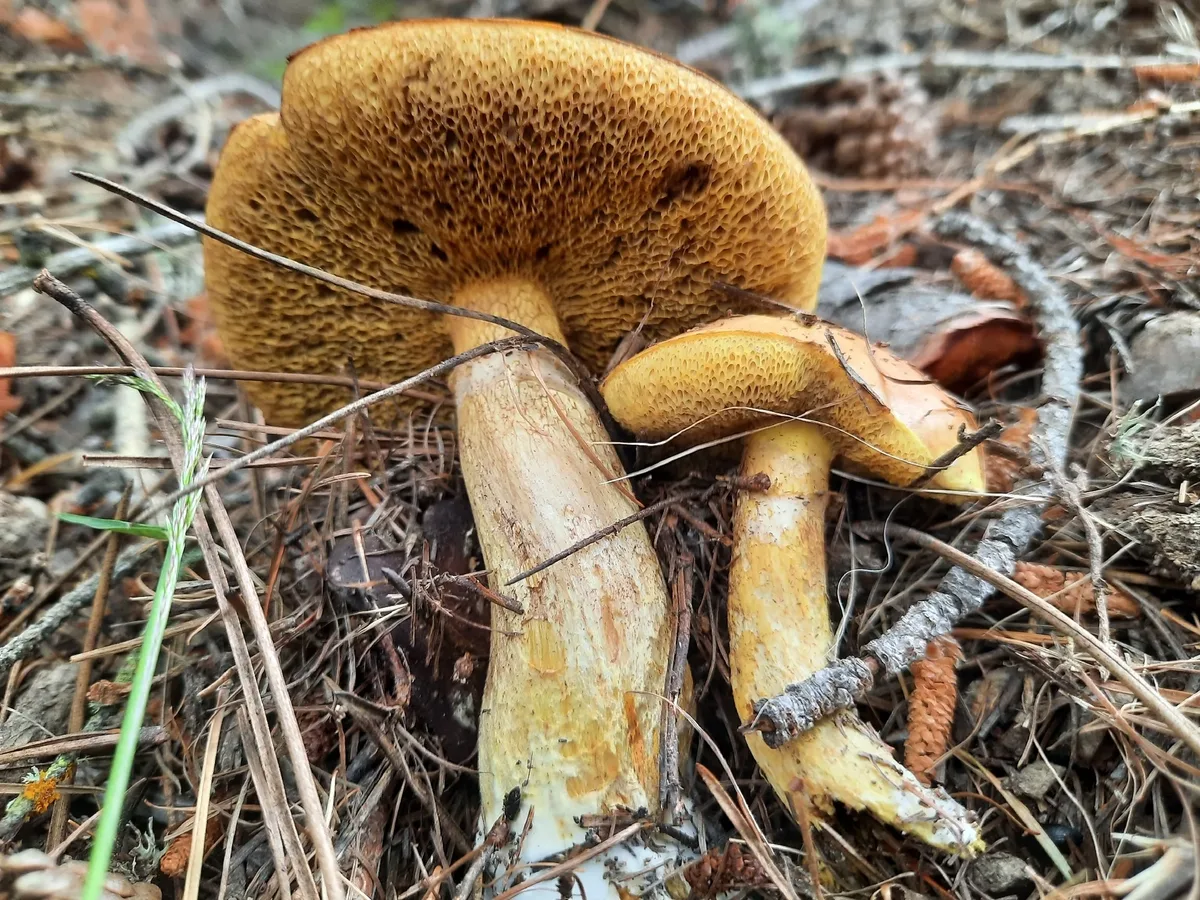 Kirsten Barkla (CC0)
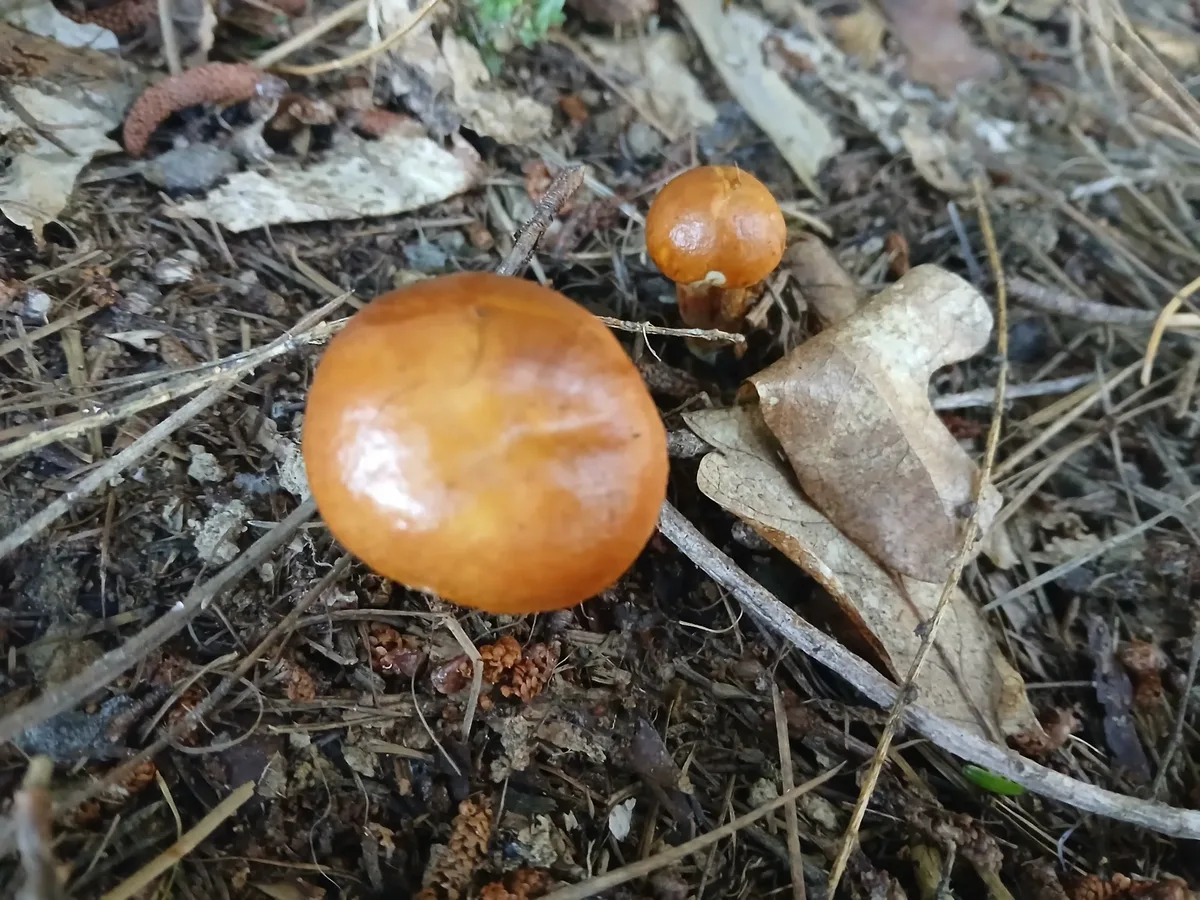 © claire (CC BY)
 © claire (CC BY)
 © John Barkla (CC BY)
 © John Barkla (CC BY)© Frank Ashwood (CC BY)Kirsten Barkla (CC0)
Good to eat, once you have identified it with certainty and cooked it through.
How to recognise it
Few boletes announce themselves as clearly as Suillus grevillei.
Cap
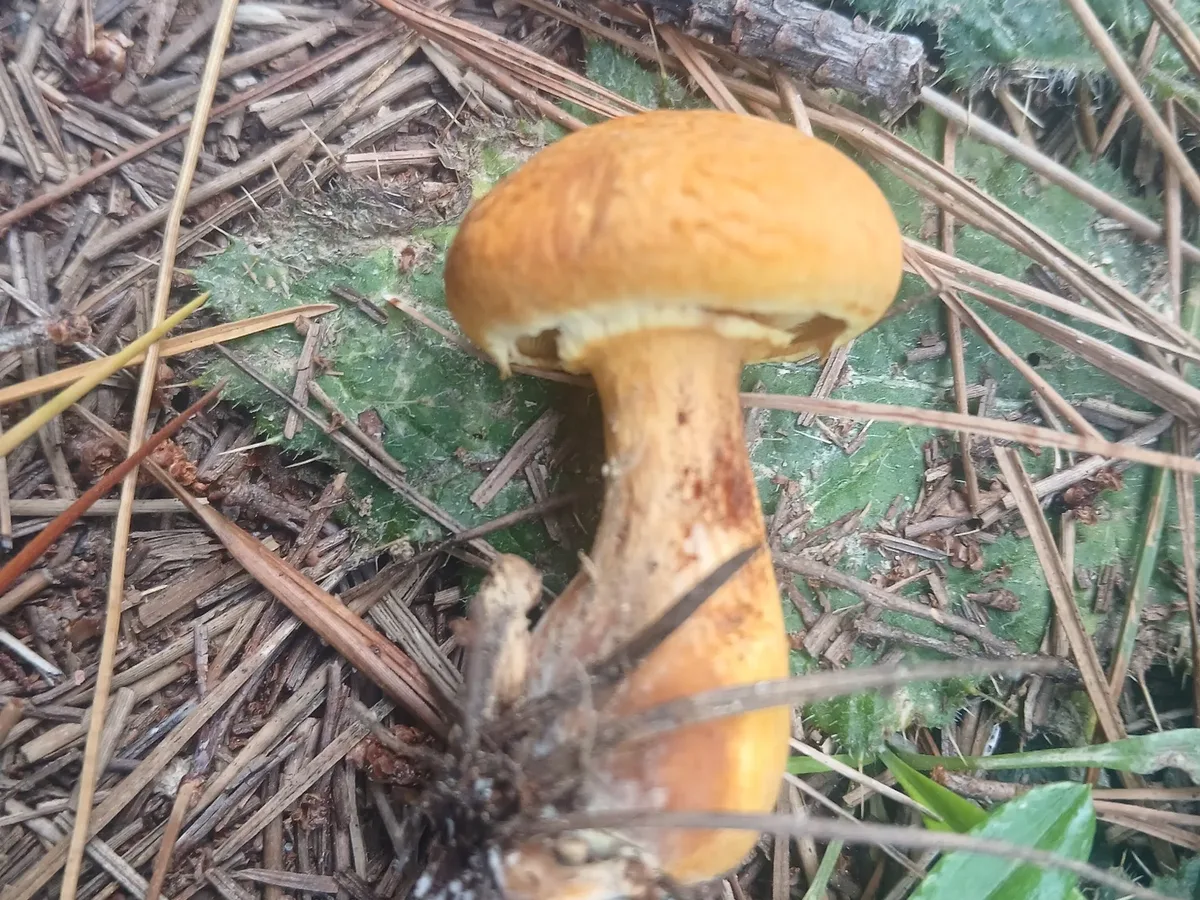
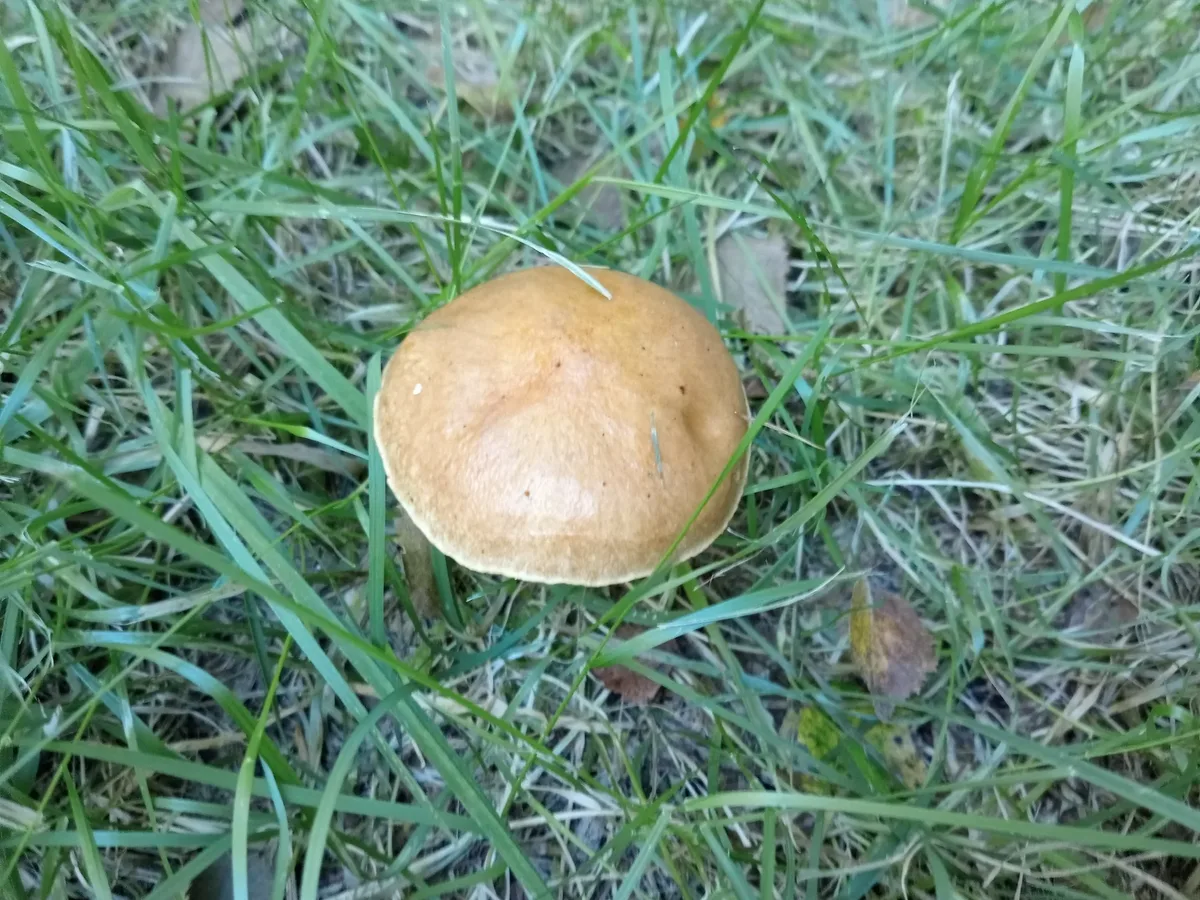
The cap is a warm golden-yellow to tawny-orange, coated in a thick, glistening slime that shines like lacquer in wet weather and dries to a smooth gloss - vivid in young specimens, fading to pale ochre with age.
Gills / Pores
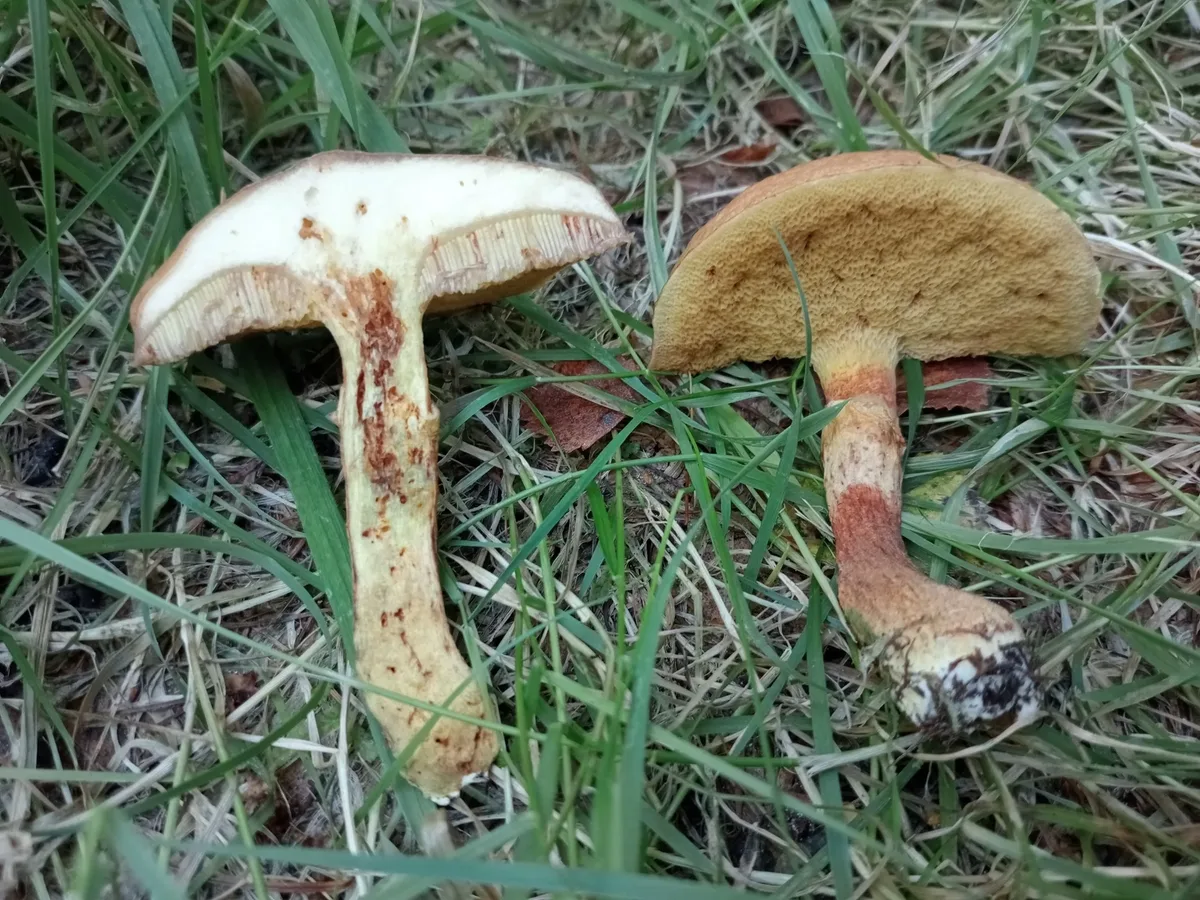
The pores underneath are a matching lemon-yellow, small and neat (1-2 per mm), and they stay yellow when bruised or cut without any trace of blue staining.
Stem
A prominent skirt-like membranous ring is the clinching detail: pale yellow on its upper face, tinged brownish below, initially intact but sometimes fraying or curling back in older fruit bodies.
Flesh
The flesh is pale yellow throughout and firm when fresh, also not bluing on exposure. Spore print is cinnamon-brown.
Where & when it grows
Habitat
An obligate mycorrhizal partner of larches (Larix spp.), the larch bolete will not be found unless a larch is nearby.
In northern and central Europe it colonises ornamental larch plantations as readily as native Alpine stands. It fruits from the duff layer of larch needles, usually within a few metres of the trunk, and often appears in diffuse arcs suggesting a spreading mycelial front.
The mycorrhizal bond means that wherever European or Japanese larch has been introduced worldwide - in parks, windbreaks, or commercial forestry - Suillus grevillei often arrives along with it, either from transported soil or wind-blown spores.
Look for the mushrooms when larch needles are still green in early autumn; fruiting frequently coincides with the first yellowing of the foliage.
When
The larch bolete is primarily an autumn mushroom, but it watches the rain more than the calendar.
The main flush across Scandinavia and the Alps runs late August through October - typically breaking out a week or two after a good soaking when summer heat has finally eased.
In cooler, wetter years or at altitude, fruiting can begin as early as June; a second, smaller wave sometimes appears in June-July at lower elevations.
High-altitude larch zones above 1 500 m may lose their season to frost by late September, while lowland plantations can keep producing into November.
How it grows
Suillus grevillei is a genuine partner to larch, forming mycorrhizal bonds exclusively with Larix species - it simply will not grow without them.
Fruit bodies appear singly or in small scattered groups, sometimes loosely clustered near the base of a single tree, rarely in tight bunches.
Beneath the surface, the mycelium is perennial: the same fungal network can thread through larch roots for decades, returning each autumn as faithfully as the tree itself. Once you find a productive spot, you can revisit it for many consecutive years as long as the host tree stays healthy.
Fruiting gets going when 15 mm or more of rain falls within a 14-day window and soil temperatures sit between 8 °C and 18 °C.
Fruiting conditions
Flushes most reliably when 15 mm or more of rain falls over 14 days and soil temperatures are between 8-18 °C. Peak productivity at soil temperatures of 10-14 °C. Fruiting terminates quickly with first hard frost.
Look-alikes
The key lookalike concern is confusion with other yellow-capped Suillus species:
- Suillus luteus (slippery jack) has a dark brownish-purple ring and white-to-cream flesh that does not smell fruity; it grows exclusively under Pinus (not larch).
- Suillus variegatus lacks a ring entirely and has a dry, granular, ochre-brown cap; it grows under Scots pine.
- Suillus aeruginascens (grey larch bolete) is a pale grey-brown, ring-bearing species sharing the larch habitat but differing in its greyish colouration and greying flesh - also edible.
None of the common lookalikes are dangerously toxic.
- The bluing boletes (Rubroboletus satanas, Neoboletus luridiformis) are excluded immediately because they blue on cutting and have red pore mouths - and crucially they do not grow under larch. Note that R. satanas causes severe gastrointestinal poisoning but is not a confirmed lethal species.
- Chroogomphus rutilus (pine spike) is sometimes found near conifers but has decurrent gills, not tubes.
Suillus grevillei is rarely confused with anything deadly when the ring, yellow pores, and larch association are all verified.
No ring; cap is pale ochre to buff, smooth and slimy but not golden; pores are larger (1-2 mm), compound, and flesh-coloured to buff. Grows under Pinus, not larch.
Shares the larch habitat and a ring on the stem but has a distinctly grey to grey-brown cap and greying flesh; also edible. Colour alone distinguishes it from the bright golden S. grevillei.
Confusion with S. grevillei is not a plausible field scenario: R. satanas is restricted to broadleaf woodland on calcareous soils and will never be found under larch. Morphologically the two are radically different - R. satanas has a white to pale grey cap, blood-red pore mouths, and a red-reticulated stem, while S. grevillei has a slimy golden-yellow cap, yellow pores, and a pale ring; all flesh in R. satanas blues intensely within seconds of cutting, which does not occur in S. grevillei. If any specimen under larch shows red pores or bluing flesh, do not eat it. R. satanas causes severe gastrointestinal poisoning (vomiting, violent diarrhoea, prostration) via the bolesatine glycoprotein but has no verified lethal toxin class and no confirmed human fatalities in the scientific literature.
Immediately excluded by its bright red pore mouths and intense blue staining of all flesh when cut. No ring. Grows under spruce and fir, not exclusively larch.
Suillus luteus has a dark purple-brown to brown ring (not pale yellow), grows exclusively under Pinus (never larch), and has a paler, cream-coloured flesh. The cap is similar in slimy texture and brown-ochre colour but lacks the vivid golden-orange tones of S. grevillei.
Lacks a ring entirely; cap is dry, granular-scurfy, and ochre-brown rather than slimy golden-yellow. Grows under Scots pine, not larch.
In the kitchen
Picking & cleaning
- Cut cleanly at the base with a knife rather than pulling, to avoid disturbing the mycelium.
- Young, firm caps are superior in quality; old specimens become very slimy and unpleasant to handle.
- Peel the slimy cap cuticle before cooking - it slips off easily from fresh material - as the gluten can impart a gluey texture and bitter aftertaste if left on.
- Wipe the stem and remove the ring, which can be bitter.
- Young specimens with firm, pale-yellow flesh are ideal; avoid any that show evidence of maggot tunnelling, which progresses rapidly in warm weather.
- Collect only as many as can be prepared within a day or two, as they deteriorate quickly.
Cooking
The larch bolete has a mild, pleasant flavour - somewhat milder and less complex than the king bolete (Boletus edulis) but agreeable and versatile.
Always peel or scrape away the slimy cap cuticle before cooking; this removes the slippery texture and sharpens the flavour considerably.
- Sliced and sautéed in butter with garlic and parsley, the flesh is tender and slightly nutty.
- It dries well: slice thinly, dry at low heat (40-50 °C) until brittle, and store airtight; reconstituted dried larch boletes make a good addition to soups, risottos, and cream sauces.
- Suitable for pickling in vinegar brine (popular in Eastern European cuisine).
- Young, button-stage specimens can be used whole in stews.
The sticky tubes can become mushy when cooked; some cooks remove them and use only the cap flesh, though this is a matter of preference.
Pairs well with lemon, thyme, sour cream, and game meats.
Good to know
Suillus grevillei is considered safe to eat and has no known deadly lookalikes in its typical larch habitat.
A small minority of individuals experience mild gastrointestinal upset when consuming raw or poorly cooked specimens - always cook thoroughly.
Some people exhibit skin sensitisation (contact dermatitis) from handling the slimy cap cuticle; wearing gloves during preparation is advisable for sensitive individuals.
Peel the gluten layer from the cap before cooking to remove most of the allergen risk and improve flavour.
The ring-bearing stem of Suillus grevillei is an unambiguous character to separate it from the ring-less Suillus bovinus and Suillus variegatus.
When harvesting under larch, no deadly species are likely to be confused with this bolete - but always confirm the following before consuming any Suillus:
- 1the host is larch,
- 2the pores are yellow and do not blue when cut, and
- 3a membranous ring is present on the stem.
A reference guide - never an edibility guarantee. When in doubt, leave it out.