Wine cap
Stropharia rugosoannulatasyn. Pholiota rugosoannulata, Stropharia ferrii, Geophila rugosoannulata
 Max Elysian (CC0)
 © prosperosity (CC BY)
 © prosperosity (CC BY)
 © prosperosity (CC BY)
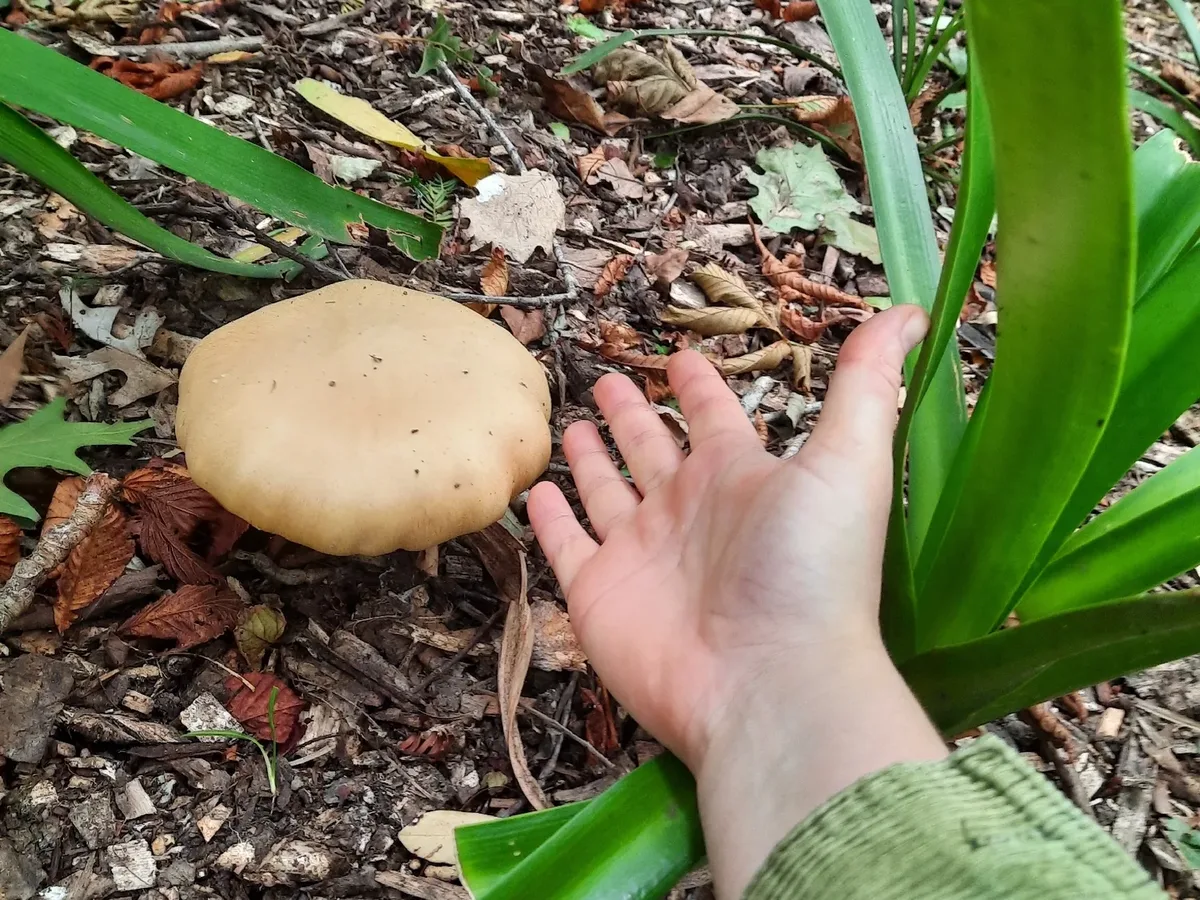 Max Elysian (CC0)
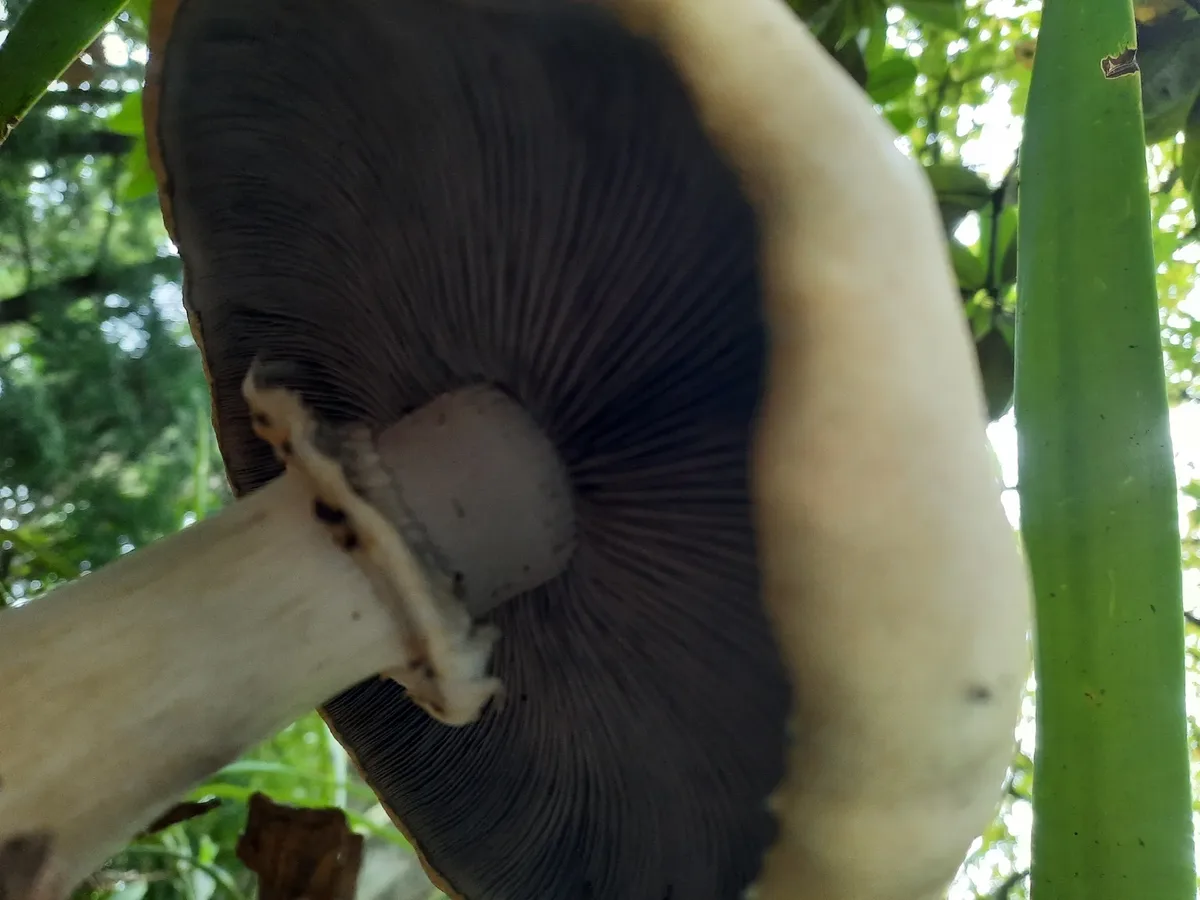 Max Elysian (CC0)
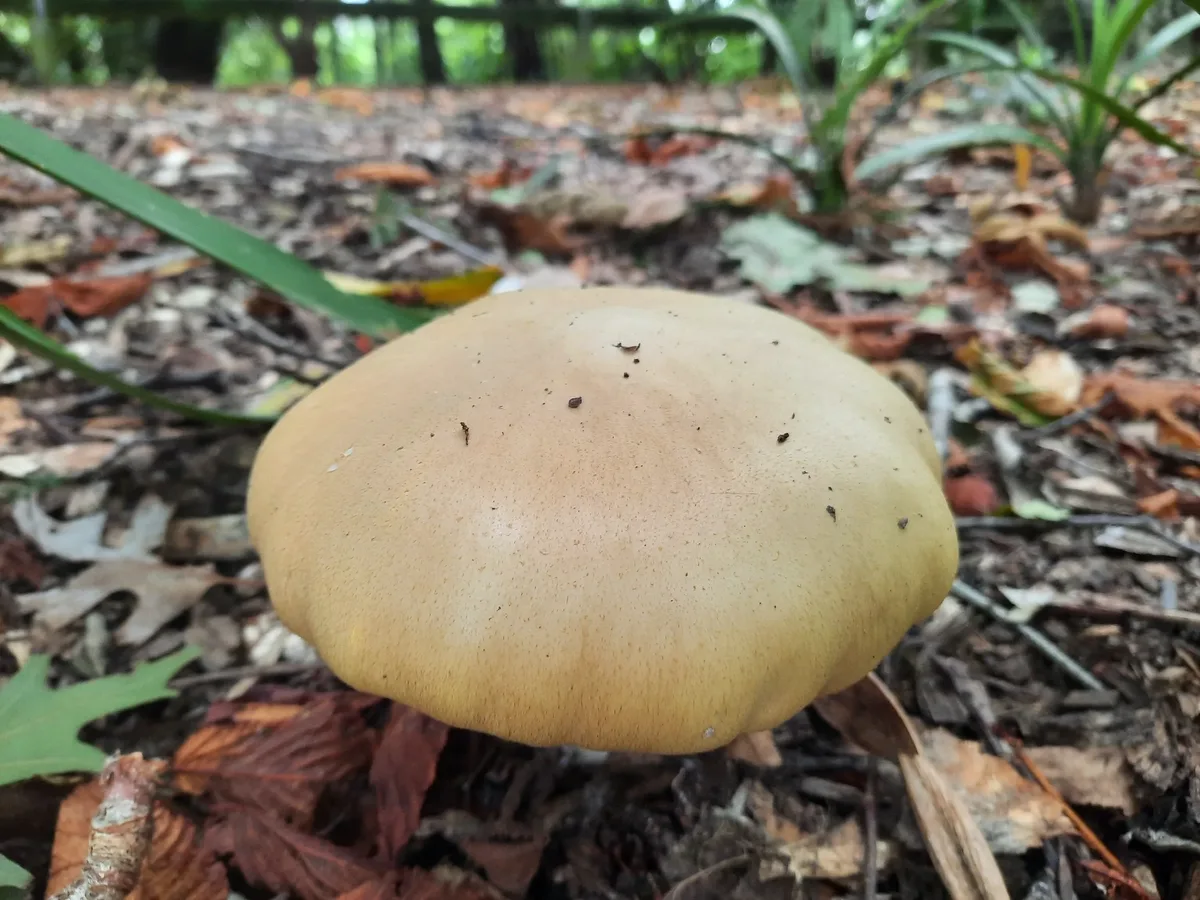 Max Elysian (CC0)Max Elysian (CC0)© prosperosity (CC BY)
One of the best mushrooms you can bring home - once you are certain of the identification.
Never eat a mushroom you are not 100% sure of - check the look-alikes below, and always cook wild mushrooms.
How to recognise it
Stropharia rugosoannulata is one of the largest gilled saprotrophic mushrooms encountered in European and North American gardens and woodchip beds.
Cap
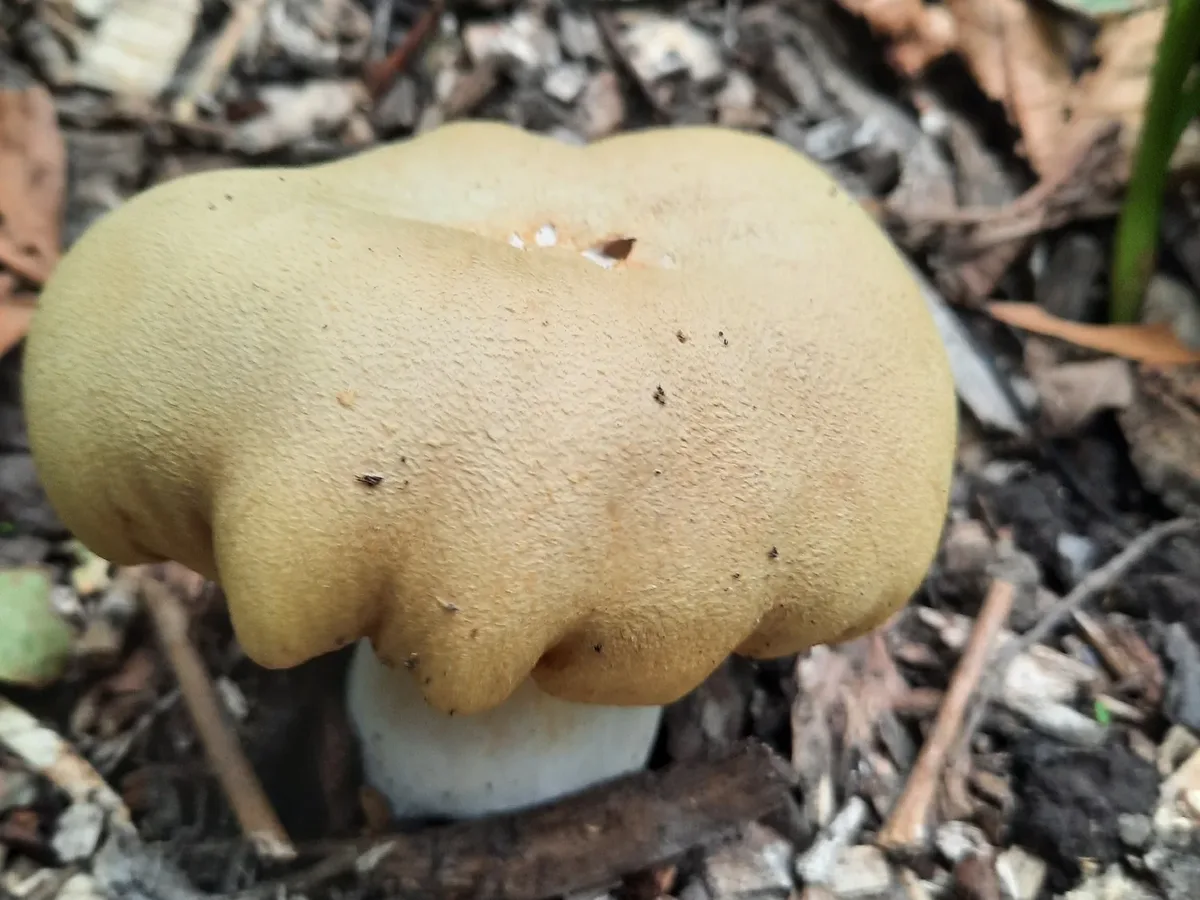
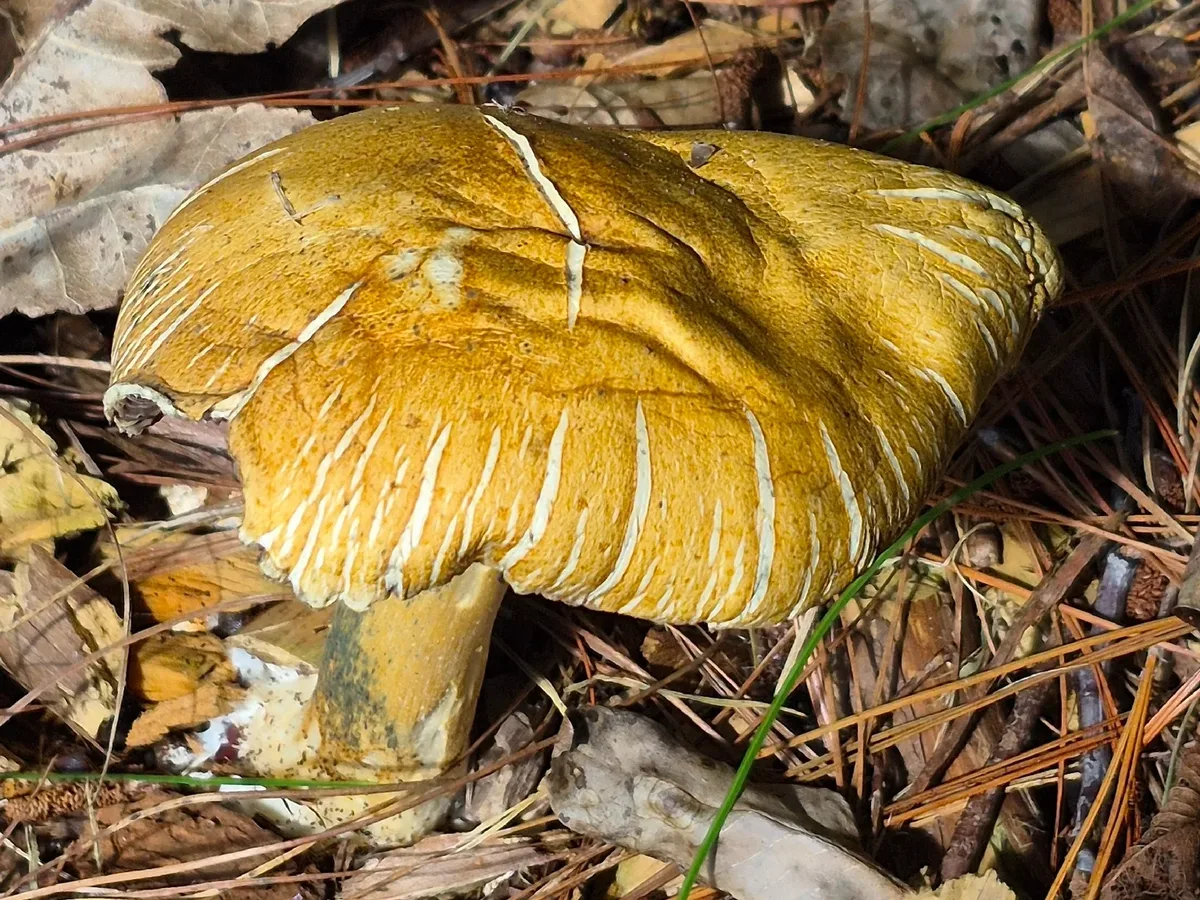
Young caps emerge as tight hemispheres of vivid wine-red to burgundy, often 8-15 cm even at button stage, and the colour is immediately striking. As the cap expands to 30 cm or more it fades progressively from the centre outward to reddish-brown, then tan or pale ochre, though the margin may retain purplish tones longest.
The surface is smooth and slightly viscid after rain; in dry conditions it is matte and can crack finely in very large specimens. The cap margin of immature specimens is draped with white cobweb-like cortinate veil strands that tear free as the cap expands.
Gills / Pores
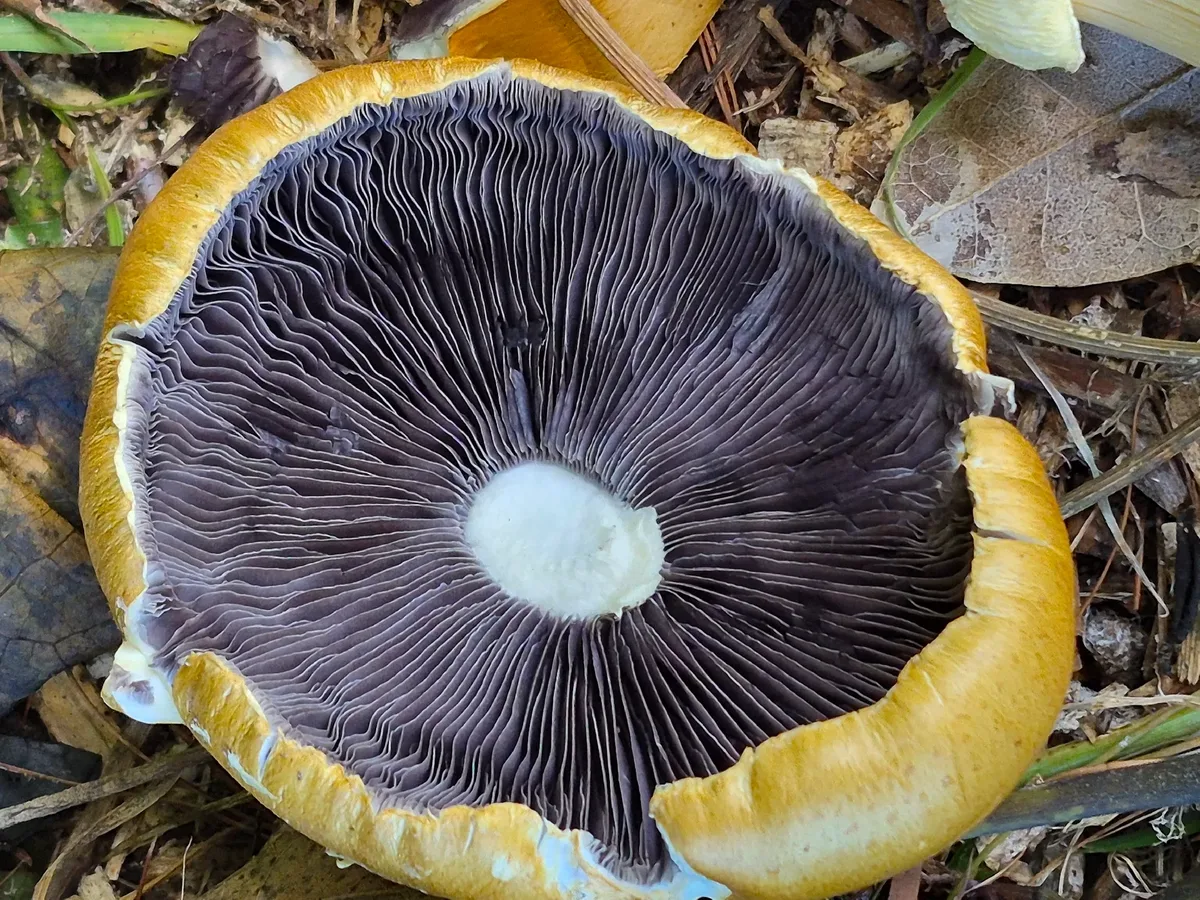
The gills are one of the most reliable diagnostic clues: they begin pale grey - almost lavender-white - and pass through steel-grey to a rich purple-brown as the spores mature.
This progression from pale to dark purple-brown, never truly black, distinguishes S. rugosoannulata from ink caps (which auto-digest) and from Agaricus species (which have free, pink-then-chocolate-brown gills).
Spore print: deep purple-brown to blackish-purple. This dark print distinguishes it from similarly large white-fleshed species such as Agaricus augustus (chocolate brown spore print, free gills, yellowing flesh) and Leucoagaricus species (white or pale pink print).
Stem
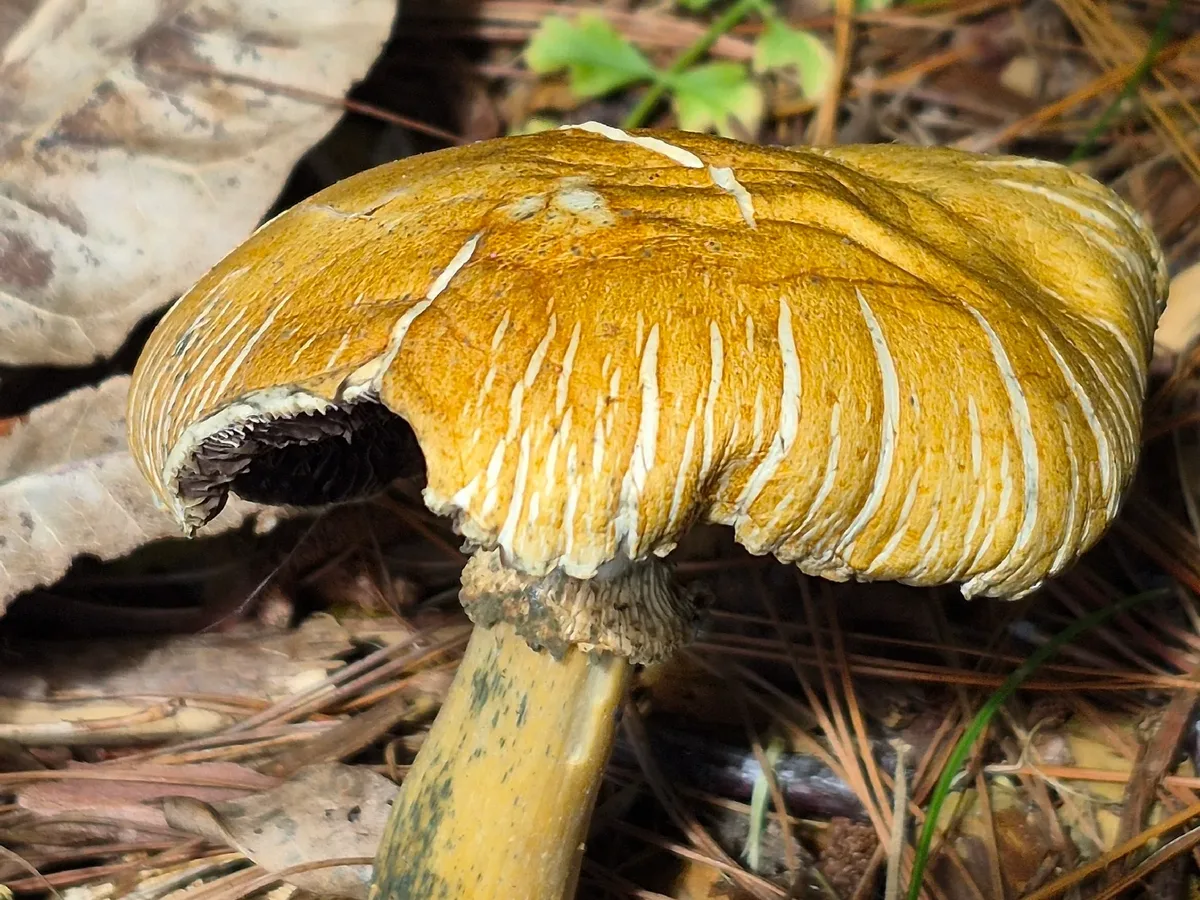
The ring (annulus) is unmistakable once seen: it is large, skirt-like, white above, and the upper surface carries a series of concentric ridges or cog-like teeth - sometimes described as a 'cogwheel' or 'gear-wheel' ring. This striated, double-edged annulus is the single most reliable field mark.
The stem is stout, white, and solid - it does not hollow until very late maturity.
Flesh
The flesh is thick, firm, and white, with a mild pleasant smell, sometimes faintly mealy.
Where & when it grows
Habitat
Stropharia rugosoannulata is a voracious decomposer of straw, wood chips, sawdust, and other lignocellulosic woody debris.
It thrives wherever such material has been deposited:
- Mulched garden beds
- Wood-chip paths
- Compost heaps
- Straw bales
- Park borders
- Roadsides lined with chipped branch wood
- The edges of arable fields
It does not require forest and is conspicuously absent from undisturbed old-growth sites.
It grows as scattered individuals or in loose clusters, never in the dense caespitose clumps of Hypholoma fasciculare, though several fruit bodies may arise from the same buried substrate within a few centimetres of one another.
It tolerates a wide range of soil pH and fertility provided the carbon-rich substrate is moist. It is absent from pure grassland with no woody component.
Because it is easily cultivated, garden finds are increasingly common across central and northern Europe, the Pacific Northwest, and the eastern United States wherever wood-chip mulch has been used. Accidentally introduced populations now persist semi-permanently in many urban parks.
When
In temperate central Europe and the British Isles the first fruit bodies appear from May onward, typically coinciding with warming soils and spring rains. A notable early-summer flush occurs in May-June on freshly laid wood chips.
Fruiting then slows in hot dry July-August weather but resumes strongly with the autumn rains in September-October, often producing the largest and most abundant fruit bodies of the year.
The season extends into November and sometimes December in mild Atlantic-influenced areas.
Heavy frosts terminate fruiting, but individual specimens are remarkably frost-tolerant compared to many other large agarics and may be found stiff but intact after -3 °C nights.
In the Pacific Northwest of North America the season runs from April through November with the autumn peak.
How it grows
Stropharia rugosoannulata is saprotrophic: it feeds entirely on dead organic matter - principally woody cellulose and hemicellulose - and forms no mycorrhizal partnership with trees.
Instead, its mycelium spreads independently through wood chips, straw, or garden mulch, breaking down lignocellulosic material that most organisms cannot digest.
Lift the mulch in an established patch and you may find a dense, bright-white mycelial mat threading through the decomposing wood - evidence of a living network that can quietly colonise a fresh bed within 4-8 weeks at 15-25 °C before producing its first flush 2-4 weeks later.
Once a bed is colonised it may continue fruiting annually for 2-4 years as the substrate is gradually consumed. Individual fruit bodies grow fast and large: caps of 25-30 cm and stems of 15 cm are not unusual on a rich substrate.
The fungus will also spread of its own accord - wood-chip paths in parks sometimes carry established populations that arrived from a nearby planting, the mycelium threading quietly into fresh material.
Fruiting conditions
Fruiting triggered by moist conditions combined with moderate temperatures; optimal substrate temperature 15-22 °C. Fruiting slows markedly above 24 °C soil temperature and ceases in hot dry conditions. Resumes reliably with cooler autumn rains. On cultivated wood-chip beds, overhead irrigation can initiate flushes during dry spells.
Look-alikes
Despite its distinctive appearance, several species could superficially resemble Stropharia rugosoannulata, and foragers should examine the cogwheel ring, gill colour progression, and spore print carefully before collecting.
- Hypholoma sublateritium (brick cap): reddish-brown caps but much smaller (3-8 cm), grows in dense caespitose clumps directly from dead wood stumps, lacks the gear-wheel ring, has yellowish gills that darken to olive-brown - not purple. Bitter taste. No confusion in practice with care.
- Hypholoma fasciculare (sulphur tuft): sulphur-yellow cap with brick tones, densely tufted on wood, green-olive to purple-brown gills, acridly bitter. Much smaller and yellow-toned. Toxic - causes serious gastrointestinal illness. No serious confusion risk with S. rugosoannulata given the colour and habitat differences.
- Agaricus augustus (the prince): large, reddish-brown scaly cap, anise/almond smell, flesh yellows when cut, free gills pink then chocolate-brown, chocolate-brown spore print. No ring with cogwheel ridges. Edible and good.
- Agaricus campestris and related species: field habitats, free gills, pink then brown, chocolate spore print, flesh may yellow slightly. None have the cogwheel ring or purple-brown gill colour.
- Cortinarius species (webcaps): DEADLY DANGER. Some larger Cortinarius have reddish-brown caps and rusty spore prints, but they are mycorrhizal (found under trees), have a cortina (spiderweb veil) rather than a solid ring, and their spore print is rusty-brown, not purple-brown. Several webcap species - including Cortinarius rubellus and C. orellanus - contain the nephrotoxin orellanine and are lethally toxic, causing irreversible kidney failure that may not manifest until weeks after ingestion. Always confirm the cogwheel ring, the purple-brown (not rusty-brown) spore print, and the wood-chip or straw substrate - webcaps grow under trees, never on wood-chip mulch away from trees.
- Pholiota squarrosa (shaggy scalycap): scaly cap, grows in dense clusters on wood, tawny with recurved scales, ring present but not cogwheel-ridged, rusty-brown spore print. Can cause gastrointestinal upset.
The cogwheel ring + deep wine-red cap fading to tan + purple-brown spore print + wood-chip/straw substrate combination is essentially unique to S. rugosoannulata.
DEADLY. Some large Cortinarius have reddish-brown caps but are found under trees (mycorrhizal habitat), have a spiderweb cortina rather than a solid cogwheel-ridged ring, and a rusty-brown (not purple-brown) spore print. Species such as C. rubellus and C. orellanus contain the nephrotoxin orellanine and can cause fatal kidney failure weeks after ingestion. Decisive checks: cogwheel ring (not cortina), purple-brown spore print, wood-chip or straw substrate (not forest floor under trees).
Much smaller (3-8 cm cap), grows in dense caespitose clusters directly on dead wood stumps, lacks the cogwheel-ridged ring, gills yellowish to olive-brown (not purple-brown), bitter taste.
Grows in open grassland, cap white to pale buff, gills free and bright pink when young then chocolate-brown, chocolate-brown spore print, no cogwheel ring, flesh may flush faintly pink when cut.
Cap and stem covered in stiff recurved scales, grows in dense clusters at tree bases, ring present but without cogwheel ridges, spore print rusty-brown not purple-brown, garlicky or rancid smell. Causes gastrointestinal upset.
Sulphur-yellow cap with brick-red centre, densely tufted on decaying wood, gills greenish-yellow to olive-purple, intensely bitter taste. Toxic - causes serious gastrointestinal illness. No cogwheel ring; much smaller and yellower than wine cap.
Cap covered in reddish-brown fibrous scales, flesh yellows distinctly when cut, strong anise/almond smell, gills free (not attached), chocolate-brown spore print (not purple-brown), no cogwheel ring.
In the kitchen
Picking & cleaning
Harvest when the cap is still convex to broadly umbonate and the gills are still pale grey or just beginning to darken - the cap veil may just be tearing or still partly intact. At this stage the flesh is firmest and flavour is best.
Fully expanded flat caps with deep purple-brown gills are still edible but have a coarser texture and more intense, sometimes slightly peppery taste; the very oldest flat specimens with fully blackened spore deposits under the cap may be mushy and less pleasant.
Cut at the base with a knife rather than pulling, so as not to disturb the underlying mycelium. Brush clean; the cap surface is smooth and easy to wipe. Young buttons beneath the mulch can be found by gently probing the substrate.
The mushrooms store well in the refrigerator for 4-5 days. They do not dry as elegantly as boletes but can be sliced and dehydrated successfully at low temperature.
Cooking
The wine cap is a genuinely high-quality edible with firm, meaty flesh that holds up well to most cooking methods. Flavour is mild, pleasant, faintly earthy and nutty - somewhat reminiscent of a good white button mushroom but more complex.
Young buttons with fully closed veils have the most delicate flavour and are excellent sliced and sautéed in butter with garlic and fresh herbs. Always cook thoroughly; raw consumption in quantity is not advisable.
Larger expanded caps are better for hearty preparations:
- Slice thick and grill over high heat until golden.
- Use in risottos, pasta sauces, soups, and stews.
- Marinate and roast whole.
The flesh does not discolour or blacken dramatically when cut. It pairs well with white wine, cream, shallots, and robust herbs such as thyme and rosemary.
For drying: slice 5 mm thick and dehydrate at 45 °C; the dried product rehydrates well and intensifies in flavour. The caps can also be pickled in brine or vinegar for long-term storage.
Good to know
Stropharia rugosoannulata has an excellent safety record and is widely eaten across Europe, North America and East Asia. There are no documented deaths attributed to this species.
Rare reports of mild gastrointestinal upset in sensitive individuals exist, but these are anecdotal and may reflect very old or poorly stored specimens.
The species does not contain amatoxins, orellanine, or gyromitrin. It is not advised to eat it raw in large quantities - thorough cooking is always recommended.
The main practical safety concern is confident identification, with particular attention to excluding Cortinarius (webcap) species, which include lethally toxic members. The decisive checks are:
- 1Confirm the distinctive cogwheel-ridged ring on the upper surface - Cortinarius species have a silky cobweb cortina, not a solid skirt-ring.
- 2Confirm the purple-brown (not rusty-brown) spore print.
- 3Confirm the substrate is wood chips, straw, or garden mulch - not beneath trees.
Never collect specimens growing in mycorrhizal forest settings and assume they are wine caps.
Additionally, collect only from uncontaminated substrates: wood chips near roadsides treated with herbicides or near industrial sites may accumulate contaminants in the flesh.
A reference guide - never an edibility guarantee. When in doubt, leave it out.