Verdigris roundhead
Stropharia aeruginosasyn. Agaricus aeruginosus Curtis, Geophila aeruginosa (Curtis) Quél., Psilocybe aeruginosa (Curtis) Noordel.
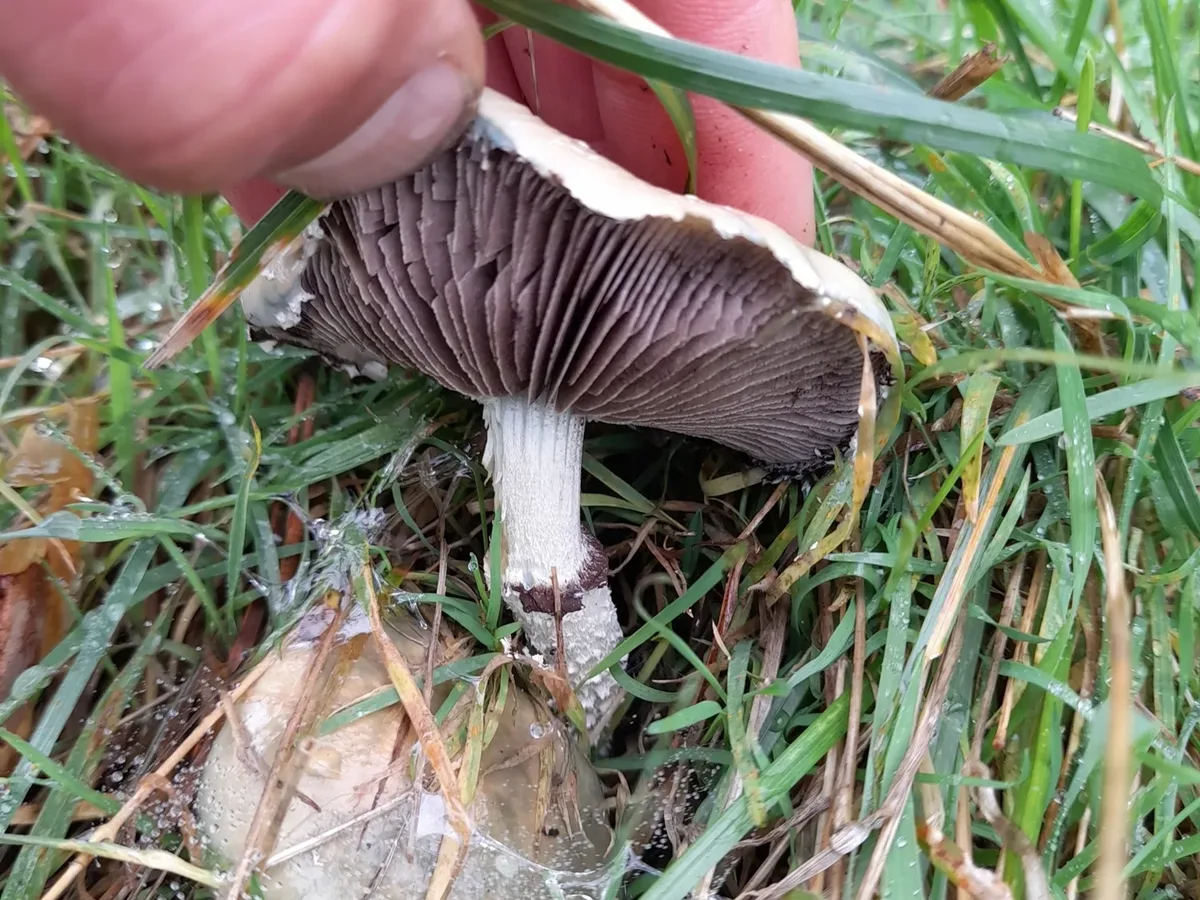 © Slaven Kljucanin (CC BY)
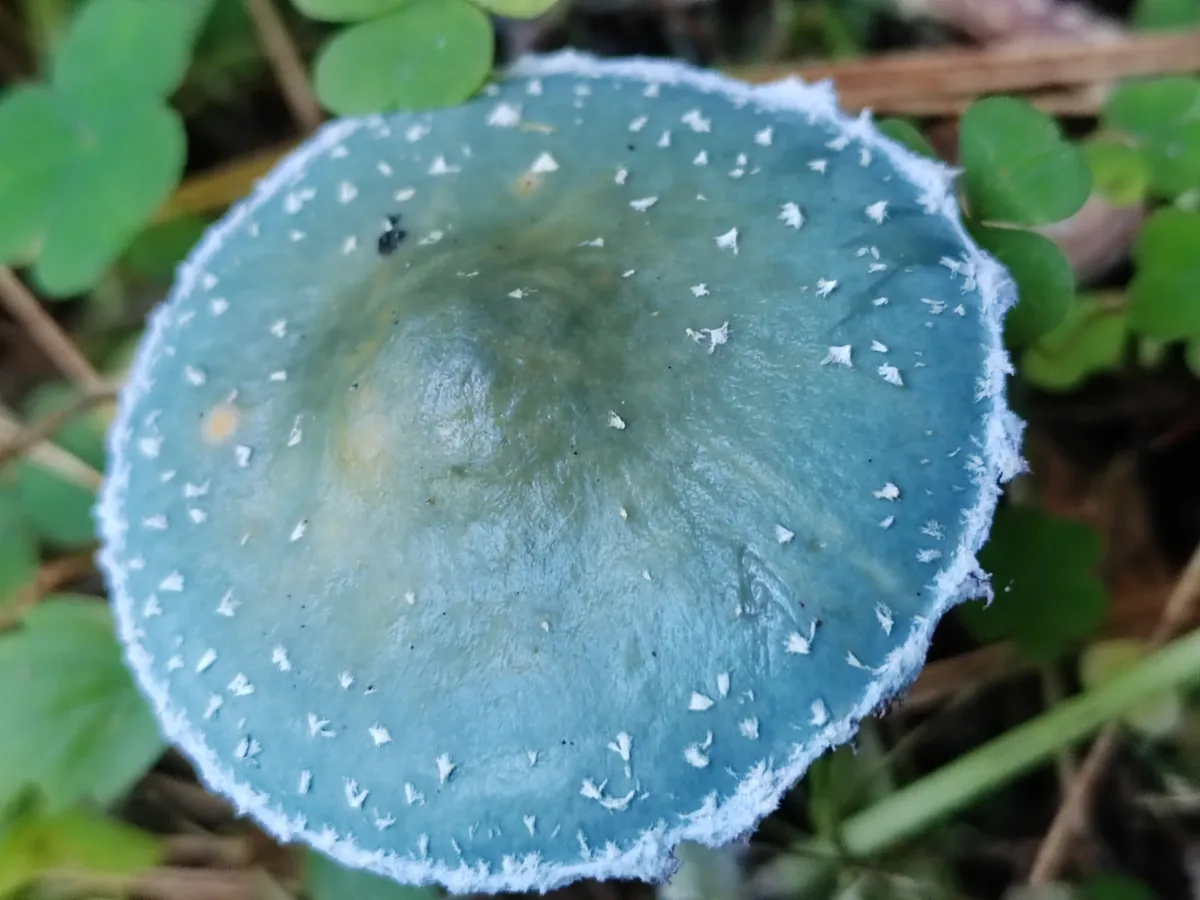 © Виктория Билоус (CC BY)
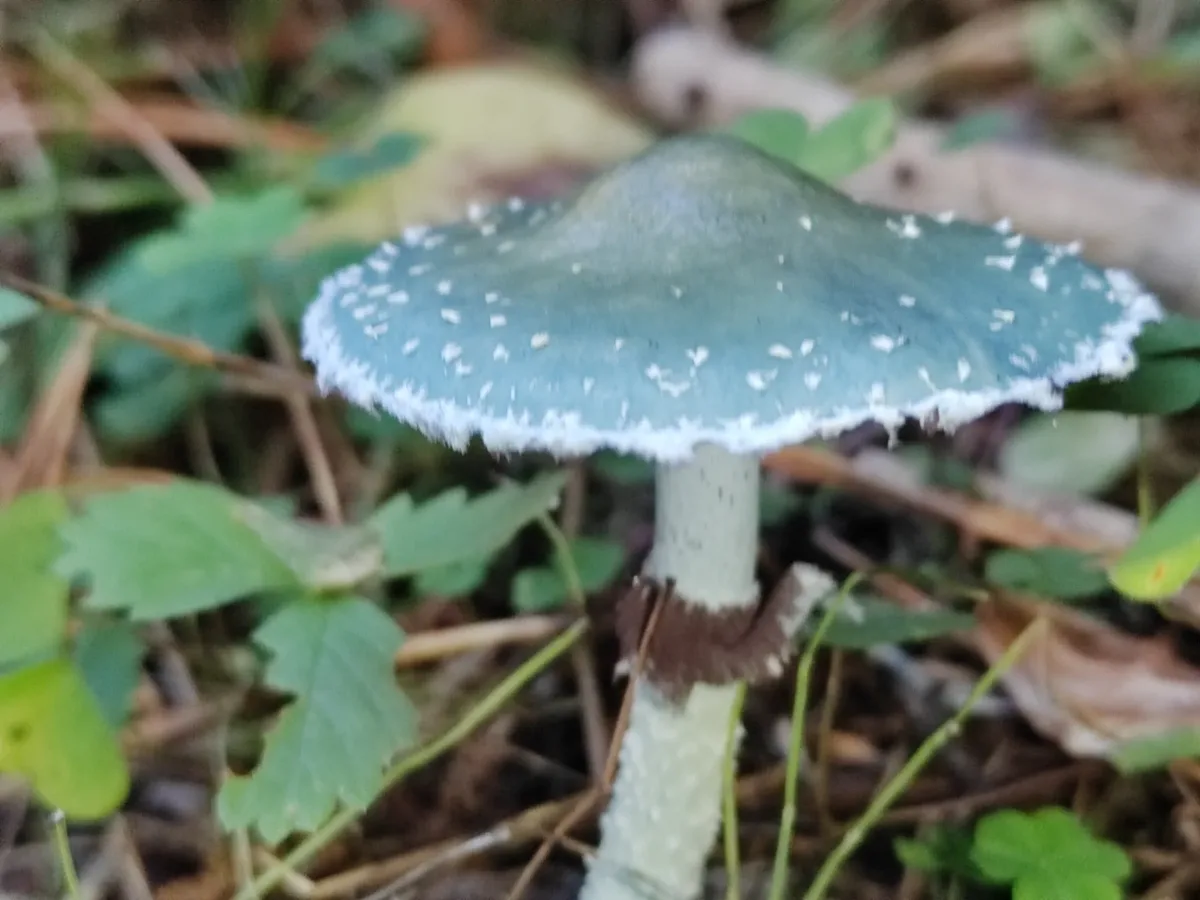 © Виктория Билоус (CC BY)
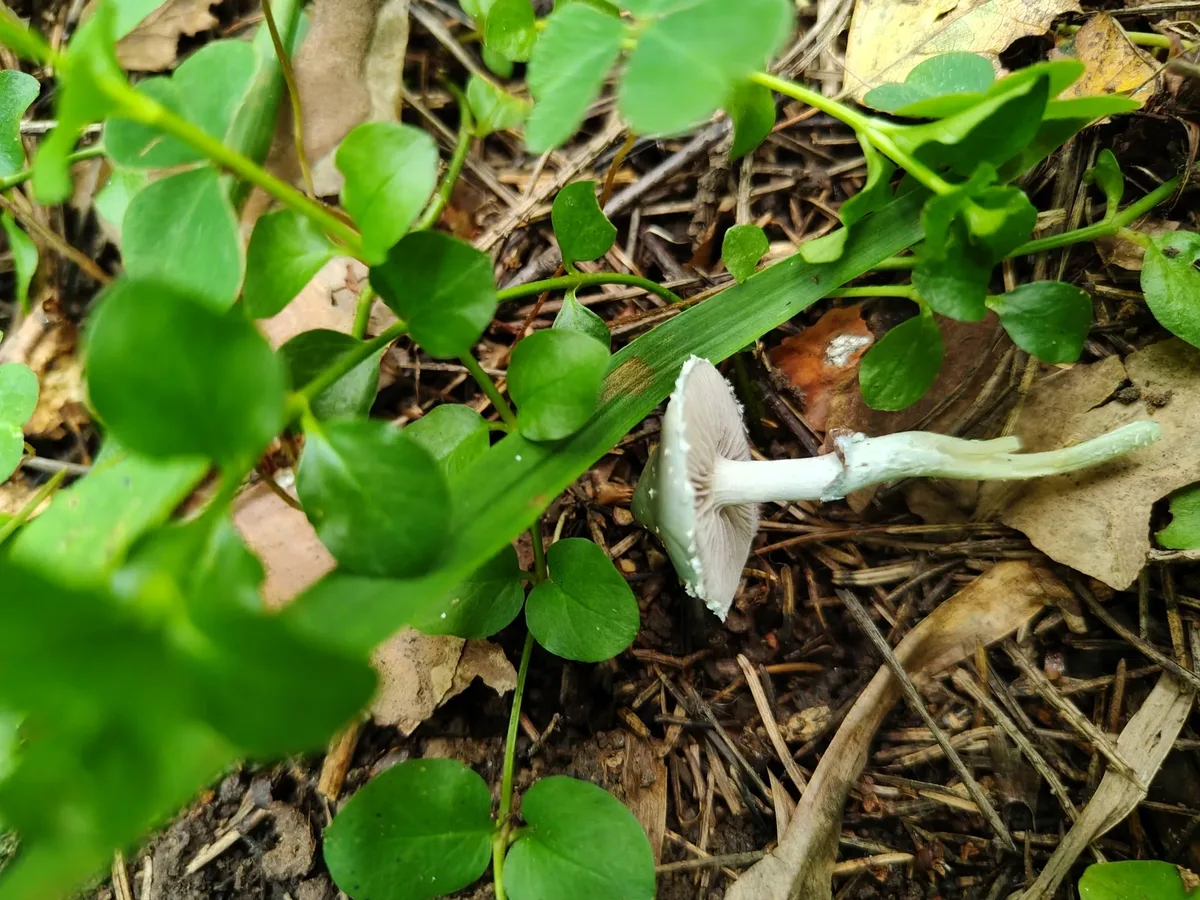 Сергей (CC0)
 Сергей (CC0)
 Сергей (CC0)
 Ossi Laaksamo (CC0)
 © Slaven Kljucanin (CC BY)© Slaven Kljucanin (CC BY)© Виктория Билоус (CC BY)
Edible only with the right preparation - or safe for some people but not others. Learn the caveats first.
Never eat a mushroom you are not 100% sure of - check the look-alikes below, and always cook wild mushrooms.
How to recognise it
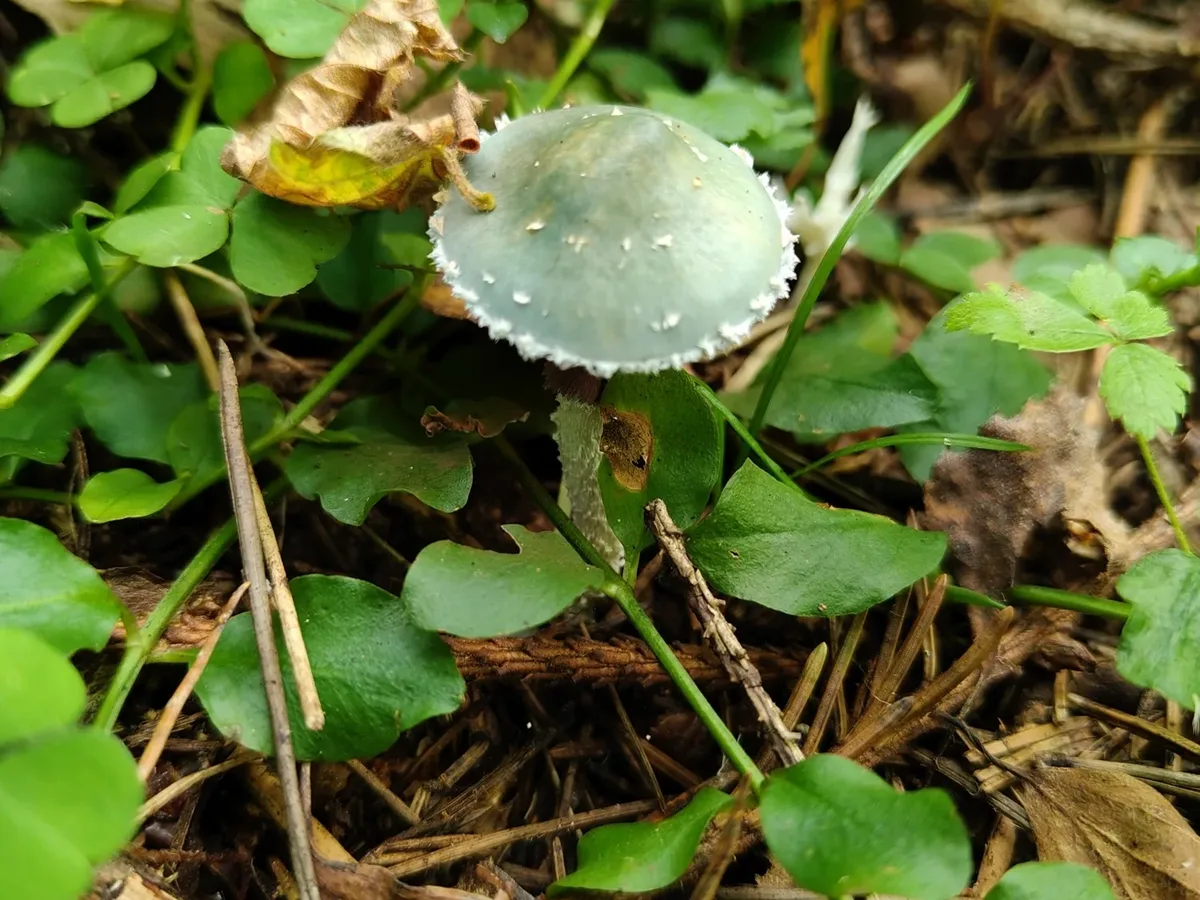
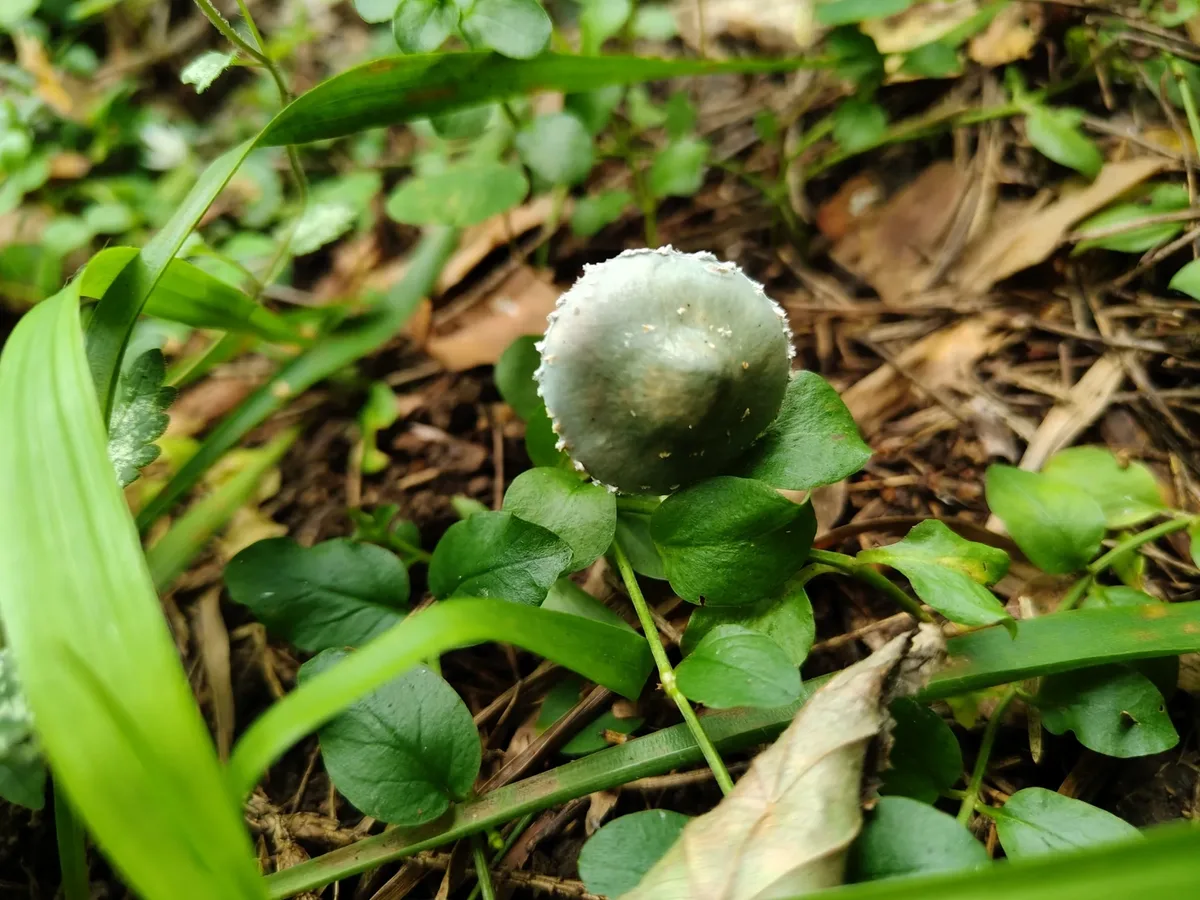
Stropharia aeruginosa is one of the most immediately recognisable mushrooms in the European flora, its fresh cap a startling shade of blue-green or verdigris - the same coppery-green patina that gives the species its name.
Cap
The cap reaches 3-8 cm across, initially convex and dome-shaped, expanding to broadly umbonate or almost flat in full maturity. The surface is covered by a prominent gelatinous pellicle that makes fresh caps extremely viscid and slimy; this sliminess is a key field character.
The blue-green pigment is concentrated in the cuticle and fades markedly from the cap centre outward as the fruit body ages or dries, so older specimens can appear yellow-ochre or pale straw, retaining blue-green only near the margin.
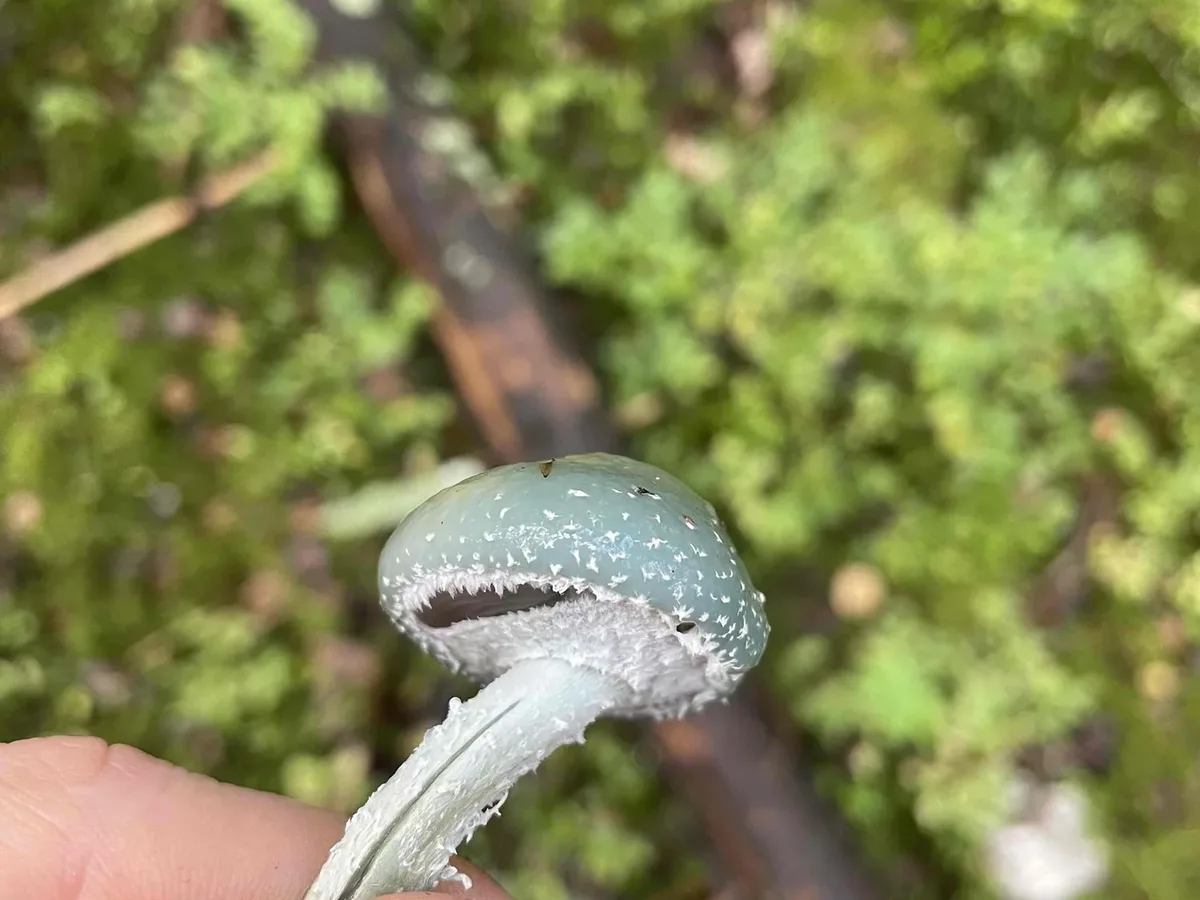
The cap margin is characteristically decorated with hanging white cottony or fibrillose veil fragments in young specimens; these are easily lost to rain and abrasion.
Gills
The gills run from pale greyish-lilac in young specimens to a deep purple-brown as the spore crop matures, with fine whitish gill edges.
The spore print is dark purple-brown, an important character distinguishing it from greenish-capped Amanita species. Microscopically, spores are ellipsoid, 8-11 × 5-6 µm, thick-walled, with a distinct germ pore.
Stem
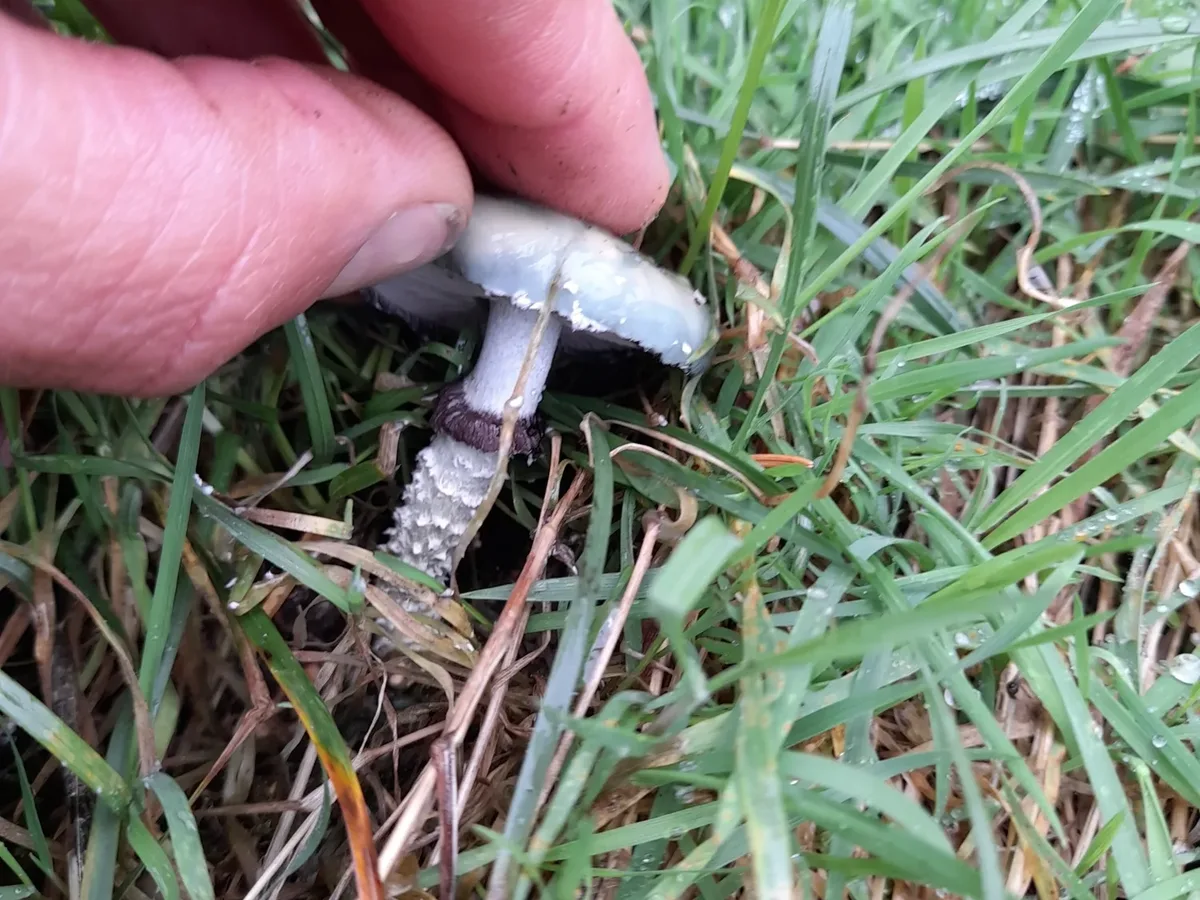
The stem is 4-9 cm tall, initially white with a faint blue-green flush, and below the ring it bears a distinctive coating of whitish to blue-green shaggy scales arranged in rings or zones - a feature that survives better than the margin veil.
The ring is membranous, drooping, persistent, and typically striate on its upper surface; it often accumulates fallen spores, turning dark purple-brown on top.
Flesh
The flesh throughout is white or faintly tinged blue-green and does not blue or stain dramatically on cutting.
Why it's dangerous
Moderate. Not typically life-threatening in healthy adults, but can cause significant gastrointestinal distress.
Vulnerable individuals (children, elderly, those with compromised liver or kidney function) warrant medical evaluation. Do not eat.
Toxin
GI-irritant compounds, nature not fully resolved.
Traces of psilocybin and/or psilocin were reported in some European collections but disputed by later analyses. The primary clinical effect is gastrointestinal irritation.
Symptoms
Nausea, vomiting, abdominal pain, and diarrhoea within 30 minutes to 3 hours of ingestion. Symptoms are generally self-limiting and resolve within 12-24 hours.
Neurological symptoms (disorientation, visual changes) have been reported anecdotally but are not consistently documented.
Staying safe
Stropharia aeruginosa is considered toxic to mildly poisonous and should not be eaten. Symptoms following ingestion include nausea, vomiting, abdominal cramps, and diarrhoea of varying severity (gastrointestinal syndrome).
Some older sources cite traces of psychoactive compounds (psilocybin, psilocin) in certain collections from Europe, though this remains disputed; the primary clinical presentations documented are gastrointestinal in nature and not reliably psychotropic. The toxins are not fully characterised.
Because the blue-green colour fades significantly with age or dry weather, experienced foragers may encounter bleached specimens that look more like edible Stropharia rugosoannulata (wine cap / garden giant) - a safe edible. But S. rugosoannulata is considerably larger, lacks the gelatinous pellicle, and grows predominantly in garden compost or wood chips rather than in wild woodland.
Never eat any Stropharia species without absolute species-level certainty. Wash hands after handling.
Where & when it grows
Habitat
Stropharia aeruginosa is a saprotrophic decomposer of lignocellulosic material in various states of decay. It thrives wherever organic matter accumulates in moist, sheltered conditions:
- woodland edges, hedgerows, roadsides with woody debris
- compost and woodchip mulch in gardens, parks, and allotments
- nutrient-rich grassland borders
- the margins of paths through deciduous or mixed forest
It is not mycorrhizal and has no obligate tree association, though it frequently fruits near broadleaf trees simply because of the leaf and twig litter they provide.
Urban environments suit it well; it is a frequent colonist of garden beds freshly mulched with wood chips or bark. It prefers slightly acidic to neutral, humus-rich, moisture-retentive soils, and often fruits in loose troops or small clusters on or very near buried decaying wood or dung-enriched substrate.
When
In central-western Europe the verdigris roundhead fruits from June or July through to November, though the main flush is concentrated in September and October when soil temperatures cool after the first autumn rains.
Extended warm autumns can push fruiting into early November. In exceptionally wet summers scattered fruit bodies may appear as early as May. The species is absent from frost-hardened ground.
How it grows
Saprotrophic - it breaks down dead plant material rather than forming partnerships with living trees. The mycelium threads invisibly through decaying wood, straw, compost, dung-enriched soil, or wood-chip mulch, sometimes for weeks or months before conditions prompt it to fruit.
Fruit bodies emerge singly, scattered, or in small gregarious clusters of 2-8, occasionally arranging into loose rings or arcs where the underground mycelium has spread outward.
The blue-green pigment is concentrated in the cap's cuticular layers and fades on exposure to air and UV light. That is why a flush that looked vivid blue-green after a rainy morning can appear yellowed and ordinary by the afternoon.
Fruiting conditions
Fruiting triggered by cooling autumn temperatures combined with adequate soil moisture; mulched and compost-rich substrates retain moisture and can produce fruit bodies earlier and later in the season than open woodland sites
Look-alikes
Several species must be carefully distinguished from Stropharia aeruginosa.
Stropharia caerulea (blue roundhead) is the most frequent confusion species and was long lumped with S. aeruginosa. It has a similar blue-green cap but lacks the prominent cottony veil scales on the cap margin and along the stem, tends toward less vivid blue tones, and has a differently structured ring. The two share toxicity status.
Stropharia pseudocyanea is smaller and paler, found in grassy habitats.
Amanita phalloides (death cap) in very young button stage could theoretically cause alarm in a novice, but its cap is olive-green to yellow-green, lacks the gelatinous pellicle and white fibrillose margin veil, and has free gills, a volva at the base, and a white spore print - all utterly different from S. aeruginosa.
Some Cortinarius species (webcaps) with bluish or greenish tints superficially resemble the cap colour. Critically, several Cortinarius - including C. rubellus and C. orellanus - are lethally toxic, containing the nephrotoxin orellanine which causes irreversible kidney failure. Cortinarius species are distinguished by a cobwebby cortina (not a solid membranous ring), a rusty-brown spore print (not dark purple-brown), and mycorrhizal habit under trees on forest floors rather than on mulched or dung-rich substrate.
Hypholoma fasciculare (sulphur tuft) grows in dense clusters on wood, has a yellow cap, lacks the blue-green colour, and has no gelatinous pellicle.
Pholiota species can share the glutinous cap and woodland substrate but are typically yellow-brown to orange-brown without any blue-green pigment.
The combination of slimy blue-green cap + persistent striate ring + scaly stem below ring + dark purple-brown spore print is collectively diagnostic for S. aeruginosa in the broad sense.
DEADLY. Some Cortinarius with bluish or greenish tints can superficially resemble the cap colour of aged S. aeruginosa; C. rubellus and C. orellanus contain the nephrotoxin orellanine causing fatal kidney failure with delayed onset (days to weeks). Distinguished by cobwebby cortina (not a solid membranous ring), rusty-brown spore print (not dark purple-brown), and mycorrhizal habitat strictly under trees on forest floors - never on wood-chip mulch or compost. Always confirm the solid striate ring and dark purple-brown spore print of S. aeruginosa
Olive-green cap in mature form, but early button stage could confuse a very inexperienced observer; A. phalloides has free white gills (not adnate), a white spore print (not dark purple-brown), a basal volva (cup or sack at the soil surface), and no gelatinous pellicle or fibrillose veil remnants on the margin - completely different in all key features
Some Cortinarius have blue or greenish-blue tints (e.g. C. caerulescens, C. violaceus); distinguished by cobwebby cortina (not a membranous ring), rusty-brown spore print (not dark purple-brown), and typically in drier woodland rather than mulched or dung-rich soil. The genus contains several lethally toxic species - never rely solely on cap colour
Very similar blue-green cap but lacks the prominent white cottony fibrillose veil remnants on the cap margin and the shaggy scale zones on the stem below the ring; ring less prominently striate; similarly toxic - the distinction matters for taxonomy but not for edibility (both are avoided)
Smaller, more pallid blue-green cap (quickly fading to whitish), found in grassy meadows and dunes rather than woodland; stem less scaly; similar cautionary status
Grows in dense tufts on wood stumps; cap yellow to orange-brown, never blue-green; no gelatinous pellicle; gills initially sulphur-yellow before darkening; bitter taste
Much larger (cap 5-20 cm), wine-red to reddish-brown cap (no blue-green), lacks gelatinous pellicle, robust double ring with cog-tooth edge, grows in compost/wood chips in gardens; this is a choice edible so correct separation is important
A reference guide - never an edibility guarantee. When in doubt, leave it out.