Confused old man of the woods
Strobilomyces confusussyn. Strobilomyces confusus Singer, Strobilomyces tomentosus (Velen.) Sing., Strobilomyces strobilaceus var. confusus
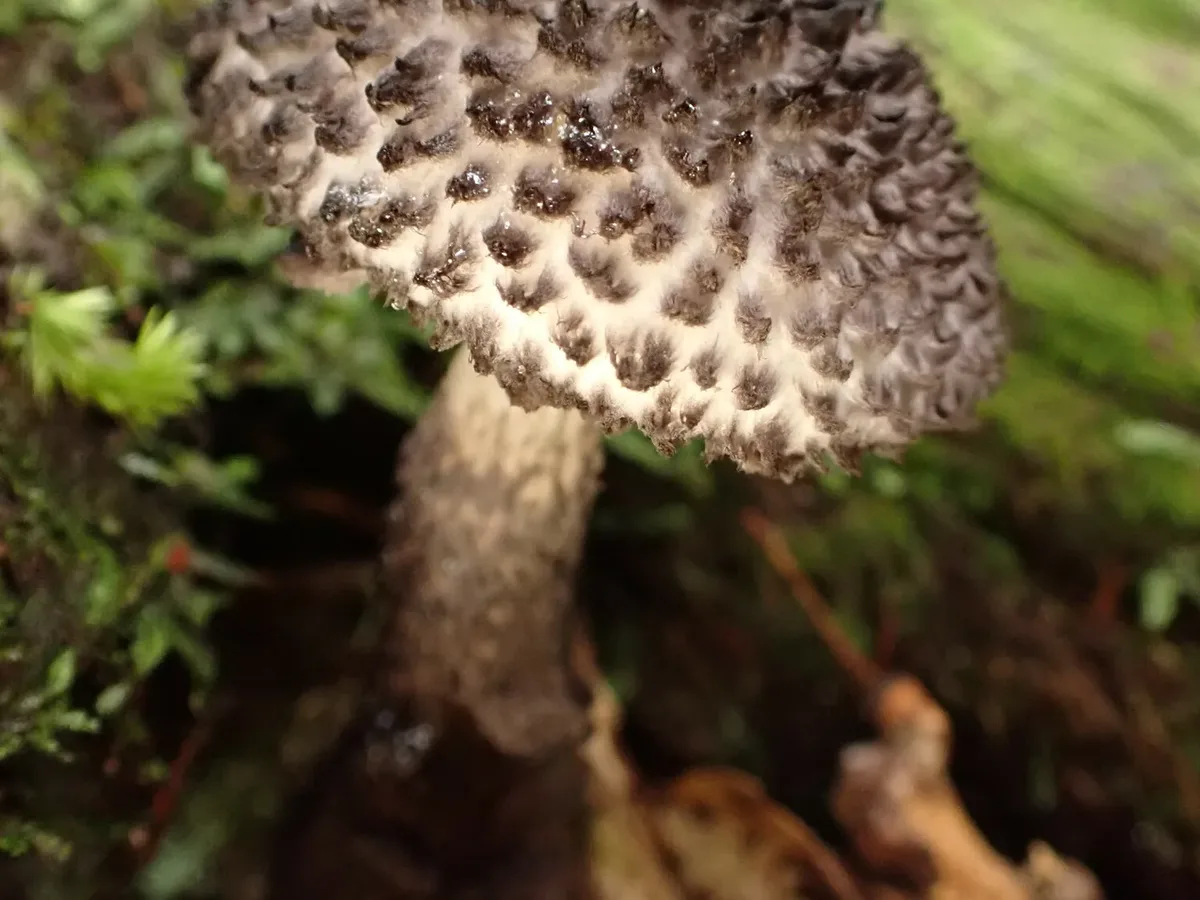 © 呂一起(Lyu yi-chi) (CC BY)
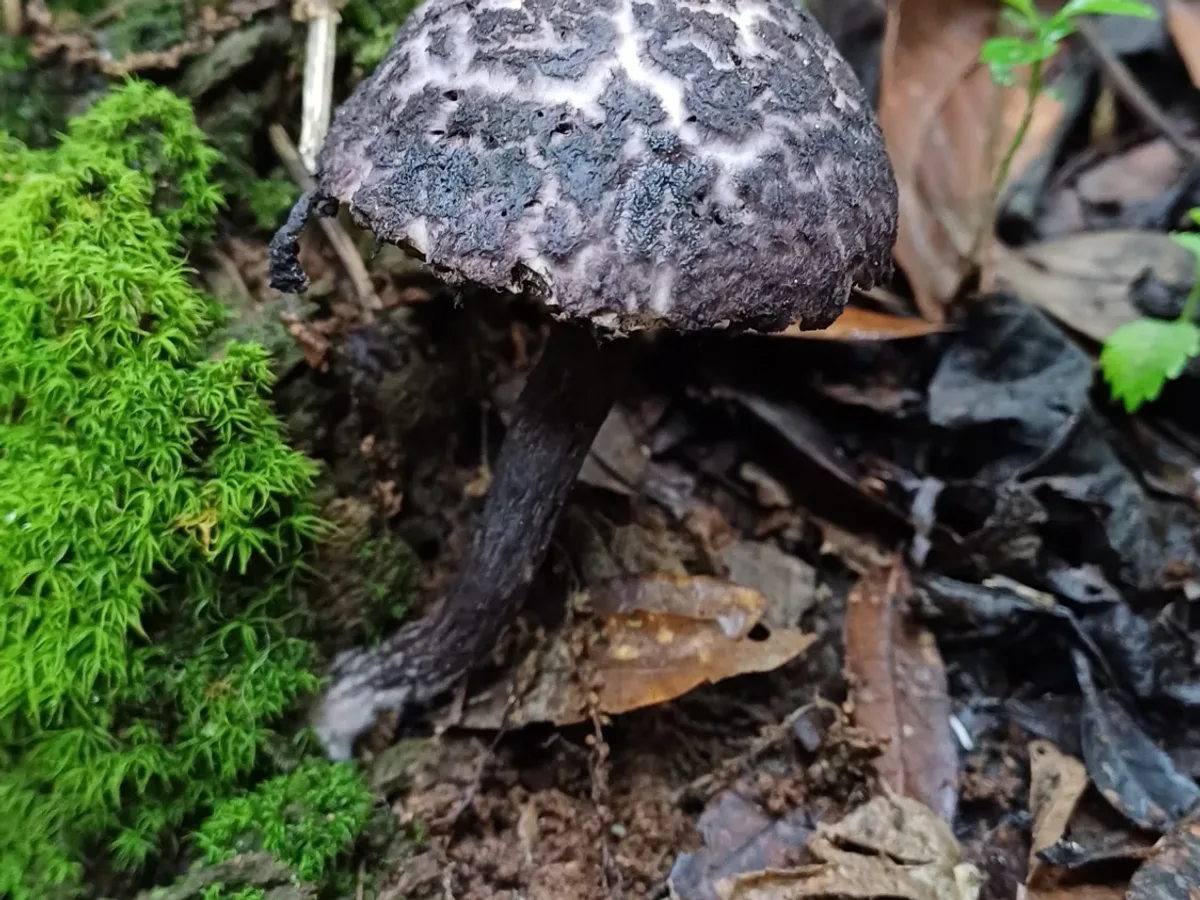 © Andrey Loria (CC BY)
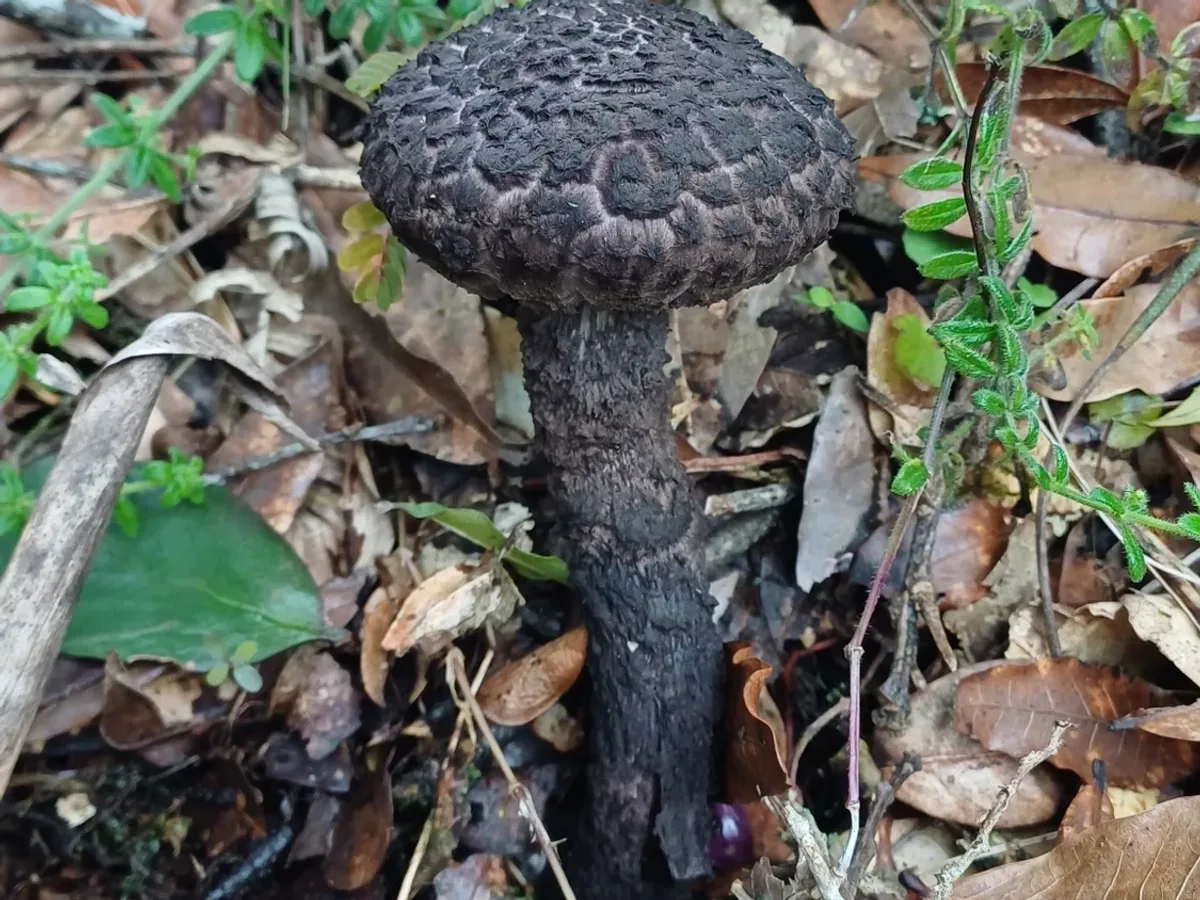 © Andrey Loria (CC BY)
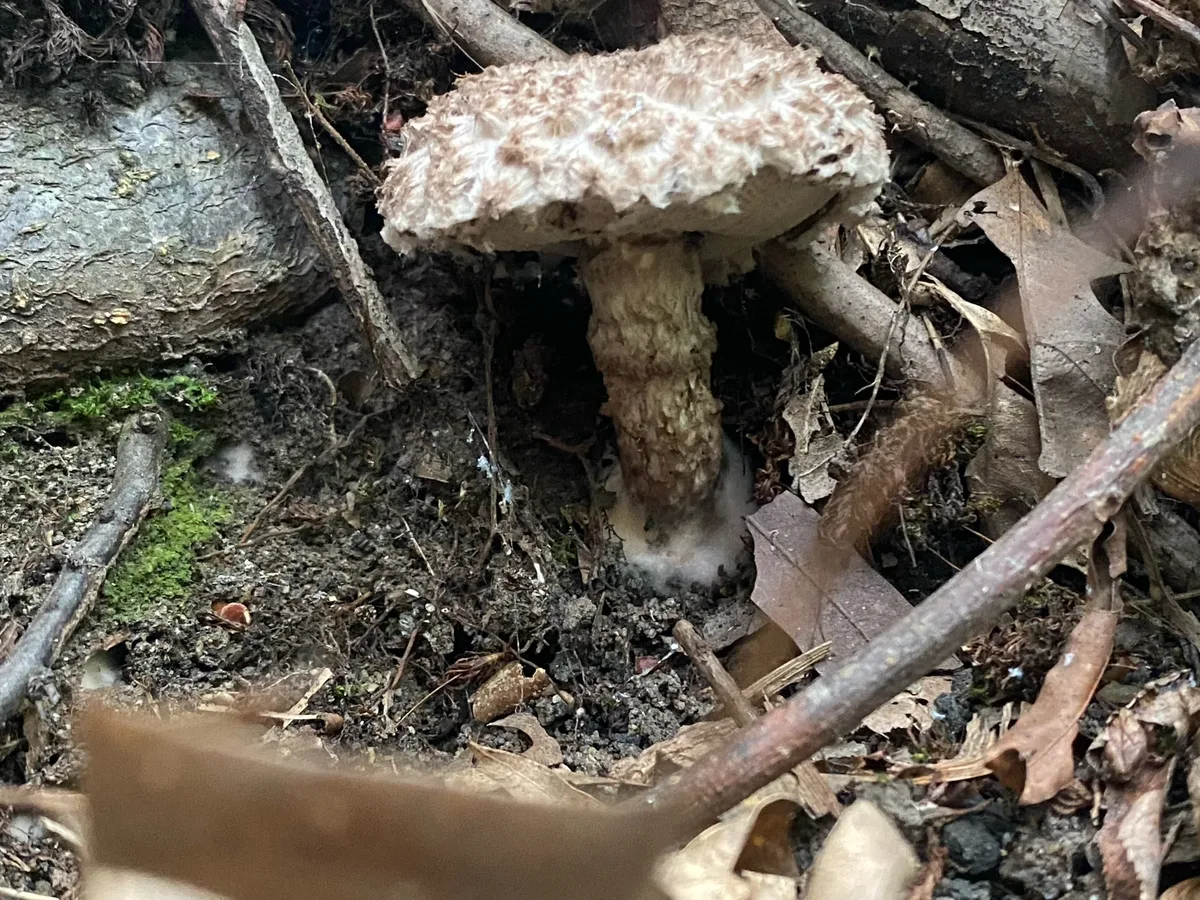 Aubrey Inkster (CC0)
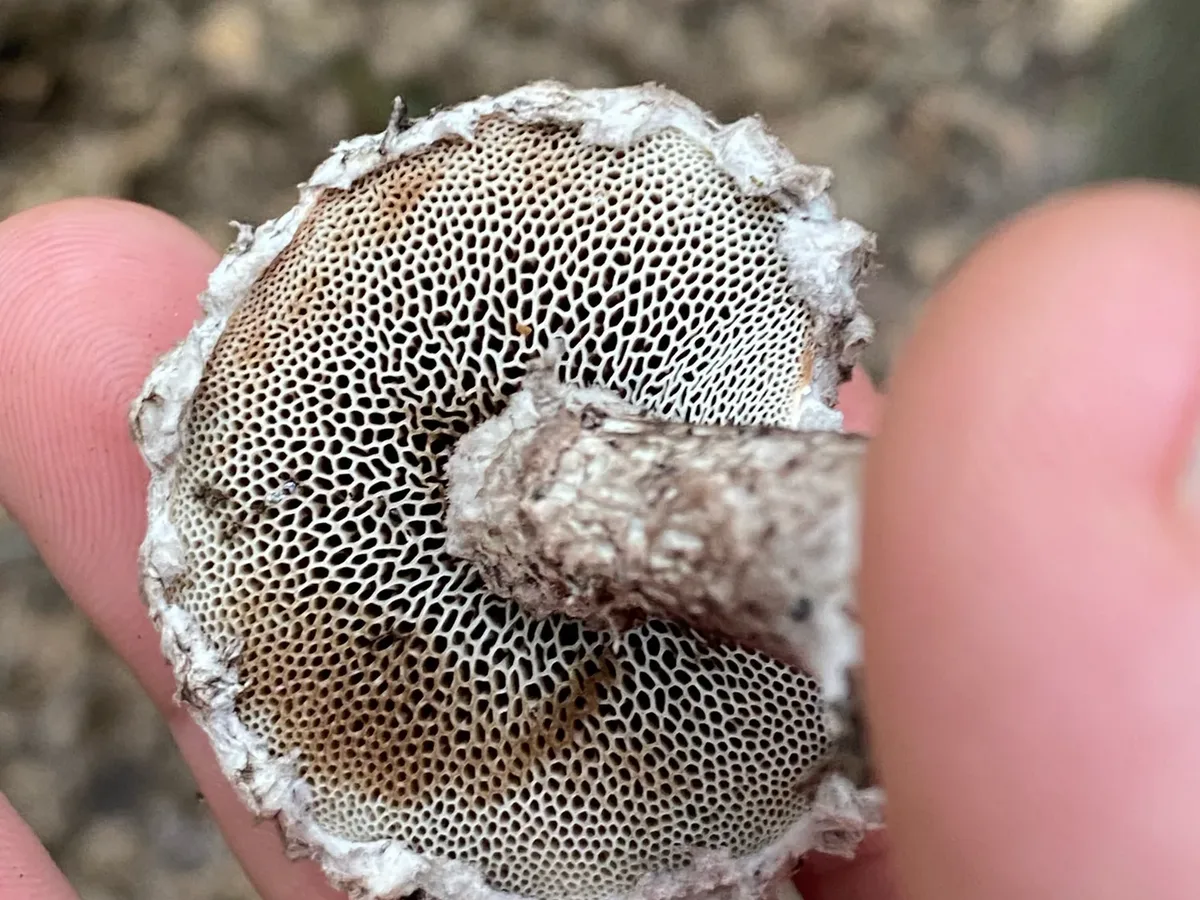 Aubrey Inkster (CC0)
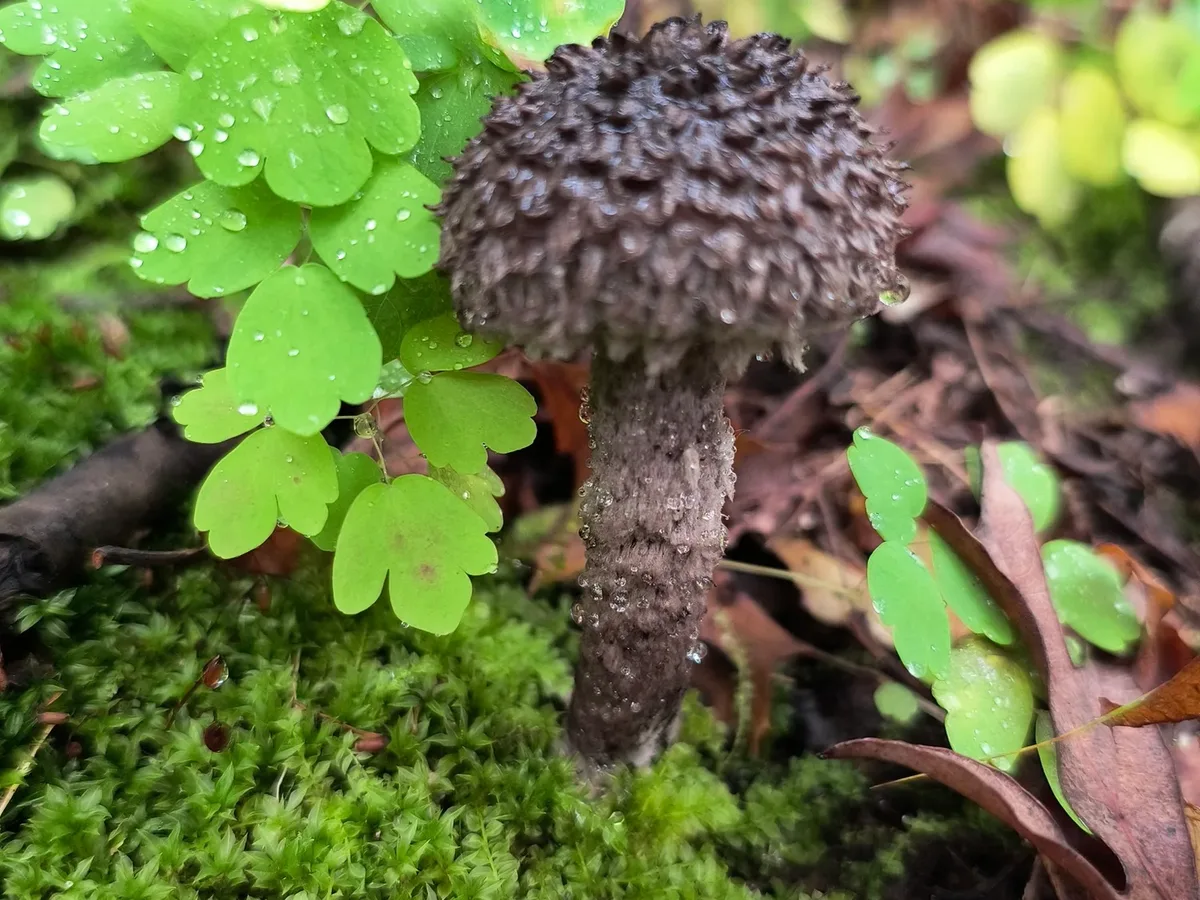 jonnas___ (CC0)
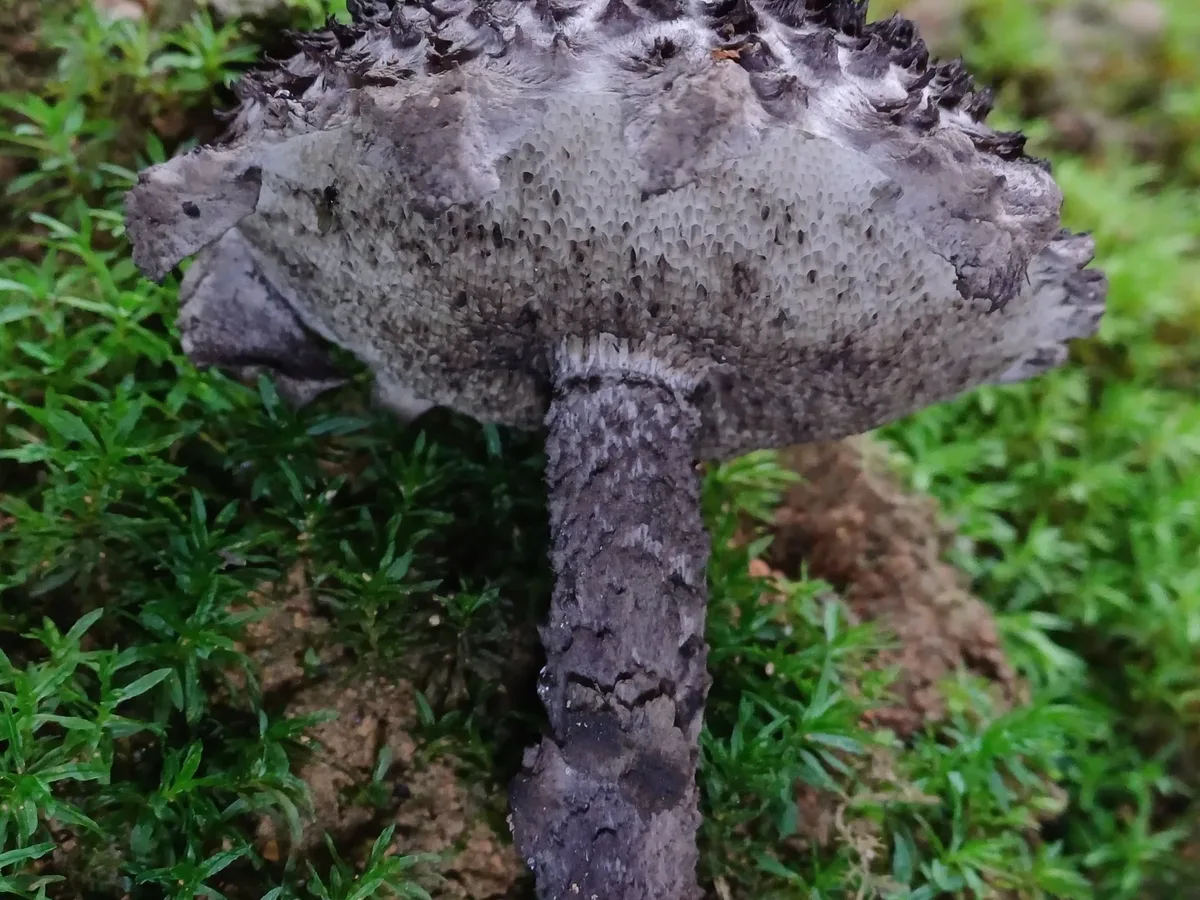 © Andrey Loria (CC BY)
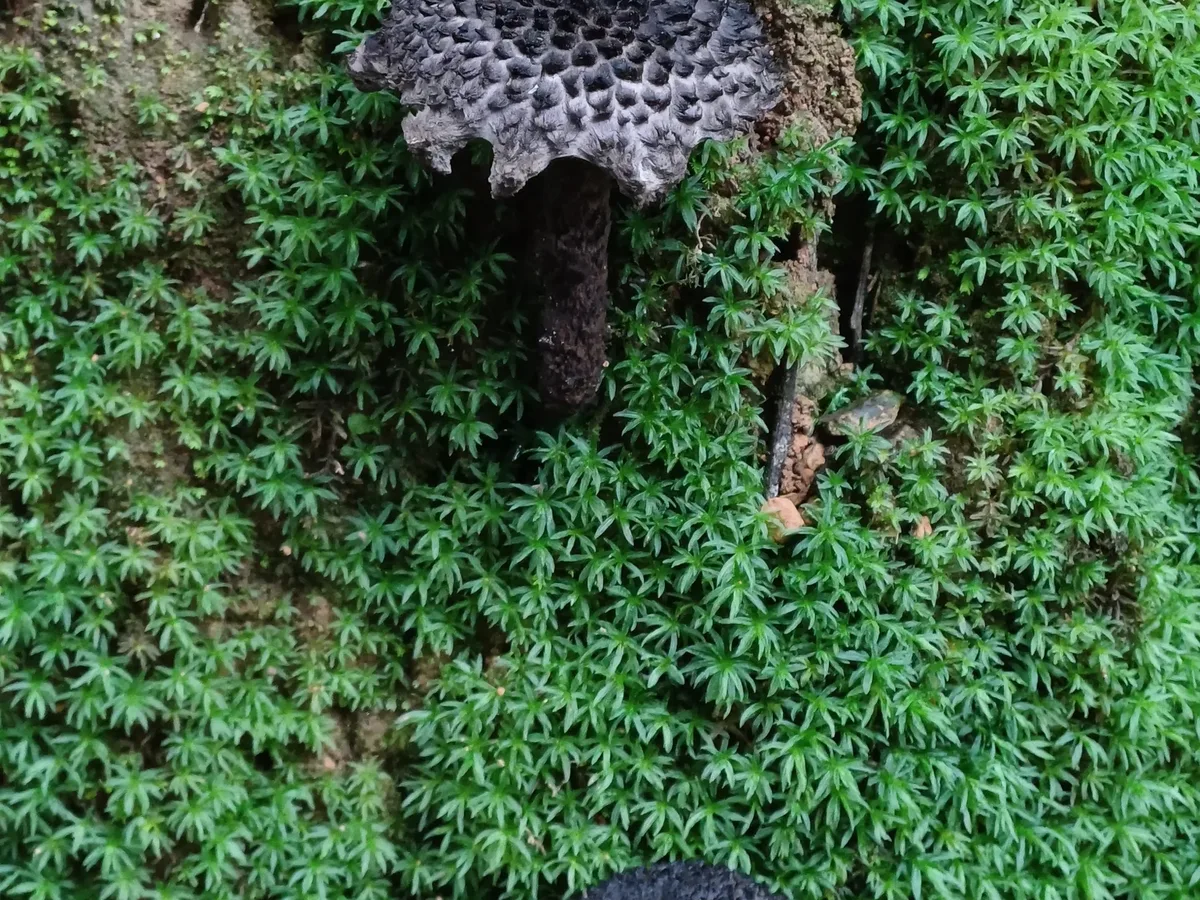 © Andrey Loria (CC BY)
 © 呂一起(Lyu yi-chi) (CC BY)© 呂一起(Lyu yi-chi) (CC BY)© Andrey Loria (CC BY)
Good to eat, once you have identified it with certainty and cooked it through.
How to recognise it
Strobilomyces confusus belongs to one of the most visually dramatic groups in the bolete family: a sturdy, dark-scaled mushroom that turns black before your eyes wherever it is touched or cut.
Cap
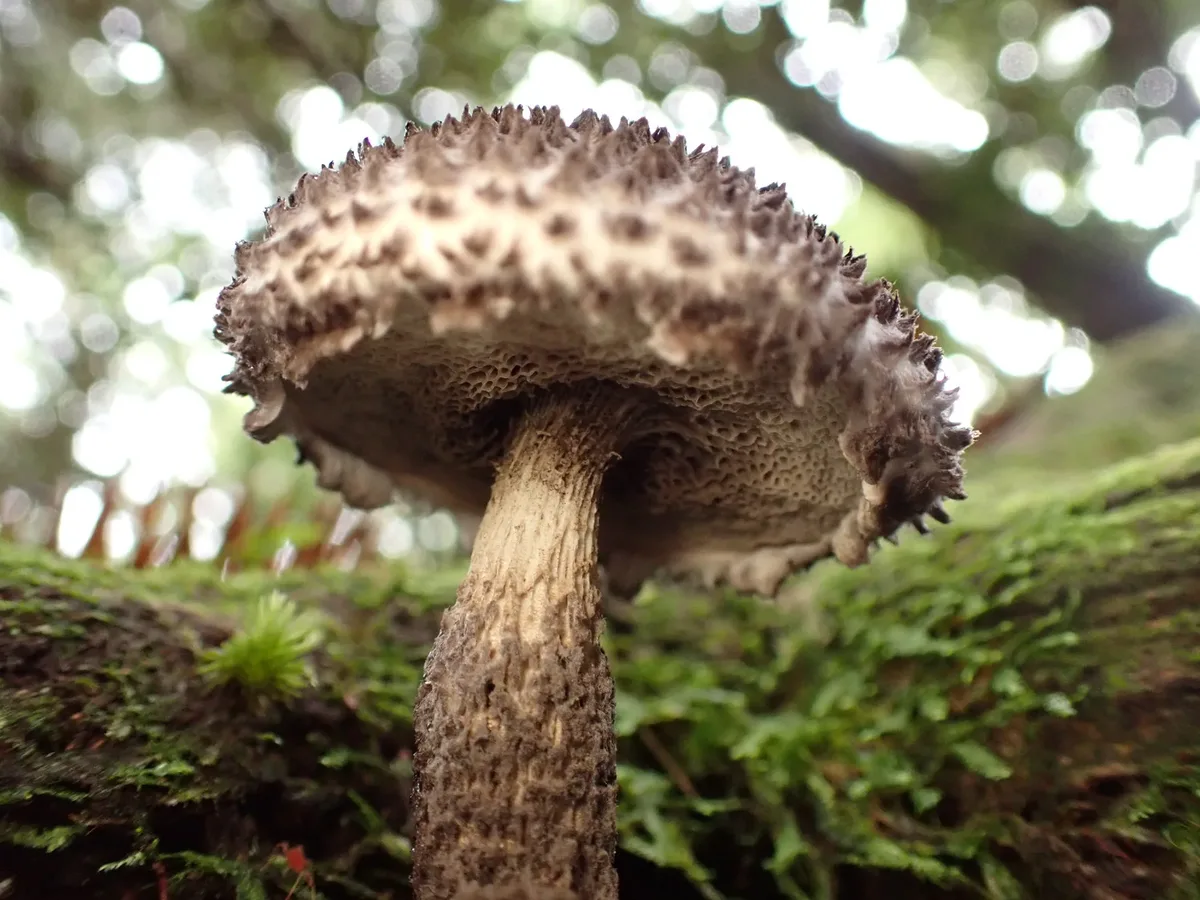
The cap is 4-12 cm across, domed when young and broadly spreading with age, its surface blanketed in dense, dark brown to blackish-brown scales pressed flat against the underlying grey-white cap flesh. This lying-flat scale posture (appressed scales) is what separates S. confusus from the closely related Strobilomyces strobilaceus, whose scales stand erect like the bracts of a pine cone.
The distinction matters for identification but not for the kitchen: both species are edible and structurally very similar.
Flesh
The oxidative blackening is the species' most striking field character and its most reliable one. Grasp the cap, scratch the surface with a fingernail, or slice through the stem - the white or pale grey flesh turns pinkish-red within seconds, then slowly cycles through grey to deep, inky black over the next quarter of an hour.
This is not decay; it is a rapid enzyme-driven oxidation reaction entirely analogous to the browning of a cut apple, and it stops completely on cooking. The cooked flesh is dark grey to black in colour but entirely safe and pleasantly flavoured.
Gills / Pores
The tube layer beneath the cap is pale grey when young and black with age. Pores are angular, 1-2 per mm, initially masked by a loose, cottony, dark grey partial veil that tears as the cap expands - it leaves ragged fragments along the cap edge and a shaggy zone on the upper stem.
Spore print is black to dark purplish-black, immediately distinguishing Strobilomyces from all common edible boletes, which yield olive-brown or tan prints.
Stem
The stem itself is 5-14 cm tall, fibrous-scaly below the veil zone and paler above, firm in youth, and spongy in old specimens.
Where & when it grows
Habitat
Strobilomyces confusus is an obligate mycorrhizal partner of broadleaf trees - principally oaks, chestnuts, chinquapins, and stone oaks of the family Fagaceae - whose roots it colonises in exchange for photosynthates.
Because these underground partnerships take years to establish and require mature trees, the species is characteristic of older, undisturbed broadleaf forest rather than young plantations or heavily managed stands.
In East and Southeast Asia it favours warm-temperate and subtropical evergreen broadleaf forest between roughly 300 and 1500 m elevation, where monsoon moisture combines with summer warmth to create productive fruiting conditions.
Regional distribution:
- Japan - most common in warm broadleaf forests of Honshu, Shikoku, and Kyushu.
- China - widely distributed in southern and central provinces, particularly Yunnan, Guizhou, Sichuan, Guangdong, and Fujian, appearing in both lowland subtropical and montane forest.
- Southeast Asia - records from Vietnam, Thailand, and Malaysian highland forest place it across much of mainland Southeast Asia wherever the right tree partners and soil conditions occur.
Look for it singly or in loose groups of two to five on the forest floor, in leaf litter, sometimes with mosses, and often near the base of large oaks or chestnuts where the mycorrhizal network is densest.
When
Summer through early autumn defines the fruiting season across most of the East and Southeast Asian range, broadly June through October, with the most productive period in July, August, and September.
The precise timing is driven by the monsoon cycle and warm soil temperatures. A significant rain event after a period of soil temperatures above 18 °C creates the physiological trigger, and new fruiting bodies typically appear 10-20 days later.
In tropical highland forest (northern Vietnam, northern Thailand, Yunnan plateau) the season can extend into October or even early November in warm years. The species does not fruit in winter or spring in its Asian range.
Because individual fruiting bodies blacken rapidly in warm weather, the practical collection window within each flush is a few days; a fresh specimen found in good condition is worth taking, as it will be unrecognisably decayed within a week.
How it grows
Grows singly or in loose groups of two to five, never in dense clusters.
As a mycorrhizal fungus it cannot be cultivated on artificial substrate - it depends entirely on a living tree partner and the accumulated carbon economy of that relationship.
Productive sites recur near the same host trees in consecutive years when conditions are right, which makes finding and mapping good spots genuinely worthwhile: the underground network does not move.
Growth is slow; a young button takes several days to fully expand.
Old specimens become insect-riddled and spongy, and the rapid blackening of damaged tissue accelerates decay - a cap that looks usable can be hollowed by beetle larvae that are invisible from outside.
Fruiting conditions
Warm-season mycorrhizal fruiter across East and Southeast Asia; requires warm soil temperatures (16-26 °C) and a significant moisture input of at least 25 mm over two weeks before a flush emerges. Flush lag of 10-20 days post-rainfall is consistent with other mycorrhizal boletes in the same region. Peak fruiting July-September following summer monsoon rains.
Look-alikes
Strobilomyces as a genus is highly distinctive. The combination of dark shaggy or appressed scales, a pored (bolete) underside, and rapid flesh-blackening on cutting is essentially unique among fleshy fungi, making serious dangerous confusion very unlikely for anyone who has checked these three characters.
The primary confusion within the genus is between S. confusus and the closely related Strobilomyces strobilaceus:
- S. strobilaceus has coarser, more erect scales giving an exaggeratedly shaggy pine-cone appearance, typically slightly larger spores, and a more northerly distribution centred on cool-temperate Europe.
- S. confusus has flatter, pressed-down scales with a less dramatically tufted look, and is more characteristic of warm-temperate and subtropical Asia.
Both species are edible and structurally similar.
In East Asia, other Strobilomyces species (including S. mirandus, S. velutipes, and S. seminudus) may co-occur; all are similarly edible. No deadly species is known to resemble any Strobilomyces.
The easiest mistake for a complete beginner would be confusing a young, unexpanded Strobilomyces cap with a dark-capped Leccinum species, but the appressed dark scales, the immediate flesh-blackening, and the black spore print are entirely different from any Leccinum.
A potential source of confusion for beginners who see a dark-capped bolete without examining it closely. Leccinum species have a tan to brown, never shaggy-scaly cap surface; flesh may discolour slightly but does not turn vivid pinkish-red then black within seconds; pores are white to greyish-brown, not blackening rapidly; scabers (stem scales) are pale then dark but not shaggy-appressed like Strobilomyces. No Leccinum is deadly, but the Leccinum aurantiacum/vulpinum group requires thorough cooking. Close inspection of scale texture and the flesh-blackening reaction immediately distinguishes Strobilomyces.
An Asian Strobilomyces species with a more uniformly velvety-tomentose rather than distinctly scaly cap surface, smaller overall size, and slightly different scale texture. Also edible. Identification requires careful comparison; the key characters - blackening flesh, pored underside, black spore print - are shared by all Strobilomyces species, all of which are edible.
The most common confusion. S. strobilaceus has dramatically erect, coarse, pine-cone-like scales standing well above the cap surface, whereas S. confusus has scales pressed flat (appressed) or only slightly ascending, giving a less wildly tufted appearance. Both have identical blackening flesh, black spore prints, and similar edibility. S. strobilaceus is more characteristic of cool-temperate Europe; S. confusus is more typical of warm-temperate and subtropical Asia, though ranges overlap. Confusing the two is of no practical consequence since both are edible.
In the kitchen
Picking & cleaning
Select young to mid-aged specimens where the flesh is still firm and white (or only just beginning to pink) inside - slice the stem base in the field to check.
Old specimens with uniformly blackened flesh or heavy insect tunnelling are unpleasant and best left.
Cut the stem at soil level with a knife rather than pulling, to preserve the mycorrhizal mat.
The dark scales are firmly attached and do not need to be removed; brush off loose debris in the field.
Because the flesh blackens quickly after cutting, bring specimens home promptly and cook or refrigerate the same day.
The species is rarely common enough to fill a basket; restrained collecting that takes only what will be used is both practical and ecologically sound.
No dangerous species resembles a mature Strobilomyces in the field, but always confirm the following before collecting unfamiliar specimens:
- blackening flesh
- pored (not gilled) underside
- black spore print
Cooking
Strobilomyces confusus is a perfectly respectable edible whose modest culinary reputation mainly reflects its relative scarcity and striking but unfamiliar appearance in the pan rather than any shortcoming in flavour.
The taste is mild to moderately earthy, with a pleasant mushroom character and a firm, slightly meaty texture that holds up well to cooking.
The key fact for the kitchen is the colour: everything turns black or very dark grey on cooking, and it will stain stocks, sauces, and cream dishes dramatically. Embrace this rather than fight it - a black mushroom broth with silky tofu is visually striking and genuinely flavourful; a black mushroom risotto made with Strobilomyces is an unusual centrepiece.
For less committed colour, fold it into mixed mushroom dishes where the dark contribution is diluted by paler species.
Young, firm specimens are best - slice them and dry excess moisture with a cloth before putting them in a hot pan to get a proper sear rather than steaming.
Sautéing in neutral oil or butter with garlic, ginger, and a little soy sauce suits the Asian context of the species well.
Drying is practical: slices dry readily and rehydrate with good flavour retention.
Thorough cooking is recommended as a matter of general principle with wild boletes, though no specific toxin requiring heat inactivation is known in this species.
Good to know
Strobilomyces confusus has no known toxicity and is not associated with poisoning cases in the mycological literature.
The alarming rapid blackening of the flesh and the dramatically dark colouration of the cooked mushroom can surprise a first-time collector, but these are normal enzymatic processes with no safety significance. The species can be eaten safely by most people.
The black or dark grey colour of cooked Strobilomyces is purely aesthetic; it will colour stocks, sauces, and risottos a striking dark grey or black, which some cooks enjoy and others find off-putting, but it causes no harm.
As with any newly tried wild mushroom, a modest first portion with a 24-hour monitoring period is a sensible precaution.
There are no deadly lookalikes, but collect only specimens you have examined carefully:
- check the pored (not gilled) underside
- confirm the blackening response by scratching the flesh
- note the black spore print
A reference guide - never an edibility guarantee. When in doubt, leave it out.