Common earthball
Scleroderma citrinumsyn. Scleroderma aurantium, Scleroderma vulgare, Lycoperdon citrinum
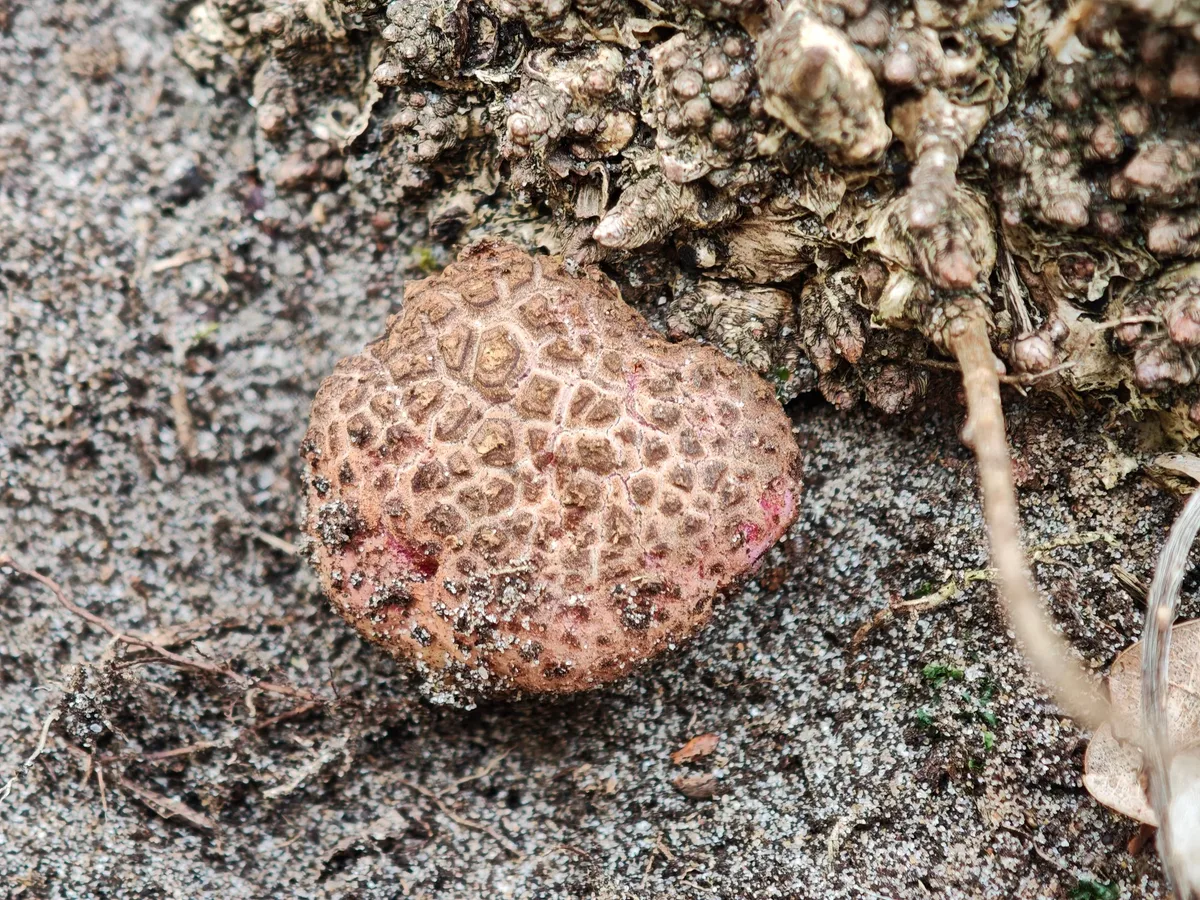 © Michel Langeveld (CC BY)
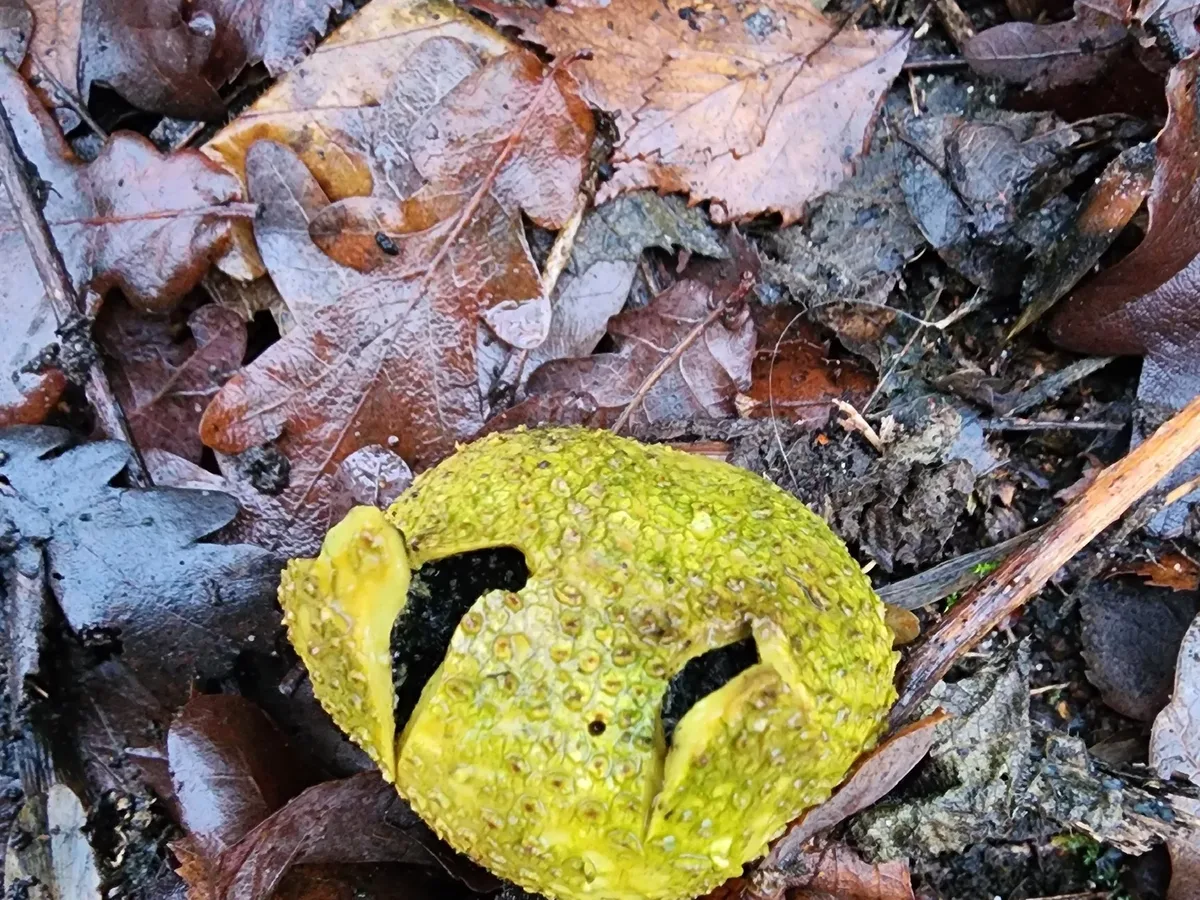 © dave_r_clark (CC BY)
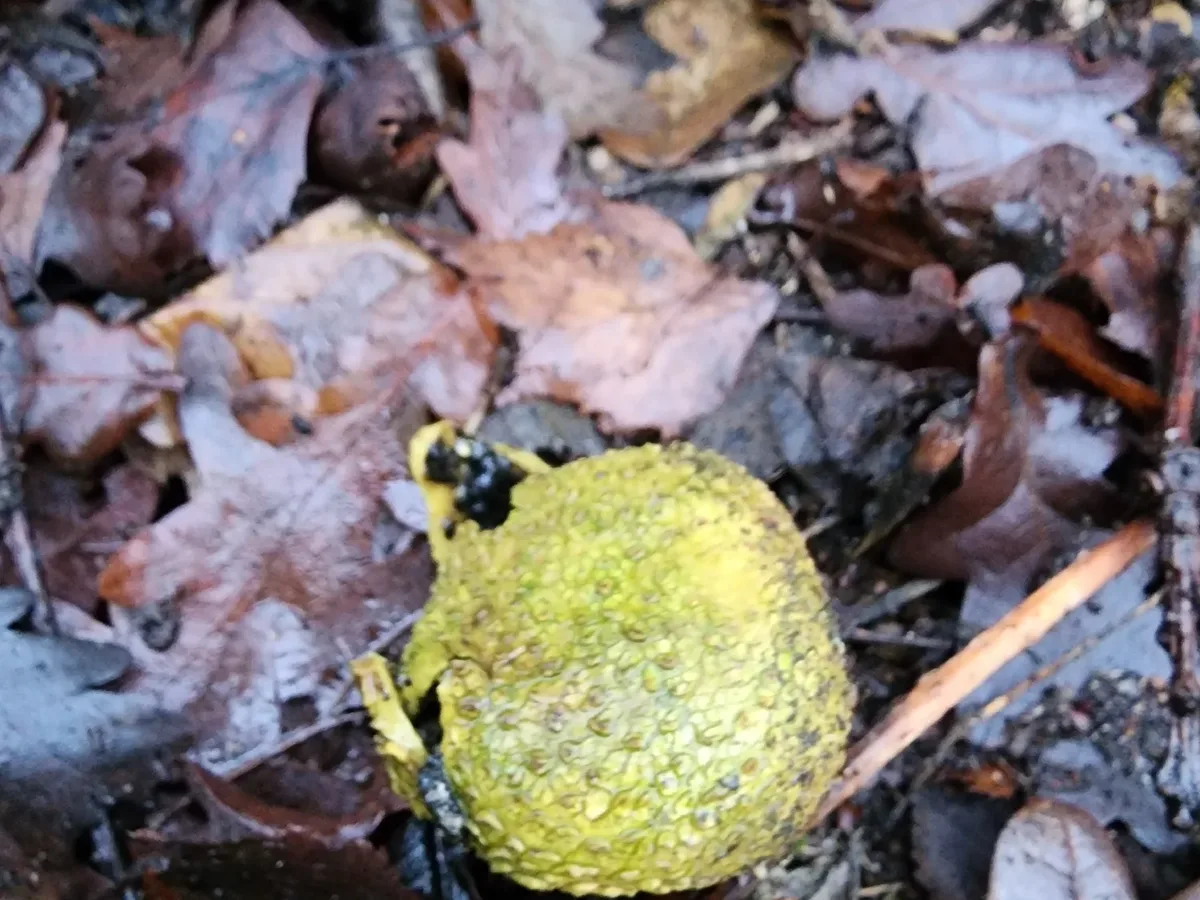 © dave_r_clark (CC BY)
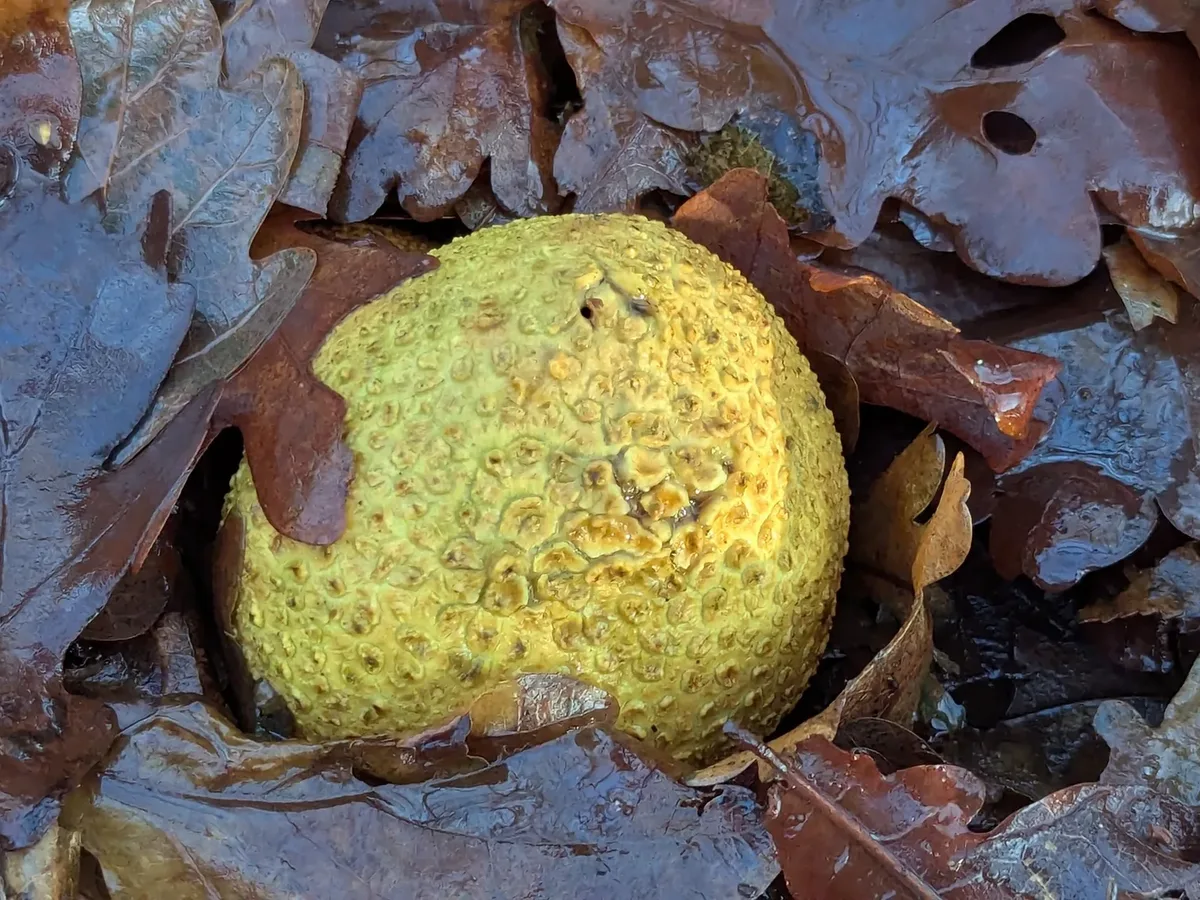 © Michel Langeveld (CC BY)
 © Chris Procter (CC BY)
 © Michel Langeveld (CC BY)
 © Michel Langeveld (CC BY)
 Henrry (CC0)© Michel Langeveld (CC BY)© dave_r_clark (CC BY)
Edible only with the right preparation - or safe for some people but not others. Learn the caveats first.
How to recognise it
The common earthball looks like a puffball at first glance - but a closer look quickly sets it apart.
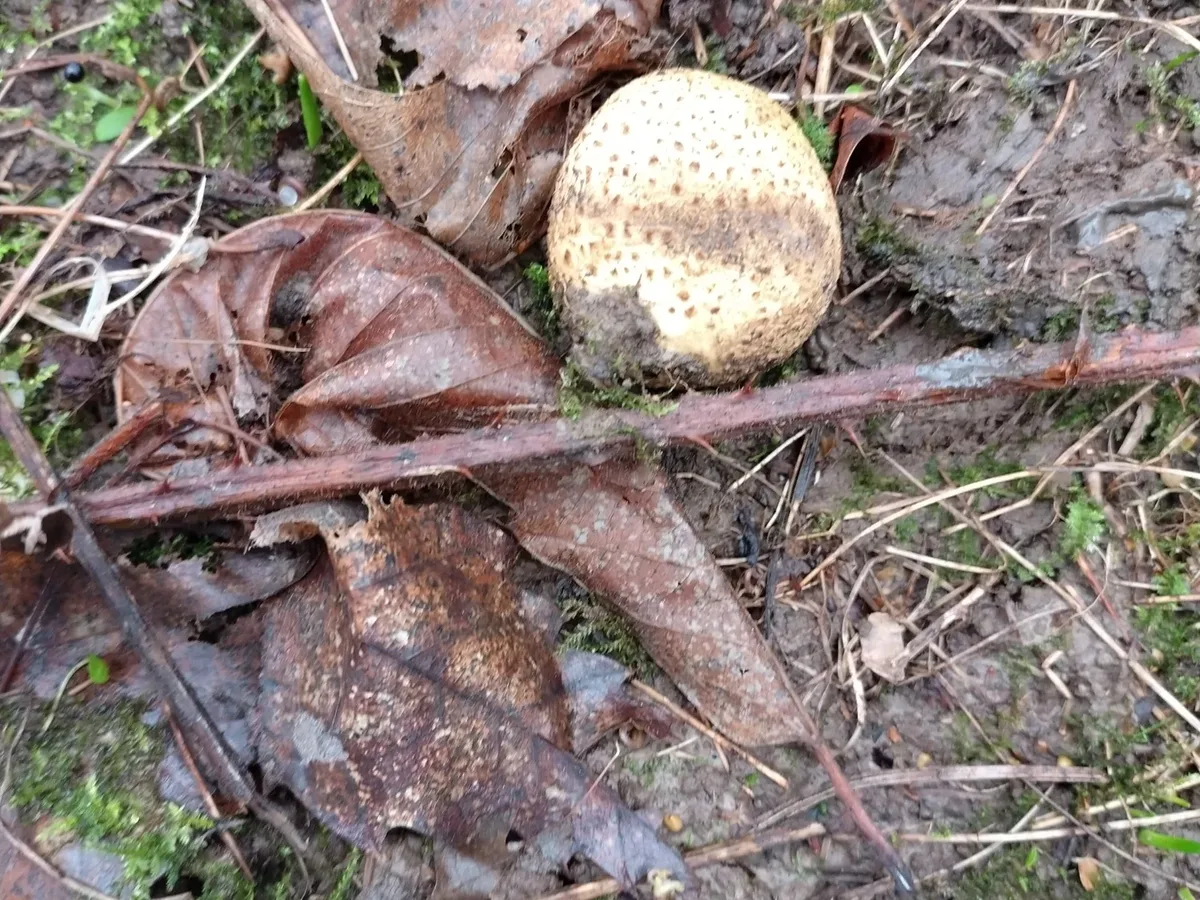
The fruitbody is a squat sphere or irregular lump, 3-10 cm across, with no true stalk, only a pinched, rooting base anchored to the soil by thick white mycelial cords.
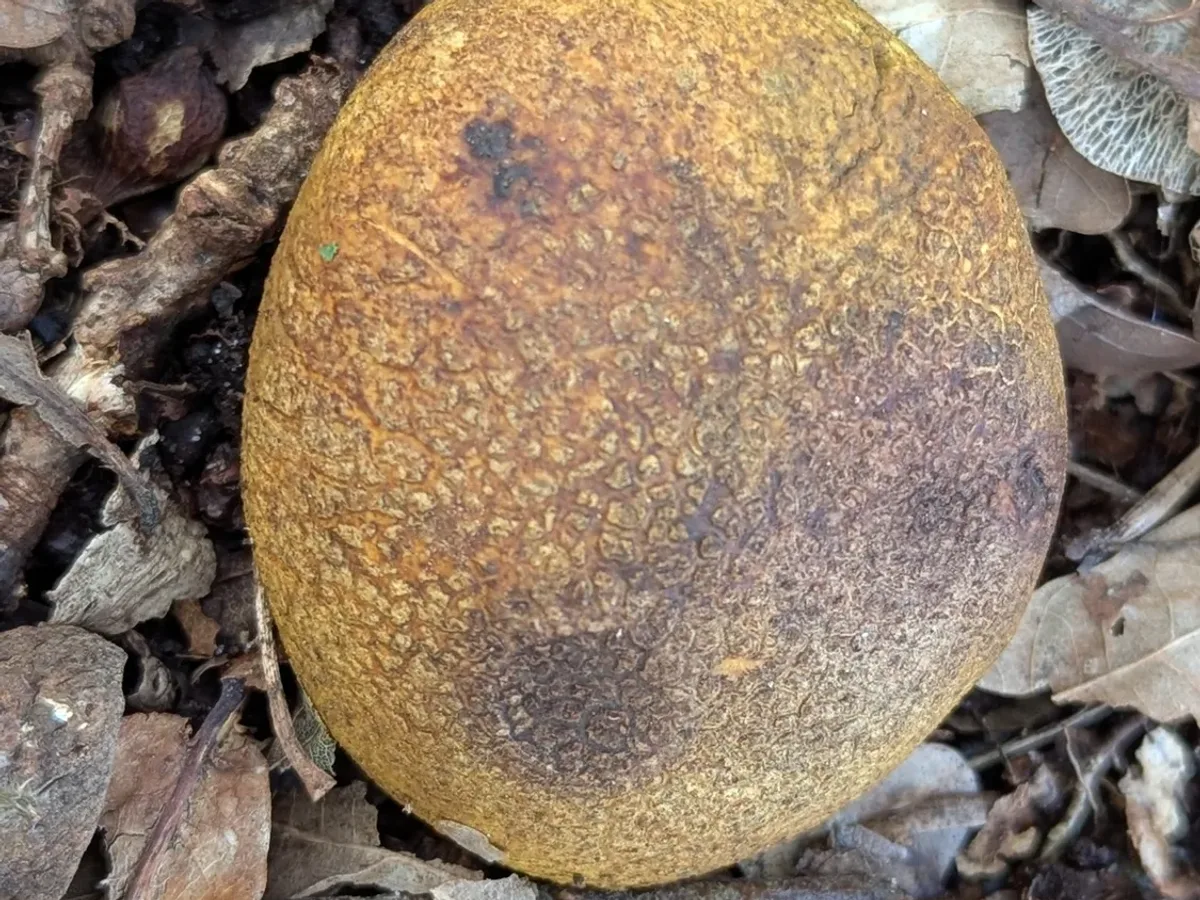
The outer wall (peridium) is the most immediately diagnostic feature: it is thick (2-4 mm), tough, and leathery - far stouter than the thin papery skin of any true puffball.
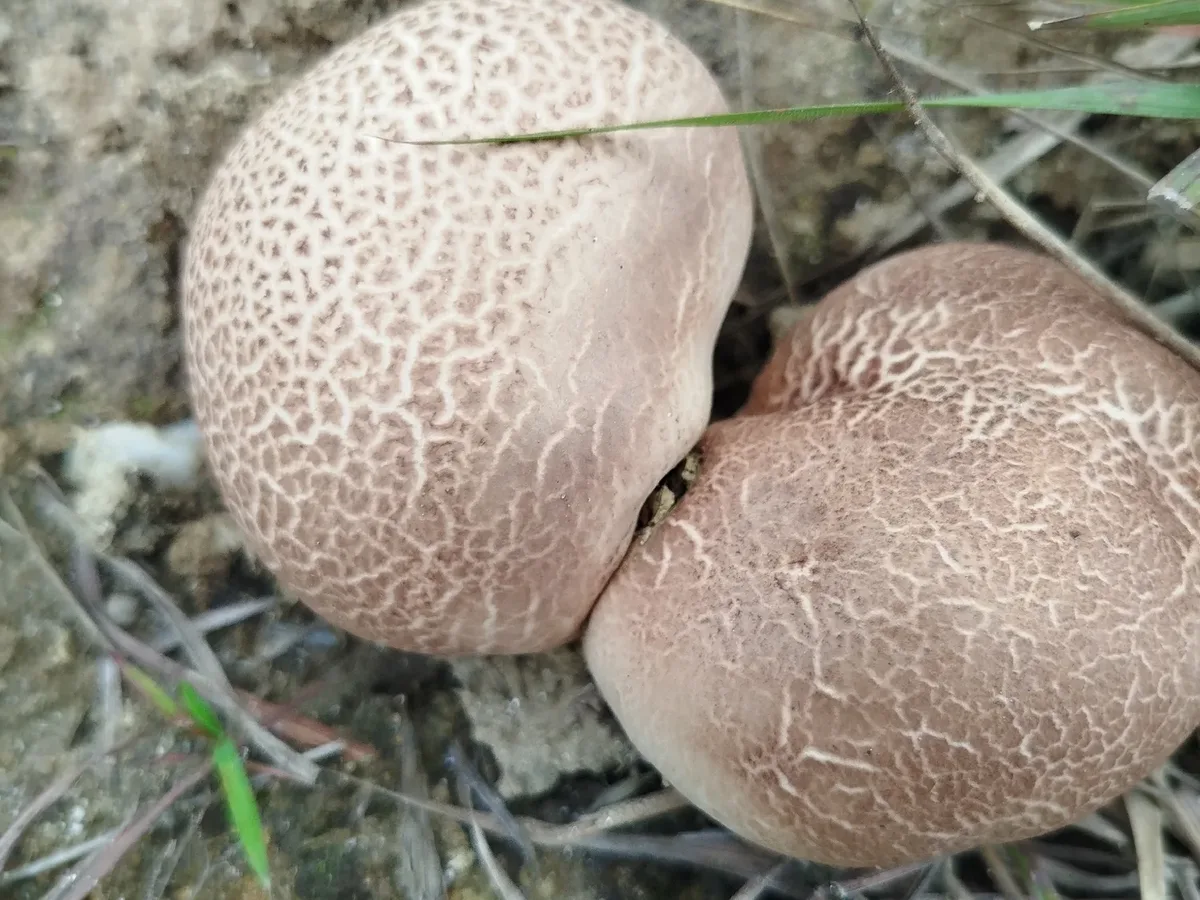
Its surface is coarse, cracked, and polygonally areolate, resembling pigskin or the rind of a rustic bread loaf, ranging from pale ochre-yellow to golden-tan or dirty cream, sometimes with a slight lemon tinge.
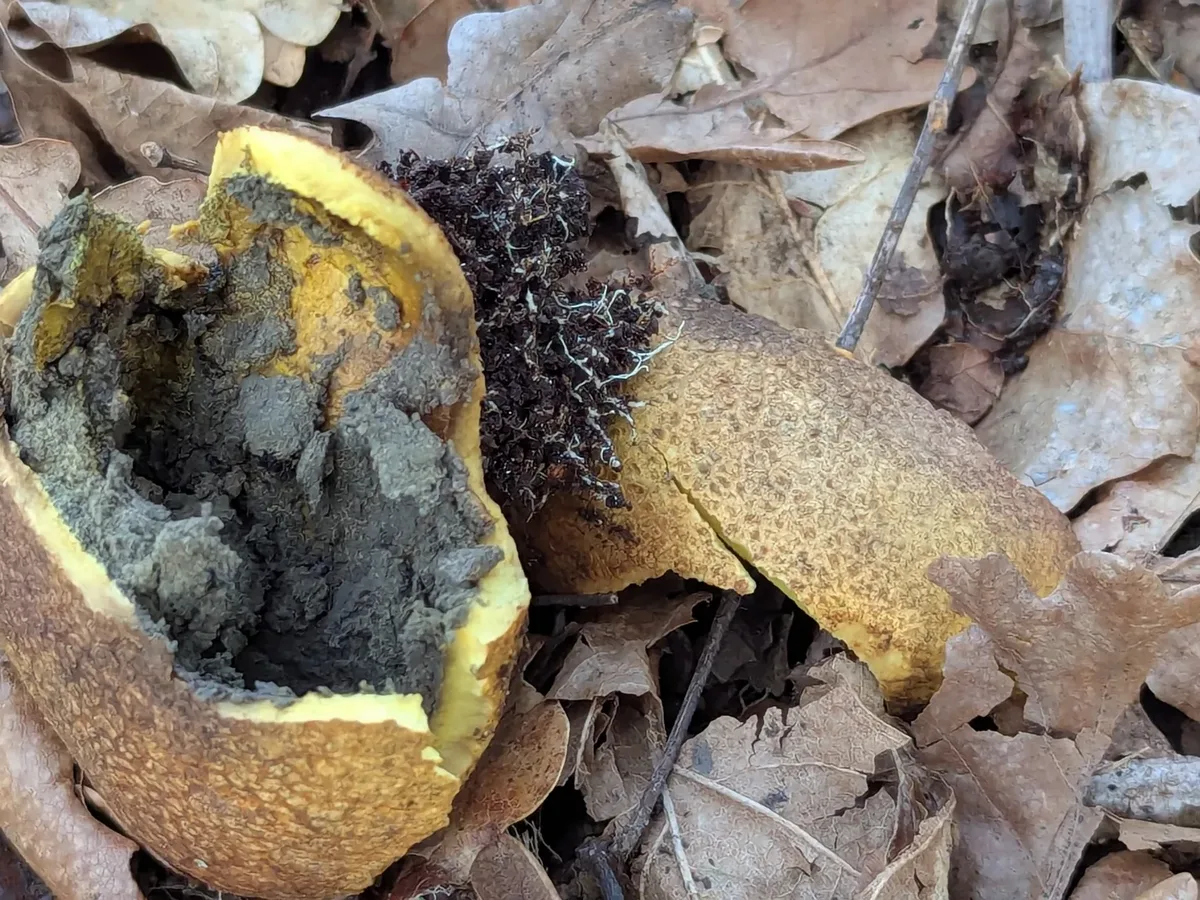
The definitive character, however, is what lies inside. In Scleroderma citrinum, even in young and apparently fresh specimens, the interior is never white.
Cut one open and you find a pale lilac-grey or violet flesh that darkens steadily to deep purple, purple-black, and ultimately a powdery black-brown mass of spores at maturity.
This dark interior is visible the moment you cut through the specimen, and it immediately rules out any white-fleshed edible puffball.
At the end of its life, the peridium ruptures irregularly at the top rather than opening via a neat apical pore; old, spent shells can persist on the forest floor for months as tough, blackened husks.
Why it's dangerous
Scleroderma citrinum is poisonous but not typically lethal.
The greatest practical danger is that an inexperienced forager gathering puffballs may include earthballs in their haul through careless identification.
The simple cut-test - pure white inside = safe puffball, dark or coloured inside = discard - is a reliable, non-negotiable protocol that prevents this mistake entirely.
The earthball is also occasionally consumed in error when used as a truffle substitute (its dark interior was historically used to adulterate truffle products), and historically small amounts were used as a spice, which is unsafe.
Treat every round, puffball-like fungus from woodland with suspicion until proven white inside.
Toxin
The precise toxins in Scleroderma citrinum have not been fully characterised.
The spore mass and peridium contain various irritant compounds:
- sclerodermin and related sesquiterpene-type substances
- unidentified gastrointestinal irritants
These compounds are heat-stable and not destroyed by cooking.
There is also some evidence of mild muscarinic-like activity, and possibly compounds affecting the autonomic nervous system, accounting for the diaphoresis (sweating) and flushing occasionally reported in poisoning cases.
The dark pigment compounds in the gleba (responsible for the characteristic purple-black colour) are also implicated in the toxic picture.
Symptoms
Ingestion of Scleroderma citrinum typically produces symptoms within 30 minutes to 3 hours, consistent with gastrointestinal irritant poisoning.
The most common effects are nausea, vomiting, abdominal cramps, and diarrhoea.
In more substantial ingestions, especially of the spore mass, additional systemic effects have been reported including profuse sweating, flushing, dizziness, and headache.
Most cases resolve within 12-24 hours with supportive treatment (rest, rehydration).
Severe poisonings requiring hospitalisation have been documented but deaths are not reliably attributed to this species alone.
Symptoms are generally less severe than those caused by Amanita phalloides or orellanin-containing Cortinarius species, but the poisoning is real and should not be dismissed.
If ingestion is suspected, contact a poison control centre.
Staying safe
Scleroderma citrinum is poisonous and must never be eaten.
It causes gastrointestinal irritation and, in larger quantities, more serious systemic effects including dizziness, flushing, sweating, and in some reported cases severe vomiting.
The key safety protocol for any puffball-like fungus is to cut every single specimen in half before placing it in your basket:
- edible puffballs are ALWAYS uniformly white throughout when young
- Scleroderma is purple-black or dark inside even when it looks young externally
If the interior is dark, discard the entire specimen and wash your hands.
Do not allow earthballs to contaminate a basket of true puffballs, as residue from cut earthballs may transfer the irritant compounds.
The species was historically used as an insect fumigant in some regions (like tobacco) but any attempt to eat it is strongly discouraged.
There is no reliable antidote; medical attention should be sought if ingestion occurs.
Where & when it grows
Habitat
Common earthball is an ectomycorrhizal fungus - it lives in quiet partnership with tree roots rather than breaking down dead matter like most puffballs do. This tie to living trees keeps it firmly rooted in woodland and its edges.
It thrives on acid, sandy, or compacted soils with good drainage, turning up in:
- woodland paths and rides
- heathland and moorland
- forest margins
- parks and gardens with established trees
- road cuttings and embankments where the soil has been disturbed
Birch and oak are its most frequent partners in north-western Europe; pine and spruce take over in more northern or continental settings.
You will often find it singly or in loose groups, and it tends to reappear in the same spots season after season - a reflection of the long-lived mycelial network quietly threading the soil below.
Rarely found in open grassland far from trees, which makes habitat a useful first clue when sorting it from grassland puffballs.
When
In central and western Europe the earthball fruits from mid-summer (July) through to late autumn (November), with the great majority of fruitbodies appearing from August to October.
Peak abundance falls in September, typically triggered when the first meaningful autumn rains arrive on soils still holding the warmth of summer.
In milder maritime climates - Atlantic Britain, western France - the season can stretch later and begin earlier. In continental or Nordic regions it tends to peak in August-September and close more abruptly with hard frost.
Old, weathered shells from the previous year can still be found into spring.
How it grows
Because it is ectomycorrhizal, Scleroderma citrinum spends most of its life entirely out of sight - a network of white mycelial cords threading through the soil around the feeder roots of nearby trees.
Some of these partnerships persist for years, which is why earthballs tend to appear in the same corners of the same woodland path season after season.
When conditions are right, fruitbodies push up from this network, often at the soil surface or half-buried, and mature slowly over several weeks.
The peridium (outer wall) is so tough that old fruitbodies can persist on the ground long after the spores have dispersed through the ragged hole at the apex.
The species is especially common along disturbed woodland tracks, possibly because compaction and disturbance concentrate the surface-level mycelium where it is more likely to fruit.
Fruiting conditions
Fruiting is triggered by late-summer or early-autumn rainfall on soils warmed through the summer; the ectomycorrhizal mycelium is well-established in the surrounding soil and responds relatively slowly to moisture, with a lag of one to three weeks between significant rain and visible fruitbodies. Dry, hot summers followed by September rain are the most productive conditions.
Look-alikes
The primary danger of Scleroderma citrinum is that it may be mistaken for edible puffballs, especially by inexperienced foragers gathering round fungi from woodland ground.
The edible true puffballs in the same habitat - most notably the common puffball (Lycoperdon perlatum) and the stump puffball (Apioperdon pyriforme) - are ALWAYS pure white throughout when young and edible.
Cut every candidate open: if the interior is anything other than uniform white, it is not an edible puffball. The earthball's interior is lilac-grey to purple-black even when young, and this is an absolute and reliable distinction.
Separation from puffballs is also aided by the peridium: in the earthball it is conspicuously thick, tough, and cracked-scaly; in Lycoperdon it is thin and papery with distinct spines or warts.
The giant puffball (Calvatia gigantea) is much larger, smooth-skinned, and has a pure white interior until very late maturity.
The earthball does NOT reliably resemble deadly Amanita species in any dangerous way; the danger is specifically the earthball-for-puffball confusion.
A secondary confusion is with young truffles (Tuber spp.) or the related Scleroderma verrucosum (scaly earthball), which is similarly poisonous. Scleroderma verrucosum is distinguished by its more distinct, narrower stem-like base, thinner peridium, and less strongly yellow surface; both are poisonous and should be avoided.
Pure white throughout when bisected at the edible stage - never lilac or dark. Outer skin is thin and papery with distinct conical spines or warts that leave a reticulate scar pattern when they fall away. Has a narrower sterile base. Cut every specimen open: uniformly white inside = edible puffball.
Much larger (typically 20-70 cm across), smooth, white skin, and uniformly pure white interior until very late maturity. No thick cracked rind. Confusion is unlikely in large adults but conceivably possible with small immature specimens; the cut test resolves it instantly.
Much smaller (1.5-4 cm), smoother, and found in open grassland rather than woodland. Interior pure white when young. Peridium thin and papery, not thick and leathery. The grassland habitat and small size prevent realistic confusion.
A closely related earthball that is also poisonous. Distinguished by its more elongated, stem-like base, slightly thinner peridium, and less strongly ochre-yellow surface. Also dark-fleshed inside. Separation from S. citrinum is mycologically important but both species are equally poisonous and should be avoided.
Pear-shaped with thin granular skin and a pronounced sterile base; always grows in clusters on or immediately beside decaying wood or buried wood roots; interior pure white when young. Not a forest-floor standalone species like the earthball.
A reference guide - never an edibility guarantee. When in doubt, leave it out.