Stalked scarlet cup
Sarcoscypha occidentalissyn. Peziza occidentalis, Lachnea occidentalis, Plectania occidentalis, Molliardiomyces occidentalis
 Nathan Cobbett (CC0)
 Terri Koontz (CC0)
 © Conway Hawn (CC BY)
 © Conway Hawn (CC BY)
 © Fluff Berger (CC BY-SA)
 © Fluff Berger (CC BY-SA)
 © Fluff Berger (CC BY-SA)
 Nathan Cobbett (CC0)
 Nathan Cobbett (CC0)Nathan Cobbett (CC0)Terri Koontz (CC0)
Edible only with the right preparation - or safe for some people but not others. Learn the caveats first.
How to recognise it
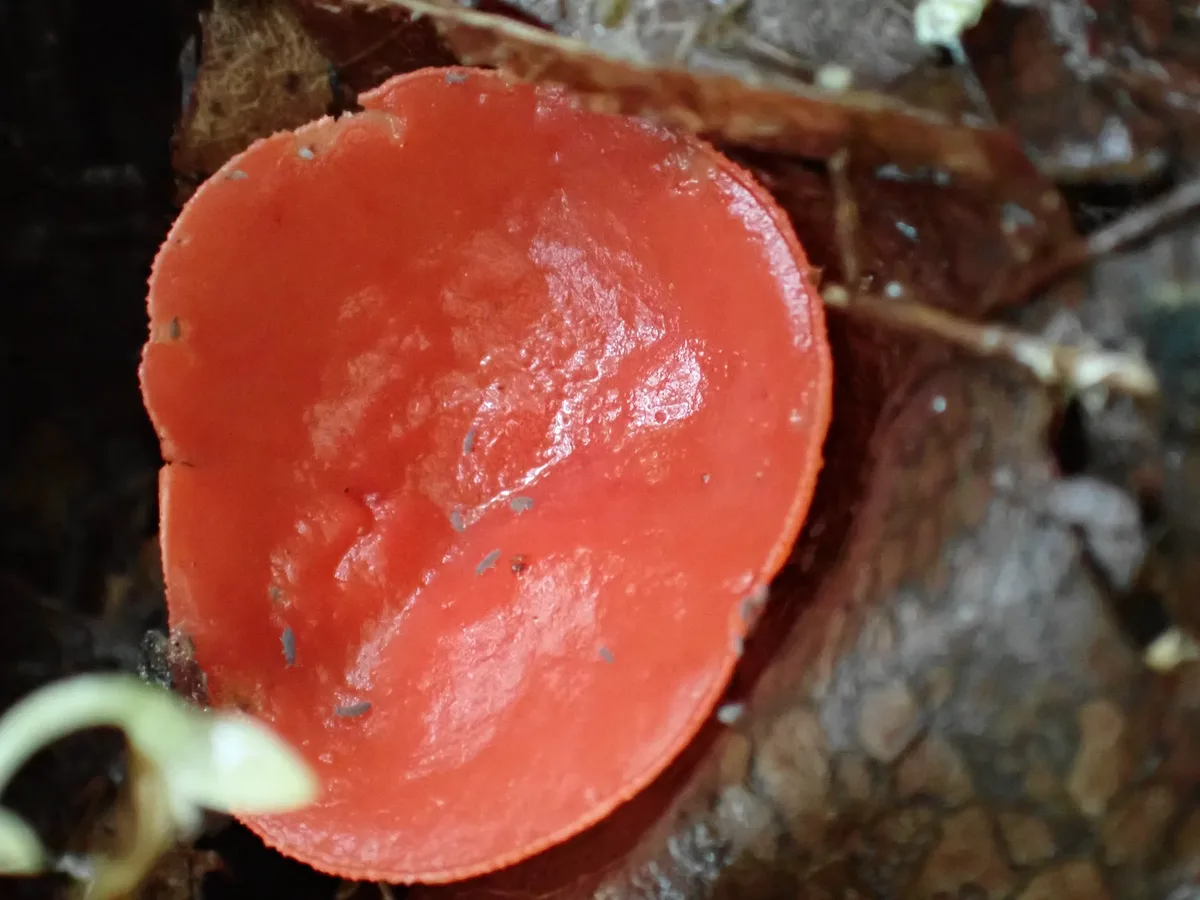
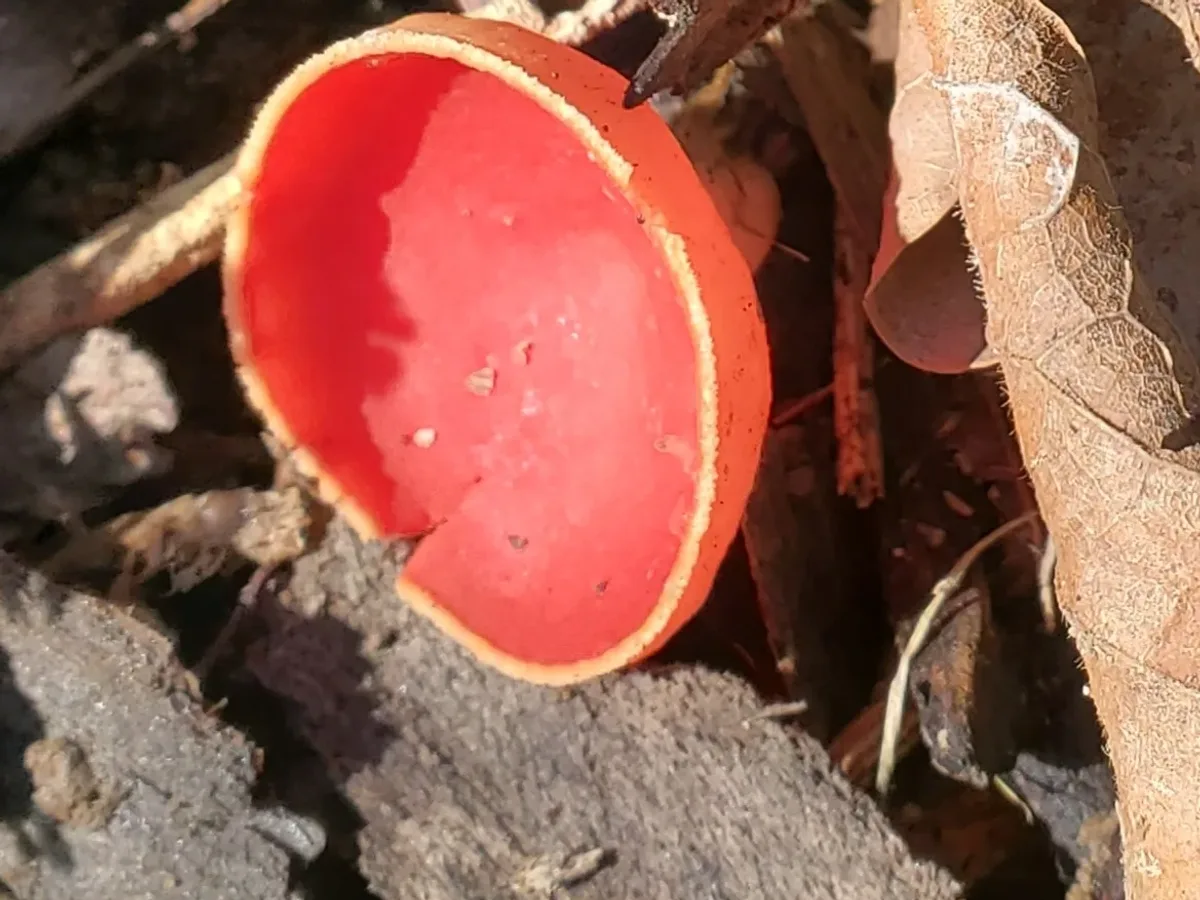
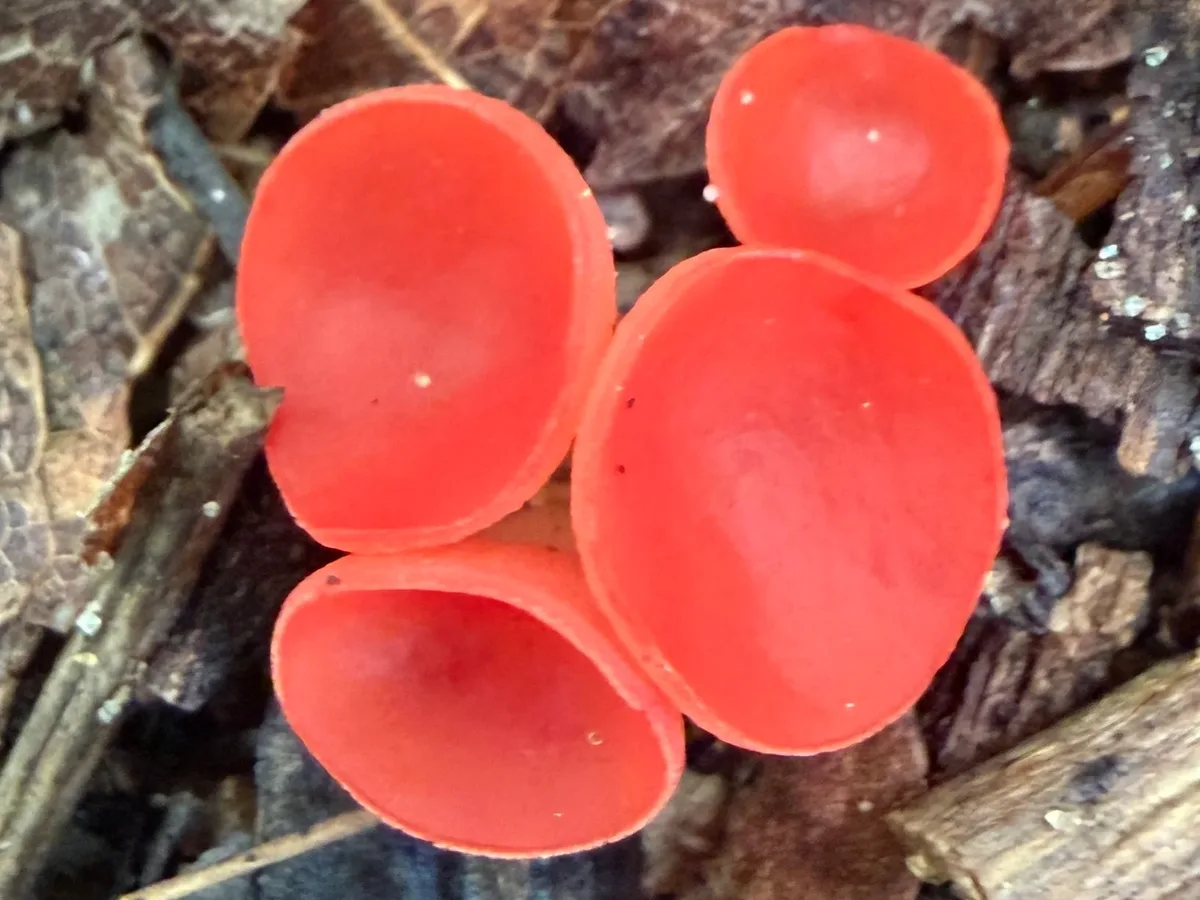
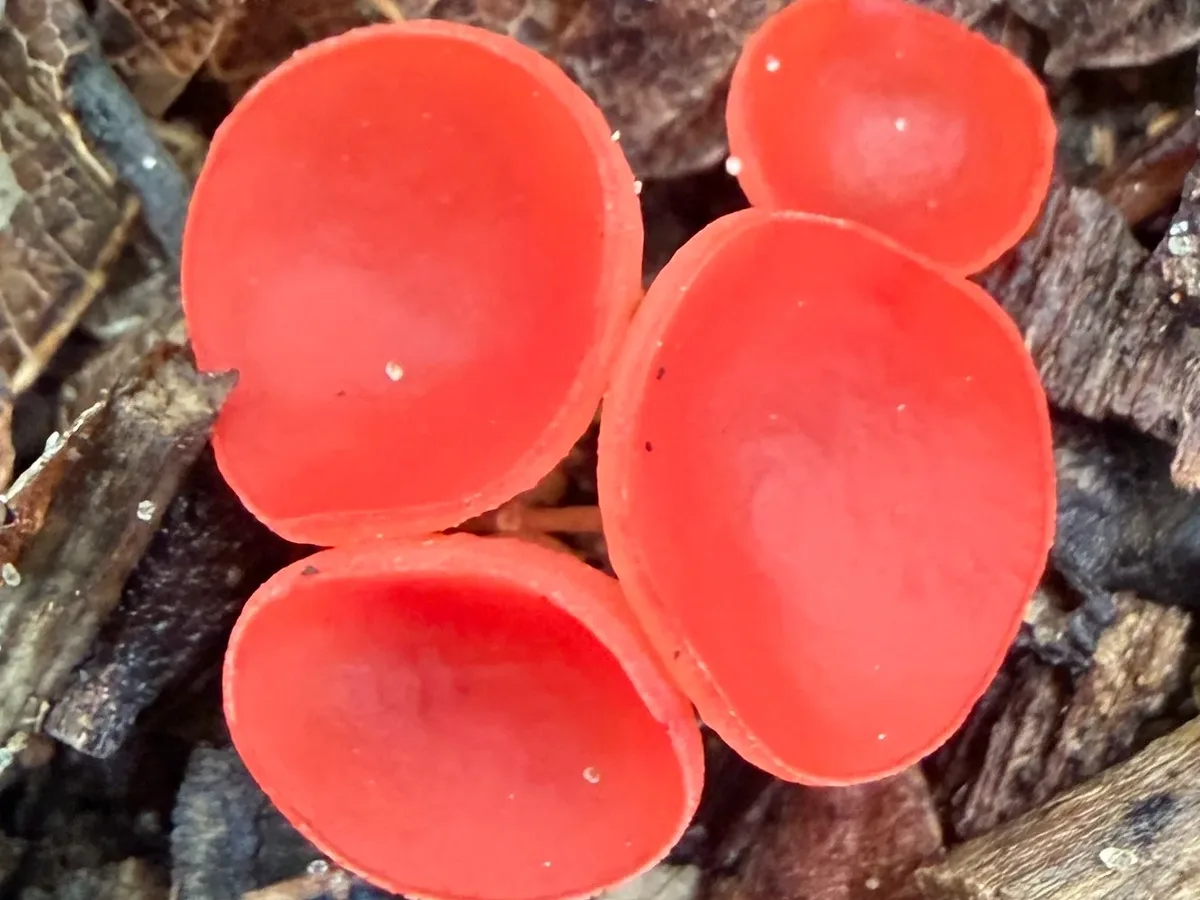
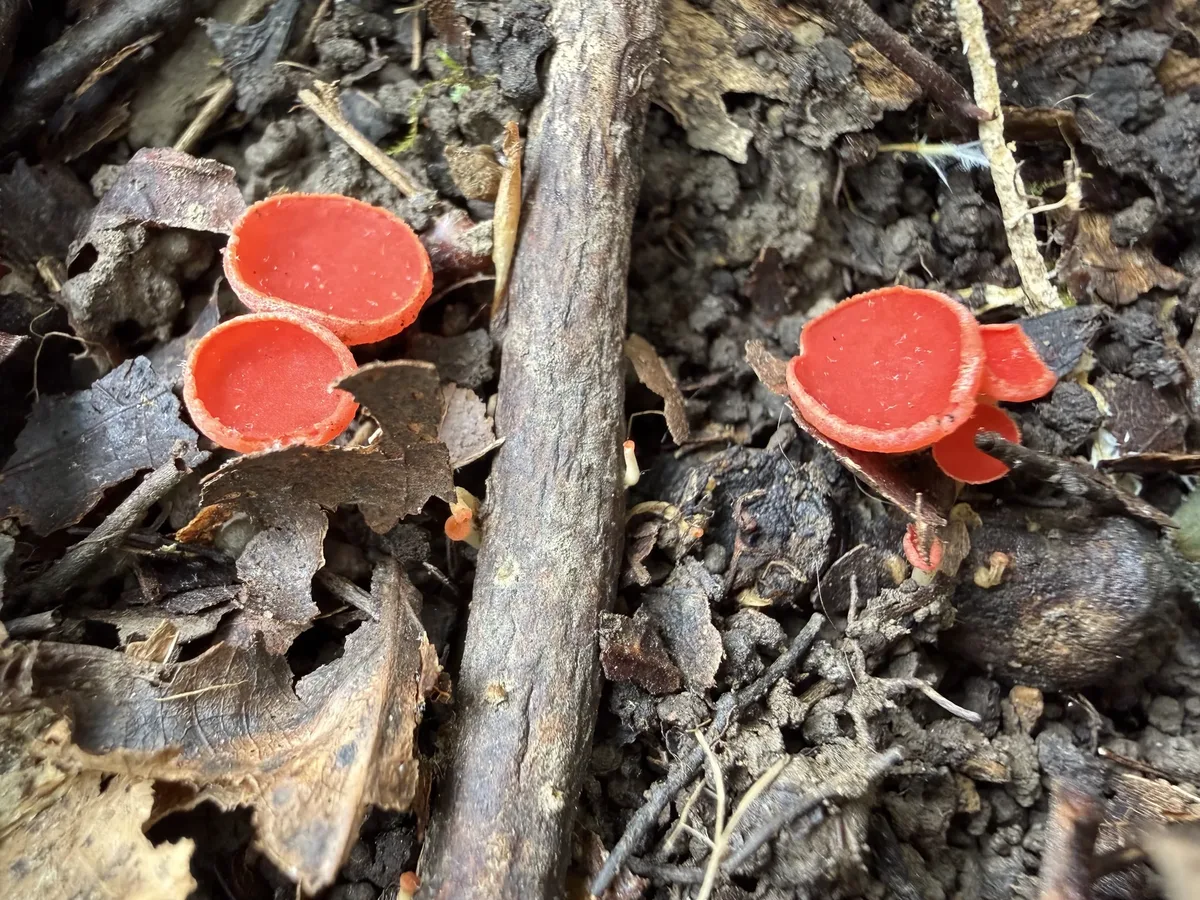
Sarcoscypha occidentalis is the 'little sister' of the famous scarlet elf cup - same vivid red colouring, unmistakably small, and distinguished by a real stem.
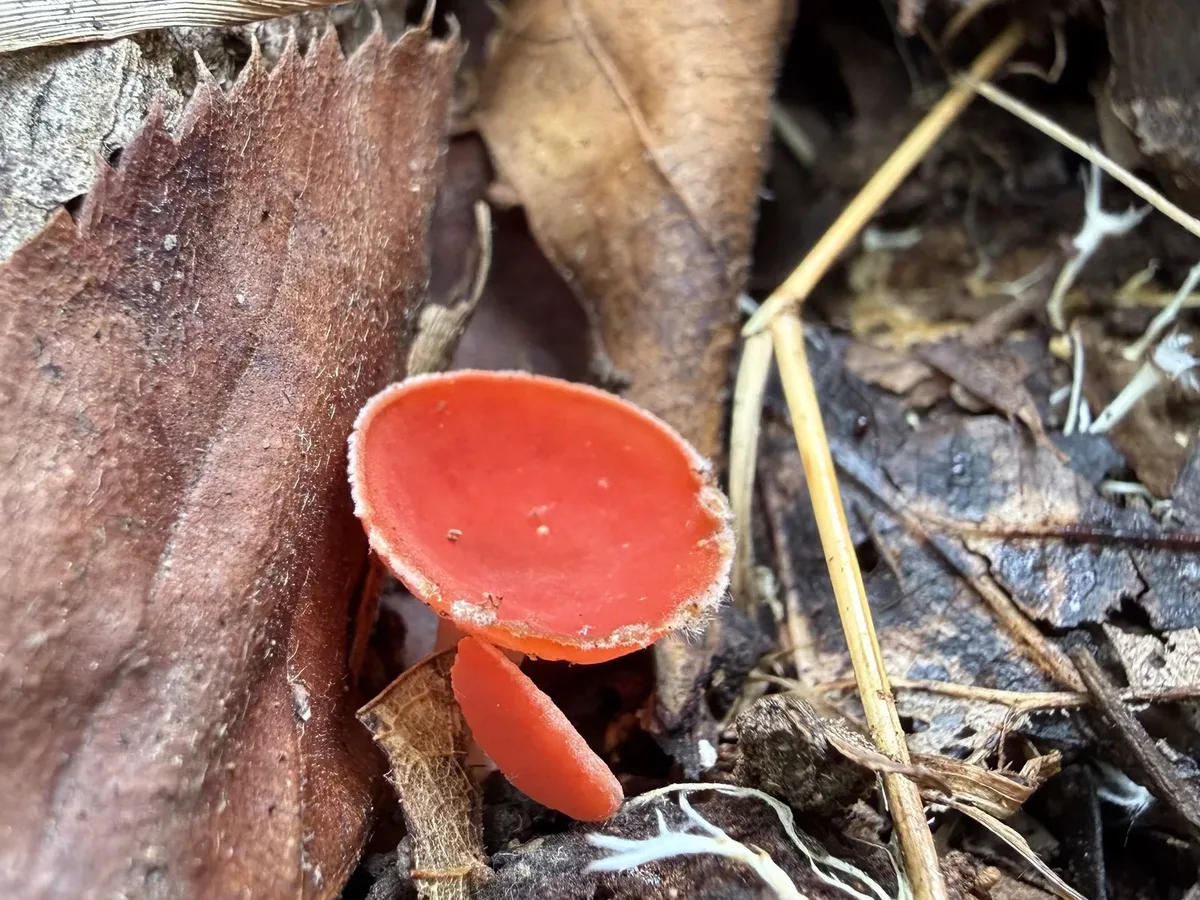
Where S. coccinea sits nearly stemless on its dead wood, occidentalis perches on a slender whitish stalk that can be a centimetre or more long and clearly visible without digging.
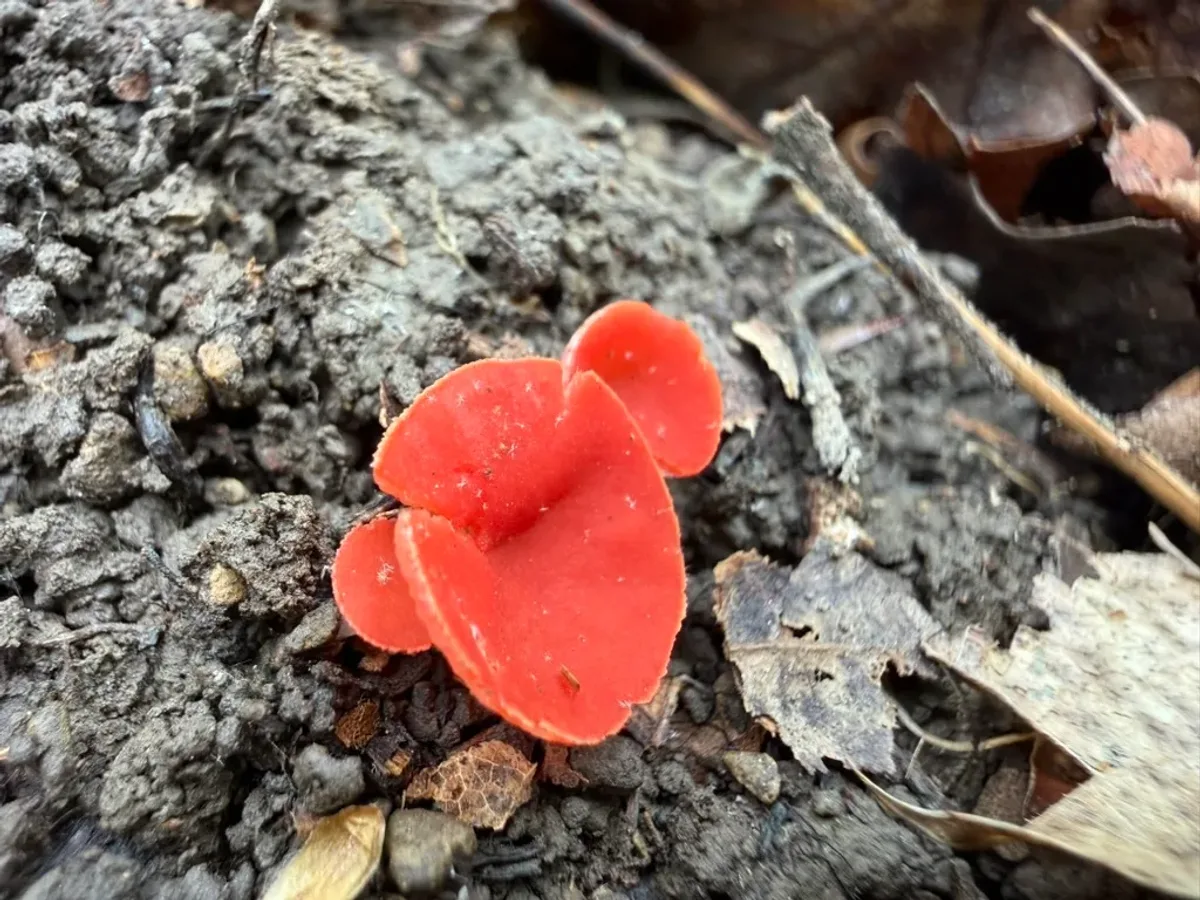
The cup itself is compact: rarely more than 2.5 cm across, deeply concave and goblet-like, and it often does not open flat even when old.
The inner surface is glossy, waxy, and intensely scarlet - not orange-red but a true, pure red. The outer surface is noticeably paler, whitish to buff, and softly hairy under a hand lens.
That combination - vivid scarlet cup + visible slender stalk - is reliable and essentially diagnostic in the field across its North American range.
Spores are also useful for confirmation: they are narrower and shorter than those of S. coccinea (18-30 × 5-8 µm vs. 26-40 × 10-13 µm), a difference detectable with a microscope.
No ring, no volva, no gills - it is an ascomycete, releasing spores from the inner surface.
Where & when it grows
Habitat
A fungus of quiet, wet woodland corners:
- The shaded banks of woodland streams
- Mossy logs in humid ravines
- The damp understorey of summer-green broadleaf forests
Like other Sarcoscypha species it is a saprotroph, meaning the mycelium colonises dead wood and breaks it down. The twig or branch it grows from is often hidden under moss or leaf litter, so cups can appear to emerge from bare ground.
Maples, elms, alders, and willows are favoured hosts in North America; in East and Southeast Asia it associates with a broader range of subtropical and tropical hardwoods.
It is the warm-season counterpart of S. coccinea: where coccinea signals late winter with its first red cups in January-March, occidentalis signals early summer when temperatures have risen and forest streams run warm.
Look for it in June-August in the eastern USA and comparable wet-season months across its Asian range.
When
Unlike its relative S. coccinea - one of the earliest fungi of the calendar year, emerging during winter thaws - S. occidentalis is a summer species.
In eastern North America fruiting begins in May as temperatures warm and continues through September, peaking in the heat of June, July, and August following rain events. In East and Southeast Asia it falls within the summer monsoon season, broadly June-October.
This summer affinity means it shares the forest with an entirely different suite of fungi from S. coccinea, and the warm-season phenology is itself a useful distinguishing clue when the two species might otherwise be confused.
How it grows
A gregarious saprotroph: several to many cups typically arise from the same decaying branch or cluster of twigs, their slender stalks pushing up through moss or leaf litter.
The visible cups are brief-lived, typically lasting one to three weeks before shrivelling and darkening.
Like other operculate discomycetes, the asci of S. occidentalis discharge their spores forcibly when the mature hymenium is disturbed - a gentle puff or tap on a ripe cup may release a faint visible cloud of spores. The spore mass floats on air currents, and the fungus relies on humid conditions for dispersal.
Mycelium persists in the substrate wood and will re-fruit from the same piece of wood in subsequent seasons as long as suitable substrate remains.
Fruiting conditions
A warm-season species contrasting with the winter-spring phenology of S. coccinea. Flushes follow moderate rainfall during warm, humid summer conditions when soil temperatures are 12-26 °C. Peak fruiting in the heat of summer (June-August in North America; monsoon season in East/Southeast Asia). Does not tolerate frost or drought.
Look-alikes
The most likely confusion is with sibling Sarcoscypha species, particularly S. coccinea and S. austriaca.
The key field separator is size and season:
- S. coccinea fruits in winter and early spring, reaches 6-8 cm, and has a very short buried stem.
- S. occidentalis fruits in summer, rarely exceeds 2.5 cm, and has a well-developed visible stem.
S. austriaca is macroscopically like S. coccinea; microscopy (coiled outer hairs, truncate spore poles) is needed to separate them from each other, but both differ from S. occidentalis in season, size, and stem development.
Other lookalikes:
- Aleuria aurantia (orange peel fungus) is orange-yellow, grows on bare disturbed soil rather than wood, and fruits in autumn.
- Geopora species and small Peziza species are similar in scale but brownish to grey, not scarlet.
- Caloscypha fulgens is orange to orange-yellow with a diagnostic blue-green bruising reaction on the outside, associated with conifers, and is not stalked.
No deadly lookalikes are known for any Sarcoscypha species.
Macroscopically very similar to S. coccinea - larger than S. occidentalis, nearly stemless, and a winter to early spring fruiter. Microscopy is required to distinguish S. austriaca from S. coccinea (coiled vs. straight outer hairs); both differ from S. occidentalis in size, stem development, and season. None is toxic.
Shares the brilliant red-orange colouring and summer season in eastern North American forests, but is a gilled fungus (or more precisely has false gills - forking ridges) with a convex to funnel-shaped cap, grows from soil (not wood), and has a distinct stem continuous with the cap. No cup or hymenial inner surface. Edible and sought after.
Orange to orange-yellow inside; outer surface bruises or ages to a striking greenish-blue, never seen in any Sarcoscypha. Associated with conifer litter and spring snowmelt at altitude, not with summer broadleaf wood debris. Not dangerous.
Similar cup shape but bright orange to orange-yellow rather than scarlet-red. Grows on bare, compacted, or disturbed soil - paths, roadsides, earthworks - never on woody debris. Lacks a stalk. Fruits in autumn (September-November), not summer. Not dangerous.
Much larger (2-8 cm vs. 0.5-2.5 cm), nearly stemless with a very short buried stem, and fruits in winter to early spring (January-April) rather than summer. Outer surface hairs are straight and non-coiled. Spores larger (26-40 × 10-13 µm vs. 18-30 × 5-8 µm). Both are edible only when cooked; neither is dangerous.
Various cup fungi in the genus Peziza can be similar in form, but are brown, grey, violet, or purplish - never vivid scarlet-red. Some are mildly toxic raw. None are red-cupped. Growing context on soil versus wood and colour are sufficient to distinguish them.
In the kitchen
Picking & cleaning
Sarcoscypha occidentalis is rarely collected for the table and is not considered a worthwhile edible - not because it is dangerous (no confirmed toxicity is on record) but because the cups are small, yields are low, and the thin flesh is too delicate and mild to reward the effort.
Some mycologists and foragers report mild raw-consumption upset (as with S. coccinea), though this is anecdotal. If collected at all, cook thoroughly before eating.
Treat populations with care: harvesting all cups from a small log or twig patch can strip a modest local population.
The species is best appreciated as a find rather than a harvest - the pop of scarlet red against mossy green is one of the quiet pleasures of summer woodland.
Cooking
Sarcoscypha occidentalis is occasionally mentioned as edible in field guides but is too small and insubstantial to be a meaningful culinary fungus.
The flavour is very mild and slightly earthy; the texture is thin and waxy, softening quickly with heat.
If collected in sufficient quantity - which requires a particularly productive patch - they can be briefly sautéed in butter and used as a garnish, much as one might use S. coccinea: a splash of vivid red on a spring salad plate or a savoury tart.
Always cook before eating. Do not expect culinary depth: this is a species appreciated for its beauty and ecological interest more than its flavour.
Good to know
No confirmed toxicity has been reported for Sarcoscypha occidentalis. It is generally listed as edible (when cooked) in North American field guides, but it is so small and insubstantial that it is essentially never eaten in meaningful quantities.
As a precaution consistent with other Sarcoscypha species, do not eat it raw - anecdotal reports of gastrointestinal discomfort following raw consumption of related species suggest that heat-labile irritants may be present. Cook thoroughly before eating any quantity.
No toxic or deadly lookalikes are known within the genus. The real safety concern is accurate identification: confirm the small size, visible stalk, and summer season to avoid confusion with larger related species (none of which are dangerous either).
The edibility tier of 'caution' reflects the raw-consumption risk and the thinness of verified edibility data, not any documented serious toxicity.
A reference guide - never an edibility guarantee. When in doubt, leave it out.