Japanese Elf Cup
Sarcoscypha japonicasyn. Sarcoscypha coccinea var. japonica, Peziza japonica
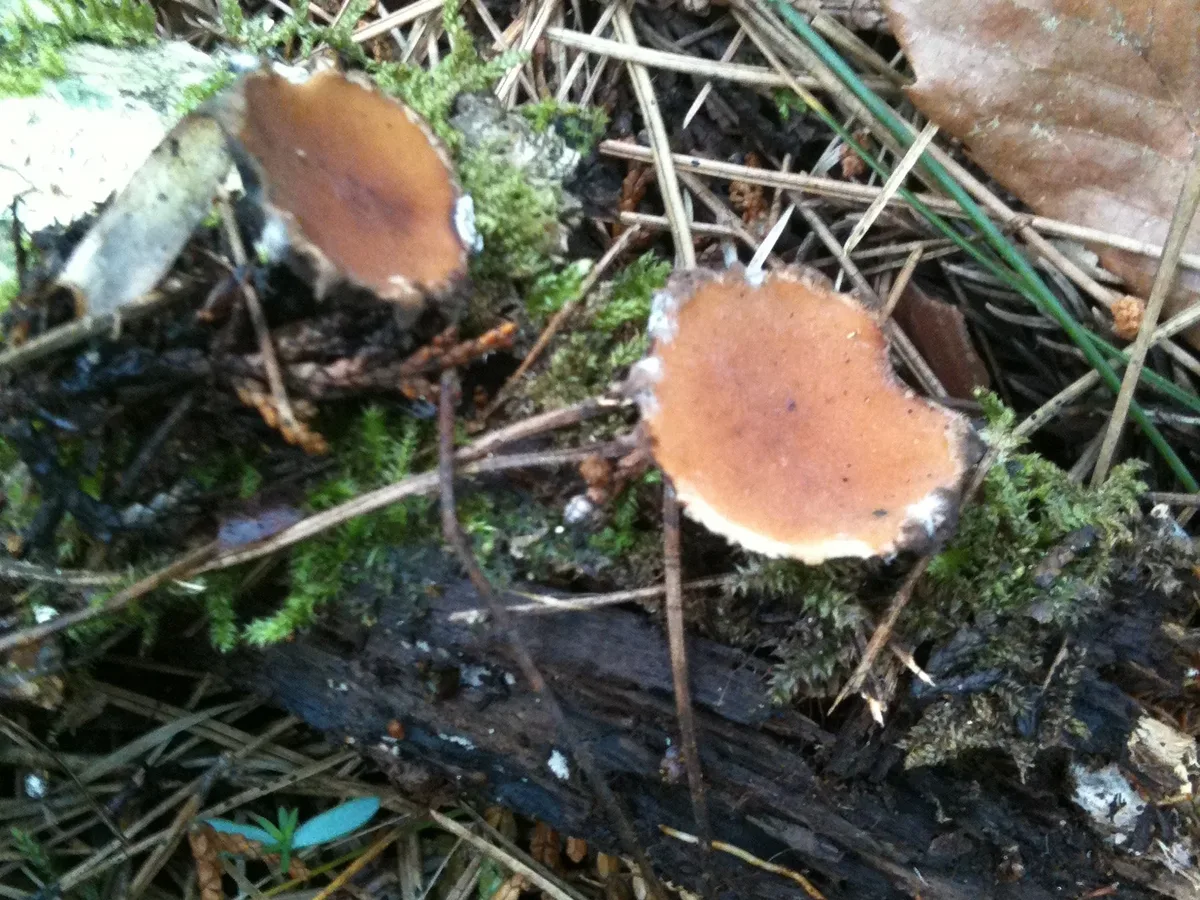 © Atsushi Nakajima (CC BY)
 © Atsushi Nakajima (CC BY)© Atsushi Nakajima (CC BY)© Atsushi Nakajima (CC BY)
Edible only with the right preparation - or safe for some people but not others. Learn the caveats first.
How to recognise it
Sarcoscypha japonica is a small, jewel-like cup fungus whose blazing scarlet inner surface makes it one of the most visually arresting fungi of the Japanese winter forest.
Cap
The apothecium (fruitbody) is typically 2-6 cm across and passes through a clear developmental arc:
- young specimens are tightly closed and deeply cup- or goblet-shaped, like a miniature chalice
- with age they open progressively to a shallow bowl
- in old specimens the margin becomes wavy, irregular, and often split or lobed
The hymenium - the inner, spore-producing surface - is smooth and an intense, lacquer-like scarlet to deep crimson, giving the appearance of a polished jewel resting on the leaf litter. This vivid colouration is produced by carotenoid pigments and is the species' most diagnostic field character.
The outer sterile surface is strikingly different: pale whitish to cream or pinkish-buff, with a soft, felty texture under a hand lens that results from densely packed microscopic hairs.
Macroscopically, S. japonica is essentially inseparable from the European S. coccinea and its sibling species (S. austriaca, S. jurana, S. dudleyi) - differentiation within the group ultimately requires microscopy to examine hair morphology, spore structure, and the mucilaginous envelope on ascospores.
Flesh
The flesh is thin, brittle, waxy, and white.
Stem
The stem is short, stout, whitish, and often buried or concealed beneath leaf litter.
There are no gills, no ring, and no volva.
Where & when it grows
Habitat
Sarcoscypha japonica occupies a very specific ecological niche: the damp, shaded woodland floor wherever moisture is reliably retained through winter.
In Japan it is most characteristic of valley-floor and stream-bank forest, where the combination of shelter, reliable humidity, and abundant deciduous woody debris provides ideal conditions.
The fungus colonises dead twigs and thin branches that have been lying in close contact with moist soil long enough to develop a moss or lichen covering. The moss mat acts as a moisture reservoir, allowing the mycelium to fruit even during dry winter spells.
The species is recorded across Japan from Kyushu to Hokkaido (becoming rarer in the coldest north), through the Korean Peninsula, in eastern and southern China (including Yunnan and Sichuan), and in Taiwan. Montane forest sites in Southeast Asia (particularly Vietnam and Myanmar at elevation) also harbour populations.
It favours low to mid elevations and is most frequently found in accessible secondary deciduous woodland rather than primary forest, partly because gaps in the canopy allow more light to reach the forest floor without drying it out.
When
The fruiting season of Sarcoscypha japonica in Japan is one of its most striking features: it is a winter mushroom, erupting from the cold forest floor at a time when almost nothing else is fruiting.
- Central Honshu (the Tokyo-Osaka corridor): main season runs January to April, with peak abundance in February and March.
- Warmer southern regions - southern Kyushu, Shikoku lowlands, Taiwan: it can appear in December.
- Hokkaido and the mountains of northern Honshu: the season begins later, typically March-April, and cups sometimes push through a light covering of snow.
The timing is closely correlated with the approach of spring in the Japanese forest: spotting these scarlet cups is often one of the first signs that the forest floor is awakening.
By late April, rising temperatures and increasing canopy shade dry out the substrate and the season ends abruptly.
How it grows
As a saprotrophic ascomycete, Sarcoscypha japonica decomposes dead deciduous wood by digesting cellulose and other structural polymers.
The mycelium develops invisibly within buried or surface-lying dead branches and twigs, often colonising wood already softened by water and the initial stages of bacterial decomposition.
Fruitbodies arise gregariously: typically several to many cups emerge from the same piece of decaying wood, sometimes in dense overlapping clusters that are collectively striking.
Mature asci (spore sacs) discharge ascospores forcibly when triggered by air movement or physical disturbance. In still air this can sometimes be observed as a faint 'smoke' rising from the cup.
Individual fruitbodies are relatively short-lived, persisting for one to three weeks before fading, collapsing, and darkening to an ochre-brown. Populations at a given site tend to be consistent from year to year if the substrate persists.
Fruiting conditions
Requires persistently cool, moist substrate conditions. Fruits in late winter and early spring, tolerating near-freezing soil temperatures and light snow cover. Optimal fruiting follows mild, wet weather (air temperatures 3-10 °C) after a cool, adequately moist winter. Does not persist into warm spring or summer temperatures; disappears when soil warms above roughly 12-14 °C and canopy shade returns.
Look-alikes
The most realistic confusions are with other Sarcoscypha species that may co-occur in East Asia.
Sarcoscypha coccinea sensu stricto (Scarlet elf cup), the widespread European species, has been recorded or closely approximated in some Asian collections, but specimens from Japan and China are generally now assigned to S. japonica; the two cannot be reliably separated in the field.
Other Asian Sarcoscypha species - including S. emarginata and S. macaronesica - are similar but with differing microscopic characters and partially overlapping ranges; none is harmful.
Beyond the genus, several species are told apart by colour, substrate, or reaction:
- Aleuria aurantia (Orange peel fungus) is orange to orange-yellow rather than scarlet-red, and grows on bare or compacted soil rather than on woody debris.
- Caloscypha fulgens is orange-yellow inside, and the outer surface develops a characteristic blue-green bruise reaction not seen in Sarcoscypha; it is associated with conifer debris.
- Various Peziza species are brown, grey, or purple-brown, never scarlet.
- Otidea species are ear-shaped (asymmetric cups), ochre to buff, never fully circular or scarlet.
No deadly lookalikes are known for this group.
Orange-yellow to ochre on the inner surface; the outer surface bruises or discolours to a distinctive greenish-blue or olive tint - this bruising reaction is diagnostic and never seen in Sarcoscypha. Associated primarily with conifer debris near snowmelt zones, not with deciduous wood. Not dangerous.
Broadly similar cup shape but conspicuously orange to orange-yellow in colour rather than scarlet. The inner surface colour alone rules it out: Aleuria aurantia is never crimson or scarlet-red. It also grows on bare, disturbed, or compacted soil (roadsides, woodland paths, burnt ground) rather than on decaying wood, and fruits mainly in autumn rather than late winter and spring. Not dangerous.
Ear-shaped or rabbit-ear cups that are asymmetrically split along one side, never fully circular; colour is yellowish-ochre to pale orange-brown, not red or scarlet. Fruits in summer and autumn on woodland soil, not in winter on dead wood. Not dangerous.
Cup-shaped but typically brown, grey, or purplish-brown inside and out - never scarlet or vivid red. Various Peziza species are common in the same forest habitats but are separated immediately by their drab colouration. Most Peziza species contain haemolysin that is destroyed by cooking; they should not be eaten raw. Not deadly.
An East Asian Sarcoscypha species (described from China) that is similar in colour and form. The key distinguishing features are microscopic: S. emarginata typically has a somewhat scalloped or notched (emarginulate) margin when mature, and differs in spore wall structure and hair morphology. Neither species is toxic; both should be cooked before eating.
The European sister species; macroscopically indistinguishable from S. japonica in the field. Separation requires microscopy - hair morphology, spore dimensions, and the presence or absence of a mucilaginous spore sheath are the primary characters examined. Both species are similarly edible only when cooked, and neither is toxic. In practice, most scarlet cups collected in Japan are best assumed to be S. japonica; typical S. coccinea is centred on Europe and western North America.
In the kitchen
Picking & cleaning
Sarcoscypha japonica can be gathered for culinary use, though it should be understood that the experience is primarily aesthetic rather than gastronomic: the cups are striking as a garnish or seasonal addition to spring dishes, but the flavour is mild and the flesh thin.
Always cook before eating - raw specimens have caused mild gastrointestinal upset in some individuals and should never be consumed uncooked.
Harvest young to medium-aged cups: these have firm, well-formed flesh and retain colour better when cooked. Old, waterlogged, or collapsed cups are unpleasant in texture.
To collect, follow the short stem down to its junction with the substrate and detach with a gentle twist, then remove any adhering moss or soil with a soft brush.
Population sizes in Japan can be modest and the species is not commonly abundant, so harvest conservatively - take only what you will use.
Transport in a rigid container to protect the brittle flesh; thin cups crush easily in a bag. Use the same day if possible, as the flesh deteriorates quickly.
Cooking
The primary appeal of Sarcoscypha japonica in the kitchen is visual: the brilliant red cup transforms any dish it appears in. Flavour is mild, faintly earthy, and slightly gelatinous - not strongly characterful in its own right.
Because the flesh is thin and the cup fragile, gentle cooking is best. A brief sauté in butter or sesame oil retains shape and colour better than boiling, which leaches out the red pigment and softens the flesh to mush.
A light blanch (15-20 seconds in salted boiling water, then refresh in cold water) can be used to par-cook cups that will be used in cold presentations.
In Japanese cuisine the cups are used as a garnish for spring celebration dishes, kaiseki courses, clear soups (suimono), and alongside sansai (mountain vegetable) preparations. Their vibrant red coordinates beautifully with spring ingredients - bamboo shoots, udo, fiddlehead ferns, fresh tofu, and miso-based dishes.
Avoid prolonged or high-heat cooking: the thin flesh collapses and loses both colour and form. Note that, as with all Sarcoscypha, quantities available in a typical foray are usually modest, suiting a garnish role more than a main ingredient.
Good to know
Sarcoscypha japonica is classified as edible when cooked, but raw or undercooked specimens should be strictly avoided.
Eating them raw has caused mild gastrointestinal upset in sensitive individuals. At least some mycological references note that the edibility of the Sarcoscypha coccinea group (of which S. japonica is a member) is disputed - some treat the whole group as inedible or suspect.
No serious toxicity or fatalities have been attributed to this species, and there are no known deadly lookalikes.
However, the precautionary principle applies:
- cook thoroughly before eating
- consume modest quantities on a first occasion
- do not eat if in any doubt
The species has no ring, no volva, and no gills - all characters that would raise immediate concern for dangerous Amanita species.
A reference guide - never an edibility guarantee. When in doubt, leave it out.